ARISTOTLE’S POLITICS:  PRACTICAL LESSONS  IN POLITICS AND DEMOCRACY
Overview Plato v. Aristotle Forms of Rule Parts of a State Practical Lessons in Politics and Democracy
A Comparison: Plato and Aristotle Plato  was fundamentally an  idealist i.e. “the ideal state” Aristotle  was more  realistic there are no ideal states, only existing ones
A Comparison: Plato and Aristotle Aristotle’s concern was to understand  how states are constituted What makes a state “tick”? Assumed that  all states  were ordered towards a  specific end Good  v.  Bad  States
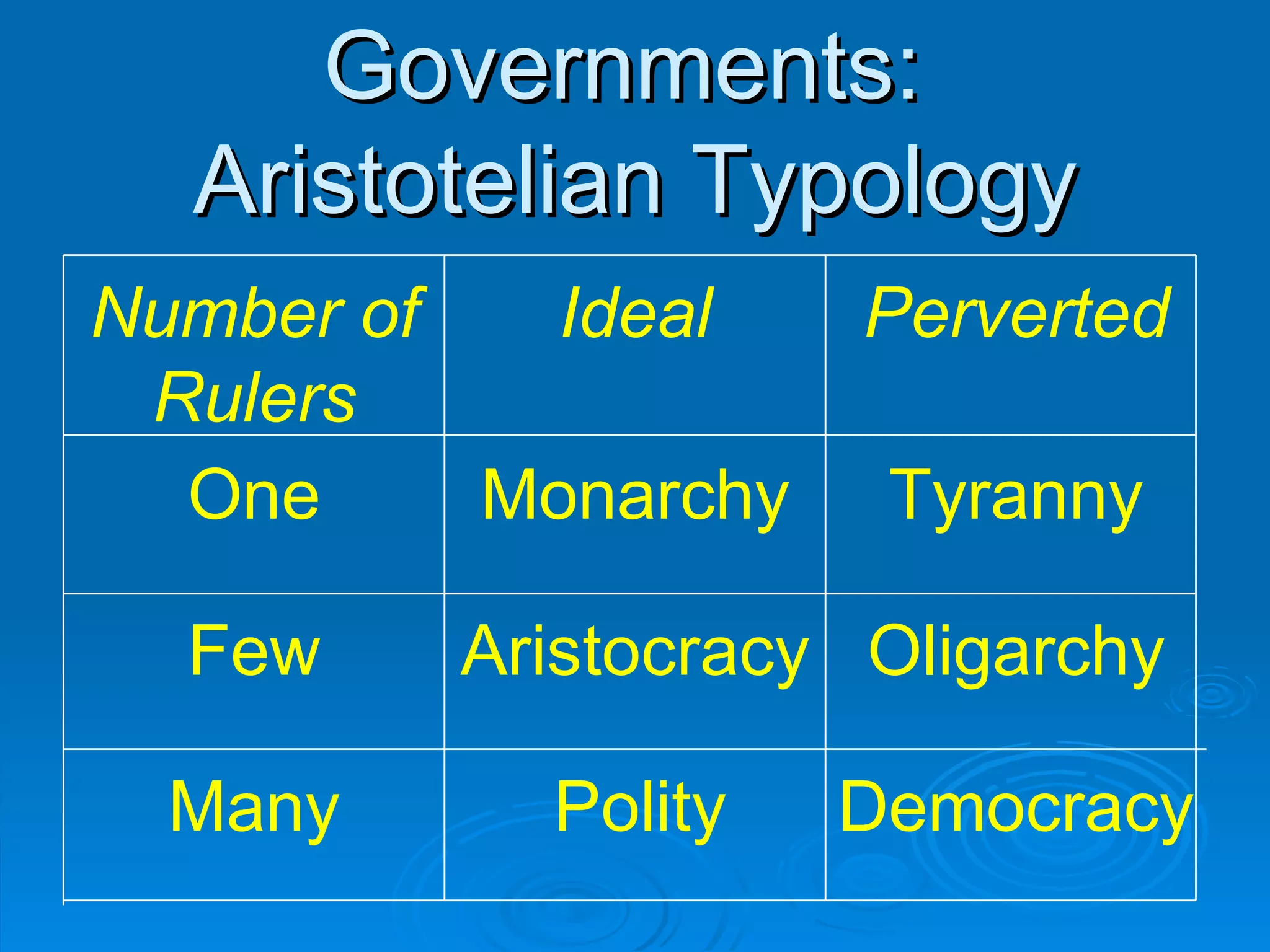
Governments:  Aristotelian Typology Democracy Polity Many Oligarchy Aristocracy Few Tyranny Monarchy One Perverted Ideal Number of Rulers
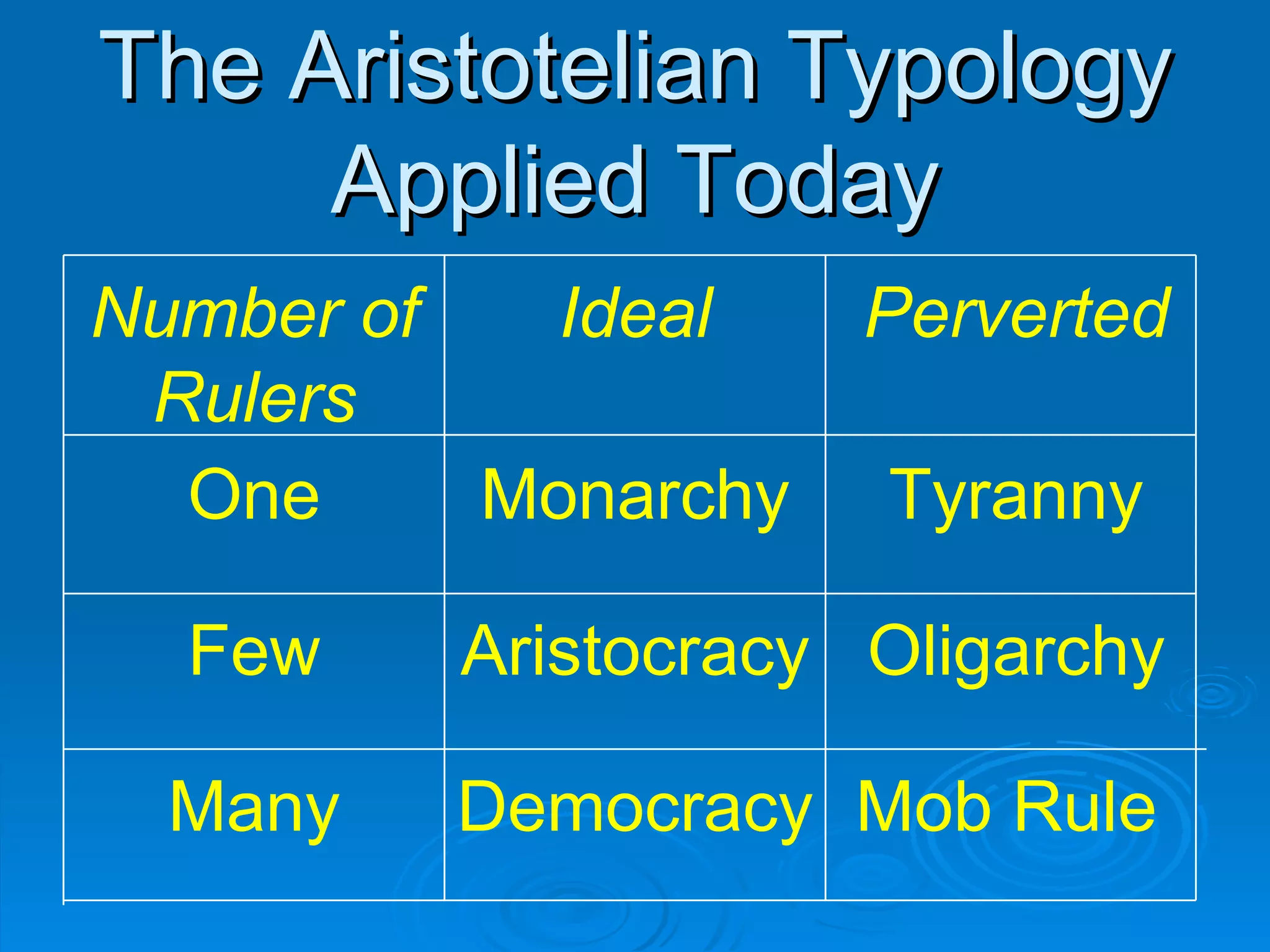
The Aristotelian Typology Applied Today Democracy Many Oligarchy Aristocracy Few Tyranny Monarchy One Perverted Ideal Number of Rulers Mob Rule
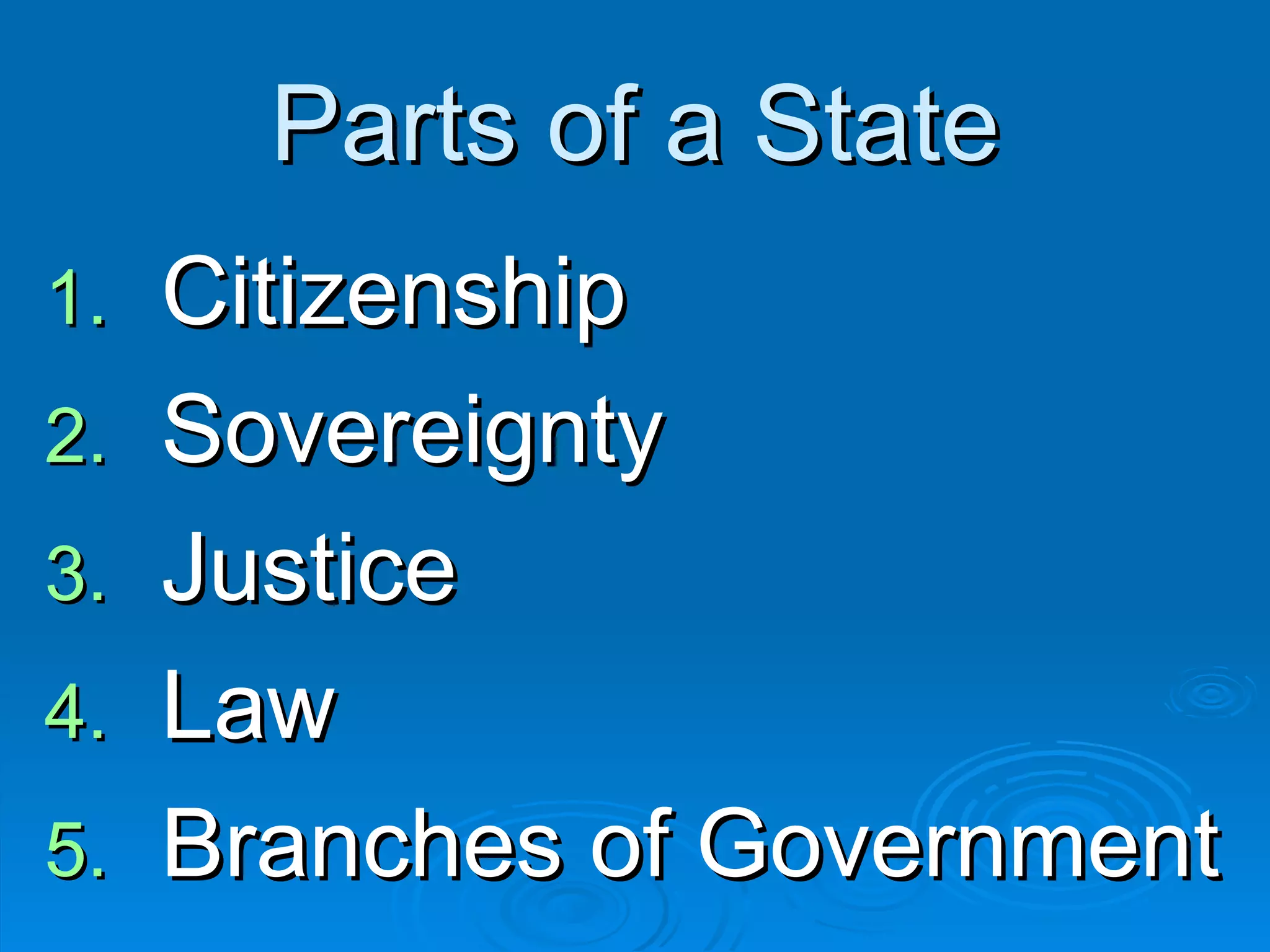
Parts of a State Citizenship Sovereignty Justice Law Branches of Government
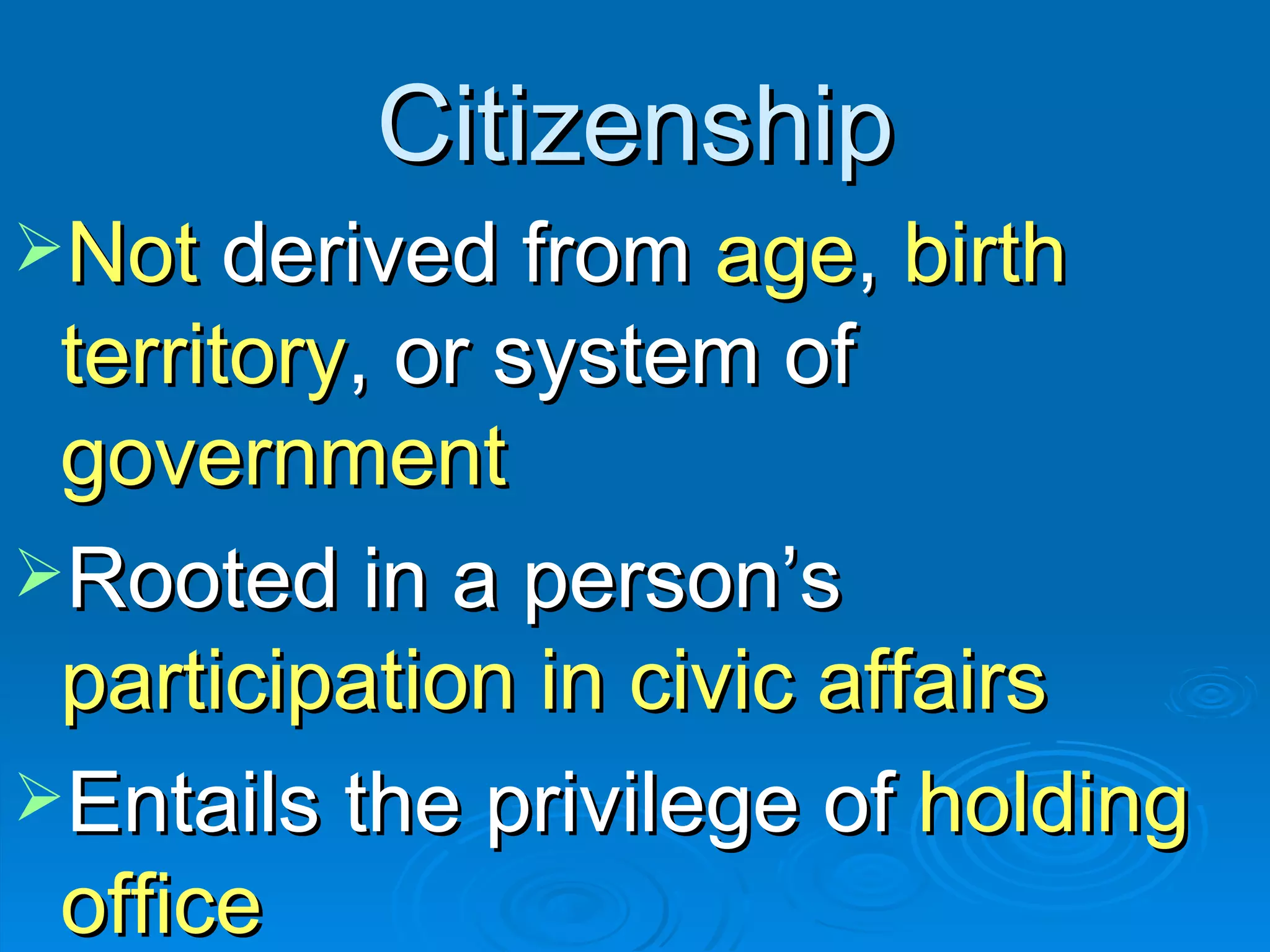
Citizenship Not  derived from  age ,  birth territory , or system of  government Rooted in a person’s  participation in civic affairs Entails the privilege of  holding office
Sovereignty The state’s  supreme power  to oblige  obedience to its will Aristotle uses the term to denote the  holding of public office He also uses the term to refer to  who  gets to make  binding public decisions
Justice The  good  towards which  politics  is directed Consists of some sort of equality (“ relative equality ”)  Related to everything that tends to promote the  common good
Law “ Reason free from all passion ” A “ neutral authority ” Dynamic  concept; includes custom and codified (written) law Aristotle distinguishes between the  letter  and  spirit  of the law
Branches of Government Deliberative Executive Judicial
Practical Lessons There is virtue in  decisions  being made by  collective bodies It is important for  individuals  to have  some share in civic affairs
More Practical Lessons It is important to  distinguish  between  individuals  and  institutions/offices The  law  is both  substantive  and  organic
Even More Practical Lessons The forms of  government  most  likely to work  are those where the  middle class is large

Aristotle's Politics (Lessons)

  • 1.
    ARISTOTLE’S POLITICS: PRACTICAL LESSONS IN POLITICS AND DEMOCRACY
  • 2.
    Overview Plato v.Aristotle Forms of Rule Parts of a State Practical Lessons in Politics and Democracy
  • 3.
    A Comparison: Platoand Aristotle Plato was fundamentally an idealist i.e. “the ideal state” Aristotle was more realistic there are no ideal states, only existing ones
  • 4.
    A Comparison: Platoand Aristotle Aristotle’s concern was to understand how states are constituted What makes a state “tick”? Assumed that all states were ordered towards a specific end Good v. Bad States
  • 5.
    Governments: AristotelianTypology Democracy Polity Many Oligarchy Aristocracy Few Tyranny Monarchy One Perverted Ideal Number of Rulers
  • 6.
    The Aristotelian TypologyApplied Today Democracy Many Oligarchy Aristocracy Few Tyranny Monarchy One Perverted Ideal Number of Rulers Mob Rule
  • 7.
    Parts of aState Citizenship Sovereignty Justice Law Branches of Government
  • 8.
    Citizenship Not derived from age , birth territory , or system of government Rooted in a person’s participation in civic affairs Entails the privilege of holding office
  • 9.
    Sovereignty The state’s supreme power to oblige obedience to its will Aristotle uses the term to denote the holding of public office He also uses the term to refer to who gets to make binding public decisions
  • 10.
    Justice The good towards which politics is directed Consists of some sort of equality (“ relative equality ”) Related to everything that tends to promote the common good
  • 11.
    Law “ Reasonfree from all passion ” A “ neutral authority ” Dynamic concept; includes custom and codified (written) law Aristotle distinguishes between the letter and spirit of the law
  • 12.
    Branches of GovernmentDeliberative Executive Judicial
  • 13.
    Practical Lessons Thereis virtue in decisions being made by collective bodies It is important for individuals to have some share in civic affairs
  • 14.
    More Practical LessonsIt is important to distinguish between individuals and institutions/offices The law is both substantive and organic
  • 15.
    Even More PracticalLessons The forms of government most likely to work are those where the middle class is large

Editor's Notes

  • #2 Learning Objectives 1.) To better appreciate the strands in Aristotle’s political thought with practical implications to the conduct of politics and our understanding of democracy (i.e. the type of constitution that is most practicable; the characteristics of a constitution that are workable for most states) 2.) To understand the difference in outlook between Aristotle’s political thought and Plato’s 3.) To become acquainted with Aristotle’s classical typology of forms of rule 4.) To understand the integral parts of the state as discussed by Aristotle (as opposed to its necessary conditions)