The Social Contract  (Rousseau)
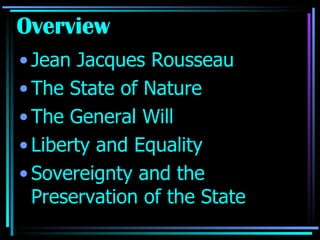
Overview Jean Jacques Rousseau The State of Nature The General Will  Liberty and Equality Sovereignty and the Preservation of the State
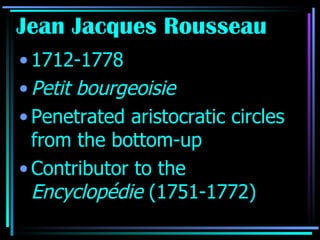
Jean Jacques Rousseau 1712-1778 Petit bourgeoisie Penetrated aristocratic circles from the bottom-up Contributor to the  Encyclopédie  (1751-1772)
The Premise “ Man is born free; and everywhere he is in chains.” - Jean-Jacques Rousseau
Man in the State of Nature  Possesses natural liberty Acts on instinct and impulse Makes no moral considerations Does not act on principle Hence, man is not secure
The Social Contract “Each of us puts his person and all his power in common under the general will, and, in our corporate capacity, we receive each member as an indivisible part of the whole.”
The Social Contract Creates a condition of equality among men and ensures freedom Entails surrendering one’s rights to the entire community It gives an objective moral dimension to human action
The Social Contract The contract creates an incorporated entity akin to a human person The body is collective It is also moral That collective body represents the general will
The General Will The general will pertains to that which can  direct  the state to the common good Individual interests may differ with the general will However, all are compelled to obey the general will
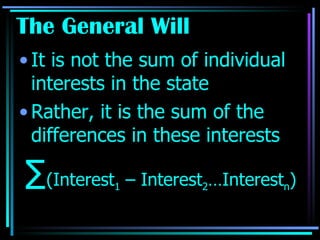
The General Will It is not the sum of individual interests in the state Rather, it is the sum of the differences in these interests ∑ (Interest 1  – Interest 2 …Interest n )
Implications Because power is vested in the general will, “sovereignty” resides in the people Equality of rights and justice only arise because of the general will A state thrives on plurality
Implications Man surrenders natural liberties in return for civil and moral ones The general will presupposes obligations and duties towards others and the state
On Sovereignty The public person formed by the social contract has many dimensions State = when passive Power = when compared to others of the same kind Sovereign = when it is active
On Sovereignty An act of sovereignty pertains to authentic acts of the general will Legitimate Equitable Useful Stable
Preserving the State Because the state is a “fictive” entity, it can be designed to work well “Good” states are relative to the  context  within which they exist (consistency is key) Sovereign power is the life principle of the state
Preserving the State The general will is manifested in the will of the majority Particularly in the implementation of laws The people possess legislative power (explicit or tacit)
Preserving the State Hence, a state thrives through popular assemblies and public service Further, legislative and executive power must be separate
On Law and the State Legislative power is the most vital power of the state Laws are necessary since: Individual people often turn away from what is in their interest A state generally knows what is in its interest, but not how to achieve it.
On Democracy Rousseau contends that there has never been a truly democratic state It must be small Issues must be simple There can be little or no luxury

Rosseau

  • 1.
  • 2.
    Overview Jean JacquesRousseau The State of Nature The General Will Liberty and Equality Sovereignty and the Preservation of the State
  • 3.
    Jean Jacques Rousseau1712-1778 Petit bourgeoisie Penetrated aristocratic circles from the bottom-up Contributor to the Encyclopédie (1751-1772)
  • 4.
    The Premise “Man is born free; and everywhere he is in chains.” - Jean-Jacques Rousseau
  • 5.
    Man in theState of Nature Possesses natural liberty Acts on instinct and impulse Makes no moral considerations Does not act on principle Hence, man is not secure
  • 6.
    The Social Contract“Each of us puts his person and all his power in common under the general will, and, in our corporate capacity, we receive each member as an indivisible part of the whole.”
  • 7.
    The Social ContractCreates a condition of equality among men and ensures freedom Entails surrendering one’s rights to the entire community It gives an objective moral dimension to human action
  • 8.
    The Social ContractThe contract creates an incorporated entity akin to a human person The body is collective It is also moral That collective body represents the general will
  • 9.
    The General WillThe general will pertains to that which can direct the state to the common good Individual interests may differ with the general will However, all are compelled to obey the general will
  • 10.
    The General WillIt is not the sum of individual interests in the state Rather, it is the sum of the differences in these interests ∑ (Interest 1 – Interest 2 …Interest n )
  • 11.
    Implications Because poweris vested in the general will, “sovereignty” resides in the people Equality of rights and justice only arise because of the general will A state thrives on plurality
  • 12.
    Implications Man surrendersnatural liberties in return for civil and moral ones The general will presupposes obligations and duties towards others and the state
  • 13.
    On Sovereignty Thepublic person formed by the social contract has many dimensions State = when passive Power = when compared to others of the same kind Sovereign = when it is active
  • 14.
    On Sovereignty Anact of sovereignty pertains to authentic acts of the general will Legitimate Equitable Useful Stable
  • 15.
    Preserving the StateBecause the state is a “fictive” entity, it can be designed to work well “Good” states are relative to the context within which they exist (consistency is key) Sovereign power is the life principle of the state
  • 16.
    Preserving the StateThe general will is manifested in the will of the majority Particularly in the implementation of laws The people possess legislative power (explicit or tacit)
  • 17.
    Preserving the StateHence, a state thrives through popular assemblies and public service Further, legislative and executive power must be separate
  • 18.
    On Law andthe State Legislative power is the most vital power of the state Laws are necessary since: Individual people often turn away from what is in their interest A state generally knows what is in its interest, but not how to achieve it.
  • 19.
    On Democracy Rousseaucontends that there has never been a truly democratic state It must be small Issues must be simple There can be little or no luxury