WELCOME
TO
MY PRESENTATION
1
Prepared by:
Md. Ashraful Alam
ID: 11121107013
Intake: 4th
Program: B.sc. in Textile Engineering
Prepared to:
Md. Mahabub Hasan
Assistant Professor
Department of Textile Engineering
BUBT
2
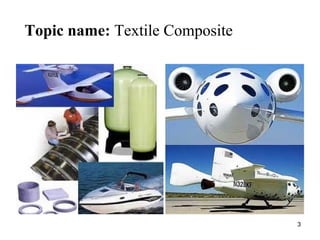
Topic name: Textile Composite
3
CONTENTS
• What are composites?
• Why composites materials?
• Constituents of composite materials
• Classification of Textile composites
• Metal matrix composite, Ceramic matrix composite,
polymer matrix composite
• Reinforcement, matrix and interface
• Manufacturing processes of Textile Composites
• Applications of Textile composites
• Properties of Textile composites materials
4
What are Textile Composites?
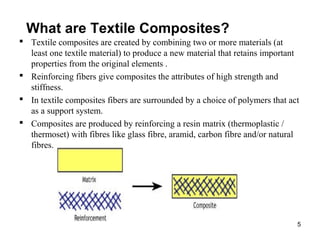
 Textile composites are created by combining two or more materials (at
least one textile material) to produce a new material that retains important
properties from the original elements .
 Reinforcing fibers give composites the attributes of high strength and
stiffness.
 In textile composites fibers are surrounded by a choice of polymers that act
as a support system.
 Composites are produced by reinforcing a resin matrix (thermoplastic /
thermoset) with fibres like glass fibre, aramid, carbon fibre and/or natural
fibres.
5
Why composites materials?
Composites materials are preferred over contemporary metallic materials due
to their
• High strength
• Light weight
• Long life
• Net shape manufacturing
• Design flexibility
• Durability
• Corrosion resistance
6
Constituents of composite materials:
1. Matrix:
 Continuous phase, the primary phase that is made of metal, polymer or
ceramic
 It holds the dispersed phase and shares a load with it.
 It protects the reinforcement from surface damage due to abrasion or
chemical attacks
2. Dispersed (reinforcing) phase:
 The second phase is imbedded in the matrix in a continuous /
discontinuous form.
 Disperse phase is usually stronger than the matrix, therefore it is sometimes
called reinforcing phase.
3. Interface:
 The zone across which the matrix and reinforcing phases interact
( chemically, physically or mechanically)
7
Classification
 Types of matrix:
1. Natural: silica sand, starch, epoxy etc
2. Synthetic: fumed silica, fused silica, epoxy, polyester etc
Based on matrix textile composite can be classified as:
 Metal matrix composites (MMC)
 Ceramic matrix composites (CMC)
 Polymer matrix composites (PMC)
a) Thermoset
b) Thermoplastic
c) Rubber
8
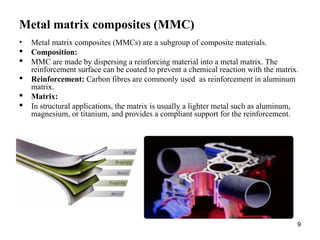
Metal matrix composites (MMC)
• Metal matrix composites (MMCs) are a subgroup of composite materials.
 Composition:
 MMC are made by dispersing a reinforcing material into a metal matrix. The
reinforcement surface can be coated to prevent a chemical reaction with the matrix.
 Reinforcement: Carbon fibres are commonly used as reinforcement in aluminum
matrix.
 Matrix:
 In structural applications, the matrix is usually a lighter metal such as aluminum,
magnesium, or titanium, and provides a compliant support for the reinforcement.
9
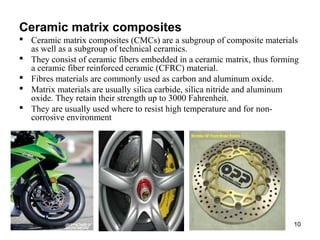
Ceramic matrix composites  
 Ceramic matrix composites (CMCs) are a subgroup of composite materials
as well as a subgroup of technical ceramics.
 They consist of ceramic fibers embedded in a ceramic matrix, thus forming
a ceramic fiber reinforced ceramic (CFRC) material.
 Fibres materials are commonly used as carbon and aluminum oxide.
 Matrix materials are usually silica carbide, silica nitride and aluminum
oxide. They retain their strength up to 3000 Fahrenheit.
 They are usually used where to resist high temperature and for non-
corrosive environment
10
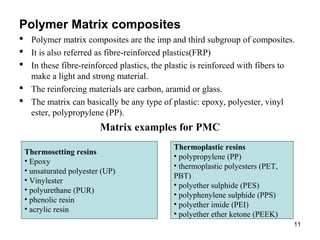
Polymer Matrix composites
 Polymer matrix composites are the imp and third subgroup of composites.
 It is also referred as fibre-reinforced plastics(FRP)
 In these fibre-reinforced plastics, the plastic is reinforced with fibers to
make a light and strong material.
 The reinforcing materials are carbon, aramid or glass.
 The matrix can basically be any type of plastic: epoxy, polyester, vinyl
ester, polypropylene (PP).
Matrix examples for PMC
11
Thermoplastic resins
• polypropylene (PP)
• thermoplastic polyesters (PET,
PBT)
• polyether sulphide (PES)
• polyphenylene sulphide (PPS)
• polyether imide (PEI)
• polyether ether ketone (PEEK)
Thermosetting resins
• Epoxy
• unsaturated polyester (UP)
• Vinylester
• polyurethane (PUR)
• phenolic resin
• acrylic resin
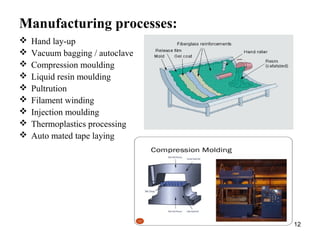
Manufacturing processes:
 Hand lay-up
 Vacuum bagging / autoclave
 Compression moulding
 Liquid resin moulding
 Pultrution
 Filament winding
 Injection moulding
 Thermoplastics processing
 Auto mated tape laying
12
Polymer matrix composite
13
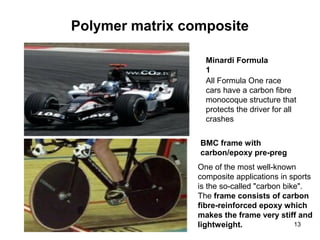
Minardi Formula
1
All Formula One race
cars have a carbon fibre
monocoque structure that
protects the driver for all
crashes
BMC frame with
carbon/epoxy pre-preg
One of the most well-known
composite applications in sports
is the so-called "carbon bike".
The frame consists of carbon
fibre-reinforced epoxy which
makes the frame very stiff and
lightweight.
BMW M6 with carbon fibre roof
In automotive applications, composites are all around us. Just as
in sports applications, weight reduction is pushing the designers to
use more and more composites. The examples are numerous.
14
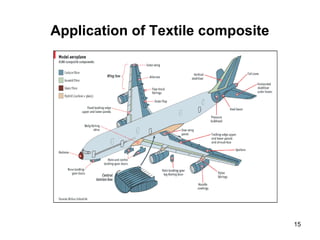
Application of Textile composite
15
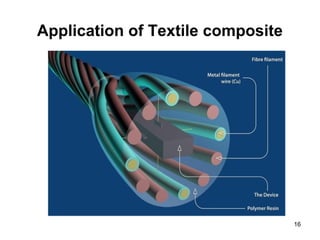
Application of Textile composite
16
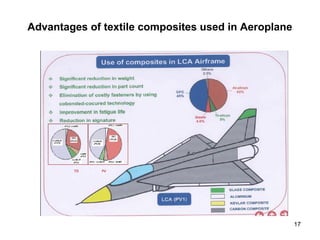
Advantages of textile composites used in Aeroplane
17
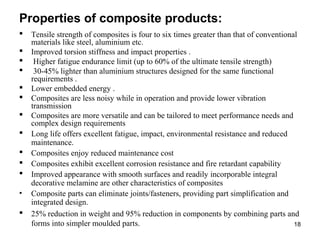
Properties of composite products:
 Tensile strength of composites is four to six times greater than that of conventional
materials like steel, aluminium etc.
 Improved torsion stiffness and impact properties .
 Higher fatigue endurance limit (up to 60% of the ultimate tensile strength)
 30-45% lighter than aluminium structures designed for the same functional
requirements .
 Lower embedded energy .
 Composites are less noisy while in operation and provide lower vibration
transmission
 Composites are more versatile and can be tailored to meet performance needs and
complex design requirements
 Long life offers excellent fatigue, impact, environmental resistance and reduced
maintenance.
 Composites enjoy reduced maintenance cost
 Composites exhibit excellent corrosion resistance and fire retardant capability
 Improved appearance with smooth surfaces and readily incorporable integral
decorative melamine are other characteristics of composites
• Composite parts can eliminate joints/fasteners, providing part simplification and
integrated design.
 25% reduction in weight and 95% reduction in components by combining parts and
forms into simpler moulded parts. 18
Conclusion:
Everybody comes across composites in his daily life. You might
be playing tennis or badminton with a "graphite racket", You
might have a "carbon bike",your bike breaks are made of
composite, several parts of your car body are also made of
composites.
So we can say today composites are popular and useful and in
future it will be very much helpful for our daily life.
19
THANK YOU ALL
20

Textile composite

  • 1.
  • 2.
    Prepared by: Md. AshrafulAlam ID: 11121107013 Intake: 4th Program: B.sc. in Textile Engineering Prepared to: Md. Mahabub Hasan Assistant Professor Department of Textile Engineering BUBT 2
  • 3.
  • 4.
    CONTENTS • What arecomposites? • Why composites materials? • Constituents of composite materials • Classification of Textile composites • Metal matrix composite, Ceramic matrix composite, polymer matrix composite • Reinforcement, matrix and interface • Manufacturing processes of Textile Composites • Applications of Textile composites • Properties of Textile composites materials 4
  • 5.
    What are TextileComposites?  Textile composites are created by combining two or more materials (at least one textile material) to produce a new material that retains important properties from the original elements .  Reinforcing fibers give composites the attributes of high strength and stiffness.  In textile composites fibers are surrounded by a choice of polymers that act as a support system.  Composites are produced by reinforcing a resin matrix (thermoplastic / thermoset) with fibres like glass fibre, aramid, carbon fibre and/or natural fibres. 5
  • 6.
    Why composites materials? Compositesmaterials are preferred over contemporary metallic materials due to their • High strength • Light weight • Long life • Net shape manufacturing • Design flexibility • Durability • Corrosion resistance 6
  • 7.
    Constituents of compositematerials: 1. Matrix:  Continuous phase, the primary phase that is made of metal, polymer or ceramic  It holds the dispersed phase and shares a load with it.  It protects the reinforcement from surface damage due to abrasion or chemical attacks 2. Dispersed (reinforcing) phase:  The second phase is imbedded in the matrix in a continuous / discontinuous form.  Disperse phase is usually stronger than the matrix, therefore it is sometimes called reinforcing phase. 3. Interface:  The zone across which the matrix and reinforcing phases interact ( chemically, physically or mechanically) 7
  • 8.
    Classification  Types ofmatrix: 1. Natural: silica sand, starch, epoxy etc 2. Synthetic: fumed silica, fused silica, epoxy, polyester etc Based on matrix textile composite can be classified as:  Metal matrix composites (MMC)  Ceramic matrix composites (CMC)  Polymer matrix composites (PMC) a) Thermoset b) Thermoplastic c) Rubber 8
  • 9.
    Metal matrix composites(MMC) • Metal matrix composites (MMCs) are a subgroup of composite materials.  Composition:  MMC are made by dispersing a reinforcing material into a metal matrix. The reinforcement surface can be coated to prevent a chemical reaction with the matrix.  Reinforcement: Carbon fibres are commonly used as reinforcement in aluminum matrix.  Matrix:  In structural applications, the matrix is usually a lighter metal such as aluminum, magnesium, or titanium, and provides a compliant support for the reinforcement. 9
  • 10.
    Ceramic matrix composites   Ceramic matrix composites (CMCs) are a subgroup of composite materials as well as a subgroup of technical ceramics.  They consist of ceramic fibers embedded in a ceramic matrix, thus forming a ceramic fiber reinforced ceramic (CFRC) material.  Fibres materials are commonly used as carbon and aluminum oxide.  Matrix materials are usually silica carbide, silica nitride and aluminum oxide. They retain their strength up to 3000 Fahrenheit.  They are usually used where to resist high temperature and for non- corrosive environment 10
  • 11.
    Polymer Matrix composites Polymer matrix composites are the imp and third subgroup of composites.  It is also referred as fibre-reinforced plastics(FRP)  In these fibre-reinforced plastics, the plastic is reinforced with fibers to make a light and strong material.  The reinforcing materials are carbon, aramid or glass.  The matrix can basically be any type of plastic: epoxy, polyester, vinyl ester, polypropylene (PP). Matrix examples for PMC 11 Thermoplastic resins • polypropylene (PP) • thermoplastic polyesters (PET, PBT) • polyether sulphide (PES) • polyphenylene sulphide (PPS) • polyether imide (PEI) • polyether ether ketone (PEEK) Thermosetting resins • Epoxy • unsaturated polyester (UP) • Vinylester • polyurethane (PUR) • phenolic resin • acrylic resin
  • 12.
    Manufacturing processes:  Handlay-up  Vacuum bagging / autoclave  Compression moulding  Liquid resin moulding  Pultrution  Filament winding  Injection moulding  Thermoplastics processing  Auto mated tape laying 12
  • 13.
    Polymer matrix composite 13 MinardiFormula 1 All Formula One race cars have a carbon fibre monocoque structure that protects the driver for all crashes BMC frame with carbon/epoxy pre-preg One of the most well-known composite applications in sports is the so-called "carbon bike". The frame consists of carbon fibre-reinforced epoxy which makes the frame very stiff and lightweight.
  • 14.
    BMW M6 withcarbon fibre roof In automotive applications, composites are all around us. Just as in sports applications, weight reduction is pushing the designers to use more and more composites. The examples are numerous. 14
  • 15.
  • 16.
  • 17.
    Advantages of textilecomposites used in Aeroplane 17
  • 18.
    Properties of compositeproducts:  Tensile strength of composites is four to six times greater than that of conventional materials like steel, aluminium etc.  Improved torsion stiffness and impact properties .  Higher fatigue endurance limit (up to 60% of the ultimate tensile strength)  30-45% lighter than aluminium structures designed for the same functional requirements .  Lower embedded energy .  Composites are less noisy while in operation and provide lower vibration transmission  Composites are more versatile and can be tailored to meet performance needs and complex design requirements  Long life offers excellent fatigue, impact, environmental resistance and reduced maintenance.  Composites enjoy reduced maintenance cost  Composites exhibit excellent corrosion resistance and fire retardant capability  Improved appearance with smooth surfaces and readily incorporable integral decorative melamine are other characteristics of composites • Composite parts can eliminate joints/fasteners, providing part simplification and integrated design.  25% reduction in weight and 95% reduction in components by combining parts and forms into simpler moulded parts. 18
  • 19.
    Conclusion: Everybody comes acrosscomposites in his daily life. You might be playing tennis or badminton with a "graphite racket", You might have a "carbon bike",your bike breaks are made of composite, several parts of your car body are also made of composites. So we can say today composites are popular and useful and in future it will be very much helpful for our daily life. 19
  • 20.