Spinning process
Presented by :
Shubham Tiwari
M.Sc Polymer science
Roll no. 26
Content
 Introduction of fiber
 Classification of fibres
 Types of Spinning technology
 Spinneret
 Melt flow
 Dry flow
 Wet flow
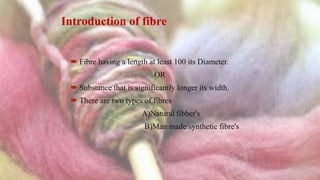
Introduction of fibre
 Fibre having a length at least 100 its Diameter.
OR
 Substance that is significantly longer its width.
 There are two types of fibres
A)Natural fibber's
B)Man made/synthetic fibre's
Fiber structures
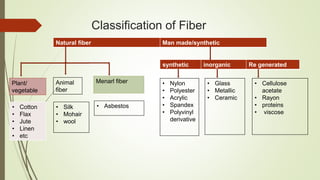
Classification of Fiber
Natural fiber Man made/synthetic
Plant/
vegetable
Animal
fiber
Menarl fiber
• Cotton
• Flax
• Jute
• Linen
• etc
• Silk
• Mohair
• wool
• Asbestos
synthetic inorganic Re generated
• Nylon
• Polyester
• Acrylic
• Spandex
• Polyvinyl
derivative
• Glass
• Metallic
• Ceramic
• Cellulose
acetate
• Rayon
• proteins
• viscose
Introduction of spinning process
Spinning is a manufacturing process for creating
polymer fibres.
 There are many types of spinning: wet, dry, melt,
gel, and electrospinning.
It is a specialized form of extrusion that uses a
spinneret to form multiple continuous filaments.
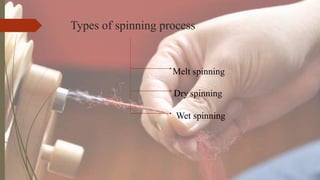
Types of spinning process
Melt spinning
Dry spinning
Wet spinning
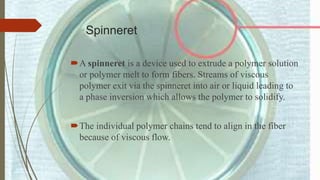
Spinneret
A spinneret is a device used to extrude a polymer solution
or polymer melt to form fibers. Streams of viscous
polymer exit via the spinneret into air or liquid leading to
a phase inversion which allows the polymer to solidify.
The individual polymer chains tend to align in the fiber
because of viscous flow.
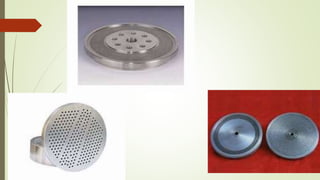
Material: Au-Pt, Tantalum, Stainless steel, others
Application: Textile, Industrial yarn
Hole size: Round/irregular-shaped hole range 0.03mm
dia to 0.3mm dia
Melt Spinning
 Melt spinning is used for polymers that can be melted. The
polymer solidifies by cooling after being extruded from the
spinneret. Nylon, olefin, polyester, saran, and sulfar are
produced via this process
 Melt Spinning (It is used for polymers that can be melted
easily.)
 Melt spinning uses heat to melt the polymer to a viscosity
suitable for extrusion. This type of spinning is used for
polymers that are not decomposed or degraded by the
temperatures necessary for extrusion. This method is used by
70% of the fibers.
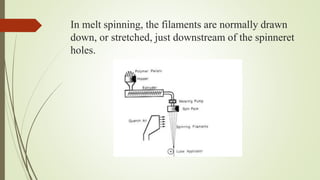
In melt spinning, the filaments are normally drawn
down, or stretched, just downstream of the spinneret
holes.
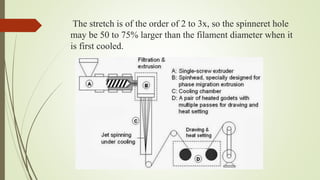
The stretch is of the order of 2 to 3x, so the spinneret hole
may be 50 to 75% larger than the filament diameter when it
is first cooled.
Process
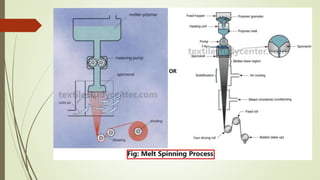
 In melt spinning, polymer is heated and it melts to form a
liquid spinning solution or dope.
 Chips of polymers are fed to a hopper which is heated. There
is a grid (sieve) at the base which permits only molten liquid
to pass through.
 Then the solution is purified by filter.
 The molten polymer is extruded at high pressure and constant
rate through a spinneret into a relatively cooler air stream that
solidifies the filaments.
 Finally the filament yarn either is immediately wound onto
bobbins or is further treated for certain desired characteristics
or end use.
Quenching/cooling system
 Cooling of fibre’s is three types.
1. Cross flow quenching.
2. In flow quenching.
3. Cut off quenching.
1. Cross flow quenching.
 Universally this method is used for fine and large deniess &
an for round and rectangular spin packs.
 But limitation that in this type only 25% of air could be used
for the purpose of quenching and rest 75% goes as waste.
2. In-flow quenching
 Air flow out side stream radially and
symmetrically distributed over filaments which
must be arranged in a ring shape.
3. Cut-off quenching
Is used for filaments yarns of high denies
and for spinning of staple fibres.
Advantages of Melt Spinning:
 Can be used for both staple and
continuous filament.
 Direct and simple process.
 No environment pollution.
 High production speed (2500-3000)
ft/min.
 Low investment cost.
Disadvantage of Melt
Spinning:
 Required more proper maintained of
machine.
 Heat of input is high.
 Only for those polymer’s which
having stability of melt in spinneret.
 Moisture content not exceed 0.05%
by wt. of nylon and 0.005% for PET
Dry spinning:
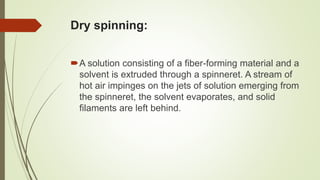
A solution consisting of a fiber-forming material and a
solvent is extruded through a spinneret. A stream of
hot air impinges on the jets of solution emerging from
the spinneret, the solvent evaporates, and solid
filaments are left behind.
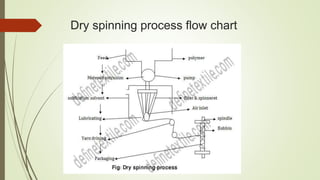
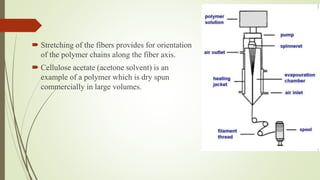
Dry spinning process flow chart
Process
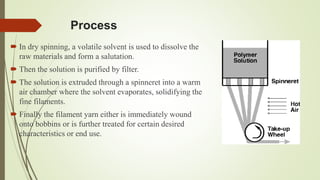
 In dry spinning, a volatile solvent is used to dissolve the
raw materials and form a salutation.
 Then the solution is purified by filter.
 The solution is extruded through a spinneret into a warm
air chamber where the solvent evaporates, solidifying the
fine filaments.
 Finally the filament yarn either is immediately wound
onto bobbins or is further treated for certain desired
characteristics or end use.
 Stretching of the fibers provides for orientation
of the polymer chains along the fiber axis.
 Cellulose acetate (acetone solvent) is an
example of a polymer which is dry spun
commercially in large volumes.
Example:
 Dry spinning is used in the production of acetate, triacetate,
and some acrylic, spandex, and vinyl (PVC,PVA) fibers.
Advantages:
 Yarn does not require
purification
Disadvantages:
 Flammable solvent hazards.
 Solvent recovery.
 Slow (200-400 yds/min).
Wet Spinning:
 A solution consisting of a fiber-forming material and a solvent is
extruded through a spinneret. A stream of hot air impinges on the
jets of solution emerging from the spinneret, the solvent evaporates,
and solid filaments are left behind.
 This is the oldest, most complex and also the most expensive
method of man-made yarn manufacture. This type of spinning is
applied to polymers which do not melt and dissolve only in non-
volatile or thermal unstable solvents.
Fig: Wet Spinning process
Process :
 In wet spinning, a non-volatile solvent is used to convert the raw
material into a solution.
 The solvent is extruded through the spinneret either by simply
washing it out or by a chemical reaction between the polymer
solution and a reagent in the spinning bath.
 After extrusion, the solvent is removed in a liquid coagulation
medium.
 Finally the filament yarn either is immediately wound onto bobbins
or is further treated for certain desired characteristics or end use.
Fig: Wet Spinning process
Example:
Wet spinning is used in the production of aramid,
Lyocell, PVC, PVA, viscose rayon, spandex,kavelar,
acrylic and modacrylic fibers.
Advantages:
 Large tows can be handled.
Disadvantages:
 Slow (70-150 yds/min).
 Washing to remove impurities.
 Solvent and chemical
recovery.
Spinning process

Spinning process

  • 1.
    Spinning process Presented by: Shubham Tiwari M.Sc Polymer science Roll no. 26
  • 2.
    Content  Introduction offiber  Classification of fibres  Types of Spinning technology  Spinneret  Melt flow  Dry flow  Wet flow
  • 3.
    Introduction of fibre Fibre having a length at least 100 its Diameter. OR  Substance that is significantly longer its width.  There are two types of fibres A)Natural fibber's B)Man made/synthetic fibre's
  • 4.
  • 5.
    Classification of Fiber Naturalfiber Man made/synthetic Plant/ vegetable Animal fiber Menarl fiber • Cotton • Flax • Jute • Linen • etc • Silk • Mohair • wool • Asbestos synthetic inorganic Re generated • Nylon • Polyester • Acrylic • Spandex • Polyvinyl derivative • Glass • Metallic • Ceramic • Cellulose acetate • Rayon • proteins • viscose
  • 6.
    Introduction of spinningprocess Spinning is a manufacturing process for creating polymer fibres.  There are many types of spinning: wet, dry, melt, gel, and electrospinning. It is a specialized form of extrusion that uses a spinneret to form multiple continuous filaments.
  • 7.
    Types of spinningprocess Melt spinning Dry spinning Wet spinning
  • 8.
    Spinneret A spinneret isa device used to extrude a polymer solution or polymer melt to form fibers. Streams of viscous polymer exit via the spinneret into air or liquid leading to a phase inversion which allows the polymer to solidify. The individual polymer chains tend to align in the fiber because of viscous flow.
  • 10.
    Material: Au-Pt, Tantalum,Stainless steel, others Application: Textile, Industrial yarn Hole size: Round/irregular-shaped hole range 0.03mm dia to 0.3mm dia
  • 11.
    Melt Spinning  Meltspinning is used for polymers that can be melted. The polymer solidifies by cooling after being extruded from the spinneret. Nylon, olefin, polyester, saran, and sulfar are produced via this process  Melt Spinning (It is used for polymers that can be melted easily.)  Melt spinning uses heat to melt the polymer to a viscosity suitable for extrusion. This type of spinning is used for polymers that are not decomposed or degraded by the temperatures necessary for extrusion. This method is used by 70% of the fibers.
  • 12.
    In melt spinning,the filaments are normally drawn down, or stretched, just downstream of the spinneret holes.
  • 13.
    The stretch isof the order of 2 to 3x, so the spinneret hole may be 50 to 75% larger than the filament diameter when it is first cooled.
  • 14.
    Process  In meltspinning, polymer is heated and it melts to form a liquid spinning solution or dope.  Chips of polymers are fed to a hopper which is heated. There is a grid (sieve) at the base which permits only molten liquid to pass through.  Then the solution is purified by filter.  The molten polymer is extruded at high pressure and constant rate through a spinneret into a relatively cooler air stream that solidifies the filaments.  Finally the filament yarn either is immediately wound onto bobbins or is further treated for certain desired characteristics or end use.
  • 16.
    Quenching/cooling system  Coolingof fibre’s is three types. 1. Cross flow quenching. 2. In flow quenching. 3. Cut off quenching.
  • 17.
    1. Cross flowquenching.  Universally this method is used for fine and large deniess & an for round and rectangular spin packs.  But limitation that in this type only 25% of air could be used for the purpose of quenching and rest 75% goes as waste.
  • 18.
    2. In-flow quenching Air flow out side stream radially and symmetrically distributed over filaments which must be arranged in a ring shape.
  • 19.
    3. Cut-off quenching Isused for filaments yarns of high denies and for spinning of staple fibres.
  • 20.
    Advantages of MeltSpinning:  Can be used for both staple and continuous filament.  Direct and simple process.  No environment pollution.  High production speed (2500-3000) ft/min.  Low investment cost. Disadvantage of Melt Spinning:  Required more proper maintained of machine.  Heat of input is high.  Only for those polymer’s which having stability of melt in spinneret.  Moisture content not exceed 0.05% by wt. of nylon and 0.005% for PET
  • 21.
    Dry spinning: A solutionconsisting of a fiber-forming material and a solvent is extruded through a spinneret. A stream of hot air impinges on the jets of solution emerging from the spinneret, the solvent evaporates, and solid filaments are left behind.
  • 22.
  • 23.
    Process  In dryspinning, a volatile solvent is used to dissolve the raw materials and form a salutation.  Then the solution is purified by filter.  The solution is extruded through a spinneret into a warm air chamber where the solvent evaporates, solidifying the fine filaments.  Finally the filament yarn either is immediately wound onto bobbins or is further treated for certain desired characteristics or end use.
  • 24.
     Stretching ofthe fibers provides for orientation of the polymer chains along the fiber axis.  Cellulose acetate (acetone solvent) is an example of a polymer which is dry spun commercially in large volumes.
  • 25.
    Example:  Dry spinningis used in the production of acetate, triacetate, and some acrylic, spandex, and vinyl (PVC,PVA) fibers.
  • 26.
    Advantages:  Yarn doesnot require purification Disadvantages:  Flammable solvent hazards.  Solvent recovery.  Slow (200-400 yds/min).
  • 27.
    Wet Spinning:  Asolution consisting of a fiber-forming material and a solvent is extruded through a spinneret. A stream of hot air impinges on the jets of solution emerging from the spinneret, the solvent evaporates, and solid filaments are left behind.  This is the oldest, most complex and also the most expensive method of man-made yarn manufacture. This type of spinning is applied to polymers which do not melt and dissolve only in non- volatile or thermal unstable solvents.
  • 28.
  • 29.
    Process :  Inwet spinning, a non-volatile solvent is used to convert the raw material into a solution.  The solvent is extruded through the spinneret either by simply washing it out or by a chemical reaction between the polymer solution and a reagent in the spinning bath.  After extrusion, the solvent is removed in a liquid coagulation medium.  Finally the filament yarn either is immediately wound onto bobbins or is further treated for certain desired characteristics or end use.
  • 30.
  • 31.
    Example: Wet spinning isused in the production of aramid, Lyocell, PVC, PVA, viscose rayon, spandex,kavelar, acrylic and modacrylic fibers.
  • 32.
    Advantages:  Large towscan be handled. Disadvantages:  Slow (70-150 yds/min).  Washing to remove impurities.  Solvent and chemical recovery.