Glass FiBRE
Submitted By
Md. Abdul Motin Nannu
Khulna University of Engineering & Technology
1521032
What is glass fiber?
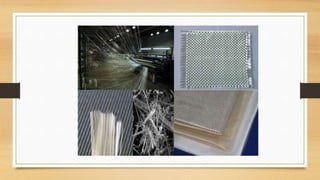
Glass fiber is a material consisting of numerous extremely
fine fibers of glass.
OR
Glass fiber is a type of fiber reinforced plastic where the
reinforcement fiber is specifically glass fiber. The glass
fiber may be randomly arranged but is commonly woven into a
mat. The plastic matrix may be a thermosetting plastic- most often
epoxy, polyester resin- or vinylester, or a thermoplastic.
History:
Glassmakers throughout history have experimented with glass
fibers, but mass manufacture of glass fiber was only made
possible with the invention of finer machine tooling. In
1893, Edward Drummond Libbey exhibited a dress at
the World's Columbian Exposition incorporating glass fibers
with the diameter and texture of silk fibers. This was first worn
by the popular stage actress of the time Georgia Cayvan.
Glass fibers can also occur naturally, as Pele's hair.
.
Manufacturing Processes:
Continuous filament glass fibers are normally used for high-
performance applications as stated earlier , the continuous filament
fibre glass technology first resulted from the joint venture of Owens-
ILLinios and corning glass works research which culminated in the
formation of a manufacturing facility in 1933 .The main manufacturing
operation of continuous fibre glass is normally a two stage process as
follows:
Glass Manufacture:
This stage undertakes the mining and fusion of the raw materials. All
ingredients are placed in a batch furnace at a temperature of around
1700c’. This ingredients, following a mixing and melting process, from
homogenous glass. The glass manufacturing stage concludes , either
with the liquid glass flowing directly to fibre-drawing furnaces called
bushings ;or alternatively, the glass is formed into marbles or rod ,
annealed and cooled at room temperature for use at some future
date.
Fibre drawing:
This stage forms the continuous glass fibre by remelting the
marbles and then passing the melt through the bushings . A
bushing has a large number of nozzles (around 200 or a multiple
of that figure) and is supplied with glass , either in the form of cold
marbles, which are first melted before the liquid glass can pass
through the nozzle or with liquid glass directly from the glass
melting furnace. Following fiberization, the glass filaments are
then passed over a roller or belt mechanism in order to apply the
size. The sizing solids used are present in amounts of less than
2% by wt of the finished product, but dictate the end use
performance of glass fibre produced.
Fibre Types And Grades:
Silica is the basis for all commercial glasses. They are obtained by
fusing a mixture of materials (various oxides) at temperatures
ranging from 1300’ to 1600’c. There are different types of glass
fibres commercially available all of which have different
compositions and very often specific technical significance. The
following is an outline if some popular varieties of glass:
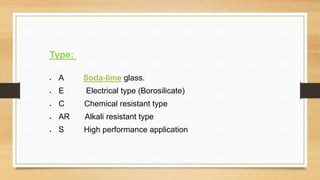
Type:
 A Soda-lime glass.
 E Electrical type (Borosilicate)
 C Chemical resistant type
 AR Alkali resistant type
 S High performance application
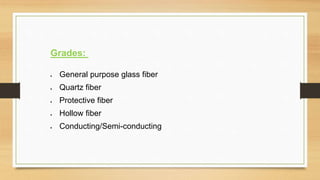
Grades:
 General purpose glass fiber
 Quartz fiber
 Protective fiber
 Hollow fiber
 Conducting/Semi-conducting
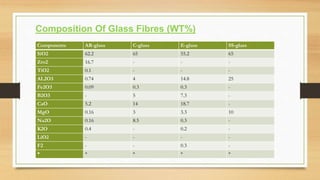
Components AR-glass C-glass E-glass SS-glass
SiO2 62.2 65 55.2 65
Zro2 16.7 - - -
TiO2 0.1 - - -
AL2O3 0.74 4 14.8 25
Fe2O3 0.09 0.3 0.3 -
B2O3 - 5 7.3 -
CaO 5.2 14 18.7 -
MgO 0.16 3 3.3 10
Na2O 0.16 8.5 0.3 -
K2O 0.4 - 0.2 -
LiO2 - - - -
F2 - - 0.3 -
* * * * *
Composition Of Glass Fibres (WT%)
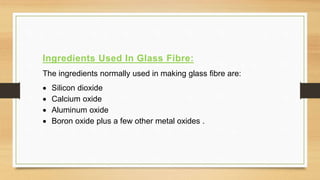
Ingredients Used In Glass Fibre:
The ingredients normally used in making glass fibre are:
 Silicon dioxide
 Calcium oxide
 Aluminum oxide
 Boron oxide plus a few other metal oxides .
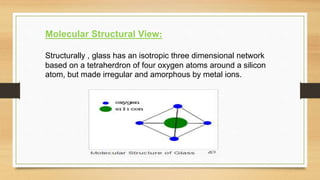
Molecular Structural View:
Structurally , glass has an isotropic three dimensional network
based on a tetraherdron of four oxygen atoms around a silicon
atom, but made irregular and amorphous by metal ions.
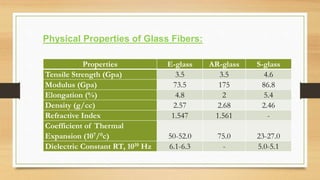
Properties E-glass AR-glass S-glass
Tensile Strength (Gpa) 3.5 3.5 4.6
Modulus (Gpa) 73.5 175 86.8
Elongation (%) 4.8 2 5.4
Density (g/cc) 2.57 2.68 2.46
Refractive Index 1.547 1.561 -
Coefficient of Thermal
Expansion (107/0c) 50-52.0 75.0 23-27.0
Dielectric Constant RT, 1010 Hz 6.1-6.3 - 5.0-5.1
Physical Properties of Glass Fibers:
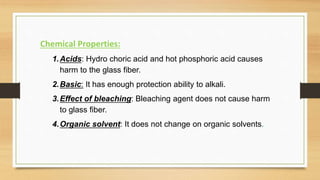
Chemical Properties:
1.Acids: Hydro choric acid and hot phosphoric acid causes
harm to the glass fiber.
2.Basic: It has enough protection ability to alkali.
3.Effect of bleaching: Bleaching agent does not cause harm
to glass fiber.
4.Organic solvent: It does not change on organic solvents.
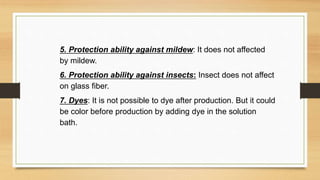
5. Protection ability against mildew: It does not affected
by mildew.
6. Protection ability against insects: Insect does not affect
on glass fiber.
7. Dyes: It is not possible to dye after production. But it could
be color before production by adding dye in the solution
bath.
Uses:
Uses for regular glass fiber include mats and fabrics for thermal
insulation, electrical insulation, sound insulation, high-strength
fabrics or heat- and corrosion-resistant fabrics. It is also used to
reinforce various materials, such as tent
poles, vault poles, arrows, bows and crossbows, translucent
roofing panels, automobile bodies, hockey sticks, surfboards,
boat hulls, and paper honeycomb. It has been used for medical
purposes in casts. Glass fiber is extensively used for
making FRP tanks and vessels.

Glass Fibre

  • 1.
    Glass FiBRE Submitted By Md.Abdul Motin Nannu Khulna University of Engineering & Technology 1521032
  • 3.
    What is glassfiber? Glass fiber is a material consisting of numerous extremely fine fibers of glass. OR Glass fiber is a type of fiber reinforced plastic where the reinforcement fiber is specifically glass fiber. The glass fiber may be randomly arranged but is commonly woven into a mat. The plastic matrix may be a thermosetting plastic- most often epoxy, polyester resin- or vinylester, or a thermoplastic.
  • 4.
    History: Glassmakers throughout historyhave experimented with glass fibers, but mass manufacture of glass fiber was only made possible with the invention of finer machine tooling. In 1893, Edward Drummond Libbey exhibited a dress at the World's Columbian Exposition incorporating glass fibers with the diameter and texture of silk fibers. This was first worn by the popular stage actress of the time Georgia Cayvan. Glass fibers can also occur naturally, as Pele's hair. .
  • 5.
    Manufacturing Processes: Continuous filamentglass fibers are normally used for high- performance applications as stated earlier , the continuous filament fibre glass technology first resulted from the joint venture of Owens- ILLinios and corning glass works research which culminated in the formation of a manufacturing facility in 1933 .The main manufacturing operation of continuous fibre glass is normally a two stage process as follows:
  • 6.
    Glass Manufacture: This stageundertakes the mining and fusion of the raw materials. All ingredients are placed in a batch furnace at a temperature of around 1700c’. This ingredients, following a mixing and melting process, from homogenous glass. The glass manufacturing stage concludes , either with the liquid glass flowing directly to fibre-drawing furnaces called bushings ;or alternatively, the glass is formed into marbles or rod , annealed and cooled at room temperature for use at some future date.
  • 7.
    Fibre drawing: This stageforms the continuous glass fibre by remelting the marbles and then passing the melt through the bushings . A bushing has a large number of nozzles (around 200 or a multiple of that figure) and is supplied with glass , either in the form of cold marbles, which are first melted before the liquid glass can pass through the nozzle or with liquid glass directly from the glass melting furnace. Following fiberization, the glass filaments are then passed over a roller or belt mechanism in order to apply the size. The sizing solids used are present in amounts of less than 2% by wt of the finished product, but dictate the end use performance of glass fibre produced.
  • 8.
    Fibre Types AndGrades: Silica is the basis for all commercial glasses. They are obtained by fusing a mixture of materials (various oxides) at temperatures ranging from 1300’ to 1600’c. There are different types of glass fibres commercially available all of which have different compositions and very often specific technical significance. The following is an outline if some popular varieties of glass:
  • 9.
    Type:  A Soda-limeglass.  E Electrical type (Borosilicate)  C Chemical resistant type  AR Alkali resistant type  S High performance application
  • 10.
    Grades:  General purposeglass fiber  Quartz fiber  Protective fiber  Hollow fiber  Conducting/Semi-conducting
  • 11.
    Components AR-glass C-glassE-glass SS-glass SiO2 62.2 65 55.2 65 Zro2 16.7 - - - TiO2 0.1 - - - AL2O3 0.74 4 14.8 25 Fe2O3 0.09 0.3 0.3 - B2O3 - 5 7.3 - CaO 5.2 14 18.7 - MgO 0.16 3 3.3 10 Na2O 0.16 8.5 0.3 - K2O 0.4 - 0.2 - LiO2 - - - - F2 - - 0.3 - * * * * * Composition Of Glass Fibres (WT%)
  • 12.
    Ingredients Used InGlass Fibre: The ingredients normally used in making glass fibre are:  Silicon dioxide  Calcium oxide  Aluminum oxide  Boron oxide plus a few other metal oxides .
  • 13.
    Molecular Structural View: Structurally, glass has an isotropic three dimensional network based on a tetraherdron of four oxygen atoms around a silicon atom, but made irregular and amorphous by metal ions.
  • 14.
    Properties E-glass AR-glassS-glass Tensile Strength (Gpa) 3.5 3.5 4.6 Modulus (Gpa) 73.5 175 86.8 Elongation (%) 4.8 2 5.4 Density (g/cc) 2.57 2.68 2.46 Refractive Index 1.547 1.561 - Coefficient of Thermal Expansion (107/0c) 50-52.0 75.0 23-27.0 Dielectric Constant RT, 1010 Hz 6.1-6.3 - 5.0-5.1 Physical Properties of Glass Fibers:
  • 15.
    Chemical Properties: 1.Acids: Hydrochoric acid and hot phosphoric acid causes harm to the glass fiber. 2.Basic: It has enough protection ability to alkali. 3.Effect of bleaching: Bleaching agent does not cause harm to glass fiber. 4.Organic solvent: It does not change on organic solvents.
  • 16.
    5. Protection abilityagainst mildew: It does not affected by mildew. 6. Protection ability against insects: Insect does not affect on glass fiber. 7. Dyes: It is not possible to dye after production. But it could be color before production by adding dye in the solution bath.
  • 17.
    Uses: Uses for regularglass fiber include mats and fabrics for thermal insulation, electrical insulation, sound insulation, high-strength fabrics or heat- and corrosion-resistant fabrics. It is also used to reinforce various materials, such as tent poles, vault poles, arrows, bows and crossbows, translucent roofing panels, automobile bodies, hockey sticks, surfboards, boat hulls, and paper honeycomb. It has been used for medical purposes in casts. Glass fiber is extensively used for making FRP tanks and vessels.