Dhaka University of Engineering and Technology(DUET),
Gazipur
Department of Textile Engineering
Presentation on Fibrous Material & Textile Physics-2
1
2
Presented By
SHAMIM SARKAR SAMIUL
Textile Engineering Department
Dhaka University of Engineering & Technology(DUET),
Gazipur
Fb: https://www.facebook.com/shamimsarkar.samiul
Email: shamim.duet.te@gmail.com
 Aramid is short form of aromatic polyamide. These fibers belong to the same
polyamide class as nylons. Aramid fibers are formed by the poly-condensation
polymerization reaction of aromatic diamines and aromatic di-acid chlorides.
 Aramids are strong synthetic fibers characterized by excellent resistance to
heat, chemicals and abrasion. They are the preferred fibers for protective
clothing applications such as chemical protection, thermal protection, fire-
proofing applications and ballistic protection.
4
 Properties of aramid fibers:
 They are very strong.
 They have excellent resistance to heat, abrasion and chemicals.
 They are electrically nonconductive.
 They do not melt but commence to degrade beyond 500 °C.
 Meta-aramids (brands Nomex, Tenjin Conex, New star, X-fiper, Kermel)
in particular have a tensile strength of about 0.5 N/tex, comparable to
high-strength synthetic fibers of nylon and polyester.
 The uniqueness of meta-aramid fibers is in their ability to withstand
tensile stress, abrasion and chemical resistance during exposure to flames
and high temperatures of up to 400 °C.
 The moisture regain of meta-aramid fibers is 5% and extension to break is
15%.
5
 Classifications of aramid fibers
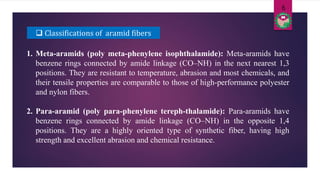
1. Meta-aramids (poly meta-phenylene isophthalamide): Meta-aramids have
benzene rings connected by amide linkage (CO–NH) in the next nearest 1,3
positions. They are resistant to temperature, abrasion and most chemicals, and
their tensile properties are comparable to those of high-performance polyester
and nylon fibers.
2. Para-aramid (poly para-phenylene tereph-thalamide): Para-aramids have
benzene rings connected by amide linkage (CO–NH) in the opposite 1,4
positions. They are a highly oriented type of synthetic fiber, having high
strength and excellent abrasion and chemical resistance.
6
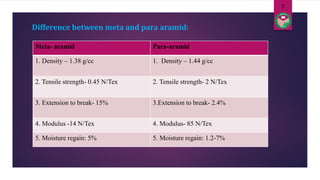
Difference between meta and para aramid:
Meta- aramid Para-aramid
1. Density – 1.38 g/cc 1. Density – 1.44 g/cc
2. Tensile strength- 0.45 N/Tex 2. Tensile strength- 2 N/Tex
3. Extension to break- 15% 3.Extension to break- 2.4%
4. Modulus -14 N/Tex 4. Modulus- 85 N/Tex
5. Moisture regain: 5% 5. Moisture regain: 1.2-7%
7
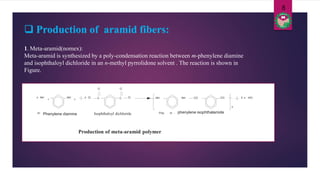
n NH
2
m- Phenylene diamine
2 n HCl
n
n Cl C
PolyIsophthaloyl dichloride m - phenylene isophthalamide
NH NH CO CO
O
C Cl
O
NH
2
Production of meta-aramid polymer.
8
 Production of aramid fibers:
1. Meta-aramid(nomex):
Meta-aramid is synthesized by a poly-condensation reaction between m-phenylene diamine
and isophthaloyl dichloride in an n-methyl pyrrolidone solvent . The reaction is shown in
Figure.
 Production of aramid fibers:
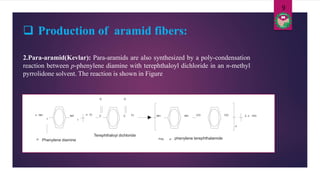
2.Para-aramid(Kevlar): Para-aramids are also synthesized by a poly-condensation
reaction between p-phenylene diamine with terephthaloyl dichloride in an n-methyl
pyrrolidone solvent. The reaction is shown in Figure
n NH
2
NH
2
n Cl ClC
O
C
O
NH NH CO CO 2 n HCl
n
Poly p - phenylene terephthalamide
Terephthaloyl dichloride
p- Phenylene diamine
9
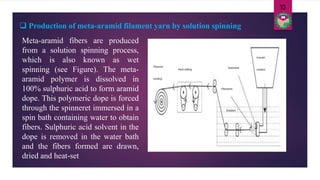
Meta-aramid fibers are produced
from a solution spinning process,
which is also known as wet
spinning (see Figure). The meta-
aramid polymer is dissolved in
100% sulphuric acid to form aramid
dope. This polymeric dope is forced
through the spinneret immersed in a
spin bath containing water to obtain
fibers. Sulphuric acid solvent in the
dope is removed in the water bath
and the fibers formed are drawn,
dried and heat-set
 Production of meta-aramid filament yarn by solution spinning
10
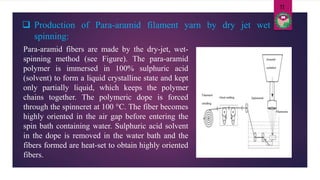
Para-aramid fibers are made by the dry-jet, wet-
spinning method (see Figure). The para-aramid
polymer is immersed in 100% sulphuric acid
(solvent) to form a liquid crystalline state and kept
only partially liquid, which keeps the polymer
chains together. The polymeric dope is forced
through the spinneret at 100 °C. The fiber becomes
highly oriented in the air gap before entering the
spin bath containing water. Sulphuric acid solvent
in the dope is removed in the water bath and the
fibers formed are heat-set to obtain highly oriented
fibers.
 Production of Para-aramid filament yarn by dry jet wet
spinning:
11
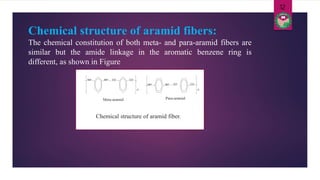
Chemical structure of aramid fibers:
The chemical constitution of both meta- and para-aramid fibers are
similar but the amide linkage in the aromatic benzene ring is
different, as shown in Figure
NH NH
Meta-aramid Para-aramid
CO CO
NH NH CO CO
nn
Chemical structure of aramid fiber.
12
Structure of aramid fibers :
 Meta-aramids are semi-crystalline fibers with a partially oriented and partially
crystalline structure similar to polyester and nylon. The presence of amide linkage in
the meta-aramid polymer restricts complete extension of the molecular chain, hence
high orientation and high crystallinity is not obtained in the meta-aramid fibers.
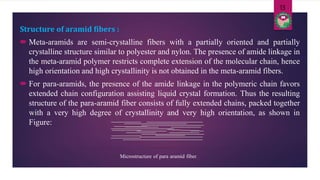
 For para-aramids, the presence of the amide linkage in the polymeric chain favors
extended chain configuration assisting liquid crystal formation. Thus the resulting
structure of the para-aramid fiber consists of fully extended chains, packed together
with a very high degree of crystallinity and very high orientation, as shown in
Figure:
Microstructure of para aramid fiber.
13
• Meta-aramid fiber, due to its excellent heat resistance, flame-proof properties,
chemical resistance, electrical non-conductance and abrasion resistance, is
established for applications involving protective apparel, specifically for fire-proof,
cut-proof and abrasion-resistant clothing for automobile drivers. Meta-aramid fibers
are also used for electrical insulation purposes.
• Para-aramids, due to their high tenacity, excellent heat resistance and abrasion
resistance properties, are the preferred fibers for ballistic protection wear such as
bullet-proof armor vests and helmets. Para-aramids have extensive applications as
fiber reinforcement for composite materials and can be used in technical textile
applications such as automobile clutch plates, brake linings, aircraft parts, boat
hulls and sporting goods. They are also extensively used for ropes, cables, optical
cable systems, sail cloths, high-temperature filtration fabrics, drumheads and
speaker diaphragms.
14
 Applications:
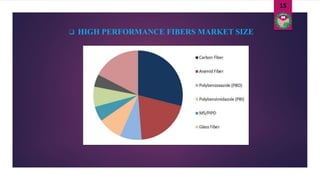
 HIGH PERFORMANCE FIBERS MARKET SIZE
15
Aramid main advantages are high strength and low weight. Like graphite, it has slightly
negative axial coefficient of thermal expansion, which means aramid laminates can be
made thermally table in dimensions. Unlike graphite, it is very resistant to impact and
abrasion damage. It can be made waterproof when combined with other materials like
epoxy. It can be used as a composite with rubber retaining its flexibility. High tensile
modulus and low breakage elongation combined with very good resistance to chemicals
make it the right choice for different composite structural parts in various applications.
 ADVANTAGES OF ARAMID FIBERS:
16
On the other hand, aramid fiber has a few disadvantages. The fibers absorb moisture,
so aramid composites are more sensitive to the environment than glass or graphite
composites. For this reason, it must be combined with moisture resistance materials
like epoxy systems. Compressive properties are relatively poor too. Consequently,
aramid fiber is not used in bridge building or whenever this king of resistance in
needed. Also, aramid fibers are difficult to cut and to grind without special
equipment’s (e.g. special scissors for cutting, special drill bits). Finally, aramid suffer
some corrosion and are degraded by UV light. For this reason, they must be properly
coated.
 DISADVANTAGES OF ARAMID FIBERS:
17
 END USE OF ARAMID FIBER:
▪ Flame-resistant clothing
▪ Heat protective clothing and helmets
▪ Body armor [competing with PE based fiber products
such as Dyneema and Spectra]
▪ Composite materials
▪ Asbestos replacement (e.g. braking pads)
▪ Hot air filtration fabrics
▪ Tires, newly as Sulfone (sulfur modified Twaron)
▪ Mechanical rubber goods reinforcement
▪ Ropes and cables
▪ Wicks for fire dancing
▪ Optical fiber cable systems
18
CONT…
▪ Sail cloth (not necessarily racing boat sails)
▪ Sporting goods
▪ Drumheads
▪ Wind instrument reeds, such as the Fibracell brand
▪ Speaker woofers
▪ Boat hull material
▪ Fiber reinforced concrete
▪ Reinforced thermoplastic pipes
▪ Tennis strings (e.g. by Ash away and Prince tennis
companies)
▪ Hockey sticks (normally in composition with such
materials as wood and carbon).
19
Thank You
20

Presentation on aramid fiber-DUET

  • 1.
    Dhaka University ofEngineering and Technology(DUET), Gazipur Department of Textile Engineering Presentation on Fibrous Material & Textile Physics-2 1
  • 2.
    2 Presented By SHAMIM SARKARSAMIUL Textile Engineering Department Dhaka University of Engineering & Technology(DUET), Gazipur Fb: https://www.facebook.com/shamimsarkar.samiul Email: shamim.duet.te@gmail.com
  • 3.
     Aramid isshort form of aromatic polyamide. These fibers belong to the same polyamide class as nylons. Aramid fibers are formed by the poly-condensation polymerization reaction of aromatic diamines and aromatic di-acid chlorides.  Aramids are strong synthetic fibers characterized by excellent resistance to heat, chemicals and abrasion. They are the preferred fibers for protective clothing applications such as chemical protection, thermal protection, fire- proofing applications and ballistic protection. 4
  • 4.
     Properties ofaramid fibers:  They are very strong.  They have excellent resistance to heat, abrasion and chemicals.  They are electrically nonconductive.  They do not melt but commence to degrade beyond 500 °C.  Meta-aramids (brands Nomex, Tenjin Conex, New star, X-fiper, Kermel) in particular have a tensile strength of about 0.5 N/tex, comparable to high-strength synthetic fibers of nylon and polyester.  The uniqueness of meta-aramid fibers is in their ability to withstand tensile stress, abrasion and chemical resistance during exposure to flames and high temperatures of up to 400 °C.  The moisture regain of meta-aramid fibers is 5% and extension to break is 15%. 5
  • 5.
     Classifications ofaramid fibers 1. Meta-aramids (poly meta-phenylene isophthalamide): Meta-aramids have benzene rings connected by amide linkage (CO–NH) in the next nearest 1,3 positions. They are resistant to temperature, abrasion and most chemicals, and their tensile properties are comparable to those of high-performance polyester and nylon fibers. 2. Para-aramid (poly para-phenylene tereph-thalamide): Para-aramids have benzene rings connected by amide linkage (CO–NH) in the opposite 1,4 positions. They are a highly oriented type of synthetic fiber, having high strength and excellent abrasion and chemical resistance. 6
  • 6.
    Difference between metaand para aramid: Meta- aramid Para-aramid 1. Density – 1.38 g/cc 1. Density – 1.44 g/cc 2. Tensile strength- 0.45 N/Tex 2. Tensile strength- 2 N/Tex 3. Extension to break- 15% 3.Extension to break- 2.4% 4. Modulus -14 N/Tex 4. Modulus- 85 N/Tex 5. Moisture regain: 5% 5. Moisture regain: 1.2-7% 7
  • 7.
    n NH 2 m- Phenylenediamine 2 n HCl n n Cl C PolyIsophthaloyl dichloride m - phenylene isophthalamide NH NH CO CO O C Cl O NH 2 Production of meta-aramid polymer. 8  Production of aramid fibers: 1. Meta-aramid(nomex): Meta-aramid is synthesized by a poly-condensation reaction between m-phenylene diamine and isophthaloyl dichloride in an n-methyl pyrrolidone solvent . The reaction is shown in Figure.
  • 8.
     Production ofaramid fibers: 2.Para-aramid(Kevlar): Para-aramids are also synthesized by a poly-condensation reaction between p-phenylene diamine with terephthaloyl dichloride in an n-methyl pyrrolidone solvent. The reaction is shown in Figure n NH 2 NH 2 n Cl ClC O C O NH NH CO CO 2 n HCl n Poly p - phenylene terephthalamide Terephthaloyl dichloride p- Phenylene diamine 9
  • 9.
    Meta-aramid fibers areproduced from a solution spinning process, which is also known as wet spinning (see Figure). The meta- aramid polymer is dissolved in 100% sulphuric acid to form aramid dope. This polymeric dope is forced through the spinneret immersed in a spin bath containing water to obtain fibers. Sulphuric acid solvent in the dope is removed in the water bath and the fibers formed are drawn, dried and heat-set  Production of meta-aramid filament yarn by solution spinning 10
  • 10.
    Para-aramid fibers aremade by the dry-jet, wet- spinning method (see Figure). The para-aramid polymer is immersed in 100% sulphuric acid (solvent) to form a liquid crystalline state and kept only partially liquid, which keeps the polymer chains together. The polymeric dope is forced through the spinneret at 100 °C. The fiber becomes highly oriented in the air gap before entering the spin bath containing water. Sulphuric acid solvent in the dope is removed in the water bath and the fibers formed are heat-set to obtain highly oriented fibers.  Production of Para-aramid filament yarn by dry jet wet spinning: 11
  • 11.
    Chemical structure ofaramid fibers: The chemical constitution of both meta- and para-aramid fibers are similar but the amide linkage in the aromatic benzene ring is different, as shown in Figure NH NH Meta-aramid Para-aramid CO CO NH NH CO CO nn Chemical structure of aramid fiber. 12
  • 12.
    Structure of aramidfibers :  Meta-aramids are semi-crystalline fibers with a partially oriented and partially crystalline structure similar to polyester and nylon. The presence of amide linkage in the meta-aramid polymer restricts complete extension of the molecular chain, hence high orientation and high crystallinity is not obtained in the meta-aramid fibers.  For para-aramids, the presence of the amide linkage in the polymeric chain favors extended chain configuration assisting liquid crystal formation. Thus the resulting structure of the para-aramid fiber consists of fully extended chains, packed together with a very high degree of crystallinity and very high orientation, as shown in Figure: Microstructure of para aramid fiber. 13
  • 13.
    • Meta-aramid fiber,due to its excellent heat resistance, flame-proof properties, chemical resistance, electrical non-conductance and abrasion resistance, is established for applications involving protective apparel, specifically for fire-proof, cut-proof and abrasion-resistant clothing for automobile drivers. Meta-aramid fibers are also used for electrical insulation purposes. • Para-aramids, due to their high tenacity, excellent heat resistance and abrasion resistance properties, are the preferred fibers for ballistic protection wear such as bullet-proof armor vests and helmets. Para-aramids have extensive applications as fiber reinforcement for composite materials and can be used in technical textile applications such as automobile clutch plates, brake linings, aircraft parts, boat hulls and sporting goods. They are also extensively used for ropes, cables, optical cable systems, sail cloths, high-temperature filtration fabrics, drumheads and speaker diaphragms. 14  Applications:
  • 14.
     HIGH PERFORMANCEFIBERS MARKET SIZE 15
  • 15.
    Aramid main advantagesare high strength and low weight. Like graphite, it has slightly negative axial coefficient of thermal expansion, which means aramid laminates can be made thermally table in dimensions. Unlike graphite, it is very resistant to impact and abrasion damage. It can be made waterproof when combined with other materials like epoxy. It can be used as a composite with rubber retaining its flexibility. High tensile modulus and low breakage elongation combined with very good resistance to chemicals make it the right choice for different composite structural parts in various applications.  ADVANTAGES OF ARAMID FIBERS: 16
  • 16.
    On the otherhand, aramid fiber has a few disadvantages. The fibers absorb moisture, so aramid composites are more sensitive to the environment than glass or graphite composites. For this reason, it must be combined with moisture resistance materials like epoxy systems. Compressive properties are relatively poor too. Consequently, aramid fiber is not used in bridge building or whenever this king of resistance in needed. Also, aramid fibers are difficult to cut and to grind without special equipment’s (e.g. special scissors for cutting, special drill bits). Finally, aramid suffer some corrosion and are degraded by UV light. For this reason, they must be properly coated.  DISADVANTAGES OF ARAMID FIBERS: 17
  • 17.
     END USEOF ARAMID FIBER: ▪ Flame-resistant clothing ▪ Heat protective clothing and helmets ▪ Body armor [competing with PE based fiber products such as Dyneema and Spectra] ▪ Composite materials ▪ Asbestos replacement (e.g. braking pads) ▪ Hot air filtration fabrics ▪ Tires, newly as Sulfone (sulfur modified Twaron) ▪ Mechanical rubber goods reinforcement ▪ Ropes and cables ▪ Wicks for fire dancing ▪ Optical fiber cable systems 18
  • 18.
    CONT… ▪ Sail cloth(not necessarily racing boat sails) ▪ Sporting goods ▪ Drumheads ▪ Wind instrument reeds, such as the Fibracell brand ▪ Speaker woofers ▪ Boat hull material ▪ Fiber reinforced concrete ▪ Reinforced thermoplastic pipes ▪ Tennis strings (e.g. by Ash away and Prince tennis companies) ▪ Hockey sticks (normally in composition with such materials as wood and carbon). 19
  • 19.