Integrated Soil Fertility Management Affect Profitability of Soybean in Northern
Ghana
Larbi A.1, Addul Rahman N.1, Kotu B.1, Hoeschle-Zeledon I.2 Akakpo D.B.3, Mellon S. B.3
1International Institute of Tropical Agriculture (IITA) – Tamale, Ghana
2International Institute of Tropical Agriculture (IITA) - Ibadan, Nigeria
3Wageningen University, Wageningen, Netherlands
Corresponding author email: a.larbi@cgiar.org
Key research activities
A split-plot design with 2 soybean varieties (TGX-1904-6F &
Jenguma) as main plots and 5 integrated soil fertility
management (ISFM) methods as subplots. ISFM methods used
include: Triple superphosphate at 60 kg/ ha(TSP) , Fertizol at 4 t/
ha (F), TSP + F, TSP + F + Boostxtra. Grain and fodder yield were
measured and benefit cost (BCR) was estimated.
Implications of the research for
generating development outcomes
Results and main findings
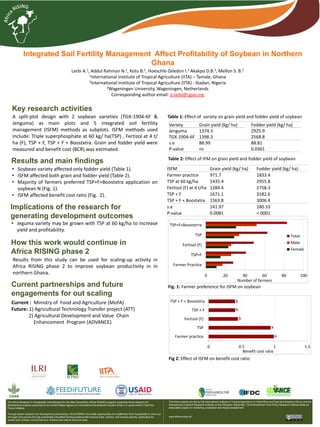
• Soybean variety affected only fodder yield (Table 1).
• ISFM affected both grain and fodder yield (Table 2).
• Majority of farmers preferred TSP+F+Boostxtra application on
soybean N (Fig. 1).
• ISFM affected benefit cost ratio (Fig. 2).
• Jeguma variety may be grown with TSP at 60 kg/ha to increase
yield and profitability.
Results from this study can be used for scaling-up activity in
Africa RISING phase 2 to improve soybean productivity in in
northern Ghana.
How this work would continue in
Africa RISING phase 2
The Africa Research In Sustainable Intensification for the Next Generation (Africa RISING) program comprises three research-for-
development projects supported by the United States Agency for International Development as part of the U.S. government’s Feed the
Future initiative.
Through action research and development partnerships, Africa RISING will create opportunities for smallholder farm households to move out
of hunger and poverty through sustainably intensified farming systems that improve food, nutrition, and income security, particularly for
women and children, and conserve or enhance the natural resource base.
The three projects are led by the International Institute of Tropical Agriculture (in West Africa and East and Southern Africa) and the
International Livestock Research Institute (in the Ethiopian Highlands). The International Food Policy Research Institute leads an
associated project on monitoring, evaluation and impact assessment.
www.africa-rising.net
Current : Ministry of Food and Agriculture (MoFA)
Future: 1) Agricultural Technology Transfer project (ATT)
2) Agricultural Development and Value Chain
Enhancement Program (ADVANCE)
Current partnerships and future
engagements for out scaling
ISFM Grain yield (kg/ ha) Fodder yield (kg/ ha)
Farmer practice 971.7 1833.4
TSP at 60 kg/ha 1435.4 2955.8
Fertizol (F) at 4 t/ha 1289.4 2758.3
TSP + F 1671.1 3182.6
TSP + F + Boostxtra 1563.8 3006.4
s.e 141.97 180.33
P-value 0.0081 <.0001
0 20 40 60 80 100
Farmer Practice
TSP+F
Fertisol (F)
TSP
TSP+F+Boostxtrra
Number of farmers
Total
Male
Female
a
a
b
b
b
0 0.5 1 1.5
Farmer practice
TSP
Fertizol (F)
TSP + F
TSP + F + Boostxtra
Benefit cost ratio
Variety Grain yield (kg/ ha) Fodder yield (kg/ ha)
Jenguma 1374.3 2925.9
TGX-1904-6F 1398.3 2568.8
s.e 88.99 88.81
P-value ns 0.0361
Table 1: Effect of variety on grain yield and fodder yield of soybean
Table 2: Effect of IFM on grain yield and fodder yield of soybean
Fig. 1: Farmer preference for ISFM on soybean
Fig 2: Effect of ISFM on benefit cost ratio

Integrated soil fertility management affect profitability of soybean in northern Ghana

  • 1.
    Integrated Soil FertilityManagement Affect Profitability of Soybean in Northern Ghana Larbi A.1, Addul Rahman N.1, Kotu B.1, Hoeschle-Zeledon I.2 Akakpo D.B.3, Mellon S. B.3 1International Institute of Tropical Agriculture (IITA) – Tamale, Ghana 2International Institute of Tropical Agriculture (IITA) - Ibadan, Nigeria 3Wageningen University, Wageningen, Netherlands Corresponding author email: a.larbi@cgiar.org Key research activities A split-plot design with 2 soybean varieties (TGX-1904-6F & Jenguma) as main plots and 5 integrated soil fertility management (ISFM) methods as subplots. ISFM methods used include: Triple superphosphate at 60 kg/ ha(TSP) , Fertizol at 4 t/ ha (F), TSP + F, TSP + F + Boostxtra. Grain and fodder yield were measured and benefit cost (BCR) was estimated. Implications of the research for generating development outcomes Results and main findings • Soybean variety affected only fodder yield (Table 1). • ISFM affected both grain and fodder yield (Table 2). • Majority of farmers preferred TSP+F+Boostxtra application on soybean N (Fig. 1). • ISFM affected benefit cost ratio (Fig. 2). • Jeguma variety may be grown with TSP at 60 kg/ha to increase yield and profitability. Results from this study can be used for scaling-up activity in Africa RISING phase 2 to improve soybean productivity in in northern Ghana. How this work would continue in Africa RISING phase 2 The Africa Research In Sustainable Intensification for the Next Generation (Africa RISING) program comprises three research-for- development projects supported by the United States Agency for International Development as part of the U.S. government’s Feed the Future initiative. Through action research and development partnerships, Africa RISING will create opportunities for smallholder farm households to move out of hunger and poverty through sustainably intensified farming systems that improve food, nutrition, and income security, particularly for women and children, and conserve or enhance the natural resource base. The three projects are led by the International Institute of Tropical Agriculture (in West Africa and East and Southern Africa) and the International Livestock Research Institute (in the Ethiopian Highlands). The International Food Policy Research Institute leads an associated project on monitoring, evaluation and impact assessment. www.africa-rising.net Current : Ministry of Food and Agriculture (MoFA) Future: 1) Agricultural Technology Transfer project (ATT) 2) Agricultural Development and Value Chain Enhancement Program (ADVANCE) Current partnerships and future engagements for out scaling ISFM Grain yield (kg/ ha) Fodder yield (kg/ ha) Farmer practice 971.7 1833.4 TSP at 60 kg/ha 1435.4 2955.8 Fertizol (F) at 4 t/ha 1289.4 2758.3 TSP + F 1671.1 3182.6 TSP + F + Boostxtra 1563.8 3006.4 s.e 141.97 180.33 P-value 0.0081 <.0001 0 20 40 60 80 100 Farmer Practice TSP+F Fertisol (F) TSP TSP+F+Boostxtrra Number of farmers Total Male Female a a b b b 0 0.5 1 1.5 Farmer practice TSP Fertizol (F) TSP + F TSP + F + Boostxtra Benefit cost ratio Variety Grain yield (kg/ ha) Fodder yield (kg/ ha) Jenguma 1374.3 2925.9 TGX-1904-6F 1398.3 2568.8 s.e 88.99 88.81 P-value ns 0.0361 Table 1: Effect of variety on grain yield and fodder yield of soybean Table 2: Effect of IFM on grain yield and fodder yield of soybean Fig. 1: Farmer preference for ISFM on soybean Fig 2: Effect of ISFM on benefit cost ratio