Opportunities and limitations of multidimensional
crop improvement in grain legumes to support
increased productivity in mixed crop livestock
systems
Michael Blümmel1, Jane Wamatu2, Barbara Rischkowsky2 and Siboniso Moyo1
International Livestock Research Institute (ILRI), PO Box 5689, Addis Ababa, Ethiopia
International Centre for Agricultural Research in Dry Areas (ICARDA), Addis Ababa, Ethiopia
2016 International Conference on Pulses: Health, Nutrition and Sustainable Agriculture in Drylands
Marrakesh, Morocco, 18-20 April, 206
Topics
 Rationale for paying attention to haulm traits:
demand, impact and cultivar differences
 Differences in haulm traits available in crop
improvement and opportunities for further
improvements
 Relationships between traits and trade-offs
 Where to go from here
Demand, impact and cultivar differences
 Legume haulm fodder markets
 Productivity of livestock fed legume haulms
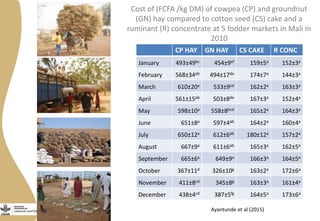
CP HAY GN HAY CS CAKE R CONC
January 493±49bc 454±9ef 159±5a 152±3a
February 568±34ab 494±17de 174±7a 144±3a
March 610±20a 533±9cd 162±2a 163±3a
April 561±15ab 503±8de 167±3a 152±4a
May 598±10a 558±8bcd 165±2a 164±3a
June 651±8a 597±4ab 164±2a 160±4a
July 650±12a 612±6ab 180±12a 157±2a
August 667±9a 611±6ab 165±3a 162±5a
September 665±6a 649±9a 166±3a 164±5a
October 367±11d 326±10g 163±2a 172±6a
November 411±8cd 345±8g 163±3a 161±4a
December 438±4cd 387±5fg 164±5a 173±6a
Cost of (FCFA /kg DM) of cowpea (CP) and groundnut
(GN) hay compared to cotton seed (CS) cake and a
ruminant (R) concentrate at 5 fodder markets in Mali in
2010
Ayantunde et al (2015)
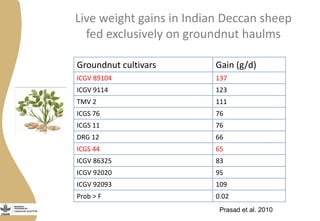
Live weight gains in Indian Deccan sheep
fed exclusively on groundnut haulms
Groundnut cultivars Gain (g/d)
ICGV 89104 137
ICGV 9114 123
TMV 2 111
ICGS 76 76
ICGS 11 76
DRG 12 66
ICGS 44 65
ICGV 86325 83
ICGV 92020 95
ICGV 92093 109
Prob > F 0.02
Prasad et al. 2010
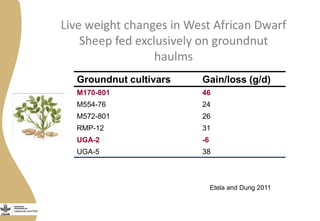
Live weight changes in West African Dwarf
Sheep fed exclusively on groundnut
haulms
Groundnut cultivars Gain/loss (g/d)
M170-801 46
M554-76 24
M572-801 26
RMP-12 31
UGA-2 -6
UGA-5 38
Etela and Dung 2011
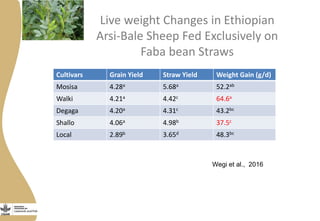
Live weight Changes in Ethiopian
Arsi-Bale Sheep Fed Exclusively on
Faba bean Straws
Wegi et al., 2016
Cultivars Grain Yield Straw Yield Weight Gain (g/d)
Mosisa 4.28a 5.68a 52.2ab
Walki 4.21a 4.42c 64.6a
Degaga 4.20a 4.31c 43.2bc
Shallo 4.06a 4.98b 37.5c
Local 2.89b 3.65d 48.3bc
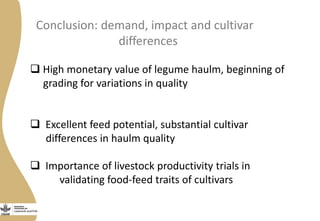
Conclusion: demand, impact and cultivar
differences
 High monetary value of legume haulm, beginning of
grading for variations in quality
 Excellent feed potential, substantial cultivar
differences in haulm quality
 Importance of livestock productivity trials in
validating food-feed traits of cultivars
Differences in haulm traits available in crop
improvement and opportunities for
further improvements
 Variations in key haulm fodder quality traits nitrogen
(N x 6.25 equals protein) and in vitro digestibility
(IVOMD)
 Broad sense heritabilities for key traits
Crop N % IVOMD % Source
Mean Range Mean Range
Cowpea [50x2x5] 2.2 1.5 – 2.5 59.1 56.7-61.0 Samireddipally et al (2016)
Groundnut [800] 1.7 1.2 – 2.3 56.3 51.7-61.1 Nigam & Blümmel (2014)
Chickpea [280] 0.7 0.4-1.7 49.5 44.0-58.6 Blümmel et al (2016)
Chickpea [475] 0.9 0.5-1.4 49.3 44.9-53.7 Wamatu et al (2016)
Field Pea [144] 1.25 0.6-1.5 50.1 47.8-52.5 Wamatu et al (2016)
Faba Bean [150] 0.83 0.8-0.9 42.1 40.4-43.7 Ashraf et al (2016)
Lentils [530] 1.5 0.6-2.4 49.3 44.9-53.7 Wamatu et al (2016)
Mean and ranges in haulm nitrogen (N) content and in
vitro digestibility (IVOMD) in some key grain legumes
Crop PY HY N IVOMD
1Cowpea [50 x 2 years x 5 locations] 0.50 0.29 0.67 0.61
2Groundnut [200 x 2 years x 2 H2O] 0.72 0.75 0.81 0.49
Broad sense heritabilities (h2) for pod (PY) and haulm yield
(HY) and key haulm fodder quality traits nitrogen
(N) and in vitro digestibility (IVOMD)
1Samireddipally et al (2016), Boukar et al (2016)
2Blümmel et al (2012)
T w e n ty h ig h e s t n itro g e n c o n te n ts
2 .3 2 .4 2 .5 2 .6 2 .7 2 .8 2 .9 3 .0 3 .1
0
5 0 0
1 0 0 0
1 5 0 0
2 0 0 0
2 5 0 0
C o n tro l: P = 0 .5
S tre s s : r= -0 .4 5 ; P = 0 .0 4
R e la tio n s h ip s b e tw e e n h a u lm n itro g e n c o n te n ts a n d p o d
y ie ld in c u ltiv a rs ra n k e d fo r h a u lm n itro g e n
N itro g e n c o n ten t o f h a u lm s (% )
Podyield(kg/ha)
T w e n ty h ig h e s t p o d y ie ld e rs
1 .7 1 .8 1 .9 2 .0 2 .1 2 .2 2 .3 2 .4 2 .5 2 .6 2 .7 2 .8
0
5 0 0
1 0 0 0
1 5 0 0
2 0 0 0
2 5 0 0
3 0 0 0
3 5 0 0
4 0 0 0
c o n tro l: P = 0 .2 5
s tre s s : P = 0 .1 6
N itro g en co n te n t o f h a u lm (% )
Podyield(kg/ha)
R e la tio n s h ip s b e tw e e n h a u lm n itro g e n c o n te n ts a n d p o d
y ie ld in c u ltiv a rs ra n k e d fo r p o d y ie ld
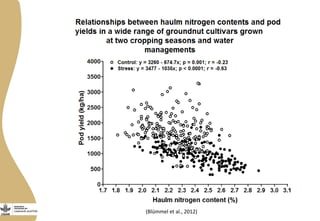
Primary of trait: Groundnut pod yield versus haulm nitrogen yield
Groundnut Set [200 x 2 years x 2 H2O]
Blümmel et al (2012)
T w e n ty h ig h e s t in v itro digestibilities
6 1 6 2 6 3 6 4 6 5 6 6
0
5 0 0
1 0 0 0
1 5 0 0
2 0 0 0
2 5 0 0
3 0 0 0
c o n tro l: P = 0 .6 3
s tre s s : P = 0 .5 9
R e la tio n s h ip s b e tw e e n h a u lm in vitro d ig e s tib ility a n d p o d
y ie ld in c u ltiv a rs ra n k e d fo r in vitro d ig e s tib ility
In v itro digestibility of haulm s (% )
Podyield(kg/ha)
T w e n ty h ig h e s t p o d y ie ld e rs
5 7 5 8 5 9 6 0 6 1 6 2 6 3 6 4 6 5
0
5 0 0
1 0 0 0
1 5 0 0
2 0 0 0
2 5 0 0
3 0 0 0
3 5 0 0
4 0 0 0
s tre s s : P = 0 .7 6
c o n tro l: P = 0 .5 0
R e la tio n s h ip s b e tw e e n h a u lm in vitro d ig e s tib ility a n d p o d
y ie ld in c u ltiv a rs ra n k e d fo r p o d y ie ld
In v itro d ig e s tib ility o f h a u lm s (% )
Podyield(kg/ha)
Primary of trait: Groundnut pod yield versus haulm in vitro
digestibility yield
Groundnut Set [200 x 2 years x 2 H2O]
Blümmel et al (2012)
Conclusions: Differences in haulm traits available
and opportunities for further improvements
 Substantial variations in key fodder quality traits
available in most crops
 Broad sense heritabilities for key traits high enough to
allow targeted improvement
 Multi traits selection seem feasible
Relationships between traits and trade-offs
 Are there immediate trade offs between biomass
quantity and quality
 How are key fodder quality traits related to pod and
haulm yield
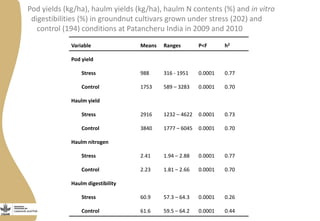
Variable Means Ranges P<F h2
Pod yield
Stress
Control
988
1753
316 - 1951
589 – 3283
0.0001
0.0001
0.77
0.70
Haulm yield
Stress
Control
2916
3840
1232 – 4622
1777 – 6045
0.0001
0.0001
0.73
0.70
Haulm nitrogen
Stress
Control
2.41
2.23
1.94 – 2.88
1.81 – 2.66
0.0001
0.0001
0.77
0.70
Haulm digestibility
Stress
Control
60.9
61.6
57.3 – 64.3
59.5 – 64.2
0.0001
0.0001
0.26
0.44
Pod yields (kg/ha), haulm yields (kg/ha), haulm N contents (%) and in vitro
digestibilities (%) in groundnut cultivars grown under stress (202) and
control (194) conditions at Patancheru India in 2009 and 2010
Crop N vs PY IVOMD vs PY N vs HY IVOMD vs HY
Cowpea [50x2x5] -0.26 0.11 0.21 0.44**
Groundnut [800] 0.26*** 0.05 0.26*** 0.23***
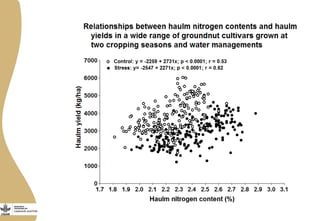
Groundnut [200] -0.23*** -0.20*** 0.53*** 0.48***
Chickpea [475] -0.06 0.06 -0.02 0.11*
Faba Bean [150] -0.16* 0.16* -0.05 0.12
Lentils [530] -0.73*** -0.12** -0.25*** 0.19***
Correlations between haulm nitrogen (N) and in vitro
digestibilities and pod (PY) and haulm yield (HY)
(Blümmel et al., 2012)
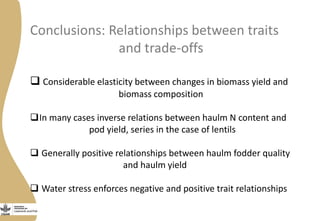
Conclusions: Relationships between traits
and trade-offs
 Considerable elasticity between changes in biomass yield and
biomass composition
In many cases inverse relations between haulm N content and
pod yield, series in the case of lentils
 Generally positive relationships between haulm fodder quality
and haulm yield
 Water stress enforces negative and positive trait relationships
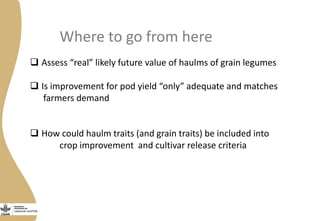
Where to go from here
 Assess “real” likely future value of haulms of grain legumes
 Is improvement for pod yield “only” adequate and matches
farmers demand
 How could haulm traits (and grain traits) be included into
crop improvement and cultivar release criteria
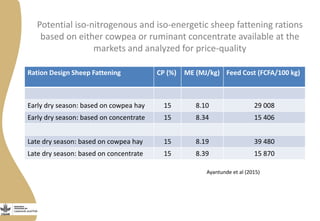
Ration Design Sheep Fattening CP (%) ME (MJ/kg) Feed Cost (FCFA/100 kg)
Early dry season: based on cowpea hay 15 8.10 29 008
Early dry season: based on concentrate 15 8.34 15 406
Late dry season: based on cowpea hay 15 8.19 39 480
Late dry season: based on concentrate 15 8.39 15 870
Ayantunde et al (2015)
Potential iso-nitrogenous and iso-energetic sheep fattening rations
based on either cowpea or ruminant concentrate available at the
markets and analyzed for price-quality
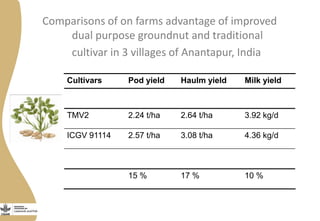
Comparisons of on farms advantage of improved
dual purpose groundnut and traditional
cultivar in 3 villages of Anantapur, India
Cultivars Pod yield Haulm yield Milk yield
TMV2 2.24 t/ha 2.64 t/ha 3.92 kg/d
ICGV 91114 2.57 t/ha 3.08 t/ha 4.36 kg/d
15 % 17 % 10 %
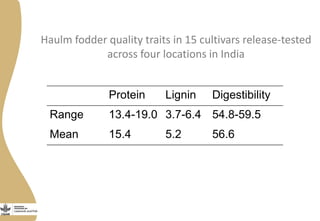
Haulm fodder quality traits in 15 cultivars release-tested
across four locations in India
Protein Lignin Digestibility
Range 13.4-19.0 3.7-6.4 54.8-59.5
Mean 15.4 5.2 56.6
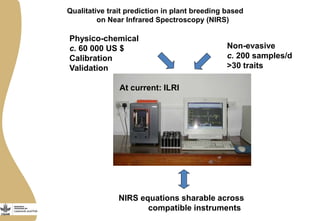
Qualitative trait prediction in plant breeding based
on Near Infrared Spectroscopy (NIRS)
Non-evasive
c. 200 samples/d
>30 traits
Physico-chemical
c. 60 000 US $
Calibration
Validation
NIRS equations sharable across
compatible instruments
At current: ILRI
Propositions: Where to go from here
Promotion and support of testing of different least cost rations
among sheep fatteners in West Africa: “perceptions vs
science”
 Understand better farmer demand and valuations of whole
crop compared to “grain” focus
 Include haulm traits into new cultivar release processes of a
grain legume as proof-of-concept
Can we discuss this in context of CRP Phase 2 work?
Thank you for your
attention!

Opportunities and limitations of multidimensional crop improvement in grain legumes to support increased productivity in mixed crop livestock systems

  • 1.
    Opportunities and limitationsof multidimensional crop improvement in grain legumes to support increased productivity in mixed crop livestock systems Michael Blümmel1, Jane Wamatu2, Barbara Rischkowsky2 and Siboniso Moyo1 International Livestock Research Institute (ILRI), PO Box 5689, Addis Ababa, Ethiopia International Centre for Agricultural Research in Dry Areas (ICARDA), Addis Ababa, Ethiopia 2016 International Conference on Pulses: Health, Nutrition and Sustainable Agriculture in Drylands Marrakesh, Morocco, 18-20 April, 206
  • 2.
    Topics  Rationale forpaying attention to haulm traits: demand, impact and cultivar differences  Differences in haulm traits available in crop improvement and opportunities for further improvements  Relationships between traits and trade-offs  Where to go from here
  • 3.
    Demand, impact andcultivar differences  Legume haulm fodder markets  Productivity of livestock fed legume haulms
  • 4.
    CP HAY GNHAY CS CAKE R CONC January 493±49bc 454±9ef 159±5a 152±3a February 568±34ab 494±17de 174±7a 144±3a March 610±20a 533±9cd 162±2a 163±3a April 561±15ab 503±8de 167±3a 152±4a May 598±10a 558±8bcd 165±2a 164±3a June 651±8a 597±4ab 164±2a 160±4a July 650±12a 612±6ab 180±12a 157±2a August 667±9a 611±6ab 165±3a 162±5a September 665±6a 649±9a 166±3a 164±5a October 367±11d 326±10g 163±2a 172±6a November 411±8cd 345±8g 163±3a 161±4a December 438±4cd 387±5fg 164±5a 173±6a Cost of (FCFA /kg DM) of cowpea (CP) and groundnut (GN) hay compared to cotton seed (CS) cake and a ruminant (R) concentrate at 5 fodder markets in Mali in 2010 Ayantunde et al (2015)
  • 5.
    Live weight gainsin Indian Deccan sheep fed exclusively on groundnut haulms Groundnut cultivars Gain (g/d) ICGV 89104 137 ICGV 9114 123 TMV 2 111 ICGS 76 76 ICGS 11 76 DRG 12 66 ICGS 44 65 ICGV 86325 83 ICGV 92020 95 ICGV 92093 109 Prob > F 0.02 Prasad et al. 2010
  • 6.
    Live weight changesin West African Dwarf Sheep fed exclusively on groundnut haulms Groundnut cultivars Gain/loss (g/d) M170-801 46 M554-76 24 M572-801 26 RMP-12 31 UGA-2 -6 UGA-5 38 Etela and Dung 2011
  • 7.
    Live weight Changesin Ethiopian Arsi-Bale Sheep Fed Exclusively on Faba bean Straws Wegi et al., 2016 Cultivars Grain Yield Straw Yield Weight Gain (g/d) Mosisa 4.28a 5.68a 52.2ab Walki 4.21a 4.42c 64.6a Degaga 4.20a 4.31c 43.2bc Shallo 4.06a 4.98b 37.5c Local 2.89b 3.65d 48.3bc
  • 8.
    Conclusion: demand, impactand cultivar differences  High monetary value of legume haulm, beginning of grading for variations in quality  Excellent feed potential, substantial cultivar differences in haulm quality  Importance of livestock productivity trials in validating food-feed traits of cultivars
  • 9.
    Differences in haulmtraits available in crop improvement and opportunities for further improvements  Variations in key haulm fodder quality traits nitrogen (N x 6.25 equals protein) and in vitro digestibility (IVOMD)  Broad sense heritabilities for key traits
  • 10.
    Crop N %IVOMD % Source Mean Range Mean Range Cowpea [50x2x5] 2.2 1.5 – 2.5 59.1 56.7-61.0 Samireddipally et al (2016) Groundnut [800] 1.7 1.2 – 2.3 56.3 51.7-61.1 Nigam & Blümmel (2014) Chickpea [280] 0.7 0.4-1.7 49.5 44.0-58.6 Blümmel et al (2016) Chickpea [475] 0.9 0.5-1.4 49.3 44.9-53.7 Wamatu et al (2016) Field Pea [144] 1.25 0.6-1.5 50.1 47.8-52.5 Wamatu et al (2016) Faba Bean [150] 0.83 0.8-0.9 42.1 40.4-43.7 Ashraf et al (2016) Lentils [530] 1.5 0.6-2.4 49.3 44.9-53.7 Wamatu et al (2016) Mean and ranges in haulm nitrogen (N) content and in vitro digestibility (IVOMD) in some key grain legumes
  • 11.
    Crop PY HYN IVOMD 1Cowpea [50 x 2 years x 5 locations] 0.50 0.29 0.67 0.61 2Groundnut [200 x 2 years x 2 H2O] 0.72 0.75 0.81 0.49 Broad sense heritabilities (h2) for pod (PY) and haulm yield (HY) and key haulm fodder quality traits nitrogen (N) and in vitro digestibility (IVOMD) 1Samireddipally et al (2016), Boukar et al (2016) 2Blümmel et al (2012)
  • 12.
    T w en ty h ig h e s t n itro g e n c o n te n ts 2 .3 2 .4 2 .5 2 .6 2 .7 2 .8 2 .9 3 .0 3 .1 0 5 0 0 1 0 0 0 1 5 0 0 2 0 0 0 2 5 0 0 C o n tro l: P = 0 .5 S tre s s : r= -0 .4 5 ; P = 0 .0 4 R e la tio n s h ip s b e tw e e n h a u lm n itro g e n c o n te n ts a n d p o d y ie ld in c u ltiv a rs ra n k e d fo r h a u lm n itro g e n N itro g e n c o n ten t o f h a u lm s (% ) Podyield(kg/ha) T w e n ty h ig h e s t p o d y ie ld e rs 1 .7 1 .8 1 .9 2 .0 2 .1 2 .2 2 .3 2 .4 2 .5 2 .6 2 .7 2 .8 0 5 0 0 1 0 0 0 1 5 0 0 2 0 0 0 2 5 0 0 3 0 0 0 3 5 0 0 4 0 0 0 c o n tro l: P = 0 .2 5 s tre s s : P = 0 .1 6 N itro g en co n te n t o f h a u lm (% ) Podyield(kg/ha) R e la tio n s h ip s b e tw e e n h a u lm n itro g e n c o n te n ts a n d p o d y ie ld in c u ltiv a rs ra n k e d fo r p o d y ie ld Primary of trait: Groundnut pod yield versus haulm nitrogen yield Groundnut Set [200 x 2 years x 2 H2O] Blümmel et al (2012)
  • 13.
    T w en ty h ig h e s t in v itro digestibilities 6 1 6 2 6 3 6 4 6 5 6 6 0 5 0 0 1 0 0 0 1 5 0 0 2 0 0 0 2 5 0 0 3 0 0 0 c o n tro l: P = 0 .6 3 s tre s s : P = 0 .5 9 R e la tio n s h ip s b e tw e e n h a u lm in vitro d ig e s tib ility a n d p o d y ie ld in c u ltiv a rs ra n k e d fo r in vitro d ig e s tib ility In v itro digestibility of haulm s (% ) Podyield(kg/ha) T w e n ty h ig h e s t p o d y ie ld e rs 5 7 5 8 5 9 6 0 6 1 6 2 6 3 6 4 6 5 0 5 0 0 1 0 0 0 1 5 0 0 2 0 0 0 2 5 0 0 3 0 0 0 3 5 0 0 4 0 0 0 s tre s s : P = 0 .7 6 c o n tro l: P = 0 .5 0 R e la tio n s h ip s b e tw e e n h a u lm in vitro d ig e s tib ility a n d p o d y ie ld in c u ltiv a rs ra n k e d fo r p o d y ie ld In v itro d ig e s tib ility o f h a u lm s (% ) Podyield(kg/ha) Primary of trait: Groundnut pod yield versus haulm in vitro digestibility yield Groundnut Set [200 x 2 years x 2 H2O] Blümmel et al (2012)
  • 14.
    Conclusions: Differences inhaulm traits available and opportunities for further improvements  Substantial variations in key fodder quality traits available in most crops  Broad sense heritabilities for key traits high enough to allow targeted improvement  Multi traits selection seem feasible
  • 15.
    Relationships between traitsand trade-offs  Are there immediate trade offs between biomass quantity and quality  How are key fodder quality traits related to pod and haulm yield
  • 16.
    Variable Means RangesP<F h2 Pod yield Stress Control 988 1753 316 - 1951 589 – 3283 0.0001 0.0001 0.77 0.70 Haulm yield Stress Control 2916 3840 1232 – 4622 1777 – 6045 0.0001 0.0001 0.73 0.70 Haulm nitrogen Stress Control 2.41 2.23 1.94 – 2.88 1.81 – 2.66 0.0001 0.0001 0.77 0.70 Haulm digestibility Stress Control 60.9 61.6 57.3 – 64.3 59.5 – 64.2 0.0001 0.0001 0.26 0.44 Pod yields (kg/ha), haulm yields (kg/ha), haulm N contents (%) and in vitro digestibilities (%) in groundnut cultivars grown under stress (202) and control (194) conditions at Patancheru India in 2009 and 2010
  • 17.
    Crop N vsPY IVOMD vs PY N vs HY IVOMD vs HY Cowpea [50x2x5] -0.26 0.11 0.21 0.44** Groundnut [800] 0.26*** 0.05 0.26*** 0.23*** Groundnut [200] -0.23*** -0.20*** 0.53*** 0.48*** Chickpea [475] -0.06 0.06 -0.02 0.11* Faba Bean [150] -0.16* 0.16* -0.05 0.12 Lentils [530] -0.73*** -0.12** -0.25*** 0.19*** Correlations between haulm nitrogen (N) and in vitro digestibilities and pod (PY) and haulm yield (HY)
  • 18.
  • 20.
    Conclusions: Relationships betweentraits and trade-offs  Considerable elasticity between changes in biomass yield and biomass composition In many cases inverse relations between haulm N content and pod yield, series in the case of lentils  Generally positive relationships between haulm fodder quality and haulm yield  Water stress enforces negative and positive trait relationships
  • 21.
    Where to gofrom here  Assess “real” likely future value of haulms of grain legumes  Is improvement for pod yield “only” adequate and matches farmers demand  How could haulm traits (and grain traits) be included into crop improvement and cultivar release criteria
  • 22.
    Ration Design SheepFattening CP (%) ME (MJ/kg) Feed Cost (FCFA/100 kg) Early dry season: based on cowpea hay 15 8.10 29 008 Early dry season: based on concentrate 15 8.34 15 406 Late dry season: based on cowpea hay 15 8.19 39 480 Late dry season: based on concentrate 15 8.39 15 870 Ayantunde et al (2015) Potential iso-nitrogenous and iso-energetic sheep fattening rations based on either cowpea or ruminant concentrate available at the markets and analyzed for price-quality
  • 23.
    Comparisons of onfarms advantage of improved dual purpose groundnut and traditional cultivar in 3 villages of Anantapur, India Cultivars Pod yield Haulm yield Milk yield TMV2 2.24 t/ha 2.64 t/ha 3.92 kg/d ICGV 91114 2.57 t/ha 3.08 t/ha 4.36 kg/d 15 % 17 % 10 %
  • 24.
    Haulm fodder qualitytraits in 15 cultivars release-tested across four locations in India Protein Lignin Digestibility Range 13.4-19.0 3.7-6.4 54.8-59.5 Mean 15.4 5.2 56.6
  • 25.
    Qualitative trait predictionin plant breeding based on Near Infrared Spectroscopy (NIRS) Non-evasive c. 200 samples/d >30 traits Physico-chemical c. 60 000 US $ Calibration Validation NIRS equations sharable across compatible instruments At current: ILRI
  • 26.
    Propositions: Where togo from here Promotion and support of testing of different least cost rations among sheep fatteners in West Africa: “perceptions vs science”  Understand better farmer demand and valuations of whole crop compared to “grain” focus  Include haulm traits into new cultivar release processes of a grain legume as proof-of-concept Can we discuss this in context of CRP Phase 2 work?
  • 27.
    Thank you foryour attention!