Collaborative potato seed multiplication activity of
Africa RISING and Debre Birhan Agricultural
Research Center
Temesgen Alene
Africa RISING Updating and Planning Workshop
18-19 November 2021
Collaborative Potato Seed Multiplication Activity
The reasons behind for the intervention
- Decline in yield over years of varieties at farmer’s hand.
- Farmers in the area were using their own potato seed tuber for
the past 6-8 years.
- Potato seed sourced from other areas (Jeldu and Holetta)
becomes a source of disease (bacterial wilt), which is not
common in the highlands of North Shewa.
- Farmers requested both Africa RISING and Debre Birhan Agri Res
Center (DBARC) during different workshops and meetings for
replacement of potato tuber that exist at their hand.
Potato Seed Multiplication
(2019)
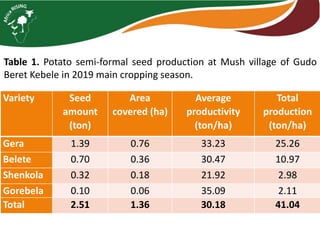
• Four potato (Gera, Shenkola, Belete and Gorebela) varieties which
were developed using tissue culture with a seed class of G2.
• 2.51 tons of G2 seed and 14 male farmers.
• We use committee members (model farmers) of Mush cooperative.
• Not clustered, none-uniform management and not inspected.
• The performance of introduced G2 seed was by far better than the
seed that exist at farmers’ hand.
• An average productivity of 30 tons/ha was recorded.
• It was possible to produce an estimated 41 tons/ha of potato seed
tuber.
Variety Seed
amount
(ton)
Area
covered (ha)
Average
productivity
(ton/ha)
Total
production
(ton/ha)
Gera 1.39 0.76 33.23 25.26
Belete 0.70 0.36 30.47 10.97
Shenkola 0.32 0.18 21.92 2.98
Gorebela 0.10 0.06 35.09 2.11
Total 2.51 1.36 30.18 41.04
Table 1. Potato semi-formal seed production at Mush village of Gudo
Beret Kebele in 2019 main cropping season.
Potato Seed Multiplication (2020)
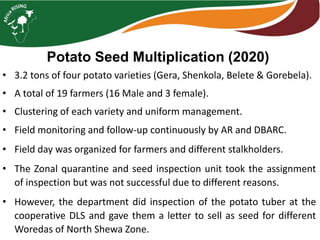
• 3.2 tons of four potato varieties (Gera, Shenkola, Belete & Gorebela).
• A total of 19 farmers (16 Male and 3 female).
• Clustering of each variety and uniform management.
• Field monitoring and follow-up continuously by AR and DBARC.
• Field day was organized for farmers and different stalkholders.
• The Zonal quarantine and seed inspection unit took the assignment
of inspection but was not successful due to different reasons.
• However, the department did inspection of the potato tuber at the
cooperative DLS and gave them a letter to sell as seed for different
Woredas of North Shewa Zone.
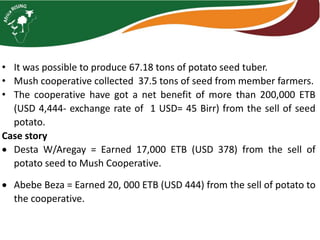
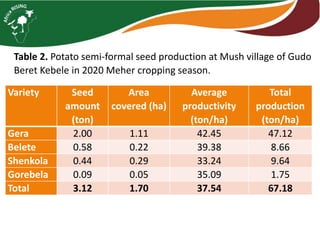
• It was possible to produce 67.18 tons of potato seed tuber.
• Mush cooperative collected 37.5 tons of seed from member farmers.
• The cooperative have got a net benefit of more than 200,000 ETB
(USD 4,444- exchange rate of 1 USD= 45 Birr) from the sell of seed
potato.
Case story
 Desta W/Aregay = Earned 17,000 ETB (USD 378) from the sell of
potato seed to Mush Cooperative.
 Abebe Beza = Earned 20, 000 ETB (USD 444) from the sell of potato to
the cooperative.
Table 2. Potato semi-formal seed production at Mush village of Gudo
Beret Kebele in 2020 Meher cropping season.
Variety Seed
amount
(ton)
Area
covered (ha)
Average
productivity
(ton/ha)
Total
production
(ton/ha)
Gera 2.00 1.11 42.45 47.12
Belete 0.58 0.22 39.38 8.66
Shenkola 0.44 0.29 33.24 9.64
Gorebela 0.09 0.05 35.09 1.75
Total 3.12 1.70 37.54 67.18
Potato seed multiplication during 2021
• G2 and G3 seed of class Gera, Shenkola, Belete & Gudene varieties.
• 4.7 seed potato was provided for member farmers of the
cooperative.
• A total of 35 farmers (31 males and 4 females).
• Clustering of each of the three varieties at different site.
• Continues Field monitoring and follow-up by AR and DBARC.
• A big field day was jointly organized by AR and DBARC.
• MoU was prepared and signed between North Shewa zone office of
agriculture and six selected Woreda offices of agriculture to scale.
 The Zonal quarantine and seed inspection unit evaluated the field
performance of the seed multiplication two times during the
cropping season.
 The final evaluation will be done after harvest by taking seed tuber
sample from the cooperative DLS.
 We are confident enough that the cooperative will get a certificate
of “Quality Declared Seed (QDS) ” for its potato seed.
 This will be for the first time in the cooperative history and good
achievement for both AR and DBARC.
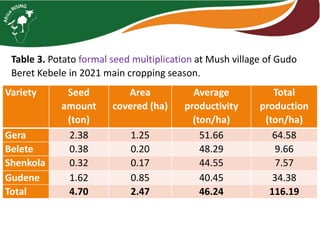
 An average productivity of 46.24 ton/ha and a total production of
116.19 tons were recorded.
Table 3. Potato formal seed multiplication at Mush village of Gudo
Beret Kebele in 2021 main cropping season.
Variety Seed
amount
(ton)
Area
covered (ha)
Average
productivity
(ton/ha)
Total
production
(ton/ha)
Gera 2.38 1.25 51.66 64.58
Belete 0.38 0.20 48.29 9.66
Shenkola 0.32 0.17 44.55 7.57
Gudene 1.62 0.85 40.45 34.38
Total 4.70 2.47 46.24 116.19
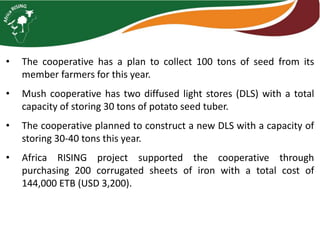
• The cooperative has a plan to collect 100 tons of seed from its
member farmers for this year.
• Mush cooperative has two diffused light stores (DLS) with a total
capacity of storing 30 tons of potato seed tuber.
• The cooperative planned to construct a new DLS with a capacity of
storing 30-40 tons this year.
• Africa RISING project supported the cooperative through
purchasing 200 corrugated sheets of iron with a total cost of
144,000 ETB (USD 3,200).
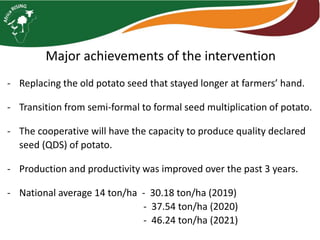
Major achievements of the intervention
- Replacing the old potato seed that stayed longer at farmers’ hand.
- Transition from semi-formal to formal seed multiplication of potato.
- The cooperative will have the capacity to produce quality declared
seed (QDS) of potato.
- Production and productivity was improved over the past 3 years.
- National average 14 ton/ha - 30.18 ton/ha (2019)
- 37.54 ton/ha (2020)
- 46.24 ton/ha (2021)
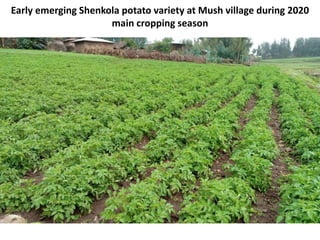
Early emerging Shenkola potato variety at Mush village during 2020
main cropping season
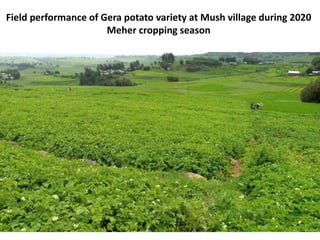
Field performance of Gera potato variety at Mush village during 2020
Meher cropping season
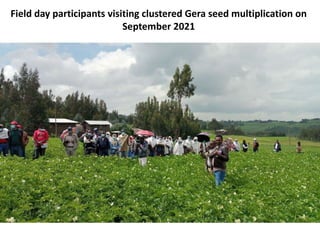
Field day participants visiting clustered Gera seed multiplication on
September 2021
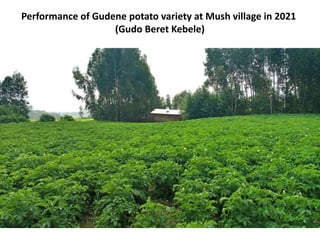
Performance of Gudene potato variety at Mush village in 2021
(Gudo Beret Kebele)
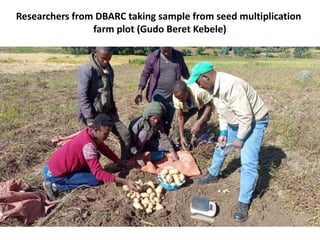
Researchers from DBARC taking sample from seed multiplication
farm plot (Gudo Beret Kebele)
Africa Research in Sustainable Intensification for the Next Generation
africa-rising.net
This presentation is licensed for use under the Creative Commons Attribution 4.0 International Licence.
Thank You

Potato seed multiplication 2021

  • 1.
    Collaborative potato seedmultiplication activity of Africa RISING and Debre Birhan Agricultural Research Center Temesgen Alene Africa RISING Updating and Planning Workshop 18-19 November 2021
  • 2.
    Collaborative Potato SeedMultiplication Activity The reasons behind for the intervention - Decline in yield over years of varieties at farmer’s hand. - Farmers in the area were using their own potato seed tuber for the past 6-8 years. - Potato seed sourced from other areas (Jeldu and Holetta) becomes a source of disease (bacterial wilt), which is not common in the highlands of North Shewa. - Farmers requested both Africa RISING and Debre Birhan Agri Res Center (DBARC) during different workshops and meetings for replacement of potato tuber that exist at their hand.
  • 3.
    Potato Seed Multiplication (2019) •Four potato (Gera, Shenkola, Belete and Gorebela) varieties which were developed using tissue culture with a seed class of G2. • 2.51 tons of G2 seed and 14 male farmers. • We use committee members (model farmers) of Mush cooperative. • Not clustered, none-uniform management and not inspected. • The performance of introduced G2 seed was by far better than the seed that exist at farmers’ hand. • An average productivity of 30 tons/ha was recorded. • It was possible to produce an estimated 41 tons/ha of potato seed tuber.
  • 4.
    Variety Seed amount (ton) Area covered (ha) Average productivity (ton/ha) Total production (ton/ha) Gera1.39 0.76 33.23 25.26 Belete 0.70 0.36 30.47 10.97 Shenkola 0.32 0.18 21.92 2.98 Gorebela 0.10 0.06 35.09 2.11 Total 2.51 1.36 30.18 41.04 Table 1. Potato semi-formal seed production at Mush village of Gudo Beret Kebele in 2019 main cropping season.
  • 5.
    Potato Seed Multiplication(2020) • 3.2 tons of four potato varieties (Gera, Shenkola, Belete & Gorebela). • A total of 19 farmers (16 Male and 3 female). • Clustering of each variety and uniform management. • Field monitoring and follow-up continuously by AR and DBARC. • Field day was organized for farmers and different stalkholders. • The Zonal quarantine and seed inspection unit took the assignment of inspection but was not successful due to different reasons. • However, the department did inspection of the potato tuber at the cooperative DLS and gave them a letter to sell as seed for different Woredas of North Shewa Zone.
  • 6.
    • It waspossible to produce 67.18 tons of potato seed tuber. • Mush cooperative collected 37.5 tons of seed from member farmers. • The cooperative have got a net benefit of more than 200,000 ETB (USD 4,444- exchange rate of 1 USD= 45 Birr) from the sell of seed potato. Case story  Desta W/Aregay = Earned 17,000 ETB (USD 378) from the sell of potato seed to Mush Cooperative.  Abebe Beza = Earned 20, 000 ETB (USD 444) from the sell of potato to the cooperative.
  • 7.
    Table 2. Potatosemi-formal seed production at Mush village of Gudo Beret Kebele in 2020 Meher cropping season. Variety Seed amount (ton) Area covered (ha) Average productivity (ton/ha) Total production (ton/ha) Gera 2.00 1.11 42.45 47.12 Belete 0.58 0.22 39.38 8.66 Shenkola 0.44 0.29 33.24 9.64 Gorebela 0.09 0.05 35.09 1.75 Total 3.12 1.70 37.54 67.18
  • 8.
    Potato seed multiplicationduring 2021 • G2 and G3 seed of class Gera, Shenkola, Belete & Gudene varieties. • 4.7 seed potato was provided for member farmers of the cooperative. • A total of 35 farmers (31 males and 4 females). • Clustering of each of the three varieties at different site. • Continues Field monitoring and follow-up by AR and DBARC. • A big field day was jointly organized by AR and DBARC. • MoU was prepared and signed between North Shewa zone office of agriculture and six selected Woreda offices of agriculture to scale.
  • 9.
     The Zonalquarantine and seed inspection unit evaluated the field performance of the seed multiplication two times during the cropping season.  The final evaluation will be done after harvest by taking seed tuber sample from the cooperative DLS.  We are confident enough that the cooperative will get a certificate of “Quality Declared Seed (QDS) ” for its potato seed.  This will be for the first time in the cooperative history and good achievement for both AR and DBARC.  An average productivity of 46.24 ton/ha and a total production of 116.19 tons were recorded.
  • 10.
    Table 3. Potatoformal seed multiplication at Mush village of Gudo Beret Kebele in 2021 main cropping season. Variety Seed amount (ton) Area covered (ha) Average productivity (ton/ha) Total production (ton/ha) Gera 2.38 1.25 51.66 64.58 Belete 0.38 0.20 48.29 9.66 Shenkola 0.32 0.17 44.55 7.57 Gudene 1.62 0.85 40.45 34.38 Total 4.70 2.47 46.24 116.19
  • 11.
    • The cooperativehas a plan to collect 100 tons of seed from its member farmers for this year. • Mush cooperative has two diffused light stores (DLS) with a total capacity of storing 30 tons of potato seed tuber. • The cooperative planned to construct a new DLS with a capacity of storing 30-40 tons this year. • Africa RISING project supported the cooperative through purchasing 200 corrugated sheets of iron with a total cost of 144,000 ETB (USD 3,200).
  • 12.
    Major achievements ofthe intervention - Replacing the old potato seed that stayed longer at farmers’ hand. - Transition from semi-formal to formal seed multiplication of potato. - The cooperative will have the capacity to produce quality declared seed (QDS) of potato. - Production and productivity was improved over the past 3 years. - National average 14 ton/ha - 30.18 ton/ha (2019) - 37.54 ton/ha (2020) - 46.24 ton/ha (2021)
  • 13.
    Early emerging Shenkolapotato variety at Mush village during 2020 main cropping season
  • 14.
    Field performance ofGera potato variety at Mush village during 2020 Meher cropping season
  • 15.
    Field day participantsvisiting clustered Gera seed multiplication on September 2021
  • 16.
    Performance of Gudenepotato variety at Mush village in 2021 (Gudo Beret Kebele)
  • 17.
    Researchers from DBARCtaking sample from seed multiplication farm plot (Gudo Beret Kebele)
  • 18.
    Africa Research inSustainable Intensification for the Next Generation africa-rising.net This presentation is licensed for use under the Creative Commons Attribution 4.0 International Licence. Thank You