Africa RISING in the Ethiopian Highlands
Core partners
Research Highlights
• Major yield benefits in wheat (50-200%) was obtained from application of
higher rates of Nitrogen and Phosphorus fertilizers. Yield benefit of
Sulphur and Zinc applications was rarely observed across locations;
• Potassium application significantly increased grain yield only in dry years,
like that of 2015
• Increased application of Nitrogen has significant increased protein grain
content of wheat compared to Controls. Crops treated with low amount
of Nitrogen had significantly lower (about 30% ) crude protein content
than those supplied with optimum amount of nitrogen.
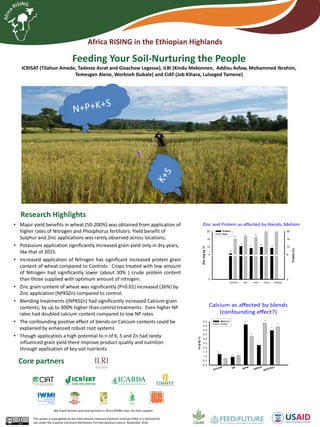
• Zinc grain content of wheat was significantly (P<0.01) increased (36%) by
Zinc application (NPKSZn) compared to control.
• Blending treatments ((NPKSZn) had significantly increased Calcium grain
contents; by up to 300% higher than control treatments. Even higher NP
rates had doubled calcium content compared to low NP rates.
• The confounding positive effect of blends on Calcium contents could be
explained by enhanced robust root systems
• Though applicatiois a high potential to n of K, S and Zn had rarely
influenced grain yield there improve product quality and nutrition
through application of key soil nutrients
Feeding Your Soil-Nurturing the People
ICRISAT (Tilahun Amede, Tadesse Asrat and Gizachew Legesse), ILRI (Kindu Mekonnen, Addisu Asfaw, Mohammed Ibrahim,
Temesgen Alene, Workneh Dubale) and CIAT (Job Kihara, Lulseged Tamene)
Africa RISING sites in Ethiopia
This poster is copyrighted by the International Livestock Research Institute (ILRI). It is licensed for
use under the Creative Commons Attribution 4.0 International Licence. November 2016
We thank farmers and local partners in Africa RISING sites for their support

Feeding your soil-nurturing the people

  • 1.
    Africa RISING inthe Ethiopian Highlands Core partners Research Highlights • Major yield benefits in wheat (50-200%) was obtained from application of higher rates of Nitrogen and Phosphorus fertilizers. Yield benefit of Sulphur and Zinc applications was rarely observed across locations; • Potassium application significantly increased grain yield only in dry years, like that of 2015 • Increased application of Nitrogen has significant increased protein grain content of wheat compared to Controls. Crops treated with low amount of Nitrogen had significantly lower (about 30% ) crude protein content than those supplied with optimum amount of nitrogen. • Zinc grain content of wheat was significantly (P<0.01) increased (36%) by Zinc application (NPKSZn) compared to control. • Blending treatments ((NPKSZn) had significantly increased Calcium grain contents; by up to 300% higher than control treatments. Even higher NP rates had doubled calcium content compared to low NP rates. • The confounding positive effect of blends on Calcium contents could be explained by enhanced robust root systems • Though applicatiois a high potential to n of K, S and Zn had rarely influenced grain yield there improve product quality and nutrition through application of key soil nutrients Feeding Your Soil-Nurturing the People ICRISAT (Tilahun Amede, Tadesse Asrat and Gizachew Legesse), ILRI (Kindu Mekonnen, Addisu Asfaw, Mohammed Ibrahim, Temesgen Alene, Workneh Dubale) and CIAT (Job Kihara, Lulseged Tamene) Africa RISING sites in Ethiopia This poster is copyrighted by the International Livestock Research Institute (ILRI). It is licensed for use under the Creative Commons Attribution 4.0 International Licence. November 2016 We thank farmers and local partners in Africa RISING sites for their support