Kindu Mekonnen and Peter
Thorne (ILRI)
Africa RISING project implementation and
contribution in Ethiopia
Africa RISING close out event
24-25 January 2023
ILRI campus- Addis Ababa, Ethiopia
Africa RISING- Africa Research In Sustainable Intensification for the Next
Generation
1. Introduction
One Program with four Projects
Funded by USAID through the FtF initiative
Sustainable Intensification (SI), multi-disciplinary action
research and facilitation of wider scaling are the core
research for development agendas of the program.
Legend: Mixed cereal/legume livestock
farming systems
Mixed crop-livestock
farming systems
Mali
Ghana
Zambia Malawi
Ethiopia
AR program managed to operate in six African countries for the
last 11 years (two phases)
Tanzania
Endamehoni
woreda of Tigray
Sinana woreda
of Oromia
Bosona woreda
of Amhara
Lemo woreda
of SNNPR
The AR project in Ethiopia worked in Amhara, Tigray, Oromia and
SNNP regions
Phase I: 2012 to 30 Sept 2016 (4 zones, 4 woredas, 8 kebeles)
In phase II (Oct 2016-2022 ) the AR project in ETH reached to 11
zones and 36 woredas.
2. Project implementation
Cross-cutting: Capdev, IPs, Partnership
Sites selection Systems
understanding
(diagnosis)
Formation of
research thematic
areas
Identification of
SI interventions
Testing and
validation of SI
interventions
Synthesizing
evidences of
validated
interventions
Identification of
potential scaling
DPs
Facilitation of
wider scaling (DPs,
media)
Adoption and
impact studies
Diffusion studies of
SI innovations
Production of
project legacy
products
Feed and forage interventions
Forage grass
• Introduced and validated
different feed and forage
technologies to improve
livestock productivity.
• Generated biophysical and socioeconomic data under on-
farm environment - example
– Biomass yields from AR validated forage crops are making
significant contributions to fill feed gaps (oat/ vetch- 12 t DM ha-1;
fodder beet- > 20 t DM ha-1; tree lucerne, 4-7 t DM ha-1).
– Supplementation of oat/vetch mixture and fodder beet have
increased milk yield from 30–50%.
– Feeding trough and storage shed have reduced feed wastage from
30- 50%.
Fodder tree
3. Project contribution
Feed trough
3.1. Research
Herbaceous
legumes /grass
mixture
Improved crop varieties and management practices
Crop varieties
Introduced and evaluated over 127 improved crop
varieties (cereal, pulse, oil, potato and enset
varieties) through PVS and crowdsourcing
approaches.
Yield Achieved
Obtained significant yield increase (%) under PVS as
compared to the national average crop yield (CSA,
2021): bread and durum wheat (52- 89%), faba
bean (90%), malt and food barley (120-132%), field
pea and lentil (83-111%), check pea and linseed (36-
83%) and potato (171%).
High value fruit trees
Fruiting Quality Test
Varieties Yield
Introduced and
validated 5 avocado
and 2 apple (Anna and
Princissa) varieties.
Avocado varieties
provide fruits in less
than 2 years with
variation across
varieties and sites.
Fruit yield per avocado
tree ranges from 50 kg
for Ettinger to 181 kg
for Nabal.
Quality (test, shelf life
and oil content) for
avocado varieties is:
Hass > Ettinger >
Fuerte > Reed > Nabal.
Validation
• Validated the right nutrient
sources and rates and ISFM
practices for wheat production
using a Decision Support Tool
(DST).
Catalyzation and Impact
• This research has catalyzed a
new national initiative to fine-
tune previous fertilizer
recommendations.
Field trials
• Conducted landscape based on-
farm fertilizer trials and
identified site-specific nutrient
sources and rates for wheat
following the 5R principles of
nutrient stewardship.
Soil fertility management
Hillslope (>
15%)
Mid-slope (5-
15%)
Foot slope
(<5%)
Small-scale based mechanization options
Introduced two-wheel tractor
and accessories (plough, planter,
reaper, thresher, sheller, water
pump and trailers)
Reduced cost of farm operations as
compared to conventional farm
practices- Example: Cost for wheat
thresher = USD 200 ha-1 without
mechanization vs 90 ha-1 with
mechanization
Created jobs for service
providers in Africa RISING
operational areas
Water management and application
• Water lifting technologies have enhanced
farmers capacity to irrigate high value
crops.
• Rainwater harvesting ponds attracted
farmers to diversify high value crops
around home- gardens.
• Introduced and validated water
harvesting, lifting and delivery
technologies in AR project sites.
• Farmers guided by wetting front detectors
able to increase irrigated fodder dry
biomass by 14%.
Implementation of integrated SWC
practices at landscape scale have
reduced soil loss by over 75% in the AR
watersheds.
Management practices implemented in
cultivated fields have reduced soil loss
by 87% as compared to non-treated
fields.
A treated landscape in Basona AR site
has shown an increase in baseflow by
up to 35%, which improves irrigation in
downstream locations.
Landscape/watershed management
• Value chain studies on livestock and crop commodities
• Nutrition (contribution of nutrition education and project
interventions) studies
• Gender studies
• RHoMIS (Rural Household Multi-Indicator Survey)
• Scaling studies (scaling scan, spillover)
• Innovations diffusion studies
1
2
3
4
3.2. Studies to evaluate SI in systems orientation
5
6
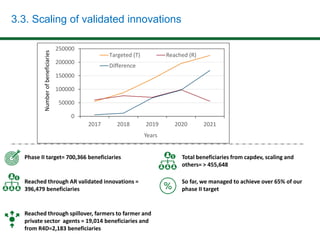
3.3. Scaling of validated innovations
Phase II target= 700,366 beneficiaries
Reached through AR validated innovations =
396,479 beneficiaries
Reached through spillover, farmers to farmer and
private sector agents = 19,014 beneficiaries and
from R4D=2,183 beneficiaries
Total beneficiaries from capdev, scaling and
others= > 455,648
So far, we managed to achieve over 65% of our
phase II target
0
50000
100000
150000
200000
250000
2017 2018 2019 2020 2021
Years
Targeted (T) Reached (R)
Difference
Number
of
beneficiaries
3.4. Capacity development - Short-term capdev initiatives
Documented over 37,972 beneficiaries from
the project short-term capdev initiatives.
The capdev program included short-term
trainings, field days, visits, workshops, surveys
and meetings
0
1000
2000
3000
4000
5000
6000
7000
8000
9000
2017 2018 2019 2020 2021 2022
Number
of
beneficiaries
Year
3.4. Capacity development - Long-term capdev initiatives
AR Phase Degree type Men Female Total
Phase I
MSc 18 7 25
PhD 2 2 4
Phase I Total 20 9 29
Phase II
MA 1 1
MSc 6 4 10
PhD 16 3 19
Phase II Total 22 8 30
Grand Total 42 17 59
• In phase I and II, AR project of the Ethiopian highlands supported 36 MSc and 23 PhD students.
• From the total attached students – 29% were female students.
3.5 Publications
 Over 600 project outputs have been produced since 2012, of which 51 are
journal articles.
Examples of peer reviewed and highest profile journal publications:
Assessing smallholder sustainable intensification in the Ethiopian
highlands (Hammond et al. 2021, Agricultural Systems)
Feed and forage development in mixed crop–livestock systems of
the Ethiopian highlands: Africa RISING project research experience
(Mekonnen et al. 2021, Agronomy Journal).
Multilevel innovation platforms for development of smallholder
livestock systems: How effective are they? (Lema et al. 2021,
Agricultural Systems).
• SI requires integrated research approaches including co- identification
of priority farming system issues, co-designing of protocols, co-
implementation of interventions, and systematic evaluation (synergies
and tradeoffs) of innovations at scale.
• Organizing cross learning events (exchange visits, trainings, field days,
monthly meetings, review and planning workshops) are useful to
speed up implementation of plans and bring visible impact.
• Identification of committed scaling partners and equipping them with
knowledge /skill through capdev schemes ensures wider dissemination
of SI innovations.
• Well planned M&E scheme, data repository system, reporting and
presentation templates helps to simplify documentations,
communications and performance of projects.
• Site level project coordinators are instrumental to facilitate
communication with local partners, strengthen partnership and
properly implement project plans.
Need for
integration
Cross learning
Committed scaling
partners
Learning from M&E
Project
coordination
5. Key lessons/messages
6. Partners
1
2
3
4
CGIAR centers
AR sister projects
Local Partners
AR site coordinators and drivers
• For their collaboration and leading the action
research
• Experience sharing and joint planning of program
level events
• Engagement and support during implementation
of the project
• Handling all the groundwork and facilitating
partnership
5
USAID • Funding the two phases of AR program
6
ILRI
• Managing the project and providing all the
services
7
• Smoothly running the project
AR coordination team
7. Acknowledgements
Program Coordination Team
(PCT)
• Providing directions to AR program
8
Africa Research in Sustainable Intensification for the Next Generation
africa-rising.net
This presentation is licensed for use under the Creative Commons Attribution 4.0 International Licence.
Thank You

AR_project_implementation-2023.pptx

  • 1.
    Kindu Mekonnen andPeter Thorne (ILRI) Africa RISING project implementation and contribution in Ethiopia Africa RISING close out event 24-25 January 2023 ILRI campus- Addis Ababa, Ethiopia
  • 2.
    Africa RISING- AfricaResearch In Sustainable Intensification for the Next Generation 1. Introduction One Program with four Projects Funded by USAID through the FtF initiative Sustainable Intensification (SI), multi-disciplinary action research and facilitation of wider scaling are the core research for development agendas of the program.
  • 3.
    Legend: Mixed cereal/legumelivestock farming systems Mixed crop-livestock farming systems Mali Ghana Zambia Malawi Ethiopia AR program managed to operate in six African countries for the last 11 years (two phases) Tanzania
  • 4.
    Endamehoni woreda of Tigray Sinanaworeda of Oromia Bosona woreda of Amhara Lemo woreda of SNNPR The AR project in Ethiopia worked in Amhara, Tigray, Oromia and SNNP regions Phase I: 2012 to 30 Sept 2016 (4 zones, 4 woredas, 8 kebeles)
  • 5.
    In phase II(Oct 2016-2022 ) the AR project in ETH reached to 11 zones and 36 woredas.
  • 6.
    2. Project implementation Cross-cutting:Capdev, IPs, Partnership Sites selection Systems understanding (diagnosis) Formation of research thematic areas Identification of SI interventions Testing and validation of SI interventions Synthesizing evidences of validated interventions Identification of potential scaling DPs Facilitation of wider scaling (DPs, media) Adoption and impact studies Diffusion studies of SI innovations Production of project legacy products
  • 7.
    Feed and forageinterventions Forage grass • Introduced and validated different feed and forage technologies to improve livestock productivity. • Generated biophysical and socioeconomic data under on- farm environment - example – Biomass yields from AR validated forage crops are making significant contributions to fill feed gaps (oat/ vetch- 12 t DM ha-1; fodder beet- > 20 t DM ha-1; tree lucerne, 4-7 t DM ha-1). – Supplementation of oat/vetch mixture and fodder beet have increased milk yield from 30–50%. – Feeding trough and storage shed have reduced feed wastage from 30- 50%. Fodder tree 3. Project contribution Feed trough 3.1. Research Herbaceous legumes /grass mixture
  • 8.
    Improved crop varietiesand management practices Crop varieties Introduced and evaluated over 127 improved crop varieties (cereal, pulse, oil, potato and enset varieties) through PVS and crowdsourcing approaches. Yield Achieved Obtained significant yield increase (%) under PVS as compared to the national average crop yield (CSA, 2021): bread and durum wheat (52- 89%), faba bean (90%), malt and food barley (120-132%), field pea and lentil (83-111%), check pea and linseed (36- 83%) and potato (171%).
  • 9.
    High value fruittrees Fruiting Quality Test Varieties Yield Introduced and validated 5 avocado and 2 apple (Anna and Princissa) varieties. Avocado varieties provide fruits in less than 2 years with variation across varieties and sites. Fruit yield per avocado tree ranges from 50 kg for Ettinger to 181 kg for Nabal. Quality (test, shelf life and oil content) for avocado varieties is: Hass > Ettinger > Fuerte > Reed > Nabal.
  • 10.
    Validation • Validated theright nutrient sources and rates and ISFM practices for wheat production using a Decision Support Tool (DST). Catalyzation and Impact • This research has catalyzed a new national initiative to fine- tune previous fertilizer recommendations. Field trials • Conducted landscape based on- farm fertilizer trials and identified site-specific nutrient sources and rates for wheat following the 5R principles of nutrient stewardship. Soil fertility management Hillslope (> 15%) Mid-slope (5- 15%) Foot slope (<5%)
  • 11.
    Small-scale based mechanizationoptions Introduced two-wheel tractor and accessories (plough, planter, reaper, thresher, sheller, water pump and trailers) Reduced cost of farm operations as compared to conventional farm practices- Example: Cost for wheat thresher = USD 200 ha-1 without mechanization vs 90 ha-1 with mechanization Created jobs for service providers in Africa RISING operational areas
  • 12.
    Water management andapplication • Water lifting technologies have enhanced farmers capacity to irrigate high value crops. • Rainwater harvesting ponds attracted farmers to diversify high value crops around home- gardens. • Introduced and validated water harvesting, lifting and delivery technologies in AR project sites. • Farmers guided by wetting front detectors able to increase irrigated fodder dry biomass by 14%.
  • 13.
    Implementation of integratedSWC practices at landscape scale have reduced soil loss by over 75% in the AR watersheds. Management practices implemented in cultivated fields have reduced soil loss by 87% as compared to non-treated fields. A treated landscape in Basona AR site has shown an increase in baseflow by up to 35%, which improves irrigation in downstream locations. Landscape/watershed management
  • 14.
    • Value chainstudies on livestock and crop commodities • Nutrition (contribution of nutrition education and project interventions) studies • Gender studies • RHoMIS (Rural Household Multi-Indicator Survey) • Scaling studies (scaling scan, spillover) • Innovations diffusion studies 1 2 3 4 3.2. Studies to evaluate SI in systems orientation 5 6
  • 15.
    3.3. Scaling ofvalidated innovations Phase II target= 700,366 beneficiaries Reached through AR validated innovations = 396,479 beneficiaries Reached through spillover, farmers to farmer and private sector agents = 19,014 beneficiaries and from R4D=2,183 beneficiaries Total beneficiaries from capdev, scaling and others= > 455,648 So far, we managed to achieve over 65% of our phase II target 0 50000 100000 150000 200000 250000 2017 2018 2019 2020 2021 Years Targeted (T) Reached (R) Difference Number of beneficiaries
  • 16.
    3.4. Capacity development- Short-term capdev initiatives Documented over 37,972 beneficiaries from the project short-term capdev initiatives. The capdev program included short-term trainings, field days, visits, workshops, surveys and meetings 0 1000 2000 3000 4000 5000 6000 7000 8000 9000 2017 2018 2019 2020 2021 2022 Number of beneficiaries Year
  • 17.
    3.4. Capacity development- Long-term capdev initiatives AR Phase Degree type Men Female Total Phase I MSc 18 7 25 PhD 2 2 4 Phase I Total 20 9 29 Phase II MA 1 1 MSc 6 4 10 PhD 16 3 19 Phase II Total 22 8 30 Grand Total 42 17 59 • In phase I and II, AR project of the Ethiopian highlands supported 36 MSc and 23 PhD students. • From the total attached students – 29% were female students.
  • 18.
    3.5 Publications  Over600 project outputs have been produced since 2012, of which 51 are journal articles. Examples of peer reviewed and highest profile journal publications: Assessing smallholder sustainable intensification in the Ethiopian highlands (Hammond et al. 2021, Agricultural Systems) Feed and forage development in mixed crop–livestock systems of the Ethiopian highlands: Africa RISING project research experience (Mekonnen et al. 2021, Agronomy Journal). Multilevel innovation platforms for development of smallholder livestock systems: How effective are they? (Lema et al. 2021, Agricultural Systems).
  • 19.
    • SI requiresintegrated research approaches including co- identification of priority farming system issues, co-designing of protocols, co- implementation of interventions, and systematic evaluation (synergies and tradeoffs) of innovations at scale. • Organizing cross learning events (exchange visits, trainings, field days, monthly meetings, review and planning workshops) are useful to speed up implementation of plans and bring visible impact. • Identification of committed scaling partners and equipping them with knowledge /skill through capdev schemes ensures wider dissemination of SI innovations. • Well planned M&E scheme, data repository system, reporting and presentation templates helps to simplify documentations, communications and performance of projects. • Site level project coordinators are instrumental to facilitate communication with local partners, strengthen partnership and properly implement project plans. Need for integration Cross learning Committed scaling partners Learning from M&E Project coordination 5. Key lessons/messages
  • 20.
  • 21.
    1 2 3 4 CGIAR centers AR sisterprojects Local Partners AR site coordinators and drivers • For their collaboration and leading the action research • Experience sharing and joint planning of program level events • Engagement and support during implementation of the project • Handling all the groundwork and facilitating partnership 5 USAID • Funding the two phases of AR program 6 ILRI • Managing the project and providing all the services 7 • Smoothly running the project AR coordination team 7. Acknowledgements Program Coordination Team (PCT) • Providing directions to AR program 8
  • 22.
    Africa Research inSustainable Intensification for the Next Generation africa-rising.net This presentation is licensed for use under the Creative Commons Attribution 4.0 International Licence. Thank You