Economic Analysis of Fertilizer Options for Maize Production in Tanzania
Bekele H. Kotu1, Job Kihara2, Yangole Luanda3, Ibrahim Wikedzi4 and Stephen Lyimo3
1IITA, 2CIAT, 3SARI-Tanzania, 4WDMI-Tanzania
Key messages
 Most of the fertilizer options under this study are better than
farmers’ practices in terms of net benefits, returns to labor, and
benefit-cost-ratio
 DAP, Minjingu Mazao and Minjingu granular can be taken as good
options in view of less risk farmers whereas a combination of
manure & Minjingu mazao would dominate the others for highly
risk averse ones.
 The two fertilizer options under up-scaling (Minjingu Mazao and
DAP) are superior to farmers practices in terms of yield and net
return as evaluated by farmers
Partners
This poster is licensed for use under the Creative Commons Attribution 4.0 International Licence.
January 2017
We thank farmers and local partners in Africa RISING sites for their contributions to this research. We also acknowledge
the support of all donors which globally support the work of the CGIAR centers and their partners through their
contributions to the CGIAR system
Objectives and approach
The objective of this study is to compare different fertilizer options in
terms of financial benefits in maize production. The fertilizer options
are displayed in Table 1. Improved maize varieties (SC627 and
PAN691, depending on location) were intercropped with pigeon pea
in all fertilizer options studied. We used data from agronomic trials in
2014 and 2015 in five villages of Babati district. In addition, we
conducted participatory cost benefit analyses with 20 groups of
farmers who tried the fertilizer options on their farms. We used three
economic parameters for comparison i.e. gross margin, returns to
labor, and benefit cost ratio based on analysis of variance. Moreover,
we conducted stochastic efficiency analysis with respect to a function
(SERF).
Key results
Results show that all of the new soil fertility management options
would result in significantly higher financial benefit than the farmers’
practice. The exception is the 6t/ha manure option which would
yield even lower than the farmers’ practice (Table 1). The differences
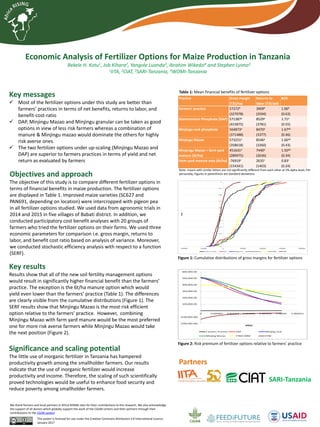
are clearly visible from the cumulative distributions (Figure 1). The
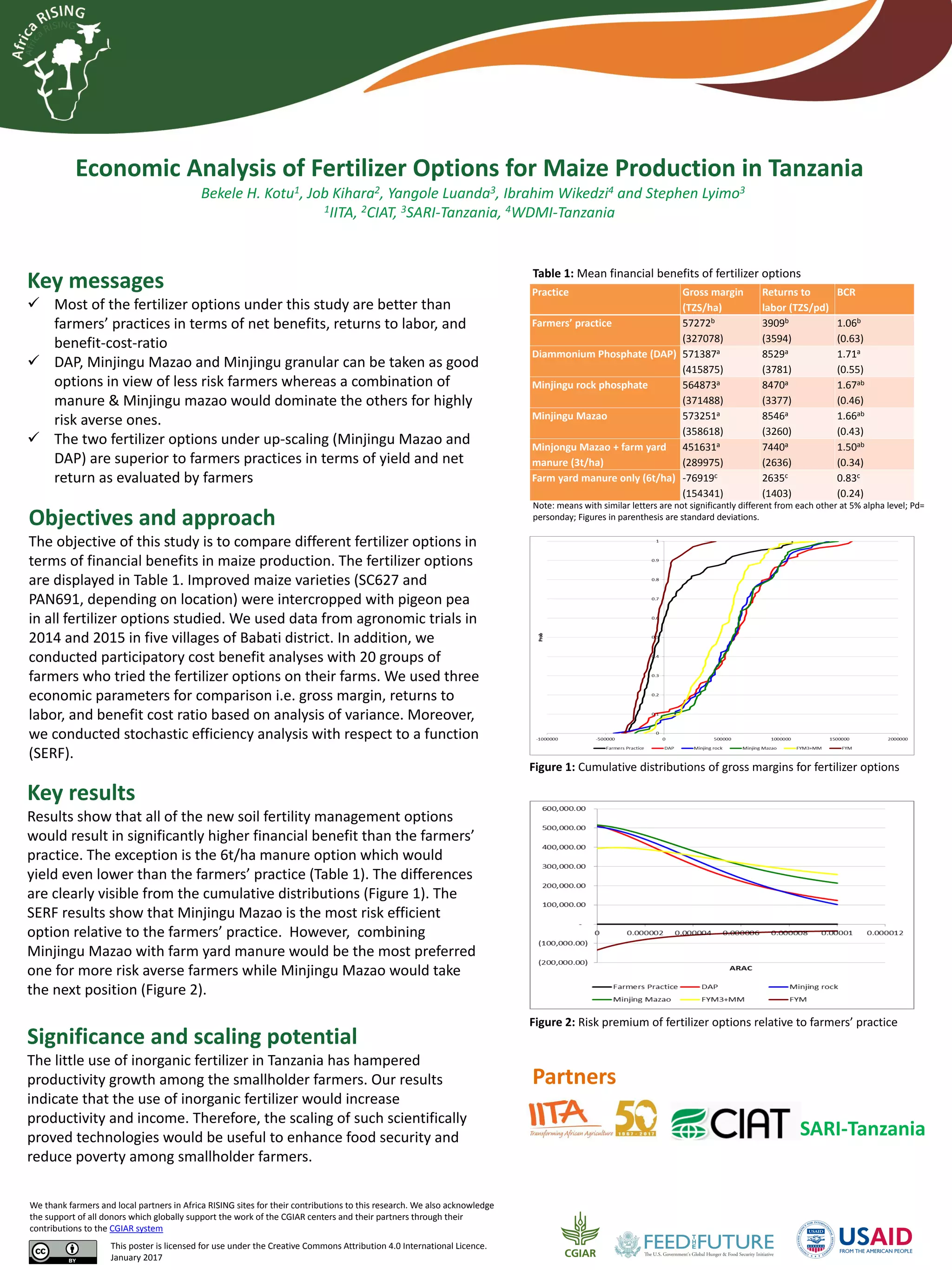
SERF results show that Minjingu Mazao is the most risk efficient
option relative to the farmers’ practice. However, combining
Minjingu Mazao with farm yard manure would be the most preferred
one for more risk averse farmers while Minjingu Mazao would take
the next position (Figure 2).
Significance and scaling potential
The little use of inorganic fertilizer in Tanzania has hampered
productivity growth among the smallholder farmers. Our results
indicate that the use of inorganic fertilizer would increase
productivity and income. Therefore, the scaling of such scientifically
proved technologies would be useful to enhance food security and
reduce poverty among smallholder farmers.
Practice Gross margin
(TZS/ha)
Returns to
labor (TZS/pd)
BCR
Farmers’ practice 57272b
(327078)
3909b
(3594)
1.06b
(0.63)
Diammonium Phosphate (DAP) 571387a
(415875)
8529a
(3781)
1.71a
(0.55)
Minjingu rock phosphate 564873a
(371488)
8470a
(3377)
1.67ab
(0.46)
Minjingu Mazao 573251a
(358618)
8546a
(3260)
1.66ab
(0.43)
Minjongu Mazao + farm yard
manure (3t/ha)
451631a
(289975)
7440a
(2636)
1.50ab
(0.34)
Farm yard manure only (6t/ha) -76919c
(154341)
2635c
(1403)
0.83c
(0.24)
Note: means with similar letters are not significantly different from each other at 5% alpha level; Pd=
personday; Figures in parenthesis are standard deviations.
Table 1: Mean financial benefits of fertilizer options
Figure 1: Cumulative distributions of gross margins for fertilizer options
Figure 2: Risk premium of fertilizer options relative to farmers’ practice
SARI-Tanzania

Economic analysis of fertilizer options for maize production in Tanzania

  • 1.
    Economic Analysis ofFertilizer Options for Maize Production in Tanzania Bekele H. Kotu1, Job Kihara2, Yangole Luanda3, Ibrahim Wikedzi4 and Stephen Lyimo3 1IITA, 2CIAT, 3SARI-Tanzania, 4WDMI-Tanzania Key messages  Most of the fertilizer options under this study are better than farmers’ practices in terms of net benefits, returns to labor, and benefit-cost-ratio  DAP, Minjingu Mazao and Minjingu granular can be taken as good options in view of less risk farmers whereas a combination of manure & Minjingu mazao would dominate the others for highly risk averse ones.  The two fertilizer options under up-scaling (Minjingu Mazao and DAP) are superior to farmers practices in terms of yield and net return as evaluated by farmers Partners This poster is licensed for use under the Creative Commons Attribution 4.0 International Licence. January 2017 We thank farmers and local partners in Africa RISING sites for their contributions to this research. We also acknowledge the support of all donors which globally support the work of the CGIAR centers and their partners through their contributions to the CGIAR system Objectives and approach The objective of this study is to compare different fertilizer options in terms of financial benefits in maize production. The fertilizer options are displayed in Table 1. Improved maize varieties (SC627 and PAN691, depending on location) were intercropped with pigeon pea in all fertilizer options studied. We used data from agronomic trials in 2014 and 2015 in five villages of Babati district. In addition, we conducted participatory cost benefit analyses with 20 groups of farmers who tried the fertilizer options on their farms. We used three economic parameters for comparison i.e. gross margin, returns to labor, and benefit cost ratio based on analysis of variance. Moreover, we conducted stochastic efficiency analysis with respect to a function (SERF). Key results Results show that all of the new soil fertility management options would result in significantly higher financial benefit than the farmers’ practice. The exception is the 6t/ha manure option which would yield even lower than the farmers’ practice (Table 1). The differences are clearly visible from the cumulative distributions (Figure 1). The SERF results show that Minjingu Mazao is the most risk efficient option relative to the farmers’ practice. However, combining Minjingu Mazao with farm yard manure would be the most preferred one for more risk averse farmers while Minjingu Mazao would take the next position (Figure 2). Significance and scaling potential The little use of inorganic fertilizer in Tanzania has hampered productivity growth among the smallholder farmers. Our results indicate that the use of inorganic fertilizer would increase productivity and income. Therefore, the scaling of such scientifically proved technologies would be useful to enhance food security and reduce poverty among smallholder farmers. Practice Gross margin (TZS/ha) Returns to labor (TZS/pd) BCR Farmers’ practice 57272b (327078) 3909b (3594) 1.06b (0.63) Diammonium Phosphate (DAP) 571387a (415875) 8529a (3781) 1.71a (0.55) Minjingu rock phosphate 564873a (371488) 8470a (3377) 1.67ab (0.46) Minjingu Mazao 573251a (358618) 8546a (3260) 1.66ab (0.43) Minjongu Mazao + farm yard manure (3t/ha) 451631a (289975) 7440a (2636) 1.50ab (0.34) Farm yard manure only (6t/ha) -76919c (154341) 2635c (1403) 0.83c (0.24) Note: means with similar letters are not significantly different from each other at 5% alpha level; Pd= personday; Figures in parenthesis are standard deviations. Table 1: Mean financial benefits of fertilizer options Figure 1: Cumulative distributions of gross margins for fertilizer options Figure 2: Risk premium of fertilizer options relative to farmers’ practice SARI-Tanzania