Biological control of aflatoxins in maize and groundnut through use of aflasafe products
developed for Ghana
D. Agbetiameh1,2, A. Ortega-Beltran1,R.T. Awuah2, A. Elzein1, J. Atehnkeng1, P.J. Cotty3, and R. Bandyopadhyay1
1International Institute of Tropical Agriculture (IITA–Ibadan, Nigeria)
2Department of Crops & Soil Sciences, Kwame Nkrumah University of Science & Technology (KNUST–Kumasi)
3USDA-ARS, School of Plant Sciences, University of Arizona, Tucson, AZ,USA
Corresponding author email: R.Bandyopadhyay@cgiar.org
Key messages
• aflasafe GH01 and aflasafe GH02 are safe, cost-effective, environmentally-benign
biocontrol products containing beneficial (i.e. non-toxin producing; atoxigenic) fungi
native to Ghana. Both products drastically reduce aflatoxin contamination in maize
and groundnut before harvest and until crops are consumed.
• One application of aflasafe (10 Kg/ha) 2-3 weeks before crop flowering modulates
Aspergillus community structure resident in the environment in favor of the
atoxigenic genotypes used as biocontrol agents.
• Use of aflasafe in maize and groundnut farming systems in Ghana has the potential
to enhance crop value, and reduce health and economic burdens frequently posed
by aflatoxin contamination in these crops.
This poster is licensed for use under the Creative Commons Attribution 4.0 International Licence.
January 2017
We thank farmers and local partners in Africa RISING sites for their contributions to this research. We also acknowledge
the support of all donors which globally support the work of the CGIAR centers and their partners through their
contributions to the CGIAR system
Objectives and approach
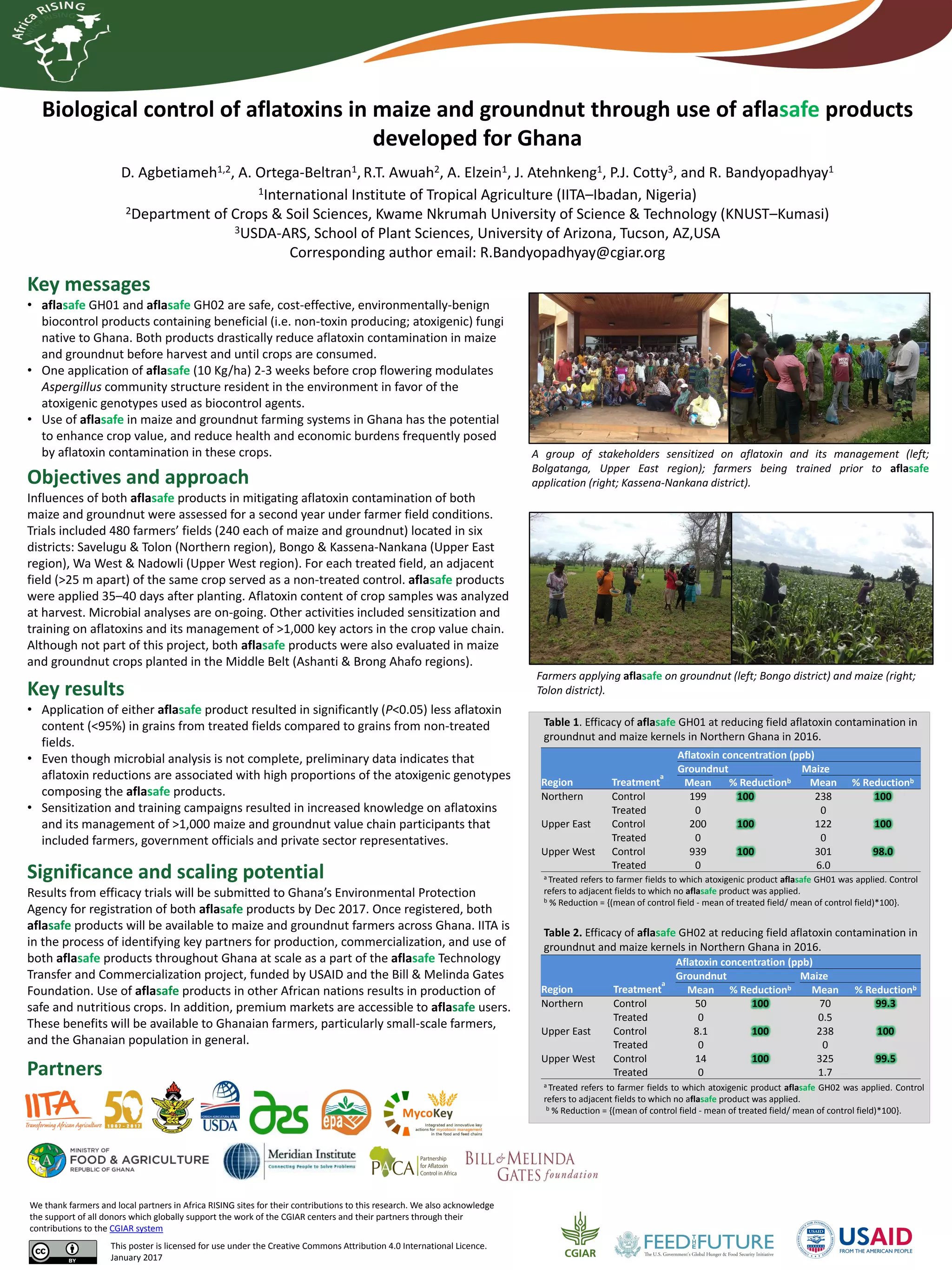
Influences of both aflasafe products in mitigating aflatoxin contamination of both
maize and groundnut were assessed for a second year under farmer field conditions.
Trials included 480 farmers’ fields (240 each of maize and groundnut) located in six
districts: Savelugu & Tolon (Northern region), Bongo & Kassena-Nankana (Upper East
region), Wa West & Nadowli (Upper West region). For each treated field, an adjacent
field (>25 m apart) of the same crop served as a non-treated control. aflasafe products
were applied 35–40 days after planting. Aflatoxin content of crop samples was analyzed
at harvest. Microbial analyses are on-going. Other activities included sensitization and
training on aflatoxins and its management of >1,000 key actors in the crop value chain.
Although not part of this project, both aflasafe products were also evaluated in maize
and groundnut crops planted in the Middle Belt (Ashanti & Brong Ahafo regions).
Key results
• Application of either aflasafe product resulted in significantly (P<0.05) less aflatoxin
content (<95%) in grains from treated fields compared to grains from non-treated
fields.
• Even though microbial analysis is not complete, preliminary data indicates that
aflatoxin reductions are associated with high proportions of the atoxigenic genotypes
composing the aflasafe products.
• Sensitization and training campaigns resulted in increased knowledge on aflatoxins
and its management of >1,000 maize and groundnut value chain participants that
included farmers, government officials and private sector representatives.
Significance and scaling potential
Results from efficacy trials will be submitted to Ghana’s Environmental Protection
Agency for registration of both aflasafe products by Dec 2017. Once registered, both
aflasafe products will be available to maize and groundnut farmers across Ghana. IITA is
in the process of identifying key partners for production, commercialization, and use of
both aflasafe products throughout Ghana at scale as a part of the aflasafe Technology
Transfer and Commercialization project, funded by USAID and the Bill & Melinda Gates
Foundation. Use of aflasafe products in other African nations results in production of
safe and nutritious crops. In addition, premium markets are accessible to aflasafe users.
These benefits will be available to Ghanaian farmers, particularly small-scale farmers,
and the Ghanaian population in general.
Farmers applying aflasafe on groundnut (left; Bongo district) and maize (right;
Tolon district).
A group of stakeholders sensitized on aflatoxin and its management (left;
Bolgatanga, Upper East region); farmers being trained prior to aflasafe
application (right; Kassena-Nankana district).
Region Treatment
a
Aflatoxin concentration (ppb)
Groundnut Maize
Mean % Reductionb Mean % Reductionb
Northern Control 50 100 70 99.3
Treated 0 0.5
Upper East Control 8.1 100 238 100
Treated 0 0
Upper West Control 14 100 325 99.5
Treated 0 1.7
Table 2. Efficacy of aflasafe GH02 at reducing field aflatoxin contamination in
groundnut and maize kernels in Northern Ghana in 2016.
Region Treatment
a
Aflatoxin concentration (ppb)
Groundnut Maize
Mean % Reductionb Mean % Reductionb
Northern Control 199 100 238 100
Treated 0 0
Upper East Control 200 100 122 100
Treated 0 0
Upper West Control 939 100 301 98.0
Treated 0 6.0
Table 1. Efficacy of aflasafe GH01 at reducing field aflatoxin contamination in
groundnut and maize kernels in Northern Ghana in 2016.
a Treated refers to farmer fields to which atoxigenic product aflasafe GH02 was applied. Control
refers to adjacent fields to which no aflasafe product was applied.
b % Reduction = {(mean of control field - mean of treated field/ mean of control field)*100}.
a Treated refers to farmer fields to which atoxigenic product aflasafe GH01 was applied. Control
refers to adjacent fields to which no aflasafe product was applied.
b % Reduction = {(mean of control field - mean of treated field/ mean of control field)*100}.
Partners

Biological control of aflatoxins in maize and groundnut through use of aflasafe products developed for Ghana

  • 1.
    Biological control ofaflatoxins in maize and groundnut through use of aflasafe products developed for Ghana D. Agbetiameh1,2, A. Ortega-Beltran1,R.T. Awuah2, A. Elzein1, J. Atehnkeng1, P.J. Cotty3, and R. Bandyopadhyay1 1International Institute of Tropical Agriculture (IITA–Ibadan, Nigeria) 2Department of Crops & Soil Sciences, Kwame Nkrumah University of Science & Technology (KNUST–Kumasi) 3USDA-ARS, School of Plant Sciences, University of Arizona, Tucson, AZ,USA Corresponding author email: R.Bandyopadhyay@cgiar.org Key messages • aflasafe GH01 and aflasafe GH02 are safe, cost-effective, environmentally-benign biocontrol products containing beneficial (i.e. non-toxin producing; atoxigenic) fungi native to Ghana. Both products drastically reduce aflatoxin contamination in maize and groundnut before harvest and until crops are consumed. • One application of aflasafe (10 Kg/ha) 2-3 weeks before crop flowering modulates Aspergillus community structure resident in the environment in favor of the atoxigenic genotypes used as biocontrol agents. • Use of aflasafe in maize and groundnut farming systems in Ghana has the potential to enhance crop value, and reduce health and economic burdens frequently posed by aflatoxin contamination in these crops. This poster is licensed for use under the Creative Commons Attribution 4.0 International Licence. January 2017 We thank farmers and local partners in Africa RISING sites for their contributions to this research. We also acknowledge the support of all donors which globally support the work of the CGIAR centers and their partners through their contributions to the CGIAR system Objectives and approach Influences of both aflasafe products in mitigating aflatoxin contamination of both maize and groundnut were assessed for a second year under farmer field conditions. Trials included 480 farmers’ fields (240 each of maize and groundnut) located in six districts: Savelugu & Tolon (Northern region), Bongo & Kassena-Nankana (Upper East region), Wa West & Nadowli (Upper West region). For each treated field, an adjacent field (>25 m apart) of the same crop served as a non-treated control. aflasafe products were applied 35–40 days after planting. Aflatoxin content of crop samples was analyzed at harvest. Microbial analyses are on-going. Other activities included sensitization and training on aflatoxins and its management of >1,000 key actors in the crop value chain. Although not part of this project, both aflasafe products were also evaluated in maize and groundnut crops planted in the Middle Belt (Ashanti & Brong Ahafo regions). Key results • Application of either aflasafe product resulted in significantly (P<0.05) less aflatoxin content (<95%) in grains from treated fields compared to grains from non-treated fields. • Even though microbial analysis is not complete, preliminary data indicates that aflatoxin reductions are associated with high proportions of the atoxigenic genotypes composing the aflasafe products. • Sensitization and training campaigns resulted in increased knowledge on aflatoxins and its management of >1,000 maize and groundnut value chain participants that included farmers, government officials and private sector representatives. Significance and scaling potential Results from efficacy trials will be submitted to Ghana’s Environmental Protection Agency for registration of both aflasafe products by Dec 2017. Once registered, both aflasafe products will be available to maize and groundnut farmers across Ghana. IITA is in the process of identifying key partners for production, commercialization, and use of both aflasafe products throughout Ghana at scale as a part of the aflasafe Technology Transfer and Commercialization project, funded by USAID and the Bill & Melinda Gates Foundation. Use of aflasafe products in other African nations results in production of safe and nutritious crops. In addition, premium markets are accessible to aflasafe users. These benefits will be available to Ghanaian farmers, particularly small-scale farmers, and the Ghanaian population in general. Farmers applying aflasafe on groundnut (left; Bongo district) and maize (right; Tolon district). A group of stakeholders sensitized on aflatoxin and its management (left; Bolgatanga, Upper East region); farmers being trained prior to aflasafe application (right; Kassena-Nankana district). Region Treatment a Aflatoxin concentration (ppb) Groundnut Maize Mean % Reductionb Mean % Reductionb Northern Control 50 100 70 99.3 Treated 0 0.5 Upper East Control 8.1 100 238 100 Treated 0 0 Upper West Control 14 100 325 99.5 Treated 0 1.7 Table 2. Efficacy of aflasafe GH02 at reducing field aflatoxin contamination in groundnut and maize kernels in Northern Ghana in 2016. Region Treatment a Aflatoxin concentration (ppb) Groundnut Maize Mean % Reductionb Mean % Reductionb Northern Control 199 100 238 100 Treated 0 0 Upper East Control 200 100 122 100 Treated 0 0 Upper West Control 939 100 301 98.0 Treated 0 6.0 Table 1. Efficacy of aflasafe GH01 at reducing field aflatoxin contamination in groundnut and maize kernels in Northern Ghana in 2016. a Treated refers to farmer fields to which atoxigenic product aflasafe GH02 was applied. Control refers to adjacent fields to which no aflasafe product was applied. b % Reduction = {(mean of control field - mean of treated field/ mean of control field)*100}. a Treated refers to farmer fields to which atoxigenic product aflasafe GH01 was applied. Control refers to adjacent fields to which no aflasafe product was applied. b % Reduction = {(mean of control field - mean of treated field/ mean of control field)*100}. Partners