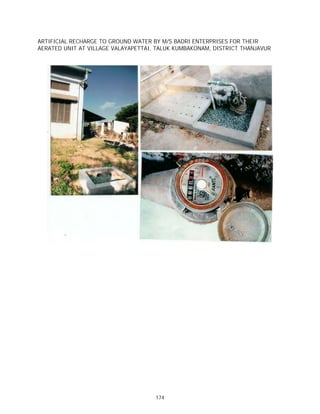
SELECT CASE STUDIES

                                                                                    RAIN WATER HARVESTING
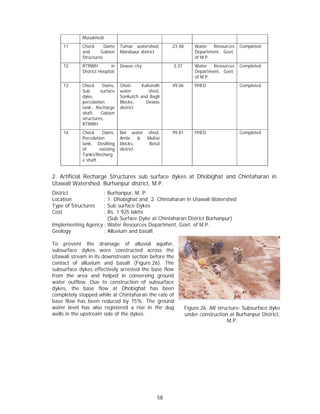
                                                                                                  and
                                                                                      ARTIFICIAL RECHARGE


Central Ground Water Board
18/11, Jam Nagar House, Mansingh Road
New Delhi – 110011
Phone : 011- 23385620
Fax : 011- 23388310
                                                                                     Central Ground Water Board
                                        Printed by : JMD - 9899590095, 9811203410


Web Site: www.cgwb.gov.in                                                              Ministry of Water Resources
Front page image : Painting by
Master. RAHUL RANJAN, VI STD                                                                    New Delhi
P.S.R Public School, Vizianagaran                                                                May 2011
Andhra Pradesh
CENTRAL GROUND WATER BOARD
MINISTRY OF WATER RESOURCES
         NEW DELHI
Prepared & Compiled under the Technical Guidance of

                                      Dr. S.C. Dhiman, Chairman
                                      Central Ground Water Board, New Delhi

                                      &

                                      Sushil Gupta, Member
                                      Central Ground Water Board, New Delhi


Contrtibutors
Anoop Nagar, Superintending Hydrogeologist, CGWB, New Delhi

S. N. Bhattacharya, Scientist-D, CGWA, New Delhi

Dr. Poonam Sharma, Scientist-D, CGWB, New Delhi

Dr. S. Subramanian, Scientist-C, CGWB, New Delhi

Dr. M. Senthil Kumar, Scientist-B, CGWB, South Eastern Coastal Region, Chennai

Saidul Haq, Assitant Hydrogeologist, CGWB, New Delhi

Faisal Abrar, Assistant Hydrogeologist, CGWA, New Delhi

P. Yadaiah, STA (HG), CGWB, New Delhi
Dr. S.C. Dhiman
 Chairman


                                       FOREWORD

         Groundwater is the major source of freshwater that caters to the demand of ever
growing domestic, agricultural and industrial sectors of the country. This renewable
resource is being indiscriminately exploited by several users. On the other hand, rapid
urbanization and land use changes has resulted in reduced natural infiltration /recharge of
aquifers. This has lead to various problems related to quantity and quality and issues like
the decline in water levels, depletion of groundwater resource and quality deterioration.
There is thus an imperative need for augmenting the valuable ground water resource.
Artificial recharge and roof top rainwater harvesting is one such method that can revive this
precious resource. Several traditional and scientifically proven artificial recharge and
rainwater harvesting techniques have been adopted in different parts of the country. These
structures have proven to be viable option for augmenting the groundwater aquifers by
making use of surplus surface runoff.

       The pioneering efforts by Central Ground Water Board (CGWB) have been
instrumental in popularizing several cost-effective recharge techniques suitable for different
hydrogeological conditions of the country. CGWB has already implemented numerous
demonstrative schemes of artificial recharge to ground water across the country.

       The untiring efforts of the Government organizations, scientific community & NGO’s
with people’s active participation have shown remarkable results in reducing the declining
trends of the groundwater resources in select pockets of the country. An effort has been
made to compile such kind of success stories in this report. The report throws light on the
recharge techniques practiced traditionally in different regions of the country.

         This report would be of immense help to the water managers, NGO’s, local bodies
all those who are concerned with recharging of the groundwater resources and monitoring
its impact.


New Delhi                                                                 Dr.S.C.Dhiman
May, 2011                                                               Chairman, CGWB
Preface

        In the last few decades rapid urbanization coupled with technological development
in construction of deep tube wells have contributed to large-scale exploitation of
groundwater. This has resulted in lowering of water table so much that many dug wells and
tube/bore wells giving previously sufficient yield have decreased now in their yield and
ultimately drying up. The situation becomes more precarious during summer. In many parts
of the country, ground water development has already reached a critical stage, resulting in
acute scarcity of the resource. Artificial recharge is the technique that can revive and sustain
development of groundwater. Several traditional and scientifically proven artificial recharge
methodologies have been adopted in different regions of the country.

       Central Ground Water Board has been in the forefront of activities for augmenting
ground water resources through scientifically designed artificial recharge structures for
harvesting runoff which otherwise runs off into sea. A number of pilot schemes and
demonstrative artificial recharge schemes have been implemented by the CGWB in
association with various State Government organizations since the 8th plan period. These are
aimed at popularizing cost-effective ground water augmentation techniques suitable for
various hydrogeological settings, to be replicated by other agencies elsewhere in similar
areas.

         The work done by Central Ground Water Board and other state and non-
governmental agencies involved in the water sector have provided the basic inputs
necessary for the preparation of this report. The present compilation highlights case studies
in artificial recharge and impact of such measures in ameliorating problems related to
groundwater.

        I hope this report will be useful to all agencies engaged in monitoring the impact of
the artificial recharge schemes across the country.


New Delhi                                                                  Sushil Gupta
May, 2011                                                          Member (SML), CGWB
CONTENT

                                                      Page No.
FOREWORD

PREFACE

INTRODUCTION                                                1

II.    GROUND WATER DEVELOPMENT SCENARIO OF THE COUNTRY     2

III.   NEED FOR ARTIFICIAL RECHARGE                         5

IV.    TRADITIONAL PRACTICES OF ARTIFICIAL RECHARGE         5

       A. Trans-Himalayan Regio                              6
       B. Western Himalaya region                            6
       C. Eastern Himalaya Region                            7
       D. Northeastern Hill Ranges                           7
       E. Brahmaputra Valley                                 8
       F. Indo-Gangetic Plains                               8
       G. Thar Deserts                                       9
       H. Central Highlands                                 12
       I.   Eastern Highlands                               13
       J.   Deccan Plateau                                  14
       K. Western Ghats                                     15
       L. Eastern Ghats                                     16
       M. Eastern Coastal plains                            16
       N. The Islands                                       17

V.     PLANNING OF ARTIFICIAL RECHARGE PROJECTS            18
                                        i
VI.    ARTIFICIAL RECHARGE TECHNIQUES AND DESIGN             19

VII.   EFFORTS OF CENTRAL GROUND WATER BOARD ON ARTIFICIAL
       RECHARGE AND RAIN WATER HARVESTING                     24


VIII. COMMON RECHARGE TECHNIQUES IMPLEMENTED BY CGWB:        29

IX.    SUCCESS STORIES OF ARTIFICIAL RECHARGRE IN STATES     30
       A. ANDHRA PRADESH                                      30
       B. CHHATTISGARH                                        34
       C. N C T, Delhi :                                      42
       D. KARNATAKA                                           53
       E. MADHYA PRADESH                                      55
       F. MAHARASHTRA                                         64
       G. NORTH EASTERN STATES                                73
       H. ORISSA                                              84
       I.   HARYANA & PUNJAB                                 118
       J.   TAMIL NADU                                       126
       K. WEST BENGAL & SIKKAM                               143
       L. ANDMAN & NICOBAR ISLANDS                           149

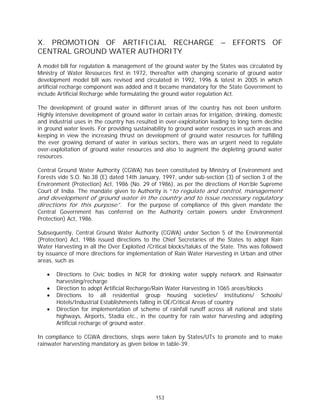
X      PROMOTION OF ARTIFICIAL RECHARGE – EFFORTS OF         152
       CENTRAL GROUND WATER AUTHORITY


                                     ii
List of figures

 Table                                Description                                    Page no
   No
1.       Categorization of Assessment Units Based on the Stage of Ground                   4
         Water Development in India (As on March 2004)
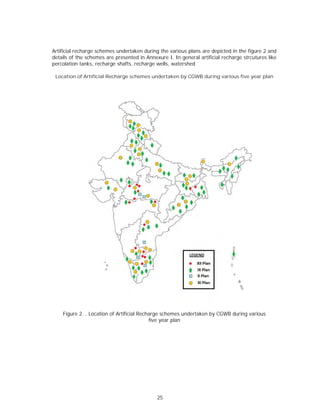
2.       Location of Artificial Recharge schemes undertaken by CGWB during                25
         various five year plan.

3        Artificial Recharge technique adopted in Pulakuntlaplle.                         31
4        Location of the Abandoned dugwells in Chennareddy palle village, AP              33
5        Check dam at Mehra kala                                                          37
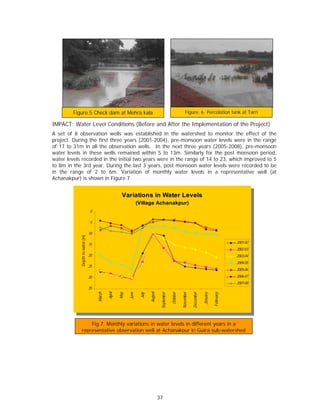
6        Percolation tank at Tarri                                                        37
7        Monthly variations in water levels in different years in a representative        37
         observation well at Achanakpur in Gujra sub-watershed
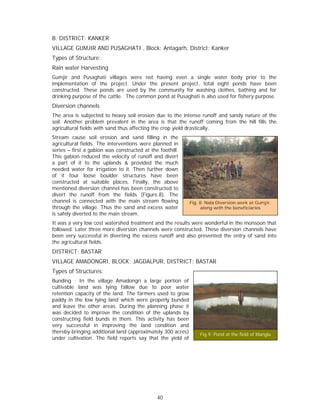
8        Nala Diversion work at Gumjir, along with the beneficiaries                      40
9        Pond at the field of Manglu                                                      40
9a       Increased crop area                                                              41
10       Impact of the pond - paddy field                                                 41
11       Artificial recharge design at President’s Estate, ND                             43
12       Rainwater harvesting system at Shram Sakthi Bhawan, ND                           44
13       Artificial recharge design at Sultan Garhi Tomb, ND                              45
14       Artificial recharge design of the Indira Gandhi International Airport, ND        46
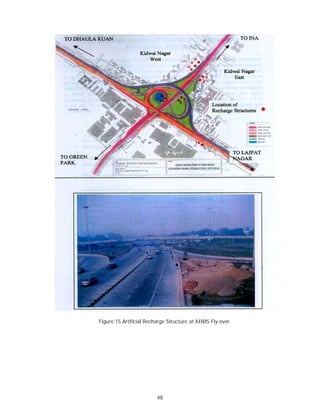
15       Artificial Recharge Structure at AIIMS Fly-over, ND                              48
16       Rain Water Harvesting and Artificial Recharge to Ground Water at                 49
         Gandhi Smriti Bhawan, Tees January Marg, ND
17       RWH & AR to Groundwater at Gandhi Smriti Bhawan, ND                              49
18       RWH & AR to Groundwater at bungalow 78 Lodhi Estate, ND                          50
19       AR structure constructed at Resident Welfare Association, Saket, ND              51
20       AR structure constructed at Mira model school, Janakpuri, ND                     51
21       AR structure constructed at Som Vihar Apartment, RK Puram, ND                    52
22       AR structure constructed at Resident Welfare society, Alaknanda ND               52
23       RTRWH & AR structure constructed at Defence colony, ND                           52
24       AR structure constructed at Freesia Farm, ND                                     53
25       AR & RWH case studies                                                            56
26       AR structure- Subsurface dyke under construction at Burhanpur                    58
         District, M.P
27       Subsurface Dykes Barwa Kalan, Ajnar sub basin, Rajgarh district, MP              59
28       Subsurface Dykes at Londri Nala, District Dewas                                  59
29       AR Structures constructed at Kheda, Roopawali, Afzal villages                    61
30       Recharge Shaft at Mendkichak District Dewas                                      62
31       AR structures constructed in Choti Kalisindh, Dewas Watershed                    64

                                           iii
32      Location of soil and water conservation structures constructed             66
33      Artificial Recharge Structures constructed at Ralegan Siddhi               68
34a     Percolation Tank at Manikpur                                               70
34b     Percolation Tank at Benoda                                                 70
35      Injection well at Dambhurni, Watershed TE-17, Jalgaon District             71
36      AR structures shaft with recharge well.                                    72
37      RTRWH & AR structures at Ramtek, Nagpur district.                          73
38      RTRWH and AR structure constructed in IGP & Circuit House, Shillong        78
39      RTRWH and AR structure constructed in District library & A Convent,        80
        Shillong
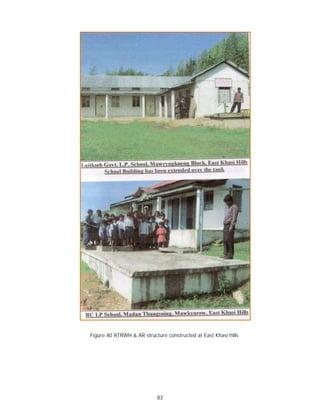
40      RTRWH & AR structure constructed in schools in East Khasi hills           83
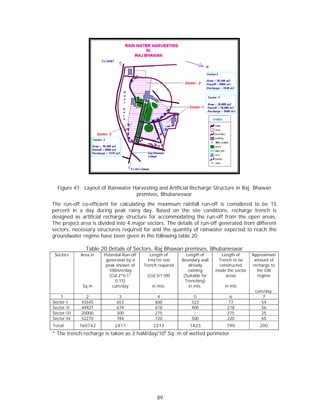
41      Layout of Rainwater Harvesting and Artificial Recharge Structure in Raj   89
        Bhawan premises, Bhubaneswar
42      Civil Structures for Rain Water Harvesting & Artificial Recharge           90
(A-E)   constructed in Raj Bhawan Premises, Bhubaneswar.
43      Composite Hydrograph of Deeper Aquifer, Raj Bhawan Premises,               93
        Bhubaneswar
44      Effect of Rainfall on the Deeper Aquifer                                  94
45      Impact of Artificial Recharge on Deeper Aquifer                           94
46      Improvement of Water Level Due to Artificial Recharge, Raj Bhawan         95
        Premises, Bhubaneswar.
47      Hydrograph of Observation well, Rajbhawan Premises showing Impact          95
        of Artificial recharge
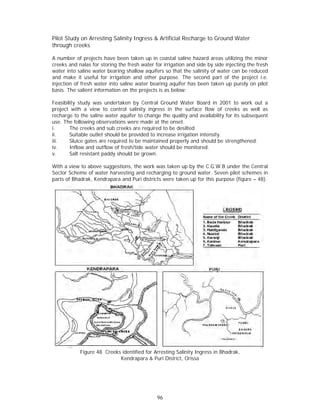
48      Creeks identified for Arresting Salinity Ingress in Bhadrak, Kendrapara    96
        & Puri District, Orissa
49(A-   Civil Construction Structures in the Creek Areas of Bhadrak District      101
H)
50      Artificial Recharge Structures in Basudevpur and Chandbali Blocks of      104
        Bhadrak                   District, Orissa.
51      Improvement of Ground Water Quality due to Artificial Recharge            106
        (Depth Vs Conductivity)
52      Improvement of Ground Water Quality due to Artificial Recharge            106
        (Temperature vs Conductivity )
53      Behaviour of floating fresh water lenses during pumping &                 107
        recouperation
54      Impact Assessment – Improvement in Depth to Water level, Kalajore         109
        Watershed, Ganjam District
55      Depth to Water level in Metres below ground level-Pre-monsoon             111
(A&B)
56      Artificial recharge structures, Tamkajodi Watershed, Saharpada Block,     112
(A-D)   Keonjhar District.
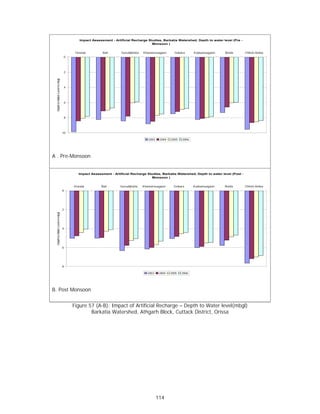
57      Impact of Artificial Recharge – Depth to Water level(mbgl) Barkatia       114
(A&B)   Watershed, Athgarh Block, Cuttack District, Orissa

                                         iv
58      Artificial Recharge Structures, Barkatia Watershed, Athgarh Block,            115
(A-D)   Cuttack District
59      Impact Assessment – Roof Top Rain Water Harvesting, HP                        117
(A&B)   Administrative Building, Bhubaneswar
60      Pond at Channian Nakodar Block, District Jalandhar                            119
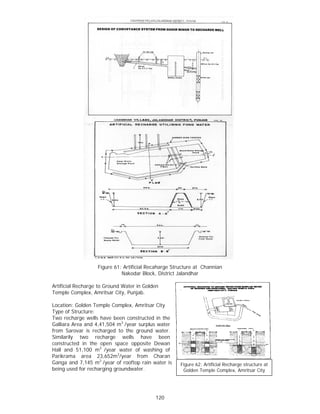
61      Artificial Recharge Structure at Channian Nakodar Block, District Jalandhar   120
62      Artificial Recharge structure at Golden Temple Complex, Amritsar City         120
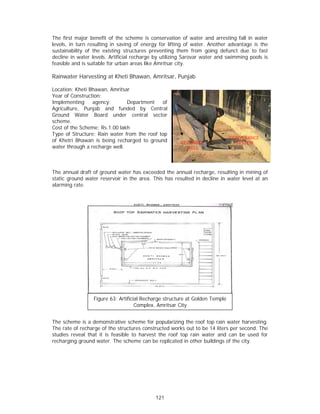
63      Artificial Recharge structure at Golden Temple Complex, Amritsar City         121

64      Artificial Recharge structure at Miranpur Choe, Block Patiala                 123
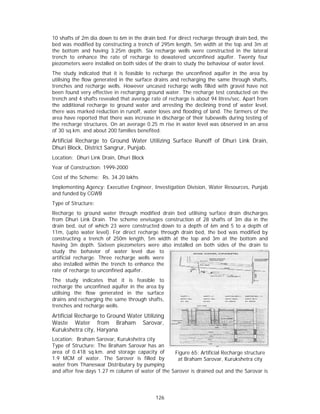
65      Artificial Recharge structure at Braham Sarovar, Kurukshetra city             125
66      Hydrograph at Madam, Dharampuri District                                      129
67      Impact analysis- hydrographs of Kunavelampatti, Namakkal District             130
68      Impact of Percolation Ponds in Coimbatore District on pumping pattern         133
69      Hydrographs adjacent to Sub Surface Dyke in Avaravalli,                       134
        Tiruchchirappalli District
70      Hydrographs of OW on Upstream & downstream of dyke                            135
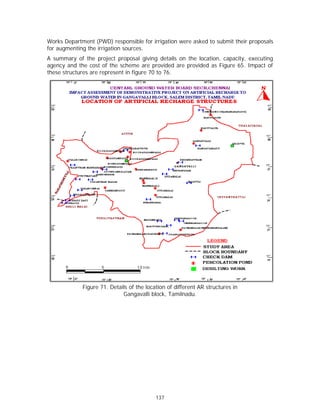
71      Details of the location of different AR structures in Gangavalli block,       136
        Tamilnadu
72      Impact on Water levels – Pre-monsoon period                                   137
73      Impact on Water levels -- Post monsoon period                                 138
74      Impact of AR structures on command area                                       139

75      Impact of AR structures- increase in paddy cultivation area                   140
76      Impact of AR structures- increase & changes in pumping pattern                141
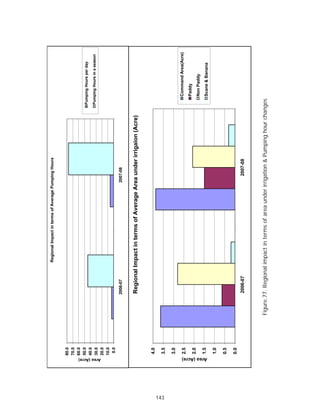
77      Regional impact in terms of area under irrigation & Pumping hour              142
        changes
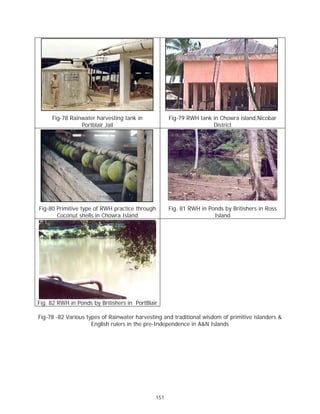
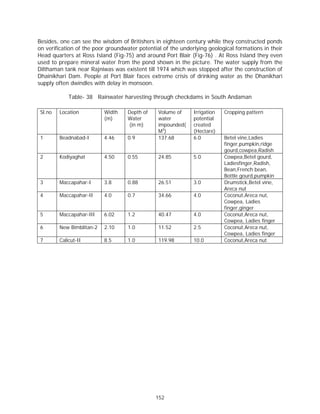
78      Rainwater harvesting tank in Portblair Jail                                   150
79      RWH tank in Chowra island, Nicobar District                                   150
80      Primitive type of RWH practice through Coconut shells in Chowra               150
        Island
81      RWH in Ponds by Britishers in Ross Island                                     150
82      RWH in Ponds by Britishers in PortBlair                                       150


                                             v
List of Tables

 Table                                Description                              Page
  No                                                                            no
1        State-wise Ground Water Resources Availability, Utilization and           2
         Stage of Development in India (in BCM)
1a       Criteria for categorization of assessment units.                          4
2a       AR studies taken by CGWB during different five year plan                 24
2b                                                                                27
         State wise funds approved and released during XI Plan (in lakhs)
3        AR to Groundwater through Dugwell recharge scheme                        28
4        Salient features of the recharge scheme.                                 54
5        AR Project taken up during freshwater year and their cost                55
6        Details of AR structures financed by CGWB in MP                          57
7        Details of soil and water conservation structures constructed            66
8        Location of Recharge Structures Constructed in WR-2 Watershed,           69
         Warud Taluka, Amravati District
9                                                                                 70
         Location of Recharge Structures Constructed in TE-17 Watershed,
         Yaval Taluka, Jalgaon District
10                                                                                72
         Location of Recharge Structures Constructed in TE-11 Watershed,
         Yaval Taluka, Jalgaon District
11       State wise Rooftop Rainwater Harvesting Structures                       74
12       Rooftop Rainwater Harvesting Structures constructed in Arunachal         74
         Pradesh
13       Salient features of rain water harvesting in Kamrup District, Assam      75
14       Roof Top Rain Water Harvesting schemes in Meghalaya                      76
15       Roof Top Rain Water Harvesting schemes in Mizoram                        76
16       Details of Rain Water Harvesting Structures in Nagaland                  77
17       Details of Roof Top Rain Water Harvesting Structures Implemented         77
         by the Soil & Conservation Department, Rengma, Nagaland
18       Details of Roof Top Rain Water Harvesting Structures Implemented         79
         by NGO
19       Details of Implementation by Bethani Society, Meghalaya                  82
20       Details of Sectors, Raj Bhawan premises, Bhubaneswar                     89
21       Sector wise details of structures, Raj Bhawan premises,                  90
         Bhubaneswar
22       Construction Details of Recharge Borewells                               91
23 (a-   Construction Details of Recharge trench and filter chamber               91
d)
24       Details of rainwater collected in roof top                               92
                                           vi
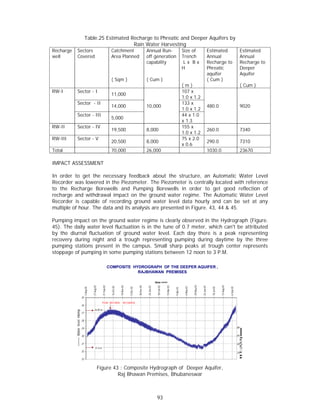
Estimated Recharge to Phreatic and Deeper Aquifers by Rain Water
25    Harvesting                                                                93

26    Details of Renovation Work Done                                           99
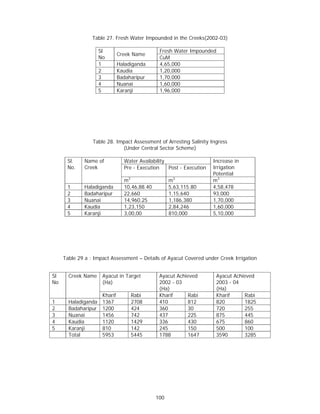
27    Fresh Water Impounded in the Creeks (2002-03)                            100
28    Impact Assessment of Arresting Salinity Ingress (Under CSS)              100
29a   Impact Assessment – Details of Ayacut Covered under Creek                100
      Irrigation
29b   Impact Assessment Details under Creek Irrigation                         102
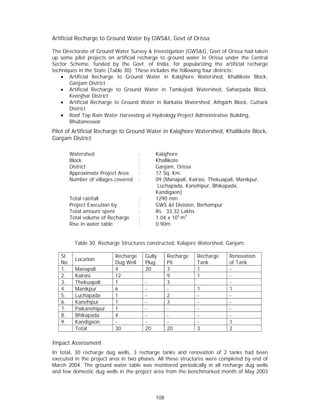
30    Recharge Structures constructed, Kalajore Watershed, Ganjam              108
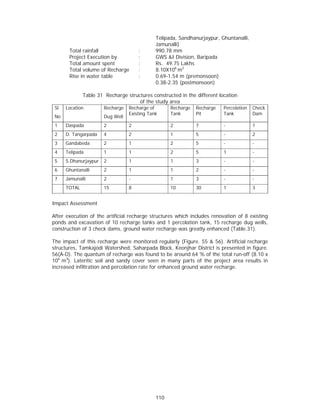
31    Recharge structures have been constructed in the different location      110
      of the study area
32    Artificial Recharge Structures (ARS) constructed in the Barakatianalla   113
33    Impact Assessment – Depth to water level in metres below ground          113
      level (in Dug Wells)Barkatia Watershed, Athgarh Block, Cuttack
      District
34    Impact Assessment – Depth to Water Level, HP Building,                   116
      Bhubaneswar
35    Details of villages in Tamil Nadu where subsurface dykes were            127
      constructed
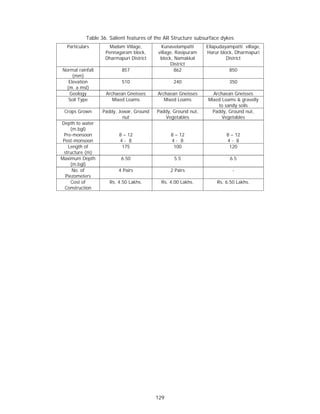
36    Salient features of the AR Structure subsurface dykes                    128
37    Summary of impact on irrigation                                          131
38    Rainwater harvesting through checkdams in South Andaman                  151
39    Action taken by State/UTs government to Promote Rainwater                153
      harvesting
40    Criteria for Granting NOC for withdrwal to Industries                    159
41    NOC granted by CGWA & RWH adopted by Industries                          160


                                       vii
I.     INTRODUCTION

In the last three decades an exponential growth in number of ground water structures has been
observed. This has lead to enormous withdrawal of groundwater for various uses of agricultural,
industrial and other domestic needs. This resource has become an important source of drinking
water and food security for teeming millions of the state. It provides 70 percent of water for
domestic use in rural areas and about 50 percent of water for urban and industrial areas. The
significant contribution made for Green Revolution and also as primary reliable source of
irrigation during drought years has further strengthened the people’s faith in utilisation of
ground water as dependable source.
The speedy and uncontrolled usage of ground water has also created many problems. The
intensive ground water development in many parts of the country has resulted in depletion of
ground water levels and availability of the resource. The pristine ground water quality too
became its victim. Though, for the State as a whole the availability of ground water resources
appears quite comfortable but localised areas have shown the deleterious effects of excessive
ground water development. To maintain sustainability of ground water resources artificial
recharge to ground water is being practiced. Subsurface reservoirs are very attractive and
technically feasible alternatives for storing surplus monsoon runoff. These subsurface reservoirs
can store substantial quantity of water. The sub-surface storages have advantages of being
free from the adverse effects like inundation of large surface area and no gigantic structures
are required. The conduit functions of aquifers thereby reducing the cost intensive surface
water conveyance system. The effluence resulting from such sub-surface storage at various
surface intersection points in the form of spring line, or stream emergence, would enhance the
river flows and improve the presently degraded ecosystem of riverine tracts, particularly in the
outfall areas. Central Ground Water Board started Artificail Recahrge Studies during VIII the
Plan (1992-1997) during which recharge studies in Maharashtra, Karnataka, Andhra Pradesh,
Delhi, Kerala, Madhya Pradesh, Tamil Nadu, West Bengal, & Chandigarh were takenup. The
recharge works were takenup as wide spread declines were observed in the water level in the
country. The studies were takenup with a objective to identify suitable artificial recharge
structure in different hydrogeological terrains. The studies have been continued during different
five year plans till date.


                                              1
II.      GROUND WATER DEVELOPMENT SCENARIO OF THE
         COUNTRY

Annual precipitation in India is of the order of 4000 BCM (including snowfall) and the natural
runoff in the rivers is computed to be about 1869 BCM. The utilizable surface water and
replenishable ground water resources are of the order of 690 BCM and 433 BCM respectively.
Thus, the total water resources available for various uses, on an annual basis, are of the order
of 1123 BCM. Although the per capita availability of water in India is about 1869 cubic meters
as in 1997 against the benchmark value of 1000 Cu m signifying ‘water-starved’ condition, there
is wide disparity in basin-wise water availability due to uneven rainfall and varying population
density in the country. The availability is as high as 14057 cu m per capita in Brahmaputra/
Barak Basin and as low as 307 cu m in Sabarmati basin. Many other basins like Mahi, Tapi,
Pennar are already water stressed.
The ground water availability in the Indian sub-continent is highly complex due to diversified
geological formations, complexity in tectonic framework, climatological dissimilarities and
changing hydro-chemical environments. Ground water development in different areas of the
country is not uniform. There is intensive development of ground water in certain areas, which
has resulted in over – exploitation of the ground water resources and led to declining trend in
levels of ground water. As per the latest assessment of ground water resources carried out
jointly by the Central Ground Water Board and the concerned States, out of 5723 assessment
units (Blocks/ Mandals/Talukas) in the country, 839 units in various States have been
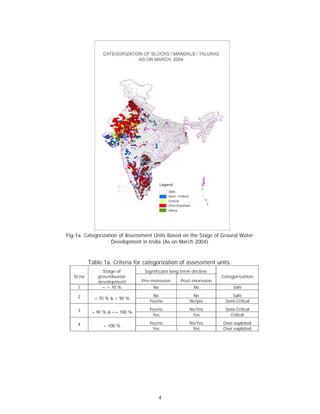
categorized as ‘Over-exploited’ (Figure.1) i.e. the annual ground water extraction exceeds the
annual replenishable resource and significant decline in long term ground water levels has been
observed either in pre- monsoon or post-monsoon or both. In addition, 226 units are ‘Critical’
i.e. the stage of ground water development is above 90 % and within 100% of annual
replenishable resource and significant decline is observed in trend of long term water levels in
both pre-monsoon and post-monsoon periods. The state-wise statuses of over-exploited and
critical areas and criteria for categorization are given in Table 1 & 1a.
       Table.1. State-wise Ground Water Resources Availability, Utilization and Stage of
                               Development in India (in BCM)

  Sl.       States / Union      Annual    Natural    Net     Annual Stage of Categorization
  No.         Territories    Replenishab Discharge Annual Ground Ground       of assessment
                              le Ground   during   Ground Water       Water        Units
                                Water       non-   Water      Draft Developm    (numbers)
                              Resources monsoon Availability         ent (%)
                                          season                             Over-    Critical
                                                                               exploited
        States
      1 Andhra Pradesh          36.5        3.55     32.95     14.9      45       219      77
      2 Arunachal Pradesh       2.56        0.26      2.3     0.0008    0.04       0       0
      3 Assam                   27.23       2.34     24.89     5.44      22        0       0
      4 Bihar                   29.19       1.77     27.42    10.77      39        0       0
      5 Chhattisgarh            14.93       1.25     13.68     2.8       20        0       0
      6 Delhi                    0.3        0.02      0.28     0.48     170        7       0
      7 Goa                     0.28        0.02      0.27     0.07      27        0       0


                                               2
Sl.      States / Union      Annual    Natural    Net     Annual Stage of Categorization
No.        Territories    Replenishab Discharge Annual Ground Ground       of assessment
                           le Ground   during   Ground Water       Water        Units
                             Water       non-   Water      Draft Developm    (numbers)
                           Resources monsoon Availability         ent (%)
                                       season                             Over-    Critical
                                                                            exploited
 8 Gujarat                   15.81       0.79      15.02    11.49     76       31       12
 9 Haryana                   9.31        0.68       8.63     9.45    109       55       11
10 Himachal Pradesh          0.43        0.04       0.39     0.12     30        0        0
11 Jammu & Kashmir            2.7        0.27       2.43     0.33     14        0        0
12 Jharkhand                 5.58        0.33       5.25     1.09     21        0        0
13 Karnataka                 15.93       0.63       15.3    10.71     70       65        3
14 Kerala                    6.84        0.61       6.23     2.92     47        5       15
15 Madhya Pradesh            37.19       1.86      35.33    17.12     48       24        5
16 Maharashtra               32.96       1.75      31.21    15.09     48        7        1
17 Manipur                   0.38        0.04       0.34    0.002    0.65       0        0
18 Meghalaya                 1.15        0.12       1.04    0.002    0.18       0        0
19 Mizoram                   0.04       0.004       0.04    0.0004   0.9        0        0
20 Nagaland                  0.36        0.04       0.32    0.009     3         0        0
21 Orissa                    23.09       2.08      21.01     3.85     18        0        0
22 Punjab                    23.78       2.33      21.44    31.16    145       103       5
23 Rajasthan                 11.56       1.18      10.38    12.99    125       140      50
24 Sikkim                    0.08         0         0.08     0.01     16        0        0
25 Tamil Nadu                23.07       2.31      20.76    17.65     85       142      33
26 Tripura                   2.19        0.22       1.97     0.17     9         0        0
27 Uttar Pradesh             76.35       6.17      70.18    48.78     70       37       13
28 Uttarakhand               2.27        0.17       2.1      1.39     66        2        0
29 West Bengal               30.36       2.9       27.46    11.65     42        0        1
      Total States          432.42      33.73      398.7    230.4    58       837       226
      Union Territories

 1 Andaman & Nicobar         0.33       0.005       0.32     0.01     4         0        0
 2 Chandigarh                0.023      0.002       0.02      0       0         0        0
 3 Dadra & Nagar Haveli      0.063      0.003       0.06    0.009     14        0        0
 4 Daman & Diu               0.009      0.0004     0.008    0.009    107        1        0
 5 Lakshadweep               0.012      0.009      0.004    0.002     63        0        0
 6 Pondicherry               0.16       0.016      0.144    0.151    105        1        0
      Total UTs              0.597      0.036      0.556    0.181     33        2        0
      Grand Total           433.02      33.77      399.25   230.6    58       839       226


                                               3
Fig-1a. Categorization of Assessment Units Based on the Stage of Ground Water
                    Development in India (As on March 2004)


           Table.1a. Criteria for categorization of assessment units.
                Stage of         Significant long term decline
   Sl.no      groundwater                                        Categorization
              development       Pre-monsoon      Post-monsoon
    1           < = 70 %             No                No               Safe

    2                                No               No             Safe
             > 70 % & < 90 %
                                   Yes/no            No/yes       Semi-Critical

    3                              Yes/no            No/Yes       Semi-Critical
            > 90 % & <= 100 %
                                    Yes               Yes           Critical

    4                              Yes/no            No/Yes      Over-exploited
                 > 100 %
                                    Yes               Yes        Over-exploited


                                       4
III.   NEED FOR ARTIFICIAL RECHARGE
Natural replenishment of ground water reservoir is slow and is unable to keep pace with the
excessive continued exploitation of ground water resources in various parts of the country. This
has resulted in declining ground water levels and depleted ground water resources in large
areas of the country. In order to augment the natural supply of ground water, artificial
recharge to ground water has become an important and frontal management strategy. The
efforts are basically augmentation of natural movement of surface water into ground water
reservoir through suitable civil structures. The techniques of artificial aquifer recharge
interrelate and integrate the source water to ground water reservoir and are dependent on the
hydrogeological situation of the area.
The rainfall occurrence in the country is monsoon dependent and in large part of the country
rain fall is limited to about three months period ranging from around 20 to 30 days. The
natural recharge to ground water reservoir is restricted to this period only. The artificial
recharge techniques aim at increasing the recharge period in the post-monsoon season for
about 3 more months providing additional recharge. This results in providing sustainability to
ground water development during the lean season.
There is thus a need to prepare a systematic implementation plan for augmenting ground water
resources under various hydrogeological situations. However specific emphasis needs to be
given in the areas where ground water levels are declining and water scarcity is being
experienced. In this report emphasis has been given to the areas with declining trend and deep
ground water levels.

IV.    TRADITIONAL PRACTICES OF ARTIFICIAL RECHARGE

India is a vast country with very deep historical roots and strong cultural traditions. These are
reflected in our social fabric and institutions of community life. In spite of social movements of
varied nature through the millennia, we have retained the spirit and essence of these traditions
and have remained attached to our roots. Some of our traditions, evolved and developed by
our ancestors thousands of years ago have played important roles in different spheres of our
life. One of the most important among these is the tradition of collecting, storing and preserving
water for various uses.

The tradition probably started at the dawn of civilization with small human settlements coming
up on the banks of rivers and streams. When, due to vagaries of nature, rivers and streams
dried up or the flow in them dwindled, they moved away to look for more reliable sources of
water. In due course of time, large settlements came up along the banks of perennial rivers
that provided plentiful water. As the population increased, settlements developed into towns
and cities and agriculture expanded. Techniques were developed to augment water availability
by collecting and storing rainwater, tapping hill and underground springs and water from snow
and glacier melt etc. Water came to be regarded as precious and its conservation and
preservation was sanctified by religion. Various religious, cultural and social rituals prescribed
purification and cleansing with water. Water itself had many applications in different rituals.
Development of reliable sources of water such as storage reservoirs, ponds, lakes, irrigation
canals etc. came to be regarded as an essential part of good governance. Emperors and kings
not only built various water bodies but also encouraged the village communities and individuals


                                              5
to build these on their own. Wide-ranging laws were enacted to regulate their construction and
maintenance and for conservation and preservation of water and its proper distribution and use.

Different regions of the country practiced variety of rainwater harvesting and artificial recharge
methods.

A.     Trans-Himalayan Region

The Trans-Himalayan region of India consists of the cold
deserts of Ladakh and Kargil in Jammu and Kashmir, and
the Lahaul and Spiti valleys of Himachal Pradesh.
Traditional recharge structure practiced here is the Zing.

Zings are water harvesting structures found in Ladakh. They are small tanks, in which collects
melted glacier water. Essential to the system is the network of guiding channels that brings the
water from the glacier to the tank. As glaciers melt during the day, the channels fill up with a
trickle that in the afternoon turns into flowing water. The water collects towards the evening,
and is used the next day.

B.     Western Himalaya region

The western Himalayan region consists of the western half, which stretches from the Kashmir
valley to the Uttarakhand region. Traditional recharge structure practiced here are the Kul,
Naula, Kuhi and Khatri.

Kuls are water channels found in precipitous mountain areas. These
channels carry water from glaciers to villages in the Spiti valley of
Himachal Pradesh. Where the terrain is muddy, the kul is lined with
rocks to keep it from becoming clogged. In the Jammu region too,
similar irrigation systems called kuhls are found.

 Naula is a surface-water harvesting method typical to the hill areas
of Uttaranchal. These are small wells or ponds in which water is
collected by making a stone wall across a stream

Khatris are structures, about 10 x 12 feet in size and
six feet deep carved out in the hard rock mountain.
These traditional water harvesting structures are found
in Hamirpur, Kangra and Mandi districts of Himachal
Pradesh There are two types of khatris: one for
animals and washing purposes in which rain water is
collected from the roof through pipes, and other used
for human consumption in which rainwater is collected
by seepage through rocks. Interestingly, the khatris
are owned by individual as well as by a community.
There are government khatris as well, which are
maintained by the panchayat.


                                              6
Kuhls are a traditional irrigation system in Himachal Pradesh-
surface channels diverting water from natural flowing streams (khuds). A typical community
kuhl services six to 30 farmers, irrigating an area of about 20 ha. The system consists of a
temporary headwall (constructed usually with river boulders) across a khud (ravine) for storage
and diversion of the flow through a canal to the fields. By modern standards, building kuhls was
simple, with boulders and labour forming the major input. The kuhl was provided with moghas
(kuchcha outlets) to draw out water and irrigate nearby terraced fields. The water would flow
from field to field and surplus water, if any, would drain back to the khud. The kuhls were
constructed and maintained by the village community.

C.     Eastern Himalaya Region

Eastern Himalayan region comprises of the states of Sikkim and Arunachal Pradesh and the
Darjeeling district of West Bengal. Traditional artificial recharge method practiced here is the
Apatani.

Apatani is a wet rice cultivation cum fish farming
system practiced in elevated regions of about 1600
m and gentle sloping valleys, having an average
annual rainfall about 1700 mm and also rich water
resources like springs and streams. This system
harvests both ground and surface water for
irrigation. It is practiced by Apatani tribes of ziro in
the lower Subansiri district of Arunachal Pradesh.

In Apatani system, valleys are terraced into plots separated by 0.6 meters high earthen dams
supported by bamboo frames. All plots have inlet and outlet on opposite sides. The inlet of low
lying plot functions as an outlet of the high lying plot. Deeper channels connect the inlet point
to outlet point. The terraced plot can be flooded or drained off with water by opening and
blocking the inlets and outlets as and when required. The stream water is tapped by
constructing a wall of 2-4 m high and 1 m thick near forested hill slopes. This is conveyed to
agricultural fields through a channel network.

D.     Northeastern Hill Ranges

Northeastern hill ranges stretches over six state namely, Assam, Nagaland, Manipur, Mizoram,
Meghalaya and Tripura in the Indian boundary and over Bangladesh and Myanmar. Traditional
artificial recharge practiced here are the Zabo, Cheo-oziihi and Bamboo-drip Irrigation.

The zabo (the word means 'impounding run-off')
system is practiced in Nagaland in north-eastern
India. Also known as the ruza system, it combines
water conservation with forestry, agriculture and
animal care. Villages such as Kikruma, where zabos
are found even today, are located on a high ridge.
Though drinking water is a major problem, the area
receives high rainfall. The rain falls on a patch of


                                                7
protected forest on the hilltop; as the water runs off along the slope, it passes through various
terraces. The water is collected in pond-like structures in the middle terraces; below are cattle
yards, and towards the foot of the hill are paddy fields, where the run-off ultimately meanders
into.

Bamboo Drip Irrigation

Meghalaya has an ingenious system of tapping of
stream and springwater by using bamboo pipes to
irrigate plantations. About 18-20 litres of water
entering the bamboo pipe system per minute gets
transported over several hundred metres and finally
gets reduced to 20-80 drops per minute at the site of
the plant. This 200-year-old system is used by the
tribal farmers of Khasi and Jaintia hills to drip-irrigate
their black pepper cultivation. Bamboo pipes are used
to divert perennial springs on the hilltops to the lower
reaches by gravity. The channel sections, made of bamboo, divert and convey water to the plot
site where it is distributed without leakage into branches, again made and laid out with different
forms of bamboo pipes. Manipulating the intake pipe positions also controls the flow of water
into the lateral pipes. Reduced channel sections and diversion units are used at the last stage of
water application. The last channel section enables the water to be dropped near the roots of
the plant. Bamboos of varying diameters are used for laying the channels. Other components
are small pipes and channels of varying sizes used for diversion and distribution of water from
the main channel. About four to five stages of distribution are involved from the point of the
water diversion to the application point.

E.     Brahmaputra Valley

Brahmaputra valley is located between the two parallel hill ranges of Arunachal Pradesh, with
Bhutan to the north and northeastern hill ranges of Meghalaya, North Cachar and Nagaland to
the south. Traditional artificial recharge practices here are the Dongs and Dungs/Jampois.
Dongs are ponds constructed by the Bodo tribes of Assam to harvest water for irrigation.
These ponds are individually owned with no community involvement. Dungs or Jampois are
small irrigation channels linking rice fields to streams in the Jalpaiguri district of West Bengal

F.     Indo-Gangetic Plains

Indo-Gangetic plains forms the important zone of human concentration in India has these plains
are enclosed by numerous small and large rivers. Artificial recharge structures practiced
traditionally here are the Ahars-Pynes, Bengal’s Inundation channels, Dighis and Baolis.

Dighi is a square or circular reservoir with steps to enter. Each dighi had its own sluice gates.
People were not allowed to bathe or wash clothes on the steps of the dighi. However, one was
free to take water for personal use. People generally hired a kahar or a mashki to draw water
from the dighis. Most of the houses had either their own wells or had smaller dighis on their
premises. In the event of canal waters not reaching the town and the dighis consequently
running dry, wells were the main source of water. Some of the major wells were Indara kuan


                                              8
near the present Jubilee cinema, Pahar-wala-kuan near Gali-pahar-wali, and Chah Rahat near
Chhipiwara (feeding water to the Jama Masjid).

Baolis are stepwells built by sultans and their nobles and maintained. These baolis were
secular structures from which everyone could draw water. Gandak-ki-baoli (so named because
its water has gandak or sulphur) was built during the reign of Sultan Iltutmish. The water of
this beautiful rock-hewn baoli is still used for washing and bathing. Adjacent to this, there are
the ruins of other baolis like Rajon-ki-baoli, a baoli in the Dargah of Kaki Saheb, and a caved
baoli behind Mahavir Sthal. During this period baolis were built in other parts of the city too.

G.     Thar Deserts

The Thar desert covers an area of 44.6 million hectare, of which 27.8 million hectare lies in
India and rest in Pakisthan. Western Rajasthan, Kutch region of Gujarat, Bhatinda & Ferozepur
districts in Punjab and most of Hisar & parts of Mohindergarh districts of Haryana fall under the
Thar desert. Many traditional artificial recharge structures have been practiced, they are the
Kunds/Kundis, Kuis/Beris, Baoris/bers, Jhararas, Nadi, Tobas, Tankas, Khadins,
Vav/Vavdi/Baoli/Bavadi, Virdas & Paar.

Kund or kundi looks like an upturned cup nestling
in a saucer. These structures harvest rainwater for
drinking, and dot the sandier tracts of the Thar
Desert in western Rajasthan and some areas in
Gujarat. Essentially a circular underground well,
kunds have a saucer-shaped catchment area that
gently slopes towards the centre where the well is
situated. A wire mesh across water-inlets prevents
debris from falling into the well-pit. The sides of the well-pit are covered with (disinfectant) lime
and ash. Most pits have a dome-shaped cover, or at least a lid, to protect the water. If need be,
water can be drawn out with a bucket. The depth and diameter of kunds depend on their use
(drinking, or domestic water requirements). They can be owned by only those with money to
invest and land to construct it. Thus for the poor, large public kunds have to be built.

Kuis / Beris are found in western Rajasthan, these are 10-12 m deep pits
dug near tanks to collect the seepage. Kuis can also be used to harvest
rainwater in areas with meagre rainfall. The mouth of the pit is usually made
very narrow. This prevents the collected water from evaporating. The pit gets
wider as it burrows under the ground, so that water can seep in into a large
surface area. The openings of these entirely kuchcha (earthen) structures are
generally covered with planks of wood, or put under lock and key. The water is
used sparingly, as a last resource in crisis situations.

                  Baoris/Bers are community wells, found in Rajasthan, that are used mainly
                  for drinking purposes. Most of them are very old and were built by banjaras
                  (mobile trading communities) for their drinking water needs. They can hold
                  water for a long time because of almost negligible water evaporation.


                                               9
Jhalaras were human-made tanks, found in Rajasthan and
Gujarat, essentially meant for community use and for religious
rites. Often rectangular in design, jhalaras have steps on
three or four sides. Jhalars areground water bodies which are
built to ensure easy & regular supply of water to the
surrounding areas.The jhalars are rectangular in shape with
steps on three or even on all the four sides of the tank . the
steps are built on a series of levels. The jhalaras collect
subterranean seepage of a talab or a lake located upstream.
The water from these jhalaras was not used for drinking but
for only community bathing and religious rites . Jhodhpur city has eight jhalaras two of which
are inside the town & six are found outside the city. The oldest jhalara is the mahamandir
jhalara which dates back to 1660 AD.

Nadis are village ponds, found near Jodhpur in Rajasthan. They are used for storing waterfrom
an adjoining natural catchment during the rainy season. The site was selected by the villagers
based on an available natural catchments and its water yield potential. Water availability from
nadi would range from two months to a year after the rains. In the dunal areas they range from
1.5 to 4.0 metres and those in sandy plains varied from 3 to 12 metres. The location of the nadi
had a strong bearing on its storage capacity due to the related catchment and runoff
characteristics.

Tobas is the local name given to a ground depression with a natural catchment area. A hard
plot of land with low porosity, consisting of a depression and a natural catchment area was
selected for the construction of tobas

Tankas (small tank) are underground tanks, found traditionally in most Bikaner houses. They
are built in the main house or in the courtyard. They were circular holes made in the ground,
lined with fine polished lime, in which raiwater was collected. Tankas were often beautifully
decorated with tiles, which helped to keep the water cool. The water was used only for
drinking. If in any year there was less than normal rainfall and the tankas did not get filled,
water from nearby wells and tanks would be obtained to fill the household tankas. In this way,
the people of Bikaner were able to meet their water requirements. The tanka system is also to
be found in the pilgrim town of Dwarka where it has been in existence for centuries. It
continues to be used in residential areas, temples, dharamshalas and hotels.

Khadin, also called a
dhora, is an ingenious
construction designed
to    harvest    surface
runoff     water      for
agriculture. Its main
feature is a very long
(100-300 m) earthen
embankment built across the lower hill slopes lying below gravelly uplands. Sluices and
spillways allow excess water to drain off. The khadin system is based on the principle of


                                            10
harvesting rainwater on farmland and subsequent use of this water-saturated land for crop
production. First designed by the Paliwal Brahmins of Jaisalmer, western Rajasthan in the 15th
century, this system has great similarity with the irrigation methods of the people of Ur (present
Iraq) around 4500 BC and later of the Nabateans in the Middle East. A similar system is also
reported to have been practised 4,000 years ago in the Negev desert, and in southwestern
Colorado 500 years ago.

Vav / Vavdi / Baoli / Bavadi, Traditional stepwells are called vav or vavadi in Gujarat, or
baolis or bavadis in Rajasthan and northern India. Built by the nobility usually for strategic
and/or philanthropical reasons, they were secular structures from which everyone could draw
water. Most of them are defunct today. Stepwell locations often suggested the way in which
they would be used. When a stepwell was located within or at the edge of a village, it was
mainly used for utilitarian purposes and as a cool place for social gatherings. When stepwells
were located outside the village, on trade routes, they were often frequented as resting places.
Many important stepwells are located on the major military and trade routes from Patan in the
north to the sea coast of Saurashtra. When stepwells were used exclusively for irrigation, a
sluice was constructed at the rim to receive the lifted water and lead it to a trough or pond,
from where it ran through a drainage system and was channelled into the fields.

Virdas    are shallow wells dug in low
depressions called jheels (tanks). They are
found all over the Banni grasslands, a part of
the Great Rann of Kutch in Gujarat. They are
systems built by the nomadic Maldharis, who
used to roam these grasslands. Now settled,
they persist in using virdas. These structures
harvest rainwater. The topography of the area
is undulating, with depressions on the ground. By studying the flow of water during the
monsoon, the Maldharis identify these depressions and make their virdas there. Essentially, the
structures use a technology that helps the Maldharis separate potable freshwater from
unpotable salt water. After rainwater infiltrates the soil, it gets stored at a level above the salty
groundwater because of the difference in their density. A structure is built to reach down (about
1 m) to this upper layer of accumulated rainwater. Between these two layers of sweet and
saline water, there exists a zone of brackish water. As freshwater is removed, the brackish
water moves upwards, and accumulates towards the bottom of the virda.

Paar is a common water harvesting practice in the western Rajasthan region. It is a common
place where the rainwater flows from the agar (catchment) and in the process percolates into
the sandy soil. In order to access the rajani pani (percolated water) kuis or beris are dug in the
agor (storage area). Kuis or beris are normally 5 metres (m) to 12 m deep. The structure was
constructed through traditional masonary technology. Normally six to ten of them are
constructed in a paar. However depending on the size of the paar the numbers of kuis or beris
are decided. Bhatti mentions that there are paars in Jaisalmer district where there are more
than 20 kuis are in operation. This is the most predominant form of rainwater harvesting in the
region. Rainwater harvested through PAAR technique is known as Patali paani.


                                               11
H.     Central Highlands

The central highlands comprises of the semi-arid uplands of the eastern Rajasthan, the Aravalli
range, uplands of the Banas-Chambal basin in Rajasthan, the Jhansi and Mirzapur uplands of
UP, eastern hilly regions of The Dangs & Panchmahals of Gujarat, northern MP uplands, the
Sagar, Bhopal & Ratlam plateaus of central MP and the Narmada region. Traditional artificial
structures practiced here are the Talab/Bandhis, Saza/Kuva, Johads, Naada/Bandh, Pat, Rapat,
Chandela tank, Bundela tank.

Talabs/Bandhis are reservoirs. They may be natural, such as the ponds (pokhariyan) at
Tikamgarh in the Bundelkhand region. They can be human-made, such the lakes in Udaipur. A
reservoir area of less than five bighas is called a talai; a medium sized lake is called a bandhi or
talab; bigger lakes are called sagar or samand. The pokhariyan serve irrigation and drinking
purposes. When the water in these reserviors dries up just a few days after the monsoon, the
pond beds are cultivated with rice

Saza Kuva is an open well with multiple owners (saza =
partner), saza kuva is the most important source of irrigation
in the Aravalli hills in Mewar, eastern Rajasthan. The soil dug
out to make the well pit is used to construct a huge circular
foundation or an elevated platform sloping away from the
well. The first is built to accomodate the rehat, a traditional
water lifting device; the sloping platform is for the chada, in
which buffaloes are used to lift water. Saza kuva construction is generally taken up by a group
of farmers with adjacent landholdings; a harva, a man with special skills in groundwater
detection, helps fix the site.

Johads are small earthen check dams that capture and
conserve rainwater, improving percolation and groundwater
recharge. Starting 1984, there has been revival of some 3000
johads spread across more than 650 villages in Alwar district,
Rajasthan. This has resulted in a general rise of the
groundwater level by almost 6 metres and a 33 percent increase
in the forest cover in the area. Five rivers that used to go dry
immediately following the monsoon have now become perennial, such as the River Arvari, has
come alive.

Naada/bandha are found in the Mewar region of the
Thar desert. It is a stone check dam, constructed
across a stream or gully, to capture monsoon runoff
on a stretch of land. Submerged in water, the land
becomes fertile as silt deposits on it and the soil
retains substantial amounts of water.

Pat system was devised according to the peculiarities
of the terrain to divert water from swift-flowing hill
streams into irrigation channels called pats. The
diversion bunds across the stream are made by piling up stones and then lining them with teak


                                              12
leaves an mud to m
         nd          make them leakproof. T  The pat chan  nnel has to negotiate small nullahs that
                                                                                             s
join the stream off and on and also shee cliffs befo reaching the fields. These sec
                                             er           ore         g                      ctions
invariably get washed away during the mons
         y                                    soons. Stone aqueducts have to be built to span the
                                                           e          s
intervening nullahs. The villager irrigate th
                                 rs           heir fields b turns. The channel r
                                                          by                     requires connstant
maintena ance and it is the duty o the family irrigating th fields on a particular day to take care
                                 of          y            he                                 e
of the pa on that pa
         at         articular day. It takes ab
                                 .           bout two wee to get th pat flowin and the w
                                                          eks         he         ng          winter
crop is so
         own in early November.

Rapat is a percolat
       s          tion tank, w
                             with a bund to impoun rainwater
                                       d         nd
flowing t
        through a w watershed and a waste weir to dis  spose of the e
        flow. If the height of th structure is small, th bund may
surplus f                       he                     he           y
be built of masonar otherwis earth is u
                    ry,         se           used. Rajas
                                                       sthan rapatss,
being smmall, are all masonry s  structures. Rapats and percolation
                                                       d           n
tanks do not direct irrigate land, but recharges w
        o           tly                     r          well within a
distance of 3-5 km downstream Silting is a serious p
                                m.                     problem withh
small rap
        pats and the estimated life of a rapat varies f
                    e                                  from 5 to 200
years.

Chandel Tanks were constructed by stop
        ela         w                         pping the flo of water in rivulets flowing betw
                                                            ow         r                       ween
hills by e
         erecting masssive earthen embankme
                                  n           ents, having width of 60 or more. These hills with
                                                           g            0m                    s
long streetches of quaartz reefs ru
                                  unning undeerneath them acted as natural grou water ba
                                                           m,                     und          arrier
helping t trap wate between t ridges. T earthen embankme
         to         er            the         The                                 upported on both
                                                                       ents were su
sides wit walls of coarse stones forming a series of st
         th                       s,                        tone steps. These tanks are made up of
                                                                                  s
lime and mortar and this is the r reason why these tanks survived ev after tho
                                                           s           ven        ousand year but
                                                                                              rs
the only problem, wh hich these taanks are fac
                                             cing, is siltati of tank beds. Chand
                                                            ion         b         dela tanks us
                                                                                              sually
had a co onvex curvatture somewh  here in the m
                                              middle of the embankment; many o    older and smmaller
tanks we construc
         ere         cted near th human settlement o near the slopes of a cluster of hills.
                                  he          s            or
These tanks served t satisfy the drinking w
                     to           e          water needs o villagers a cattle.
                                                            of         and

Bundela Tanks are bigger in size as com
        a          e                     mpared to C Chandela tan
                                                                nks. These ttanks had ssolidly
construct steps lea
        ted        ading to wat in the tank; But thes structures had chabo
                               ter                    se         s         ootaras, paviillions
and roya orchards d
       al          designed to show off the glory of th king who built them. But these t
                                          e           he        o           .           tanks
are not a cost effec
        as         ctive and sim
                               mple as Chandela tanks. These tank were con
                                                                 ks        nstructed to meet
the grow
       wing water ddemands in the area, mmaintenance of these tan was don by the pe
                                                                nks         ne          erson
employed by the kin but in cas of smalle tanks villagers collecti
        d          ng          se        er                      ively remove silt and r
                                                                            ed         repair
embankm ment.

I.     Eastern Hig
       E         ghlands

The easte Plateau extends across Bihar, MP and Orissa
          ern                                  M           a
district. The uplands of sout Bihar (C
                                     th         Chotanagpur
plateau),,north easte  ern MP up    plands cove ering Rewa
                                                         a,
Santhal P Parganas & Singhbhum and extend into Wes
                                   m            ds        st
Bengal. T Traditional a
                      artificial rech
                                    harge structu practiced
                                                ure        d
here is th Katas/Mundas/Bandh
         he                         has.

Katas/M
      Mundas/Ba
              andhas wer the main irrigation so
                       re                     ources in th ancient t
                                                         he        tribal kingdo of
                                                                               om
the Gond (now in Orissa and M
       ds        O          Madhya Prad
                                      desh). Most of these ka
                                                            atas were bu by the v
                                                                       uilt     village


                                               13
headmen known as Gountias, who in turn, received the land from the Gond kings. Land here is
classified into four groups on the basis of its topography: aat, (highland); mal (sloped land);
berna (medium land); and bahal (low land). This classification helps to select. A kata is
constructed north to south, or east to west, of a village. A strong earthen embankment, curved
at either end, is built across a drainage line to hold up an irregularly-shaped sheet of water. The
undulations of the country usually determine its shape as that of a long isosceles triangle, of
which the dam forms the base. It commands a valley, the bottom of which is the bahal land and
the sides are the mal terrace. As a rule, there is a cut high up on the slope near one end of the
embankment from where water is led either by a small channel or tal, or from field to field
along terraces, going lower down to the fields. In years of normal rainfall, irrigation was not
needed because of moisture from percolation and, in that case, the surplus flow was passed
into a nullah. In years of scanty rainfall, the centre of the tank was sometimes cut so that the
lowest land could be irrigated.

J.     Deccan Plateau

Deccan plateau constitutes the major portion of south Indian tableland, i.e the elevated region
lying east of the western ghats. These plateaus occupy large parts of Maharashtra, Karnataka &
a small portion of AP. The traditional structures practiced here are the Cheruvu, Kohil tanks,
Bhandaras, Phad, Kere and The Ramtek Model.

Cheruvu are found in Chitoor and Cuddapah districts in Andhra Pradesh. They are reservoirs to
store runoff. Cheruvu embankments are fitted with thoomu (sluices), alugu or marva or kalju
(flood weir) and kalava (canal).

Kohlis, a small group of cultivators, built some 43,381 water tanks in the district of Bhandara,
Maharashtra, some 250-300 years ago. These tanks constituted the backbone of irrigation in
the area until the government took them over in the 1950s. It is still crucial for sugar and rice
irrigation. The tanks were of all sizes, often with provisions to bring water literally to the
doorstep of villagers

Bandharas are check dams or diversion weirs
built across rivers. A traditional system found in
Maharashtra, their presence raises the water level
of the rivers so that it begins to flow into
channels. They are also used to impound water
and form a large reservoir. Where a bandhara was
built across a small stream, the water supply
would usually last for a few months after the rains. They are built
either by villagers or by private persons who received rent-free land
in return for their public act. Most Bandharas are defunct today.

Phad The community-managed phad irrigation system, prevalent in
northwestern Maharashtra, probably came into existence some 300-
400 years ago. The system operated on three rivers in the Tapi
basin - Panjhra, Mosam and Aram - in Dhule and Nasik districts (still
in use in some places here). The system starts with a bandhara
(check dam or diversion-weir) built across a rivers. From the bandharas branch out kalvas


                                              14
(canals) to carry water into the fields. The length of these canals varies from 2-12 km. Each
canal has a uniform discharge capacity of about 450 litres/second. Charis (distributaries) are
built for feeding water from the kalva to different areas of the phad. Sarangs (field channels)
carry water to individual fields. Sandams (escapes), along with kalvas and charis, drain away
excess water. In this way water reaches the kayam baghayat (agricultural command area),
usually divided into four phads (blocks). The size of a phad can vary from 10-200 ha, the
average being 100-125 ha. Every year, the village decides which phads to use and which to
leave fallow. Only one type of crop is allowed in one phad. Generally, sugarcane is grown in one
or two phads; seasonal crops are grown in the others. This ensures a healthy crop rotation
system that maintains soil fertility, and reduces the danger of waterlogging and salinity.

Tanks, called kere in Kannada, were the predominant traditional method of irrigation in the
Central Karnataka Plateau, and were fed either by channels branching off from anicuts (chech
dams) built across streams, or by streams in valleys. The outflow of one tank supplied the next
all the way down the course of the stream; the tanks were built in a series, usually situated a
few kilometres apart. This ensured a) no wastage through overflow, and b) the seepage of a
tank higher up in the series would be collected in the next lower one.

The Ramtek model has been named after water harvesting structures in the town of Ramtek,
Maharashtra. A scientific analysis revealed an intricate network of groundwater and surface
waterbodies, intrinsically connected through surface and underground canals. A fully evolved
system, this model harvested runoff through tanks, supported by high yielding wells and
structures like baories, kundis, and waterholes. This system, intelligently designed to utlise
every raindrop falling in the watershed area is disintegrating due to neglect and ignorance.
Constructed and maintained mostly by malguzars (landowners), these tanks form a chain,
extending from the foothills to the plains, conserving about 60-70 per cent of the total runoff.
Once tanks located in the upper reaches close to the hills were filled to capacity, the water
flowed down to fill successive tanks, generally through interconnecting channels. This
sequential arrangement generally ended in a small waterhole to store whatever water remained
unstored.

The presence of the Ramtek ridge in the middle, having a steep slope on both sides, results in
quick runoffs and little percolation. This might have led the residents of the southern plains of
the Ramtek hills to construct different types of water conservation structures (like tanks) where
they could trap the maximum.

K.     Western Ghats

Western ghats constitutes a narrow strip of long running hill range running from north to south
of the western coast of India. It extends from Gujarat to Kerala, passing through Maharashtra,
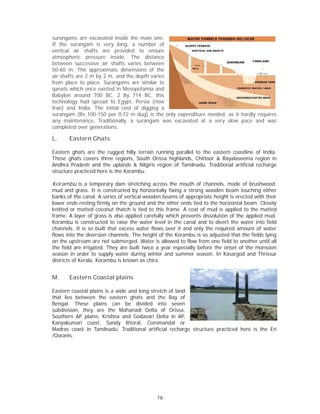
Goa & Karnataka. The traditional artificial recharge structure practiced here is the Surangam.

Surangam word is derived from a Kannada word for tunnel. It is also known as thurangam,
thorapu, mala, etc, in different parts of Kasaragod. It is a horizontal well mostly excavated in
hard laterite rock formations. The excavation continues until a good amount of water is struck.
Water seeps out of the hard rock and flows out of the tunnel. This water is usually collected in
an open pit constructed outside the surangam. A surangam is about 0.45-0.70 metres (m) wide
and about 1.8-2.0 m high. The length varies from 3-300 m. Usually several subsidiary


                                             15
surangams are excavated inside the main one.
If the surangam is very long, a number of
vertical air shafts are provided to ensure
atmospheric pressure inside. The distance
between successive air shafts varies between
50-60 m. The approximate dimensions of the
air shafts are 2 m by 2 m, and the depth varies
from place to place. Surangams are similar to
qanats which once existed in Mesopotamia and
Babylon around 700 BC. 2 By 714 BC, this
technology had spread to Egypt, Persia (now
Iran) and India. The initial cost of digging a
surangam (Rs 100-150 per 0.72 m dug) is the only expenditure needed, as it hardly requires
any maintenance. Traditionally, a surangam was excavated at a very slow pace and was
completed over generations.

L.     Eastern Ghats

Eastern ghats are the rugged hilly terrain running parallel to the eastern coastline of India.
These ghats covers three regions, South Orissa highlands, Chittoor & Rayalaseema region in
Andhra Pradesh and the uplands & Nilgiris region of Tamilnadu. Traditional artificial recharge
structure practiced here is the Korambu.

Korambu is a temporary dam stretching across the mouth of channels, made of brushwood,
mud and grass. It is constructed by horizontally fixing a strong wooden beam touching either
banks of the canal. A series of vertical wooden beams of appropriate height is erected with their
lower ends resting firmly on the ground and the other ends tied to the horizontal beam. Closely
knitted or matted coconut thatch is tied to this frame. A coat of mud is applied to the matted
frame. A layer of grass is also applied carefully which prevents dissolution of the applied mud.
Korambu is constructed to raise the water level in the canal and to divert the water into field
channels. It is so built that excess water flows over it and only the required amount of water
flows into the diversion channels. The height of the Korambu is so adjusted that the fields lying
on the upstream are not submerged. Water is allowed to flow from one field to another until all
the field are irrigated. They are built twice a year especially before the onset of the monsoon
season in order to supply water during winter and summer season. In Kasargod and Thrissur
districts of Kerala, Korambu is known as chira.


M.     Eastern Coastal plains

Eastern coastal plains is a wide and long stretch of land
that lies between the eastern ghats and the Bay of
Bengal. These plains can be divided into seven
subdivision, they are the Mahanadi Delta of Orissa,
Southern AP plains, Krishna and Godavari Delta in AP,
Kanyakumari coast, Sandy littoral, Coromandal or
Madras coast in Tamilnadu. Traditional artificial recharge structure practiced here is the Eri
/Ooranis.


                                             16
Eris (tanks) water approximately one-third of the irrigated area of Tamil Nadu. Eris have played
several important roles in maintaining ecological harmony as flood-control systems, preventing
soil erosion and wastage of runoff during periods of heavy rainfall, and recharging the
groundwater in the surrounding areas. The presence of eris provided an appropriate micro-
climate for the local areas. Without eris, paddy cultivation would have been impossible. Till the
British arrived, local communities maintained eris. Historical data from Chengalpattu district, for
instance, indicates that in the 18th century about 4-5 per cent of the gross produce of each
village was allocated to maintain eris and other irrigation structures. Assignments of revenue-
free lands, called manyams, were made to support village functionaries who undertook to
maintain and manage eris. These allocations ensured eri upkeep through regular desilting and
maintenance of sluices, inlets and irrigation channels. The early British rule saw disastrous
experiments with the land tenure system in quest for larger land revenues. The enormous
expropriation of village resources by the state led to the disintegration of the traditional society,
its economy and polity. Allocations for maintenance of eris could no longer be supported by the
village communities, and these extraordinary water harvesting systems began to decline.

N.     The Islands

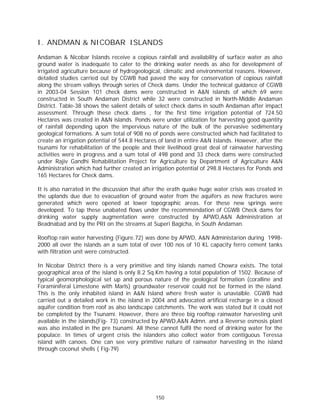
The Indian Island comprises of the Andaman & Nicobar islands in the Bay of Bengal and
Lakshadweep islands in the Arabian Sea. Traditional artificial recharge structure practiced here
is the Jackwells.

Jackwells are pits used to collect rainwater drop by drop. The difference in the physiography,
topography, rock types and rainfall meant that the tribes in the different islands followed
different methods of harvesting rain and groundwater. For instance, the southern part of the
Great Nicobar Island near Shastri Nagar has a relatively rugged topography in comparison to
the northern part of the islands. The shompen tribals here made full use of the topography to
harvest water. In lower parts of the undulating terrain, bunds were made using logs of hard
bullet wood, and water would collect in the pits so formed. They make extensive use of split
bamboos in their water harvesting systems. A full length of bamboo is cut longitudinally and
placed along a gentle slope with the lower end leading into a shallow pit. These serve as
conduits for rainwater which is collected drop by drop in pits called Jackwells. Often, these split
bamboos are placed under trees to harvest the throughfalls (of rain) through the leaves. A
series of increasingly bigger jackwells is built, connected by split bamboos so that overflows
from one lead to the other, ultimately leading to the biggest jackwell, with an approximate
diameter of 6 m and depth of 7 m so that overflows from one lead to the other.


 Note:- Extracts Reproduced from the Publication “Dying Wisdom” , Centre for Sceicne and Environment,
 New Delhi and “ India Water Portal” (http://www.indiawaterportal.org) are duly acknowledged with
 thanks.


                                               17
V.           PLANNING OF ARTIFICIAL RECHARGE PROJECTS
 Basic requirement of Artificial recharge

     x       Availability of non-committed runoff in space and time
     x       Identification of suitable hydrogeological environment and sites for augmenting sub-
             surface reservoir through cost effective artificial recharge techniques.

     The remaining criteria and inputs required for planning the scheme are:

 A) Identification of Area

     x       Areas where ground water levels are declining on regular basis.
     x       Areas where substantial amount of aquifer has already been desaturated.
     x       Areas where availability of ground water is inadequate in lean months.
     x       Areas where salinity ingress is taking place.
     x       Urban Area where decline in water levesl is observed.

B) Hydrometerological studies
     x       Rainfall pattern in the area.
     x       Evaporation losses from the area.
     x       Climatological features that effectthe planning of artificial recharge.

C) Hydrological studies
         x    Insitu precipitation on the watershed.
         x    Surface (canal) supplies from large reservoirs located within basin
         x    Surface supplies through trans basin water transfer.
         x    Treated municipal and industrial wastewaters.
         x    Hydrological investigations are be carried out in the Watershed/Sub-basin/basin for
              determining the source water availability

D) Soil infiltration studies

         x Control the rate of infiltration
         x Prerequisite study in cases of artificial recharge through water spreading methods
         x Infiltration rates can be estimated by soils infiltration tests using Cylinder or flood
           infiltro-meters instruments.

E) Hydrogeological studies
         x Is the prime importance study
         x First step is to synthesize all the available data on hydrogeology from different
           agencies.
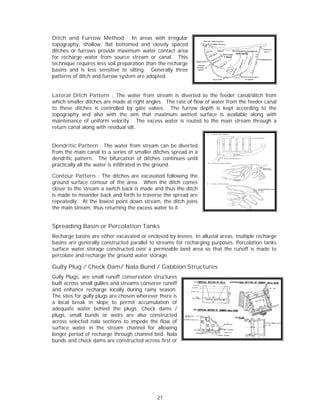
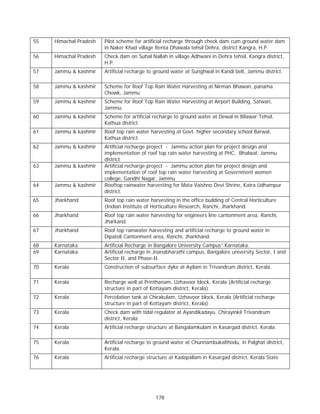
         x Study of satellite imagery for identification of geomorphic units.
         x Regional Hydrogeological maps indicating hydrogeological units, both at shallow and
           deeper levels.
         x Water table contours to determine the form of the water table and the hydraulic
           connection of ground water with rivers, canals etc.


                                                    18
x Depths to the water table (DTW) for the periods of the maximum, minimum and mean
    annual position of water table.
  x Ground water potential of different hydrogeological units and the level of ground water
    development.
  x Chemical quality of ground water in different aquifers.

 F) Aquifer Geometry:
       x Data on the sub-surface hydrogeological units, their thickness and depth of
         occurrence
       x Disposition and hydraulic properties of unconfined, semi-confined and confined
         aquifers in the area

 G) Chemical Quality of Source Water
       x   Quality of raw waters available for recharge is determine
       x   Treatment before being used for recharge
       x   Relation to the changes in the soil structure and the biological phenomena which take
           place when infiltration begins
       x   Changes expected to the environmental conditions.

VI.        ARTIFICIAL RECHARGE TECHNIQUES AND DESIGN
A variety of methods have been developed to recharge ground water. Artificial recharge
techniques can be broadly categorized into:
      a. Direct surface techniques
          •      Flooding
          •      Basins or percolation tanks
          •      Stream augmentation
          •      Ditch and furrow system
          •      Over irrigation

      b. Direct sub surface techniques
          •      Injection wells or recharge wells
          •      Recharge pits and shafts
          •      Dug well recharge
          •      Bore hole flooding
          •      Natural openings, cavity fillings.

      c. Combination surface – sub-surface techniques
          •    Basin or percolation tanks with pit shaft or wells.

      d. Indirect Techniques
          •    Induced recharge from surface water source.
           •   Aquifer modification
Although no two projects are identical, most use variation or combination of direct method,
direct-sub-surface, or indirect techniques. A schematic diagram of the artificial recharge
methods used is given as flowchart below.


                                                19
ARTIFICIAL RECHARGE

     SURFACE                                           SUB- SURFACE
                                                        PRACTICES

  Ist – 2nd order           2nd- 3rd order           (Throughout watershed)
      streams                  streams
   CONTOUR                   CEMENT
   BUNDING/                 PLUGGING/
      GULLY
                          PERCOLATION TANKS


 INJECTION                  RECHARGE                       DUGWELL
                          SHAFT/TRENCH                     RECHARGE


GRAVITY HEAD                 PRESSURE
                             INJECTION


WATER CONSERVATION STRUCTURES

 SURFACE WATER                                      GROUNDWATER
  (to arrest base flow)                               In discharge area
                                                 Where base flow is generated
       WEIRS
                                                    SUBSURFACE
                                             DYKES/GROUNDWATER DAMS


   Flowchart showing the various artificial recharge practices


                               20
Ditch and Furrow Method: In areas with irregular
                   w
topograpphy, shallow flat botto
                    w,         omed and closely spaced
                                           c
ditches o furrows p
        or          provide maxximum water contact ar
                                           r          rea
for recha
        arge water from source stream or canal. Th
                                e          r           his
technique requires le soil prep
         e          ess        paration than the rechar
                                           n          rge
basins and is less sensitive to silting. Generally thr
                     s                                ree
patterns of ditch and furrow syst
                    d           tem are adopted.


Lateral Ditch Patt   tern : The water from stream is d diverted to the feeder canal/ditch from
which smmaller ditches are made at right angles. The rat of flow of water from the feeder canal
                      s                                te         f
to these ditches is controlled b gate val
                                 by         lves. The furrow dept is kept a
                                                                   th         according to the
                                                                                         o
topograpphy and als with the aim that maximum w
                    so                                 wetted surfa           lable along with
                                                                   ace is avail
maintenaance of unif form velocity The exc
                                 y.        cess water is routed to the main stream throu
                                                       s                                 ugh a
return ca
        anal along with residual silt.
                    w


Dendriti Pattern : The water from stream can be di
         ic                       r            m        iverted
from the main canal to a series of smaller ditches sprea in a
                                               d        ad
dendritic pattern. T  The bifurcattion of ditch continue until
                                              hes      es
practically all the wat is infiltrated in the ground.
                      ter

Contour Pattern : The ditches are excava
         r                      s           ated following the
ground s surface cont
                    tour of the aarea. When the ditch comes
                                            n
closer to the stream a switch ba is made and thus the ditch
                               ack                        e
is made t meander back and fo
         to                    orth to traverse the spre are
                                                         ead
repeatedly. At the llowest point down strea
                                t          am, the ditch joins
                                                          h
the main stream, thu returning the excess w
                    us                      water to it.


Spreading Basin or Percola
                         ation Tank
                                  ks
Recharge basins are either excav
        e                      vated or encclosed by lev
                                                       vees. In allu
                                                                   uvial areas, m
                                                                                multiple rech
                                                                                            harge
basins ar generally constructed parallel to streams for recharging purposes. P
        re                     d                       r                        Percolation t
                                                                                            tanks
surface w
        water storag construct
                   ge          ted over a ppermeable laand area so that the ru
                                                                   o            unoff is mad to
                                                                                            de
percolate and rechar the ground water sto
        e          rge                     orage.

Gully Plug / Chec Dam/ N
                ck     Nala Bund / Gabbion Structur
                               d                  res
Gully Plu
        ugs, are sma runoff co
                     all         onservation structures
                                               s
built acro small gullies and stre
         oss                       eams conser runoff
                                               rve
and enhance rechar    rge locally dduring rainy season.
                                               y
The sites for gully plu are chos whereve there is
         s            ugs          sen        er
a local break in slope to per     rmit accumu ulation of
adequate water behind the plugs. Check dams /
         e                                    k
plugs, sm mall bunds or weirs a   are also co onstructed
across seelected nala sections to impede th flow of
                     a            o           he
surface w water in th stream c
                     he            channel for allowing
longer peeriod of rechharge throug channel bed. Nala
                                   gh
bunds an check dam are const
         nd           ms           tructed acro first or
                                              oss


                                               21
second oorder stream in areas having gent
                   ms                        tler slopes. To harness the maximu runoff in the
                                                                               um        n
stream, series of check dams are constructed.Gabbion is low height struc       cture, comm
                                                                                         monly
        ted across small stream to conse
construct                        m          erve stream flow with practically n submerg
                                                                               no        gence
beyond sstream course. The bou  ulders locally available a stored in a steel wir mesh and put
                                             y           are        n          re        d
across th stream ch
        he          hannel as a ssmall dam b anchoring it to the stream side. T excess w
                                            by           g                    The        water
overflows these struc
         s          ctures storin some wat to serve a source fo recharge.
                                ng           ter          as       or
Dug We Recharg In alluvia as well as hard
         ell         ge          al           s
rock are eas, there a are thousannds of dug wells
which ha ave either gone dry or the water levels
                     g
have dec             derably. The dug wells can
         clined consid            ese
be used as structure to rechar
                      es         rge. Ordinary dug
                                               y
wells/ bo wells and tube wells can be us
         ore                      s           sed as
recharge wells, whenever su
                     w            urplus water is
available. In such ca ases recharg takes pla by
                                 ge           ace
gravity fflow. In are eas where water levels are
declining due to over deve        elopment, using
available abstraction structures for recha
                      n           s           arging
aquifers is the imm  mediately avaailable optio In
                                              on.
areas of heavy gro
         f           ound water exploitation the
                                              n,
dug wel and sha
          lls         allow bore wells often get
                                              n
partially or fully driied up during summer Ther.
formation exposed in these we is perm
          n                       ells       meable
and the unsaturated horizon of phreatic aq
                     d                        quifer can be good repo
                                                          e         ository of wa
                                                                                ater if recha
                                                                                            arged
with surp plus available water. Th
                                 hese wells can be used for pumpin as well a for recha
                                              c          d          ng          as          arging
process.
Recharg Shafts/P
      ge       Pits/Trench
                         hes
It is the most eff
         e           ficient and cost effect  tive
structure to recharg the aquifer directly. In
        es            ge
the areas where source of wat is available
                                  ter
either for some time or perenn
                      e          nially e.g. baase
flow, sprrings etc. th recharge shaft can be
                     he           e
constructted. Rechar rge shafts are construct  ted
in the sit
         tuation when phreatic aquifers are not
                     n                         n
hydrauliccally in connection wit the surfa
                                  th          ace
water. Generally on a re           egional sc cale
impermeable layers or lenses form barr         rier
between the surface water and water tab
                      e            d          ble,
and thus the water spreading methods show
         s
low efficiency in recharge. For effect        tive
recharge of the aqu  uifers, the le permeable
                                   ess
zones ar required to be pene
         re                      etrated so th hat
the aquif zones c
          fer        can receive recharge. T  The
recharge shafts can be constru
                     n             ucted in tw different ways viz. Vertical and lateral. Ve
                                              wo                                d         ertical
recharge shafts can be furthe improvise with or without inj
                     n            er          ed                    jection well Recharge pits
                                                                                l.        e
overcome the difficu
          e          ulty of artifi
                                  icial recharg of phreat aquifer f
                                              ge         tic       from surface water sou
                                                                                e         urces.
Recharge pit is excav
         e            vated sufficiently deep t penetrate less perme
                                               to       e          eable strata. Recharge tr
                                                                                           rench
is a spec cial case of recharge p in which sometimes bore wells are drilled to increas its
                     f            pit,        h                                 d          se


                                             22
recharge capabilities. In case aquifers are located below the land surface and overlain by poorly
permeable strata, a recharge shaft similar to a recharge pit but much smaller in cross section is
constructed.

Artificial Recharge through Injection Well
Injection well is a recharge well similar to tube well but made with the purpose of augmenting
the ground water storage of a confined aquifer by pumping-in treated surface water under
pressure. Injection well is generally opted when land is scarce, as in urban areas. The aquifer to
be replenished is generally over-exploited. In certain hydrogelogical setting, the aquifers do not
get natural replenishment from the natural recharge because of the confining layers of low
permeability and need direct injection of water through recharge well. Artificial recharge of
aquifers by injection recharge wells is also suitable for coastal regions to arrest the ingress of
sea water and also to combat the problems of land subsidence in areas where confined aquifers
are heavily pumped. Water for recharging is to be properly treated for removal of suspended
material, chemical stabilization and bacterial control. Chlorination of recharge water can also be
done to prevent development of bacterial growth. The injection well is to be periodically
redeveloped for efficient running.

Induced Recharge from Surface Water Sources
It is an indirect method of initiating recharge by pumping from aquifer hydraulically connected
with surface water to induce recharge to ground water reservoir. When the cone of depression
intercepts river recharge boundary, a hydraulic connection gets established with surface source
which starts providing part of the pumpage yield. For obtaining very large water supplies from
river bed / lake bed or waterlogged areas, collector wells are constructed. Such wells have been
installed in river beds at Delhi, Gujarat, Tamil Nadu and Orissa. In areas where the phreatic
aquifers adjacent to the river are of limited thickness, horizontal wells are more appropriate
than vertical wells. Collector well with horizontal laterals and infiltration galleries get more
induced recharge from the stream.

Subsurface Dykes/ Underground Bandharas
Subsurface dyke is a subsurface barrier across a stream which retards the natural subsurface /
ground water flow of the system and stores water below ground surface to meet the demand
during the period of need. The main purpose of ground water dam is to arrest the flow of
ground water out of the sub-basin and increase the storage within the aquifer.

Roof Top Rainwater Harvesting and Aquifer Recharge
In urban areas where open land is not commonly available, roof top rain water can be
conserved and used for recharge of ground water. This approach requires connecting the outlet
pipe from roof top to divert the rain water to either existing wells / tube wells / bore wells or
specially designed recharge trench / recharge shaft cum bore well. Drain pipes, roof surfaces
and storage tanks should be constructed of chemically inert materials such as plastics,
aluminum, galvanized iron or fiber glass, in order to avoid contaminating the rainwater.
The impact of recharge through these structures to ground water regime is local, but if
implemented on a massive scale, it can raise the water level remarkably and increase the
sustainability of water supply through shallow depth ground water structures.


                                             23
VII.     EFFORTS OF CENTRAL GROUND WATER BOARD         ON
         ARTIFICIAL RECHARGE AND RAIN WATER HARVESTING

A.        Pilot / Demonstrative Schemes

Experiments on artificial recharge to aquifers started in India from 1970 onwards by Central &
State Governments and individually by NGOs in various parts of the country where early signs of
overexploitation of ground water were noticed. The Central Ground Water Board undertook
artificial recharge experiments through injection well around Kamliwara in Central Mehsana
where sufficient water was available from Saraswati river during monsoon period. A detailed
injection experiment was carried out at the Kamliwara site by injecting water from the source
well in Saraswati riverbed to the injection well by 5cm dia. siphon of galvanized pipe, at a rate
of 225 m3/day for 250 days. There was a buildup of 5 meters in the injection well and 0.6 to 1.0
m in wells in areas 150 m away. These experiments indicated the feasibility of ground water
recharge through injection well in the area.

Similarly spreading test through channel and recharge pit were carried in coastal areas of
Saurashtra, Gujarat. The Board undertook another artificial recharge study in the Ghaggar river
basin with the assistance of UNDP during the period 1976-78 at Kandi area and Narwana
Branch area, Dabkheri and indicated area as suitable for recharge through ponds and spreading
basin in Kandi area and through injection wells at Narwana.

Several experimental recharge and rainwater harvesting pilot projects were carried out at
Saurashtra, Ahmedabad city and Kutch in Gujarat, farm rain water management at Raipur,
Percolation tanks/check dams in Andhra Pradesh, Percolation channels and Bandharas in
Maharashtra, subsurface dykes in Kerala, roof top rain water harvesting and recharge in urban
and hilly areas by the Board, State Governments and Non Government Organisations. Details of
artificial recharge structure constructed during different five year plan under Central Sector
Schemes are given in table. 2a.

               Table.2a AR studies taken by CGWB during different five year plans
       Plan                                             States                                              Cost
                                                                                                          (Rs in Cr)

 VIII             Maharashtra, Karnataka, Andhra Pradesh, Delhi, Kerala, Madhya Pradesh, Tamil Nadu,         3.23
 (1992-1997)      West Bengal, & Chandigarh
                  (Total States-9)
 IX               Andhra Pradesh, Arunachal Pradesh, Assam, Bihar, Chandigarh, Gujarat, Haryana,            33.31
 (1997-2002)      Himachal Pradesh,
                  Jammu and Kashmir, Jharkhand, Karnataka , Kerala, Lakshdweep, Madhya Pradesh ,
                  Maharashtra, Meghalaya, Mizoram, Nagaland, NCT Delhi, Orissa, Punjab, Rajasthan,
                  Tamil Nadu, Uttar Pradesh, And West Bengal
                  (Total States-25)

 X                Andhra Pradesh, Karnataka, Madhya Pradesh, & Tamil Nadu                                    5.60
 (2002-2007)      (Total States-4)

 XI               Arunachal Pradesh, Punjab, Tamil Nadu, Kerala, Karnataka ,West Bengal , Andhra            63.96
 (2007-20012)     Pradesh, Uttar Pradesh & Madhya Pradesh, Chandigarh, Gujarat, Maharashtra, Jharkhand,
                  Delhi, Himachal Pradesh, Jammu and Kashmir, Orrisa, Rajasthan and Bihar.
                  (Total States-19)


                                                         24
Artificial recharge schemes undertaken during the various plans are depicted in the figure 2 and
details of the schemes are presented in Annexure I. In general artificial recharge strcutures like
percolation tanks, recharge shafts, recharge wells, watershed

 Location of Artificial Recharge schemes undertaken by CGWB during various five year plan


    Figure 2. . Location of Artificial Recharge schemes undertaken by CGWB during various
                                           five year plan


                                             25
treatment, checks dams, subsurface dykes, vented dam, cross bund, create work gully
plugging, Siphon pit, loose boulder check dam, Roof top rain water harvesting and Micro water
shed management were undertaken in various plan.

VIII & IX PLAN : As demonstrative schemes, CGWB undertook Central Sector Scheme on
“Study of Recharge to Groundwater” under VIII & IX Plan which were implemented through
State Government with the objective of dissemination of technical know how to the State
Government and other agencies for successful replication of the methodology elsewhere in the
country under similar hydrogeological set up. During VIII Plan, 24 projects were taken up
mainly in the state of Maharashtra, Karnataka, Delhi, Chandigarh, Madhya Pradesh, Kerala,
Tamil Nadu etc. and 62 artificial recharge structures viz percolation tank, check dam, sub-
surface dyke, recharge shaft, recharge wells, roof top rain water harvesting systems etc. were
constructed and their impact on groundwater regime was evaluated. Further, under the IX
Plan, 165 projects involving construction of more than 670 artificial recharge structures viz
Percolation tanks, Check dams, Recharge Shafts/Trench/Pit, Sub-Surface Dykes, Roof Top Rain
Water Harvesting Systems etc have been taken up in 27 States and UTs. The efficacies of
constructed recharge structures have been evaluated.
X PLAN : In Tenth Five year plan, special emphasis is given to implementation of rain water
harvesting at schools for utilization of rain runoff and creation of mass awareness amongst
school children. In Fresh Water Year – 2003, the Ministry of Water Resources had approved and
sanctioned 19 projects on construction of roof top rainwater harvesting structures at
Government buildings in the states of AP, Assam, Bihar, Karnataka, Kerala, Madhya Pradesh,
Orissa, Punjab, Sikkim, Tamil Nadu and Uttar Pradesh and UT of Chandigarh. These projects
were constructed under technical guidance of Central Ground Water Board with funds under
Grant-in-Aid provided to the concerned state Governments for total amount of Rs.208.55 lakhs.
Similarly, demonstrative projects of Roof top rainwater harvesting were also implemented
through NGO’s in 100 schools in rural area of 13 states viz Andhra Pradeh, Delhi, Gujarat,
Himachal Pradesh, Kerala, Madhya Pradesh, Maharashtra, Orrisa, Rajasthan, Sikkim, Tamil
Nadu, Uttaranchal and West Bangal.
In 2005-2007, project on rainwater harvesting from Roof tops of remote government rural
schools for collection of rainwater for drinking and use in two toilets for girls in 413 schools in
rural areas in 15 states were sanctioned by the Ministry of Water resources. The Central Ground
Water Board facilitated the work by providing technical guidance in designing, monitoring and
implementation through its expert scientists.
During X plan demonstrative scheme on “Rain Water Harvesting and Artificial Recharge to
Ground Water” has been taken at 8 identified areas in Andhra Pradesh, Tamil Nadu, Karnataka
and Madhya Pradesh.The approved cost of projects is Rs. 5.95 crores for implementation by the
departments of states under overall technical guidance of CGWB during 2006-08 with 100%
funding by the Central Government. The norms adopted in the implementation of MaNational
Rural Employment Guarantee Scheme (NREGS) by the Ministry of Rural Development are being
followed in implementation of civil works of the present scheme. Under this scheme, priority is
given to hard rock areas having over-exploited ground water resources. The first installment of
70% of the approved cost of the project is released after approval of the project to the
implementing agencies. The next installment of 30% of the approved cost is released on
recommendation of State Level Technical Coordination Committee on physical progress and
after utilization of 70% of initial funds released to the implementing agency. On completion of


                                              26
civil works of recharge facility, impact assessment studies will be taken up to demonstrate the
    efficacy of artificial recharge and rain water harvesting in above mentioned sites selected on
    scientific basis in different hydrogeological situations. Successful examples would be replicated
    by the states in similar set ups in future.
    XI Plan : The scheme will be implemented in identified fesible areas of various States,
    particularly in Over-exploited and Dark blocks, drought prone and water scarcity areas, coastal
    areas & islands affected by saline water ingress, areas of inland salinity, urban areas showing
    steep decline in ground water levels and in sub-mountainous / hilly areas of the country. The
    fund earmarked for demonstrative recahrge projects is RS. 100 Crores in XI plan. Total of 64
    artificial recharge schemes under central sector schemes, amount to be Rs.63.96 Crores have
    been sanctioned and details are given in table 2b.
    2b. State wise funds approved and released during XI Plan (in lakhs)

Sl.    State
No
                     approved


                                           approved


                                                                  approved


                                                                                          approved


                                                                                                                    approved
                                released


                                                      released


                                                                               released


                                                                                                         released


                                                                                                                                   released
                                Fund


                                                      Fund


                                                                               Fund


                                                                                                         Fund


                                                                                                                                   Fund
                     Cost


                                           Cost


                                                                  Cost


                                                                                          Cost


                                                                                                                    Cost
                         2008-09                  2009-10                 2010-11                    2011-12                   G.Total

1      Tamil Nadu    111.00     33.30      415.35     368.45      0            0.00       0.00           30         526.35         431.75

2      Andhra        0.00       0.00       130.02     91.01       75.18        52.64      348.84         283.194    554.04         426.85
       Pradesh
3      Kerala        39.05      11.72      0.00       0.00        0            10.82      13.48          9.435      52.53          31.97

4      West Bengal   111.09     33.33      0.00       0.00        0            44.44      0.00           0          111.09         77.76
5      Arunachal     259.67     77.90      0.00       0.00        0            103.87     0.00           0          259.67         181.77
       Pradesh
6      Punjab        179.45     53.84      0.00       0.00        0            0.00       80.88          56.62      260.33         110.46

7      Chandigarh    0.00       0.00       0.00       0.00        776.03       543.22     0.00           0          776.03         543.22
       (UT)
8      Karnataka     0.00       0.00       109.16     76.41       96.585       67.61      194.16         135.91     399.90         279.93

9      Uttar         0.00       0.00       720.06     504.44      1060.64      728.50     0.00           0          1780.70        1232.94
       Pradesh
10     Madhya        0.00       0.00       0.00       0.00        431.86       302.30     0.00           0          431.86         302.30
       Pradesh
11     Himachal      0.00       0.00       0.00       0.00        0            0.00       179.53         125.655    179.53         125.66
       Pradesh
12     Rajasthan     0.00       0.00       0.00       0.00        0            0.00       34.30          24.012     34.30          24.01

13     Jammu         0.00       0.00       0.00       0.00        0            0.00       78.11          54.677     78.11          54.68
       Kashmir
14     Orrissa       0.00       0.00       0.00       0.00        0            0.00       464.36         325.04     464.36         325.04

15     Bihar         0.00       0.00       0.00       0.00        0            0.00       96.01          67.21      96.01          67.21
16     Gujarat       0.00       0.00       0.00       0.00        316.24       221.368    0              0          316.24         221.37

17     Maharashtra   0.00       0.00       0.00       0.00        15.15        10.605     0              0          15.15          10.61
18     Delhi         0.00       0.00       0.00       0.00        0            0.00       43.44          30.41      43.44          30.41
19     Jharkhand     0.00       0.00       0.00       0.00        16.49        11.543     0              0          16.49          11.54

       Total         700.26     210.08     1374.59    1040.31     2788.175     2096.91    1533.11        1142.163   6396.14        4489.46


                                                                 27
B.     Dug well Recharge in Hard Rock Areas of the Country

Scheme “Artificial recharge to ground water through dugwells” is being implemented in seven
states namely Tamil Nadu, Gujarat, Madhya Pradesh, Maharshtra, Andhra Pradesh, Karnataka &
Rajsthan for construction of recharge facility on irrigation dugwells owned by the farmers. The
main aim of the dug well recharge scheme is to increase the recharge to the ground water
reservoir by utilizing the runoff generated in the agriculture fields, which otherwise goes as
waste. The scheme has large potential not only because of its capacity to recharge shallow
aquifers but also it is economically affordable for local people.
The CGWB and State Ground Water Departments are providing technical guidance for optimum
benefit and creating awareness amongst beneficiaries. 4454669 number of irrigation dugwells
located in 1155 blocks of seven participating states are envisaged to be covered for
construction of recharge facilities with the objective of recharging aquifers through runoff
available in agricultural fields during rains. The total cost of the project is Rs.1798.71 Crores.
Average cost of dug well recharge is Rs.4000/- which varies from Rs.3600 as in Maharashtra to
Rs.5700 as in Andhra Pradesh. Under the scheme, owners of the irrigation dug wells belonging
to small and marginal farmers are being provided 100 % subsidy, while other category farmers
are provided 50% of the cost as subsidy.
Details of the subsidy released and structures constructed is given in table 3 below:

                Table. 3 AR to Groundwater through Dugwell recharge scheme

        s.no                 States        Amount of      No. Units for      No. of dug well
                                           Net Subsidy     which net            recharge
                                             released       subsidy            Structures
                                            (Rs in Cr)     released            completed


          1        Andhra Pradesh                            Yet to be started

          2        Gujarat                    48.414          141381              7629

          3        Karnataka                  26.078          68864              11007

          4        Madhya Pradesh             40.147          93847              13855

          5        Maharashtra                14.042          44632              38023

          6        Rajasthan                  29.806          88765               4396

                   Tamil Nadu                 103.831         275553             21055

                    Total                    262.319         713042              95965


                                             28
VIII. COMMON RECHARGE TECHNIQUES IMPLEMENTED BY CGWB

Flooding

A pilot project was implemented at Chetua to Jamuna, Pandua block, Hoogly district in West
Bengal by the Central Ground Water Board in IX plan.

Recharge Basin or Percolation Tanks

Percolatation tanks have been constructed by CGWB at Watershed TE-11 Jalgaon district,
Maharashtra, at Chirakulam in Kottayam district, Kerala, Sikheri village and Tumar watershed in
Mandsaur & Dewas districts Madhya Pradesh, Narasipuram in Alandurai watershed,
Thondamuthur and Vedapatti village in Virdhunagar district of Tamil Nadu and in Mahboobnagar
district, Andhra Pradesh in central sector scheme. Recharging of aquifers through percolation
tanks in above projects has shown encouraging results during impact assessment studies.

Gully Plug / Check Dam/ Nala Bund / Gabbion Structures

The Board has implemented artificial recharge projects by constructing such structures through
state government agencies at Ayandikadayu, Chirayanki district, Kerala; Kadam nala, Pusaro
nala, Brahmani nala and Tepra nala in Dumka district, Jharkhand; Gwalpahari, district Gurgaon,
Haryana; Thano reserved forest area, Doiwala block, Uttarakhand; Chalokhar in Hamirpur
district , Bhatti nala, Suhal nala and Naker khad in Kangra district of Himachal Pradesh; Dewal
in Kathua district, J&K; Parol naggal & Chotti bari naggal of district Ropar in Punjab; Bangalore
university campus in Karnataka. Substantial impact on augmentation of ground water has been
noticed in areas around these structures.

Recharge Wells/Dug Well Recharge /Borehole Flooding

A project of roof top rain water harvesting through dug well recharge at Kavikulguru Institute of
Technology and Science (KITS), Ramtek, Nagpur district, Maharshtra has been implemented. An
area of 20 hectare had been benefited by storing 8000 cubic meters of water annually in
addition to existing resources through this pilot scheme.

Recharge Pits/ Trench and Shafts

The recharge structures like lateral shafts with injection wells have been constructed on
experimental basis at Deoli Ahir, in link channel of Hasanpur distributary in Mahendergarh
district, Panipat district and near Markanda river in Shahbad block of Kurukshatra district in
Haryana State as pilot recharge projects. Similarly Recharge pits with recharge shafts have been
constructed at Lodi garden, New Delhi, at Choe no. 1 Bhakhara main line canal village Dhanetha
, Samana block, Patiala and on Dhuri drain in Sangrur district, at low dam in village Majra, Tehsil
Kharar in Ropar district in Punjab State. Recharge trenches with bore wells have been
constructed in Midjil mandal in Mehboobnagar district in Andhra Pradesh and in Taliparamba
taluk, Kannur in Kerala. Impact analysis of such projects indicated favorable recharging results.


                                              29
Subsurface Dykes/ Underground Bandharas

Subsurface dyke is a subsurface barrier across a stream which retards the natural subsurface /
ground water flow of the system and stores water below ground surface to meet the demand
during the period of need. Central Ground Water Board has constructed subsurface dykes in
Ayilam in Trivandrum district, Kerala, Kasrawad, district Kahrgone, Madhya Pradesh, Saltora
block, Bankura district, West Bengal, Nallanpillai Petral village, Villupuram, Tamil Nadu, at Walmi
Farm, Madhya Pradesh and Karnataka state.

Roof Top Rainwater Harvesting and Aquifer Recharge

In urban areas where open land is not commonly available, roof top rain water can be
conserved and used for recharge of ground water. Urban housing complexes, historical forts and
institutional buildings generally have large roof area and can be utilised for harvesting roof top
rainwater to recharge the depleted aquifers. More than 50 roof top rain water harvesting and
recharge projects have been implemented by the Central Ground Water Board at Assam, Delhi,
Chandigarh, several building in Punjab, Jaipur and Udiapur in Rajasthan, Kangra in Himachal
Pradesh, Ahmedabad in Gujarat, Kannur in Kerala, Patna in Bihar, Lucknow in Uttar Pradesh,
Dewas and Musakhedi in Madhya Pradesh and Gurgaon and Faridabad in Haryana State.

IX.    SUCCESS STORIES OF ARTIFICIAL RECHARGRE IN STATES
A. ANDHRA PRADESH

Andhra Pradesh (AP) state covers an area of 2,75,069 km2. Physiographically, it has three major
features Coastal plains, Eastern ghats and western pedeplain. The state experiences a variable
rainfall pattern with minimum rainfall of 561 mm to maximum of 1113 mm. Nearly 84% of the
State is underlain by hard crystalline and consolidated formations like Archaean, Cuddapah,
Dharwars, Kurnool, Deccan Traps etc. The rest of the State is underlain by semi-consolidated
formation like Gondwanas and Tertiaries and unconsolidated deposits like Recent alluvium. The
yield of wells ranges between 2-5 m3/hr in Dharwars comprising schist, phyllites, amphibolites
and epidiorites. In granite gneiss, khondalites and charnokites, the yield ranges between 10-35
m3/hr. In Cuddapahs, the yield ranges between 7-50 m3/hr. In shales and Deccan traps, the
yield ranges between 0.5-1.5 m3/hr and 10-40 m3/hr, respectively. The yield of wells in soft
rocks like Gondwana sand stone varies from 12-220 m3/hr. The alluvial formations are confined
mainly in the delta region where the tubewells yield from 15-60 m3/hr.
The annual replenishable groundwater resource of the state is 36.50 bcm with a net annual
groundwater availability of 32.95 bcm. Ground water draft (as on 31st march 2004) is 14.9 bcm
with a stage of ground water development of 45%. Out of the 1231 assessment units in the
state, 219 have been categorised as over exploited and 77 have been categorised as critical
from ground water development point of view.
Artificial recharge Techniques suitable for the state
Major portion of the state is covered by Achaeans and pre-Cambrians (Cuddapah). The
structures suitable for this terrain are the Check dams, Gully plugs, nalla bunds, recharge pits
and percolation tanks/ponds.


                                              30
Recharge pits/ shafts and trench with injection wells are ideally suited for Semi-consolidated
and unconsolidated formations. In Rajahmundry region multilayered aquifer system exists
recharge shaft with injection wells and percolation ponds with injection wells are suitable. For
the urban areas the Roof top Rainwater harvesting with artificial recharge structures like
recharge shafts and recharge pits with/without tubewells are suitable.

Details of some recharge structures constructed in state and benefits observed from these
structures are described below:

1      Groundwater Recharge in Pulakuntlapalle Micro Hydrological Unit

Pulakuntlapalle micro hydrological unit is located in primary catchment area of Dhiguvetigadda
Hydrological Unit in Ramasamudram Mandal, Chittoor dist (Figure.3). The study area (322 Ha)
lies between 130 27’ 32” N to 130 26’ 12” N latitude and 780 23’ 18” E to 780 24’ 10” E
longitude. Recharge techniques executed are described below:


                Figure.3 Artificial Recharge technique adopted in Pulakuntlaplle.

De-siltation of the tanks done to the fullest extent of depth where the fracture system/
weathered granite system is traversing. Desilted material was used for both tank bund
strengthening and application in catchment area fields. The water stored in the pit after rain
infiltrates into the aquifer zone as recharge. The stored water spreads into the aquifer zone to
all directions and recharging the groundwater. Three injection wells at Utlavani Cheruvu, Bayya
Reddy Cheruvu and Kothakunta drilled to a depth of 400 feet at pre-defined location based on
the Geophysical Investigations. Recharge shaft constructed to ensure the higher rate of good
quality recharge to the deeper aquifers.One check dam was constructed to conserve the soil
moisture and to maintain the ecological balance to some extent in the vicinity.


                                             31
Impact of artificial recharge on local ground water system

Before artificial recharge, the groundwater flow direction was from North to SE part of the area.
But after construction, of recharge structures the flow direction spreads to all surrounding
areas.

x    The average water level rise was 3 m higher in the area of recharge as compared with the
     average water level rise in non recharging areas.
x    In recharge area, additional groundwater amount is 2,36,241 cubic meters.
x    By using this additional recharge amount the local farmers are being benefited.
x    Now additionally 79 acres area can be irrigated by additional groundwater available through
     recharge.
x    Some bore wells that were dry up to September 2005, started functioning for the irrigation
     uses. In Pulakuntlapalle, there were 35 functioning wells as well as 7 defunct wells. After
     the influence of AGR structure, all the defunct wells are functioning.
x    Some parameters like fluoride were also diluted due to recharge.
x    There is no ground water quality deterioration after construction of recharge structures
     influence. The fluoride content was more than the preferable limits before AGR impact (1.8
     mg/l), later it reduced to 1.0 mg/l. The total hardness also diluted after the AGR impact.
x    As the silt was removed to its fullest extent (i.e. ranging from 4 ft to 8ft bgl), it has
     accelerated the rate of ground water recharge The silt was collected and tested in the
     laboratory for fertility. The richness of the soil fertility was explained to the community in
     the capacity building training. The mode and method of execution of each structure and its
     role in AGR was also discussed with the community in detailed.

2.     Pilot project on Recharging of Abandoned dug wells in Chennareddy Palle Village,
       Pendlimarri Mandal, Kadapa District of Andhra Pradesh with community
       participation


                                              32
Figure.4 location of the Abandoned dugwells in Chennareddy palle village, AP

Andhra Pradesh Farmers (AMGS) has been involved with DSMG in Yerravanka Hydrological Unit
since 2004. Crop water balance estimation indicated deficit in water balance in the Hydrological
Unit. For improving the groundwater situation through reduced pumping with demand side
interventions, improving crop water efficiency and crop diversification, supply side interventions
such as recharging through abandoned wells was taken up.            Wherever suitable sites were
available, artificial groundwater recharge of open wells was taken up by the communities with
technical guidance from the project (figure.4).

Average rainfall of the area was 750mm and 75 - 80% of the rainfall received through influence
of South West monsoons spread over from July to October with average 35 rainy days per year.
Highest rainfall of 1572.5mm was recorded during the year of 1996-97. Six out of 14 years
reported, less than average rain fall and the least rain fall reported is 285.6 mm during the
monsoon year 1999 – 2000.

Depletion water levels were observed in Pendlimarri, Lingareddi Palli and Chennareddi Palli
habitations. Many bore wells went dry during summer 2006 and presence of silt in the surface
water bodies also hampered recharging process. Towards meeting the objectives, Ground water
Management Committees (GMC) had been established in all the habitations comprising of men
and women members. GMC’s played major watch dog role, preventing over exploitation of
ground water resources in the area.

The main objectives of the pilot were to:

• Favorably alter the natural conditions to enhance the groundwater recharge at a micro basin
  level.
• To improve the groundwater levels in micro basin.


                                             33
• Initiate artificial injection of runoff generated from peak storms at favorable locations.
• Facilitate the technology, skills and knowledge for better understanding the ground water
  system in the area to the community enabling longer sustainability.

Component of People’s Participation in recharging of abandoned open wells

The area proposed for Artificial Groundwater Recharge belonged to the people of
Chennareddypalli villages and Part of Yerravaka habitations.      The bore wells, the principal
source of water were unable to cope up the demand of the community. Lots of money was
being invested to get the required water in the form of drilling new bore wells but the result
was multifold loss. At this juncture, APFAMGS project personnel associated with people and
slowly incorporated the idea of comprehensive groundwater management through people’s
participation. As the projects concept was in line with the need of the farmers, the response
and involvement of the community was encouraging. During this process, the farmers were
made to analyze the situation and were able to develop the action plan of their own to improve
the groundwater situation in their micro HU. The various stages of people’s participation in
activity were:

x   Demand from the people for recharge measures during informal as well as in GMC
    meetings.
x   Expressed their willingness to extend participation in the activities. Requested the project to
    extend the support and explore the avenues for groundwater recharge.
x   Involved in evolving the situation of groundwater resources.
x   During feasibility studies, all the GMC members actively shared their opinions and extended
    their cooperation.
x   After getting the technical feasibility, Combined GMC’S meeting were organized and
    discussed their role in RECHARGE OF ABANNDONED OPEN WELLS execution.
x   Permission from the Panchayati Raj Institution (GP) was obtained by GMC.

B. CHHATTISGARH

Chhattisgarh state covers an area of 1,35,000 Km2 with a population of nearly 2 crore. Average
annual rainfall in the state is nearly 1200 mm. Over 80% of the populace in the state are
dependent on agriculture and allied activities. Geologically, the state is a part of Central Indian
Shield consisting of lithounits ranging in age from Archaean to Recent. Nearly 60% of the state
is covered by crystalline and metamorphic rocks. Precambrian Chhattisgarh Supergroup of rocks
occupies nearly 27% area of the state. Semi-consolidated rocks and others occupy only 13%
area of the state. By and large, these lithounits have limited ground water potential.

Groundwater potential zone is restricted to weathered mantle, caverns, fracture and formation
contacts. Rocks belonging to Gondwana super group are the next major litho units of the area.
The sandstones have primary and occasional secondary porosity. They form thick and extensive
unconfined to confined aquifers down to 300 mbgl. Groundwater some times occurs under free
flow conditions in localized belts. At places high groundwater temperature even up to 500
centigrade have been recorded. The unconsolidated formation of Quaternary age comprising
alluvium, clay, silt, laterite etc. form thin and extensive unconfined aquifers in several isolated
patches and near major river courses with thickness up to 30 mbgl.


                                              34
Depth to water level is governed by geological formations and topography. The premonsoon
water level of Raipur,Dhamtari and Mahasamund varies from 1.35mbgl to 15.10mbgl while the
postmonsoon water level varies from 0.61mbgl to 8.26mbgl.The premonsoon and postmonsoon
water levels of Bilaspur, Janjgir-champa and Korba districts range between 1.19mbgl and 17.33
& 0.7mbgl and 13.27mbgl respectively. Similarly the premonsoon and postmonsoon water levels
of Rajnandgaon, Durg and Kawardha districts range between 1.67mbgl and 23.05mbgl & 0.81
mbgl and 14.43 mbgl respectively.

On an average groundwater meets 90% and 13.4% of total drinking and irrigation water
requirements respectively. Ground water draft (as on 31st march 2004) is 2.8 bcm with a stage
of ground water development of 20.5%. Out of the 146 blocks in the state, 138 have been
categorised as safe and the remaining 8 have been categorised as semi-critical from ground
water development point of view. There are no critical or over exploited blocks in the state.

Artificial recharge Techniques suitable for the state
In Chhattisgarh all programmes of groundwater recharge and conservation should be taken up
in the form of small watershed management. The main objective of such watershed
management programme should be to control the surplus surface runoff during the monsoon
which indirectly gives benefits such as control/ reduction in soil erosion and flood control in
addition to augmenting the groundwater storage. A watershed can broadly be classified in
three zones i.e. (i) high sloping area, ii) moderately sloping area iii) relatively gently sloping
area/ terrain. Given a similar climate, hydrology, soil and hydrogeological features for a
watershed, following structures are recommended to augment recharge from surplus runoff to
saturate vadose zone.

   a) High sloping area:
     Contour trenching on hilly slopes, bench terracing, stone terracing at steep
     slopes, diversion channels across slopes, afforestation.

   b) Moderately sloping area:
      Contour or graded bunding, gully protection, nala bunding and check dams, etc.
      Construction of percolation tanks and or groundwater dams (sub- surfaces dykes), basin
      spreading, contour cultivation, gravity flow in existing dug wells.

   c) Gently sloping to flat terrain:
      Groundwater dams, water-spreading techniques, gravity flow in existing dug wells.
      Surplus water storage bodies, which are constructed for storing the monsoon runoff and
      thereby recharging the groundwater, should be designed properly taking all precautions
      so that during heavy storms they should not be washed away. The evaporation losses
      from these bodies will be very high if water is allowed to be stored beyond the month of
      February.


                                             35
Details of some recharge structures constructed in state and benefits observed from these
structures are described below:

1. Rainwater Harvesting and Artificial Recharge Gujra Sub-Watershed (Block: Patan,
   District: Durg)
    Location: Gujra Sub-Watershed, Block, Patan. The watershed lies in Patan block of Durg
    district within north latitudes 21°04’30” and 21°14’30” and east longitudes 81°23’00” and
    81°34’00”.
    Implementing Agency: Public Health Engineering Department (PHED) and funded by the
    centrally sponsored accelerated rural water supply programme of Ministry of Rural
    Development, Govt. of India.
    Year of Completion              : 2003-05
    Cost of the Project             : Rs 2.67 crore
    Average annual rainfall         : 1200 mm.

    Type of Structures
 Types and numbers of structures constructed in Gujra sub-watershed
 Sl. No.                    Type of structure          No. of Structures constructed
           1                Masonry stop dam                        23
           2                Percolation Tank                        12
           3                Boulder Check dam                       25
           4                Silt trap/Nala bund                     13
           5                Desilting of pond                       28
                            Total                                   101
 Salient aspects of the engineering structures constructed in Gujra sub-watershed
           Type of Structure                             Salient features
           Masonry dams: Stone masonry dams              Span 10 to 12m
           were constructed on 2nd and 3rd               Height 1 to 1.5 m
           order streams.                                Foundation (cement concrete)
                                                         depth 1 to 1.2
           Boulder Check Dams: Constructed               Span 6 to 10m
           on 2nd order stream (figure.5).               Height 1 to 1.2m
           Silt trap: These are simple masonry           Height 0.5 to 0.7 m
           Structures
           Percolation Tank (figure.6)                   With masonry west weir and
                                                         earthen side bunds
           Desilting of Ponds                            Existing village ponds were
                                                         desilted


                                                  36
Figure.5 Check dam at Mehra kala                                                                                 Figure. 6 Percolation tank at Tarri

IMPACT: Water Level Conditions (Before and After the Implementation of the Project)
A set of 8 observation wells was established in the watershed to monitor the effect of the
project. During the first three years (2001-2004), pre-monsoon water levels were in the range
of 17 to 31m in all the observation wells. In the next three years (2005-2008), pre-monsoon
water levels in these wells remained within 5 to 13m. Similarly for the post monsoon period,
water levels recorded in the initial two years were in the range of 14 to 23, which improved to 5
to 8m in the 3rd year. During the last 3 years, post monsoon water levels were recorded to be
in the range of 2 to 6m. Variation of monthly water levels in a representative well (at
Achanakpur) is shown in Figure.7


                                                             Variations in Water Levels
                                                              Variations in Water Levels
                                                                       (Village Achanakpur)
                                                                        (Village Achanakpur)
                                  0
                                      0

                                  5
                                      5

                              10
                                10
             Depth to water (m)
            Depth to water (m)


                              15                                                                                                                                       2001-02
                                                                                                                                                                         2001-02
                                15
                                                                                                                                                                       2002-03
                                                                                                                                                                         2002-03
                              20                                                                                                                                       2003-04
                                20                                                                                                                                       2003-04
                                                                                                                                                                       2004-05
                              25                                                                                                                                         2004-05
                                25                                                                                                                                     2005-06
                                                                                                                                                                         2005-06
                              30                                                                                                                                       2006-07
                                30                                                                                                                                       2006-07
                                                                                                                                                                       2007-08
                                                                                                                                                                         2007-08
                              35
                                35
                                                                                      August
                                                    April
                                           March


                                                                     June


                                                                                                September

                                                                                                             October

                                                                                                                        November

                                                                                                                                    December
                                                             May


                                                                              July


                                                                                                                                                 January

                                                                                                                                                            February
                                                                                     August
                                                   April
                                          March


                                                                   June


                                                                                                            October


                                                                                                                                   December
                                                                                               September


                                                                                                                       November
                                                            May


                                                                            July


                                                                                                                                               January

                                                                                                                                                           February


                Fig.7. Monthly variations in water levels in different years in a
            representative observation well at Achanakpur in Gujra sub-watershed


                                                                                           37
Irrigation, Agriculture and Other Aspects
The significant improvement in water level conditions, in turn, resulted in improvement of soil
moisture conditions and agricultural production. The sustainability of the ground water
abstraction structures was ensured because of this project. Due to rise in water levels, the dug
wells in the area, which were rendered useless prior to the implementation of the project
because of lowering water levels, got revived. People started constructing new dug wells as
well. Inspite of groundwater abstraction has significantly increased in the area., water level
have not further deteriorated.
2.   RAINWATER HARVESTING UNDER JOINT FOREST MANAGEMENT PROGRAMME -
     (Implemented by Department of Forest)

Achievements of forest department under this programme are given here.


a.     BELARBAHRA VILLAGE (Block: Nagri, District: Dhamtari)
Belarbahra village is adjacent to a protected forest in Dhamtari District. In addition to other
development activities like facilitating honey culture etc. providing better irrigation facilities
were also the priorities of the joint forest management committee. To start with they deepened
a village tank named Dhau talab. Risai Jharan, a spring flowing from the hills used to fall
directly to the paddy fields there by destroying the crop and the field. The villagers constructed
a canal of 1 Km length and channeled the spring flow to Dhau talab. It solved two purposes,
routing the stream through the canal saved the paddy fields from being degraded and the
water thus transported to Dhau Talab was stored and used for irrigation. This resulted in 37%
(to 150 ha) increase in total irrigated area (Kharif) and nearly 19% increase in total production.


b.     ALEKHUNTA VILLAGE (Block: Nagri, District: Dhamtari)
In Alekhunta village of Dhamtari district, the Forest Management Committee has set an
example in water resources Management. Alekhunta village, home to 64 families with a total
population of 267 was almost entirely dependent on forest. Under JFM Programme, a stop dam
of 10m width was constructed along Futhamuda stream. The stored water was then distributed
to different parts of the village with construction of 2 canals, one of 4 Km length and the other
of 3 Km length. There was 350 acres of arable land and there was no irrigation facility. This
construction provided irrigation facilities to the entire 350 acres (during kharif only) of land and
resulted in 80% increase in agricultural productivity in the village.


c.      JHUNJHRAKASA VILLAGE (Block: Nagri, District: Dhamtari)
Jhunjhrakasa village is on Birgudi-Ghattasilli road in Dhamtari district. The village has a
population of 503. Paddy cultivation in the village used to be completely dependent on
monsoon rain. Under the Joint Forest Management Programme, the Forest Management
Committee has constructed a stop dam across Jhura Nala as a result of which 200 acres of land
could be brought under assured irrigation. In addition to this the Forest management
Committee has also constructed 18 sluice gates thereby facilitating irrigation in additional 90
acres. The villagers in Jhunjhrakasa are now started taking the second crop in 80 acres of land.


                                              38
3. WATER CONSERVATION MEASURES BY AFPRO (ACTION FOR FOOD PRODUCTION)

A.   DISTRICT: BILASPUR
KHONDRA VILLAGE, Block: Masturi, District: Bilaspur
Pre-project scenario: There was severe soil erosion by streams in the agricultural lands in
foothill areas, rendering marginal farmers landless. No source of irrigation except one water
harvesting structure that provided critical irrigation to approximately 30 acres of kharif crop i.e.
paddy
There were only two water harvesting structures (ponds) in the village that were utilised for
washing, bathing, drinking water for cattle etc.
Type of Structures Constructed:
Gabion: One stream which is used to cause erosion to about 12 acres of land, one gabion has
been constructed to reduce the runoff velocity of stream water, divert a part of it while letting
the rest to spill over it.
One diversion canal was constructed to let the runoff diverted by the gabion to a pond that was
constructed with the objective of storing the diverted water.
Cost of the Structure: Rs.15,000/-
Reclamation of 12 acres of land that was rendered unfit for cultivation thus providing livelihood
option for the seven farmers who had virtually become landless because of erosion.
Creation of a water body (pond) that is used to provide critical irrigation for paddy in about 25
acres of land. In addition, it is also used for pisciculture by women Self Help Groups (SHGs).
Indirect benefit to about 50 acres of land in the form of protection from soil erosion the
intensity of which has been reduced after the construction of the structure. About 15 families
are benefited by it.
Gravity Irrigation Scheme: There was an existing water harvesting structure across one of the
streams which was used for washing clothes, bathing and to meet drinking requirement of
animals. A sluice gate installed at one side of it provided water for kharif crop in about 30 acres
of land.
It was planned to increase the storage area of the structure and to install a gravity irrigation
mechanism in it. Increase in the storage area would further reduce the intensity of soil erosion
that the overflow from the structure was causing.
A trench was dug for laying the pipe about 4m below the ground level and the strata was rocky.
Every family contributed its own share of digging and time limit was fixed for it. It was
interesting to note that the mechanism for controlling the flow of water through the pipe is an
innovative approach where an iron rod has been fixed with concrete and a mechanism for lifting
/ bringing down has been built up. It has reduced its cost and time required for construction.
The scheme provided irrigation to 100 acres of paddy. When sowing was delayed in rest parts
of the area, Khondra people could do it on time due to the scheme. The structure is expected to
initiate second cropping in the village. About 75 farmers would get the benefit of the structure.


                                              39
B. DISTRICT: KANKER
VILLAGE GUMJIR AND PUSAGHATI , Block: Antagarh, District: Kanker
Types of Structure:
Rain water Harvesting
Gumjir and Pusaghati villages were not having even a single water body prior to the
implementation of the project. Under the present project, total eight ponds have been
constructed. These ponds are used by the community for washing clothes, bathing and for
drinking purpose of the cattle. The common pond at Pusaghati is also used for fishery purpose.
Diversion channels
The area is subjected to heavy soil erosion due to the intense runoff and sandy nature of the
soil. Another problem prevalent in the area is that the runoff coming from the hill fills the
agricultural fields with sand thus affecting the crop yield drastically.
Stream cause soil erosion and sand filling in the
agricultural fields. The interventions were planned in
series – first a gabion was constructed at the foothill.
This gabion reduced the velocity of runoff and divert
a part of it to the uplands & provided the much
needed water for irrigation to it. Then further down
of it four loose boulder structures have been
constructed at suitable places. Finally, the above
mentioned diversion channel has been constructed to
divert the runoff from the fields (Figure.8). The
channel is connected with the main stream flowing            Fig. 8. Nala Diversion work at Gumjir,
through the village. Thus the sand and excess water               along with the beneficiaries
is safely diverted to the main stream.
It was a very low cost watershed treatment and the results were wonderful in the monsoon that
followed. Later three more diversion channels were constructed. These diversion channels have
been very successful in diverting the excess runoff and also prevented the entry of sand into
the agricultural fields.
DISTRICT: BASTAR
VILLAGE AMADONGRI, BLOCK: JAGDALPUR, DISTRICT: BASTAR
Types of Structures:
Bunding : In the village Amadongri a large portion of
cultivable land was lying fallow due to poor water
retention capacity of the land. The farmers used to grow
paddy in the low lying land which were properly bunded
and leave the other areas. During the planning phase it
was decided to improve the condition of the uplands by
constructing field bunds in them. This activity has been
very successful in improving the land condition and
thereby bringing additional land (approximately 300 acres)       Fig.9. Pond at the field of Manglu
under cultivation. The field reports say that the yield of


                                              40
paddy has increased approximately from 1.5-2 qtls per acre to 4-5 qtls per acre.


Pond construction: The village was having only one pond
during begining of the project. This was the community
pond that used to dry up in summer. It was deepened
and now it holds water for the entire year fulfilling the
domestic need of the community (figure.9 to 10).
Besides this, three more ponds have been constructed,
two of which are on personal lands of beneficiaries. The
purpose of these ponds is to provide water for their
animals and benefit the lands at the downstream through
percolation. The pond at the field of Manglu has been
constructed only for Rs.10,000/- approximately and its
size is 18m*18m*1.75m.                                         Fig.9a. Increased crop area

The ponds constructed for Madda and Manglu are personal but their access is open for all so far
as the requirement of cattle or domestic needs of the human beings are concerned. The owner
may practice fishery in their ponds and enjoy exclusive rights over it.


Contour Bunding: The idea of constructing contour
bunds was new to the community of Amadongri.
The community was taken for an exposure trip to
Mariguda watershed area in Jagdalpur where they
were exposed to the benefits of contour bunding.
Secondly community was convinced that the height
of the bunds would be kept less and provisions for
disposing excess water would also be there that
would prevent their crops from any possible
damage due to water logging condition.


The land selected for contour bunding was upland                 Fig 10: Contour bund
that was undergoing severe soil erosion because
there were no bunds in it at all. The community was taking maize, and some local cereals called
as kodo, kutki in it. But after the construction of contour bunds, they are now able to take
paddy in it and also some second crop like gram, mustard etc that can grow in the moisture
present in the soil naturally. About 113 acres of land has been covered under contour bunding.


                                            41
C. N C T, Delhi : National Capital Territory (NCT) Delhi covers an area of 1483 Sq.km. The
Ground water availability in the territory is controlled by the hydrogeological situation
characterized by occurrence of alluvial formation and hard rocks such as quartzite. The
hydrogeological set up and the following distinct physiographic units further influence the
ground water occurrence: (1) Older Alluvial Plain on the eastern and western side of the ridge.
(2) Yamuna Flood Plain deposits. (3) Isolated and nearly closed Chattarpur alluvial basin. (4)
NNE-SSW trending Quartzite Ridge. The yield of tube wells ranges between 18-144 m3/hr in
Yamuna Flood Plain aquifers. In Older Alluvium of eastern and western sides of the ridge, the
yield of tube wells ranges between 12 to 36 m3/ hr. Tube wells constructed in Chattarpur
alluvial basin tapping the aquifers of both alluvium and weathered and fractured quartzite
yield about 9 to 27 m3/hr. Discharge of tube wells constructed in Quartzites varies from 6-15
m3/hr.

The high rate of population growth and high level of urbanization in NCT, Delhi has resulted in
over-development of ground water resources. Thus in about 75% area of NCT, Delhi ground
water levels are declining at an alarming rate of 0.20 m per annum. The annual replenishable
groundwater resource of the state is 0.30 bcm with a net annual groundwater availability of
0.28 bcm. Ground water draft (as on 31st march 2004) is 0.48 bcm with a stage of ground
water development of 170%. Out of the 09 assessment units in the state, 07 have been
categorised as over exploited and 02 have been categorised as safe from ground water
development point of view.

In order to increase the natural ground water resource rain water harvesting and artificial
recharge to ground water has become increasingly important in ground water management.
Some of the case studies of rain water harvesting and artificial recharge are elaborated below:

Artificial recharge structures suitable for the state
Geologically, Delhi state is occupied by quartzites of pre-cambrian period and alluvium deposits
classified as older and newer alluvium. The artificial recharge structures suitable for the
quartzites are the check dams/nalla bunds and percolation pond/tanks. For the urban areas it is
the Roof top Rainwater harvesting. Recharge shafts and recharge pits with tubewells.

The rain water harvesting and recharge pilots implemented in NCT district of Delhi by utilizing
runoff generated from roof top, roads, paved area and bare ground are given below:

   a.   Artificial recharge to ground water in Presidents Estate .
   b.   Artificial recharge to ground water in Prime Ministers Office.
   c.   Artificial Recharge to ground water in Shram Shakti Bhawan.
   d.   Artificial Recharge to Ground water in Lodhi garden.
   e.   Artificial recharge to ground water in Safdarjung Hospital.
   f.   Artificial recharge project at Tughlak Lane and Surrounding areas
   g.   Artificial recharge project at Bunglow-5, Janpath Road, New Delhi
   h.   Artificial Recharge project in Sena Bhawan, New Delhi
   i.   Kushk Nala Artificial Recharge Project

In President Estate, runoff generated from 1.3 sq. Km of area is recharged through two
abandoned dug wells, one recharge shaft and two trenches with borewells. This has resulted in
rise in water levels ranging from 0.66 to 4.10 meters (Figure.11).


                                            42
Figure.11. Artificia recharge d
                                al         design at Pre
                                                       esident’s Esta New De
                                                                    ate,   elhi

The Kush Nala pilo study was on a small nala origina
       hak        ot           s                     ating from Birla Mandir a flowing west
                                                                B            and
of Rasht          wan. It has effective c
       trapati Bhaw                       catchment aarea of 3.5 Sq.km. Under the art tificial
recharge scheme tw gabion b
                  wo          bunds and two nala bu
                                          t          unds were cconstructed to recharge the
                                                                                      e
110000 C
       Cubic meters of rain runoff generate in this wa
                  s                       ed         atershed.

Rain wat harvesting system at Shram Shakti Bhaw
       ter                          S         wan

From all the above projects it is estimated that abo 225670 Cu.mts of runoff wat is
                  e           t                    out                            ter
recharged to ground water from about 3.67 Sq.Km. o catchment area. The total cost o the
                  d          m            78       of                             of
these sch
        hemes were Rs: 60.12 la
                              akhs (Figure
                                         e.12).


                                            43
Rainwater runoff: 3325 m3                                       Average Recharge:
                                                                        3000 m3/Year
        Recharge Structures
        Trench & recharge wells: 3                                       (Rise) in water levels
                                                                        Aug ‘07: 1.68 - 3.33 m
        Year of construction: 2001
                                                                        Cost : Rs 4.10 Lakh


          Figure.12. Rainwater harvesting system at Shram sakthi Bhawan, New Delhi


Artificial Recharge projects implemented in South, South West and West districts of NCT
Delhi:

The details of different projects under various hydrogeological setting are given below:

HARD ROCK TERRAIN:

JNU – IIT - Sanjay Van Project: Under this project four check dams and one roof top rain
water harvesting structure was constructed with the cost of 43.58 lakhs. Total reservoir
capacity created in four check dams is 49048 Cu. mts.

The total capacity utilization of the created storage capacity is about 368% by repeated filling of
the check dams. The total recharge to ground water is about 75.72 TCM which resulted in rise
in water levels to the tune of about 13.70 m. Included in this project was the roof top rain
water harvesting scheme taken up in Block-VI of IIT, Delhi campus. The rain water harvested
was recharged to ground water through construction of injection wells and abandoned dugwell.
It is seen that about 830 Cu. mt of rain water is recharge from the 1660 Sq. mt of roof area
which resulted in rise in water level to the tune of about 2.29 to 2.87 m in one hectare of area.

Sultan Garhi Tomb Artificial Recharge Project: This project was implemented around Sultan
Garhi Tomb (figure.13). Under this project, the three big quarries present in the tomb area


                                              44
were con nverted into recharge poonds by connstruction of proper bun and dive
                                                        f          nds         ersion chann to
                                                                                            nel
divert ruunoff from Vasant Kunj
                     V           j-D block. Three recha
                                             T          arge ponds were creat   ted. In orde to
                                                                                             er
increase the recharg rate, one recharge pit with tubew and one recharge pit with bor
                    ge                                   well                               rewell
filled with gravel were construct in these ponds. About 65000 Cu
          h                     ted                                u.mts of runnoff is diverted to
the recha arge ponds f
                     from 0.99 Sq
                                q.km of catcchment area. The total cost of the scheme was Rs. 6
                                                                   c
lakhs.


                   Figure.13. Ar
                   F           rtificial recha
                                             arge design a Sultan Ga Tomb
                                                         at        arhi

OLDER A
      ALLUVIUM, WEATHER
                      RED AND FR
                               RACTURED HARD ROC TERRAIN:
                                               CK

Four Arti
        ificial rechar
                     rge projects were imple
                                           emented in this hydroge          nvironment. They
                                                                 eological en
are:

   ¾ A
     Artificial Rech
                   harge to groound water in Vayusena
                                                    abad-Residential area of Tughlkaba Air
                                                                                     ad
     Fo
      orce Station.
   ¾ A
     Artificial Rech
                   harge to grou water in Meera Bai Politechnic, Maharani Ba
                               und       n                                 agh, New Deelhi.
   ¾ A
     Artificial Rech
                   harge to grou water in Central Park, D-Block Vasant Vihar New Delhi
                               und       n                      V          r,         i.
   ¾ A
     Artificial Rech
                   harge to grou water D Central W
                               und       DTC        Workshop-II Okhla, New Delhi.
                                                                I,

Under th
       hese projects also runoff generated from the ur
                     s          f                     rban environnments like roof area, ppaved
        ads, parks and bare grounds pres
area, roa            a                     sent in thes projects areas has b
                                                      se                       been utilized for
rechargin the depleted aquife
        ng                     ers. Recharg shafts w
                                           ge         with tubewe ells, recharg trenches with
                                                                              ge
tubewells lateral sh
        s,          hafts with tu
                                ubewells we construc
                                           ere        cted. It is estimated th about 4
                                                                  e           hat         42410
Cu.mts o runoff water is rechar
        of                      rged to grou
                                           und water frrom about 3321325 Sq.m of catchment
                                                                              mts
area. The total cost o the above four schem is Rs: 17
        e            of        e          mes         7.11 lakhs.


                                             45
OLDER A
      ALLUVIUM :

i) Two arrtificial recha
                       arge projects are implem
                                   s          mented in th
                                                         hese hydrogo
                                                                    oelogical env
                                                                                vironments. They
are locate at:
         ed
    ¾ A Artificial Rechharge Project at Deen Daayal Upadhy
                                                         yaya Hospita West distr
                                                                    al,         rict, Delhi.
    ¾ A Artificial Rechharge Proje at Abhiy
                                  ect         yan Co-operative Group Housing S
                                                                    p           Society Ltd., Plot
                                                                                             ,
        No.15, Sector
        N              r-12, Dwarka , South We district, D
                                   a           est        Delhi.

In these two project runoff ge
                     ts         enerated from the comp   plete campu i.e roof area, paved area,
                                                                     us
roads and other area has been utilized for recharge p
                     as         n           r            purpose. It is estimated that about 8270
                                                                      s
Cu.mts o runoff is b
         of         being recharg from the 21970 Sq.
                                 ged                      .mts of area The total c
                                                                     a.          cost of these two
                                                                                             e
schemes is Rs. 5.535 lakhs.
                     5
Details of few of the important p
          f                     projects located in differe hydrogo
                                                          ent        oelogical env
                                                                                 vironments a as
                                                                                             are
follows:

ii) Artific Recharg to groun water in Indira Gandhi Interna
          cial    ge       nd                             ational Airpo
                                                                      ort:

The area is underlain by alluviu of varyin depths co
        a                       um          ng          onsists of cla silt and silty sand m
                                                                      ay,                     mixed
with kankkar. Depth to water leve is about 20 to 25 m b
                     t          el                     bgl. In a catchment are of 5.59 Sq
                                                                                  ea          q.km,
the availa
         able runoff of 6144125 C
                     o           Cu.m. of waater was utili
                                                         ized for rech
                                                                     harging the gground wate 24
                                                                                              er.
trenches with rechar tubewells are constr
                     rge                    ructed at diff
                                                         ferent locations in differ
                                                                                  rent drains w
                                                                                              which
enabled no surface ponding of water. Artificial re
                     e                                  echarge des  sign of the Indira Ga
                                                                                  e           andhi
Internatio
         onal Airport is represen
                                nted in figur 14. A rise of water le
                                            re          e            evel upto 1 m was reco   orded
after monnsoon 2003. .


             Figure.14 Artificial recharge de
                                            esign of the I
                                                         Indira Gandh Internatio
                                                                    hi         onal Airport


                                              46
iii) Artificial Recharge to ground water at Link Road connecting NH-8 to Dwarka:

Delhi Development Authority has constructed 60 m wide road to connect Dwarka with N.H.-8.
The runoff generated from the road is being collected in a drain constructed adjacent to the
road. A series of shafts were constructed to recharge the runoff generated from the road. The
shafts were constructed at a spacing of 250 to 300 m distance on both sides of the road.

iv) Artificial Recharge to ground water at Rajiv Gandhi Setu (AIIMS Crossing Flyover)
New Delhi
Central Ground Water Board in NCT, Delhi, has provided technical designs for 33 flyovers.
Intersection of Ring road and Aurobindo marg at AIIMS crossing is one of the most important
flyovers in NCT, Delhi. Runoff from this green flyover is utilized for recharging to the aquifers.
The total runoff available in this flyover is about 35000 cu.m., which is recharged to the
aquifers through 10 recharge shafts constructed at different locations of the flyover (Figure.15).
The shafts are associated with recharge tubewells of depth 25 m to recharge the ground water
aquifers.


A number of artificial recharge to ground water schemes are being implemented by different
agencies in NCT, Delhi. NDMC has implemented the scheme in different buildings and parks like
Talkatora garden and Nehru Park etc. MES has implemented the scheme in Delhi cantt. area,
Subroto park area and in its establishment in Gurgaon (Air Force Station Gurgaon,
Mohammdpur Air Force Station etc).

i. Rain Water Harvesting and Artificial Recharge to Ground Water at 12 Akbar Road,
New Delhi
The main objective of the study was solving waterlogging problems in the premises. Further, it
would help in increasing the soil moisture and help in sustaining the green areas, arrest the
declining ground water level and sustain the existing nearby ground water abstraction
structures. The total area of the bungalow as per the plan is about 9521 sq km and about 6555
sq km of area was considered for estimating run-off from rooftop, paved and green area
available for recharging (Figure.16 & 17). Two recharge pits are constructed. First structure is
being constructed in front lawn of the premises having dimension 2mx2mx4m filled with 2.25 m
of graded material along with two number of filter chambers. Second structure is having
dimension 5m x 2m x 4m filled with 2.25 m of graded bedding along with four numbers of filter
chambers.


                                             47
Figure.15 Artificial Recharge Structure at AIIMS Fly-over
           r             a          u


                         48
Figure. 16 Rain Wa
                 ater Harvest
                            ting and Artificial Recha
                                                    arge to Grou Water a Gandhi Sm
                                                               und     at        mriti
                        Bhawwan, Tees Jaanuary Marg New Delh
                                                    g,         hi
The main purpose of this projec was to so
        n          o            ct        olve the twin problems of declining water level and
                                                      n                       g
limited w
        water logging in the arrea. The tot catchmen area providing runof for rain w
                                          tal         nt                       ff          water
harvestin is 20400 sq. m. The total roof t
        ng                                top area con
                                                     nsidered for surface run noff calculati
                                                                                           ion is
4650 sq m, the total paved area considered for surface runoff calcu
                    l          a          d                       ulation is 87 sq m and the
                                                                              700
total gre
        een area considered for surface ruunoff calcula
                                                      ation is 705 sq m. Th annual w
                                                                  50           he          water
harvestin capacity c
        ng          calculated as 6895 cum The recha
                                         m.          arge structur construc
                                                                  res         cted are trennches
with rech
        harge wells-5
                    5.


                Figu
                   ure.17. RWH & AR to Gro
                                         oundwater a Gandhi Sm Bhawan
                                                   at        mriti  n

ii. Rain W
         Water Harv
                  vesting and Artificial Recharge to Ground Water at Bu
                            d            R         o        W         ungalow No 78,
                                                                               o.
Lodhi Esstate, New Delhi

The main objective o this partic
       n           of          cular project is to propag
                                                        gate the con
                                                                   ncept of rain
                                                                               nwater harveesting
through a live demonstration prooject. The to area of the bungalo is 2810 s m (Figure
                                            otal                   ow          sq          e.18).
The com
      mplex consist of main b
                   ts          building, gueesthouse, seervant quarters, paved aareas, roads and
                                                                                           s


                                             49
green lawns. Out of the total area of 2810 sq m, 2500 sq.m has been considered for effective
rainwater harvesting through artificial recharge to ground water.


              Figure.18 RWH & AR to Groundwater at bungalow 78 Lodhi Estate

iii. Implementation of Recharge techniques by Resident Assocations / schools Anand
Lok Residents Association, August Kranti Marg, New Delhi.

The total 8 recharge pits with recharge bores have been constructed. Total Area is about
94,400 sq m and catchments area is about 59,798 sq m. Roof Top/Paved/Pucca Area is 46,298
sq. m (including road area). Open/Green Area is 13,500 sq m (9000+4500 for green area of
individual plots). Annual Runoff is 20,600 cubic meters.

iv. Resident Welfare Association, J-Block, Saket, New Delhi

The recharge structures constructed are 3 recharge pits with 3 recharge bores (Figure.19).
Total Area is about 80,000 sq m and total catchment area is about 50,000 sq m. Total roof top
area is 25,000 sq m approx. Annual runoff is 12,200 sq m. One recharge structure was
constructed in 2004 and two in 2007.


                                           50
Figure.19. AR structure constructed at Resident Welfare Association, J-Block, Saket

v. Mira Model School, B-2 Block, Janakpuri, New Delhi.

The recharge structures constructed are 5 recharge pits with recharge shaft (Figure.20). The
total catchment area is 16700 sq m. The total roof top area is 7493 sq m. The Annual runoff is
4466 cubic metre.


                         Figure.20. AR structure constructed at Mira
                                  model school, Janakpuri

vi. Som Vihar Apartment Owners Housing Maintenance Cooperative Society, Major
Shamnath Sharma Marg, R.K. Puram, New Delhi.

The recharge structures constructed are 6 recharge pits with 6 recharge bores (Figure.21). The
total catchment area is 28, 000 sq m. The total roof top area is 25,500 sq m. Annual runoff is
11000 cubic meter.


                                            51
Figure.21. AR structure c
       F           R           constructed a Som Viha Apartment RK Puram, New Delhi
                                           at       ar        t,

vii. Resid                   ion, Mandakini Enclave Alaknand New De
         dent Welfar Associati
                   re                             e,       da,    elhi.

The rech harge struct            ructed are 6 recharge pits with 5 recharge bores and one
                      tures constr
abandone tubewell (Figure.22) The total catchment a
         ed                      ).                     area is abou 80,000 cu
                                                                   ut        ubic meters. The
total roof top area is 45,000 sq m Annual ru
         f                       m.        unoff is 20,235 cubic meeter.


     Fig
       gure.22. AR structure co
                              onstructed at Resident W
                                          t          Welfare socie
                                                                 ety, Alaknan New Delhi
                                                                            nda

viii. Indiv
          vidual house at Defence Colony, N
                     e          e         New Delhi

The rechharge struct
                   ture constru
                              ucted is 1 re
                                          echarge pit with a rech
                                                                harge bore (
                                                                           (Figure.23). The
                                                                                      .
total catchment are is 335 sq m. The ro top area is 200 sq m. The ann
                   ea         q          oof        a                     nual runoff is 95
cubic meeter.


         Figure.23. RTRWH & A structure constructed at Defence colony, New Delhi
                            AR                                           w


                                           52
ix. Frees Farm, Ne Delhi
        sia      ew

The rech harge strucctures cons
                              structed are 6 recharg trenches with 12 recharge s
                                         e         ge       s                   shafts
(Figure.224). The tot catchme area is 2
                    tal       ent        20,400 sq m Roof top area is 50 sq m. An
                                                   m.       p          00       nnual
runoff is 1410 cubic meters.
                   c


                             Figu
                                ure.24. AR s
                                           structure co
                                                      onstructed a
                                                                 at
                                    Freesia Farm, New Delhi

D. KAR
     RNATAKA
           A

Karnatak state cove an area of 191,791 km2. The s
        ka             ers                                state is cove
                                                                      ered by pen ninsular gnei
                                                                                              isses,
granites, schists, & basalts along with sedim
                      b            g           mentaries of Kaldagi and Bhima gro
                                                          f           d           oups. The reecent
alluvium is restricte to coasta areas an stream c
                      ed           al          nd          courses. Th water be
                                                                      he          earing and yield
characterristics in har rock are primarily controlled by t extent o weathering and fractu
                      rd                                   the        of                      uring.
In limest
        tone areas, s  solution cav
                                  vities impart secondary p
                                                          porosity. The yield of tu wells tap
                                                                       e          ube         pping
hard rock is as high as 50 m3/hr. The tube wells in sedi
         ks                                                imentaries c yield up to 15 m3/hr.
                                                                      can
The annu replenish
         ual        hable groun ndwater reso
                                           ource of the state is 15
                                                       e          5.93 bcm wwith a net annnual
groundwater availabbility of 15.3 bcm. Gro
                                30        ound water d draft (as on 31st march 2004) is 1
                                                                  n          h          10.70
bcm with a stage of ground wate developm
        h                        er       ment of 70%. Out of the 175 assessmment units in the
state, 65 have been categorised as over expploited and 0 have been categorise as critical from
                                                       03          n        ed
ground wwater develo
                   opment point of view.
                                 t


Artificial recharge s
                    structures s
                               suitable for the state

Geologica
        ally, Karnak
                   kata state is a part of the peninsular shield co
                                             t                     omprising of gneiss, sh
                                                                              f          hicsts,
granites and basalt The arti
                    ts.         ificial recha
                                            arge structures suitable for these are the c
                                                                   e         e           check
dams/nalla bunds an percolatio pond/tank
                   nd          on           ks.

For the urban area Roof top rainwater harvesting and artificial recharge structures with
                   as         p
recharge shafts and recharge pit with/witho tubewells are feasibl
                               ts         out                   le.

Rain wat harvesting and artific recharge to the grou water in the state of Karnataka have
       ter                      cial        e          und                     f
been carried out at f
                    following loca
                                 ation by stat agencies and proved successful:
                                             te


                                              53
Rain Water Harvesting and Artificial Recharge in Gauribidanur & Mulbagal taluk of Kolar
district

Desilting of pond was taken up for conservation of water in ponds. The Post desilting period
revealed built up in ground water storage to the tune of 2-4.5 m downstream of the tanks.
Watershed treatment revealed built up in ground water storage to the tune of 3-5 m in the
phreatic zone. Point recharge structure has benefited storage in the deeper aquifers. Financial
Incurrence: Gauribidanur & Mulbagal taluks of Kolar district- Cost of Project: 44.116 Lakhs
Artificial Recharge in Jnanbharathi campus, Bangalore University
A scheme on artificial recharge to ground water is executed in Jnanabharathi campus,
Bangalore University which covered an area of about one sq km. The scheme on completion
helped in harnessing 0.043 MCM (43,000 m 3) monsoon run off going as waste and improved
ground water levels and sustainability of abstraction structure in the area through artificial
recharge structures such as check dams and subsurface dyke. The salient features of the
recharge scheme given in table.4.

                         Table.4. Salient features of the recharge scheme.

         Catchment details            Check Dam 1         Check Dam 2         Check Dam 3

             Area ( sq. m)               260000              340000              410000

              Yield (cu.m)                14860               19430               23430

      Water available for recharge        11150               14570               17570
        75% of yield (cum.m)


Artificial recharge structures were constructed to harness the natural surface water runoff
(43290 cu.m) to recharge the aquifer system instead letting it into a drainage course. This
helped to maintain the productivity of the existing water supply of the borewells which supply
water to the University and Sports Authority of India campus. The scheme recharged about
21645 cu.m. (50% of 43290 cu.m.) of potable water into the depleting aquifer system in the
area. Considering 20 years span of life for the structures, the annual investment with 10% rate
of interest works out to Rs 80740.00. The cost per thousand litre of water harvesting works out
to about Rs. 2.00. In addition to above, the possible intrusion of polluted Vrishabhavati water to
the aquifer in the area would be prevented. Details of project are given in Table.5.


                                             54
Table.5. AR Project taken up during freshwater year and their cost
    S. NO.                             Project Area                          Cost of project
                                                                             (Rs. in lakhs)

       1.                    Raj Bhawan, Bangalore (phase-II)                     12.2

       2.         Armed Police Training School/Police Driving Maintenance         13.5
                               school, Yelhanka, Bangalore

       3.                Airmen Training station, Sambra, Belgaum                 15.0

       4.          Indian Institute of Horticulture Research, Hesaraghata,        1.17
                                          Bangalore

       5.         Bangalore Development Authority, Head Office Building,          12.5
                                      Bangalore

                                     Total                                       54.37


E. MADHYA PRADESH
The state of Madhya Pradesh covers an area of 3,08,000 km2. Physiographically, the state can
be divided into 6 units, they are the Saptura range, Vindhyan range, Malwa Plateau,
Bundelkhand region, Mahakoshal range and valley regions. The state is underlain by formations
in age ranging from Archaean to Recent. One fifth of the area is occupied by granite gneisses
and meta-sedimentary rocks, whereas one tenth by Gondwanas comprising sand stones, lime
stones & marbles. The Deccan Trap covers a larger part of the State whereas the Quaternary
alluvium covers 6% of the State area. The alluvial deposits form prolific aquifers where tube
wells can yield in the range of 50-80 m3/hr. The yield of tube wells in sand stones of
Gondwanas ranges between 20-30 m3/hr; whereas in limestones of Gondwanas, it varies
between 50-80 m3/hr. The yield of tube wells in basalts in select area ranges between 20-30
m3/hr.

As per long-term water level trend analysis (Pre monsoon and post monsoon) for the period
between 1997-2006, the districts where high percentage of wells show declining trend (declines
> 20 cm/year) during pre monsoon as well as post monsoon periods lies in northern and
western parts of the state namely Bhind, Morena, Sheopur, Gwalior, Datia, Shivpuri, Khandwa,
Burhanpur, Guna, Rajgarh, Shajapur, Ujjain, Indore and Barwani, Bhopal, Vidisha and Sehore
districts. A total area of 36,335 Sq. Km. shows a declining trend in ground water levels.
Maximum decline in ground water was observed in Ratlam, Mandsaur and Neemuch districts. 69
major watersheds have been identified in which declining trend of more than 0.10 m/ year was
observed.The annual replenishable groundwater resource of the state is 37.19 bcm with a net
annual groundwater availability of 35.33 bcm. Ground water draft (as on 31st march 2004) is
17.12 bcm with a stage of ground water development of 48%. Out of the 312 assessment units
in the state, 24 have been categorised as over exploited and 05 have been categorised as
critical from ground water development point of view.


                                                55
Artificial recharge structures suitable for the state

Geologically, major portion of the state is occupied by Granitic gneisses and metasedimentary
rocks with undulating topography. Contour bunding along the slopes and check dam/ nalla
plugs and gully plugs are the suitable artificial recharge structures. Percolation ponds/tanks are
ideally suited for the plain regions. In the alluvial deposit recharge pits, recharge shaft and
trenches are suitable. For the urban areas Roof top rainwater harvesting and artificial recharge
structures with recharge shafts and recharge pits with/without tubewells are feasible.

Artificial Recharge to Ground water and Rain Water Harvesting schemes have been
implemented in various parts of the state in association with State Govt. departments, NGO’s
and Voluntary Organizations, Panchayats etc. to encourage rain water harvesting and artificial
recharge activities in the state.
Some of the case studies on artificial recharge Ground water and rainwater harvesting taken up
by various organizations/agencies are indicated below( Figure.25):


                               Figure.25. AR & RWH case studies
The “Malwa area” covering major part of the state experience declining trend of water levels,
where ground water development has already reached to semi-critical, critical and over
exploited categories. Uncontrolled pumping of ground water from shallow aquifers has caused
shortage in water supply and drying up of dug wells which affecting socio-economic conditions
of a bulk population of the State. Ground water levels in the phreatic aquifers are noticed
declining rapidly and many dug wells are drying up by January and many remains dry
throughout the year.
The watersheds have been identified for construction of suitable artificial recharge structures for
augmenting the available ground water resources. Number of Artificial recharge structures, viz.
Percolation tanks, Check dams/ Stop dams/ Cement Plugs, De-silting of existing tanks,
Recharge shafts, Sub-surface dykes and Gabion structures and also Roof Top Rain Water
Harvesting structures etc. were constructed by Central and State Govt. departments, NGO’s and


                                              56
Voluntary Organizations / village Panchayats. Artificial recharge studies taken up by CGWB with
State Govt. departments, under Central Sector schemes and impact assessment studies were
also carried out. A large number of recharge structures were also constructed by various state
Govt. organizations with their own funds. The State Govt. as well as some NGO’s have also
undertaken Roof Top Rain Water Harvesting in the State in Dewas and Jhabua districts. Most of
the Artificial recharge and Roof Top Rain Water Harvesting structures in the State were
constructed in areas occupied by Deccan Trap basalts.
1. Artificial Recharge & Roof Top Rain Water Harvesting (RTRWH) taken up                                Under
   Central Sector Schemes
Details of various artificial recharge structures that were financed by Central Ground Water
Board and implemented through various State agencies and results of their impact is also given
below (Table.6).
                      Table.6 Details of AR structures financed by CGWB in MP
    S.No.   Type       of                  Location         Expenditu   Implementing        Status
            Structures                                       re (Rs.    Agency
                                                             Lakhs)
    1       Sub         surface   Bagh   Dobhighat,           1.00      Water   Resources   Completed
            dyke                  Burhanpur district                    Department, Govt.
                                                                        of M.P.
    2       Sub         surface   Chintaharan,                0.925     Water   Resources   Completed
            dyke                  Burhanpur district                    Department, Govt.
                                                                        of M.P.
    3       Sub         surface   Barwa         Kalan,         2.0      PHED                Completed
            dyke                  Rajgarh district
    4       Check      Dam,       Londri Nala, Dewas           3.2      PHED                Completed
            Sub      surface      district
            dyke,     Gabion
            structure
    5       Check     Dam,        WALMI         campus,       2.26      WALMI               Completed
            Gabion                Bhopal
            Structure, Sub
            surface dyke
    6       Sub         surface   Kasrawad,                   2.38      Water   Resources   Completed
            dyke                  Khargone district                     Department, Govt.
                                                                        of M.P.
    7       Percolation           Sikhedi, Mandsaur           8.27      Water   Resources   Completed
            Tank                  district                              Department, Govt.
                                                                        of M.P.
    8       1000       RTRWH      Dewas                       6.00      Collector, Dewas    Completed
            filters
    9       Recharge              Dewas district              9.15      Water   Resources   Completed
            Shafts                                                      Department, Govt.
                                                                        of M.P.
    10      RTRWH     in          Indore City                 6.94      PHED                Completed
            PHED Colony,


                                                       57
Musakhedi
    11      Check      Dams     Tumar watershed,      23.48       Water   Resources   Completed
            and      Gabion     Mandsaur district                 Department, Govt.
            Structures                                            of M.P.
    12      RTRWH          in   Dewas city            3.37        Water   Resources   Completed
            District Hospital                                     Department, Govt.
                                                                  of M.P.
    13      Check     Dams,     Choti-    Kalisindh   49.06       PHED                Completed
            Sub      surface    water         shed,
            dyke,               Sonkutch and Bagli
            percolation         Blocks,     Dewas
            tank, Recharge      district
            shaft,   Gabion
            structures,
            RTRWH
    14      Check     Dams,     Bel water shed,       99.81       PHED                Completed
            Percolation         Amla     & Multai
            tank, Desilting     blocks,     Betul
            of       existing   district
            Tanks/Recharg
            e shaft.


2. Artificial Recharge Structures sub surface dykes at Dhobighat and Chintaharan in
Utawali Watershed, Burhanpur district, M.P.
District                :
                      Burhanpur, M. P.
Location                :
                      1. Dhobighat and 2. Chintaharan in Utawali Watershed
Type of Structures      :
                      Sub surface Dykes
Cost                    :
                      Rs. 1.925 lakhs
                      (Sub Surface Dyke at Chintaharan District Burhanpur)
Implementing Agency : Water Resources Department, Govt. of M.P.
Geology             : Alluvium and basalt

To prevent the drainage of alluvial aquifer,
subsurface dykes were constructed across the
Utawali stream in its downstream section before the
contact of alluvium and basalt (Figure.26). The
subsurface dykes effectively arrested the base flow
from the area and helped in conserving ground
water outflow. Due to construction of subsurface
dykes, the base flow at Dhobighat has been
completely stopped while at Chintaharan the rate of
base flow has been reduced by 75%. The ground
water level has also registered a rise in the dug             Figure.26. AR structure- Subsurface dyke
wells in the upstream side of the dykes.                      under construction at Burhanpur District,
                                                                                M.P.


                                                 58
3. Artificial Recharge Structures (Sub surface Dykes) in Rajgarh district, M.P.
District            :        Raigarh, M. P.
Location            :        Barwa Kalan, Ajnar subbasin, Rajgarh district
Type of Structure   :        Subsurface Dykes
Cost                :        Rs. 2.0 lakhs
Implementing Agency :        Public Health Engineering Department, Govt. of M.P.
Geology             :        Alluvium and basalt

Description: To arrest the subsurface out flow of
ground water to the river Ajnar, in the form of
base flow, subsurface dykes were constructed
near Barwa Kalan village (Figure.27).
Impact: After the construction of the dykes,
water level in the nearby dug wells registered a
rise ranging from 0.80 to 3.80 metres. In the
hand pumps, the rise was in the range of 6.0 to
12.0 meters. Due to rise in water level and the
increased water column, the yield of dug wells
showed a marked increase of 50% to 100%.
Wells, which were dry by January end, now
sustain pumping till April end. The Rabi crop area
has increased from 97 to 121 Hectares. The            Figure.27. Subsurface Dykes at Barwa
number of irrigation wells, which were only 38,       Kalan, Ajnar sub basin, Rajgarh district
has increased to 102 irrigation wells.


4. Artificial Recharge Structures (Sub surface Dyke, Boulder Check Dam and Gabion
structure) in Londri Nala, Dewas district
District              : Dewas, M. P.
Location            : Londri Nala. Sonkotch Block,
                      Dewas district, M.P
Structures          : Subsurface Dyke, Boulder
                      Check Dam and Gabion
Cost                : Rs. 3.2 lakhs
Implementing Agency : Public Health Engineering
                      Department, Govt. of M.P
Geology             : Alluvium and basalt

Description : In Londri watershed, heavy base flow was
occurring. To conserve this base flow, a subsurface dyke
was constructed across the Londri nala (Figure.28). In
addition, a boulder checks dam and gabion structure           Figure.28. Subsurface Dykes at
was also constructed. Due to these structures, the dug          Londri Nala, District Dewas
wells have shown a rise of 0.30 to 2.00 meters in water
level.


                                             59
5. Artificial Recharge Structures (Sub surface Dyke, Nala bund, contour trenches) in
WALMI farm, Bhopal
District                            :       Bhopal, M. P.
Location                            :       WALMI farm, Bhopal, M.P
Structures                          :       Subsurface Dyke, Nala bund, contour trenches.
Expenditure                         :       Rs. 2.26 lakhs
Implementing Agency                 :       WALMI, Govt. of M.P.
Geology                             :       Basalt

Description : WALMI had constructed a rainwater collection tank, for irrigation purposes, in its
farm. However, due to unscientific site selection, water was seeping out from the vesicular
basalt, which formed the base of the tank. A subsurface dyke has been constructed at the lower
end of the rainwater collection tank to prevent the subsurface outflow of water. In addition,
about 460 metres of contour trenches and a sand bag nala bund have been constructed in the
catchment area of the rainwater collection tank to increase the inflow.
Due to the construction of the subsurface dyke, the average rate of water depletion reduced
from 10 cm/day to 6 cm/day, the nala bund retained 500 cubic meters of water and recharged
the pheratic aquifer.
6. Artificial Recharge Structures (Subsurface dykes) at Choti Kasrawad, Khargone
district
District                            :       Khargone
Location                            :       Choti Kasrawad, Khargone district, M.P
Structures                          :       Subsurface Dykes
Cost                                :       Rs. 2.38 lakhs
Implementing Agency                 :       Water Resources Department, Govt. of M.P.
Geology                             :       Basalt

Description: It was observed that ground water seepage as base flow was very high in nalas
due to steep gradient. Ground water level in the area was declining very fast after monsoon
and ground water availability was also not adequate for irrigation.
After construction of the sub-surface dykes, the base flow was considerably reduced and as a
consequence, rise in ground water level was recorded which ultimately increased the yield of
the dug wells located in the vicinity of the dykes.
7. Artificial Recharge Structures (Percolation Tank, Check dams, Cement plug & Gabion
structures) in Tumar watershed, Mandsaur district
Location                            :       Tumar Watershed, Mandsaur district, M.P
Structures                          :       Sikhedi Percolation tank
                                            Roopawali check dam
                                            Kheda check dam,
                                            Afzalpur Cement plug
                                            Gabion structures (19 nos)
Expenditure                         :       Rs. 23.48 lakhs
Implementing Agency                 :       Water Resources Department, Govt. of M.P.
Geology                             :       Basalt


                                            60
To study impact of these structures, water levels were recorded from June, 2000 to 2005, and
it was found that Afzalpur observation well has shown a rise in post-monsoon water level of the
order of 15 cm / year (figure.29). Water level trend analysis of observation wells located at
village Roopawali reveals that there is a rise in water level in both pre & post –monsoon periods
with rising rate 15cm/year and 22 cm/ year respectively. Water level at village Kheda shows a
rising trend of 14cm/ year during post-monsoon.


              Figure.29 AR Structures constructed at Kheda, Roopawali, Afzal villages


                                             61
8. Roof Top Rain Water Harvesting Studies in Dewas City, Dewas district
Location                              :        Dewas City, Dewas district, M.P
Structures                            :        One Thousand On-line filters
Expenditure                           :        Rs. 6.0 lakhs
Implementing Agency                   :        Collector, Dewas
Year of completion                    :        2000
Geology                               :        Basalt

Dewas city, located in the Malwa region of M.P., is one of the highly water scarce area. In the
past, water was even brought by special trains. To overcome this situation, a people’s
movement, ‘Bhujal Samvardhan Mission’, was launched under the leader ship of the Collector. A
low cost filter, for roof top rainwater harvesting, was developed as per CPHEED specifications.
CGWB agreed to subsidize the cost of 1000 filters provided that the beneficiaries registered
their ground water abstraction structure with CGWA.

After the installation of these water filters, there was a marked increase in the discharge of tube
wells and an improvement in quality was also noticed.
9. Artificial Recharge Structures (Recharge Shafts) in Dewas district, M.P.
Location                              :        5 village tanks in Dewas and Tonkkhurd blocks,
District                              :        Dewas
Structures                            :        Recharge shafts
Expenditure                           :        Rs. 9.15 lakhs
Implementing Agency                   :        Water Resources Department, Govt. of M.P.
Geology                               :        Basalt

At some places in Dewas district it was
found that dug wells in the vicinity of the
village tanks were either dry or had very
deep water levels due to heavy siltation.
Alternatively, when the tanks were de-silted
before the onset of monsoon, no surface
storage could be created for longer period
of time as these tanks served as good
percolation tanks. Hence, it was decided
that recharge shafts should be constructed
in these tanks keeping the top of the
recharge shaft at 50% R.L of the tank so
that there should be recharge to ground
water as well as storage water for ‘Nistar’                 Figure.30 Recharge Shaft at
purposes.                                                    Mendkichak District Dewas


After the construction of theses recharge shafts (Figure.30), the water levels in the dug wells
have show a rise in water levels.


                                               62
10. Roof Top Rain Water Harvesting in PHED Colony, Musakhedi, Indore city

Location                             :       PHED Colony, Musakhedi, Indore city, M.P
Structures                           :       Roof Top Rain Water Harvesting
Expenditure                          :       Rs. 6.94 lakhs
Implementing Agency                  :       Public Health Engineering Department,
                                             Govt. of M.P.
Geology                              :       Basalt

Indore city is highly urbanized and developed with high percentage of paved area resulting in
reduction of natural ground water recharge, increase in runoff, decline in water level and
decrease in yield of ground water abstraction structures. In PHED colony, Musakhedi, a total
roof area of 2710 sq. m was utilized for roof top rain water harvesting. The roof top rainwater
was diverted to a recharging well through troughs into collection chambers and then through a
filter chamber. A piezometer of 60 m depth was drilled and equipped through DWLR to assess
the impact of roof top rainwater harvesting.
Studies conducted have shown that there is a rise in water level of almost 4 – 5 metres after
the monsoon. Dry hand pumps in the Colony have started to yield water.
11. Roof Top Rain Water Harvesting in Dewas district Hospital, Dewas city
Location                             :       District Hospital, Dewas district, M.P
Structures                           :       Roof top rain Water Harvesting
Expenditure                          :       Rs. 3.37 lakhs
Implementing Agency                  :       Water Resources Department, Govt. of M.P.
Geology                              :       Basalt

The purpose for construction of roof top rainwater harvesting structure was to recharge the
ground water and to improve the water quality.
After the construction of the roof top rainwater harvesting structure, the nitrate content, in the
borehole in hospital campus, which was earlier more than 100 mg/l had reduced to less than 45
mg/l.
12. Artificial Recharge Studies (Demonstrative Projects) in Choti Kali Sindh watershed,
Sonkutch and Bagli blocks, Dewas district, M.P.

Location                             :       Choti Kali Sindh watershed, Sonkutch and Bagli
                                             blocks, Dewas district, M.P
Structures                           :       Percolation tank (1), Stop dams (11), Recharge
                                             shaft (1), Gabion structures (10), Roof top rain
                                             water harvesting (2), Subsurface dyke (1)
Sanctioned amount                    :       Rs. 49.06 lakhs
Implementing Agency                  :       Public Health Engineering Department,
                                             Govt. of M.P.
Amount of water likely to be
harnessed (Estimated)                :       158.24 TCM (in one year)


                                             63
Choti kalisindh Watershed in Dewas district
(Figure.31) comprises an area of 294.9 Sq. Km and
falls in Survey of India Topo Sheet No. 55A/8 and
55B/1,5, & 9 and is bounded between N Lat.
76º17’04’’ and 76º32’04’’; and E long: 22º43’08’’
and 23º02’04’’. The major area of this watershed
falls in Sonkutch block and some parts of western
Tonkkhurd block and northern part of Bagli block.
The area exhibits broad, flat shallow valleys with
lateral erosion. Kali sind river drains the area. The
average annual rainfall is 1021 mm. Deccan Trap
basalts occupy the area. Long-term water level
study reveals a declining trend ranging between
0.40 and 0.60-m/ year. A total 127 number of
villages located in the area are declared “Water
Scarcity villages” by the state PHED . On the basis
of field survey and local conditions, 26 Sites for
artificial recharge structures and 15 sites for
                                                         Figure.31. AR structures constructed
Piezometers (For monitoring water levels) were          in Choti Kalisindh, Dewas Watershed
selected in consultation with implementing agency,
PHED, Dewas as follows:
Stop dam (Masonry) –6,Stop dam (Masonry Weir) –5
Gabion structure –10, Percolation tank-01, Sub-surface dyke – 01
Recharge shaft – 01, Roof top rain water harvesting – 02
Piezometers – 15
All the structures were constructed and at present impact assessment studies are going on.
Initial observations indicate that hand pumps, which were dried up, have started yielding and
water levels in Piezometers and key observation wells are showing rising trend ranging between
5.00 and 12.00 m in pre monsoon period (2007, pre monsoon to 2008, pre monsoon).

F.     MAHARASHTRA
Maharashtra covers an area 3,07,713 km2. Average annual rainfall in the state is about 1433
mm. About 85% of the state is covered by Deccan basalts whereas the rest of the state is
covered by Quaternary alluvium, Gondwanas, Cuddapahs, Kaladgis, Vindhyans, Dharwars and
Archaeans. Based on the hydrogeological properties of different rock formations, the State can
be divided into three major groups namely Unconsolidated, Semi-consolidated and Consolidated
groups. The yield of dug wells in Deccan Trap varies from 0.2 to 30 m3/hr whereas in
Vindhyans, Cuddapahs and Kaladgi, it varies from 1.12-10 m3/hr. In Archaean, yield is just 3-4
m3/hr. In the semi consolidated formations, which consists of coastal Sedimentaries, Intra-
trapeans and Gondwanas, the dugwells yield between 6-12m3/hr. In unconsolidated formations,
the dug wells yield between 0.5-20m3/hr.
The annual replenishable groundwater resource of the state is 32.96 bcm with a net annual
groundwater availability of 31.21 bcm. Ground water draft (as on 31st march 2004) is 15.09
bcm with a stage of ground water development of 48%. Out of the 318 assessment units in the
state, 07 have been categorised as over exploited and 01 have been categorised as critical from
ground water development point of view.


                                             64
Artificial recharge structures suitable in the state

Geologically, the area is occupied by Deccan traps with an undulating topography. Contour
bunding along the slopes and check dam/ nalla plugs and gully plugs are the suitable artificial
recharge structures. Percolation ponds/tanks are ideally suited for the plain regions. In the
alluvial deposit recharge pits, recharge shaft and trenches are suitable. For the urban areas it is
the Roof top Rainwater harvesting and artificial recharge structures like the recharge shafts and
recharge pits with/without tubewells are suitable.

The implementation of rain water harvesting and artificial recharge to ground water through
watershed development programmes has been carried out in drought prone areas of
Ahmednagar district by various Gram Panchayat, village communities and NGO’s. The main aim
of these programmes was to control soil erosion, conserve sub surface outflow, enhance soil
moisture condition and augment the ground water resources through simple artificial recharge
techniques. Benefits of such projects are as follows:-

A. Ahmadnagar District

Hiware Bazaar

In the village of Hiware Bazaar, a rain shadow area with an annual rainfall of 400 mm, the
village community has demonstrated the benefits of rainwater harvesting, artificial recharge to
ground water, conservation and management of ground resources. The ridge to valley concept
was adopted under watershed development programme. It involved construction of structures
like gully plugging, loose boulder structure, gabion structure, nalla bunding, cement check dams
etc. The cost involved in constructing cement check dams was prohibitive and hence Shri
Hazare developed modified gabion structure with a core wall which reduced the cost
considerably and was as effective as cement check dam. This novel approach is being followed
elsewhere also. Similarly on the ridgeline where the CCT was not possible, shallow soak pits
were dug in order to collect rain water so that through seepage the water would be available to
surrounding plantation. This resulted in increase in plant survival and their vigorous growth.
This was also a novelty of Ralegan Siddhi programme.
Under watershed development programme, number of soil and water conservation structures
like contour bunding, nala bund, cement nala bund, van tale, percolation tank, loose boulder
structure, earthen bund and storage bandhara in addition to CCT in private and Panchayat land
were constructed by Shramdan of villagers till 2005. The details are given in Table-7 and
location is given in Figure.-32.


                                              65
Table 7: Details of soil and water conservation structures constructed

                   Sr.No    Type of work                        Area/Nos.
                   1        Contour bunding                      414 ha
                   2        Nalla bunding                       51
                   3        Van Talao                           2
                   4        Cement Nalla bunding                 4
                   5        Afforestation                       408 ha
                   6        Storage Bandhara                    7
                   7        Tree Plantation on road side        6 km
                   8        Loose boulder construction          12
                   9        Earthern structure                  2


           Figure.32 Location of soil and water conservation structures constructed.


A large-scale tree plantation along the roadside and farm bunds was also taken up with the help
of Forest Department and People Participation. The impact assessment analysis indicated that
the number of wells for irrigation has increased from 97 to 231 (2.4 times), area under


                                                 66
protected irrigation increased by 1.5 times and irrigation during summer increased by 8.5 times.
Sustainability of ground water resources as compared to pre project period has increased
considerably. The agriculture growth has increased to 63% and the cropping intensity to 34 %.
Ground water levels have become shallow (4 to 6 m from ground surface) even during summer
season. As a result, the socio-economic condition of the villagers has improved tremendously.
The village Panchayat has been awarded with 'National award for "Bhujal Samvardhan
Puraskar" for the year 2007 by the Ministry of Water Resources, Govt. of India. Due to
availability of water for irrigation through wells and realizing the importance of water the
villagers decided to form cooperative societies well-wise. This resulted in bringing more land
under cultivation and developments like double cropping change of farming system, horticulture
plantations, vegetable cultivation, dairy farming etc. could take place. All this resulted in
substantial increase in per capita income of the farmers and the villagers through their
cooperative efforts created facilities like school, hostel. Gymnasiums, credit societies renovation
of temple etc. in the village.


Ralegan Siddhi

The watershed development programme has been implemented in an interactive manner in
Ralegan Siddhi, Parner taluka, Ahmednagar district. The village lies in the drought prone area.
An intensive watershed development work has been undertaken in the village. This work was
taken up under Integrated Watershed Development Project in the village since 1975. The water
conservation structures constructed were Percolation Tanks, Nala Bunding, Contour Bunding,
K.T. weirs and Gabion structures. The impact assessment of watershed development
programme was undertaken by Directorate of Irrigation Research Development (DIRD), Govt,
of Maharashtra in 1989-92 indicated the positive effect of overall water resources availability
and benefits to the activities/operations based on water resources utilization. Few photographs
of various recharge structures are given in Figure.33


                Contour Bunding                                 Series of Check Dams


                                              67
Percolation Tank                                    Check Dam

            Figure.33- Artificial Recharge Structures constructed at Ralegan Siddhi.


Wadgaon (Amli) This is a drought prone village in Parner taluka, Ahmednagar district. In this
village, roof top rainwater harvesting has been implemented in about 60% of village houses for
augmenting two existing dug wells in the village. The village Panchayat has also constructed 4
K.T. weirs, Gabion structures on local nalas.


2. Arificial Recharge & Rain water Harvesting implemented by state agencies with
   CGWB
Pilot artificial recharge studies in Maharashtra were taken up with objective to investigate the
feasibility of various recharge techniques in the watersheds namely WR-2 in Amravati district
and TE-11 and TE-17 in Jalgaon district having different hydrogeological settings i.e. hard rock
and soft rock. The ground water development in these watersheds was quite intensive and
decline in ground water levels was being witnessed.
Watershed WR-2, Amravati District
The watershed WR-2 covers an area of about 488.7 sq. kms and is located in Warud taluka of
Amravati district. This watershed is underlain by basalts and represents a hard rock terrain. The
watershed covers 96 villages. Due to over exploitation of ground water for orange cultivation,
the water levels are declining trend @ 0.20 m/year. Three percolation tanks and 10 cement
plugs have been constructed (1995 to 1998) and details are given in Table 8.


                                             68
Table 8 Location of Recharge Structures Constructed in WR-2 Watershed, Warud
                                      Taluka, Amravati District

     S.   Name of the        No. of           Location of           Gross        Average     Effici-
           recharge                            recharge           storage in    benefited    ency
 No                          recharge
           structure                                              Thousands       area by
                            structures           structures
                                                                 Cubic Meters      each
                           constructed
                                                                                 structure
                                                                                in hectare

 1        Percolation           3        Manikpur                   220.6        50-100      78-91%
          tanks
                                         Benoda                     198.0
                                         Bhimdi                      71.0

 2        Cement Plugs         10        Temburkheda I               7.42          10         81-
                                                                                             97.5%
          (Nallah Bunds)                 Temburkheda II,             4.79
                                         Malkhed                     2.10
                                         Loni I                      2.21
                                         Loni II                     3.60
                                         Sendurjanaghat I            5.67
                                         Sendurjanaghat II           2.49
                                         Alora                       3.23
                                         Benoda                      5.30
                                         Mamdapur                    3.24

 3        Under Ground         05        Peth Mangruli, Bhada,
          Bhandharas                     Nandgaon, Haturna
          (UGB)                          I&II

Percolation tanks: Three Percolation tanks at Manikpur (Figure.34a), Benoda (Figure.34b)
and Bhimdi with gross storage capacity varying from 71 to 221 TCM have been constructed.
The recharge to ground water from percolation tanks varied from 49 to 132 TCM during 1997-
98. These tanks contained water for 180 to 252 days. Around 60 to 120 ha of area downstream
of percolation tanks was benefited by the recharge from percolation tanks. Around 1-4m, 4-9m,
and 6-10m rise in water levels was observed during 1997-98. A total of 298.4 TCM of additional
recharge from these three percolation tanks is capable of bringing about 60 ha of additional
land under assured irrigation during the year.
Cement Plugs: Ten cement plugs having a storage capacity of 2.1 to 7.42 TCM have been
constructed. The efficiency of cement plugs varies from 81.1 to 97.5 %. In general 3 to 6
fillings are observed during the monsoon and capacity utilisation of cement plugs is at times up
to 400 % of storage capacity. During 1997-98, ten cement plugs recharged around 58.7 TCM to
ground water which can bring an additional area of 11.7 ha under assured irrigation.
Under Ground Bhandaras: Five UGBs have been constructed and their impact on ground
water reservoir is monitored.


                                                   69
F
       Fig.34a Perco
                   olation Tank at Manikpur
                              k                              Fig.34b.Perc
                                                                        colation Tan at Benoda
                                                                                   nk        a

Case stu of Wat
       udy    tershed TE-
                        -17, Jalgaon District
                                   n
The wate ershed TE-1 covers an area of a
                    17           n         about 235 sqq.kms and is located in located in Yaval
                                                                             n          n
taluka of Jalgaon d
         f         district. This watershed is underlai by alluviu and rep
                                                       in         um         presents sof rock
                                                                                         ft
terrain. D to exten
         Due        nsive banana cultivation, the ground water decl
                                 a                     d          lines @ 1m/
                                                                            /year. A tota of 10
                                                                                        al
recharge structures have been constructed (1995 to 199 and the details are g
                    h                       (          98)                  given in Table 9.
       T
       Table 9: Loca
                   ation of Rech
                               harge Struct
                                          tures Construucted in TE-17 Watershe Yaval Ta
                                                                             ed,      aluka,
                                            Jalgaon Dist
                                                       trict
  S.     Name of thee             No .o
                                      of    Location       orage Capacity
                                                         Sto                    Averagge    Efficiency
          recharge               recharge      of
                                                f               in             benefitted
  No
          structure             structu
                                      ures  recha
                                                arge                             area b
                                                                                      by
                                                           ousands Cubic
                                                         Tho
                               constru
                                     ucted struct
                                                tures                             each
                                                             Meters
                                                                                structu
                                                                                      ure
                                                                               in hecta
                                                                                      are
   1   Percolation Tan
                     nk            3       Ichkeda              45             200 to 30
                                                                                       00   95-97
                                                                                                7%
                                           Haripura
                                                                12
                                           Dongaoon
                                                                11
   2   Conversion of VT
       C                           2       Baghjir
                                                 ra              6             100 to 20
                                                                                       00   95-97
                                                                                                7%
       in PT
        nto                                Haripura
                                                                22
   3   Nallah divers
       N              sion         1       Nagade
                                                evi             350            300 to 40
                                                                                       00   95-97
                                                                                                7%
       to utilise exist
        o             ting
       ca
        apacity of PT
   4   In
        njection well              1       Dambh
                                               hurni      Int
                                                            take Capacity          1          95%
                                                                                                %
                                                         300 to 5000 lph
                                                            00           h
   5   Recharge Shaft
       R            t              2       Savkhe
                                                eda          1440 lph              3          95%
                                                                                                %
                                           Nagjhir
                                                 ra
                                                              480 lph
                                                           cha
                                                        (Rec rge Capacity
                                                                        y)

   6   Dug
       D                well
                        w          1       Giradgaon    (Volu
                                                            ume recharged d)       3          95%
                                                                                                %
       re
        echarge                                             000- 70,000 lph
                                                         60,0


                                                  70
It was observed that the efficiency of percolation tanks is up to 97% and the capacity utilisation
due to repetitive fillings in case of new percolation tanks constructed under this project is
around 140 to 450%. The area benefited ranges from 100-400 ha. The two recharge shafts
constructed at Savkheda and Nagjhira have augmented around 23.60 TCM during 1997. It is
observed that percolation tanks are most suitable surface structures in Bazada zone and the
recharge shafts are considered as most efficient schemes in deep water table mountain front
area. In watershed TE-17, about 605 TCM can be conserved in surface structures benefiting
more than 1000 hectares of land. Among the sub-surface structures, recharge shafts and dug
well recharge techniques are cost affective. The injection well method of recharging aquifer is
very expensive. Injection well constructed at Dambhurni, Watershed TE-17, Jalgaon District is
presented in Figure.35


           Figure.35 Injection well at Dambhurni, Watershed TE-17, Jalgaon District


Case Study of Watershed TE-11, Jalgaon District

The watershed TE-11 in Yaval tahsil of Jalgaon district covering 28 villages has an area of 371
Sq.kms and falls in Tapi river basin. The main water bearing formations are alluvium as well as
Talus and Scree deposits. A total of 10 recharge structures have been constructed during 2001-
02. and the details are given in Table 10.


                                             71
Table 10: Location of Recharge Structures Constructed in TE-11 Watershed, Yaval Taluka,
                                         Jalgaon District

    S.    Name of       No. of         Location of        Storage         Recharge to
          the           recharge       recharge           Capacity   in   Ground
    No
          recharge      structures     structures         Thousands       Water in
          structure     constructed                       Cubic Meters    Cubic Meters

    1     Percolation   5              Wadri              98              11230
          Tank
                                       Sangvi             71              33360
                                       Dongarda I         32              6580
                                       Dongarda II        25              8850
                                       DongardaIII        58              28083

    2     Recharge      5              Borkheda (1 No.)   1440            3
          Shaft
                                       Wadri (4 Nos.)     480
                                                          (Recharge
                                                          capacity)


Percolation tanks : Five Percolation tanks at Wadri,
Sangvi and Dongarda with gross storage capacity
varying from 71 to 98 Thousand Cubic Meter (TCM)
have been constructedand being monitored during
the first year of its completion. The catchment areas
of individual tanks varies from 0.425 to 4.273 sq.km.
The combined storage capacity of all five percolation
tanks is 285.89 TCM. The recharge to ground water
from percolation tanks varied from 6.580 to 28.083
TCM. The submergence areas of these tanks varies
from 12.35 to 42.0 Thousand Sq m. The benefit- cost
ratio of these tanks varies between 1.12 and 2.30.
Recharge Shafts : The water levels of 42
observation wells, located around the five recharge
shafts (Figure.36), were monitored weekly from June
to Dec. 01 and afterwards monitoring was taken
monthly upto March 02. The water levels in these    Figure.36. AR structures shaft with
wells ranged between 23.20 and 100.00 m bgl. 21                recharge well.
wells have gone dry during March 2002. The period
of water impounded were 79, 40 and 11 days for Borkheda R.S. Wadri Circular II and Wadri
Square II recharge shafts respectively.


                                            72
Case Study of Ramtek, Nagpur District

A demonstrative project of roof top rain water harvesting has been implemented in Kavikulguru
Institute of Technology and Science (KITS), Ramtek, Nagpur district during 2001-02 (Figure
37). Roof-top area of 360 sq m of Information Technology building has been used to harvest
rain water and divert the same to recharge ground water through an existing dug well in the
premises of the Institute. Rainfall from the roof of the building was diverted through a system
of pipes, silt settlement chamber with overflow arrangement, on-line sand filter, flow meter,
control valve to the recharge well.

Analysis of water level data collected from the
recharge well and an observation bore well has
indicated a substantial improvement in water level
as well as the well yields in the area. As per
estimation, a total of 215.7 cu. m of rain was
received on the roof of the building, out of which 19
cu. m was actually recharged into the ground water
system through the dug well.
This project has been implemented to familiarize the
Government, Public Sector organisations, Industries,
NGOs, voluntary organisations, Academic Institutes,
etc. with the field demonstration of benefit of
harvesting rain water on the building roof-tops and
helping in recharging the aquifers for meeting the
ever increasing demand for ground water.
                                                        Figure.37.RTRWH & AR structures at
Case Study of Warud, Amravati District                            Ramtek Nagpur district
A demonstrative project of roof top rain water
harvesting has been implemented in Panchayat Samithi Office premises, Warud, Amravati
district during 2002-03. Roof-top area of 500 sq m of Panchayat Samithi building has been used
to harvest rain water and divert the same to recharge ground water through an existing dug
well in the premises. Rainfall from the roof of the building was diverted through a system of
pipes, silt settlement chamber with overflow arrangement, on-line sand filter, flow meter,
control valve to the recharge well.

Analysis of water level data collected from the recharge well has indicated a substantial
improvement in water level as well as the well yields in the area. As per estimation, a total of
311.30 cu. m of rain was received on the roof of the building, out of which 280.17 cu. m (90
%) was actually recharged into the ground water system through the dug well. This project has
been implemented to familiarize the Government, Public Sector organisations, Industries, NGOs,
voluntary organisations, Academic Institutes, etc. with the field demonstration of benefit of
harvesting rain water on the building roof-tops and helping in recharging the aquifers for
meeting the ever increasing demand for ground water.

G.     NORTH EASTERN STATES
North Eastern region, though endowed with high rainfall, suffers from water shortage during
the dry months particularly in hilly areas and urban areas. Rainwater is considered to be a


                                            73
viable means to augment the water supply for domestic water needs. The number of structures
constructed state-wise is depicted Table 11.


                 Table 11 State wise Rooftop Rainwater Harvesting Structures


                                                                 Cost
                       State         Total Structures
                                                              (in lakhs)
                   Assam             13                       23.22
                   Nagaland          42                       116.43
                   Arunachal
                   Pradesh
                                     5                        20.0
                   Meghalaya
                                     6                        20.32
                   Mizoram
                                     35                       28.0

                   Total
                                     101                      207.97


Arunachal Pradesh
Arunachal Pradesh is occupied mostly by hills (about 85% of the total geographical area) and
15% valley areas. Though it is heavily rain fed area, acute water scarcity is felt during lean
period. To augment during lean period Roof Top Rain Water harvesting Scheme was selected
the Ruksin Sub division of East Siang district. The details of schemes are given below in table
12.
     Table 12: Rooftop Rainwater Harvesting Structures constructed in Arunachal Pradesh
    Sl.   Scheme            Total fund Implementing            Impact Assessment
    No                      allocated  Agency
    .                       (Lakhs)
    1.    Roof Top Rain 20             IFCD                    Water Tank capacity of
          Water                        Govt. of Arunachal      each structure is 30,000
          harvesting     in            Pradesh                 ltrs
          Ruksin       Sub
          division in East
          Siang district

Assam State

12 structures was constructed in Kamrup District. Hajo and Sonapur towns in Kamrup District
have been selected for roof top rainwater harvesting schemes. 12 schools have been selected in
two towns i.e. 6 in each town. The district is bestowed with abundant rainfall of over 2,000 mm


                                            74
spread over 7 months in a year. The salient features of rain water harvesting schemes are
furnished in Table.13 given below.


             Table 13. Salient features of rain water harvesting in Kamrup District, Assam
S.No.          Site          Total      Roof Top    Average     80% of      Volume of    Number     Storage     Rainfall
                           Roof Top       Area      Rain Fall   Average        water     of Tanks   Capacity   required
                           Area (sq.   Considered     (m)       Rain Fall    available   provided   Created    for filling
                             km.)       (sq. km.)                 (m)        annually               (cu. m)      Tanks
                                                                              (cu. m)                            (mm)
I.        HAJO
     1.   S.B.S.K.higher    773.8        773.8       2.127      1.7016       1316.7         4         12          15
            Secondary
              School
     2.       Adarsh        741.89      300.00       2.127      1.7016        510.5         2          6          20
            Vidyapith
           High School
     3.     Ganestola       116.61       70.00       2.127      1.7016        119.1         1          3          42
            Prathamik
            Vidyalaya
     4.      Fakirtola      159.39       95.22       2.127      1.7016        162.0         1          3          32
            Prathamik
            Vidyalaya
     5.      Fakirtola      87.86        87.86       2.127      1.7016        149.5         2          6          68
            Madrassa
           High School
     6.      Devalaya       247.76      247.76       2.127      1.7016        421.6         2          6          24
            Prathamik
            Vidyalaya
  II.     SONAPUR
     1.    Kamarkuchi       745.00      745.00       2.127      1.7016       1267.7         2          6          8.0
           M.E. School
     2.    Kamarkuchi       206.00      206.00       2.127      1.7016        350.5         1          3         15.0
            L.P. School
     3.      Ural L.P.      140.50      140.50       2.127      1.7016        239.1         1          3         21.0
              School
     4.    Borkhat L.P.     268.25      268.00       2.127      1.7016        456.0         1          3         11.0
           School (No.-
                 1)
     5.    Borkhat L.P.     157.70      157.70       2.127      1.7016        268.3         1          3         19.0
           School (No.-
                 2)
     6.       Borkhat       176.00      150.00       2.127      1.7016        255.2         1          3         20.0
          Janajatia M.E.
              School
Out of 12 structures, one structure i.e. Devalaya Prathamik Vidyalaya in Hajo was executed by
CGWB, NER at the cost of Rs 84,252/-. However, other structures were executed by WAPCOS
under overall supervision of CGWB, NER.
Meghalaya state
Meghalaya is predominantly a hilly terrain with limited valley areas at places. The average
annual rainfall in the state is around 2,050 mm. Though, the state is endowed with the plenty
of rainfall, it experiences shortage of drinking water during the summer. This may be due to
high surface run off, as the area is hilly with steep slopes. The main water supply is dependent


                                                         75
on spring, streams and waterfalls. To augment water supply, Central Ground Water Board has
 provided technical guidance for construction of six roof top rainwater harvesting structures in
 East Khasi Hills district. Out of these six, three schemes are in schools and three schemes in
 Govt. buildings. The details of schemes are given below in table 14.
                          Table.14 Roof Top Rain Water Harvesting schemes in Meghalaya
Sl.No     Location         of                Total       Implementing       Water       Persons       Purposes
          Schemes                 Total      fund        Agency             Harvested   benefitted
                                  Roof       allocated                      (cu. m)
                                  Area       (Lakhs)
                                  (sq. m)
1.        State       Guest       186.2      20.32       WAPCOS             357         -             Washing          &
          House                                                                                       cleaning

2.        Circuit House           137.6                                     264.19      -             Gardening       &
                                                                                                      washing
3.        State      Central      1103.2                                    2118.4      15            Drinking, washing
          Library                                                                                     & cleaning
                                                                                                      laboratories,
4.        Auxilium                520.5                                     999.36      2000          drinking,
          Convent                                                                                     gardening       &
                                                                                                      washing
5.                                973.3                                     1868.73     1500
          Pine     Mount                                                                              Laboratories     &
6.        School                                                                                      drinking
          All      Saints         613.4                                     1177.73     2100          Laboratories
          Diocesan  H.S.
          School


 Mizoram state
 The state constitutes a mountainous terrain with rugged topography represented by high
 longitudinal, parallel to sub parallel trending North South hills with moderate to steep slopes
 and narrow valleys. The hills are steep and separated by rivers creating deep gorges.
 The average annual rainfall in the states is 2200 mm. The major part of rainfall is lost as
 surface run-off. In spite of good rainfall in state there is acute shortage of water especially
 during the summer. Considering the physiography, rainfall, some suitable structures like check
 dams can be constructed for harvesting the surface run off. The present water resources of
 Mizoram can be augmented through development of springs and by constructing rain water
 harvesting structures. The Central Ground Water Board has provided funds for construction of
 Rain Water harvesting structures of 35 selected sites in Aizawl district, Mizoram. The details of
 allocation of funds and schemes are given below in table 15.
                          Table.15 Roof Top Rain Water Harvesting schemes in Mizoram
Sl.     Scheme                  Total fund           Implementing             Total Schemes     Impact Assessment
No                              allocated (Lakhs)    Agency
1       Roof Top Rain                                Directorate of Rural     35    schemes     Total 5,53,000 ltrs.
        Water harvesting        28                   Development,             completed.        Harvested.
        in Mizoram                                   Mizoram.                                   59,153 persons benefited.


                                                           76
Nagaland
Nagaland is basically hilly terrain with small-elongated valleys constituting about only 6 percent
of total geographical area. Acute scarcity of drinking water occurs during the lean period mainly
in hilly areas, which comprise about 94 % of total area of the state. In order to augment water
supply, construction of rainwater harvesting structures in 47 sites covering Kohima and
Mokokchung districts have been done. The details are given in table 16 & 17.
                  Table.16 Details of Rain Water Harvesting Structures in Nagaland

  Sl.         Schemes          Total fund     Implementing      Completed Schemes      Households
  No.                          allocated        Agency                                 Benefitted in
                                (Lakh)                                                 use for drinking
                                                                                       & domestic
                                                                                       purposes
   1.    RTRWH in Kohima,         55        Soil & Water       33 Structures           551
             Mokokchung                     Conservation       completed
          district, Nagaland                Deptt. Nagaland    (15 in Kohima, 18 in
                                                               Mokokchung district)
   2.    RTRWH in Rengma         10.96      Soil & Water       4 Structures            60
                 area,                      Conservation       completed
               Nagaland                     Deptt. Nagaland
   3.         RTRWH in           50.47      IFCD               11 Structures           378
             Mokokchung                                        completed
          district, Nagaland


         Table.17 : Details of Roof Top Rain Water Harvesting Structures Implemented by the
                          Soil & Conservation Department, Rengma, Nagaland


         Sl.No.     Location           Estimated Cost     Storage              No. of persons
                                       Rs. P              capacity (Litres)    benefited
         1.         Tsosisenyu         2,83,000           24,580               109
         2.         Sendenyu           2,69,000           70,687               315
         3.         Nsunyu             2,73,000           24,580               109
         4.         Tesophenyu         2,71,000           34,622               154
                   TOTAL               10,96,000          1,54,469             687


                                                   77
Figure.38 RTRWH and AR structure constructed in Shillong


                         78
Demonstration of Rain Water Harvesting from Rooftops of Govt. Rural Schools located
in remote area for Collection of Rainwater by Constructing Storage Tank for Drinking
and Use in Two Toilets for Girls in Govt. Schools in Rural Areas

In North Eastern Region, 36 Govt. schools have been covered in 4 states i.e. Assam, Manipur,
Meghalaya and Nagaland in Phase-I. In Phase-II, 45 Govt. schools have been covered in those
states. The details are summarized in Table 18.

                    Table.18 Details of Roof Top Rain Water Harvesting Structures
                                         Implemented by NGO

   Name        of   Name of NGO                           No. of Schools covered                 No. of
   State                                        Phase-1    District     Phase-11   District     students
                                                                                                benefite
                                                                                                d
   Assam            Bosco Reach out,               5       N.C. Hills   ___        ___            NA
                    Guwahati, Kamrup
                     Centre for Youth & Rural      6       Chirang/     ___        ___           NA
                     Development, Chirang.                 Udalguri
                     Subungni Najanai,             5       Kokrajhar    15         Kokrajhar    NA
                     Kokrajhar
   Manipur           Volunteers for village        5       Ukhrul       10         Ukhrul       772
                    development, Ukhrul
                     Bethany Society,              6       East Khasi   2          West Garo    836
   Meghalaya        Laitumkhrah, Shillong                  Hills                   Hills
                                                                        1          East Garo
                                                                        1          South Garo
   Nagaland          Prodigals Home, Dimapur       5       Dimapur      10         Dimapur/P    2068
                                                                                   eren
                    Naga Mothers Association,      5       Kohima       10         Kohima       NA
                    Kohima
                     Total                       37                     49                      3676


Bhoomual Samvardhan Puruskar – 2007

Bethany Society, Meghalaya was the only recipient of ‘Bhoomijal Samvardhan Puraskar 2007
in North Eastern States. Ten Rooftop Rain Water Harvesting Tanks have been constructed in
ten schools located in the East Khasi Hills, East, West and South Garo Hills district,
Meghalaya. Twenty low cost toilets have been constructed, two in each school. There are
separate toilets for girl students.
Benefits accrued
    x A total of 3,00,000 litres rainwater has been conserved in 10 tanks.
    x 20 low cost toilets, 2 in each school.
    x 836 students are availing of safe drinking water and sanitation facilities in the 10
        schools.


                                                  79
Figure.39 RTRWH and AR structure constructed in Shillong

x   Village community came together to solve an urgent problem, Village
    community was trained to implement all aspects of a programme such as planning,
    purchase of materials, payment to workers, monitoring, social auditing,
    maintenance of records, share benefits according to norms set by the community.
x   Awareness levels regarding water and sanitation were raised and
    community is demanding such services from their local representatives.


                                       80
x   Village community and school community were motivated to take charge of the
       programme and ensure its sustainability.


Type of innovative methodology/technology adopted

   x   Involvement of the community for the total implementation of the project.
   x   Gender sensitivity in formation of village level implementation committees.
   x   Transparency in all monetary transactions.
   x   Demonstration of both underground and above ground rainwater harvesting tanks.
   x   Use of rooftop rainwater harvesting technology.
   x   Use of two-pit low cost sanitation toilets.
   x   Use of social audit for monitoring.
   x   Collaboration among Ministry of Water Resources, CGWB, National Level NGO, Local
       NGO and local community to implement the programme.
   x   The scheme is under the direct charge of the Headmaster and Managing Committee
       of the respective school.

Benefit-cost ratio

   x   Approximately Rs. 80,000/- was spent on the construction of the tanks. Hence, the cost of
       per litre of water conserved has been worked out to be Rs. 2.66.
   x   The maintenance cost is almost negligible.


Sustainability

   x   The tanks have a life of 20 years and the only maintenance required is to ensure that
       the channels from the rooftops are well maintained and the tanks are cleaned and
       necessary chemicals are used for purification. The school and village communities were
       made the primary stakeholders.

Awareness Generated

   x   Awareness has been generated in all the ten villages and also some of the neighbouring
       villages on the value of rainwater harvesting, importance of portable drinking water and
       sanitation.
   x   Bethany Society has been approached by many villages and local community groups
       to expand the programme.

 The details of implementation by Bethani Society are depicted in Table.19:


                                             81
Table.19 : Details of Implementation by Bethani Society, Meghalaya


S.No. Name of School                     Block & District Volume of   No.
      & Address                                           Water       students
                                                          Conserved   benefitted
                                                          (Litres)
1.    Rombagre Upper Primary School.     Rongram Block      30?000    75
      Rombagre Village.                  West Garo Hills

2.    Rongkhon Dilnigre Govt. L.P.       Gambegre Block     30,000    55
      School.. Dilnigre Village          West Garo Hills

3.    Megapgre Govt. L.P.                Samanda Block      30,000    150
      School                             East Garo Hills
      Village Mepagre

4.    Dagal Songittal L. P. School.      Chokpot Block      30,000    40
      Village Khakiza                    South Garo Hills

5.    Mawlyngad                          Mawryngkneng       30,000    140
      Presbyterian L.P.                  Block
      School                             East Khasi Hills
      Village Mawlyngad

6.    Laitkseh Govt. L.P. School.        Mawryengkneng      30,000    64
      Village Laitkseh                   Block.
                                         East Khasi Hills
7.    R C L.P. School Village Madan      Mawkynrew          30,000    45
      Thangsning                         Block'
                                         East Khasi Hills
8.    Kong BaiT Secondary School.        Mawkynrew          30,000    163
      Kharang Village                    Block
                                         East Khasi Hills
9.    Sohrarim Presbyterian L.P.         Laitkroh Block     30,000    63
      School. Village Sohrarim           East Khasi Hills


10.   Khutmadan RC Govt. Aided School.   Sheila             30,000    41
      Village Khutmadan                  Bholagunj
                                         Block.
                                         East Khasi Hills


                                           82
Figure.40 RTRWH & AR structure constructed at East Khasi hills


                            83
H.     ORISSA
Orissa state covers an area of 1,55,707 km2. There are five prominent physiographic features,
they are coastal plains, northern uplands, southwestern hilly region, erossional plains of
Mahanadi valley and subdued plateaus. The average annual rainfall of the state is about 1502
mm. The State is underlain by diverse rock types ranging in age from Archaean to Recent. The
State can be hydrogeologically sub divided into consolidated, semi-consolidated &
unconsolidated formations. The consolidated formations include hard crystallines and compact
sedimentary rocks whereas semi-consolidated formations include weathered and friable
Gondwana sedimentaries and loosely cemented Baripada beds. The unconsolidated formations
include laterites and recent alluvium. The yield of tubewells tapping granite gneisse ranges
between 10-35 m3/hr whereas other consolidated formations, it ranges between 5-18 m3/hr.
The yield of tubewells in semi-consolidated formations range between 20-115 m3/hr.

The annual replenishable groundwater resource of the state is 23.09 bcm with a net annual
groundwater availability of 21.01 bcm. Ground water draft (as on 31st march 2004) is 3.85 bcm
with a stage of ground water development of 18%. Out of the 314 assessment units in the
state, 308 blocks has been categorised as safe from ground water development point of view.
The remaining 6 blocks are saline.


Artificial recharge structures suitable for the state

The Orissa state has diversified geological features, from the archeans to the recent formation.
Check dams/nalla plugs/ gully plugs and percolation ponds are suited for the consolidated
formations. Recharge pits and recharge shafts with/without tubewells are ideally suited for the
semiconsolidated and unconsolidated formations.

For the urban areas Roof top rainwater harvesting and artificial recharge structures with
recharge shafts and recharge pits with/without tubewells are feasible.

Few case studies taken up in the state along with the impact analysis of these structures are
listed below:

1.   RAINWATER HARVESTING AND ARTIFICIAL RECHARGE TO GROUND WATER IN
THE RAJ BHAWAN PREMISES, BHUBANESWAR, ORISSA.

Athgarh Sandstone of Upper Jurassic age occupies the whole Raj Bhawan premises with little or
no lateritic cover. The phreatic aquifer, which contributes to the dug wells are poor and non
yielding during summer. However the deeper aquifers in the form of fracture zones are highly
potential and hence are extensively exploited in the Raj Bhawan and its surroundings. Long
duration pumping through 8 to 10 Nos. of deep bore wells in the vicinities of Raj Bhawan and 4
such in the premises by PHE &D has already put enormous stress on the deeper ground water
regime. The pre monsoonal (May) depth to water level was around 28.5 mbgl and the post
monsoonal (November) was not improving beyond 18 to 20 mbgl. Raj Bhawan having a vast
area of around 18.70 hectares felt capable building area for generating sufficient rain run-off
due to the topography and was chosen for implementing pilot artificial recharge project in


                                            84
association with state govt. as implementing agency.

About 7.40 hectares of Raj Bhawan was sub divided into 3 sectors on the basis of land slope to
treat the run-off separately. In each sector, the surface run-off was collected in a trench
system. The phreatic aquifer gets recharged by seepage through side weep holes and base of
the trench. Once sufficient surface run-off is harvested in the trench system, it flows through an
array of pipes to the filtration chamber, where a fine sand filter removes all the fines from the
water to make it ready for recharge. A primary filter (coarse sand) was also constructed in each
trench to make the filtration more effective. A deep bore well at the end of each sector guides
the harvested water to the deeper aquifer; thereby augmenting the deeper ground water
resource by artificial means. To safeguard the deeper aquifer against pollution, arrangement of
gate valve is made, which should be opened after 2 to 3 early monsoon showers, to deny entry
of the pollutants, mainly nitrate, into the system. The Salient features of the Project are given
below:

1.   Project Area                        :   7.0 Hectares.
2.   Normal Annual Rainfall              :   1520 mm.
3.   Number of Rainy Days                :   86.
4.   Annual Surface Run off              :   26,000 m3.
5.   Geology                             :   Athgarh Sandstone of Upper Gondwana age. 6.
6. Hydrogeology                          :   i.      Phreatic Aquifer is devoid of sufficient
                                                     ground water.
                                         :   ii      Fracture zones form deeper aquifers, which
                                                     are highly potential and are extensively
                                                     exploited.
                                         :   iii     Pre monsoonal (April) depth to water level
                                                     Phreatic - 7.60mbgl ; Deeper 28.50mbgl.
                                         :   iv      Post monsoonal (November) depth to
                                                     water level Phreatic - 5.20mbgl ; Deeper -
                                                     20.00mbgl.
7.   Rain water harvested by             :   525m long trench system with lined wall,
                                             and 75m long open trench system.
8.   Recharge bore wells                 :   80m deep (3 Nos.).
9.   Annual recharge to                  :   1155 m3.
     phreatic aquifer
10. Annual recharge to                   :   23670 m3.
     deeper aquifer
11. Ground water monitoring by           :   90m deep (1 piezometer) fitted with
                                             Automatic water Level Recorder.

12. Project cost                         :   Rs. 14.17 Lakhs.


                                              85
HYDROGEOLOGICAL SETUP
Upper Gondwana formation represented by Athgarh sandstones consisting of fine to coarse
grained, white to gray feldspathic sandstones, occur in major part of the area (Figure. 40).
These are at times pebbly, conglomeratic to gritty and ferruginous layers of grayish white to
pinkish clay, carbonaceous shale and Kaolin are intercalated with these sandstones. Un-
consolidated formations are consisted of a sequence of sand, gravel, clay and silt layers.
Laterites generally occur as capping over the Sandstones. The alluvium consists of sand, gravel
and clay occurs mainly in the eastern part of the city.
A number of prominent lineaments have been identified by Remote sensing studies in the
study area, which facilitate the ground water movement.
The depressions of the city follows East-West trending lineaments. Springs namely at Kedar
Gouri and Baramunda are seen in this depression. These structural features are significant from
hydrogeological point of view. Intersection of lineaments constitute potential zones for ground
water development.


Ground Water Conditions
The city area is occupied by weathered, compact, friable and fractured sandstones. The
laterites / weathered sandstones form phreatic aquifers tapped by dug wells. The dug wells
range in depth from 1.70 to 15.61m. The pre and post monsoon depth to water level varies
from 1.46 to 10.55 and 0.40 to 7.53 mbgl. respectively. The water table fluctuation range
between 0.54 to 3.79 m and the yield varies from 1 to 3 m3/hr. Dug wells located in
topographic depressions have high yields.
The fractured and friable Athagarh sandstones form the deeper aquifers under semi-confined to
confined conditions. The depth of the wells drilled in Bhubaneswar city area, ranges from 44 to
151m. Most of these wells are cased down to 15 to 25m. depth depending upon loose
formation encountered. The Static Water Level in tube wells ranges from 7 to 24 mbgl. The
yield of these wells ranges from 3 to 115m3/hr. In the North-western parts of the city around
Chandrasekharpur the wells sustain yield of 115m3/hr (depth 100m), which reduces to less than
10m3/hr in the Southern and South-western parts of the city around the Bhubaneswar air port
and adjoining areas. The transmissivity values of the wells tested at CRPF (depth 150.7m) and
Central Poultry Breeding Farm (depth 98.70m) are 258 and 94 m2/day respectively. The
basement is not encountered in both the bore holes. However at Aiginia area, the records of
PHED bore hole indicate sharp reduction in the thickness of Athgarh sandstones and basement
encountered at 25m depth only, with reduced yield of the bore wells. The bore holes were
drilled by Central Ground water Board at Kapilaprasad and Khondalite basement was
encountered at 51m depth.
The data indicated that fractured and friable Athgarh sandstones form the deeper aquifers. The
laterites formed due to weathering of sandstones are vesicular, ferruginous and highly porous,
which support a large number of dug wells.
The Unconsolidated formations consisting sequence of sand, gravel, clay and silt layers. The
sand and gravel form the main repository of ground water. The Ground water in shallow
aquifers occurs under phreatic conditions, while the deeper aquifers occur under confined
conditions. The depth of the tube wells in this formation are generally less than 40m, tapping
10 to 15 m of aquifer thickness and the yield of the wells is about 10 lps.


                                            86
Pre-monsoon water levels          : The depth to water level during pre monsoon ranges
                                    from 1.46 to 10.55 mbgl. The deeper water levels i.e.
                                    more than 8 m, generally occur in Northwest, and western
                                    part of the city.
Post-Monsoon Water Level          : The depth to water level ranges from 0.40 to 7.53 mbgl.
                                    The depth to water level between 2 and 4 m. occurs in
                                    eastern part of the city. The depth to water level map for
                                    post-monsoon period has been presented in Plate-3.
Water Level Fluctuation           : The water level fluctuation varies from 0.28 to 3.79 m.
                                    The maximum fluctuation (>3m.) has been observed in
                                    Kapilprasad, Nuagaon, Jagannath prasad and Mancheswar
                                    occur in western part of the city, while the fluctuation less
                                    than 1m has been recorded in Bargarh, Koradakatta,
                                    Jharapada, OUAT Farm, RBI colony and Sahid Nagar.
Long Term Water Level Trend of National Hydrograph Stations in Bhubaneswar city
For recording long term water level trend within the city area, 5 nos. national hydrograph
network stations had been established and monitored four times in a year. The long term trend
of water levels indicate marginal decline in water level in the city. The main source of Ground
water recharge is precipitation, which is further augmented by recharge from surface water
bodies present in the area The construction of new buildings have reduced the recharge to
ground water , which in turn have increased the storm runoff. The annual replenishable
Ground water resource in the Bhubaneswar master plan area has been estimated to be 27.97
MCM. The hydrogeological situation prevailing in the Bhubaneswar city area is favourable for
developing the ground water resource and the decline in ground water level at present is
marginal. However in due course of time i.e. by 2020, the Ground water levels may further
decline due to excess withdrawal of water by fast urbanisation and industrial development. To
augment the ground water resource for facing any unforeseen situation in the long term, the
artificial recharge techniques like, roof top rain water harvesting, surface runoff rain water
Harvesting and renovation of existing tanks may be adopted
The ground water samples from shallow aquifers (Dug wells) in general have lower dissolved
mineral content as all the water samples have E.C. values less than 750 micro siemens/cm at
25 0 C. The electrical conductivity was found varying from 42 to 523 micro siemens/cm at 250 C
during the pre monsoon and from 40 to 638 micro siemens / cm at 250 C during the post
monsoon. Hence the ground water is quite fresh in Bhubaneswar. Ground Water from shallow
aquifer has been found to be slightly acidic in nature. In pre monsoon, the pH ranges from
4.68 to 7.075 and in post-monsoon it ranges from 3.92 to 6.93. The chloride content of ground
water in the shallow aquifers ranges from 7.1 to 80 mg/l during pre monsoon and from 3.5 to
85 mg/l during post monsoon studies. The highest value of 85 mg/l was recorded at Rasulgarh.
Pre monsoon chemical quality of shallow ground water with respect to Nitrate content varies in
different localities of the Bhubaneswar city. Only two wells, at Bargarh (50 mg/l) and Bapuji
Nagar (55 mg/l) were found to have Nitrate more than the permissible limit of 45 mg/l (BIS
1993). In post monsoon, more wells have been found to fall under high nitrate concentration (
> 45 mg/l) . The wells at Ashok Nagar, Bargarh , Kedargouri temple, Khandagiri, Delta Colony
and Ganga nagar were found containing Nitrate more than 45 mg/l.
In shallow ground water of the Bhubaneswar city, the fluoride contents are within the
permissible limit of 1.5 mg/l. The Total Hardness is within desirable limit of 300 mg/l as CaCO3


                                            87
(BIS -1993). In pre monsoon studies the hardness values ranges between 18 to 125 mg/l and
in post monsoon it ranges from 14 to 200 mg/l.The iron content in phreatic aquifer is well
within the permissible limit (1.0 mg/l) except in two places Damana Chhak (pre monsoon, 1.4
mg/l) and Jharpada (post monsoon ,1.4 mg/l). The existence of iron is mainly due to the iron
rich lateritic formation in the area.
The ground water sample from deeper aquifers (semi/confined) have on the whole lower
dissolved mineral content, as around 92 % water samples, having E.C. values less than 500
micro siemens / cm during pre monsoon studies with highest value of 561 micro siemens / cm
at Lingipur hand pump. The Electrical conductance ranges between 42 and 823 micro
siemens/cm at 25°c .The pH varies from 3.88 to 6.70 in the area which shows acidic nature of
the water. This may be inferred due to progressive leaching action in laterite. Other chemical
constituents are within the permissible limit.


2. ARTIFICIAL RECHARGE TECHNIQUES:

The Project area considered for implementing Rainwater harvesting within the Raj Bhawan
premises in about 18.70 ha, which is situated on a low mound having radial slope. The Raj
Bhawan main building is located centrally in the project area. Roof top rain water harvesting is
planned for the main building, whereas, the open areas such as approach roads, lawns, garden
areas and secretariat blocks are considered for harvesting surface run-off (Figure. 41). Based
on rainfall data of Bhubaneswar IMD station, rainfall of 100mm per day is considered as the
expected maximum daily rainfall of the city. Therefore the maximum amount of rainwater
expected to harvest from these open areas are calculated to 2800 m3 per day. However it was
not possible to harvest all the water for the recharge work due to various hydrological/
hydrogeological factors such as, topography of project area, land forms/use, slopping pattern,
shape of the project area, and the lateritic soil cover on Athagarh sandstone.


                                            88
Figure 41. Layout of Rainwater Harvesting and Artificial Recharge Structure in Raj Bhawan
                                  premises, Bhubaneswar
The run-off co-efficient for calculating the maximum rainfall run-off is considered to be 15
percent in a day during peak rainy day. Based on the site conditions, recharge trench is
designed as artificial recharge structure for accommodating the run-off from the open areas.
The project area is divided into 4 major sectors. The details of run-off generated from different
sectors, necessary structures required for and the quantity of rainwater expected to reach the
groundwater regime have been given in the following table.20

               Table.20 Details of Sectors, Raj Bhawan premises, Bhubaneswar
 Sectors     Area in   Potential Run-off      Length of        Length of          Length of       Approximate
                        generated by a       1mx1m size      Boundary wall      Trench to be       amount of
                        peak shower of     Trench required       already         constructed      recharge to
                         100mm/day                              existing      inside the sector     the GW
                          (Col.2*0.1*       (Col.3/1.09)      (Suitable for         areas           regime
                             0.15)                             Trenching)
              Sq.m         cum/day             in mts.           in mts.           in mts
                                                                                                   cum/day.
    1          2              3                  4                 5                 6                7
Sector-I     43545           653                600               523               77                54
Sector-II    44927           674                618               400               218               56
Sector-III   20000           300                275                -                275               25
Sector-IV    52270           784                720               500               220               65
Total        160742         2411               2213              1423               790              200
                                                      6
* The trench recharge is taken as 3 haM/day/10 Sq .m of wetted perimeter


                                                 89
Initially, the Recharge trench of size 1m width and 1m depth was constructed adjacent to the
existing 1423 m length of boundary wall all along in order to give maximum wetted area per
cubic meter of trench thereby allowing optimum recharge. Further another 790 m length of
recharge trench was excavated inside the garden/ lawn area in order to harvest the additional
run-off generated from the areas. Iron mesh of 1.5m width was be provided over the top of the
trench so as to avoid any mishaps. This recharge structure was designed to accommodate
around 2400 cum of water and can sustain the maximum rainfall of 100mm per day. These
artificial recharge structures are capable of adding 200 cum per day to groundwater regime
from the surface run-off. Since the annual normal rainfall of Bhubaneswar is around 1520mm,
these artificial recharge structures are capable of augmenting additional recharge of around
30000 cum annually to the groundwater regime considering 85% efficiency of structures. The
details of sector wise structures is given in figure 42 (A-E) and table 21, 22, 23 (a-b).


  A : Honeycomb Structures               B : Trench with Iron Mesh             C : Lined Trench with Gravel
                                                   cover                                   Beds


    D : Filter Chamber with Recharge Bore                        E : Top View of Filter Chamber

           Figure 42 (A-E) : Civil Structures for Rain Water Harvesting & Artificial Recharge
                            constructed in Raj Bhawan Premises, Bhubaneswar

            Table.21 Sector wise details of structures, Raj Bhawan premises, Bhubaneswar
Sectors                 Catchment area    Expected Annual   Length of Trench     Estimated Annual   Estimated Annual
                                          run-off                                recharge to        recharge to deeper
                                                                                 phreatic aquifer   aquifer
                                                                                 ( m3 )             ( m3 )
                        ( m2 )            ( m3 )            (m)
Sector –I               30,000            10,000            292 (lined)          480                9,020
(Police barrack)                                            73 (unlined)
Sector-II (Children's   20,500            8,000             48 (lined)           290                7,340
park)                                                       2 (unlined)
Sector-III              19,500            8,000             155 (lined)          260                7,310
(Deer park)
Near Garrage            4,000             1,800             30 (lined)           125                -
Total                   74,000            27,800            525 (lined)          1,155              23,670
                                                            75 (unlined)


                                                      90
Table 22: Construction Details of Recharge Borewells

Recharge Well    Depth of        Fracture        Individual          Cumulative    Static Water level
site (RW)        Well            Zones           Discharge           Discharge      as on 07-01-02
                 ( mbgl )        ( mbgl )        ( LPS )             ( LPS )       ( mbgl )
RW-I                             35.0            2.0
(Police          85              47.0-51.55      5.0                 11.0          25.33
Barrack)                         78.8-83.0       4.0
RW-II                            34.0            2.0
(Children's                      53.0            2.0
                 80                                                  12.0          20.54
park)                            57.3-59.6       3.0
                                 73.3-77.8       5.0
RW-III                           32.4-34.7       2.0
                 80                                                  7.0           22.24
(Deer park)                      52.85-55.15     5.0


                            Table 23a: Construction Details of Trenches

Sector                Location          Catchment          Size of Trench
                                        Area Planned       Lx BxH
                                                           (m)
                                        (Sqm)               (Lined)               (Unlined)
Sector –I             Police barrack    11,000             106 x 1.0 x 1.2      -
                      Ring side         14,000             143 x 1.0 x 1.2      32 x 1.0 x 1.00
                      Coconut area      5,000              43 x 1.0 x 1.3
                                                                                41 x 0.45 x 0.5
                                                           30 x 1.0 x 1.5
Sector –II            Children's Park   20500              48 x 2.0 x 0.6       2 x 2.0 x 0.3
Sector –III           Deer's Park       19500              155 x 1.0 x 1.2      -


                        Table 23b: Construction Details of Filter Chambers

ITEM                  Location           Size of Filter         Material used
                                         Lx BxH

                                         (m)
Primary filter        In the             1.0 x 1.0 x1.2         Course sand with Pebbles of 10-20 mm
                      end/middle of                             size, 10cm thick at top and bottom
                      each trench
Main filter           At every           5.0 x 2.0 x 1.5        Fine sand (0.6 - 1 mm) with Pebbles of
(Filtration           Recharge bore                             10-20mm size, 10cm thick at top and
Chamber)              well                                      30 cm at bottom

CALCULATION PROCEDURE APPLIED FOR ARTIFICIAL RECHARGE

Considering 10% of rainfall as interception and evaporation, the rain water generated on
the roof is given in table 24.


                                                   91
Table 24. Details of rainwater collected in roof
                Amount of rain fall   Rainwater collected over the roof area
                in mm                 in mm
                50                    45
                100                   90
                150                   135
                200                   180
                250                   225
                300                   270

II.    The intake capacity of the proposed borewell to be 160 cum per day.

III.    As the maximum intensity of shower is around 15 mm/hr, 160 cum of roof top water
can be collected in 12 hrs. in exceptional cases. While the bore well can accommodate only
80 cum of water, a trench of size 1m x 2m x 40m long is to be constructed for storing the
rest. The trench is to be divided into two compartments, of which the first chamber is to be
filled with cobbles and pebbles of 30 cm thick to avoid turbidity of incoming harvested
water. A fine sand filter of 4 m length with multiple compartment is to be constructed to
make the water free from sediments. The filtered clear water is then routed to the recharge
bore well by an outlet pipe through a sieve of 0.5mm to 1mm size.

IV.    The structure thus designed can accommodate maximum of 220 cum of water in a
day, that is equivalent to 250 mm of rainfall. As the trench can recharge 5 cum/day to the
phreatic aquifer, the dead storage in the trench will thrive only for 12 to 15 days after a
peak rainfall.

V.     Addition of rainwater into the deeper aquifer through the recharge well produces a
cone of influence around it. It's radius is independent of the amount of harvested water
added (Q) and is governed by the following formula,

             2.25Tt
       R
               S
       So, a heavy rainfall of around 250mm with moderate intensity can recharge the
aquifer 700m away from the recharge well, while the same rain with low intensity can
recharge upto 1000m. The addition to the groundwater reservoir is calculated as 100 cum in
both the ways.

Since the rainfall ranges from drizzles to heavy downpour, the amount of annual recharge to
the deeper aquifer can vary from 1000 cum to 600 cum respectively, whereas the annual
recharge to the phreatic aquifer is around 350 cum. Thus the structure can recharge an
additional quantity of 1200 cum of water annually on an average to the ground water
regime (Table 25).


                                             92
Table.25 Estimated Recharge to Phreatic and Deeper Aquifers by
                                                             Rain Water Harvesting
Recharge    Sectors                                                            Catchment                                      Annual Run-                                     Size of                             Estimated                                 Estimated
well        Covered                                                            Area Planned                                   off generation                                  Trench                              Annual                                    Annual
                                                                                                                              capability                                       Lx Bx                              Recharge to                               Recharge to
                                                                                                                                                                              H                                   Phreatic                                  Deeper
                                                                                                                                                                                                                  aquifer                                   Aquifer
                                                                               ( Sqm )                                        ( Cum )                                                                             ( Cum )
                                                                                                                                                                              (m)                                                                           ( Cum )
RW-I        Sector - I                                                                                                                                                        107 x
                                                                               11,000
                                                                                                                                                                              1.0 x 1.2
            Sector - II                                                                                                                                                       133 x
                                                                               14,000                                         10,000                                                                              480.0                                     9020
                                                                                                                                                                              1.0 x 1.2
            Sector - III                                                                                                                                                      44 x 1.0
                                                                               5,000
                                                                                                                                                                              x 1.3
RW-II       Sector - IV                                                                                                                                                       155 x
                                                                               19,500                                         8,000                                                                               260.0                                     7340
                                                                                                                                                                              1.0 x 1.2
RW-III      Sector - V                                                                                                                                                        75 x 2.0
                                                                               20,500                                         8,000                                                                               290.0                                     7310
                                                                                                                                                                              x 0.6
Total                                                                          70,000                                         26,000                                                                              1030.0                                    23670

IMPACT ASSESSMENT

In order to get the necessary feedback about the structure, an Automatic Water Level
Recorder was lowered in the Piezometer. The Piezometer is centrally located with reference
to the Recharge Borewells and Pumping Borewells in order to get good reflection of
recharge and withdrawal impact on the ground water regime. The Automatic Water Level
Recorder is capable of recording ground water level data hourly and can be set at any
multiple of hour. The data and its analysis are presented in Figure. 43, 44 & 45.

Pumping impact on the ground water regime is clearly observed in the Hydrograph (Figure.
45). The daily water level fluctuation is in the tune of 0.7 meter, which can't be attributed
by the diurnal fluctuation of ground water level. Each day there is a peak representing
recovery during night and a trough representing pumping during daytime by the three
pumping stations present in the campus. Small sharp peaks at trough center represents
stoppage of pumping in some pumping stations between 12 noon to 3 P.M.

                                                                              COMPOSITE HYDROGRAPH OF THE DEEPER AQUIFER ,
                                                                                          RAJBHAWAN PREMISES

                                                                                                                                          time ===>
                                                                                                                                                                                          29-May-03
                                                    27-Aug-02


                                                                  21-Sep-02


                                                                                                                                                                                                                                12-Aug-03
                                                                                           10-Nov-02


                                                                                                                  30-Dec-02


                                                                                                                                           18-Feb-03


                                                                                                                                                       15-Mar-03
                                                                                                                              24-Jan-03


                                                                                                                                                                                                      23-Jun-03
                                                                               16-Oct-02


                                                                                                                                                                               4-May-03


                                                                                                                                                                                                                    18-Jul-03
                                         2-Aug-02


                                                                                                                                                                                                                                            6-Sep-03
                                                                                                       5-Dec-02


                                                                                                                                                                   9-Apr-03


                                    25
                                                                  PEAK NATURAL RECHARGE
                                    26
                                                      26.85 m
           <==== Water level mbmp


                                    27

                                    28

                                    29                                                                                                                                                                                                                 80


                                    30                                                                                                                                                                                                                 60


                                    31                                                                                                                                                                                                                 40
                                                        31.4 m
                                    32                                                                                                                                                                                                                 20

                                    33


                                                                Figure 43 : Composite Hydrograph of Deeper Aquifer,
                                                                         Raj Bhawan Premises, Bhubaneswar


                                                                                                                                           93
The water bearing fractures are present approximately at 35, 57 & 79 meter below ground
level and are confined in nature. In phreatic aquifer the impact of rain on ground water is
immediate, while in case of confined aquifer it takes few hours to few days depending on
the distance of the recharge zone from the observed location. So sudden rise of water level
during rain is caused by the direct recharge of the aquifer at the recharge well site thus
indicating artificial recharge. Early monsoonal showers clearly depict this pattern where as
the impact of late showers are being marred by the natural ground water recharge.
          300                                                                                                                                                                                                                                                                                                                                                                                                                                              24.00


                                                                                                                                                                                                                                                                                                                                                                                                                                                           25.00
          250


                                                                                                                                                                                                                                                                                                                                                                                                                                                           26.00
          200


                                                                                                                                                                                                                                                                                                                                                                                                                                                           27.00

          150

                                                                                                                                                                                                                                                                                                                                                                                                                                                           28.00


          100
                                                                                                                                                                                                                                                                                                                                                                                                                                                           29.00


           50
                                                                                                                                                                                                                                                                                                                                                                                                                                                           30.00


            0                                                                                                                                                                                                                                                                                                                                                                                                                                              31.00
                    6-Aug-02


                                            19-Aug-02


                                                                    27-Aug-02


                                                                                                                          5-Sep-02


                                                                                                                                                            13-Sep-02


                                                                                                                                                                                          21-Sep-02


                                                                                                                                                                                                                  30-Sep-02


                                                                                                                                                                                                                                                               8-Oct-02


                                                                                                                                                                                                                                                                                                              16-Oct-02


                                                                                                                                                                                                                                                                                                                                                       25-Oct-02


                                                                                                                                                                                                                                                                                                                                                                               2-Nov-02


                                                                                                                                                                                                                                                                                                                                                                                                10-Nov-02


                                                                                                                                                                                                                                                                                                                                                                                                                     19-Nov-02


                                                                                                                                                                                                                                                                                                                                                                                                                                            27-Nov-02
                                                                                                                                                                                                                 Rainfall                                                 water level-02


                                                        Figure 44 : Effect of Rainfall on the Deeper Aquifer

Comparison of water level data from early August to Mid September shows a rise of around
1 meter in the ground water regime (Figure. 46). The cumulative monsoonal rainfall from
May onwards, show less rainfall in 2003 than that of the year 2002. Therefore the rise is
clearly attributed to the artificial recharge. The natural monsoonal recharge is around 4.55
meter as depicted in Fig-47. A rise of 1.0 meter of water level thus, contributes to 22% of
ground water resource augmentation due to artificial recharge.

            300.0                                                                                                                                                                                                                                                                                                                                                                                                                                       26.00
                                                                                                                                                                                                                                                                             A. R. REFLECTED ON THE PUMPING
                                                                                WATER LEVEL RISE DUE TO REDUCED PUMPING


                                                                                                                                                                                                                                                                                                                                                                                                      A. R. MARKED
                                                                                                                                                                                                                                                                                                                                                                                                      BY NATURAL
                                                                                                                                                                                                                                                                                                                                                                                                      RECHARGE
                                                                                                                                                                                                                                                                                                                                      A. R. REFLECTED ON THE NON
                                                                                                                                      PUMPING WATER LEVEL DUE TO ARTIFICIAL
                                                                                                                                      SUDDEN RISE OF BOTH PUMPING AND NON


                                                                                                                                                                                                                              A. R. REFLECTED ON THE PUMPING
            RAINFALL in mm.


                                                                                                                                                                                                                                                                                                                                      PUMPING WATER LEVEL
                                                                                                                                      RECHARGE (A.R.) IN THE FIRST DEEP


                                                                                                                                                                                                                                                                                                                                                                                                                                                        27.00
            250.0
                                                                                                                                                                                                                                                                             WATER LEVEL


                                                                                                                                                                                                                                                                                                                                                                                                                                                        28.00
                                                                                DUE TO GRID FAILURE


                                                                                                                                                                                                                              WATER LEVEL


            200.0
                                                                                                                                      DEPRESSION


                                                                                                                                                                                                                                                                                                                                                                                                                                                        29.00

            150.0

                                                                                                                                                                                                                                                                                                                                                                                                                                                        30.00


            100.0
                                                                                                                                                                                                                                                                                                                                                                                                                                                        31.00


             50.0
                                                                                                                                                                                                                                                                                                                                                                                                                                                        32.00


                      0.0                                                                                                                                                                                                                                                                                                                                                                                                                               33.00
                               15-May-03


                                                        30-May-03


                                                                                                                          11-Jun-03


                                                                                                                                                                              24-Jun-03


                                                                                                                                                                                                      6-Jul-03


                                                                                                                                                                                                                                                           19-Jul-03


                                                                                                                                                                                                                                                                                                                          31-Jul-03


                                                                                                                                                                                                                                                                                                                                                                   13-Aug-03


                                                                                                                                                                                                                                                                                                                                                                                          25-Aug-03


                                                                                                                                                                                                                                                                                                                                                                                                                                 7-Sep-03


                                                                                                                                                                                                                 Rainfall                                                                  water level-03

                                                        Composite Hydrograph of the Deeper Aquifer Showing Impact of Artificial Recharge


                                           Figure 45 : Impact of Artificial Recharge on Deeper Aquifer


                                                                                                                                                                                                                                94
IMPROVEMENT OF WATER LEVEL DUE TO
                                          ARTIFICIAL RECHARGE, IN RAJ BHAWAN PREMISES

                                                                                          Tim e ---->
                               6-Aug         11-Aug          16-Aug        21-Aug            26-Aug              31-Aug               5-Sep          10-Sep        15-Sep
                         25.50


                         26.00

                         26.50


                         27.00
                 b p
< W te L v l in m m


                         27.50
 ---- a r e e


                         28.00

                         28.50

                         29.00


                         29.50


                         30.00

                         30.50

                                                                                WL-2002-03                 WL-2003-04


                          Figure 46. Improvement of Water Level Due to Artificial Recharge, Raj Bhawan
                                                    Premises, Bhubaneswar


                                                                      HYDROGRAPH OF RAJBHAWAN O/W


                                                                                       Ti me I nde x - >

                         5-Aug-02      6-Aug-02   7-Aug-02      8-Aug-02    9-Aug-02      10-Aug-02         11-Aug-02     12-Aug-02      13-Aug-02     14-Aug-02   15-Aug-02
                       28.50


                       29.00


                       29.50


                       30.00


                       30.50


                                                                                       2002-03         2003-04


   Figure 47 : Hydrograph of Observation well, Rajbhawan Premises showing Impact of
                                   Artificial recharge


                                                                                          95
Pilot Stu on Arresting Salinit Ingress & Artificial Recharge to Ground W
        udy                  ty                                        Water
through creeks

A numbe of projects have been taken up in coastal sa
         er                      n                       aline hazard areas utilizing the mino or
creeks an nalas for storing the fresh water for irrigation and side b side inject
         nd                                               n           by           ting the fres
                                                                                               sh
water int saline wat bearing s
         to          ter         shallow aquiifers so that the salinity of water can be reduce ed
and mak it useful for irrigatio and other purpose. The second part of the project i.e
         ke                     on                                    d            e           e.
injection of fresh wa
                    ater into saline water be
                                            earing aquife has been taken up purely on pilo
                                                         er                                    ot
basis. Th salient inf
        he          formation on the project is as below
                                n           ts           w:

Feasibility study was undertake by Centra Ground W
          y           s           en           al         Water Board in 2001 to work out a
                                                                       d          o
project wwith a view to control salinity ing
                    w                         gress in the surface flo of creek as well a
                                                                       ow         ks        as
recharge to the salin water aqu
                     ne           uifer to chan the quality and availability for it subsequen
                                              nge                                 ts        nt
use. The following ob bservations were made at the onset   t.
i.      The creeks an sub creek are requir to be de
                      nd           ks          red        esilted
ii.     Suitable outle should be provided to increase irr
                     et                       o           rigation inten
                                                                       nsity.
iii.    Sluice gates a required to be maint
                      are                      tained prope and shou be streng
                                                          erly          uld        gthened.
iv.     Innflow and ouutflow of fresh/tide wate should be monitored.
                                              er
v.      Salt resistant paddy shou be grown
                                  uld         n.

With a viiew to above suggestion the work was taken u by the C.
                    e          ns,        k            up        .G.W.B unde the Centra
                                                                            er          al
Sector Sccheme of waater harvesting and rech
                                           harging to ground water Seven pilo schemes i
                                                                 r.         ot          in
         Bhadrak, Kendrapara an Puri districts were tak up for th purpose (
parts of B                     nd                     ken        his        (figure – 48)
                                                                                        ).


            Figure 48 Creeks ide
                    8          entified for A
                                            Arresting Salinity Ingress in Bhadrak
                                                                                k,
                            Kenndrapara & Puri District, Orissa
                                                        ,


                                               96
There were two components of these schemes.

The work of construction of shallow piezometers to monitor ground water build up and
improvement in water quality due to water spreading in creeks and work shall be carried out
by Central Ground Water Board.

The work of strengthening and provisioning of sluice gates / tidal regulators on creeks as
well as other related civil works shall be done by WAPCOS and Govt. of Orissa.
The people of these areas mainly depend on agriculture and irrigation, which mainly
depends on the availability of water in creek and sub creeks. During drought and scattered
rainfall years, Kharif paddy gets damaged and Rabi crops could not be raised due to lack of
irrigation facilities. On implementation of these schemes, the impounded sweet water in the
creek can easily be utilised by the farmers through indigenous devices. The following creeks
were studied and proposed for work.

i.     Haldiganda Creek, Chandabali block, Bhadrak district.
ii.    Kaudia creek, Chandabali block, Bhadrak district.
iii.   Nuanai creek, Chandabali block, Bhadrak district.
iv.    Karanji creek, Tihidi block, Bhadrak district.
v.     Bada Haripur creek, Chandabali block, Bhadrak district.
vi.    Kani creek, Rajnagar block, Kendrapara district.
vii.   Talsuan creek, Kakatpur block, Puri district.

The brief descriptions of the above creeks are given below.

3.1    Haldiganda Creek

The Haldiganda (Nunajore) is a drainage channel, which off takes from the river Salandi
near the village Hengupati and out falls to the river Matei, which is 2 km down stream of
Bansada ferry ghat. The length of the channel is 19.74 km and drains out from an area of
9000 ha in the Chandbali block of Bhadrak district through 34 numbers of sub creeks. The
total length of these sub creeks is 79.26 km.

The Haldiganda creek receives sweet / fresh water flow from Salandi river upto mid of
March. One sluice gate has been provided near village Hengupati across this creek to
impound sweet/fresh water. Another sluice gate has been provided near Matei river side to
prevent ingress of saline water from the Sea. At present creek and sub creeks are silted up,
which retards the easy flow of water.

However, a small part in the area is being irrigated in the proposed project area. People are
utilizing this water for irrigation (mainly Summer Paddy and Wheat) and other selective cash
crops. The sluice which has been damaged during last super cyclone, needs repair.

The water flowing from Salandi river is found to be sweet/fresh up to mid of March which
can be impounded in Haldiganda creek and sub creeks through sluice gates at Hengupati
and Biswanathpur. The impounded water in the creek and sub creeks can easily be utilized
by the farmers through indigenous devices. This will cater to irrigate 1103 hectares in Rabi
and selective cash crops could be raised along this creek. There are 23 villages to be
benefited through this scheme. The main creek will also provide inland transportation of
agricultural products of locality as it was in practice earlier. It may also provide connectivity
to the villages, through water ways if needed.


                                               97
3.2    Kaudia Creek

The Kaudiajore off takes from the river Salandi and out falls in the river Baitarani near
Chandbali. The length of the jore is 11.85 kms. There are 28 numbers of sub creeks which
join the Kaudia jore and the total length of sub creeks is 33.5 kms. The water enters into
the main creek and sub creeks and remains fresh/sweet upto 1st week of March which can
be utilised for irrigation purpose by the framers through indigenous devices. One sluice gate
has been provided across Kaudiajore near Chandbali to prevent ingress of tidal water from
the Sea. Creek and sub creeks are silted up which needs renovation. One sluice gate is
suggested at suitable point where Kaudiajore meets Salandi.
The impounded fresh/sweet water in the creek and sub creeks on full implementation of
scheme could be utilised for irrigation by the farmers especially in Rabi season and
Supplement in Kharif during dry spell. This will create an irrigation potential of 1120 ha. in
Kharif season and 400 ha. in Rabi season.
3.3    Nuanai Creek
The Nuanai Creek off takes from the river Matei near village Baliapal and ultimately joins to
another creek “Terjodia” Nallah. The length of the main creek is 7 Km and sub creeks 21.35
Kms. The creeks are silted up as a result of which flow of water is obstructed.
One sluice gate if provided at Baliapal at Nuanai and Matei confluence it will facilitate flow
and prevention of tidal water into Nuanai. The fresh/sweet water may be allowed to
impound in the creek/sub creeks and impounded water may be utilised for irrigation during
Rabi and Kharif seasons. The main creek and sub creeks may be renovated which not only
help in irrigation but also in quick discharge of accumulated water. The drainage congestion
can also be relieved through the drainage after renovation.
3.4    Karanji Creek
The Karanji nala originates from the escape channel of Dasmeriza canal (Salandi irrigation
canal). Near Baruni village it bifurcates into Karanji nala and Kundi nala. The catchment of
Kundi nala and Karanji nala is 755 ha and 1195 ha respectively. The nalas are situated in
the flooded area without any protection embankment. The nalas have joined at a distance
of 1 Km down stream of the existing sluice site and flowing for length of 6 Km in the name
of Dholi nala which fells into Matei river. The total length of 4 numbers main creeks is 7.10
Kms and 4 numbers of sub creeks is of 6.8 kms. The creeks and sub creeks are silted up.
There are two sluice gates at Kundi and Karanji which are badly damaged. Strengthening of
the gates may be ensured for impounding of fresh water and preventing saline water.
Provision for construction of additional drainage outlets may be considered. Creeks and sub
creeks are to be renovated for proper drainage and impounding fresh water. The irrigation
potential likely to be created is around 810 ha in Kharif and 442 ha in Rabi. The agricultural
activity in the area will boost the socio-economic condition of the people.
3.5    Bada Haripur Creek
The Bada Haripur creek which is a drainage channel and takes off from the left bank of
Baitarani river near the village Bada Haripur extends for a length of 5 Km. It drains out an
area of 1500 ha. There are 12 numbers of sub creeks having total length of 20.16 Kms. Due
to tidal effect, sweet water is pushed into these creeks which is used for irrigation. Presently
creeks and sub creeks are siltedup and as a result of which the entry of sweet water from
river Baitarani into the creeks has been blocked up. Existing drainage sluice a Badaharipur is
to be strengthened to regulate sweet flow from Baitarani river and prevent tidal ingress.
Renovation of drainage channels, creeks and sub creeks for impounding fresh water and
provision of outlet will facilitate recharge to ground water regime.


                                              98
3.6       Kani Creek
The lengths of the Kani creek and sub creeks are 13km and 20 km respectively. It covers
drainage area of 1000 ha. There is no regulatory provision for movement of sweet water
and prevention of tidal water into the creeks. Presently creeks and sub creeks are silted up
with the construction of 3 nos. of sluice gates, renovation of creeks and sub creeks etc,
drainage congestion will be relieved and ingress of saline water through control sluice could
be checked.
3.7       Talasuan Creek
The length of the Talasuan creek is 3.5km and sub creeks are 7.0 km. The total drainage
area is 500 ha. There is no regulatory provisions for movement of sweet water and
preventing ingress of saline water in the creeks. Presently creeks and sub creeks are silted
up.

It was proposed to construct sluice gate to regulate the flow of sweet/fresh water and
renovation of creek and sub creeks of estimated cost of Rs.0.2 crores. With this, drainage
congestion will be relieved and ingress of saline water can be checked through sluice gate.

Execution / Construction Activity

The following works were done for arresting saline ingress
   x Desiltation and renovation of the creeks by excavation
   x Remodelling of old sluices and construction of new ones
   x Construction of 15 small(VRB) bridges and one high level bridge across Bhadrak-
        Chandbali road over the creeks
The details of renovation work carried out in the creeks are given in table 26

                           Table 26 Details of Renovation Work Done
      Sl    Name of        Number of                     Excavation
      No    Creek          Creeks    Sub-        Total Estimated         Executed
                                     Creeks              Quantity        Quantity
                                                         CuM             CuM
      1     Haladiganda    1         31          32      3,31,000        3,30,800
      2     Kaudia         1         28          29      1,01,440        1,01,140
      3     Badaharipur    1         14          15      93,340          93,340
      4     Nuanai         1         24          25      2,16,465        2,12,983
      5     Karanji        1         6           7       2,45,685        2,45,685
            Total          5         103         108     9,87,930        9,83,908

Impact Assessment

After renovation of creeks and remodelling of sluices, the fresh water has been impounded
in the year of 2002 – 03. The amount of fresh water impounded in the creeks is given in
table 27. There has been a remarkable increase in water availability and irrigation potential
after implementation of the project. The irrigation potentiality was 30 % during 2002 – 03
and it increased to 60 % during 2003 – 04. The photographic glimpses of the structures
constructed have been given in figure 48 (A-H) and the impact assessment details are given
in table 28. The details of Kharif and Rabi ayacut and under creek are given in table 29a& b


                                             99
Table 27. Fresh Water Impounded in the Creeks(2002-03)

                     Sl                         Fresh Water Impounded
                               Creek Name
                     No                         CuM
                     1         Haladiganda      4,65,000
                     2         Kaudia           1,20,000
                     3         Badaharipur      1,70,000
                     4         Nuanai           1,60,000
                     5         Karanji          1,96,000


                 Table 28. Impact Assessment of Arresting Salinity Ingress
                             (Under Central Sector Scheme)

      Sl.    Name of             Water Availability                    Increase in
      No.    Creek               Pre - Execution    Post - Execution   Irrigation
                                                                       Potential
                                 m3                  m3                m3
      1      Haladiganda         10,46,88.40         5,63,115.80       4,58,478
      2      Badaharipur         22,660              1,15,640          93,000
      3      Nuanai              14,960.25           1,186,380         1,70,000
      4      Kaudia              1,23,150            2,84,246          1,60,000
      5      Karanji             3,00,00             810,000           5,10,000


     Table 29 a : Impact Assessment – Details of Ayacut Covered under Creek Irrigation


Sl     Creek Name     Ayacut in Target          Ayacut Achieved         Ayacut Achieved
No                    (Ha)                      2002 - 03               2003 - 04
                                                (Ha)                    (Ha)
                      Kharif        Rabi        Kharif     Rabi         Kharif      Rabi
1      Haladiganda    1367          2708        410        812          820        1825
2      Badaharipur    1200          424         360        30           720        255
3      Nuanai         1456          742         437        225          875        445
4      Kaudia         1120          1429        336        430          675         860
5      Karanji        810           142         245        150          500        100
       Total          5953          5445        1788       1647         3590       3285


                                               100
A. Ricket Chattara Creek – Excavation in         B. Ricket Chattara Creek – After Completion
                  progress                                        of Excavation


   C. Sashikadeipur Creek – Excavation in             D. Kalidaspur Sluice – Reinforcement
                  Progress                                           Details


E. Kuhali-Baupokhari Sluice – Reinforcement         F. View of Andola Sluice after Completion
                  Details


G. View of Gahamnali Sluice after Completion           H. View of Karanjadia Sluice after
                                                                  Completion
  Figure 49 ( A – H ). Civil Construction Structures in the Creek Areas of Bhadrak District


                                             101
Table 29 b : Impact Assessment Details under Creek Irrigation

           Creeks        Haldiganda      Badaharipur      Nuanai         Kaudia          Karanji
Effects
Salinity Ingress         Completely      Completely       Completely     Completely      From Mantei
Check                    Checked and     Checked and      Checked        Checked         river completely
                         Multiple        Multiple usage   and Multiple   and             checked. 1950
                         usage of        of creek water   usage of       Multiple        Ha made free of
                         creek water     done             creek water    usage of        Salinity & Water
                         done                             done           creek water     Logging.
                                                                         done            Multiple usage
                                                                                         of creek water
                                                                                         done

Impounding Capacity      4,65,000        1,20,000         1,70,000       1,60,000           1,96,875
(CuM)
Ayacut         Khariff   367             1200             1456           1120               810
Irrigated      Rabi      2708            424              742            1429               142
(Ha)
Increased Irrigation     460             93               170            160                810
Potential (HaM)
Ground Water             All along the   All along the    All along      All along the      17.5 Km
Recharge                 Creek           Creek network    the Creek      Creek network      Tract
                         network                          network                           Recharged

Case Study on arresting Salinity Ingress & Artificial Recharge to Ground Water in parts of
Basudevpur & Chandbali Blocks of Bhadrak District, Orissa
PROJECT AT A GLANCE

I.        General Particulars
          (a) Location                                    :   20055’ and 21015’ North Latitude
                                                               86045’ and 86055’ East Longitude
          (b) Project Area                                :   830 Km2 (Appx.)
          (c) District Head quarters                      :   Bhadrak
           (d) Subdivision                                :   Bhadrak
          (e) Blocks                                      :   1.Basudevpur (Part)
                                                              2. Chandbali (Part)

II        Climatology                                     :
          (a) Average annual rainfall                     :   1528 mm
          (b) Maximum temperature                         :   36°C (May)
          (c) Minimum temperature                         :   14°C (December)
III       Name of the scheme                                  “Arresting Salinity Ingress &
                                                              Artificial Recharge to Ground Water
                                                              in parts of Basudevpur & Chandbali
                                                              Blocks of Bhadrak District, Orissa”.
V         Financial outlay of the project
          Initial Estimated outlay of the Scheme              Rs. 647 lakhs
          Actual expenditure                                  Rs. 549.25 lakhs
V         Date of Launching of the project                    09.01.2002
          Duration of the project                             2002-2004
VI        Funding Agency                                      Ministry of Water Resources, Govt.
                                                              of India
VII       Implementing Agencies


                                                    102
State Water Resources Department, Govt.         (Civil and structural works)
       of Orissa.
       WAPCOS India Ltd.                               (Consultancy and supervision
                                                       charges)
       CGWB, Govt. of India                            (Construction of recharge wells and
                                                       allied structures etc)
VIII   Details of Creeks/ sub creeks renovated
       No. of creeks and sub creeks identified         27
       for renovation
       Total quantity of earth work carried out        12,27,876 cum
       for desiltation of creeks
       No. of sluices                                  6
                                                       Kalidaspur Gadala,           Karanjadia
                                                       Kuhaliboupukhari,            ,
                                                       Andola jhor,                 Gahama
                                                                                    nala
                                                                                    Baliapada
       No. of foot bridges constructed                 27
       Total length of creeks/sub creeks               76.60 km
       renovated
       Impact Assessment after construction of
IX
       sluices and renovation of creeks/sub
       creeks
       Quantity of fresh water impounded in 27         798119.29 cum
       creeks/sub-creeks
       Irrigation potential created                    5500 Ha in Rabi
                                                       5500 Ha in Kharif


X      Hydrogeological investigation and construction of recharge structures etc.

       Geological formation                            Alluvium
       Major geomorphic features                       Coastal plain, Tidal flat, Marshy
                                                       land, Estuaries, palaeo-dunes and
                                                       creeks.
       No. of recharge well constructed                22
       No. of piezometers constructed                  15
       Occurrence of fresh/brackish water zones        0-10 fresh, 10-180 saline,
                                                       180-246 fresh,       >246 saline
       Zones tapped                                    15-45 m bgl
       Yield of the wells                              15-32 lps
       Transmissivity                                  274-1798 m2/day
       Specific capacity                               2.6-13.3 lps/m
       Static water level of shallow piezometers       1.02-2.10 m bgl
       EC in Ps/cm at 250 C                            777- 30525
XI     Findings on Impact Assessment studies

       Intake capacity of recharge wells               5,37,192 cum
       Post project observations and data              Improvement in water quality with
       analysis.                                       passage of time and fresh water
                                                       lense / ridge created over brackish
                                                       water to arrest salinity ingress.


                                            103
AIM OF THE PROJECT

The area represents the zone where land and sea meet and comprise a variety of
geomorphic features like estuaries, marshes, palaeo-dunes, tidal flats and tidal channels
/creeks The creeks are tidal in nature and salinity ingress is a regular phenomenon in the
area. The project aims at arresting salinity ingress and improving irrigation facilities in the
area through the development of creeks/sub creeks, which were silted up over space and
time. Moreover, an attempt has been made for improving the ground water quality by
injecting the fresh surface water impounded in the creeks/sub creeks to the saline aquifer
system by adopting artificial recharge techniques.

BENEFITS FROM THE PROJECT

Improvement of Irrigation facilities Renovation of the creek system and Sluice and Check
weirs have been constructed to regulate sea water ingress and to impound the fresh water
in the creeks through tidal influx. Proper sluice arrangement was made at the end of each
creek. During full moon and new moon days sluice gate is opened for entry of fresh water
into the creeks and once the creek gets filled up, the sluice gate is closed. The fresh water
thus impounded is being used for irrigation through indigenous devices. Rabi crops like
wheat and mustard, green vegetables are cultivated in the area after these constructions.
Now it is observed that people have started double cropping pattern since the
implementation of this project. Quantity of fresh water which will be impounded in the 27
creeks/sub-creeks (figure – 50) has been estimated as 798119.29 cum and irrigation
potential of 5500 ha in Rabi and 5500 ha during Kharif has been created from the project.


 Figure 50 : Artificial Recharge Structures in Basudevpur and Chandbali Blocks of Bhadrak
                                        District, Orissa

ARTIFICIAL RECHARGE STRUCTURES

Based on the prevailing hydrogeological conditions of the area, 22 numbers of recharge
wells of 152mm diameter has been constructed by means of Water Jet Technique, which is
similar to Rotary Drilling. The brackish water zones existing between 15m to 45 meter below
ground level were tapped by lowering suitable well assembly. As the water level in the
recharge well is around 0.5 to 1 meter below that of the canal water level, a pressure head


                                             104
of around the same is planned to be maintained by siphoning the excess creek water in to
the brackish aquifer system.

The excess fresh water is directed to the recharge well by overflow pipes of (2½" dia) with
regulatory valve arrangements. A coarse sand filter is constructed to filter effectively the
creek water before entering into the recharge well. To check and monitor the recharge, a
gate valve and water meter arrangement has been made to each recharge well.

IMPACT ASSESSMENT

As the canal water head is around 0.5 meter above the water level of the recharge well,
thus ideally the well can accept water at the rate of half of the Specific Capacity. However
the intake capacity of wells seldom matches with that of pumping capacity due to a lot of
factors like siltation of the aquifer, air entrapped in the recharged water, clogging of the
well screen by bacterial activities and flocculation by mixing of two different type of water
(Todd et.al, pp 467-468). Hence 75% of intake capacity is taken into consideration for
recharge calculation.

Taking in to consideration of the Specific capacity of the recharge wells as well as the
factors described above, the total intake capacity works out to be 36.16 lps for 21 number
of recharge wells. The total quantity of water that can be recharged for 250 operational
days comes to 716256 m3. Hence, the 75% of this quantity i.e. 537192 m3 (716256*0.75)
may be taken as total quantity for recharge.

Generally, the river (Matei) water remains fresh up to March and gets brackish to saline
during summer i.e. April to June. However, heavy late monsoon showers in 2003, which
continued up to December 2003, had led to the availability of fresh water during the full
summer. So as the recharge wells were made operational during April 2004, sufficient fresh
water had entered into the aquifer system. Thus a floating fresh water lense is detected at
the piezometer constructed at Rahimpur village. This floating fresh water has variation of
quality downwards. The water sample collected from 4 m bgl on 4.6.2004 has shown EC of
760 Ps/cm at 250C while that collected from 13 m bgl has given EC of 2288Ps/cm at 250 C.
The formation water is found out to be 36000 Ps/cm at 250 C.

The AWLR having the provision of EC measurement was lowered in the above-mentioned
piezometer and was programmed for 2 hourly data acquisition. The continuous data on the
fresh floating water lense for 7 days from 4.6.2004 to 10.6.2004 is summarised in the
figure-51. The EC has improved continuously in stepwise manner from 2288 to 1727 Ps/cm
at 250 C. Though the ground water level is on a decline trend due to summer season, the
improvement of ground water quality indicates that artificial recharge is on progress.

An interesting correlation is observed between the EC and the temperature of the ground
water. Sudden rise of ground water temperature coincides with the steps where ground
water improves its quality. This can be explained by the differences of temperature between
the surface water harvested in the creeks and the ground water existing in the aquifer.
During summer seasons the surface water temperature used to be around 310C, which is
more than that of the ground water. Thus when large volume of fresh surface water is
recharging the aquifer, its reflection on the ground water temperature is imminent (figure.
52).

Monsoonal rain generally starts from mid June and thus creeks and canals got filled up with
rainwater as well as from the fresh river water. Artificial recharge during the whole
monsoonal period has improved the quality still further as the EC has reached 1500 Ps/cm
at 250 C during October 2004.


                                            105
Figure. 51 : Improvement of Ground Water Quality due to Artificial Recharge
                                (Depth Vs Conductivity)


        Figure. 52 Improvement of Ground Water Quality due to Artificial Recharge
                            (Temperature vs Conductivity)

To determine the utility of the fresh water lense floating over the brackish / saline zone a
pumping test was carried out on piezometer. The water quality was found to be fresh up to
5 minutes of pumping with EC of around 2683 Ps/cm at 250 C. The water is of Na (Cl +
HCO3) type with the concentration of Chloride is twice that of the Bicarbonate (Table – 3).
This can be explained by the fact that the floating fresh water-bearing zone develops on the
saline aquifer by replacing the saline water. Thus when the NaCl type of water is getting
replaced by Ca (HCO3)2 type of water, Ion exchange results in the formation of Na( Cl +
HCO3) type of water. If the undisturbed fresh water of the floating zone could have been
collected, then it could have been of Na HCO3 type.


                                            106
Once pumping was stopped, the water level start recouping by gushing of fresh water from
all around. Hence EC started improving from 46000 to 8504 Ps/cm at 250 C between 11
days. However the improvement is not uniform and sudden jump of EC from 45290 to
16622 Ps/cm at 250 C within 12 hours was conspicuous (figure. 53).


                  Figure – 53. Behaviour of floating fresh water lenses during
                                   pumping & recouperation
The pilot project is one of its maiden attempts taken up by Central ground Water Board in
the coastal creek areas of Orissa. On successful implementation of the project and based on
pre- post project data gathered from field studies, it was observed that there is a
remarkable change in water quality with passage of time. Further, the project had accrued
many benefits in terms of higher agricultural production through double cropping and has
encouraged the local people to adopt cash crops especially during rabi season. Also, the
areas, which were prone to drainage congestion and flooding, are now free from such water
logging and heavy inundation. Foot bridges have helped the local farmers in transporting
their agricultural produces and crossing of castles. The areas that were unapproachable
have now become easily accessible.
The recharge wells near to the sluices need frequent maintenance, as the tidal water is
muddy and is choking the filter bed. The pipe which is connecting the canal to the recharge
structure also require maintenance against the entry of wooden pieces, dead aquatic
animals, etc which are responsible for choking the pipe. Hence the following are some of
the feedbacks received from this study:
Around 15% of the project fund can be earmarked for such types of schemes towards the
maintenance of the A.R structures, which is vital for its continued operation.
Recharge structures near sluices are to be avoided as the effect of heavy influx of saline
water during high tides may affect the recharge well.
In future, such structures are to be constructed in the creek / canal itself to avoid use of
pipes and gate valves etc. which need constant maintenance.
The floating fresh water lense can be utilised by deploying low capacity pumps. The
drawdown should be kept as low as possible (less than 0.3 meter) as one meter of
drawdown can lead to 40 meter rise of fresh-saline water interface (Ghyben – Herzberg
Principle).
To get optimum recharge, the creeks / canals are to be filled up frequently as the recharge
amount depends on the differences between the canal level and ground water head. To
achieve this, sluice gates require to be properly regulated in time.


                                            107
Artificial Recharge to Ground Water by GWS&I, Govt of Orissa

The Directorate of Ground Water Survey & Investigation (GWS&I), Govt of Orissa had taken
up some pilot projects on artificial recharge to ground water in Orissa under the Central
Sector Scheme, funded by the Govt. of India, for popularizing the artificial recharge
techniques in the State (Table 30). These includes the following four districts:
    x Artificial Recharge to Ground Water in Kalajhore Watershed, Khallikote Block,
       Ganjam District
    x Artificial Recharge to Ground Water in Tamkajodi Watershed, Saharpada Block,
       Keonjhar District
    x Artificial Recharge to Ground Water in Barkatia Watershed, Athgarh Block, Cuttack
       District
    x Roof Top Rain Water Harvesting at Hydrology Project Administrative Building,
       Bhubaneswar
Pilot of Artificial Recharge to Ground Water in Kalajhore Watershed, Khallikote Block,
Ganjam District

        Watershed                    :        Kalajhore
        Block                        :        Khallikote
        District                     :        Ganjam, Orissa
        Approximate Project Area     :        17 Sq. Km.
        Number of villages covered   :        09 (Manapali, Kairasi, Thekuapali, Manikpur,
                                               Luchapada, Kanehipur, Bhikapada,
                                              Kandigaon)
        Total rainfall               :        1290 mm
        Project Execution by         :        GWS &I Division, Berhampur
        Total amount spent           :        Rs. 33.32 Lakhs
        Total volume of Recharge     :        1.04 x 10⁵ m3
        Rise in water table          :        0.90m


          Table 30. Recharge Structures constructed, Kalajore Watershed, Ganjam.

   Sl                     Recharge       Gully      Recharge   Recharge      Renovation
          Location
   No                     Dug Well       Plug       Pit        Tank          of Tank
   1.     Manapali        4              20         3          1             -
   2.     Kairasi         12                        9          1             -
   3.     Thekuapali      1              -          3                        -
   4.     Manikpur        6              -          -          1             1
   5.     Luchapada       1              -          2          -             -
   6.     Kanehipur       1              -          3          -             -
   7.     Paikanehipur    1              -          -          -             -
   8.     Bhikapada       4              -          -          -             -
   9.     Kandigaon       -              -          -          -             1
          Total           30             20         20         3             2

Impact Assessment
In total, 30 recharge dug wells, 3 recharge tanks and renovation of 2 tanks        had been
executed in the project area in two phases. All these structures were completed    by end of
March 2004. The ground water table was monitored periodically in all recharge      dug wells
and few domestic dug wells in the project area from the benchmarked month of       May 2003


                                              108
up to May 2006. Monitoring of depth to water level indicate the tremendous impact of the
recharge structures on the ground water regime of the region (figure. 54). On an average,
the impact has resulted in increase of summer water table by 0.90 Meters in domestic dug
wells. This ecological impact in the project area has also lead to improvement of soil
moisture and created a verdant landscape in summer. People are quite happy to find water
in their wells during the worst part of the summer (April-May). They have been eagerly
explaining the positive effect of the project to all visiting teams of officers representing
Govt. of India / Govt. of Orissa with a hope to increase the density of these artificial
recharge structures in the watershed so that they can harvest more water to meet their
farming requirements. The ground water resource of the project area has been impacted
due to augmented recharge during monsoon season. The pre-project assessment of ground
water resource was made based on the rainfall infiltration factor. It was estimated to be 127
Hectare Meters (HM). During post-project period, the summer water table has been raised
on an average 0.90 M, which is equivalent to additional 10.44 HM of ground water resource
over and above 127 HM. Hence the present ground water resource of the project area is
assed to be 137.44 HM based on the water table fluctuation.
                                                        IMPCAT OF ARTIFICIAL RECHARGE STRUCTURES ON THE WATER TABLE REGIME OF KALAJORE WATERSHED


                                                                                                                                                                 May-03                    May-04                            May-05                             Apr-06

                                                                                                                                                                  Monitoring - Recharge Dug Well


                                                                                                                                                                                                                                                                                                                                                                                                                 Bhikapada-IV
                                                                                                                                                                                                                                                                                                                                       Paikanehipur


                                                                                                                                                                                                                                                                                                                                                                                                 Bhikapada-III
                                                                                                                                                                                                                                                                                                                                                                                  Bhikapada-II
                                                                                                                                                                                                                                                                                              Manikpur-IV


                                                                                                                                                                                                                                                                                                                         Manikpur-VI


                                                                                                                                                                                                                                                                                                                                                                    Bhikapada-I
                                                                                                                                                                                                                                     Manapali-IV


                                                                                                                                                                                                                                                                               Manikpur-III


                                                                                                                                                                                                                                                                                                            Manikpur-V


                                                                                                                                                                                                                                                                                                                                                      Thekuapalli
                                                                                                                                                                                                                      Manapali-III
                                                                                                                                                                               Luchapada


                                                                                                                                                                                                                                                                 Manikpur-II
                                                                                                                                                                                                        Manapali-II
                                                                                                           Kairasi-VIII


                                                                                                                                                                                                                                                   Manikpur-I
                                                                                                                                                                   Kanehipur


                                                                                                                                                                                           Manapali-I
                                                                                             Kairasi-VII


                                                                                                                                                   Kairasi-XII
                                          Kairasi-IV

                                                       Kairasi-IX


                                                                                Kairasi-VI


                                                                                                                                      Kairasi-XI
                            Kairasi-III


                                                                    Kairasi-V


                                                                                                                          Kairasi-X
              Kairasi-II
  Kairasi-I


                                                                                                                                                                                                                                                                                                                                                                                                                                0.00


                                                                                                                                                                                                                                                                                                                                                                                                                                       Depth of Water Table Below Ground Level in Metres
                                                                                                                                                                                                                                                                                                                                                                                                                                2.00


                                                                                                                                                                                                                                                                                                                                                                                                                                4.00


                                                                                                                                                                                                                                                                                                                                                                                                                                6.00


                                                                                                                                                                                                                                                                                                                                                                                                                                8.00


                                                                                                                                                                                                                                                                                                                                                                                                                                10.00


                                                                                                                                                                                                                                                                                                                                                                                                                                12.00


B: Recharge Wells


                                          Figure 54. Impact Assessment – Improvement in Depth to Water level,
                                                           Kalajore Watershed, Ganjam District

Artificial Recharge to Ground Water in Tamkajodi Watershed, Saharpada Block, Keonjhar
District

                           Watershed                                                                                                                                  :                                 Tamkajodi
                           Block                                                                                                                                      :                                 Saharapada
                           District                                                                                                                                   :                                 Keonjhar, Orissa
                           Approximate Project Area                                                                                                                   :                                 15 Sq. Km.
                           Number of villages covered                                                                                                                 :                                 07 (Danuatangarpada, Daspada,
                                                                                                                                                                                                        Gandabeda,


                                                                                                                                                                                                        109
Telipada, Sandhanurjaypur, Ghuntanalli,
                                              Jamunalli)
       Total rainfall                 :       990.78 mm
       Project Execution by           :       GWS &I Division, Baripada
       Total amount spent             :       Rs. 49.75 Lakhs
       Total volume of Recharge       :       8.10X10⁶ m3
       Rise in water table            :       0.69-1.54 m (premonsoon)
                                              0.38-2.35 (postmonsoon)

              Table 31 Recharge structures constructed in the different location
                                     of the study area
 Sl   Location         Recharge   Recharge of       Recharge   Recharge   Percolation   Check
                                  Existing Tank     Tank       Pit        Tank          Dam
 No                    Dug Well
 1    Daspada          2          2                 2          7          -             1
 2    D. Tangarpada    4          2                 1          5          -             2
 3    Gandabeda        2          1                 2          5          -             -
 4    Telipada         1          1                 2          5          1             -
 5    S.Dhanurjaypur   2          1                 1          3          -             -
 6    Ghuntanalli      2          1                 1          2          -             -
 7    Jamunalli        2          -                 1          3          -             -
      TOTAL            15         8                 10         30         1             3


Impact Assessment

After execution of the artificial recharge structures which includes renovation of 8 existing
ponds and excavation of 10 recharge tanks and 1 percolation tank, 15 recharge dug wells,
construction of 3 check dams, ground water recharge was greatly enhanced (Table.31).

The impact of this recharge were monitored regularly (Figure. 55 & 56). Artificial recharge
structures, Tamkajodi Watershed, Saharpada Block, Keonjhar District is presented in figure.
56(A-D). The quantum of recharge was found to be around 64 % of the total run-off (8.10 x
106 m3). Lateritic soil and sandy cover seen in many parts of the project area results in
increased infiltration and percolation rate for enhanced ground water recharge.


                                              110
Impact Assessment - Artificial Recharge Studies, Tamkajodi Watershed, Saharpada Block, Keonjhar
                                                                           District ( Pre - Monsoon)


                                                                                                                                                       S. Dhanurjaypur
                                                       D. Tangarpada


                                                                                                                                                                                                     Ghuntanalli
                                                                                      Gandabeda


                                                                                                                                                                                                                                 Jamunalli
                                        Daspada


                                                                                                                         Telipada
                                  0


                                  2
 Depth to Water Level(mbgl)


                                  4


                                  6


                                  8


                                 10


                                 12

                                                                                   2000           2001          2002     2003            2004    2005                    2006
                                                                                                                                                                                                                                                         A.

Pre - Monsoon


                                       Impact Assessment - Artificial Recharge Studies, Tamkajodi Watershed, Saharpada Block, Keonjhar
                                                                           District ( Post - Monsoon)


                                                                                                                                                                            S. Dhanurjaypur
                                                                   D. Tangarpada


                                                                                                                                                                                                                   Ghuntanalli
                                                                                                  Gandabeda


                                                                                                                                                                                                                                             Jamunalli
                                         Daspada


                                                                                                                                    Telipada


                                 0


                                 1
    Depth to Water Level(mbgl)


                                 2


                                 3


                                 4


                                 5


                                 6


                                 7

                                                                                      2000                    2001     2002         2003        2004                     2005                 2006


B. Post – Monsoon


                                             Figure 55 (A&B) : Depth to Water level in Metres below ground level


                                                                                                                        111
A. Tamakjodi Watershed – Check Dam           B. Tamakjodi Watershed – Check Dam After
        during Construction Phase                             Completion


C. Tamakjodi Watershed – Percolation Tank              D. Recharge Well At Daspada
           during Construction


           Figure 56 (A-D) : Artificial recharge structures, Tamkajodi Watershed,
                             Saharpada Block, Keonjhar District

Artificial Recharge to Ground Water in Barkatia Watershed, Athgarh Block, Cuttack District

       Watershed                            :      Barkatianalla
       Block                                :      Athagarh
       District                             :      Cuttack
       Approximate Project Area             :      20.00 Sq. Km.
       Numbers and names of the             :      20(Jemadeipur, Kapusingh, Sarkoli,
       Villages covered                            Oranda, Gurudijhatia, Kotar,
                                                   Pithakhia, Bali, Baula, Chotiambmba,
                                                   Sitarampur, Khamarnuagaon,
                                                   Kaduanuagaon, Chhagaon, Sauria,
                                                   Gobara, Belda, Danduria,
                                                   Kolalathapangi, Moharitaila)
       Project Execution by                 :      HP Division, Bhubaneswar
       Total expenditure                    :      Rs. 54.76 lakhs
       Total volume Recharge                :      13 x 106 m3


                                            112
Table 32. Artificial Recharge Structures (ARS) constructed in the Barakatianalla
Sl.     Location        Recharge      Recharge   Recharge    Recharge     Recharge    Renovation     Check
No      (Village)       Dug Well      BW         TW          Pit          Tank        of Tank        Dam
1       Sitarampur      1             -          1           1            -           -              -
2       Oranda          1             1          -           1            -           1              1
3       Bali            1             -          -           1            2           1              -
4       Jemadeipur      1             -          -           -            1           -              -
5       Sarkoli         1             1          -           1            2           1              -
6       Baula           -             -          -           -            -           1              -
7       Kapursingh      -             1          -           -            -           1              -
8       Kolathapangi    -             1          -           -            3           -              -
9       Souria          -             1          -           -            3           -              -
10      Pithakhia       -             -          1           -            -           -              -
11      Belda           1             -          -           1            3           -              -
12      Khamarnuagaon   1             -          -           1            -           1              -
13      Chotiamba       1             -          -           1            3           1              -
14      Gurudijhatia    3             -          -           3            -           1              -
15      Kotar           1             -          -           1            -           1              -
16      Danduria        2             -          -           2            -           1              -
17      Kaduanuagaon    2             -          -           2            -           -              -
18      Moharitaila     1             -          -           1            3           -              -
19      Gobara          2             -          -           2            -           -              -
20      Chhagaon        1                                    1                        -              -
        Total           20            5          2           20           20          10             1


Impact Assessment
After execution of the above mentioned structures for artificial recharge, the impact of
recharge through renovation of existing pond, recharge tanks, rooftop rainwater harvesting
structures, check dam established in the command areas as well as the catchments in the
project area were monitored regularly. From the monitoring it was observed that on an
average there is a rise of 1 – 2.40 m of water level in the pre-monsoon and 0.6 – 1.07 m in
the post-monsoon period (figure.57 A&B). depth to water level during pre & post monsoon
is given in Table.33. The quantum of recharge being around 55% of the total run off ( 13 X
106 m3). Artificial recharge structures constructed in the Barkatia block, Athgarh block,
Cuttack district, Orissa is presented in figure 58 A-D.

    Table 33. Impact Assessment – Depth to water level in metres below ground level (in Dug
                   Wells)Barkatia Watershed, Athgarh Block, Cuttack District.

Sl No     Location              2003                 2004          2005               2006

                                Pre       Post       Pre    Post   Pre         Post   Pre     Post
1         Oranda                9.85      5.02       8.42   4.76   8.05        4.41   7.81    4.05

2         Bali                  8.24      5.01       7.11   4.95   6.99        4.28   6.72    4.1
3         Gurudijhatia          8.42      6.32       7.80   5.77   6.03        5.25   5.9     5.06
4         Khamarnuagaon         8.80      6.15       8.48   5.98   7.72        5.69   7.49    5.33
5         Gobara                7.48      5.05       7.19   4.83   6.91        4.54   6.78    4.42
6         Kaduanuagaon          8.23      6.01       8.10   5.89   7.97        5.51   7.85    5.47
7         Belda                 7.32      5.78       6.60   5.22   6.02        4.87   5.96    4.69
8         Chhoti Amba           9.53      7.64       8.65   7.17   8.53        6.98   8.39    6.84


                                                 113
Impact Assessment - Artificial Recharge Studies, Barkatia Watershed, Depth to water level (Pre -
                                                                                     Monsoon )


                                         Oranda         Bali       Gurudijhatia   Khamarnuagaon       Gobara      Kaduanuagaon   Belda        Chhoti Amba
                                    0


                                    2
 Depth to Water Level in mbgl


                                    4


                                    6


                                    8


                                10

                                                                                     2003    2004   2005   2006


A . Pre-Monsoon


                                          Impact Assessment - Artificial Recharge Studies, Barkatia Watershed, Depth to water level (Post -
                                                                                    Monsoon )


                                        Oranda         Bali        Gurudijhatia   Khamarnuagaon       Gobara      Kaduanuagaon   Belda        Chhoti Amba
                                0


                                2
 Depth to Water Level in mbgl


                                4


                                6


                                8

                                                                                    2003     2004   2005   2006


B. Post Monsoon


                                        Figure 57 (A-B): Impact of Artificial Recharge – Depth to Water level(mbgl)
                                                Barkatia Watershed, Athgarh Block, Cuttack District, Orissa


                                                                                            114
A. Barkatia Water Shed – Percolation Tank         B. Barkatia Watershed – Recharge Pit with
                                                                  Bore Well


 C. Barkatia Watershed – Recharge Bore              D. Barkatia Watershed - Trench with
                                                               recharge Bore

   Figure 58 (A-D): Artificial Recharge Structures, Barkatia Watershed, Athgarh Block,
                                      Cuttack District


                                            115
Roof Top Rain Water Harvesting at Hydrology Project

Administrative Building, Bhubaneswar

Location                       :       HP BUILDING,BHUBANESWAR
District                       :       Khurda, Orissa
Year of construction           :       2004
Total rainfall                 :       1691.07 mm
Total sanctioned cost          :       Rs. 8.13 Lakhs
of the Project
Total amount spent             :       Rs. 8.56 Lakhs
Total volume of Recharge       :       2174.23 m3
Rise in water table            :       0.70m (premonsoon)
                                       2.04 m (post monsoon)
Formation                      :       Sandstone.
Recharge Structures            :       Recharge dug well (dia-6m) with three shafts
constructed                            of 125 mm dia.

Ground water is the only source of water in the campus of the Hydrology Project
Administrative Building, Bhubaneswar. There are two bore wells in the campus and one
additional bore well is for depth to water level monitoring which is fitted with DWLR. One
dug well is excavated for recharge purpose.
HP administrative building is having a roof top area of 1000 sq. m and that of OWPO
quarters is 800 sq. m. nearby Rengali Liason Office is 450 sq. m. The total Roof top area of
the project is 2250 sq. m. 15 rainwater outlets at the roof top were connected to 15 number
of PVC pipes of 100 mm diameter to bring down rain water to the collection and a first flush
device too is installed. The collection chambers are half filled with gravels for rainwater
filtration. The chambers are connected with 150 mm diameter PVC pipes with the excavated
dug well at the backward of the building. The silt settling tank, filter chambers are properly
arranged and the roof tops were maintained and cleaned regularly.
Impact Assessment
The project was monitored weekly and rainfall data, depth to water level and water quality
data was collected on a regular periodicity. The monitoring records shows instant response
of rain water harvesting in the dug well with a 1.5 – 2 m rise in water level from October
2003 to that of 2006 (Figure.59 A&B). The comparison of water levels in the bore well and
that in the dug wells are given below in table 34. However, in the year 2006 due to
excessive pumping the water levels showed a pseudo decline.

     Table 34. Impact Assessment – Depth to Water Level, HP Building, Bhubaneswar

                Year   Bore Well           Dug Well            Rainfall Rainwater
                                                                        Harvested
                       Pre         Post    Pre          Post   (mm)     (m3)
                2000   12.60       10.24   -            -
                2001   14.80       8.88    -            -
                2002   14.31       9.79    -            -
                2003   15.20       8.01    8.70         5.24
                2004   13.82       8.50    7.80         4.50   1096    2096
                2005   13.60       7.61    7.40         3.20   1579    2566.86
                2006   15.00       9.30    7.25         3.00   1881    2174.23


                                                  116
Impact Assessment - Roof Top Rain Water Harvesting, HP Building, Bhubaneswar, Depth to Water Level in mbgl (
                                                                                     Pre - Monsoon )

                                                           Recharge Bore                                                 Recharge Dug Well
                                   0


                                   2


                                   4
   Depth to Water Level in mbgl


                                   6


                                   8


                                  10


                                  12


                                  14


                                  16

                                                                           2000   2001   2002   2003    2004   2005   2006


A. Pre – Monsoon


                                         Impact Assessment - Roof Top Rain Water Harvesting, HP Building, Bhubaneswar, Depth to Water
                                                                       Level in mbgl ( Post - Monsoon )


                                                           Recharge Bore                                                 Recharge Dug Well
                                   0


                                   2
  Depth to Water Level in mbgl


                                   4


                                   6


                                   8


                                  10


                                  12

                                                                           2000   2001   2002   2003    2004   2005   2006


B. Post – Monsoon


                                       Figure 59 (A-B) : Impact Assessment – Roof Top Rain Water Harvesting, HP
                                                          Administrative Building, Bhubaneswar


                                                                                          117
I.       HARYANA & PUNJAB
Haryana state covers an area of 44,212 km2. The state has an average annaual rainfall of
612 mm. Major part of the state is occupied by alluvium. The southern part of the state is
underlain by consolidated formations of the Delhi system and northern part is underlain by
Siwaliks. Based on yield potential characteristics of aquifers, the State can be divided into
three zones. The first one comprises of 26,090 sq.km in parts of Sirsa, Hissar, Bhiwani,
Mahendergarh & Jind districts, where tubewells can yield 50 m3/hr. The second one falls in
parts of Hissar, Kurukshetra, Karnal, Bhiwani and Gurgaon districts, covering an area of
7100 sq.km tubewells in this zone, can yield between 50-150m3/hr. The third one extends
by 9200 sq.km in parts of Ambala, Kuruskshetra, Karnal and Sonepat districts, where the
yield varies between 150-200 m3/hr. An area of 1660 sq.km in parts of Gurgaon, Bhiwani
and Mahendergarh districts is underlain by consolidated formations, where the yield
prospects of aquifers are limited.

The main cause of ground water depletion is over exploitation of ground water resources to
meet the increasing demand of various sector including agriculture, industry and domestic in
Punjab and Haryana states. Extensive paddy cultivations, especially during summer months
has effected the available ground water resources adversely due to declining water table,
the tubewells have to be deepened and farmers are shifting to the use of submersible
pumps in place of centrifugal pumps being used by them till now, resulting in additional
expenditure and extra power consumption. This has adversely affected the socio- economic
conditions of the small farmers. This declining water table trends, if not checked, would
assume an alarming situation in near future affecting agriculture production and thus
economy of the state and the country.

The annual replenishable groundwater resource of the Haryana and Punjab state are 9.31
bcm & 23.78 bcm respectively. The net annual groundwater availability of Haryana and
Punjab state are 8.63 bcm & 21.44 bcm respectively. Ground water draft (as on 31st march
2004) of Haryana state is 9.45 bcm with a stage of ground water development of 109%.
Out of the 113 assessment units in the Haryana state, 55 blocks has been categorised as
over exploited and 11 blocks as critical from ground water development point of view.
Groundwater draft (as on 31st march 2004) of Punjab state is 31.16 bcm with a stage of
ground water development of 145%. Out of the 137 assessment units in the Punjab state,
103 blocks has been categorised as over exploited and 05 blocks as critical from ground
water development point of view.
Artificial recharge structures suitable for the state

Major portion of the state is occupied by alluvium. Surface spreading, Recharge pits and
recharge shafts with tubewells are ideally suited for these unconsolidated formations.
Induced recharge wells in favourable locations. Check dams/nalla plugs/ gully plugs and
percolation ponds are suited for the consolidated formations. For the urban areas Roof top
rainwater harvesting and artificial recharge structures with recharge shafts and recharge
pits with/without tubewells are feasible.

The impact on the ground water regime in terms of quality and quantity by implementing
the artificial recharge and rain water harvesting studies in the State of Punjab and Haryana
have been found very encouraging. Followings studies on artificial recharge and rain water
harvesting have been carried out in the Haryana & Punjab State:

     x   Artificial recharge to ground water utilising canal and surplus pond water at village
         Channian Nakodar block, district Jalandhar, punjab


                                             118
x   Artificial recharge to ground water in golden temple complex, Amritsar city, Punjab
   x   Artificial recharge to ground water utilizing runoff generated in patiala nadi, block
       patiala, district patiala, Punjab
   x   Artificial recharge to ground water by utilizing surplus water of khanna distributary,
       at Bhattian canal colony, block Khanna, district Ludhiana, Punjab
   x   Rainwater harvesting at Kheti Bhawan, Amritsar, Punjab
   x   Roof top rain water harvesting at basic medical sciences block, Punjab University,
       Chandigarh.
   x   Artificial recharge to ground water utilizing run off generated in Miranpur choe ,
       block Patiala , district Patiala , Punjab
   x   Artificial recharge to ground water utilizing surface runoff of dhuri drain, dhuri block,
       district Sangrur, Punjab
   x   Artificial recharge to ground water utilizing surface runoff of Dhuri link drain, dhuri
       block, district Sangrur, Punjab.
   x   Artificial recharge to ground water utilising runoff generated in bassian drain, block
       Nihalsisngh wala district Moga
   x   Artificial recharge to ground water utilizing waste water from Brahm Sarovar,
       Haryana

Artificial Recharge to Ground Water
Utilising Canal and Surplus Pond Water
at Village Channian      Nakodar Block,
District Jalandhar

Location: Village Channian Nakodar Block,
District Jalandhar
Year of construction: 1999-2000
Implementing      Agency:   Ground     Water
Cell,Department of Agriculture, Punjab


                                                     Figure 60: Pond at Channian Nakodar Block,
                                                     District Jalandhar

Type of Structures:

   x   A recharge well with observation wells
   x   Modification of abandoned dug well to recharge well.
   x   Utilization of the water of existing village pond for artificial recharge.

The results of the studies indicate that the recharged water is effective in arresting the rate
of decline of water levels in the area. Due to artificial recharge from surplus pond water and
natural recharge from rainfall, the falling water level trend was arrested from 1.31 m/month
to 0.41m/month to 0.29m/month by October 2002. The results have also indicated that it is
feasible to recharge unconfined aquifer by utilizing canal and pond water. For two years
since the inception of the scheme, the back flow of waste water has stopped entering the
streets. The abandoned dry dug wells can be put to best use again by converting them into
dug cum recharge wells and these can be proved as effective recharge structures.


                                               119
Figure 61: Ar
                    F           rtificial Recaharge Struct
                                                         ture at Channian
                              Naakodar Block District Jalandhar
                                             k,

Artificial Recharge to Ground Wa
                     o            ater in Golde
                                              en
Temple C  Complex, Ammritsar City, Punjab.

Location: Golden Tem
          :          mple Comple Amritsar City
                                ex,
Type of SStructure:
Two rech harge wells have been c constructed in the
Galliara A
         Area and 4,441,504 m3 /y
                                year surplus water
                                           s
from Sar rovar is recharged to tthe ground water.
Similarily two recharge we
         y                      ells have been
construct ted in the open space opposite Dewan
                               e            D
Hall and 51,100 m3 /year wat of wash
                                ter        hing of
Parikrama area 23,652m3/yea from C
                                ar          Charan
Ganga an 7,145 m3 /year of ro
          nd                   ooftop rain wwater is   Figure 62: Art
                                                       F            tificial Recharg structure a
                                                                                   ge          at
being use for recharging groundwater.
          ed                                             Golden Temp Complex, Amritsar City
                                                                    ple                       y


                                              120
The first major benefit of the scheme is conservation of water and arresting fall in water
levels, in turn resulting in saving of energy for lifting of water. Another advantage is the
sustainability of the existing structures preventing them from going defunct due to fast
decline in water levels. Artificial recharge by utilizing Sarovar water and swimming pools is
feasible and is suitable for urban areas like Amritsar city.

Rainwater Harvesting at Kheti Bhawan, Amritsar, Punjab

Location: Kheti Bhawan, Amritsar
Year of Construction:
Implementing     agency:       Department    of
Agriculture, Punjab and funded by Central
Ground Water Board under central sector
scheme.
Cost of the Scheme: Rs.1.00 lakh
Type of Structure: Rain water from the roof top
                                                                             CONVEYANCE
of Khetri Bhawan is being recharged to ground          RECHARGE                SYSTEM
water through a recharge well.                           WELL


The annual draft of ground water has exceeded the annual recharge, resulting in mining of
static ground water reservoir in the area. This has resulted in decline in water level at an
alarming rate.


                 Figure 63: Artificial Recharge structure at Golden Temple
                                    Complex, Amritsar City


The scheme is a demonstrative scheme for popularizing the roof top rain water harvesting.
The rate of recharge of the structures constructed works out to be 14 liters per second. The
studies reveal that it is feasible to harvest the roof top rain water and can be used for
recharging ground water. The scheme can be replicated in other buildings of the city.


                                            121
Artificial Recharge to Ground Water utilizing runoff generated in Patiala Nadi, Block
Patiala, District Patiala, Punjab

Location: Patiala Nadi, Block Patiala
Type of Structure:
Punjab has a dense network of drains which
were constructed during early 70's to tackle the    FILLING OF FILTER MEDIA IN THE
problems of water logging both surface as well                  TRENCH
as sub-surface These drains were very effective
in getting rid of water logging problem. Due to
declining water levels, these drains are not
serving the purpose for which these were
constructed. This resulted into the reduction of
natural recharge to a greater extent. In case
the bed of these drains is modified in a way to
allow the surface runoff to percolate to recharge
the ground water regime it can help to check
the declining trend of water levels.

Along Patiala Nadi in Patiala block, Patiala district, the bed of the drain was modified by
constructing one long trench and 20 small trenches and within long trench 10 recharge
wells and one recharge well in each small trench were constructed, to enhance the rate of
recharge to ground water. Maintenance of the recharge structures, involving clearing of
weeds and grass from the bed of the modified drains and removal of accumulated silt is
very important for overall efficiency during its lifetime.

Experiment has created awareness amongst
the farmers of the area for augmenting the
ground water recharge along the Nadi beds
in depleting water level areas. By doing so,
apart from the additional recharge to
ground water, there will be marked
reduction in runoff losses and flooding of
land.

Observed rate of recharge in slice I & II
with 20 recharge wells was 10.5 lps/well
where as it is 8.96 lps/running meter length
of trench in slice III with 5 recharge wells.


Artificial Recharge to Ground Water Utilizing Run off generated in Miranpur Choe,
Block Patiala, District Patiala, Punjab

Location:      Miranpur Choe, Block Patiala


Type of structure:   The bed of the Miranpur drain was modified to construct 24 number
recharge wells. Four number piezometers were also constructed to monitor the effect of
recharge on ground water regime.


                                              122
During monitoring period the recharge
capacity of the recharge / injection
wells has come out to be 2.22 lps.
These results have been found to be
encouraging in the experimental stage.
These kind of schemes can be
replicated    in   other    areas     for
augmenting the ground water recharge
by artificial means. The encouraging
results could be sustained only if the
structures are properly maintained. It
involves clearing of weeds and grass
from the bed of the modified drains and
removal of accumulated silt on the filter
media from time to time, which can be       Figure 64: Artificial Recharge structure at Miranpur
done at nominal cost.                                        Choe, Block Patiala

Artificial Recharge to Ground Water by Utilizing Surplus Water Of Khanna
Distributary, at Bhattian Canal Colony, Block Khanna, District Ludhiana, Punjab

Location: Bhattian Canal Colony, Block Khanna
Year of Construction: 2002
Implementing agency: Investigation division of Directorate Water Resources, Punjab
Cost of the scheme: Rs. 9.48 lakhs
Type of Structure:
The scheme utilized surplus canal water of Khanna distributary of Bhakra main line canal for
ground water recharge. It was taken up to study the feasibility of augmenting ground water
resources in the area. Six recharge tubewells were constructed for recharging canal water
under gravity. A water distribution tank and three filtration chambers were also constructed.
The artificial recharge to ground water
has helped in arresting the rate of
decline from 16 cms/months to 4
cm/month rise. As per the information
collected from local people, the
discharge of the tubewells is not
reduced at the time of pumping of
ground water during sowing season of
paddy although ground water draft is at
its peak. The scheme has been found
very effective in recharging surplus
canal water and is cost effective. The
recharge wells have to be cleared with
compressed air once in 3 years so as to maintain their original recharge capacity.
Roof Top Rain Water Harvesting at Basic Medical Sciences Block, Punjab University,
Chandigarh.
Location                  : Basic Medical Sciences Block, Panjab University, Chandigarh
Year of Construction      : 2001
Implementing agency       : Engineering wing of Punjab University and funded by Central
                            Ground Water Board under central sector scheme.


                                            123
Hydrogrphs of Wells in Upstream Side                                                                                                   Hydrogrphs of Wells in Upstream Side

                                                                                        D TW ( m b gl )                                                                                                                     D TW ( m b gl )


                                                                                                                                                                            Jun-02
                                                                                                                                                                                        Aug-02
                                                                                                                                                                                                    Oct-02
                                                                                                                                                                                                                 Dec-02
                                                                                                                                                                                                                                   Feb-03
                                                                                                                                                                                                                                                 Apr-03
                                                                                                                                                                                                                                                               Jun-03
                                                                                                                                                                                                                                                                                 Aug-03
                                                                                                                                                                                                                                                                                                   Oct-03


                                     Jun-02
                                                   Aug-02
                                                                 Oct-02
                                                                              Dec-02
                                                                                             Feb-03
                                                                                                          Apr-03
                                                                                                                      Jun-03
                                                                                                                                   Aug-03
                                                                                                                                               Oct-03
                      9.00                                                                                                                                       8.00


                     10 . 0 0                                                                                                                                    9.00

                                                                                                                                                                10 . 0 0                                                                                                                                    OW 2
                     11. 0 0
                                                                                                                                                        OW 1                                                                                                                                                OW 3
                                                                                                                                                                11. 0 0
                     12 . 0 0                                                                                                                           OW 4                                                                                                                                                OW 10

                                                                                                                                                        OW 6    12 . 0 0
                     13 . 0 0
                                                                                                                                                                13 . 0 0
                     14 . 0 0
                                                                                                                                                                14 . 0 0
                     15 . 0 0


124
                                         Hydrogrphs of Wells in Upstream Side                                                                                                        Hydrogrphs of Wells in Downstream Side

                                                                                       DTW (m bgl)                                                                                                                        D T W ( m bg l )


                                                                          Dec-02


                                Jun-02
                                                                                         Feb-03
                                                                                                                   Jun-03


                                              Aug-02
                                                                                                                               Aug-03


                                                                                                      Apr-03


                                                            Oct-02
                                                                                                                                            Oct-03
                                                                                                                                                                           Jun-02
                                                                                                                                                                                      Aug-02
                                                                                                                                                                                                 Oct-02
                                                                                                                                                                                                             Dec-02
                                                                                                                                                                                                                              Feb-03
                                                                                                                                                                                                                                            Apr-03
                                                                                                                                                                                                                                                          Jun-03
                                                                                                                                                                                                                                                                        Aug-03
                                                                                                                                                                                                                                                                                          Oct-03


                    8.00                                                                                                                                        5.00


                    9.00                                                                                                                                        6.00


                   10.00                                                                                                                                        7.00

                                                                                                                                                        OW 5                                                                                                                                                 OW 8
                   11.00                                                                                                                                        8.00
                                                                                                                                                        OW 7                                                                                                                                                 OW 9


      Month/Year
                   12.00                                                                                                                                        9.00


                   13.00                                                                                                                                       10 . 0 0


                   14.00                                                                                                                                       11. 0 0


                                                             Figure 69. Hydrographs adjacent to Sub Surface Dyke in Avaravalli, Tiruchchirappalli District
Cost of the Scheme:       Rs.2.56 Lakh
Type of structure:
Domestic water supply in the city is met from two sources, Bhakra canal and deep
tubewells. The canal water supply is limited hence the additional burden of increased water
demand is met by ground water through construction of additional tubewells. This puts
more stress on ground water storage and decline in the water levels particularly of deeper
aquifers, which sustain the tubewell discharge.
Water from surface runoff and rooftop rainwater can be utilized for augmenting ground
water resources. The Basic Medical Sciences Block, Panjab University with rooftop area of
2100 m 2 was selected to study the feasibility of recharging ground water by harvesting roof
top rain water.The total rainfall received during the study period is 1201 mm, resulting
2135m3 of roof top surface runoff. Out of this, 1985m3 of water is estimated to be
recharged to the ground water reservoir, which is 93% of roof top runoff generated.The
recharge results have indicated that it is possible to recharge the confined aquifer system
occurring in the city and the experimental studies have proved to be very successful. Aquifer
system, comprising of sand and gravel can easily accept water recharged through recharge
wells. The scheme also helped in creating awareness amongst the students of various
departments and institutions about roof top rainwater harvesting techniques. The teaching
faculty members have also been trained in these artificial recharge methods.


Artificial Recharge to Ground Water Utilising Runoff generated in Bassian Drain ,
Block Nihalsisngh Wala, District Moga
Location: Bassian Drain , Block Nihalsisngh Wala
Type of Structure:
Two trenches each having 170m length were constructed with three recharge wells in each
trench and 3 piezometers on both sides of the trench. Total quantity of water anticipated to
be recharged annually through two trenches of 170m length is 5.58 MCM.


Scheme has helped to install 18 additional shallow tubewells in the area. In the area 108
shallow tubewells owned by the farmers have been benefited due to rise in water level.
Total number of beneficiaries is 130 families. In an area of 11 sq km the rise in water level
observed was 0.20m. The farmers of the area also reported that there is appreciable
increase in discharge of their shallow tubewells due to artificial recharging of aquifer system
of the area. Water level data reveals marginal increase in water levels around Bassian drain
in spite of heavy pumping for paddy growth.
Artificial Recharge to Ground Water Utilizing Surface Runoff of Dhuri Drain , Dhuri
Block, District Sangrur, Punjab
Location: Dhuri Drain , Dhuri Block
Year of Construction: 1999-2000
Cost of the Scheme: Rs. 39.10 lakhs
Implementing Agency: Executive Engineer, Investigation Division, Water Resources, Punjab
and funded by CGWB
Type of Structure:
Artificial recharge to ground water through modified drain bed utilizing surface drain
discharges from Dhuri Drain. The scheme envisages construction of 20 shafts of 3m dia and


                                             125
10 shafts of 2m dia down to 6m in the drain bed. For direct recharge through drain bed, the
bed was modified by constructing a trench of 295m length, 5m width at the top and 3m at
the bottom and having 3.25m depth. Six recharge wells were constructed in the lateral
trench to enhance the rate of recharge to dewatered unconfined aquifer. Twenty four
piezometers were installed on both sides of the drain to study the behaviour of water level.
The study indicated that it is feasible to recharge the unconfined aquifer in the area by
utilising the flow generated in the surface drains and recharging the same through shafts,
trenches and recharge wells. However uncased recharge wells filled with gravel have not
been found very effective in recharging ground water. The recharge test conducted on the
trench and 4 shafts revealed that average rate of recharge is about 94 litres/sec. Apart from
the additional recharge to ground water and arresting the declining trend of water level,
there was marked reduction in runoff, water loses and flooding of land. The farmers of the
area have reported that there was increase in discharge of their tubewells during testing of
the recharge structures. On an average 0.25 m rise in water level was observed in an area
of 30 sq.km. and about 200 families benefited.
Artificial Recharge to Ground Water Utilizing Surface Runoff of Dhuri Link Drain,
Dhuri Block, District Sangrur, Punjab.
Location: Dhuri Link Drain, Dhuri Block
Year of Construction: 1999-2000
Cost of the Scheme: Rs. 34.20 lakhs
Implementing Agency: Executive Engineer, Investigation Division, Water Resources, Punjab
and funded by CGWB
Type of Structure:
Recharge to ground water through modified drain bed utilising surface drain discharges
from Dhuri Link Drain. The scheme envisages construction of 28 shafts of 3m dia in the
drain bed, out of which 23 were constructed down to a depth of 6m and 5 to a depth of
11m, (upto water level). For direct recharge through drain bed, the bed was modified by
constructing a trench of 250m length, 5m width at the top and 3m at the bottom and
having 3m depth. Sixteen piezometers were also installed on both sides of the drain to
study the behavior of water level due to
artificial recharge. Three recharge wells were
also installed within the trench to enhance the
rate of recharge to unconfined aquifer.
The study indicates that it is feasible to
recharge the unconfined aquifer in the area by
utilising the flow generated in the surface
drains and recharging the same through shafts,
trenches and recharge wells.
Artificial Recharge to Ground Water Utilizing
Waste Water from Braham Sarovar,
Kurukshetra city, Haryana
Location: Braham Sarovar, Kurukshetra city
Type of Structure: The Braham Sarovar has an
area of 0.418 sq.km. and storage capacity of      Figure 65: Artificial Recharge structure
1.9 MCM of water. The Sarover is filled by         at Braham Sarovar, Kurukshetra city
water from Thaneswar Distributary by pumping
and after few days 1.27 m column of water of the Sarover is drained out and the Sarovar is


                                            126
again filled with water to maintain desired water column. The scheme envisaged the
recharge to ground water through injecting wastewater of Braham Sarovar by recharge
structures such as recharge shafts and injection wells.     Two recharge shafts and two
injection wells were constructed in the south western part of the Braham Sarovar.

Total annual water available from leakage was estimated to be 0.063 MCM. The surplus
water discharged from Sarovar is 0.2808 MCM. Hence, the total water available for recharge
during one year from Sarovar was 0.3496 MCM.The analysis of water level data indicates
that no rise of water level was observed in piezometer. However trend analysis of water
level indicates that decline rate at nearest hydrograph network station at Kaulpur, tapping
shallow aquifers was 1.175 m/year, where as average declining rate in the piezometers near
artificial recharge structure was 0.2544 m/ year. The lesser rate of decline in piezometer
might be an indication of positive impact of the structure.

J.     TAMIL NADU
Tamil Nadu state covers an area of 1,30,058 km2. The average annual rainfall of the state is
about 995 mm. Nearly 73% of the total area of the State is occupied by a variety of hard &
fissured crystalline rocks like charnockite, gneisses and granites. The depth of open wells
varies from 6 to 30mbgl. While the depth of borewells generally varies from 30-100m. The
sedimentary formations consist of sand stones, limestones and shales whereas Quaternary
sediments in the State represented by Older alluvium and Recent alluvium and coastal
sands. In the Cauvery delta of Thanjavur district, the artesian pressure head ranges
between 4.5 m to 17 magl with free flow up to 270 m3/hr. The yield of wells in the alluvium
varies form 27 to 212 m3/hr. The yield of wells in the fissured formations varies from 7 to 35
m3/hr.

The annual replenishable groundwater resource of the state is 23.07 bcm with a net annual
groundwater availability of 20.76 bcm. Ground water draft (as on 31st march 2004) is 17.65
bcm with a stage of ground water development of 85%. Out of the 385 assessment units in
the state, 142 blocks has been categorised as overexploited and 33 blocks have been
categorised as critical from ground water development point of view.
Artificial recharge structures suitable for the state

The Tamil Nadu state has diversified geological features, from the archeans to the recent
formation with major portion occupied by consolidated formations. Check dams/nalla plugs/
gully plugs and percolation ponds are suited for these consolidated formations. Recharge
pits and recharge shafts with tubewells are ideally suited for the semiconsolidated and
unconsolidated formations. For urban areas roof top rainwater harvesting and artificial
recharge structure like the recharge pit and recharge shafts with/without tubewells are
feasible.

Some of the Pilot and Demonstrative Artificial Recharge studies to augment the
groundwater resources executed by State Agencies and NGOs under technical and financial
support of Central Ground Water Board are described briefly about the objectives of the
study, the background information on the area, project formulation, execution and impact of
the artificial recharge structures on the groundwater regime.

Under Central Sector Scheme, construction of sub-surface dykes on experimental/
operational basis was taken up at three locations in Tamil Nadu. The details of villages
where these structures have been shown in Table-35


                                             127
Table: 35 Details of villages in Tamil Nadu where subsurface dykes were constructed

       S.No     District        Taluk               Block            Village

       1        Dharmapuri      Pennagaram          Pennagaram       Madam
       2        Namakkal        Rasipuram           Rasipuram        Kunavelampatti
       3        Dharmapuri      Harur               Harur            Ellapudayampatti

Sub-surface dykes, also known as Ground water Dams or Underground Bandharas are
basically water conservation structures and are effective in providing sustainability to
ground water abstraction structures by arresting sub-surface flow. The main purpose of
construction of a sub-surface dyke is to arrest the flow of ground water out of the
watershed and to increase the storage within the aquifer, by which the de-saturated
aquifers get replenished, resulting in rise of ground water in the upstream side of the
structure.

Sub-surface dykes have the following advantages in comparison with other artificial
recharge structures

   x       As water is stored within the aquifer, no land is lost due to submergence and the
           land above the reservoir can be utilized even after construction of the structure.
   x       No water is lost due to evaporation.
   x       There is no siltation and consequent reduction in storage capacity.
   x       There is no potential disaster like collapse as in the case of surface reservoirs.

Technical possibilities of constructing the dyke and achieving large storage reservoirs with
suitable recharge conditions and low seepage losses are the main criteria for siting of sub-
surface dykes. Valley shapes and gradients are used for site identification. Optimally, a
valley should be well defined and wide with a very narrow outlet (bottle necked). This
reduces the cost of the structure and makes it possible to have a comparatively large
storage volume. This indicates that the gradient of the valley floor should not be high since
that would reduce the storage volumes behind a dam of given height.

The limitations on depth of underground construction stipulate that the unconfined aquifer
should be within a shallow to moderate depth (down to 10 m bgl) and have a well-defined
impermeable base layer. Such situations occur in hard rock areas and shallow alluvial
riverine deposits.

Salient features of the sub surface dykes constructed are given in Table 36.


Impact Assessment Study
The following methodologies have been adopted for assessing the impacts of the sub-
surface dyke on the ground water regime in the area.

Observation wells established in the area were monitored on a regular basis to estimate the
rise in water levels and to estimate the quantum of ground water recharge. However, as
ground water extraction is taking place from the area together with its recharge, realistic
assessment of the quantum of water recharged is considered difficult.

Data pertaining to Increase in the availability of water in the existing wells and the increase
in the area cropped were collected from the farmers and this data was used to quantify the
benefits due to construction of the structure.


                                              128
Table 36. Salient features of the AR Structure subsurface dykes
  Particulars        Madam Village,        Kunavelampatti     Ellapudayampatti village,
                   Pennagaram block,     village, Rasipuram   Harur block, Dharmapuri
                   Dharmapuri District    block, Namakkal              District
                                               District
Normal rainfall           857                    862                    850
    (mm)
  Elevation               510                   240                     350
 (m. a msl)
   Geology         Archaean Gneisses     Archaean Gneisses       Archaean Gneisses
  Soil Type           Mixed Loams           Mixed Loams        Mixed Loams & gravelly
                                                                   to sandy soils
 Crops Grown      Paddy, Jowar, Ground   Paddy, Ground nut,      Paddy, Ground nut,
                           nut              Vegetables               Vegetables
Depth to water
     (m.bgl)
 Pre-monsoon             8 – 12                8 – 12                  8 – 12
 Post-monsoon            4- 8                  4- 8                    4- 8
   Length of              175                   100                     120
 structure (m)
Maximum Depth             6.50                  5.5                     6.5
     (m.bgl)
      No. of             4 Pairs               2 Pairs                    -
  Piezometers
     Cost of         Rs. 4.50 Lakhs.       Rs. 4.00 Lakhs.        Rs. 6.50 Lakhs.
  Construction


                                         129
DTW (M.bgl)
                                                                                                                                                            DTW (M.bgl)
                                                            DTW (m bgl)


                                                                                                                                                                                                                                                         10
                                                                                                                                                                                                                                                          8
                                                                                                                                                                                                                                                          6
                                                                                                                                                                                                                                                          4
                                                                                                                                                                                                                                                          2
                                                                                                                                                                                                                                                          0


                                                                                                                                                            10
                                                                                                                                                             8
                                                                                                                                                             6
                                                                                                                                                             4
                                                                                                                                                             2
                                                                                                                                                             0


                                                            12
                                                            10
                                                             8
                                                             6
                                                             4
                                                             2
                                                             0
                                                                                                                                                                          25/04/1997
                                                                                                                                                                                                                                                                       25/04/1997
                                                                          25/04/1997
                                                                                                                                                                          25/06/1997                                                                                   25/06/1997
                                                                          25/06/1997
                                                                                                                                                                          25/08/1997                                                                                   25/08/1997
                                                                          25/08/1997
                                                                                                                                                                          25/10/1997                                                                                   25/10/1997
                                                                          25/10/1997
                                                                                                                                                                          25/12/1997                                                                                   25/12/1997
                                                                          25/12/1997
                                                                                                                                                                          25/02/1998                                                                                   25/02/1998
                                                                          25/02/1998

                                                                          25/04/1998                                                                                      25/04/1998                                                                                   25/04/1998

                                                                          25/06/1998                                                                                      25/06/1998                                                                                   25/06/1998

                                                                          25/08/1998                                                                                      25/08/1998                                                                                   25/08/1998

                                                                          25/10/1998                                                                                      25/10/1998                                                                                   25/10/1998

                                                                          25/12/1998                                                                                      25/12/1998                                                                                   25/12/1998


130
                                                                          25/02/1999                                                                                      25/02/1999                                                                                   25/02/1999
                                                                                                                                                                                       D a te
                                                                                                                                                                                                                                                                                    Date


                                                                                       D a te
                                                                          25/04/1999                                                                                      25/04/1999                                                                                   25/04/1999

                                                                          25/06/1999                                                                                      25/06/1999                                                                                   25/06/1999
                                                                          25/08/1999                                                                                      25/08/1999                                                                                   25/08/1999
                                                                          25/10/1999                                                                                      25/10/1999                                                                                   25/10/1999
                                                                                                                                                                                                H y d r o g r a p h o f O b . W e ll U p s tr e a m -1
                                                                                                                                                                                                                                                                                           H ydrograph of O b. W ell U pstream -1


                                                                          25/12/1999                                                                                      25/12/1999
                                                                                                                                                                                                                                                                                                                                    Impacts on water levels have been presented below for each site.


                                                                                                                                                                                                                                                                       25/12/1999
                                                                                                H y d r o g r a p h o f O b .w e ll -D o w n s tr e a m 1


                                                                          25/02/2000                                                                                      25/02/2000                                                                                   25/02/2000
                                                                          25/04/2000                                                                                      25/04/2000                                                                                   25/04/2000


      Figure 66: Hydrograph at Madam, Dharmapuri District
                                                                          25/06/2000                                                                                      25/06/2000
                                                                                                                                                                                                                                                                       25/06/2000
                                                                          25/08/2000                                                                                      25/08/2000
                                                                                                                                                                                                                                                                       25/08/2000
                                                                          25/10/2000                                                                                      25/10/2000
                                                                                                                                                                                                                                                                       25/10/2000
                                                                          25/12/2000                                                                                      25/12/2000
                                                                                                                                                                                                                                                                       25/12/2000
Figure 67: Impact Analysis- Kunavelampatti, Namakkal District


                            131
A summary of impact on the irrigation has been provided below (Table 37)

                          Table 37: Summary of Impact on irrigation
 Particulars                    Madam
                                              Ellapudayampatti           Kunavelampatti
                                Dharmapuri
                                              Dharmapuri District        Namakkal district
                                district
 No. of farmers benefited       15            8                          5
 Total area benefited           10 Ha.        12 Ha.                     7.5Ha.
 Incremental income due to      2500          2500                       2500
 assured irrigation +
 additional area brought
 under irrigation (Rs/Yr/ha)
 Total incremental income       25,000        30,000                     18,750
 due to increased
 production(Rs/Yr)
 Cost of construction of the    4,50,000      6,50,000                   4,00,000
 structure (Rs.)
 Life of the structure (Years) 25             25                         25
 Annual investment for          18,000        26,000                     16,000
 construction (Rs)
 Interest on Annual             1800          2600                       1600
 expenditure @10% (Rs)
 Total Annual investment        19,800        28,600                     17,600
 (Rs)
 Cost-benefit ratio             1: 1.26       1: 1.052                   1: 1.1

The construction of sub surface dykes for water conservation purposes has revealed the
following.

   x   Subsurface dykes constructed in Namakkal and Dharmapuri districts have been
       effective in conserving ground water on their upstream sides by arresting sub-
       surface flow of ground water.
   x   The construction of the structures has resulted in improved sustainability of irrigation
       wells in the command areas of the structures.
   x   No significant decline in water levels/reduction in yield has been observed in wells
       located downstream of the structures.
   x   The cost-benefit ratios computed for the schemes indicate that subsurface dykes,
       though economically viable, may not be the best structures suitable for conservation
       of groundwater for irrigation purposes, as the area benefited is normally small.
       However, subsurface dykes could be ideal structures for water conservation for
       community water supplies, when combined with an infiltration well on its upstream
       side. Further, the cost on operation and maintenance is nil, thus on a longer run, the
       structure will be highly cost effective.
   x   Realistic assessment of impacts of subsurface dyke is difficult due to the ground
       water extraction from the command area. The assessment of impacts, in such cases,
       is to be done based on reported data only. However, the actual beneficial impacts in
       the long run will be much higher when we consider the improvements in the socio-
       economic conditions of the farmers in the area.
   x   Subsurface dykes could be used effectively to conserve sub-surface flow, when
       constructed in combination with other recharge structures like check dams and
       percolation ponds, for a watershed/sub-basin as a whole.


                                             132
x   During IX and X plans 13 schemes were executed by CGWB under Central Sector
       Scheme in the State of Tamil Nadu. The schemes have been executed by State
       Government agencies, viz., Agricultural Engineering Department, Tamil Nadu Water
       Supply & Drainage Board, Public Works Department, Auroville Water Service, a NGO
       etc.

   x   Observation wells established in the area were monitored on a regular basis to
       estimate the rise in water levels and to estimate the quantum of ground water
       recharge. However, as ground water extraction is taking place from the area
       together with its recharge, realistic assessment of the quantum of water recharged is
       considered difficult. Data pertaining to increase in the availability of water in the
       existing wells and the increases in the area cropped were collected from the farmers
       and this data was used to quantify the benefits due to construction of the structure.


Impact Assessment Study
          The impacts of different structures are enumerated below in figure 68.


                                           133
C ha nge in pum ping H o urs in Ke m pa nur, C o im ba t o re D is t ric t


                1200.0

                1100.0

P m in H u s
 u p g or       1000.0

                 900.0                                                                                  Before Project
                 800.0                                                                                  After Project
                 700.0
                 600.0

                 500.0


                      C ha n ge in C ro pp e d A re a in T ho nd a m u t h ur, C o im ba t o re D is t ric t


                2.2
Co p dAe (H )
 r pe ra a


                2.0

                                                                                                         Before Project
                1.8
                                                                                                         After Project

                1.6


                1.4


                      Change in Pum ping Hour s in Vavipalayam , Coim bator e Dis trict


                1000.0
                 900.0
                 800.0
 P m in H u s
  u p g or


                 700.0
                 600.0                                                                                  Before Project
                 500.0                                                                                  After Project
                 400.0
                 300.0
                 200.0
                 100.0


                      Figure 68: Impact of Percolation Ponds in Coimbatore District
                                          on pumping pattern


                                                                134
Hydrogrphs of Wells in Upstream Side                                                                                                   Hydrogrphs of Wells in Upstream Side

                                                                                        D TW ( m b gl )                                                                                                                     D TW ( m b gl )


                                                                                                                                                                            Jun-02
                                                                                                                                                                                        Aug-02
                                                                                                                                                                                                    Oct-02
                                                                                                                                                                                                                 Dec-02
                                                                                                                                                                                                                                   Feb-03
                                                                                                                                                                                                                                                 Apr-03
                                                                                                                                                                                                                                                               Jun-03
                                                                                                                                                                                                                                                                                 Aug-03
                                                                                                                                                                                                                                                                                                   Oct-03


                                     Jun-02
                                                   Aug-02
                                                                 Oct-02
                                                                              Dec-02
                                                                                             Feb-03
                                                                                                          Apr-03
                                                                                                                      Jun-03
                                                                                                                                   Aug-03
                                                                                                                                               Oct-03
                      9.00                                                                                                                                       8.00


                     10 . 0 0                                                                                                                                    9.00

                                                                                                                                                                10 . 0 0                                                                                                                                    OW 2
                     11. 0 0
                                                                                                                                                        OW 1                                                                                                                                                OW 3
                                                                                                                                                                11. 0 0
                     12 . 0 0                                                                                                                           OW 4                                                                                                                                                OW 10

                                                                                                                                                        OW 6    12 . 0 0
                     13 . 0 0
                                                                                                                                                                13 . 0 0
                     14 . 0 0
                                                                                                                                                                14 . 0 0
                     15 . 0 0


135
                                         Hydrogrphs of Wells in Upstream Side                                                                                                        Hydrogrphs of Wells in Downstream Side

                                                                                       DTW (m bgl)                                                                                                                        D T W ( m bg l )


                                                                          Dec-02


                                Jun-02
                                                                                         Feb-03
                                                                                                                   Jun-03


                                              Aug-02
                                                                                                                               Aug-03


                                                                                                      Apr-03


                                                            Oct-02
                                                                                                                                            Oct-03
                                                                                                                                                                           Jun-02
                                                                                                                                                                                      Aug-02
                                                                                                                                                                                                 Oct-02
                                                                                                                                                                                                             Dec-02
                                                                                                                                                                                                                              Feb-03
                                                                                                                                                                                                                                            Apr-03
                                                                                                                                                                                                                                                          Jun-03
                                                                                                                                                                                                                                                                        Aug-03
                                                                                                                                                                                                                                                                                          Oct-03


                    8.00                                                                                                                                        5.00


                    9.00                                                                                                                                        6.00


                   10.00                                                                                                                                        7.00

                                                                                                                                                        OW 5                                                                                                                                                 OW 8
                   11.00                                                                                                                                        8.00
                                                                                                                                                        OW 7                                                                                                                                                 OW 9


      Month/Year
                   12.00                                                                                                                                        9.00


                   13.00                                                                                                                                       10 . 0 0


                   14.00                                                                                                                                       11. 0 0


                                                             Figure 69. Hydrographs adjacent to Sub Surface Dyke in Avaravalli, Tiruchchirappalli District
SUBSURFACE DYKE AT NALLANPILLAI PETRAL, VILLUPURAM DISTRICT, TAMIL NADU
                                                                                            HYDROGRAPHS OF SELECT OBSERVATION WELLS
                                                                                                        (UPSTREAM SIDE)

               0.00

                       Aug/99                    Nov/99        Feb/00            May/00         Aug/00        Nov/00            Feb/01      May/01          Aug/01            Nov/01      Feb/02   May/02


               -2.00


                                                                                                         US 1                            US 3                   US 5
               -4.00
DTW (m.bgl)


               -6.00


               -8.00


              -10.00


              -12.00

                                                                                                                    MONTH


                                                                         SUBSURFACE DYKE AT NALLANPILLAI PETRAL, VILLUPURAM DISTRICT, TAMIL NADU
                                                                           HYDROGRAPHS OF SELECT OBSERVATION WELLS
                                                                                      DOWNSTREAM SIDE


                                                                                                               MONTH
                                                Aug-99    Nov-99        Feb-00     May-00     Aug-00      Nov-00       Feb-01      May-01   Aug-01     Nov-01        Feb-02      May-02
                                         0.00


                                         2.00


                                                                                                                                         DS 1                    DS 3
                                         4.00
                           DTW(m.bgl)


                                         6.00


                                         8.00


                                        10.00


                                        12.00


                                                Figure 70: Hydrographs of OW on Upstream & downstream of dyke


              Demonstrative Project on Artificial Recharge to Groundwater in Gangavalli Block
              During X Plan, the Central Ground Water Board executed artificial recharge structures
              with cluster approach in Gangavalli Block, which has the highest groundwater
              development (221%) as per the computation of Dynamic resources of the State of Tamil
              Nadu as on 31.03.2004, to improve the overall groundwater situation for increased
              productivity of crops and sustainable rural water supply to the people. The scheme for
              artificial recharge was formulated with two-pronged approach, viz., augmenting the
              irrigation sources and drinking water sources. A reconnaissance survey was made and
              Tamil Nadu Water Supply and Drainage Board (TWAD Board) responsible for water
              supply in the State of Tamil Nadu was asked to submit a proposal for augmenting their
              sources in Gangavalli Block, while Agricultural Engineering Department (AED)
              responsible for assisting the farmers in “On Farm Development” activities and Public


                                                                                                                   136
Works Department (PWD) responsible for irrigation were asked to submit their proposals
for augmenting the irrigation sources.
A summary of the project proposal giving details on the location, capacity, executing
agency and the cost of the scheme are provided are provided as Figure 65. Impact of
these structures are represent in figure 70 to 76.


             Figure 71. Details of the location of different AR structures in
                             Gangavalli block, Tamilnadu.


                                           137
138
                                                                                        Depth to Water Level (m bgl)
                                                       25
                                                            20
                                                                                   15
                                                                                            10
                                                                                                   5
                                                                                                           0


                                                                                                               Gangavalli
                                                                                                               Kondayayampalli
                                                                                                               Kondayayampalli
                                                                                                               Naduvalur
                                                                                                               Koodayayampalli
                                                                                                               Gudamalai
                                                                                                               Tammampatti
                                                                                                               Nagiyampatti
                                                                                                               Koneripatti
                                                                                                               Sendarapatti
                                                                                                               Gudamalai
                                                                                                               Naduvalur
                                                                                                               Manmalai_I
                                                                                                               Manmalai_II
                                                                                                               Pachamalai…
                                                                                                               Pachamalai…
                                                                                                               Valakombai
                                                                                                               Uillipuram Mankaradu
                                                                                                               Naduvenjarai
                                                                                                               ChinnaNagoor
                                                                                                               PeriyaNagoor
                                                                                                               Mayambadi
                                                                                                               OdaikattuPudur
                                                                                                               Thangarapudur
                                                                                                               Pudumavaru
                                                                                                               Krishnapuram
                                                                                                               Gudamalai
                                                                                                               Othiyathoor…
                                                                                                               Indiranagar


Figure 72. Impact on Water levels- premonsoon period
                                                                                                               Valakombai
                                                                                                               Pillalyamathy
                                                                                                               Seradi
                                                                                                               Ninankarai
                                                                                                               Seradi East
                                                                                                               Malpuli


                                                                 Jul-07
                                                                          Jul-06
                                                                                                               GandiNagar
                                                                                                               Vasanthan Nagar
                                                                                                               GoundamPalayam
                                                                                                               Kangavaikadu
                                                                                                               Tidavur
                                                                                                               Kondayampalli
139
                                                                                          Depth to Water Level (m bgl
                                                                                      8
                                                                                           6
                                                                                                 4
                                                                                                     2
                                                                                                         0


                                                         16
                                                              14
                                                                        12
                                                                                 10


                                                                                                             Gangavalli
                                                                                                             Kondayayampalli
                                                                                                             Kondayayampalli
                                                                                                             Naduvalur
                                                                                                             Koodayayampalli
                                                                                                             Gudamalai
                                                                                                             Tammampatti
                                                                                                             Nagiyampatti
                                                                                                             Koneripatti
                                                                                                             Sendarapatti
                                                                                                             Gudamalai
                                                                                                             Naduvalur
                                                                                                             Manmalai_I
                                                                                                             Manmalai_II
                                                                                                             Pachamalai        (Odadikadu)
                                                                                                             Pachamalai…
                                                                                                             Valakombai
                                                                                                             Uillipuram Mankaradu
                                                                                                             Naduvenjarai
                                                                                                             ChinnaNagoor
                                                                                                             PeriyaNagoor
                                                                                                             Mayambadi
                                                                                                             OdaikattuPudur
                                                                                                             Thangarapudur
                                                                                                             Pudumavaru
                                                                                                             Krishnapuram
                                                                                                             Gudamalai
                                                                                                             Othiyathoor        (Anaikarapatti)
                                                                                                             Indiranagar
                                                                                                             Valakombai


Figure 73. Impact on Water levels- Post monsoon period
                                                                                                             Pillalyamathy
                                                                                                             Seradi
                                                                                                             Ninankarai
                                                                                                             Seradi East
                                                                                                             Malpuli


                                                               Jan-08
                                                                        Jan-07
                                                                                                             GandiNagar
                                                                                                             Vasanthan Nagar
                                                                                                             GoundamPalayam
                                                                                                             Kangavaikadu
                                                                                                             Tidavur
                                                                                                             Kondayampalli
140
                                                                                   Command Area (Acre)
                                                                                    0
                                                                                   10
                                                                                   20
                                                                                   30
                                                                                   40
                                                                                   50
                                                                                   60
                                                                                   70
                                                                                   80
                                                                                   90


                                                                     Othiyathur
                                                                 Naduvallur(E)
                                                                Naduvallur(W)
                                                               Thedavur DSP
                                                                 Kanavaikkadu
                                                                     Gangavalli
                                                                        Malpuli
                                                              74-Krishnapuram
                                                     Gudamalai CD, Indiranagar
                                                                     Gudamalai…
                                                               Gudamalai PP/3
                                                               Gudamalai PP/4
                                                                     Ninankarai
                                                                   Manmalai-I
                                                                   Manmalai-II
                                                                  Manmalai-III
                                                                 Kondayanpalli…
                                                             Thakarapudur CD
                                                                                           2008
                                                                                                  2007


                                                       Kondayampalli PP (East)
                                                      Kondayampalli PP (West)
                                                           Kondayampalli DSP
                                                               Nagiampatti PP
                                                                 Ullipuram CD
                                                                  Gandhinagar
                                                                                                         Impact on Command Area (Acre)


                                                            Kavundampalayam
                                                                     Koneripatti
                                                            Vasanthanagar CD
                                                                  Pudumavaru
                                                              Vazhakombai PP


Figure 74. Impact of AR structures on command area
                                                              Vazhakombai CD
                                                                  Pillayarmathi
                                                                     Seradi (E)
                                                                     Seradi (W)
                                                            Thammampatti PP
                                                                 Odaikadu PP
                                                           Odaikadu Pudur CD
                                                             Chinnamangalam
                                                                Naduvancharai
                                                                  Chinnanagur
                                                                  Periyanagur
                                                                   Mayambadi
141
                                                                                                              Cropped Area (Acre)
                                                                                                     0
                                                                                                         10
                                                                                                              20
                                                                                                                   30
                                                                                                                        40
                                                                                                                               50
                                                                                                                                       60


                                                                                       Othiyathur
                                                                                    Naduvallur(E)
                                                                                   Naduvallur(W)
                                                                                  Thedavur DSP
                                                                                   Kanavaikkadu
                                                                                       Gangavalli
                                                                                          Malpuli
                                                                                74-Krishnapuram
                                                                                      Gudamalai…
                                                                                      Gudamalai…
                                                                                  Gudamalai PP/3
                                                                                  Gudamalai PP/4
                                                                                       Ninankarai
                                                                                      Manmalai-I
                                                                                      Manmalai-II
                                                                                     Manmalai-III
                                                                                   Kondayanpalli…
                                                                               Thakarapudur CD
                                                                         Kondayampalli PP (East)
                                                                         Kondayampalli PP (West)
                                                                              Kondayampalli DSP
                                                                                  Nagiampatti PP
                                                                                                                                            Area under Paddy Crop (Acre)


                                                                                    Ullipuram CD
                                                                                    Gandhinagar
                                                                              Kavundampalayam
                                                                                       Koneripatti
                                                                                                                        2008
                                                                                                                                    2007


                                                                              Vasanthanagar CD
                                                                                     Pudumavaru
                                                                                Vazhakombai PP
                                                                                Vazhakombai CD
                                                                                     Pillayarmathi
                                                                                       Seradi (E)


Figure 75: Impact of AR structures- increase in paddy cultivation area
                                                                                       Seradi (W)
                                                                               Thammampatti PP
                                                                                    Odaikadu PP
                                                                             Odaikadu Pudur CD
                                                                                Chinnamangalam
                                                                                   Naduvancharai
                                                                                    Chinnanagur
                                                                                     Periyanagur
                                                                                      Mayambadi
142
                                                                                                                 Seasonal Pumping Hours (Nov-Jan)
                                                                                                       0
                                                                                                           200
                                                                                                                  400
                                                                                                                        600
                                                                                                                              800
                                                                                                                                    1000
                                                                                                                                           1200
                                                                                                                                                        1400
                                                                                                                                                                  1600


                                                                                         Othiyathur
                                                                                      Naduvallur(E)
                                                                                      Naduvallur(W)
                                                                                     Thedavur DSP
                                                                                      Kanavaikkadu
                                                                                         Gangavalli
                                                                                            Malpuli
                                                                                   74-Krishnapuram
                                                                                         Gudamalai…
                                                                                         Gudamalai…
                                                                                    Gudamalai PP/3
                                                                                    Gudamalai PP/4
                                                                                         Ninankarai
                                                                                         Manmalai-I
                                                                                        Manmalai-II
                                                                                       Manmalai-III
                                                                                      Kondayanpalli…
                                                                                  Thakarapudur CD
                                                                            Kondayampalli PP (East)
                                                                            Kondayampalli PP (West)
                                                                                 Kondayampalli DSP
                                                                                    Nagiampatti PP
                                                                                       Ullipuram CD
                                                                                       Gandhinagar
                                                                                                                                                                         Changes in the Seasonal Pumping Hours at each site


                                                                                 Kavundampalayam
                                                                                         Koneripatti
                                                                                 Vasanthanagar CD
                                                                                       Pudumavaru
                                                                                   Vazhakombai PP
                                                                                   Vazhakombai CD
                                                                                       Pillayarmathi
                                                                                         Seradi (E)


Figure 76. Impact of AR structures- increase & changes in pumping pattern
                                                                                         Seradi (W)
                                                                                  Thammampatti PP
                                                                                       Odaikadu PP
                                                                                Odaikadu Pudur CD                                             2007-08
                                                                                   Chinnamangalam                                                              2006-07
                                                                                     Naduvancharai
                                                                                       Chinnanagur
                                                                                        Periyanagur
                                                                                        Mayambadi
Regional Impact in terms of Average Pumping Hours


                    80.0
                    70.0
                    60.0
                    50.0                                                                                   Pumping Hours per day
                    40.0
                    30.0                                                                                   Pumping Hours in a season


      Area (Acre)
                    20.0
                    10.0
                     0.0
                                  2006-07                                           2007-08


                                   Regional Impact in terms of Average Area under irrigaion (Acre)

                    4.0


143
                    3.5

                    3.0

                    2.5                                                                                          Command Area(Acre)
                                                                                                                 Paddy
                    2.0
                                                                                                                 Non Paddy
                    1.5


      Area (Acre)
                                                                                                                 Scane & Banana
                    1.0

                    0.5

                    0.0
                                   2006-07                                             2007-08


                           Figure.77. Regional impact in terms of area under irrigation & Pumping hour changes
K.     WEST BENGAL AND SIKKIM
West Bengal state covers an area of 88,752 km2. The state receives an average annual rainfall
of 2074 mm. The state can be divided into two hydrogeological unit namely fissured hard rocks
& porous alluvial formations. Fissured formation includes crystalline, meta-sedimentary and
volcanic rocks. The yield of wells tapping fractured zones varies from 10-20 m3/hr. Two third of
the State is underlain by alluvial sediments mainly deposited by Ganga & Brahmaputra rivers.
Based on the yield of wells tapping these alluvial sediments, aquifers of the alluvial area can be
divided into three zones. 1. Yielding about 150m3/hr, occurs from Jalpaiguri to Kochbihar in
north to Medinipur & 24 Parganas in South. 2. Yielding about 50-150 m3/hr, occurs in parts of
Malda, Dinanjpur and western part of Murshidabad districts. 3. Yielding less than 50 m3/hr,
occurs as Marginal alluvial tract in parts of Birbhum, Burdawan, Bankura and Murshidabad
districts.

Sikkim is a small mountainous state characterized by rugged topography with series of ridges
and valleys. The various rock types prevalent in the state are Pelitic and carbonate rocks.
Gondwanas and occasional alluvial terrains occur along streams and river courses. Groundwater
occurs largely in disconnected localized pockets and in deeper fracture zones. Springs are the
main source of water.
The annual replenishable groundwater resource of the state is 30.36 bcm with a net annual
groundwater availability of 27.46 bcm. Ground water draft (as on 31st march 2004) is 11.65
bcm with a stage of ground water development of 42%. Out of the 269 assessment units in the
state, 01 have been categorised as critical and 37 blocks as semi-critical and remaining 231
blocks as safe category from ground water development point of view.

Artificial recharge Techniques suitable for the state

Major portion of the state is occupied by alluvial formation deposited by Ganges and
Brahmaputra rivers. Recharge pits/recharge shafts with tubewell and induced well recharge in
certain regions may be ideally suited for these unconsolidated formations. For the
semiconsolidated and consolidated formations percolation pond are suitable. For urban areas
roof top rainwater harvesting and artificial recharge structures like the recharge pit and shaft
with/without tubewell may be adopted.


Rain water harvesting and artificial recharge have been implemented by the Centre for Ground
Water Studies, Tagore Society for Rural Development, Institute For Motivating Self-


                                               144
Employment, Institute of Environmental Studies and Wetland Management and others institutes
/ organization and played proactive role in the state.

Construction of Rain Wate Harvestig Structures inTwenty Schools of West Bengal

Designed by : Centre for Ground Water Studies
Districts      : Bankura and Birbhum, Puruliya and Darjeeling districts and Loreto Girls'
School, Entally, Kolkata.

Bankura District

  Name of the School                                   Roof Area    Recharge     Quantity of
                                                       in sq.m      Efficiency   Recharge in
                                                                                 litres
  1.Bishnupur High School                              213.00       0.68         1,73,808
  2.Rajgram Vivekananda Hindu Vidyalaya                302.00       0.68         2,46,432
  3.Dubrajpur Uttarayan Vidyatan                       635.00       0.68         5,18,160
  4.Bankura Municipal High School                      650.00       0.68         5,30,400
  5. Mejia High School                                 364.00       0.68         2,97,024

Birbhum District

  1.Kirnahar Shiv Chandra High School                  120.00       0.68         97,920
  2.Kirnahar Tarapada Smriti Girls’ High School        281.00       0.68         2,29,292
  3.Satyanarayan Siksha Niketan Girls High School,     240.00       0.68         1,95,840
  Labpur
  4.Ahmadpur,Joydurga High School                      215.00       0.68         1,75,440

Darjeeling & Jalpaiguri Districts

 1. Bagha Jatin Vidyapith, Siliguri                    225.00      0.68          3,06,000
 2. Siliguri Deshbandhu Hindu High School              220.00      0.68          3,00,000
 3. Phansidewa High School                             178.00      0.68          2,42,000
 4. St. Mary’s Girls’ High School, Kamala Bagan        260.00      0.68          3,54,000
 5. NJP Railway Girls High School, Jalpaiguri          250.00      0.68          3,46,000

Purulia District

  1.   Manbazar Girls’ High School                      195.00       0.68        1,46,250
  2.   Hutmura High School                              350.00       0.68        2,62,500
  3.   Raghunathpur Girls’ High School                  350.00       0.68        2,62,500
  4.   Gar Jaipur R.B.B. High School                    520.00       0.68        3,90,000
  5.   Chittaranjan High School, Puruliya               360.00       0.68        2,70,000

Two Storage Tanks of 5000 litres capacity each, earmarked for Two Schools, have been
diverted and fitted with Loreto Girls' School, Entally as approved by the Coca-Cola Authority. A


                                                145
provision for recharging about 3,50,000 litres of water through a 80 m deep recharge well has
been made. These twenty schools where ground water recharging through roof-top rain water
harvesting were effected in the year 2005-2006, were further inspected in 2008. A general
impression gathered from the School Authorities reveals that these structures successfully
recharge the shallow aquifers and Water logging could be prevented in some school buildings
as the water incident on the roofs could be recharged underground. Besides, a lot of awareness
could be generated amongst the students and teachers regarding the necessity of rain water
harvesting.

Designing of Rain Water Harvesting Structures in the Coca-Cola Campus of Raninagar
(Jalpaiguri District), West Bengal

Centre for Ground Water Studies designed Rain Water Harvesting Structures for Ground Water
Recharging in for the Roof-tops of the Factory at Raninagar, Jalpaiguri District, West Bengal of
M/S Coca-Cola India Ltd. In Raninagar Campus, ground water recharging to the tune of 15 lakh
litres through suitably designed recharge wells down to the depth of 40 m are working
satisfactorily.

Rain Water Harvesting and Artificial Recharge by Tagore Society for Rural Development
(TSRD)

Designed by           : Tagore Society for Rural Development (TSRD)
Sponsored by          : Council for the Advancement of Peoples’ Action and Rural Technology
                        (CAPART)
Scheme                : Development of Agricultural infrastructure for irrigation & Greening
                        Program
Pond Excavation Program:
Before our intervention all the Project areas suffered from severe deficit of water for drinking,
washing and irrigation.
Sunderbans: Thanks to an ambitious project promoted by the Sundarban Development Board,
Govt. of West Bengal, the excavation of Tanks/Ponds for harvesting rain water in this area has
received a major fillip. TSRD is the single biggest implementer of this program, specially in
Sagar, Basanti and Gosaba blocks. These new tanks/ponds are on private lands. Thus,
individual households now have access to water for year long irrigation, domestic purposes and
the promotion of livelihood options through cash cropping, kitchen gardening, horticulture,
pisciculture and duck rearing.
Drought prone areas: Regular drought and lack of irrigation infrastructure made it difficult to
cultivate land for agriculture in our remaining project areas. Thus, most of the villagers were
poor and frequently faced unemployment and starvation. Large numbers of people migrated to
other states for off season employment. TSRD's interventions to promote water conservation
through excavation of Tanks, Ponds, Canals, Kharis, construction of waste weirs on canals and
Kharis proved beneficial to the local people. Integrated Water Shed Management improved the
socio-economic scenario as cash crops, water for human use and livestock rearing were
automatically promoted. Conservation of rain water through these improved water bodies
helped recharge ground water in these areas. Green fields can be seen in these areas both in
summer and winter.


                                              146
Watershed management in Pakur and Patamda in East Singhbhum, Jharkhand means
regeneration of soil water by recharging under ground aquifers, improved livelihoods through
farming and agriculture.
Over the years, the Society excavated and re-excavated more than 1000 ponds, tanks, canals,
Kharis, nullahs, etc. spread over all the project areas for enhanced water storage capacity.
During the last 2 years, the Society has re-excavated more than 700 derelict tanks in Sagar,
Gosaba and Basanti blocks of South 24-Parganas District, West Bengal.
x   Constructed rain water reservoirs in some places of Jharkhand projects.
x   Constructed check weirs on kharis, canals and nullahs to store run off rain water, both for
    irrigation and recharging ground water.
x   Introduced in situ moisture conservation process by a network of run off management
    structures and devices in large stretches of upland and mid land for recharging ground
    water.
x   Under TSRD's Greening Program, about 10 lakh saplings are planted annually to check run
    off, prevent soil erosion and promote percolation of water.

Awareness Generated

x   Formation of Implementing teams (Excavation/Planting etc.) was around the creation of
    village based assets and community dynamics
x   Maintenance and Usage by local communities
x   As these are seen as Community assets
x   The access and use of Dalits and Tribal to these assets
x   Empowerment of Women and formation of SHGs to maintain these assets.
Type of innovative methodology/technology adopted:
Upland technology – Besides the excavation and re-excavation, the Society adopted small plots-
cum-moisture storage pit technology for uplands and midlands where large stretches of uplands
are divided into small plots. The Moisture collection pits are dug at the lower most corner of
each plot. The pits are spread all over the area to store run off and improved sub-soil moisture.
This is done over a large area. In contiguous plots which retains enough moisture and increases
the ground water level in low lands. Organization of farmers of contiguous plots and their
involvement is an integral part of process.

Plain land technology - 20% of total allotted land is used for water harvesting and storage
for irrigating the remaining 80% which is used for farming.

Scope of replication: The fact that the Sunderbans Development Board has proposed to
excavate 50,000 ponds and tanks by 2010.

Sustainability: As Village Users Committees/SHGs have taken over the use and maintenance
of these community assets, sustainability is automatically ensured.
Many other NGOs/CBOs now working in these areas are already replicating these efforts as are
local SHGs.
Cost - Benefit Ratio –
Total benefit accrued –


                                              147
Tangible
   x Water for most part of the year
   x Increased irrigation and farm productivity
   x Pisciculture
   x Employment opportunity for byproduct activities

Non-Tangible
    x Better health and hygiene
    x Easier access to water for women
    x Help reduce migration
Intensive agriculture and its required irrigation ensure the top soil is kept moist throughout the
year.
 Out put – In West Bengal for last 2 years
(Numbers): 771 ponds excavated/re-excavated
            1800 Hectares of lands brought under Greening Program
              205 Hectares of lands brought under irrigation
Out comes:
    x Increased income
    x Recharge of Ground Water
    x Greater moisture retention
    x Reduced run off
    x Reduction of island erosion
    x Increase in Wild Life habitat

Investment/Benefit: Rs. 1.9 crores and benefit accrued Rs.38.5 lakhs per annum
(approximately) from cultivation – Agriculture & Pisciculture. Man days created 40,000 per
annum. In addition to recharge of rain water and moisture conservation, these ponds provide
additional income from Pond Management and Duckery.

Rain-Water Harvesting Project in Schools (Implemented in the districts of Murshidabad,
Birbhum & Nadia)
IMSE was given responsibility for construction of rainwater harvesting structures in selected
government schools through GRHC, Tilonia, Rajasthan.
                Year                    Birbhum       Murshidabad       Nadia
                2005-06                 -             05                05
                2006-07                 10            10                -

IMSE successfully implemented the projects. The one of
the success stories of the projects of Birbhum district
has been furnished below:

Gurisha Senior Madrasa’s story is a story of success in
rainwater harvesting in schools. Gurisha Madrasa is
situated in the village of Gurisha, P.S. Ilambazar in the
subdivision of Bolpur in the district of Birbhum.

                                                              Headmaster of Madrasa begins


                                               148
The school is surrounded by villages where during the dry season due to high extraction of
groundwater, the water level of the area becomes lower. The surrounding areas face acute
crisis of drinking water.
Department of Water Resource Development Research Centre, Government of India sponsored
the Barefoot College of Rajasthan for the RWH programme. In collaboration with the Barefoot
College IMSE also embarked on the project.
                                                   IMSE team visited the affected areas and also
                                                   found in some areas water was contaminated
                                                   with Arsenic content where RWH would be a
                                                   suitable way to solve the problem. After
                                                   studying several areas IMSE team approached
                                                   Gurisha Madrasa authority for the water
                                                   harvesting programme, where other area
                                                   suffered from acute water crisis. The school
                                                   authority immediately agreed with IMSE
                                                   team.
                                                   During the implementation a beneficiary
                                                   committee       was     formed     comprising
                                                   Headmaster of the School, teachers’
representative of the school, local NGO, local government official.
During the implementation, a purchase committee was formed, awareness campaign was held
regarding use of rainwater, and a move to collect local funds was taken up. At the final stage
after the completion of the project a social audit was organized where to maintain
transparency, villagers were invited to query on expenditure of the project. After the successful
implementation of the project the 300 hundred students realized that the rainwater is the only
alternative source of drinking water. The people also use the water for worship and call it
‘Allahar Pani’ or water of God. People think that the RWH programme should be taken up in
other areas at community level where the ordinary people would be further benefited.
During the implementation of the project the Central Ground Water Board provided necessary
guidance and advice. We

Rain water harvesting schemes implemented by Institute of Environmental Studies and
Wetland Management (IESWM) in Districts of West Bengal.

The Institute has installed Rooftop Rainwater Harvesting System in schools. Because in West
Bengal state, the rain starts in June and lingers up to month of September, the system has
been installed in such a way that water can be used continuously i.e. storage and use of water
goes simultaneously. From the end of August the water is stored for use in the dry period i.e
during summer.

 S.N.O    District                Present Status
 1.       Bankura                 90% of well maintained and functioning smoothly
 2.       Birbhum                 80% of well maintained and functioning smoothly
 3.       Purulia                 75% of well maintained and functioning smoothly
 4.       North 24 Paragnas       100% of well maintained and functioning smoothly


                                              149
I. ANDMAN & NICOBAR ISLANDS
Andaman & Nicobar Islands receive a copious rainfall and availability of surface water as also
ground water is inadequate to cater to the drinking water needs as also for development of
irrigated agriculture because of hydrogeological, climatic and environmental reasons. However,
detailed studies carried out by CGWB had paved the way for conservation of copious rainfall
along the stream valleys through series of Check dams. Under the technical guidance of CGWB
in 2003-04 Session 101 check dams were constructed in A&N islands of which 69 were
constructed in South Andaman District while 32 were constructed in North-Middle Andaman
District. Table-38 shows the salient details of select check dams in south Andaman after impact
assessment. Through these check dams , for the first time irrigation potential of 724.50
Hectares was created in A&N islands. Ponds were under utilization for harvesting good quantity
of rainfall depending upon the impervious nature of the bulk of the pervasive sedimentary
geological formations. A sum total of 908 no of ponds were constructed which had facilitated to
create an irrigation potential of 544.8 Hectares of land in entire A&N Islands. However, after the
tsunami for rehabilitation of the people and their livelihood great deal of rainwater harvesting
activities were in progress and a sum total of 498 pond and 33 check dams were constructed
under Rajiv Gandhi Rehabilitation Project for Agriculture by Department of Agriculture A&N
Administration which had further created an irrigation potential of 298.8 Hectares for Ponds and
165 Hectares for Check dams.

It is also narrated in the discussion that after the erath quake huge water crisis was created in
the uplands due due to evacuation of ground water from the aquifers as new fractures were
generated which were opened at lower topographic areas. For these new springs were
developed. To tap these unabated flows under the recommendation of CGWB Check dams for
drinking water supply augmentation were constructed by APWD,A&N Administration at
Beadnabad and by the PRI on the streams at Superi Bagicha, in South Andaman.

Rooftop rain water harvesting (Figure.72) was done by APWD, A&N Administarion during 1998-
2000 all over the islands an a sum total of over 100 nos of 10 KL capacity ferro cement tanks
with filtration unit were constructed.

In Nicobar District there is a very primitive and tiny islands named Chowra exists. The total
geographical area of the island is only 8.2 Sq.Km having a total population of 1502. Because of
typical geomorphological set up and porous nature of the geological formation (coralline and
Foraminiferal Limestone with Marls) groundwater reservoir could not be formed in the island.
This is the only inhabited island in A&N Island where fresh water is unavialble. CGWB had
carried out a detailed work in the island in 2004 and advocated artificial recharge in a closed
aquifer condition from roof as also landscape catchments. The work was stated but it could not
be completed by the Tsunami. However, there are three big rooftop rainwater harvesting unit
available in the islands(Fig- 73) constructed by APWD,A&N Admn. and a Reverse osmosis plant
was also installed in the pre tsunami. All these cannot fulfil the need of drinking water for the
populace. In times of urgent crisis the islanders also collect water from contiguous Teressa
island with canoes. One can see very primitive nature of rainwater harvesting in the island
through coconut shells ( Fig-79)


                                               150
Fig-78 Rainwater harvesting tank in            Fig-79 RWH tank in Chowra island,Nicobar
                Portblair Jail                                      District


Fig-80 Primitive type of RWH practice through       Fig. 81 RWH in Ponds by Britishers in Ross
       Coconut shells in Chowra Island                               Island


Fig. 82 RWH in Ponds by Britishers in PortBlair

Fig-78 -82 Various types of Rainwater harvesting and traditional wisdom of primitive islanders &
                     English rulers in the pre-Independence in A&N Islands


                                              151
Besides, one can see the wisdom of Britishers in eighteen century while they constructed ponds
on verification of the poor groundwater potential of the underlying geological formations in their
Head quarters at Ross Island (Fig-75) and around Port Blair (Fig-76) . At Ross Island they even
used to prepare mineral water from the pond shown in the picture. The water supply from the
Dilthaman tank near Rajniwas was existent till 1974 which was stopped after the construction of
Dhainikhari Dam. People at Port Blair faces extreme crisis of drinking water as the Dhanikhari
supply often dwindles with delay in monsoon.

             Table- 38 Rainwater harvesting through checkdams in South Andaman

 Sl.no   Location          Width    Depth of    Volume of     Irrigation   Cropping pattern
                           (m)      Water       water         potential
                                    (in m)      impounded(    created
                                                M 3)          (Hectare)
 1       Beadnabad-I       4.46     0.9         137.68        6.0          Betel vine,Ladies
                                                                           finger,pumpkin,ridge
                                                                           gourd,cowpea,Radish
 2       Kodiyaghat        4.50     0.55        24.85         5.0          Cowpea,Betel gourd,
                                                                           Ladiesfinger,Radish,
                                                                           Bean,French bean,
                                                                           Bottle gourd,pumpkin
 3       Maccapahar-I      3.8      0.88        26.51         3.0          Drumstick,Betel vine,
                                                                           Areca nut
 4       Maccapahar-II     4.0      0.7         34.66         4.0          Coconut,Areca nut,
                                                                           Cowpea, Ladies
                                                                           finger,ginger
 5       Maccapahar-III    6.02     1.2         40.47         4.0          Coconut,Areca nut,
                                                                           Cowpea, Ladies finger
 6       New Bimblitan-2   2.10     1.0         11.52         2.5          Coconut,Areca nut,
                                                                           Cowpea, Ladies finger
 7       Calicut-II        8.5      1.0         119.98        10.0         Coconut,Areca nut


                                               152
X. PROMOTION OF ARTIFICIAL RECHARGE – EFFORTS OF
CENTRAL GROUND WATER AUTHORITY
A model bill for regulation & management of the ground water by the States was circulated by
Ministry of Water Resources first in 1972, thereafter with changing scenario of ground water
development model bill was revised and circulated in 1992, 1996 & latest in 2005 in which
artificial recharge component was added and it became mandatory for the State Government to
include Artificial Recharge while formulating the ground water regulation Act.

The development of ground water in different areas of the country has not been uniform.
Highly intensive development of ground water in certain areas for irrigation, drinking, domestic
and industrial uses in the country has resulted in over-exploitation leading to long term decline
in ground water levels. For providing sustainability to ground water resources in such areas and
keeping in view the increasing thrust on development of ground water resources for fulfilling
the ever growing demand of water in various sectors, there was an urgent need to regulate
over-exploitation of ground water resources and also to augment the depleting ground water
resources.

Central Ground Water Authority (CGWA) has been constituted by Ministry of Environment and
Forests vide S.O. No.38 (E) dated 14th January, 1997, under sub-section (3) of section 3 of the
Environment (Protection) Act, 1986 (No. 29 of 1986), as per the directions of Hon’ble Supreme
Court of India. The mandate given to Authority is “to regulate and control, management
and development of ground water in the country and to issue necessary regulatory
directions for this purpose”. For the purpose of compliance of this given mandate the
Central Government has conferred on the Authority certain powers under Environment
Protection) Act, 1986.

Subsequently, Central Ground Water Authority (CGWA) under Section 5 of the Environmental
(Protection) Act, 1986 issued directions to the Chief Secretaries of the States to adopt Rain
Water Harvesting in all the Over Exploited /Critical blocks/taluks of the State. This was followed
by issuance of more directions for implementation of Rain Water Harvesting in Urban and other
areas, such as

   x   Directions to Civic bodies in NCR for drinking water supply network and Rainwater
       harvesting/recharge
   x   Direction to adopt Artificial Recharge/Rain Water Harvesting in 1065 areas/blocks
   x   Directions to all residential group housing societies/ institutions/ Schools/
       Hotels/Industrial Establishments falling in OE/Critical Areas of country
   x   Direction for implementation of scheme of rainfall runoff across all national and state
       highways, Airports, Stadia etc., in the country for rain water harvesting and adopting
       Artificial recharge of ground water.

In compliance to CGWA directions, steps were taken by States/UTs to promote and to make
rainwater harvesting mandatory as given below in table-39.


                                               153
Table 39: Action taken by State/ UT Governments to promote rain water harvesting

S.No.      State/ UT           Action taken
1.         Andhra Pradesh      Under Chapter 3, Section 17 (1) of the ‘Andhra Pradesh Water,
                               Land and Tree Act, 2002’ stipulates mandatory provision to
                               construct rainwater harvesting structures at new and existing
                               constructions for all residential, commercial and other premises
                               and open space having area of not less than 200 sq.m. in the
                               stipulated period, failing which the authority may get such rain
                               water harvesting structures constructed and recover the co
                                incurred along with the penalty as may be prescribed. Municipal
                               Administration and Urban Development have notified that all Group
                               Housing schemes shall be provided with required facilities and
                               infrastructure for conservation and harvesting of rain water.
                               Municipal Administration and Urban Development Department vide
                               G.O.     No. 185 dated May 5, 2001 have been assigned
                               responsibilities and made special efforts to conserve rain water
                               through rain water harvesting structures in urban environs.
                               Municipal Corporation of Hyderabad, surrounding Municipalities
                               and Panchayats have been made responsible for construction of
                               rain water harvesting pits.
2.         Bihar               Enacted “The Bihar Ground Water(Regulation and Control of
                               Development and Management) Act, 2006. Chapter-III (Clause 18)
                               of the Act stipulates provision of roof top rain water harvesting
                               structures in the building plan in an area of 1000 sq. mt. or more
                               while according approval for construction by the Municipal
                               Corporation/other local bodies.
3.         Chandigarh          UT Administration has made installation of rain water harvesting
                               system mandatory for all buildings (existing and new) located on
                               plot of one kanal and above to recharge ground water.
4.         Chhatisgarh          Rain Water Harvesting project “Gajra Sub Watershed Management
                                Project” implemented in semi critical block Patan of Durg District
                                by Public Health Engineering Department.
                                There are proposals to take up works such as construction of stop
                                dams, percolation tanks, boulder check dams across the
                                nallas/smaller rivers to check depletion of ground water table.
5.         Delhi               Roof top rain water harvesting made mandatory for building having
                               area of 100 sq.m. and above by amending building bye laws.
                               Financial assistance of 50% of the cost upto Rs. 1 lakh is provided
                               under Bhagidari programme to Group Housing Societies, Resident
                               Welfare Associations, private/recognized schools, institutional
                               buildings, hospitals, charitable institutions for construction of rain
                               water harvesting structures.
                               Registrar, Cooperative Societies advised all Group Housing
                               Societies to adopt rain water harvesting in their premises.
                               MOU signed with Confederation of Indian Industries (CII) for
                               promotion of water conservation, water audit of Govt. buildings
                               and industries.
                               Requested all Govt. departments to adopt rain water harvesting
                               and waste water recycling system.


                                                154
Education Department is implementing rain water harvesting in all
                         schools under their control.
                         NDMC, MCD, DDA, PWD sanctioning plan by including rain water
                         harvesting and also implementing rain water harvesting in their
                         buildings.
6.
      Gujarat            Metropolitan areas have notified rules under which no new building
                         plan is approved without corresponding rainwater harvesting
                         structure.
                         Construction of Check Dams, khet talavdi and tanks, spreading
                         channels and Deeping of Percolation tanks under Sardar Patel
                         Sahbhagi Jal Sanchay Yojana & Sujlam Suflam Yojna.
                         Construction of Recharge Tube Wells.
7.    Haryana            Rain water harvesting made mandatory by Chief Administration,
                         Haryana Urban Development Authority & Secretary to Govt. of
                         Haryana vide notifications dated 31st October, 2001 and 13th
                         December, 2002 respectively.
8.    Himachal Pradesh    Construction of rain water harvesting system has been made
                          mandatory for all Schools, Govt. buildings and Rest Houses,
                          upcoming industries, bus stands etc.
                          Provision of rain water harvesting structures compulsory as per
                          provisions in section-107 of H.P. Municipal Act, 1994 in all new
                          buildings to be constructed within the jurisdiction of Municipal
                          Councils/Nagar Panchayats in the State to stop the misuse of
                          expensive treated water.
9.    Jharkhand          Ranchi Regional Development Authority amended building bye laws
                         in November, 2006 and made adoption of rain water harvesting
                         and recharge well mandatory for multi dwelling and commercial
                         units.
10.   Karnataka          Amended Rules of Bangalore Water Supply and Sewerage Board
                         which provide for mandatory provision of rain water harvesting
                         structure by every owner with site dimension of 2400 sq ft and
                         above, or every owner who proposes to construct new buildings
                         with site area more than 1200 sq ft.
                         Different line departments are implementing programmes of
                         rainwater harvesting and artificial recharge in the state.
                          Department of Mines & Geology is conducting the ground water
                         public awareness programmes in over-exploited, critical and semi-
                         critical districts of the state emphasizing importance of ground
                         water conservation and rain water harvesting.
                         Revival of conventional methods of rain water harvesting in
                         ponds, lakes, wells, step wells used earlier are being implemented
                         by the Jal Samvardhan Yojana Sangh, Rural Development &
                         Panchayati Raj and other departments.
11.   Kerala             Vide G.O. (Ms) No. 19/2004/LSGD dated 12.1.2004, an
                         amendment was made in Kerala Municipality Building Rules, 1999
                         in Chapter XVI-A to incorporate rainwater harvesting
                         arrangements.
12.   Madhya Pradesh     Incorporated mandatory provision for rain water harvesting in the


                                         155
M.P. Bhumi Vikas Niyam (1984). Rule 78(4) makes it mandatory to
                    provide for rain water harvesting in all houses of more than 140
                    sq.m.
13.   Maharashtra
                    Launched rain water recharge scheme named “Shivkalin Pani
                    Sathawan Yojana” (Shivkalin Water Recharge Scheme) in the State
                    from 2002. Under this scheme, drinking water sources are
                    strengthened by recharging rainwater through different water
                    harvesting structures. This scheme is implemented in rural areas.
                    In urban areas, keeping in view the constraint of the available
                    space, provision has been made in the Development Control Rules
                    to make provision of rain water harvesting scheme in Greater
                    Mumbai Municipal Corporation Area and other municipal areas of
                    the State.
14.   Orissa
                    Dte. of Ground Water Survey & Investigation has undertaken
                    construction of recharge structures like recharge tanks, recharge
                    dugwell, recharge pits, renovation of existing ponds, recharge
                    tubewell, recharge borewells, check dams, roof top rain water
                    harvesting structures in different watersheds.
                    Orissa Watershed Development Mission, Dte. of Soil Conservation
                    and Minor Irrigation Department are also taking necessary steps
                    for renovation, restoration and repair of water bodies like tanks,
                    ponds, wells etc.
15.   Puducherry    Made provision of rain water harvesting mandatory in residential,
                    offices and public buildings, commercial buildings, educational and
                    health institutions and industrial buildings vide Govt. order No.
                    6/2010-Hg dated 19.3.2010.
16.   Punjab        Department of Local Government have amended and notified the
                    building Bye-Laws and have made mandatory Rain Water
                    Harvesting System in all buildings above 200 sq. yards. The same
                    has been adopted by all Urban Local Bodies of the state.
                    Punjab Urban Development Authority has also made provision of
                    rain water harvesting mandatory in all institutional buildings while
                    approving building plans as well as licensed colonies developed by
                    private promoters.
17.   Tamil Nadu
                    Vide Ordinance No. 4 of 2003 dated July, 2003 laws relating to
                    Municipal Corporations and Municipalities in the State have been
                    amended making it mandatory for all the existing and new
                    buildings to provide rain water harvesting facilities.
                    The State has launched implementation of RWH scheme on
                    massive scale in Government buildings, private houses/Institutions
                    and commercial buildings in urban & rural areas.
                    The State Government has achieved cent percent coverage in roof
                    top rain water harvesting. It has also been made mandatory to
                    include roof top rain water harvesting structure in the plan of the
                    building itself for accordance of approval by the relevant


                                    156
competent authority.
                      TWAD Board has constructed various recharge structures like
                      check dams, percolation ponds, recharge pits, trenches,
                      improvement to traditional ooranis, defucty borewells etc.
18.   Rajasthan
                      Provision of rain water harvesting made mandatory in respect of
                      plots having more than 300 sq. m. area in Nagar Nigam/ Nagar
                      Parishad/ Nagar Palika areas and notification in respect issued vie
                      letter No. F 55/PA/AS/DLB/06-4280-4362 dated 16.1.2006 by the
                      Local Self Department.
                      The State Ground Water Department has prepared master Plan for
                      artificial recharge of ground water in the state by utilizing rain
                      water, which has been handed over to State Water Resources
                      Department for its implementation by construction of artificial
                      recharge structures on the sites proposed by GWD.
                      About 300 artificial recharge structures (check dams, percolation
                      tanks, dug out ponds, subsurface barriers etc.) have been
                      constructed on pilot basis in Mandore – Osian, Distt. Jodhpur,
                      Piprali, Distt. Sikar and Khamnor, Distt. Rajsamand under
                      “Rajasthan Water Sector Restructuring Project”.
                      Suitable artificial recharge structures are being constructed under
                      National Rural Employment Guarantee Scheme.
                      Structures like contour bunding, check dams. Contour furrows/
                      staggered trenches and various water harvesting structures like
                      renovation of existing structures (nadi/ pond), farm ponds, anicuts
                      are being constructed under Desert Development Programme,
                      Drought Prone Area Programme and Integrated Wasteland
                      Development      Project,    National    Watershed    Development
                      Programme for        Rainfed Areas and Integrated Watershed
                      Management Programme by Watershed Development & Soil
                      Conservation Department.
19.   Uttar Pradesh
                      Rain Water Harvesting made mandatory for all new housing
                      schemes/plots/buildings/ group housing schemes with separate
                      network of pipes for combined Rain Water Harvesting/Recharging
                      system.
                      In all developmental schemes (Govt./ private) roof top rain water
                      harvesting is compulsory for plots of 100 sq.m. and above but
                      below 200 sq.m., network of combined recharge system is
                      essential and for plots of 300 sq.m. and above, if combined system
                      is of recharge is not possible, landlord has to install the system.
                      In Govt. Buildings (both new as well as old), installation of rain
                      water harvesting structures has been made mandatory.
                      For housing schemes of 20 acres and above it is mandatory to
                      develop ponds/ water bodies in 5% of the total proposed area.
                      For regular monitoring of different schemes of rain water


                                      157
harvesting by different departments, an ‘Executive Committee’
                              under the chairmanship of the Chief Secretary has been
                              constituted.
20.       Uttarakhand         The Govt. (Awas evam Shahari Vikas) made rules for compulsory
                              installation of rain water harvesting system and directed to adopt
                              rules in building Bye-laws vide order dated 15.11.2003.
                              Accordingly, all the Development Authorities have made partial
                              amendments in the prevalent House Building and Development
                              Bye-laws/Regulations.
                              109 traditional ponds and 104 percolation tanks have been
                              constructed to conserve water. Besides these schemes basin/sub
                              basin catchment programme has been taken up by the Project
                              Management Unit (PMU) under “Swajal Project” under the
                              Catchment Area Conservation and Management Plan (CACMP).
21.       West Bengal         Vide Gazette notification No. 67/MA/O/C-4/3R-8/2002 dated
                              14.2.2007, Govt. has promulgated “The West Bengal Municipal
                              (Building) Rules, 2007 and vide its rule No. 168(13), Part – XII has
                              made rain water harvesting mandatory for all buildings.
                              The State Water Investigation Directorate undertakes the pilot
                              schemes of demonstrative nature. The Water Resources
                              Development Directorate is engaged to replicate it accordingly.
                              SWID has also implemented artificial recharge schemes in drough
                              prone districts of Purulia, Bankura and Paschim Medinipur as well
                              as in some semi critical/ critical blocks.
                              Already different types of artificial recharge schemes have been
                              implemented under different programmes of state and central
                              assistance. A good numbers of tanks in Uttar Dinajpur and South
                              24 Parganas have been rejuvenated under Repair, renovation and
                              restoration of water bodies directly linked to agriculture under
                              central assistance programme.
                              The State Govt. has given importance towards formulating
                              schemes based on impounding Reservoir, Rain Water Storage
                              Pond, Rooftop Rain Water Harvesting etc.
                              The Public Health Engineering Department, Govt. of West Bengal
                              has undertaken 20 nos. of schemes in based on rain water storage
                              ponds, 14 nos. of schemes based on impounding water of various
                              dams and 22 nos. schemes based on rooftop rain water
                              harvesting.


Water requirement for industries in India is comparatively small as compared to the quantity of
water needed for agriculture. However, when industrial demand is concentrated in specific
locations, heavy withdrawals are done from available water resources. Mostly the industrial uses
are non-consumptive, thus making reuse through recycling and other conservation measures
possible. The amount of water consumed for any product, varies widely depending upon the
processes used, plant efficiency, technology employed, the degree to which water is re-
circulated and other factors. Industrial waste may contain different kinds of toxic pollutants,
which if untreated may result in contamination of water resources. Treatment of industrial
waste water and recycling are essential to conserve water resources.


                                              158
The prime objective of the recharge by the industries and infrastructure projects, is to focus on
a specific part of ground water management viz. ensuring sustainability of ground water both in
terms of quantity & quality and also focus on land based management of ground water
resources.

As per the ground water resource estimates of 2004, out of the 5723 assessed units (Blocks,
Mandals, Talukas, districts), 839 over-exploited units, 226 critical units and 550 semi-critical
units have been identified across the country by Central Ground Water Board.

Criteria for the Development & Management of ground water vary widely. The prospects for the
management of ground water in various regions are also varying and required to be addressed
on area specific basis. The criteria to be considered for various purpose of ground water
development like Drinking and Domestic, Industries, Infrastructure, Mining, Recreation etc., are
different in different areas. They vary as per availability of aquifers (like shallow, deeper aquifer
in both alluvium and hard-rock areas), water conservation and recharge to ground water/water
harvesting potentials.
Various methods/techniques of recharge for groundwater to overcome the impact of withdrawal
are mandated for implementation depending on the local hydro-geological set up for which
following criteria are considered

A The quantum of harvested rain water and recharge to ground water for neutralizing
/improving the effects of ground water abstraction. Whether rainwater harvesting structures
exist, Proposed rain water harvesting structure(s), Creation of water bodies in the premises,
Adoption of water bodies in the micro-watershed with Panchayati Raj Institution/ Local Govt.
bodies.
B. Adoption of water conservation measures like, technologies used for ensuring water
conservation, Water audits for ensuring minimal use of water in various sectors, In terms of
quantity, Quality, Recycle/Reuse and the purpose.
C. Recycling and reuse of effluents, Quantity of effluent generated, quality of effluent
generated, treatment technologies existing or proposed to be adopted, Whether the effluents
quality conforms to the standard norms of CPCB/SPCB/PCC(s), Whether utilization of treated
water is as per the norms of PCB/SPCB/PCC(s)/MOEF.

In the areas where saline ground water aquifers exists saturated thickness of fresh water zones
above saline water zones/ saturated thickness of fresh water zones below saline water zones,
saturated thickness of fresh water zones between saline water zones. Abstraction of fresh
ground water is to be regulated to prevent.

           x   Up-coning of saline water into fresh water zone
           x   Lateral ingress of saline water
           x   Depletion/ shrinkage of fresh ground water zones

Based on above, the project proposals for various purposes are evaluated for consideration of
ground water abstractions under different hydro-geological conditions including water
conservation measures in Safe, Semi-critical, Critical and Over-exploited areas as per criteria
given in table 40.


                                                159
Table 40: Criteria for Granting NOC for Ground Water withdrawal to Industries
Category        Stage of         Recycle/Reuse          Other Water    Withdrawal permitted
                Development                             Conservation   (%age of proposed
                (%)                                     Practices      recharge)
Safe            < 70             Mandatory              Water audit    To be brought under the
                                 recycling and          measures to    purview if quantity of
                                 reuse of water         be adopted     abstraction exceeds 1000
                                                                       m3/day in hard rock areas
                                                                       and 2000 m3/day in
                                                                       alluvial areas. RWH to be
                                                                       adopted.
Semi-           70 - 100         Efficient              Water audit    Withdrawal may be
critical                         utilization of         measures to    permitted subject to
                                 recycled water         be adopted     undertaking of recharge
                                 and reuse of                          measures. Since the area
                                 water should be                       is less stressed, at least
                                 mandatory.                            50% recharge be made
                                                                       mandatory.
Critical        90 – 100         Efficient              Water audit    Withdrawal may be
                                 utilization of         measures to    permitted subject to
                                 recycled water         be adopted     undertaking of recharge
                                 and reuse of                          measures. The quantum of
                                 water should be                       recharge should be equal
                                 mandatory.                            to or more than the
                                                                       proposed withdrawal.
Over-           >100             Efficient              Water audit    Withdrawal may be
exploited                        utilization of         measures to    permitted upto 60 % of
                                 recycled water         be adopted     proposed recharge. Also
                                 and reuse of                          withdrawal should not
                                 water should be                       exceed a maximum limit of
                                 mandatory.                            1500 m3/day for each unit.

In compliance with water conservation measures, recharge to ground water to neutralize the
impact of withdrawal of water and its monitoring. During the year, 2009-10 and 2010-11, the
CGWA issued NOC for withdrawal of ground water in Over Exploited/Critical/Semi-Critical areas.
State wise details of NOC issued and artificial recharge/rainwater harvesting measures made
compulsory by the industries are presented in the table 41.


                                                  160
Table 41: Table showing NOC granted by CGWA and Rain water
                        Harvesting Adopted by Industries

S.No.   State/Year        2009-2010                        2010-2011
                         Number of         Quantum of     Number of    Quantum
                         Industries to     water to be    Industries   of water
                         whom              recharged in   to whom      to be
                         permission        Cubic          permission   recharged
                         accorded          meter/year     accorded     in Cubic
                                                                       meter/yea
                                                                       r
1       Andhra pradesh   11                563168         2            69360
2       Chhatisgarh      3                 457262         12           3455321
3       Gujarat          40                1679948        6            1151945
4       Haryana          17                1920156        8            1625188
5       Karnataka        6                 1393330        -            -
6       Madhya Pradesh   12                1723664        6            734417
7       Orissa           2                 81198          11           869161
8       Punjab           21                1204309        10           1580035
9       Rajasthan        58                6324567        18           3376187
10      Tamil Nadu       40                1653705        30           3214750
11      Uttar Pradesh    13                537446         7            194308
12      Uttarakhand      4                 181741         -            -
        Total (MCM)      227               17.72          110          16.27


                                     161
ARTIFICIAL RECHARGE TO GROUND WATER BY M/s CAIRN ENERGY INDIA PVT LTD AT
MANGALA AND AISHWARIYA FIELDS, BARMER


The total amount of recharge by the above structures - 21,000 cum/annum


                                           162
163
ARTIFICIAL RECHARGE TO GROUND WATER BY M/s SANGAM SPINNERS FOR THEIR SPINNING
MILL AT DHUWALIYA VILLAGE, HURDA BLOCK, BHILWARA DISTRICT


The total amount of recharge by Five recharge ponds is - 235329 cum/annum.


                                           164
ARTIFICIAL RECHARGE TO GROUND WATER AT M/S VARUN BEVERAGES LIMITED AT
CHOPANKI, TIJARA BLOCK, DISTRICT ALWAR


                                     165
ARTIFICIAL RECHARGE TO GROUND WATER AT M/S VARUN BEVERAGES LIMITED AT
CHOPANKI, TIJARA BLOCK, DISTRICT ALWAR


The total amount of recharge by the above structures - 45,465 cum/annum


                                           166
ARTIFICIAL RECHARGE TO GROUND WATER BY M/S JUBLIANT ORGANOSYS FOR THEIR
FERTILISER PLANT AT SINGHPUR VILLAGE, KAPASAN BLOCK, CHITTAURGARH DISTRICT


                                      167
ARTIFICIAL RECHARGE TO GROUND WATER BY M/S JUBLIANT ORGANOSYS FOR THEIR
FERTILISER PLANT AT SINGHPUR VILLAGE, KAPASAN BLOCK, CHITTAURGARH DISTRICT


The total amount of recharge by all the above structures - 227691 cum/annum


                                            168
ARTIFICIAL RECHARGE TO GROUND WATER BY M/S JUBLIANT ORGANOSYS FOR THEIR
FERTILISER PLANT AT SINGHPUR VILLAGE, KAPASAN BLOCK, CHITTAURGARH DISTRICT


The total amount of recharge by all the above structures - 227691 cum/annum


                                            169
ARTIFICIAL RECHARGE TO GROUND WATER BY M/s BINANI CEMENT LTD., FOR THEIR
CEMENT PLANT AT BINANIGRAM, VILLAGE AMLI, TEHSIL PINDWARA, SIROHI DISTRICT


                                      170
171
172
The total amount of recharge by all the above structures - 14,14,238 cum/annum


                                            173
ARTIFICIAL RECHARGE TO GROUND WATER BY M/S BADRI ENTERPRISES FOR THEIR
AERATED UNIT AT VILLAGE VALAYAPETTAI, TALUK KUMBAKONAM, DISTRICT THANJAVUR


                                     174
ANNEXURE – I
     Details of schemes undertaken by Central Ground Water Board during VIII, IX,X and XI Plan
VIII Plan
Sl No     State             Name of the Scheme
1         Chandigarh        Roof top rain water harvesting at CSIO, Chandigarh
2         Karnataka         Rain water harvesting in Mulbagul and Gauribidnaur Talukas, Kolar district.

3        Madhya Pradesh     Construction of Sub-surface Dykes at Dhobighat and Chhintaharan in Utawali
                            Watershed, Block Burhanpur, District Khandwa

4        Madhya Pradesh     Artificial recharge studies in Khargone district

5        Madhya Pradesh     Artificial recharge studies in Londhri Watershed, village Narayana, Dewas
                            district
6        Madhya Pradesh     Artificial recharge studies in Barwa Kalan, Rajgarh district

7        Madhya Pradesh     Construction of sub-surface Dyke at Walmi Farm

8        Maharashtra        Artificial recharge in Besaltic terrain, Warud taluka, Amravati district

9        Maharashtra        Mountain Front recharge of alluvial aquifers, Yaval Taluka, Jalgaon district

10       Delhi              Artificial Recharge in JNU & IIT
11       Delhi              Roof top rain water harvesting in IIT
12       Punjab             Artificial recharge to ground water utilizing canal and surplus pond water at
                            village Channian, Nakodar block, District Jalandhar
13      Rajasthan           Artificial Recharge in Mainpura Jhunjhunu district.
14      West Bengal         Artificial Recharge Project-Saltora Block, Bankura district
IX Plan
Sl No    State              Name of the Scheme

1        Andaman &          Development of lal Pahar Nallah, Andhaman & Nicobar Islands.
         Nicobar
2        Andaman &          Development of water sources at Majori. Andaman & Nicobar Islands.
         Nicobar
3        Andaman &          Development of water sources at Prothrapur, Bird line, Andhaman & Nicobar
         Nicobar            Islands.
4        Andhra Pradesh     Artificial recharge of ground water in Abhangapatnam village, Koilkonda
                            Mandal, Mahaboobnagar district, AP.
5        Andhra Pradesh     Artificial recharge of ground water in Malkapur village, Koilkonda mandal,
                            Mahaboobnagar district, Andhra Pradesh.
6        Andhra Pradesh     Artificial recharge of ground water in Ananthpur village, Koilkonda Mandal,
                            Mahaboobnagar district, Andhra Pradesh.
7        Andhra Pradesh     Artificial recharge of ground water in Kesahvapur village, koilkonda mandal,
                            Mahaboobnagar district, Andhra Pradesh.
8        Andhra Pradesh     Artificial recharge of ground water in Mallapur village, Koilkonda Mandal,
                            Mahaboobnagar district, Andhra Pradesh.
9        Andhra Pradesh     Water conservation at Khammam district, Andhra Praesh.


                                                   175
10   Andhra Pradesh      Artificial recharge of ground water in Bora Banda Wadika, Thimmannapally
                         H/O Revelly Village, Midjil Mandal, Mahboobnagar District, Andhra Pradesh.
11   Andhra Pradesh      Artificial recharge of ground water in Tekula Kunta Wadika Thimmannapally
                         H/o Revelly Village, Midjil Mandal, Mahboobnagar District, Andhra Pradesh.
12   Andhra Pradesh      Artificial recharge of ground water in Mondoni Kunta Wadika Thimmannapally
                         H/o Revelly Village, Midjil Mandal, Mahboobnagar District, Andhra Pradesh.
13   Andhra Pradesh      Artificial recharge of ground water in Revelly Village, Midjil Mandal,
                         Mahboobnagar District, Andhra Pradesh. SY no.62, check dam across
                         yatakirosi Chelka alike of 2nd order of stream.
14   Arunachal Pradesh   Roof top rain water harvesting in Ruksin sub-division in East Siang district,
                         Arunachal Pradesh.
15   Assam               Rain water harvesting in Selected areas of Sonapur Block & Guwahati Area of
                         Kamrup district, Assam.
16   Bihar               Project proposal for artificial recharge ground water in Patna University
                         Campus, Patna, Bihar,
17   Chandigarh          Artificial recharge to ground water under central sector scheme in Punjab
                         university, Chandigarh.
18   Chandigarh          Artificial recharge to ground water in Shantikunj area sector –16 (Leisure
                         Valley) Chandigarh.
19   Chandigarh          Roof top Rain Water Harvesting at Bhujal Bhawan Chandigarh

20   Chandigarh          Artificial recharge to ground water at office of Chandigarh housing board in
                         Sector 9, Chandigarh.
21   Chandigarh          Rain water harvesting at DAV School in Sector 8, Chandigarh.

22   Chandigarh          Artificial recharge to ground water at Technical Teachers Training institute
                         (TTTI), Sector 26, Chandigarh.
23   Chandigarh          Utilizing surplus water monsoon runoff for sector 26,27,19,30,20, Chandigarh.

24   Delhi               Scheme for Artificial Recharge to Ground water at Tuglak Lane and
                         surrounding area's , New Delhi.

25   Delhi               Scheme for Artificial Recharge to Ground water at Meera Bai Polytechnic
                         Campus, Mahrani Bag, New Delhi

26   Delhi               Artificial recharge scheme in park of D-Block, Vasant Vihar, New Delhi.

27   Delhi               Scheme for artificial recharge to ground water at 5, Janpath Raod, New Delhi.

28   Delhi               Scheme for artificial recharge to ground water at group housing for abhiyan
                         CGHS ltd. Plot - 15 , sector- 12, Dwarka, New Delhi.

29   Delhi               Artificial recharge to ground water at sultangarhi tomb, New Delhi.

30   Delhi               Artificial Recharge Scheme for President Estate, New Delhi
31   Delhi               Artificial recharge to ground water in Kushak Nala, New Delhi
32   Delhi               Artificial recharge to ground water in Lodi Garden, New Delhi


                                               176
33   Delhi              Rain water harvesting in Shram Shakti Bhawan, New Delhi

34   Delhi              Artificial recharge to ground water at Prime Minister’s office, South Block, New
                        Delhi.
35   Delhi              Artificial recharge to ground water at Vayusenabad, Air force station,
                        Tughlakabad, New Delhi.
36   Delhi              Artificial recharge to ground water at Deen Dayal Upadhyay Hospital, New
                        Delhi.
37   Delhi              Artificial recharge scheme to ground water at Safdargunj Hospital, New Delhi.

38   Delhi              Scheme for Artificial recharge to ground water at DTC Central Workshop-II,
                        Okhla, New Delhi.
39   Delhi              Scheme for Artificial Recharge to Ground Water at Sena Bhawan, South Block,
                        New Delhi
40   Gujarat            Roof top Harvesting of Rain water at Gujarat High Court Building, Sola,
                        Ahmedabad, Gujarat.
41   Gujarat            Rain water harvesting scheme – IFFCO Residential colony Kasturinagar –
                        Sertha, District Gandhinagar, Gujarat.
42   Gujarat            Rain water Harvesting at Physical Research Laboratory, Ahmedabad, Gujarat.

43   Haryana            Artificial recharge to ground water from Brahm sarovar, Kurukshetra town,
                        Haryana.
44   Haryana            Artificial Recharge through Shafts in depressions of village Kirmich and
                        Samaspur, district Kurukshetra, Haryana.
45   Haryana            Artificial Recharge through Roof Top Rain Water Harvesting in DC office,
                        Faridabad . (Haryana)
46   Haryana            Artificial recharge to ground water through link channel of Hasanpur
                        distributary at Hamidpur bund, Mahandergarh district, Haryana.
47   Haryana            Artificial recharge to ground water through escape water of JLN canal at
                        Deroli-Ahir Mahenderagarh district, Haryana.
48   Haryana            Artificial recharge to ground water through water in depression in district
                        Panipat, Haryana.
49   Haryana            Artificial recharge to ground water from Markanda river in Shahabad block,
                        district Kurukshetra, Haryana.
50   Haryana            Artificial recharge to ground water at Aravalli view Rail Vihar, Sector-56,
                        Gurgaon, Haryana.
51   Himachal Pradesh   Pilot scheme for Roof top rain water harvesting to recharge ground water in
                        the premises of Executive engineer, IPH division, Indora , Kangra district.
52   Himachal Pradesh   Scheme for irrigation and artificial recharge through check dam on nallah at
                        village Chalokhar, Hamirpur district, H.P.
53   Himachal Pradesh   Pilot scheme for artificial recharge through check dam on Bhatti nala in Kathog
                        ( Kunli) village, Kangra district, H.P.
54   Himachal Pradesh   Pilot scheme for roof top rainfall harvesting to recharge ground water in
                        Palanpur town district Kangra, Himachal Pradesh.


                                               177
55   Himachal Pradesh   Pilot scheme for artificial recharge through check dam cum ground water dam
                        in Naker Khad village Renta Dhawala tehsil Dehra, district Kangra, H.P.
56   Himachal Pradesh   Check dam on Suhal Nallah in village Adhwani in Dehra tehsil, Kangra district,
                        H.P.
57   Jammu & kashmir    Artificial recharge to ground water at Sunghwal in Kandi belt, Jammu district.

58   Jammu & kashmir    Scheme for Roof Top Rain Water Harvesting at Nirman Bhawan, panama
                        Chowk, Jammu
59   Jammu & kashmir    Scheme for Roof Top Rain Water Harvesting at Airport Building, Satwari,
                        Jammu.
60   Jammu & kashmir    Scheme for artificial recharge to ground water at Dewal in Bilawar Tehsil,
                        Kathua district.
61   Jammu & kashmir    Roof top rain water harvesting at Govt. higher secondary school Barwal,
                        Kathua district.
62   Jammu & kashmir    Artificial recharge project - Jammu action plan for project design and
                        implementation of roof top rain water harvesting at PHC, Bhalwal, Jammu
                        district
63   Jammu & kashmir    Artificial recharge project - Jammu action plan for project design and
                        implementation of roof top rain water harvesting at Government women
                        college, Gandhi Nagar, Jammu
64   Jammu & kashmir    Rooftop rainwater harvesting for Mata Vaishno Devi Shrine, Katra Udhampur
                        district.
65   Jharkhand          Roof top rain water harvesting in the office building of Central Horticulture
                        (Indian Institute of Horticulture Research, Ranchi, Jharkhand.
66   Jharkhand          Roof top rain water harvesting for engineers line cantonment area, Ranchi,
                        Jharkand.
67   Jharkhand          Roof top rainwater harvesting and artificial recharge to ground water in
                        Dipatoli Cantonment area, Ranchi, Jharkhand.
68   Karnataka          Artificial Recharge in Bangalore University Campus”.Karnataka.
69   Karnataka          Artificial recharge in Jnanabharathi campus, Bangalore university Sector, I and
                        Sector II, and Phase-II.
70   Kerala             Construction of subsurface dyke at Ayilam in Trivandrum district, Kerala.

71   Kerala             Recharge well at Printhanam, Uzhavoor block, Kerala (Artificial recharge
                        structure in part of Kottayam district, Kerala)
72   Kerala             Percolation tank at Chirakulam, Uzhavoor block, Kerala (Artificial recharge
                        structure in part of Kottayam district, Kerala)
73   Kerala             Check dam with tidal regulator at Ayandikadayu, Chirayinkil Trivandrum
                        district, Kerala
74   Kerala             Artificial recharge structure at Bangalamkulam in Kasargad district, Kerala.

75   Kerala             Artificial recharge to ground water at Chunnambukalthodu, in Palghat district,
                        Kerala.
76   Kerala             Artificial recharge structure at Kadapallam in Kasargad district, Kerala State


                                              178
77   Kerala           Roof water harvesting in Mayyil Colony, Taliparamba taluk, Kannur, Kerala.

78   Kerala           Recharge to ground water at naval Academy, Ezhimala, Kannur district,
                      Kerala.
79   Kerala           Construction of subsurface dam at Thalayil-Mottakavu in Manikkal Panchayat,
                      Thiruvananthapuram district, Kerala.
80   Kerala           Investigation for subsurface dam at Komuttychella-Kadubampallam-Pudussery
                      Panchayath, Palakkad, Kerala.
81   Kerala           Construction of Checkdam at Aninja across Kunduni Thodu in Chemnad Grama
                      Pachayath in Kasaragod district, Kerala.
82   Kerala           Artificial recharge scheme proposal at Civil station building, kasaragod, Kerala

83   Lakshadweep      Scheme proposal for rain water harvesting/artificial recharge in the U.T. of
                      Lakshadweep Islands/Tribal Area Kavaratti Island at the Fisheries complex,
                      Lakshadweep Islands.
84   Lakshadweep      Scheme proposal for rain water harvesting/artificial recharge in the U.T. of
                      Lakshadweep Islands/Tribal Area Indira Gandhi Hospital, Lakshadweep
                      islands.
85   Madhya Pradesh   Scheme for construction of percolation tank in sikheri village, District
                      Mandsaur, M.P.
86   Madhya Pradesh   Pilot project for ground water recharge through Roof Top Rain water
                      harvesting in Narmada Water Supply,PHED Colony, Musakhedi, Indore
87   Madhya Pradesh   Conservation & artificial recharge of ground water in Tumar watershed ,
                      Mandsaur block, Mandsaur district, Madhya Pradesh.
88   Madhya Pradesh   Scheme for roof top rain water harvesting for Dewas City, Dewas district,

89   Madhya Pradesh   Artificial recharge to ground water in Dewasdistrict, Madhya Pradesh.

90   Maharashtra      Artificial recharge to ground water in Watershed TE-11 of Jalgaon district,
                      Maharashtra.
91   Maharashtra      Roof top rain water harvesting at Panchanyat Samiti Office premises, Warud
                      District Amravati, Maharshtra.
92   Maharashtra      Roof top rain water harvesting in KITS campus, Ramtek, Maharashtra

93   Meghalaya        Scheme for roof top rain water harvesting in Shillong city, Meghalaya

94   Mizoram          Scheme for roof top rain water harvesting in Mizoram.

95   Nagaland         Project for rooftop rain water conservation for multipurpose use in Kohima and
                      Mokokchung townships, Nagaland.
96   Nagaland         Roof top rain water harvesting and storage in Rengma Area in Nagaland.

97   Nagaland         Roof top rain water harvesting in Mokokchung Town, Nagaland.
98   Orissa           Arresting salinity Ingress through ground water recharge in Bhadrak,
                      Kendrapara and parts of puri district, Orissa.


                                            179
99    Orissa   Scheme of rain water harvesting/roof top rain water harvesting in Raj Bhawan
               Premises, Bhubhaneshwar, Orissa.
100   Orissa   Arresting salinity ingress and ground water recharge in Chandbali and
               Basudevpur blocks of Bhadrak district of Orissa.
101   Orissa   Artificial recharge scheme for Kalajore Watershed Khalikote Block, Ganjam
               District, Orissa.
102   Orissa   Artificial recharge scheme for Tamkajodi watershed Sharapada block Keonjhar
               district, Orissa.
103   Orissa   Pilot project scheme for roof top rain water harvesting for application for
               artificial recharge in the Premises of Hydrology project building delta square,
               Bhubaneshwar,
104   Orissa   Artificial recharge scheme for Barkatia watershed Athagarh block, Cuttack
               district, Orissa.
105   Punjab   Scheme for Recharge of sarovar water in Golden Temple area, Amritsar,.

106   Punjab   Pilot Scheme for Roof Top Rain water harvesting to recharge ground water in
               Kheti Bhavan, Amritsar town,
107   Punjab   Scheme for Artificial Recharge to Ground Water from Dhuri Link Drain in Dhuri
               Block, District Sangrur. (Punjab).
108   Punjab   Pilot project for Artificial Recharge to Ground Water from Village Pond in
               Village Issru, Khanna Block, District Ludhiana, Punjab.
109   Punjab   Artificial recharge to ground water from Bist Doab canal system in Nurmahal
               area, district Jallandhar, Punjab
110   Punjab   Artificial Recharge scheme to ground water from Dhuri drain in Sangrur
               district, Punjab
111   Punjab   Pilot project for artificial recharge from Choe no 1 Bhakhara Main Line Canal
               near village Dhanetha Samana Block, Patiala, Punjab.
112   Punjab   Pilot study for artificial recharge to ground water from Bassain drain in Moga
               district, Punjab.
113   Punjab   Pilot study for artificial recharge to ground water from Sirhind Choe in Patiala
               district, Punjab.
114   Punjab   Scheme for artificial recharge to ground water from existing and new rain
               water harvesting structures, Village Parol Naggal, Block Majri, Tehsil Kharar,
               District Ropar, Punjab
115   Punjab   Scheme for artificial recharge to ground water by utilising water of existing
               water harvesting structures ( low dams ), Village Chhoti Bari Naggal, Majri
               Block, Tehsil Kharar, District Ropar, Punjab.
116   Punjab   Scheme for artificial recharge to ground water harvesting rain water in Low
               dam village Majra, Block Majri, Tehsil Kharar, District Ropar, Punjab.
117   Punjab   Scheme for Artificial recharge to ground water by harvesting rainwater in low
               Dam Village Siswan, Block Majri, Teshil Kharar, District Ropar, Punjab.
118   Punjab   Scheme for Artificial recharge to ground water by Harvesting Rainwater in Low
               Dam Village Bardar, District Ropar, Punjab.
119   Punjab   Pilot study for artificial recharge to ground water from Patiala Nadi, District
               Patiala, Punjab.


                                      180
120   Punjab       Pilot study for artificial recharge to ground water from Miranpur Choe, district
                   Patiala, Punjab.
121   Punjab       Scheme for artificial recharge to ground water from Khanna Distributary in
                   Bhattian canal colony, block Khanna, District Ludhiana, Punjab.
122   Rajasthan    Scheme for construction of subsurface barriers (SSB) at Makhar and Bhagoli
                   village on Kantli river, District Jhunjhunu, Rajasthan.
123   Rajasthan    Scheme for construction of roof top/pavement rain water harvesting structures
                   for artificial recharge in the office building of CGWB,Western Region ,Jaipur.
124   Rajasthan    Roof top /pavement rain water run off harvesting at Sinchai Bhawan, Jaipur

125   Rajasthan    Roof top rain water harvesting at Chief Minister's residence, Jaipur.

126   Rajasthan    Rooftop rain water harvesting at Governor house, Raj Bhavan,Jaipur.

127   Rajasthan    Roof top/ pavement rain water runoff harvesting structures at Rajsthan High
                   Court Jaipur.
128   Rajasthan    Roof top/ pavement rain water runoff harvesting structures at State
                   Secretariat (part-I & part-II),Jaipur.
129   Rajasthan    Roof top runoff harvesting artificial recharge structures part of Institutional
                   building of MREC, Jaipur.
130   Rajasthan    Roof top/ pavement rain water runoff harvseting at Vitta Bhavan, Jaipur,
                   Rajasthan.
131   Rajasthan    Roof top/ pavement rain water runoff harvesting at Reserve Bank of India,ram
                   Bagh Circle, Jaipur, Rajasthan.
132   Rajasthan    Roof top rain water harvsesting structure at ground water department building
                   premises,Jaipur, Rajasthan.
133   Rajasthan    Concept plan for proejct design and implementation of Roof Top/Pavement
                   Rain water Run-off harvesting structures at officers training school ( OTS,
                   Nehru Bhawan), Jaipur, Rajasthan.
134   Rajasthan    Artificial recharge at College of Technology and Engineering, (CTAE), Udiapur,
                   Rajasthan.
135   Rajasthan    Concept Plan for project design and implementation of Roof top/pavement
                   rain water run-off harvesting structure premises of PHED, Head office ( New
                   building), Jaipur, Rajasthan.
136   Rajasthan    Artificial recharge scheme site Palasara, district Sikar, Rajasthan.

137   Rajasthan    Artificial recharge scheme of Prithvipura, District Sikar, Rajasthan.

138   Rajasthan    Artificial recharge scheme of Ajabpura, District Sikar, Rajasthan.

139   Rajasthan    Concept plan for project Design and Implementation of roof top/pavement
                   Rain water run-off harvesting structure at collectorate (I), Jaipur, Rajasthan.
140   Tamil Nadu   Construction of subsurface dyke for Artificial recharge/Ground water
                   conservation Nallan Pillai petral of Gingee block, Gingee village, Villupuram
                   district, Tamil Nadu.
141   Tamil Nadu   Construction of percolation pond at Narasipuram,Alandurai watershed,
                   Coimbatore, Tamil Nadu.


                                          181
142   Tamil Nadu      Construction of percolation pond at Vadipalayam village, Tiruppur Taluk,
                      Coimbatore district, Tamil Nadu.
143   Tamil Nadu      Augmentation of ground water through artificial recharge in Vanur Watershed,
                      Villupuram district, Tamil Nadu.
144   Tamil Nadu      Construction of a water harvesting structure at 240 Thondamuthur,
                      Coimbatore, Tamil Nadu.
145   Tamil Nadu      Formation of a pond in Kosavampalayam village near Arasur in Udumalpet
                      Taluk, Coimbatore, Tamil Nadu.
146   Tamil Nadu      Reconsideration of modified scheme on Revitalisation of a percolation pond at
                      Vadapatti village, Virudhunagar district, TamilNadu”.
147   Tamil Nadu      Artificial recharge to ground water in Central Leather Research Institute,
                      Chennai, Tamil Nadu.
148   Tamil Nadu      Recharge to ground water construction of subsurface dyke in Thiruchirapalli
                      district, Tamil Nadu.
149   Tamil Nadu      Implementation of rain water harvesting in Collectorate complex,
                      Ramanathapuram, T.N.
150   Uttalranchal    Artificial Recharge in Thano Micro-watershed at Ramnagar Danda, Thano
                      Reserved Forest, Doiwala Block, District Dehradun (U.P.)
151   Uttar Pradesh   Scheme for Artificial Recharge to Ground Water in Chogawan Area, District
                      Baghpat (U.P.)
152   Uttar Pradesh   Project proposal for artificial recharge by roof top rain water harvesting at
                      Bhujal Bhavan, Lucknow.
153   Uttar Pradesh   Artificial recharge by roof top rain water harvesting at New Lucknow University
                      Campus, Jankipuram, Lucknow , U.P
154   Uttar Pradesh   Artificial recharge by roof top rain water harvesting at Jal Nigam Colony, Indira
                      Nagar, Lucknow, UP
155   Uttar Pradesh   Artificial recharge to ground water water through storm water run off in
                      Aligarh city, U.P.
156   Uttar Pradesh   Rain water harvesting and artificial recharge to groundwater at Niryat Bhawan,
                      Office Complex of BIDA in Bhadohi, Sant Ravi Das Nagar (Bhadohi), U.P.
157   Uttar Pradesh   Roof top rain water harvesting at Vikas Bhawan, Allahabad, U.P.
158   Uttar Pradesh   Roof top rain water harvesting at Ambedkar Vihar, Chauphataka in lieu of
                      Sangam Place, Civil Lines, Allahabad, U.P.
159   Uttar Pradesh   Rainwater harvesting and artificial recharge in selected government buildings
                      in Seven sites at Lucknow, Uttar Pradesh
160   West Bengal     Scheme for Artificial Recharge by Recasting of Channel from Chetua to
                      Jamuna, Pandua Block, District Hoogly, West Bengal
161   West Bengal     Artificial Recharge at Khatura Bangar ( Kankana Bangar) Over-Developed and
                      Arsenic affected area, parts of Swarup Nagar and Gaighat Blocks, District
                      North 24-Parganas, West Bengal.
162   West Bengal     Integrated Approach of Artificial Recharge of Ground Water for Improvement
                      in the Watershed management in the water scarce area of Purulia District,
                      West Bengal.
163   West Bengal     Study of artificial recharge in different ground water conditions for
                      improvement of watershed management in Midnapur district in the State of
                      West Bengal.


                                             182
164      West Bengal         A pilot study of evaluate the effect of Roof top rain water harvesting on
                             Ground water resources (unconfined shallow aquifer) of Visva Bharati Area,
                             Bolpur, West Bengal
165      West Bengal         Roof top rain water harvesting at Baishnabghatapatuli office campus, Calcutta.

X Plan

1        Andhra Pradesh      Artificial Recharge to Groundwater in Lingala, Kadapa district.

2        Andhra Pradesh      Artificial Recharge to Groundwater in Pulivendula, Kadapa district.

3        Andhra Pradesh      Artificial Recharge to Groundwater in Vemula, Kadapa district.

4        Andhra Pradesh      Artificial Recharge to Groundwater in Vempalli, Kadapa district.

5        Karnataka           Artificial Recharge to Groundwater in Malur, Kolar district.

6        Madhya Pradesh      Artificial Recharge to Groundwater in Bel Watershed of Amla and Muitai
                             blocks, Betul district.
7        Madhya Pradesh      Artificial Recharge to Groundwater in Sonkatch Watershed of Amla and Muitai
                             blocks, Betul district.
8        Tamil Nadu          Artificial Recharge to Groundwater in Gangavalli, Salem district.

XI Plan
1       Kerala               Artificial Recharge to Groundwater using Roof Top Rainwater in the premises
                             of government upper primary school, Kolathur II, Bedadka Grama Panchayat
                             of Kasargod
2        Kerala              Artificial Recharge at Govind Pai Memorial College Manjeshwar Kasargod Dist.

3        Kerala              Desiltation of Pond at Pallipara in Kayyur Cheemeni Gram Panchayat,
                             Kasargod dist. Kerala
4        Kerala              Project Propsoal for AR system at Jawahar Navodaya Vidyalaya , Kasargod
5        Kerala              Artificial Recharge System at Kendriya Vidyala, Vidyalaya No. 2, Vidyanagar,
                             Kasagod
6        Kerala              Rainwater harvesting to recharge groundwater at Govt college, Chittoor,
                             Palakhad Dist.
7        Punjab              Pilot project on Artificial Recharge to augment declining groundwater
                             resources of Moga Dist.
8        Punjab              Artificial Recharge by using Canal water to augment declining Groundwater
                             Resources at Majjupur and Kohali canal rest house of district Amritsar of
                             Punjab state.
9        Punjab              Artificial Recharge by using Canal water to augment declining Groundwater
                             Resources at Bucher and Khalra canal rest house of district Tarantaran of
                             Punjab state.
10       Arunachal Pradesh   Roof top rain water harvesting in Arunachal Pradesh


                                                    183
11   West Bengal        Study of artificial recharge in the blocks of Nalhati I and Murarai-I of Birbhum
                        dist.
12   Tamil Nadu         Artificial Recharge to Groundwater in Thalaivasal block of Salem District, Tamil
                        Nadu
13   Tamil Nadu         Rain Water Harvesting Arrangements in the premise of the National Institute
                        of Technical Teachers Training and Research, Taramani, Chennai. Tamil Nadu.
14   Tamil Nadu         Artificial recharge to Groundwater in Karuvatur watershed, Nammakal district,
                        Tamil Nadu
15   Tamil Nadu         Artificial groundwater recharge through road side and open space rainwater
                        harvesting structures in Coimbatore city, Tamil Nadu.
16   Andhra Pradesh     Rainwater harvesting in premises of Kakatiya University, Warangal dist.
                        Andhra Pradesh
17   Andhra Pradesh     Construction of Artificial recharge structures in Chittoor District, Andhra
                        Pradesh
18   Andhra Pradesh     Rain Water Harvesting structures in Jawaharlal Nehru Technology University,
                        Hyderabad.
19   Andhra Pradesh     Artificial Recharge Project in Medak district, Andhra Pradesh
20   Karnataka          Artificial recharge to Groundwater in Bangalore Rural District, Karnataka
21   Karnataka          Demonstrative artificial recharge project in Malur taluk., Kolar District,
                        Karnataka
22   Karnataka          Rain water Harvesting & Artificial Recharge To Ground Water’ in the campus
                        of University of Agricultural Sciences, Dharwad
23   Karnataka          Demonstrative Artificial Recharge Project in Panmanglore Sub Watershed,
                        Bantwal Taluk, Dakshin Kannada district, Karnataka

24   Uttar Pradesh      Artificial recharge to Groundwater in Sataon Block of Rae Bareli District, Uttar
                        Pradesh.
25   Uttar Pradesh      Artificial recharge structures in Indira Nagar & Gomti Nagar regions of
                        Lucknow city
26   Madhya Pradesh     Artificial recharge to Groundwater in Ratlam District, Madhya Pradesh.
27   Madhya Pradesh     Artificial recharge to Groundwater in Shajapur District, Madhya Pradesh.
28   Chandigarh         Artificial recharge structures in the premises of Panjab University, Chandigarh.
                        Punjab
29   Gujarat            Artificial recharge structures in Watrak (Mohar) watershed (Sabarmati Basin)
                        area of Kheda & Sabarkanth district, Gujarat
30   Gujarat            Artificial recharge structures in Saraswati River Bed at Madhu Pavdi check
                        dam, Siddhpur, district Patan, Gujarat
31   Maharashtra        Artificial recharge structures in Raj Bhawan, Nagpur
32   Jharkhand          Construction of Artificial recharge structures in Ranchi Urban Area, jharkhand

33   Himachal Pradesh   Construction of Check Dam on Mandir Nala at Jwalamukhi, District Kangra
34   Himachal Pradesh   Construction of Check Dam on Kona Nala in Village Duhuk, District Kangra
35   Himachal Pradesh   Construction of Check Dam on Jajhar Nala in Village Duhuk, District Kangra

36   Himachal Pradesh   Construction of Check Dam on Thehra Nala in Village Toru, District Kangra


                                               184
37   Himachal Pradesh   Construction of Ground Water Recharge through Borewells in Dhamandri in
                        Tehsil & District Una
38   Himachal Pradesh   Construction of Artificial Recharge through Check Dam at Piyungal nala near
                        Village Sakoh, Tehsil Dharamshala
39   Himachal Pradesh   Construction of Artificial Recharge to Ground Water by sub-surface dyke cum
                        Check Dam across pung Khad for LWSS Bhaleth
40   Himachal Pradesh   Construction of Artificial recharge through check dam in Kohi Nallah up stream
                        of Jansoh scheme Tehsil Nadaun, district Hamirpur
41   Himachal Pradesh   Construction of Artificial Recharge through Check Dam at Haretta Khad near
                        LWSS Ghalian" Tehsil Nadaun District Hamirpur
42   Rajasthan          Construction of Roof Top Run off Harvesting Structure at Govt. Mahila
                        Polytechnical College, Bikaner City

43   Rajasthan          Construction of Roof Top Run off Harvesting Structure at Govt. Polytechnical
                        College (boys) Bikaner City
44   Rajasthan          Construction of Roof Top Run off Harvesting Structure at CE, IGNP officer
                        Building Bikaner City.
45   Jammu & Kashmir    Pilot scheme for Artificial recharge of groundwater at Phangeri, Tehsil
                        Hiranagar Dist- Kathua.
46   Jammu & Kashmir    Pilot scheme for Artificial recharge of groundwater at Dabbie, Tehsil Hiranagar
                        Dist- Kathua.
47   Jammu & Kashmir    Pilot scheme for Artificial recharge of groundwater at Marchola, Tehsil
                        Sunderbani Dist- Rajauri
48   Delhi              Artificial recharge to ground water in the office , mess and the adjacent area
                        in and around chief engineer office WAC, Palam, New Delhi
49   Orissa             Artificial Recharge Scheme for Ganda Watershed (Part), Korei Block, Jajpur
                        dist.
50   Orissa             Artificial Recharge Scheme for Himtira Watershed (Part), Kishornagar Block,,
                        Angul dist
51   Orissa             Artificial Recharge Scheme for Ligarakat Watershed (Part), Block Banerpal,
                        Angul dist.
52   Orissa             Artificial Recharge Scheme for Uppalairai Desibatia Watershed (Part), Block
                        Gosani, Gajapati dist.
53   Orissa             Artificial Recharge Scheme for Burudi Watershed (Part), Block Ganjam
                        dist.Ganjam
54   Orissa             Artificial Recharge Scheme for Kasia Nalla Watershed, Block – Joda , Keonjhar
                        dist.
55   Orissa             Artificial Recharge Scheme for Bologarh Nalla Watershed, Block -Bolagarh,
                        Khurda dist.
56   Orissa             Artificial Recharge Scheme for Karmeli Mini Watershed, Block -Saintala,
                        Bolangir dist.
57   Orissa             Artificial Recharge in the DRDA Office Building inside Collectorate Campus,
                        KHURDA
58   Orissa             Artificial Recharge in the Govt. Women’s Polytechnic Hostel Building,
                        Berhampur, Rangeilunda Block, district Ganjam.


                                              185
59   Orissa   Roof Top rain Water Harvesting Scheme for Application of Artificial at WQL &
              CC (Level- II) Bilding, Takatpur, Baripada, district Mayurbhanj
60   Orissa   Roof Top rain Water Harvesting Scheme for Application of Artificial at in the
              Premises of the Office Building of The Hydrologist, GWS&I Division at Danipali,
              Dhankauda block, Sambalpur dist
61   Orissa   Artificial Recharge Scheme for Pandripatha nala micro watershed,
              Jharsuguda block, Jharsuguda dist.
62   Orissa   Artificial Recharge Scheme for Katikela Nala micro watershed, Jharsuguda
              block, Jharsuguda dist.Jharsuguda dist.
63   Bihar     Scheme for Demonstrative AR of GW by Sub surface dam on different nalla
              and rivers , Jamui district of Bihar
64   Bihar    Scheme for Demonstrative AR of GW by SSD on different nalas and river of
              Munger district of Bihar


                                    186
ANNEXURE - II


187
188

India; Rain Water Harvesting and Artificial Recharge

  • 1.
    SELECT CASE STUDIES RAIN WATER HARVESTING and ARTIFICIAL RECHARGE Central Ground Water Board 18/11, Jam Nagar House, Mansingh Road New Delhi – 110011 Phone : 011- 23385620 Fax : 011- 23388310 Central Ground Water Board Printed by : JMD - 9899590095, 9811203410 Web Site: www.cgwb.gov.in Ministry of Water Resources Front page image : Painting by Master. RAHUL RANJAN, VI STD New Delhi P.S.R Public School, Vizianagaran May 2011 Andhra Pradesh
  • 2.
    CENTRAL GROUND WATERBOARD MINISTRY OF WATER RESOURCES NEW DELHI
  • 3.
    Prepared & Compiledunder the Technical Guidance of Dr. S.C. Dhiman, Chairman Central Ground Water Board, New Delhi & Sushil Gupta, Member Central Ground Water Board, New Delhi Contrtibutors Anoop Nagar, Superintending Hydrogeologist, CGWB, New Delhi S. N. Bhattacharya, Scientist-D, CGWA, New Delhi Dr. Poonam Sharma, Scientist-D, CGWB, New Delhi Dr. S. Subramanian, Scientist-C, CGWB, New Delhi Dr. M. Senthil Kumar, Scientist-B, CGWB, South Eastern Coastal Region, Chennai Saidul Haq, Assitant Hydrogeologist, CGWB, New Delhi Faisal Abrar, Assistant Hydrogeologist, CGWA, New Delhi P. Yadaiah, STA (HG), CGWB, New Delhi
  • 4.
    Dr. S.C. Dhiman Chairman FOREWORD Groundwater is the major source of freshwater that caters to the demand of ever growing domestic, agricultural and industrial sectors of the country. This renewable resource is being indiscriminately exploited by several users. On the other hand, rapid urbanization and land use changes has resulted in reduced natural infiltration /recharge of aquifers. This has lead to various problems related to quantity and quality and issues like the decline in water levels, depletion of groundwater resource and quality deterioration. There is thus an imperative need for augmenting the valuable ground water resource. Artificial recharge and roof top rainwater harvesting is one such method that can revive this precious resource. Several traditional and scientifically proven artificial recharge and rainwater harvesting techniques have been adopted in different parts of the country. These structures have proven to be viable option for augmenting the groundwater aquifers by making use of surplus surface runoff. The pioneering efforts by Central Ground Water Board (CGWB) have been instrumental in popularizing several cost-effective recharge techniques suitable for different hydrogeological conditions of the country. CGWB has already implemented numerous demonstrative schemes of artificial recharge to ground water across the country. The untiring efforts of the Government organizations, scientific community & NGO’s with people’s active participation have shown remarkable results in reducing the declining trends of the groundwater resources in select pockets of the country. An effort has been made to compile such kind of success stories in this report. The report throws light on the recharge techniques practiced traditionally in different regions of the country. This report would be of immense help to the water managers, NGO’s, local bodies all those who are concerned with recharging of the groundwater resources and monitoring its impact. New Delhi Dr.S.C.Dhiman May, 2011 Chairman, CGWB
  • 5.
    Preface In the last few decades rapid urbanization coupled with technological development in construction of deep tube wells have contributed to large-scale exploitation of groundwater. This has resulted in lowering of water table so much that many dug wells and tube/bore wells giving previously sufficient yield have decreased now in their yield and ultimately drying up. The situation becomes more precarious during summer. In many parts of the country, ground water development has already reached a critical stage, resulting in acute scarcity of the resource. Artificial recharge is the technique that can revive and sustain development of groundwater. Several traditional and scientifically proven artificial recharge methodologies have been adopted in different regions of the country. Central Ground Water Board has been in the forefront of activities for augmenting ground water resources through scientifically designed artificial recharge structures for harvesting runoff which otherwise runs off into sea. A number of pilot schemes and demonstrative artificial recharge schemes have been implemented by the CGWB in association with various State Government organizations since the 8th plan period. These are aimed at popularizing cost-effective ground water augmentation techniques suitable for various hydrogeological settings, to be replicated by other agencies elsewhere in similar areas. The work done by Central Ground Water Board and other state and non- governmental agencies involved in the water sector have provided the basic inputs necessary for the preparation of this report. The present compilation highlights case studies in artificial recharge and impact of such measures in ameliorating problems related to groundwater. I hope this report will be useful to all agencies engaged in monitoring the impact of the artificial recharge schemes across the country. New Delhi Sushil Gupta May, 2011 Member (SML), CGWB
  • 6.
    CONTENT Page No. FOREWORD PREFACE INTRODUCTION 1 II. GROUND WATER DEVELOPMENT SCENARIO OF THE COUNTRY 2 III. NEED FOR ARTIFICIAL RECHARGE 5 IV. TRADITIONAL PRACTICES OF ARTIFICIAL RECHARGE 5 A. Trans-Himalayan Regio 6 B. Western Himalaya region 6 C. Eastern Himalaya Region 7 D. Northeastern Hill Ranges 7 E. Brahmaputra Valley 8 F. Indo-Gangetic Plains 8 G. Thar Deserts 9 H. Central Highlands 12 I. Eastern Highlands 13 J. Deccan Plateau 14 K. Western Ghats 15 L. Eastern Ghats 16 M. Eastern Coastal plains 16 N. The Islands 17 V. PLANNING OF ARTIFICIAL RECHARGE PROJECTS 18 i
  • 7.
    VI. ARTIFICIAL RECHARGE TECHNIQUES AND DESIGN 19 VII. EFFORTS OF CENTRAL GROUND WATER BOARD ON ARTIFICIAL RECHARGE AND RAIN WATER HARVESTING 24 VIII. COMMON RECHARGE TECHNIQUES IMPLEMENTED BY CGWB: 29 IX. SUCCESS STORIES OF ARTIFICIAL RECHARGRE IN STATES 30 A. ANDHRA PRADESH 30 B. CHHATTISGARH 34 C. N C T, Delhi : 42 D. KARNATAKA 53 E. MADHYA PRADESH 55 F. MAHARASHTRA 64 G. NORTH EASTERN STATES 73 H. ORISSA 84 I. HARYANA & PUNJAB 118 J. TAMIL NADU 126 K. WEST BENGAL & SIKKAM 143 L. ANDMAN & NICOBAR ISLANDS 149 X PROMOTION OF ARTIFICIAL RECHARGE – EFFORTS OF 152 CENTRAL GROUND WATER AUTHORITY ii
  • 8.
    List of figures Table Description Page no No 1. Categorization of Assessment Units Based on the Stage of Ground 4 Water Development in India (As on March 2004) 2. Location of Artificial Recharge schemes undertaken by CGWB during 25 various five year plan. 3 Artificial Recharge technique adopted in Pulakuntlaplle. 31 4 Location of the Abandoned dugwells in Chennareddy palle village, AP 33 5 Check dam at Mehra kala 37 6 Percolation tank at Tarri 37 7 Monthly variations in water levels in different years in a representative 37 observation well at Achanakpur in Gujra sub-watershed 8 Nala Diversion work at Gumjir, along with the beneficiaries 40 9 Pond at the field of Manglu 40 9a Increased crop area 41 10 Impact of the pond - paddy field 41 11 Artificial recharge design at President’s Estate, ND 43 12 Rainwater harvesting system at Shram Sakthi Bhawan, ND 44 13 Artificial recharge design at Sultan Garhi Tomb, ND 45 14 Artificial recharge design of the Indira Gandhi International Airport, ND 46 15 Artificial Recharge Structure at AIIMS Fly-over, ND 48 16 Rain Water Harvesting and Artificial Recharge to Ground Water at 49 Gandhi Smriti Bhawan, Tees January Marg, ND 17 RWH & AR to Groundwater at Gandhi Smriti Bhawan, ND 49 18 RWH & AR to Groundwater at bungalow 78 Lodhi Estate, ND 50 19 AR structure constructed at Resident Welfare Association, Saket, ND 51 20 AR structure constructed at Mira model school, Janakpuri, ND 51 21 AR structure constructed at Som Vihar Apartment, RK Puram, ND 52 22 AR structure constructed at Resident Welfare society, Alaknanda ND 52 23 RTRWH & AR structure constructed at Defence colony, ND 52 24 AR structure constructed at Freesia Farm, ND 53 25 AR & RWH case studies 56 26 AR structure- Subsurface dyke under construction at Burhanpur 58 District, M.P 27 Subsurface Dykes Barwa Kalan, Ajnar sub basin, Rajgarh district, MP 59 28 Subsurface Dykes at Londri Nala, District Dewas 59 29 AR Structures constructed at Kheda, Roopawali, Afzal villages 61 30 Recharge Shaft at Mendkichak District Dewas 62 31 AR structures constructed in Choti Kalisindh, Dewas Watershed 64 iii
  • 9.
    32 Location of soil and water conservation structures constructed 66 33 Artificial Recharge Structures constructed at Ralegan Siddhi 68 34a Percolation Tank at Manikpur 70 34b Percolation Tank at Benoda 70 35 Injection well at Dambhurni, Watershed TE-17, Jalgaon District 71 36 AR structures shaft with recharge well. 72 37 RTRWH & AR structures at Ramtek, Nagpur district. 73 38 RTRWH and AR structure constructed in IGP & Circuit House, Shillong 78 39 RTRWH and AR structure constructed in District library & A Convent, 80 Shillong 40 RTRWH & AR structure constructed in schools in East Khasi hills 83 41 Layout of Rainwater Harvesting and Artificial Recharge Structure in Raj 89 Bhawan premises, Bhubaneswar 42 Civil Structures for Rain Water Harvesting & Artificial Recharge 90 (A-E) constructed in Raj Bhawan Premises, Bhubaneswar. 43 Composite Hydrograph of Deeper Aquifer, Raj Bhawan Premises, 93 Bhubaneswar 44 Effect of Rainfall on the Deeper Aquifer 94 45 Impact of Artificial Recharge on Deeper Aquifer 94 46 Improvement of Water Level Due to Artificial Recharge, Raj Bhawan 95 Premises, Bhubaneswar. 47 Hydrograph of Observation well, Rajbhawan Premises showing Impact 95 of Artificial recharge 48 Creeks identified for Arresting Salinity Ingress in Bhadrak, Kendrapara 96 & Puri District, Orissa 49(A- Civil Construction Structures in the Creek Areas of Bhadrak District 101 H) 50 Artificial Recharge Structures in Basudevpur and Chandbali Blocks of 104 Bhadrak District, Orissa. 51 Improvement of Ground Water Quality due to Artificial Recharge 106 (Depth Vs Conductivity) 52 Improvement of Ground Water Quality due to Artificial Recharge 106 (Temperature vs Conductivity ) 53 Behaviour of floating fresh water lenses during pumping & 107 recouperation 54 Impact Assessment – Improvement in Depth to Water level, Kalajore 109 Watershed, Ganjam District 55 Depth to Water level in Metres below ground level-Pre-monsoon 111 (A&B) 56 Artificial recharge structures, Tamkajodi Watershed, Saharpada Block, 112 (A-D) Keonjhar District. 57 Impact of Artificial Recharge – Depth to Water level(mbgl) Barkatia 114 (A&B) Watershed, Athgarh Block, Cuttack District, Orissa iv
  • 10.
    58 Artificial Recharge Structures, Barkatia Watershed, Athgarh Block, 115 (A-D) Cuttack District 59 Impact Assessment – Roof Top Rain Water Harvesting, HP 117 (A&B) Administrative Building, Bhubaneswar 60 Pond at Channian Nakodar Block, District Jalandhar 119 61 Artificial Recharge Structure at Channian Nakodar Block, District Jalandhar 120 62 Artificial Recharge structure at Golden Temple Complex, Amritsar City 120 63 Artificial Recharge structure at Golden Temple Complex, Amritsar City 121 64 Artificial Recharge structure at Miranpur Choe, Block Patiala 123 65 Artificial Recharge structure at Braham Sarovar, Kurukshetra city 125 66 Hydrograph at Madam, Dharampuri District 129 67 Impact analysis- hydrographs of Kunavelampatti, Namakkal District 130 68 Impact of Percolation Ponds in Coimbatore District on pumping pattern 133 69 Hydrographs adjacent to Sub Surface Dyke in Avaravalli, 134 Tiruchchirappalli District 70 Hydrographs of OW on Upstream & downstream of dyke 135 71 Details of the location of different AR structures in Gangavalli block, 136 Tamilnadu 72 Impact on Water levels – Pre-monsoon period 137 73 Impact on Water levels -- Post monsoon period 138 74 Impact of AR structures on command area 139 75 Impact of AR structures- increase in paddy cultivation area 140 76 Impact of AR structures- increase & changes in pumping pattern 141 77 Regional impact in terms of area under irrigation & Pumping hour 142 changes 78 Rainwater harvesting tank in Portblair Jail 150 79 RWH tank in Chowra island, Nicobar District 150 80 Primitive type of RWH practice through Coconut shells in Chowra 150 Island 81 RWH in Ponds by Britishers in Ross Island 150 82 RWH in Ponds by Britishers in PortBlair 150 v
  • 11.
    List of Tables Table Description Page No no 1 State-wise Ground Water Resources Availability, Utilization and 2 Stage of Development in India (in BCM) 1a Criteria for categorization of assessment units. 4 2a AR studies taken by CGWB during different five year plan 24 2b 27 State wise funds approved and released during XI Plan (in lakhs) 3 AR to Groundwater through Dugwell recharge scheme 28 4 Salient features of the recharge scheme. 54 5 AR Project taken up during freshwater year and their cost 55 6 Details of AR structures financed by CGWB in MP 57 7 Details of soil and water conservation structures constructed 66 8 Location of Recharge Structures Constructed in WR-2 Watershed, 69 Warud Taluka, Amravati District 9 70 Location of Recharge Structures Constructed in TE-17 Watershed, Yaval Taluka, Jalgaon District 10 72 Location of Recharge Structures Constructed in TE-11 Watershed, Yaval Taluka, Jalgaon District 11 State wise Rooftop Rainwater Harvesting Structures 74 12 Rooftop Rainwater Harvesting Structures constructed in Arunachal 74 Pradesh 13 Salient features of rain water harvesting in Kamrup District, Assam 75 14 Roof Top Rain Water Harvesting schemes in Meghalaya 76 15 Roof Top Rain Water Harvesting schemes in Mizoram 76 16 Details of Rain Water Harvesting Structures in Nagaland 77 17 Details of Roof Top Rain Water Harvesting Structures Implemented 77 by the Soil & Conservation Department, Rengma, Nagaland 18 Details of Roof Top Rain Water Harvesting Structures Implemented 79 by NGO 19 Details of Implementation by Bethani Society, Meghalaya 82 20 Details of Sectors, Raj Bhawan premises, Bhubaneswar 89 21 Sector wise details of structures, Raj Bhawan premises, 90 Bhubaneswar 22 Construction Details of Recharge Borewells 91 23 (a- Construction Details of Recharge trench and filter chamber 91 d) 24 Details of rainwater collected in roof top 92 vi
  • 12.
    Estimated Recharge toPhreatic and Deeper Aquifers by Rain Water 25 Harvesting 93 26 Details of Renovation Work Done 99 27 Fresh Water Impounded in the Creeks (2002-03) 100 28 Impact Assessment of Arresting Salinity Ingress (Under CSS) 100 29a Impact Assessment – Details of Ayacut Covered under Creek 100 Irrigation 29b Impact Assessment Details under Creek Irrigation 102 30 Recharge Structures constructed, Kalajore Watershed, Ganjam 108 31 Recharge structures have been constructed in the different location 110 of the study area 32 Artificial Recharge Structures (ARS) constructed in the Barakatianalla 113 33 Impact Assessment – Depth to water level in metres below ground 113 level (in Dug Wells)Barkatia Watershed, Athgarh Block, Cuttack District 34 Impact Assessment – Depth to Water Level, HP Building, 116 Bhubaneswar 35 Details of villages in Tamil Nadu where subsurface dykes were 127 constructed 36 Salient features of the AR Structure subsurface dykes 128 37 Summary of impact on irrigation 131 38 Rainwater harvesting through checkdams in South Andaman 151 39 Action taken by State/UTs government to Promote Rainwater 153 harvesting 40 Criteria for Granting NOC for withdrwal to Industries 159 41 NOC granted by CGWA & RWH adopted by Industries 160 vii
  • 13.
    I. INTRODUCTION In the last three decades an exponential growth in number of ground water structures has been observed. This has lead to enormous withdrawal of groundwater for various uses of agricultural, industrial and other domestic needs. This resource has become an important source of drinking water and food security for teeming millions of the state. It provides 70 percent of water for domestic use in rural areas and about 50 percent of water for urban and industrial areas. The significant contribution made for Green Revolution and also as primary reliable source of irrigation during drought years has further strengthened the people’s faith in utilisation of ground water as dependable source. The speedy and uncontrolled usage of ground water has also created many problems. The intensive ground water development in many parts of the country has resulted in depletion of ground water levels and availability of the resource. The pristine ground water quality too became its victim. Though, for the State as a whole the availability of ground water resources appears quite comfortable but localised areas have shown the deleterious effects of excessive ground water development. To maintain sustainability of ground water resources artificial recharge to ground water is being practiced. Subsurface reservoirs are very attractive and technically feasible alternatives for storing surplus monsoon runoff. These subsurface reservoirs can store substantial quantity of water. The sub-surface storages have advantages of being free from the adverse effects like inundation of large surface area and no gigantic structures are required. The conduit functions of aquifers thereby reducing the cost intensive surface water conveyance system. The effluence resulting from such sub-surface storage at various surface intersection points in the form of spring line, or stream emergence, would enhance the river flows and improve the presently degraded ecosystem of riverine tracts, particularly in the outfall areas. Central Ground Water Board started Artificail Recahrge Studies during VIII the Plan (1992-1997) during which recharge studies in Maharashtra, Karnataka, Andhra Pradesh, Delhi, Kerala, Madhya Pradesh, Tamil Nadu, West Bengal, & Chandigarh were takenup. The recharge works were takenup as wide spread declines were observed in the water level in the country. The studies were takenup with a objective to identify suitable artificial recharge structure in different hydrogeological terrains. The studies have been continued during different five year plans till date. 1
  • 14.
    II. GROUND WATER DEVELOPMENT SCENARIO OF THE COUNTRY Annual precipitation in India is of the order of 4000 BCM (including snowfall) and the natural runoff in the rivers is computed to be about 1869 BCM. The utilizable surface water and replenishable ground water resources are of the order of 690 BCM and 433 BCM respectively. Thus, the total water resources available for various uses, on an annual basis, are of the order of 1123 BCM. Although the per capita availability of water in India is about 1869 cubic meters as in 1997 against the benchmark value of 1000 Cu m signifying ‘water-starved’ condition, there is wide disparity in basin-wise water availability due to uneven rainfall and varying population density in the country. The availability is as high as 14057 cu m per capita in Brahmaputra/ Barak Basin and as low as 307 cu m in Sabarmati basin. Many other basins like Mahi, Tapi, Pennar are already water stressed. The ground water availability in the Indian sub-continent is highly complex due to diversified geological formations, complexity in tectonic framework, climatological dissimilarities and changing hydro-chemical environments. Ground water development in different areas of the country is not uniform. There is intensive development of ground water in certain areas, which has resulted in over – exploitation of the ground water resources and led to declining trend in levels of ground water. As per the latest assessment of ground water resources carried out jointly by the Central Ground Water Board and the concerned States, out of 5723 assessment units (Blocks/ Mandals/Talukas) in the country, 839 units in various States have been categorized as ‘Over-exploited’ (Figure.1) i.e. the annual ground water extraction exceeds the annual replenishable resource and significant decline in long term ground water levels has been observed either in pre- monsoon or post-monsoon or both. In addition, 226 units are ‘Critical’ i.e. the stage of ground water development is above 90 % and within 100% of annual replenishable resource and significant decline is observed in trend of long term water levels in both pre-monsoon and post-monsoon periods. The state-wise statuses of over-exploited and critical areas and criteria for categorization are given in Table 1 & 1a. Table.1. State-wise Ground Water Resources Availability, Utilization and Stage of Development in India (in BCM) Sl. States / Union Annual Natural Net Annual Stage of Categorization No. Territories Replenishab Discharge Annual Ground Ground of assessment le Ground during Ground Water Water Units Water non- Water Draft Developm (numbers) Resources monsoon Availability ent (%) season Over- Critical exploited States 1 Andhra Pradesh 36.5 3.55 32.95 14.9 45 219 77 2 Arunachal Pradesh 2.56 0.26 2.3 0.0008 0.04 0 0 3 Assam 27.23 2.34 24.89 5.44 22 0 0 4 Bihar 29.19 1.77 27.42 10.77 39 0 0 5 Chhattisgarh 14.93 1.25 13.68 2.8 20 0 0 6 Delhi 0.3 0.02 0.28 0.48 170 7 0 7 Goa 0.28 0.02 0.27 0.07 27 0 0 2
  • 15.
    Sl. States / Union Annual Natural Net Annual Stage of Categorization No. Territories Replenishab Discharge Annual Ground Ground of assessment le Ground during Ground Water Water Units Water non- Water Draft Developm (numbers) Resources monsoon Availability ent (%) season Over- Critical exploited 8 Gujarat 15.81 0.79 15.02 11.49 76 31 12 9 Haryana 9.31 0.68 8.63 9.45 109 55 11 10 Himachal Pradesh 0.43 0.04 0.39 0.12 30 0 0 11 Jammu & Kashmir 2.7 0.27 2.43 0.33 14 0 0 12 Jharkhand 5.58 0.33 5.25 1.09 21 0 0 13 Karnataka 15.93 0.63 15.3 10.71 70 65 3 14 Kerala 6.84 0.61 6.23 2.92 47 5 15 15 Madhya Pradesh 37.19 1.86 35.33 17.12 48 24 5 16 Maharashtra 32.96 1.75 31.21 15.09 48 7 1 17 Manipur 0.38 0.04 0.34 0.002 0.65 0 0 18 Meghalaya 1.15 0.12 1.04 0.002 0.18 0 0 19 Mizoram 0.04 0.004 0.04 0.0004 0.9 0 0 20 Nagaland 0.36 0.04 0.32 0.009 3 0 0 21 Orissa 23.09 2.08 21.01 3.85 18 0 0 22 Punjab 23.78 2.33 21.44 31.16 145 103 5 23 Rajasthan 11.56 1.18 10.38 12.99 125 140 50 24 Sikkim 0.08 0 0.08 0.01 16 0 0 25 Tamil Nadu 23.07 2.31 20.76 17.65 85 142 33 26 Tripura 2.19 0.22 1.97 0.17 9 0 0 27 Uttar Pradesh 76.35 6.17 70.18 48.78 70 37 13 28 Uttarakhand 2.27 0.17 2.1 1.39 66 2 0 29 West Bengal 30.36 2.9 27.46 11.65 42 0 1 Total States 432.42 33.73 398.7 230.4 58 837 226 Union Territories 1 Andaman & Nicobar 0.33 0.005 0.32 0.01 4 0 0 2 Chandigarh 0.023 0.002 0.02 0 0 0 0 3 Dadra & Nagar Haveli 0.063 0.003 0.06 0.009 14 0 0 4 Daman & Diu 0.009 0.0004 0.008 0.009 107 1 0 5 Lakshadweep 0.012 0.009 0.004 0.002 63 0 0 6 Pondicherry 0.16 0.016 0.144 0.151 105 1 0 Total UTs 0.597 0.036 0.556 0.181 33 2 0 Grand Total 433.02 33.77 399.25 230.6 58 839 226 3
  • 16.
    Fig-1a. Categorization ofAssessment Units Based on the Stage of Ground Water Development in India (As on March 2004) Table.1a. Criteria for categorization of assessment units. Stage of Significant long term decline Sl.no groundwater Categorization development Pre-monsoon Post-monsoon 1 < = 70 % No No Safe 2 No No Safe > 70 % & < 90 % Yes/no No/yes Semi-Critical 3 Yes/no No/Yes Semi-Critical > 90 % & <= 100 % Yes Yes Critical 4 Yes/no No/Yes Over-exploited > 100 % Yes Yes Over-exploited 4
  • 17.
    III. NEED FOR ARTIFICIAL RECHARGE Natural replenishment of ground water reservoir is slow and is unable to keep pace with the excessive continued exploitation of ground water resources in various parts of the country. This has resulted in declining ground water levels and depleted ground water resources in large areas of the country. In order to augment the natural supply of ground water, artificial recharge to ground water has become an important and frontal management strategy. The efforts are basically augmentation of natural movement of surface water into ground water reservoir through suitable civil structures. The techniques of artificial aquifer recharge interrelate and integrate the source water to ground water reservoir and are dependent on the hydrogeological situation of the area. The rainfall occurrence in the country is monsoon dependent and in large part of the country rain fall is limited to about three months period ranging from around 20 to 30 days. The natural recharge to ground water reservoir is restricted to this period only. The artificial recharge techniques aim at increasing the recharge period in the post-monsoon season for about 3 more months providing additional recharge. This results in providing sustainability to ground water development during the lean season. There is thus a need to prepare a systematic implementation plan for augmenting ground water resources under various hydrogeological situations. However specific emphasis needs to be given in the areas where ground water levels are declining and water scarcity is being experienced. In this report emphasis has been given to the areas with declining trend and deep ground water levels. IV. TRADITIONAL PRACTICES OF ARTIFICIAL RECHARGE India is a vast country with very deep historical roots and strong cultural traditions. These are reflected in our social fabric and institutions of community life. In spite of social movements of varied nature through the millennia, we have retained the spirit and essence of these traditions and have remained attached to our roots. Some of our traditions, evolved and developed by our ancestors thousands of years ago have played important roles in different spheres of our life. One of the most important among these is the tradition of collecting, storing and preserving water for various uses. The tradition probably started at the dawn of civilization with small human settlements coming up on the banks of rivers and streams. When, due to vagaries of nature, rivers and streams dried up or the flow in them dwindled, they moved away to look for more reliable sources of water. In due course of time, large settlements came up along the banks of perennial rivers that provided plentiful water. As the population increased, settlements developed into towns and cities and agriculture expanded. Techniques were developed to augment water availability by collecting and storing rainwater, tapping hill and underground springs and water from snow and glacier melt etc. Water came to be regarded as precious and its conservation and preservation was sanctified by religion. Various religious, cultural and social rituals prescribed purification and cleansing with water. Water itself had many applications in different rituals. Development of reliable sources of water such as storage reservoirs, ponds, lakes, irrigation canals etc. came to be regarded as an essential part of good governance. Emperors and kings not only built various water bodies but also encouraged the village communities and individuals 5
  • 18.
    to build theseon their own. Wide-ranging laws were enacted to regulate their construction and maintenance and for conservation and preservation of water and its proper distribution and use. Different regions of the country practiced variety of rainwater harvesting and artificial recharge methods. A. Trans-Himalayan Region The Trans-Himalayan region of India consists of the cold deserts of Ladakh and Kargil in Jammu and Kashmir, and the Lahaul and Spiti valleys of Himachal Pradesh. Traditional recharge structure practiced here is the Zing. Zings are water harvesting structures found in Ladakh. They are small tanks, in which collects melted glacier water. Essential to the system is the network of guiding channels that brings the water from the glacier to the tank. As glaciers melt during the day, the channels fill up with a trickle that in the afternoon turns into flowing water. The water collects towards the evening, and is used the next day. B. Western Himalaya region The western Himalayan region consists of the western half, which stretches from the Kashmir valley to the Uttarakhand region. Traditional recharge structure practiced here are the Kul, Naula, Kuhi and Khatri. Kuls are water channels found in precipitous mountain areas. These channels carry water from glaciers to villages in the Spiti valley of Himachal Pradesh. Where the terrain is muddy, the kul is lined with rocks to keep it from becoming clogged. In the Jammu region too, similar irrigation systems called kuhls are found. Naula is a surface-water harvesting method typical to the hill areas of Uttaranchal. These are small wells or ponds in which water is collected by making a stone wall across a stream Khatris are structures, about 10 x 12 feet in size and six feet deep carved out in the hard rock mountain. These traditional water harvesting structures are found in Hamirpur, Kangra and Mandi districts of Himachal Pradesh There are two types of khatris: one for animals and washing purposes in which rain water is collected from the roof through pipes, and other used for human consumption in which rainwater is collected by seepage through rocks. Interestingly, the khatris are owned by individual as well as by a community. There are government khatris as well, which are maintained by the panchayat. 6
  • 19.
    Kuhls are atraditional irrigation system in Himachal Pradesh- surface channels diverting water from natural flowing streams (khuds). A typical community kuhl services six to 30 farmers, irrigating an area of about 20 ha. The system consists of a temporary headwall (constructed usually with river boulders) across a khud (ravine) for storage and diversion of the flow through a canal to the fields. By modern standards, building kuhls was simple, with boulders and labour forming the major input. The kuhl was provided with moghas (kuchcha outlets) to draw out water and irrigate nearby terraced fields. The water would flow from field to field and surplus water, if any, would drain back to the khud. The kuhls were constructed and maintained by the village community. C. Eastern Himalaya Region Eastern Himalayan region comprises of the states of Sikkim and Arunachal Pradesh and the Darjeeling district of West Bengal. Traditional artificial recharge method practiced here is the Apatani. Apatani is a wet rice cultivation cum fish farming system practiced in elevated regions of about 1600 m and gentle sloping valleys, having an average annual rainfall about 1700 mm and also rich water resources like springs and streams. This system harvests both ground and surface water for irrigation. It is practiced by Apatani tribes of ziro in the lower Subansiri district of Arunachal Pradesh. In Apatani system, valleys are terraced into plots separated by 0.6 meters high earthen dams supported by bamboo frames. All plots have inlet and outlet on opposite sides. The inlet of low lying plot functions as an outlet of the high lying plot. Deeper channels connect the inlet point to outlet point. The terraced plot can be flooded or drained off with water by opening and blocking the inlets and outlets as and when required. The stream water is tapped by constructing a wall of 2-4 m high and 1 m thick near forested hill slopes. This is conveyed to agricultural fields through a channel network. D. Northeastern Hill Ranges Northeastern hill ranges stretches over six state namely, Assam, Nagaland, Manipur, Mizoram, Meghalaya and Tripura in the Indian boundary and over Bangladesh and Myanmar. Traditional artificial recharge practiced here are the Zabo, Cheo-oziihi and Bamboo-drip Irrigation. The zabo (the word means 'impounding run-off') system is practiced in Nagaland in north-eastern India. Also known as the ruza system, it combines water conservation with forestry, agriculture and animal care. Villages such as Kikruma, where zabos are found even today, are located on a high ridge. Though drinking water is a major problem, the area receives high rainfall. The rain falls on a patch of 7
  • 20.
    protected forest onthe hilltop; as the water runs off along the slope, it passes through various terraces. The water is collected in pond-like structures in the middle terraces; below are cattle yards, and towards the foot of the hill are paddy fields, where the run-off ultimately meanders into. Bamboo Drip Irrigation Meghalaya has an ingenious system of tapping of stream and springwater by using bamboo pipes to irrigate plantations. About 18-20 litres of water entering the bamboo pipe system per minute gets transported over several hundred metres and finally gets reduced to 20-80 drops per minute at the site of the plant. This 200-year-old system is used by the tribal farmers of Khasi and Jaintia hills to drip-irrigate their black pepper cultivation. Bamboo pipes are used to divert perennial springs on the hilltops to the lower reaches by gravity. The channel sections, made of bamboo, divert and convey water to the plot site where it is distributed without leakage into branches, again made and laid out with different forms of bamboo pipes. Manipulating the intake pipe positions also controls the flow of water into the lateral pipes. Reduced channel sections and diversion units are used at the last stage of water application. The last channel section enables the water to be dropped near the roots of the plant. Bamboos of varying diameters are used for laying the channels. Other components are small pipes and channels of varying sizes used for diversion and distribution of water from the main channel. About four to five stages of distribution are involved from the point of the water diversion to the application point. E. Brahmaputra Valley Brahmaputra valley is located between the two parallel hill ranges of Arunachal Pradesh, with Bhutan to the north and northeastern hill ranges of Meghalaya, North Cachar and Nagaland to the south. Traditional artificial recharge practices here are the Dongs and Dungs/Jampois. Dongs are ponds constructed by the Bodo tribes of Assam to harvest water for irrigation. These ponds are individually owned with no community involvement. Dungs or Jampois are small irrigation channels linking rice fields to streams in the Jalpaiguri district of West Bengal F. Indo-Gangetic Plains Indo-Gangetic plains forms the important zone of human concentration in India has these plains are enclosed by numerous small and large rivers. Artificial recharge structures practiced traditionally here are the Ahars-Pynes, Bengal’s Inundation channels, Dighis and Baolis. Dighi is a square or circular reservoir with steps to enter. Each dighi had its own sluice gates. People were not allowed to bathe or wash clothes on the steps of the dighi. However, one was free to take water for personal use. People generally hired a kahar or a mashki to draw water from the dighis. Most of the houses had either their own wells or had smaller dighis on their premises. In the event of canal waters not reaching the town and the dighis consequently running dry, wells were the main source of water. Some of the major wells were Indara kuan 8
  • 21.
    near the presentJubilee cinema, Pahar-wala-kuan near Gali-pahar-wali, and Chah Rahat near Chhipiwara (feeding water to the Jama Masjid). Baolis are stepwells built by sultans and their nobles and maintained. These baolis were secular structures from which everyone could draw water. Gandak-ki-baoli (so named because its water has gandak or sulphur) was built during the reign of Sultan Iltutmish. The water of this beautiful rock-hewn baoli is still used for washing and bathing. Adjacent to this, there are the ruins of other baolis like Rajon-ki-baoli, a baoli in the Dargah of Kaki Saheb, and a caved baoli behind Mahavir Sthal. During this period baolis were built in other parts of the city too. G. Thar Deserts The Thar desert covers an area of 44.6 million hectare, of which 27.8 million hectare lies in India and rest in Pakisthan. Western Rajasthan, Kutch region of Gujarat, Bhatinda & Ferozepur districts in Punjab and most of Hisar & parts of Mohindergarh districts of Haryana fall under the Thar desert. Many traditional artificial recharge structures have been practiced, they are the Kunds/Kundis, Kuis/Beris, Baoris/bers, Jhararas, Nadi, Tobas, Tankas, Khadins, Vav/Vavdi/Baoli/Bavadi, Virdas & Paar. Kund or kundi looks like an upturned cup nestling in a saucer. These structures harvest rainwater for drinking, and dot the sandier tracts of the Thar Desert in western Rajasthan and some areas in Gujarat. Essentially a circular underground well, kunds have a saucer-shaped catchment area that gently slopes towards the centre where the well is situated. A wire mesh across water-inlets prevents debris from falling into the well-pit. The sides of the well-pit are covered with (disinfectant) lime and ash. Most pits have a dome-shaped cover, or at least a lid, to protect the water. If need be, water can be drawn out with a bucket. The depth and diameter of kunds depend on their use (drinking, or domestic water requirements). They can be owned by only those with money to invest and land to construct it. Thus for the poor, large public kunds have to be built. Kuis / Beris are found in western Rajasthan, these are 10-12 m deep pits dug near tanks to collect the seepage. Kuis can also be used to harvest rainwater in areas with meagre rainfall. The mouth of the pit is usually made very narrow. This prevents the collected water from evaporating. The pit gets wider as it burrows under the ground, so that water can seep in into a large surface area. The openings of these entirely kuchcha (earthen) structures are generally covered with planks of wood, or put under lock and key. The water is used sparingly, as a last resource in crisis situations. Baoris/Bers are community wells, found in Rajasthan, that are used mainly for drinking purposes. Most of them are very old and were built by banjaras (mobile trading communities) for their drinking water needs. They can hold water for a long time because of almost negligible water evaporation. 9
  • 22.
    Jhalaras were human-madetanks, found in Rajasthan and Gujarat, essentially meant for community use and for religious rites. Often rectangular in design, jhalaras have steps on three or four sides. Jhalars areground water bodies which are built to ensure easy & regular supply of water to the surrounding areas.The jhalars are rectangular in shape with steps on three or even on all the four sides of the tank . the steps are built on a series of levels. The jhalaras collect subterranean seepage of a talab or a lake located upstream. The water from these jhalaras was not used for drinking but for only community bathing and religious rites . Jhodhpur city has eight jhalaras two of which are inside the town & six are found outside the city. The oldest jhalara is the mahamandir jhalara which dates back to 1660 AD. Nadis are village ponds, found near Jodhpur in Rajasthan. They are used for storing waterfrom an adjoining natural catchment during the rainy season. The site was selected by the villagers based on an available natural catchments and its water yield potential. Water availability from nadi would range from two months to a year after the rains. In the dunal areas they range from 1.5 to 4.0 metres and those in sandy plains varied from 3 to 12 metres. The location of the nadi had a strong bearing on its storage capacity due to the related catchment and runoff characteristics. Tobas is the local name given to a ground depression with a natural catchment area. A hard plot of land with low porosity, consisting of a depression and a natural catchment area was selected for the construction of tobas Tankas (small tank) are underground tanks, found traditionally in most Bikaner houses. They are built in the main house or in the courtyard. They were circular holes made in the ground, lined with fine polished lime, in which raiwater was collected. Tankas were often beautifully decorated with tiles, which helped to keep the water cool. The water was used only for drinking. If in any year there was less than normal rainfall and the tankas did not get filled, water from nearby wells and tanks would be obtained to fill the household tankas. In this way, the people of Bikaner were able to meet their water requirements. The tanka system is also to be found in the pilgrim town of Dwarka where it has been in existence for centuries. It continues to be used in residential areas, temples, dharamshalas and hotels. Khadin, also called a dhora, is an ingenious construction designed to harvest surface runoff water for agriculture. Its main feature is a very long (100-300 m) earthen embankment built across the lower hill slopes lying below gravelly uplands. Sluices and spillways allow excess water to drain off. The khadin system is based on the principle of 10
  • 23.
    harvesting rainwater onfarmland and subsequent use of this water-saturated land for crop production. First designed by the Paliwal Brahmins of Jaisalmer, western Rajasthan in the 15th century, this system has great similarity with the irrigation methods of the people of Ur (present Iraq) around 4500 BC and later of the Nabateans in the Middle East. A similar system is also reported to have been practised 4,000 years ago in the Negev desert, and in southwestern Colorado 500 years ago. Vav / Vavdi / Baoli / Bavadi, Traditional stepwells are called vav or vavadi in Gujarat, or baolis or bavadis in Rajasthan and northern India. Built by the nobility usually for strategic and/or philanthropical reasons, they were secular structures from which everyone could draw water. Most of them are defunct today. Stepwell locations often suggested the way in which they would be used. When a stepwell was located within or at the edge of a village, it was mainly used for utilitarian purposes and as a cool place for social gatherings. When stepwells were located outside the village, on trade routes, they were often frequented as resting places. Many important stepwells are located on the major military and trade routes from Patan in the north to the sea coast of Saurashtra. When stepwells were used exclusively for irrigation, a sluice was constructed at the rim to receive the lifted water and lead it to a trough or pond, from where it ran through a drainage system and was channelled into the fields. Virdas are shallow wells dug in low depressions called jheels (tanks). They are found all over the Banni grasslands, a part of the Great Rann of Kutch in Gujarat. They are systems built by the nomadic Maldharis, who used to roam these grasslands. Now settled, they persist in using virdas. These structures harvest rainwater. The topography of the area is undulating, with depressions on the ground. By studying the flow of water during the monsoon, the Maldharis identify these depressions and make their virdas there. Essentially, the structures use a technology that helps the Maldharis separate potable freshwater from unpotable salt water. After rainwater infiltrates the soil, it gets stored at a level above the salty groundwater because of the difference in their density. A structure is built to reach down (about 1 m) to this upper layer of accumulated rainwater. Between these two layers of sweet and saline water, there exists a zone of brackish water. As freshwater is removed, the brackish water moves upwards, and accumulates towards the bottom of the virda. Paar is a common water harvesting practice in the western Rajasthan region. It is a common place where the rainwater flows from the agar (catchment) and in the process percolates into the sandy soil. In order to access the rajani pani (percolated water) kuis or beris are dug in the agor (storage area). Kuis or beris are normally 5 metres (m) to 12 m deep. The structure was constructed through traditional masonary technology. Normally six to ten of them are constructed in a paar. However depending on the size of the paar the numbers of kuis or beris are decided. Bhatti mentions that there are paars in Jaisalmer district where there are more than 20 kuis are in operation. This is the most predominant form of rainwater harvesting in the region. Rainwater harvested through PAAR technique is known as Patali paani. 11
  • 24.
    H. Central Highlands The central highlands comprises of the semi-arid uplands of the eastern Rajasthan, the Aravalli range, uplands of the Banas-Chambal basin in Rajasthan, the Jhansi and Mirzapur uplands of UP, eastern hilly regions of The Dangs & Panchmahals of Gujarat, northern MP uplands, the Sagar, Bhopal & Ratlam plateaus of central MP and the Narmada region. Traditional artificial structures practiced here are the Talab/Bandhis, Saza/Kuva, Johads, Naada/Bandh, Pat, Rapat, Chandela tank, Bundela tank. Talabs/Bandhis are reservoirs. They may be natural, such as the ponds (pokhariyan) at Tikamgarh in the Bundelkhand region. They can be human-made, such the lakes in Udaipur. A reservoir area of less than five bighas is called a talai; a medium sized lake is called a bandhi or talab; bigger lakes are called sagar or samand. The pokhariyan serve irrigation and drinking purposes. When the water in these reserviors dries up just a few days after the monsoon, the pond beds are cultivated with rice Saza Kuva is an open well with multiple owners (saza = partner), saza kuva is the most important source of irrigation in the Aravalli hills in Mewar, eastern Rajasthan. The soil dug out to make the well pit is used to construct a huge circular foundation or an elevated platform sloping away from the well. The first is built to accomodate the rehat, a traditional water lifting device; the sloping platform is for the chada, in which buffaloes are used to lift water. Saza kuva construction is generally taken up by a group of farmers with adjacent landholdings; a harva, a man with special skills in groundwater detection, helps fix the site. Johads are small earthen check dams that capture and conserve rainwater, improving percolation and groundwater recharge. Starting 1984, there has been revival of some 3000 johads spread across more than 650 villages in Alwar district, Rajasthan. This has resulted in a general rise of the groundwater level by almost 6 metres and a 33 percent increase in the forest cover in the area. Five rivers that used to go dry immediately following the monsoon have now become perennial, such as the River Arvari, has come alive. Naada/bandha are found in the Mewar region of the Thar desert. It is a stone check dam, constructed across a stream or gully, to capture monsoon runoff on a stretch of land. Submerged in water, the land becomes fertile as silt deposits on it and the soil retains substantial amounts of water. Pat system was devised according to the peculiarities of the terrain to divert water from swift-flowing hill streams into irrigation channels called pats. The diversion bunds across the stream are made by piling up stones and then lining them with teak 12
  • 25.
    leaves an mudto m nd make them leakproof. T The pat chan nnel has to negotiate small nullahs that s join the stream off and on and also shee cliffs befo reaching the fields. These sec er ore g ctions invariably get washed away during the mons y soons. Stone aqueducts have to be built to span the e s intervening nullahs. The villager irrigate th rs heir fields b turns. The channel r by requires connstant maintena ance and it is the duty o the family irrigating th fields on a particular day to take care of y he e of the pa on that pa at articular day. It takes ab . bout two wee to get th pat flowin and the w eks he ng winter crop is so own in early November. Rapat is a percolat s tion tank, w with a bund to impoun rainwater d nd flowing t through a w watershed and a waste weir to dis spose of the e flow. If the height of th structure is small, th bund may surplus f he he y be built of masonar otherwis earth is u ry, se used. Rajas sthan rapatss, being smmall, are all masonry s structures. Rapats and percolation d n tanks do not direct irrigate land, but recharges w o tly r well within a distance of 3-5 km downstream Silting is a serious p m. problem withh small rap pats and the estimated life of a rapat varies f e from 5 to 200 years. Chandel Tanks were constructed by stop ela w pping the flo of water in rivulets flowing betw ow r ween hills by e erecting masssive earthen embankme n ents, having width of 60 or more. These hills with g 0m s long streetches of quaartz reefs ru unning undeerneath them acted as natural grou water ba m, und arrier helping t trap wate between t ridges. T earthen embankme to er the The upported on both ents were su sides wit walls of coarse stones forming a series of st th s, tone steps. These tanks are made up of s lime and mortar and this is the r reason why these tanks survived ev after tho s ven ousand year but rs the only problem, wh hich these taanks are fac cing, is siltati of tank beds. Chand ion b dela tanks us sually had a co onvex curvatture somewh here in the m middle of the embankment; many o older and smmaller tanks we construc ere cted near th human settlement o near the slopes of a cluster of hills. he s or These tanks served t satisfy the drinking w to e water needs o villagers a cattle. of and Bundela Tanks are bigger in size as com a e mpared to C Chandela tan nks. These ttanks had ssolidly construct steps lea ted ading to wat in the tank; But thes structures had chabo ter se s ootaras, paviillions and roya orchards d al designed to show off the glory of th king who built them. But these t e he o . tanks are not a cost effec as ctive and sim mple as Chandela tanks. These tank were con ks nstructed to meet the grow wing water ddemands in the area, mmaintenance of these tan was don by the pe nks ne erson employed by the kin but in cas of smalle tanks villagers collecti d ng se er ively remove silt and r ed repair embankm ment. I. Eastern Hig E ghlands The easte Plateau extends across Bihar, MP and Orissa ern M a district. The uplands of sout Bihar (C th Chotanagpur plateau),,north easte ern MP up plands cove ering Rewa a, Santhal P Parganas & Singhbhum and extend into Wes m ds st Bengal. T Traditional a artificial rech harge structu practiced ure d here is th Katas/Mundas/Bandh he has. Katas/M Mundas/Ba andhas wer the main irrigation so re ources in th ancient t he tribal kingdo of om the Gond (now in Orissa and M ds O Madhya Prad desh). Most of these ka atas were bu by the v uilt village 13
  • 26.
    headmen known asGountias, who in turn, received the land from the Gond kings. Land here is classified into four groups on the basis of its topography: aat, (highland); mal (sloped land); berna (medium land); and bahal (low land). This classification helps to select. A kata is constructed north to south, or east to west, of a village. A strong earthen embankment, curved at either end, is built across a drainage line to hold up an irregularly-shaped sheet of water. The undulations of the country usually determine its shape as that of a long isosceles triangle, of which the dam forms the base. It commands a valley, the bottom of which is the bahal land and the sides are the mal terrace. As a rule, there is a cut high up on the slope near one end of the embankment from where water is led either by a small channel or tal, or from field to field along terraces, going lower down to the fields. In years of normal rainfall, irrigation was not needed because of moisture from percolation and, in that case, the surplus flow was passed into a nullah. In years of scanty rainfall, the centre of the tank was sometimes cut so that the lowest land could be irrigated. J. Deccan Plateau Deccan plateau constitutes the major portion of south Indian tableland, i.e the elevated region lying east of the western ghats. These plateaus occupy large parts of Maharashtra, Karnataka & a small portion of AP. The traditional structures practiced here are the Cheruvu, Kohil tanks, Bhandaras, Phad, Kere and The Ramtek Model. Cheruvu are found in Chitoor and Cuddapah districts in Andhra Pradesh. They are reservoirs to store runoff. Cheruvu embankments are fitted with thoomu (sluices), alugu or marva or kalju (flood weir) and kalava (canal). Kohlis, a small group of cultivators, built some 43,381 water tanks in the district of Bhandara, Maharashtra, some 250-300 years ago. These tanks constituted the backbone of irrigation in the area until the government took them over in the 1950s. It is still crucial for sugar and rice irrigation. The tanks were of all sizes, often with provisions to bring water literally to the doorstep of villagers Bandharas are check dams or diversion weirs built across rivers. A traditional system found in Maharashtra, their presence raises the water level of the rivers so that it begins to flow into channels. They are also used to impound water and form a large reservoir. Where a bandhara was built across a small stream, the water supply would usually last for a few months after the rains. They are built either by villagers or by private persons who received rent-free land in return for their public act. Most Bandharas are defunct today. Phad The community-managed phad irrigation system, prevalent in northwestern Maharashtra, probably came into existence some 300- 400 years ago. The system operated on three rivers in the Tapi basin - Panjhra, Mosam and Aram - in Dhule and Nasik districts (still in use in some places here). The system starts with a bandhara (check dam or diversion-weir) built across a rivers. From the bandharas branch out kalvas 14
  • 27.
    (canals) to carrywater into the fields. The length of these canals varies from 2-12 km. Each canal has a uniform discharge capacity of about 450 litres/second. Charis (distributaries) are built for feeding water from the kalva to different areas of the phad. Sarangs (field channels) carry water to individual fields. Sandams (escapes), along with kalvas and charis, drain away excess water. In this way water reaches the kayam baghayat (agricultural command area), usually divided into four phads (blocks). The size of a phad can vary from 10-200 ha, the average being 100-125 ha. Every year, the village decides which phads to use and which to leave fallow. Only one type of crop is allowed in one phad. Generally, sugarcane is grown in one or two phads; seasonal crops are grown in the others. This ensures a healthy crop rotation system that maintains soil fertility, and reduces the danger of waterlogging and salinity. Tanks, called kere in Kannada, were the predominant traditional method of irrigation in the Central Karnataka Plateau, and were fed either by channels branching off from anicuts (chech dams) built across streams, or by streams in valleys. The outflow of one tank supplied the next all the way down the course of the stream; the tanks were built in a series, usually situated a few kilometres apart. This ensured a) no wastage through overflow, and b) the seepage of a tank higher up in the series would be collected in the next lower one. The Ramtek model has been named after water harvesting structures in the town of Ramtek, Maharashtra. A scientific analysis revealed an intricate network of groundwater and surface waterbodies, intrinsically connected through surface and underground canals. A fully evolved system, this model harvested runoff through tanks, supported by high yielding wells and structures like baories, kundis, and waterholes. This system, intelligently designed to utlise every raindrop falling in the watershed area is disintegrating due to neglect and ignorance. Constructed and maintained mostly by malguzars (landowners), these tanks form a chain, extending from the foothills to the plains, conserving about 60-70 per cent of the total runoff. Once tanks located in the upper reaches close to the hills were filled to capacity, the water flowed down to fill successive tanks, generally through interconnecting channels. This sequential arrangement generally ended in a small waterhole to store whatever water remained unstored. The presence of the Ramtek ridge in the middle, having a steep slope on both sides, results in quick runoffs and little percolation. This might have led the residents of the southern plains of the Ramtek hills to construct different types of water conservation structures (like tanks) where they could trap the maximum. K. Western Ghats Western ghats constitutes a narrow strip of long running hill range running from north to south of the western coast of India. It extends from Gujarat to Kerala, passing through Maharashtra, Goa & Karnataka. The traditional artificial recharge structure practiced here is the Surangam. Surangam word is derived from a Kannada word for tunnel. It is also known as thurangam, thorapu, mala, etc, in different parts of Kasaragod. It is a horizontal well mostly excavated in hard laterite rock formations. The excavation continues until a good amount of water is struck. Water seeps out of the hard rock and flows out of the tunnel. This water is usually collected in an open pit constructed outside the surangam. A surangam is about 0.45-0.70 metres (m) wide and about 1.8-2.0 m high. The length varies from 3-300 m. Usually several subsidiary 15
  • 28.
    surangams are excavatedinside the main one. If the surangam is very long, a number of vertical air shafts are provided to ensure atmospheric pressure inside. The distance between successive air shafts varies between 50-60 m. The approximate dimensions of the air shafts are 2 m by 2 m, and the depth varies from place to place. Surangams are similar to qanats which once existed in Mesopotamia and Babylon around 700 BC. 2 By 714 BC, this technology had spread to Egypt, Persia (now Iran) and India. The initial cost of digging a surangam (Rs 100-150 per 0.72 m dug) is the only expenditure needed, as it hardly requires any maintenance. Traditionally, a surangam was excavated at a very slow pace and was completed over generations. L. Eastern Ghats Eastern ghats are the rugged hilly terrain running parallel to the eastern coastline of India. These ghats covers three regions, South Orissa highlands, Chittoor & Rayalaseema region in Andhra Pradesh and the uplands & Nilgiris region of Tamilnadu. Traditional artificial recharge structure practiced here is the Korambu. Korambu is a temporary dam stretching across the mouth of channels, made of brushwood, mud and grass. It is constructed by horizontally fixing a strong wooden beam touching either banks of the canal. A series of vertical wooden beams of appropriate height is erected with their lower ends resting firmly on the ground and the other ends tied to the horizontal beam. Closely knitted or matted coconut thatch is tied to this frame. A coat of mud is applied to the matted frame. A layer of grass is also applied carefully which prevents dissolution of the applied mud. Korambu is constructed to raise the water level in the canal and to divert the water into field channels. It is so built that excess water flows over it and only the required amount of water flows into the diversion channels. The height of the Korambu is so adjusted that the fields lying on the upstream are not submerged. Water is allowed to flow from one field to another until all the field are irrigated. They are built twice a year especially before the onset of the monsoon season in order to supply water during winter and summer season. In Kasargod and Thrissur districts of Kerala, Korambu is known as chira. M. Eastern Coastal plains Eastern coastal plains is a wide and long stretch of land that lies between the eastern ghats and the Bay of Bengal. These plains can be divided into seven subdivision, they are the Mahanadi Delta of Orissa, Southern AP plains, Krishna and Godavari Delta in AP, Kanyakumari coast, Sandy littoral, Coromandal or Madras coast in Tamilnadu. Traditional artificial recharge structure practiced here is the Eri /Ooranis. 16
  • 29.
    Eris (tanks) waterapproximately one-third of the irrigated area of Tamil Nadu. Eris have played several important roles in maintaining ecological harmony as flood-control systems, preventing soil erosion and wastage of runoff during periods of heavy rainfall, and recharging the groundwater in the surrounding areas. The presence of eris provided an appropriate micro- climate for the local areas. Without eris, paddy cultivation would have been impossible. Till the British arrived, local communities maintained eris. Historical data from Chengalpattu district, for instance, indicates that in the 18th century about 4-5 per cent of the gross produce of each village was allocated to maintain eris and other irrigation structures. Assignments of revenue- free lands, called manyams, were made to support village functionaries who undertook to maintain and manage eris. These allocations ensured eri upkeep through regular desilting and maintenance of sluices, inlets and irrigation channels. The early British rule saw disastrous experiments with the land tenure system in quest for larger land revenues. The enormous expropriation of village resources by the state led to the disintegration of the traditional society, its economy and polity. Allocations for maintenance of eris could no longer be supported by the village communities, and these extraordinary water harvesting systems began to decline. N. The Islands The Indian Island comprises of the Andaman & Nicobar islands in the Bay of Bengal and Lakshadweep islands in the Arabian Sea. Traditional artificial recharge structure practiced here is the Jackwells. Jackwells are pits used to collect rainwater drop by drop. The difference in the physiography, topography, rock types and rainfall meant that the tribes in the different islands followed different methods of harvesting rain and groundwater. For instance, the southern part of the Great Nicobar Island near Shastri Nagar has a relatively rugged topography in comparison to the northern part of the islands. The shompen tribals here made full use of the topography to harvest water. In lower parts of the undulating terrain, bunds were made using logs of hard bullet wood, and water would collect in the pits so formed. They make extensive use of split bamboos in their water harvesting systems. A full length of bamboo is cut longitudinally and placed along a gentle slope with the lower end leading into a shallow pit. These serve as conduits for rainwater which is collected drop by drop in pits called Jackwells. Often, these split bamboos are placed under trees to harvest the throughfalls (of rain) through the leaves. A series of increasingly bigger jackwells is built, connected by split bamboos so that overflows from one lead to the other, ultimately leading to the biggest jackwell, with an approximate diameter of 6 m and depth of 7 m so that overflows from one lead to the other. Note:- Extracts Reproduced from the Publication “Dying Wisdom” , Centre for Sceicne and Environment, New Delhi and “ India Water Portal” (http://www.indiawaterportal.org) are duly acknowledged with thanks. 17
  • 30.
    V. PLANNING OF ARTIFICIAL RECHARGE PROJECTS Basic requirement of Artificial recharge x Availability of non-committed runoff in space and time x Identification of suitable hydrogeological environment and sites for augmenting sub- surface reservoir through cost effective artificial recharge techniques. The remaining criteria and inputs required for planning the scheme are: A) Identification of Area x Areas where ground water levels are declining on regular basis. x Areas where substantial amount of aquifer has already been desaturated. x Areas where availability of ground water is inadequate in lean months. x Areas where salinity ingress is taking place. x Urban Area where decline in water levesl is observed. B) Hydrometerological studies x Rainfall pattern in the area. x Evaporation losses from the area. x Climatological features that effectthe planning of artificial recharge. C) Hydrological studies x Insitu precipitation on the watershed. x Surface (canal) supplies from large reservoirs located within basin x Surface supplies through trans basin water transfer. x Treated municipal and industrial wastewaters. x Hydrological investigations are be carried out in the Watershed/Sub-basin/basin for determining the source water availability D) Soil infiltration studies x Control the rate of infiltration x Prerequisite study in cases of artificial recharge through water spreading methods x Infiltration rates can be estimated by soils infiltration tests using Cylinder or flood infiltro-meters instruments. E) Hydrogeological studies x Is the prime importance study x First step is to synthesize all the available data on hydrogeology from different agencies. x Study of satellite imagery for identification of geomorphic units. x Regional Hydrogeological maps indicating hydrogeological units, both at shallow and deeper levels. x Water table contours to determine the form of the water table and the hydraulic connection of ground water with rivers, canals etc. 18
  • 31.
    x Depths tothe water table (DTW) for the periods of the maximum, minimum and mean annual position of water table. x Ground water potential of different hydrogeological units and the level of ground water development. x Chemical quality of ground water in different aquifers. F) Aquifer Geometry: x Data on the sub-surface hydrogeological units, their thickness and depth of occurrence x Disposition and hydraulic properties of unconfined, semi-confined and confined aquifers in the area G) Chemical Quality of Source Water x Quality of raw waters available for recharge is determine x Treatment before being used for recharge x Relation to the changes in the soil structure and the biological phenomena which take place when infiltration begins x Changes expected to the environmental conditions. VI. ARTIFICIAL RECHARGE TECHNIQUES AND DESIGN A variety of methods have been developed to recharge ground water. Artificial recharge techniques can be broadly categorized into: a. Direct surface techniques • Flooding • Basins or percolation tanks • Stream augmentation • Ditch and furrow system • Over irrigation b. Direct sub surface techniques • Injection wells or recharge wells • Recharge pits and shafts • Dug well recharge • Bore hole flooding • Natural openings, cavity fillings. c. Combination surface – sub-surface techniques • Basin or percolation tanks with pit shaft or wells. d. Indirect Techniques • Induced recharge from surface water source. • Aquifer modification Although no two projects are identical, most use variation or combination of direct method, direct-sub-surface, or indirect techniques. A schematic diagram of the artificial recharge methods used is given as flowchart below. 19
  • 32.
    ARTIFICIAL RECHARGE SURFACE SUB- SURFACE PRACTICES Ist – 2nd order 2nd- 3rd order (Throughout watershed) streams streams CONTOUR CEMENT BUNDING/ PLUGGING/ GULLY PERCOLATION TANKS INJECTION RECHARGE DUGWELL SHAFT/TRENCH RECHARGE GRAVITY HEAD PRESSURE INJECTION WATER CONSERVATION STRUCTURES SURFACE WATER GROUNDWATER (to arrest base flow) In discharge area Where base flow is generated WEIRS SUBSURFACE DYKES/GROUNDWATER DAMS Flowchart showing the various artificial recharge practices 20
  • 33.
    Ditch and FurrowMethod: In areas with irregular w topograpphy, shallow flat botto w, omed and closely spaced c ditches o furrows p or provide maxximum water contact ar r rea for recha arge water from source stream or canal. Th e r his technique requires le soil prep e ess paration than the rechar n rge basins and is less sensitive to silting. Generally thr s ree patterns of ditch and furrow syst d tem are adopted. Lateral Ditch Patt tern : The water from stream is d diverted to the feeder canal/ditch from which smmaller ditches are made at right angles. The rat of flow of water from the feeder canal s te f to these ditches is controlled b gate val by lves. The furrow dept is kept a th according to the o topograpphy and als with the aim that maximum w so wetted surfa lable along with ace is avail maintenaance of unif form velocity The exc y. cess water is routed to the main stream throu s ugh a return ca anal along with residual silt. w Dendriti Pattern : The water from stream can be di ic r m iverted from the main canal to a series of smaller ditches sprea in a d ad dendritic pattern. T The bifurcattion of ditch continue until hes es practically all the wat is infiltrated in the ground. ter Contour Pattern : The ditches are excava r s ated following the ground s surface cont tour of the aarea. When the ditch comes n closer to the stream a switch ba is made and thus the ditch ack e is made t meander back and fo to orth to traverse the spre are ead repeatedly. At the llowest point down strea t am, the ditch joins h the main stream, thu returning the excess w us water to it. Spreading Basin or Percola ation Tank ks Recharge basins are either excav e vated or encclosed by lev vees. In allu uvial areas, m multiple rech harge basins ar generally constructed parallel to streams for recharging purposes. P re d r Percolation t tanks surface w water storag construct ge ted over a ppermeable laand area so that the ru o unoff is mad to de percolate and rechar the ground water sto e rge orage. Gully Plug / Chec Dam/ N ck Nala Bund / Gabbion Structur d res Gully Plu ugs, are sma runoff co all onservation structures s built acro small gullies and stre oss eams conser runoff rve and enhance rechar rge locally dduring rainy season. y The sites for gully plu are chos whereve there is s ugs sen er a local break in slope to per rmit accumu ulation of adequate water behind the plugs. Check dams / e k plugs, sm mall bunds or weirs a are also co onstructed across seelected nala sections to impede th flow of a o he surface w water in th stream c he channel for allowing longer peeriod of rechharge throug channel bed. Nala gh bunds an check dam are const nd ms tructed acro first or oss 21
  • 34.
    second oorder streamin areas having gent ms tler slopes. To harness the maximu runoff in the um n stream, series of check dams are constructed.Gabbion is low height struc cture, comm monly ted across small stream to conse construct m erve stream flow with practically n submerg no gence beyond sstream course. The bou ulders locally available a stored in a steel wir mesh and put y are n re d across th stream ch he hannel as a ssmall dam b anchoring it to the stream side. T excess w by g The water overflows these struc s ctures storin some wat to serve a source fo recharge. ng ter as or Dug We Recharg In alluvia as well as hard ell ge al s rock are eas, there a are thousannds of dug wells which ha ave either gone dry or the water levels g have dec derably. The dug wells can clined consid ese be used as structure to rechar es rge. Ordinary dug y wells/ bo wells and tube wells can be us ore s sed as recharge wells, whenever su w urplus water is available. In such ca ases recharg takes pla by ge ace gravity fflow. In are eas where water levels are declining due to over deve elopment, using available abstraction structures for recha n s arging aquifers is the imm mediately avaailable optio In on. areas of heavy gro f ound water exploitation the n, dug wel and sha lls allow bore wells often get n partially or fully driied up during summer Ther. formation exposed in these we is perm n ells meable and the unsaturated horizon of phreatic aq d quifer can be good repo e ository of wa ater if recha arged with surp plus available water. Th hese wells can be used for pumpin as well a for recha c d ng as arging process. Recharg Shafts/P ge Pits/Trench hes It is the most eff e ficient and cost effect tive structure to recharg the aquifer directly. In es ge the areas where source of wat is available ter either for some time or perenn e nially e.g. baase flow, sprrings etc. th recharge shaft can be he e constructted. Rechar rge shafts are construct ted in the sit tuation when phreatic aquifers are not n n hydrauliccally in connection wit the surfa th ace water. Generally on a re egional sc cale impermeable layers or lenses form barr rier between the surface water and water tab e d ble, and thus the water spreading methods show s low efficiency in recharge. For effect tive recharge of the aqu uifers, the le permeable ess zones ar required to be pene re etrated so th hat the aquif zones c fer can receive recharge. T The recharge shafts can be constru n ucted in tw different ways viz. Vertical and lateral. Ve wo d ertical recharge shafts can be furthe improvise with or without inj n er ed jection well Recharge pits l. e overcome the difficu e ulty of artifi icial recharg of phreat aquifer f ge tic from surface water sou e urces. Recharge pit is excav e vated sufficiently deep t penetrate less perme to e eable strata. Recharge tr rench is a spec cial case of recharge p in which sometimes bore wells are drilled to increas its f pit, h d se 22
  • 35.
    recharge capabilities. Incase aquifers are located below the land surface and overlain by poorly permeable strata, a recharge shaft similar to a recharge pit but much smaller in cross section is constructed. Artificial Recharge through Injection Well Injection well is a recharge well similar to tube well but made with the purpose of augmenting the ground water storage of a confined aquifer by pumping-in treated surface water under pressure. Injection well is generally opted when land is scarce, as in urban areas. The aquifer to be replenished is generally over-exploited. In certain hydrogelogical setting, the aquifers do not get natural replenishment from the natural recharge because of the confining layers of low permeability and need direct injection of water through recharge well. Artificial recharge of aquifers by injection recharge wells is also suitable for coastal regions to arrest the ingress of sea water and also to combat the problems of land subsidence in areas where confined aquifers are heavily pumped. Water for recharging is to be properly treated for removal of suspended material, chemical stabilization and bacterial control. Chlorination of recharge water can also be done to prevent development of bacterial growth. The injection well is to be periodically redeveloped for efficient running. Induced Recharge from Surface Water Sources It is an indirect method of initiating recharge by pumping from aquifer hydraulically connected with surface water to induce recharge to ground water reservoir. When the cone of depression intercepts river recharge boundary, a hydraulic connection gets established with surface source which starts providing part of the pumpage yield. For obtaining very large water supplies from river bed / lake bed or waterlogged areas, collector wells are constructed. Such wells have been installed in river beds at Delhi, Gujarat, Tamil Nadu and Orissa. In areas where the phreatic aquifers adjacent to the river are of limited thickness, horizontal wells are more appropriate than vertical wells. Collector well with horizontal laterals and infiltration galleries get more induced recharge from the stream. Subsurface Dykes/ Underground Bandharas Subsurface dyke is a subsurface barrier across a stream which retards the natural subsurface / ground water flow of the system and stores water below ground surface to meet the demand during the period of need. The main purpose of ground water dam is to arrest the flow of ground water out of the sub-basin and increase the storage within the aquifer. Roof Top Rainwater Harvesting and Aquifer Recharge In urban areas where open land is not commonly available, roof top rain water can be conserved and used for recharge of ground water. This approach requires connecting the outlet pipe from roof top to divert the rain water to either existing wells / tube wells / bore wells or specially designed recharge trench / recharge shaft cum bore well. Drain pipes, roof surfaces and storage tanks should be constructed of chemically inert materials such as plastics, aluminum, galvanized iron or fiber glass, in order to avoid contaminating the rainwater. The impact of recharge through these structures to ground water regime is local, but if implemented on a massive scale, it can raise the water level remarkably and increase the sustainability of water supply through shallow depth ground water structures. 23
  • 36.
    VII. EFFORTS OF CENTRAL GROUND WATER BOARD ON ARTIFICIAL RECHARGE AND RAIN WATER HARVESTING A. Pilot / Demonstrative Schemes Experiments on artificial recharge to aquifers started in India from 1970 onwards by Central & State Governments and individually by NGOs in various parts of the country where early signs of overexploitation of ground water were noticed. The Central Ground Water Board undertook artificial recharge experiments through injection well around Kamliwara in Central Mehsana where sufficient water was available from Saraswati river during monsoon period. A detailed injection experiment was carried out at the Kamliwara site by injecting water from the source well in Saraswati riverbed to the injection well by 5cm dia. siphon of galvanized pipe, at a rate of 225 m3/day for 250 days. There was a buildup of 5 meters in the injection well and 0.6 to 1.0 m in wells in areas 150 m away. These experiments indicated the feasibility of ground water recharge through injection well in the area. Similarly spreading test through channel and recharge pit were carried in coastal areas of Saurashtra, Gujarat. The Board undertook another artificial recharge study in the Ghaggar river basin with the assistance of UNDP during the period 1976-78 at Kandi area and Narwana Branch area, Dabkheri and indicated area as suitable for recharge through ponds and spreading basin in Kandi area and through injection wells at Narwana. Several experimental recharge and rainwater harvesting pilot projects were carried out at Saurashtra, Ahmedabad city and Kutch in Gujarat, farm rain water management at Raipur, Percolation tanks/check dams in Andhra Pradesh, Percolation channels and Bandharas in Maharashtra, subsurface dykes in Kerala, roof top rain water harvesting and recharge in urban and hilly areas by the Board, State Governments and Non Government Organisations. Details of artificial recharge structure constructed during different five year plan under Central Sector Schemes are given in table. 2a. Table.2a AR studies taken by CGWB during different five year plans Plan States Cost (Rs in Cr) VIII Maharashtra, Karnataka, Andhra Pradesh, Delhi, Kerala, Madhya Pradesh, Tamil Nadu, 3.23 (1992-1997) West Bengal, & Chandigarh (Total States-9) IX Andhra Pradesh, Arunachal Pradesh, Assam, Bihar, Chandigarh, Gujarat, Haryana, 33.31 (1997-2002) Himachal Pradesh, Jammu and Kashmir, Jharkhand, Karnataka , Kerala, Lakshdweep, Madhya Pradesh , Maharashtra, Meghalaya, Mizoram, Nagaland, NCT Delhi, Orissa, Punjab, Rajasthan, Tamil Nadu, Uttar Pradesh, And West Bengal (Total States-25) X Andhra Pradesh, Karnataka, Madhya Pradesh, & Tamil Nadu 5.60 (2002-2007) (Total States-4) XI Arunachal Pradesh, Punjab, Tamil Nadu, Kerala, Karnataka ,West Bengal , Andhra 63.96 (2007-20012) Pradesh, Uttar Pradesh & Madhya Pradesh, Chandigarh, Gujarat, Maharashtra, Jharkhand, Delhi, Himachal Pradesh, Jammu and Kashmir, Orrisa, Rajasthan and Bihar. (Total States-19) 24
  • 37.
    Artificial recharge schemesundertaken during the various plans are depicted in the figure 2 and details of the schemes are presented in Annexure I. In general artificial recharge strcutures like percolation tanks, recharge shafts, recharge wells, watershed Location of Artificial Recharge schemes undertaken by CGWB during various five year plan Figure 2. . Location of Artificial Recharge schemes undertaken by CGWB during various five year plan 25
  • 38.
    treatment, checks dams,subsurface dykes, vented dam, cross bund, create work gully plugging, Siphon pit, loose boulder check dam, Roof top rain water harvesting and Micro water shed management were undertaken in various plan. VIII & IX PLAN : As demonstrative schemes, CGWB undertook Central Sector Scheme on “Study of Recharge to Groundwater” under VIII & IX Plan which were implemented through State Government with the objective of dissemination of technical know how to the State Government and other agencies for successful replication of the methodology elsewhere in the country under similar hydrogeological set up. During VIII Plan, 24 projects were taken up mainly in the state of Maharashtra, Karnataka, Delhi, Chandigarh, Madhya Pradesh, Kerala, Tamil Nadu etc. and 62 artificial recharge structures viz percolation tank, check dam, sub- surface dyke, recharge shaft, recharge wells, roof top rain water harvesting systems etc. were constructed and their impact on groundwater regime was evaluated. Further, under the IX Plan, 165 projects involving construction of more than 670 artificial recharge structures viz Percolation tanks, Check dams, Recharge Shafts/Trench/Pit, Sub-Surface Dykes, Roof Top Rain Water Harvesting Systems etc have been taken up in 27 States and UTs. The efficacies of constructed recharge structures have been evaluated. X PLAN : In Tenth Five year plan, special emphasis is given to implementation of rain water harvesting at schools for utilization of rain runoff and creation of mass awareness amongst school children. In Fresh Water Year – 2003, the Ministry of Water Resources had approved and sanctioned 19 projects on construction of roof top rainwater harvesting structures at Government buildings in the states of AP, Assam, Bihar, Karnataka, Kerala, Madhya Pradesh, Orissa, Punjab, Sikkim, Tamil Nadu and Uttar Pradesh and UT of Chandigarh. These projects were constructed under technical guidance of Central Ground Water Board with funds under Grant-in-Aid provided to the concerned state Governments for total amount of Rs.208.55 lakhs. Similarly, demonstrative projects of Roof top rainwater harvesting were also implemented through NGO’s in 100 schools in rural area of 13 states viz Andhra Pradeh, Delhi, Gujarat, Himachal Pradesh, Kerala, Madhya Pradesh, Maharashtra, Orrisa, Rajasthan, Sikkim, Tamil Nadu, Uttaranchal and West Bangal. In 2005-2007, project on rainwater harvesting from Roof tops of remote government rural schools for collection of rainwater for drinking and use in two toilets for girls in 413 schools in rural areas in 15 states were sanctioned by the Ministry of Water resources. The Central Ground Water Board facilitated the work by providing technical guidance in designing, monitoring and implementation through its expert scientists. During X plan demonstrative scheme on “Rain Water Harvesting and Artificial Recharge to Ground Water” has been taken at 8 identified areas in Andhra Pradesh, Tamil Nadu, Karnataka and Madhya Pradesh.The approved cost of projects is Rs. 5.95 crores for implementation by the departments of states under overall technical guidance of CGWB during 2006-08 with 100% funding by the Central Government. The norms adopted in the implementation of MaNational Rural Employment Guarantee Scheme (NREGS) by the Ministry of Rural Development are being followed in implementation of civil works of the present scheme. Under this scheme, priority is given to hard rock areas having over-exploited ground water resources. The first installment of 70% of the approved cost of the project is released after approval of the project to the implementing agencies. The next installment of 30% of the approved cost is released on recommendation of State Level Technical Coordination Committee on physical progress and after utilization of 70% of initial funds released to the implementing agency. On completion of 26
  • 39.
    civil works ofrecharge facility, impact assessment studies will be taken up to demonstrate the efficacy of artificial recharge and rain water harvesting in above mentioned sites selected on scientific basis in different hydrogeological situations. Successful examples would be replicated by the states in similar set ups in future. XI Plan : The scheme will be implemented in identified fesible areas of various States, particularly in Over-exploited and Dark blocks, drought prone and water scarcity areas, coastal areas & islands affected by saline water ingress, areas of inland salinity, urban areas showing steep decline in ground water levels and in sub-mountainous / hilly areas of the country. The fund earmarked for demonstrative recahrge projects is RS. 100 Crores in XI plan. Total of 64 artificial recharge schemes under central sector schemes, amount to be Rs.63.96 Crores have been sanctioned and details are given in table 2b. 2b. State wise funds approved and released during XI Plan (in lakhs) Sl. State No approved approved approved approved approved released released released released released Fund Fund Fund Fund Fund Cost Cost Cost Cost Cost 2008-09 2009-10 2010-11 2011-12 G.Total 1 Tamil Nadu 111.00 33.30 415.35 368.45 0 0.00 0.00 30 526.35 431.75 2 Andhra 0.00 0.00 130.02 91.01 75.18 52.64 348.84 283.194 554.04 426.85 Pradesh 3 Kerala 39.05 11.72 0.00 0.00 0 10.82 13.48 9.435 52.53 31.97 4 West Bengal 111.09 33.33 0.00 0.00 0 44.44 0.00 0 111.09 77.76 5 Arunachal 259.67 77.90 0.00 0.00 0 103.87 0.00 0 259.67 181.77 Pradesh 6 Punjab 179.45 53.84 0.00 0.00 0 0.00 80.88 56.62 260.33 110.46 7 Chandigarh 0.00 0.00 0.00 0.00 776.03 543.22 0.00 0 776.03 543.22 (UT) 8 Karnataka 0.00 0.00 109.16 76.41 96.585 67.61 194.16 135.91 399.90 279.93 9 Uttar 0.00 0.00 720.06 504.44 1060.64 728.50 0.00 0 1780.70 1232.94 Pradesh 10 Madhya 0.00 0.00 0.00 0.00 431.86 302.30 0.00 0 431.86 302.30 Pradesh 11 Himachal 0.00 0.00 0.00 0.00 0 0.00 179.53 125.655 179.53 125.66 Pradesh 12 Rajasthan 0.00 0.00 0.00 0.00 0 0.00 34.30 24.012 34.30 24.01 13 Jammu 0.00 0.00 0.00 0.00 0 0.00 78.11 54.677 78.11 54.68 Kashmir 14 Orrissa 0.00 0.00 0.00 0.00 0 0.00 464.36 325.04 464.36 325.04 15 Bihar 0.00 0.00 0.00 0.00 0 0.00 96.01 67.21 96.01 67.21 16 Gujarat 0.00 0.00 0.00 0.00 316.24 221.368 0 0 316.24 221.37 17 Maharashtra 0.00 0.00 0.00 0.00 15.15 10.605 0 0 15.15 10.61 18 Delhi 0.00 0.00 0.00 0.00 0 0.00 43.44 30.41 43.44 30.41 19 Jharkhand 0.00 0.00 0.00 0.00 16.49 11.543 0 0 16.49 11.54 Total 700.26 210.08 1374.59 1040.31 2788.175 2096.91 1533.11 1142.163 6396.14 4489.46 27
  • 40.
    B. Dug well Recharge in Hard Rock Areas of the Country Scheme “Artificial recharge to ground water through dugwells” is being implemented in seven states namely Tamil Nadu, Gujarat, Madhya Pradesh, Maharshtra, Andhra Pradesh, Karnataka & Rajsthan for construction of recharge facility on irrigation dugwells owned by the farmers. The main aim of the dug well recharge scheme is to increase the recharge to the ground water reservoir by utilizing the runoff generated in the agriculture fields, which otherwise goes as waste. The scheme has large potential not only because of its capacity to recharge shallow aquifers but also it is economically affordable for local people. The CGWB and State Ground Water Departments are providing technical guidance for optimum benefit and creating awareness amongst beneficiaries. 4454669 number of irrigation dugwells located in 1155 blocks of seven participating states are envisaged to be covered for construction of recharge facilities with the objective of recharging aquifers through runoff available in agricultural fields during rains. The total cost of the project is Rs.1798.71 Crores. Average cost of dug well recharge is Rs.4000/- which varies from Rs.3600 as in Maharashtra to Rs.5700 as in Andhra Pradesh. Under the scheme, owners of the irrigation dug wells belonging to small and marginal farmers are being provided 100 % subsidy, while other category farmers are provided 50% of the cost as subsidy. Details of the subsidy released and structures constructed is given in table 3 below: Table. 3 AR to Groundwater through Dugwell recharge scheme s.no States Amount of No. Units for No. of dug well Net Subsidy which net recharge released subsidy Structures (Rs in Cr) released completed 1 Andhra Pradesh Yet to be started 2 Gujarat 48.414 141381 7629 3 Karnataka 26.078 68864 11007 4 Madhya Pradesh 40.147 93847 13855 5 Maharashtra 14.042 44632 38023 6 Rajasthan 29.806 88765 4396 Tamil Nadu 103.831 275553 21055 Total 262.319 713042 95965 28
  • 41.
    VIII. COMMON RECHARGETECHNIQUES IMPLEMENTED BY CGWB Flooding A pilot project was implemented at Chetua to Jamuna, Pandua block, Hoogly district in West Bengal by the Central Ground Water Board in IX plan. Recharge Basin or Percolation Tanks Percolatation tanks have been constructed by CGWB at Watershed TE-11 Jalgaon district, Maharashtra, at Chirakulam in Kottayam district, Kerala, Sikheri village and Tumar watershed in Mandsaur & Dewas districts Madhya Pradesh, Narasipuram in Alandurai watershed, Thondamuthur and Vedapatti village in Virdhunagar district of Tamil Nadu and in Mahboobnagar district, Andhra Pradesh in central sector scheme. Recharging of aquifers through percolation tanks in above projects has shown encouraging results during impact assessment studies. Gully Plug / Check Dam/ Nala Bund / Gabbion Structures The Board has implemented artificial recharge projects by constructing such structures through state government agencies at Ayandikadayu, Chirayanki district, Kerala; Kadam nala, Pusaro nala, Brahmani nala and Tepra nala in Dumka district, Jharkhand; Gwalpahari, district Gurgaon, Haryana; Thano reserved forest area, Doiwala block, Uttarakhand; Chalokhar in Hamirpur district , Bhatti nala, Suhal nala and Naker khad in Kangra district of Himachal Pradesh; Dewal in Kathua district, J&K; Parol naggal & Chotti bari naggal of district Ropar in Punjab; Bangalore university campus in Karnataka. Substantial impact on augmentation of ground water has been noticed in areas around these structures. Recharge Wells/Dug Well Recharge /Borehole Flooding A project of roof top rain water harvesting through dug well recharge at Kavikulguru Institute of Technology and Science (KITS), Ramtek, Nagpur district, Maharshtra has been implemented. An area of 20 hectare had been benefited by storing 8000 cubic meters of water annually in addition to existing resources through this pilot scheme. Recharge Pits/ Trench and Shafts The recharge structures like lateral shafts with injection wells have been constructed on experimental basis at Deoli Ahir, in link channel of Hasanpur distributary in Mahendergarh district, Panipat district and near Markanda river in Shahbad block of Kurukshatra district in Haryana State as pilot recharge projects. Similarly Recharge pits with recharge shafts have been constructed at Lodi garden, New Delhi, at Choe no. 1 Bhakhara main line canal village Dhanetha , Samana block, Patiala and on Dhuri drain in Sangrur district, at low dam in village Majra, Tehsil Kharar in Ropar district in Punjab State. Recharge trenches with bore wells have been constructed in Midjil mandal in Mehboobnagar district in Andhra Pradesh and in Taliparamba taluk, Kannur in Kerala. Impact analysis of such projects indicated favorable recharging results. 29
  • 42.
    Subsurface Dykes/ UndergroundBandharas Subsurface dyke is a subsurface barrier across a stream which retards the natural subsurface / ground water flow of the system and stores water below ground surface to meet the demand during the period of need. Central Ground Water Board has constructed subsurface dykes in Ayilam in Trivandrum district, Kerala, Kasrawad, district Kahrgone, Madhya Pradesh, Saltora block, Bankura district, West Bengal, Nallanpillai Petral village, Villupuram, Tamil Nadu, at Walmi Farm, Madhya Pradesh and Karnataka state. Roof Top Rainwater Harvesting and Aquifer Recharge In urban areas where open land is not commonly available, roof top rain water can be conserved and used for recharge of ground water. Urban housing complexes, historical forts and institutional buildings generally have large roof area and can be utilised for harvesting roof top rainwater to recharge the depleted aquifers. More than 50 roof top rain water harvesting and recharge projects have been implemented by the Central Ground Water Board at Assam, Delhi, Chandigarh, several building in Punjab, Jaipur and Udiapur in Rajasthan, Kangra in Himachal Pradesh, Ahmedabad in Gujarat, Kannur in Kerala, Patna in Bihar, Lucknow in Uttar Pradesh, Dewas and Musakhedi in Madhya Pradesh and Gurgaon and Faridabad in Haryana State. IX. SUCCESS STORIES OF ARTIFICIAL RECHARGRE IN STATES A. ANDHRA PRADESH Andhra Pradesh (AP) state covers an area of 2,75,069 km2. Physiographically, it has three major features Coastal plains, Eastern ghats and western pedeplain. The state experiences a variable rainfall pattern with minimum rainfall of 561 mm to maximum of 1113 mm. Nearly 84% of the State is underlain by hard crystalline and consolidated formations like Archaean, Cuddapah, Dharwars, Kurnool, Deccan Traps etc. The rest of the State is underlain by semi-consolidated formation like Gondwanas and Tertiaries and unconsolidated deposits like Recent alluvium. The yield of wells ranges between 2-5 m3/hr in Dharwars comprising schist, phyllites, amphibolites and epidiorites. In granite gneiss, khondalites and charnokites, the yield ranges between 10-35 m3/hr. In Cuddapahs, the yield ranges between 7-50 m3/hr. In shales and Deccan traps, the yield ranges between 0.5-1.5 m3/hr and 10-40 m3/hr, respectively. The yield of wells in soft rocks like Gondwana sand stone varies from 12-220 m3/hr. The alluvial formations are confined mainly in the delta region where the tubewells yield from 15-60 m3/hr. The annual replenishable groundwater resource of the state is 36.50 bcm with a net annual groundwater availability of 32.95 bcm. Ground water draft (as on 31st march 2004) is 14.9 bcm with a stage of ground water development of 45%. Out of the 1231 assessment units in the state, 219 have been categorised as over exploited and 77 have been categorised as critical from ground water development point of view. Artificial recharge Techniques suitable for the state Major portion of the state is covered by Achaeans and pre-Cambrians (Cuddapah). The structures suitable for this terrain are the Check dams, Gully plugs, nalla bunds, recharge pits and percolation tanks/ponds. 30
  • 43.
    Recharge pits/ shaftsand trench with injection wells are ideally suited for Semi-consolidated and unconsolidated formations. In Rajahmundry region multilayered aquifer system exists recharge shaft with injection wells and percolation ponds with injection wells are suitable. For the urban areas the Roof top Rainwater harvesting with artificial recharge structures like recharge shafts and recharge pits with/without tubewells are suitable. Details of some recharge structures constructed in state and benefits observed from these structures are described below: 1 Groundwater Recharge in Pulakuntlapalle Micro Hydrological Unit Pulakuntlapalle micro hydrological unit is located in primary catchment area of Dhiguvetigadda Hydrological Unit in Ramasamudram Mandal, Chittoor dist (Figure.3). The study area (322 Ha) lies between 130 27’ 32” N to 130 26’ 12” N latitude and 780 23’ 18” E to 780 24’ 10” E longitude. Recharge techniques executed are described below: Figure.3 Artificial Recharge technique adopted in Pulakuntlaplle. De-siltation of the tanks done to the fullest extent of depth where the fracture system/ weathered granite system is traversing. Desilted material was used for both tank bund strengthening and application in catchment area fields. The water stored in the pit after rain infiltrates into the aquifer zone as recharge. The stored water spreads into the aquifer zone to all directions and recharging the groundwater. Three injection wells at Utlavani Cheruvu, Bayya Reddy Cheruvu and Kothakunta drilled to a depth of 400 feet at pre-defined location based on the Geophysical Investigations. Recharge shaft constructed to ensure the higher rate of good quality recharge to the deeper aquifers.One check dam was constructed to conserve the soil moisture and to maintain the ecological balance to some extent in the vicinity. 31
  • 44.
    Impact of artificialrecharge on local ground water system Before artificial recharge, the groundwater flow direction was from North to SE part of the area. But after construction, of recharge structures the flow direction spreads to all surrounding areas. x The average water level rise was 3 m higher in the area of recharge as compared with the average water level rise in non recharging areas. x In recharge area, additional groundwater amount is 2,36,241 cubic meters. x By using this additional recharge amount the local farmers are being benefited. x Now additionally 79 acres area can be irrigated by additional groundwater available through recharge. x Some bore wells that were dry up to September 2005, started functioning for the irrigation uses. In Pulakuntlapalle, there were 35 functioning wells as well as 7 defunct wells. After the influence of AGR structure, all the defunct wells are functioning. x Some parameters like fluoride were also diluted due to recharge. x There is no ground water quality deterioration after construction of recharge structures influence. The fluoride content was more than the preferable limits before AGR impact (1.8 mg/l), later it reduced to 1.0 mg/l. The total hardness also diluted after the AGR impact. x As the silt was removed to its fullest extent (i.e. ranging from 4 ft to 8ft bgl), it has accelerated the rate of ground water recharge The silt was collected and tested in the laboratory for fertility. The richness of the soil fertility was explained to the community in the capacity building training. The mode and method of execution of each structure and its role in AGR was also discussed with the community in detailed. 2. Pilot project on Recharging of Abandoned dug wells in Chennareddy Palle Village, Pendlimarri Mandal, Kadapa District of Andhra Pradesh with community participation 32
  • 45.
    Figure.4 location ofthe Abandoned dugwells in Chennareddy palle village, AP Andhra Pradesh Farmers (AMGS) has been involved with DSMG in Yerravanka Hydrological Unit since 2004. Crop water balance estimation indicated deficit in water balance in the Hydrological Unit. For improving the groundwater situation through reduced pumping with demand side interventions, improving crop water efficiency and crop diversification, supply side interventions such as recharging through abandoned wells was taken up. Wherever suitable sites were available, artificial groundwater recharge of open wells was taken up by the communities with technical guidance from the project (figure.4). Average rainfall of the area was 750mm and 75 - 80% of the rainfall received through influence of South West monsoons spread over from July to October with average 35 rainy days per year. Highest rainfall of 1572.5mm was recorded during the year of 1996-97. Six out of 14 years reported, less than average rain fall and the least rain fall reported is 285.6 mm during the monsoon year 1999 – 2000. Depletion water levels were observed in Pendlimarri, Lingareddi Palli and Chennareddi Palli habitations. Many bore wells went dry during summer 2006 and presence of silt in the surface water bodies also hampered recharging process. Towards meeting the objectives, Ground water Management Committees (GMC) had been established in all the habitations comprising of men and women members. GMC’s played major watch dog role, preventing over exploitation of ground water resources in the area. The main objectives of the pilot were to: • Favorably alter the natural conditions to enhance the groundwater recharge at a micro basin level. • To improve the groundwater levels in micro basin. 33
  • 46.
    • Initiate artificialinjection of runoff generated from peak storms at favorable locations. • Facilitate the technology, skills and knowledge for better understanding the ground water system in the area to the community enabling longer sustainability. Component of People’s Participation in recharging of abandoned open wells The area proposed for Artificial Groundwater Recharge belonged to the people of Chennareddypalli villages and Part of Yerravaka habitations. The bore wells, the principal source of water were unable to cope up the demand of the community. Lots of money was being invested to get the required water in the form of drilling new bore wells but the result was multifold loss. At this juncture, APFAMGS project personnel associated with people and slowly incorporated the idea of comprehensive groundwater management through people’s participation. As the projects concept was in line with the need of the farmers, the response and involvement of the community was encouraging. During this process, the farmers were made to analyze the situation and were able to develop the action plan of their own to improve the groundwater situation in their micro HU. The various stages of people’s participation in activity were: x Demand from the people for recharge measures during informal as well as in GMC meetings. x Expressed their willingness to extend participation in the activities. Requested the project to extend the support and explore the avenues for groundwater recharge. x Involved in evolving the situation of groundwater resources. x During feasibility studies, all the GMC members actively shared their opinions and extended their cooperation. x After getting the technical feasibility, Combined GMC’S meeting were organized and discussed their role in RECHARGE OF ABANNDONED OPEN WELLS execution. x Permission from the Panchayati Raj Institution (GP) was obtained by GMC. B. CHHATTISGARH Chhattisgarh state covers an area of 1,35,000 Km2 with a population of nearly 2 crore. Average annual rainfall in the state is nearly 1200 mm. Over 80% of the populace in the state are dependent on agriculture and allied activities. Geologically, the state is a part of Central Indian Shield consisting of lithounits ranging in age from Archaean to Recent. Nearly 60% of the state is covered by crystalline and metamorphic rocks. Precambrian Chhattisgarh Supergroup of rocks occupies nearly 27% area of the state. Semi-consolidated rocks and others occupy only 13% area of the state. By and large, these lithounits have limited ground water potential. Groundwater potential zone is restricted to weathered mantle, caverns, fracture and formation contacts. Rocks belonging to Gondwana super group are the next major litho units of the area. The sandstones have primary and occasional secondary porosity. They form thick and extensive unconfined to confined aquifers down to 300 mbgl. Groundwater some times occurs under free flow conditions in localized belts. At places high groundwater temperature even up to 500 centigrade have been recorded. The unconsolidated formation of Quaternary age comprising alluvium, clay, silt, laterite etc. form thin and extensive unconfined aquifers in several isolated patches and near major river courses with thickness up to 30 mbgl. 34
  • 47.
    Depth to waterlevel is governed by geological formations and topography. The premonsoon water level of Raipur,Dhamtari and Mahasamund varies from 1.35mbgl to 15.10mbgl while the postmonsoon water level varies from 0.61mbgl to 8.26mbgl.The premonsoon and postmonsoon water levels of Bilaspur, Janjgir-champa and Korba districts range between 1.19mbgl and 17.33 & 0.7mbgl and 13.27mbgl respectively. Similarly the premonsoon and postmonsoon water levels of Rajnandgaon, Durg and Kawardha districts range between 1.67mbgl and 23.05mbgl & 0.81 mbgl and 14.43 mbgl respectively. On an average groundwater meets 90% and 13.4% of total drinking and irrigation water requirements respectively. Ground water draft (as on 31st march 2004) is 2.8 bcm with a stage of ground water development of 20.5%. Out of the 146 blocks in the state, 138 have been categorised as safe and the remaining 8 have been categorised as semi-critical from ground water development point of view. There are no critical or over exploited blocks in the state. Artificial recharge Techniques suitable for the state In Chhattisgarh all programmes of groundwater recharge and conservation should be taken up in the form of small watershed management. The main objective of such watershed management programme should be to control the surplus surface runoff during the monsoon which indirectly gives benefits such as control/ reduction in soil erosion and flood control in addition to augmenting the groundwater storage. A watershed can broadly be classified in three zones i.e. (i) high sloping area, ii) moderately sloping area iii) relatively gently sloping area/ terrain. Given a similar climate, hydrology, soil and hydrogeological features for a watershed, following structures are recommended to augment recharge from surplus runoff to saturate vadose zone. a) High sloping area: Contour trenching on hilly slopes, bench terracing, stone terracing at steep slopes, diversion channels across slopes, afforestation. b) Moderately sloping area: Contour or graded bunding, gully protection, nala bunding and check dams, etc. Construction of percolation tanks and or groundwater dams (sub- surfaces dykes), basin spreading, contour cultivation, gravity flow in existing dug wells. c) Gently sloping to flat terrain: Groundwater dams, water-spreading techniques, gravity flow in existing dug wells. Surplus water storage bodies, which are constructed for storing the monsoon runoff and thereby recharging the groundwater, should be designed properly taking all precautions so that during heavy storms they should not be washed away. The evaporation losses from these bodies will be very high if water is allowed to be stored beyond the month of February. 35
  • 48.
    Details of somerecharge structures constructed in state and benefits observed from these structures are described below: 1. Rainwater Harvesting and Artificial Recharge Gujra Sub-Watershed (Block: Patan, District: Durg) Location: Gujra Sub-Watershed, Block, Patan. The watershed lies in Patan block of Durg district within north latitudes 21°04’30” and 21°14’30” and east longitudes 81°23’00” and 81°34’00”. Implementing Agency: Public Health Engineering Department (PHED) and funded by the centrally sponsored accelerated rural water supply programme of Ministry of Rural Development, Govt. of India. Year of Completion : 2003-05 Cost of the Project : Rs 2.67 crore Average annual rainfall : 1200 mm. Type of Structures Types and numbers of structures constructed in Gujra sub-watershed Sl. No. Type of structure No. of Structures constructed 1 Masonry stop dam 23 2 Percolation Tank 12 3 Boulder Check dam 25 4 Silt trap/Nala bund 13 5 Desilting of pond 28 Total 101 Salient aspects of the engineering structures constructed in Gujra sub-watershed Type of Structure Salient features Masonry dams: Stone masonry dams Span 10 to 12m were constructed on 2nd and 3rd Height 1 to 1.5 m order streams. Foundation (cement concrete) depth 1 to 1.2 Boulder Check Dams: Constructed Span 6 to 10m on 2nd order stream (figure.5). Height 1 to 1.2m Silt trap: These are simple masonry Height 0.5 to 0.7 m Structures Percolation Tank (figure.6) With masonry west weir and earthen side bunds Desilting of Ponds Existing village ponds were desilted 36
  • 49.
    Figure.5 Check damat Mehra kala Figure. 6 Percolation tank at Tarri IMPACT: Water Level Conditions (Before and After the Implementation of the Project) A set of 8 observation wells was established in the watershed to monitor the effect of the project. During the first three years (2001-2004), pre-monsoon water levels were in the range of 17 to 31m in all the observation wells. In the next three years (2005-2008), pre-monsoon water levels in these wells remained within 5 to 13m. Similarly for the post monsoon period, water levels recorded in the initial two years were in the range of 14 to 23, which improved to 5 to 8m in the 3rd year. During the last 3 years, post monsoon water levels were recorded to be in the range of 2 to 6m. Variation of monthly water levels in a representative well (at Achanakpur) is shown in Figure.7 Variations in Water Levels Variations in Water Levels (Village Achanakpur) (Village Achanakpur) 0 0 5 5 10 10 Depth to water (m) Depth to water (m) 15 2001-02 2001-02 15 2002-03 2002-03 20 2003-04 20 2003-04 2004-05 25 2004-05 25 2005-06 2005-06 30 2006-07 30 2006-07 2007-08 2007-08 35 35 August April March June September October November December May July January February August April March June October December September November May July January February Fig.7. Monthly variations in water levels in different years in a representative observation well at Achanakpur in Gujra sub-watershed 37
  • 50.
    Irrigation, Agriculture andOther Aspects The significant improvement in water level conditions, in turn, resulted in improvement of soil moisture conditions and agricultural production. The sustainability of the ground water abstraction structures was ensured because of this project. Due to rise in water levels, the dug wells in the area, which were rendered useless prior to the implementation of the project because of lowering water levels, got revived. People started constructing new dug wells as well. Inspite of groundwater abstraction has significantly increased in the area., water level have not further deteriorated. 2. RAINWATER HARVESTING UNDER JOINT FOREST MANAGEMENT PROGRAMME - (Implemented by Department of Forest) Achievements of forest department under this programme are given here. a. BELARBAHRA VILLAGE (Block: Nagri, District: Dhamtari) Belarbahra village is adjacent to a protected forest in Dhamtari District. In addition to other development activities like facilitating honey culture etc. providing better irrigation facilities were also the priorities of the joint forest management committee. To start with they deepened a village tank named Dhau talab. Risai Jharan, a spring flowing from the hills used to fall directly to the paddy fields there by destroying the crop and the field. The villagers constructed a canal of 1 Km length and channeled the spring flow to Dhau talab. It solved two purposes, routing the stream through the canal saved the paddy fields from being degraded and the water thus transported to Dhau Talab was stored and used for irrigation. This resulted in 37% (to 150 ha) increase in total irrigated area (Kharif) and nearly 19% increase in total production. b. ALEKHUNTA VILLAGE (Block: Nagri, District: Dhamtari) In Alekhunta village of Dhamtari district, the Forest Management Committee has set an example in water resources Management. Alekhunta village, home to 64 families with a total population of 267 was almost entirely dependent on forest. Under JFM Programme, a stop dam of 10m width was constructed along Futhamuda stream. The stored water was then distributed to different parts of the village with construction of 2 canals, one of 4 Km length and the other of 3 Km length. There was 350 acres of arable land and there was no irrigation facility. This construction provided irrigation facilities to the entire 350 acres (during kharif only) of land and resulted in 80% increase in agricultural productivity in the village. c. JHUNJHRAKASA VILLAGE (Block: Nagri, District: Dhamtari) Jhunjhrakasa village is on Birgudi-Ghattasilli road in Dhamtari district. The village has a population of 503. Paddy cultivation in the village used to be completely dependent on monsoon rain. Under the Joint Forest Management Programme, the Forest Management Committee has constructed a stop dam across Jhura Nala as a result of which 200 acres of land could be brought under assured irrigation. In addition to this the Forest management Committee has also constructed 18 sluice gates thereby facilitating irrigation in additional 90 acres. The villagers in Jhunjhrakasa are now started taking the second crop in 80 acres of land. 38
  • 51.
    3. WATER CONSERVATIONMEASURES BY AFPRO (ACTION FOR FOOD PRODUCTION) A. DISTRICT: BILASPUR KHONDRA VILLAGE, Block: Masturi, District: Bilaspur Pre-project scenario: There was severe soil erosion by streams in the agricultural lands in foothill areas, rendering marginal farmers landless. No source of irrigation except one water harvesting structure that provided critical irrigation to approximately 30 acres of kharif crop i.e. paddy There were only two water harvesting structures (ponds) in the village that were utilised for washing, bathing, drinking water for cattle etc. Type of Structures Constructed: Gabion: One stream which is used to cause erosion to about 12 acres of land, one gabion has been constructed to reduce the runoff velocity of stream water, divert a part of it while letting the rest to spill over it. One diversion canal was constructed to let the runoff diverted by the gabion to a pond that was constructed with the objective of storing the diverted water. Cost of the Structure: Rs.15,000/- Reclamation of 12 acres of land that was rendered unfit for cultivation thus providing livelihood option for the seven farmers who had virtually become landless because of erosion. Creation of a water body (pond) that is used to provide critical irrigation for paddy in about 25 acres of land. In addition, it is also used for pisciculture by women Self Help Groups (SHGs). Indirect benefit to about 50 acres of land in the form of protection from soil erosion the intensity of which has been reduced after the construction of the structure. About 15 families are benefited by it. Gravity Irrigation Scheme: There was an existing water harvesting structure across one of the streams which was used for washing clothes, bathing and to meet drinking requirement of animals. A sluice gate installed at one side of it provided water for kharif crop in about 30 acres of land. It was planned to increase the storage area of the structure and to install a gravity irrigation mechanism in it. Increase in the storage area would further reduce the intensity of soil erosion that the overflow from the structure was causing. A trench was dug for laying the pipe about 4m below the ground level and the strata was rocky. Every family contributed its own share of digging and time limit was fixed for it. It was interesting to note that the mechanism for controlling the flow of water through the pipe is an innovative approach where an iron rod has been fixed with concrete and a mechanism for lifting / bringing down has been built up. It has reduced its cost and time required for construction. The scheme provided irrigation to 100 acres of paddy. When sowing was delayed in rest parts of the area, Khondra people could do it on time due to the scheme. The structure is expected to initiate second cropping in the village. About 75 farmers would get the benefit of the structure. 39
  • 52.
    B. DISTRICT: KANKER VILLAGEGUMJIR AND PUSAGHATI , Block: Antagarh, District: Kanker Types of Structure: Rain water Harvesting Gumjir and Pusaghati villages were not having even a single water body prior to the implementation of the project. Under the present project, total eight ponds have been constructed. These ponds are used by the community for washing clothes, bathing and for drinking purpose of the cattle. The common pond at Pusaghati is also used for fishery purpose. Diversion channels The area is subjected to heavy soil erosion due to the intense runoff and sandy nature of the soil. Another problem prevalent in the area is that the runoff coming from the hill fills the agricultural fields with sand thus affecting the crop yield drastically. Stream cause soil erosion and sand filling in the agricultural fields. The interventions were planned in series – first a gabion was constructed at the foothill. This gabion reduced the velocity of runoff and divert a part of it to the uplands & provided the much needed water for irrigation to it. Then further down of it four loose boulder structures have been constructed at suitable places. Finally, the above mentioned diversion channel has been constructed to divert the runoff from the fields (Figure.8). The channel is connected with the main stream flowing Fig. 8. Nala Diversion work at Gumjir, through the village. Thus the sand and excess water along with the beneficiaries is safely diverted to the main stream. It was a very low cost watershed treatment and the results were wonderful in the monsoon that followed. Later three more diversion channels were constructed. These diversion channels have been very successful in diverting the excess runoff and also prevented the entry of sand into the agricultural fields. DISTRICT: BASTAR VILLAGE AMADONGRI, BLOCK: JAGDALPUR, DISTRICT: BASTAR Types of Structures: Bunding : In the village Amadongri a large portion of cultivable land was lying fallow due to poor water retention capacity of the land. The farmers used to grow paddy in the low lying land which were properly bunded and leave the other areas. During the planning phase it was decided to improve the condition of the uplands by constructing field bunds in them. This activity has been very successful in improving the land condition and thereby bringing additional land (approximately 300 acres) Fig.9. Pond at the field of Manglu under cultivation. The field reports say that the yield of 40
  • 53.
    paddy has increasedapproximately from 1.5-2 qtls per acre to 4-5 qtls per acre. Pond construction: The village was having only one pond during begining of the project. This was the community pond that used to dry up in summer. It was deepened and now it holds water for the entire year fulfilling the domestic need of the community (figure.9 to 10). Besides this, three more ponds have been constructed, two of which are on personal lands of beneficiaries. The purpose of these ponds is to provide water for their animals and benefit the lands at the downstream through percolation. The pond at the field of Manglu has been constructed only for Rs.10,000/- approximately and its size is 18m*18m*1.75m. Fig.9a. Increased crop area The ponds constructed for Madda and Manglu are personal but their access is open for all so far as the requirement of cattle or domestic needs of the human beings are concerned. The owner may practice fishery in their ponds and enjoy exclusive rights over it. Contour Bunding: The idea of constructing contour bunds was new to the community of Amadongri. The community was taken for an exposure trip to Mariguda watershed area in Jagdalpur where they were exposed to the benefits of contour bunding. Secondly community was convinced that the height of the bunds would be kept less and provisions for disposing excess water would also be there that would prevent their crops from any possible damage due to water logging condition. The land selected for contour bunding was upland Fig 10: Contour bund that was undergoing severe soil erosion because there were no bunds in it at all. The community was taking maize, and some local cereals called as kodo, kutki in it. But after the construction of contour bunds, they are now able to take paddy in it and also some second crop like gram, mustard etc that can grow in the moisture present in the soil naturally. About 113 acres of land has been covered under contour bunding. 41
  • 54.
    C. N CT, Delhi : National Capital Territory (NCT) Delhi covers an area of 1483 Sq.km. The Ground water availability in the territory is controlled by the hydrogeological situation characterized by occurrence of alluvial formation and hard rocks such as quartzite. The hydrogeological set up and the following distinct physiographic units further influence the ground water occurrence: (1) Older Alluvial Plain on the eastern and western side of the ridge. (2) Yamuna Flood Plain deposits. (3) Isolated and nearly closed Chattarpur alluvial basin. (4) NNE-SSW trending Quartzite Ridge. The yield of tube wells ranges between 18-144 m3/hr in Yamuna Flood Plain aquifers. In Older Alluvium of eastern and western sides of the ridge, the yield of tube wells ranges between 12 to 36 m3/ hr. Tube wells constructed in Chattarpur alluvial basin tapping the aquifers of both alluvium and weathered and fractured quartzite yield about 9 to 27 m3/hr. Discharge of tube wells constructed in Quartzites varies from 6-15 m3/hr. The high rate of population growth and high level of urbanization in NCT, Delhi has resulted in over-development of ground water resources. Thus in about 75% area of NCT, Delhi ground water levels are declining at an alarming rate of 0.20 m per annum. The annual replenishable groundwater resource of the state is 0.30 bcm with a net annual groundwater availability of 0.28 bcm. Ground water draft (as on 31st march 2004) is 0.48 bcm with a stage of ground water development of 170%. Out of the 09 assessment units in the state, 07 have been categorised as over exploited and 02 have been categorised as safe from ground water development point of view. In order to increase the natural ground water resource rain water harvesting and artificial recharge to ground water has become increasingly important in ground water management. Some of the case studies of rain water harvesting and artificial recharge are elaborated below: Artificial recharge structures suitable for the state Geologically, Delhi state is occupied by quartzites of pre-cambrian period and alluvium deposits classified as older and newer alluvium. The artificial recharge structures suitable for the quartzites are the check dams/nalla bunds and percolation pond/tanks. For the urban areas it is the Roof top Rainwater harvesting. Recharge shafts and recharge pits with tubewells. The rain water harvesting and recharge pilots implemented in NCT district of Delhi by utilizing runoff generated from roof top, roads, paved area and bare ground are given below: a. Artificial recharge to ground water in Presidents Estate . b. Artificial recharge to ground water in Prime Ministers Office. c. Artificial Recharge to ground water in Shram Shakti Bhawan. d. Artificial Recharge to Ground water in Lodhi garden. e. Artificial recharge to ground water in Safdarjung Hospital. f. Artificial recharge project at Tughlak Lane and Surrounding areas g. Artificial recharge project at Bunglow-5, Janpath Road, New Delhi h. Artificial Recharge project in Sena Bhawan, New Delhi i. Kushk Nala Artificial Recharge Project In President Estate, runoff generated from 1.3 sq. Km of area is recharged through two abandoned dug wells, one recharge shaft and two trenches with borewells. This has resulted in rise in water levels ranging from 0.66 to 4.10 meters (Figure.11). 42
  • 55.
    Figure.11. Artificia recharged al design at Pre esident’s Esta New De ate, elhi The Kush Nala pilo study was on a small nala origina hak ot s ating from Birla Mandir a flowing west B and of Rasht wan. It has effective c trapati Bhaw catchment aarea of 3.5 Sq.km. Under the art tificial recharge scheme tw gabion b wo bunds and two nala bu t unds were cconstructed to recharge the e 110000 C Cubic meters of rain runoff generate in this wa s ed atershed. Rain wat harvesting system at Shram Shakti Bhaw ter S wan From all the above projects it is estimated that abo 225670 Cu.mts of runoff wat is e t out ter recharged to ground water from about 3.67 Sq.Km. o catchment area. The total cost o the d m 78 of of these sch hemes were Rs: 60.12 la akhs (Figure e.12). 43
  • 56.
    Rainwater runoff: 3325m3 Average Recharge: 3000 m3/Year Recharge Structures Trench & recharge wells: 3 (Rise) in water levels Aug ‘07: 1.68 - 3.33 m Year of construction: 2001 Cost : Rs 4.10 Lakh Figure.12. Rainwater harvesting system at Shram sakthi Bhawan, New Delhi Artificial Recharge projects implemented in South, South West and West districts of NCT Delhi: The details of different projects under various hydrogeological setting are given below: HARD ROCK TERRAIN: JNU – IIT - Sanjay Van Project: Under this project four check dams and one roof top rain water harvesting structure was constructed with the cost of 43.58 lakhs. Total reservoir capacity created in four check dams is 49048 Cu. mts. The total capacity utilization of the created storage capacity is about 368% by repeated filling of the check dams. The total recharge to ground water is about 75.72 TCM which resulted in rise in water levels to the tune of about 13.70 m. Included in this project was the roof top rain water harvesting scheme taken up in Block-VI of IIT, Delhi campus. The rain water harvested was recharged to ground water through construction of injection wells and abandoned dugwell. It is seen that about 830 Cu. mt of rain water is recharge from the 1660 Sq. mt of roof area which resulted in rise in water level to the tune of about 2.29 to 2.87 m in one hectare of area. Sultan Garhi Tomb Artificial Recharge Project: This project was implemented around Sultan Garhi Tomb (figure.13). Under this project, the three big quarries present in the tomb area 44
  • 57.
    were con nvertedinto recharge poonds by connstruction of proper bun and dive f nds ersion chann to nel divert ruunoff from Vasant Kunj V j-D block. Three recha T arge ponds were creat ted. In orde to er increase the recharg rate, one recharge pit with tubew and one recharge pit with bor ge well rewell filled with gravel were construct in these ponds. About 65000 Cu h ted u.mts of runnoff is diverted to the recha arge ponds f from 0.99 Sq q.km of catcchment area. The total cost of the scheme was Rs. 6 c lakhs. Figure.13. Ar F rtificial recha arge design a Sultan Ga Tomb at arhi OLDER A ALLUVIUM, WEATHER RED AND FR RACTURED HARD ROC TERRAIN: CK Four Arti ificial rechar rge projects were imple emented in this hydroge nvironment. They eological en are: ¾ A Artificial Rech harge to groound water in Vayusena abad-Residential area of Tughlkaba Air ad Fo orce Station. ¾ A Artificial Rech harge to grou water in Meera Bai Politechnic, Maharani Ba und n agh, New Deelhi. ¾ A Artificial Rech harge to grou water in Central Park, D-Block Vasant Vihar New Delhi und n V r, i. ¾ A Artificial Rech harge to grou water D Central W und DTC Workshop-II Okhla, New Delhi. I, Under th hese projects also runoff generated from the ur s f rban environnments like roof area, ppaved ads, parks and bare grounds pres area, roa a sent in thes projects areas has b se been utilized for rechargin the depleted aquife ng ers. Recharg shafts w ge with tubewe ells, recharg trenches with ge tubewells lateral sh s, hafts with tu ubewells we construc ere cted. It is estimated th about 4 e hat 42410 Cu.mts o runoff water is rechar of rged to grou und water frrom about 3321325 Sq.m of catchment mts area. The total cost o the above four schem is Rs: 17 e of e mes 7.11 lakhs. 45
  • 58.
    OLDER A ALLUVIUM : i) Two arrtificial recha arge projects are implem s mented in th hese hydrogo oelogical env vironments. They are locate at: ed ¾ A Artificial Rechharge Project at Deen Daayal Upadhy yaya Hospita West distr al, rict, Delhi. ¾ A Artificial Rechharge Proje at Abhiy ect yan Co-operative Group Housing S p Society Ltd., Plot , No.15, Sector N r-12, Dwarka , South We district, D a est Delhi. In these two project runoff ge ts enerated from the comp plete campu i.e roof area, paved area, us roads and other area has been utilized for recharge p as n r purpose. It is estimated that about 8270 s Cu.mts o runoff is b of being recharg from the 21970 Sq. ged .mts of area The total c a. cost of these two e schemes is Rs. 5.535 lakhs. 5 Details of few of the important p f projects located in differe hydrogo ent oelogical env vironments a as are follows: ii) Artific Recharg to groun water in Indira Gandhi Interna cial ge nd ational Airpo ort: The area is underlain by alluviu of varyin depths co a um ng onsists of cla silt and silty sand m ay, mixed with kankkar. Depth to water leve is about 20 to 25 m b t el bgl. In a catchment are of 5.59 Sq ea q.km, the availa able runoff of 6144125 C o Cu.m. of waater was utili ized for rech harging the gground wate 24 er. trenches with rechar tubewells are constr rge ructed at diff ferent locations in differ rent drains w which enabled no surface ponding of water. Artificial re e echarge des sign of the Indira Ga e andhi Internatio onal Airport is represen nted in figur 14. A rise of water le re e evel upto 1 m was reco orded after monnsoon 2003. . Figure.14 Artificial recharge de esign of the I Indira Gandh Internatio hi onal Airport 46
  • 59.
    iii) Artificial Rechargeto ground water at Link Road connecting NH-8 to Dwarka: Delhi Development Authority has constructed 60 m wide road to connect Dwarka with N.H.-8. The runoff generated from the road is being collected in a drain constructed adjacent to the road. A series of shafts were constructed to recharge the runoff generated from the road. The shafts were constructed at a spacing of 250 to 300 m distance on both sides of the road. iv) Artificial Recharge to ground water at Rajiv Gandhi Setu (AIIMS Crossing Flyover) New Delhi Central Ground Water Board in NCT, Delhi, has provided technical designs for 33 flyovers. Intersection of Ring road and Aurobindo marg at AIIMS crossing is one of the most important flyovers in NCT, Delhi. Runoff from this green flyover is utilized for recharging to the aquifers. The total runoff available in this flyover is about 35000 cu.m., which is recharged to the aquifers through 10 recharge shafts constructed at different locations of the flyover (Figure.15). The shafts are associated with recharge tubewells of depth 25 m to recharge the ground water aquifers. A number of artificial recharge to ground water schemes are being implemented by different agencies in NCT, Delhi. NDMC has implemented the scheme in different buildings and parks like Talkatora garden and Nehru Park etc. MES has implemented the scheme in Delhi cantt. area, Subroto park area and in its establishment in Gurgaon (Air Force Station Gurgaon, Mohammdpur Air Force Station etc). i. Rain Water Harvesting and Artificial Recharge to Ground Water at 12 Akbar Road, New Delhi The main objective of the study was solving waterlogging problems in the premises. Further, it would help in increasing the soil moisture and help in sustaining the green areas, arrest the declining ground water level and sustain the existing nearby ground water abstraction structures. The total area of the bungalow as per the plan is about 9521 sq km and about 6555 sq km of area was considered for estimating run-off from rooftop, paved and green area available for recharging (Figure.16 & 17). Two recharge pits are constructed. First structure is being constructed in front lawn of the premises having dimension 2mx2mx4m filled with 2.25 m of graded material along with two number of filter chambers. Second structure is having dimension 5m x 2m x 4m filled with 2.25 m of graded bedding along with four numbers of filter chambers. 47
  • 60.
    Figure.15 Artificial RechargeStructure at AIIMS Fly-over r a u 48
  • 61.
    Figure. 16 RainWa ater Harvest ting and Artificial Recha arge to Grou Water a Gandhi Sm und at mriti Bhawwan, Tees Jaanuary Marg New Delh g, hi The main purpose of this projec was to so n o ct olve the twin problems of declining water level and n g limited w water logging in the arrea. The tot catchmen area providing runof for rain w tal nt ff water harvestin is 20400 sq. m. The total roof t ng top area con nsidered for surface run noff calculati ion is 4650 sq m, the total paved area considered for surface runoff calcu l a d ulation is 87 sq m and the 700 total gre een area considered for surface ruunoff calcula ation is 705 sq m. Th annual w 50 he water harvestin capacity c ng calculated as 6895 cum The recha m. arge structur construc res cted are trennches with rech harge wells-5 5. Figu ure.17. RWH & AR to Gro oundwater a Gandhi Sm Bhawan at mriti n ii. Rain W Water Harv vesting and Artificial Recharge to Ground Water at Bu d R o W ungalow No 78, o. Lodhi Esstate, New Delhi The main objective o this partic n of cular project is to propag gate the con ncept of rain nwater harveesting through a live demonstration prooject. The to area of the bungalo is 2810 s m (Figure otal ow sq e.18). The com mplex consist of main b ts building, gueesthouse, seervant quarters, paved aareas, roads and s 49
  • 62.
    green lawns. Outof the total area of 2810 sq m, 2500 sq.m has been considered for effective rainwater harvesting through artificial recharge to ground water. Figure.18 RWH & AR to Groundwater at bungalow 78 Lodhi Estate iii. Implementation of Recharge techniques by Resident Assocations / schools Anand Lok Residents Association, August Kranti Marg, New Delhi. The total 8 recharge pits with recharge bores have been constructed. Total Area is about 94,400 sq m and catchments area is about 59,798 sq m. Roof Top/Paved/Pucca Area is 46,298 sq. m (including road area). Open/Green Area is 13,500 sq m (9000+4500 for green area of individual plots). Annual Runoff is 20,600 cubic meters. iv. Resident Welfare Association, J-Block, Saket, New Delhi The recharge structures constructed are 3 recharge pits with 3 recharge bores (Figure.19). Total Area is about 80,000 sq m and total catchment area is about 50,000 sq m. Total roof top area is 25,000 sq m approx. Annual runoff is 12,200 sq m. One recharge structure was constructed in 2004 and two in 2007. 50
  • 63.
    Figure.19. AR structureconstructed at Resident Welfare Association, J-Block, Saket v. Mira Model School, B-2 Block, Janakpuri, New Delhi. The recharge structures constructed are 5 recharge pits with recharge shaft (Figure.20). The total catchment area is 16700 sq m. The total roof top area is 7493 sq m. The Annual runoff is 4466 cubic metre. Figure.20. AR structure constructed at Mira model school, Janakpuri vi. Som Vihar Apartment Owners Housing Maintenance Cooperative Society, Major Shamnath Sharma Marg, R.K. Puram, New Delhi. The recharge structures constructed are 6 recharge pits with 6 recharge bores (Figure.21). The total catchment area is 28, 000 sq m. The total roof top area is 25,500 sq m. Annual runoff is 11000 cubic meter. 51
  • 64.
    Figure.21. AR structurec F R constructed a Som Viha Apartment RK Puram, New Delhi at ar t, vii. Resid ion, Mandakini Enclave Alaknand New De dent Welfar Associati re e, da, elhi. The rech harge struct ructed are 6 recharge pits with 5 recharge bores and one tures constr abandone tubewell (Figure.22) The total catchment a ed ). area is abou 80,000 cu ut ubic meters. The total roof top area is 45,000 sq m Annual ru f m. unoff is 20,235 cubic meeter. Fig gure.22. AR structure co onstructed at Resident W t Welfare socie ety, Alaknan New Delhi nda viii. Indiv vidual house at Defence Colony, N e e New Delhi The rechharge struct ture constru ucted is 1 re echarge pit with a rech harge bore ( (Figure.23). The . total catchment are is 335 sq m. The ro top area is 200 sq m. The ann ea q oof a nual runoff is 95 cubic meeter. Figure.23. RTRWH & A structure constructed at Defence colony, New Delhi AR w 52
  • 65.
    ix. Frees Farm,Ne Delhi sia ew The rech harge strucctures cons structed are 6 recharg trenches with 12 recharge s e ge s shafts (Figure.224). The tot catchme area is 2 tal ent 20,400 sq m Roof top area is 50 sq m. An m. p 00 nnual runoff is 1410 cubic meters. c Figu ure.24. AR s structure co onstructed a at Freesia Farm, New Delhi D. KAR RNATAKA A Karnatak state cove an area of 191,791 km2. The s ka ers state is cove ered by pen ninsular gnei isses, granites, schists, & basalts along with sedim b g mentaries of Kaldagi and Bhima gro f d oups. The reecent alluvium is restricte to coasta areas an stream c ed al nd courses. Th water be he earing and yield characterristics in har rock are primarily controlled by t extent o weathering and fractu rd the of uring. In limest tone areas, s solution cav vities impart secondary p porosity. The yield of tu wells tap e ube pping hard rock is as high as 50 m3/hr. The tube wells in sedi ks imentaries c yield up to 15 m3/hr. can The annu replenish ual hable groun ndwater reso ource of the state is 15 e 5.93 bcm wwith a net annnual groundwater availabbility of 15.3 bcm. Gro 30 ound water d draft (as on 31st march 2004) is 1 n h 10.70 bcm with a stage of ground wate developm h er ment of 70%. Out of the 175 assessmment units in the state, 65 have been categorised as over expploited and 0 have been categorise as critical from 03 n ed ground wwater develo opment point of view. t Artificial recharge s structures s suitable for the state Geologica ally, Karnak kata state is a part of the peninsular shield co t omprising of gneiss, sh f hicsts, granites and basalt The arti ts. ificial recha arge structures suitable for these are the c e e check dams/nalla bunds an percolatio pond/tank nd on ks. For the urban area Roof top rainwater harvesting and artificial recharge structures with as p recharge shafts and recharge pit with/witho tubewells are feasibl ts out le. Rain wat harvesting and artific recharge to the grou water in the state of Karnataka have ter cial e und f been carried out at f following loca ation by stat agencies and proved successful: te 53
  • 66.
    Rain Water Harvestingand Artificial Recharge in Gauribidanur & Mulbagal taluk of Kolar district Desilting of pond was taken up for conservation of water in ponds. The Post desilting period revealed built up in ground water storage to the tune of 2-4.5 m downstream of the tanks. Watershed treatment revealed built up in ground water storage to the tune of 3-5 m in the phreatic zone. Point recharge structure has benefited storage in the deeper aquifers. Financial Incurrence: Gauribidanur & Mulbagal taluks of Kolar district- Cost of Project: 44.116 Lakhs Artificial Recharge in Jnanbharathi campus, Bangalore University A scheme on artificial recharge to ground water is executed in Jnanabharathi campus, Bangalore University which covered an area of about one sq km. The scheme on completion helped in harnessing 0.043 MCM (43,000 m 3) monsoon run off going as waste and improved ground water levels and sustainability of abstraction structure in the area through artificial recharge structures such as check dams and subsurface dyke. The salient features of the recharge scheme given in table.4. Table.4. Salient features of the recharge scheme. Catchment details Check Dam 1 Check Dam 2 Check Dam 3 Area ( sq. m) 260000 340000 410000 Yield (cu.m) 14860 19430 23430 Water available for recharge 11150 14570 17570 75% of yield (cum.m) Artificial recharge structures were constructed to harness the natural surface water runoff (43290 cu.m) to recharge the aquifer system instead letting it into a drainage course. This helped to maintain the productivity of the existing water supply of the borewells which supply water to the University and Sports Authority of India campus. The scheme recharged about 21645 cu.m. (50% of 43290 cu.m.) of potable water into the depleting aquifer system in the area. Considering 20 years span of life for the structures, the annual investment with 10% rate of interest works out to Rs 80740.00. The cost per thousand litre of water harvesting works out to about Rs. 2.00. In addition to above, the possible intrusion of polluted Vrishabhavati water to the aquifer in the area would be prevented. Details of project are given in Table.5. 54
  • 67.
    Table.5. AR Projecttaken up during freshwater year and their cost S. NO. Project Area Cost of project (Rs. in lakhs) 1. Raj Bhawan, Bangalore (phase-II) 12.2 2. Armed Police Training School/Police Driving Maintenance 13.5 school, Yelhanka, Bangalore 3. Airmen Training station, Sambra, Belgaum 15.0 4. Indian Institute of Horticulture Research, Hesaraghata, 1.17 Bangalore 5. Bangalore Development Authority, Head Office Building, 12.5 Bangalore Total 54.37 E. MADHYA PRADESH The state of Madhya Pradesh covers an area of 3,08,000 km2. Physiographically, the state can be divided into 6 units, they are the Saptura range, Vindhyan range, Malwa Plateau, Bundelkhand region, Mahakoshal range and valley regions. The state is underlain by formations in age ranging from Archaean to Recent. One fifth of the area is occupied by granite gneisses and meta-sedimentary rocks, whereas one tenth by Gondwanas comprising sand stones, lime stones & marbles. The Deccan Trap covers a larger part of the State whereas the Quaternary alluvium covers 6% of the State area. The alluvial deposits form prolific aquifers where tube wells can yield in the range of 50-80 m3/hr. The yield of tube wells in sand stones of Gondwanas ranges between 20-30 m3/hr; whereas in limestones of Gondwanas, it varies between 50-80 m3/hr. The yield of tube wells in basalts in select area ranges between 20-30 m3/hr. As per long-term water level trend analysis (Pre monsoon and post monsoon) for the period between 1997-2006, the districts where high percentage of wells show declining trend (declines > 20 cm/year) during pre monsoon as well as post monsoon periods lies in northern and western parts of the state namely Bhind, Morena, Sheopur, Gwalior, Datia, Shivpuri, Khandwa, Burhanpur, Guna, Rajgarh, Shajapur, Ujjain, Indore and Barwani, Bhopal, Vidisha and Sehore districts. A total area of 36,335 Sq. Km. shows a declining trend in ground water levels. Maximum decline in ground water was observed in Ratlam, Mandsaur and Neemuch districts. 69 major watersheds have been identified in which declining trend of more than 0.10 m/ year was observed.The annual replenishable groundwater resource of the state is 37.19 bcm with a net annual groundwater availability of 35.33 bcm. Ground water draft (as on 31st march 2004) is 17.12 bcm with a stage of ground water development of 48%. Out of the 312 assessment units in the state, 24 have been categorised as over exploited and 05 have been categorised as critical from ground water development point of view. 55
  • 68.
    Artificial recharge structuressuitable for the state Geologically, major portion of the state is occupied by Granitic gneisses and metasedimentary rocks with undulating topography. Contour bunding along the slopes and check dam/ nalla plugs and gully plugs are the suitable artificial recharge structures. Percolation ponds/tanks are ideally suited for the plain regions. In the alluvial deposit recharge pits, recharge shaft and trenches are suitable. For the urban areas Roof top rainwater harvesting and artificial recharge structures with recharge shafts and recharge pits with/without tubewells are feasible. Artificial Recharge to Ground water and Rain Water Harvesting schemes have been implemented in various parts of the state in association with State Govt. departments, NGO’s and Voluntary Organizations, Panchayats etc. to encourage rain water harvesting and artificial recharge activities in the state. Some of the case studies on artificial recharge Ground water and rainwater harvesting taken up by various organizations/agencies are indicated below( Figure.25): Figure.25. AR & RWH case studies The “Malwa area” covering major part of the state experience declining trend of water levels, where ground water development has already reached to semi-critical, critical and over exploited categories. Uncontrolled pumping of ground water from shallow aquifers has caused shortage in water supply and drying up of dug wells which affecting socio-economic conditions of a bulk population of the State. Ground water levels in the phreatic aquifers are noticed declining rapidly and many dug wells are drying up by January and many remains dry throughout the year. The watersheds have been identified for construction of suitable artificial recharge structures for augmenting the available ground water resources. Number of Artificial recharge structures, viz. Percolation tanks, Check dams/ Stop dams/ Cement Plugs, De-silting of existing tanks, Recharge shafts, Sub-surface dykes and Gabion structures and also Roof Top Rain Water Harvesting structures etc. were constructed by Central and State Govt. departments, NGO’s and 56
  • 69.
    Voluntary Organizations /village Panchayats. Artificial recharge studies taken up by CGWB with State Govt. departments, under Central Sector schemes and impact assessment studies were also carried out. A large number of recharge structures were also constructed by various state Govt. organizations with their own funds. The State Govt. as well as some NGO’s have also undertaken Roof Top Rain Water Harvesting in the State in Dewas and Jhabua districts. Most of the Artificial recharge and Roof Top Rain Water Harvesting structures in the State were constructed in areas occupied by Deccan Trap basalts. 1. Artificial Recharge & Roof Top Rain Water Harvesting (RTRWH) taken up Under Central Sector Schemes Details of various artificial recharge structures that were financed by Central Ground Water Board and implemented through various State agencies and results of their impact is also given below (Table.6). Table.6 Details of AR structures financed by CGWB in MP S.No. Type of Location Expenditu Implementing Status Structures re (Rs. Agency Lakhs) 1 Sub surface Bagh Dobhighat, 1.00 Water Resources Completed dyke Burhanpur district Department, Govt. of M.P. 2 Sub surface Chintaharan, 0.925 Water Resources Completed dyke Burhanpur district Department, Govt. of M.P. 3 Sub surface Barwa Kalan, 2.0 PHED Completed dyke Rajgarh district 4 Check Dam, Londri Nala, Dewas 3.2 PHED Completed Sub surface district dyke, Gabion structure 5 Check Dam, WALMI campus, 2.26 WALMI Completed Gabion Bhopal Structure, Sub surface dyke 6 Sub surface Kasrawad, 2.38 Water Resources Completed dyke Khargone district Department, Govt. of M.P. 7 Percolation Sikhedi, Mandsaur 8.27 Water Resources Completed Tank district Department, Govt. of M.P. 8 1000 RTRWH Dewas 6.00 Collector, Dewas Completed filters 9 Recharge Dewas district 9.15 Water Resources Completed Shafts Department, Govt. of M.P. 10 RTRWH in Indore City 6.94 PHED Completed PHED Colony, 57
  • 70.
    Musakhedi 11 Check Dams Tumar watershed, 23.48 Water Resources Completed and Gabion Mandsaur district Department, Govt. Structures of M.P. 12 RTRWH in Dewas city 3.37 Water Resources Completed District Hospital Department, Govt. of M.P. 13 Check Dams, Choti- Kalisindh 49.06 PHED Completed Sub surface water shed, dyke, Sonkutch and Bagli percolation Blocks, Dewas tank, Recharge district shaft, Gabion structures, RTRWH 14 Check Dams, Bel water shed, 99.81 PHED Completed Percolation Amla & Multai tank, Desilting blocks, Betul of existing district Tanks/Recharg e shaft. 2. Artificial Recharge Structures sub surface dykes at Dhobighat and Chintaharan in Utawali Watershed, Burhanpur district, M.P. District : Burhanpur, M. P. Location : 1. Dhobighat and 2. Chintaharan in Utawali Watershed Type of Structures : Sub surface Dykes Cost : Rs. 1.925 lakhs (Sub Surface Dyke at Chintaharan District Burhanpur) Implementing Agency : Water Resources Department, Govt. of M.P. Geology : Alluvium and basalt To prevent the drainage of alluvial aquifer, subsurface dykes were constructed across the Utawali stream in its downstream section before the contact of alluvium and basalt (Figure.26). The subsurface dykes effectively arrested the base flow from the area and helped in conserving ground water outflow. Due to construction of subsurface dykes, the base flow at Dhobighat has been completely stopped while at Chintaharan the rate of base flow has been reduced by 75%. The ground water level has also registered a rise in the dug Figure.26. AR structure- Subsurface dyke wells in the upstream side of the dykes. under construction at Burhanpur District, M.P. 58
  • 71.
    3. Artificial RechargeStructures (Sub surface Dykes) in Rajgarh district, M.P. District : Raigarh, M. P. Location : Barwa Kalan, Ajnar subbasin, Rajgarh district Type of Structure : Subsurface Dykes Cost : Rs. 2.0 lakhs Implementing Agency : Public Health Engineering Department, Govt. of M.P. Geology : Alluvium and basalt Description: To arrest the subsurface out flow of ground water to the river Ajnar, in the form of base flow, subsurface dykes were constructed near Barwa Kalan village (Figure.27). Impact: After the construction of the dykes, water level in the nearby dug wells registered a rise ranging from 0.80 to 3.80 metres. In the hand pumps, the rise was in the range of 6.0 to 12.0 meters. Due to rise in water level and the increased water column, the yield of dug wells showed a marked increase of 50% to 100%. Wells, which were dry by January end, now sustain pumping till April end. The Rabi crop area has increased from 97 to 121 Hectares. The Figure.27. Subsurface Dykes at Barwa number of irrigation wells, which were only 38, Kalan, Ajnar sub basin, Rajgarh district has increased to 102 irrigation wells. 4. Artificial Recharge Structures (Sub surface Dyke, Boulder Check Dam and Gabion structure) in Londri Nala, Dewas district District : Dewas, M. P. Location : Londri Nala. Sonkotch Block, Dewas district, M.P Structures : Subsurface Dyke, Boulder Check Dam and Gabion Cost : Rs. 3.2 lakhs Implementing Agency : Public Health Engineering Department, Govt. of M.P Geology : Alluvium and basalt Description : In Londri watershed, heavy base flow was occurring. To conserve this base flow, a subsurface dyke was constructed across the Londri nala (Figure.28). In addition, a boulder checks dam and gabion structure Figure.28. Subsurface Dykes at was also constructed. Due to these structures, the dug Londri Nala, District Dewas wells have shown a rise of 0.30 to 2.00 meters in water level. 59
  • 72.
    5. Artificial RechargeStructures (Sub surface Dyke, Nala bund, contour trenches) in WALMI farm, Bhopal District : Bhopal, M. P. Location : WALMI farm, Bhopal, M.P Structures : Subsurface Dyke, Nala bund, contour trenches. Expenditure : Rs. 2.26 lakhs Implementing Agency : WALMI, Govt. of M.P. Geology : Basalt Description : WALMI had constructed a rainwater collection tank, for irrigation purposes, in its farm. However, due to unscientific site selection, water was seeping out from the vesicular basalt, which formed the base of the tank. A subsurface dyke has been constructed at the lower end of the rainwater collection tank to prevent the subsurface outflow of water. In addition, about 460 metres of contour trenches and a sand bag nala bund have been constructed in the catchment area of the rainwater collection tank to increase the inflow. Due to the construction of the subsurface dyke, the average rate of water depletion reduced from 10 cm/day to 6 cm/day, the nala bund retained 500 cubic meters of water and recharged the pheratic aquifer. 6. Artificial Recharge Structures (Subsurface dykes) at Choti Kasrawad, Khargone district District : Khargone Location : Choti Kasrawad, Khargone district, M.P Structures : Subsurface Dykes Cost : Rs. 2.38 lakhs Implementing Agency : Water Resources Department, Govt. of M.P. Geology : Basalt Description: It was observed that ground water seepage as base flow was very high in nalas due to steep gradient. Ground water level in the area was declining very fast after monsoon and ground water availability was also not adequate for irrigation. After construction of the sub-surface dykes, the base flow was considerably reduced and as a consequence, rise in ground water level was recorded which ultimately increased the yield of the dug wells located in the vicinity of the dykes. 7. Artificial Recharge Structures (Percolation Tank, Check dams, Cement plug & Gabion structures) in Tumar watershed, Mandsaur district Location : Tumar Watershed, Mandsaur district, M.P Structures : Sikhedi Percolation tank Roopawali check dam Kheda check dam, Afzalpur Cement plug Gabion structures (19 nos) Expenditure : Rs. 23.48 lakhs Implementing Agency : Water Resources Department, Govt. of M.P. Geology : Basalt 60
  • 73.
    To study impactof these structures, water levels were recorded from June, 2000 to 2005, and it was found that Afzalpur observation well has shown a rise in post-monsoon water level of the order of 15 cm / year (figure.29). Water level trend analysis of observation wells located at village Roopawali reveals that there is a rise in water level in both pre & post –monsoon periods with rising rate 15cm/year and 22 cm/ year respectively. Water level at village Kheda shows a rising trend of 14cm/ year during post-monsoon. Figure.29 AR Structures constructed at Kheda, Roopawali, Afzal villages 61
  • 74.
    8. Roof TopRain Water Harvesting Studies in Dewas City, Dewas district Location : Dewas City, Dewas district, M.P Structures : One Thousand On-line filters Expenditure : Rs. 6.0 lakhs Implementing Agency : Collector, Dewas Year of completion : 2000 Geology : Basalt Dewas city, located in the Malwa region of M.P., is one of the highly water scarce area. In the past, water was even brought by special trains. To overcome this situation, a people’s movement, ‘Bhujal Samvardhan Mission’, was launched under the leader ship of the Collector. A low cost filter, for roof top rainwater harvesting, was developed as per CPHEED specifications. CGWB agreed to subsidize the cost of 1000 filters provided that the beneficiaries registered their ground water abstraction structure with CGWA. After the installation of these water filters, there was a marked increase in the discharge of tube wells and an improvement in quality was also noticed. 9. Artificial Recharge Structures (Recharge Shafts) in Dewas district, M.P. Location : 5 village tanks in Dewas and Tonkkhurd blocks, District : Dewas Structures : Recharge shafts Expenditure : Rs. 9.15 lakhs Implementing Agency : Water Resources Department, Govt. of M.P. Geology : Basalt At some places in Dewas district it was found that dug wells in the vicinity of the village tanks were either dry or had very deep water levels due to heavy siltation. Alternatively, when the tanks were de-silted before the onset of monsoon, no surface storage could be created for longer period of time as these tanks served as good percolation tanks. Hence, it was decided that recharge shafts should be constructed in these tanks keeping the top of the recharge shaft at 50% R.L of the tank so that there should be recharge to ground water as well as storage water for ‘Nistar’ Figure.30 Recharge Shaft at purposes. Mendkichak District Dewas After the construction of theses recharge shafts (Figure.30), the water levels in the dug wells have show a rise in water levels. 62
  • 75.
    10. Roof TopRain Water Harvesting in PHED Colony, Musakhedi, Indore city Location : PHED Colony, Musakhedi, Indore city, M.P Structures : Roof Top Rain Water Harvesting Expenditure : Rs. 6.94 lakhs Implementing Agency : Public Health Engineering Department, Govt. of M.P. Geology : Basalt Indore city is highly urbanized and developed with high percentage of paved area resulting in reduction of natural ground water recharge, increase in runoff, decline in water level and decrease in yield of ground water abstraction structures. In PHED colony, Musakhedi, a total roof area of 2710 sq. m was utilized for roof top rain water harvesting. The roof top rainwater was diverted to a recharging well through troughs into collection chambers and then through a filter chamber. A piezometer of 60 m depth was drilled and equipped through DWLR to assess the impact of roof top rainwater harvesting. Studies conducted have shown that there is a rise in water level of almost 4 – 5 metres after the monsoon. Dry hand pumps in the Colony have started to yield water. 11. Roof Top Rain Water Harvesting in Dewas district Hospital, Dewas city Location : District Hospital, Dewas district, M.P Structures : Roof top rain Water Harvesting Expenditure : Rs. 3.37 lakhs Implementing Agency : Water Resources Department, Govt. of M.P. Geology : Basalt The purpose for construction of roof top rainwater harvesting structure was to recharge the ground water and to improve the water quality. After the construction of the roof top rainwater harvesting structure, the nitrate content, in the borehole in hospital campus, which was earlier more than 100 mg/l had reduced to less than 45 mg/l. 12. Artificial Recharge Studies (Demonstrative Projects) in Choti Kali Sindh watershed, Sonkutch and Bagli blocks, Dewas district, M.P. Location : Choti Kali Sindh watershed, Sonkutch and Bagli blocks, Dewas district, M.P Structures : Percolation tank (1), Stop dams (11), Recharge shaft (1), Gabion structures (10), Roof top rain water harvesting (2), Subsurface dyke (1) Sanctioned amount : Rs. 49.06 lakhs Implementing Agency : Public Health Engineering Department, Govt. of M.P. Amount of water likely to be harnessed (Estimated) : 158.24 TCM (in one year) 63
  • 76.
    Choti kalisindh Watershedin Dewas district (Figure.31) comprises an area of 294.9 Sq. Km and falls in Survey of India Topo Sheet No. 55A/8 and 55B/1,5, & 9 and is bounded between N Lat. 76º17’04’’ and 76º32’04’’; and E long: 22º43’08’’ and 23º02’04’’. The major area of this watershed falls in Sonkutch block and some parts of western Tonkkhurd block and northern part of Bagli block. The area exhibits broad, flat shallow valleys with lateral erosion. Kali sind river drains the area. The average annual rainfall is 1021 mm. Deccan Trap basalts occupy the area. Long-term water level study reveals a declining trend ranging between 0.40 and 0.60-m/ year. A total 127 number of villages located in the area are declared “Water Scarcity villages” by the state PHED . On the basis of field survey and local conditions, 26 Sites for artificial recharge structures and 15 sites for Figure.31. AR structures constructed Piezometers (For monitoring water levels) were in Choti Kalisindh, Dewas Watershed selected in consultation with implementing agency, PHED, Dewas as follows: Stop dam (Masonry) –6,Stop dam (Masonry Weir) –5 Gabion structure –10, Percolation tank-01, Sub-surface dyke – 01 Recharge shaft – 01, Roof top rain water harvesting – 02 Piezometers – 15 All the structures were constructed and at present impact assessment studies are going on. Initial observations indicate that hand pumps, which were dried up, have started yielding and water levels in Piezometers and key observation wells are showing rising trend ranging between 5.00 and 12.00 m in pre monsoon period (2007, pre monsoon to 2008, pre monsoon). F. MAHARASHTRA Maharashtra covers an area 3,07,713 km2. Average annual rainfall in the state is about 1433 mm. About 85% of the state is covered by Deccan basalts whereas the rest of the state is covered by Quaternary alluvium, Gondwanas, Cuddapahs, Kaladgis, Vindhyans, Dharwars and Archaeans. Based on the hydrogeological properties of different rock formations, the State can be divided into three major groups namely Unconsolidated, Semi-consolidated and Consolidated groups. The yield of dug wells in Deccan Trap varies from 0.2 to 30 m3/hr whereas in Vindhyans, Cuddapahs and Kaladgi, it varies from 1.12-10 m3/hr. In Archaean, yield is just 3-4 m3/hr. In the semi consolidated formations, which consists of coastal Sedimentaries, Intra- trapeans and Gondwanas, the dugwells yield between 6-12m3/hr. In unconsolidated formations, the dug wells yield between 0.5-20m3/hr. The annual replenishable groundwater resource of the state is 32.96 bcm with a net annual groundwater availability of 31.21 bcm. Ground water draft (as on 31st march 2004) is 15.09 bcm with a stage of ground water development of 48%. Out of the 318 assessment units in the state, 07 have been categorised as over exploited and 01 have been categorised as critical from ground water development point of view. 64
  • 77.
    Artificial recharge structuressuitable in the state Geologically, the area is occupied by Deccan traps with an undulating topography. Contour bunding along the slopes and check dam/ nalla plugs and gully plugs are the suitable artificial recharge structures. Percolation ponds/tanks are ideally suited for the plain regions. In the alluvial deposit recharge pits, recharge shaft and trenches are suitable. For the urban areas it is the Roof top Rainwater harvesting and artificial recharge structures like the recharge shafts and recharge pits with/without tubewells are suitable. The implementation of rain water harvesting and artificial recharge to ground water through watershed development programmes has been carried out in drought prone areas of Ahmednagar district by various Gram Panchayat, village communities and NGO’s. The main aim of these programmes was to control soil erosion, conserve sub surface outflow, enhance soil moisture condition and augment the ground water resources through simple artificial recharge techniques. Benefits of such projects are as follows:- A. Ahmadnagar District Hiware Bazaar In the village of Hiware Bazaar, a rain shadow area with an annual rainfall of 400 mm, the village community has demonstrated the benefits of rainwater harvesting, artificial recharge to ground water, conservation and management of ground resources. The ridge to valley concept was adopted under watershed development programme. It involved construction of structures like gully plugging, loose boulder structure, gabion structure, nalla bunding, cement check dams etc. The cost involved in constructing cement check dams was prohibitive and hence Shri Hazare developed modified gabion structure with a core wall which reduced the cost considerably and was as effective as cement check dam. This novel approach is being followed elsewhere also. Similarly on the ridgeline where the CCT was not possible, shallow soak pits were dug in order to collect rain water so that through seepage the water would be available to surrounding plantation. This resulted in increase in plant survival and their vigorous growth. This was also a novelty of Ralegan Siddhi programme. Under watershed development programme, number of soil and water conservation structures like contour bunding, nala bund, cement nala bund, van tale, percolation tank, loose boulder structure, earthen bund and storage bandhara in addition to CCT in private and Panchayat land were constructed by Shramdan of villagers till 2005. The details are given in Table-7 and location is given in Figure.-32. 65
  • 78.
    Table 7: Detailsof soil and water conservation structures constructed Sr.No Type of work Area/Nos. 1 Contour bunding 414 ha 2 Nalla bunding 51 3 Van Talao 2 4 Cement Nalla bunding 4 5 Afforestation 408 ha 6 Storage Bandhara 7 7 Tree Plantation on road side 6 km 8 Loose boulder construction 12 9 Earthern structure 2 Figure.32 Location of soil and water conservation structures constructed. A large-scale tree plantation along the roadside and farm bunds was also taken up with the help of Forest Department and People Participation. The impact assessment analysis indicated that the number of wells for irrigation has increased from 97 to 231 (2.4 times), area under 66
  • 79.
    protected irrigation increasedby 1.5 times and irrigation during summer increased by 8.5 times. Sustainability of ground water resources as compared to pre project period has increased considerably. The agriculture growth has increased to 63% and the cropping intensity to 34 %. Ground water levels have become shallow (4 to 6 m from ground surface) even during summer season. As a result, the socio-economic condition of the villagers has improved tremendously. The village Panchayat has been awarded with 'National award for "Bhujal Samvardhan Puraskar" for the year 2007 by the Ministry of Water Resources, Govt. of India. Due to availability of water for irrigation through wells and realizing the importance of water the villagers decided to form cooperative societies well-wise. This resulted in bringing more land under cultivation and developments like double cropping change of farming system, horticulture plantations, vegetable cultivation, dairy farming etc. could take place. All this resulted in substantial increase in per capita income of the farmers and the villagers through their cooperative efforts created facilities like school, hostel. Gymnasiums, credit societies renovation of temple etc. in the village. Ralegan Siddhi The watershed development programme has been implemented in an interactive manner in Ralegan Siddhi, Parner taluka, Ahmednagar district. The village lies in the drought prone area. An intensive watershed development work has been undertaken in the village. This work was taken up under Integrated Watershed Development Project in the village since 1975. The water conservation structures constructed were Percolation Tanks, Nala Bunding, Contour Bunding, K.T. weirs and Gabion structures. The impact assessment of watershed development programme was undertaken by Directorate of Irrigation Research Development (DIRD), Govt, of Maharashtra in 1989-92 indicated the positive effect of overall water resources availability and benefits to the activities/operations based on water resources utilization. Few photographs of various recharge structures are given in Figure.33 Contour Bunding Series of Check Dams 67
  • 80.
    Percolation Tank Check Dam Figure.33- Artificial Recharge Structures constructed at Ralegan Siddhi. Wadgaon (Amli) This is a drought prone village in Parner taluka, Ahmednagar district. In this village, roof top rainwater harvesting has been implemented in about 60% of village houses for augmenting two existing dug wells in the village. The village Panchayat has also constructed 4 K.T. weirs, Gabion structures on local nalas. 2. Arificial Recharge & Rain water Harvesting implemented by state agencies with CGWB Pilot artificial recharge studies in Maharashtra were taken up with objective to investigate the feasibility of various recharge techniques in the watersheds namely WR-2 in Amravati district and TE-11 and TE-17 in Jalgaon district having different hydrogeological settings i.e. hard rock and soft rock. The ground water development in these watersheds was quite intensive and decline in ground water levels was being witnessed. Watershed WR-2, Amravati District The watershed WR-2 covers an area of about 488.7 sq. kms and is located in Warud taluka of Amravati district. This watershed is underlain by basalts and represents a hard rock terrain. The watershed covers 96 villages. Due to over exploitation of ground water for orange cultivation, the water levels are declining trend @ 0.20 m/year. Three percolation tanks and 10 cement plugs have been constructed (1995 to 1998) and details are given in Table 8. 68
  • 81.
    Table 8 Locationof Recharge Structures Constructed in WR-2 Watershed, Warud Taluka, Amravati District S. Name of the No. of Location of Gross Average Effici- recharge recharge storage in benefited ency No recharge structure Thousands area by structures structures Cubic Meters each constructed structure in hectare 1 Percolation 3 Manikpur 220.6 50-100 78-91% tanks Benoda 198.0 Bhimdi 71.0 2 Cement Plugs 10 Temburkheda I 7.42 10 81- 97.5% (Nallah Bunds) Temburkheda II, 4.79 Malkhed 2.10 Loni I 2.21 Loni II 3.60 Sendurjanaghat I 5.67 Sendurjanaghat II 2.49 Alora 3.23 Benoda 5.30 Mamdapur 3.24 3 Under Ground 05 Peth Mangruli, Bhada, Bhandharas Nandgaon, Haturna (UGB) I&II Percolation tanks: Three Percolation tanks at Manikpur (Figure.34a), Benoda (Figure.34b) and Bhimdi with gross storage capacity varying from 71 to 221 TCM have been constructed. The recharge to ground water from percolation tanks varied from 49 to 132 TCM during 1997- 98. These tanks contained water for 180 to 252 days. Around 60 to 120 ha of area downstream of percolation tanks was benefited by the recharge from percolation tanks. Around 1-4m, 4-9m, and 6-10m rise in water levels was observed during 1997-98. A total of 298.4 TCM of additional recharge from these three percolation tanks is capable of bringing about 60 ha of additional land under assured irrigation during the year. Cement Plugs: Ten cement plugs having a storage capacity of 2.1 to 7.42 TCM have been constructed. The efficiency of cement plugs varies from 81.1 to 97.5 %. In general 3 to 6 fillings are observed during the monsoon and capacity utilisation of cement plugs is at times up to 400 % of storage capacity. During 1997-98, ten cement plugs recharged around 58.7 TCM to ground water which can bring an additional area of 11.7 ha under assured irrigation. Under Ground Bhandaras: Five UGBs have been constructed and their impact on ground water reservoir is monitored. 69
  • 82.
    F Fig.34a Perco olation Tank at Manikpur k Fig.34b.Perc colation Tan at Benoda nk a Case stu of Wat udy tershed TE- -17, Jalgaon District n The wate ershed TE-1 covers an area of a 17 n about 235 sqq.kms and is located in located in Yaval n n taluka of Jalgaon d f district. This watershed is underlai by alluviu and rep in um presents sof rock ft terrain. D to exten Due nsive banana cultivation, the ground water decl a d lines @ 1m/ /year. A tota of 10 al recharge structures have been constructed (1995 to 199 and the details are g h ( 98) given in Table 9. T Table 9: Loca ation of Rech harge Struct tures Construucted in TE-17 Watershe Yaval Ta ed, aluka, Jalgaon Dist trict S. Name of thee No .o of Location orage Capacity Sto Averagge Efficiency recharge recharge of f in benefitted No structure structu ures recha arge area b by ousands Cubic Tho constru ucted struct tures each Meters structu ure in hecta are 1 Percolation Tan nk 3 Ichkeda 45 200 to 30 00 95-97 7% Haripura 12 Dongaoon 11 2 Conversion of VT C 2 Baghjir ra 6 100 to 20 00 95-97 7% in PT nto Haripura 22 3 Nallah divers N sion 1 Nagade evi 350 300 to 40 00 95-97 7% to utilise exist o ting ca apacity of PT 4 In njection well 1 Dambh hurni Int take Capacity 1 95% % 300 to 5000 lph 00 h 5 Recharge Shaft R t 2 Savkhe eda 1440 lph 3 95% % Nagjhir ra 480 lph cha (Rec rge Capacity y) 6 Dug D well w 1 Giradgaon (Volu ume recharged d) 3 95% % re echarge 000- 70,000 lph 60,0 70
  • 83.
    It was observedthat the efficiency of percolation tanks is up to 97% and the capacity utilisation due to repetitive fillings in case of new percolation tanks constructed under this project is around 140 to 450%. The area benefited ranges from 100-400 ha. The two recharge shafts constructed at Savkheda and Nagjhira have augmented around 23.60 TCM during 1997. It is observed that percolation tanks are most suitable surface structures in Bazada zone and the recharge shafts are considered as most efficient schemes in deep water table mountain front area. In watershed TE-17, about 605 TCM can be conserved in surface structures benefiting more than 1000 hectares of land. Among the sub-surface structures, recharge shafts and dug well recharge techniques are cost affective. The injection well method of recharging aquifer is very expensive. Injection well constructed at Dambhurni, Watershed TE-17, Jalgaon District is presented in Figure.35 Figure.35 Injection well at Dambhurni, Watershed TE-17, Jalgaon District Case Study of Watershed TE-11, Jalgaon District The watershed TE-11 in Yaval tahsil of Jalgaon district covering 28 villages has an area of 371 Sq.kms and falls in Tapi river basin. The main water bearing formations are alluvium as well as Talus and Scree deposits. A total of 10 recharge structures have been constructed during 2001- 02. and the details are given in Table 10. 71
  • 84.
    Table 10: Locationof Recharge Structures Constructed in TE-11 Watershed, Yaval Taluka, Jalgaon District S. Name of No. of Location of Storage Recharge to the recharge recharge Capacity in Ground No recharge structures structures Thousands Water in structure constructed Cubic Meters Cubic Meters 1 Percolation 5 Wadri 98 11230 Tank Sangvi 71 33360 Dongarda I 32 6580 Dongarda II 25 8850 DongardaIII 58 28083 2 Recharge 5 Borkheda (1 No.) 1440 3 Shaft Wadri (4 Nos.) 480 (Recharge capacity) Percolation tanks : Five Percolation tanks at Wadri, Sangvi and Dongarda with gross storage capacity varying from 71 to 98 Thousand Cubic Meter (TCM) have been constructedand being monitored during the first year of its completion. The catchment areas of individual tanks varies from 0.425 to 4.273 sq.km. The combined storage capacity of all five percolation tanks is 285.89 TCM. The recharge to ground water from percolation tanks varied from 6.580 to 28.083 TCM. The submergence areas of these tanks varies from 12.35 to 42.0 Thousand Sq m. The benefit- cost ratio of these tanks varies between 1.12 and 2.30. Recharge Shafts : The water levels of 42 observation wells, located around the five recharge shafts (Figure.36), were monitored weekly from June to Dec. 01 and afterwards monitoring was taken monthly upto March 02. The water levels in these Figure.36. AR structures shaft with wells ranged between 23.20 and 100.00 m bgl. 21 recharge well. wells have gone dry during March 2002. The period of water impounded were 79, 40 and 11 days for Borkheda R.S. Wadri Circular II and Wadri Square II recharge shafts respectively. 72
  • 85.
    Case Study ofRamtek, Nagpur District A demonstrative project of roof top rain water harvesting has been implemented in Kavikulguru Institute of Technology and Science (KITS), Ramtek, Nagpur district during 2001-02 (Figure 37). Roof-top area of 360 sq m of Information Technology building has been used to harvest rain water and divert the same to recharge ground water through an existing dug well in the premises of the Institute. Rainfall from the roof of the building was diverted through a system of pipes, silt settlement chamber with overflow arrangement, on-line sand filter, flow meter, control valve to the recharge well. Analysis of water level data collected from the recharge well and an observation bore well has indicated a substantial improvement in water level as well as the well yields in the area. As per estimation, a total of 215.7 cu. m of rain was received on the roof of the building, out of which 19 cu. m was actually recharged into the ground water system through the dug well. This project has been implemented to familiarize the Government, Public Sector organisations, Industries, NGOs, voluntary organisations, Academic Institutes, etc. with the field demonstration of benefit of harvesting rain water on the building roof-tops and helping in recharging the aquifers for meeting the ever increasing demand for ground water. Figure.37.RTRWH & AR structures at Case Study of Warud, Amravati District Ramtek Nagpur district A demonstrative project of roof top rain water harvesting has been implemented in Panchayat Samithi Office premises, Warud, Amravati district during 2002-03. Roof-top area of 500 sq m of Panchayat Samithi building has been used to harvest rain water and divert the same to recharge ground water through an existing dug well in the premises. Rainfall from the roof of the building was diverted through a system of pipes, silt settlement chamber with overflow arrangement, on-line sand filter, flow meter, control valve to the recharge well. Analysis of water level data collected from the recharge well has indicated a substantial improvement in water level as well as the well yields in the area. As per estimation, a total of 311.30 cu. m of rain was received on the roof of the building, out of which 280.17 cu. m (90 %) was actually recharged into the ground water system through the dug well. This project has been implemented to familiarize the Government, Public Sector organisations, Industries, NGOs, voluntary organisations, Academic Institutes, etc. with the field demonstration of benefit of harvesting rain water on the building roof-tops and helping in recharging the aquifers for meeting the ever increasing demand for ground water. G. NORTH EASTERN STATES North Eastern region, though endowed with high rainfall, suffers from water shortage during the dry months particularly in hilly areas and urban areas. Rainwater is considered to be a 73
  • 86.
    viable means toaugment the water supply for domestic water needs. The number of structures constructed state-wise is depicted Table 11. Table 11 State wise Rooftop Rainwater Harvesting Structures Cost State Total Structures (in lakhs) Assam 13 23.22 Nagaland 42 116.43 Arunachal Pradesh 5 20.0 Meghalaya 6 20.32 Mizoram 35 28.0 Total 101 207.97 Arunachal Pradesh Arunachal Pradesh is occupied mostly by hills (about 85% of the total geographical area) and 15% valley areas. Though it is heavily rain fed area, acute water scarcity is felt during lean period. To augment during lean period Roof Top Rain Water harvesting Scheme was selected the Ruksin Sub division of East Siang district. The details of schemes are given below in table 12. Table 12: Rooftop Rainwater Harvesting Structures constructed in Arunachal Pradesh Sl. Scheme Total fund Implementing Impact Assessment No allocated Agency . (Lakhs) 1. Roof Top Rain 20 IFCD Water Tank capacity of Water Govt. of Arunachal each structure is 30,000 harvesting in Pradesh ltrs Ruksin Sub division in East Siang district Assam State 12 structures was constructed in Kamrup District. Hajo and Sonapur towns in Kamrup District have been selected for roof top rainwater harvesting schemes. 12 schools have been selected in two towns i.e. 6 in each town. The district is bestowed with abundant rainfall of over 2,000 mm 74
  • 87.
    spread over 7months in a year. The salient features of rain water harvesting schemes are furnished in Table.13 given below. Table 13. Salient features of rain water harvesting in Kamrup District, Assam S.No. Site Total Roof Top Average 80% of Volume of Number Storage Rainfall Roof Top Area Rain Fall Average water of Tanks Capacity required Area (sq. Considered (m) Rain Fall available provided Created for filling km.) (sq. km.) (m) annually (cu. m) Tanks (cu. m) (mm) I. HAJO 1. S.B.S.K.higher 773.8 773.8 2.127 1.7016 1316.7 4 12 15 Secondary School 2. Adarsh 741.89 300.00 2.127 1.7016 510.5 2 6 20 Vidyapith High School 3. Ganestola 116.61 70.00 2.127 1.7016 119.1 1 3 42 Prathamik Vidyalaya 4. Fakirtola 159.39 95.22 2.127 1.7016 162.0 1 3 32 Prathamik Vidyalaya 5. Fakirtola 87.86 87.86 2.127 1.7016 149.5 2 6 68 Madrassa High School 6. Devalaya 247.76 247.76 2.127 1.7016 421.6 2 6 24 Prathamik Vidyalaya II. SONAPUR 1. Kamarkuchi 745.00 745.00 2.127 1.7016 1267.7 2 6 8.0 M.E. School 2. Kamarkuchi 206.00 206.00 2.127 1.7016 350.5 1 3 15.0 L.P. School 3. Ural L.P. 140.50 140.50 2.127 1.7016 239.1 1 3 21.0 School 4. Borkhat L.P. 268.25 268.00 2.127 1.7016 456.0 1 3 11.0 School (No.- 1) 5. Borkhat L.P. 157.70 157.70 2.127 1.7016 268.3 1 3 19.0 School (No.- 2) 6. Borkhat 176.00 150.00 2.127 1.7016 255.2 1 3 20.0 Janajatia M.E. School Out of 12 structures, one structure i.e. Devalaya Prathamik Vidyalaya in Hajo was executed by CGWB, NER at the cost of Rs 84,252/-. However, other structures were executed by WAPCOS under overall supervision of CGWB, NER. Meghalaya state Meghalaya is predominantly a hilly terrain with limited valley areas at places. The average annual rainfall in the state is around 2,050 mm. Though, the state is endowed with the plenty of rainfall, it experiences shortage of drinking water during the summer. This may be due to high surface run off, as the area is hilly with steep slopes. The main water supply is dependent 75
  • 88.
    on spring, streamsand waterfalls. To augment water supply, Central Ground Water Board has provided technical guidance for construction of six roof top rainwater harvesting structures in East Khasi Hills district. Out of these six, three schemes are in schools and three schemes in Govt. buildings. The details of schemes are given below in table 14. Table.14 Roof Top Rain Water Harvesting schemes in Meghalaya Sl.No Location of Total Implementing Water Persons Purposes Schemes Total fund Agency Harvested benefitted Roof allocated (cu. m) Area (Lakhs) (sq. m) 1. State Guest 186.2 20.32 WAPCOS 357 - Washing & House cleaning 2. Circuit House 137.6 264.19 - Gardening & washing 3. State Central 1103.2 2118.4 15 Drinking, washing Library & cleaning laboratories, 4. Auxilium 520.5 999.36 2000 drinking, Convent gardening & washing 5. 973.3 1868.73 1500 Pine Mount Laboratories & 6. School drinking All Saints 613.4 1177.73 2100 Laboratories Diocesan H.S. School Mizoram state The state constitutes a mountainous terrain with rugged topography represented by high longitudinal, parallel to sub parallel trending North South hills with moderate to steep slopes and narrow valleys. The hills are steep and separated by rivers creating deep gorges. The average annual rainfall in the states is 2200 mm. The major part of rainfall is lost as surface run-off. In spite of good rainfall in state there is acute shortage of water especially during the summer. Considering the physiography, rainfall, some suitable structures like check dams can be constructed for harvesting the surface run off. The present water resources of Mizoram can be augmented through development of springs and by constructing rain water harvesting structures. The Central Ground Water Board has provided funds for construction of Rain Water harvesting structures of 35 selected sites in Aizawl district, Mizoram. The details of allocation of funds and schemes are given below in table 15. Table.15 Roof Top Rain Water Harvesting schemes in Mizoram Sl. Scheme Total fund Implementing Total Schemes Impact Assessment No allocated (Lakhs) Agency 1 Roof Top Rain Directorate of Rural 35 schemes Total 5,53,000 ltrs. Water harvesting 28 Development, completed. Harvested. in Mizoram Mizoram. 59,153 persons benefited. 76
  • 89.
    Nagaland Nagaland is basicallyhilly terrain with small-elongated valleys constituting about only 6 percent of total geographical area. Acute scarcity of drinking water occurs during the lean period mainly in hilly areas, which comprise about 94 % of total area of the state. In order to augment water supply, construction of rainwater harvesting structures in 47 sites covering Kohima and Mokokchung districts have been done. The details are given in table 16 & 17. Table.16 Details of Rain Water Harvesting Structures in Nagaland Sl. Schemes Total fund Implementing Completed Schemes Households No. allocated Agency Benefitted in (Lakh) use for drinking & domestic purposes 1. RTRWH in Kohima, 55 Soil & Water 33 Structures 551 Mokokchung Conservation completed district, Nagaland Deptt. Nagaland (15 in Kohima, 18 in Mokokchung district) 2. RTRWH in Rengma 10.96 Soil & Water 4 Structures 60 area, Conservation completed Nagaland Deptt. Nagaland 3. RTRWH in 50.47 IFCD 11 Structures 378 Mokokchung completed district, Nagaland Table.17 : Details of Roof Top Rain Water Harvesting Structures Implemented by the Soil & Conservation Department, Rengma, Nagaland Sl.No. Location Estimated Cost Storage No. of persons Rs. P capacity (Litres) benefited 1. Tsosisenyu 2,83,000 24,580 109 2. Sendenyu 2,69,000 70,687 315 3. Nsunyu 2,73,000 24,580 109 4. Tesophenyu 2,71,000 34,622 154 TOTAL 10,96,000 1,54,469 687 77
  • 90.
    Figure.38 RTRWH andAR structure constructed in Shillong 78
  • 91.
    Demonstration of RainWater Harvesting from Rooftops of Govt. Rural Schools located in remote area for Collection of Rainwater by Constructing Storage Tank for Drinking and Use in Two Toilets for Girls in Govt. Schools in Rural Areas In North Eastern Region, 36 Govt. schools have been covered in 4 states i.e. Assam, Manipur, Meghalaya and Nagaland in Phase-I. In Phase-II, 45 Govt. schools have been covered in those states. The details are summarized in Table 18. Table.18 Details of Roof Top Rain Water Harvesting Structures Implemented by NGO Name of Name of NGO No. of Schools covered No. of State Phase-1 District Phase-11 District students benefite d Assam Bosco Reach out, 5 N.C. Hills ___ ___ NA Guwahati, Kamrup Centre for Youth & Rural 6 Chirang/ ___ ___ NA Development, Chirang. Udalguri Subungni Najanai, 5 Kokrajhar 15 Kokrajhar NA Kokrajhar Manipur Volunteers for village 5 Ukhrul 10 Ukhrul 772 development, Ukhrul Bethany Society, 6 East Khasi 2 West Garo 836 Meghalaya Laitumkhrah, Shillong Hills Hills 1 East Garo 1 South Garo Nagaland Prodigals Home, Dimapur 5 Dimapur 10 Dimapur/P 2068 eren Naga Mothers Association, 5 Kohima 10 Kohima NA Kohima Total 37 49 3676 Bhoomual Samvardhan Puruskar – 2007 Bethany Society, Meghalaya was the only recipient of ‘Bhoomijal Samvardhan Puraskar 2007 in North Eastern States. Ten Rooftop Rain Water Harvesting Tanks have been constructed in ten schools located in the East Khasi Hills, East, West and South Garo Hills district, Meghalaya. Twenty low cost toilets have been constructed, two in each school. There are separate toilets for girl students. Benefits accrued x A total of 3,00,000 litres rainwater has been conserved in 10 tanks. x 20 low cost toilets, 2 in each school. x 836 students are availing of safe drinking water and sanitation facilities in the 10 schools. 79
  • 92.
    Figure.39 RTRWH andAR structure constructed in Shillong x Village community came together to solve an urgent problem, Village community was trained to implement all aspects of a programme such as planning, purchase of materials, payment to workers, monitoring, social auditing, maintenance of records, share benefits according to norms set by the community. x Awareness levels regarding water and sanitation were raised and community is demanding such services from their local representatives. 80
  • 93.
    x Village community and school community were motivated to take charge of the programme and ensure its sustainability. Type of innovative methodology/technology adopted x Involvement of the community for the total implementation of the project. x Gender sensitivity in formation of village level implementation committees. x Transparency in all monetary transactions. x Demonstration of both underground and above ground rainwater harvesting tanks. x Use of rooftop rainwater harvesting technology. x Use of two-pit low cost sanitation toilets. x Use of social audit for monitoring. x Collaboration among Ministry of Water Resources, CGWB, National Level NGO, Local NGO and local community to implement the programme. x The scheme is under the direct charge of the Headmaster and Managing Committee of the respective school. Benefit-cost ratio x Approximately Rs. 80,000/- was spent on the construction of the tanks. Hence, the cost of per litre of water conserved has been worked out to be Rs. 2.66. x The maintenance cost is almost negligible. Sustainability x The tanks have a life of 20 years and the only maintenance required is to ensure that the channels from the rooftops are well maintained and the tanks are cleaned and necessary chemicals are used for purification. The school and village communities were made the primary stakeholders. Awareness Generated x Awareness has been generated in all the ten villages and also some of the neighbouring villages on the value of rainwater harvesting, importance of portable drinking water and sanitation. x Bethany Society has been approached by many villages and local community groups to expand the programme. The details of implementation by Bethani Society are depicted in Table.19: 81
  • 94.
    Table.19 : Detailsof Implementation by Bethani Society, Meghalaya S.No. Name of School Block & District Volume of No. & Address Water students Conserved benefitted (Litres) 1. Rombagre Upper Primary School. Rongram Block 30?000 75 Rombagre Village. West Garo Hills 2. Rongkhon Dilnigre Govt. L.P. Gambegre Block 30,000 55 School.. Dilnigre Village West Garo Hills 3. Megapgre Govt. L.P. Samanda Block 30,000 150 School East Garo Hills Village Mepagre 4. Dagal Songittal L. P. School. Chokpot Block 30,000 40 Village Khakiza South Garo Hills 5. Mawlyngad Mawryngkneng 30,000 140 Presbyterian L.P. Block School East Khasi Hills Village Mawlyngad 6. Laitkseh Govt. L.P. School. Mawryengkneng 30,000 64 Village Laitkseh Block. East Khasi Hills 7. R C L.P. School Village Madan Mawkynrew 30,000 45 Thangsning Block' East Khasi Hills 8. Kong BaiT Secondary School. Mawkynrew 30,000 163 Kharang Village Block East Khasi Hills 9. Sohrarim Presbyterian L.P. Laitkroh Block 30,000 63 School. Village Sohrarim East Khasi Hills 10. Khutmadan RC Govt. Aided School. Sheila 30,000 41 Village Khutmadan Bholagunj Block. East Khasi Hills 82
  • 95.
    Figure.40 RTRWH &AR structure constructed at East Khasi hills 83
  • 96.
    H. ORISSA Orissa state covers an area of 1,55,707 km2. There are five prominent physiographic features, they are coastal plains, northern uplands, southwestern hilly region, erossional plains of Mahanadi valley and subdued plateaus. The average annual rainfall of the state is about 1502 mm. The State is underlain by diverse rock types ranging in age from Archaean to Recent. The State can be hydrogeologically sub divided into consolidated, semi-consolidated & unconsolidated formations. The consolidated formations include hard crystallines and compact sedimentary rocks whereas semi-consolidated formations include weathered and friable Gondwana sedimentaries and loosely cemented Baripada beds. The unconsolidated formations include laterites and recent alluvium. The yield of tubewells tapping granite gneisse ranges between 10-35 m3/hr whereas other consolidated formations, it ranges between 5-18 m3/hr. The yield of tubewells in semi-consolidated formations range between 20-115 m3/hr. The annual replenishable groundwater resource of the state is 23.09 bcm with a net annual groundwater availability of 21.01 bcm. Ground water draft (as on 31st march 2004) is 3.85 bcm with a stage of ground water development of 18%. Out of the 314 assessment units in the state, 308 blocks has been categorised as safe from ground water development point of view. The remaining 6 blocks are saline. Artificial recharge structures suitable for the state The Orissa state has diversified geological features, from the archeans to the recent formation. Check dams/nalla plugs/ gully plugs and percolation ponds are suited for the consolidated formations. Recharge pits and recharge shafts with/without tubewells are ideally suited for the semiconsolidated and unconsolidated formations. For the urban areas Roof top rainwater harvesting and artificial recharge structures with recharge shafts and recharge pits with/without tubewells are feasible. Few case studies taken up in the state along with the impact analysis of these structures are listed below: 1. RAINWATER HARVESTING AND ARTIFICIAL RECHARGE TO GROUND WATER IN THE RAJ BHAWAN PREMISES, BHUBANESWAR, ORISSA. Athgarh Sandstone of Upper Jurassic age occupies the whole Raj Bhawan premises with little or no lateritic cover. The phreatic aquifer, which contributes to the dug wells are poor and non yielding during summer. However the deeper aquifers in the form of fracture zones are highly potential and hence are extensively exploited in the Raj Bhawan and its surroundings. Long duration pumping through 8 to 10 Nos. of deep bore wells in the vicinities of Raj Bhawan and 4 such in the premises by PHE &D has already put enormous stress on the deeper ground water regime. The pre monsoonal (May) depth to water level was around 28.5 mbgl and the post monsoonal (November) was not improving beyond 18 to 20 mbgl. Raj Bhawan having a vast area of around 18.70 hectares felt capable building area for generating sufficient rain run-off due to the topography and was chosen for implementing pilot artificial recharge project in 84
  • 97.
    association with stategovt. as implementing agency. About 7.40 hectares of Raj Bhawan was sub divided into 3 sectors on the basis of land slope to treat the run-off separately. In each sector, the surface run-off was collected in a trench system. The phreatic aquifer gets recharged by seepage through side weep holes and base of the trench. Once sufficient surface run-off is harvested in the trench system, it flows through an array of pipes to the filtration chamber, where a fine sand filter removes all the fines from the water to make it ready for recharge. A primary filter (coarse sand) was also constructed in each trench to make the filtration more effective. A deep bore well at the end of each sector guides the harvested water to the deeper aquifer; thereby augmenting the deeper ground water resource by artificial means. To safeguard the deeper aquifer against pollution, arrangement of gate valve is made, which should be opened after 2 to 3 early monsoon showers, to deny entry of the pollutants, mainly nitrate, into the system. The Salient features of the Project are given below: 1. Project Area : 7.0 Hectares. 2. Normal Annual Rainfall : 1520 mm. 3. Number of Rainy Days : 86. 4. Annual Surface Run off : 26,000 m3. 5. Geology : Athgarh Sandstone of Upper Gondwana age. 6. 6. Hydrogeology : i. Phreatic Aquifer is devoid of sufficient ground water. : ii Fracture zones form deeper aquifers, which are highly potential and are extensively exploited. : iii Pre monsoonal (April) depth to water level Phreatic - 7.60mbgl ; Deeper 28.50mbgl. : iv Post monsoonal (November) depth to water level Phreatic - 5.20mbgl ; Deeper - 20.00mbgl. 7. Rain water harvested by : 525m long trench system with lined wall, and 75m long open trench system. 8. Recharge bore wells : 80m deep (3 Nos.). 9. Annual recharge to : 1155 m3. phreatic aquifer 10. Annual recharge to : 23670 m3. deeper aquifer 11. Ground water monitoring by : 90m deep (1 piezometer) fitted with Automatic water Level Recorder. 12. Project cost : Rs. 14.17 Lakhs. 85
  • 98.
    HYDROGEOLOGICAL SETUP Upper Gondwanaformation represented by Athgarh sandstones consisting of fine to coarse grained, white to gray feldspathic sandstones, occur in major part of the area (Figure. 40). These are at times pebbly, conglomeratic to gritty and ferruginous layers of grayish white to pinkish clay, carbonaceous shale and Kaolin are intercalated with these sandstones. Un- consolidated formations are consisted of a sequence of sand, gravel, clay and silt layers. Laterites generally occur as capping over the Sandstones. The alluvium consists of sand, gravel and clay occurs mainly in the eastern part of the city. A number of prominent lineaments have been identified by Remote sensing studies in the study area, which facilitate the ground water movement. The depressions of the city follows East-West trending lineaments. Springs namely at Kedar Gouri and Baramunda are seen in this depression. These structural features are significant from hydrogeological point of view. Intersection of lineaments constitute potential zones for ground water development. Ground Water Conditions The city area is occupied by weathered, compact, friable and fractured sandstones. The laterites / weathered sandstones form phreatic aquifers tapped by dug wells. The dug wells range in depth from 1.70 to 15.61m. The pre and post monsoon depth to water level varies from 1.46 to 10.55 and 0.40 to 7.53 mbgl. respectively. The water table fluctuation range between 0.54 to 3.79 m and the yield varies from 1 to 3 m3/hr. Dug wells located in topographic depressions have high yields. The fractured and friable Athagarh sandstones form the deeper aquifers under semi-confined to confined conditions. The depth of the wells drilled in Bhubaneswar city area, ranges from 44 to 151m. Most of these wells are cased down to 15 to 25m. depth depending upon loose formation encountered. The Static Water Level in tube wells ranges from 7 to 24 mbgl. The yield of these wells ranges from 3 to 115m3/hr. In the North-western parts of the city around Chandrasekharpur the wells sustain yield of 115m3/hr (depth 100m), which reduces to less than 10m3/hr in the Southern and South-western parts of the city around the Bhubaneswar air port and adjoining areas. The transmissivity values of the wells tested at CRPF (depth 150.7m) and Central Poultry Breeding Farm (depth 98.70m) are 258 and 94 m2/day respectively. The basement is not encountered in both the bore holes. However at Aiginia area, the records of PHED bore hole indicate sharp reduction in the thickness of Athgarh sandstones and basement encountered at 25m depth only, with reduced yield of the bore wells. The bore holes were drilled by Central Ground water Board at Kapilaprasad and Khondalite basement was encountered at 51m depth. The data indicated that fractured and friable Athgarh sandstones form the deeper aquifers. The laterites formed due to weathering of sandstones are vesicular, ferruginous and highly porous, which support a large number of dug wells. The Unconsolidated formations consisting sequence of sand, gravel, clay and silt layers. The sand and gravel form the main repository of ground water. The Ground water in shallow aquifers occurs under phreatic conditions, while the deeper aquifers occur under confined conditions. The depth of the tube wells in this formation are generally less than 40m, tapping 10 to 15 m of aquifer thickness and the yield of the wells is about 10 lps. 86
  • 99.
    Pre-monsoon water levels : The depth to water level during pre monsoon ranges from 1.46 to 10.55 mbgl. The deeper water levels i.e. more than 8 m, generally occur in Northwest, and western part of the city. Post-Monsoon Water Level : The depth to water level ranges from 0.40 to 7.53 mbgl. The depth to water level between 2 and 4 m. occurs in eastern part of the city. The depth to water level map for post-monsoon period has been presented in Plate-3. Water Level Fluctuation : The water level fluctuation varies from 0.28 to 3.79 m. The maximum fluctuation (>3m.) has been observed in Kapilprasad, Nuagaon, Jagannath prasad and Mancheswar occur in western part of the city, while the fluctuation less than 1m has been recorded in Bargarh, Koradakatta, Jharapada, OUAT Farm, RBI colony and Sahid Nagar. Long Term Water Level Trend of National Hydrograph Stations in Bhubaneswar city For recording long term water level trend within the city area, 5 nos. national hydrograph network stations had been established and monitored four times in a year. The long term trend of water levels indicate marginal decline in water level in the city. The main source of Ground water recharge is precipitation, which is further augmented by recharge from surface water bodies present in the area The construction of new buildings have reduced the recharge to ground water , which in turn have increased the storm runoff. The annual replenishable Ground water resource in the Bhubaneswar master plan area has been estimated to be 27.97 MCM. The hydrogeological situation prevailing in the Bhubaneswar city area is favourable for developing the ground water resource and the decline in ground water level at present is marginal. However in due course of time i.e. by 2020, the Ground water levels may further decline due to excess withdrawal of water by fast urbanisation and industrial development. To augment the ground water resource for facing any unforeseen situation in the long term, the artificial recharge techniques like, roof top rain water harvesting, surface runoff rain water Harvesting and renovation of existing tanks may be adopted The ground water samples from shallow aquifers (Dug wells) in general have lower dissolved mineral content as all the water samples have E.C. values less than 750 micro siemens/cm at 25 0 C. The electrical conductivity was found varying from 42 to 523 micro siemens/cm at 250 C during the pre monsoon and from 40 to 638 micro siemens / cm at 250 C during the post monsoon. Hence the ground water is quite fresh in Bhubaneswar. Ground Water from shallow aquifer has been found to be slightly acidic in nature. In pre monsoon, the pH ranges from 4.68 to 7.075 and in post-monsoon it ranges from 3.92 to 6.93. The chloride content of ground water in the shallow aquifers ranges from 7.1 to 80 mg/l during pre monsoon and from 3.5 to 85 mg/l during post monsoon studies. The highest value of 85 mg/l was recorded at Rasulgarh. Pre monsoon chemical quality of shallow ground water with respect to Nitrate content varies in different localities of the Bhubaneswar city. Only two wells, at Bargarh (50 mg/l) and Bapuji Nagar (55 mg/l) were found to have Nitrate more than the permissible limit of 45 mg/l (BIS 1993). In post monsoon, more wells have been found to fall under high nitrate concentration ( > 45 mg/l) . The wells at Ashok Nagar, Bargarh , Kedargouri temple, Khandagiri, Delta Colony and Ganga nagar were found containing Nitrate more than 45 mg/l. In shallow ground water of the Bhubaneswar city, the fluoride contents are within the permissible limit of 1.5 mg/l. The Total Hardness is within desirable limit of 300 mg/l as CaCO3 87
  • 100.
    (BIS -1993). Inpre monsoon studies the hardness values ranges between 18 to 125 mg/l and in post monsoon it ranges from 14 to 200 mg/l.The iron content in phreatic aquifer is well within the permissible limit (1.0 mg/l) except in two places Damana Chhak (pre monsoon, 1.4 mg/l) and Jharpada (post monsoon ,1.4 mg/l). The existence of iron is mainly due to the iron rich lateritic formation in the area. The ground water sample from deeper aquifers (semi/confined) have on the whole lower dissolved mineral content, as around 92 % water samples, having E.C. values less than 500 micro siemens / cm during pre monsoon studies with highest value of 561 micro siemens / cm at Lingipur hand pump. The Electrical conductance ranges between 42 and 823 micro siemens/cm at 25°c .The pH varies from 3.88 to 6.70 in the area which shows acidic nature of the water. This may be inferred due to progressive leaching action in laterite. Other chemical constituents are within the permissible limit. 2. ARTIFICIAL RECHARGE TECHNIQUES: The Project area considered for implementing Rainwater harvesting within the Raj Bhawan premises in about 18.70 ha, which is situated on a low mound having radial slope. The Raj Bhawan main building is located centrally in the project area. Roof top rain water harvesting is planned for the main building, whereas, the open areas such as approach roads, lawns, garden areas and secretariat blocks are considered for harvesting surface run-off (Figure. 41). Based on rainfall data of Bhubaneswar IMD station, rainfall of 100mm per day is considered as the expected maximum daily rainfall of the city. Therefore the maximum amount of rainwater expected to harvest from these open areas are calculated to 2800 m3 per day. However it was not possible to harvest all the water for the recharge work due to various hydrological/ hydrogeological factors such as, topography of project area, land forms/use, slopping pattern, shape of the project area, and the lateritic soil cover on Athagarh sandstone. 88
  • 101.
    Figure 41. Layoutof Rainwater Harvesting and Artificial Recharge Structure in Raj Bhawan premises, Bhubaneswar The run-off co-efficient for calculating the maximum rainfall run-off is considered to be 15 percent in a day during peak rainy day. Based on the site conditions, recharge trench is designed as artificial recharge structure for accommodating the run-off from the open areas. The project area is divided into 4 major sectors. The details of run-off generated from different sectors, necessary structures required for and the quantity of rainwater expected to reach the groundwater regime have been given in the following table.20 Table.20 Details of Sectors, Raj Bhawan premises, Bhubaneswar Sectors Area in Potential Run-off Length of Length of Length of Approximate generated by a 1mx1m size Boundary wall Trench to be amount of peak shower of Trench required already constructed recharge to 100mm/day existing inside the sector the GW (Col.2*0.1* (Col.3/1.09) (Suitable for areas regime 0.15) Trenching) Sq.m cum/day in mts. in mts. in mts cum/day. 1 2 3 4 5 6 7 Sector-I 43545 653 600 523 77 54 Sector-II 44927 674 618 400 218 56 Sector-III 20000 300 275 - 275 25 Sector-IV 52270 784 720 500 220 65 Total 160742 2411 2213 1423 790 200 6 * The trench recharge is taken as 3 haM/day/10 Sq .m of wetted perimeter 89
  • 102.
    Initially, the Rechargetrench of size 1m width and 1m depth was constructed adjacent to the existing 1423 m length of boundary wall all along in order to give maximum wetted area per cubic meter of trench thereby allowing optimum recharge. Further another 790 m length of recharge trench was excavated inside the garden/ lawn area in order to harvest the additional run-off generated from the areas. Iron mesh of 1.5m width was be provided over the top of the trench so as to avoid any mishaps. This recharge structure was designed to accommodate around 2400 cum of water and can sustain the maximum rainfall of 100mm per day. These artificial recharge structures are capable of adding 200 cum per day to groundwater regime from the surface run-off. Since the annual normal rainfall of Bhubaneswar is around 1520mm, these artificial recharge structures are capable of augmenting additional recharge of around 30000 cum annually to the groundwater regime considering 85% efficiency of structures. The details of sector wise structures is given in figure 42 (A-E) and table 21, 22, 23 (a-b). A : Honeycomb Structures B : Trench with Iron Mesh C : Lined Trench with Gravel cover Beds D : Filter Chamber with Recharge Bore E : Top View of Filter Chamber Figure 42 (A-E) : Civil Structures for Rain Water Harvesting & Artificial Recharge constructed in Raj Bhawan Premises, Bhubaneswar Table.21 Sector wise details of structures, Raj Bhawan premises, Bhubaneswar Sectors Catchment area Expected Annual Length of Trench Estimated Annual Estimated Annual run-off recharge to recharge to deeper phreatic aquifer aquifer ( m3 ) ( m3 ) ( m2 ) ( m3 ) (m) Sector –I 30,000 10,000 292 (lined) 480 9,020 (Police barrack) 73 (unlined) Sector-II (Children's 20,500 8,000 48 (lined) 290 7,340 park) 2 (unlined) Sector-III 19,500 8,000 155 (lined) 260 7,310 (Deer park) Near Garrage 4,000 1,800 30 (lined) 125 - Total 74,000 27,800 525 (lined) 1,155 23,670 75 (unlined) 90
  • 103.
    Table 22: ConstructionDetails of Recharge Borewells Recharge Well Depth of Fracture Individual Cumulative Static Water level site (RW) Well Zones Discharge Discharge as on 07-01-02 ( mbgl ) ( mbgl ) ( LPS ) ( LPS ) ( mbgl ) RW-I 35.0 2.0 (Police 85 47.0-51.55 5.0 11.0 25.33 Barrack) 78.8-83.0 4.0 RW-II 34.0 2.0 (Children's 53.0 2.0 80 12.0 20.54 park) 57.3-59.6 3.0 73.3-77.8 5.0 RW-III 32.4-34.7 2.0 80 7.0 22.24 (Deer park) 52.85-55.15 5.0 Table 23a: Construction Details of Trenches Sector Location Catchment Size of Trench Area Planned Lx BxH (m) (Sqm) (Lined) (Unlined) Sector –I Police barrack 11,000 106 x 1.0 x 1.2 - Ring side 14,000 143 x 1.0 x 1.2 32 x 1.0 x 1.00 Coconut area 5,000 43 x 1.0 x 1.3 41 x 0.45 x 0.5 30 x 1.0 x 1.5 Sector –II Children's Park 20500 48 x 2.0 x 0.6 2 x 2.0 x 0.3 Sector –III Deer's Park 19500 155 x 1.0 x 1.2 - Table 23b: Construction Details of Filter Chambers ITEM Location Size of Filter Material used Lx BxH (m) Primary filter In the 1.0 x 1.0 x1.2 Course sand with Pebbles of 10-20 mm end/middle of size, 10cm thick at top and bottom each trench Main filter At every 5.0 x 2.0 x 1.5 Fine sand (0.6 - 1 mm) with Pebbles of (Filtration Recharge bore 10-20mm size, 10cm thick at top and Chamber) well 30 cm at bottom CALCULATION PROCEDURE APPLIED FOR ARTIFICIAL RECHARGE Considering 10% of rainfall as interception and evaporation, the rain water generated on the roof is given in table 24. 91
  • 104.
    Table 24. Detailsof rainwater collected in roof Amount of rain fall Rainwater collected over the roof area in mm in mm 50 45 100 90 150 135 200 180 250 225 300 270 II. The intake capacity of the proposed borewell to be 160 cum per day. III. As the maximum intensity of shower is around 15 mm/hr, 160 cum of roof top water can be collected in 12 hrs. in exceptional cases. While the bore well can accommodate only 80 cum of water, a trench of size 1m x 2m x 40m long is to be constructed for storing the rest. The trench is to be divided into two compartments, of which the first chamber is to be filled with cobbles and pebbles of 30 cm thick to avoid turbidity of incoming harvested water. A fine sand filter of 4 m length with multiple compartment is to be constructed to make the water free from sediments. The filtered clear water is then routed to the recharge bore well by an outlet pipe through a sieve of 0.5mm to 1mm size. IV. The structure thus designed can accommodate maximum of 220 cum of water in a day, that is equivalent to 250 mm of rainfall. As the trench can recharge 5 cum/day to the phreatic aquifer, the dead storage in the trench will thrive only for 12 to 15 days after a peak rainfall. V. Addition of rainwater into the deeper aquifer through the recharge well produces a cone of influence around it. It's radius is independent of the amount of harvested water added (Q) and is governed by the following formula, 2.25Tt R S So, a heavy rainfall of around 250mm with moderate intensity can recharge the aquifer 700m away from the recharge well, while the same rain with low intensity can recharge upto 1000m. The addition to the groundwater reservoir is calculated as 100 cum in both the ways. Since the rainfall ranges from drizzles to heavy downpour, the amount of annual recharge to the deeper aquifer can vary from 1000 cum to 600 cum respectively, whereas the annual recharge to the phreatic aquifer is around 350 cum. Thus the structure can recharge an additional quantity of 1200 cum of water annually on an average to the ground water regime (Table 25). 92
  • 105.
    Table.25 Estimated Rechargeto Phreatic and Deeper Aquifers by Rain Water Harvesting Recharge Sectors Catchment Annual Run- Size of Estimated Estimated well Covered Area Planned off generation Trench Annual Annual capability Lx Bx Recharge to Recharge to H Phreatic Deeper aquifer Aquifer ( Sqm ) ( Cum ) ( Cum ) (m) ( Cum ) RW-I Sector - I 107 x 11,000 1.0 x 1.2 Sector - II 133 x 14,000 10,000 480.0 9020 1.0 x 1.2 Sector - III 44 x 1.0 5,000 x 1.3 RW-II Sector - IV 155 x 19,500 8,000 260.0 7340 1.0 x 1.2 RW-III Sector - V 75 x 2.0 20,500 8,000 290.0 7310 x 0.6 Total 70,000 26,000 1030.0 23670 IMPACT ASSESSMENT In order to get the necessary feedback about the structure, an Automatic Water Level Recorder was lowered in the Piezometer. The Piezometer is centrally located with reference to the Recharge Borewells and Pumping Borewells in order to get good reflection of recharge and withdrawal impact on the ground water regime. The Automatic Water Level Recorder is capable of recording ground water level data hourly and can be set at any multiple of hour. The data and its analysis are presented in Figure. 43, 44 & 45. Pumping impact on the ground water regime is clearly observed in the Hydrograph (Figure. 45). The daily water level fluctuation is in the tune of 0.7 meter, which can't be attributed by the diurnal fluctuation of ground water level. Each day there is a peak representing recovery during night and a trough representing pumping during daytime by the three pumping stations present in the campus. Small sharp peaks at trough center represents stoppage of pumping in some pumping stations between 12 noon to 3 P.M. COMPOSITE HYDROGRAPH OF THE DEEPER AQUIFER , RAJBHAWAN PREMISES time ===> 29-May-03 27-Aug-02 21-Sep-02 12-Aug-03 10-Nov-02 30-Dec-02 18-Feb-03 15-Mar-03 24-Jan-03 23-Jun-03 16-Oct-02 4-May-03 18-Jul-03 2-Aug-02 6-Sep-03 5-Dec-02 9-Apr-03 25 PEAK NATURAL RECHARGE 26 26.85 m <==== Water level mbmp 27 28 29 80 30 60 31 40 31.4 m 32 20 33 Figure 43 : Composite Hydrograph of Deeper Aquifer, Raj Bhawan Premises, Bhubaneswar 93
  • 106.
    The water bearingfractures are present approximately at 35, 57 & 79 meter below ground level and are confined in nature. In phreatic aquifer the impact of rain on ground water is immediate, while in case of confined aquifer it takes few hours to few days depending on the distance of the recharge zone from the observed location. So sudden rise of water level during rain is caused by the direct recharge of the aquifer at the recharge well site thus indicating artificial recharge. Early monsoonal showers clearly depict this pattern where as the impact of late showers are being marred by the natural ground water recharge. 300 24.00 25.00 250 26.00 200 27.00 150 28.00 100 29.00 50 30.00 0 31.00 6-Aug-02 19-Aug-02 27-Aug-02 5-Sep-02 13-Sep-02 21-Sep-02 30-Sep-02 8-Oct-02 16-Oct-02 25-Oct-02 2-Nov-02 10-Nov-02 19-Nov-02 27-Nov-02 Rainfall water level-02 Figure 44 : Effect of Rainfall on the Deeper Aquifer Comparison of water level data from early August to Mid September shows a rise of around 1 meter in the ground water regime (Figure. 46). The cumulative monsoonal rainfall from May onwards, show less rainfall in 2003 than that of the year 2002. Therefore the rise is clearly attributed to the artificial recharge. The natural monsoonal recharge is around 4.55 meter as depicted in Fig-47. A rise of 1.0 meter of water level thus, contributes to 22% of ground water resource augmentation due to artificial recharge. 300.0 26.00 A. R. REFLECTED ON THE PUMPING WATER LEVEL RISE DUE TO REDUCED PUMPING A. R. MARKED BY NATURAL RECHARGE A. R. REFLECTED ON THE NON PUMPING WATER LEVEL DUE TO ARTIFICIAL SUDDEN RISE OF BOTH PUMPING AND NON A. R. REFLECTED ON THE PUMPING RAINFALL in mm. PUMPING WATER LEVEL RECHARGE (A.R.) IN THE FIRST DEEP 27.00 250.0 WATER LEVEL 28.00 DUE TO GRID FAILURE WATER LEVEL 200.0 DEPRESSION 29.00 150.0 30.00 100.0 31.00 50.0 32.00 0.0 33.00 15-May-03 30-May-03 11-Jun-03 24-Jun-03 6-Jul-03 19-Jul-03 31-Jul-03 13-Aug-03 25-Aug-03 7-Sep-03 Rainfall water level-03 Composite Hydrograph of the Deeper Aquifer Showing Impact of Artificial Recharge Figure 45 : Impact of Artificial Recharge on Deeper Aquifer 94
  • 107.
    IMPROVEMENT OF WATERLEVEL DUE TO ARTIFICIAL RECHARGE, IN RAJ BHAWAN PREMISES Tim e ----> 6-Aug 11-Aug 16-Aug 21-Aug 26-Aug 31-Aug 5-Sep 10-Sep 15-Sep 25.50 26.00 26.50 27.00 b p < W te L v l in m m 27.50 ---- a r e e 28.00 28.50 29.00 29.50 30.00 30.50 WL-2002-03 WL-2003-04 Figure 46. Improvement of Water Level Due to Artificial Recharge, Raj Bhawan Premises, Bhubaneswar HYDROGRAPH OF RAJBHAWAN O/W Ti me I nde x - > 5-Aug-02 6-Aug-02 7-Aug-02 8-Aug-02 9-Aug-02 10-Aug-02 11-Aug-02 12-Aug-02 13-Aug-02 14-Aug-02 15-Aug-02 28.50 29.00 29.50 30.00 30.50 2002-03 2003-04 Figure 47 : Hydrograph of Observation well, Rajbhawan Premises showing Impact of Artificial recharge 95
  • 108.
    Pilot Stu onArresting Salinit Ingress & Artificial Recharge to Ground W udy ty Water through creeks A numbe of projects have been taken up in coastal sa er n aline hazard areas utilizing the mino or creeks an nalas for storing the fresh water for irrigation and side b side inject nd n by ting the fres sh water int saline wat bearing s to ter shallow aquiifers so that the salinity of water can be reduce ed and mak it useful for irrigatio and other purpose. The second part of the project i.e ke on d e e. injection of fresh wa ater into saline water be earing aquife has been taken up purely on pilo er ot basis. Th salient inf he formation on the project is as below n ts w: Feasibility study was undertake by Centra Ground W y s en al Water Board in 2001 to work out a d o project wwith a view to control salinity ing w gress in the surface flo of creek as well a ow ks as recharge to the salin water aqu ne uifer to chan the quality and availability for it subsequen nge ts nt use. The following ob bservations were made at the onset t. i. The creeks an sub creek are requir to be de nd ks red esilted ii. Suitable outle should be provided to increase irr et o rigation inten nsity. iii. Sluice gates a required to be maint are tained prope and shou be streng erly uld gthened. iv. Innflow and ouutflow of fresh/tide wate should be monitored. er v. Salt resistant paddy shou be grown uld n. With a viiew to above suggestion the work was taken u by the C. e ns, k up .G.W.B unde the Centra er al Sector Sccheme of waater harvesting and rech harging to ground water Seven pilo schemes i r. ot in Bhadrak, Kendrapara an Puri districts were tak up for th purpose ( parts of B nd ken his (figure – 48) ). Figure 48 Creeks ide 8 entified for A Arresting Salinity Ingress in Bhadrak k, Kenndrapara & Puri District, Orissa , 96
  • 109.
    There were twocomponents of these schemes. The work of construction of shallow piezometers to monitor ground water build up and improvement in water quality due to water spreading in creeks and work shall be carried out by Central Ground Water Board. The work of strengthening and provisioning of sluice gates / tidal regulators on creeks as well as other related civil works shall be done by WAPCOS and Govt. of Orissa. The people of these areas mainly depend on agriculture and irrigation, which mainly depends on the availability of water in creek and sub creeks. During drought and scattered rainfall years, Kharif paddy gets damaged and Rabi crops could not be raised due to lack of irrigation facilities. On implementation of these schemes, the impounded sweet water in the creek can easily be utilised by the farmers through indigenous devices. The following creeks were studied and proposed for work. i. Haldiganda Creek, Chandabali block, Bhadrak district. ii. Kaudia creek, Chandabali block, Bhadrak district. iii. Nuanai creek, Chandabali block, Bhadrak district. iv. Karanji creek, Tihidi block, Bhadrak district. v. Bada Haripur creek, Chandabali block, Bhadrak district. vi. Kani creek, Rajnagar block, Kendrapara district. vii. Talsuan creek, Kakatpur block, Puri district. The brief descriptions of the above creeks are given below. 3.1 Haldiganda Creek The Haldiganda (Nunajore) is a drainage channel, which off takes from the river Salandi near the village Hengupati and out falls to the river Matei, which is 2 km down stream of Bansada ferry ghat. The length of the channel is 19.74 km and drains out from an area of 9000 ha in the Chandbali block of Bhadrak district through 34 numbers of sub creeks. The total length of these sub creeks is 79.26 km. The Haldiganda creek receives sweet / fresh water flow from Salandi river upto mid of March. One sluice gate has been provided near village Hengupati across this creek to impound sweet/fresh water. Another sluice gate has been provided near Matei river side to prevent ingress of saline water from the Sea. At present creek and sub creeks are silted up, which retards the easy flow of water. However, a small part in the area is being irrigated in the proposed project area. People are utilizing this water for irrigation (mainly Summer Paddy and Wheat) and other selective cash crops. The sluice which has been damaged during last super cyclone, needs repair. The water flowing from Salandi river is found to be sweet/fresh up to mid of March which can be impounded in Haldiganda creek and sub creeks through sluice gates at Hengupati and Biswanathpur. The impounded water in the creek and sub creeks can easily be utilized by the farmers through indigenous devices. This will cater to irrigate 1103 hectares in Rabi and selective cash crops could be raised along this creek. There are 23 villages to be benefited through this scheme. The main creek will also provide inland transportation of agricultural products of locality as it was in practice earlier. It may also provide connectivity to the villages, through water ways if needed. 97
  • 110.
    3.2 Kaudia Creek The Kaudiajore off takes from the river Salandi and out falls in the river Baitarani near Chandbali. The length of the jore is 11.85 kms. There are 28 numbers of sub creeks which join the Kaudia jore and the total length of sub creeks is 33.5 kms. The water enters into the main creek and sub creeks and remains fresh/sweet upto 1st week of March which can be utilised for irrigation purpose by the framers through indigenous devices. One sluice gate has been provided across Kaudiajore near Chandbali to prevent ingress of tidal water from the Sea. Creek and sub creeks are silted up which needs renovation. One sluice gate is suggested at suitable point where Kaudiajore meets Salandi. The impounded fresh/sweet water in the creek and sub creeks on full implementation of scheme could be utilised for irrigation by the farmers especially in Rabi season and Supplement in Kharif during dry spell. This will create an irrigation potential of 1120 ha. in Kharif season and 400 ha. in Rabi season. 3.3 Nuanai Creek The Nuanai Creek off takes from the river Matei near village Baliapal and ultimately joins to another creek “Terjodia” Nallah. The length of the main creek is 7 Km and sub creeks 21.35 Kms. The creeks are silted up as a result of which flow of water is obstructed. One sluice gate if provided at Baliapal at Nuanai and Matei confluence it will facilitate flow and prevention of tidal water into Nuanai. The fresh/sweet water may be allowed to impound in the creek/sub creeks and impounded water may be utilised for irrigation during Rabi and Kharif seasons. The main creek and sub creeks may be renovated which not only help in irrigation but also in quick discharge of accumulated water. The drainage congestion can also be relieved through the drainage after renovation. 3.4 Karanji Creek The Karanji nala originates from the escape channel of Dasmeriza canal (Salandi irrigation canal). Near Baruni village it bifurcates into Karanji nala and Kundi nala. The catchment of Kundi nala and Karanji nala is 755 ha and 1195 ha respectively. The nalas are situated in the flooded area without any protection embankment. The nalas have joined at a distance of 1 Km down stream of the existing sluice site and flowing for length of 6 Km in the name of Dholi nala which fells into Matei river. The total length of 4 numbers main creeks is 7.10 Kms and 4 numbers of sub creeks is of 6.8 kms. The creeks and sub creeks are silted up. There are two sluice gates at Kundi and Karanji which are badly damaged. Strengthening of the gates may be ensured for impounding of fresh water and preventing saline water. Provision for construction of additional drainage outlets may be considered. Creeks and sub creeks are to be renovated for proper drainage and impounding fresh water. The irrigation potential likely to be created is around 810 ha in Kharif and 442 ha in Rabi. The agricultural activity in the area will boost the socio-economic condition of the people. 3.5 Bada Haripur Creek The Bada Haripur creek which is a drainage channel and takes off from the left bank of Baitarani river near the village Bada Haripur extends for a length of 5 Km. It drains out an area of 1500 ha. There are 12 numbers of sub creeks having total length of 20.16 Kms. Due to tidal effect, sweet water is pushed into these creeks which is used for irrigation. Presently creeks and sub creeks are siltedup and as a result of which the entry of sweet water from river Baitarani into the creeks has been blocked up. Existing drainage sluice a Badaharipur is to be strengthened to regulate sweet flow from Baitarani river and prevent tidal ingress. Renovation of drainage channels, creeks and sub creeks for impounding fresh water and provision of outlet will facilitate recharge to ground water regime. 98
  • 111.
    3.6 Kani Creek The lengths of the Kani creek and sub creeks are 13km and 20 km respectively. It covers drainage area of 1000 ha. There is no regulatory provision for movement of sweet water and prevention of tidal water into the creeks. Presently creeks and sub creeks are silted up with the construction of 3 nos. of sluice gates, renovation of creeks and sub creeks etc, drainage congestion will be relieved and ingress of saline water through control sluice could be checked. 3.7 Talasuan Creek The length of the Talasuan creek is 3.5km and sub creeks are 7.0 km. The total drainage area is 500 ha. There is no regulatory provisions for movement of sweet water and preventing ingress of saline water in the creeks. Presently creeks and sub creeks are silted up. It was proposed to construct sluice gate to regulate the flow of sweet/fresh water and renovation of creek and sub creeks of estimated cost of Rs.0.2 crores. With this, drainage congestion will be relieved and ingress of saline water can be checked through sluice gate. Execution / Construction Activity The following works were done for arresting saline ingress x Desiltation and renovation of the creeks by excavation x Remodelling of old sluices and construction of new ones x Construction of 15 small(VRB) bridges and one high level bridge across Bhadrak- Chandbali road over the creeks The details of renovation work carried out in the creeks are given in table 26 Table 26 Details of Renovation Work Done Sl Name of Number of Excavation No Creek Creeks Sub- Total Estimated Executed Creeks Quantity Quantity CuM CuM 1 Haladiganda 1 31 32 3,31,000 3,30,800 2 Kaudia 1 28 29 1,01,440 1,01,140 3 Badaharipur 1 14 15 93,340 93,340 4 Nuanai 1 24 25 2,16,465 2,12,983 5 Karanji 1 6 7 2,45,685 2,45,685 Total 5 103 108 9,87,930 9,83,908 Impact Assessment After renovation of creeks and remodelling of sluices, the fresh water has been impounded in the year of 2002 – 03. The amount of fresh water impounded in the creeks is given in table 27. There has been a remarkable increase in water availability and irrigation potential after implementation of the project. The irrigation potentiality was 30 % during 2002 – 03 and it increased to 60 % during 2003 – 04. The photographic glimpses of the structures constructed have been given in figure 48 (A-H) and the impact assessment details are given in table 28. The details of Kharif and Rabi ayacut and under creek are given in table 29a& b 99
  • 112.
    Table 27. FreshWater Impounded in the Creeks(2002-03) Sl Fresh Water Impounded Creek Name No CuM 1 Haladiganda 4,65,000 2 Kaudia 1,20,000 3 Badaharipur 1,70,000 4 Nuanai 1,60,000 5 Karanji 1,96,000 Table 28. Impact Assessment of Arresting Salinity Ingress (Under Central Sector Scheme) Sl. Name of Water Availability Increase in No. Creek Pre - Execution Post - Execution Irrigation Potential m3 m3 m3 1 Haladiganda 10,46,88.40 5,63,115.80 4,58,478 2 Badaharipur 22,660 1,15,640 93,000 3 Nuanai 14,960.25 1,186,380 1,70,000 4 Kaudia 1,23,150 2,84,246 1,60,000 5 Karanji 3,00,00 810,000 5,10,000 Table 29 a : Impact Assessment – Details of Ayacut Covered under Creek Irrigation Sl Creek Name Ayacut in Target Ayacut Achieved Ayacut Achieved No (Ha) 2002 - 03 2003 - 04 (Ha) (Ha) Kharif Rabi Kharif Rabi Kharif Rabi 1 Haladiganda 1367 2708 410 812 820 1825 2 Badaharipur 1200 424 360 30 720 255 3 Nuanai 1456 742 437 225 875 445 4 Kaudia 1120 1429 336 430 675 860 5 Karanji 810 142 245 150 500 100 Total 5953 5445 1788 1647 3590 3285 100
  • 113.
    A. Ricket ChattaraCreek – Excavation in B. Ricket Chattara Creek – After Completion progress of Excavation C. Sashikadeipur Creek – Excavation in D. Kalidaspur Sluice – Reinforcement Progress Details E. Kuhali-Baupokhari Sluice – Reinforcement F. View of Andola Sluice after Completion Details G. View of Gahamnali Sluice after Completion H. View of Karanjadia Sluice after Completion Figure 49 ( A – H ). Civil Construction Structures in the Creek Areas of Bhadrak District 101
  • 114.
    Table 29 b: Impact Assessment Details under Creek Irrigation Creeks Haldiganda Badaharipur Nuanai Kaudia Karanji Effects Salinity Ingress Completely Completely Completely Completely From Mantei Check Checked and Checked and Checked Checked river completely Multiple Multiple usage and Multiple and checked. 1950 usage of of creek water usage of Multiple Ha made free of creek water done creek water usage of Salinity & Water done done creek water Logging. done Multiple usage of creek water done Impounding Capacity 4,65,000 1,20,000 1,70,000 1,60,000 1,96,875 (CuM) Ayacut Khariff 367 1200 1456 1120 810 Irrigated Rabi 2708 424 742 1429 142 (Ha) Increased Irrigation 460 93 170 160 810 Potential (HaM) Ground Water All along the All along the All along All along the 17.5 Km Recharge Creek Creek network the Creek Creek network Tract network network Recharged Case Study on arresting Salinity Ingress & Artificial Recharge to Ground Water in parts of Basudevpur & Chandbali Blocks of Bhadrak District, Orissa PROJECT AT A GLANCE I. General Particulars (a) Location : 20055’ and 21015’ North Latitude 86045’ and 86055’ East Longitude (b) Project Area : 830 Km2 (Appx.) (c) District Head quarters : Bhadrak (d) Subdivision : Bhadrak (e) Blocks : 1.Basudevpur (Part) 2. Chandbali (Part) II Climatology : (a) Average annual rainfall : 1528 mm (b) Maximum temperature : 36°C (May) (c) Minimum temperature : 14°C (December) III Name of the scheme “Arresting Salinity Ingress & Artificial Recharge to Ground Water in parts of Basudevpur & Chandbali Blocks of Bhadrak District, Orissa”. V Financial outlay of the project Initial Estimated outlay of the Scheme Rs. 647 lakhs Actual expenditure Rs. 549.25 lakhs V Date of Launching of the project 09.01.2002 Duration of the project 2002-2004 VI Funding Agency Ministry of Water Resources, Govt. of India VII Implementing Agencies 102
  • 115.
    State Water ResourcesDepartment, Govt. (Civil and structural works) of Orissa. WAPCOS India Ltd. (Consultancy and supervision charges) CGWB, Govt. of India (Construction of recharge wells and allied structures etc) VIII Details of Creeks/ sub creeks renovated No. of creeks and sub creeks identified 27 for renovation Total quantity of earth work carried out 12,27,876 cum for desiltation of creeks No. of sluices 6 Kalidaspur Gadala, Karanjadia Kuhaliboupukhari, , Andola jhor, Gahama nala Baliapada No. of foot bridges constructed 27 Total length of creeks/sub creeks 76.60 km renovated Impact Assessment after construction of IX sluices and renovation of creeks/sub creeks Quantity of fresh water impounded in 27 798119.29 cum creeks/sub-creeks Irrigation potential created 5500 Ha in Rabi 5500 Ha in Kharif X Hydrogeological investigation and construction of recharge structures etc. Geological formation Alluvium Major geomorphic features Coastal plain, Tidal flat, Marshy land, Estuaries, palaeo-dunes and creeks. No. of recharge well constructed 22 No. of piezometers constructed 15 Occurrence of fresh/brackish water zones 0-10 fresh, 10-180 saline, 180-246 fresh, >246 saline Zones tapped 15-45 m bgl Yield of the wells 15-32 lps Transmissivity 274-1798 m2/day Specific capacity 2.6-13.3 lps/m Static water level of shallow piezometers 1.02-2.10 m bgl EC in Ps/cm at 250 C 777- 30525 XI Findings on Impact Assessment studies Intake capacity of recharge wells 5,37,192 cum Post project observations and data Improvement in water quality with analysis. passage of time and fresh water lense / ridge created over brackish water to arrest salinity ingress. 103
  • 116.
    AIM OF THEPROJECT The area represents the zone where land and sea meet and comprise a variety of geomorphic features like estuaries, marshes, palaeo-dunes, tidal flats and tidal channels /creeks The creeks are tidal in nature and salinity ingress is a regular phenomenon in the area. The project aims at arresting salinity ingress and improving irrigation facilities in the area through the development of creeks/sub creeks, which were silted up over space and time. Moreover, an attempt has been made for improving the ground water quality by injecting the fresh surface water impounded in the creeks/sub creeks to the saline aquifer system by adopting artificial recharge techniques. BENEFITS FROM THE PROJECT Improvement of Irrigation facilities Renovation of the creek system and Sluice and Check weirs have been constructed to regulate sea water ingress and to impound the fresh water in the creeks through tidal influx. Proper sluice arrangement was made at the end of each creek. During full moon and new moon days sluice gate is opened for entry of fresh water into the creeks and once the creek gets filled up, the sluice gate is closed. The fresh water thus impounded is being used for irrigation through indigenous devices. Rabi crops like wheat and mustard, green vegetables are cultivated in the area after these constructions. Now it is observed that people have started double cropping pattern since the implementation of this project. Quantity of fresh water which will be impounded in the 27 creeks/sub-creeks (figure – 50) has been estimated as 798119.29 cum and irrigation potential of 5500 ha in Rabi and 5500 ha during Kharif has been created from the project. Figure 50 : Artificial Recharge Structures in Basudevpur and Chandbali Blocks of Bhadrak District, Orissa ARTIFICIAL RECHARGE STRUCTURES Based on the prevailing hydrogeological conditions of the area, 22 numbers of recharge wells of 152mm diameter has been constructed by means of Water Jet Technique, which is similar to Rotary Drilling. The brackish water zones existing between 15m to 45 meter below ground level were tapped by lowering suitable well assembly. As the water level in the recharge well is around 0.5 to 1 meter below that of the canal water level, a pressure head 104
  • 117.
    of around thesame is planned to be maintained by siphoning the excess creek water in to the brackish aquifer system. The excess fresh water is directed to the recharge well by overflow pipes of (2½" dia) with regulatory valve arrangements. A coarse sand filter is constructed to filter effectively the creek water before entering into the recharge well. To check and monitor the recharge, a gate valve and water meter arrangement has been made to each recharge well. IMPACT ASSESSMENT As the canal water head is around 0.5 meter above the water level of the recharge well, thus ideally the well can accept water at the rate of half of the Specific Capacity. However the intake capacity of wells seldom matches with that of pumping capacity due to a lot of factors like siltation of the aquifer, air entrapped in the recharged water, clogging of the well screen by bacterial activities and flocculation by mixing of two different type of water (Todd et.al, pp 467-468). Hence 75% of intake capacity is taken into consideration for recharge calculation. Taking in to consideration of the Specific capacity of the recharge wells as well as the factors described above, the total intake capacity works out to be 36.16 lps for 21 number of recharge wells. The total quantity of water that can be recharged for 250 operational days comes to 716256 m3. Hence, the 75% of this quantity i.e. 537192 m3 (716256*0.75) may be taken as total quantity for recharge. Generally, the river (Matei) water remains fresh up to March and gets brackish to saline during summer i.e. April to June. However, heavy late monsoon showers in 2003, which continued up to December 2003, had led to the availability of fresh water during the full summer. So as the recharge wells were made operational during April 2004, sufficient fresh water had entered into the aquifer system. Thus a floating fresh water lense is detected at the piezometer constructed at Rahimpur village. This floating fresh water has variation of quality downwards. The water sample collected from 4 m bgl on 4.6.2004 has shown EC of 760 Ps/cm at 250C while that collected from 13 m bgl has given EC of 2288Ps/cm at 250 C. The formation water is found out to be 36000 Ps/cm at 250 C. The AWLR having the provision of EC measurement was lowered in the above-mentioned piezometer and was programmed for 2 hourly data acquisition. The continuous data on the fresh floating water lense for 7 days from 4.6.2004 to 10.6.2004 is summarised in the figure-51. The EC has improved continuously in stepwise manner from 2288 to 1727 Ps/cm at 250 C. Though the ground water level is on a decline trend due to summer season, the improvement of ground water quality indicates that artificial recharge is on progress. An interesting correlation is observed between the EC and the temperature of the ground water. Sudden rise of ground water temperature coincides with the steps where ground water improves its quality. This can be explained by the differences of temperature between the surface water harvested in the creeks and the ground water existing in the aquifer. During summer seasons the surface water temperature used to be around 310C, which is more than that of the ground water. Thus when large volume of fresh surface water is recharging the aquifer, its reflection on the ground water temperature is imminent (figure. 52). Monsoonal rain generally starts from mid June and thus creeks and canals got filled up with rainwater as well as from the fresh river water. Artificial recharge during the whole monsoonal period has improved the quality still further as the EC has reached 1500 Ps/cm at 250 C during October 2004. 105
  • 118.
    Figure. 51 :Improvement of Ground Water Quality due to Artificial Recharge (Depth Vs Conductivity) Figure. 52 Improvement of Ground Water Quality due to Artificial Recharge (Temperature vs Conductivity) To determine the utility of the fresh water lense floating over the brackish / saline zone a pumping test was carried out on piezometer. The water quality was found to be fresh up to 5 minutes of pumping with EC of around 2683 Ps/cm at 250 C. The water is of Na (Cl + HCO3) type with the concentration of Chloride is twice that of the Bicarbonate (Table – 3). This can be explained by the fact that the floating fresh water-bearing zone develops on the saline aquifer by replacing the saline water. Thus when the NaCl type of water is getting replaced by Ca (HCO3)2 type of water, Ion exchange results in the formation of Na( Cl + HCO3) type of water. If the undisturbed fresh water of the floating zone could have been collected, then it could have been of Na HCO3 type. 106
  • 119.
    Once pumping wasstopped, the water level start recouping by gushing of fresh water from all around. Hence EC started improving from 46000 to 8504 Ps/cm at 250 C between 11 days. However the improvement is not uniform and sudden jump of EC from 45290 to 16622 Ps/cm at 250 C within 12 hours was conspicuous (figure. 53). Figure – 53. Behaviour of floating fresh water lenses during pumping & recouperation The pilot project is one of its maiden attempts taken up by Central ground Water Board in the coastal creek areas of Orissa. On successful implementation of the project and based on pre- post project data gathered from field studies, it was observed that there is a remarkable change in water quality with passage of time. Further, the project had accrued many benefits in terms of higher agricultural production through double cropping and has encouraged the local people to adopt cash crops especially during rabi season. Also, the areas, which were prone to drainage congestion and flooding, are now free from such water logging and heavy inundation. Foot bridges have helped the local farmers in transporting their agricultural produces and crossing of castles. The areas that were unapproachable have now become easily accessible. The recharge wells near to the sluices need frequent maintenance, as the tidal water is muddy and is choking the filter bed. The pipe which is connecting the canal to the recharge structure also require maintenance against the entry of wooden pieces, dead aquatic animals, etc which are responsible for choking the pipe. Hence the following are some of the feedbacks received from this study: Around 15% of the project fund can be earmarked for such types of schemes towards the maintenance of the A.R structures, which is vital for its continued operation. Recharge structures near sluices are to be avoided as the effect of heavy influx of saline water during high tides may affect the recharge well. In future, such structures are to be constructed in the creek / canal itself to avoid use of pipes and gate valves etc. which need constant maintenance. The floating fresh water lense can be utilised by deploying low capacity pumps. The drawdown should be kept as low as possible (less than 0.3 meter) as one meter of drawdown can lead to 40 meter rise of fresh-saline water interface (Ghyben – Herzberg Principle). To get optimum recharge, the creeks / canals are to be filled up frequently as the recharge amount depends on the differences between the canal level and ground water head. To achieve this, sluice gates require to be properly regulated in time. 107
  • 120.
    Artificial Recharge toGround Water by GWS&I, Govt of Orissa The Directorate of Ground Water Survey & Investigation (GWS&I), Govt of Orissa had taken up some pilot projects on artificial recharge to ground water in Orissa under the Central Sector Scheme, funded by the Govt. of India, for popularizing the artificial recharge techniques in the State (Table 30). These includes the following four districts: x Artificial Recharge to Ground Water in Kalajhore Watershed, Khallikote Block, Ganjam District x Artificial Recharge to Ground Water in Tamkajodi Watershed, Saharpada Block, Keonjhar District x Artificial Recharge to Ground Water in Barkatia Watershed, Athgarh Block, Cuttack District x Roof Top Rain Water Harvesting at Hydrology Project Administrative Building, Bhubaneswar Pilot of Artificial Recharge to Ground Water in Kalajhore Watershed, Khallikote Block, Ganjam District Watershed : Kalajhore Block : Khallikote District : Ganjam, Orissa Approximate Project Area : 17 Sq. Km. Number of villages covered : 09 (Manapali, Kairasi, Thekuapali, Manikpur, Luchapada, Kanehipur, Bhikapada, Kandigaon) Total rainfall : 1290 mm Project Execution by : GWS &I Division, Berhampur Total amount spent : Rs. 33.32 Lakhs Total volume of Recharge : 1.04 x 10⁵ m3 Rise in water table : 0.90m Table 30. Recharge Structures constructed, Kalajore Watershed, Ganjam. Sl Recharge Gully Recharge Recharge Renovation Location No Dug Well Plug Pit Tank of Tank 1. Manapali 4 20 3 1 - 2. Kairasi 12 9 1 - 3. Thekuapali 1 - 3 - 4. Manikpur 6 - - 1 1 5. Luchapada 1 - 2 - - 6. Kanehipur 1 - 3 - - 7. Paikanehipur 1 - - - - 8. Bhikapada 4 - - - - 9. Kandigaon - - - - 1 Total 30 20 20 3 2 Impact Assessment In total, 30 recharge dug wells, 3 recharge tanks and renovation of 2 tanks had been executed in the project area in two phases. All these structures were completed by end of March 2004. The ground water table was monitored periodically in all recharge dug wells and few domestic dug wells in the project area from the benchmarked month of May 2003 108
  • 121.
    up to May2006. Monitoring of depth to water level indicate the tremendous impact of the recharge structures on the ground water regime of the region (figure. 54). On an average, the impact has resulted in increase of summer water table by 0.90 Meters in domestic dug wells. This ecological impact in the project area has also lead to improvement of soil moisture and created a verdant landscape in summer. People are quite happy to find water in their wells during the worst part of the summer (April-May). They have been eagerly explaining the positive effect of the project to all visiting teams of officers representing Govt. of India / Govt. of Orissa with a hope to increase the density of these artificial recharge structures in the watershed so that they can harvest more water to meet their farming requirements. The ground water resource of the project area has been impacted due to augmented recharge during monsoon season. The pre-project assessment of ground water resource was made based on the rainfall infiltration factor. It was estimated to be 127 Hectare Meters (HM). During post-project period, the summer water table has been raised on an average 0.90 M, which is equivalent to additional 10.44 HM of ground water resource over and above 127 HM. Hence the present ground water resource of the project area is assed to be 137.44 HM based on the water table fluctuation. IMPCAT OF ARTIFICIAL RECHARGE STRUCTURES ON THE WATER TABLE REGIME OF KALAJORE WATERSHED May-03 May-04 May-05 Apr-06 Monitoring - Recharge Dug Well Bhikapada-IV Paikanehipur Bhikapada-III Bhikapada-II Manikpur-IV Manikpur-VI Bhikapada-I Manapali-IV Manikpur-III Manikpur-V Thekuapalli Manapali-III Luchapada Manikpur-II Manapali-II Kairasi-VIII Manikpur-I Kanehipur Manapali-I Kairasi-VII Kairasi-XII Kairasi-IV Kairasi-IX Kairasi-VI Kairasi-XI Kairasi-III Kairasi-V Kairasi-X Kairasi-II Kairasi-I 0.00 Depth of Water Table Below Ground Level in Metres 2.00 4.00 6.00 8.00 10.00 12.00 B: Recharge Wells Figure 54. Impact Assessment – Improvement in Depth to Water level, Kalajore Watershed, Ganjam District Artificial Recharge to Ground Water in Tamkajodi Watershed, Saharpada Block, Keonjhar District Watershed : Tamkajodi Block : Saharapada District : Keonjhar, Orissa Approximate Project Area : 15 Sq. Km. Number of villages covered : 07 (Danuatangarpada, Daspada, Gandabeda, 109
  • 122.
    Telipada, Sandhanurjaypur, Ghuntanalli, Jamunalli) Total rainfall : 990.78 mm Project Execution by : GWS &I Division, Baripada Total amount spent : Rs. 49.75 Lakhs Total volume of Recharge : 8.10X10⁶ m3 Rise in water table : 0.69-1.54 m (premonsoon) 0.38-2.35 (postmonsoon) Table 31 Recharge structures constructed in the different location of the study area Sl Location Recharge Recharge of Recharge Recharge Percolation Check Existing Tank Tank Pit Tank Dam No Dug Well 1 Daspada 2 2 2 7 - 1 2 D. Tangarpada 4 2 1 5 - 2 3 Gandabeda 2 1 2 5 - - 4 Telipada 1 1 2 5 1 - 5 S.Dhanurjaypur 2 1 1 3 - - 6 Ghuntanalli 2 1 1 2 - - 7 Jamunalli 2 - 1 3 - - TOTAL 15 8 10 30 1 3 Impact Assessment After execution of the artificial recharge structures which includes renovation of 8 existing ponds and excavation of 10 recharge tanks and 1 percolation tank, 15 recharge dug wells, construction of 3 check dams, ground water recharge was greatly enhanced (Table.31). The impact of this recharge were monitored regularly (Figure. 55 & 56). Artificial recharge structures, Tamkajodi Watershed, Saharpada Block, Keonjhar District is presented in figure. 56(A-D). The quantum of recharge was found to be around 64 % of the total run-off (8.10 x 10⁶ m3). Lateritic soil and sandy cover seen in many parts of the project area results in increased infiltration and percolation rate for enhanced ground water recharge. 110
  • 123.
    Impact Assessment -Artificial Recharge Studies, Tamkajodi Watershed, Saharpada Block, Keonjhar District ( Pre - Monsoon) S. Dhanurjaypur D. Tangarpada Ghuntanalli Gandabeda Jamunalli Daspada Telipada 0 2 Depth to Water Level(mbgl) 4 6 8 10 12 2000 2001 2002 2003 2004 2005 2006 A. Pre - Monsoon Impact Assessment - Artificial Recharge Studies, Tamkajodi Watershed, Saharpada Block, Keonjhar District ( Post - Monsoon) S. Dhanurjaypur D. Tangarpada Ghuntanalli Gandabeda Jamunalli Daspada Telipada 0 1 Depth to Water Level(mbgl) 2 3 4 5 6 7 2000 2001 2002 2003 2004 2005 2006 B. Post – Monsoon Figure 55 (A&B) : Depth to Water level in Metres below ground level 111
  • 124.
    A. Tamakjodi Watershed– Check Dam B. Tamakjodi Watershed – Check Dam After during Construction Phase Completion C. Tamakjodi Watershed – Percolation Tank D. Recharge Well At Daspada during Construction Figure 56 (A-D) : Artificial recharge structures, Tamkajodi Watershed, Saharpada Block, Keonjhar District Artificial Recharge to Ground Water in Barkatia Watershed, Athgarh Block, Cuttack District Watershed : Barkatianalla Block : Athagarh District : Cuttack Approximate Project Area : 20.00 Sq. Km. Numbers and names of the : 20(Jemadeipur, Kapusingh, Sarkoli, Villages covered Oranda, Gurudijhatia, Kotar, Pithakhia, Bali, Baula, Chotiambmba, Sitarampur, Khamarnuagaon, Kaduanuagaon, Chhagaon, Sauria, Gobara, Belda, Danduria, Kolalathapangi, Moharitaila) Project Execution by : HP Division, Bhubaneswar Total expenditure : Rs. 54.76 lakhs Total volume Recharge : 13 x 106 m3 112
  • 125.
    Table 32. ArtificialRecharge Structures (ARS) constructed in the Barakatianalla Sl. Location Recharge Recharge Recharge Recharge Recharge Renovation Check No (Village) Dug Well BW TW Pit Tank of Tank Dam 1 Sitarampur 1 - 1 1 - - - 2 Oranda 1 1 - 1 - 1 1 3 Bali 1 - - 1 2 1 - 4 Jemadeipur 1 - - - 1 - - 5 Sarkoli 1 1 - 1 2 1 - 6 Baula - - - - - 1 - 7 Kapursingh - 1 - - - 1 - 8 Kolathapangi - 1 - - 3 - - 9 Souria - 1 - - 3 - - 10 Pithakhia - - 1 - - - - 11 Belda 1 - - 1 3 - - 12 Khamarnuagaon 1 - - 1 - 1 - 13 Chotiamba 1 - - 1 3 1 - 14 Gurudijhatia 3 - - 3 - 1 - 15 Kotar 1 - - 1 - 1 - 16 Danduria 2 - - 2 - 1 - 17 Kaduanuagaon 2 - - 2 - - - 18 Moharitaila 1 - - 1 3 - - 19 Gobara 2 - - 2 - - - 20 Chhagaon 1 1 - - Total 20 5 2 20 20 10 1 Impact Assessment After execution of the above mentioned structures for artificial recharge, the impact of recharge through renovation of existing pond, recharge tanks, rooftop rainwater harvesting structures, check dam established in the command areas as well as the catchments in the project area were monitored regularly. From the monitoring it was observed that on an average there is a rise of 1 – 2.40 m of water level in the pre-monsoon and 0.6 – 1.07 m in the post-monsoon period (figure.57 A&B). depth to water level during pre & post monsoon is given in Table.33. The quantum of recharge being around 55% of the total run off ( 13 X 106 m3). Artificial recharge structures constructed in the Barkatia block, Athgarh block, Cuttack district, Orissa is presented in figure 58 A-D. Table 33. Impact Assessment – Depth to water level in metres below ground level (in Dug Wells)Barkatia Watershed, Athgarh Block, Cuttack District. Sl No Location 2003 2004 2005 2006 Pre Post Pre Post Pre Post Pre Post 1 Oranda 9.85 5.02 8.42 4.76 8.05 4.41 7.81 4.05 2 Bali 8.24 5.01 7.11 4.95 6.99 4.28 6.72 4.1 3 Gurudijhatia 8.42 6.32 7.80 5.77 6.03 5.25 5.9 5.06 4 Khamarnuagaon 8.80 6.15 8.48 5.98 7.72 5.69 7.49 5.33 5 Gobara 7.48 5.05 7.19 4.83 6.91 4.54 6.78 4.42 6 Kaduanuagaon 8.23 6.01 8.10 5.89 7.97 5.51 7.85 5.47 7 Belda 7.32 5.78 6.60 5.22 6.02 4.87 5.96 4.69 8 Chhoti Amba 9.53 7.64 8.65 7.17 8.53 6.98 8.39 6.84 113
  • 126.
    Impact Assessment -Artificial Recharge Studies, Barkatia Watershed, Depth to water level (Pre - Monsoon ) Oranda Bali Gurudijhatia Khamarnuagaon Gobara Kaduanuagaon Belda Chhoti Amba 0 2 Depth to Water Level in mbgl 4 6 8 10 2003 2004 2005 2006 A . Pre-Monsoon Impact Assessment - Artificial Recharge Studies, Barkatia Watershed, Depth to water level (Post - Monsoon ) Oranda Bali Gurudijhatia Khamarnuagaon Gobara Kaduanuagaon Belda Chhoti Amba 0 2 Depth to Water Level in mbgl 4 6 8 2003 2004 2005 2006 B. Post Monsoon Figure 57 (A-B): Impact of Artificial Recharge – Depth to Water level(mbgl) Barkatia Watershed, Athgarh Block, Cuttack District, Orissa 114
  • 127.
    A. Barkatia WaterShed – Percolation Tank B. Barkatia Watershed – Recharge Pit with Bore Well C. Barkatia Watershed – Recharge Bore D. Barkatia Watershed - Trench with recharge Bore Figure 58 (A-D): Artificial Recharge Structures, Barkatia Watershed, Athgarh Block, Cuttack District 115
  • 128.
    Roof Top RainWater Harvesting at Hydrology Project Administrative Building, Bhubaneswar Location : HP BUILDING,BHUBANESWAR District : Khurda, Orissa Year of construction : 2004 Total rainfall : 1691.07 mm Total sanctioned cost : Rs. 8.13 Lakhs of the Project Total amount spent : Rs. 8.56 Lakhs Total volume of Recharge : 2174.23 m3 Rise in water table : 0.70m (premonsoon) 2.04 m (post monsoon) Formation : Sandstone. Recharge Structures : Recharge dug well (dia-6m) with three shafts constructed of 125 mm dia. Ground water is the only source of water in the campus of the Hydrology Project Administrative Building, Bhubaneswar. There are two bore wells in the campus and one additional bore well is for depth to water level monitoring which is fitted with DWLR. One dug well is excavated for recharge purpose. HP administrative building is having a roof top area of 1000 sq. m and that of OWPO quarters is 800 sq. m. nearby Rengali Liason Office is 450 sq. m. The total Roof top area of the project is 2250 sq. m. 15 rainwater outlets at the roof top were connected to 15 number of PVC pipes of 100 mm diameter to bring down rain water to the collection and a first flush device too is installed. The collection chambers are half filled with gravels for rainwater filtration. The chambers are connected with 150 mm diameter PVC pipes with the excavated dug well at the backward of the building. The silt settling tank, filter chambers are properly arranged and the roof tops were maintained and cleaned regularly. Impact Assessment The project was monitored weekly and rainfall data, depth to water level and water quality data was collected on a regular periodicity. The monitoring records shows instant response of rain water harvesting in the dug well with a 1.5 – 2 m rise in water level from October 2003 to that of 2006 (Figure.59 A&B). The comparison of water levels in the bore well and that in the dug wells are given below in table 34. However, in the year 2006 due to excessive pumping the water levels showed a pseudo decline. Table 34. Impact Assessment – Depth to Water Level, HP Building, Bhubaneswar Year Bore Well Dug Well Rainfall Rainwater Harvested Pre Post Pre Post (mm) (m3) 2000 12.60 10.24 - - 2001 14.80 8.88 - - 2002 14.31 9.79 - - 2003 15.20 8.01 8.70 5.24 2004 13.82 8.50 7.80 4.50 1096 2096 2005 13.60 7.61 7.40 3.20 1579 2566.86 2006 15.00 9.30 7.25 3.00 1881 2174.23 116
  • 129.
    Impact Assessment -Roof Top Rain Water Harvesting, HP Building, Bhubaneswar, Depth to Water Level in mbgl ( Pre - Monsoon ) Recharge Bore Recharge Dug Well 0 2 4 Depth to Water Level in mbgl 6 8 10 12 14 16 2000 2001 2002 2003 2004 2005 2006 A. Pre – Monsoon Impact Assessment - Roof Top Rain Water Harvesting, HP Building, Bhubaneswar, Depth to Water Level in mbgl ( Post - Monsoon ) Recharge Bore Recharge Dug Well 0 2 Depth to Water Level in mbgl 4 6 8 10 12 2000 2001 2002 2003 2004 2005 2006 B. Post – Monsoon Figure 59 (A-B) : Impact Assessment – Roof Top Rain Water Harvesting, HP Administrative Building, Bhubaneswar 117
  • 130.
    I. HARYANA & PUNJAB Haryana state covers an area of 44,212 km2. The state has an average annaual rainfall of 612 mm. Major part of the state is occupied by alluvium. The southern part of the state is underlain by consolidated formations of the Delhi system and northern part is underlain by Siwaliks. Based on yield potential characteristics of aquifers, the State can be divided into three zones. The first one comprises of 26,090 sq.km in parts of Sirsa, Hissar, Bhiwani, Mahendergarh & Jind districts, where tubewells can yield 50 m3/hr. The second one falls in parts of Hissar, Kurukshetra, Karnal, Bhiwani and Gurgaon districts, covering an area of 7100 sq.km tubewells in this zone, can yield between 50-150m3/hr. The third one extends by 9200 sq.km in parts of Ambala, Kuruskshetra, Karnal and Sonepat districts, where the yield varies between 150-200 m3/hr. An area of 1660 sq.km in parts of Gurgaon, Bhiwani and Mahendergarh districts is underlain by consolidated formations, where the yield prospects of aquifers are limited. The main cause of ground water depletion is over exploitation of ground water resources to meet the increasing demand of various sector including agriculture, industry and domestic in Punjab and Haryana states. Extensive paddy cultivations, especially during summer months has effected the available ground water resources adversely due to declining water table, the tubewells have to be deepened and farmers are shifting to the use of submersible pumps in place of centrifugal pumps being used by them till now, resulting in additional expenditure and extra power consumption. This has adversely affected the socio- economic conditions of the small farmers. This declining water table trends, if not checked, would assume an alarming situation in near future affecting agriculture production and thus economy of the state and the country. The annual replenishable groundwater resource of the Haryana and Punjab state are 9.31 bcm & 23.78 bcm respectively. The net annual groundwater availability of Haryana and Punjab state are 8.63 bcm & 21.44 bcm respectively. Ground water draft (as on 31st march 2004) of Haryana state is 9.45 bcm with a stage of ground water development of 109%. Out of the 113 assessment units in the Haryana state, 55 blocks has been categorised as over exploited and 11 blocks as critical from ground water development point of view. Groundwater draft (as on 31st march 2004) of Punjab state is 31.16 bcm with a stage of ground water development of 145%. Out of the 137 assessment units in the Punjab state, 103 blocks has been categorised as over exploited and 05 blocks as critical from ground water development point of view. Artificial recharge structures suitable for the state Major portion of the state is occupied by alluvium. Surface spreading, Recharge pits and recharge shafts with tubewells are ideally suited for these unconsolidated formations. Induced recharge wells in favourable locations. Check dams/nalla plugs/ gully plugs and percolation ponds are suited for the consolidated formations. For the urban areas Roof top rainwater harvesting and artificial recharge structures with recharge shafts and recharge pits with/without tubewells are feasible. The impact on the ground water regime in terms of quality and quantity by implementing the artificial recharge and rain water harvesting studies in the State of Punjab and Haryana have been found very encouraging. Followings studies on artificial recharge and rain water harvesting have been carried out in the Haryana & Punjab State: x Artificial recharge to ground water utilising canal and surplus pond water at village Channian Nakodar block, district Jalandhar, punjab 118
  • 131.
    x Artificial recharge to ground water in golden temple complex, Amritsar city, Punjab x Artificial recharge to ground water utilizing runoff generated in patiala nadi, block patiala, district patiala, Punjab x Artificial recharge to ground water by utilizing surplus water of khanna distributary, at Bhattian canal colony, block Khanna, district Ludhiana, Punjab x Rainwater harvesting at Kheti Bhawan, Amritsar, Punjab x Roof top rain water harvesting at basic medical sciences block, Punjab University, Chandigarh. x Artificial recharge to ground water utilizing run off generated in Miranpur choe , block Patiala , district Patiala , Punjab x Artificial recharge to ground water utilizing surface runoff of dhuri drain, dhuri block, district Sangrur, Punjab x Artificial recharge to ground water utilizing surface runoff of Dhuri link drain, dhuri block, district Sangrur, Punjab. x Artificial recharge to ground water utilising runoff generated in bassian drain, block Nihalsisngh wala district Moga x Artificial recharge to ground water utilizing waste water from Brahm Sarovar, Haryana Artificial Recharge to Ground Water Utilising Canal and Surplus Pond Water at Village Channian Nakodar Block, District Jalandhar Location: Village Channian Nakodar Block, District Jalandhar Year of construction: 1999-2000 Implementing Agency: Ground Water Cell,Department of Agriculture, Punjab Figure 60: Pond at Channian Nakodar Block, District Jalandhar Type of Structures: x A recharge well with observation wells x Modification of abandoned dug well to recharge well. x Utilization of the water of existing village pond for artificial recharge. The results of the studies indicate that the recharged water is effective in arresting the rate of decline of water levels in the area. Due to artificial recharge from surplus pond water and natural recharge from rainfall, the falling water level trend was arrested from 1.31 m/month to 0.41m/month to 0.29m/month by October 2002. The results have also indicated that it is feasible to recharge unconfined aquifer by utilizing canal and pond water. For two years since the inception of the scheme, the back flow of waste water has stopped entering the streets. The abandoned dry dug wells can be put to best use again by converting them into dug cum recharge wells and these can be proved as effective recharge structures. 119
  • 132.
    Figure 61: Ar F rtificial Recaharge Struct ture at Channian Naakodar Block District Jalandhar k, Artificial Recharge to Ground Wa o ater in Golde en Temple C Complex, Ammritsar City, Punjab. Location: Golden Tem : mple Comple Amritsar City ex, Type of SStructure: Two rech harge wells have been c constructed in the Galliara A Area and 4,441,504 m3 /y year surplus water s from Sar rovar is recharged to tthe ground water. Similarily two recharge we y ells have been construct ted in the open space opposite Dewan e D Hall and 51,100 m3 /year wat of wash ter hing of Parikrama area 23,652m3/yea from C ar Charan Ganga an 7,145 m3 /year of ro nd ooftop rain wwater is Figure 62: Art F tificial Recharg structure a ge at being use for recharging groundwater. ed Golden Temp Complex, Amritsar City ple y 120
  • 133.
    The first majorbenefit of the scheme is conservation of water and arresting fall in water levels, in turn resulting in saving of energy for lifting of water. Another advantage is the sustainability of the existing structures preventing them from going defunct due to fast decline in water levels. Artificial recharge by utilizing Sarovar water and swimming pools is feasible and is suitable for urban areas like Amritsar city. Rainwater Harvesting at Kheti Bhawan, Amritsar, Punjab Location: Kheti Bhawan, Amritsar Year of Construction: Implementing agency: Department of Agriculture, Punjab and funded by Central Ground Water Board under central sector scheme. Cost of the Scheme: Rs.1.00 lakh Type of Structure: Rain water from the roof top CONVEYANCE of Khetri Bhawan is being recharged to ground RECHARGE SYSTEM water through a recharge well. WELL The annual draft of ground water has exceeded the annual recharge, resulting in mining of static ground water reservoir in the area. This has resulted in decline in water level at an alarming rate. Figure 63: Artificial Recharge structure at Golden Temple Complex, Amritsar City The scheme is a demonstrative scheme for popularizing the roof top rain water harvesting. The rate of recharge of the structures constructed works out to be 14 liters per second. The studies reveal that it is feasible to harvest the roof top rain water and can be used for recharging ground water. The scheme can be replicated in other buildings of the city. 121
  • 134.
    Artificial Recharge toGround Water utilizing runoff generated in Patiala Nadi, Block Patiala, District Patiala, Punjab Location: Patiala Nadi, Block Patiala Type of Structure: Punjab has a dense network of drains which were constructed during early 70's to tackle the FILLING OF FILTER MEDIA IN THE problems of water logging both surface as well TRENCH as sub-surface These drains were very effective in getting rid of water logging problem. Due to declining water levels, these drains are not serving the purpose for which these were constructed. This resulted into the reduction of natural recharge to a greater extent. In case the bed of these drains is modified in a way to allow the surface runoff to percolate to recharge the ground water regime it can help to check the declining trend of water levels. Along Patiala Nadi in Patiala block, Patiala district, the bed of the drain was modified by constructing one long trench and 20 small trenches and within long trench 10 recharge wells and one recharge well in each small trench were constructed, to enhance the rate of recharge to ground water. Maintenance of the recharge structures, involving clearing of weeds and grass from the bed of the modified drains and removal of accumulated silt is very important for overall efficiency during its lifetime. Experiment has created awareness amongst the farmers of the area for augmenting the ground water recharge along the Nadi beds in depleting water level areas. By doing so, apart from the additional recharge to ground water, there will be marked reduction in runoff losses and flooding of land. Observed rate of recharge in slice I & II with 20 recharge wells was 10.5 lps/well where as it is 8.96 lps/running meter length of trench in slice III with 5 recharge wells. Artificial Recharge to Ground Water Utilizing Run off generated in Miranpur Choe, Block Patiala, District Patiala, Punjab Location: Miranpur Choe, Block Patiala Type of structure: The bed of the Miranpur drain was modified to construct 24 number recharge wells. Four number piezometers were also constructed to monitor the effect of recharge on ground water regime. 122
  • 135.
    During monitoring periodthe recharge capacity of the recharge / injection wells has come out to be 2.22 lps. These results have been found to be encouraging in the experimental stage. These kind of schemes can be replicated in other areas for augmenting the ground water recharge by artificial means. The encouraging results could be sustained only if the structures are properly maintained. It involves clearing of weeds and grass from the bed of the modified drains and removal of accumulated silt on the filter media from time to time, which can be Figure 64: Artificial Recharge structure at Miranpur done at nominal cost. Choe, Block Patiala Artificial Recharge to Ground Water by Utilizing Surplus Water Of Khanna Distributary, at Bhattian Canal Colony, Block Khanna, District Ludhiana, Punjab Location: Bhattian Canal Colony, Block Khanna Year of Construction: 2002 Implementing agency: Investigation division of Directorate Water Resources, Punjab Cost of the scheme: Rs. 9.48 lakhs Type of Structure: The scheme utilized surplus canal water of Khanna distributary of Bhakra main line canal for ground water recharge. It was taken up to study the feasibility of augmenting ground water resources in the area. Six recharge tubewells were constructed for recharging canal water under gravity. A water distribution tank and three filtration chambers were also constructed. The artificial recharge to ground water has helped in arresting the rate of decline from 16 cms/months to 4 cm/month rise. As per the information collected from local people, the discharge of the tubewells is not reduced at the time of pumping of ground water during sowing season of paddy although ground water draft is at its peak. The scheme has been found very effective in recharging surplus canal water and is cost effective. The recharge wells have to be cleared with compressed air once in 3 years so as to maintain their original recharge capacity. Roof Top Rain Water Harvesting at Basic Medical Sciences Block, Punjab University, Chandigarh. Location : Basic Medical Sciences Block, Panjab University, Chandigarh Year of Construction : 2001 Implementing agency : Engineering wing of Punjab University and funded by Central Ground Water Board under central sector scheme. 123
  • 136.
    Hydrogrphs of Wellsin Upstream Side Hydrogrphs of Wells in Upstream Side D TW ( m b gl ) D TW ( m b gl ) Jun-02 Aug-02 Oct-02 Dec-02 Feb-03 Apr-03 Jun-03 Aug-03 Oct-03 Jun-02 Aug-02 Oct-02 Dec-02 Feb-03 Apr-03 Jun-03 Aug-03 Oct-03 9.00 8.00 10 . 0 0 9.00 10 . 0 0 OW 2 11. 0 0 OW 1 OW 3 11. 0 0 12 . 0 0 OW 4 OW 10 OW 6 12 . 0 0 13 . 0 0 13 . 0 0 14 . 0 0 14 . 0 0 15 . 0 0 124 Hydrogrphs of Wells in Upstream Side Hydrogrphs of Wells in Downstream Side DTW (m bgl) D T W ( m bg l ) Dec-02 Jun-02 Feb-03 Jun-03 Aug-02 Aug-03 Apr-03 Oct-02 Oct-03 Jun-02 Aug-02 Oct-02 Dec-02 Feb-03 Apr-03 Jun-03 Aug-03 Oct-03 8.00 5.00 9.00 6.00 10.00 7.00 OW 5 OW 8 11.00 8.00 OW 7 OW 9 Month/Year 12.00 9.00 13.00 10 . 0 0 14.00 11. 0 0 Figure 69. Hydrographs adjacent to Sub Surface Dyke in Avaravalli, Tiruchchirappalli District
  • 137.
    Cost of theScheme: Rs.2.56 Lakh Type of structure: Domestic water supply in the city is met from two sources, Bhakra canal and deep tubewells. The canal water supply is limited hence the additional burden of increased water demand is met by ground water through construction of additional tubewells. This puts more stress on ground water storage and decline in the water levels particularly of deeper aquifers, which sustain the tubewell discharge. Water from surface runoff and rooftop rainwater can be utilized for augmenting ground water resources. The Basic Medical Sciences Block, Panjab University with rooftop area of 2100 m 2 was selected to study the feasibility of recharging ground water by harvesting roof top rain water.The total rainfall received during the study period is 1201 mm, resulting 2135m3 of roof top surface runoff. Out of this, 1985m3 of water is estimated to be recharged to the ground water reservoir, which is 93% of roof top runoff generated.The recharge results have indicated that it is possible to recharge the confined aquifer system occurring in the city and the experimental studies have proved to be very successful. Aquifer system, comprising of sand and gravel can easily accept water recharged through recharge wells. The scheme also helped in creating awareness amongst the students of various departments and institutions about roof top rainwater harvesting techniques. The teaching faculty members have also been trained in these artificial recharge methods. Artificial Recharge to Ground Water Utilising Runoff generated in Bassian Drain , Block Nihalsisngh Wala, District Moga Location: Bassian Drain , Block Nihalsisngh Wala Type of Structure: Two trenches each having 170m length were constructed with three recharge wells in each trench and 3 piezometers on both sides of the trench. Total quantity of water anticipated to be recharged annually through two trenches of 170m length is 5.58 MCM. Scheme has helped to install 18 additional shallow tubewells in the area. In the area 108 shallow tubewells owned by the farmers have been benefited due to rise in water level. Total number of beneficiaries is 130 families. In an area of 11 sq km the rise in water level observed was 0.20m. The farmers of the area also reported that there is appreciable increase in discharge of their shallow tubewells due to artificial recharging of aquifer system of the area. Water level data reveals marginal increase in water levels around Bassian drain in spite of heavy pumping for paddy growth. Artificial Recharge to Ground Water Utilizing Surface Runoff of Dhuri Drain , Dhuri Block, District Sangrur, Punjab Location: Dhuri Drain , Dhuri Block Year of Construction: 1999-2000 Cost of the Scheme: Rs. 39.10 lakhs Implementing Agency: Executive Engineer, Investigation Division, Water Resources, Punjab and funded by CGWB Type of Structure: Artificial recharge to ground water through modified drain bed utilizing surface drain discharges from Dhuri Drain. The scheme envisages construction of 20 shafts of 3m dia and 125
  • 138.
    10 shafts of2m dia down to 6m in the drain bed. For direct recharge through drain bed, the bed was modified by constructing a trench of 295m length, 5m width at the top and 3m at the bottom and having 3.25m depth. Six recharge wells were constructed in the lateral trench to enhance the rate of recharge to dewatered unconfined aquifer. Twenty four piezometers were installed on both sides of the drain to study the behaviour of water level. The study indicated that it is feasible to recharge the unconfined aquifer in the area by utilising the flow generated in the surface drains and recharging the same through shafts, trenches and recharge wells. However uncased recharge wells filled with gravel have not been found very effective in recharging ground water. The recharge test conducted on the trench and 4 shafts revealed that average rate of recharge is about 94 litres/sec. Apart from the additional recharge to ground water and arresting the declining trend of water level, there was marked reduction in runoff, water loses and flooding of land. The farmers of the area have reported that there was increase in discharge of their tubewells during testing of the recharge structures. On an average 0.25 m rise in water level was observed in an area of 30 sq.km. and about 200 families benefited. Artificial Recharge to Ground Water Utilizing Surface Runoff of Dhuri Link Drain, Dhuri Block, District Sangrur, Punjab. Location: Dhuri Link Drain, Dhuri Block Year of Construction: 1999-2000 Cost of the Scheme: Rs. 34.20 lakhs Implementing Agency: Executive Engineer, Investigation Division, Water Resources, Punjab and funded by CGWB Type of Structure: Recharge to ground water through modified drain bed utilising surface drain discharges from Dhuri Link Drain. The scheme envisages construction of 28 shafts of 3m dia in the drain bed, out of which 23 were constructed down to a depth of 6m and 5 to a depth of 11m, (upto water level). For direct recharge through drain bed, the bed was modified by constructing a trench of 250m length, 5m width at the top and 3m at the bottom and having 3m depth. Sixteen piezometers were also installed on both sides of the drain to study the behavior of water level due to artificial recharge. Three recharge wells were also installed within the trench to enhance the rate of recharge to unconfined aquifer. The study indicates that it is feasible to recharge the unconfined aquifer in the area by utilising the flow generated in the surface drains and recharging the same through shafts, trenches and recharge wells. Artificial Recharge to Ground Water Utilizing Waste Water from Braham Sarovar, Kurukshetra city, Haryana Location: Braham Sarovar, Kurukshetra city Type of Structure: The Braham Sarovar has an area of 0.418 sq.km. and storage capacity of Figure 65: Artificial Recharge structure 1.9 MCM of water. The Sarover is filled by at Braham Sarovar, Kurukshetra city water from Thaneswar Distributary by pumping and after few days 1.27 m column of water of the Sarover is drained out and the Sarovar is 126
  • 139.
    again filled withwater to maintain desired water column. The scheme envisaged the recharge to ground water through injecting wastewater of Braham Sarovar by recharge structures such as recharge shafts and injection wells. Two recharge shafts and two injection wells were constructed in the south western part of the Braham Sarovar. Total annual water available from leakage was estimated to be 0.063 MCM. The surplus water discharged from Sarovar is 0.2808 MCM. Hence, the total water available for recharge during one year from Sarovar was 0.3496 MCM.The analysis of water level data indicates that no rise of water level was observed in piezometer. However trend analysis of water level indicates that decline rate at nearest hydrograph network station at Kaulpur, tapping shallow aquifers was 1.175 m/year, where as average declining rate in the piezometers near artificial recharge structure was 0.2544 m/ year. The lesser rate of decline in piezometer might be an indication of positive impact of the structure. J. TAMIL NADU Tamil Nadu state covers an area of 1,30,058 km2. The average annual rainfall of the state is about 995 mm. Nearly 73% of the total area of the State is occupied by a variety of hard & fissured crystalline rocks like charnockite, gneisses and granites. The depth of open wells varies from 6 to 30mbgl. While the depth of borewells generally varies from 30-100m. The sedimentary formations consist of sand stones, limestones and shales whereas Quaternary sediments in the State represented by Older alluvium and Recent alluvium and coastal sands. In the Cauvery delta of Thanjavur district, the artesian pressure head ranges between 4.5 m to 17 magl with free flow up to 270 m3/hr. The yield of wells in the alluvium varies form 27 to 212 m3/hr. The yield of wells in the fissured formations varies from 7 to 35 m3/hr. The annual replenishable groundwater resource of the state is 23.07 bcm with a net annual groundwater availability of 20.76 bcm. Ground water draft (as on 31st march 2004) is 17.65 bcm with a stage of ground water development of 85%. Out of the 385 assessment units in the state, 142 blocks has been categorised as overexploited and 33 blocks have been categorised as critical from ground water development point of view. Artificial recharge structures suitable for the state The Tamil Nadu state has diversified geological features, from the archeans to the recent formation with major portion occupied by consolidated formations. Check dams/nalla plugs/ gully plugs and percolation ponds are suited for these consolidated formations. Recharge pits and recharge shafts with tubewells are ideally suited for the semiconsolidated and unconsolidated formations. For urban areas roof top rainwater harvesting and artificial recharge structure like the recharge pit and recharge shafts with/without tubewells are feasible. Some of the Pilot and Demonstrative Artificial Recharge studies to augment the groundwater resources executed by State Agencies and NGOs under technical and financial support of Central Ground Water Board are described briefly about the objectives of the study, the background information on the area, project formulation, execution and impact of the artificial recharge structures on the groundwater regime. Under Central Sector Scheme, construction of sub-surface dykes on experimental/ operational basis was taken up at three locations in Tamil Nadu. The details of villages where these structures have been shown in Table-35 127
  • 140.
    Table: 35 Detailsof villages in Tamil Nadu where subsurface dykes were constructed S.No District Taluk Block Village 1 Dharmapuri Pennagaram Pennagaram Madam 2 Namakkal Rasipuram Rasipuram Kunavelampatti 3 Dharmapuri Harur Harur Ellapudayampatti Sub-surface dykes, also known as Ground water Dams or Underground Bandharas are basically water conservation structures and are effective in providing sustainability to ground water abstraction structures by arresting sub-surface flow. The main purpose of construction of a sub-surface dyke is to arrest the flow of ground water out of the watershed and to increase the storage within the aquifer, by which the de-saturated aquifers get replenished, resulting in rise of ground water in the upstream side of the structure. Sub-surface dykes have the following advantages in comparison with other artificial recharge structures x As water is stored within the aquifer, no land is lost due to submergence and the land above the reservoir can be utilized even after construction of the structure. x No water is lost due to evaporation. x There is no siltation and consequent reduction in storage capacity. x There is no potential disaster like collapse as in the case of surface reservoirs. Technical possibilities of constructing the dyke and achieving large storage reservoirs with suitable recharge conditions and low seepage losses are the main criteria for siting of sub- surface dykes. Valley shapes and gradients are used for site identification. Optimally, a valley should be well defined and wide with a very narrow outlet (bottle necked). This reduces the cost of the structure and makes it possible to have a comparatively large storage volume. This indicates that the gradient of the valley floor should not be high since that would reduce the storage volumes behind a dam of given height. The limitations on depth of underground construction stipulate that the unconfined aquifer should be within a shallow to moderate depth (down to 10 m bgl) and have a well-defined impermeable base layer. Such situations occur in hard rock areas and shallow alluvial riverine deposits. Salient features of the sub surface dykes constructed are given in Table 36. Impact Assessment Study The following methodologies have been adopted for assessing the impacts of the sub- surface dyke on the ground water regime in the area. Observation wells established in the area were monitored on a regular basis to estimate the rise in water levels and to estimate the quantum of ground water recharge. However, as ground water extraction is taking place from the area together with its recharge, realistic assessment of the quantum of water recharged is considered difficult. Data pertaining to Increase in the availability of water in the existing wells and the increase in the area cropped were collected from the farmers and this data was used to quantify the benefits due to construction of the structure. 128
  • 141.
    Table 36. Salientfeatures of the AR Structure subsurface dykes Particulars Madam Village, Kunavelampatti Ellapudayampatti village, Pennagaram block, village, Rasipuram Harur block, Dharmapuri Dharmapuri District block, Namakkal District District Normal rainfall 857 862 850 (mm) Elevation 510 240 350 (m. a msl) Geology Archaean Gneisses Archaean Gneisses Archaean Gneisses Soil Type Mixed Loams Mixed Loams Mixed Loams & gravelly to sandy soils Crops Grown Paddy, Jowar, Ground Paddy, Ground nut, Paddy, Ground nut, nut Vegetables Vegetables Depth to water (m.bgl) Pre-monsoon 8 – 12 8 – 12 8 – 12 Post-monsoon 4- 8 4- 8 4- 8 Length of 175 100 120 structure (m) Maximum Depth 6.50 5.5 6.5 (m.bgl) No. of 4 Pairs 2 Pairs - Piezometers Cost of Rs. 4.50 Lakhs. Rs. 4.00 Lakhs. Rs. 6.50 Lakhs. Construction 129
  • 142.
    DTW (M.bgl) DTW (M.bgl) DTW (m bgl) 10 8 6 4 2 0 10 8 6 4 2 0 12 10 8 6 4 2 0 25/04/1997 25/04/1997 25/04/1997 25/06/1997 25/06/1997 25/06/1997 25/08/1997 25/08/1997 25/08/1997 25/10/1997 25/10/1997 25/10/1997 25/12/1997 25/12/1997 25/12/1997 25/02/1998 25/02/1998 25/02/1998 25/04/1998 25/04/1998 25/04/1998 25/06/1998 25/06/1998 25/06/1998 25/08/1998 25/08/1998 25/08/1998 25/10/1998 25/10/1998 25/10/1998 25/12/1998 25/12/1998 25/12/1998 130 25/02/1999 25/02/1999 25/02/1999 D a te Date D a te 25/04/1999 25/04/1999 25/04/1999 25/06/1999 25/06/1999 25/06/1999 25/08/1999 25/08/1999 25/08/1999 25/10/1999 25/10/1999 25/10/1999 H y d r o g r a p h o f O b . W e ll U p s tr e a m -1 H ydrograph of O b. W ell U pstream -1 25/12/1999 25/12/1999 Impacts on water levels have been presented below for each site. 25/12/1999 H y d r o g r a p h o f O b .w e ll -D o w n s tr e a m 1 25/02/2000 25/02/2000 25/02/2000 25/04/2000 25/04/2000 25/04/2000 Figure 66: Hydrograph at Madam, Dharmapuri District 25/06/2000 25/06/2000 25/06/2000 25/08/2000 25/08/2000 25/08/2000 25/10/2000 25/10/2000 25/10/2000 25/12/2000 25/12/2000 25/12/2000
  • 143.
    Figure 67: ImpactAnalysis- Kunavelampatti, Namakkal District 131
  • 144.
    A summary ofimpact on the irrigation has been provided below (Table 37) Table 37: Summary of Impact on irrigation Particulars Madam Ellapudayampatti Kunavelampatti Dharmapuri Dharmapuri District Namakkal district district No. of farmers benefited 15 8 5 Total area benefited 10 Ha. 12 Ha. 7.5Ha. Incremental income due to 2500 2500 2500 assured irrigation + additional area brought under irrigation (Rs/Yr/ha) Total incremental income 25,000 30,000 18,750 due to increased production(Rs/Yr) Cost of construction of the 4,50,000 6,50,000 4,00,000 structure (Rs.) Life of the structure (Years) 25 25 25 Annual investment for 18,000 26,000 16,000 construction (Rs) Interest on Annual 1800 2600 1600 expenditure @10% (Rs) Total Annual investment 19,800 28,600 17,600 (Rs) Cost-benefit ratio 1: 1.26 1: 1.052 1: 1.1 The construction of sub surface dykes for water conservation purposes has revealed the following. x Subsurface dykes constructed in Namakkal and Dharmapuri districts have been effective in conserving ground water on their upstream sides by arresting sub- surface flow of ground water. x The construction of the structures has resulted in improved sustainability of irrigation wells in the command areas of the structures. x No significant decline in water levels/reduction in yield has been observed in wells located downstream of the structures. x The cost-benefit ratios computed for the schemes indicate that subsurface dykes, though economically viable, may not be the best structures suitable for conservation of groundwater for irrigation purposes, as the area benefited is normally small. However, subsurface dykes could be ideal structures for water conservation for community water supplies, when combined with an infiltration well on its upstream side. Further, the cost on operation and maintenance is nil, thus on a longer run, the structure will be highly cost effective. x Realistic assessment of impacts of subsurface dyke is difficult due to the ground water extraction from the command area. The assessment of impacts, in such cases, is to be done based on reported data only. However, the actual beneficial impacts in the long run will be much higher when we consider the improvements in the socio- economic conditions of the farmers in the area. x Subsurface dykes could be used effectively to conserve sub-surface flow, when constructed in combination with other recharge structures like check dams and percolation ponds, for a watershed/sub-basin as a whole. 132
  • 145.
    x During IX and X plans 13 schemes were executed by CGWB under Central Sector Scheme in the State of Tamil Nadu. The schemes have been executed by State Government agencies, viz., Agricultural Engineering Department, Tamil Nadu Water Supply & Drainage Board, Public Works Department, Auroville Water Service, a NGO etc. x Observation wells established in the area were monitored on a regular basis to estimate the rise in water levels and to estimate the quantum of ground water recharge. However, as ground water extraction is taking place from the area together with its recharge, realistic assessment of the quantum of water recharged is considered difficult. Data pertaining to increase in the availability of water in the existing wells and the increases in the area cropped were collected from the farmers and this data was used to quantify the benefits due to construction of the structure. Impact Assessment Study The impacts of different structures are enumerated below in figure 68. 133
  • 146.
    C ha ngein pum ping H o urs in Ke m pa nur, C o im ba t o re D is t ric t 1200.0 1100.0 P m in H u s u p g or 1000.0 900.0 Before Project 800.0 After Project 700.0 600.0 500.0 C ha n ge in C ro pp e d A re a in T ho nd a m u t h ur, C o im ba t o re D is t ric t 2.2 Co p dAe (H ) r pe ra a 2.0 Before Project 1.8 After Project 1.6 1.4 Change in Pum ping Hour s in Vavipalayam , Coim bator e Dis trict 1000.0 900.0 800.0 P m in H u s u p g or 700.0 600.0 Before Project 500.0 After Project 400.0 300.0 200.0 100.0 Figure 68: Impact of Percolation Ponds in Coimbatore District on pumping pattern 134
  • 147.
    Hydrogrphs of Wellsin Upstream Side Hydrogrphs of Wells in Upstream Side D TW ( m b gl ) D TW ( m b gl ) Jun-02 Aug-02 Oct-02 Dec-02 Feb-03 Apr-03 Jun-03 Aug-03 Oct-03 Jun-02 Aug-02 Oct-02 Dec-02 Feb-03 Apr-03 Jun-03 Aug-03 Oct-03 9.00 8.00 10 . 0 0 9.00 10 . 0 0 OW 2 11. 0 0 OW 1 OW 3 11. 0 0 12 . 0 0 OW 4 OW 10 OW 6 12 . 0 0 13 . 0 0 13 . 0 0 14 . 0 0 14 . 0 0 15 . 0 0 135 Hydrogrphs of Wells in Upstream Side Hydrogrphs of Wells in Downstream Side DTW (m bgl) D T W ( m bg l ) Dec-02 Jun-02 Feb-03 Jun-03 Aug-02 Aug-03 Apr-03 Oct-02 Oct-03 Jun-02 Aug-02 Oct-02 Dec-02 Feb-03 Apr-03 Jun-03 Aug-03 Oct-03 8.00 5.00 9.00 6.00 10.00 7.00 OW 5 OW 8 11.00 8.00 OW 7 OW 9 Month/Year 12.00 9.00 13.00 10 . 0 0 14.00 11. 0 0 Figure 69. Hydrographs adjacent to Sub Surface Dyke in Avaravalli, Tiruchchirappalli District
  • 148.
    SUBSURFACE DYKE ATNALLANPILLAI PETRAL, VILLUPURAM DISTRICT, TAMIL NADU HYDROGRAPHS OF SELECT OBSERVATION WELLS (UPSTREAM SIDE) 0.00 Aug/99 Nov/99 Feb/00 May/00 Aug/00 Nov/00 Feb/01 May/01 Aug/01 Nov/01 Feb/02 May/02 -2.00 US 1 US 3 US 5 -4.00 DTW (m.bgl) -6.00 -8.00 -10.00 -12.00 MONTH SUBSURFACE DYKE AT NALLANPILLAI PETRAL, VILLUPURAM DISTRICT, TAMIL NADU HYDROGRAPHS OF SELECT OBSERVATION WELLS DOWNSTREAM SIDE MONTH Aug-99 Nov-99 Feb-00 May-00 Aug-00 Nov-00 Feb-01 May-01 Aug-01 Nov-01 Feb-02 May-02 0.00 2.00 DS 1 DS 3 4.00 DTW(m.bgl) 6.00 8.00 10.00 12.00 Figure 70: Hydrographs of OW on Upstream & downstream of dyke Demonstrative Project on Artificial Recharge to Groundwater in Gangavalli Block During X Plan, the Central Ground Water Board executed artificial recharge structures with cluster approach in Gangavalli Block, which has the highest groundwater development (221%) as per the computation of Dynamic resources of the State of Tamil Nadu as on 31.03.2004, to improve the overall groundwater situation for increased productivity of crops and sustainable rural water supply to the people. The scheme for artificial recharge was formulated with two-pronged approach, viz., augmenting the irrigation sources and drinking water sources. A reconnaissance survey was made and Tamil Nadu Water Supply and Drainage Board (TWAD Board) responsible for water supply in the State of Tamil Nadu was asked to submit a proposal for augmenting their sources in Gangavalli Block, while Agricultural Engineering Department (AED) responsible for assisting the farmers in “On Farm Development” activities and Public 136
  • 149.
    Works Department (PWD)responsible for irrigation were asked to submit their proposals for augmenting the irrigation sources. A summary of the project proposal giving details on the location, capacity, executing agency and the cost of the scheme are provided are provided as Figure 65. Impact of these structures are represent in figure 70 to 76. Figure 71. Details of the location of different AR structures in Gangavalli block, Tamilnadu. 137
  • 150.
    138 Depth to Water Level (m bgl) 25 20 15 10 5 0 Gangavalli Kondayayampalli Kondayayampalli Naduvalur Koodayayampalli Gudamalai Tammampatti Nagiyampatti Koneripatti Sendarapatti Gudamalai Naduvalur Manmalai_I Manmalai_II Pachamalai… Pachamalai… Valakombai Uillipuram Mankaradu Naduvenjarai ChinnaNagoor PeriyaNagoor Mayambadi OdaikattuPudur Thangarapudur Pudumavaru Krishnapuram Gudamalai Othiyathoor… Indiranagar Figure 72. Impact on Water levels- premonsoon period Valakombai Pillalyamathy Seradi Ninankarai Seradi East Malpuli Jul-07 Jul-06 GandiNagar Vasanthan Nagar GoundamPalayam Kangavaikadu Tidavur Kondayampalli
  • 151.
    139 Depth to Water Level (m bgl 8 6 4 2 0 16 14 12 10 Gangavalli Kondayayampalli Kondayayampalli Naduvalur Koodayayampalli Gudamalai Tammampatti Nagiyampatti Koneripatti Sendarapatti Gudamalai Naduvalur Manmalai_I Manmalai_II Pachamalai (Odadikadu) Pachamalai… Valakombai Uillipuram Mankaradu Naduvenjarai ChinnaNagoor PeriyaNagoor Mayambadi OdaikattuPudur Thangarapudur Pudumavaru Krishnapuram Gudamalai Othiyathoor (Anaikarapatti) Indiranagar Valakombai Figure 73. Impact on Water levels- Post monsoon period Pillalyamathy Seradi Ninankarai Seradi East Malpuli Jan-08 Jan-07 GandiNagar Vasanthan Nagar GoundamPalayam Kangavaikadu Tidavur Kondayampalli
  • 152.
    140 Command Area (Acre) 0 10 20 30 40 50 60 70 80 90 Othiyathur Naduvallur(E) Naduvallur(W) Thedavur DSP Kanavaikkadu Gangavalli Malpuli 74-Krishnapuram Gudamalai CD, Indiranagar Gudamalai… Gudamalai PP/3 Gudamalai PP/4 Ninankarai Manmalai-I Manmalai-II Manmalai-III Kondayanpalli… Thakarapudur CD 2008 2007 Kondayampalli PP (East) Kondayampalli PP (West) Kondayampalli DSP Nagiampatti PP Ullipuram CD Gandhinagar Impact on Command Area (Acre) Kavundampalayam Koneripatti Vasanthanagar CD Pudumavaru Vazhakombai PP Figure 74. Impact of AR structures on command area Vazhakombai CD Pillayarmathi Seradi (E) Seradi (W) Thammampatti PP Odaikadu PP Odaikadu Pudur CD Chinnamangalam Naduvancharai Chinnanagur Periyanagur Mayambadi
  • 153.
    141 Cropped Area (Acre) 0 10 20 30 40 50 60 Othiyathur Naduvallur(E) Naduvallur(W) Thedavur DSP Kanavaikkadu Gangavalli Malpuli 74-Krishnapuram Gudamalai… Gudamalai… Gudamalai PP/3 Gudamalai PP/4 Ninankarai Manmalai-I Manmalai-II Manmalai-III Kondayanpalli… Thakarapudur CD Kondayampalli PP (East) Kondayampalli PP (West) Kondayampalli DSP Nagiampatti PP Area under Paddy Crop (Acre) Ullipuram CD Gandhinagar Kavundampalayam Koneripatti 2008 2007 Vasanthanagar CD Pudumavaru Vazhakombai PP Vazhakombai CD Pillayarmathi Seradi (E) Figure 75: Impact of AR structures- increase in paddy cultivation area Seradi (W) Thammampatti PP Odaikadu PP Odaikadu Pudur CD Chinnamangalam Naduvancharai Chinnanagur Periyanagur Mayambadi
  • 154.
    142 Seasonal Pumping Hours (Nov-Jan) 0 200 400 600 800 1000 1200 1400 1600 Othiyathur Naduvallur(E) Naduvallur(W) Thedavur DSP Kanavaikkadu Gangavalli Malpuli 74-Krishnapuram Gudamalai… Gudamalai… Gudamalai PP/3 Gudamalai PP/4 Ninankarai Manmalai-I Manmalai-II Manmalai-III Kondayanpalli… Thakarapudur CD Kondayampalli PP (East) Kondayampalli PP (West) Kondayampalli DSP Nagiampatti PP Ullipuram CD Gandhinagar Changes in the Seasonal Pumping Hours at each site Kavundampalayam Koneripatti Vasanthanagar CD Pudumavaru Vazhakombai PP Vazhakombai CD Pillayarmathi Seradi (E) Figure 76. Impact of AR structures- increase & changes in pumping pattern Seradi (W) Thammampatti PP Odaikadu PP Odaikadu Pudur CD 2007-08 Chinnamangalam 2006-07 Naduvancharai Chinnanagur Periyanagur Mayambadi
  • 155.
    Regional Impact interms of Average Pumping Hours 80.0 70.0 60.0 50.0 Pumping Hours per day 40.0 30.0 Pumping Hours in a season Area (Acre) 20.0 10.0 0.0 2006-07 2007-08 Regional Impact in terms of Average Area under irrigaion (Acre) 4.0 143 3.5 3.0 2.5 Command Area(Acre) Paddy 2.0 Non Paddy 1.5 Area (Acre) Scane & Banana 1.0 0.5 0.0 2006-07 2007-08 Figure.77. Regional impact in terms of area under irrigation & Pumping hour changes
  • 156.
    K. WEST BENGAL AND SIKKIM West Bengal state covers an area of 88,752 km2. The state receives an average annual rainfall of 2074 mm. The state can be divided into two hydrogeological unit namely fissured hard rocks & porous alluvial formations. Fissured formation includes crystalline, meta-sedimentary and volcanic rocks. The yield of wells tapping fractured zones varies from 10-20 m3/hr. Two third of the State is underlain by alluvial sediments mainly deposited by Ganga & Brahmaputra rivers. Based on the yield of wells tapping these alluvial sediments, aquifers of the alluvial area can be divided into three zones. 1. Yielding about 150m3/hr, occurs from Jalpaiguri to Kochbihar in north to Medinipur & 24 Parganas in South. 2. Yielding about 50-150 m3/hr, occurs in parts of Malda, Dinanjpur and western part of Murshidabad districts. 3. Yielding less than 50 m3/hr, occurs as Marginal alluvial tract in parts of Birbhum, Burdawan, Bankura and Murshidabad districts. Sikkim is a small mountainous state characterized by rugged topography with series of ridges and valleys. The various rock types prevalent in the state are Pelitic and carbonate rocks. Gondwanas and occasional alluvial terrains occur along streams and river courses. Groundwater occurs largely in disconnected localized pockets and in deeper fracture zones. Springs are the main source of water. The annual replenishable groundwater resource of the state is 30.36 bcm with a net annual groundwater availability of 27.46 bcm. Ground water draft (as on 31st march 2004) is 11.65 bcm with a stage of ground water development of 42%. Out of the 269 assessment units in the state, 01 have been categorised as critical and 37 blocks as semi-critical and remaining 231 blocks as safe category from ground water development point of view. Artificial recharge Techniques suitable for the state Major portion of the state is occupied by alluvial formation deposited by Ganges and Brahmaputra rivers. Recharge pits/recharge shafts with tubewell and induced well recharge in certain regions may be ideally suited for these unconsolidated formations. For the semiconsolidated and consolidated formations percolation pond are suitable. For urban areas roof top rainwater harvesting and artificial recharge structures like the recharge pit and shaft with/without tubewell may be adopted. Rain water harvesting and artificial recharge have been implemented by the Centre for Ground Water Studies, Tagore Society for Rural Development, Institute For Motivating Self- 144
  • 157.
    Employment, Institute ofEnvironmental Studies and Wetland Management and others institutes / organization and played proactive role in the state. Construction of Rain Wate Harvestig Structures inTwenty Schools of West Bengal Designed by : Centre for Ground Water Studies Districts : Bankura and Birbhum, Puruliya and Darjeeling districts and Loreto Girls' School, Entally, Kolkata. Bankura District Name of the School Roof Area Recharge Quantity of in sq.m Efficiency Recharge in litres 1.Bishnupur High School 213.00 0.68 1,73,808 2.Rajgram Vivekananda Hindu Vidyalaya 302.00 0.68 2,46,432 3.Dubrajpur Uttarayan Vidyatan 635.00 0.68 5,18,160 4.Bankura Municipal High School 650.00 0.68 5,30,400 5. Mejia High School 364.00 0.68 2,97,024 Birbhum District 1.Kirnahar Shiv Chandra High School 120.00 0.68 97,920 2.Kirnahar Tarapada Smriti Girls’ High School 281.00 0.68 2,29,292 3.Satyanarayan Siksha Niketan Girls High School, 240.00 0.68 1,95,840 Labpur 4.Ahmadpur,Joydurga High School 215.00 0.68 1,75,440 Darjeeling & Jalpaiguri Districts 1. Bagha Jatin Vidyapith, Siliguri 225.00 0.68 3,06,000 2. Siliguri Deshbandhu Hindu High School 220.00 0.68 3,00,000 3. Phansidewa High School 178.00 0.68 2,42,000 4. St. Mary’s Girls’ High School, Kamala Bagan 260.00 0.68 3,54,000 5. NJP Railway Girls High School, Jalpaiguri 250.00 0.68 3,46,000 Purulia District 1. Manbazar Girls’ High School 195.00 0.68 1,46,250 2. Hutmura High School 350.00 0.68 2,62,500 3. Raghunathpur Girls’ High School 350.00 0.68 2,62,500 4. Gar Jaipur R.B.B. High School 520.00 0.68 3,90,000 5. Chittaranjan High School, Puruliya 360.00 0.68 2,70,000 Two Storage Tanks of 5000 litres capacity each, earmarked for Two Schools, have been diverted and fitted with Loreto Girls' School, Entally as approved by the Coca-Cola Authority. A 145
  • 158.
    provision for rechargingabout 3,50,000 litres of water through a 80 m deep recharge well has been made. These twenty schools where ground water recharging through roof-top rain water harvesting were effected in the year 2005-2006, were further inspected in 2008. A general impression gathered from the School Authorities reveals that these structures successfully recharge the shallow aquifers and Water logging could be prevented in some school buildings as the water incident on the roofs could be recharged underground. Besides, a lot of awareness could be generated amongst the students and teachers regarding the necessity of rain water harvesting. Designing of Rain Water Harvesting Structures in the Coca-Cola Campus of Raninagar (Jalpaiguri District), West Bengal Centre for Ground Water Studies designed Rain Water Harvesting Structures for Ground Water Recharging in for the Roof-tops of the Factory at Raninagar, Jalpaiguri District, West Bengal of M/S Coca-Cola India Ltd. In Raninagar Campus, ground water recharging to the tune of 15 lakh litres through suitably designed recharge wells down to the depth of 40 m are working satisfactorily. Rain Water Harvesting and Artificial Recharge by Tagore Society for Rural Development (TSRD) Designed by : Tagore Society for Rural Development (TSRD) Sponsored by : Council for the Advancement of Peoples’ Action and Rural Technology (CAPART) Scheme : Development of Agricultural infrastructure for irrigation & Greening Program Pond Excavation Program: Before our intervention all the Project areas suffered from severe deficit of water for drinking, washing and irrigation. Sunderbans: Thanks to an ambitious project promoted by the Sundarban Development Board, Govt. of West Bengal, the excavation of Tanks/Ponds for harvesting rain water in this area has received a major fillip. TSRD is the single biggest implementer of this program, specially in Sagar, Basanti and Gosaba blocks. These new tanks/ponds are on private lands. Thus, individual households now have access to water for year long irrigation, domestic purposes and the promotion of livelihood options through cash cropping, kitchen gardening, horticulture, pisciculture and duck rearing. Drought prone areas: Regular drought and lack of irrigation infrastructure made it difficult to cultivate land for agriculture in our remaining project areas. Thus, most of the villagers were poor and frequently faced unemployment and starvation. Large numbers of people migrated to other states for off season employment. TSRD's interventions to promote water conservation through excavation of Tanks, Ponds, Canals, Kharis, construction of waste weirs on canals and Kharis proved beneficial to the local people. Integrated Water Shed Management improved the socio-economic scenario as cash crops, water for human use and livestock rearing were automatically promoted. Conservation of rain water through these improved water bodies helped recharge ground water in these areas. Green fields can be seen in these areas both in summer and winter. 146
  • 159.
    Watershed management inPakur and Patamda in East Singhbhum, Jharkhand means regeneration of soil water by recharging under ground aquifers, improved livelihoods through farming and agriculture. Over the years, the Society excavated and re-excavated more than 1000 ponds, tanks, canals, Kharis, nullahs, etc. spread over all the project areas for enhanced water storage capacity. During the last 2 years, the Society has re-excavated more than 700 derelict tanks in Sagar, Gosaba and Basanti blocks of South 24-Parganas District, West Bengal. x Constructed rain water reservoirs in some places of Jharkhand projects. x Constructed check weirs on kharis, canals and nullahs to store run off rain water, both for irrigation and recharging ground water. x Introduced in situ moisture conservation process by a network of run off management structures and devices in large stretches of upland and mid land for recharging ground water. x Under TSRD's Greening Program, about 10 lakh saplings are planted annually to check run off, prevent soil erosion and promote percolation of water. Awareness Generated x Formation of Implementing teams (Excavation/Planting etc.) was around the creation of village based assets and community dynamics x Maintenance and Usage by local communities x As these are seen as Community assets x The access and use of Dalits and Tribal to these assets x Empowerment of Women and formation of SHGs to maintain these assets. Type of innovative methodology/technology adopted: Upland technology – Besides the excavation and re-excavation, the Society adopted small plots- cum-moisture storage pit technology for uplands and midlands where large stretches of uplands are divided into small plots. The Moisture collection pits are dug at the lower most corner of each plot. The pits are spread all over the area to store run off and improved sub-soil moisture. This is done over a large area. In contiguous plots which retains enough moisture and increases the ground water level in low lands. Organization of farmers of contiguous plots and their involvement is an integral part of process. Plain land technology - 20% of total allotted land is used for water harvesting and storage for irrigating the remaining 80% which is used for farming. Scope of replication: The fact that the Sunderbans Development Board has proposed to excavate 50,000 ponds and tanks by 2010. Sustainability: As Village Users Committees/SHGs have taken over the use and maintenance of these community assets, sustainability is automatically ensured. Many other NGOs/CBOs now working in these areas are already replicating these efforts as are local SHGs. Cost - Benefit Ratio – Total benefit accrued – 147
  • 160.
    Tangible x Water for most part of the year x Increased irrigation and farm productivity x Pisciculture x Employment opportunity for byproduct activities Non-Tangible x Better health and hygiene x Easier access to water for women x Help reduce migration Intensive agriculture and its required irrigation ensure the top soil is kept moist throughout the year. Out put – In West Bengal for last 2 years (Numbers): 771 ponds excavated/re-excavated 1800 Hectares of lands brought under Greening Program 205 Hectares of lands brought under irrigation Out comes: x Increased income x Recharge of Ground Water x Greater moisture retention x Reduced run off x Reduction of island erosion x Increase in Wild Life habitat Investment/Benefit: Rs. 1.9 crores and benefit accrued Rs.38.5 lakhs per annum (approximately) from cultivation – Agriculture & Pisciculture. Man days created 40,000 per annum. In addition to recharge of rain water and moisture conservation, these ponds provide additional income from Pond Management and Duckery. Rain-Water Harvesting Project in Schools (Implemented in the districts of Murshidabad, Birbhum & Nadia) IMSE was given responsibility for construction of rainwater harvesting structures in selected government schools through GRHC, Tilonia, Rajasthan. Year Birbhum Murshidabad Nadia 2005-06 - 05 05 2006-07 10 10 - IMSE successfully implemented the projects. The one of the success stories of the projects of Birbhum district has been furnished below: Gurisha Senior Madrasa’s story is a story of success in rainwater harvesting in schools. Gurisha Madrasa is situated in the village of Gurisha, P.S. Ilambazar in the subdivision of Bolpur in the district of Birbhum. Headmaster of Madrasa begins 148
  • 161.
    The school issurrounded by villages where during the dry season due to high extraction of groundwater, the water level of the area becomes lower. The surrounding areas face acute crisis of drinking water. Department of Water Resource Development Research Centre, Government of India sponsored the Barefoot College of Rajasthan for the RWH programme. In collaboration with the Barefoot College IMSE also embarked on the project. IMSE team visited the affected areas and also found in some areas water was contaminated with Arsenic content where RWH would be a suitable way to solve the problem. After studying several areas IMSE team approached Gurisha Madrasa authority for the water harvesting programme, where other area suffered from acute water crisis. The school authority immediately agreed with IMSE team. During the implementation a beneficiary committee was formed comprising Headmaster of the School, teachers’ representative of the school, local NGO, local government official. During the implementation, a purchase committee was formed, awareness campaign was held regarding use of rainwater, and a move to collect local funds was taken up. At the final stage after the completion of the project a social audit was organized where to maintain transparency, villagers were invited to query on expenditure of the project. After the successful implementation of the project the 300 hundred students realized that the rainwater is the only alternative source of drinking water. The people also use the water for worship and call it ‘Allahar Pani’ or water of God. People think that the RWH programme should be taken up in other areas at community level where the ordinary people would be further benefited. During the implementation of the project the Central Ground Water Board provided necessary guidance and advice. We Rain water harvesting schemes implemented by Institute of Environmental Studies and Wetland Management (IESWM) in Districts of West Bengal. The Institute has installed Rooftop Rainwater Harvesting System in schools. Because in West Bengal state, the rain starts in June and lingers up to month of September, the system has been installed in such a way that water can be used continuously i.e. storage and use of water goes simultaneously. From the end of August the water is stored for use in the dry period i.e during summer. S.N.O District Present Status 1. Bankura 90% of well maintained and functioning smoothly 2. Birbhum 80% of well maintained and functioning smoothly 3. Purulia 75% of well maintained and functioning smoothly 4. North 24 Paragnas 100% of well maintained and functioning smoothly 149
  • 162.
    I. ANDMAN &NICOBAR ISLANDS Andaman & Nicobar Islands receive a copious rainfall and availability of surface water as also ground water is inadequate to cater to the drinking water needs as also for development of irrigated agriculture because of hydrogeological, climatic and environmental reasons. However, detailed studies carried out by CGWB had paved the way for conservation of copious rainfall along the stream valleys through series of Check dams. Under the technical guidance of CGWB in 2003-04 Session 101 check dams were constructed in A&N islands of which 69 were constructed in South Andaman District while 32 were constructed in North-Middle Andaman District. Table-38 shows the salient details of select check dams in south Andaman after impact assessment. Through these check dams , for the first time irrigation potential of 724.50 Hectares was created in A&N islands. Ponds were under utilization for harvesting good quantity of rainfall depending upon the impervious nature of the bulk of the pervasive sedimentary geological formations. A sum total of 908 no of ponds were constructed which had facilitated to create an irrigation potential of 544.8 Hectares of land in entire A&N Islands. However, after the tsunami for rehabilitation of the people and their livelihood great deal of rainwater harvesting activities were in progress and a sum total of 498 pond and 33 check dams were constructed under Rajiv Gandhi Rehabilitation Project for Agriculture by Department of Agriculture A&N Administration which had further created an irrigation potential of 298.8 Hectares for Ponds and 165 Hectares for Check dams. It is also narrated in the discussion that after the erath quake huge water crisis was created in the uplands due due to evacuation of ground water from the aquifers as new fractures were generated which were opened at lower topographic areas. For these new springs were developed. To tap these unabated flows under the recommendation of CGWB Check dams for drinking water supply augmentation were constructed by APWD,A&N Administration at Beadnabad and by the PRI on the streams at Superi Bagicha, in South Andaman. Rooftop rain water harvesting (Figure.72) was done by APWD, A&N Administarion during 1998- 2000 all over the islands an a sum total of over 100 nos of 10 KL capacity ferro cement tanks with filtration unit were constructed. In Nicobar District there is a very primitive and tiny islands named Chowra exists. The total geographical area of the island is only 8.2 Sq.Km having a total population of 1502. Because of typical geomorphological set up and porous nature of the geological formation (coralline and Foraminiferal Limestone with Marls) groundwater reservoir could not be formed in the island. This is the only inhabited island in A&N Island where fresh water is unavialble. CGWB had carried out a detailed work in the island in 2004 and advocated artificial recharge in a closed aquifer condition from roof as also landscape catchments. The work was stated but it could not be completed by the Tsunami. However, there are three big rooftop rainwater harvesting unit available in the islands(Fig- 73) constructed by APWD,A&N Admn. and a Reverse osmosis plant was also installed in the pre tsunami. All these cannot fulfil the need of drinking water for the populace. In times of urgent crisis the islanders also collect water from contiguous Teressa island with canoes. One can see very primitive nature of rainwater harvesting in the island through coconut shells ( Fig-79) 150
  • 163.
    Fig-78 Rainwater harvestingtank in Fig-79 RWH tank in Chowra island,Nicobar Portblair Jail District Fig-80 Primitive type of RWH practice through Fig. 81 RWH in Ponds by Britishers in Ross Coconut shells in Chowra Island Island Fig. 82 RWH in Ponds by Britishers in PortBlair Fig-78 -82 Various types of Rainwater harvesting and traditional wisdom of primitive islanders & English rulers in the pre-Independence in A&N Islands 151
  • 164.
    Besides, one cansee the wisdom of Britishers in eighteen century while they constructed ponds on verification of the poor groundwater potential of the underlying geological formations in their Head quarters at Ross Island (Fig-75) and around Port Blair (Fig-76) . At Ross Island they even used to prepare mineral water from the pond shown in the picture. The water supply from the Dilthaman tank near Rajniwas was existent till 1974 which was stopped after the construction of Dhainikhari Dam. People at Port Blair faces extreme crisis of drinking water as the Dhanikhari supply often dwindles with delay in monsoon. Table- 38 Rainwater harvesting through checkdams in South Andaman Sl.no Location Width Depth of Volume of Irrigation Cropping pattern (m) Water water potential (in m) impounded( created M 3) (Hectare) 1 Beadnabad-I 4.46 0.9 137.68 6.0 Betel vine,Ladies finger,pumpkin,ridge gourd,cowpea,Radish 2 Kodiyaghat 4.50 0.55 24.85 5.0 Cowpea,Betel gourd, Ladiesfinger,Radish, Bean,French bean, Bottle gourd,pumpkin 3 Maccapahar-I 3.8 0.88 26.51 3.0 Drumstick,Betel vine, Areca nut 4 Maccapahar-II 4.0 0.7 34.66 4.0 Coconut,Areca nut, Cowpea, Ladies finger,ginger 5 Maccapahar-III 6.02 1.2 40.47 4.0 Coconut,Areca nut, Cowpea, Ladies finger 6 New Bimblitan-2 2.10 1.0 11.52 2.5 Coconut,Areca nut, Cowpea, Ladies finger 7 Calicut-II 8.5 1.0 119.98 10.0 Coconut,Areca nut 152
  • 165.
    X. PROMOTION OFARTIFICIAL RECHARGE – EFFORTS OF CENTRAL GROUND WATER AUTHORITY A model bill for regulation & management of the ground water by the States was circulated by Ministry of Water Resources first in 1972, thereafter with changing scenario of ground water development model bill was revised and circulated in 1992, 1996 & latest in 2005 in which artificial recharge component was added and it became mandatory for the State Government to include Artificial Recharge while formulating the ground water regulation Act. The development of ground water in different areas of the country has not been uniform. Highly intensive development of ground water in certain areas for irrigation, drinking, domestic and industrial uses in the country has resulted in over-exploitation leading to long term decline in ground water levels. For providing sustainability to ground water resources in such areas and keeping in view the increasing thrust on development of ground water resources for fulfilling the ever growing demand of water in various sectors, there was an urgent need to regulate over-exploitation of ground water resources and also to augment the depleting ground water resources. Central Ground Water Authority (CGWA) has been constituted by Ministry of Environment and Forests vide S.O. No.38 (E) dated 14th January, 1997, under sub-section (3) of section 3 of the Environment (Protection) Act, 1986 (No. 29 of 1986), as per the directions of Hon’ble Supreme Court of India. The mandate given to Authority is “to regulate and control, management and development of ground water in the country and to issue necessary regulatory directions for this purpose”. For the purpose of compliance of this given mandate the Central Government has conferred on the Authority certain powers under Environment Protection) Act, 1986. Subsequently, Central Ground Water Authority (CGWA) under Section 5 of the Environmental (Protection) Act, 1986 issued directions to the Chief Secretaries of the States to adopt Rain Water Harvesting in all the Over Exploited /Critical blocks/taluks of the State. This was followed by issuance of more directions for implementation of Rain Water Harvesting in Urban and other areas, such as x Directions to Civic bodies in NCR for drinking water supply network and Rainwater harvesting/recharge x Direction to adopt Artificial Recharge/Rain Water Harvesting in 1065 areas/blocks x Directions to all residential group housing societies/ institutions/ Schools/ Hotels/Industrial Establishments falling in OE/Critical Areas of country x Direction for implementation of scheme of rainfall runoff across all national and state highways, Airports, Stadia etc., in the country for rain water harvesting and adopting Artificial recharge of ground water. In compliance to CGWA directions, steps were taken by States/UTs to promote and to make rainwater harvesting mandatory as given below in table-39. 153
  • 166.
    Table 39: Actiontaken by State/ UT Governments to promote rain water harvesting S.No. State/ UT Action taken 1. Andhra Pradesh Under Chapter 3, Section 17 (1) of the ‘Andhra Pradesh Water, Land and Tree Act, 2002’ stipulates mandatory provision to construct rainwater harvesting structures at new and existing constructions for all residential, commercial and other premises and open space having area of not less than 200 sq.m. in the stipulated period, failing which the authority may get such rain water harvesting structures constructed and recover the co incurred along with the penalty as may be prescribed. Municipal Administration and Urban Development have notified that all Group Housing schemes shall be provided with required facilities and infrastructure for conservation and harvesting of rain water. Municipal Administration and Urban Development Department vide G.O. No. 185 dated May 5, 2001 have been assigned responsibilities and made special efforts to conserve rain water through rain water harvesting structures in urban environs. Municipal Corporation of Hyderabad, surrounding Municipalities and Panchayats have been made responsible for construction of rain water harvesting pits. 2. Bihar Enacted “The Bihar Ground Water(Regulation and Control of Development and Management) Act, 2006. Chapter-III (Clause 18) of the Act stipulates provision of roof top rain water harvesting structures in the building plan in an area of 1000 sq. mt. or more while according approval for construction by the Municipal Corporation/other local bodies. 3. Chandigarh UT Administration has made installation of rain water harvesting system mandatory for all buildings (existing and new) located on plot of one kanal and above to recharge ground water. 4. Chhatisgarh Rain Water Harvesting project “Gajra Sub Watershed Management Project” implemented in semi critical block Patan of Durg District by Public Health Engineering Department. There are proposals to take up works such as construction of stop dams, percolation tanks, boulder check dams across the nallas/smaller rivers to check depletion of ground water table. 5. Delhi Roof top rain water harvesting made mandatory for building having area of 100 sq.m. and above by amending building bye laws. Financial assistance of 50% of the cost upto Rs. 1 lakh is provided under Bhagidari programme to Group Housing Societies, Resident Welfare Associations, private/recognized schools, institutional buildings, hospitals, charitable institutions for construction of rain water harvesting structures. Registrar, Cooperative Societies advised all Group Housing Societies to adopt rain water harvesting in their premises. MOU signed with Confederation of Indian Industries (CII) for promotion of water conservation, water audit of Govt. buildings and industries. Requested all Govt. departments to adopt rain water harvesting and waste water recycling system. 154
  • 167.
    Education Department isimplementing rain water harvesting in all schools under their control. NDMC, MCD, DDA, PWD sanctioning plan by including rain water harvesting and also implementing rain water harvesting in their buildings. 6. Gujarat Metropolitan areas have notified rules under which no new building plan is approved without corresponding rainwater harvesting structure. Construction of Check Dams, khet talavdi and tanks, spreading channels and Deeping of Percolation tanks under Sardar Patel Sahbhagi Jal Sanchay Yojana & Sujlam Suflam Yojna. Construction of Recharge Tube Wells. 7. Haryana Rain water harvesting made mandatory by Chief Administration, Haryana Urban Development Authority & Secretary to Govt. of Haryana vide notifications dated 31st October, 2001 and 13th December, 2002 respectively. 8. Himachal Pradesh Construction of rain water harvesting system has been made mandatory for all Schools, Govt. buildings and Rest Houses, upcoming industries, bus stands etc. Provision of rain water harvesting structures compulsory as per provisions in section-107 of H.P. Municipal Act, 1994 in all new buildings to be constructed within the jurisdiction of Municipal Councils/Nagar Panchayats in the State to stop the misuse of expensive treated water. 9. Jharkhand Ranchi Regional Development Authority amended building bye laws in November, 2006 and made adoption of rain water harvesting and recharge well mandatory for multi dwelling and commercial units. 10. Karnataka Amended Rules of Bangalore Water Supply and Sewerage Board which provide for mandatory provision of rain water harvesting structure by every owner with site dimension of 2400 sq ft and above, or every owner who proposes to construct new buildings with site area more than 1200 sq ft. Different line departments are implementing programmes of rainwater harvesting and artificial recharge in the state. Department of Mines & Geology is conducting the ground water public awareness programmes in over-exploited, critical and semi- critical districts of the state emphasizing importance of ground water conservation and rain water harvesting. Revival of conventional methods of rain water harvesting in ponds, lakes, wells, step wells used earlier are being implemented by the Jal Samvardhan Yojana Sangh, Rural Development & Panchayati Raj and other departments. 11. Kerala Vide G.O. (Ms) No. 19/2004/LSGD dated 12.1.2004, an amendment was made in Kerala Municipality Building Rules, 1999 in Chapter XVI-A to incorporate rainwater harvesting arrangements. 12. Madhya Pradesh Incorporated mandatory provision for rain water harvesting in the 155
  • 168.
    M.P. Bhumi VikasNiyam (1984). Rule 78(4) makes it mandatory to provide for rain water harvesting in all houses of more than 140 sq.m. 13. Maharashtra Launched rain water recharge scheme named “Shivkalin Pani Sathawan Yojana” (Shivkalin Water Recharge Scheme) in the State from 2002. Under this scheme, drinking water sources are strengthened by recharging rainwater through different water harvesting structures. This scheme is implemented in rural areas. In urban areas, keeping in view the constraint of the available space, provision has been made in the Development Control Rules to make provision of rain water harvesting scheme in Greater Mumbai Municipal Corporation Area and other municipal areas of the State. 14. Orissa Dte. of Ground Water Survey & Investigation has undertaken construction of recharge structures like recharge tanks, recharge dugwell, recharge pits, renovation of existing ponds, recharge tubewell, recharge borewells, check dams, roof top rain water harvesting structures in different watersheds. Orissa Watershed Development Mission, Dte. of Soil Conservation and Minor Irrigation Department are also taking necessary steps for renovation, restoration and repair of water bodies like tanks, ponds, wells etc. 15. Puducherry Made provision of rain water harvesting mandatory in residential, offices and public buildings, commercial buildings, educational and health institutions and industrial buildings vide Govt. order No. 6/2010-Hg dated 19.3.2010. 16. Punjab Department of Local Government have amended and notified the building Bye-Laws and have made mandatory Rain Water Harvesting System in all buildings above 200 sq. yards. The same has been adopted by all Urban Local Bodies of the state. Punjab Urban Development Authority has also made provision of rain water harvesting mandatory in all institutional buildings while approving building plans as well as licensed colonies developed by private promoters. 17. Tamil Nadu Vide Ordinance No. 4 of 2003 dated July, 2003 laws relating to Municipal Corporations and Municipalities in the State have been amended making it mandatory for all the existing and new buildings to provide rain water harvesting facilities. The State has launched implementation of RWH scheme on massive scale in Government buildings, private houses/Institutions and commercial buildings in urban & rural areas. The State Government has achieved cent percent coverage in roof top rain water harvesting. It has also been made mandatory to include roof top rain water harvesting structure in the plan of the building itself for accordance of approval by the relevant 156
  • 169.
    competent authority. TWAD Board has constructed various recharge structures like check dams, percolation ponds, recharge pits, trenches, improvement to traditional ooranis, defucty borewells etc. 18. Rajasthan Provision of rain water harvesting made mandatory in respect of plots having more than 300 sq. m. area in Nagar Nigam/ Nagar Parishad/ Nagar Palika areas and notification in respect issued vie letter No. F 55/PA/AS/DLB/06-4280-4362 dated 16.1.2006 by the Local Self Department. The State Ground Water Department has prepared master Plan for artificial recharge of ground water in the state by utilizing rain water, which has been handed over to State Water Resources Department for its implementation by construction of artificial recharge structures on the sites proposed by GWD. About 300 artificial recharge structures (check dams, percolation tanks, dug out ponds, subsurface barriers etc.) have been constructed on pilot basis in Mandore – Osian, Distt. Jodhpur, Piprali, Distt. Sikar and Khamnor, Distt. Rajsamand under “Rajasthan Water Sector Restructuring Project”. Suitable artificial recharge structures are being constructed under National Rural Employment Guarantee Scheme. Structures like contour bunding, check dams. Contour furrows/ staggered trenches and various water harvesting structures like renovation of existing structures (nadi/ pond), farm ponds, anicuts are being constructed under Desert Development Programme, Drought Prone Area Programme and Integrated Wasteland Development Project, National Watershed Development Programme for Rainfed Areas and Integrated Watershed Management Programme by Watershed Development & Soil Conservation Department. 19. Uttar Pradesh Rain Water Harvesting made mandatory for all new housing schemes/plots/buildings/ group housing schemes with separate network of pipes for combined Rain Water Harvesting/Recharging system. In all developmental schemes (Govt./ private) roof top rain water harvesting is compulsory for plots of 100 sq.m. and above but below 200 sq.m., network of combined recharge system is essential and for plots of 300 sq.m. and above, if combined system is of recharge is not possible, landlord has to install the system. In Govt. Buildings (both new as well as old), installation of rain water harvesting structures has been made mandatory. For housing schemes of 20 acres and above it is mandatory to develop ponds/ water bodies in 5% of the total proposed area. For regular monitoring of different schemes of rain water 157
  • 170.
    harvesting by differentdepartments, an ‘Executive Committee’ under the chairmanship of the Chief Secretary has been constituted. 20. Uttarakhand The Govt. (Awas evam Shahari Vikas) made rules for compulsory installation of rain water harvesting system and directed to adopt rules in building Bye-laws vide order dated 15.11.2003. Accordingly, all the Development Authorities have made partial amendments in the prevalent House Building and Development Bye-laws/Regulations. 109 traditional ponds and 104 percolation tanks have been constructed to conserve water. Besides these schemes basin/sub basin catchment programme has been taken up by the Project Management Unit (PMU) under “Swajal Project” under the Catchment Area Conservation and Management Plan (CACMP). 21. West Bengal Vide Gazette notification No. 67/MA/O/C-4/3R-8/2002 dated 14.2.2007, Govt. has promulgated “The West Bengal Municipal (Building) Rules, 2007 and vide its rule No. 168(13), Part – XII has made rain water harvesting mandatory for all buildings. The State Water Investigation Directorate undertakes the pilot schemes of demonstrative nature. The Water Resources Development Directorate is engaged to replicate it accordingly. SWID has also implemented artificial recharge schemes in drough prone districts of Purulia, Bankura and Paschim Medinipur as well as in some semi critical/ critical blocks. Already different types of artificial recharge schemes have been implemented under different programmes of state and central assistance. A good numbers of tanks in Uttar Dinajpur and South 24 Parganas have been rejuvenated under Repair, renovation and restoration of water bodies directly linked to agriculture under central assistance programme. The State Govt. has given importance towards formulating schemes based on impounding Reservoir, Rain Water Storage Pond, Rooftop Rain Water Harvesting etc. The Public Health Engineering Department, Govt. of West Bengal has undertaken 20 nos. of schemes in based on rain water storage ponds, 14 nos. of schemes based on impounding water of various dams and 22 nos. schemes based on rooftop rain water harvesting. Water requirement for industries in India is comparatively small as compared to the quantity of water needed for agriculture. However, when industrial demand is concentrated in specific locations, heavy withdrawals are done from available water resources. Mostly the industrial uses are non-consumptive, thus making reuse through recycling and other conservation measures possible. The amount of water consumed for any product, varies widely depending upon the processes used, plant efficiency, technology employed, the degree to which water is re- circulated and other factors. Industrial waste may contain different kinds of toxic pollutants, which if untreated may result in contamination of water resources. Treatment of industrial waste water and recycling are essential to conserve water resources. 158
  • 171.
    The prime objectiveof the recharge by the industries and infrastructure projects, is to focus on a specific part of ground water management viz. ensuring sustainability of ground water both in terms of quantity & quality and also focus on land based management of ground water resources. As per the ground water resource estimates of 2004, out of the 5723 assessed units (Blocks, Mandals, Talukas, districts), 839 over-exploited units, 226 critical units and 550 semi-critical units have been identified across the country by Central Ground Water Board. Criteria for the Development & Management of ground water vary widely. The prospects for the management of ground water in various regions are also varying and required to be addressed on area specific basis. The criteria to be considered for various purpose of ground water development like Drinking and Domestic, Industries, Infrastructure, Mining, Recreation etc., are different in different areas. They vary as per availability of aquifers (like shallow, deeper aquifer in both alluvium and hard-rock areas), water conservation and recharge to ground water/water harvesting potentials. Various methods/techniques of recharge for groundwater to overcome the impact of withdrawal are mandated for implementation depending on the local hydro-geological set up for which following criteria are considered A The quantum of harvested rain water and recharge to ground water for neutralizing /improving the effects of ground water abstraction. Whether rainwater harvesting structures exist, Proposed rain water harvesting structure(s), Creation of water bodies in the premises, Adoption of water bodies in the micro-watershed with Panchayati Raj Institution/ Local Govt. bodies. B. Adoption of water conservation measures like, technologies used for ensuring water conservation, Water audits for ensuring minimal use of water in various sectors, In terms of quantity, Quality, Recycle/Reuse and the purpose. C. Recycling and reuse of effluents, Quantity of effluent generated, quality of effluent generated, treatment technologies existing or proposed to be adopted, Whether the effluents quality conforms to the standard norms of CPCB/SPCB/PCC(s), Whether utilization of treated water is as per the norms of PCB/SPCB/PCC(s)/MOEF. In the areas where saline ground water aquifers exists saturated thickness of fresh water zones above saline water zones/ saturated thickness of fresh water zones below saline water zones, saturated thickness of fresh water zones between saline water zones. Abstraction of fresh ground water is to be regulated to prevent. x Up-coning of saline water into fresh water zone x Lateral ingress of saline water x Depletion/ shrinkage of fresh ground water zones Based on above, the project proposals for various purposes are evaluated for consideration of ground water abstractions under different hydro-geological conditions including water conservation measures in Safe, Semi-critical, Critical and Over-exploited areas as per criteria given in table 40. 159
  • 172.
    Table 40: Criteriafor Granting NOC for Ground Water withdrawal to Industries Category Stage of Recycle/Reuse Other Water Withdrawal permitted Development Conservation (%age of proposed (%) Practices recharge) Safe < 70 Mandatory Water audit To be brought under the recycling and measures to purview if quantity of reuse of water be adopted abstraction exceeds 1000 m3/day in hard rock areas and 2000 m3/day in alluvial areas. RWH to be adopted. Semi- 70 - 100 Efficient Water audit Withdrawal may be critical utilization of measures to permitted subject to recycled water be adopted undertaking of recharge and reuse of measures. Since the area water should be is less stressed, at least mandatory. 50% recharge be made mandatory. Critical 90 – 100 Efficient Water audit Withdrawal may be utilization of measures to permitted subject to recycled water be adopted undertaking of recharge and reuse of measures. The quantum of water should be recharge should be equal mandatory. to or more than the proposed withdrawal. Over- >100 Efficient Water audit Withdrawal may be exploited utilization of measures to permitted upto 60 % of recycled water be adopted proposed recharge. Also and reuse of withdrawal should not water should be exceed a maximum limit of mandatory. 1500 m3/day for each unit. In compliance with water conservation measures, recharge to ground water to neutralize the impact of withdrawal of water and its monitoring. During the year, 2009-10 and 2010-11, the CGWA issued NOC for withdrawal of ground water in Over Exploited/Critical/Semi-Critical areas. State wise details of NOC issued and artificial recharge/rainwater harvesting measures made compulsory by the industries are presented in the table 41. 160
  • 173.
    Table 41: Tableshowing NOC granted by CGWA and Rain water Harvesting Adopted by Industries S.No. State/Year 2009-2010 2010-2011 Number of Quantum of Number of Quantum Industries to water to be Industries of water whom recharged in to whom to be permission Cubic permission recharged accorded meter/year accorded in Cubic meter/yea r 1 Andhra pradesh 11 563168 2 69360 2 Chhatisgarh 3 457262 12 3455321 3 Gujarat 40 1679948 6 1151945 4 Haryana 17 1920156 8 1625188 5 Karnataka 6 1393330 - - 6 Madhya Pradesh 12 1723664 6 734417 7 Orissa 2 81198 11 869161 8 Punjab 21 1204309 10 1580035 9 Rajasthan 58 6324567 18 3376187 10 Tamil Nadu 40 1653705 30 3214750 11 Uttar Pradesh 13 537446 7 194308 12 Uttarakhand 4 181741 - - Total (MCM) 227 17.72 110 16.27 161
  • 174.
    ARTIFICIAL RECHARGE TOGROUND WATER BY M/s CAIRN ENERGY INDIA PVT LTD AT MANGALA AND AISHWARIYA FIELDS, BARMER The total amount of recharge by the above structures - 21,000 cum/annum 162
  • 175.
  • 176.
    ARTIFICIAL RECHARGE TOGROUND WATER BY M/s SANGAM SPINNERS FOR THEIR SPINNING MILL AT DHUWALIYA VILLAGE, HURDA BLOCK, BHILWARA DISTRICT The total amount of recharge by Five recharge ponds is - 235329 cum/annum. 164
  • 177.
    ARTIFICIAL RECHARGE TOGROUND WATER AT M/S VARUN BEVERAGES LIMITED AT CHOPANKI, TIJARA BLOCK, DISTRICT ALWAR 165
  • 178.
    ARTIFICIAL RECHARGE TOGROUND WATER AT M/S VARUN BEVERAGES LIMITED AT CHOPANKI, TIJARA BLOCK, DISTRICT ALWAR The total amount of recharge by the above structures - 45,465 cum/annum 166
  • 179.
    ARTIFICIAL RECHARGE TOGROUND WATER BY M/S JUBLIANT ORGANOSYS FOR THEIR FERTILISER PLANT AT SINGHPUR VILLAGE, KAPASAN BLOCK, CHITTAURGARH DISTRICT 167
  • 180.
    ARTIFICIAL RECHARGE TOGROUND WATER BY M/S JUBLIANT ORGANOSYS FOR THEIR FERTILISER PLANT AT SINGHPUR VILLAGE, KAPASAN BLOCK, CHITTAURGARH DISTRICT The total amount of recharge by all the above structures - 227691 cum/annum 168
  • 181.
    ARTIFICIAL RECHARGE TOGROUND WATER BY M/S JUBLIANT ORGANOSYS FOR THEIR FERTILISER PLANT AT SINGHPUR VILLAGE, KAPASAN BLOCK, CHITTAURGARH DISTRICT The total amount of recharge by all the above structures - 227691 cum/annum 169
  • 182.
    ARTIFICIAL RECHARGE TOGROUND WATER BY M/s BINANI CEMENT LTD., FOR THEIR CEMENT PLANT AT BINANIGRAM, VILLAGE AMLI, TEHSIL PINDWARA, SIROHI DISTRICT 170
  • 183.
  • 184.
  • 185.
    The total amountof recharge by all the above structures - 14,14,238 cum/annum 173
  • 186.
    ARTIFICIAL RECHARGE TOGROUND WATER BY M/S BADRI ENTERPRISES FOR THEIR AERATED UNIT AT VILLAGE VALAYAPETTAI, TALUK KUMBAKONAM, DISTRICT THANJAVUR 174
  • 187.
    ANNEXURE – I Details of schemes undertaken by Central Ground Water Board during VIII, IX,X and XI Plan VIII Plan Sl No State Name of the Scheme 1 Chandigarh Roof top rain water harvesting at CSIO, Chandigarh 2 Karnataka Rain water harvesting in Mulbagul and Gauribidnaur Talukas, Kolar district. 3 Madhya Pradesh Construction of Sub-surface Dykes at Dhobighat and Chhintaharan in Utawali Watershed, Block Burhanpur, District Khandwa 4 Madhya Pradesh Artificial recharge studies in Khargone district 5 Madhya Pradesh Artificial recharge studies in Londhri Watershed, village Narayana, Dewas district 6 Madhya Pradesh Artificial recharge studies in Barwa Kalan, Rajgarh district 7 Madhya Pradesh Construction of sub-surface Dyke at Walmi Farm 8 Maharashtra Artificial recharge in Besaltic terrain, Warud taluka, Amravati district 9 Maharashtra Mountain Front recharge of alluvial aquifers, Yaval Taluka, Jalgaon district 10 Delhi Artificial Recharge in JNU & IIT 11 Delhi Roof top rain water harvesting in IIT 12 Punjab Artificial recharge to ground water utilizing canal and surplus pond water at village Channian, Nakodar block, District Jalandhar 13 Rajasthan Artificial Recharge in Mainpura Jhunjhunu district. 14 West Bengal Artificial Recharge Project-Saltora Block, Bankura district IX Plan Sl No State Name of the Scheme 1 Andaman & Development of lal Pahar Nallah, Andhaman & Nicobar Islands. Nicobar 2 Andaman & Development of water sources at Majori. Andaman & Nicobar Islands. Nicobar 3 Andaman & Development of water sources at Prothrapur, Bird line, Andhaman & Nicobar Nicobar Islands. 4 Andhra Pradesh Artificial recharge of ground water in Abhangapatnam village, Koilkonda Mandal, Mahaboobnagar district, AP. 5 Andhra Pradesh Artificial recharge of ground water in Malkapur village, Koilkonda mandal, Mahaboobnagar district, Andhra Pradesh. 6 Andhra Pradesh Artificial recharge of ground water in Ananthpur village, Koilkonda Mandal, Mahaboobnagar district, Andhra Pradesh. 7 Andhra Pradesh Artificial recharge of ground water in Kesahvapur village, koilkonda mandal, Mahaboobnagar district, Andhra Pradesh. 8 Andhra Pradesh Artificial recharge of ground water in Mallapur village, Koilkonda Mandal, Mahaboobnagar district, Andhra Pradesh. 9 Andhra Pradesh Water conservation at Khammam district, Andhra Praesh. 175
  • 188.
    10 Andhra Pradesh Artificial recharge of ground water in Bora Banda Wadika, Thimmannapally H/O Revelly Village, Midjil Mandal, Mahboobnagar District, Andhra Pradesh. 11 Andhra Pradesh Artificial recharge of ground water in Tekula Kunta Wadika Thimmannapally H/o Revelly Village, Midjil Mandal, Mahboobnagar District, Andhra Pradesh. 12 Andhra Pradesh Artificial recharge of ground water in Mondoni Kunta Wadika Thimmannapally H/o Revelly Village, Midjil Mandal, Mahboobnagar District, Andhra Pradesh. 13 Andhra Pradesh Artificial recharge of ground water in Revelly Village, Midjil Mandal, Mahboobnagar District, Andhra Pradesh. SY no.62, check dam across yatakirosi Chelka alike of 2nd order of stream. 14 Arunachal Pradesh Roof top rain water harvesting in Ruksin sub-division in East Siang district, Arunachal Pradesh. 15 Assam Rain water harvesting in Selected areas of Sonapur Block & Guwahati Area of Kamrup district, Assam. 16 Bihar Project proposal for artificial recharge ground water in Patna University Campus, Patna, Bihar, 17 Chandigarh Artificial recharge to ground water under central sector scheme in Punjab university, Chandigarh. 18 Chandigarh Artificial recharge to ground water in Shantikunj area sector –16 (Leisure Valley) Chandigarh. 19 Chandigarh Roof top Rain Water Harvesting at Bhujal Bhawan Chandigarh 20 Chandigarh Artificial recharge to ground water at office of Chandigarh housing board in Sector 9, Chandigarh. 21 Chandigarh Rain water harvesting at DAV School in Sector 8, Chandigarh. 22 Chandigarh Artificial recharge to ground water at Technical Teachers Training institute (TTTI), Sector 26, Chandigarh. 23 Chandigarh Utilizing surplus water monsoon runoff for sector 26,27,19,30,20, Chandigarh. 24 Delhi Scheme for Artificial Recharge to Ground water at Tuglak Lane and surrounding area's , New Delhi. 25 Delhi Scheme for Artificial Recharge to Ground water at Meera Bai Polytechnic Campus, Mahrani Bag, New Delhi 26 Delhi Artificial recharge scheme in park of D-Block, Vasant Vihar, New Delhi. 27 Delhi Scheme for artificial recharge to ground water at 5, Janpath Raod, New Delhi. 28 Delhi Scheme for artificial recharge to ground water at group housing for abhiyan CGHS ltd. Plot - 15 , sector- 12, Dwarka, New Delhi. 29 Delhi Artificial recharge to ground water at sultangarhi tomb, New Delhi. 30 Delhi Artificial Recharge Scheme for President Estate, New Delhi 31 Delhi Artificial recharge to ground water in Kushak Nala, New Delhi 32 Delhi Artificial recharge to ground water in Lodi Garden, New Delhi 176
  • 189.
    33 Delhi Rain water harvesting in Shram Shakti Bhawan, New Delhi 34 Delhi Artificial recharge to ground water at Prime Minister’s office, South Block, New Delhi. 35 Delhi Artificial recharge to ground water at Vayusenabad, Air force station, Tughlakabad, New Delhi. 36 Delhi Artificial recharge to ground water at Deen Dayal Upadhyay Hospital, New Delhi. 37 Delhi Artificial recharge scheme to ground water at Safdargunj Hospital, New Delhi. 38 Delhi Scheme for Artificial recharge to ground water at DTC Central Workshop-II, Okhla, New Delhi. 39 Delhi Scheme for Artificial Recharge to Ground Water at Sena Bhawan, South Block, New Delhi 40 Gujarat Roof top Harvesting of Rain water at Gujarat High Court Building, Sola, Ahmedabad, Gujarat. 41 Gujarat Rain water harvesting scheme – IFFCO Residential colony Kasturinagar – Sertha, District Gandhinagar, Gujarat. 42 Gujarat Rain water Harvesting at Physical Research Laboratory, Ahmedabad, Gujarat. 43 Haryana Artificial recharge to ground water from Brahm sarovar, Kurukshetra town, Haryana. 44 Haryana Artificial Recharge through Shafts in depressions of village Kirmich and Samaspur, district Kurukshetra, Haryana. 45 Haryana Artificial Recharge through Roof Top Rain Water Harvesting in DC office, Faridabad . (Haryana) 46 Haryana Artificial recharge to ground water through link channel of Hasanpur distributary at Hamidpur bund, Mahandergarh district, Haryana. 47 Haryana Artificial recharge to ground water through escape water of JLN canal at Deroli-Ahir Mahenderagarh district, Haryana. 48 Haryana Artificial recharge to ground water through water in depression in district Panipat, Haryana. 49 Haryana Artificial recharge to ground water from Markanda river in Shahabad block, district Kurukshetra, Haryana. 50 Haryana Artificial recharge to ground water at Aravalli view Rail Vihar, Sector-56, Gurgaon, Haryana. 51 Himachal Pradesh Pilot scheme for Roof top rain water harvesting to recharge ground water in the premises of Executive engineer, IPH division, Indora , Kangra district. 52 Himachal Pradesh Scheme for irrigation and artificial recharge through check dam on nallah at village Chalokhar, Hamirpur district, H.P. 53 Himachal Pradesh Pilot scheme for artificial recharge through check dam on Bhatti nala in Kathog ( Kunli) village, Kangra district, H.P. 54 Himachal Pradesh Pilot scheme for roof top rainfall harvesting to recharge ground water in Palanpur town district Kangra, Himachal Pradesh. 177
  • 190.
    55 Himachal Pradesh Pilot scheme for artificial recharge through check dam cum ground water dam in Naker Khad village Renta Dhawala tehsil Dehra, district Kangra, H.P. 56 Himachal Pradesh Check dam on Suhal Nallah in village Adhwani in Dehra tehsil, Kangra district, H.P. 57 Jammu & kashmir Artificial recharge to ground water at Sunghwal in Kandi belt, Jammu district. 58 Jammu & kashmir Scheme for Roof Top Rain Water Harvesting at Nirman Bhawan, panama Chowk, Jammu 59 Jammu & kashmir Scheme for Roof Top Rain Water Harvesting at Airport Building, Satwari, Jammu. 60 Jammu & kashmir Scheme for artificial recharge to ground water at Dewal in Bilawar Tehsil, Kathua district. 61 Jammu & kashmir Roof top rain water harvesting at Govt. higher secondary school Barwal, Kathua district. 62 Jammu & kashmir Artificial recharge project - Jammu action plan for project design and implementation of roof top rain water harvesting at PHC, Bhalwal, Jammu district 63 Jammu & kashmir Artificial recharge project - Jammu action plan for project design and implementation of roof top rain water harvesting at Government women college, Gandhi Nagar, Jammu 64 Jammu & kashmir Rooftop rainwater harvesting for Mata Vaishno Devi Shrine, Katra Udhampur district. 65 Jharkhand Roof top rain water harvesting in the office building of Central Horticulture (Indian Institute of Horticulture Research, Ranchi, Jharkhand. 66 Jharkhand Roof top rain water harvesting for engineers line cantonment area, Ranchi, Jharkand. 67 Jharkhand Roof top rainwater harvesting and artificial recharge to ground water in Dipatoli Cantonment area, Ranchi, Jharkhand. 68 Karnataka Artificial Recharge in Bangalore University Campus”.Karnataka. 69 Karnataka Artificial recharge in Jnanabharathi campus, Bangalore university Sector, I and Sector II, and Phase-II. 70 Kerala Construction of subsurface dyke at Ayilam in Trivandrum district, Kerala. 71 Kerala Recharge well at Printhanam, Uzhavoor block, Kerala (Artificial recharge structure in part of Kottayam district, Kerala) 72 Kerala Percolation tank at Chirakulam, Uzhavoor block, Kerala (Artificial recharge structure in part of Kottayam district, Kerala) 73 Kerala Check dam with tidal regulator at Ayandikadayu, Chirayinkil Trivandrum district, Kerala 74 Kerala Artificial recharge structure at Bangalamkulam in Kasargad district, Kerala. 75 Kerala Artificial recharge to ground water at Chunnambukalthodu, in Palghat district, Kerala. 76 Kerala Artificial recharge structure at Kadapallam in Kasargad district, Kerala State 178
  • 191.
    77 Kerala Roof water harvesting in Mayyil Colony, Taliparamba taluk, Kannur, Kerala. 78 Kerala Recharge to ground water at naval Academy, Ezhimala, Kannur district, Kerala. 79 Kerala Construction of subsurface dam at Thalayil-Mottakavu in Manikkal Panchayat, Thiruvananthapuram district, Kerala. 80 Kerala Investigation for subsurface dam at Komuttychella-Kadubampallam-Pudussery Panchayath, Palakkad, Kerala. 81 Kerala Construction of Checkdam at Aninja across Kunduni Thodu in Chemnad Grama Pachayath in Kasaragod district, Kerala. 82 Kerala Artificial recharge scheme proposal at Civil station building, kasaragod, Kerala 83 Lakshadweep Scheme proposal for rain water harvesting/artificial recharge in the U.T. of Lakshadweep Islands/Tribal Area Kavaratti Island at the Fisheries complex, Lakshadweep Islands. 84 Lakshadweep Scheme proposal for rain water harvesting/artificial recharge in the U.T. of Lakshadweep Islands/Tribal Area Indira Gandhi Hospital, Lakshadweep islands. 85 Madhya Pradesh Scheme for construction of percolation tank in sikheri village, District Mandsaur, M.P. 86 Madhya Pradesh Pilot project for ground water recharge through Roof Top Rain water harvesting in Narmada Water Supply,PHED Colony, Musakhedi, Indore 87 Madhya Pradesh Conservation & artificial recharge of ground water in Tumar watershed , Mandsaur block, Mandsaur district, Madhya Pradesh. 88 Madhya Pradesh Scheme for roof top rain water harvesting for Dewas City, Dewas district, 89 Madhya Pradesh Artificial recharge to ground water in Dewasdistrict, Madhya Pradesh. 90 Maharashtra Artificial recharge to ground water in Watershed TE-11 of Jalgaon district, Maharashtra. 91 Maharashtra Roof top rain water harvesting at Panchanyat Samiti Office premises, Warud District Amravati, Maharshtra. 92 Maharashtra Roof top rain water harvesting in KITS campus, Ramtek, Maharashtra 93 Meghalaya Scheme for roof top rain water harvesting in Shillong city, Meghalaya 94 Mizoram Scheme for roof top rain water harvesting in Mizoram. 95 Nagaland Project for rooftop rain water conservation for multipurpose use in Kohima and Mokokchung townships, Nagaland. 96 Nagaland Roof top rain water harvesting and storage in Rengma Area in Nagaland. 97 Nagaland Roof top rain water harvesting in Mokokchung Town, Nagaland. 98 Orissa Arresting salinity Ingress through ground water recharge in Bhadrak, Kendrapara and parts of puri district, Orissa. 179
  • 192.
    99 Orissa Scheme of rain water harvesting/roof top rain water harvesting in Raj Bhawan Premises, Bhubhaneshwar, Orissa. 100 Orissa Arresting salinity ingress and ground water recharge in Chandbali and Basudevpur blocks of Bhadrak district of Orissa. 101 Orissa Artificial recharge scheme for Kalajore Watershed Khalikote Block, Ganjam District, Orissa. 102 Orissa Artificial recharge scheme for Tamkajodi watershed Sharapada block Keonjhar district, Orissa. 103 Orissa Pilot project scheme for roof top rain water harvesting for application for artificial recharge in the Premises of Hydrology project building delta square, Bhubaneshwar, 104 Orissa Artificial recharge scheme for Barkatia watershed Athagarh block, Cuttack district, Orissa. 105 Punjab Scheme for Recharge of sarovar water in Golden Temple area, Amritsar,. 106 Punjab Pilot Scheme for Roof Top Rain water harvesting to recharge ground water in Kheti Bhavan, Amritsar town, 107 Punjab Scheme for Artificial Recharge to Ground Water from Dhuri Link Drain in Dhuri Block, District Sangrur. (Punjab). 108 Punjab Pilot project for Artificial Recharge to Ground Water from Village Pond in Village Issru, Khanna Block, District Ludhiana, Punjab. 109 Punjab Artificial recharge to ground water from Bist Doab canal system in Nurmahal area, district Jallandhar, Punjab 110 Punjab Artificial Recharge scheme to ground water from Dhuri drain in Sangrur district, Punjab 111 Punjab Pilot project for artificial recharge from Choe no 1 Bhakhara Main Line Canal near village Dhanetha Samana Block, Patiala, Punjab. 112 Punjab Pilot study for artificial recharge to ground water from Bassain drain in Moga district, Punjab. 113 Punjab Pilot study for artificial recharge to ground water from Sirhind Choe in Patiala district, Punjab. 114 Punjab Scheme for artificial recharge to ground water from existing and new rain water harvesting structures, Village Parol Naggal, Block Majri, Tehsil Kharar, District Ropar, Punjab 115 Punjab Scheme for artificial recharge to ground water by utilising water of existing water harvesting structures ( low dams ), Village Chhoti Bari Naggal, Majri Block, Tehsil Kharar, District Ropar, Punjab. 116 Punjab Scheme for artificial recharge to ground water harvesting rain water in Low dam village Majra, Block Majri, Tehsil Kharar, District Ropar, Punjab. 117 Punjab Scheme for Artificial recharge to ground water by harvesting rainwater in low Dam Village Siswan, Block Majri, Teshil Kharar, District Ropar, Punjab. 118 Punjab Scheme for Artificial recharge to ground water by Harvesting Rainwater in Low Dam Village Bardar, District Ropar, Punjab. 119 Punjab Pilot study for artificial recharge to ground water from Patiala Nadi, District Patiala, Punjab. 180
  • 193.
    120 Punjab Pilot study for artificial recharge to ground water from Miranpur Choe, district Patiala, Punjab. 121 Punjab Scheme for artificial recharge to ground water from Khanna Distributary in Bhattian canal colony, block Khanna, District Ludhiana, Punjab. 122 Rajasthan Scheme for construction of subsurface barriers (SSB) at Makhar and Bhagoli village on Kantli river, District Jhunjhunu, Rajasthan. 123 Rajasthan Scheme for construction of roof top/pavement rain water harvesting structures for artificial recharge in the office building of CGWB,Western Region ,Jaipur. 124 Rajasthan Roof top /pavement rain water run off harvesting at Sinchai Bhawan, Jaipur 125 Rajasthan Roof top rain water harvesting at Chief Minister's residence, Jaipur. 126 Rajasthan Rooftop rain water harvesting at Governor house, Raj Bhavan,Jaipur. 127 Rajasthan Roof top/ pavement rain water runoff harvesting structures at Rajsthan High Court Jaipur. 128 Rajasthan Roof top/ pavement rain water runoff harvesting structures at State Secretariat (part-I & part-II),Jaipur. 129 Rajasthan Roof top runoff harvesting artificial recharge structures part of Institutional building of MREC, Jaipur. 130 Rajasthan Roof top/ pavement rain water runoff harvseting at Vitta Bhavan, Jaipur, Rajasthan. 131 Rajasthan Roof top/ pavement rain water runoff harvesting at Reserve Bank of India,ram Bagh Circle, Jaipur, Rajasthan. 132 Rajasthan Roof top rain water harvsesting structure at ground water department building premises,Jaipur, Rajasthan. 133 Rajasthan Concept plan for proejct design and implementation of Roof Top/Pavement Rain water Run-off harvesting structures at officers training school ( OTS, Nehru Bhawan), Jaipur, Rajasthan. 134 Rajasthan Artificial recharge at College of Technology and Engineering, (CTAE), Udiapur, Rajasthan. 135 Rajasthan Concept Plan for project design and implementation of Roof top/pavement rain water run-off harvesting structure premises of PHED, Head office ( New building), Jaipur, Rajasthan. 136 Rajasthan Artificial recharge scheme site Palasara, district Sikar, Rajasthan. 137 Rajasthan Artificial recharge scheme of Prithvipura, District Sikar, Rajasthan. 138 Rajasthan Artificial recharge scheme of Ajabpura, District Sikar, Rajasthan. 139 Rajasthan Concept plan for project Design and Implementation of roof top/pavement Rain water run-off harvesting structure at collectorate (I), Jaipur, Rajasthan. 140 Tamil Nadu Construction of subsurface dyke for Artificial recharge/Ground water conservation Nallan Pillai petral of Gingee block, Gingee village, Villupuram district, Tamil Nadu. 141 Tamil Nadu Construction of percolation pond at Narasipuram,Alandurai watershed, Coimbatore, Tamil Nadu. 181
  • 194.
    142 Tamil Nadu Construction of percolation pond at Vadipalayam village, Tiruppur Taluk, Coimbatore district, Tamil Nadu. 143 Tamil Nadu Augmentation of ground water through artificial recharge in Vanur Watershed, Villupuram district, Tamil Nadu. 144 Tamil Nadu Construction of a water harvesting structure at 240 Thondamuthur, Coimbatore, Tamil Nadu. 145 Tamil Nadu Formation of a pond in Kosavampalayam village near Arasur in Udumalpet Taluk, Coimbatore, Tamil Nadu. 146 Tamil Nadu Reconsideration of modified scheme on Revitalisation of a percolation pond at Vadapatti village, Virudhunagar district, TamilNadu”. 147 Tamil Nadu Artificial recharge to ground water in Central Leather Research Institute, Chennai, Tamil Nadu. 148 Tamil Nadu Recharge to ground water construction of subsurface dyke in Thiruchirapalli district, Tamil Nadu. 149 Tamil Nadu Implementation of rain water harvesting in Collectorate complex, Ramanathapuram, T.N. 150 Uttalranchal Artificial Recharge in Thano Micro-watershed at Ramnagar Danda, Thano Reserved Forest, Doiwala Block, District Dehradun (U.P.) 151 Uttar Pradesh Scheme for Artificial Recharge to Ground Water in Chogawan Area, District Baghpat (U.P.) 152 Uttar Pradesh Project proposal for artificial recharge by roof top rain water harvesting at Bhujal Bhavan, Lucknow. 153 Uttar Pradesh Artificial recharge by roof top rain water harvesting at New Lucknow University Campus, Jankipuram, Lucknow , U.P 154 Uttar Pradesh Artificial recharge by roof top rain water harvesting at Jal Nigam Colony, Indira Nagar, Lucknow, UP 155 Uttar Pradesh Artificial recharge to ground water water through storm water run off in Aligarh city, U.P. 156 Uttar Pradesh Rain water harvesting and artificial recharge to groundwater at Niryat Bhawan, Office Complex of BIDA in Bhadohi, Sant Ravi Das Nagar (Bhadohi), U.P. 157 Uttar Pradesh Roof top rain water harvesting at Vikas Bhawan, Allahabad, U.P. 158 Uttar Pradesh Roof top rain water harvesting at Ambedkar Vihar, Chauphataka in lieu of Sangam Place, Civil Lines, Allahabad, U.P. 159 Uttar Pradesh Rainwater harvesting and artificial recharge in selected government buildings in Seven sites at Lucknow, Uttar Pradesh 160 West Bengal Scheme for Artificial Recharge by Recasting of Channel from Chetua to Jamuna, Pandua Block, District Hoogly, West Bengal 161 West Bengal Artificial Recharge at Khatura Bangar ( Kankana Bangar) Over-Developed and Arsenic affected area, parts of Swarup Nagar and Gaighat Blocks, District North 24-Parganas, West Bengal. 162 West Bengal Integrated Approach of Artificial Recharge of Ground Water for Improvement in the Watershed management in the water scarce area of Purulia District, West Bengal. 163 West Bengal Study of artificial recharge in different ground water conditions for improvement of watershed management in Midnapur district in the State of West Bengal. 182
  • 195.
    164 West Bengal A pilot study of evaluate the effect of Roof top rain water harvesting on Ground water resources (unconfined shallow aquifer) of Visva Bharati Area, Bolpur, West Bengal 165 West Bengal Roof top rain water harvesting at Baishnabghatapatuli office campus, Calcutta. X Plan 1 Andhra Pradesh Artificial Recharge to Groundwater in Lingala, Kadapa district. 2 Andhra Pradesh Artificial Recharge to Groundwater in Pulivendula, Kadapa district. 3 Andhra Pradesh Artificial Recharge to Groundwater in Vemula, Kadapa district. 4 Andhra Pradesh Artificial Recharge to Groundwater in Vempalli, Kadapa district. 5 Karnataka Artificial Recharge to Groundwater in Malur, Kolar district. 6 Madhya Pradesh Artificial Recharge to Groundwater in Bel Watershed of Amla and Muitai blocks, Betul district. 7 Madhya Pradesh Artificial Recharge to Groundwater in Sonkatch Watershed of Amla and Muitai blocks, Betul district. 8 Tamil Nadu Artificial Recharge to Groundwater in Gangavalli, Salem district. XI Plan 1 Kerala Artificial Recharge to Groundwater using Roof Top Rainwater in the premises of government upper primary school, Kolathur II, Bedadka Grama Panchayat of Kasargod 2 Kerala Artificial Recharge at Govind Pai Memorial College Manjeshwar Kasargod Dist. 3 Kerala Desiltation of Pond at Pallipara in Kayyur Cheemeni Gram Panchayat, Kasargod dist. Kerala 4 Kerala Project Propsoal for AR system at Jawahar Navodaya Vidyalaya , Kasargod 5 Kerala Artificial Recharge System at Kendriya Vidyala, Vidyalaya No. 2, Vidyanagar, Kasagod 6 Kerala Rainwater harvesting to recharge groundwater at Govt college, Chittoor, Palakhad Dist. 7 Punjab Pilot project on Artificial Recharge to augment declining groundwater resources of Moga Dist. 8 Punjab Artificial Recharge by using Canal water to augment declining Groundwater Resources at Majjupur and Kohali canal rest house of district Amritsar of Punjab state. 9 Punjab Artificial Recharge by using Canal water to augment declining Groundwater Resources at Bucher and Khalra canal rest house of district Tarantaran of Punjab state. 10 Arunachal Pradesh Roof top rain water harvesting in Arunachal Pradesh 183
  • 196.
    11 West Bengal Study of artificial recharge in the blocks of Nalhati I and Murarai-I of Birbhum dist. 12 Tamil Nadu Artificial Recharge to Groundwater in Thalaivasal block of Salem District, Tamil Nadu 13 Tamil Nadu Rain Water Harvesting Arrangements in the premise of the National Institute of Technical Teachers Training and Research, Taramani, Chennai. Tamil Nadu. 14 Tamil Nadu Artificial recharge to Groundwater in Karuvatur watershed, Nammakal district, Tamil Nadu 15 Tamil Nadu Artificial groundwater recharge through road side and open space rainwater harvesting structures in Coimbatore city, Tamil Nadu. 16 Andhra Pradesh Rainwater harvesting in premises of Kakatiya University, Warangal dist. Andhra Pradesh 17 Andhra Pradesh Construction of Artificial recharge structures in Chittoor District, Andhra Pradesh 18 Andhra Pradesh Rain Water Harvesting structures in Jawaharlal Nehru Technology University, Hyderabad. 19 Andhra Pradesh Artificial Recharge Project in Medak district, Andhra Pradesh 20 Karnataka Artificial recharge to Groundwater in Bangalore Rural District, Karnataka 21 Karnataka Demonstrative artificial recharge project in Malur taluk., Kolar District, Karnataka 22 Karnataka Rain water Harvesting & Artificial Recharge To Ground Water’ in the campus of University of Agricultural Sciences, Dharwad 23 Karnataka Demonstrative Artificial Recharge Project in Panmanglore Sub Watershed, Bantwal Taluk, Dakshin Kannada district, Karnataka 24 Uttar Pradesh Artificial recharge to Groundwater in Sataon Block of Rae Bareli District, Uttar Pradesh. 25 Uttar Pradesh Artificial recharge structures in Indira Nagar & Gomti Nagar regions of Lucknow city 26 Madhya Pradesh Artificial recharge to Groundwater in Ratlam District, Madhya Pradesh. 27 Madhya Pradesh Artificial recharge to Groundwater in Shajapur District, Madhya Pradesh. 28 Chandigarh Artificial recharge structures in the premises of Panjab University, Chandigarh. Punjab 29 Gujarat Artificial recharge structures in Watrak (Mohar) watershed (Sabarmati Basin) area of Kheda & Sabarkanth district, Gujarat 30 Gujarat Artificial recharge structures in Saraswati River Bed at Madhu Pavdi check dam, Siddhpur, district Patan, Gujarat 31 Maharashtra Artificial recharge structures in Raj Bhawan, Nagpur 32 Jharkhand Construction of Artificial recharge structures in Ranchi Urban Area, jharkhand 33 Himachal Pradesh Construction of Check Dam on Mandir Nala at Jwalamukhi, District Kangra 34 Himachal Pradesh Construction of Check Dam on Kona Nala in Village Duhuk, District Kangra 35 Himachal Pradesh Construction of Check Dam on Jajhar Nala in Village Duhuk, District Kangra 36 Himachal Pradesh Construction of Check Dam on Thehra Nala in Village Toru, District Kangra 184
  • 197.
    37 Himachal Pradesh Construction of Ground Water Recharge through Borewells in Dhamandri in Tehsil & District Una 38 Himachal Pradesh Construction of Artificial Recharge through Check Dam at Piyungal nala near Village Sakoh, Tehsil Dharamshala 39 Himachal Pradesh Construction of Artificial Recharge to Ground Water by sub-surface dyke cum Check Dam across pung Khad for LWSS Bhaleth 40 Himachal Pradesh Construction of Artificial recharge through check dam in Kohi Nallah up stream of Jansoh scheme Tehsil Nadaun, district Hamirpur 41 Himachal Pradesh Construction of Artificial Recharge through Check Dam at Haretta Khad near LWSS Ghalian" Tehsil Nadaun District Hamirpur 42 Rajasthan Construction of Roof Top Run off Harvesting Structure at Govt. Mahila Polytechnical College, Bikaner City 43 Rajasthan Construction of Roof Top Run off Harvesting Structure at Govt. Polytechnical College (boys) Bikaner City 44 Rajasthan Construction of Roof Top Run off Harvesting Structure at CE, IGNP officer Building Bikaner City. 45 Jammu & Kashmir Pilot scheme for Artificial recharge of groundwater at Phangeri, Tehsil Hiranagar Dist- Kathua. 46 Jammu & Kashmir Pilot scheme for Artificial recharge of groundwater at Dabbie, Tehsil Hiranagar Dist- Kathua. 47 Jammu & Kashmir Pilot scheme for Artificial recharge of groundwater at Marchola, Tehsil Sunderbani Dist- Rajauri 48 Delhi Artificial recharge to ground water in the office , mess and the adjacent area in and around chief engineer office WAC, Palam, New Delhi 49 Orissa Artificial Recharge Scheme for Ganda Watershed (Part), Korei Block, Jajpur dist. 50 Orissa Artificial Recharge Scheme for Himtira Watershed (Part), Kishornagar Block,, Angul dist 51 Orissa Artificial Recharge Scheme for Ligarakat Watershed (Part), Block Banerpal, Angul dist. 52 Orissa Artificial Recharge Scheme for Uppalairai Desibatia Watershed (Part), Block Gosani, Gajapati dist. 53 Orissa Artificial Recharge Scheme for Burudi Watershed (Part), Block Ganjam dist.Ganjam 54 Orissa Artificial Recharge Scheme for Kasia Nalla Watershed, Block – Joda , Keonjhar dist. 55 Orissa Artificial Recharge Scheme for Bologarh Nalla Watershed, Block -Bolagarh, Khurda dist. 56 Orissa Artificial Recharge Scheme for Karmeli Mini Watershed, Block -Saintala, Bolangir dist. 57 Orissa Artificial Recharge in the DRDA Office Building inside Collectorate Campus, KHURDA 58 Orissa Artificial Recharge in the Govt. Women’s Polytechnic Hostel Building, Berhampur, Rangeilunda Block, district Ganjam. 185
  • 198.
    59 Orissa Roof Top rain Water Harvesting Scheme for Application of Artificial at WQL & CC (Level- II) Bilding, Takatpur, Baripada, district Mayurbhanj 60 Orissa Roof Top rain Water Harvesting Scheme for Application of Artificial at in the Premises of the Office Building of The Hydrologist, GWS&I Division at Danipali, Dhankauda block, Sambalpur dist 61 Orissa Artificial Recharge Scheme for Pandripatha nala micro watershed, Jharsuguda block, Jharsuguda dist. 62 Orissa Artificial Recharge Scheme for Katikela Nala micro watershed, Jharsuguda block, Jharsuguda dist.Jharsuguda dist. 63 Bihar Scheme for Demonstrative AR of GW by Sub surface dam on different nalla and rivers , Jamui district of Bihar 64 Bihar Scheme for Demonstrative AR of GW by SSD on different nalas and river of Munger district of Bihar 186
  • 199.
  • 200.