APPROACH TO PALPITATIONS
Dr.G.VENKATA RAMANA
MBBS DNB FAMILY MEDICINE
PALPITATION
• Defined as a “thumping,” “pounding,” or
“fluttering” sensation in the chest
• This sensation can be either intermittent or
sustained and either regular or irregular
• Unusual awareness of the heartbeat
• Palpitations are often noted when the patient
is quietly resting, during which time other
stimuli are minimal
• Palpitations that are positional generally
reflect a structural process within(e.g., atrial
myxoma) or adjacent to (e.g., mediastinal
mass) the heart
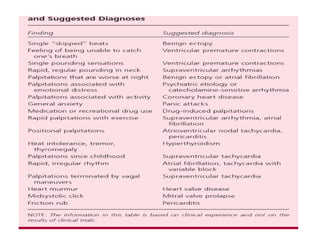
NATURE OF PALPITATIONS
Feature Suggests
Heart misses and thumps Ectopic beats
Worse at rest Ectopic beats
Very fast regular SVT/VT
Sudden onset SVT/VT
Offset with vagal manoeuvres SVT
Fast and irregular AF and atrial flutter with varying block
Forceful and regular –not fast Awareness of sinus rhythm (anxiety)
Severe dizziness or syncope VT or Bradyarrhythmias
Pre-existing heart failure VT
PATHOPHYSIOLOGY
• Augmentation of heart contractility
• Physiological augmentation
• Exercising strongly and over nervous
• After drinking coffee,tea,alcohol
• Taking medicine such as Atropine,Ephedrine,Aminophylline
• Pathological augmentation
• Ventricular hypertrophy
• Preload or afterload increase hypertrophy augmentation of
contractilitypalpitation
• Thyrotoxicosis : basic metabolism amplify &sympathetic nerve
exciteheart rate increases
• Anemia: hypoxia heart rate increases
• Fever: basic metabolism amplify
• Hypoglycemia: palpitation due to release of catecholamine
• Arrhythmia
• Cardiac neurosis : turbulence of sympathetic nerve and
pneumogastric nerve
ETIOLOGY
• Cardiac causes
Arrhythmias
Nonarrhythmic cardiac cause
• Extracardiac causes
• Psychiatric causes
• Drugs & Diets
ARRHYTHMIAS
• Atrial fibrillation/flutter
• Bradycardia caused by advanced AV block or
sinus node dysfunction
• Bradycardia –tachycardia syndrome
• Multifocal atrial tachycardia
• Premature supraventricular or ventricular
contractions
• Sinus tachycardia
• Supraventricular tachycardia
• Ventricular tachycardia
• Wolff –Parkinson-White syndrome
NONARRHYTHMIC CARDIAC
CAUSES
• Mitral valve prolapse
• Atrial or Ventricular septal defect
• Cardiomyopathy
• Congenital heart disease
• Congestive heart failure
• Pacemaker–mediated tachycardia
• Pericarditis
• Valvular disease-Aortic insufficiency,Stenosis
EXTRACARDIAC CAUSES
• Fever
• Anemia
• Hyperthyroidism
• Pheochromocytoma
• Hypovolemia
• Hypoglycemia
• Electrolyte imbalance
• Pulmonary disease
• Vasovagal syndrome
PSYCHIATRIC CAUSES
• Panic attacks
• Anxiety
• Somatization
• Patients with psychiatric causes for
palpitations more commonly report a longer
duration of the sensation (>15 min) and other
accompanying symptoms than do patients
with other causes
DRUGS & DIETS
• Beta agonists
• Phenothiazine
• Theophylline
• Isotretinoin
• Digoxin
• Tobacco
• Alcohol
• Caffeine
• Chocolate
• Cocaine
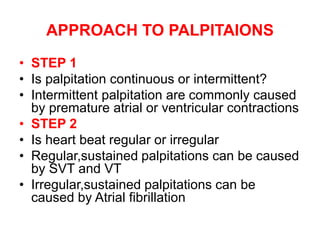
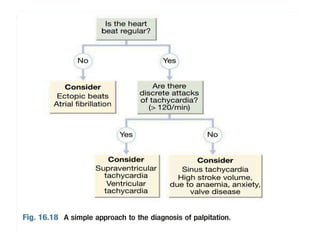
APPROACH TO PALPITAIONS
• STEP 1
• Is palpitation continuous or intermittent?
• Intermittent palpitation are commonly caused
by premature atrial or ventricular contractions
• STEP 2
• Is heart beat regular or irregular
• Regular,sustained palpitations can be caused
by SVT and VT
• Irregular,sustained palpitations can be
caused by Atrial fibrillation
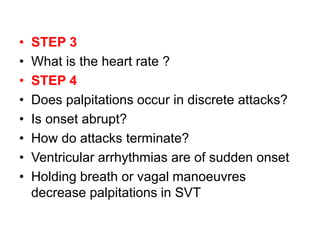
• STEP 3
• What is the heart rate ?
• STEP 4
• Does palpitations occur in discrete attacks?
• Is onset abrupt?
• How do attacks terminate?
• Ventricular arrhythmias are of sudden onset
• Holding breath or vagal manoeuvres
decrease palpitations in SVT
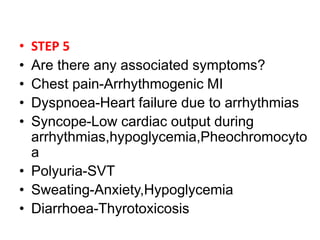
• STEP 5
• Are there any associated symptoms?
• Chest pain-Arrhythmogenic MI
• Dyspnoea-Heart failure due to arrhythmias
• Syncope-Low cardiac output during
arrhythmias,hypoglycemia,Pheochromocyto
a
• Polyuria-SVT
• Sweating-Anxiety,Hypoglycemia
• Diarrhoea-Thyrotoxicosis
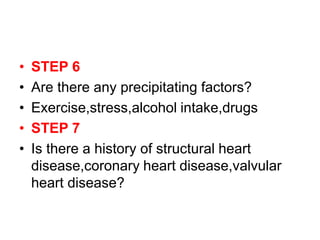
• STEP 6
• Are there any precipitating factors?
• Exercise,stress,alcohol intake,drugs
• STEP 7
• Is there a history of structural heart
disease,coronary heart disease,valvular
heart disease?
EXAMINATION
• Pallor
• Thyroid swelling
• Pulse
• Blood pressure
• Heart murmurs
• Signs of left/right ventricular
dysfunction
• Features of endocrine abnormality
INVESTIGATIONS
• CBC
• Thyroid function test
• RBS
• Resting ECG
• Exercise ECG (If exertion is known to induce
arrhythmia and accompanying palpitations)
• Continuous ECG monitoring (Holter)
• Telephonic monitoring
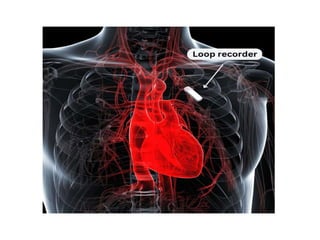
• Loop recordings- External or Implantable
• 2D ECHO
MANAGEMENT
• Beta blocker – Symptomatic atrial or
ventricular premature contractions
• Sustained arrhythmias –Pharmacologic or
Invasive electrophysiologic study
• Treat underlying cause for the noncardiac,
psychiatric or nonarrhythmia cardiac
etiology
• Abstain from caffeine,alcohol,foods or
stressful situations that appear to trigger
palpitations

approach to palpitations.pptx

  • 1.
    APPROACH TO PALPITATIONS Dr.G.VENKATARAMANA MBBS DNB FAMILY MEDICINE
  • 2.
    PALPITATION • Defined asa “thumping,” “pounding,” or “fluttering” sensation in the chest • This sensation can be either intermittent or sustained and either regular or irregular • Unusual awareness of the heartbeat • Palpitations are often noted when the patient is quietly resting, during which time other stimuli are minimal • Palpitations that are positional generally reflect a structural process within(e.g., atrial myxoma) or adjacent to (e.g., mediastinal mass) the heart
  • 3.
    NATURE OF PALPITATIONS FeatureSuggests Heart misses and thumps Ectopic beats Worse at rest Ectopic beats Very fast regular SVT/VT Sudden onset SVT/VT Offset with vagal manoeuvres SVT Fast and irregular AF and atrial flutter with varying block Forceful and regular –not fast Awareness of sinus rhythm (anxiety) Severe dizziness or syncope VT or Bradyarrhythmias Pre-existing heart failure VT
  • 4.
    PATHOPHYSIOLOGY • Augmentation ofheart contractility • Physiological augmentation • Exercising strongly and over nervous • After drinking coffee,tea,alcohol • Taking medicine such as Atropine,Ephedrine,Aminophylline • Pathological augmentation • Ventricular hypertrophy • Preload or afterload increase hypertrophy augmentation of contractilitypalpitation • Thyrotoxicosis : basic metabolism amplify &sympathetic nerve exciteheart rate increases • Anemia: hypoxia heart rate increases • Fever: basic metabolism amplify • Hypoglycemia: palpitation due to release of catecholamine • Arrhythmia • Cardiac neurosis : turbulence of sympathetic nerve and pneumogastric nerve
  • 5.
    ETIOLOGY • Cardiac causes Arrhythmias Nonarrhythmiccardiac cause • Extracardiac causes • Psychiatric causes • Drugs & Diets
  • 6.
    ARRHYTHMIAS • Atrial fibrillation/flutter •Bradycardia caused by advanced AV block or sinus node dysfunction • Bradycardia –tachycardia syndrome • Multifocal atrial tachycardia • Premature supraventricular or ventricular contractions • Sinus tachycardia • Supraventricular tachycardia • Ventricular tachycardia • Wolff –Parkinson-White syndrome
  • 7.
    NONARRHYTHMIC CARDIAC CAUSES • Mitralvalve prolapse • Atrial or Ventricular septal defect • Cardiomyopathy • Congenital heart disease • Congestive heart failure • Pacemaker–mediated tachycardia • Pericarditis • Valvular disease-Aortic insufficiency,Stenosis
  • 8.
    EXTRACARDIAC CAUSES • Fever •Anemia • Hyperthyroidism • Pheochromocytoma • Hypovolemia • Hypoglycemia • Electrolyte imbalance • Pulmonary disease • Vasovagal syndrome
  • 9.
    PSYCHIATRIC CAUSES • Panicattacks • Anxiety • Somatization • Patients with psychiatric causes for palpitations more commonly report a longer duration of the sensation (>15 min) and other accompanying symptoms than do patients with other causes
  • 10.
    DRUGS & DIETS •Beta agonists • Phenothiazine • Theophylline • Isotretinoin • Digoxin • Tobacco • Alcohol • Caffeine • Chocolate • Cocaine
  • 12.
    APPROACH TO PALPITAIONS •STEP 1 • Is palpitation continuous or intermittent? • Intermittent palpitation are commonly caused by premature atrial or ventricular contractions • STEP 2 • Is heart beat regular or irregular • Regular,sustained palpitations can be caused by SVT and VT • Irregular,sustained palpitations can be caused by Atrial fibrillation
  • 13.
    • STEP 3 •What is the heart rate ? • STEP 4 • Does palpitations occur in discrete attacks? • Is onset abrupt? • How do attacks terminate? • Ventricular arrhythmias are of sudden onset • Holding breath or vagal manoeuvres decrease palpitations in SVT
  • 14.
    • STEP 5 •Are there any associated symptoms? • Chest pain-Arrhythmogenic MI • Dyspnoea-Heart failure due to arrhythmias • Syncope-Low cardiac output during arrhythmias,hypoglycemia,Pheochromocyto a • Polyuria-SVT • Sweating-Anxiety,Hypoglycemia • Diarrhoea-Thyrotoxicosis
  • 15.
    • STEP 6 •Are there any precipitating factors? • Exercise,stress,alcohol intake,drugs • STEP 7 • Is there a history of structural heart disease,coronary heart disease,valvular heart disease?
  • 16.
    EXAMINATION • Pallor • Thyroidswelling • Pulse • Blood pressure • Heart murmurs • Signs of left/right ventricular dysfunction • Features of endocrine abnormality
  • 18.
    INVESTIGATIONS • CBC • Thyroidfunction test • RBS • Resting ECG • Exercise ECG (If exertion is known to induce arrhythmia and accompanying palpitations) • Continuous ECG monitoring (Holter) • Telephonic monitoring • Loop recordings- External or Implantable • 2D ECHO
  • 24.
    MANAGEMENT • Beta blocker– Symptomatic atrial or ventricular premature contractions • Sustained arrhythmias –Pharmacologic or Invasive electrophysiologic study • Treat underlying cause for the noncardiac, psychiatric or nonarrhythmia cardiac etiology • Abstain from caffeine,alcohol,foods or stressful situations that appear to trigger palpitations