1
 1.Historical foundations
 2. Principal Findings in CA
 Turn-taking
 Adjacency pairs and sequence organization
 Repair
 Turn design
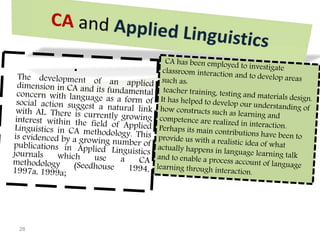
 CA and Applied Linguistics
 Applications of CA
 CA and education settings
 DA vs.CA
2
3
2
5
Ethno- methodology is the study
of methods people use for
understanding and producing the
social order in which they live.
• For Sacks, two important functions of CA
– that it kept its grip “on the primary data of the social world
– that it was testable and examinable by more than the sociologist
performing the analysis.
6
Conversation analysis is : “an approach within the social
sciences that aims to describe, analyse and understand
talk as a basic and constitutive feature of human life...
7
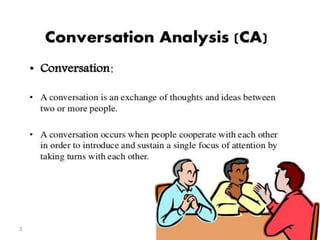
Conversation Analysis (commonly abbreviated as (CA) is an
approach to the study of social interaction,
embracing both verbal and non-verbal conduct, in
situations of everyday life.
An activity in which, for the most part, two or more people
take turns at speaking.
Some features of conversational interaction:
Typically, only one person speaks at a time.
Usually, silence is avoided.
If two people talk at the same time, one of them stops.
8
A: Didn’t you [know wh-
B: [But he must’ve been there by two
A: Yes, but you knew where he was going
9
• What makes talk a
worthy focus of study
for social scientists
from such a diversity
of backgrounds?
Talk is, first, “what appears to be
the primordial site of sociality”
(Schegloff, 1986, p. 112). This is
an important notion with its
implication that it is talk above all
else that allows us to transcend
isolation and to share our lives
with others.
Talk is a crucial activity at the center of world-
changing events: summit meetings between world
leaders, policy decisions in board rooms of
multinational companies, international conferences
on environmental policies. It is also a means we use
to do the mundane and routine in life: the
exchange of greetings with a neighbor, polite chit-
chat with workmates during a break, ordering a
snack at lunch time.
Talk
10
A. Turn-taking
What Is a Turn?
a turn is the speech of one person
continued until another takes the
floor.
11
Ochs( 1979 : 63) defines a turn as
“an utterance bounded by
significant pause or by utterance of
other participants’’.
12
13
• Additionally, Sacks et al. suggest a number of
rules that operate on turn units using the
symbol NS for the next speaker,
• and TRP for Transition Relevant Place defined
as the recognizable end of a turn
constructional unit.
14
NS•
• The Current Speaker Selects The Next Speaker
• The Next speaker Self-selects
• The Current Speaker May Continue.
15
• A transition-relevance place (TRP) takes
place at the completion of an utterance; it
is the change-of-turn place (Wang, 2011).
• 1.If a speaker is selected by the current
speaker, then that speaker must take the
turn at the next transition relevance place.
• A. Venus: Where should we go now, turn
left or turn right?Winnie.
• B. Winnie: I don't know, I am sorry.
• In this situation, A pass the turn to B by
asking a question.16
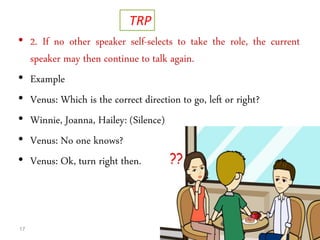
• 2. If no other speaker self-selects to take the role, the current
speaker may then continue to talk again.
• Example
• Venus: Which is the correct direction to go, left or right?
• Winnie, Joanna, Hailey: (Silence)
• Venus: No one knows?
• Venus: Ok, turn right then.
17
TRP
The Functions of Adjacency Pairs
Adjacency pairs are used to
coordinate turns
They help in opening and closing a
conversation, Negotiate deals and
Change topics
18
• They are two utterances long
• The utterances are produced successively by different
speakers
• The utterances are ordered – the first must belong to the class
of first pair parts , the second to the class of second pair parts.
• The utterances are related , not any second pair can follow
any first pair part , but only appropriate one
• The first pair part often selects next speaker and always
selects next action – it thus sets up a transition relevance and
expectation which the next speaker fulfills , in other words
the first part of a pair predicts the occurrence of the second
19
• Prototypical examples of adjacency pairs
would be the following:
• 1) greeting-greeting:
• A: Hello.
• B: Hello.
• 2) offer-acceptance:
• A: Would you care for more tea?
• B: Yes, please.
• 3) apology-minimization:
• A: I’m sorry.
• B: Oh, don’t worry. That’s O.K
20
• Adjacency pairs are used to coordinate turns
• They help in opening and closing a
conversation
• Negotiate deals
• Change topics
19
Repair
An important strategy speakers use in spoken discourse is what is
termed Repair, that is, the way speakers correct things they or
someone else has said, and check what they have understood in
a conversation. Repair is often done through self repair and
other repair .
22
• Self-initiated repair is differentiated from other
initiated
• repair. Self-repair within a turn may be signaled
by phenomena such as glottal stops, lengthened
vowels, etc.
• Repair initiated by a participant other than the
speaker may be achieved by the use of echo-
questions, repetitions of problematic items with
stress on problem syllables, or by using
expressions such as
• What?, Pardon?, Excuse me?, etc.
23
• self-initiated self repairs
• ) the speaker himself can
initiate his mistake)
• Example
• Ruby: What have you done at
the weekend?
• LiXun: I go …….¦I have gone to
see a movie.
• In the example, LiXun initiates
that he uses the wrong tense
so he changes 'go' into 'have
gone' immediately.
24
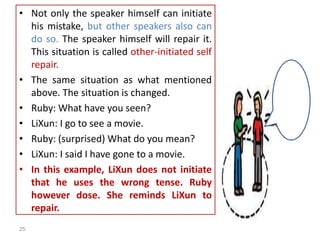
• Not only the speaker himself can initiate
his mistake, but other speakers also can
do so. The speaker himself will repair it.
This situation is called other-initiated self
repair.
• The same situation as what mentioned
above. The situation is changed.
• Ruby: What have you seen?
• LiXun: I go to see a movie.
• Ruby: (surprised) What do you mean?
• LiXun: I said I have gone to a movie.
• In this example, LiXun does not initiate
that he uses the wrong tense. Ruby
however dose. She reminds LiXun to
repair.
25
• The Aspects Of Grammar Or The Way In Which A Turn At
Talk, Or A Turn Constructional Unit, Is Put Together.
• It can be considered as something that is constructed in response
to the contingencies of the local meaning and social requirements
of the emerging talk.
• It is about the relationship between form and function: the
morphosyntax and lexis of an utterance, and the action it is
designed to achieve
26
• To Make An Offer, For Example, Speakers Can
Design Their Turn As A Conditional
• If Your Husband Would Like The Address, My
Husband Would Gladly Give It To Him),
• Declarative (I’ll Take Her In Sunday), Or
• Interrogative (Do You Want Me To Bring The
Chairs?),
• Each Of Which Systematically Occurs In Particular
sequential positions
27
28
Applications of CA
• CA and education settings
Interaction is the key concept in
educational settings
In an early study using CA methodology in an
educational setting, McHoul investigated
turn-taking in formal classrooms, and
proposed a set of turn taking rules derived
from Sacks, Schegloff, & Jefferson (1974),
which laid out rules which allowed “that
only teachers can direct speakership in any
creative way” (McHoul, 1978, p. 188)
29
Student Interaction
30
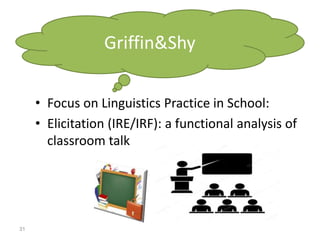
• Focus on Linguistics Practice in School:
• Elicitation (IRE/IRF): a functional analysis of
classroom talk
31
Griffin&Shy
26
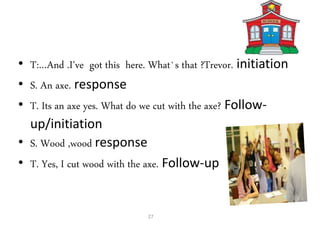
IRE
• T:…And .I've got this here. What`s that ?Trevor. initiation
• S. An axe. response
• T. Its an axe yes. What do we cut with the axe? Follow-
up/initiation
• S. Wood ,wood response
• T. Yes, I cut wood with the axe. Follow-up
27
34
• CA &DA come from different fields:
Sociology
Spoken language
Linguistics
Spoken &Written language
CA DA
35
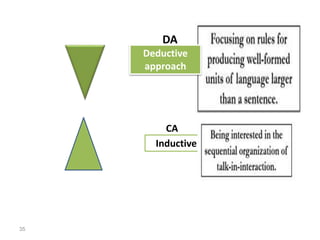
Deductive
approach
DA
CA
Inductive
CA& Cooperative Principle
• The cooperative principle has four sub-parts, four rules or
maxims that people involved in conversations tend to
respect:
• -The maxim of quantity=say enough ,but don`t say too
much(Say just as much as is necessary”)
• -The maxim of quality=say only what you have reason to
believe is true. (“Tell the truth”)
•-The maxim of raltion=say only what is relevant.
•(Make your contributions relevant.)
• -the maxim of manner=be breif,clear,and un ambiguous.
36
• A: What time do you work tomorrow?(quantity)
• B: Tomorrow I work at 2pm.
• In the example, B responds to A’s question without
adding other information.
•
• A: Why were you late last night?
• B: My car broke down.
• In the example, B gives truthful information that the
car broke down and that’s why they were late.(quality)
• A: How is the weather today?
• B: It is rainy and cloudy.
• In the example, B provides accurate information that is
relevant to A’s question.(relevance)
• A: Where was the professor when class ended?
• B: She left class and went to her office.
• In the example, B responds with orderly information to
the question posed by A.(manner)
37
38

Applied Linguistics:CA

  • 1.
  • 2.
     1.Historical foundations 2. Principal Findings in CA  Turn-taking  Adjacency pairs and sequence organization  Repair  Turn design  CA and Applied Linguistics  Applications of CA  CA and education settings  DA vs.CA 2
  • 3.
  • 4.
  • 5.
    5 Ethno- methodology isthe study of methods people use for understanding and producing the social order in which they live.
  • 6.
    • For Sacks,two important functions of CA – that it kept its grip “on the primary data of the social world – that it was testable and examinable by more than the sociologist performing the analysis. 6
  • 7.
    Conversation analysis is: “an approach within the social sciences that aims to describe, analyse and understand talk as a basic and constitutive feature of human life... 7 Conversation Analysis (commonly abbreviated as (CA) is an approach to the study of social interaction, embracing both verbal and non-verbal conduct, in situations of everyday life.
  • 8.
    An activity inwhich, for the most part, two or more people take turns at speaking. Some features of conversational interaction: Typically, only one person speaks at a time. Usually, silence is avoided. If two people talk at the same time, one of them stops. 8 A: Didn’t you [know wh- B: [But he must’ve been there by two A: Yes, but you knew where he was going
  • 9.
  • 10.
    • What makestalk a worthy focus of study for social scientists from such a diversity of backgrounds? Talk is, first, “what appears to be the primordial site of sociality” (Schegloff, 1986, p. 112). This is an important notion with its implication that it is talk above all else that allows us to transcend isolation and to share our lives with others. Talk is a crucial activity at the center of world- changing events: summit meetings between world leaders, policy decisions in board rooms of multinational companies, international conferences on environmental policies. It is also a means we use to do the mundane and routine in life: the exchange of greetings with a neighbor, polite chit- chat with workmates during a break, ordering a snack at lunch time. Talk 10
  • 11.
    A. Turn-taking What Isa Turn? a turn is the speech of one person continued until another takes the floor. 11 Ochs( 1979 : 63) defines a turn as “an utterance bounded by significant pause or by utterance of other participants’’.
  • 12.
  • 13.
  • 14.
    • Additionally, Sackset al. suggest a number of rules that operate on turn units using the symbol NS for the next speaker, • and TRP for Transition Relevant Place defined as the recognizable end of a turn constructional unit. 14
  • 15.
    NS• • The CurrentSpeaker Selects The Next Speaker • The Next speaker Self-selects • The Current Speaker May Continue. 15
  • 16.
    • A transition-relevanceplace (TRP) takes place at the completion of an utterance; it is the change-of-turn place (Wang, 2011). • 1.If a speaker is selected by the current speaker, then that speaker must take the turn at the next transition relevance place. • A. Venus: Where should we go now, turn left or turn right?Winnie. • B. Winnie: I don't know, I am sorry. • In this situation, A pass the turn to B by asking a question.16
  • 17.
    • 2. Ifno other speaker self-selects to take the role, the current speaker may then continue to talk again. • Example • Venus: Which is the correct direction to go, left or right? • Winnie, Joanna, Hailey: (Silence) • Venus: No one knows? • Venus: Ok, turn right then. 17 TRP
  • 18.
    The Functions ofAdjacency Pairs Adjacency pairs are used to coordinate turns They help in opening and closing a conversation, Negotiate deals and Change topics 18
  • 19.
    • They aretwo utterances long • The utterances are produced successively by different speakers • The utterances are ordered – the first must belong to the class of first pair parts , the second to the class of second pair parts. • The utterances are related , not any second pair can follow any first pair part , but only appropriate one • The first pair part often selects next speaker and always selects next action – it thus sets up a transition relevance and expectation which the next speaker fulfills , in other words the first part of a pair predicts the occurrence of the second 19
  • 20.
    • Prototypical examplesof adjacency pairs would be the following: • 1) greeting-greeting: • A: Hello. • B: Hello. • 2) offer-acceptance: • A: Would you care for more tea? • B: Yes, please. • 3) apology-minimization: • A: I’m sorry. • B: Oh, don’t worry. That’s O.K 20
  • 21.
    • Adjacency pairsare used to coordinate turns • They help in opening and closing a conversation • Negotiate deals • Change topics 19
  • 22.
    Repair An important strategyspeakers use in spoken discourse is what is termed Repair, that is, the way speakers correct things they or someone else has said, and check what they have understood in a conversation. Repair is often done through self repair and other repair . 22
  • 23.
    • Self-initiated repairis differentiated from other initiated • repair. Self-repair within a turn may be signaled by phenomena such as glottal stops, lengthened vowels, etc. • Repair initiated by a participant other than the speaker may be achieved by the use of echo- questions, repetitions of problematic items with stress on problem syllables, or by using expressions such as • What?, Pardon?, Excuse me?, etc. 23
  • 24.
    • self-initiated selfrepairs • ) the speaker himself can initiate his mistake) • Example • Ruby: What have you done at the weekend? • LiXun: I go …….¦I have gone to see a movie. • In the example, LiXun initiates that he uses the wrong tense so he changes 'go' into 'have gone' immediately. 24
  • 25.
    • Not onlythe speaker himself can initiate his mistake, but other speakers also can do so. The speaker himself will repair it. This situation is called other-initiated self repair. • The same situation as what mentioned above. The situation is changed. • Ruby: What have you seen? • LiXun: I go to see a movie. • Ruby: (surprised) What do you mean? • LiXun: I said I have gone to a movie. • In this example, LiXun does not initiate that he uses the wrong tense. Ruby however dose. She reminds LiXun to repair. 25
  • 26.
    • The AspectsOf Grammar Or The Way In Which A Turn At Talk, Or A Turn Constructional Unit, Is Put Together. • It can be considered as something that is constructed in response to the contingencies of the local meaning and social requirements of the emerging talk. • It is about the relationship between form and function: the morphosyntax and lexis of an utterance, and the action it is designed to achieve 26
  • 27.
    • To MakeAn Offer, For Example, Speakers Can Design Their Turn As A Conditional • If Your Husband Would Like The Address, My Husband Would Gladly Give It To Him), • Declarative (I’ll Take Her In Sunday), Or • Interrogative (Do You Want Me To Bring The Chairs?), • Each Of Which Systematically Occurs In Particular sequential positions 27
  • 28.
  • 29.
    Applications of CA •CA and education settings Interaction is the key concept in educational settings In an early study using CA methodology in an educational setting, McHoul investigated turn-taking in formal classrooms, and proposed a set of turn taking rules derived from Sacks, Schegloff, & Jefferson (1974), which laid out rules which allowed “that only teachers can direct speakership in any creative way” (McHoul, 1978, p. 188) 29
  • 30.
  • 31.
    • Focus onLinguistics Practice in School: • Elicitation (IRE/IRF): a functional analysis of classroom talk 31 Griffin&Shy
  • 32.
  • 33.
    • T:…And .I'vegot this here. What`s that ?Trevor. initiation • S. An axe. response • T. Its an axe yes. What do we cut with the axe? Follow- up/initiation • S. Wood ,wood response • T. Yes, I cut wood with the axe. Follow-up 27
  • 34.
    34 • CA &DAcome from different fields: Sociology Spoken language Linguistics Spoken &Written language CA DA
  • 35.
  • 36.
    CA& Cooperative Principle •The cooperative principle has four sub-parts, four rules or maxims that people involved in conversations tend to respect: • -The maxim of quantity=say enough ,but don`t say too much(Say just as much as is necessary”) • -The maxim of quality=say only what you have reason to believe is true. (“Tell the truth”) •-The maxim of raltion=say only what is relevant. •(Make your contributions relevant.) • -the maxim of manner=be breif,clear,and un ambiguous. 36
  • 37.
    • A: Whattime do you work tomorrow?(quantity) • B: Tomorrow I work at 2pm. • In the example, B responds to A’s question without adding other information. • • A: Why were you late last night? • B: My car broke down. • In the example, B gives truthful information that the car broke down and that’s why they were late.(quality) • A: How is the weather today? • B: It is rainy and cloudy. • In the example, B provides accurate information that is relevant to A’s question.(relevance) • A: Where was the professor when class ended? • B: She left class and went to her office. • In the example, B responds with orderly information to the question posed by A.(manner) 37
  • 38.