Conversation Analysis in the language classroom
Prepared by:
Ayad Inad Abduallah
Burhan Raad Saud
Ibrahim Mohammed Ahmed
Supervised by:
Prof. Dr. Istabriq Al Azzawi
• Content
• Introduction
• Background
• Adjacency pairs
• Preference organization
• Opening and closing sequences
• Applying’ CA to the classroom
• Conclusion
Introduction
Among the many abilities and skills that language teachers
aim to develop in their students, developing oral fluency is
an increasingly important one. Most teachers would agree
that one of the most important objectives of classes
focusing on speaking skills is to prepare students to use the
language outside the classroom in real-life situations
whether it be in everyday conversation or in service
encounters, face to face or on the telephone. The following
two examples illustrate such a discrepancy. The first is from
a naturally occurring conversation between two colleagues
greeting each other after the winter break and the second
is from an English language lesson in which two students
are doing a speaking activity in front of the class
.
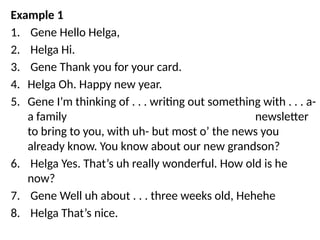
Example 1
1. Gene Hello Helga,
2. Helga Hi.
3. Gene Thank you for your card.
4. Helga Oh. Happy new year.
5. Gene I’m thinking of . . . writing out something with . . . a-
a family newsletter
to bring to you, with uh- but most o’ the news you
already know. You know about our new grandson?
6. Helga Yes. That’s uh really wonderful. How old is he
now?
7. Gene Well uh about . . . three weeks old, Hehehe
8. Helga That’s nice.
Example 2 Three Brazilian students have been asked ‘to stand up
and chat with each other about anything they wanted’ (adapted
from Hoey, 1991: 66). Initially, only two of the students speak:
1. A: Good morning.
2. B: Good morning.
3. A: I love Tina Turner.
4. B: Tina Turner?
5. A: Tina Turner is a famous singer.
[8 turns in which A
and B talk about Tina Turner]
6. A: How’s the weather?
7. B: It was cloudy.
8. B: Oh, what time is it?
9. A: It’s twelve o’clock.
10. B: How are you?
11. A: Not bad.
• Both conversations start with an initial greeting, but after that they progress
very differently. The speakers in Example 1 develop a series of related topics
(the New Year holiday, writing seasonal cards and newsletters, family news,
the new grandson),whereas the two students in Example 2 switch abruptly
between seemingly unrelated topics (the singer Tina Turner, the weather, the
time, asking how the other person is). Gene and Helga in Example 1 are
clearly engaging with one another, whereas the two students seem to be
bringing up any topic that comes to mind simply to keep the conversation
going. Part of the problem here is of course that the students are under
pressure to perform in front of the class. In naturally occurring situations
outside the classroom, people usually have something they want to say to
one another, whereas the students have no particular motivation to talk
except for the fact that they have been asked to by the teacher. But a further
problem may be that the students do not know how to structure and develop
a conversation in the target language. In order to help students with such
conversational skills, teachers need to have an understanding themselves of
how conversations are structured. Conversation Analysis (CA) is an approach
used to investigate how speakers collaboratively co-construct talk, and
therefore can be a useful tool for analysing classroom discourse and for
teaching oral skills.
• Background
• Conversation Analysis refers to a specific approach to the
study of spoken interaction first pioneered by the American
sociologist Harvey Sacks and his collaborators Gail Jefferson
and Emanuel Schegloff in the 1960s and 1970s. These
sociologists were not interested in language as such, but in
the organization of interaction. While CA remains a sub-
discipline within Sociology, nowadays it is also used in a
variety of disciplines concerned with the study of language,
including Applied Linguistics. Conversation Analysis has
identified a number of basic conversational structures and
patterns which recur across a range of situations and
speakers. I will focus on just three types of phenomena: 1)
adjacency pairs; 2) preference; organization ; and 3)
opening and closing sequences.
• Adjacency pairs
One of the first noticeable patterns in looking at a transcript of a naturally
occurring conversation is that some turns are more closely linked
together than others. For instance turns 1–2 and 6–7 in Example 1:
1. Gene Hello Helga,
2. Helga Hi.
6- Helga [. . .] How old is he now?
7- Gene Well uh about . . . three weeks old, Hehehe
•
In turn 2 Helga responds to Gene’s greeting, and in turn 7 Gene
responds to a question posed by Helga. Turns 1 and 6 respectively set up
the expectation that a certain type of next turn will occur, thus a
greeting expects another greeting in return, and a question expects an
answer. Such initial turns are labelled ‘first pair parts’ and responding
turns which fulfil the expectation set up by the first turn are called
‘second pair parts’. A sequence of two such
• turns is an ‘adjacency pair’. If we turn to the language classroom,
learners clearly need to be able to produce appropriate second pair
parts in order to engage in spoken interaction. The classroom
interaction in Example 2 shows that the two students are indeed
capable of producing coherent adjacency pairs, for example:
1. A: Good morning.
2. B: Good morning.
6- A: How’s the weather?
7- B: It was cloudy.
8- B: Oh, what time is it?
9- A: It’s twelve o’clock.
As far as adjacency pairs are concerned, their interaction seems to
be realistic. However, as we shall see, other aspects of their
interaction deviate considerably from what happens in naturally
occurring conversation, resulting in very unnatural and stilted
sounding discourse.
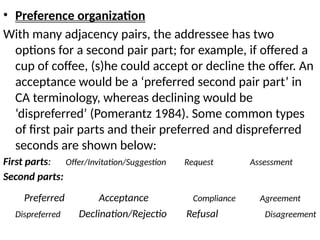
• Preference organization
With many adjacency pairs, the addressee has two
options for a second pair part; for example, if offered a
cup of coffee, (s)he could accept or decline the offer. An
acceptance would be a ‘preferred second pair part’ in
CA terminology, whereas declining would be
‘dispreferred’ (Pomerantz 1984). Some common types
of first pair parts and their preferred and dispreferred
seconds are shown below:
First parts: Offer/Invitation/Suggestion Request Assessment
Second parts:
Preferred Acceptance Compliance Agreement
Dispreferred Declination/Rejectio Refusal Disagreement
• What CA researchers found from examining many interactions was
that the two alternative types of second pair parts systematically
have quite different structures and characteristics. Preferred
seconds are structurally very simple: they are usually produced
without any hesitations and are short and direct, for example:
• Example 3 A- But you know maybe- maybe what I should do is . . .
, →
Suggestion
is just write a little memo.
B- That’s not a bad idea, → Accept
• Opening and Closing sequences
1. Opening sequences
The following is a real example of an opening sequence
that took place between colleagues in an office:
Example 5
A. Liz Morning Ron
B. Ron Hello, how are you?
C. Liz Fine, thank you, how are you?
D. Ron Yeah all right, yeah,
E. Liz Good,
F. Ron hhh Can’t be that machine [. . .]
•
Clearly there are several parts to this sequence: it
begins with a greeting, (turns 1 and 2), then
enquiry as to the other person’s health (3–5), and
then a ‘first topic’ is introduced in line 6 (Ron has
in fact come in to use the photocopier and finds
there is a problem). But opening sequences can
contain other elements as well: conversation
analysts have identified the following set of
elements typically occurring in the order listed
(Schegloff 1968; see also Hutchby and Wooffitt
1998: 122–126)
:
1. Summons/answer
2. Identification/recognition
3. Greetings
4. Initial enquiries
5. First topic
• The ‘first topic’ is not actually part of the
opening sequence, but occurs after completion of
the opening sequence and often gives the reason
for the encounter. The following (invented)
beginning of a telephone conversation shows all
five elements.
Example 6
1 [Ring] Summons
2 A: Hello Answering summons
3 B: Hello, Dan? Identification
4 A: Yeah.
5 B: This is Jenny. Recognition
6 A: Oh hi Jenny. Greeting
7 B: Hi,
how are you doing. Initial enquiries
8 B: Pretty good. How ’bout you.
9 A: I’m fine.
10 B: The reason I called was to ask [. . .] First topic
• Note that the elements occur as adjacency pairs, e.g.
‘summons – answering summons’, or as sequences, e.g. ‘initial
enquiries’, which consists of two reciprocal adjacency
pairs.The first ‘hello’ in a telephone call is not actually a
greeting, but answers the summons (the ringing of the
phone). In face-to-face conversations, summons are not
usually necessary, unless calling to attract the other person’s
attention. If speakers know each other (or, on the phone,
recognize each others’ voice or if the name of the caller
appears on the display), a separate identification/recognition
stage is not necessary either. So variation occurs in opening
sequences in line with the CA notion of ‘recipient design’, that
is, participants design their turns according to the assumed
state of shared knowledge between them.
• Closing sequences
Ending a conversation also follows a fairly routine
pattern. Conversation analysts have shown that
this involves much more than simply saying
‘goodbye’; in fact three stages are necessary
(Schegloff and Sacks 1973), as illustrated in the
example below from the end of a workplace
encounter:
• Example7
1. Becky Okay ’cause I th- I wanted to just see who was
→ Topic closing doing what, an’ I was gonna make
some calls this afternoon, but I’ll do it tomorrow.
2. Amy Mhm, There-
⎣
3. Amy Okay. → (poss.) pre-closing
4. Becky Okay.
Then uh: good night, → Terminal exchange
5. Amy Uhm Good night.
⎣
6.Becky We’ll see you tomorrow morning,
7. Amy Okay
• [Becky leaves]
• Becky moves towards closure by summarizing what the
conversation was about (I just wanted to see who was doing what)
and what action she will take as a result (I was gonna make some
calls . . . I’ll do it tomorrow). This topic closing is followed by two
lexically empty turns (Okay – Okay), whose function it is effectively
to close down the conversation. It is a possible pre-closing, as this
slot provides the opportunity for either speaker to introduce a
further topic. Amy initially seems to have more to say, as she
produces an incomplete utterance in turn 2 overlapping with
Becky’s turn 1, but she then moves to pre-closing in turn 3 (Okay),
which Amy echoes in turn 4, thus confirming that both speakers are
happy to end the conversation. The speakers can now move on to
the terminal exchange, where they say ‘goodbye’ – typically an
adjacency pair, but here expanded to two pairs (turns 4–7). As with
opening sequences, exposure to and practice of the structure of
closing sequences would be of practical value to language learners.
• ‘Applying’ CA to the classroom
Conversation Analysis has thus shown that speakers
orient to a number of recurring conversational structures,
including adjacency pairs, preference organization
anddifferent types of sequences. It is argued here that
knowledge of these structures would be beneficial to
teachers in developing their students’ conversational
skills. Armed with these insights from CA research,
teachers could devise activities aimed at developing
awareness of and practising these conversational
structures.The sample activity in Figure 4.1 shows the
transcript of a real encounter in a university office
between a student, who has a query, and an
administrative member of staff.
• Conclusion
The aim of this chapter has been to demonstrate the relevance and
application of findings from Conversation Analysis to the teaching of
the spoken language in general and conversational skills in
particular in the language classroom. CA analysis has demonstrated
that everyday conversation is orderly and exhibits recurring
structures and sequences. It thus provides valuable information for
language teachers about the structure of talk which can be easily
applied to the teaching of conversation. But it is important that this
is not simply a mechanistic application of structural phenomena
identified by CA. A central premise of CA is that participants in
interaction do not simply ‘apply’ conversational rules, but design
each turn specifically in relation top receding talk and to the context
(i.e. the other participants, the setting etc.) in which they are
interacting. Therefore what kind of turn-taking is appropriate or
‘natural’ will depend on the specific interactional activities in which
learners engage in the classroom.
•
Conversation Analysis in the language classroom.pptx

Conversation Analysis in the language classroom.pptx

  • 1.
    Conversation Analysis inthe language classroom Prepared by: Ayad Inad Abduallah Burhan Raad Saud Ibrahim Mohammed Ahmed Supervised by: Prof. Dr. Istabriq Al Azzawi
  • 2.
    • Content • Introduction •Background • Adjacency pairs • Preference organization • Opening and closing sequences • Applying’ CA to the classroom • Conclusion
  • 3.
    Introduction Among the manyabilities and skills that language teachers aim to develop in their students, developing oral fluency is an increasingly important one. Most teachers would agree that one of the most important objectives of classes focusing on speaking skills is to prepare students to use the language outside the classroom in real-life situations whether it be in everyday conversation or in service encounters, face to face or on the telephone. The following two examples illustrate such a discrepancy. The first is from a naturally occurring conversation between two colleagues greeting each other after the winter break and the second is from an English language lesson in which two students are doing a speaking activity in front of the class .
  • 4.
    Example 1 1. GeneHello Helga, 2. Helga Hi. 3. Gene Thank you for your card. 4. Helga Oh. Happy new year. 5. Gene I’m thinking of . . . writing out something with . . . a- a family newsletter to bring to you, with uh- but most o’ the news you already know. You know about our new grandson? 6. Helga Yes. That’s uh really wonderful. How old is he now? 7. Gene Well uh about . . . three weeks old, Hehehe 8. Helga That’s nice.
  • 5.
    Example 2 ThreeBrazilian students have been asked ‘to stand up and chat with each other about anything they wanted’ (adapted from Hoey, 1991: 66). Initially, only two of the students speak: 1. A: Good morning. 2. B: Good morning. 3. A: I love Tina Turner. 4. B: Tina Turner? 5. A: Tina Turner is a famous singer. [8 turns in which A and B talk about Tina Turner] 6. A: How’s the weather? 7. B: It was cloudy. 8. B: Oh, what time is it? 9. A: It’s twelve o’clock. 10. B: How are you? 11. A: Not bad.
  • 6.
    • Both conversationsstart with an initial greeting, but after that they progress very differently. The speakers in Example 1 develop a series of related topics (the New Year holiday, writing seasonal cards and newsletters, family news, the new grandson),whereas the two students in Example 2 switch abruptly between seemingly unrelated topics (the singer Tina Turner, the weather, the time, asking how the other person is). Gene and Helga in Example 1 are clearly engaging with one another, whereas the two students seem to be bringing up any topic that comes to mind simply to keep the conversation going. Part of the problem here is of course that the students are under pressure to perform in front of the class. In naturally occurring situations outside the classroom, people usually have something they want to say to one another, whereas the students have no particular motivation to talk except for the fact that they have been asked to by the teacher. But a further problem may be that the students do not know how to structure and develop a conversation in the target language. In order to help students with such conversational skills, teachers need to have an understanding themselves of how conversations are structured. Conversation Analysis (CA) is an approach used to investigate how speakers collaboratively co-construct talk, and therefore can be a useful tool for analysing classroom discourse and for teaching oral skills.
  • 7.
    • Background • ConversationAnalysis refers to a specific approach to the study of spoken interaction first pioneered by the American sociologist Harvey Sacks and his collaborators Gail Jefferson and Emanuel Schegloff in the 1960s and 1970s. These sociologists were not interested in language as such, but in the organization of interaction. While CA remains a sub- discipline within Sociology, nowadays it is also used in a variety of disciplines concerned with the study of language, including Applied Linguistics. Conversation Analysis has identified a number of basic conversational structures and patterns which recur across a range of situations and speakers. I will focus on just three types of phenomena: 1) adjacency pairs; 2) preference; organization ; and 3) opening and closing sequences.
  • 8.
    • Adjacency pairs Oneof the first noticeable patterns in looking at a transcript of a naturally occurring conversation is that some turns are more closely linked together than others. For instance turns 1–2 and 6–7 in Example 1: 1. Gene Hello Helga, 2. Helga Hi. 6- Helga [. . .] How old is he now? 7- Gene Well uh about . . . three weeks old, Hehehe • In turn 2 Helga responds to Gene’s greeting, and in turn 7 Gene responds to a question posed by Helga. Turns 1 and 6 respectively set up the expectation that a certain type of next turn will occur, thus a greeting expects another greeting in return, and a question expects an answer. Such initial turns are labelled ‘first pair parts’ and responding turns which fulfil the expectation set up by the first turn are called ‘second pair parts’. A sequence of two such
  • 9.
    • turns isan ‘adjacency pair’. If we turn to the language classroom, learners clearly need to be able to produce appropriate second pair parts in order to engage in spoken interaction. The classroom interaction in Example 2 shows that the two students are indeed capable of producing coherent adjacency pairs, for example: 1. A: Good morning. 2. B: Good morning. 6- A: How’s the weather? 7- B: It was cloudy. 8- B: Oh, what time is it? 9- A: It’s twelve o’clock. As far as adjacency pairs are concerned, their interaction seems to be realistic. However, as we shall see, other aspects of their interaction deviate considerably from what happens in naturally occurring conversation, resulting in very unnatural and stilted sounding discourse.
  • 10.
    • Preference organization Withmany adjacency pairs, the addressee has two options for a second pair part; for example, if offered a cup of coffee, (s)he could accept or decline the offer. An acceptance would be a ‘preferred second pair part’ in CA terminology, whereas declining would be ‘dispreferred’ (Pomerantz 1984). Some common types of first pair parts and their preferred and dispreferred seconds are shown below: First parts: Offer/Invitation/Suggestion Request Assessment Second parts: Preferred Acceptance Compliance Agreement Dispreferred Declination/Rejectio Refusal Disagreement
  • 11.
    • What CAresearchers found from examining many interactions was that the two alternative types of second pair parts systematically have quite different structures and characteristics. Preferred seconds are structurally very simple: they are usually produced without any hesitations and are short and direct, for example: • Example 3 A- But you know maybe- maybe what I should do is . . . , → Suggestion is just write a little memo. B- That’s not a bad idea, → Accept
  • 12.
    • Opening andClosing sequences 1. Opening sequences The following is a real example of an opening sequence that took place between colleagues in an office: Example 5 A. Liz Morning Ron B. Ron Hello, how are you? C. Liz Fine, thank you, how are you? D. Ron Yeah all right, yeah, E. Liz Good, F. Ron hhh Can’t be that machine [. . .]
  • 13.
    • Clearly there areseveral parts to this sequence: it begins with a greeting, (turns 1 and 2), then enquiry as to the other person’s health (3–5), and then a ‘first topic’ is introduced in line 6 (Ron has in fact come in to use the photocopier and finds there is a problem). But opening sequences can contain other elements as well: conversation analysts have identified the following set of elements typically occurring in the order listed (Schegloff 1968; see also Hutchby and Wooffitt 1998: 122–126) :
  • 14.
    1. Summons/answer 2. Identification/recognition 3.Greetings 4. Initial enquiries 5. First topic • The ‘first topic’ is not actually part of the opening sequence, but occurs after completion of the opening sequence and often gives the reason for the encounter. The following (invented) beginning of a telephone conversation shows all five elements.
  • 15.
    Example 6 1 [Ring]Summons 2 A: Hello Answering summons 3 B: Hello, Dan? Identification 4 A: Yeah. 5 B: This is Jenny. Recognition 6 A: Oh hi Jenny. Greeting 7 B: Hi, how are you doing. Initial enquiries 8 B: Pretty good. How ’bout you. 9 A: I’m fine. 10 B: The reason I called was to ask [. . .] First topic
  • 16.
    • Note thatthe elements occur as adjacency pairs, e.g. ‘summons – answering summons’, or as sequences, e.g. ‘initial enquiries’, which consists of two reciprocal adjacency pairs.The first ‘hello’ in a telephone call is not actually a greeting, but answers the summons (the ringing of the phone). In face-to-face conversations, summons are not usually necessary, unless calling to attract the other person’s attention. If speakers know each other (or, on the phone, recognize each others’ voice or if the name of the caller appears on the display), a separate identification/recognition stage is not necessary either. So variation occurs in opening sequences in line with the CA notion of ‘recipient design’, that is, participants design their turns according to the assumed state of shared knowledge between them.
  • 17.
    • Closing sequences Endinga conversation also follows a fairly routine pattern. Conversation analysts have shown that this involves much more than simply saying ‘goodbye’; in fact three stages are necessary (Schegloff and Sacks 1973), as illustrated in the example below from the end of a workplace encounter:
  • 18.
    • Example7 1. BeckyOkay ’cause I th- I wanted to just see who was → Topic closing doing what, an’ I was gonna make some calls this afternoon, but I’ll do it tomorrow. 2. Amy Mhm, There- ⎣ 3. Amy Okay. → (poss.) pre-closing 4. Becky Okay. Then uh: good night, → Terminal exchange 5. Amy Uhm Good night. ⎣ 6.Becky We’ll see you tomorrow morning, 7. Amy Okay • [Becky leaves]
  • 19.
    • Becky movestowards closure by summarizing what the conversation was about (I just wanted to see who was doing what) and what action she will take as a result (I was gonna make some calls . . . I’ll do it tomorrow). This topic closing is followed by two lexically empty turns (Okay – Okay), whose function it is effectively to close down the conversation. It is a possible pre-closing, as this slot provides the opportunity for either speaker to introduce a further topic. Amy initially seems to have more to say, as she produces an incomplete utterance in turn 2 overlapping with Becky’s turn 1, but she then moves to pre-closing in turn 3 (Okay), which Amy echoes in turn 4, thus confirming that both speakers are happy to end the conversation. The speakers can now move on to the terminal exchange, where they say ‘goodbye’ – typically an adjacency pair, but here expanded to two pairs (turns 4–7). As with opening sequences, exposure to and practice of the structure of closing sequences would be of practical value to language learners.
  • 20.
    • ‘Applying’ CAto the classroom Conversation Analysis has thus shown that speakers orient to a number of recurring conversational structures, including adjacency pairs, preference organization anddifferent types of sequences. It is argued here that knowledge of these structures would be beneficial to teachers in developing their students’ conversational skills. Armed with these insights from CA research, teachers could devise activities aimed at developing awareness of and practising these conversational structures.The sample activity in Figure 4.1 shows the transcript of a real encounter in a university office between a student, who has a query, and an administrative member of staff.
  • 21.
    • Conclusion The aimof this chapter has been to demonstrate the relevance and application of findings from Conversation Analysis to the teaching of the spoken language in general and conversational skills in particular in the language classroom. CA analysis has demonstrated that everyday conversation is orderly and exhibits recurring structures and sequences. It thus provides valuable information for language teachers about the structure of talk which can be easily applied to the teaching of conversation. But it is important that this is not simply a mechanistic application of structural phenomena identified by CA. A central premise of CA is that participants in interaction do not simply ‘apply’ conversational rules, but design each turn specifically in relation top receding talk and to the context (i.e. the other participants, the setting etc.) in which they are interacting. Therefore what kind of turn-taking is appropriate or ‘natural’ will depend on the specific interactional activities in which learners engage in the classroom. •