CONVERSATION
Conversation is any interactive spoken exchange between two or more people and can be: face – to – face exchanges non – face – to – face exchanges broadcast materials
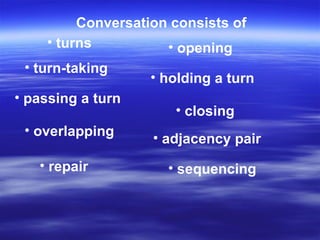
Conversation consists of opening turn-taking holding a turn passing a turn closing overlapping repair adjacency pair sequencing   turns
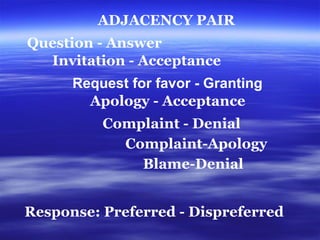
ADJACENCY PAIR Question  -   A nswer Invitation  -   A cceptance   Request for favor  -   G ranting  Apology  -   A cceptance  Complaint -  D enial   Complaint- A pology  B lame- D enial  Response: Preferred - Dispreferred
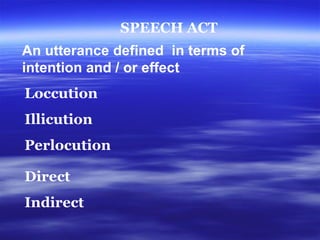
SPEECH ACT An utterance defined  in terms of intention and / or effect Loccution Illicution Perlocution Direct Indirect
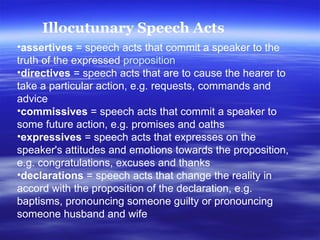
assertives  = speech acts that commit a speaker to the truth of the expressed  proposition   directives  = speech acts that are to cause the hearer to take a particular action, e.g. requests, commands and advice  commissives  = speech acts that commit a speaker to some future action, e.g. promises and oaths  expressives  = speech acts that expresses on the speaker's attitudes and emotions towards the proposition, e.g. congratulations, excuses and thanks  declarations  = speech acts that change the reality in accord with the proposition of the declaration, e.g. baptisms, pronouncing someone guilty or pronouncing someone husband and wife  Illocutunary Speech Acts
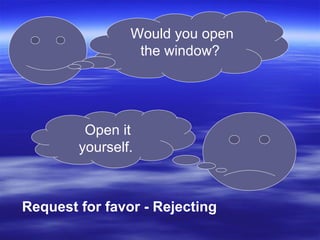
Would you open the window?  Open it yourself.  Request for favor  -   Rejecting
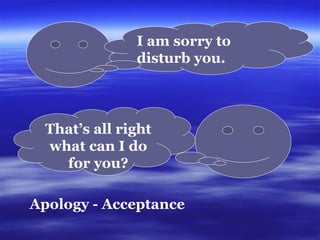
I am sorry to disturb you.   That’s all right what can I do for you? Apology  -   A cceptance
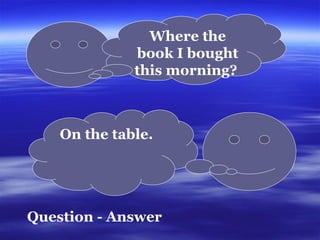
Where the book I bought this morning?  On the table.   Question  -   A nswer
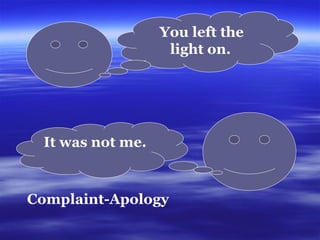
Y ou left the light on.   It was not me.   Complaint- A pology
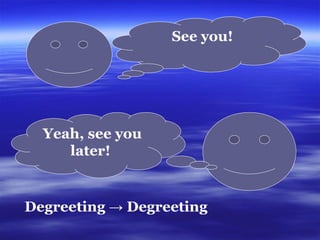
D egreeting ->  D egreeting  See you! Yeah, see you later!
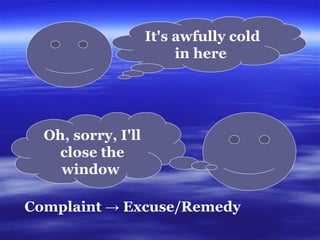
It's awfully cold in here   Oh, sorry, I'll close the window   C omplaint ->  E xcuse/ R emedy
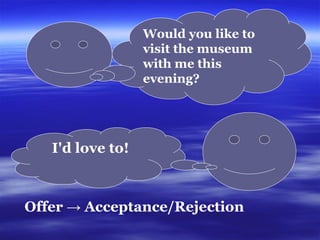
Would you like to visit the museum with me this evening?   I'd love to!  O ffer ->  A cceptance/ R ejection
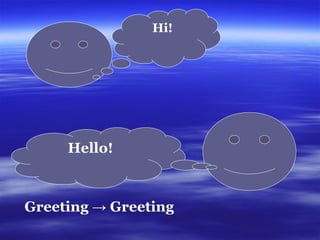
Hi! Hello!   G reeting ->  Gr eeting
Let’s try to apply the above information on the following conversation
Yoy wanted to see me? Yes. Oh my… Did you finish your errands? Because I need you to head to the diner and take care of the night shift. Tonight’s my night off and it’s the Halloween dance at school ,so … I know, but you need to stop being so self-centered, Sam, and start thinking of others. Others need you to go to the diner and mop the floors tonight.
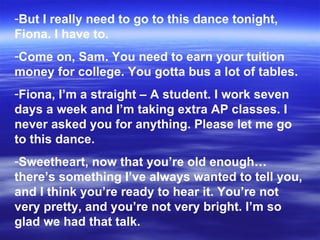
But I really need to go to this dance tonight, Fiona. I have to. Come on, Sam. You need to earn your tuition money for college. You gotta bus a lot of tables. Fiona, I’m a straight – A student. I work seven days a week and I’m taking extra AP classes. I never asked you for anything. Please let me go to this dance. Sweetheart, now that you’re old enough… there’s something I’ve always wanted to tell you, and I think you’re ready to hear it. You’re not very pretty, and you’re not very bright. I’m so glad we had that talk.

Conversation Analysis

  • 1.
  • 2.
    Conversation is anyinteractive spoken exchange between two or more people and can be: face – to – face exchanges non – face – to – face exchanges broadcast materials
  • 3.
    Conversation consists ofopening turn-taking holding a turn passing a turn closing overlapping repair adjacency pair sequencing turns
  • 4.
    ADJACENCY PAIR Question - A nswer Invitation - A cceptance Request for favor - G ranting Apology - A cceptance Complaint - D enial Complaint- A pology B lame- D enial Response: Preferred - Dispreferred
  • 5.
    SPEECH ACT Anutterance defined in terms of intention and / or effect Loccution Illicution Perlocution Direct Indirect
  • 6.
    assertives =speech acts that commit a speaker to the truth of the expressed proposition directives = speech acts that are to cause the hearer to take a particular action, e.g. requests, commands and advice commissives = speech acts that commit a speaker to some future action, e.g. promises and oaths expressives = speech acts that expresses on the speaker's attitudes and emotions towards the proposition, e.g. congratulations, excuses and thanks declarations = speech acts that change the reality in accord with the proposition of the declaration, e.g. baptisms, pronouncing someone guilty or pronouncing someone husband and wife Illocutunary Speech Acts
  • 7.
    Would you openthe window? Open it yourself. Request for favor - Rejecting
  • 8.
    I am sorryto disturb you. That’s all right what can I do for you? Apology - A cceptance
  • 9.
    Where the bookI bought this morning? On the table. Question - A nswer
  • 10.
    Y ou leftthe light on. It was not me. Complaint- A pology
  • 11.
    D egreeting -> D egreeting See you! Yeah, see you later!
  • 12.
    It's awfully coldin here Oh, sorry, I'll close the window C omplaint -> E xcuse/ R emedy
  • 13.
    Would you liketo visit the museum with me this evening? I'd love to! O ffer -> A cceptance/ R ejection
  • 14.
    Hi! Hello! G reeting -> Gr eeting
  • 15.
    Let’s try toapply the above information on the following conversation
  • 16.
    Yoy wanted tosee me? Yes. Oh my… Did you finish your errands? Because I need you to head to the diner and take care of the night shift. Tonight’s my night off and it’s the Halloween dance at school ,so … I know, but you need to stop being so self-centered, Sam, and start thinking of others. Others need you to go to the diner and mop the floors tonight.
  • 17.
    But I reallyneed to go to this dance tonight, Fiona. I have to. Come on, Sam. You need to earn your tuition money for college. You gotta bus a lot of tables. Fiona, I’m a straight – A student. I work seven days a week and I’m taking extra AP classes. I never asked you for anything. Please let me go to this dance. Sweetheart, now that you’re old enough… there’s something I’ve always wanted to tell you, and I think you’re ready to hear it. You’re not very pretty, and you’re not very bright. I’m so glad we had that talk.