Presented by:
Dinda
Siti
Nita
Rudi
CONVERSATION AND
PREFERENCE STRUCTURE
ALLPPT.com _ Free PowerPoint Templates, Diagrams and Charts
Conversation analysis
• Conversation analysis also called talk-
in-interaction is the study of talk
produced in the course of ordinary
human interactions.
• Conversation analysis (commonly
abbreviated as CA) is an approach to
the study of social interaction ,
embracing both verbal and non-verbal
conduct, in situations of everyday life.
Types of Conversation analysis
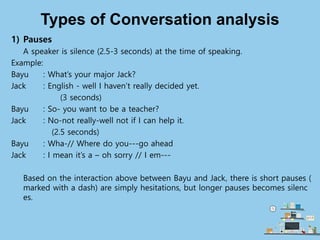
1) Pauses
A speaker is silence (2.5-3 seconds) at the time of speaking.
Example:
Bayu : What’s your major Jack?
Jack : English - well I haven’t really decided yet.
(3 seconds)
Bayu : So- you want to be a teacher?
Jack : No-not really-well not if I can help it.
(2.5 seconds)
Bayu : Wha-// Where do you---go ahead
Jack : I mean it’s a – oh sorry // I em---
Based on the interaction above between Bayu and Jack, there is short pauses (
marked with a dash) are simply hesitations, but longer pauses becomes silenc
es.
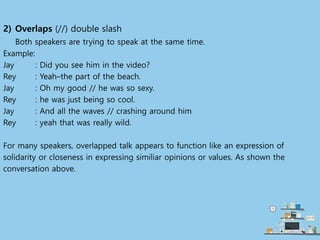
2) Overlaps (//) double slash
Both speakers are trying to speak at the same time.
Example:
Jay : Did you see him in the video?
Rey : Yeah–the part of the beach.
Jay : Oh my good // he was so sexy.
Rey : he was just being so cool.
Jay : And all the waves // crashing around him
Rey : yeah that was really wild.
For many speakers, overlapped talk appears to function like an expression of
solidarity or closeness in expressing similiar opinions or values. As shown the
conversation above.
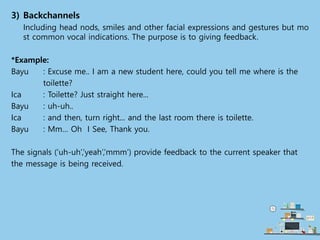
3) Backchannels
Including head nods, smiles and other facial expressions and gestures but mo
st common vocal indications. The purpose is to giving feedback.
*Example:
Bayu : Excuse me.. I am a new student here, could you tell me where is the
toilette?
Ica : Toilette? Just straight here...
Bayu : uh-uh..
Ica : and then, turn right... and the last room there is toilette.
Bayu : Mm… Oh I See, Thank you.
The signals (‘uh-uh’,’yeah’,’mmm’) provide feedback to the current speaker that
the message is being received.
Adjacency pairs
• Adjacency pairs refer to 'conversational sequences' in w
hich an utterance by one speaker depends on an uttera
nce made by another speaker . Adjacency pair is compo
sed of two different speakers which are placed adjacentl
y and where the second utterance is identified as relate
d to the first.
question/answer
complaint/denial
offer/accept
request/grant
Invitation/acceptance
Apology/acceptance.
Adjacency pairs include the
following patterns:
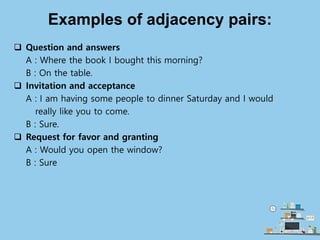
Examples of adjacency pairs:
 Question and answers
A : Where the book I bought this morning?
B : On the table.
 Invitation and acceptance
A : I am having some people to dinner Saturday and I would
really like you to come.
B : Sure.
 Request for favor and granting
A : Would you open the window?
B : Sure
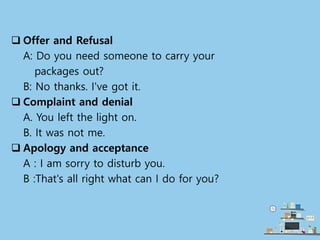
 Offer and Refusal
A: Do you need someone to carry your
packages out?
B: No thanks. I've got it.
 Complaint and denial
A. You left the light on.
B. It was not me.
 Apology and acceptance
A : I am sorry to disturb you.
B :That's all right what can I do for you?
PREFERENCE STRUCTURE
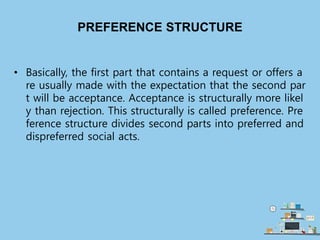
• Basically, the first part that contains a request or offers a
re usually made with the expectation that the second par
t will be acceptance. Acceptance is structurally more likel
y than rejection. This structurally is called preference. Pre
ference structure divides second parts into preferred and
dispreferred social acts.
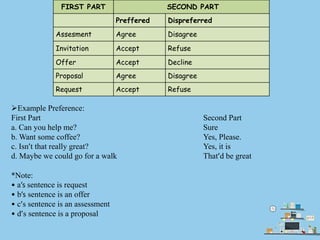
FIRST PART SECOND PART
Preffered Dispreferred
Assesment Agree Disagree
Invitation Accept Refuse
Offer Accept Decline
Proposal Agree Disagree
Request Accept Refuse
Example Preference:
First Part Second Part
a. Can you help me? Sure
b. Want some coffee? Yes, Please.
c. Isn’t that really great? Yes, it is
d. Maybe we could go for a walk That’d be great
*Note:
• a’s sentence is request
• b’s sentence is an offer
• c’s sentence is an assessment
• d’s sentence is a proposal
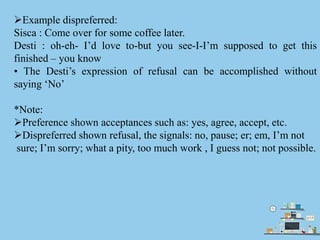
Example dispreferred:
Sisca : Come over for some coffee later.
Desti : oh-eh- I’d love to-but you see-I-I’m supposed to get this
finished – you know
• The Desti’s expression of refusal can be accomplished without
saying ‘No’
*Note:
Preference shown acceptances such as: yes, agree, accept, etc.
Dispreferred shown refusal, the signals: no, pause; er; em, I’m not
sure; I’m sorry; what a pity, too much work , I guess not; not possible.
CONCLUSION
THANK YOU!

Conversation and Preference structure

  • 1.
    Presented by: Dinda Siti Nita Rudi CONVERSATION AND PREFERENCESTRUCTURE ALLPPT.com _ Free PowerPoint Templates, Diagrams and Charts
  • 2.
    Conversation analysis • Conversationanalysis also called talk- in-interaction is the study of talk produced in the course of ordinary human interactions. • Conversation analysis (commonly abbreviated as CA) is an approach to the study of social interaction , embracing both verbal and non-verbal conduct, in situations of everyday life.
  • 3.
    Types of Conversationanalysis 1) Pauses A speaker is silence (2.5-3 seconds) at the time of speaking. Example: Bayu : What’s your major Jack? Jack : English - well I haven’t really decided yet. (3 seconds) Bayu : So- you want to be a teacher? Jack : No-not really-well not if I can help it. (2.5 seconds) Bayu : Wha-// Where do you---go ahead Jack : I mean it’s a – oh sorry // I em--- Based on the interaction above between Bayu and Jack, there is short pauses ( marked with a dash) are simply hesitations, but longer pauses becomes silenc es.
  • 4.
    2) Overlaps (//)double slash Both speakers are trying to speak at the same time. Example: Jay : Did you see him in the video? Rey : Yeah–the part of the beach. Jay : Oh my good // he was so sexy. Rey : he was just being so cool. Jay : And all the waves // crashing around him Rey : yeah that was really wild. For many speakers, overlapped talk appears to function like an expression of solidarity or closeness in expressing similiar opinions or values. As shown the conversation above.
  • 5.
    3) Backchannels Including headnods, smiles and other facial expressions and gestures but mo st common vocal indications. The purpose is to giving feedback. *Example: Bayu : Excuse me.. I am a new student here, could you tell me where is the toilette? Ica : Toilette? Just straight here... Bayu : uh-uh.. Ica : and then, turn right... and the last room there is toilette. Bayu : Mm… Oh I See, Thank you. The signals (‘uh-uh’,’yeah’,’mmm’) provide feedback to the current speaker that the message is being received.
  • 6.
    Adjacency pairs • Adjacencypairs refer to 'conversational sequences' in w hich an utterance by one speaker depends on an uttera nce made by another speaker . Adjacency pair is compo sed of two different speakers which are placed adjacentl y and where the second utterance is identified as relate d to the first.
  • 7.
  • 8.
    Examples of adjacencypairs:  Question and answers A : Where the book I bought this morning? B : On the table.  Invitation and acceptance A : I am having some people to dinner Saturday and I would really like you to come. B : Sure.  Request for favor and granting A : Would you open the window? B : Sure
  • 9.
     Offer andRefusal A: Do you need someone to carry your packages out? B: No thanks. I've got it.  Complaint and denial A. You left the light on. B. It was not me.  Apology and acceptance A : I am sorry to disturb you. B :That's all right what can I do for you?
  • 10.
    PREFERENCE STRUCTURE • Basically,the first part that contains a request or offers a re usually made with the expectation that the second par t will be acceptance. Acceptance is structurally more likel y than rejection. This structurally is called preference. Pre ference structure divides second parts into preferred and dispreferred social acts.
  • 11.
    FIRST PART SECONDPART Preffered Dispreferred Assesment Agree Disagree Invitation Accept Refuse Offer Accept Decline Proposal Agree Disagree Request Accept Refuse Example Preference: First Part Second Part a. Can you help me? Sure b. Want some coffee? Yes, Please. c. Isn’t that really great? Yes, it is d. Maybe we could go for a walk That’d be great *Note: • a’s sentence is request • b’s sentence is an offer • c’s sentence is an assessment • d’s sentence is a proposal
  • 12.
    Example dispreferred: Sisca :Come over for some coffee later. Desti : oh-eh- I’d love to-but you see-I-I’m supposed to get this finished – you know • The Desti’s expression of refusal can be accomplished without saying ‘No’ *Note: Preference shown acceptances such as: yes, agree, accept, etc. Dispreferred shown refusal, the signals: no, pause; er; em, I’m not sure; I’m sorry; what a pity, too much work , I guess not; not possible.
  • 13.
  • 14.