Conversation Analysis
(CA)
Assignment Two: Conversation Analysis Teaching
Ruth Nicole Hall
Spring 2014
Quote for Thought
“The single biggest problem with communication is
the illusion that it has taken place.”
~George Bernard Shaw
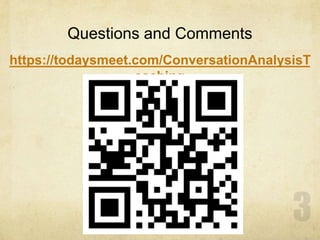
Questions and Comments
https://todaysmeet.com/ConversationAnalysisT
eaching
Contents of Teaching
Pre-Test
Sociocultural Tradition
Ethnomethodology and Sociocultural Tradition
Conversations
Sociocultural Tradition with Conversation Analysis (CA)
Watch Conversation Analysis (CA) Video
What is Conversation Analysis? (CA)
Doing Conversation Analysis (CA)
Post-Test
Questions and Comments
Conversation Analysis Pre-Test
http://www.polleverywhere.com/free_text_polls/J
MAZr2Yfw2yXDrq
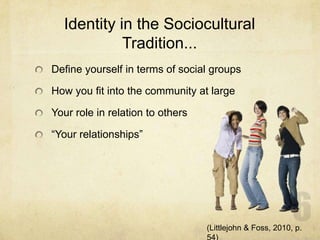
Identity in the Sociocultural
Tradition...
Define yourself in terms of social groups
How you fit into the community at large
Your role in relation to others
“Your relationships”
(Littlejohn & Foss, 2010, p.
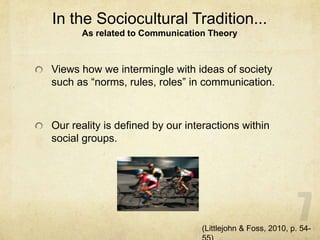
In the Sociocultural Tradition...
As related to Communication Theory
Views how we intermingle with ideas of society
such as “norms, rules, roles” in communication.
Our reality is defined by our interactions within
social groups.
(Littlejohn & Foss, 2010, p. 54-
Sociocultural Tradition
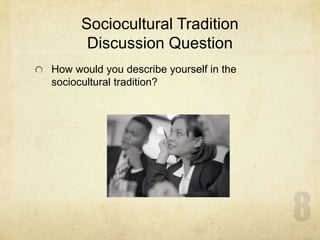
Discussion Question
How would you describe yourself in the
sociocultural tradition?
Ethnomethodology and
Sociocultural Tradition
Harold Garfinkel and Harvey Sacks
Ethnomethodology—Detailed observation of
everyday routines in our social lives
How we “manage behaviors [in social
interactions] at actual moments in time” (Littlejohn &
Foss, 2010).
(Littlejohn & Foss, 2010, p. 56)
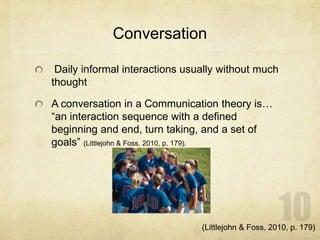
Conversation
Daily informal interactions usually without much
thought
A conversation in a Communication theory is…
“an interaction sequence with a defined
beginning and end, turn taking, and a set of
goals” (Littlejohn & Foss, 2010, p. 179).
(Littlejohn & Foss, 2010, p. 179)
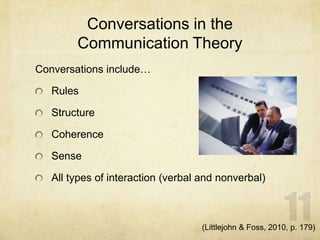
Conversations in the
Communication Theory
Conversations include…
Rules
Structure
Coherence
Sense
All types of interaction (verbal and nonverbal)
(Littlejohn & Foss, 2010, p. 179)
Conversation Discussion
Questions
What type of conversations do you engage in
daily?
How do those conversations effect your daily
life?
Quote for Thought
“The single biggest problem with communication is
the illusion that it has taken place.”
~George Bernard Shaw
Discussion Question
After listening to the story from the video, why do
you think there was a break down in
communication?
What is Conversation Analysis (CA)?
“The study of the orders of talk-in-interaction” (ten Have,
2007).
The study of “the organization of social
action…particularly in everyday actions” (Psathas, 1995).
“CA focuses more narrowly on the principles which
people use to interact with each other by means of
language” (Seedhouse, 2004).
Conversation Analysis Discussion
Question
In which areas of library science do you think
Conversation Analysis (CA) would be most useful? Why?
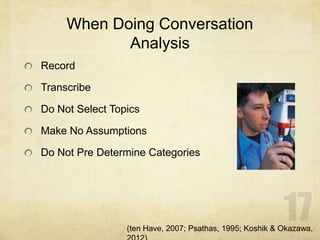
When Doing Conversation
Analysis
Record
Transcribe
Do Not Select Topics
Make No Assumptions
Do Not Pre Determine Categories
(ten Have, 2007; Psathas, 1995; Koshik & Okazawa,
What You Should Look For Doing
CA
Body Movement
Gestures
How the person expresses him or herself
Silences
Utterances
Similar actions of participants
(Psathas, 1995)
Doing Conversation Analysis—
Practice
1. Let’s have a short conversation. (2 to 5 minutes)
2. Then briefly analyze your the interaction within the
conversation both verbal and nonverbal. (2 to 5 minutes)
3. List each interaction on one stick note. (2 to 3 minutes)
4. Share what types of interactions were noted. (1 to 2 minutes)
5. Make categories and put interactions into those categories.
(3 to 5 minutes)
Let’s Try It Again!—Practice
Conversation Analysis from Greek
Remember to look for (Body Movement, Gestures, How the
person expresses him or herself, Silences, Utterances, &
Similar actions of participants)
1. Analyze the interactions in the video conversation both verbal
and nonverbal.
2. List each interaction on one sticky note.
3. Share what types of interaction you noted.
4. Make categories and put the interactions into those
categories.
Discussion Question
How was analyzing the first conversation
different from analyzing the second
conversation?
Conversation Analysis Post-Test
http://www.polleverywhere.com/free_text_polls/z
FQ29Br0FbfHr79
Questions and Comments
https://todaysmeet.com/ConversationAnalysisTe
aching
References
Koshik, I., & Okazawa, H. (2012). A conversation analytic study of actual and
potential problems in communication in library chat reference interactions. Journal
of the American Society for Information Science & Technology, 63(10), 2006-2019.
Retrieved from
http://ezproxy.twu.edu:2048/login?url=http://ezproxy.twu.edu:2060/login.aspx?direct
=true&db=a9h&AN=80125936&site=ehost-live&scope=site
Littlejohn, S. W., & Foss, K. A. (2010). Theories of human communication (10th ed.).
Long Grove, IL: Waveland.
Psathas, G. (1995). Conversation analysis: The study of talk-in-interaction.
Thousand Oaks, CA: SAGE Publications..
Seedhouse, P. (2004). Conversation analysis methodology. Language Learning, 54,
1-54. Retrieved from
http://ezproxy.twu.edu:2048/login?url=http://search.ebscohost.com/login.aspx?direct
=true&db=ehh&AN=62959559&site=ehost-live&scope=site
ten Have, P. (2007). Doing conversation analysis (2nd ed.). London: SAGE
Publications.
References-Media
AIEMACA. (2009, October 25). Fabienne Chevalier: IPRA diaries 2009.
Retrieved from http://www.youtube.com/watch?v=iLqglRwk_RQ
Bulletinaheart1. (2010, May 2). Conversation analysis. (Greek, Season 2,
Episode 5). Retrieved from http://www.youtube.com/watch?v=YItCE8t4WLA
Leadership Speaker Series. (2011, May 13). Leadership in Government
Speaker Series—Judge Eric Shepperd Part 2. Retrieved from
http://www.youtube.com/watch?v=yWOvDccMxMs
All clipart from Microsoft Office Photo Browser.
QR Code created at kaywa.com

teaching_assignment two_conversation_analysis_teaching

  • 1.
    Conversation Analysis (CA) Assignment Two:Conversation Analysis Teaching Ruth Nicole Hall Spring 2014
  • 2.
    Quote for Thought “Thesingle biggest problem with communication is the illusion that it has taken place.” ~George Bernard Shaw
  • 3.
  • 4.
    Contents of Teaching Pre-Test SocioculturalTradition Ethnomethodology and Sociocultural Tradition Conversations Sociocultural Tradition with Conversation Analysis (CA) Watch Conversation Analysis (CA) Video What is Conversation Analysis? (CA) Doing Conversation Analysis (CA) Post-Test Questions and Comments
  • 5.
  • 6.
    Identity in theSociocultural Tradition... Define yourself in terms of social groups How you fit into the community at large Your role in relation to others “Your relationships” (Littlejohn & Foss, 2010, p.
  • 7.
    In the SocioculturalTradition... As related to Communication Theory Views how we intermingle with ideas of society such as “norms, rules, roles” in communication. Our reality is defined by our interactions within social groups. (Littlejohn & Foss, 2010, p. 54-
  • 8.
    Sociocultural Tradition Discussion Question Howwould you describe yourself in the sociocultural tradition?
  • 9.
    Ethnomethodology and Sociocultural Tradition HaroldGarfinkel and Harvey Sacks Ethnomethodology—Detailed observation of everyday routines in our social lives How we “manage behaviors [in social interactions] at actual moments in time” (Littlejohn & Foss, 2010). (Littlejohn & Foss, 2010, p. 56)
  • 10.
    Conversation Daily informal interactionsusually without much thought A conversation in a Communication theory is… “an interaction sequence with a defined beginning and end, turn taking, and a set of goals” (Littlejohn & Foss, 2010, p. 179). (Littlejohn & Foss, 2010, p. 179)
  • 11.
    Conversations in the CommunicationTheory Conversations include… Rules Structure Coherence Sense All types of interaction (verbal and nonverbal) (Littlejohn & Foss, 2010, p. 179)
  • 12.
    Conversation Discussion Questions What typeof conversations do you engage in daily? How do those conversations effect your daily life?
  • 13.
    Quote for Thought “Thesingle biggest problem with communication is the illusion that it has taken place.” ~George Bernard Shaw
  • 14.
    Discussion Question After listeningto the story from the video, why do you think there was a break down in communication?
  • 15.
    What is ConversationAnalysis (CA)? “The study of the orders of talk-in-interaction” (ten Have, 2007). The study of “the organization of social action…particularly in everyday actions” (Psathas, 1995). “CA focuses more narrowly on the principles which people use to interact with each other by means of language” (Seedhouse, 2004).
  • 16.
    Conversation Analysis Discussion Question Inwhich areas of library science do you think Conversation Analysis (CA) would be most useful? Why?
  • 17.
    When Doing Conversation Analysis Record Transcribe DoNot Select Topics Make No Assumptions Do Not Pre Determine Categories (ten Have, 2007; Psathas, 1995; Koshik & Okazawa,
  • 18.
    What You ShouldLook For Doing CA Body Movement Gestures How the person expresses him or herself Silences Utterances Similar actions of participants (Psathas, 1995)
  • 19.
    Doing Conversation Analysis— Practice 1.Let’s have a short conversation. (2 to 5 minutes) 2. Then briefly analyze your the interaction within the conversation both verbal and nonverbal. (2 to 5 minutes) 3. List each interaction on one stick note. (2 to 3 minutes) 4. Share what types of interactions were noted. (1 to 2 minutes) 5. Make categories and put interactions into those categories. (3 to 5 minutes)
  • 20.
    Let’s Try ItAgain!—Practice Conversation Analysis from Greek Remember to look for (Body Movement, Gestures, How the person expresses him or herself, Silences, Utterances, & Similar actions of participants) 1. Analyze the interactions in the video conversation both verbal and nonverbal. 2. List each interaction on one sticky note. 3. Share what types of interaction you noted. 4. Make categories and put the interactions into those categories.
  • 21.
    Discussion Question How wasanalyzing the first conversation different from analyzing the second conversation?
  • 22.
  • 23.
  • 24.
    References Koshik, I., &Okazawa, H. (2012). A conversation analytic study of actual and potential problems in communication in library chat reference interactions. Journal of the American Society for Information Science & Technology, 63(10), 2006-2019. Retrieved from http://ezproxy.twu.edu:2048/login?url=http://ezproxy.twu.edu:2060/login.aspx?direct =true&db=a9h&AN=80125936&site=ehost-live&scope=site Littlejohn, S. W., & Foss, K. A. (2010). Theories of human communication (10th ed.). Long Grove, IL: Waveland. Psathas, G. (1995). Conversation analysis: The study of talk-in-interaction. Thousand Oaks, CA: SAGE Publications.. Seedhouse, P. (2004). Conversation analysis methodology. Language Learning, 54, 1-54. Retrieved from http://ezproxy.twu.edu:2048/login?url=http://search.ebscohost.com/login.aspx?direct =true&db=ehh&AN=62959559&site=ehost-live&scope=site ten Have, P. (2007). Doing conversation analysis (2nd ed.). London: SAGE Publications.
  • 25.
    References-Media AIEMACA. (2009, October25). Fabienne Chevalier: IPRA diaries 2009. Retrieved from http://www.youtube.com/watch?v=iLqglRwk_RQ Bulletinaheart1. (2010, May 2). Conversation analysis. (Greek, Season 2, Episode 5). Retrieved from http://www.youtube.com/watch?v=YItCE8t4WLA Leadership Speaker Series. (2011, May 13). Leadership in Government Speaker Series—Judge Eric Shepperd Part 2. Retrieved from http://www.youtube.com/watch?v=yWOvDccMxMs All clipart from Microsoft Office Photo Browser. QR Code created at kaywa.com