CONVERSATION ANALYSIS
PHD COURSE IN CDA
Prepared by:
BEKHAL ABUBAKIR HUSSEIN
Feb.22nd
,2017
UNIVERSITY OF SULAIMANI
Conversation Analysis
A major area of study in the analysis of discourse is
conversational analysis.
Conversational analysis looks at ordinary everyday
spoken discourse and aims to understand, from a fine-
grained analysis of the conversation, how people
manage their interactions.
 It also looks at how social relations are developed
through the use of spoken discourse
(Paltridge,2006:106).
Definition
Conversation Analysis (commonly abbreviated as
CA) is an approach to the study of social interaction,
embracing both verbal and non-verbal conduct, in
situations of everyday life.
As its name implies, CA began with a focus on casual
but its methods were subsequently adapted to
embrace more task- and institution-centered
interactions, such as those occurring in doctors'
offices, courts, law enforcement, educational
settings, and the mass media.
The Development of CA
CA was developed in the late 1960s and early 1970s
principally by the sociologist Harvey Sacks and his
close associates Emanuel Schegloff & Gail Jefferson.
Today CA is an established method used in
sociology, anthropology, linguistics, speech-
communication and psychology.
It is particularly influential in interactional
sociolinguistics, discourse analysis and discursive
psychology.
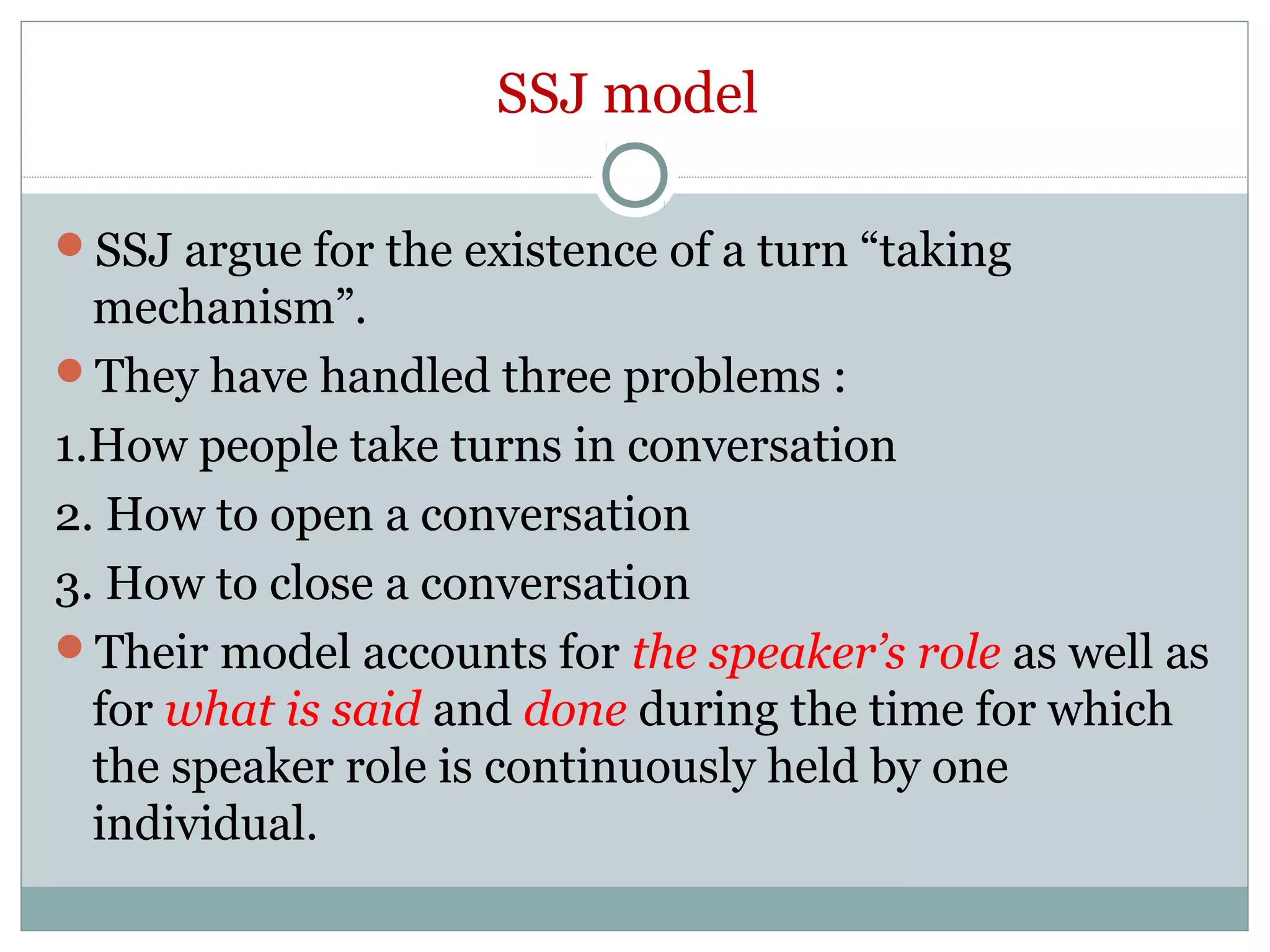
SSJ model
SSJ argue for the existence of a turn “taking
mechanism”.
They have handled three problems :
1.How people take turns in conversation
2. How to open a conversation
3. How to close a conversation
Their model accounts for the speaker’s role as well as
for what is said and done during the time for which
the speaker role is continuously held by one
individual.
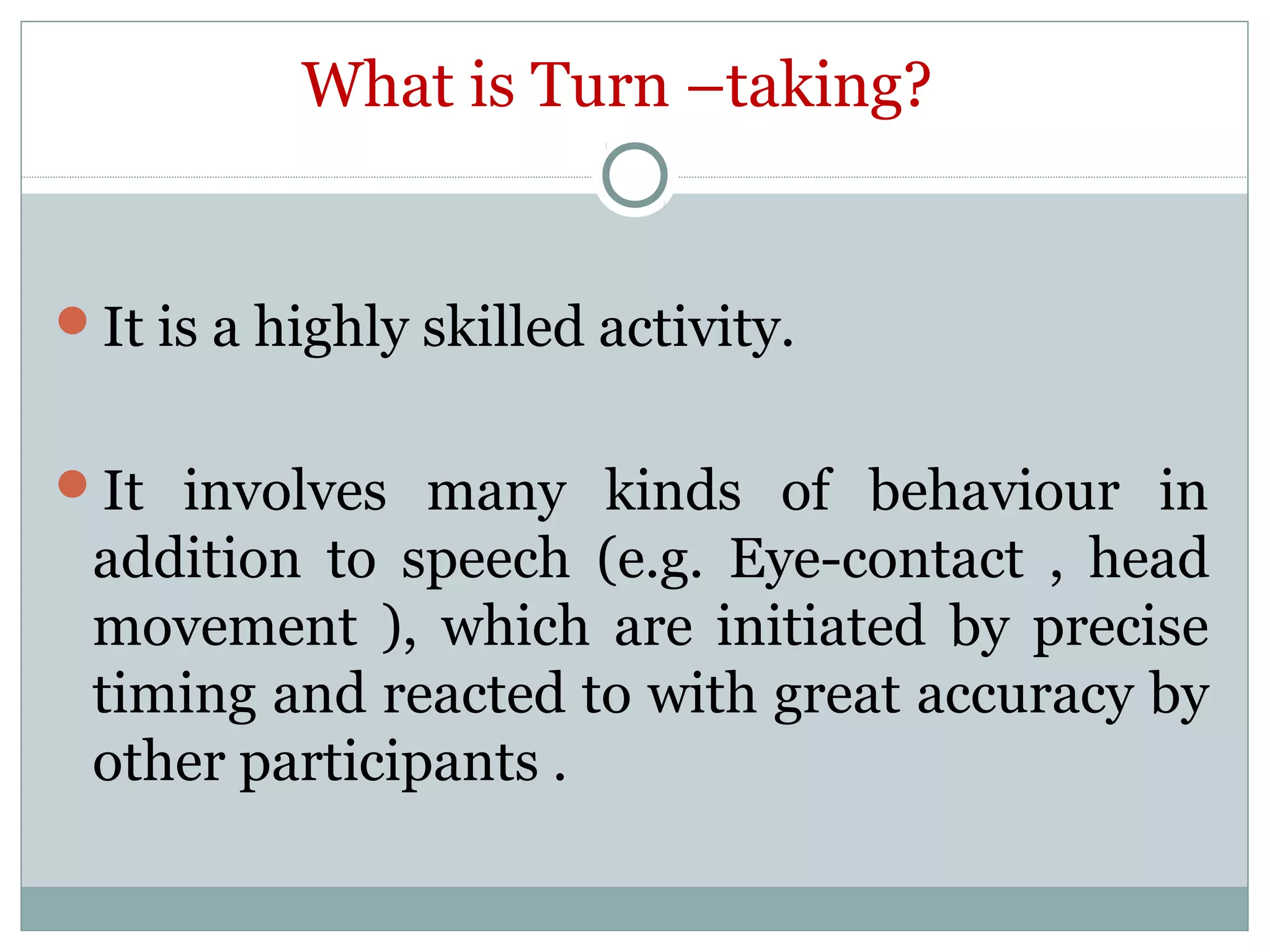
What is Turn –taking?
It is a highly skilled activity.
It involves many kinds of behaviour in
addition to speech (e.g. Eye-contact , head
movement ), which are initiated by precise
timing and reacted to with great accuracy by
other participants .
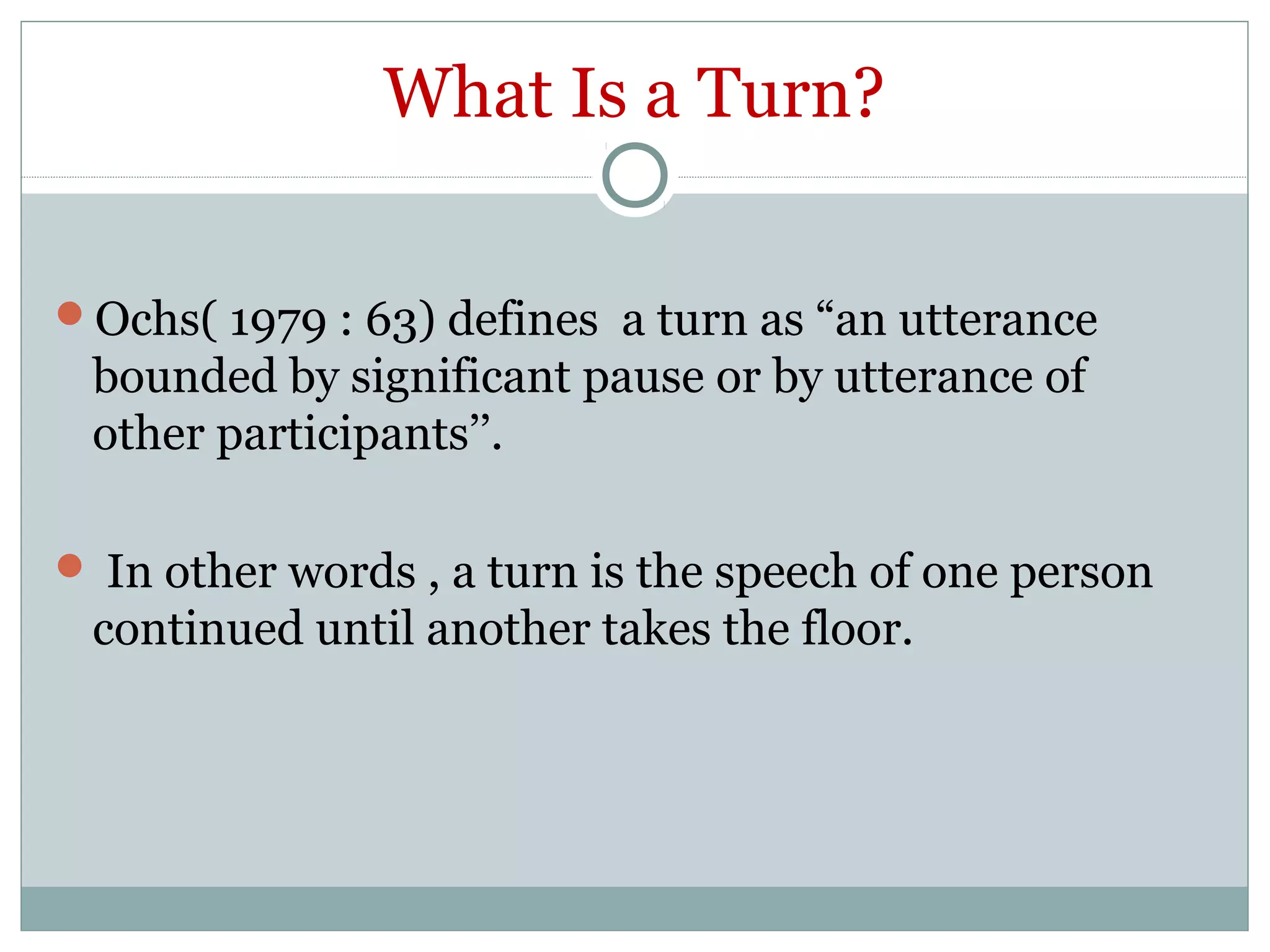
What Is a Turn?
Ochs( 1979 : 63) defines a turn as “an utterance
bounded by significant pause or by utterance of
other participants’’.
 In other words , a turn is the speech of one person
continued until another takes the floor.
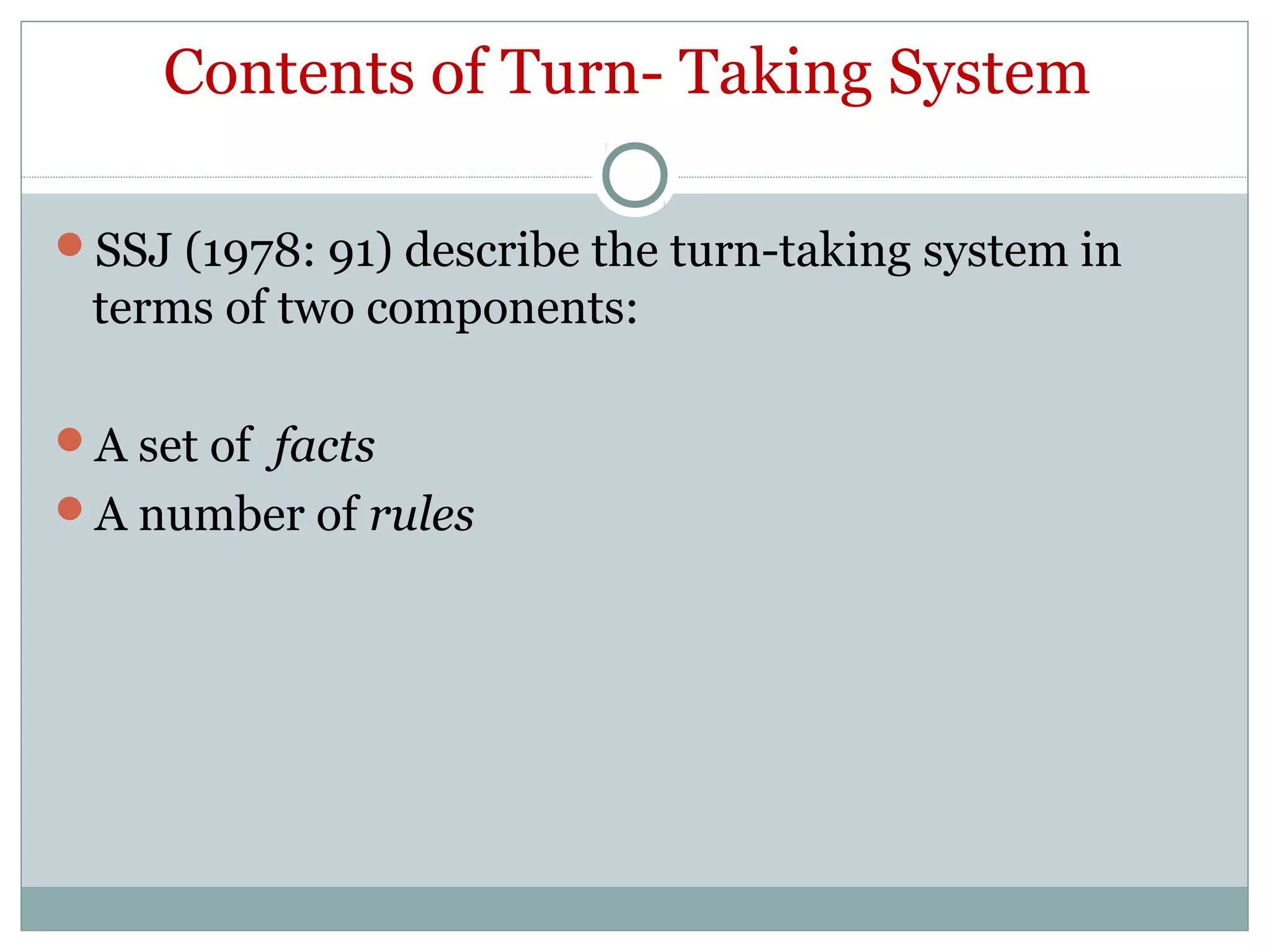
Contents of Turn- Taking System
SSJ (1978: 91) describe the turn-taking system in
terms of two components:
A set of facts
A number of rules
The Components
1. The turn constructional components
2. The turn Allocational Components
The Turn Constructional Components
This component simply shows that a turn is
constructed of various syntactic unit-types
such as sentences, clauses, phrases, and
single words through which a speaker may
set out to construct a turn.
The Turn Allocational Components
This component includes techniques that
could be classified into:
Those in which the next turn is allocated by
a current speaker selecting a next speaker;
Those in which a next turn is allocated by
self-selection.
The Set of Facts
Sacks et al. offer a set of facts whose validity and
verification determine the organization of the
discourse as stated hereunder:
1. Speaker change recurs, or at least occurs.
2. Overwhelmingly, one party talks at a time.
3. Occurrences of more than one speaker at a time are
common, but brief.
4. Transitions from one turn to a next with no gap and
no overlap between them are common.
Together with transitions characterized by slight gap
or slight overlap, they make the vast majority of
transitions.
5. Turn order is not fixed, but varies.
6. Turn size is not fixed, but varies.
More Facts
7. Length of conversation is not fixed, nor specified in
advance.
8. What the parties say is not fixed, nor specified in
advance.
9. Relative distribution of turns is not fixed, nor
specified in advance.
10.Number of parties can change.
11.Talk can be continuous or discontinuous.
12.Turn-allocation techniques are obviously used. A current-
speaker may select a next speaker (as when a current speaker
addresses a question to another party); parties may self-select
in starting to talk.
13.Various turn-constructional units are employed. Turns can
be projected one-word-long, or, for example, sentential in
length.
14.Repair mechanisms for dealing with turn-taking errors
and violations are obviously available for use. For example, if
two parties find themselves talking at the same time, one of
them will stop prematurely to repair the overlap.
The Rules
Additionally, Sacks et al. suggest a number of rules
that operate on turn units using the symbol NS for
the next speaker, and TRP for Transition Relevant
Place defined as the recognizable end of a turn-
constructional unit.
Rule (1)
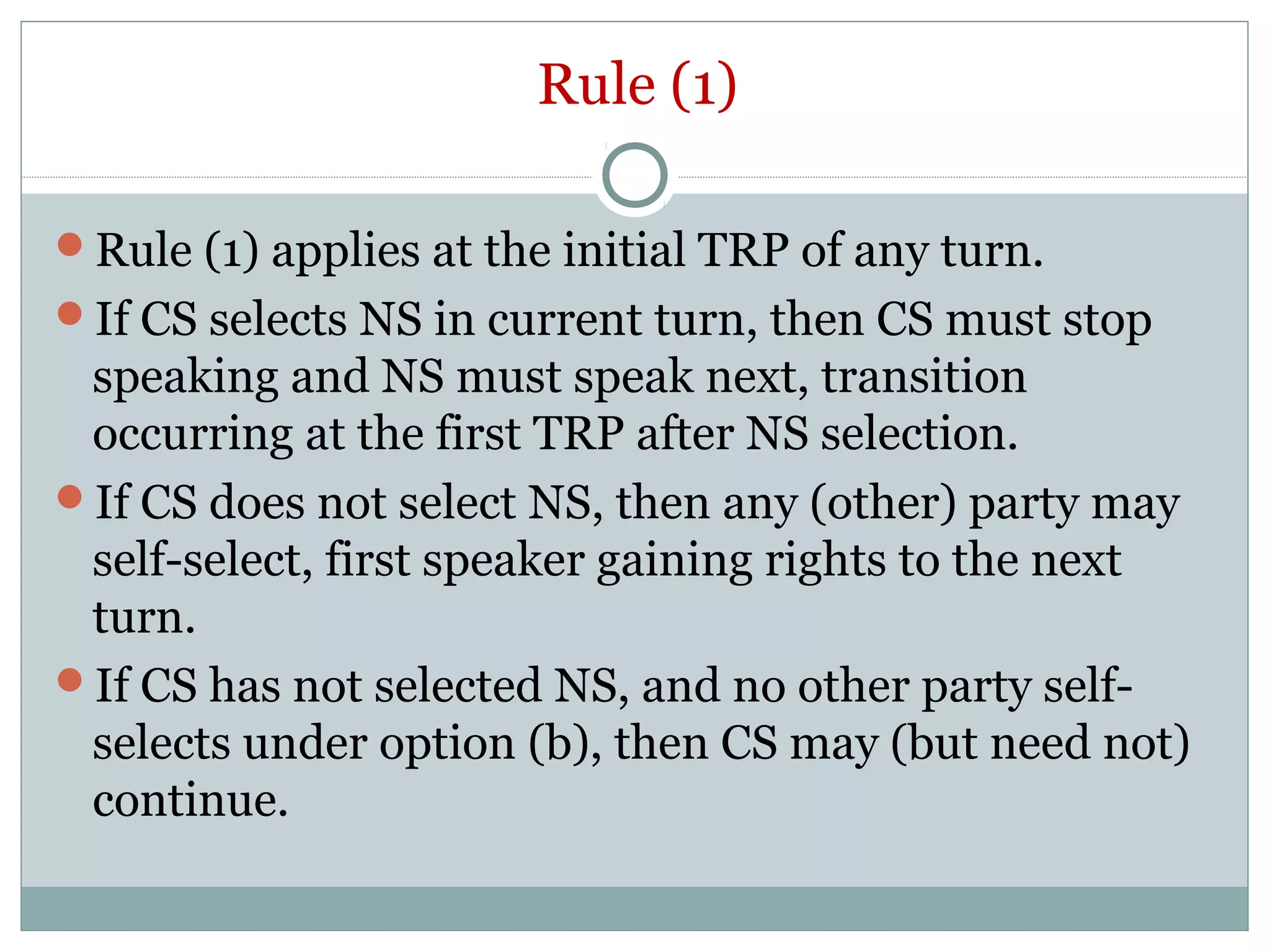
Rule (1) applies at the initial TRP of any turn.
If CS selects NS in current turn, then CS must stop
speaking and NS must speak next, transition
occurring at the first TRP after NS selection.
If CS does not select NS, then any (other) party may
self-select, first speaker gaining rights to the next
turn.
If CS has not selected NS, and no other party self-
selects under option (b), then CS may (but need not)
continue.
Rule (2)
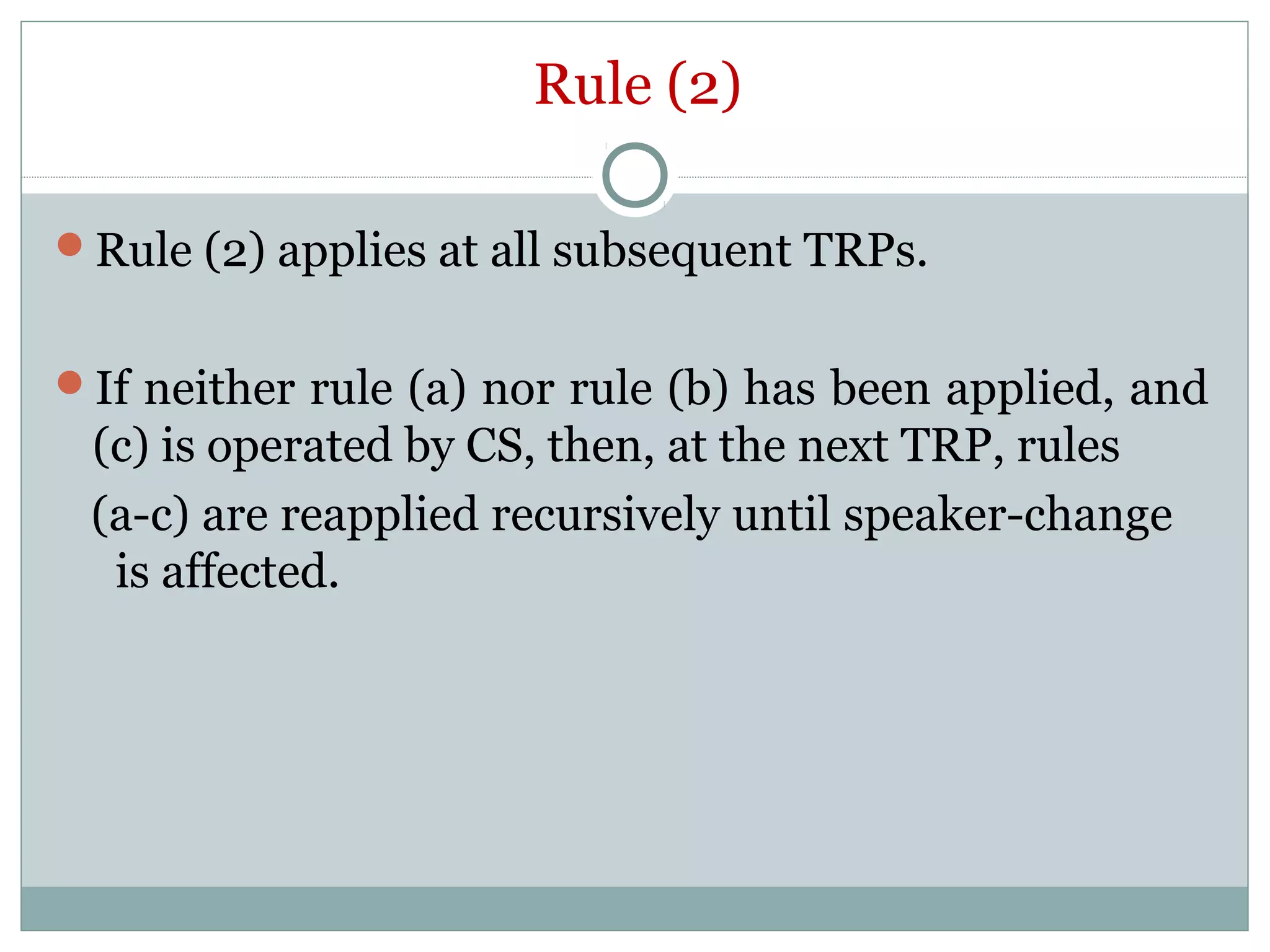
Rule (2) applies at all subsequent TRPs.
If neither rule (a) nor rule (b) has been applied, and
(c) is operated by CS, then, at the next TRP, rules
(a-c) are reapplied recursively until speaker-change
is affected.
Adjacency Pairs
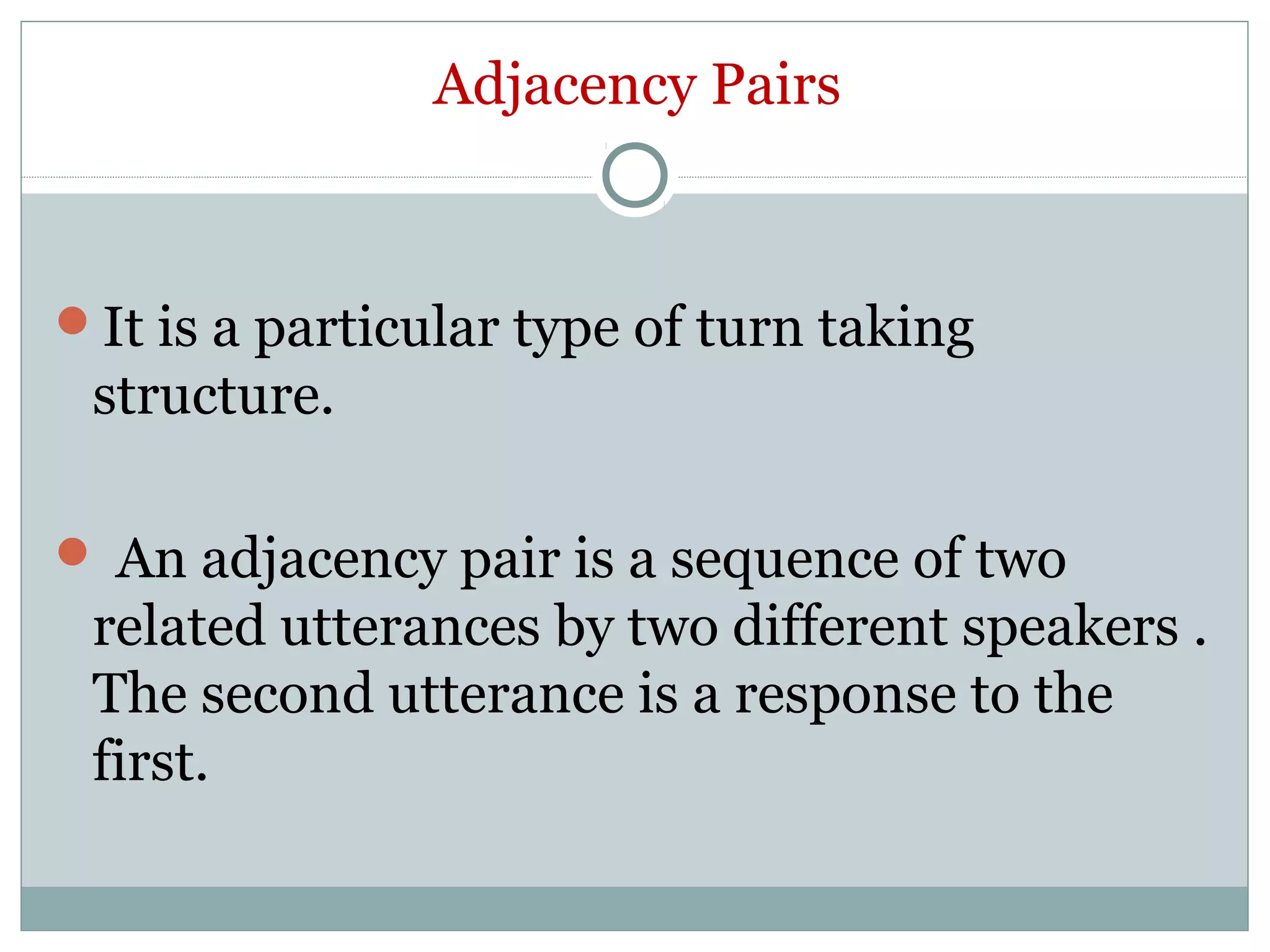
It is a particular type of turn taking
structure.
 An adjacency pair is a sequence of two
related utterances by two different speakers .
The second utterance is a response to the
first.
Features of Adjacency Pairs
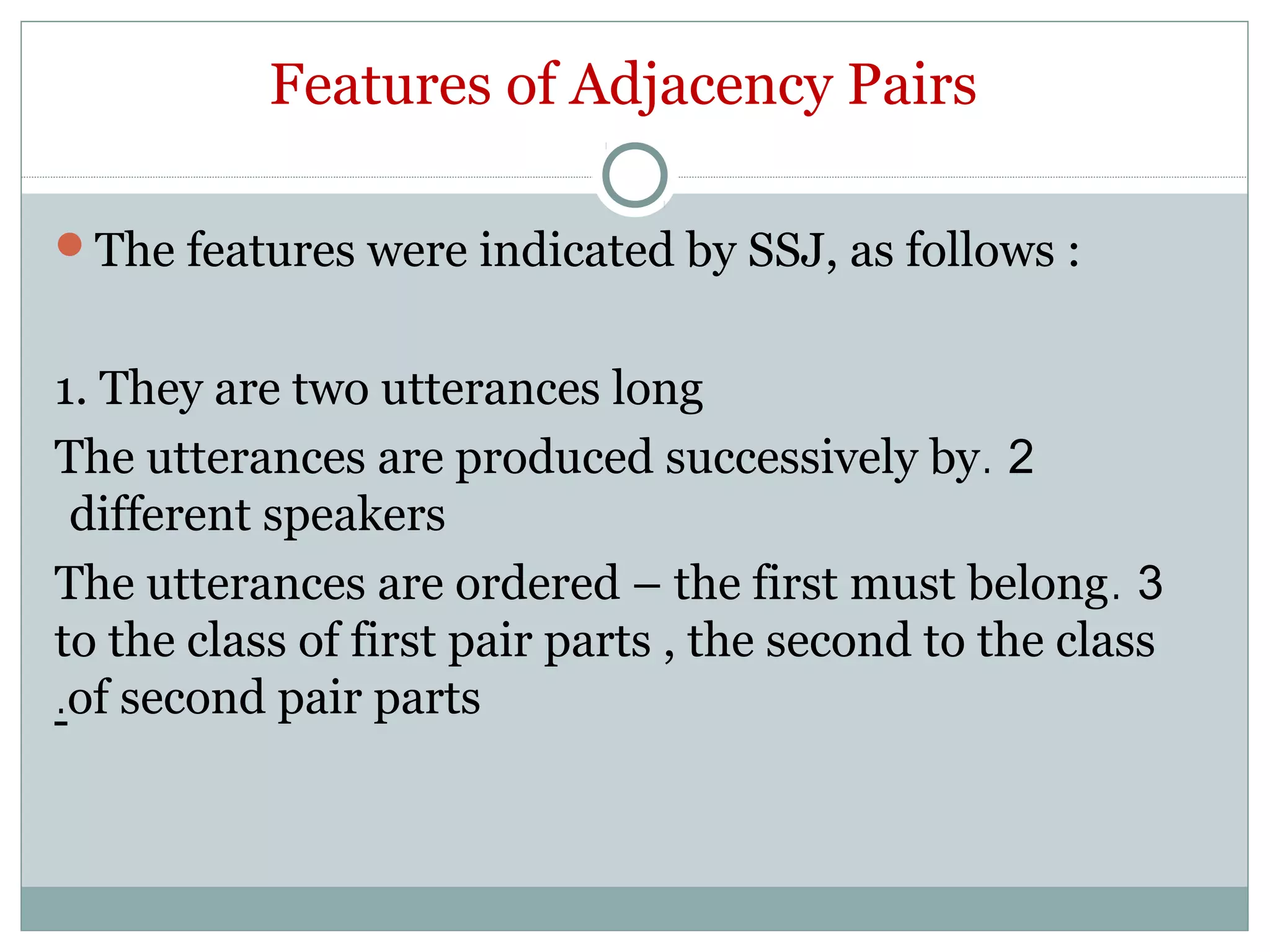
The features were indicated by SSJ, as follows :
1. They are two utterances long
2.The utterances are produced successively by
different speakers
3.The utterances are ordered – the first must belong
to the class of first pair parts , the second to the class
of second pair parts.
4.The utterances are related , not any second pair can
follow any first pair part , but only appropriate one.
5.The first pair part often selects next speaker and
always selects next action – it thus sets up a transition
relevance and expectation which the next speaker
fulfills , in other words the first part of a pair predicts
the occurrence of the second.
Varieties of Adjacency pairs
 Prototypical examples of adjacency pairs would be the following:
 1) greeting-greeting: A: Hello.
B: Hello.
 2) offer-acceptance: A: Would you care for more tea?
B: Yes, please.
 3) apology-minimization: A: I’m sorry.
B: Oh, don’t worry. That’s O.K.
There is a class of first pair parts which includes
QUESTIONS, GREETINGS, CHALLENGES,
OFFERS, REQUESTS, COMPLAINTS,
INVITATIONS, ANOUNCEMENTS
For some first pair parts the second pair part is
reciprocal (Greeting-Greeting)
For some there is only one appropriate second
(Question-Answer), for some more than one
(Complaint-Apology/Justification)
(Coulthard,1985:69).
 Sacks suggests that a current speaker can exercise
three degree of control over the next turn.
Firstly, s/he can select which participant will speak
next, either by naming him or by alluding to him
with a descriptive phrase, ‘the Right Honorable
Member for Bexley South’.
If the current speaker selects the next speaker, he
usually also selects the type of next utterance by
producing the first part of an adjacency pair.
For example a question or a greeting which
constrains the selected speaker to produce an
appropriate answer or return greeting.
DOCTOR: Hello Mrs. Jones
PATIENT: Hello Doctor
DOCTOR: Hello Catherine
CHILD: Hello
The current speaker’s second option is simply to
constrain the next utterance, but not select the next
speaker.
The third option is to select neither and leave it to
one of the participants to continue the conversation
by selecting himself (Coulthard,1985:60).
The Functions of Adjacency Pairs
Adjacency pairs are used to coordinate turns
They help in opening and closing a
conversation
Negotiate deals
Change topics
Preference Organization
Preference is a very powerful concept and once it has
been established, it can be used to explain the
occurrence of a quite number of other conversational
phenomena as the results of speakers trying to avoid
having to perform disprefered seconds (Coulthard,
1985:71).
The concept of preference organization underlies the
idea that there is a hierarchy operating over the
potential second parts of an adjacency pair. Thus,
there is at least one preferred and one dispreferred
category of response to first parts.
A compliment can be followed be an ‘accept’ or a
‘reject’. Thus, some second pair parts may be
preferred others may be dispreferred.
For example, a question may be followed by an
expected answer (the preferred second pair part) or
an ‘unexpected or non- answer’ (the dispreferred
second pair part).
When this happens, the dispreferred second pair
part is often preceded by a ‘delay’, a ‘preface’, and/or
an ‘account’.
For instance:
 A: Are you going out with anyone at the moment?
(Question)
 B: Uhhh….. (Delay)
Well, kind of ….. (Preface)
There is someone I met a while back….. (Account)
Actually, I’m getting married at the end of the year
(Unexpected answer) (Paltridge,2006:117).
Insertion Sequences
 Insertion Sequences occur (Schegloff, 1972, cited in
Alba-Juez,2009) in which, for example, a question-
answer pair is embedded within another, as seen in
this example :
Child: Mom, can I play Nintendo now? (Question 1)
Mother: Have you cleaned up the playroom?
(Question 2)
Child: No. (Answer 2)
Mother: Then, NO! (Answer 1)
Occasionally, either because he doesn’t understand,
or because he doesn’t want to commit himself until
he knows more, or because he’s simply stalling, a
next speaker produces not a second pair part but
another first pair part. The suggestion is ‘if you
answer this one, I will answer yours’ (Coulthard,
1985:73).
Other Sequences
Apart from the local organization operating in
conversation by means of turn-taking and adjacency
pairs, there are other orders of organization, such as
certain recurrent kinds of sequence which can only
be defined over three or four or more turns.
We refer to repair, pre-sequences and overall
organization (Alba-Juez, 2009).
Repair
An important strategy speakers use in spoken
discourse is what is termed Repair, that is, the way
speakers correct things they or someone else has
said, and check what they have understood in a
conversation. Repair is often done through self
repair and other repair (Paltridge, 2006:119).
Self-initiated repair is differentiated from other-
initiated repair. Self-repair within a turn may be
signaled by phenomena such as glottal stops,
lengthened vowels, etc. Repair initiated by a
participant other than the speaker may be achieved
by the use of echo-questions, repetitions of
problematic items with stress on problem syllables,
or by using expressions such as What?, Pardon?,
Excuse me?, etc.( Alba-Juez,2009).
Pre-sequences
Some sequences prefigure a turn which contains a
reason for the sequence. For example, a summons
prefigures a turn which contains the reason for the
summons (Levinson, 1983, cited in Alba-Juez, 2009),
as in:
A: Jim! (Summons)
J: Yes? (Answer)
A: Could you come down here and help me with the
washing up? (Reason for summons)
Most pre-sequences can be said to prefigure
the specific kind of action that they
potentially precede. Other clear examples of
pre-sequences are pre-closings, pre-
invitations, pre-requests, pre-arrangements,
pre-announcements, etc.
Overall Organization
 There is what conversational analysts call overall
organization, due to the fact that it organizes the
totality of the exchange within some specific kind of
conversation. Thus, we may speak of classes of
verbal interchanges (e.g. telephone calls, a talk over
the garden fence, etc.)
Opening Conversations
One area where conversational openings have been
examined in detail is in the area of telephone conversation.
Schegloff (1986) analyzed a large data set of phone
openings to come up with this ‘canonical opening’ for
American private telephone conversations:
Summons/answer sequence
Identification/recognition sequence
Greeting sequence
How are you sequence
Reason for call sequence
Closing Conversations
Schegloff & Sacks (1973) have looked at
conversational closings, and this work has been
continued by Button (1987).
Button points out that telephone closings usually go
over 4 turns of talk (archetype closing), made up of:
Pre-closing: ‘OK’ & ‘all right’ with falling intonation.
The closing: ‘bye bye’ & ‘goodbye’
In the closing turn, both speakers mutually
negotiate the end of the conversation.
Insertion sequence can be introduced between the
two units which make up these turns, before the
closing finally takes place.
The closing may also be preceded by a number of
pre-sequences e.g. making of an arrangement,
referring back to something previously said, a new
topic (which may not be responded to), good
wished, restatement of the reason of calling, thanks
for calling.
Closing may be extended by continued by
repetition of pre-closing & closing items such as:
‘bye’, ‘bye’
‘love you’, ‘love you’
‘sleep well’, ‘you too’
Closing are complex interactional units which are
sensitive to the speaker’s orientation to continuing,
closing (or not wanting to close) the conversation
(Paltridge, 2006:110-113).
Criticisms of CA
- CA is an invaluable tool for the analysis of spoken
discourse, yet it is somewhat ‘monolithic’.
- CA’s view of itself as self-sufficient research tool is
problematic, it does not need data other than the
conversation to explain and justify its claims.
- Data analysts are working as ‘spectators’ not
‘participants’.
- CA is lack of attention to issues of power, inequality
and social disadvantages. It is also lack of attention
to wider historical, cultural and political issues
(Paltridge, 2006:122).
References
1. Alba-Juez, L. (2009) Perspectives on Discourse
Analysis: Theory and Practice. Cambridge Scholars
Publishing.
2. Chapman, S. (2011) Pragmatics. Palgrave
Macmillan.
3. Coulthard, M. (1985) An Introduction to Discourse
Analysis. Routledge.
4. Paltridge, B. (2006) Discourse Analysis. London:
Continuum.

Conversation analysis

  • 1.
    CONVERSATION ANALYSIS PHD COURSEIN CDA Prepared by: BEKHAL ABUBAKIR HUSSEIN Feb.22nd ,2017 UNIVERSITY OF SULAIMANI
  • 2.
    Conversation Analysis A majorarea of study in the analysis of discourse is conversational analysis. Conversational analysis looks at ordinary everyday spoken discourse and aims to understand, from a fine- grained analysis of the conversation, how people manage their interactions.  It also looks at how social relations are developed through the use of spoken discourse (Paltridge,2006:106).
  • 3.
    Definition Conversation Analysis (commonlyabbreviated as CA) is an approach to the study of social interaction, embracing both verbal and non-verbal conduct, in situations of everyday life. As its name implies, CA began with a focus on casual but its methods were subsequently adapted to embrace more task- and institution-centered interactions, such as those occurring in doctors' offices, courts, law enforcement, educational settings, and the mass media.
  • 4.
    The Development ofCA CA was developed in the late 1960s and early 1970s principally by the sociologist Harvey Sacks and his close associates Emanuel Schegloff & Gail Jefferson. Today CA is an established method used in sociology, anthropology, linguistics, speech- communication and psychology. It is particularly influential in interactional sociolinguistics, discourse analysis and discursive psychology.
  • 5.
    SSJ model SSJ arguefor the existence of a turn “taking mechanism”. They have handled three problems : 1.How people take turns in conversation 2. How to open a conversation 3. How to close a conversation Their model accounts for the speaker’s role as well as for what is said and done during the time for which the speaker role is continuously held by one individual.
  • 6.
    What is Turn–taking? It is a highly skilled activity. It involves many kinds of behaviour in addition to speech (e.g. Eye-contact , head movement ), which are initiated by precise timing and reacted to with great accuracy by other participants .
  • 7.
    What Is aTurn? Ochs( 1979 : 63) defines a turn as “an utterance bounded by significant pause or by utterance of other participants’’.  In other words , a turn is the speech of one person continued until another takes the floor.
  • 8.
    Contents of Turn-Taking System SSJ (1978: 91) describe the turn-taking system in terms of two components: A set of facts A number of rules
  • 9.
    The Components 1. Theturn constructional components 2. The turn Allocational Components
  • 10.
    The Turn ConstructionalComponents This component simply shows that a turn is constructed of various syntactic unit-types such as sentences, clauses, phrases, and single words through which a speaker may set out to construct a turn.
  • 11.
    The Turn AllocationalComponents This component includes techniques that could be classified into: Those in which the next turn is allocated by a current speaker selecting a next speaker; Those in which a next turn is allocated by self-selection.
  • 12.
    The Set ofFacts Sacks et al. offer a set of facts whose validity and verification determine the organization of the discourse as stated hereunder: 1. Speaker change recurs, or at least occurs. 2. Overwhelmingly, one party talks at a time. 3. Occurrences of more than one speaker at a time are common, but brief.
  • 13.
    4. Transitions fromone turn to a next with no gap and no overlap between them are common. Together with transitions characterized by slight gap or slight overlap, they make the vast majority of transitions. 5. Turn order is not fixed, but varies. 6. Turn size is not fixed, but varies.
  • 14.
    More Facts 7. Lengthof conversation is not fixed, nor specified in advance. 8. What the parties say is not fixed, nor specified in advance. 9. Relative distribution of turns is not fixed, nor specified in advance. 10.Number of parties can change. 11.Talk can be continuous or discontinuous.
  • 15.
    12.Turn-allocation techniques areobviously used. A current- speaker may select a next speaker (as when a current speaker addresses a question to another party); parties may self-select in starting to talk. 13.Various turn-constructional units are employed. Turns can be projected one-word-long, or, for example, sentential in length. 14.Repair mechanisms for dealing with turn-taking errors and violations are obviously available for use. For example, if two parties find themselves talking at the same time, one of them will stop prematurely to repair the overlap.
  • 16.
    The Rules Additionally, Sackset al. suggest a number of rules that operate on turn units using the symbol NS for the next speaker, and TRP for Transition Relevant Place defined as the recognizable end of a turn- constructional unit.
  • 17.
    Rule (1) Rule (1)applies at the initial TRP of any turn. If CS selects NS in current turn, then CS must stop speaking and NS must speak next, transition occurring at the first TRP after NS selection. If CS does not select NS, then any (other) party may self-select, first speaker gaining rights to the next turn. If CS has not selected NS, and no other party self- selects under option (b), then CS may (but need not) continue.
  • 18.
    Rule (2) Rule (2)applies at all subsequent TRPs. If neither rule (a) nor rule (b) has been applied, and (c) is operated by CS, then, at the next TRP, rules (a-c) are reapplied recursively until speaker-change is affected.
  • 19.
    Adjacency Pairs It isa particular type of turn taking structure.  An adjacency pair is a sequence of two related utterances by two different speakers . The second utterance is a response to the first.
  • 20.
    Features of AdjacencyPairs The features were indicated by SSJ, as follows : 1. They are two utterances long 2.The utterances are produced successively by different speakers 3.The utterances are ordered – the first must belong to the class of first pair parts , the second to the class of second pair parts.
  • 21.
    4.The utterances arerelated , not any second pair can follow any first pair part , but only appropriate one. 5.The first pair part often selects next speaker and always selects next action – it thus sets up a transition relevance and expectation which the next speaker fulfills , in other words the first part of a pair predicts the occurrence of the second.
  • 22.
    Varieties of Adjacencypairs  Prototypical examples of adjacency pairs would be the following:  1) greeting-greeting: A: Hello. B: Hello.  2) offer-acceptance: A: Would you care for more tea? B: Yes, please.  3) apology-minimization: A: I’m sorry. B: Oh, don’t worry. That’s O.K.
  • 23.
    There is aclass of first pair parts which includes QUESTIONS, GREETINGS, CHALLENGES, OFFERS, REQUESTS, COMPLAINTS, INVITATIONS, ANOUNCEMENTS For some first pair parts the second pair part is reciprocal (Greeting-Greeting) For some there is only one appropriate second (Question-Answer), for some more than one (Complaint-Apology/Justification) (Coulthard,1985:69).
  • 24.
     Sacks suggeststhat a current speaker can exercise three degree of control over the next turn. Firstly, s/he can select which participant will speak next, either by naming him or by alluding to him with a descriptive phrase, ‘the Right Honorable Member for Bexley South’. If the current speaker selects the next speaker, he usually also selects the type of next utterance by producing the first part of an adjacency pair.
  • 25.
    For example aquestion or a greeting which constrains the selected speaker to produce an appropriate answer or return greeting. DOCTOR: Hello Mrs. Jones PATIENT: Hello Doctor DOCTOR: Hello Catherine CHILD: Hello
  • 26.
    The current speaker’ssecond option is simply to constrain the next utterance, but not select the next speaker. The third option is to select neither and leave it to one of the participants to continue the conversation by selecting himself (Coulthard,1985:60).
  • 27.
    The Functions ofAdjacency Pairs Adjacency pairs are used to coordinate turns They help in opening and closing a conversation Negotiate deals Change topics
  • 28.
    Preference Organization Preference isa very powerful concept and once it has been established, it can be used to explain the occurrence of a quite number of other conversational phenomena as the results of speakers trying to avoid having to perform disprefered seconds (Coulthard, 1985:71).
  • 29.
    The concept ofpreference organization underlies the idea that there is a hierarchy operating over the potential second parts of an adjacency pair. Thus, there is at least one preferred and one dispreferred category of response to first parts.
  • 30.
    A compliment canbe followed be an ‘accept’ or a ‘reject’. Thus, some second pair parts may be preferred others may be dispreferred. For example, a question may be followed by an expected answer (the preferred second pair part) or an ‘unexpected or non- answer’ (the dispreferred second pair part). When this happens, the dispreferred second pair part is often preceded by a ‘delay’, a ‘preface’, and/or an ‘account’.
  • 31.
    For instance:  A:Are you going out with anyone at the moment? (Question)  B: Uhhh….. (Delay) Well, kind of ….. (Preface) There is someone I met a while back….. (Account) Actually, I’m getting married at the end of the year (Unexpected answer) (Paltridge,2006:117).
  • 32.
    Insertion Sequences  InsertionSequences occur (Schegloff, 1972, cited in Alba-Juez,2009) in which, for example, a question- answer pair is embedded within another, as seen in this example : Child: Mom, can I play Nintendo now? (Question 1) Mother: Have you cleaned up the playroom? (Question 2) Child: No. (Answer 2) Mother: Then, NO! (Answer 1)
  • 33.
    Occasionally, either becausehe doesn’t understand, or because he doesn’t want to commit himself until he knows more, or because he’s simply stalling, a next speaker produces not a second pair part but another first pair part. The suggestion is ‘if you answer this one, I will answer yours’ (Coulthard, 1985:73).
  • 34.
    Other Sequences Apart fromthe local organization operating in conversation by means of turn-taking and adjacency pairs, there are other orders of organization, such as certain recurrent kinds of sequence which can only be defined over three or four or more turns. We refer to repair, pre-sequences and overall organization (Alba-Juez, 2009).
  • 35.
    Repair An important strategyspeakers use in spoken discourse is what is termed Repair, that is, the way speakers correct things they or someone else has said, and check what they have understood in a conversation. Repair is often done through self repair and other repair (Paltridge, 2006:119).
  • 36.
    Self-initiated repair isdifferentiated from other- initiated repair. Self-repair within a turn may be signaled by phenomena such as glottal stops, lengthened vowels, etc. Repair initiated by a participant other than the speaker may be achieved by the use of echo-questions, repetitions of problematic items with stress on problem syllables, or by using expressions such as What?, Pardon?, Excuse me?, etc.( Alba-Juez,2009).
  • 37.
    Pre-sequences Some sequences prefigurea turn which contains a reason for the sequence. For example, a summons prefigures a turn which contains the reason for the summons (Levinson, 1983, cited in Alba-Juez, 2009), as in: A: Jim! (Summons) J: Yes? (Answer) A: Could you come down here and help me with the washing up? (Reason for summons)
  • 38.
    Most pre-sequences canbe said to prefigure the specific kind of action that they potentially precede. Other clear examples of pre-sequences are pre-closings, pre- invitations, pre-requests, pre-arrangements, pre-announcements, etc.
  • 39.
    Overall Organization  Thereis what conversational analysts call overall organization, due to the fact that it organizes the totality of the exchange within some specific kind of conversation. Thus, we may speak of classes of verbal interchanges (e.g. telephone calls, a talk over the garden fence, etc.)
  • 40.
    Opening Conversations One areawhere conversational openings have been examined in detail is in the area of telephone conversation. Schegloff (1986) analyzed a large data set of phone openings to come up with this ‘canonical opening’ for American private telephone conversations: Summons/answer sequence Identification/recognition sequence Greeting sequence How are you sequence Reason for call sequence
  • 41.
    Closing Conversations Schegloff &Sacks (1973) have looked at conversational closings, and this work has been continued by Button (1987). Button points out that telephone closings usually go over 4 turns of talk (archetype closing), made up of: Pre-closing: ‘OK’ & ‘all right’ with falling intonation. The closing: ‘bye bye’ & ‘goodbye’
  • 42.
    In the closingturn, both speakers mutually negotiate the end of the conversation. Insertion sequence can be introduced between the two units which make up these turns, before the closing finally takes place. The closing may also be preceded by a number of pre-sequences e.g. making of an arrangement, referring back to something previously said, a new topic (which may not be responded to), good wished, restatement of the reason of calling, thanks for calling.
  • 43.
    Closing may beextended by continued by repetition of pre-closing & closing items such as: ‘bye’, ‘bye’ ‘love you’, ‘love you’ ‘sleep well’, ‘you too’ Closing are complex interactional units which are sensitive to the speaker’s orientation to continuing, closing (or not wanting to close) the conversation (Paltridge, 2006:110-113).
  • 44.
    Criticisms of CA -CA is an invaluable tool for the analysis of spoken discourse, yet it is somewhat ‘monolithic’. - CA’s view of itself as self-sufficient research tool is problematic, it does not need data other than the conversation to explain and justify its claims. - Data analysts are working as ‘spectators’ not ‘participants’. - CA is lack of attention to issues of power, inequality and social disadvantages. It is also lack of attention to wider historical, cultural and political issues (Paltridge, 2006:122).
  • 45.
    References 1. Alba-Juez, L.(2009) Perspectives on Discourse Analysis: Theory and Practice. Cambridge Scholars Publishing. 2. Chapman, S. (2011) Pragmatics. Palgrave Macmillan. 3. Coulthard, M. (1985) An Introduction to Discourse Analysis. Routledge. 4. Paltridge, B. (2006) Discourse Analysis. London: Continuum.