OGHENETEGA SYLVIA IDOGHO
UP686679
UNIVERSITY OF PORTSMOUTH
22/04/2013
Conversation
Analysis
Content
Intro to ease you in
What was done
Interpretation of findings
What we have learnt
References
Introduction/Background
 Conversation analysis has been increasing used in associated
subjects such as sociology, anthropology, psychology etc.
(Smith, 2008) due to its ability to examine social interactions.
 According to Seedhouse (2004), conversation analysis is the
investigation of “how participants analyse and interpret each
others actions and develop a shared understanding”
 Conversation analyst observes conversation as an action, not
just a communication. (Smith, 2008 cites Edwards, 1995).
Therefore, the analysis focuses on how people understand
and respond to one another.
 Varied actions occur which enables a smooth conversation
such as…
 OVERLAPS and GAPS.
Introduction/Background
 Overlaps are aspects of conversation when more than one
speaker talks.
 Gaps are silences that occur at Transition Relevant Places
(TRP).
 Overlaps and Gaps occur in conversation to indicate turn
taking. However, founders of CA were confused at how little
these factors occur in conversations.
 Research indicates that turn taking is NOT as precise as it is
assumed, and in a free flowing conversation, overlaps occur
(Heldner & Edlund, 2012). Therefore, I decided to investigate
gaps and overlaps which occur during social interaction.
 This aspects of conversation will be explored by studying
naturally occurring data; focus and examine how interaction
is organised i.e. turn taking.
Method
 Sources of data
 Transcription of data
 Procedures for analysis and interpretation
Method: Source of data
 The extracts used in this analysis derived from a selection
of recordings of naturally occurring communications.
 The participants involved in the conversation:
 A husband and his wife discussing about wrapping garden
plants.
 A man and woman eating while talking about a shed.
 The aspects of conversation I focused on were Gaps and
Overlaps due to its significant value in conversations.
 I decided on elaborate on fragments and turns that might
mean more than they seem.
Method: Transcription of data
 The data collected was transcribed using a
repeated playback method and the standard CA
conventions.
 The transcript also followed the Jefferson
transcription conventions.
 Extracts were repeatedly played and listen to
correct any errors and ensure the transcript was
reliable.
 Pauses and gaps were timed using a stopwatch.
Method: Procedures for Analysis and
Interpretation
 After selecting the fragments, and transcribing, each
TCU was identified by a gap or an overlap.
 Data was analysed turn by turn basis after
transcription.
 To ensure validity of analysis, the next turn was
assessed to see how the turn taker responded to what
had been said.
Results and Discussion
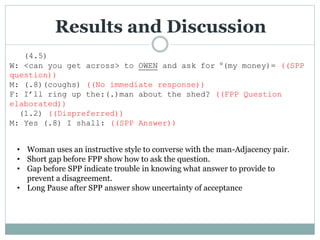
(4.5)
W: <can you get across> to OWEN and ask for (my money)= ((SPP
question))
M: (.8)(coughs) ((No immediate response))
F: I’ll ring up the:(.)man about the shed? ((FPP Question
elaborated))
(1.2) ((Dispreferred))
M: Yes (.8) I shall: ((SPP Answer))
• Woman uses an instructive style to converse with the man-Adjacency pair.
• Short gap before FPP show how to ask the question.
• Gap before SPP indicate trouble in knowing what answer to provide to
prevent a disagreement.
• Long Pause after SPP answer show uncertainty of acceptance
Results/Discussion
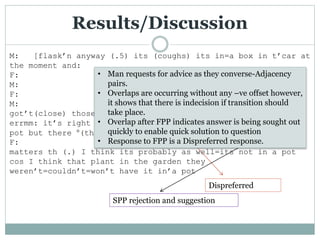
M: [flask’n anyway (.5) its (coughs) its in=a box in t’car at
the moment and:
F: [is it in a pot? ((FPP question))
M: [it’s no ((SPP answer))
F: [no?
M: [no=which is why I
got’t(close) those ones that were on offer (.9)
errmm: it’s right here (coughs)they were already in a=a nice
pot but there (things were close) [collection
F: [ well=ah don’t think it
matters th (.) I think its probably as well=its not in a pot
cos I think that plant in the garden they
weren’t=couldn’t=won’t have it in’a pot
Dispreferred
SPP rejection and suggestion
• Man requests for advice as they converse-Adjacency
pairs.
• Overlaps are occurring without any –ve offset however,
it shows that there is indecision if transition should
take place.
• Overlap after FPP indicates answer is being sought out
quickly to enable quick solution to question
• Response to FPP is a Dispreferred response.
Results/Discussion
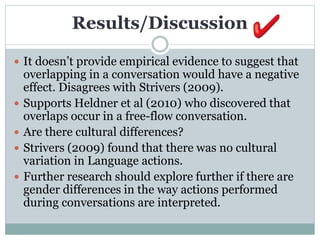
 It doesn’t provide empirical evidence to suggest that
overlapping in a conversation would have a negative
effect. Disagrees with Strivers (2009).
 Supports Heldner et al (2010) who discovered that
overlaps occur in a free-flow conversation.
 Are there cultural differences?
 Strivers (2009) found that there was no cultural
variation in Language actions.
 Further research should explore further if there are
gender differences in the way actions performed
during conversations are interpreted.
Summary
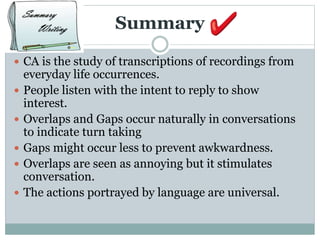
 CA is the study of transcriptions of recordings from
everyday life occurrences.
 People listen with the intent to reply to show
interest.
 Overlaps and Gaps occur naturally in conversations
to indicate turn taking
 Gaps might occur less to prevent awkwardness.
 Overlaps are seen as annoying but it stimulates
conversation.
 The actions portrayed by language are universal.
References
 Edwards, D. (1995). ‘Sacks and Psychology’. Theory and
Psychology, Vol 15 (3) pp 579-597
 Heldner, M. & Edlund, J. (2010). Pauses, Gaps and Overlaps
in conversations. Journal of Phonetics, Vol 38 (4) pp 555-
568
 Ping, Z. (2007). On Preferred and Dispreferred second turns
in Interaction. Sino-Us English Teaching, Vol 4 pp 38-41
 Seedhouse, P. (2004). Conversation Analysis Methodology.
Language Learning, Vol 54 (1) pp 1-54
 Smith, J.A. (2008). Qualitative psychology: A practical
guide to research methods. London: Sage Publications Ltd.
 Strivers, T. (2009). Universal and Cultural Variation in Turn
taking. PNAS, Vol 106 pp 10587-10592
Conversation Analysis original

Conversation Analysis original

  • 1.
    OGHENETEGA SYLVIA IDOGHO UP686679 UNIVERSITYOF PORTSMOUTH 22/04/2013 Conversation Analysis
  • 2.
    Content Intro to easeyou in What was done Interpretation of findings What we have learnt References
  • 3.
    Introduction/Background  Conversation analysishas been increasing used in associated subjects such as sociology, anthropology, psychology etc. (Smith, 2008) due to its ability to examine social interactions.  According to Seedhouse (2004), conversation analysis is the investigation of “how participants analyse and interpret each others actions and develop a shared understanding”  Conversation analyst observes conversation as an action, not just a communication. (Smith, 2008 cites Edwards, 1995). Therefore, the analysis focuses on how people understand and respond to one another.  Varied actions occur which enables a smooth conversation such as…  OVERLAPS and GAPS.
  • 4.
    Introduction/Background  Overlaps areaspects of conversation when more than one speaker talks.  Gaps are silences that occur at Transition Relevant Places (TRP).  Overlaps and Gaps occur in conversation to indicate turn taking. However, founders of CA were confused at how little these factors occur in conversations.  Research indicates that turn taking is NOT as precise as it is assumed, and in a free flowing conversation, overlaps occur (Heldner & Edlund, 2012). Therefore, I decided to investigate gaps and overlaps which occur during social interaction.  This aspects of conversation will be explored by studying naturally occurring data; focus and examine how interaction is organised i.e. turn taking.
  • 5.
    Method  Sources ofdata  Transcription of data  Procedures for analysis and interpretation
  • 6.
    Method: Source ofdata  The extracts used in this analysis derived from a selection of recordings of naturally occurring communications.  The participants involved in the conversation:  A husband and his wife discussing about wrapping garden plants.  A man and woman eating while talking about a shed.  The aspects of conversation I focused on were Gaps and Overlaps due to its significant value in conversations.  I decided on elaborate on fragments and turns that might mean more than they seem.
  • 7.
    Method: Transcription ofdata  The data collected was transcribed using a repeated playback method and the standard CA conventions.  The transcript also followed the Jefferson transcription conventions.  Extracts were repeatedly played and listen to correct any errors and ensure the transcript was reliable.  Pauses and gaps were timed using a stopwatch.
  • 8.
    Method: Procedures forAnalysis and Interpretation  After selecting the fragments, and transcribing, each TCU was identified by a gap or an overlap.  Data was analysed turn by turn basis after transcription.  To ensure validity of analysis, the next turn was assessed to see how the turn taker responded to what had been said.
  • 9.
    Results and Discussion (4.5) W:<can you get across> to OWEN and ask for (my money)= ((SPP question)) M: (.8)(coughs) ((No immediate response)) F: I’ll ring up the:(.)man about the shed? ((FPP Question elaborated)) (1.2) ((Dispreferred)) M: Yes (.8) I shall: ((SPP Answer)) • Woman uses an instructive style to converse with the man-Adjacency pair. • Short gap before FPP show how to ask the question. • Gap before SPP indicate trouble in knowing what answer to provide to prevent a disagreement. • Long Pause after SPP answer show uncertainty of acceptance
  • 10.
    Results/Discussion M: [flask’n anyway(.5) its (coughs) its in=a box in t’car at the moment and: F: [is it in a pot? ((FPP question)) M: [it’s no ((SPP answer)) F: [no? M: [no=which is why I got’t(close) those ones that were on offer (.9) errmm: it’s right here (coughs)they were already in a=a nice pot but there (things were close) [collection F: [ well=ah don’t think it matters th (.) I think its probably as well=its not in a pot cos I think that plant in the garden they weren’t=couldn’t=won’t have it in’a pot Dispreferred SPP rejection and suggestion • Man requests for advice as they converse-Adjacency pairs. • Overlaps are occurring without any –ve offset however, it shows that there is indecision if transition should take place. • Overlap after FPP indicates answer is being sought out quickly to enable quick solution to question • Response to FPP is a Dispreferred response.
  • 11.
    Results/Discussion  It doesn’tprovide empirical evidence to suggest that overlapping in a conversation would have a negative effect. Disagrees with Strivers (2009).  Supports Heldner et al (2010) who discovered that overlaps occur in a free-flow conversation.  Are there cultural differences?  Strivers (2009) found that there was no cultural variation in Language actions.  Further research should explore further if there are gender differences in the way actions performed during conversations are interpreted.
  • 12.
    Summary  CA isthe study of transcriptions of recordings from everyday life occurrences.  People listen with the intent to reply to show interest.  Overlaps and Gaps occur naturally in conversations to indicate turn taking  Gaps might occur less to prevent awkwardness.  Overlaps are seen as annoying but it stimulates conversation.  The actions portrayed by language are universal.
  • 13.
    References  Edwards, D.(1995). ‘Sacks and Psychology’. Theory and Psychology, Vol 15 (3) pp 579-597  Heldner, M. & Edlund, J. (2010). Pauses, Gaps and Overlaps in conversations. Journal of Phonetics, Vol 38 (4) pp 555- 568  Ping, Z. (2007). On Preferred and Dispreferred second turns in Interaction. Sino-Us English Teaching, Vol 4 pp 38-41  Seedhouse, P. (2004). Conversation Analysis Methodology. Language Learning, Vol 54 (1) pp 1-54  Smith, J.A. (2008). Qualitative psychology: A practical guide to research methods. London: Sage Publications Ltd.  Strivers, T. (2009). Universal and Cultural Variation in Turn taking. PNAS, Vol 106 pp 10587-10592