Article Presentation by
   Carinne Karlick
        ESL 501
According to Richards,
•   The mastery of speaking English is a priority
    for most second language learners.
•   The question that has long been debated:
    What is the best approach to teaching oral
    language skills?
•   A variety of approaches have been
    implemented by teachers and have been the
    focus of textbooks.
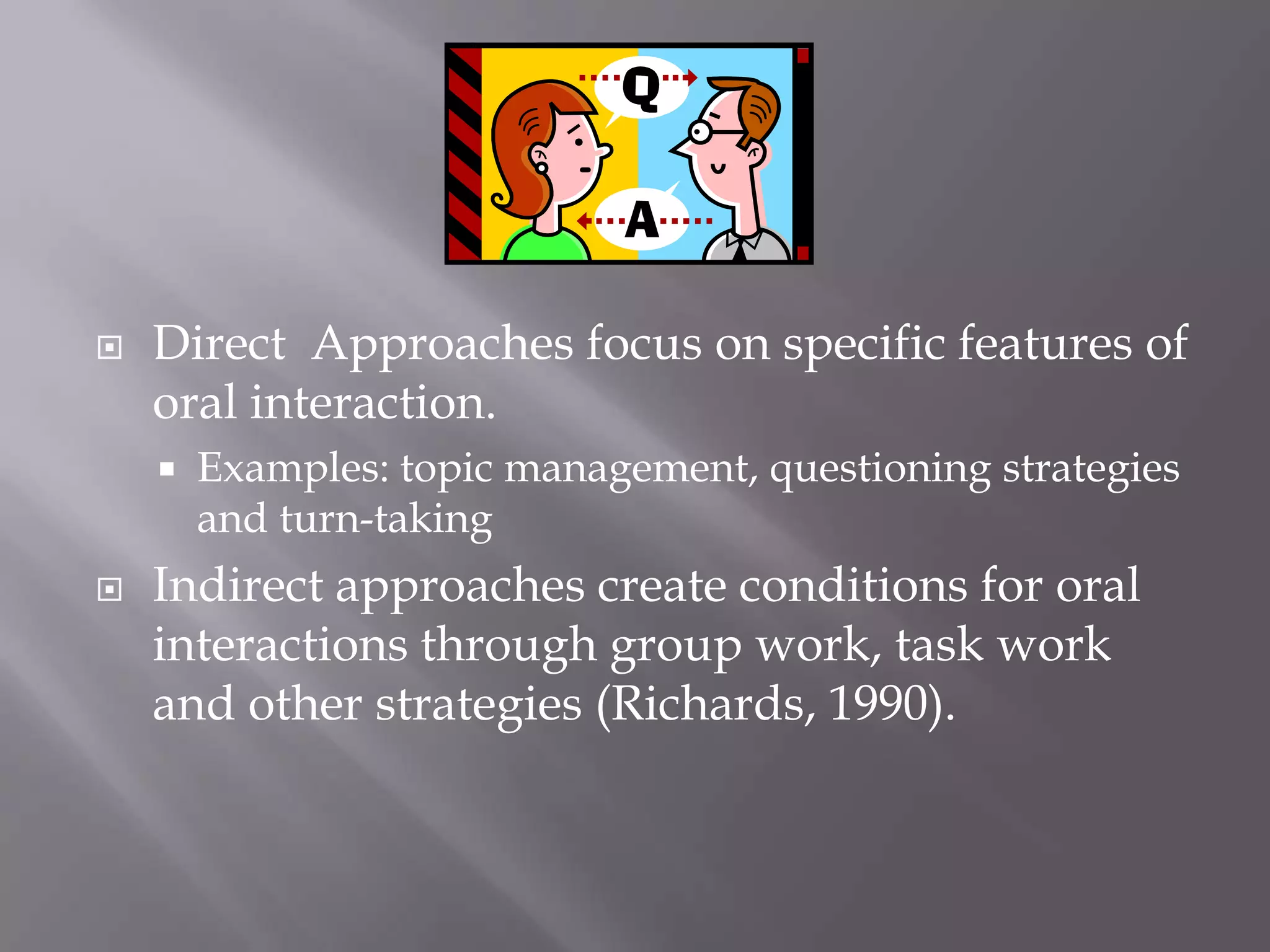
   Direct Approaches focus on specific features of
    oral interaction.
       Examples: topic management, questioning strategies
        and turn-taking
   Indirect approaches create conditions for oral
    interactions through group work, task work
    and other strategies (Richards, 1990).
   Composed of idea units (conjoined short phrases)
   Planned (ex: lecture) or unplanned (ex: conversation)
   Employs more generic words than written language
   Contains slips and errors reflecting on-line processing
   Involved reciprocity (ex: interactions are jointly
    constructed)
   Shows variation (ex: between formal and casual speech)
    reflecting speaker roles,
    speaking purpose, and the context
   According to Richards (2010), designing
    speaking activities and instruction materials for
    L2 learners it is important to recognize the
    different functions speaking performs and the
    different purposes our students need speaking
    skills.
   Brown and Yule (1983) distinguish between
    interactional (social) functions of speaking and
    transactional functions (exchange of
    information).
•   After designing his own materials and
    collaborating with teachers in
    workshops, Richards uses an expanded three
    part version of Brown& Yule’s framework
    (after Jones, 1996 and Burns, 1998)
    – Talk as interaction
    – Talk as transaction
    – Talk as performance
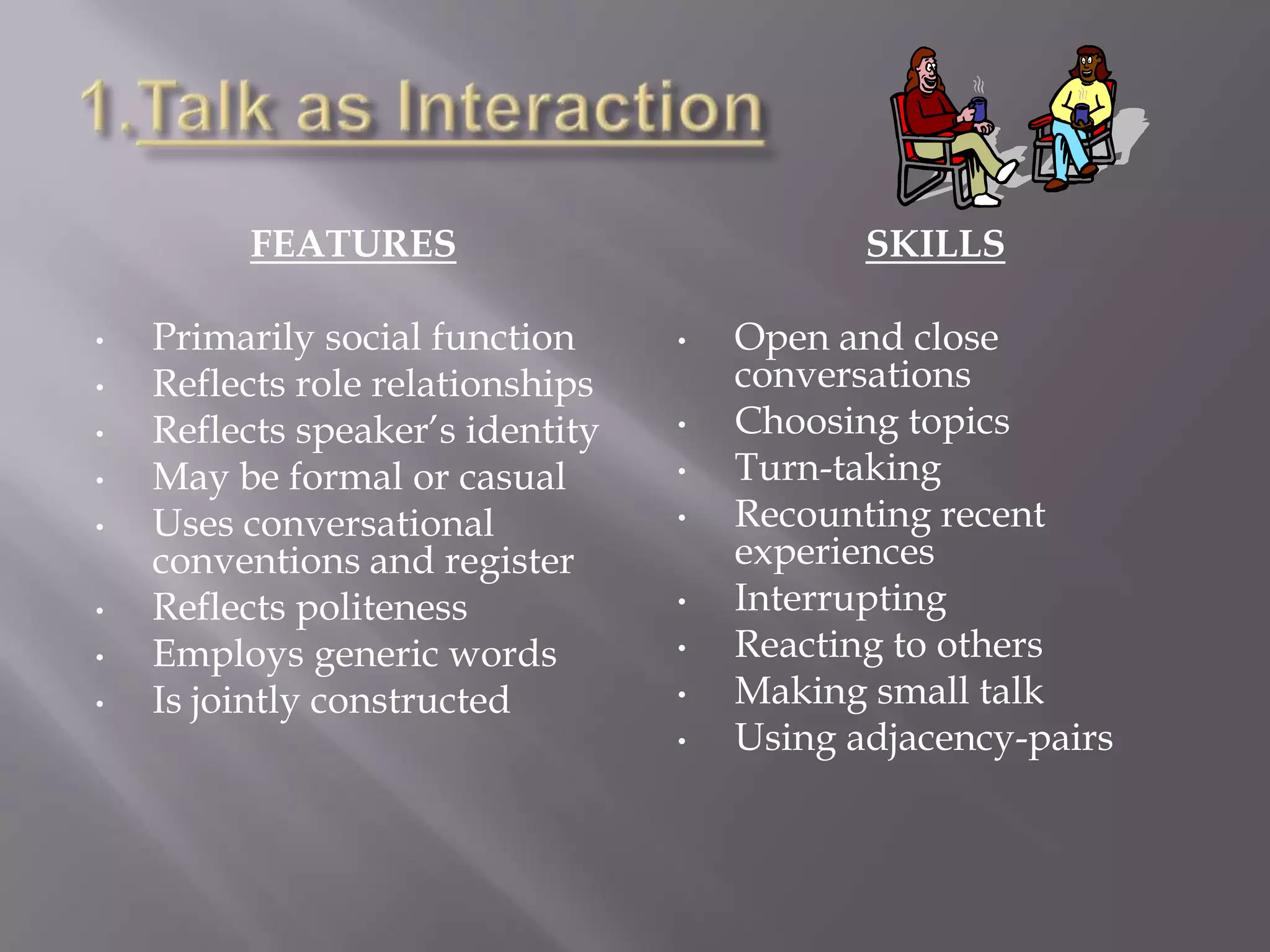
FEATURES                            SKILLS

•   Primarily social function     •   Open and close
•   Reflects role relationships       conversations
•   Reflects speaker’s identity   •   Choosing topics
•   May be formal or casual       •   Turn-taking
•   Uses conversational           •   Recounting recent
    conventions and register          experiences
•   Reflects politeness           •   Interrupting
•   Employs generic words         •   Reacting to others
•   Is jointly constructed        •   Making small talk
                                  •   Using adjacency-pairs
   Commonly referred to as “conversation”
   According to Richards, mastering the art of talk
    as interaction is difficult and may not be
    important to all learners.
   Some students may feel awkward and at a loss
    for words in interactional situations.
   They may avoid such situations.
   It puts students at a disadvantage when
    conversation is important.
   Most difficult to teach because it is complex
    and has “unspoken rules”
                      Best Taught
   Naturalistic dialogues
   Modeling opening and
    closing conversation
   Recounting personal experience
   Practice reacting to what others say.
       For example: Students are given dialogue and work in pairs
        adding reactions that have been omitted. Or students practice
        conversation starters and have to respond by asking 2 follow
        up questions.
FEATURES                              SKILLS

•   It has an informational focus   •   Explaining an intention or
•   The main focus is the               need
    message & not the               •   Describing something
    participants                    •   Asking questions
•   Participants make use of        •   Confirming information
    communication strategies to     •   Justifying an opinion
    make themselves understood
•   Frequent questions,             •   Making suggestions
    repetitions, and                •   Clarifying understanding
    comprehension checks            •   Making comparisons
•   Language accuracy is not        •   Agreeing and disagreeing
    always important
   The focus on what is said or done
   The message is the central focus and ensuring
    that the speaker is understood clearly.
   Burns identifies 2 types:
    - One focuses on giving/receiving info and on
      what is said or achieved.
    - The second focuses on getting
      goods or services.
   More easily planned with use of current
    materials, role play and real-world
    transactions.
                      Best Taught
   Ranking activities
   Brainstorming
   Group discussion
       For example: Students prepare a list of controversial
        statements, exchange and discuss them.
   Simulation or Role Play
       For example: Students act out real world transactions in three
        stages: preparation, modeling, practice/review
FEATURES                         SKILLS

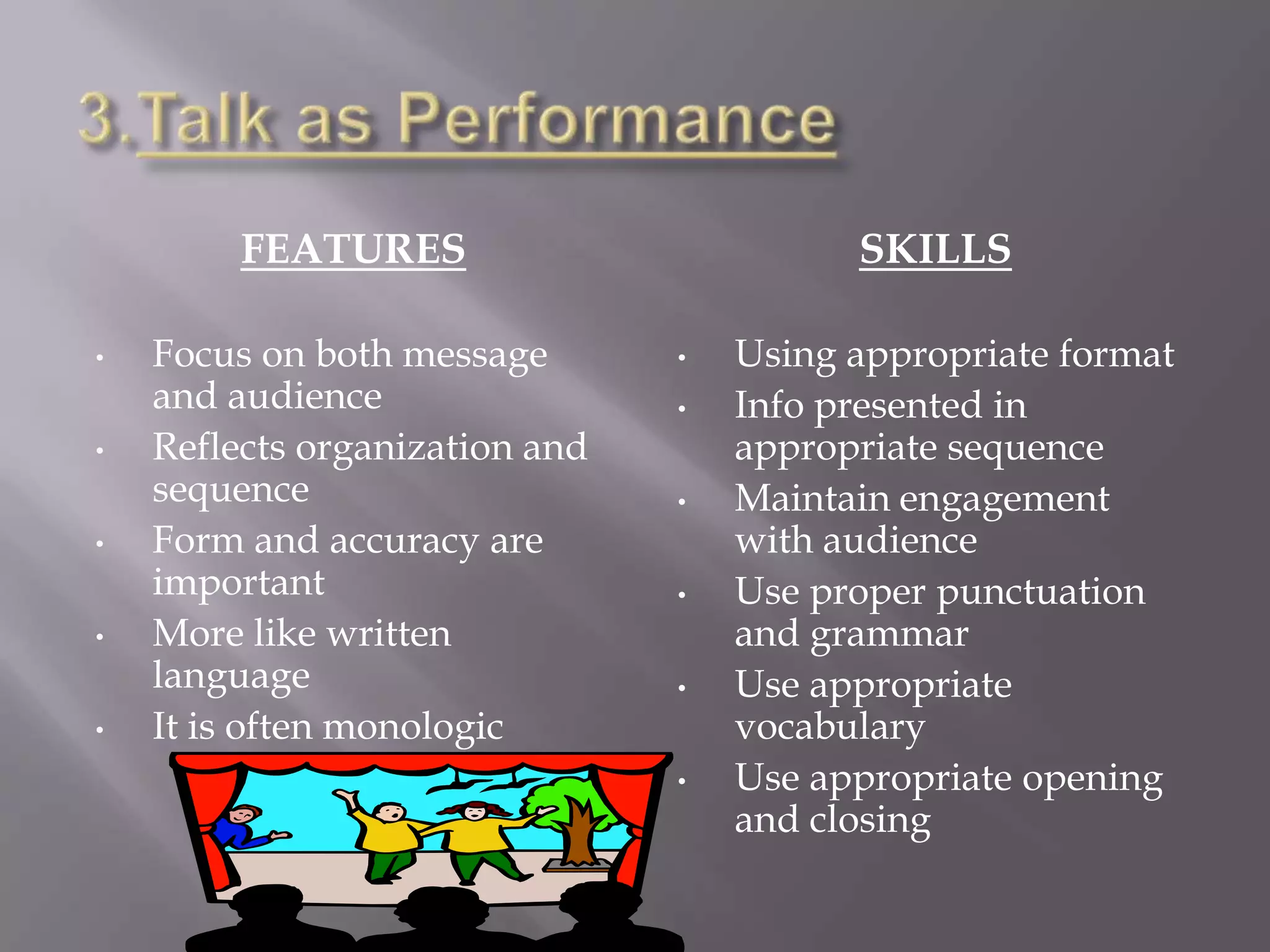
•   Focus on both message       •   Using appropriate format
    and audience                •   Info presented in
•   Reflects organization and       appropriate sequence
    sequence                    •   Maintain engagement
•   Form and accuracy are           with audience
    important                   •   Use proper punctuation
•   More like written               and grammar
    language                    •   Use appropriate
•   It is often monologic           vocabulary
                                •   Use appropriate opening
                                    and closing
   Refers to talk that transmits information before
    an audience like performances, public
    announcements and speeches.
   In a school setting this type of talk could be
    presenting an oral report, conducting a
    class debate or giving a speech.
   It is usually evaluated according to its
    impact on the listener.
This requires a different teaching strategy. According to Jones (1996), talk
    as performance need to be prepared for and scaffold the same way as
    written text and strategies used to make text accessible applied to formal
    uses of spoken language.

                              Best Taught
   Providing examples: Speeches, oral
        presentations, stories though video/audio.
   Examples are then analyzed to understand how texts
    work and what their linguistic features are.
   Questions to guide the process are:
       What is the speaker’s purpose? Who is the audience?
       What info does the audience expect? How does the talk
        begin/develop/end? What strategies are involved? What
        language is used?
   Students then work together on planning their own
    text to present.
When planning speaking activities:
   Determine what kinds of speaking skills will the course
    focus on (interaction, transaction, performance.)
   Perform an informal needs analysis through
    questionnaires, interviews, communicative tasks etc.
   Then identify the teaching strategies for learners to
    acquire each kind of talk.
   Determine the expected level of performance and the
    criteria used to assess.
Teachers need to consider what the completion of
    the activity involves according to the type
     (interaction, transaction or performance)
          of talk and classroom activity.
 Teachers should ask themselves:
     How will the activity be modeled?
     What language support will be needed?
     What resources will be used?
     What learning arrangements will be needed?
     What level of performance is expected?
     How will the feedback be given?
It is suggested to assign one student be an
    observer during a discussion
   Talk as Interaction
       Introduces new topics effectively,
        contributes equally by taking turns,
        interrupting appropriately
   Talk as Transaction
       The speaker’s need is expressed effectively, a description is clear.
   Talk as performance
       Clarity of presentation (is it organized and comprehensible?)
       Use of discourse markers, repetition, stress to emphasize important
        points.
       Audience engaged when appropriate
Article presentation esl 501 developing classroom speaking activities

Article presentation esl 501 developing classroom speaking activities

  • 1.
    Article Presentation by Carinne Karlick ESL 501
  • 2.
    According to Richards, • The mastery of speaking English is a priority for most second language learners. • The question that has long been debated: What is the best approach to teaching oral language skills? • A variety of approaches have been implemented by teachers and have been the focus of textbooks.
  • 3.
    Direct Approaches focus on specific features of oral interaction.  Examples: topic management, questioning strategies and turn-taking  Indirect approaches create conditions for oral interactions through group work, task work and other strategies (Richards, 1990).
  • 4.
    Composed of idea units (conjoined short phrases)  Planned (ex: lecture) or unplanned (ex: conversation)  Employs more generic words than written language  Contains slips and errors reflecting on-line processing  Involved reciprocity (ex: interactions are jointly constructed)  Shows variation (ex: between formal and casual speech) reflecting speaker roles, speaking purpose, and the context
  • 5.
    According to Richards (2010), designing speaking activities and instruction materials for L2 learners it is important to recognize the different functions speaking performs and the different purposes our students need speaking skills.  Brown and Yule (1983) distinguish between interactional (social) functions of speaking and transactional functions (exchange of information).
  • 6.
    After designing his own materials and collaborating with teachers in workshops, Richards uses an expanded three part version of Brown& Yule’s framework (after Jones, 1996 and Burns, 1998) – Talk as interaction – Talk as transaction – Talk as performance
  • 7.
    FEATURES SKILLS • Primarily social function • Open and close • Reflects role relationships conversations • Reflects speaker’s identity • Choosing topics • May be formal or casual • Turn-taking • Uses conversational • Recounting recent conventions and register experiences • Reflects politeness • Interrupting • Employs generic words • Reacting to others • Is jointly constructed • Making small talk • Using adjacency-pairs
  • 8.
    Commonly referred to as “conversation”  According to Richards, mastering the art of talk as interaction is difficult and may not be important to all learners.  Some students may feel awkward and at a loss for words in interactional situations.  They may avoid such situations.  It puts students at a disadvantage when conversation is important.
  • 9.
    Most difficult to teach because it is complex and has “unspoken rules” Best Taught  Naturalistic dialogues  Modeling opening and closing conversation  Recounting personal experience  Practice reacting to what others say.  For example: Students are given dialogue and work in pairs adding reactions that have been omitted. Or students practice conversation starters and have to respond by asking 2 follow up questions.
  • 10.
    FEATURES SKILLS • It has an informational focus • Explaining an intention or • The main focus is the need message & not the • Describing something participants • Asking questions • Participants make use of • Confirming information communication strategies to • Justifying an opinion make themselves understood • Frequent questions, • Making suggestions repetitions, and • Clarifying understanding comprehension checks • Making comparisons • Language accuracy is not • Agreeing and disagreeing always important
  • 11.
    The focus on what is said or done  The message is the central focus and ensuring that the speaker is understood clearly.  Burns identifies 2 types: - One focuses on giving/receiving info and on what is said or achieved. - The second focuses on getting goods or services.
  • 12.
    More easily planned with use of current materials, role play and real-world transactions. Best Taught  Ranking activities  Brainstorming  Group discussion  For example: Students prepare a list of controversial statements, exchange and discuss them.  Simulation or Role Play  For example: Students act out real world transactions in three stages: preparation, modeling, practice/review
  • 13.
    FEATURES SKILLS • Focus on both message • Using appropriate format and audience • Info presented in • Reflects organization and appropriate sequence sequence • Maintain engagement • Form and accuracy are with audience important • Use proper punctuation • More like written and grammar language • Use appropriate • It is often monologic vocabulary • Use appropriate opening and closing
  • 14.
    Refers to talk that transmits information before an audience like performances, public announcements and speeches.  In a school setting this type of talk could be presenting an oral report, conducting a class debate or giving a speech.  It is usually evaluated according to its impact on the listener.
  • 15.
    This requires adifferent teaching strategy. According to Jones (1996), talk as performance need to be prepared for and scaffold the same way as written text and strategies used to make text accessible applied to formal uses of spoken language. Best Taught  Providing examples: Speeches, oral presentations, stories though video/audio.  Examples are then analyzed to understand how texts work and what their linguistic features are.  Questions to guide the process are:  What is the speaker’s purpose? Who is the audience?  What info does the audience expect? How does the talk begin/develop/end? What strategies are involved? What language is used?  Students then work together on planning their own text to present.
  • 16.
    When planning speakingactivities:  Determine what kinds of speaking skills will the course focus on (interaction, transaction, performance.)  Perform an informal needs analysis through questionnaires, interviews, communicative tasks etc.  Then identify the teaching strategies for learners to acquire each kind of talk.  Determine the expected level of performance and the criteria used to assess.
  • 17.
    Teachers need toconsider what the completion of the activity involves according to the type (interaction, transaction or performance) of talk and classroom activity.  Teachers should ask themselves:  How will the activity be modeled?  What language support will be needed?  What resources will be used?  What learning arrangements will be needed?  What level of performance is expected?  How will the feedback be given?
  • 18.
    It is suggestedto assign one student be an observer during a discussion  Talk as Interaction  Introduces new topics effectively, contributes equally by taking turns, interrupting appropriately  Talk as Transaction  The speaker’s need is expressed effectively, a description is clear.  Talk as performance  Clarity of presentation (is it organized and comprehensible?)  Use of discourse markers, repetition, stress to emphasize important points.  Audience engaged when appropriate