Presentation No.2
Topic: TALK Chapter Nine
from Doing Pragmatics by
Peter Grundy
Presented by
Ijaz Ahmed
Supervised by Dr. Iqbal Butt
Discipline: Mphil in
Linguistics
Pragmatics and conversation
• The varieties of pragmatics meaning
you are familiar with will be useful in
explaining how meaning is conveyed
utterance by utterance, but that these
accounts of utterance meaning may
be inadequate as accounts of how
extended talk works.
Conversational Analytic approach to
language understanding
• The conversational analytic
approach to language
understanding is characterized by
the search for patterns in talk
which reflect its culturally
recognizable and therefore
expectable nature.
Conversational features called
Members Methods
Turn, Adjacency pair, Latched utterance,
pause, transition-relevance, place, overlap,
repair, formulation and self –formulation
such conversational features are called
Members’ methods because they are
recognized by all those who belong to the
community of talkers (members) and are
expectable routines (methods)
Cont……………
• An adjacency pair is an example of
conversational turn-taking An adjacency
pair is composed of two utterances by
two speakers, one after the other. The
speaking of the first utterance (the first-
pair part, or the first turn) provokes a
responding utterance (the second-pair
part, or the second turn).
Cont………….
• For example, a question such as "What's your
name?" requires the addressee to provide an
answer in the following turn, thus completing the
adjacency pair. A satisfactory response could be
"I'm James". To provide an irrelevant response, or
to fail to complete the pair, is noticed as a breach
of conversational maxim. A reply like "I'm allergic
to shellfish" would not satisfy the adjacency pair,
as it violates Grice's conversational maxim of
relevance.
Cont…………..
• greeting → greeting
• "Heya!" → "Oh, hi!"offer →
• acceptance/rejection
• "Would you like to visit the museum with me this
evening?" → "I'd love to!
• "request → acceptance/rejection
• "Is it OK if I borrow this book?" → "I'd rather you didn't,
it's due back at the library tomorrow“
• question → answer
• "What does this big red button do?" → "It causes two-
thirds of the universe to implode"
Cont…………
• complaint → excuse/remedy
• "It's awfully cold in here" → "Oh, sorry, I'll
close the window“
• degreeting → degreeting
• "See you!" → "Yeah, see you later!“
• inform → acknowledge
• "Your phone is over there" → "I know"
Cont…….
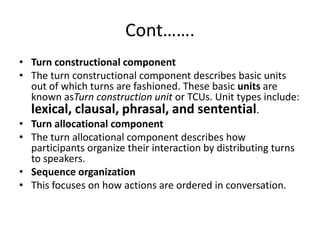
• Turn constructional component
• The turn constructional component describes basic units
out of which turns are fashioned. These basic units are
known asTurn construction unit or TCUs. Unit types include:
lexical, clausal, phrasal, and sentential.
• Turn allocational component
• The turn allocational component describes how
participants organize their interaction by distributing turns
to speakers.
• Sequence organization
• This focuses on how actions are ordered in conversation.
Cont………….
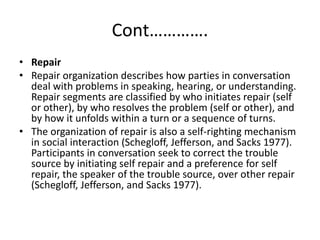
• Repair
• Repair organization describes how parties in conversation
deal with problems in speaking, hearing, or understanding.
Repair segments are classified by who initiates repair (self
or other), by who resolves the problem (self or other), and
by how it unfolds within a turn or a sequence of turns.
• The organization of repair is also a self-righting mechanism
in social interaction (Schegloff, Jefferson, and Sacks 1977).
Participants in conversation seek to correct the trouble
source by initiating self repair and a preference for self
repair, the speaker of the trouble source, over other repair
(Schegloff, Jefferson, and Sacks 1977).
Cont………
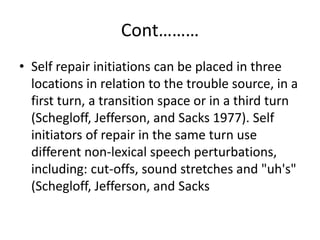
• Self repair initiations can be placed in three
locations in relation to the trouble source, in a
first turn, a transition space or in a third turn
(Schegloff, Jefferson, and Sacks 1977). Self
initiators of repair in the same turn use
different non-lexical speech perturbations,
including: cut-offs, sound stretches and "uh's"
(Schegloff, Jefferson, and Sacks
Cont…………
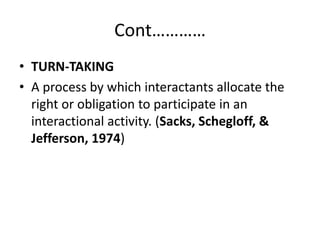
• TURN-TAKING
• A process by which interactants allocate the
right or obligation to participate in an
interactional activity. (Sacks, Schegloff, &
Jefferson, 1974)
Talk in interaction structure
• Sacks et al show that a turn projects its own
end, or transition-relevance place, and that
the speaker may select next speaker or allow
self-selection of next speaker to take place in a
way that minimizes gaps and overlaps because
a turn’s end is projected, next speakers have
an opportunity to prepare their contribution.
Talk and context
• There are two kinds of context micro and
macro
• Macro context exist outside the talk exchange.
• In chapter 8 he described the male
manger/young female employee with limited
office-fronting responsibilities scenario as a
micro context. and suggested that this context
was remade in the service encounter when
the customer pressed his enquiry.
Cont…….
• Schegloff argues that a context can only
influence a talk exchange to the extent that it
is made relevant in it.
• If macro context aren't relevant we can
discount then, and if they are relevant, they
will be appear as micro contexts oriented to in
the talk itself
Cont…….
• Context provide opportunity to the hearer to
understand the speaker intention.
• Without context no intention can be
understood.
• Context is necessary in conversation analysis
when it goes between more than one person.
• Contextual resources for talk play a extensive
influence for conversation.
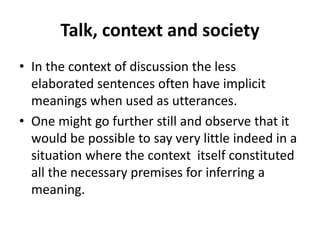
Talk, context and society
• In the context of discussion the less
elaborated sentences often have implicit
meanings when used as utterances.
• One might go further still and observe that it
would be possible to say very little indeed in a
situation where the context itself constituted
all the necessary premises for inferring a
meaning.
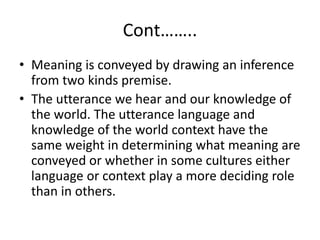
Cont……..
• Meaning is conveyed by drawing an inference
from two kinds premise.
• The utterance we hear and our knowledge of
the world. The utterance language and
knowledge of the world context have the
same weight in determining what meaning are
conveyed or whether in some cultures either
language or context play a more deciding role
than in others.
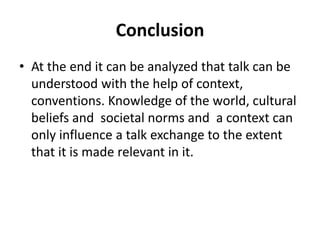
Conclusion
• At the end it can be analyzed that talk can be
understood with the help of context,
conventions. Knowledge of the world, cultural
beliefs and societal norms and a context can
only influence a talk exchange to the extent
that it is made relevant in it.

Presentation pragmatics from doing pragmatics chapter nine talk

  • 1.
    Presentation No.2 Topic: TALKChapter Nine from Doing Pragmatics by Peter Grundy Presented by Ijaz Ahmed Supervised by Dr. Iqbal Butt Discipline: Mphil in Linguistics
  • 2.
    Pragmatics and conversation •The varieties of pragmatics meaning you are familiar with will be useful in explaining how meaning is conveyed utterance by utterance, but that these accounts of utterance meaning may be inadequate as accounts of how extended talk works.
  • 3.
    Conversational Analytic approachto language understanding • The conversational analytic approach to language understanding is characterized by the search for patterns in talk which reflect its culturally recognizable and therefore expectable nature.
  • 4.
    Conversational features called MembersMethods Turn, Adjacency pair, Latched utterance, pause, transition-relevance, place, overlap, repair, formulation and self –formulation such conversational features are called Members’ methods because they are recognized by all those who belong to the community of talkers (members) and are expectable routines (methods)
  • 5.
    Cont…………… • An adjacencypair is an example of conversational turn-taking An adjacency pair is composed of two utterances by two speakers, one after the other. The speaking of the first utterance (the first- pair part, or the first turn) provokes a responding utterance (the second-pair part, or the second turn).
  • 6.
    Cont…………. • For example,a question such as "What's your name?" requires the addressee to provide an answer in the following turn, thus completing the adjacency pair. A satisfactory response could be "I'm James". To provide an irrelevant response, or to fail to complete the pair, is noticed as a breach of conversational maxim. A reply like "I'm allergic to shellfish" would not satisfy the adjacency pair, as it violates Grice's conversational maxim of relevance.
  • 7.
    Cont………….. • greeting →greeting • "Heya!" → "Oh, hi!"offer → • acceptance/rejection • "Would you like to visit the museum with me this evening?" → "I'd love to! • "request → acceptance/rejection • "Is it OK if I borrow this book?" → "I'd rather you didn't, it's due back at the library tomorrow“ • question → answer • "What does this big red button do?" → "It causes two- thirds of the universe to implode"
  • 8.
    Cont………… • complaint →excuse/remedy • "It's awfully cold in here" → "Oh, sorry, I'll close the window“ • degreeting → degreeting • "See you!" → "Yeah, see you later!“ • inform → acknowledge • "Your phone is over there" → "I know"
  • 9.
    Cont……. • Turn constructionalcomponent • The turn constructional component describes basic units out of which turns are fashioned. These basic units are known asTurn construction unit or TCUs. Unit types include: lexical, clausal, phrasal, and sentential. • Turn allocational component • The turn allocational component describes how participants organize their interaction by distributing turns to speakers. • Sequence organization • This focuses on how actions are ordered in conversation.
  • 10.
    Cont…………. • Repair • Repairorganization describes how parties in conversation deal with problems in speaking, hearing, or understanding. Repair segments are classified by who initiates repair (self or other), by who resolves the problem (self or other), and by how it unfolds within a turn or a sequence of turns. • The organization of repair is also a self-righting mechanism in social interaction (Schegloff, Jefferson, and Sacks 1977). Participants in conversation seek to correct the trouble source by initiating self repair and a preference for self repair, the speaker of the trouble source, over other repair (Schegloff, Jefferson, and Sacks 1977).
  • 11.
    Cont……… • Self repairinitiations can be placed in three locations in relation to the trouble source, in a first turn, a transition space or in a third turn (Schegloff, Jefferson, and Sacks 1977). Self initiators of repair in the same turn use different non-lexical speech perturbations, including: cut-offs, sound stretches and "uh's" (Schegloff, Jefferson, and Sacks
  • 12.
    Cont………… • TURN-TAKING • Aprocess by which interactants allocate the right or obligation to participate in an interactional activity. (Sacks, Schegloff, & Jefferson, 1974)
  • 13.
    Talk in interactionstructure • Sacks et al show that a turn projects its own end, or transition-relevance place, and that the speaker may select next speaker or allow self-selection of next speaker to take place in a way that minimizes gaps and overlaps because a turn’s end is projected, next speakers have an opportunity to prepare their contribution.
  • 14.
    Talk and context •There are two kinds of context micro and macro • Macro context exist outside the talk exchange. • In chapter 8 he described the male manger/young female employee with limited office-fronting responsibilities scenario as a micro context. and suggested that this context was remade in the service encounter when the customer pressed his enquiry.
  • 15.
    Cont……. • Schegloff arguesthat a context can only influence a talk exchange to the extent that it is made relevant in it. • If macro context aren't relevant we can discount then, and if they are relevant, they will be appear as micro contexts oriented to in the talk itself
  • 16.
    Cont……. • Context provideopportunity to the hearer to understand the speaker intention. • Without context no intention can be understood. • Context is necessary in conversation analysis when it goes between more than one person. • Contextual resources for talk play a extensive influence for conversation.
  • 17.
    Talk, context andsociety • In the context of discussion the less elaborated sentences often have implicit meanings when used as utterances. • One might go further still and observe that it would be possible to say very little indeed in a situation where the context itself constituted all the necessary premises for inferring a meaning.
  • 18.
    Cont…….. • Meaning isconveyed by drawing an inference from two kinds premise. • The utterance we hear and our knowledge of the world. The utterance language and knowledge of the world context have the same weight in determining what meaning are conveyed or whether in some cultures either language or context play a more deciding role than in others.
  • 19.
    Conclusion • At theend it can be analyzed that talk can be understood with the help of context, conventions. Knowledge of the world, cultural beliefs and societal norms and a context can only influence a talk exchange to the extent that it is made relevant in it.