EDUC 553 Steve Gabel
Limits and Their Properties: Limits and Continuity
Continuity When we evaluate a limit, it’s easy as long as the function is  continuous …just use  Direct Substitution . But what does it mean for a function to be continuous? Our informal definition was that a function is continuous as long as you can draw the graph without lifting your pencil. This definition gives us a general idea of how continuity works but it’s not a great definition; we need a much better definition
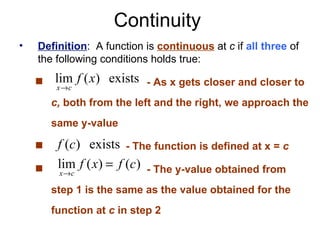
Continuity Definition :  A function is  continuous  at  c  if  all three  of the following conditions holds true: - As x gets closer and closer to  c,  both from the left and the right, we approach the same y-value  - The function is defined at x =  c - The y-value obtained from step 1 is the same as the value obtained for the function at  c  in step 2
Continuity If a function is continuous for  ALL  x, then we say it is a continuous function. Some functions can be continuous in certain parts of its domain and discontinuous in others There are 4 different types of discontinuity: Point discontinuity  – this is where there is a “hole” in the graph or a missing point. Asymptotic/infinite discontinuity  – this is when we encounter a asymptote. Jump discontinuity  – this occurs when our function “jumps” from one point to another. Essential discontinuity  – this happens when one side or more sides doesn’t exist or is infinite.
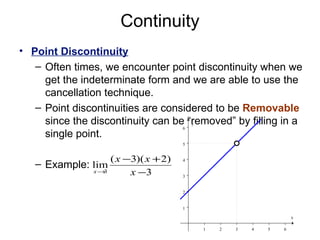
Continuity Point Discontinuity Often times, we encounter point discontinuity when we get the indeterminate form and we are able to use the cancellation technique. Point discontinuities are considered to be  Removable  since the discontinuity can be “removed” by filling in a single point. Example:
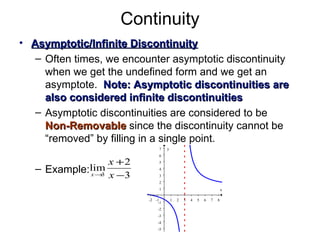
Continuity Asymptotic/Infinite Discontinuity Often times, we encounter asymptotic discontinuity when we get the undefined form and we get an asymptote.  Note: Asymptotic discontinuities are also considered infinite discontinuities   Asymptotic discontinuities are considered to be  Non-Removable  since the discontinuity cannot be “removed” by filling in a single point. Example:
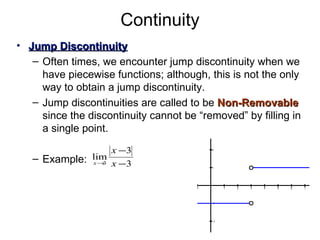
Continuity Jump Discontinuity Often times, we encounter jump discontinuity when we have piecewise functions; although, this is not the only way to obtain a jump discontinuity.  Jump discontinuities are called to be  Non-Removable  since the discontinuity cannot be “removed” by filling in a single point. Example:
Continuity Essential Discontinuity When one (or both) of our  one-sided limits  does not exist or goes to infinity, it is called an essential discontinuity.  This can occur with radical expressions, inequalities, piece-wise functions, etc.  Essential discontinuities are always  Non-Removable .  Note: we can consider infinite discontinuities to be essential as well. Example:
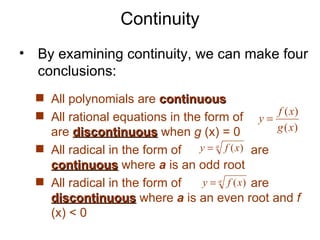
Continuity By examining continuity, we can make four conclusions: All polynomials are  continuous All rational equations in the form of  are  discontinuous  when  g  (x) = 0 All radical in the form of  are  continuous  where  a  is an odd root  All radical in the form of  are  discontinuous  where  a  is an even root and  f  (x) < 0
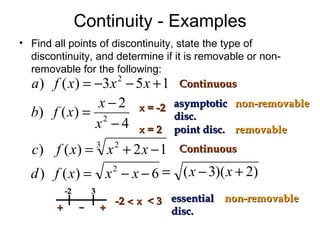
Continuity - Examples Find all points of discontinuity, state the type of discontinuity, and determine if it is removable or non-removable for the following: Continuous x = -2 Continuous asymptotic disc.  non-removable x = 2 point disc.  removable – + + -2  <   x  < 3 essential disc.  non-removable -2 3
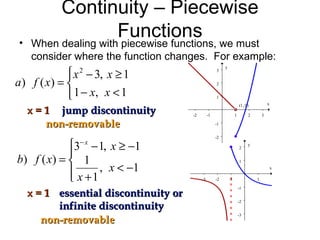
Continuity – Piecewise Functions When dealing with piecewise functions, we must consider where the function changes.  For example: jump discontinuity essential discontinuity or infinite discontinuity  x = 1 non-removable x = 1 non-removable
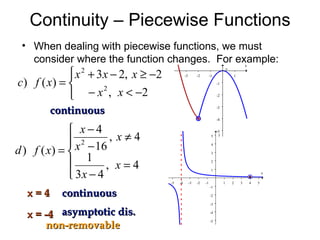
Continuity – Piecewise Functions When dealing with piecewise functions, we must consider where the function changes.  For example: continuous continuous asymptotic dis. x = 4 non-removable x = -4
Homework Continuity Read Sections TBD Problems: p. TBD

Psc553

  • 1.
  • 2.
    Limits and TheirProperties: Limits and Continuity
  • 3.
    Continuity When weevaluate a limit, it’s easy as long as the function is continuous …just use Direct Substitution . But what does it mean for a function to be continuous? Our informal definition was that a function is continuous as long as you can draw the graph without lifting your pencil. This definition gives us a general idea of how continuity works but it’s not a great definition; we need a much better definition
  • 4.
    Continuity Definition : A function is continuous at c if all three of the following conditions holds true: - As x gets closer and closer to c, both from the left and the right, we approach the same y-value - The function is defined at x = c - The y-value obtained from step 1 is the same as the value obtained for the function at c in step 2
  • 5.
    Continuity If afunction is continuous for ALL x, then we say it is a continuous function. Some functions can be continuous in certain parts of its domain and discontinuous in others There are 4 different types of discontinuity: Point discontinuity – this is where there is a “hole” in the graph or a missing point. Asymptotic/infinite discontinuity – this is when we encounter a asymptote. Jump discontinuity – this occurs when our function “jumps” from one point to another. Essential discontinuity – this happens when one side or more sides doesn’t exist or is infinite.
  • 6.
    Continuity Point DiscontinuityOften times, we encounter point discontinuity when we get the indeterminate form and we are able to use the cancellation technique. Point discontinuities are considered to be Removable since the discontinuity can be “removed” by filling in a single point. Example:
  • 7.
    Continuity Asymptotic/Infinite DiscontinuityOften times, we encounter asymptotic discontinuity when we get the undefined form and we get an asymptote. Note: Asymptotic discontinuities are also considered infinite discontinuities Asymptotic discontinuities are considered to be Non-Removable since the discontinuity cannot be “removed” by filling in a single point. Example:
  • 8.
    Continuity Jump DiscontinuityOften times, we encounter jump discontinuity when we have piecewise functions; although, this is not the only way to obtain a jump discontinuity. Jump discontinuities are called to be Non-Removable since the discontinuity cannot be “removed” by filling in a single point. Example:
  • 9.
    Continuity Essential DiscontinuityWhen one (or both) of our one-sided limits does not exist or goes to infinity, it is called an essential discontinuity. This can occur with radical expressions, inequalities, piece-wise functions, etc. Essential discontinuities are always Non-Removable . Note: we can consider infinite discontinuities to be essential as well. Example:
  • 10.
    Continuity By examiningcontinuity, we can make four conclusions: All polynomials are continuous All rational equations in the form of are discontinuous when g (x) = 0 All radical in the form of are continuous where a is an odd root All radical in the form of are discontinuous where a is an even root and f (x) < 0
  • 11.
    Continuity - ExamplesFind all points of discontinuity, state the type of discontinuity, and determine if it is removable or non-removable for the following: Continuous x = -2 Continuous asymptotic disc. non-removable x = 2 point disc. removable – + + -2 < x < 3 essential disc. non-removable -2 3
  • 12.
    Continuity – PiecewiseFunctions When dealing with piecewise functions, we must consider where the function changes. For example: jump discontinuity essential discontinuity or infinite discontinuity x = 1 non-removable x = 1 non-removable
  • 13.
    Continuity – PiecewiseFunctions When dealing with piecewise functions, we must consider where the function changes. For example: continuous continuous asymptotic dis. x = 4 non-removable x = -4
  • 14.
    Homework Continuity ReadSections TBD Problems: p. TBD