ASYMPTOTES
D.R.Alıyeva
calculus
aliyeva_dunya8@mail.ru
INTRODUCTION
Anasymptote of a curvey= f(x) that has aninfinite branch is called a line such that the
distance between the point (x, f (x)) lyingon the curveand the lineapproaches zeroas the point
moves along the branch to infinity.
Asymptotes can be vertical, oblique (slant) and horizontal. A horizontal asymptote is often
considered as a special case of an oblique asymptote.
Asymptotesare useful guides tocomplete the graph of a function. An asymptoteis a line
towhich the curve of the function approaches atinfinity or atcertain points of
discontinuity.
THE
APPLICATION OF
ASYMPTOTE
IN REAL LIFE
WELLSPRING
Use for significant O notations
Relevant for Algebra:
Limits of Functions
Useful for graphing
rational equations
WELLSPRING
Use this color palette when you
want a blend of nature-infused
hues that highlight the
compatibility of the greens and
the “health giving” properties of
these deliciously subtle and
nourishing hues.
VERTICAL ASYMPTOTE
The straight line 𝑥 = 𝑎 is a vertical asymptote ofthe graphofthe function 𝑦 = 𝑓(𝑥) if at least one ofthe following conditions is true:
In other words,at least one ofthe one-sided limits at the point 𝑥 = 𝑎 must be equal toinfinity.
Avertical asymptote occurs in rational functions at the points when the denominator is zero andthe numerator is not equal tozero (i.e. At
the points ofdiscontinuity ofthe second kind ).
Remainder:The function f(x) is said tohave a discontinuity ofthe second kind (ora nonremovable oressential discontinuity) at x=a,if at least one of the one-sided limits either does
not exist oris infinite.
Example
the graphof the function
𝑦 =
1
𝑥
has the vertical asymptote 𝑥 = 𝑎 . Inthis case, both one-
sided limits (from the left and from the right) tend to infinity:
Vertical asymptotesofrationalfunction
Example: findvertical asymptotes off(x) =(x+1) / (x2 - 1).
Solution:
let us factorize andsimplify the given expression:
then f(x) =(x+1) /[(x+1) (x - 1) ]=1 /(x- 1).
If we dothat, we getx= -1 and x=1 tobe the vas off(x)
WARM-UP:
FINDVERTICALASYMPTOTEOFF(X)= (3X2)/(X2-5X+6).
IMPORTANTNOTESON VERTICALASYMPTOTES
A function can haveanynumberof vertical asymptotes.
No polynomial functionhas a vertical asymptote.
No exponential function has a vertical asymptote.
Every logarithmic functionhas at least one vertical asymptote.
.
Oblique Asymptote
The straight line 𝑦 = 𝑘𝑥 + b is called an oblique (slant) asymptote of the graph of the function
𝑦 = 𝑓(𝑥)as 𝑥 → ∞ if
Similarly, we introduce oblique asymptotes as 𝑥 → −∞ .
The oblique asymptotes of the graph of the function 𝑦 = 𝑓(𝑥) may be different as 𝑥 → ∞ and 𝑥 → −∞ .
Therefore, when finding oblique (or horizontal) asymptotes, it is a good practice to compute them separately.
The coefficients 𝑘 and b of an oblique asymptote 𝑦 = 𝑘𝑥 + b are defined by the following theorem:
A straight line 𝑦 = 𝑘𝑥 + b is an asymptote of a function 𝑦 = 𝑓(𝑥) as 𝑥 → ∞ if and only if the following two limits are finite:
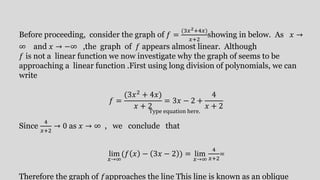
Before proceeding, consider the graph of 𝑓 =
(3𝑥2+4𝑥)
𝑥+2
showing in below. As 𝑥 →
∞ and 𝑥 → −∞ ,the graph of 𝑓 appears almost linear. Although
𝑓 is not a linear function we now investigate why the graph of seems to be
approaching a linear function .First using long division of polynomials, we can
write
𝑓 =
(3𝑥2 + 4𝑥)
𝑥 + 2
= 3𝑥 − 2 +
4
𝑥 + 2
Since
4
𝑥+2
→ 0 as 𝑥 → ∞ , we conclude that
lim
𝑥→∞
(𝑓 𝑥 − 3𝑥 − 2 ) = lim
𝑥→∞
4
𝑥+2
=
Therefore the graph of 𝑓approaches the line This line is known as an oblique
Type equation here.
HorizontalAsymptote
Inparticular,ifk=0,weobtaina horizontalasymptote,whichisdescribedby theequation𝑦 = b.Thetheoremon necessaryandsufficientconditionsfortheexistenceofahorizontalasymptoteis
statedasfollows:
A straightline 𝑦 = b isanasymptoteofa function 𝑦 = 𝑓(𝑥)as 𝑥 → ∞,ifandonlyifthefollowinglimitisfinite:
Thecase 𝑥 → −∞isconsidered
inthesameway.

Asymptotes.pptx

  • 1.
  • 2.
    INTRODUCTION Anasymptote of acurvey= f(x) that has aninfinite branch is called a line such that the distance between the point (x, f (x)) lyingon the curveand the lineapproaches zeroas the point moves along the branch to infinity. Asymptotes can be vertical, oblique (slant) and horizontal. A horizontal asymptote is often considered as a special case of an oblique asymptote. Asymptotesare useful guides tocomplete the graph of a function. An asymptoteis a line towhich the curve of the function approaches atinfinity or atcertain points of discontinuity.
  • 3.
  • 4.
    WELLSPRING Use for significantO notations Relevant for Algebra: Limits of Functions Useful for graphing rational equations
  • 5.
    WELLSPRING Use this colorpalette when you want a blend of nature-infused hues that highlight the compatibility of the greens and the “health giving” properties of these deliciously subtle and nourishing hues.
  • 6.
    VERTICAL ASYMPTOTE The straightline 𝑥 = 𝑎 is a vertical asymptote ofthe graphofthe function 𝑦 = 𝑓(𝑥) if at least one ofthe following conditions is true: In other words,at least one ofthe one-sided limits at the point 𝑥 = 𝑎 must be equal toinfinity. Avertical asymptote occurs in rational functions at the points when the denominator is zero andthe numerator is not equal tozero (i.e. At the points ofdiscontinuity ofthe second kind ). Remainder:The function f(x) is said tohave a discontinuity ofthe second kind (ora nonremovable oressential discontinuity) at x=a,if at least one of the one-sided limits either does not exist oris infinite.
  • 7.
    Example the graphof thefunction 𝑦 = 1 𝑥 has the vertical asymptote 𝑥 = 𝑎 . Inthis case, both one- sided limits (from the left and from the right) tend to infinity:
  • 8.
    Vertical asymptotesofrationalfunction Example: findverticalasymptotes off(x) =(x+1) / (x2 - 1). Solution: let us factorize andsimplify the given expression: then f(x) =(x+1) /[(x+1) (x - 1) ]=1 /(x- 1). If we dothat, we getx= -1 and x=1 tobe the vas off(x) WARM-UP: FINDVERTICALASYMPTOTEOFF(X)= (3X2)/(X2-5X+6).
  • 9.
    IMPORTANTNOTESON VERTICALASYMPTOTES A functioncan haveanynumberof vertical asymptotes. No polynomial functionhas a vertical asymptote. No exponential function has a vertical asymptote. Every logarithmic functionhas at least one vertical asymptote. .
  • 10.
    Oblique Asymptote The straightline 𝑦 = 𝑘𝑥 + b is called an oblique (slant) asymptote of the graph of the function 𝑦 = 𝑓(𝑥)as 𝑥 → ∞ if Similarly, we introduce oblique asymptotes as 𝑥 → −∞ . The oblique asymptotes of the graph of the function 𝑦 = 𝑓(𝑥) may be different as 𝑥 → ∞ and 𝑥 → −∞ . Therefore, when finding oblique (or horizontal) asymptotes, it is a good practice to compute them separately. The coefficients 𝑘 and b of an oblique asymptote 𝑦 = 𝑘𝑥 + b are defined by the following theorem: A straight line 𝑦 = 𝑘𝑥 + b is an asymptote of a function 𝑦 = 𝑓(𝑥) as 𝑥 → ∞ if and only if the following two limits are finite:
  • 11.
    Before proceeding, considerthe graph of 𝑓 = (3𝑥2+4𝑥) 𝑥+2 showing in below. As 𝑥 → ∞ and 𝑥 → −∞ ,the graph of 𝑓 appears almost linear. Although 𝑓 is not a linear function we now investigate why the graph of seems to be approaching a linear function .First using long division of polynomials, we can write 𝑓 = (3𝑥2 + 4𝑥) 𝑥 + 2 = 3𝑥 − 2 + 4 𝑥 + 2 Since 4 𝑥+2 → 0 as 𝑥 → ∞ , we conclude that lim 𝑥→∞ (𝑓 𝑥 − 3𝑥 − 2 ) = lim 𝑥→∞ 4 𝑥+2 = Therefore the graph of 𝑓approaches the line This line is known as an oblique Type equation here.
  • 14.
    HorizontalAsymptote Inparticular,ifk=0,weobtaina horizontalasymptote,whichisdescribedby theequation𝑦= b.Thetheoremon necessaryandsufficientconditionsfortheexistenceofahorizontalasymptoteis statedasfollows: A straightline 𝑦 = b isanasymptoteofa function 𝑦 = 𝑓(𝑥)as 𝑥 → ∞,ifandonlyifthefollowinglimitisfinite: Thecase 𝑥 → −∞isconsidered inthesameway.