RESEARCH TITLE :  APPLICATION OF WORK STUDY CONCEPTS IN APPAREL MANUFACTURING RESEARCH ASSOCIATES IQBAL AHMED – BS in Industrial Engineering NIRANJAN K. H – BS in Industrial Engineering Dr. Ambedkar Institute of Technology Bangalore University BALAJI B JAGANNATH Head Of Industrial Engineering Bombay Rayon Fashion Limited CONDUCTED AT BOMBAY RAYON FASHIONS LIMITED(UNIT-1)  BANGALORE
OBJECTIVE OF THE PROJECT WORK TO IMPLEMENT WORKSTUDY CHARTS TO OBTAIN MAXIMUM UTILIZATION OF THE RESOURCES(MAN, MACHINE AND MATERIALS) AND TO OPTIMIZE WORKPLACE BY CHANGING THE PLANT LAYOUT AND WORKSTATION, USING THE PROCESS CHARTS.
ROLE OF INDUSTRIAL ENGINEERING DEPARTMENT IN APPAREL INDUSTRY. Importance of Industrial Engineering (IE) tools that can be used to  improve upon the productivity  of their factories and thus  enhance the profits ! Very few companies have been operating with a full-fledged industrial engineering department and even those which boast of an Industrial Engineering Department (IED) in their factories are not allowing ample freedom and scope to function to its full capabilities. The role of IED is important for the garment industry for the following two reasons: It’s a highly labor-intensive industry.   Effective planning is emerging as one of the  key factors for the garment manufacturing  industry.
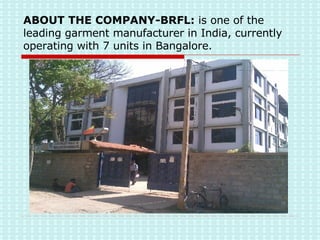
ABOUT THE COMPANY-BRFL:  is one of the leading garment manufacturer in India, currently operating with 7 units in Bangalore.
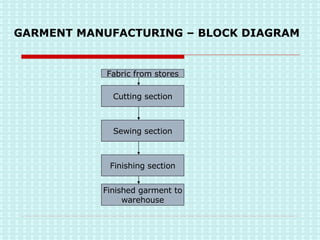
GARMENT MANUFACTURING – BLOCK DIAGRAM Fabric from stores Cutting section Sewing section Finishing section Finished garment to warehouse
TOPICS COVERED DURING THE PROJECT WORK   Plant Layout And Work Station Design Work Study Concepts
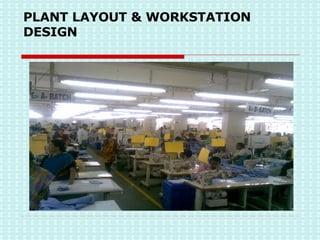
PLANT LAYOUT & WORKSTATION DESIGN
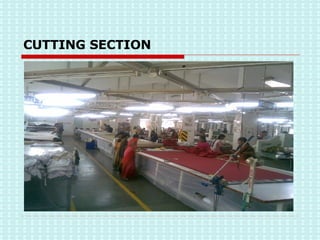
CUTTING SECTION
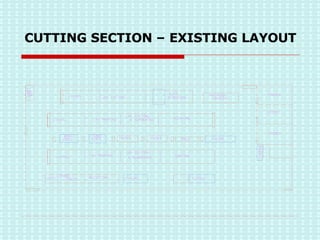
CUTTING SECTION – EXISTING LAYOUT
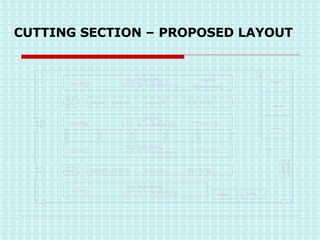
CUTTING SECTION – PROPOSED LAYOUT
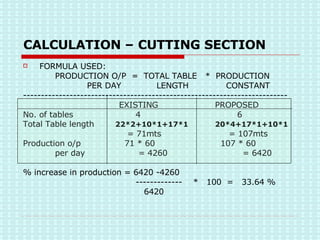
CALCULATION – CUTTING SECTION FORMULA USED: PRODUCTION O/P  =  TOTAL TABLE  *  PRODUCTION PER DAY   LENGTH   CONSTANT -------------------------------------------------------------------------- EXISTING   PROPOSED No. of tables   4   6 Total Table length  22*2+10*1+17*1 20*4+17*1+10*1   = 71mts   = 107mts Production o/p    71 * 60   107 * 60 per day   = 4260   = 6420 % increase in production = 6420 -4260   -------------  *  100  =  33.64 %   6420
COMPARISION  B/W EXISTING & PROPOSED CUTTING SECTION LAYOUT EXISTING Lesser space utilization Operations not arranged in sequence. Bottle-necks occurs Production is less Too much of material movement & handling   PROPOSED Maximum space utilization Operations are arranged in sequence. Bottle-necks avoided Higher production achieved Minimized material movement & handling
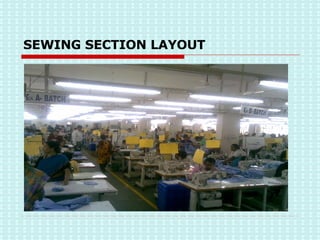
SEWING SECTION LAYOUT
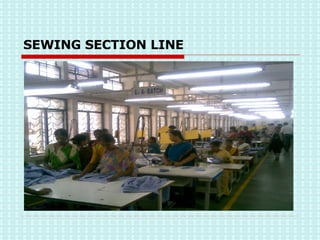
SEWING SECTION LINE
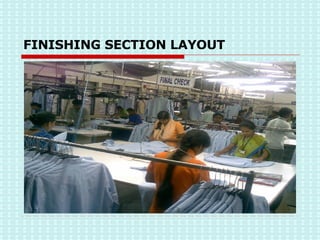
FINISHING SECTION LAYOUT
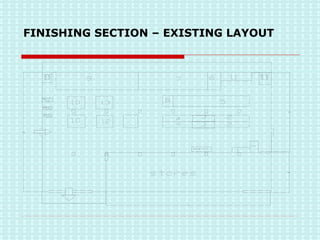
FINISHING SECTION – EXISTING LAYOUT
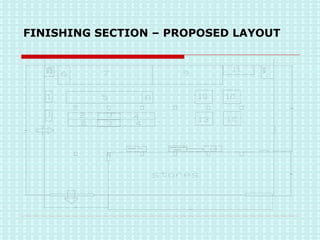
FINISHING SECTION – PROPOSED LAYOUT
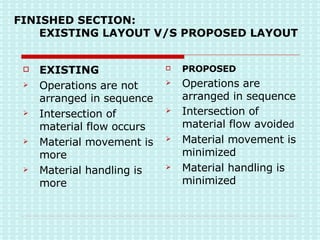
FINISHED SECTION:   EXISTING LAYOUT V/S PROPOSED LAYOUT    EXISTING Operations are not arranged in sequence Intersection of material flow occurs Material movement is more Material handling is more PROPOSED Operations are arranged in sequence Intersection of material flow avoide d Material movement is minimized Material handling is minimized
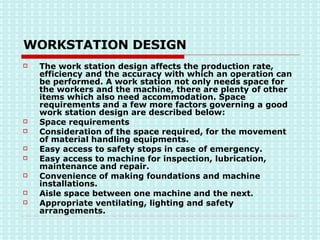
WORKSTATION DESIGN The work station design affects the production rate, efficiency and the accuracy with which an operation can be performed. A work station not only needs space for the workers and the machine, there are plenty of other items which also need accommodation. Space requirements and a few more factors governing a good work station design are described below: Space requirements Consideration of the space required, for the movement of material handling equipments. Easy access to safety stops in case of emergency. Easy access to machine for inspection, lubrication, maintenance and repair. Convenience of making foundations and machine installations. Aisle space between one machine and the next. Appropriate ventilating, lighting and safety arrangements.
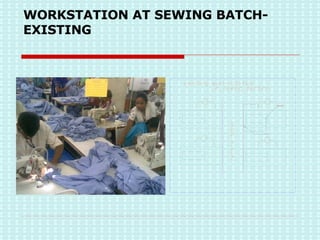
WORKSTATION AT SEWING BATCH- EXISTING
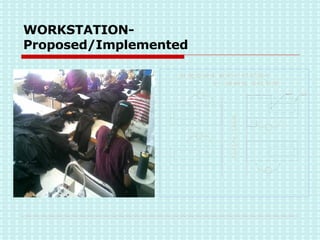
WORKSTATION- Proposed/Implemented
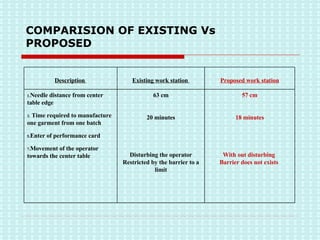
COMPARISION OF EXISTING Vs PROPOSED  57 cm 18 minutes With out disturbing  Barrier does not exists  63 cm 20 minutes Disturbing the operator Restricted by the barrier to a limit Needle distance from center table edge Time required to manufacture one garment from one batch  Enter of performance card Movement of the operator towards the center table Proposed work station Existing work station  Description
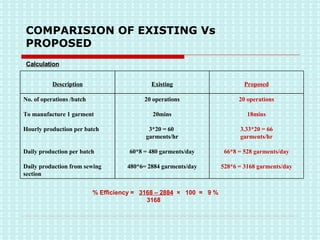
COMPARISION OF EXISTING Vs PROPOSED  Calculation % Efficiency =  3168 – 2884   ×  100  =  9 %   3168 20 operations 18mins 3.33*20 = 66 garments/hr 66*8 = 528 garments/day 528*6 = 3168 garments/day 20 operations 20mins 3*20 = 60  garments/hr 60*8 = 480 garments/day 480*6= 2884 garments/day No. of operations /batch To manufacture 1 garment Hourly production per batch Daily production per batch Daily production from sewing section Proposed Existing Description
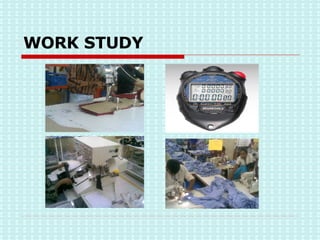
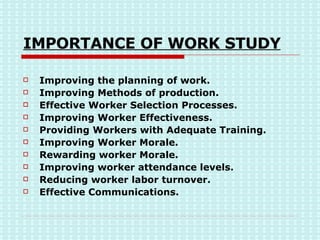
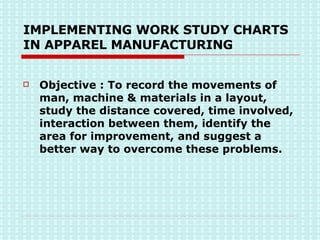
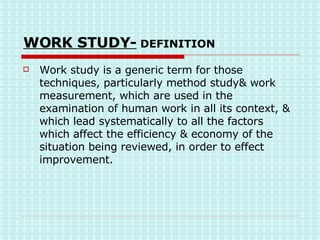
WORK STUDY
IMPORTANCE OF WORK STUDY Improving the planning of work. Improving Methods of production. Effective Worker Selection Processes. Improving Worker Effectiveness. Providing Workers with Adequate Training. Improving Worker Morale. Rewarding worker Morale. Improving worker attendance levels. Reducing worker labor turnover. Effective Communications.
IMPLEMENTING WORK STUDY CHARTS IN APPAREL MANUFACTURING Objective : To record the movements of man, machine & materials in a layout, study the distance covered, time involved, interaction between them, identify the area for improvement, and suggest a better way to overcome these problems.
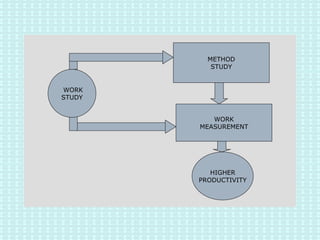
WORK STUDY-   DEFINITION Work study is a generic term for those techniques, particularly method study& work measurement, which are used in the examination of human work in all its context, & which lead systematically to all the factors which affect the efficiency & economy of the situation being reviewed, in order to effect improvement.
METHOD STUDY WORK MEASUREMENT HIGHER PRODUCTIVITY WORK STUDY
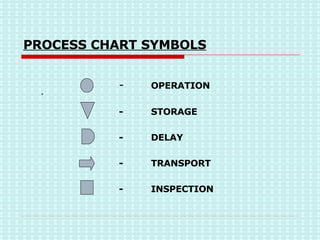
PROCESS CHART SYMBOLS - OPERATION - STORAGE - DELAY - TRANSPORT - INSPECTION
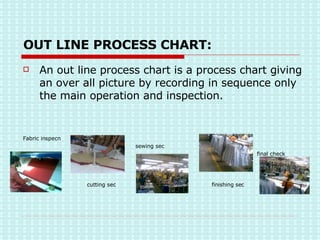
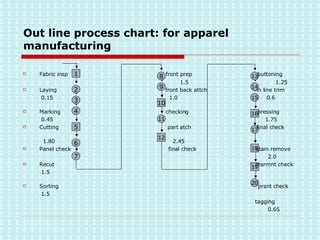
OUT LINE PROCESS CHART: An out line process chart is a process chart giving an over all picture by recording in sequence only the main operation and inspection. Fabric inspecn sewing sec  final check cutting sec  finishing sec
Out line process chart: for apparel manufacturing Fabric insp  front prep  buttoning 1.5  1.25 Laying  front back attch  in line trim 0.15  1.0  0.6  Marking  checking  pressing 0.45  1.75 Cutting  part atch  final check  1.80  2.45  Panel check  final check  stain remove 2.0 Recut  msrmnt check  1.5  Sorting  prsnt check  1.5  tagging 0.65  1 2 3 4 5 6 7 8 9 10 11 12 13 14 15 16 17 19 20 18
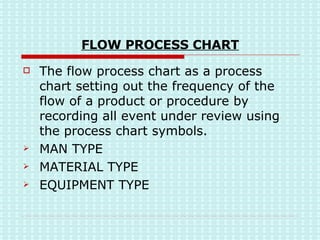
FLOW PROCESS CHART The flow process chart as a process chart setting out the frequency of the flow of a product or procedure by recording all event under review using the process chart symbols.  MAN TYPE MATERIAL TYPE EQUIPMENT TYPE
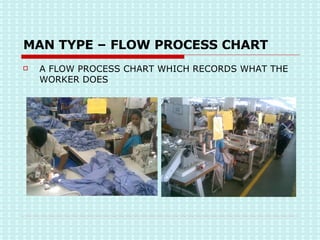
MAN TYPE – FLOW PROCESS CHART A FLOW PROCESS CHART WHICH RECORDS WHAT THE WORKER DOES
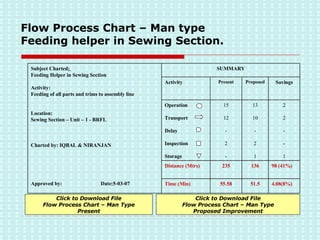
Flow Process Chart – Man type Feeding helper in Sewing Section. Click to Download File Flow Process Chart – Man Type Present Click to Download File Flow Process Chart – Man Type Proposed Improvement 4.08(8%) 51.5 55.58 Time (Min) 98 (41%) 136 235 Distance (Mtrs) 2 2 - - 1 13 10 - 2 1 15 12 - 2 - Operation Transport Delay Inspection Storage Savings Proposed Present Activity SUMMARY Subject Charted :  Feeding Helper in Sewing Section Activity:  Feeding of all parts and trims to assembly line Location:  Sewing Section – Unit – 1 - BRFL Charted by: IQBAL & NIRANJAN Approved by:  Date:5-03-07
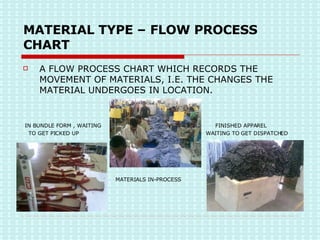
MATERIAL TYPE – FLOW PROCESS CHART A FLOW PROCESS CHART WHICH RECORDS THE MOVEMENT OF MATERIALS, I.E. THE CHANGES THE MATERIAL UNDERGOES IN LOCATION. IN BUNDLE FORM , WAITING  FINISHED APPAREL  TO GET PICKED UP  WAITING TO GET DISPATCHED MATERIALS IN-PROCESS
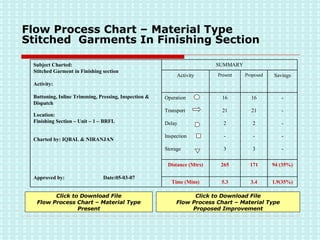
Flow Process Chart – Material Type  Stitched  Garments In Finishing Section Click to Download File Flow Process Chart – Material Type Present Click to Download File Flow Process Chart – Material Type Proposed Improvement 1.9(35%) 3.4 5.3 Time (Mins) 94 (35%) 171 265 Distance (Mtrs) - - - - - 16 21 2 - 3 16 21 2 - 3 Operation Transport Delay Inspection Storage Savings Proposed Present Activity SUMMARY Subject Charted:  Stitched Garment in Finishing section  Activity: Buttoning, Inline Trimming, Pressing, Inspection & Dispatch Location:  Finishing Section – Unit – 1 – BRFL Charted by: IQBAL & NIRANJAN Approved by:  Date:05-03-07
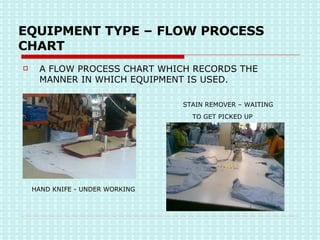
EQUIPMENT TYPE – FLOW PROCESS CHART A FLOW PROCESS CHART WHICH RECORDS THE MANNER IN WHICH EQUIPMENT IS USED. STAIN REMOVER – WAITING    TO GET PICKED UP HAND KNIFE - UNDER WORKING
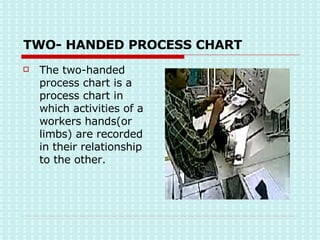
TWO- HANDED PROCESS CHART The two-handed process chart is a process chart in which activities of a workers hands(or limbs) are recorded in their relationship to the other.
MULTIPLE ACTIVITY CHART Is useful recording tool for situations where the work involves interactions of different subjects. One or more workers looking after different machines or a group of workers working on loading materials at one point.
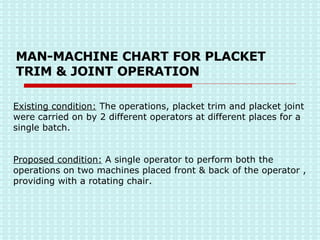
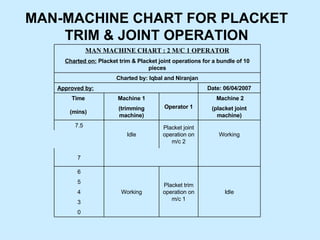
MAN-MACHINE CHART FOR PLACKET TRIM & JOINT OPERATION Existing condition:  The operations, placket trim and placket joint were carried on by 2 different operators at different places for a single batch. Proposed condition:  A single operator to perform both the operations on two machines placed front & back of the operator , providing with a rotating chair.
MAN-MACHINE CHART FOR PLACKET TRIM & JOINT OPERATION 0 3 4 5 Idle Placket trim operation on m/c 1 Working 6 7 Working Placket joint operation on m/c 2 Idle 7.5 (placket joint machine) (trimming machine) (mins)    Machine 2 Operator 1 Machine 1 Time  Date: 06/04/2007 Approved by: Charted by: Iqbal and Niranjan Charted on:  Placket trim & Placket joint operations for a bundle of 10 pieces MAN MACHINE CHART : 2 M/C 1 OPERATOR
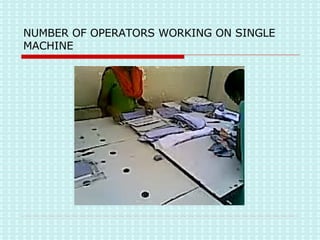
NUMBER OF OPERATORS WORKING ON SINGLE MACHINE
CONCLUSION WITH THE APPLICATION OF WORK STUDY CHARTS IN APPAREL MANUFACTURING, THE EFFECTIVE UTILIZATION OF RESOURCES ( MAN, MATERIAL & MACHINES) CAN BE ACHIEVED. THE COST INVOLVED IN USING THESE CHARTS ARE VERY MINIMUM AND A SOLUTION CAN BE DERIVED IN A SHORT PERIOD OF TIME.
THANK  YOU -----------------

Application Of Workstudy

  • 1.
    RESEARCH TITLE : APPLICATION OF WORK STUDY CONCEPTS IN APPAREL MANUFACTURING RESEARCH ASSOCIATES IQBAL AHMED – BS in Industrial Engineering NIRANJAN K. H – BS in Industrial Engineering Dr. Ambedkar Institute of Technology Bangalore University BALAJI B JAGANNATH Head Of Industrial Engineering Bombay Rayon Fashion Limited CONDUCTED AT BOMBAY RAYON FASHIONS LIMITED(UNIT-1) BANGALORE
  • 2.
    OBJECTIVE OF THEPROJECT WORK TO IMPLEMENT WORKSTUDY CHARTS TO OBTAIN MAXIMUM UTILIZATION OF THE RESOURCES(MAN, MACHINE AND MATERIALS) AND TO OPTIMIZE WORKPLACE BY CHANGING THE PLANT LAYOUT AND WORKSTATION, USING THE PROCESS CHARTS.
  • 3.
    ROLE OF INDUSTRIALENGINEERING DEPARTMENT IN APPAREL INDUSTRY. Importance of Industrial Engineering (IE) tools that can be used to improve upon the productivity of their factories and thus enhance the profits ! Very few companies have been operating with a full-fledged industrial engineering department and even those which boast of an Industrial Engineering Department (IED) in their factories are not allowing ample freedom and scope to function to its full capabilities. The role of IED is important for the garment industry for the following two reasons: It’s a highly labor-intensive industry. Effective planning is emerging as one of the key factors for the garment manufacturing industry.
  • 4.
    ABOUT THE COMPANY-BRFL: is one of the leading garment manufacturer in India, currently operating with 7 units in Bangalore.
  • 5.
    GARMENT MANUFACTURING –BLOCK DIAGRAM Fabric from stores Cutting section Sewing section Finishing section Finished garment to warehouse
  • 6.
    TOPICS COVERED DURINGTHE PROJECT WORK Plant Layout And Work Station Design Work Study Concepts
  • 7.
    PLANT LAYOUT &WORKSTATION DESIGN
  • 8.
  • 9.
    CUTTING SECTION –EXISTING LAYOUT
  • 10.
    CUTTING SECTION –PROPOSED LAYOUT
  • 11.
    CALCULATION – CUTTINGSECTION FORMULA USED: PRODUCTION O/P = TOTAL TABLE * PRODUCTION PER DAY LENGTH CONSTANT -------------------------------------------------------------------------- EXISTING PROPOSED No. of tables 4 6 Total Table length 22*2+10*1+17*1 20*4+17*1+10*1 = 71mts = 107mts Production o/p 71 * 60 107 * 60 per day = 4260 = 6420 % increase in production = 6420 -4260 ------------- * 100 = 33.64 % 6420
  • 12.
    COMPARISION B/WEXISTING & PROPOSED CUTTING SECTION LAYOUT EXISTING Lesser space utilization Operations not arranged in sequence. Bottle-necks occurs Production is less Too much of material movement & handling PROPOSED Maximum space utilization Operations are arranged in sequence. Bottle-necks avoided Higher production achieved Minimized material movement & handling
  • 13.
  • 14.
  • 15.
  • 16.
    FINISHING SECTION –EXISTING LAYOUT
  • 17.
    FINISHING SECTION –PROPOSED LAYOUT
  • 18.
    FINISHED SECTION: EXISTING LAYOUT V/S PROPOSED LAYOUT EXISTING Operations are not arranged in sequence Intersection of material flow occurs Material movement is more Material handling is more PROPOSED Operations are arranged in sequence Intersection of material flow avoide d Material movement is minimized Material handling is minimized
  • 19.
    WORKSTATION DESIGN Thework station design affects the production rate, efficiency and the accuracy with which an operation can be performed. A work station not only needs space for the workers and the machine, there are plenty of other items which also need accommodation. Space requirements and a few more factors governing a good work station design are described below: Space requirements Consideration of the space required, for the movement of material handling equipments. Easy access to safety stops in case of emergency. Easy access to machine for inspection, lubrication, maintenance and repair. Convenience of making foundations and machine installations. Aisle space between one machine and the next. Appropriate ventilating, lighting and safety arrangements.
  • 20.
    WORKSTATION AT SEWINGBATCH- EXISTING
  • 21.
  • 22.
    COMPARISION OF EXISTINGVs PROPOSED 57 cm 18 minutes With out disturbing Barrier does not exists 63 cm 20 minutes Disturbing the operator Restricted by the barrier to a limit Needle distance from center table edge Time required to manufacture one garment from one batch Enter of performance card Movement of the operator towards the center table Proposed work station Existing work station Description
  • 23.
    COMPARISION OF EXISTINGVs PROPOSED Calculation % Efficiency = 3168 – 2884 × 100 = 9 % 3168 20 operations 18mins 3.33*20 = 66 garments/hr 66*8 = 528 garments/day 528*6 = 3168 garments/day 20 operations 20mins 3*20 = 60 garments/hr 60*8 = 480 garments/day 480*6= 2884 garments/day No. of operations /batch To manufacture 1 garment Hourly production per batch Daily production per batch Daily production from sewing section Proposed Existing Description
  • 24.
  • 25.
    IMPORTANCE OF WORKSTUDY Improving the planning of work. Improving Methods of production. Effective Worker Selection Processes. Improving Worker Effectiveness. Providing Workers with Adequate Training. Improving Worker Morale. Rewarding worker Morale. Improving worker attendance levels. Reducing worker labor turnover. Effective Communications.
  • 26.
    IMPLEMENTING WORK STUDYCHARTS IN APPAREL MANUFACTURING Objective : To record the movements of man, machine & materials in a layout, study the distance covered, time involved, interaction between them, identify the area for improvement, and suggest a better way to overcome these problems.
  • 27.
    WORK STUDY- DEFINITION Work study is a generic term for those techniques, particularly method study& work measurement, which are used in the examination of human work in all its context, & which lead systematically to all the factors which affect the efficiency & economy of the situation being reviewed, in order to effect improvement.
  • 28.
    METHOD STUDY WORKMEASUREMENT HIGHER PRODUCTIVITY WORK STUDY
  • 29.
    PROCESS CHART SYMBOLS- OPERATION - STORAGE - DELAY - TRANSPORT - INSPECTION
  • 30.
    OUT LINE PROCESSCHART: An out line process chart is a process chart giving an over all picture by recording in sequence only the main operation and inspection. Fabric inspecn sewing sec final check cutting sec finishing sec
  • 31.
    Out line processchart: for apparel manufacturing Fabric insp front prep buttoning 1.5 1.25 Laying front back attch in line trim 0.15 1.0 0.6 Marking checking pressing 0.45 1.75 Cutting part atch final check 1.80 2.45 Panel check final check stain remove 2.0 Recut msrmnt check 1.5 Sorting prsnt check 1.5 tagging 0.65 1 2 3 4 5 6 7 8 9 10 11 12 13 14 15 16 17 19 20 18
  • 32.
    FLOW PROCESS CHARTThe flow process chart as a process chart setting out the frequency of the flow of a product or procedure by recording all event under review using the process chart symbols. MAN TYPE MATERIAL TYPE EQUIPMENT TYPE
  • 33.
    MAN TYPE –FLOW PROCESS CHART A FLOW PROCESS CHART WHICH RECORDS WHAT THE WORKER DOES
  • 34.
    Flow Process Chart– Man type Feeding helper in Sewing Section. Click to Download File Flow Process Chart – Man Type Present Click to Download File Flow Process Chart – Man Type Proposed Improvement 4.08(8%) 51.5 55.58 Time (Min) 98 (41%) 136 235 Distance (Mtrs) 2 2 - - 1 13 10 - 2 1 15 12 - 2 - Operation Transport Delay Inspection Storage Savings Proposed Present Activity SUMMARY Subject Charted : Feeding Helper in Sewing Section Activity: Feeding of all parts and trims to assembly line Location: Sewing Section – Unit – 1 - BRFL Charted by: IQBAL & NIRANJAN Approved by: Date:5-03-07
  • 35.
    MATERIAL TYPE –FLOW PROCESS CHART A FLOW PROCESS CHART WHICH RECORDS THE MOVEMENT OF MATERIALS, I.E. THE CHANGES THE MATERIAL UNDERGOES IN LOCATION. IN BUNDLE FORM , WAITING FINISHED APPAREL TO GET PICKED UP WAITING TO GET DISPATCHED MATERIALS IN-PROCESS
  • 36.
    Flow Process Chart– Material Type Stitched Garments In Finishing Section Click to Download File Flow Process Chart – Material Type Present Click to Download File Flow Process Chart – Material Type Proposed Improvement 1.9(35%) 3.4 5.3 Time (Mins) 94 (35%) 171 265 Distance (Mtrs) - - - - - 16 21 2 - 3 16 21 2 - 3 Operation Transport Delay Inspection Storage Savings Proposed Present Activity SUMMARY Subject Charted: Stitched Garment in Finishing section Activity: Buttoning, Inline Trimming, Pressing, Inspection & Dispatch Location: Finishing Section – Unit – 1 – BRFL Charted by: IQBAL & NIRANJAN Approved by: Date:05-03-07
  • 37.
    EQUIPMENT TYPE –FLOW PROCESS CHART A FLOW PROCESS CHART WHICH RECORDS THE MANNER IN WHICH EQUIPMENT IS USED. STAIN REMOVER – WAITING TO GET PICKED UP HAND KNIFE - UNDER WORKING
  • 38.
    TWO- HANDED PROCESSCHART The two-handed process chart is a process chart in which activities of a workers hands(or limbs) are recorded in their relationship to the other.
  • 39.
    MULTIPLE ACTIVITY CHARTIs useful recording tool for situations where the work involves interactions of different subjects. One or more workers looking after different machines or a group of workers working on loading materials at one point.
  • 40.
    MAN-MACHINE CHART FORPLACKET TRIM & JOINT OPERATION Existing condition: The operations, placket trim and placket joint were carried on by 2 different operators at different places for a single batch. Proposed condition: A single operator to perform both the operations on two machines placed front & back of the operator , providing with a rotating chair.
  • 41.
    MAN-MACHINE CHART FORPLACKET TRIM & JOINT OPERATION 0 3 4 5 Idle Placket trim operation on m/c 1 Working 6 7 Working Placket joint operation on m/c 2 Idle 7.5 (placket joint machine) (trimming machine) (mins)    Machine 2 Operator 1 Machine 1 Time Date: 06/04/2007 Approved by: Charted by: Iqbal and Niranjan Charted on: Placket trim & Placket joint operations for a bundle of 10 pieces MAN MACHINE CHART : 2 M/C 1 OPERATOR
  • 42.
    NUMBER OF OPERATORSWORKING ON SINGLE MACHINE
  • 43.
    CONCLUSION WITH THEAPPLICATION OF WORK STUDY CHARTS IN APPAREL MANUFACTURING, THE EFFECTIVE UTILIZATION OF RESOURCES ( MAN, MATERIAL & MACHINES) CAN BE ACHIEVED. THE COST INVOLVED IN USING THESE CHARTS ARE VERY MINIMUM AND A SOLUTION CAN BE DERIVED IN A SHORT PERIOD OF TIME.
  • 44.
    THANK YOU-----------------