Production Flow
steering on
COTTON TO
GARMENTS
PRODUCTION
MOHAMMAD SHAHADAT HOSAIN
Mohammad Shahadat Hosain
MOHAMMAD SHAHADAT HOSAIN
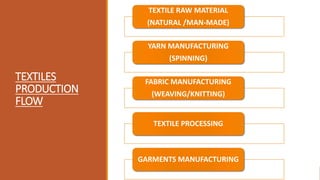
TEXTILES
PRODUCTION
FLOW
TEXTILE RAW MATERIAL
(NATURAL /MAN-MADE)
YARN MANUFACTURING
(SPINNING)
FABRIC MANUFACTURING
(WEAVING/KNITTING)
TEXTILE PROCESSING
GARMENTS MANUFACTURING
MOHAMMAD SHAHADAT HOSAIN
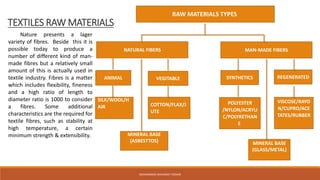
TEXTILES RAW MATERIALS
RAW MATERIALS TYPES
NATURAL FIBERS MAN-MADE FIBERS
ANIMAL VEGITABLE
SILK/WOOL/H
AIR COTTON/FLAX/J
UTE
MINERAL BASE
(ASBESTTOS)
SYNTHETICS REGENERATED
POLYESTER
/NYLON/ACRYLI
C/POLYRETHAN
E
VISCOSE/RAYO
N/CUPRO/ACE
TATES/RUBBER
MINERAL BASE
(GLASS/METAL)
Nature presents a lager
variety of fibres. Beside this it is
possible today to produce a
number of different kind of man-
made fibres but a relatively small
amount of this is actually used in
textile industry. Fibres is a matter
which includes flexibility, fineness
and a high ratio of length to
diameter ratio is 1000 to consider
a fibres. Some additional
characteristics are the required for
textile fibres, such as stability at
high temperature, a certain
minimum strength & extensibility.
MOHAMMAD SHAHADAT HOSAIN
YARN MANUFACTURING PROCESS BLOWROOM
CARDING
DRAWING
ROVING
RING FRAME
COMBING
MOHAMMAD SHAHADAT HOSAIN
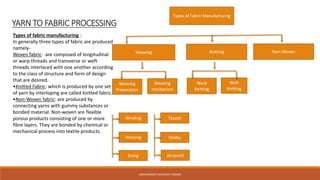
YARN TO FABRIC PROCESSING
Types of Fabric Manufacturing
Weaving Knitting Non-Woven
Weaving
Preparation
Weaving
mechanism
Warp
knitting
Weft
Knitting
Winding
Warping
Sizing
Tappet
Dobby
Jacquard
Types of fabric manufacturing :
In generally three types of fabric are produced
namely-
Woven fabric: are composed of longitudinal
or warp threads and transverse or weft
threads interlaced with one another according
to the class of structure and form of design
that are desired.
•Knitted Fabric: which is produced by one set
of yarn by interloping are called knitted fabric.
•Non-Woven fabric: are produced by
connecting yarns with gummy substances or
bonded material. Non-woven are flexible
porous products consisting of one or more
fibre layers. They are bonded by chemical or
mechanical process into textile products.
MOHAMMAD SHAHADAT HOSAIN
FLOW OF WEAVING
Pirn WindingTying-in
MOHAMMAD SHAHADAT HOSAIN
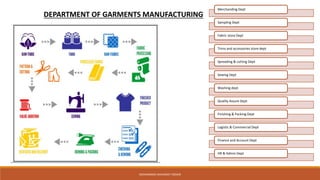
DEPARTMENT OF GARMENTS MANUFACTURING
Merchanding Dept
Sampling Dept
Fabric store Dept
Trims and accessories store dept
Spreading & cutting Dept
Sewing Dept
Washing dept
Quality Assure Dept
Finishing & Packing Dept
Logistic & Commercial Dept
Finance and Account Dept
HR & Admin Dept
MOHAMMAD SHAHADAT HOSAIN
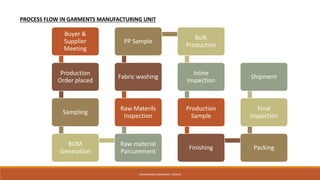
PROCESS FLOW IN GARMENTS MANUFACTURING UNIT
Buyer &
Supplier
Meeting
Production
Order placed
Sampling
BOM
Generation
Raw material
Parcurement
Raw Materils
Inspection
Fabric washing
PP Sample
Bulk
Production
Inline
Inspection
Production
Sample
Finishing Packing
Final
Inspection
Shipment
MOHAMMAD SHAHADAT HOSAIN
APPROVAL FLOW CHART
Customer Technical Dept
Receive Tack Pack
Sample
Section
Pass
Not
Pass
Not
Approve
d
Quality CheckProto / PP sample
Remake
Sample Submission for approval
If
Missing
If Not
Check Teck
Pack
Start Customer Order
Sample
Evaluation
Approved
Flow chart for Sample
Approval
There are lost of
circumstance to
placement an order to
any supplier. However
After select a supplier
they have to get
sample approval from
customer technical
department. The flow
chart are providing
information how the
supplier get the
approval from the
customer.
MOHAMMAD SHAHADAT HOSAIN
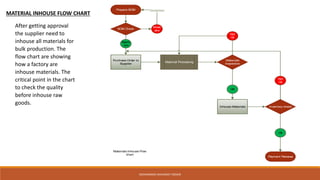
MATERIAL INHOUSE FLOW CHART
Purchase Order to
Supplier
Inhouse Materials
Materials
Inspection
BOM Check
Prepare BOM
Misst
ake
Correction
Appro
ved
Inventory check
Not
Ok
Material Processing
OK
Not
Ok
Ok
Payment Release
Materials Inhouse Flow
chart
After getting approval
the supplier need to
inhouse all materials for
bulk production. The
flow chart are showing
how a factory are
inhouse materials. The
critical point in the chart
to check the quality
before inhouse raw
goods.
MOHAMMAD SHAHADAT HOSAIN
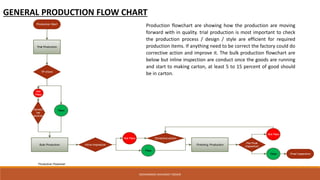
GENERAL PRODUCTION FLOW CHART
Pass
Not
Pass
Inline Inspection
Production Start
Trial Production
TP check
Correct
ive
acction
Bulk Production
Pass
Not Pass
Pre Final
Inspection
Corrective action
Finishing Production
Pass
Not Pass
Final Inspection
Production Flowchart
Production flowchart are showing how the production are moving
forward with in quality. trial production is most important to check
the production process / design / style are efficient for required
production items. If anything need to be correct the factory could do
corrective action and improve it. The bulk production flowchart are
below but inline inspection are conduct once the goods are running
and start to making carton, at least 5 to 15 percent of good should
be in carton.
MOHAMMAD SHAHADAT HOSAIN
BULK PRODUCTION FLOW CHART
Fabric Received in
cutting
Fabric Spreading Fabric Marking
Bulk Production
Fabric
Inspection
Pass
Not Pass
Fabric CuttingFabric BundingPrint/ Embrodery
Sewing Process
Fabric Bundle check
& correction
Print/ Embroidery
Quality check
Pass
Not
Pass
Sewing Input
Line Quality
check
Pass
Not
Pass
Sewing Output
Output
Inspection
Pass
Not
Pass
Corrective
Action
Finishing InputThread Sucking
Needle Checking Ironing
Measurement
Check
Pass
Not
Pass
Attach Hangtag,
Folding & Making
Poly
Making CartonFinal InspectionReady for shipment
Pass
Not
Pass
Corrective
Action
Corrective
Action
Corrective
Action
Corrective
Action
Corrective
Action
Bulk Production Flow chart
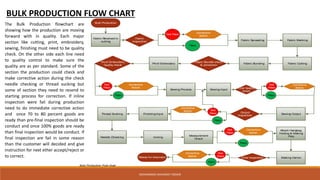
The Bulk Production flowchart are
showing how the production are moving
forward with in quality. Each major
section like cutting, print, embroidery,
sewing, finishing must need to be quality
check. On the other side each line need
to quality control to make sure the
quality are as per standard. Some of the
section the production could check and
make corrective action during the check
needle checking or thread sucking but
some of section they need to resend to
starting process for correction. If inline
inspection were fail during production
need to do immediate corrective action
and once 70 to 80 percent goods are
ready than pre-final inspection should be
conduct and once 100% goods are ready
than final inspection would be conduct. If
final inspection are fail in some reason
than the customer will decided and give
instruction for next ether accept/reject or
to correct.
MOHAMMAD SHAHADAT HOSAIN
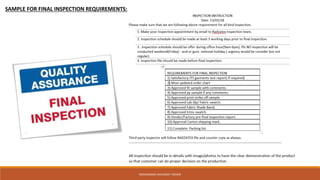
SAMPLE FOR FINAL INSPECTION REQUIREMENTS:
MOHAMMAD SHAHADAT HOSAIN
DESCRIBE & PROPOSITION OF METHOD ( JIT/ MRP/ 6SIGMA / LEAN)
PRODUCTION TO IMPROVEMENT OF RESULT.
JIT (JUST IN TIME): JIT concept is very much are
effect in this production process. If some materials
are not arrive in time then production will hamper,
some time its also effect on quality. For instance
shading, ratio of mistake will be increase as well as
process will be loss. Hence production need to
conduct strong follow up everything are control
and in time. There are couple of tools are used to
make efficient follow-up Like TAC(time action
calendar).
MATERIAL REQUIREMENTS PLANNING (MRP): in
terms of required quality & quantity assurance
MRP are useful as well as required shipment date.
Gantt chart is one of best tools for MRP system.
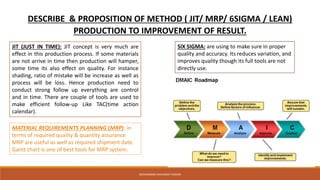
SIX SIGMA: are using to make sure in proper
quality and accuracy. Its reduces variation, and
improves quality though its full tools are not
directly use.
MOHAMMAD SHAHADAT HOSAIN
LEAN: system use for removes waste and increase
SMV / speed of production. This system are removes
non-value added process steps, and fixes connection
between process steps. Lean manufacturing or lean
production often simply ‘’Lean’’, is a systematic
method for the elimination of waste within a
manufacturing system. It also take into account waste
created through overburden and waste created
though unevenness in workloads. The core idea is to
maximize customer value while minimizing waste.
DESCRIBE & PROPOSITION OF METHOD ( JIT/ MRP/ 6SIGMA /
LEAN) PRODUCTION TO IMPROVEMENT OF RESULT.
The Best follow-up for production is OPS-order progress sheet,
TAC-Time action calendar, as well as Gantt chart are more
effective to execute a production. Since JIT, MRP, Six sigma,
Lean are focused in different areas there for so many
companies are using those methodology in specific areas in
certain output.
MOHAMMAD SHAHADAT HOSAIN
SAMPLE OF OPS (ORDER PROGRESS SHEET)
In OPS generally it’s a follow-chart;
mentioning/make note each steps of
production.
MOHAMMAD SHAHADAT HOSAIN
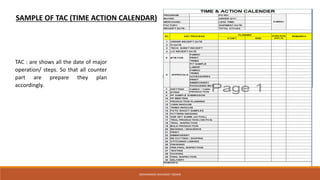
SAMPLE OF TAC (TIME ACTION CALENDAR)
TAC : are shows all the date of major
operation/ steps. So that all counter
part are prepare they plan
accordingly.
MOHAMMAD SHAHADAT HOSAIN
Thanks to all
MOHAMMAD SHAHADAT HOSAIN

Production flow steering

  • 1.
    Production Flow steering on COTTONTO GARMENTS PRODUCTION MOHAMMAD SHAHADAT HOSAIN
  • 2.
  • 3.
    TEXTILES PRODUCTION FLOW TEXTILE RAW MATERIAL (NATURAL/MAN-MADE) YARN MANUFACTURING (SPINNING) FABRIC MANUFACTURING (WEAVING/KNITTING) TEXTILE PROCESSING GARMENTS MANUFACTURING MOHAMMAD SHAHADAT HOSAIN
  • 4.
    TEXTILES RAW MATERIALS RAWMATERIALS TYPES NATURAL FIBERS MAN-MADE FIBERS ANIMAL VEGITABLE SILK/WOOL/H AIR COTTON/FLAX/J UTE MINERAL BASE (ASBESTTOS) SYNTHETICS REGENERATED POLYESTER /NYLON/ACRYLI C/POLYRETHAN E VISCOSE/RAYO N/CUPRO/ACE TATES/RUBBER MINERAL BASE (GLASS/METAL) Nature presents a lager variety of fibres. Beside this it is possible today to produce a number of different kind of man- made fibres but a relatively small amount of this is actually used in textile industry. Fibres is a matter which includes flexibility, fineness and a high ratio of length to diameter ratio is 1000 to consider a fibres. Some additional characteristics are the required for textile fibres, such as stability at high temperature, a certain minimum strength & extensibility. MOHAMMAD SHAHADAT HOSAIN
  • 5.
    YARN MANUFACTURING PROCESSBLOWROOM CARDING DRAWING ROVING RING FRAME COMBING MOHAMMAD SHAHADAT HOSAIN
  • 6.
    YARN TO FABRICPROCESSING Types of Fabric Manufacturing Weaving Knitting Non-Woven Weaving Preparation Weaving mechanism Warp knitting Weft Knitting Winding Warping Sizing Tappet Dobby Jacquard Types of fabric manufacturing : In generally three types of fabric are produced namely- Woven fabric: are composed of longitudinal or warp threads and transverse or weft threads interlaced with one another according to the class of structure and form of design that are desired. •Knitted Fabric: which is produced by one set of yarn by interloping are called knitted fabric. •Non-Woven fabric: are produced by connecting yarns with gummy substances or bonded material. Non-woven are flexible porous products consisting of one or more fibre layers. They are bonded by chemical or mechanical process into textile products. MOHAMMAD SHAHADAT HOSAIN
  • 7.
    FLOW OF WEAVING PirnWindingTying-in MOHAMMAD SHAHADAT HOSAIN
  • 8.
    DEPARTMENT OF GARMENTSMANUFACTURING Merchanding Dept Sampling Dept Fabric store Dept Trims and accessories store dept Spreading & cutting Dept Sewing Dept Washing dept Quality Assure Dept Finishing & Packing Dept Logistic & Commercial Dept Finance and Account Dept HR & Admin Dept MOHAMMAD SHAHADAT HOSAIN
  • 9.
    PROCESS FLOW INGARMENTS MANUFACTURING UNIT Buyer & Supplier Meeting Production Order placed Sampling BOM Generation Raw material Parcurement Raw Materils Inspection Fabric washing PP Sample Bulk Production Inline Inspection Production Sample Finishing Packing Final Inspection Shipment MOHAMMAD SHAHADAT HOSAIN
  • 10.
    APPROVAL FLOW CHART CustomerTechnical Dept Receive Tack Pack Sample Section Pass Not Pass Not Approve d Quality CheckProto / PP sample Remake Sample Submission for approval If Missing If Not Check Teck Pack Start Customer Order Sample Evaluation Approved Flow chart for Sample Approval There are lost of circumstance to placement an order to any supplier. However After select a supplier they have to get sample approval from customer technical department. The flow chart are providing information how the supplier get the approval from the customer. MOHAMMAD SHAHADAT HOSAIN
  • 11.
    MATERIAL INHOUSE FLOWCHART Purchase Order to Supplier Inhouse Materials Materials Inspection BOM Check Prepare BOM Misst ake Correction Appro ved Inventory check Not Ok Material Processing OK Not Ok Ok Payment Release Materials Inhouse Flow chart After getting approval the supplier need to inhouse all materials for bulk production. The flow chart are showing how a factory are inhouse materials. The critical point in the chart to check the quality before inhouse raw goods. MOHAMMAD SHAHADAT HOSAIN
  • 12.
    GENERAL PRODUCTION FLOWCHART Pass Not Pass Inline Inspection Production Start Trial Production TP check Correct ive acction Bulk Production Pass Not Pass Pre Final Inspection Corrective action Finishing Production Pass Not Pass Final Inspection Production Flowchart Production flowchart are showing how the production are moving forward with in quality. trial production is most important to check the production process / design / style are efficient for required production items. If anything need to be correct the factory could do corrective action and improve it. The bulk production flowchart are below but inline inspection are conduct once the goods are running and start to making carton, at least 5 to 15 percent of good should be in carton. MOHAMMAD SHAHADAT HOSAIN
  • 13.
    BULK PRODUCTION FLOWCHART Fabric Received in cutting Fabric Spreading Fabric Marking Bulk Production Fabric Inspection Pass Not Pass Fabric CuttingFabric BundingPrint/ Embrodery Sewing Process Fabric Bundle check & correction Print/ Embroidery Quality check Pass Not Pass Sewing Input Line Quality check Pass Not Pass Sewing Output Output Inspection Pass Not Pass Corrective Action Finishing InputThread Sucking Needle Checking Ironing Measurement Check Pass Not Pass Attach Hangtag, Folding & Making Poly Making CartonFinal InspectionReady for shipment Pass Not Pass Corrective Action Corrective Action Corrective Action Corrective Action Corrective Action Bulk Production Flow chart The Bulk Production flowchart are showing how the production are moving forward with in quality. Each major section like cutting, print, embroidery, sewing, finishing must need to be quality check. On the other side each line need to quality control to make sure the quality are as per standard. Some of the section the production could check and make corrective action during the check needle checking or thread sucking but some of section they need to resend to starting process for correction. If inline inspection were fail during production need to do immediate corrective action and once 70 to 80 percent goods are ready than pre-final inspection should be conduct and once 100% goods are ready than final inspection would be conduct. If final inspection are fail in some reason than the customer will decided and give instruction for next ether accept/reject or to correct. MOHAMMAD SHAHADAT HOSAIN
  • 14.
    SAMPLE FOR FINALINSPECTION REQUIREMENTS: MOHAMMAD SHAHADAT HOSAIN
  • 15.
    DESCRIBE & PROPOSITIONOF METHOD ( JIT/ MRP/ 6SIGMA / LEAN) PRODUCTION TO IMPROVEMENT OF RESULT. JIT (JUST IN TIME): JIT concept is very much are effect in this production process. If some materials are not arrive in time then production will hamper, some time its also effect on quality. For instance shading, ratio of mistake will be increase as well as process will be loss. Hence production need to conduct strong follow up everything are control and in time. There are couple of tools are used to make efficient follow-up Like TAC(time action calendar). MATERIAL REQUIREMENTS PLANNING (MRP): in terms of required quality & quantity assurance MRP are useful as well as required shipment date. Gantt chart is one of best tools for MRP system. SIX SIGMA: are using to make sure in proper quality and accuracy. Its reduces variation, and improves quality though its full tools are not directly use. MOHAMMAD SHAHADAT HOSAIN
  • 16.
    LEAN: system usefor removes waste and increase SMV / speed of production. This system are removes non-value added process steps, and fixes connection between process steps. Lean manufacturing or lean production often simply ‘’Lean’’, is a systematic method for the elimination of waste within a manufacturing system. It also take into account waste created through overburden and waste created though unevenness in workloads. The core idea is to maximize customer value while minimizing waste. DESCRIBE & PROPOSITION OF METHOD ( JIT/ MRP/ 6SIGMA / LEAN) PRODUCTION TO IMPROVEMENT OF RESULT. The Best follow-up for production is OPS-order progress sheet, TAC-Time action calendar, as well as Gantt chart are more effective to execute a production. Since JIT, MRP, Six sigma, Lean are focused in different areas there for so many companies are using those methodology in specific areas in certain output. MOHAMMAD SHAHADAT HOSAIN
  • 17.
    SAMPLE OF OPS(ORDER PROGRESS SHEET) In OPS generally it’s a follow-chart; mentioning/make note each steps of production. MOHAMMAD SHAHADAT HOSAIN
  • 18.
    SAMPLE OF TAC(TIME ACTION CALENDAR) TAC : are shows all the date of major operation/ steps. So that all counter part are prepare they plan accordingly. MOHAMMAD SHAHADAT HOSAIN
  • 19.
    Thanks to all MOHAMMADSHAHADAT HOSAIN