Applications of Geospatial
Systems and Green Economy


MSR Murthy
MENRIS
International Centre for Integrated Mountain Development
Kathmandu, Nepal
Geospatial Systems - Need

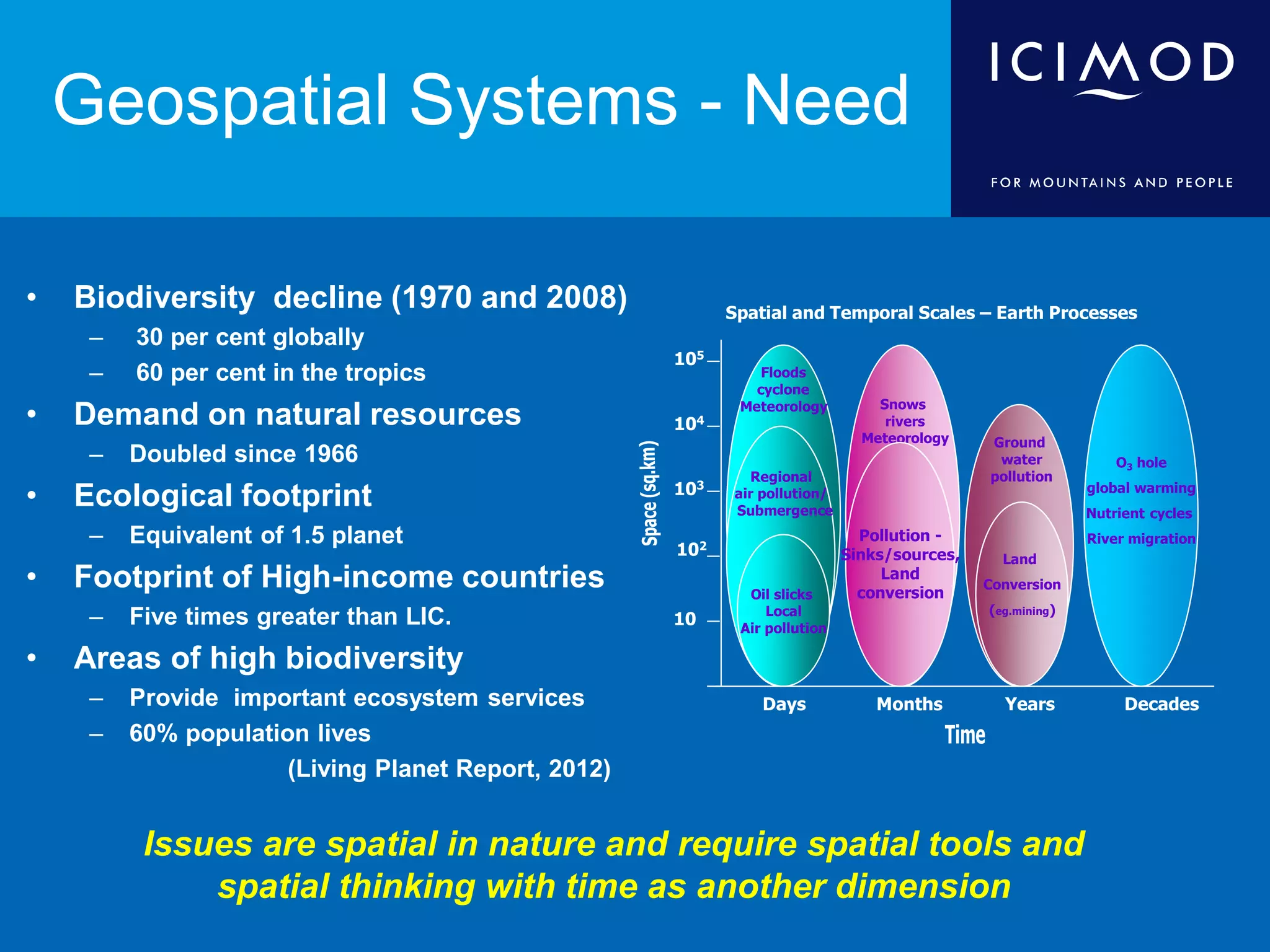
•   Biodiversity decline (1970 and 2008)                   Spatial and Temporal Scales – Earth Processes
     –   30 per cent globally
                                                     105
     –   60 per cent in the tropics                            Floods
                                                              cyclone
                                                                                Snows
•   Demand on natural resources                      104
                                                            Meteorology
                                                                                 rivers
                                                                              Meteorology    Ground
     –   Doubled since 1966                                                                   water            O3 hole
                                                             Regional                        pollution
•   Ecological footprint                             103   air pollution/
                                                           Submergence
                                                                                                           global warming
                                                                                                           Nutrient cycles
     –   Equivalent of 1.5 planet                                             Pollution -                  River migration
                                                     102                    Sinks/sources,     Land
•   Footprint of High-income countries                       Oil slicks
                                                                                 Land
                                                                              conversion
                                                                                             Conversion
                                                                Local                        (eg.mining)
     –   Five times greater than LIC.                10     Air pollution

•   Areas of high biodiversity
     –   Provide important ecosystem services                  Days             Months         Years            Decades
     –   60% population lives
                      (Living Planet Report, 2012)


          Issues are spatial in nature and require spatial tools and
              spatial thinking with time as another dimension
Convergence of Geospatial
    Technologies and Innovations

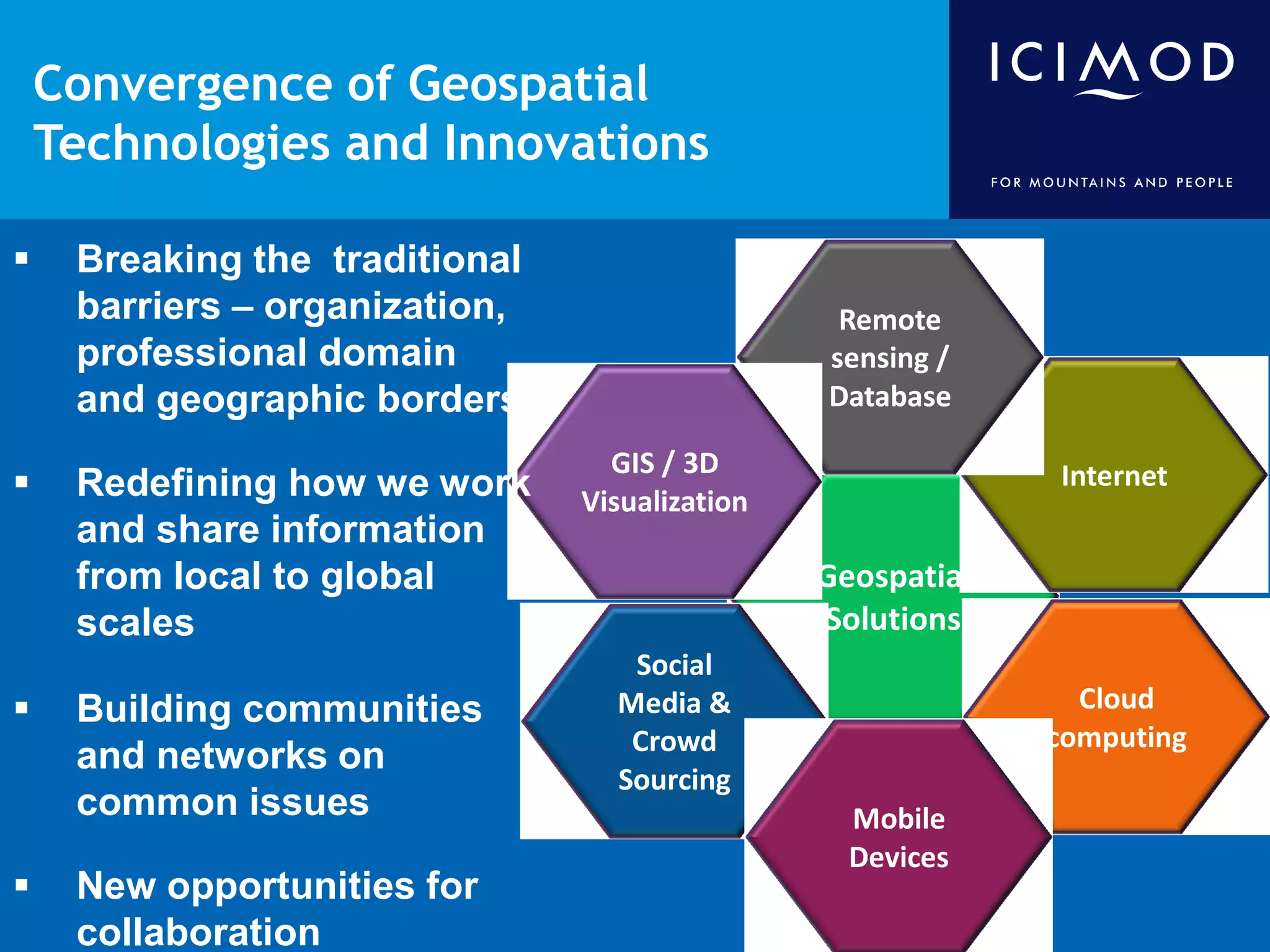
    Breaking the traditional
     barriers – organization,                    Remote
     professional domain                        sensing /
     and geographic borders                     Database

                                  GIS / 3D
    Redefining how we work     Visualization
                                                             Internet
     and share information
     from local to global                       Geospatial
     scales                                     Solutions
                                   Social
    Building communities         Media &                      Cloud
                                   Crowd                     computing
     and networks on
                                  Sourcing
     common issues                                Mobile
                                                  Devices
    New opportunities for
     collaboration
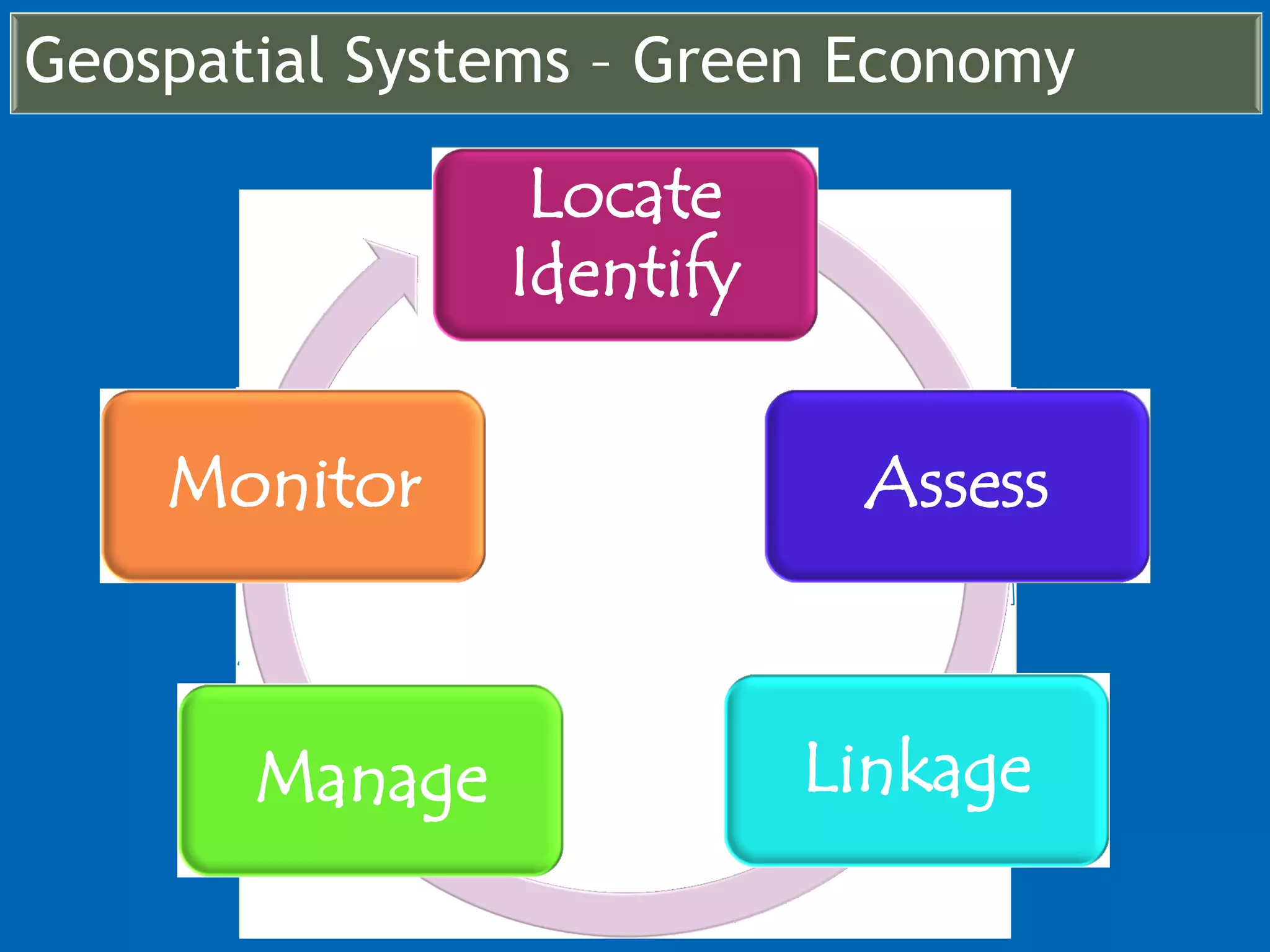
Geospatial Systems – Green Economy

                 Locate
                Identify

    Monitor                 Assess


       Manage              Linkage
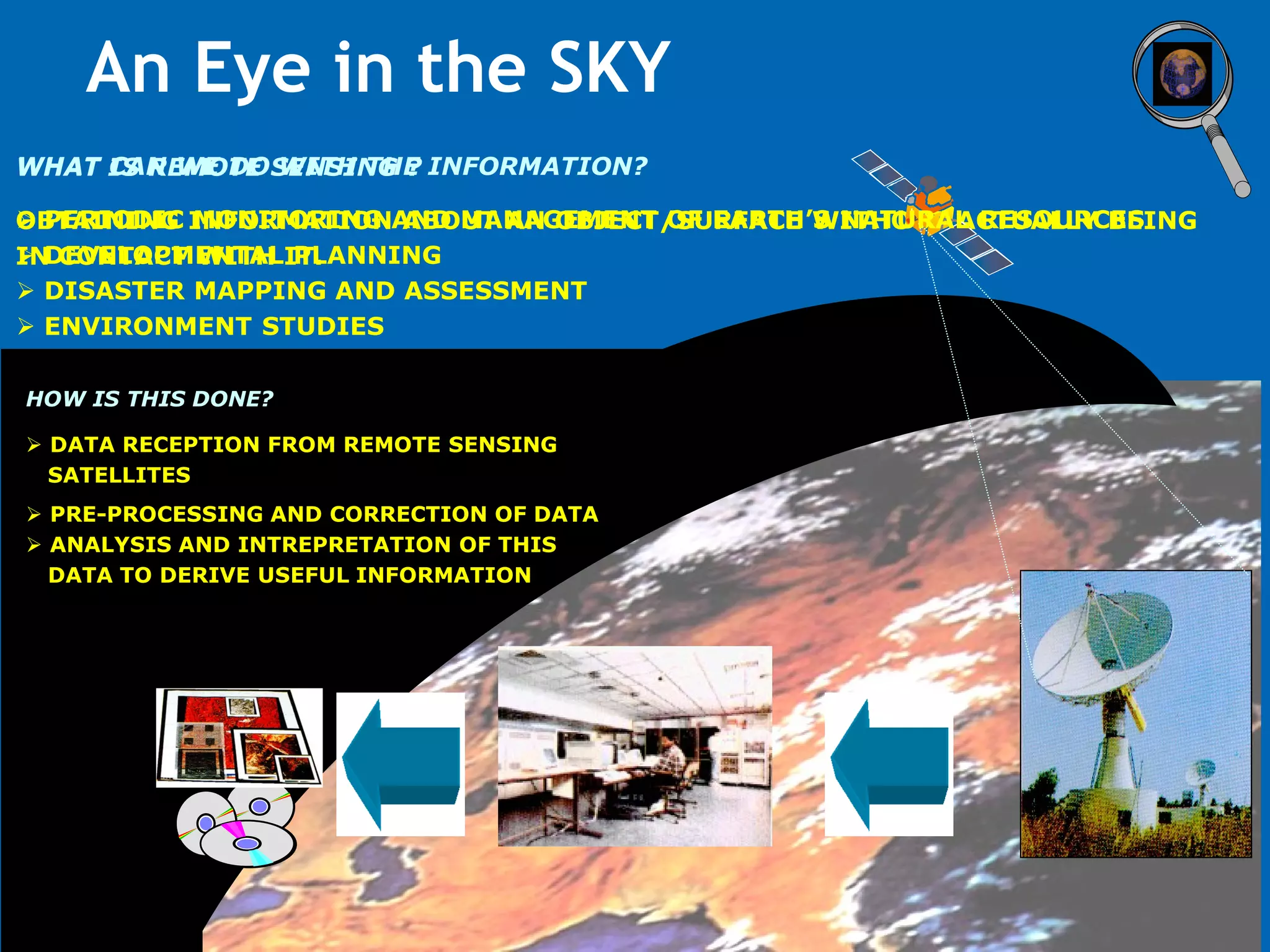
An Eye in the SKY
WHAT IS REMOTE SENSING ? INFORMATION?
     CAN WE DO WITH THE

OBTAINING INFORMATIONAND MANAGEMENT OF EARTH’S NATURAL RESOURCES
 PERIODIC MONITORING ABOUT AN OBJECT/SURFACE WITHOUT ACTUALLY BEING
 DEVELOPMENTAL PLANNING
IN CONTACT WITH IT.
 DISASTER MAPPING AND ASSESSMENT
 ENVIRONMENT STUDIES

HOW IS THIS DONE?

 DATA RECEPTION FROM REMOTE SENSING
  SATELLITES
 PRE-PROCESSING AND CORRECTION OF DATA
 ANALYSIS AND INTREPRETATION OF THIS
  DATA TO DERIVE USEFUL INFORMATION
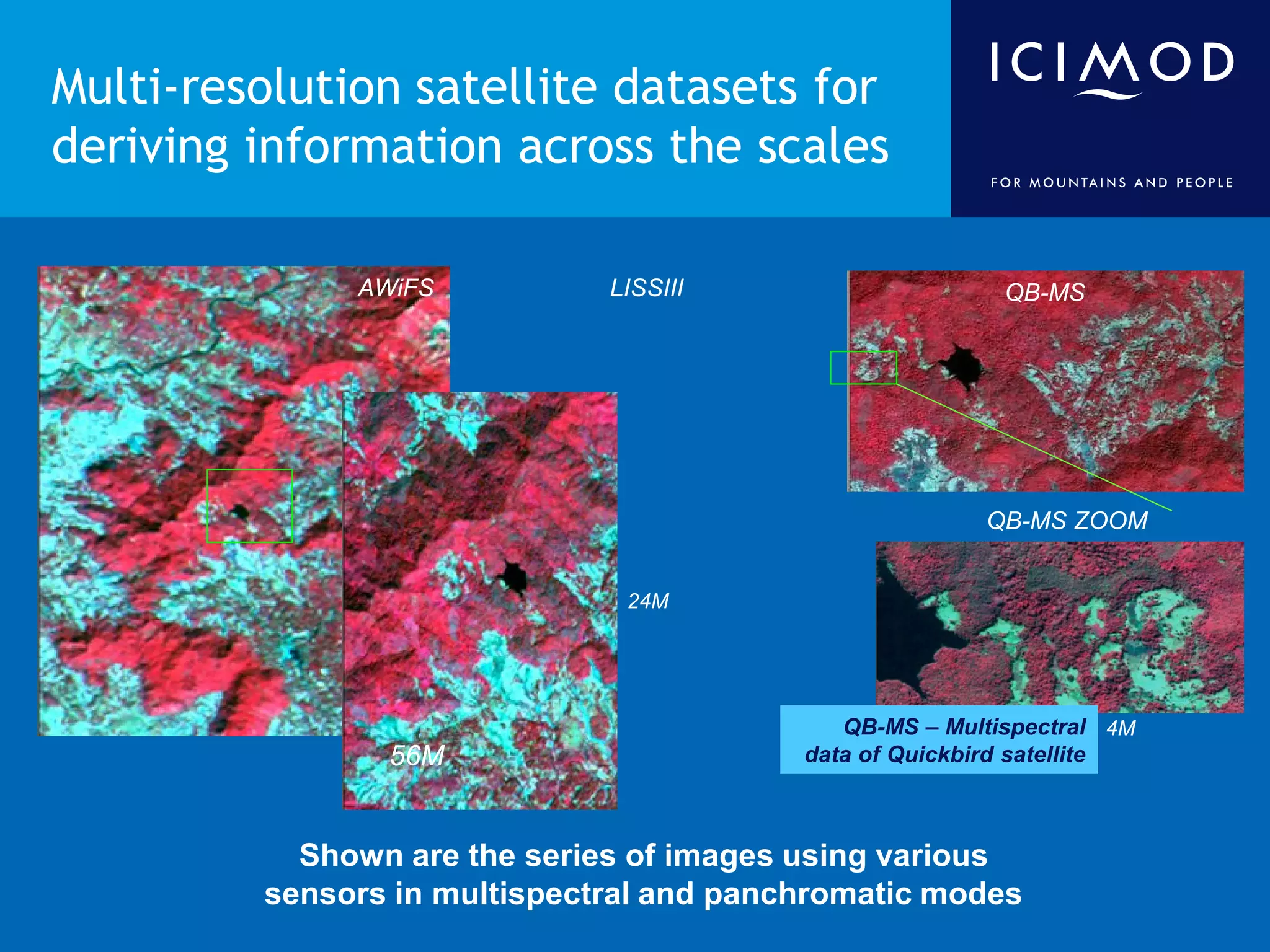
Multi-resolution satellite datasets for
deriving information across the scales

              AWiFS           LISSIII                     QB-MS


                                                        QB-MS ZOOM


                               24M


                                             QB-MS – Multispectral 4M
                56M                       data of Quickbird satellite


           Shown are the series of images using various
         sensors in multispectral and panchromatic modes
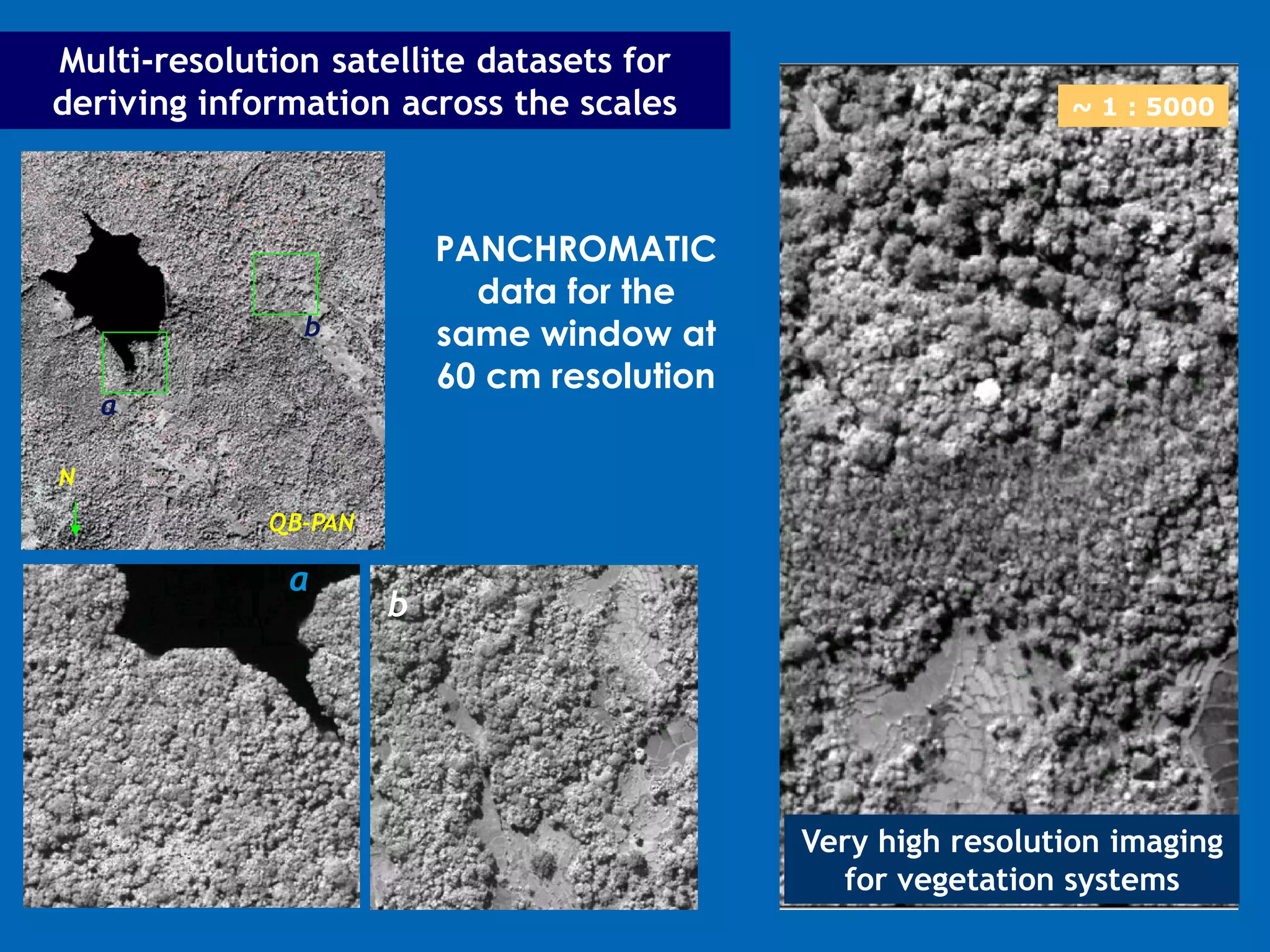
Multi-resolution satellite datasets for
deriving information across the scales                        ~ 1 : 5000


                          PANCHROMATIC
                            data for the
               b          same window at
                          60 cm resolution
    a

N
             QB-PAN

              a
                      b


                                             Very high resolution imaging
                                               for vegetation systems
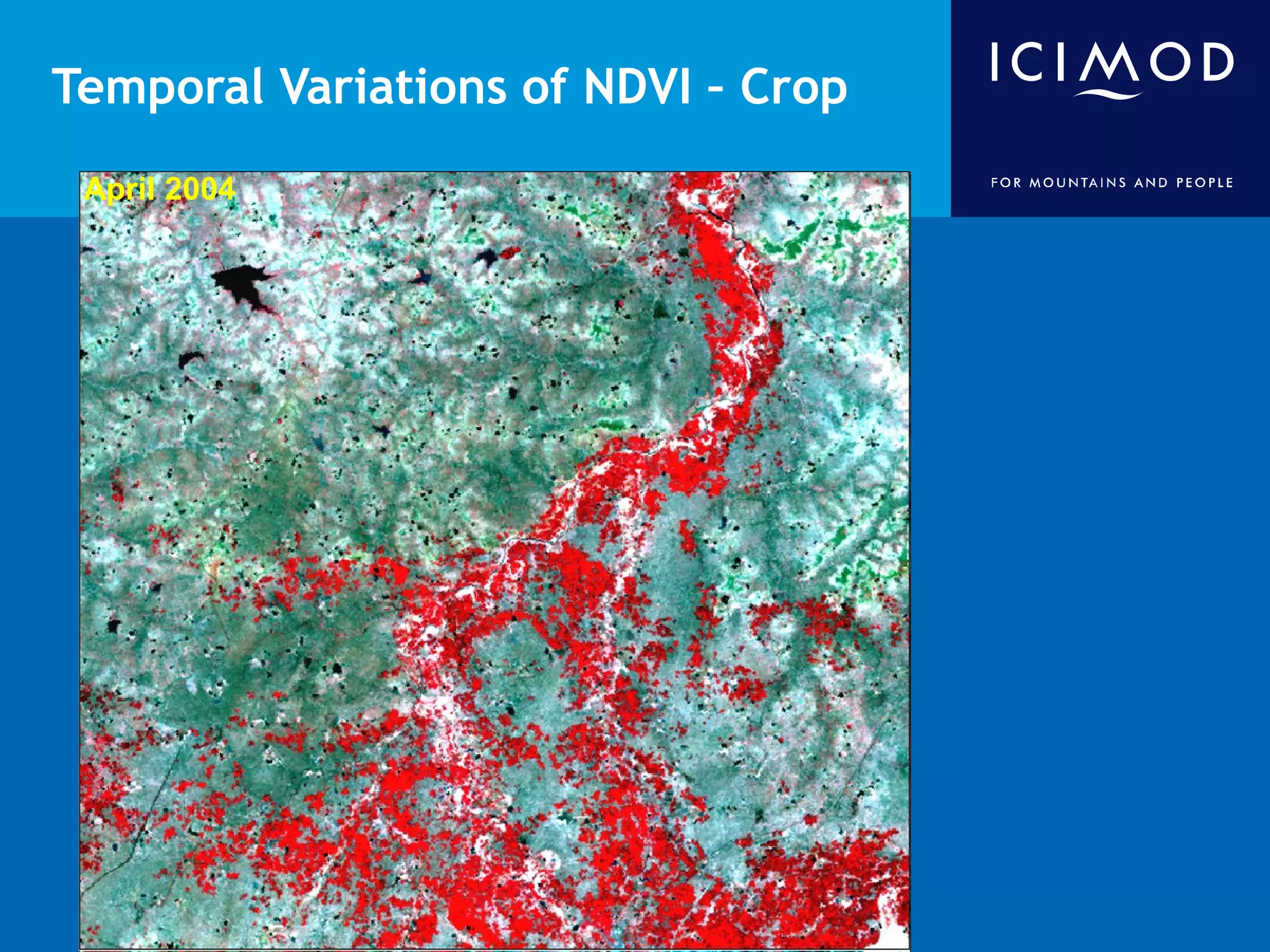
Temporal Variations of NDVI – Crop
 March 2004
 January 2004
 April 2004
 February2003
 December 2004
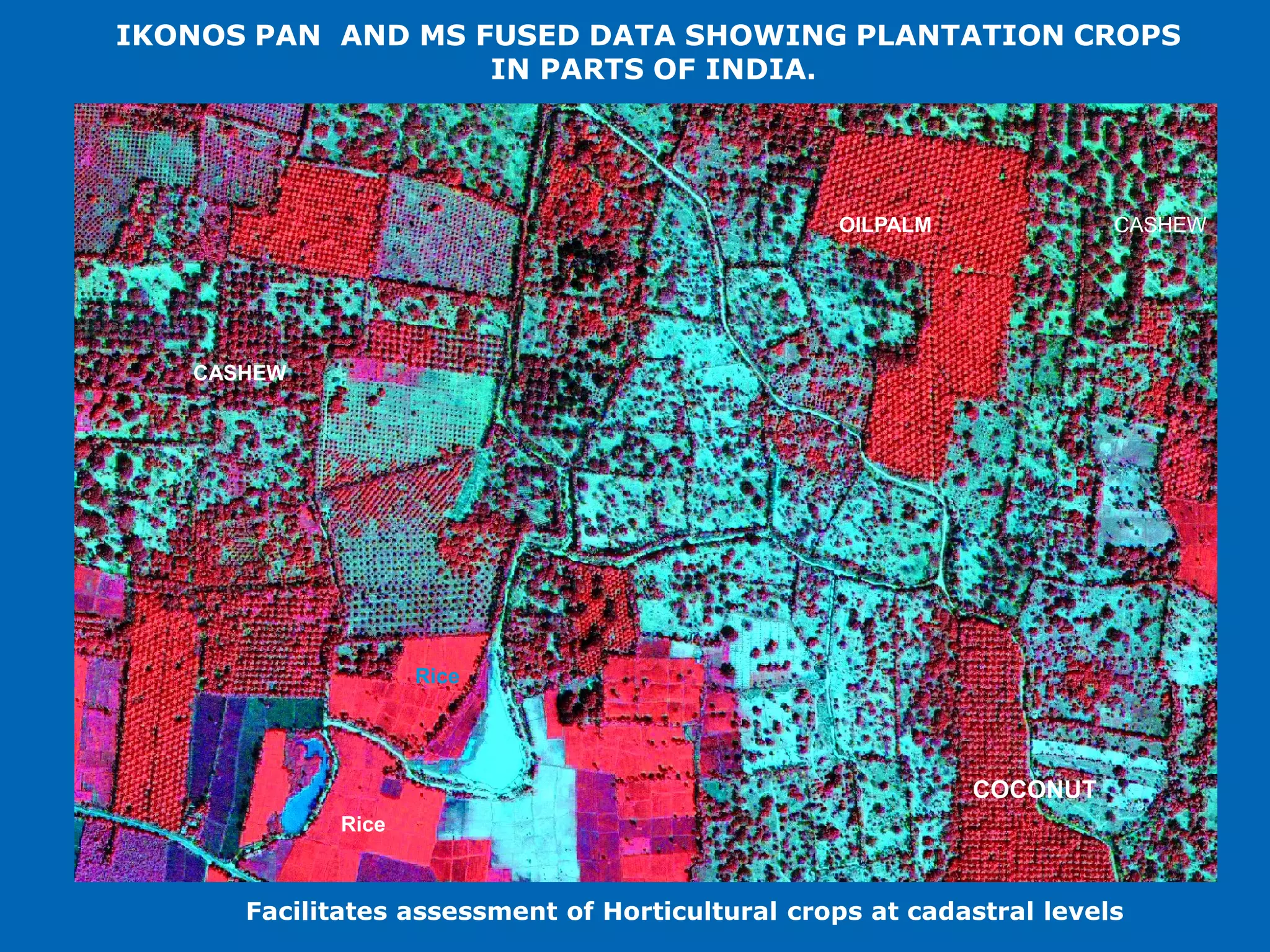
IKONOS PAN AND MS FUSED DATA SHOWING PLANTATION CROPS
                   IN PARTS OF INDIA.


                                                 OILPALM              CASHEW


   CASHEW


                    Rice


                                                           COCONUT
             Rice


      Facilitates assessment of Horticultural crops at cadastral levels
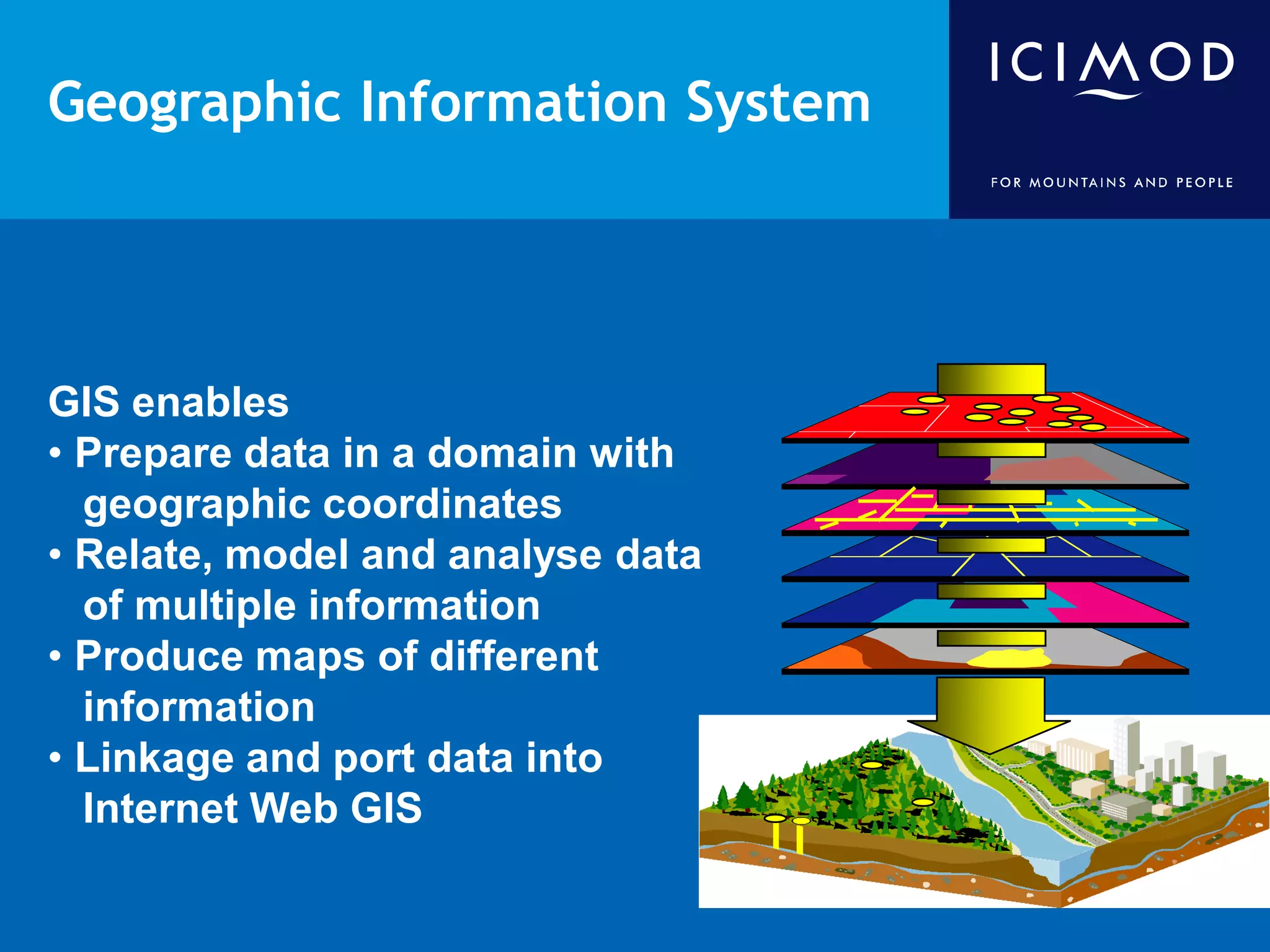
Geographic Information System


GIS enables
• Prepare data in a domain with
  geographic coordinates
• Relate, model and analyse data
  of multiple information
• Produce maps of different
  information
• Linkage and port data into
  Internet Web GIS
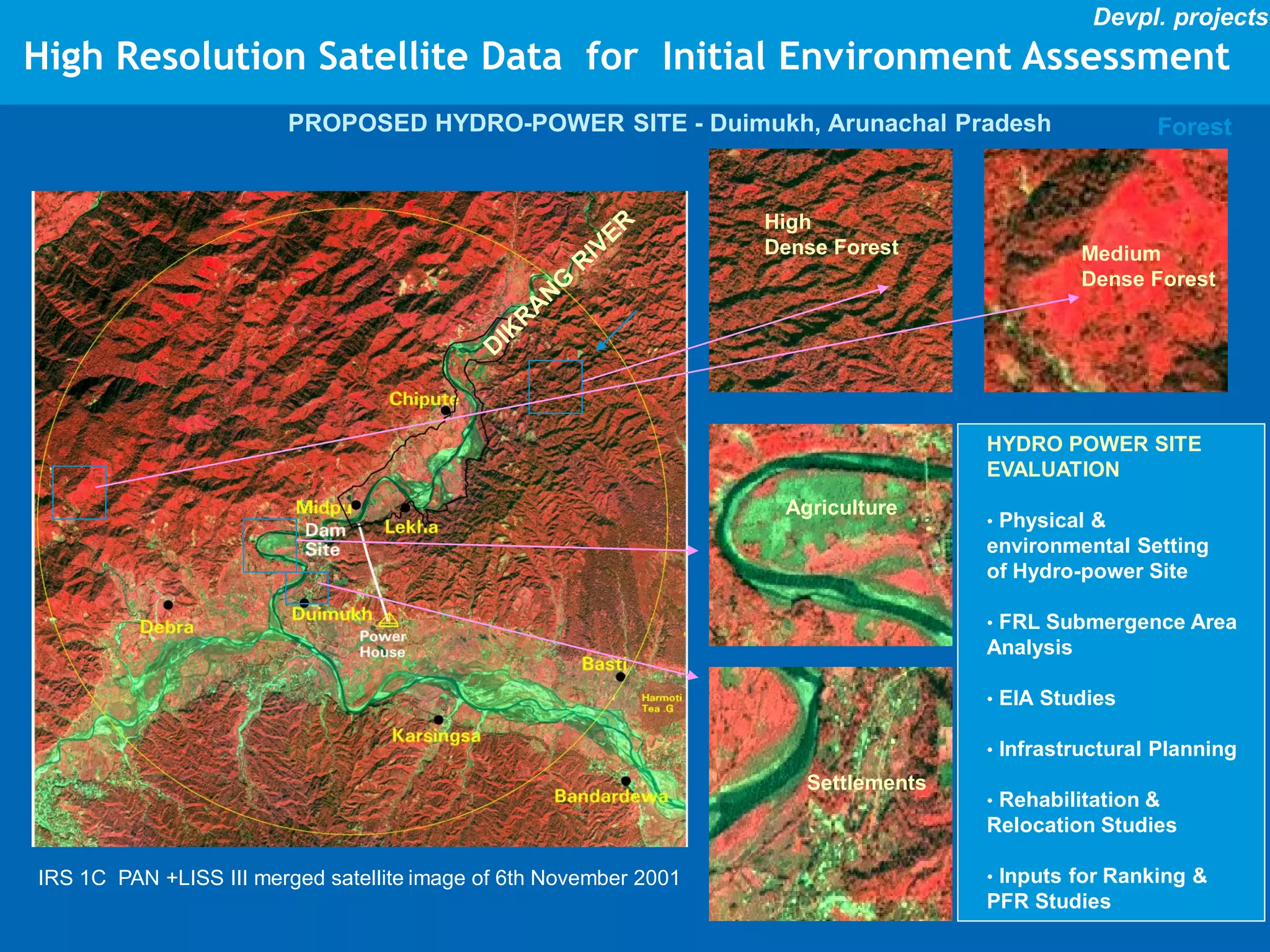
Devpl. projects
High Resolution Satellite Data for Initial Environment Assessment
                        PROPOSED HYDRO-POWER SITE - Duimukh, Arunachal Pradesh                       Forest


                                                                   High
                                                                   Dense Forest                Medium
                                                                                               Dense Forest


                                                                                    HYDRO POWER SITE
                                                                                    EVALUATION
                                                                    Agriculture
                                                                                    • Physical &
                                                                                    environmental Setting
                                                                                    of Hydro-power Site

                                                                                    • FRL Submergence Area
                                                                                    Analysis

                                                                                    • EIA Studies

                                                                                    • Infrastructural Planning
                                                                      Settlements
                                                                                    • Rehabilitation &
                                                                                    Relocation Studies

IRS 1C PAN +LISS III merged satellite image of 6th November 2001                    • Inputs for Ranking &
                                                                                    PFR Studies
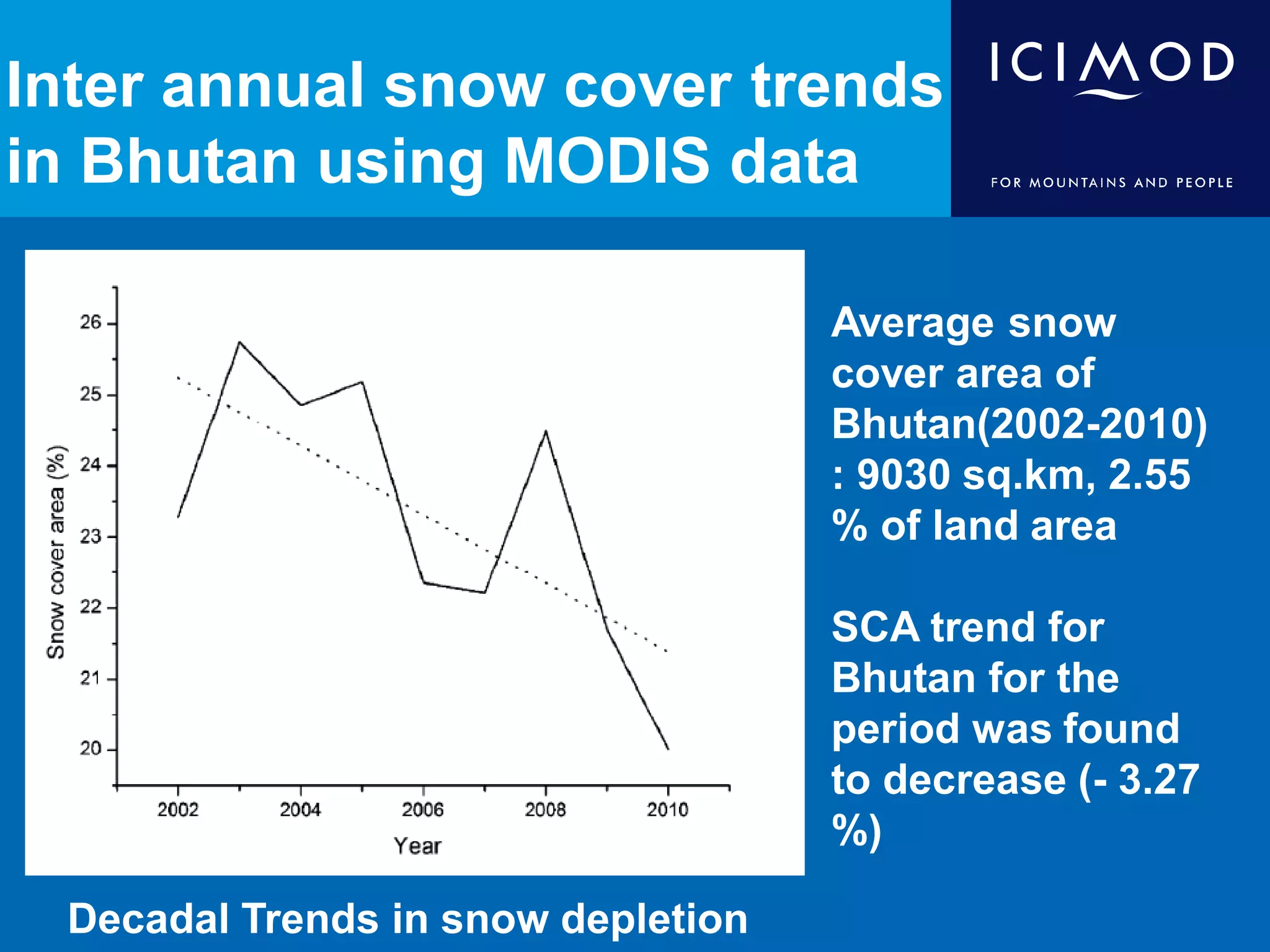
Inter annual snow cover trends
in Bhutan using MODIS data

                                    Average snow
                                    cover area of
                                    Bhutan(2002-2010)
                                    : 9030 sq.km, 2.55
                                    % of land area

                                    SCA trend for
                                    Bhutan for the
                                    period was found
                                    to decrease (- 3.27
                                    %)

 Decadal Trends in snow depletion
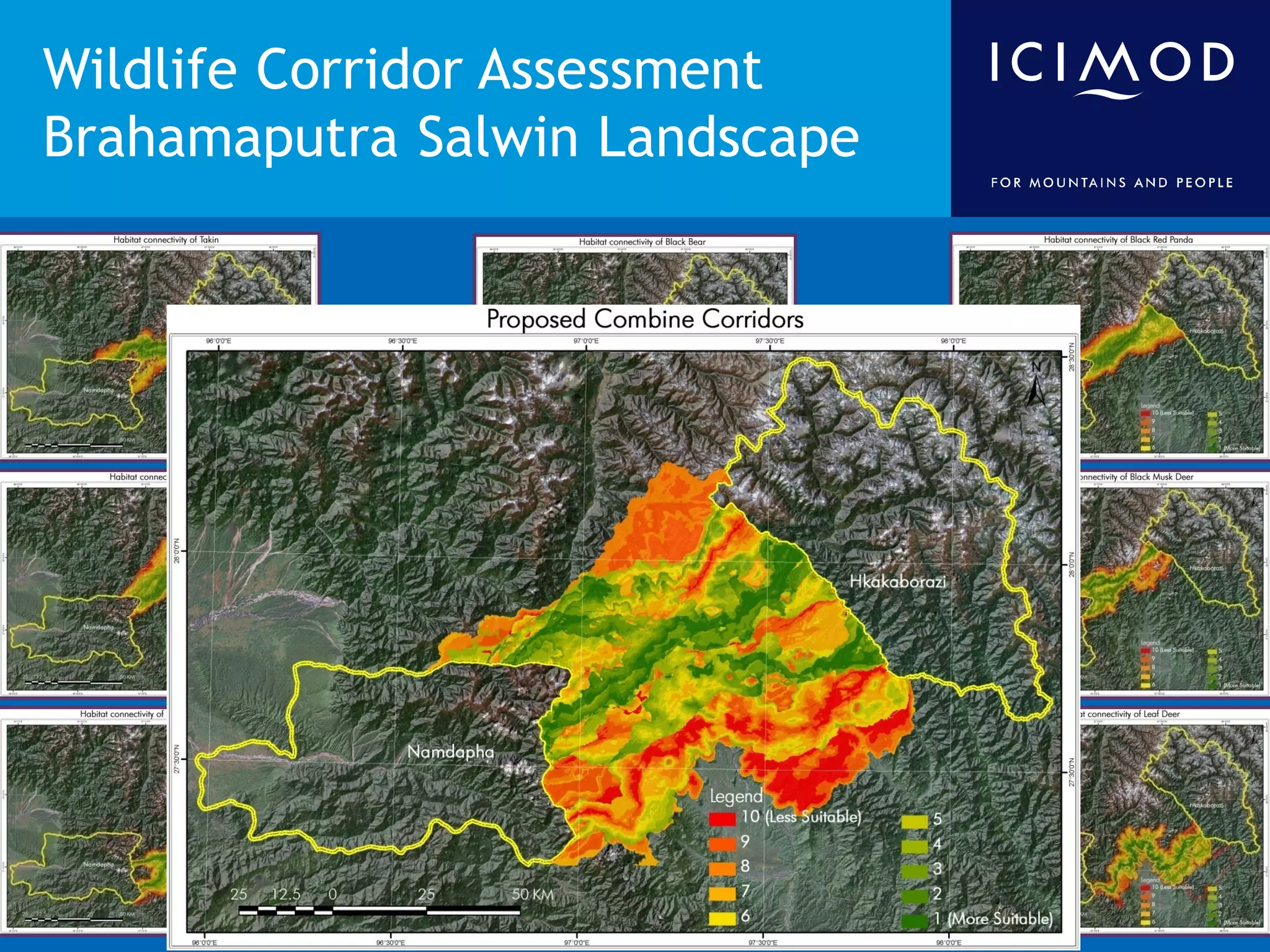
Wildlife Corridor Assessment
Brahamaputra Salwin Landscape
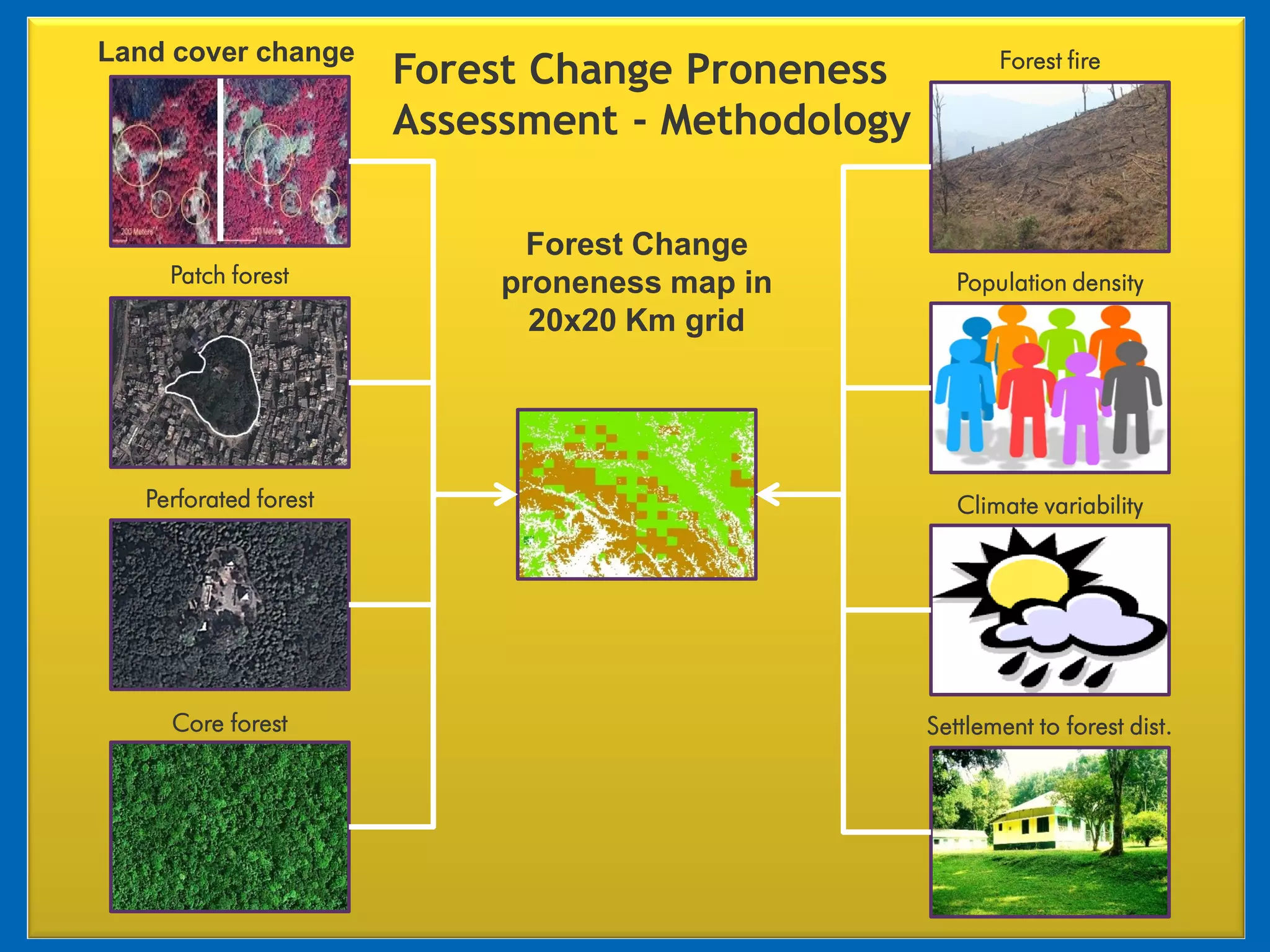
Land cover change
                       Forest Change Proneness           Forest fire

                       Assessment - Methodology

                             Forest Change
     Patch forest           proneness map in         Population density
                              20x20 Km grid


   Perforated forest                                 Climate variability


     Core forest                                  Settlement to forest dist.
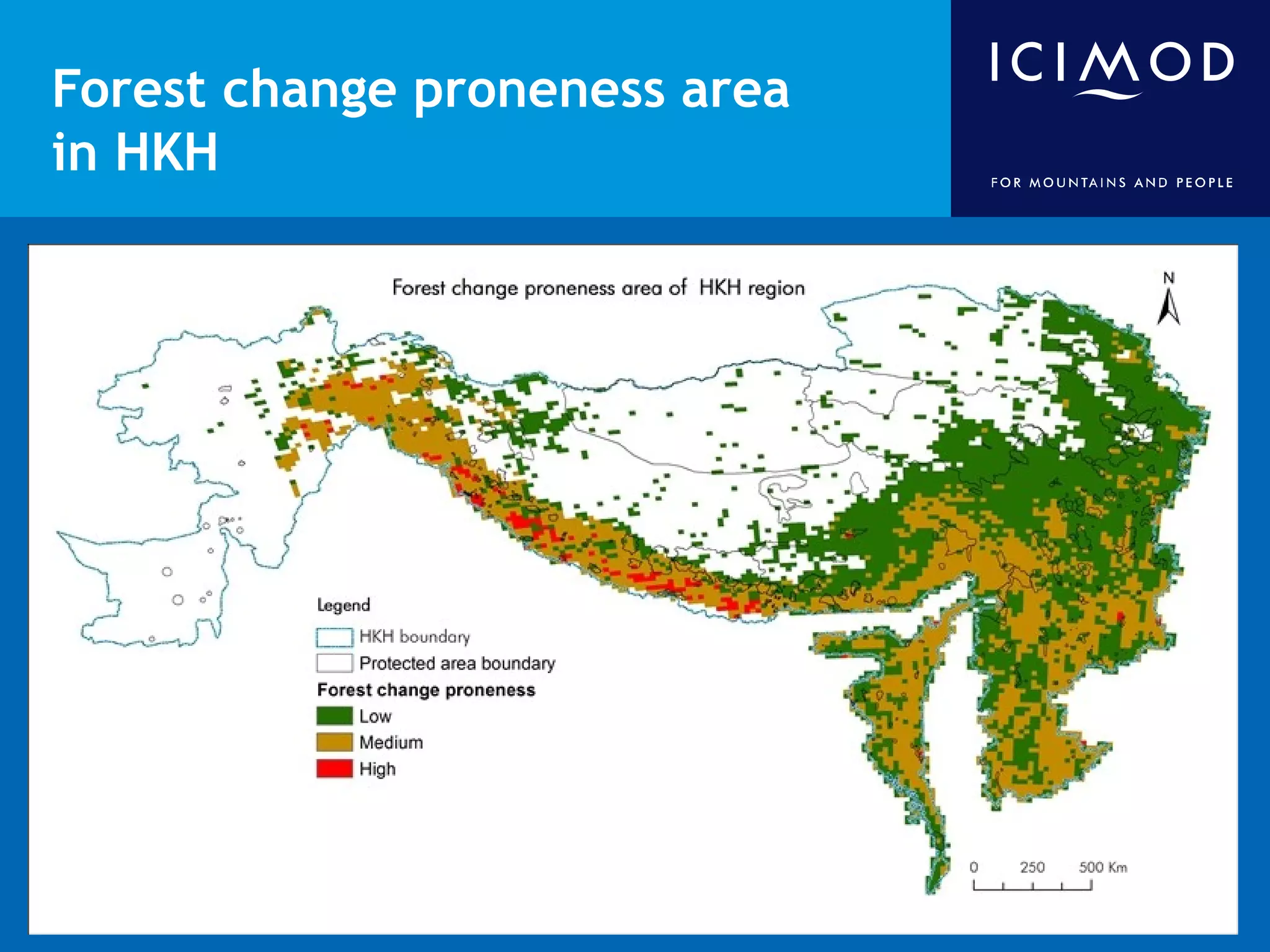
Forest change proneness area
in HKH
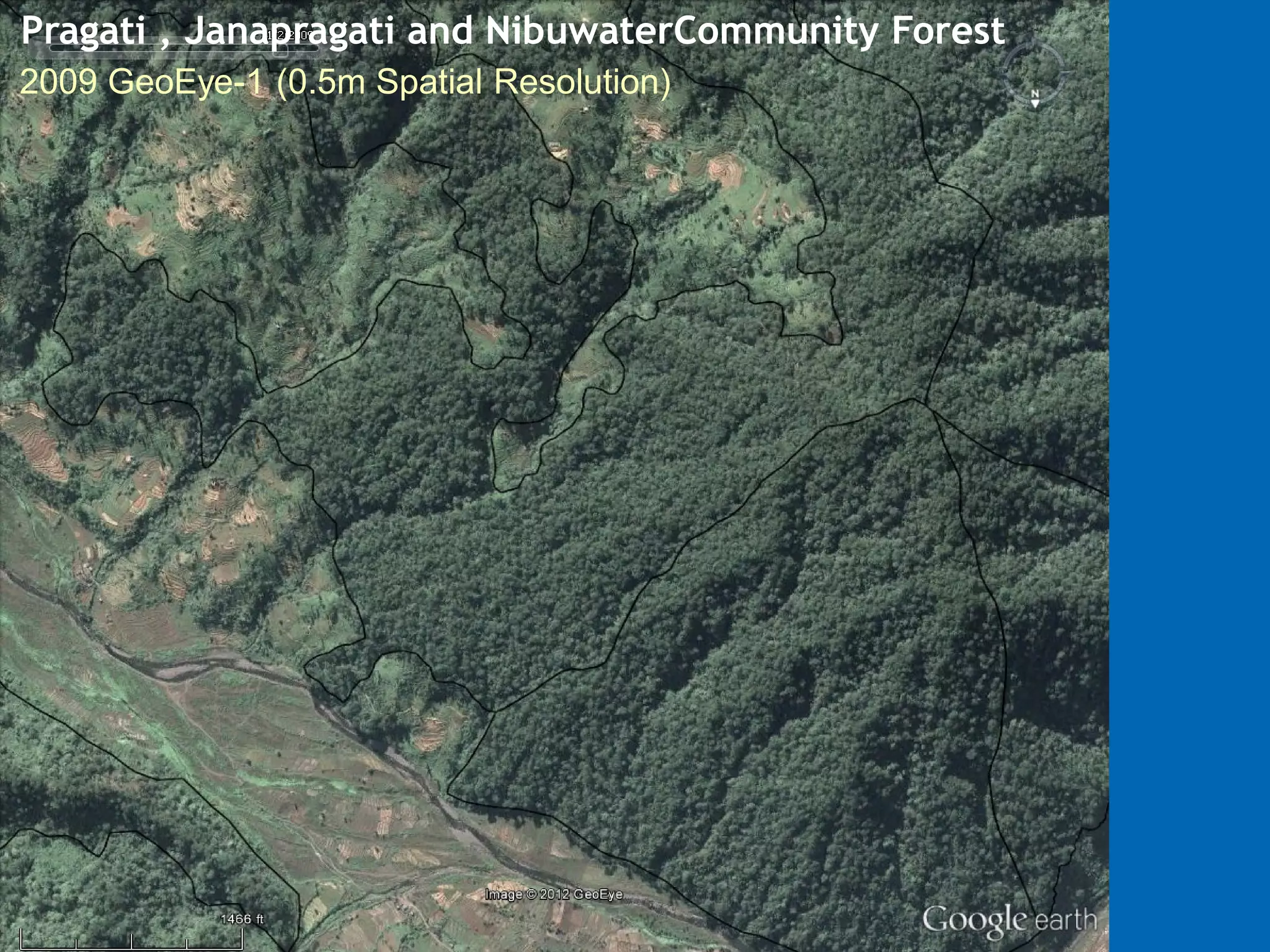
Pragati , Janapragati and NibuwaterCommunity Forest
2002GeoEye-1 (0.5m Spatial Resolution)
2009 GeoEye-1 (0.5m Spatial Resolution)
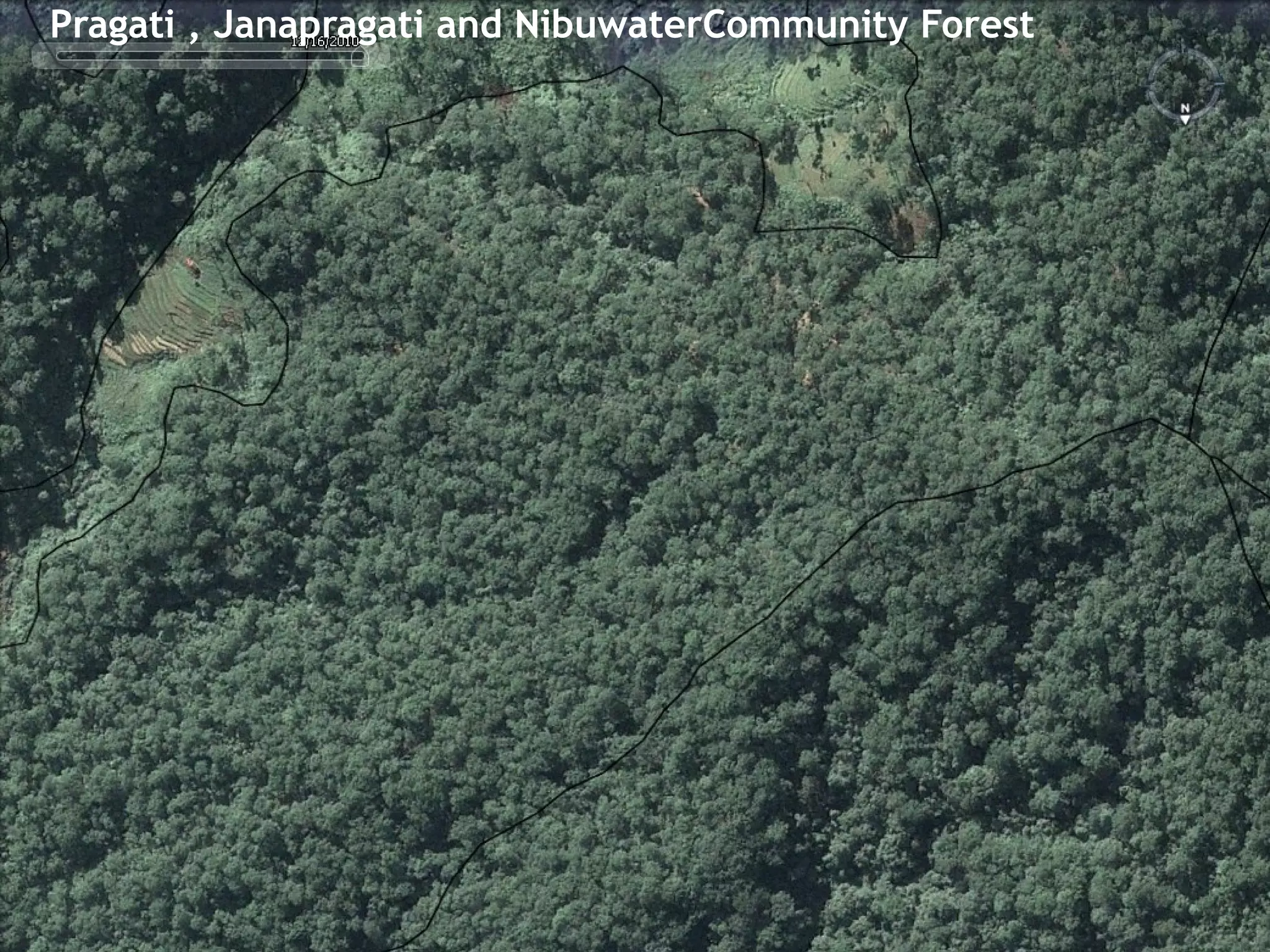
Pragati , Janapragati and NibuwaterCommunity Forest
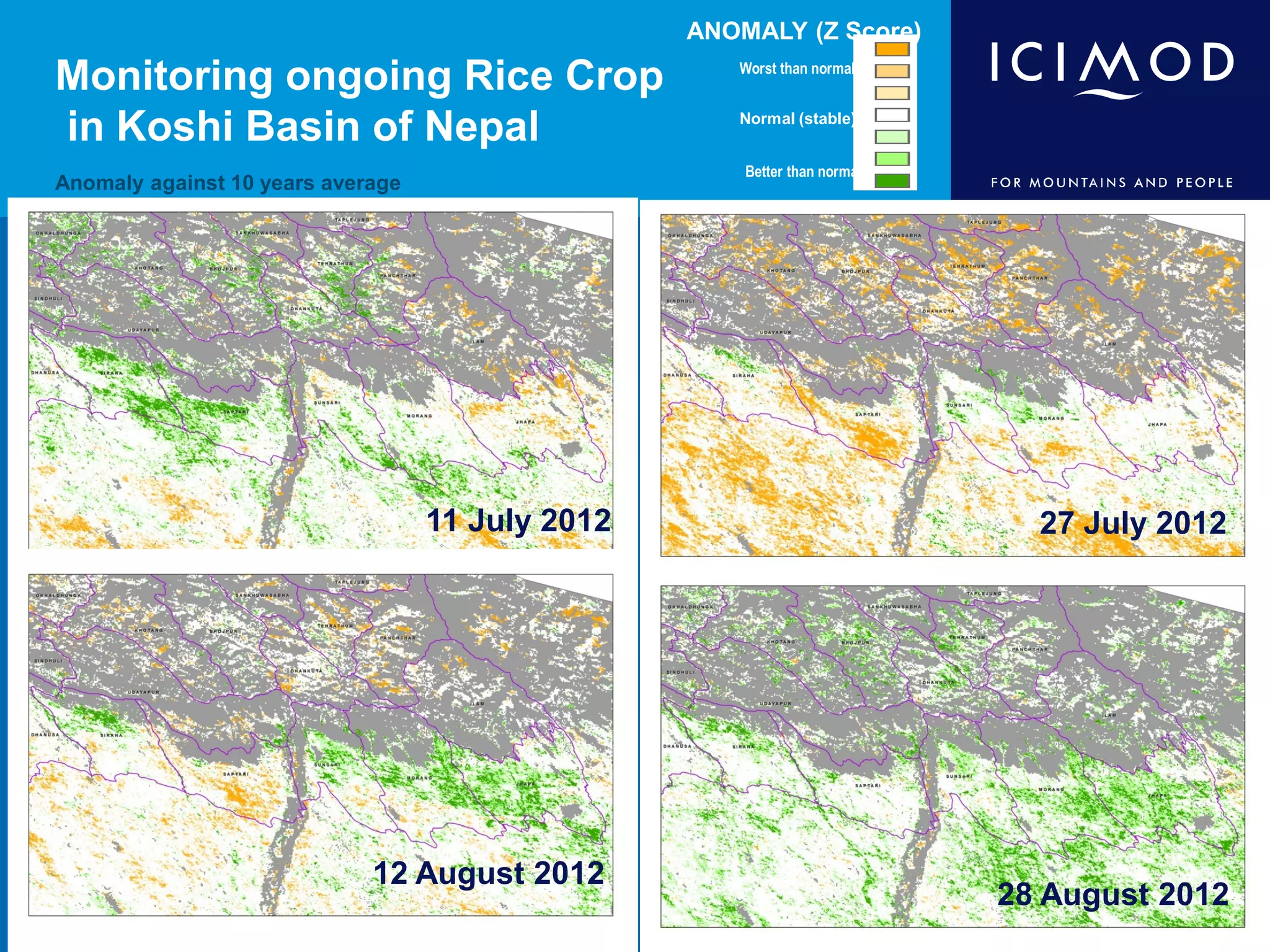
ANOMALY (Z Score)

Monitoring ongoing Rice Crop                         Worst than normal


in Koshi Basin of Nepal                              Normal (stable)


                                                      Better than normal
Anomaly against 10 years average


                                   11 July 2012                              27 July 2012


                             12 August 2012
                                                                           28 August 2012
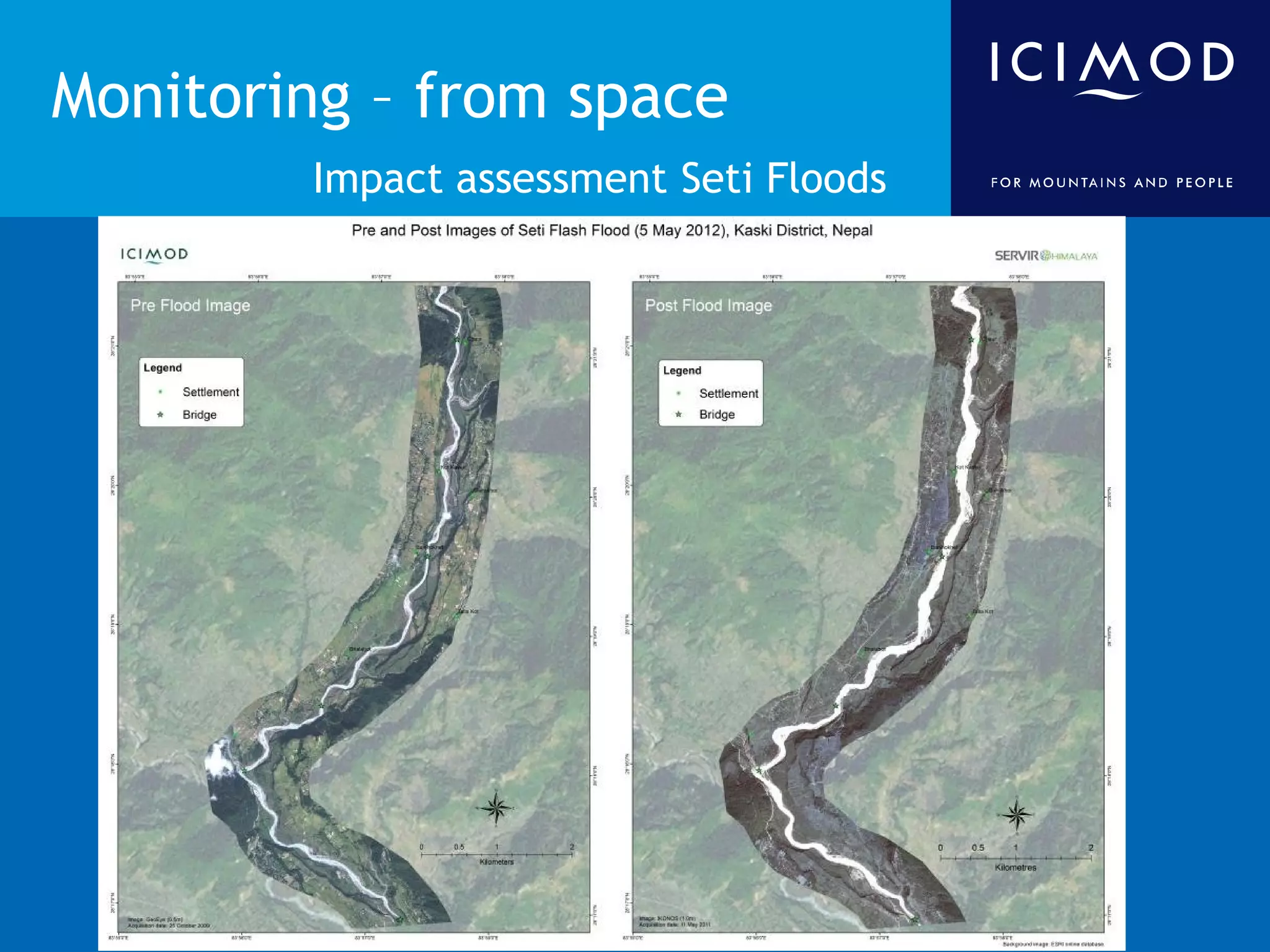
Monitoring – from space
        Impact assessment Seti Floods
Crowdsourcing

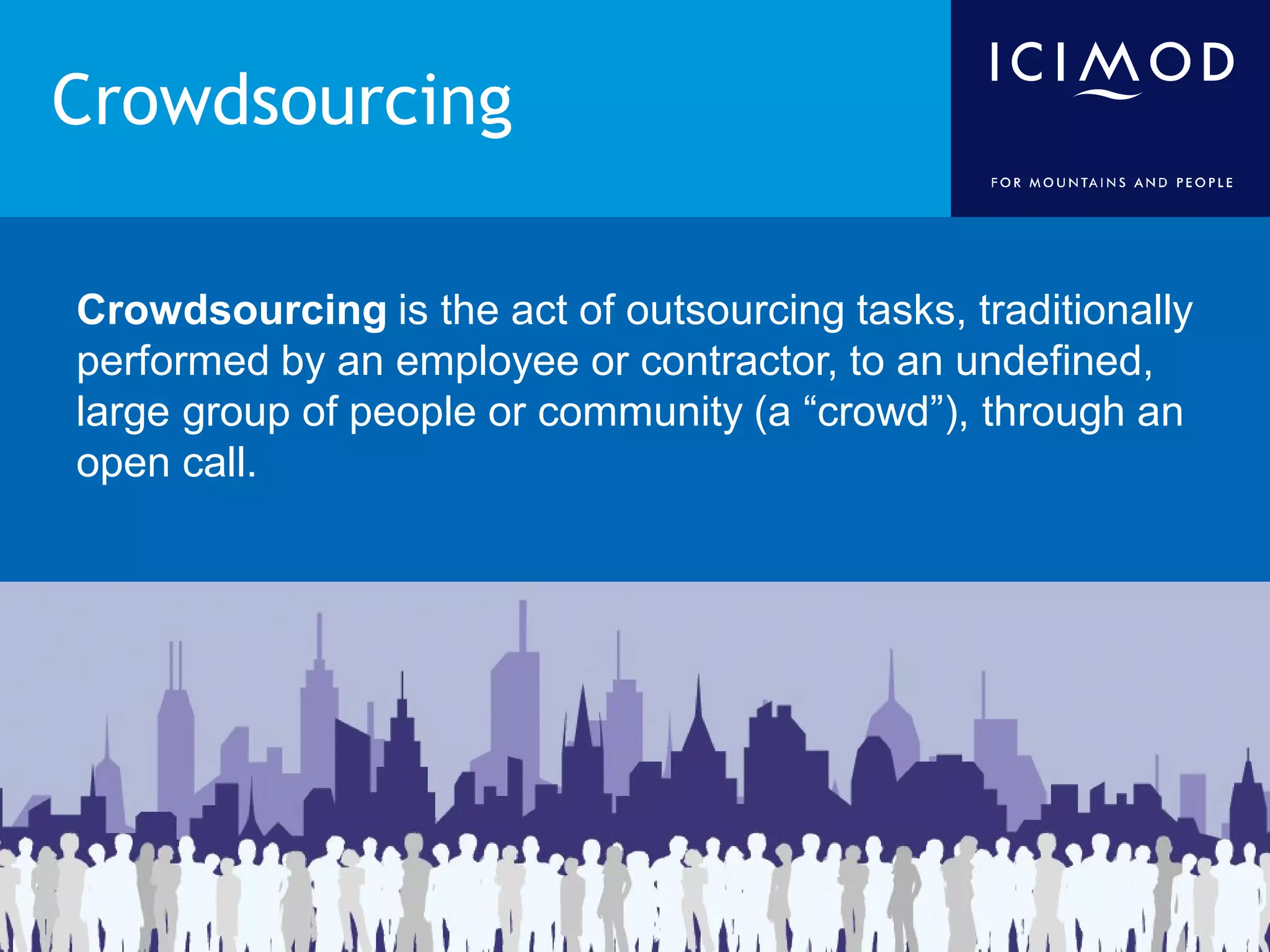
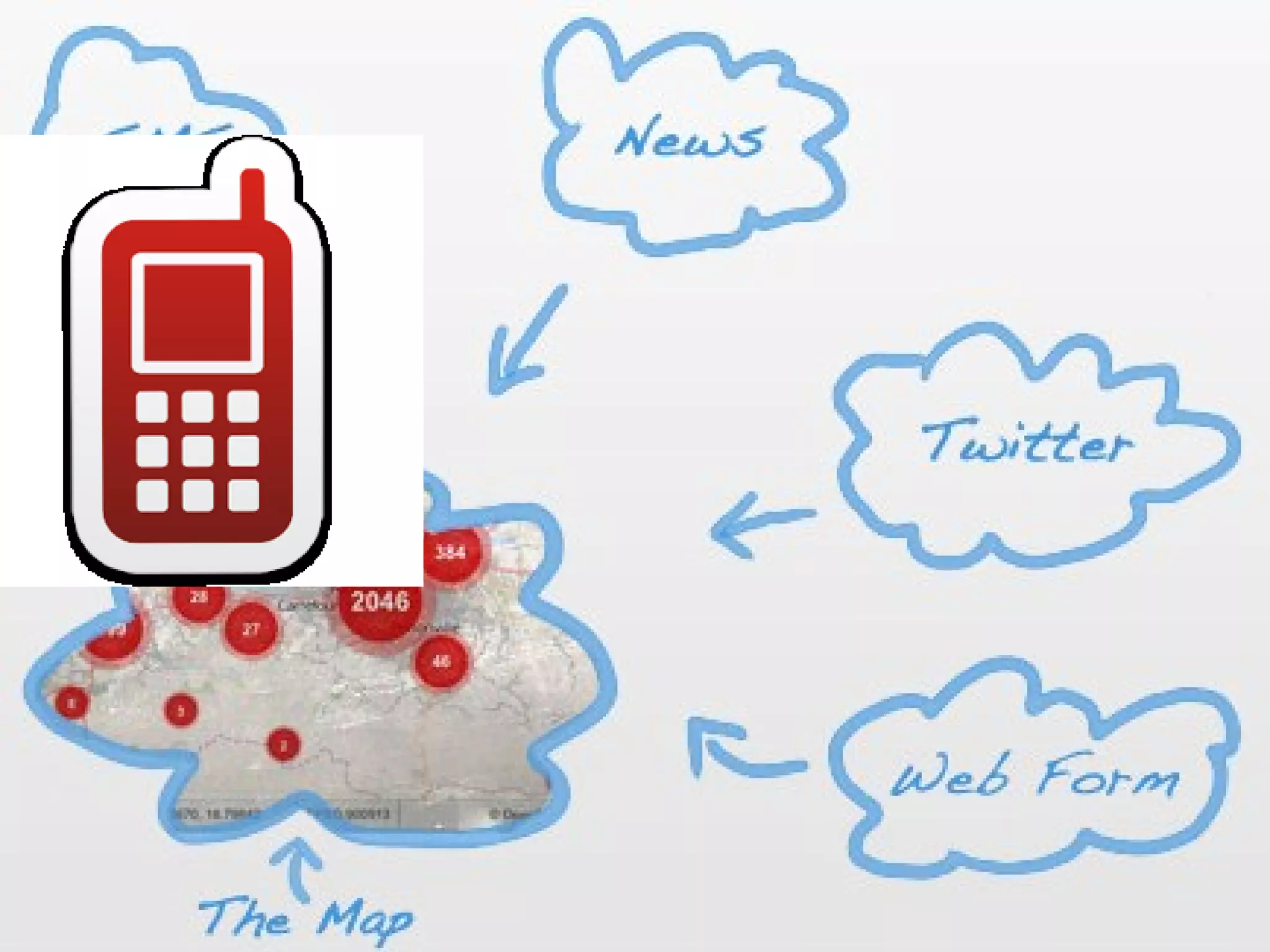
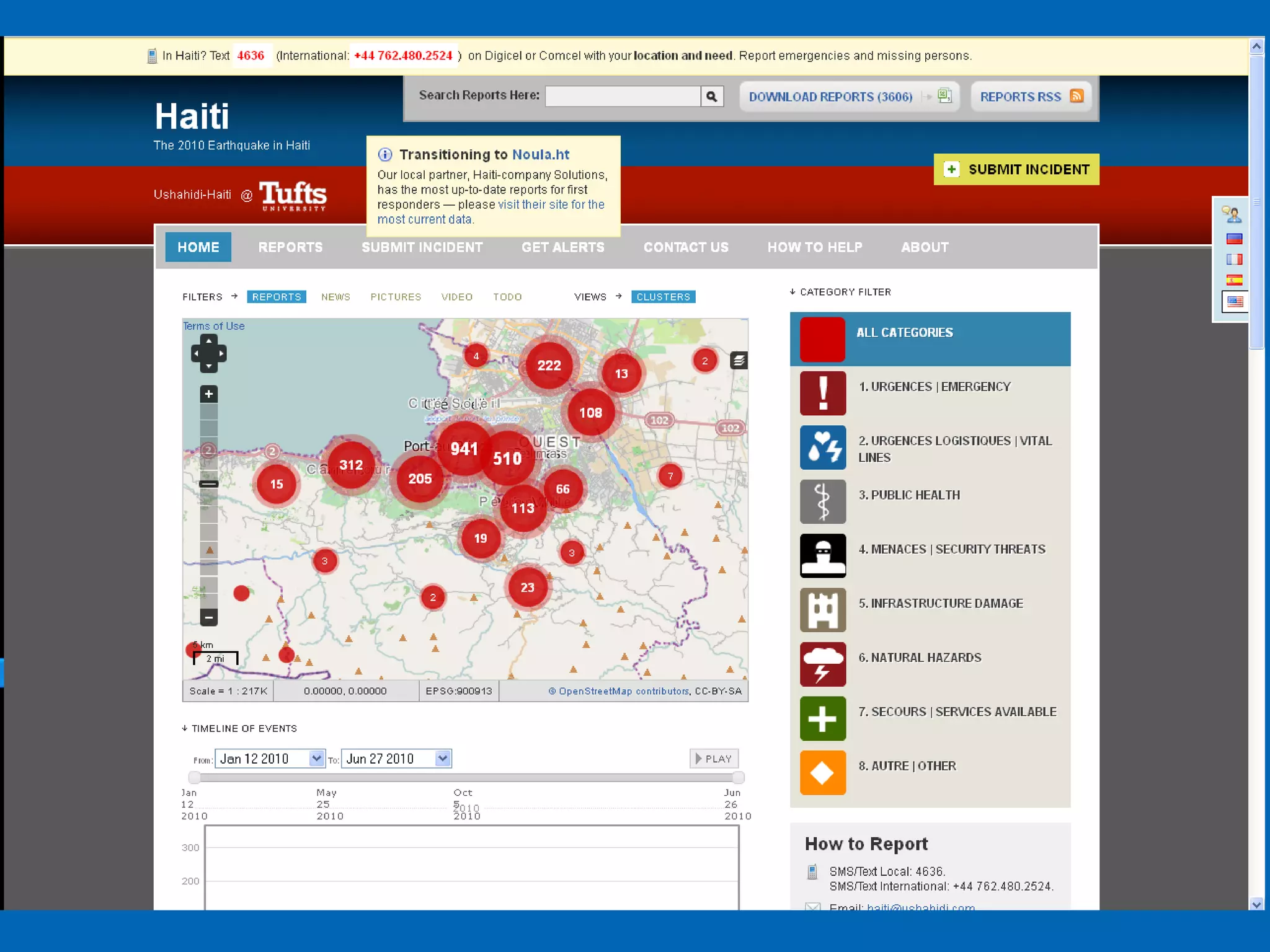
Crowdsourcing is the act of outsourcing tasks, traditionally
performed by an employee or contractor, to an undefined,
large group of people or community (a “crowd”), through an
open call.
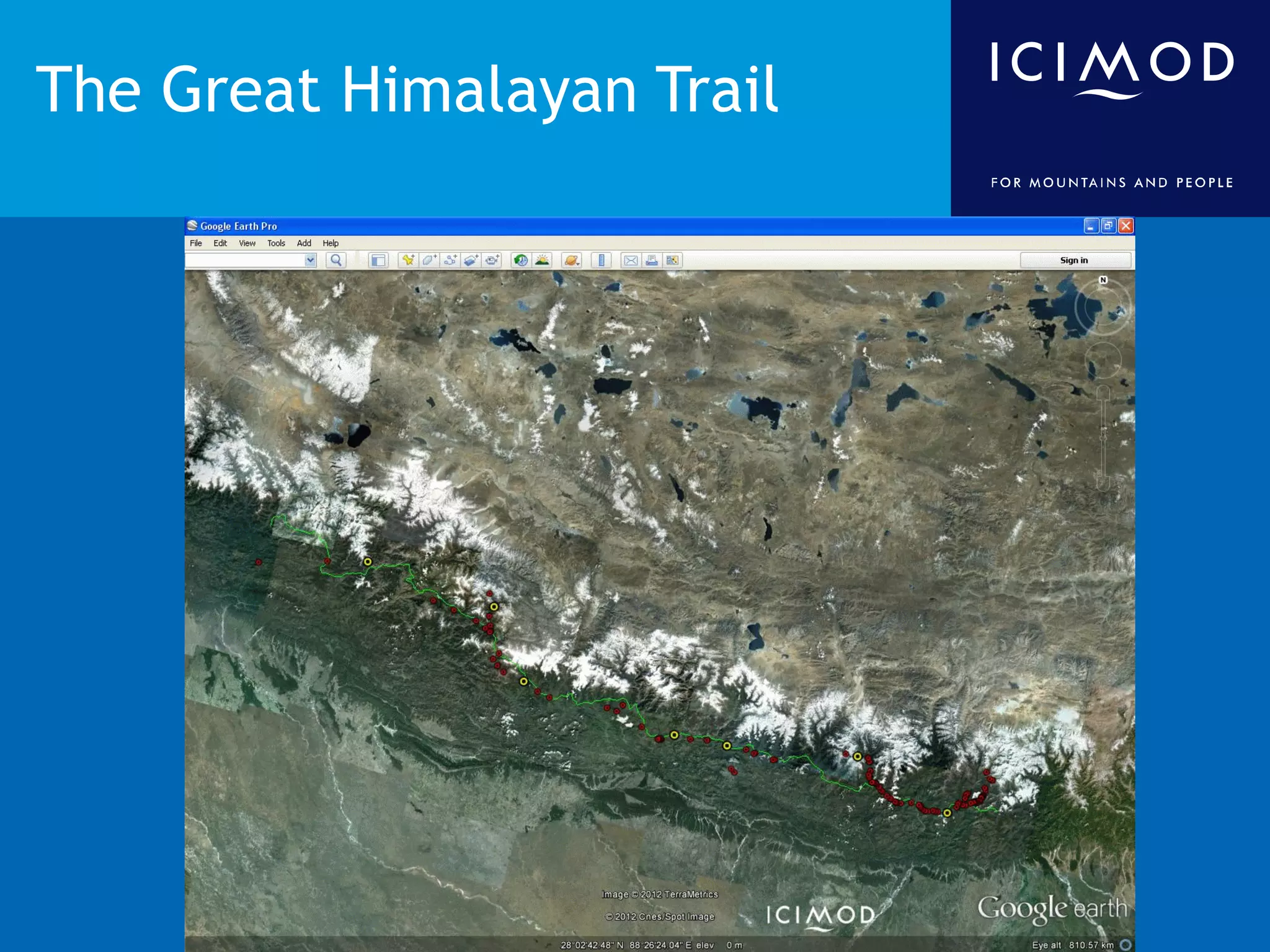
The Great Himalayan Trail
3D Models - Visualisation
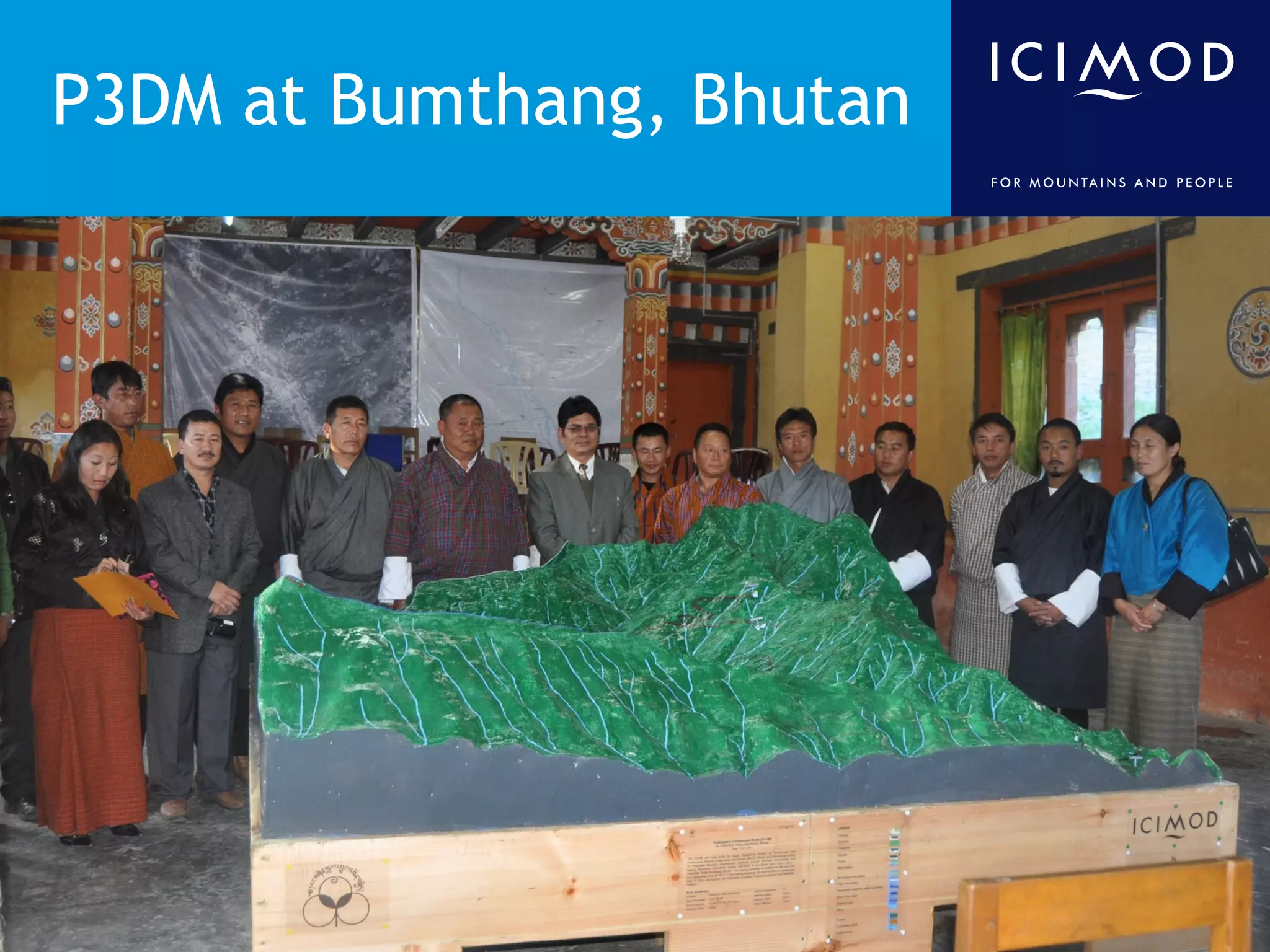
P3DM at Bumthang, Bhutan
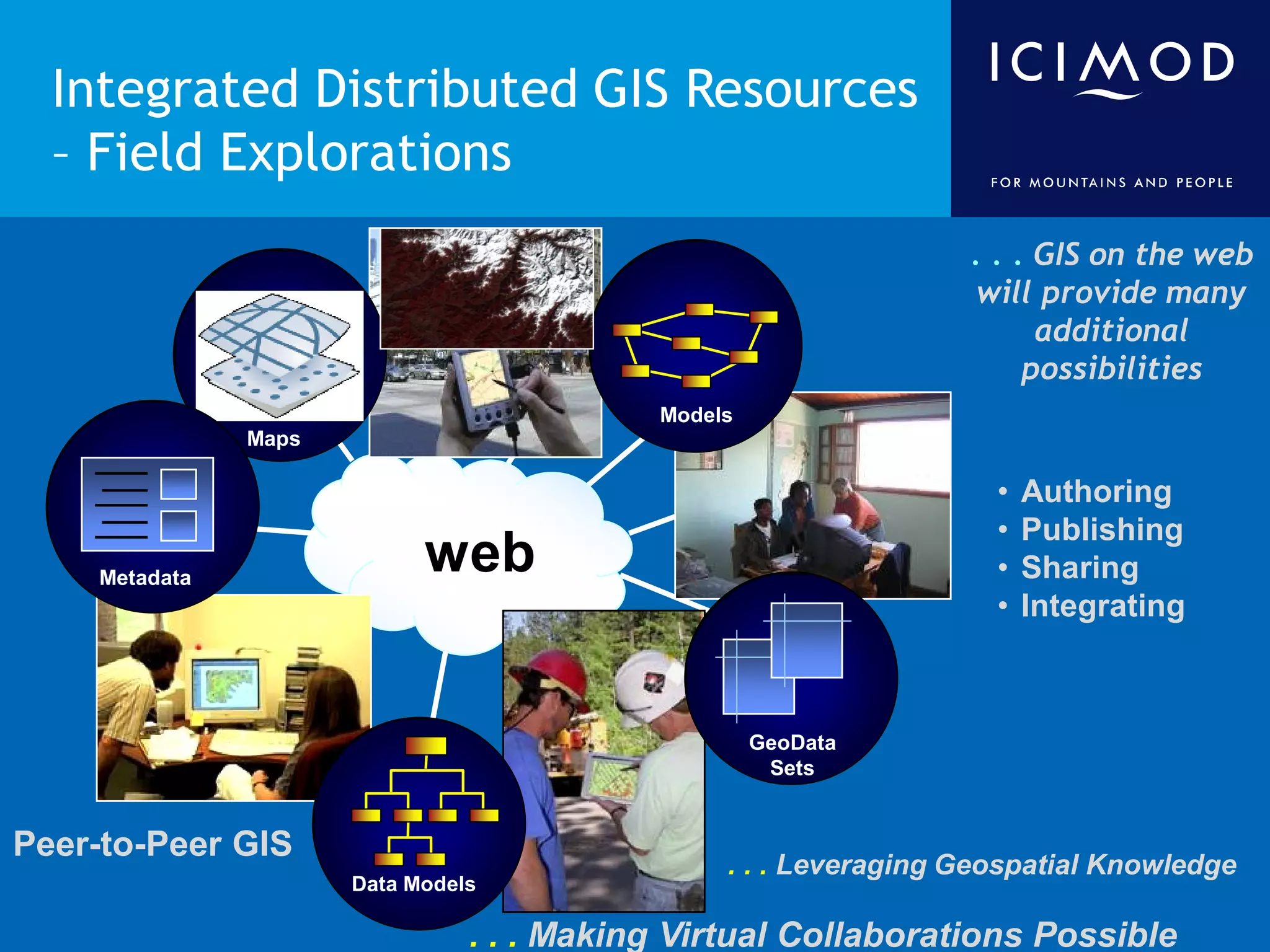
Integrated Distributed GIS Resources
  – Field Explorations
                                                                 . . . GIS on the web
                                                                  will provide many
                                                                       additional
                                                                      possibilities
                                           Models
               Maps

                                                                   •   Authoring
                                                                   •   Publishing
    Metadata
                            web                                    •   Sharing
                                                                   •   Integrating


                                                    GeoData
                                                     Sets


Peer-to-Peer GIS
                                                . . . Leveraging Geospatial Knowledge
                      Data Models

                                . . . Making Virtual Collaborations Possible
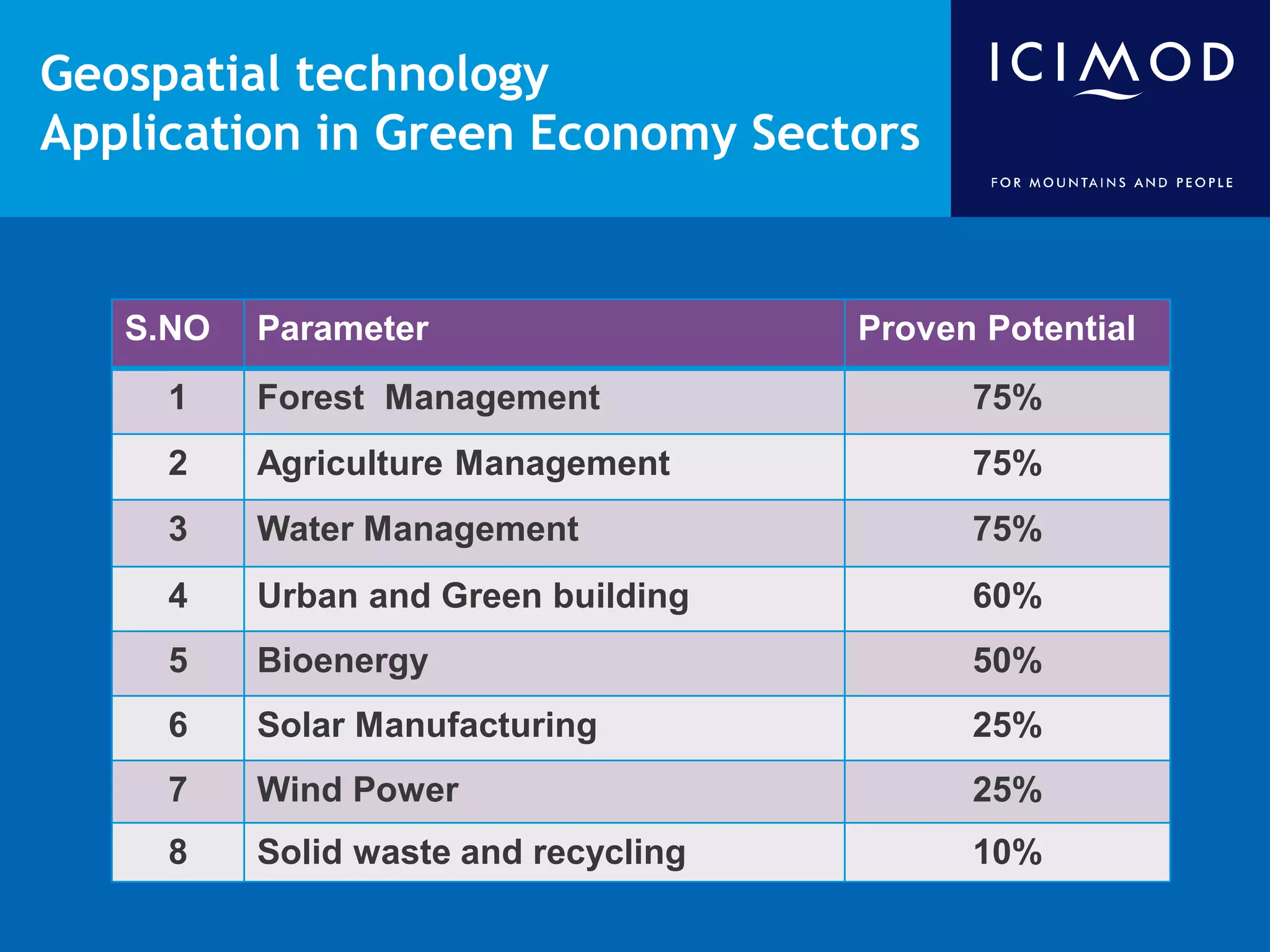
Geospatial technology
Application in Green Economy Sectors


   S.NO   Parameter                   Proven Potential
     1    Forest Management                 75%
     2    Agriculture Management            75%
     3    Water Management                  75%
     4    Urban and Green building          60%
     5    Bioenergy                         50%
     6    Solar Manufacturing               25%
     7    Wind Power                        25%
     8    Solid waste and recycling         10%
Green Economy
   A Complex Web
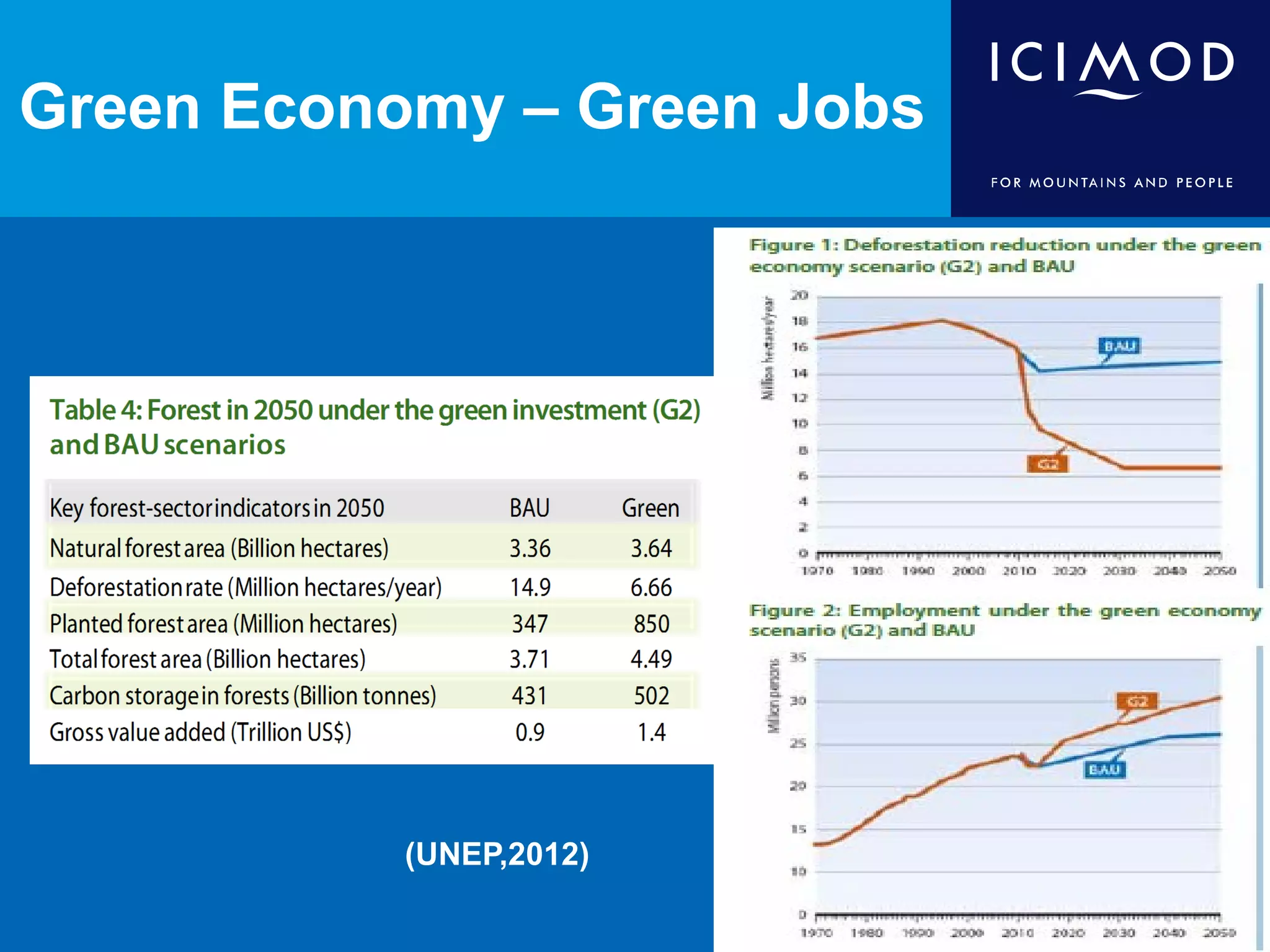
Green Economy – Green Jobs


           (UNEP,2012)
Global Foot Print Analysis
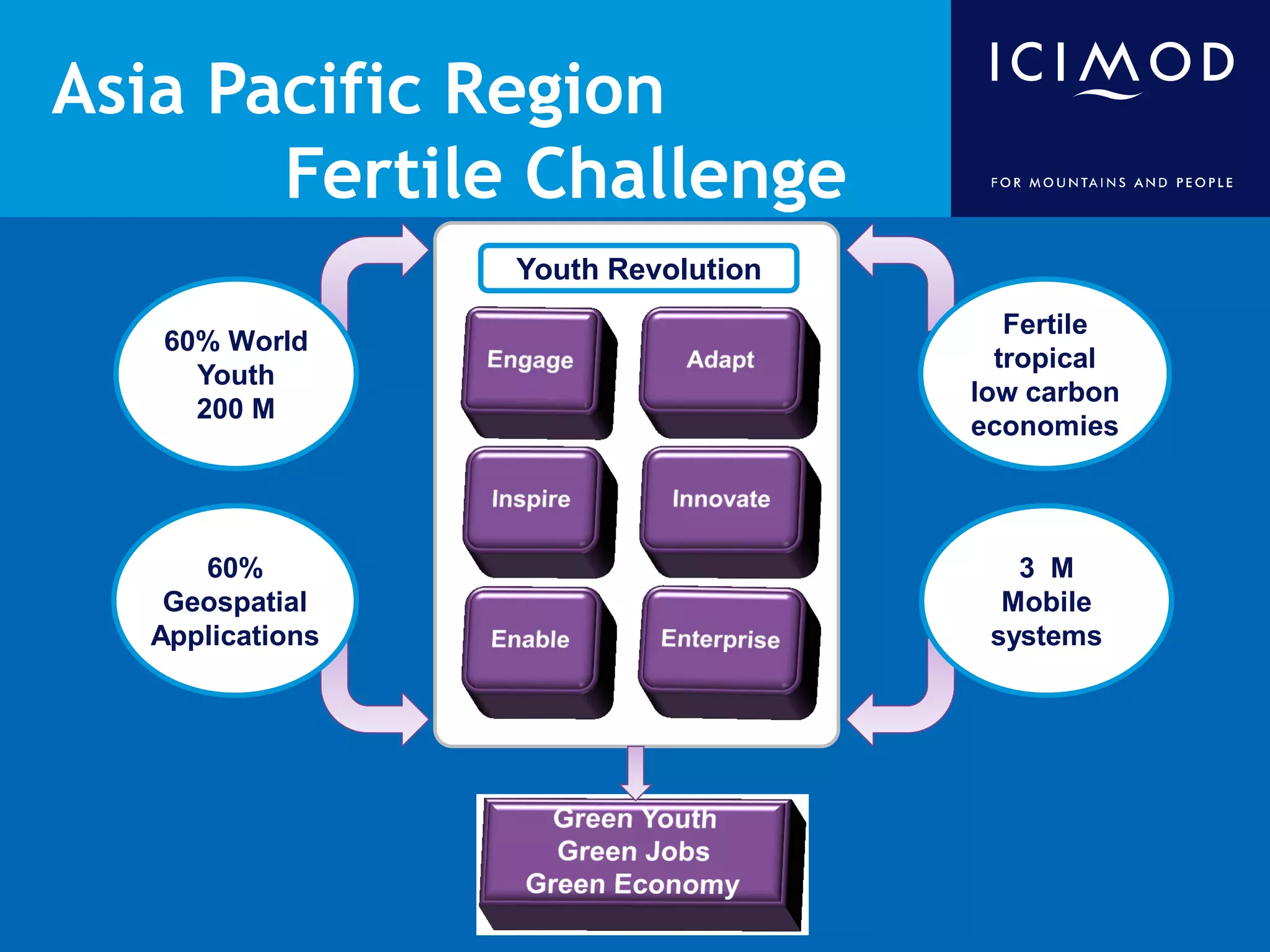
Asia Pacific Region
       Fertile Challenge
                 Youth Revolution
                                       Fertile
   60% World
                                      tropical
     Youth
                                    low carbon
     200 M
                                    economies


     60%                               3 M
   Geospatial                         Mobile
  Applications                       systems
Youth the bricks of future Asia Pacific region
thanks for kind attention
Geospatial Applications


•   Forest carbon assessment and monitoring
•   Target species monitoring
•   Define wildlife areas or corridors for Conservation
•   Efficient farming practices planning and monitoring
•   Surface water modeling - Availability
•   Urban planning applications - Optimal land use planning
•   Best locations for renewable energy sites(Solar or wind)
•   Best routing to reduce pollution or energy consumption.
•   Dust and Cloud detection
•   Eco tourism planning

Msr apyouth

  • 1.
    Applications of Geospatial Systemsand Green Economy MSR Murthy MENRIS International Centre for Integrated Mountain Development Kathmandu, Nepal
  • 2.
    Geospatial Systems -Need • Biodiversity decline (1970 and 2008) Spatial and Temporal Scales – Earth Processes – 30 per cent globally 105 – 60 per cent in the tropics Floods cyclone Snows • Demand on natural resources 104 Meteorology rivers Meteorology Ground – Doubled since 1966 water O3 hole Regional pollution • Ecological footprint 103 air pollution/ Submergence global warming Nutrient cycles – Equivalent of 1.5 planet Pollution - River migration 102 Sinks/sources, Land • Footprint of High-income countries Oil slicks Land conversion Conversion Local (eg.mining) – Five times greater than LIC. 10 Air pollution • Areas of high biodiversity – Provide important ecosystem services Days Months Years Decades – 60% population lives (Living Planet Report, 2012) Issues are spatial in nature and require spatial tools and spatial thinking with time as another dimension
  • 3.
    Convergence of Geospatial Technologies and Innovations  Breaking the traditional barriers – organization, Remote professional domain sensing / and geographic borders Database GIS / 3D  Redefining how we work Visualization Internet and share information from local to global Geospatial scales Solutions Social  Building communities Media & Cloud Crowd computing and networks on Sourcing common issues Mobile Devices  New opportunities for collaboration
  • 4.
    Geospatial Systems –Green Economy Locate Identify Monitor Assess Manage Linkage
  • 6.
    An Eye inthe SKY WHAT IS REMOTE SENSING ? INFORMATION? CAN WE DO WITH THE OBTAINING INFORMATIONAND MANAGEMENT OF EARTH’S NATURAL RESOURCES  PERIODIC MONITORING ABOUT AN OBJECT/SURFACE WITHOUT ACTUALLY BEING  DEVELOPMENTAL PLANNING IN CONTACT WITH IT.  DISASTER MAPPING AND ASSESSMENT  ENVIRONMENT STUDIES HOW IS THIS DONE?  DATA RECEPTION FROM REMOTE SENSING SATELLITES  PRE-PROCESSING AND CORRECTION OF DATA  ANALYSIS AND INTREPRETATION OF THIS DATA TO DERIVE USEFUL INFORMATION
  • 7.
    Multi-resolution satellite datasetsfor deriving information across the scales AWiFS LISSIII QB-MS QB-MS ZOOM 24M QB-MS – Multispectral 4M 56M data of Quickbird satellite Shown are the series of images using various sensors in multispectral and panchromatic modes
  • 8.
    Multi-resolution satellite datasetsfor deriving information across the scales ~ 1 : 5000 PANCHROMATIC data for the b same window at 60 cm resolution a N QB-PAN a b Very high resolution imaging for vegetation systems
  • 9.
    Temporal Variations ofNDVI – Crop March 2004 January 2004 April 2004 February2003 December 2004
  • 10.
    IKONOS PAN ANDMS FUSED DATA SHOWING PLANTATION CROPS IN PARTS OF INDIA. OILPALM CASHEW CASHEW Rice COCONUT Rice Facilitates assessment of Horticultural crops at cadastral levels
  • 11.
    Geographic Information System GISenables • Prepare data in a domain with geographic coordinates • Relate, model and analyse data of multiple information • Produce maps of different information • Linkage and port data into Internet Web GIS
  • 12.
    Devpl. projects High ResolutionSatellite Data for Initial Environment Assessment PROPOSED HYDRO-POWER SITE - Duimukh, Arunachal Pradesh Forest High Dense Forest Medium Dense Forest HYDRO POWER SITE EVALUATION Agriculture • Physical & environmental Setting of Hydro-power Site • FRL Submergence Area Analysis • EIA Studies • Infrastructural Planning Settlements • Rehabilitation & Relocation Studies IRS 1C PAN +LISS III merged satellite image of 6th November 2001 • Inputs for Ranking & PFR Studies
  • 13.
    Inter annual snowcover trends in Bhutan using MODIS data Average snow cover area of Bhutan(2002-2010) : 9030 sq.km, 2.55 % of land area SCA trend for Bhutan for the period was found to decrease (- 3.27 %) Decadal Trends in snow depletion
  • 14.
  • 15.
    Land cover change Forest Change Proneness Forest fire Assessment - Methodology Forest Change Patch forest proneness map in Population density 20x20 Km grid Perforated forest Climate variability Core forest Settlement to forest dist.
  • 16.
  • 17.
    Pragati , Janapragatiand NibuwaterCommunity Forest 2002GeoEye-1 (0.5m Spatial Resolution) 2009 GeoEye-1 (0.5m Spatial Resolution)
  • 18.
    Pragati , Janapragatiand NibuwaterCommunity Forest
  • 19.
    ANOMALY (Z Score) Monitoringongoing Rice Crop Worst than normal in Koshi Basin of Nepal Normal (stable) Better than normal Anomaly against 10 years average 11 July 2012 27 July 2012 12 August 2012 28 August 2012
  • 20.
    Monitoring – fromspace Impact assessment Seti Floods
  • 21.
    Crowdsourcing Crowdsourcing is theact of outsourcing tasks, traditionally performed by an employee or contractor, to an undefined, large group of people or community (a “crowd”), through an open call.
  • 24.
  • 25.
    3D Models -Visualisation
  • 26.
  • 27.
    Integrated Distributed GISResources – Field Explorations . . . GIS on the web will provide many additional possibilities Models Maps • Authoring • Publishing Metadata web • Sharing • Integrating GeoData Sets Peer-to-Peer GIS . . . Leveraging Geospatial Knowledge Data Models . . . Making Virtual Collaborations Possible
  • 28.
    Geospatial technology Application inGreen Economy Sectors S.NO Parameter Proven Potential 1 Forest Management 75% 2 Agriculture Management 75% 3 Water Management 75% 4 Urban and Green building 60% 5 Bioenergy 50% 6 Solar Manufacturing 25% 7 Wind Power 25% 8 Solid waste and recycling 10%
  • 29.
    Green Economy A Complex Web
  • 30.
    Green Economy –Green Jobs (UNEP,2012)
  • 31.
  • 32.
    Asia Pacific Region Fertile Challenge Youth Revolution Fertile 60% World tropical Youth low carbon 200 M economies 60% 3 M Geospatial Mobile Applications systems
  • 33.
    Youth the bricksof future Asia Pacific region thanks for kind attention
  • 34.
    Geospatial Applications • Forest carbon assessment and monitoring • Target species monitoring • Define wildlife areas or corridors for Conservation • Efficient farming practices planning and monitoring • Surface water modeling - Availability • Urban planning applications - Optimal land use planning • Best locations for renewable energy sites(Solar or wind) • Best routing to reduce pollution or energy consumption. • Dust and Cloud detection • Eco tourism planning