Minor and micro
irrigation
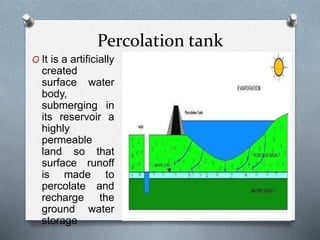
Percolation tank
O It is a artificially
created
surface water
body,
submerging in
its reservoir a
highly
permeable
land so that
surface runoff
is made to
percolate and
recharge the
ground water
storage
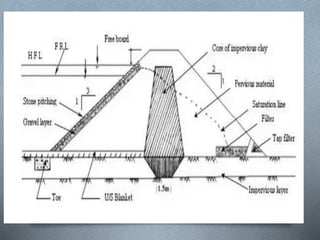
Component and construction
O Only earthen bund with cut off trench which is
constructed with locally available material like
moorum, soft rock, black cotton soil and stones for
chipping.
O The bund has single or straight alignment
O The cut off trench is provided for stability and
protection of bund from seepage directly through
junction of bund and ground having depth 30-90
cm & bottom width 60-120 cm.
O A central core portion is compacted filled by clayey
soil with full moisture condition and covered by
sandy soil with stone pitching over it on u/s side
with proper waste wier to pass flood water safely.
Advantages and disadvantages
O Advantages-
1. Low cost
2. Easy construction
3. Resource utilization
O Disadvantages-
1. Low efficiency- as compared to other
irrigation scheme
2. Costly investigation
3. Uncertain command area
4. Slip of bunds-due to seepage
Site selection for percolation
tank
O The bed of tank should be pervious
O There should be sufficient number of wells
in the command area
O The site should have sufficient discharge
O Side of stream should be steep
O Material and labour should available near
by site
Lift irrigation
O When source of water is lower than the
area to be irrigated then water is to be
lifted by artificial means and process of
lifting water from lower to higher level is
called as lift irrigation.
Advantages and disadvantages
O Advantages-
1. Efficiency-
optimum use of water thus increases efficiency
2. Isolated development-
more people get advantages
3. Prevents water logging
4. Local control-
as it is operated manually farmers use it properly
5. Utilization of resource-water from more below ground can be use
6. Investment-
small farmers can dug bore hole for only 15-20000/-
O Disadvantages-
1. Presence of harmful salts
2. Uneconomical
3. Low dependability
pump depends on motor if it fails farmer has to depend on other source
4. Increases manure requirement-
5. Less discharge- compared to canal
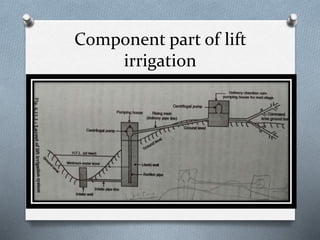
Component part of lift
irrigation
O Component parts of lift irrigation-
1. Intake channel
2. Inlet chamber
3. Jack well
4. Inlet pipe joining inlet chamber
5. Engine house
6. Rising main
7. Delivery chamber
8. Water distribution system
9. Pumping machinery
O Inlet channel-
to take water into inlet chamber it is designed below the
lowest water level
O Inlet chamber-
it is circular or rectangular constructed near the bank to
avoid silt and debris enter into jackwell by provision of steel mesh
at different level with different openings.
O Jackwell-
it gives location of an engine house above high flood level
and allows pumping during flood with dia. 3.65-4.55 m
O Inlet pipe-
to convey water from inlet chamber to jackwell with proper
gradient and valve is provided to control discharge
O Engine house-
it is with 1/2 engine with small store rooms for
storing fuels, spare parts, tools.
O Rising main-
convey water from inlet pipe to delivery chamber
O Delivery chamber-
the water from rising main is collected in delivery
chamber & then it is allowed to flow in field ditches.
(3×1.5×1m)
O Water distribution system-
O Pumping machinery
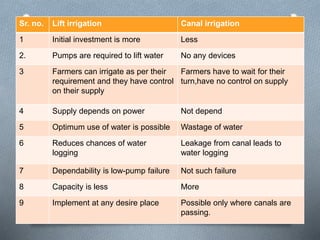
Sr. no. Lift irrigation Canal irrigation
1 Initial investment is more Less
2. Pumps are required to lift water No any devices
3 Farmers can irrigate as per their
requirement and they have control
on their supply
Farmers have to wait for their
turn,have no control on supply
4 Supply depends on power Not depend
5 Optimum use of water is possible Wastage of water
6 Reduces chances of water
logging
Leakage from canal leads to
water logging
7 Dependability is low-pump failure Not such failure
8 Capacity is less More
9 Implement at any desire place Possible only where canals are
passing.
Micro irrigation
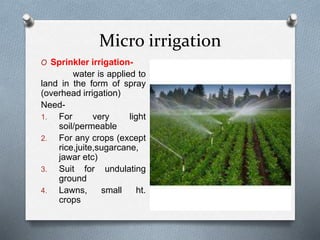
O Sprinkler irrigation-
water is applied to
land in the form of spray
(overhead irrigation)
Need-
1. For very light
soil/permeable
2. For any crops (except
rice,juite,sugarcane,
jawar etc)
3. Suit for undulating
ground
4. Lawns, small ht.
crops
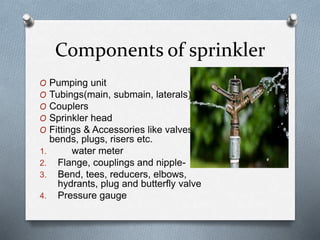
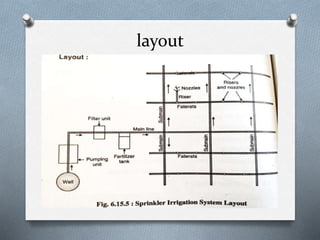
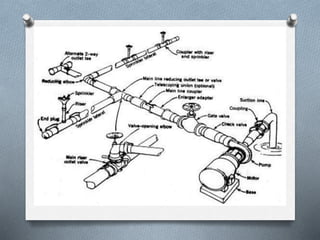
Components of sprinkler
O Pumping unit
O Tubings(main, submain, laterals)
O Couplers
O Sprinkler head
O Fittings & Accessories like valves,
bends, plugs, risers etc.
1. water meter
2. Flange, couplings and nipple-
3. Bend, tees, reducers, elbows,
hydrants, plug and butterfly valve
4. Pressure gauge
layout
Merits and demerits
O Merits-
1. Prevent Soil erosion
2. Uniform application of water
3. Land preparation is not required
4. No surface runoff
5. More land is available for cropping
6. Use of less water
7. Time and amount of fertilizers can be controlled
O Demerits-
1. Wind may obstruct sprinkling pattern
2. Water must be clean and free from sand
3. Depends on power
4. Soil with poor intake is not irrigated effectively
5. Initial and operating cost is more
6. Perforated pipe laid on ground may gets
choked
Situations where sprinkler is
used
O For many crops and all type of soil of
different topography with different slopes
O It is best useful to sandy soil and
permeable
O For steep slopes
O Suitable for growing high priced.
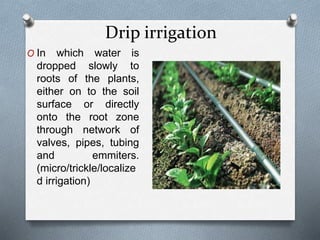
Drip irrigation
O In which water is
dropped slowly to
roots of the plants,
either on to the soil
surface or directly
onto the root zone
through network of
valves, pipes, tubing
and emmiters.
(micro/trickle/localize
d irrigation)
Need
O Saves the water and fertilizer
O In water scarcity zone it is useful
O Suitable for row crops
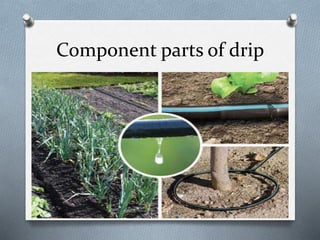
Component parts of drip
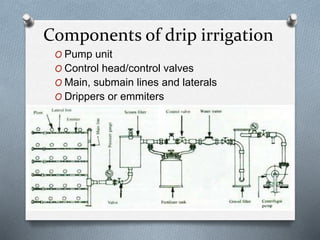
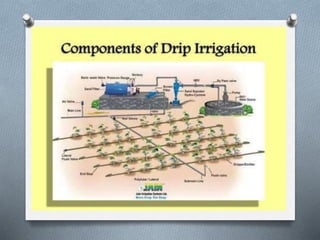
Components of drip irrigation
O Pump unit
O Control head/control valves
O Main, submain lines and laterals
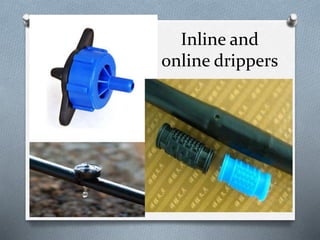
O Drippers or emmiters
Inline and
online drippers
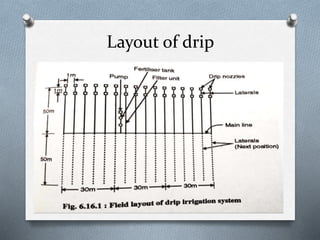
Layout of drip
Maintenance
O Emitters are prone to clogging due to deposits of
calcium carbonate, algae or bacteria so it needs
maintenance
1. Filter system should check every day and clean once
a month with drip tubing
2. Drip lines should be flushed with acid at the end of
each season to remove the precipitation of Ca & Mg
salts
3. Inspect drippers periodically to ensure that no clogging
4. During freezing weather it recommanded to drain poly
tube or rolling it up
5. Remove end caps to flush the line once a year
6. Remove the filter body after first week if is clean check
it in each month if there is no dirt then clean the filter
once a season

Minor and micro irrigation

  • 1.
  • 2.
    Percolation tank O Itis a artificially created surface water body, submerging in its reservoir a highly permeable land so that surface runoff is made to percolate and recharge the ground water storage
  • 4.
    Component and construction OOnly earthen bund with cut off trench which is constructed with locally available material like moorum, soft rock, black cotton soil and stones for chipping. O The bund has single or straight alignment O The cut off trench is provided for stability and protection of bund from seepage directly through junction of bund and ground having depth 30-90 cm & bottom width 60-120 cm. O A central core portion is compacted filled by clayey soil with full moisture condition and covered by sandy soil with stone pitching over it on u/s side with proper waste wier to pass flood water safely.
  • 5.
    Advantages and disadvantages OAdvantages- 1. Low cost 2. Easy construction 3. Resource utilization O Disadvantages- 1. Low efficiency- as compared to other irrigation scheme 2. Costly investigation 3. Uncertain command area 4. Slip of bunds-due to seepage
  • 6.
    Site selection forpercolation tank O The bed of tank should be pervious O There should be sufficient number of wells in the command area O The site should have sufficient discharge O Side of stream should be steep O Material and labour should available near by site
  • 7.
    Lift irrigation O Whensource of water is lower than the area to be irrigated then water is to be lifted by artificial means and process of lifting water from lower to higher level is called as lift irrigation.
  • 8.
    Advantages and disadvantages OAdvantages- 1. Efficiency- optimum use of water thus increases efficiency 2. Isolated development- more people get advantages 3. Prevents water logging 4. Local control- as it is operated manually farmers use it properly 5. Utilization of resource-water from more below ground can be use 6. Investment- small farmers can dug bore hole for only 15-20000/- O Disadvantages- 1. Presence of harmful salts 2. Uneconomical 3. Low dependability pump depends on motor if it fails farmer has to depend on other source 4. Increases manure requirement- 5. Less discharge- compared to canal
  • 9.
    Component part oflift irrigation
  • 10.
    O Component partsof lift irrigation- 1. Intake channel 2. Inlet chamber 3. Jack well 4. Inlet pipe joining inlet chamber 5. Engine house 6. Rising main 7. Delivery chamber 8. Water distribution system 9. Pumping machinery
  • 11.
    O Inlet channel- totake water into inlet chamber it is designed below the lowest water level O Inlet chamber- it is circular or rectangular constructed near the bank to avoid silt and debris enter into jackwell by provision of steel mesh at different level with different openings. O Jackwell- it gives location of an engine house above high flood level and allows pumping during flood with dia. 3.65-4.55 m O Inlet pipe- to convey water from inlet chamber to jackwell with proper gradient and valve is provided to control discharge
  • 12.
    O Engine house- itis with 1/2 engine with small store rooms for storing fuels, spare parts, tools. O Rising main- convey water from inlet pipe to delivery chamber O Delivery chamber- the water from rising main is collected in delivery chamber & then it is allowed to flow in field ditches. (3×1.5×1m) O Water distribution system- O Pumping machinery
  • 13.
    Sr. no. Liftirrigation Canal irrigation 1 Initial investment is more Less 2. Pumps are required to lift water No any devices 3 Farmers can irrigate as per their requirement and they have control on their supply Farmers have to wait for their turn,have no control on supply 4 Supply depends on power Not depend 5 Optimum use of water is possible Wastage of water 6 Reduces chances of water logging Leakage from canal leads to water logging 7 Dependability is low-pump failure Not such failure 8 Capacity is less More 9 Implement at any desire place Possible only where canals are passing.
  • 14.
    Micro irrigation O Sprinklerirrigation- water is applied to land in the form of spray (overhead irrigation) Need- 1. For very light soil/permeable 2. For any crops (except rice,juite,sugarcane, jawar etc) 3. Suit for undulating ground 4. Lawns, small ht. crops
  • 15.
    Components of sprinkler OPumping unit O Tubings(main, submain, laterals) O Couplers O Sprinkler head O Fittings & Accessories like valves, bends, plugs, risers etc. 1. water meter 2. Flange, couplings and nipple- 3. Bend, tees, reducers, elbows, hydrants, plug and butterfly valve 4. Pressure gauge
  • 16.
  • 18.
    Merits and demerits OMerits- 1. Prevent Soil erosion 2. Uniform application of water 3. Land preparation is not required 4. No surface runoff 5. More land is available for cropping 6. Use of less water 7. Time and amount of fertilizers can be controlled
  • 19.
    O Demerits- 1. Windmay obstruct sprinkling pattern 2. Water must be clean and free from sand 3. Depends on power 4. Soil with poor intake is not irrigated effectively 5. Initial and operating cost is more 6. Perforated pipe laid on ground may gets choked
  • 20.
    Situations where sprinkleris used O For many crops and all type of soil of different topography with different slopes O It is best useful to sandy soil and permeable O For steep slopes O Suitable for growing high priced.
  • 21.
    Drip irrigation O Inwhich water is dropped slowly to roots of the plants, either on to the soil surface or directly onto the root zone through network of valves, pipes, tubing and emmiters. (micro/trickle/localize d irrigation)
  • 22.
    Need O Saves thewater and fertilizer O In water scarcity zone it is useful O Suitable for row crops
  • 23.
  • 24.
    Components of dripirrigation O Pump unit O Control head/control valves O Main, submain lines and laterals O Drippers or emmiters
  • 25.
  • 27.
  • 28.
    Maintenance O Emitters areprone to clogging due to deposits of calcium carbonate, algae or bacteria so it needs maintenance 1. Filter system should check every day and clean once a month with drip tubing 2. Drip lines should be flushed with acid at the end of each season to remove the precipitation of Ca & Mg salts 3. Inspect drippers periodically to ensure that no clogging 4. During freezing weather it recommanded to drain poly tube or rolling it up 5. Remove end caps to flush the line once a year 6. Remove the filter body after first week if is clean check it in each month if there is no dirt then clean the filter once a season