E c o n o m i c        &


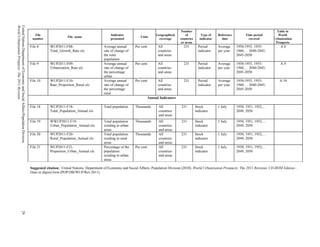
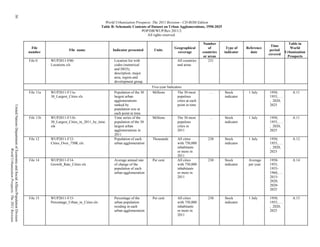
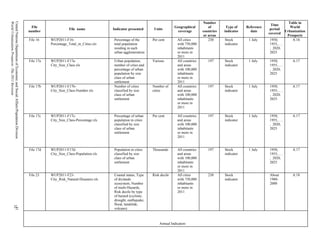
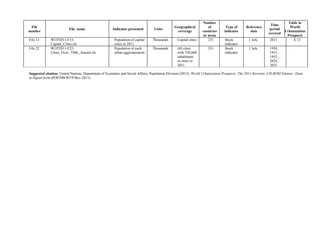
                                                 S o c i a l
                                                 A f f a i r s
World Urbanization Prospects
The 2011 Revision
 Highlights


              United Nations
                 New York
ESA/P/WP/224
                                                  March 2012
                                                  English only


Department of Economic and Social Affairs
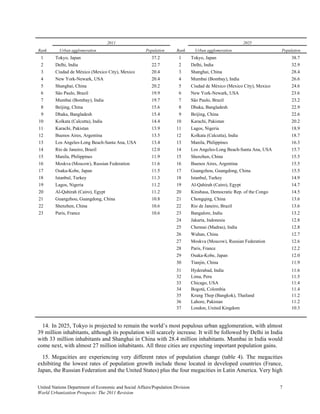
Population Division


World Urbanization Prospects
The 2011 Revision
  Highlights


                               United Nations
                               New York, 2012
DESA
The Department of Economic and Social Affairs of the United Nations Secretariat
is a vital interface between global policies in the economic, social and
environmental spheres and national action. The Department works in three main
interlinked areas: (i) it compiles, generates and analyses a wide range of economic,
social and environmental data and information on which States Members of the
United Nations draw to review common problems and take stock of policy
options; (ii) it facilitates the negotiations of Member States in many
intergovernmental bodies on joint courses of action to address ongoing or emerging
global challenges; and (iii) it advises interested Governments on the ways and means
of translating policy frameworks developed in United Nations conferences and
summits into programmes at the country level and, through technical assistance,
helps build national capacities.


        Note

        The designations employed in this report and the material presented in it do not
        imply the expression of any opinion whatsoever on the part of the Secretariat of
        the United Nations concerning the legal status of any country, territory, city or
        area or of its authorities, or concerning the delimitation of its frontiers or
        boundaries.

        Symbols of United Nations documents are composed of capital letters combined
        with figures.

        This publication has been issued without formal editing.
PREFACE


     The Population Division of the Department of Economic and Social Affairs at the United Nations
Secretariat is responsible for providing the international community with up-to-date and scientifically objective
information on population and development. The Population Division provides guidance to the United Nations
General Assembly, Economic and Social Council, and the Commission on Population and Development on
population and development issues and undertakes regular studies on population levels and trends, population
estimates and projections, population policies, and population and development inter-relationships.

       The Population Division’s work encompasses the following substantive areas: the study of mortality,
fertility, international and internal migration, including their levels and trends as well as their causes and
consequences; estimates and projections of the distribution of the population between urban and rural areas and
in cities; estimates and projections of population size, age and sex structure, and demographic indicators for all
countries of the world; the documentation and analysis of population and development policies at the national
and international levels; and the study of the relationship between socio-economic development and population
change.

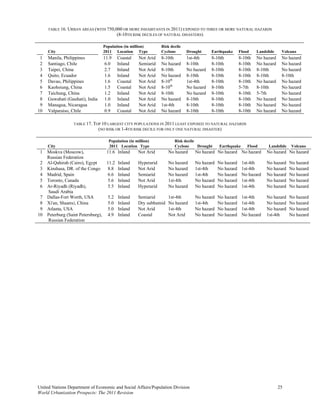
      This report presents the highlights of the 2011 Revision of World Urbanization Prospects including the
official United Nations estimates and projections of urban and rural populations for major areas, regions and
countries of the world and of all urban agglomerations with 750,000 inhabitants or more in 2011. The data in
this Revision are consistent with the total populations estimated and projected according to the medium variant
of the 2010 Revision of the United Nations global population estimates and projections, published in World
Population Prospects: The 2010 Revision1. This Revision updates and supersedes previous estimates and
projections published by the United Nations.

      Wall charts entitled Urban Agglomerations 2011 and Urban and Rural Areas 2011 will also be issued in
2012. A CD-ROM containing major results of the 2011 Revision can be purchased from the Population
Division. A description of the databases and an order form are given on pages 27-33 of this publication and are
also posted on the Population Division’s web site at www.unpopulation.org. All basic data and a complete list
of data sources can be retrieved from an on-line database at the same web site.

     This publication may also be accessed on the website of the Population Division at
www.unpopulation.org. For further information about the 2011 Revision, please contact the office of
Mr. Gerhard Heilig, Chief, Population Estimates and Projections Section (heilig@un.org), Population Division,
DESA, United Nations, New York, NY 10017, USA; tel.: (1 212) 963-4531, fax: (1 212) 963-2147.


    1
       World Population Prospects: The 2010 Revision, Volume I, Comprehensive Tables (United Nations publication,
ST/ESA/SER.A/313) and Volume II: Demographic Profiles. (United Nations publication, ST/ESA/SER.A/317).
http://esa.un.org/unpd/wpp/Documentation/publications.htm


United Nations Department of Economic and Social Affairs/Population Division                                         iii
World Urbanization Prospects: The 2011 Revision
CONTENTS
                                                                                                                                                                             Page

PREFACE....................................................................................................................................................................    iii

EXPLANATORY NOTES ............................................................................................................................................... vii

EXECUTIVE SUMMARY ..............................................................................................................................................                1

KEY FINDINGS OF THE 2011 REVISION .......................................................................................................................                       3

URBANIZATION AND NATURAL HAZARDS .................................................................................................................. 17

DATA IN DIGITAL FORM ............................................................................................................................................. 27

ORDER FORM ............................................................................................................................................................. 33


                                                                                   TABLES

No.


  1.   Total, urban and rural populations by development group, selected periods, 1950-2050 ...............................                                                     4
  2.   Percentage urban by development group, selected periods, 1950-2050 ..........................................................                                            4
  3.   Population of urban agglomerations with 10 million inhabitants or more, 1950, 1975, 2011 and 2025 .........                                                              6
  4.   Population of urban agglomerations with 10 million inhabitants or more in 2011 and their average
       annual rates of change, selected periods, 1970-2025.......................................................................................                               8
  5.   Population distribution of the world and development groups, by area of residence and size class of
       urban settlement, 1970, 2011 and 2025 ...........................................................................................................                        9
 6.    Percentage urban by major area, selected periods, 1950-2050 ........................................................................                                    11
 7.    Total, urban and rural populations by major area, selected periods, 1950-2050 .............................................                                             12
 8.    Government views on the spatial distribution of the population, 2009 ...........................................................                                        15
 9.    Number of cities by number of natural hazards, class size (2011) and major area .........................................                                               20
10.    City population (in million) by number of natural hazards, class size (2011) and region ...............................                                                 21
11.    Number of cities (750,000 inhabitants or more in 2011) by risk decile, type of natural hazard and
       coastal status ....................................................................................................................................................     22
12.    Population for cities or urban agglomerations of 750,000 inhabitants or more in 2011 (in millions)
       by risk decile, type of natural hazard and coastal status ..................................................................................                            22
13.    Cities and urban agglomerations (with 5 million or more inhabitants in 2011) exposed to at least one
       major natural hazard (8-10th risk deciles of natural disasters) ........................................................................                                23
14.    Top 10 largest city populations in 2011 at 8-10th risk deciles by type of hazard ............................................                                           24
15.    Top 10 fastest growing city populations in 2001-2011 at 8-10th risk deciles by type of hazard.....................                                                      24
16.    Urban areas (with 750,000 or more inhabitants in 2011) exposed to three or more natural hazards
       (8-10th risk deciles of natural disasters ...........................................................................................................                   25
17.    Top 10 largest city populations in 2011 least exposed to natural hazards (no risk or 1-4th risk decile
       for only one natural disaster ............................................................................................................................              25


United Nations Department of Economic and Social Affairs/Population Division                                                                                                    v
World Urbanization Prospects: The 2011 Revision
FIGURES
No                                                                                                                                           Page


   I.Urban and rural population of the world, 1950-2050...................................................................................      3
  II.Total population in millions by city size class, 1970, 1990, 2011 and 2025 ................................................                5
 III.Percentage of the population in urban areas, 2011, 2030 and 2050 .............................................................            10
 IV. Distribution of the world urban population by major area, 1950, 2011, 2050 .............................................                  11
  V. Contribution of demographic and urban growth to urbanization among the ten countries with the
     largest increase in their urban population between 2000 and 2050, 1950-2050 ..........................................                    14
 VI. Distribution of cities by population size in 2011 and risk of natural hazards ..............................................              18


vi                                                    United Nations Department of Economic and Social Affairs/Population Division
                                                                                 World Urbanization Prospects: The 2011 Revision
EXPLANATORY NOTES


The following symbols have been used in the tables throughout this report:

       Two dots (..) indicate that the item is not applicable.
       Three dots (...) indicate that data are not available or are not separately reported.
       An em dash (—) indicates that the value is zero (magnitude zero).
       0 or 0.0 indicates that the magnitude is not zero, but less than half of the unit employed.
       A minus sign (-) before a figure indicates a decrease.
       A full stop (.) is used to indicate decimals.
       Years given start on 1 July.
       Use of a hyphen (-) between years, for example, 1995-2000, signifies the full period involved,
       from 1 July of the beginning year to 30 June of the end year.

Decimals and percentages in tables may not add to the totals presented because of rounding.

References to countries, territories, areas and urban locations
The designations employed in this publication do not imply the expression of any opinion whatsoever on the part of
the Secretariat of the United Nations concerning the legal status of any country, territory or area or of its authorities,
or concerning the delimitation of its frontiers or boundaries.
The designations “more developed regions” and “less developed regions” are used for statistical convenience and do
not necessarily express a judgment about the stage reached by a particular country or area in the development
process. The term “country” as used in this publication also refers, as appropriate, to territories or areas.
The more developed regions comprise all regions of Europe plus Northern America, Australia/New Zealand and
Japan. The term “developed countries” is used to designate countries in the more developed regions.
The less developed regions comprise all regions of Africa, Asia (excluding Japan) and Latin America and the
Caribbean, as well as Melanesia, Micronesia and Polynesia. The term “developing countries” is used to designate
countries in the less developed regions.
The group of least developed countries, as defined by the United Nations General Assembly in resolutions 59/209,
59/210 and 60/33, as of January 2008 comprises 49 countries, 33of which are located in Africa, 10 in Asia, one in
Latin America and the Caribbean, and five in Oceania (Botswana graduated in 1994 and Cape Verde in December
2007 from the group of least developed countries).
Country names and the composition of geographical areas follow those presented in “Standard country or area codes
for statistical use” (ST/ESA/STAT/SER.M/49/Rev.3), available at:
http://unstats.un.org/unsd/methods/m49/m49.htm.
Names of cities or urban agglomerations are presented in their original language, following the names used by
National Statistical Offices or the United Nations Demographic Yearbook. For cities with names in more than one
language, different names are separated by a hyphen. If the country uses non-Latin scripts, a transliteration of the
original spelling into Latin script is used. If cities have established alternative names or English names, those names
are presented in brackets. When necessary, the administrative subdivision to which a city belongs is appended to the
city name to identify it unambiguously.
For convenience, the term “growth rate” is used in this report interchangeably with the more appropriate term “rate
of change”, which is neutral in respect to either growth or decline.
The following abbreviations are used in this publication:
DESA Department of Economic and Social Affairs
SAR      Special Administrative Region
HDI      Human Development Index


United Nations Department of Economic and Social Affairs/Population Division                                           vii
World Urbanization Prospects: The 2011 Revision
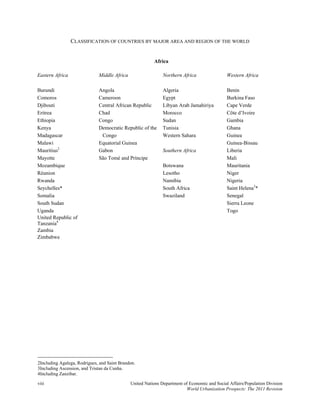
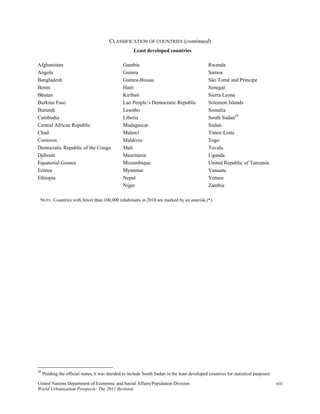
CLASSIFICATION OF COUNTRIES BY MAJOR AREA AND REGION OF THE WORLD


                                                         Africa

Eastern Africa                Middle Africa                   Northern Africa                 Western Africa

Burundi                       Angola                          Algeria                         Benin
Comoros                       Cameroon                        Egypt                           Burkina Faso
Djibouti                      Central African Republic        Libyan Arab Jamahiriya          Cape Verde
Eritrea                       Chad                            Morocco                         Côte d’Ivoire
Ethiopia                      Congo                           Sudan                           Gambia
Kenya                         Democratic Republic of the      Tunisia                         Ghana
Madagascar                     Congo                          Western Sahara                  Guinea
Malawi                        Equatorial Guinea                                               Guinea-Bissau
Mauritius2                    Gabon                           Southern Africa                 Liberia
Mayotte                       São Tomé and Príncipe                                           Mali
Mozambique                                                    Botswana                        Mauritania
Réunion                                                       Lesotho                         Niger
Rwanda                                                        Namibia                         Nigeria
Seychelles*                                                   South Africa                    Saint Helena3*
Somalia                                                       Swaziland                       Senegal
South Sudan                                                                                   Sierra Leone
Uganda                                                                                        Togo
United Republic of
Tanzania4
Zambia
Zimbabwe


2Including Agalega, Rodrigues, and Saint Brandon.
3Including Ascension, and Tristan da Cunha.
4Including Zanzibar.

viii                                          United Nations Department of Economic and Social Affairs/Population Division
                                                                         World Urbanization Prospects: The 2011 Revision
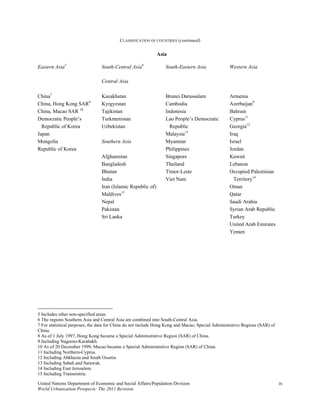
CLASSIFICATION OF COUNTRIES (continued)

                                                             Asia

Eastern Asia5                   South-Central Asia6              South-Eastern Asia               Western Asia

                                Central Asia

China7                          Kazakhstan                       Brunei Darussalam                Armenia
China, Hong Kong SAR8           Kyrgyzstan                       Cambodia                         Azerbaijan9
China, Macao SAR 10             Tajikistan                       Indonesia                        Bahrain
Democratic People’s             Turkmenistan                     Lao People’s Democratic          Cyprus11
  Republic of Korea             Uzbekistan                         Republic                       Georgia12
Japan                                                            Malaysia13                       Iraq
Mongolia                        Southern Asia                    Myanmar                          Israel
Republic of Korea                                                Philippines                      Jordan
                                Afghanistan                      Singapore                        Kuwait
                                Bangladesh                       Thailand                         Lebanon
                                Bhutan                           Timor-Leste                      Occupied Palestinian
                                India                            Viet Nam                           Territory14
                                Iran (Islamic Republic of)                                        Oman
                                Maldives15                                                        Qatar
                                Nepal                                                             Saudi Arabia
                                Pakistan                                                          Syrian Arab Republic
                                Sri Lanka                                                         Turkey
                                                                                                  United Arab Emirates
                                                                                                  Yemen


5 Includes other non-specified areas
6 The regions Southern Asia and Central Asia are combined into South-Central Asia.
7 For statistical purposes, the data for China do not include Hong Kong and Macao, Special Administrative Regions (SAR) of
China.
8 As of 1 July 1997, Hong Kong became a Special Administrative Region (SAR) of China.
9 Including Nagorno-Karabakh.
10 As of 20 December 1999, Macao became a Special Administrative Region (SAR) of China.
11 Including Northern-Cyprus.
12 Including Abkhazia and South Ossetia
13 Including Sabah and Sarawak.
14 Including East Jerusalem.
15 Including Transnistria.

United Nations Department of Economic and Social Affairs/Population Division                                                 ix
World Urbanization Prospects: The 2011 Revision
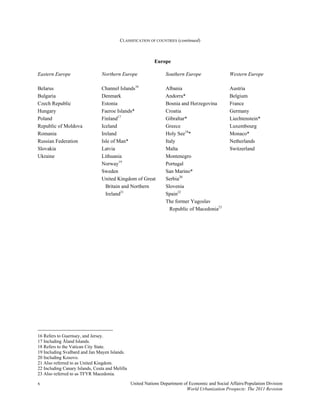
CLASSIFICATION OF COUNTRIES (continued)


                                                            Europe

Eastern Europe                  Northern Europe                   Southern Europe                 Western Europe

Belarus                         Channel Islands16                 Albania                         Austria
Bulgaria                        Denmark                           Andorra*                        Belgium
Czech Republic                  Estonia                           Bosnia and Herzegovina          France
Hungary                         Faeroe Islands*                   Croatia                         Germany
Poland                          Finland17                         Gibraltar*                      Liechtenstein*
Republic of Moldova             Iceland                           Greece                          Luxembourg
Romania                         Ireland                           Holy See18*                     Monaco*
Russian Federation              Isle of Man*                      Italy                           Netherlands
Slovakia                        Latvia                            Malta                           Switzerland
Ukraine                         Lithuania                         Montenegro
                                Norway19                          Portugal
                                Sweden                            San Marino*
                                United Kingdom of Great           Serbia20
                                  Britain and Northern            Slovenia
                                  Ireland21                       Spain22
                                                                  The former Yugoslav
                                                                    Republic of Macedonia23


16 Refers to Guernsey, and Jersey.
17 Including Åland Islands.
18 Refers to the Vatican City State.
19 Including Svalbard and Jan Mayen Islands.
20 Including Kosovo.
21 Also referred to as United Kingdom.
22 Including Canary Islands, Ceuta and Melilla
23 Also referred to as TFYR Macedonia.

x                                                United Nations Department of Economic and Social Affairs/Population Division
                                                                            World Urbanization Prospects: The 2011 Revision
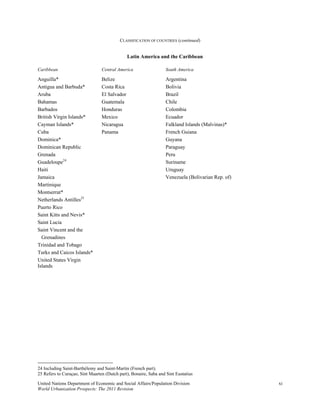
CLASSIFICATION OF COUNTRIES (continued)


                                               Latin America and the Caribbean

Caribbean                        Central America                  South America

Anguilla*                        Belize                           Argentina
Antigua and Barbuda*             Costa Rica                       Bolivia
Aruba                            El Salvador                      Brazil
Bahamas                          Guatemala                        Chile
Barbados                         Honduras                         Colombia
British Virgin Islands*          Mexico                           Ecuador
Cayman Islands*                  Nicaragua                        Falkland Islands (Malvinas)*
Cuba                             Panama                           French Guiana
Dominica*                                                         Guyana
Dominican Republic                                                Paraguay
Grenada                                                           Peru
Guadeloupe24                                                      Suriname
Haiti                                                             Uruguay
Jamaica                                                           Venezuela (Bolivarian Rep. of)
Martinique
Montserrat*
Netherlands Antilles25
Puerto Rico
Saint Kitts and Nevis*
Saint Lucia
Saint Vincent and the
  Grenadines
Trinidad and Tobago
Turks and Caicos Islands*
United States Virgin
Islands


24 Including Saint-Barthélemy and Saint-Martin (French part).
25 Refers to Curaçao, Sint Maarten (Dutch part), Bonaire, Saba and Sint Eustatius

United Nations Department of Economic and Social Affairs/Population Division                       xi
World Urbanization Prospects: The 2011 Revision
CLASSIFICATION OF COUNTRIES (continued)


                                                      Northern America

Bermuda*
Canada
Greenland*
Saint Pierre and Miquelon*
United States of America


                                                            Oceania

Australia/New Zealand            Melanesia                        Micronesia                     Polynesia26

Australia27                      Fiji                             Guam                           American Samoa*
New Zealand                      New Caledonia                    Kiribati*                      Cook Islands*
                                 Papua New Guinea                 Marshall Islands*              French Polynesia
                                 Solomon Islands                  Micronesia                     Niue*
                                 Vanuatu                           (Federated States of)         Samoa
                                                                  Nauru*                         Tokelau*
                                                                  Northern Mariana Islands*      Tonga
                                                                  Palau*                         Tuvalu*
                                                                                                 Wallis and Futuna Islands*


                                                       Sub-Saharan Africa

Angola                          Côte d'Ivoire             Kenya                Niger                      South Sudan
Benin                           Democratic Republic       Lesotho              Nigeria                    Swaziland
Botswana                         of the Congo             Liberia              Réunion                    Togo
Burkina Faso                    Djibouti                  Madagascar           Rwanda                     Uganda
Burundi                         Equatorial Guinea         Malawi               Saint Helena               United Republic
Cameroon                        Eritrea                   Mali                 São Tomé and Príncipe       of Tanzania
Cape Verde                      Ethiopia                  Mauritania           Senegal                    Zambia
Central African Republic        Gabon                     Mauritius            Seychelles                 Zimbabwe
Chad                            Gambia                    Mayotte              Sierra Leone
Comoros                         Ghana                     Mozambique           Somalia
Congo                           Guinea                    Namibia              South Africa
                                Guinea-Bissau


26 Including Pitcairn.
27 Including Christmas Island, Cocos (Keeling) Islands, and Norfolk Island.

xii                                             United Nations Department of Economic and Social Affairs/Population Division
                                                                           World Urbanization Prospects: The 2011 Revision
CLASSIFICATION OF COUNTRIES (continued)
                                                      Least developed countries

Afghanistan                                      Gambia                                        Rwanda
Angola                                           Guinea                                        Samoa
Bangladesh                                       Guinea-Bissau                                 São Tomé and Príncipe
Benin                                            Haiti                                         Senegal
Bhutan                                           Kiribati                                      Sierra Leone
Burkina Faso                                     Lao People’s Democratic Republic              Solomon Islands
Burundi                                          Lesotho                                       Somalia
Cambodia                                         Liberia                                       South Sudan28
Central African Republic                         Madagascar                                    Sudan
Chad                                             Malawi                                        Timor-Leste
Comoros                                          Maldives                                      Togo
Democratic Republic of the Congo                 Mali                                          Tuvalu
Djibouti                                         Mauritania                                    Uganda
Equatorial Guinea                                Mozambique                                    United Republic of Tanzania
Eritrea                                          Myanmar                                       Vanuatu
Ethiopia                                         Nepal                                         Yemen
                                                 Niger                                         Zambia

 NOTE: Countries with fewer than 100,000 inhabitants in 2010 are marked by an asterisk (*).


28
     Pending the official status, it was decided to include South Sudan in the least developed countries for statistical purposes.

United Nations Department of Economic and Social Affairs/Population Division                                                         xiii
World Urbanization Prospects: The 2011 Revision
EXECUTIVE SUMMARY

      Since 1988 the Population Division of the Department of Economic and Social Affairs of the United
Nations has been issuing every two years revised and updated estimates and projections of the urban and
rural populations of all countries in the world and of their major urban agglomerations. This note presents
the main findings of the 2011 Revision of World Urbanization Prospects which are consistent with the
size of the total population of each country as estimated or projected in the 2010 Revision of World
Population Prospects (United Nations, 2011).

     The 2011 Revision presents estimates and projections of the total, urban and rural populations of the
world for the period 1950-2050. The results are shown for development groups, six major areas (i.e.,
Africa, Asia, Europe, Latin America and the Caribbean, Northern America and Oceania) and 21 regions.
Data are further presented for the 231 countries or areas of the world. The 2011 Revision also provides
estimates and projections of the population of urban agglomerations with at least 750,000 inhabitants in
2011 for the period 1950-2025. Estimates of the proportion of the population living in urban areas and the
population of cities are based on national statistics. Population censuses are the most commonly used
sources of data on the proportion urban and the population of cities. However, in some countries, the data
used as the basis for estimation are obtained from population registers or administrative statistics.

      As reported in previous revisions, more than half of the world population lives in urban areas.
Nevertheless, not all regions of the world have reached this level of urbanization. According to the 2011
Revision, it is expected that half of the population of Asia will live in urban areas by 2020, while Africa is
likely to reach a 50 per cent urbanization rate only in 2035.

      Between 2011 and 2050, the world population is expected to increase by 2.3 billion, passing from
7.0 billion to 9.3 billion (United Nations, 2011).At the same time, the population living in urban areas is
projected to gain 2.6 billion, passing from 3.6 billion in 2011 to 6.3 billion 2050. Thus, the urban areas of
the world are expected to absorb all the population growth expected over the next four decades while at
the same time drawing in some of the rural population. As a result, the world rural population is projected
to start decreasing in about a decade and there will likely be 0.3 billion fewer rural inhabitants in 2050
than today. Furthermore, most of the population growth expected in urban areas will be concentrated in
the cities and towns of the less developed regions. Asia, in particular, is projected to see its urban
population increase by 1.4 billion, Africa by 0.9 billion, and Latin America and the Caribbean by 0.2
billion. Population growth is therefore becoming largely an urban phenomenon concentrated in the
developing world (David Satterthwaite, 2007).

     Realization of these projections is contingent on the continuation of fertility reductions in the
developing world. If fertility were to remain constant at current levels and the pace of urbanization
remained that projected in the 2011 Revision, the world urban population would increase to 7.4 billion by
2050 instead of the 6.3 billion expected when fertility is assumed to continue declining in all developing
regions (United Nations, 2009b). In many countries, natural increase (the difference of births minus
deaths) accounts for 60 per cent or more of urban population growth. Consequently, policies that facilitate
the reduction of fertility by ensuring that couples have access to the modern contraception and that they
can decide freely the number of children they desire can contribute to moderate increases in the number
of urban dwellers, thereby making it easier for developing countries to adjust to the transformations
associated with growing urbanization.

     There is significant diversity in the urbanization levels reached by different regions. The
transformative power of urbanization was felt earlier in today’s more developed regions and they have
reached high levels of urbanization. Thus, 78 per cent of the inhabitants of the more developed regions


United Nations Department of Economic and Social Affairs/Population Division                                1
World Urbanization Prospects: The 2011 Revision
lived in urban areas in 2011, whereas just 47 per cent of those in the less developed regions did so.
Urbanization is expected to continue rising in both the more developed and the less developed regions so
that, by 2050, urban dwellers will likely account for 86 per cent of the population in the more developed
regions and for 64 per cent of that in the less developed regions. Overall, the world population is expected
to be 67 per cent urban in 2050.

      Today’s 3.6 billion urban dwellers are distributed unevenly among urban settlements of different
size. In 2011, 23 urban agglomerations qualified as megacities because they had at least 10 million
inhabitants. By 2025 there will be 37 megacities. About 13.6 per cent of the urban population of the world
will then live in these very large agglomerations – up from 9.9 per cent today. The population living in
urban agglomerations with a population of between 5 and 10 million inhabitants will also increase
significantly – from 283 million in 2011 to 402 million in 2025. And the population in urban settlements
with a population between 1 and 5 million inhabitants will increase from 776 million to 1.129 billion.
There seems to be a process of urban concentration: Cities with more than 1 million inhabitants will
increase their share of the urban population, while cities with less than 1 million inhabitants will have a
declining share of the urban population of the world. For instance, in 2011, over half of the urban
population of the world still lives in urban centres with fewer than half a million inhabitants; by 2025 it
will be only 42.3 per cent of the urban population. These and other key findings of the 2011 Revision are
summarized below.


2                                       United Nations Department of Economic and Social Affairs/Population Division
                                                                   World Urbanization Prospects: The 2011 Revision
KEY FINDINGS OF THE 2011 REVISION

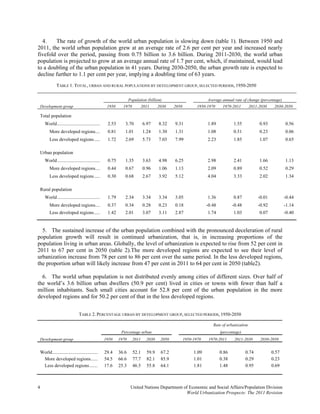
  1. Major disparities in the level of urbanization exist among development groups. Thus, whereas the
proportion urban in the more developed regions was already nearly 54 per cent in 1950, it will still take
another decade for half of the population of the less developed regions to live in urban areas (figure I).

                                           Figure I. Urban and rural populations by development group, 1950-2050

                          6,000


                          5,000
  Population (millions)


                          4,000


                          3,000


                          2,000


                          1,000


                             0
                              1950       1960     1970      1980     1990        2000    2010      2020      2030     2040      2050

                                     More developed regions - Urban population          Less developed regions - Urban population

                                     More developed regions - Rural population          Less developed regions - Rural population


  2. The world urban population is expected to increase by 72 per cent by 2050, from 3.6 billion in 2011
to 6.3 billion in 2050. By mid-century the world urban population will likely be the same size as the
world’s total population was in 2002. Virtually all of the expected growth in the world population will be
concentrated in the urban areas of the less developed regions, whose population is projected to increase
from 2.7 billion in 2011 to 5.1 billion in 2050. Over the same period, the rural population of the less
developed regions is expected to decline from 3.1 billion to 2.9 billion. In the more developed regions, the
urban population is projected to increase modestly, from 1 billion in 2011 to 1.1 billion in 2050 (table 1).

  3. The world rural population is expected to reach a maximum of 3.4 billion in 2021 and to decline
slowly thereafter, to reach 3.05 billion in 2050. These global trends are driven mostly by the dynamics of
rural population growth in the less developed regions, which house today almost 92 per cent of the world
rural population. Whereas the rural population of the more developed regions has been declining steadily
during the second half of the twentieth century and will continue to do so for the foreseeable future, the
rural population of the less developed regions more than doubled since 1950 and will likely continue to
grow until 2021 before a long-term decline sets in.


United Nations Department of Economic and Social Affairs/Population Division                                                           3
World Urbanization Prospects: The 2011 Revision
4.    The rate of growth of the world urban population is slowing down (table 1). Between 1950 and
2011, the world urban population grew at an average rate of 2.6 per cent per year and increased nearly
fivefold over the period, passing from 0.75 billion to 3.6 billion. During 2011-2030, the world urban
population is projected to grow at an average annual rate of 1.7 per cent, which, if maintained, would lead
to a doubling of the urban population in 41 years. During 2030-2050, the urban growth rate is expected to
decline further to 1.1 per cent per year, implying a doubling time of 63 years.
                TABLE 1. TOTAL, URBAN AND RURAL POPULATIONS BY DEVELOPMENT GROUP, SELECTED PERIODS, 1950-2050


                                                                   Population (billion)                         Average annual rate of change (percentage)
    Development group                                1950     1970          2011     2030    2050          1950-1970     1970-2011        2011-2030    2030-2050

    Total population
       World ....................................    2.53      3.70         6.97     8.32    9.31               1.89           1.55            0.93          0.56
           More developed regions ....               0.81      1.01         1.24     1.30    1.31               1.08           0.51            0.23          0.06
           Less developed regions .....              1.72      2.69         5.73     7.03    7.99               2.23           1.85            1.07          0.65

    Urban population
       World ....................................    0.75      1.35         3.63     4.98    6.25               2.98           2.41            1.66          1.13
           More developed regions ....               0.44      0.67         0.96     1.06    1.13               2.09           0.89            0.52          0.29
           Less developed regions .....              0.30      0.68         2.67     3.92    5.12               4.04           3.33            2.02          1.34

    Rural population
       World ....................................    1.79      2.34         3.34     3.34    3.05               1.36           0.87           -0.01          -0.44
           More developed regions ....               0.37      0.34         0.28     0.23    0.18               -0.48          -0.48          -0.92          -1.14
           Less developed regions .....              1.42      2.01         3.07     3.11    2.87               1.74           1.03            0.07          -0.40


  5. The sustained increase of the urban population combined with the pronounced deceleration of rural
population growth will result in continued urbanization, that is, in increasing proportions of the
population living in urban areas. Globally, the level of urbanization is expected to rise from 52 per cent in
2011 to 67 per cent in 2050 (table 2).The more developed regions are expected to see their level of
urbanization increase from 78 per cent to 86 per cent over the same period. In the less developed regions,
the proportion urban will likely increase from 47 per cent in 2011 to 64 per cent in 2050 (table2).

  6. The world urban population is not distributed evenly among cities of different sizes. Over half of
the world’s 3.6 billion urban dwellers (50.9 per cent) lived in cities or towns with fewer than half a
million inhabitants. Such small cities account for 52.8 per cent of the urban population in the more
developed regions and for 50.2 per cent of that in the less developed regions.


                                 TABLE 2. PERCENTAGE URBAN BY DEVELOPMENT GROUP, SELECTED PERIODS, 1950-2050

                                                                                                                   Rate of urbanization
                                                             Percentage urban                                           (percentage)
    Development group                               1950    1970     2011     2030    2050          1950-1970    1970-2011      2011-2030      2030-2050


    World ......................................    29.4    36.6     52.1     59.9    67.2               1.09           0.86           0.74           0.57
     More developed regions......                   54.5    66.6     77.7     82.1    85.9               1.01           0.38           0.29           0.23
     Less developed regions .......                 17.6    25.3     46.5     55.8    64.1               1.81           1.48           0.95           0.69


4                                                                   United Nations Department of Economic and Social Affairs/Population Division
                                                                                               World Urbanization Prospects: The 2011 Revision
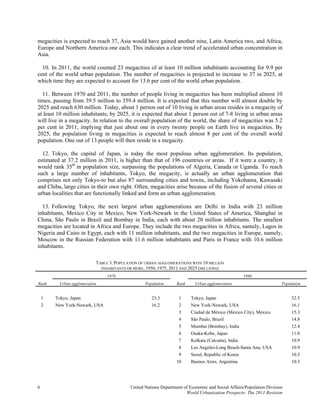
7. In 2011, cities with fewer than 500,000 inhabitants accounted for about half of the world urban
population, amounting to 1.85 billion (figure II). Cities with populations ranging between 500,000 and 1
million were home to a further 365 million people, equivalent to 10.1 per cent of the world urban
population. Taken together, cities with fewer than 1 million inhabitants account for 61 per cent of the
urban population.

                                  Figure II. Total population in millions by city size class, 1970, 1990, 2011 and 2025


                                                      1,966
                               2,000
                                               1,849


                                                                                                1970       1990        2011       2025
  Total population (million)


                               1,500
                                           1,333

                                                                                                       1,129

                               1,000
                                         833
                                                                                                  776

                                                                                                                                                         630
                                                                                516
                                500                                                           456
                                                                          365                                                   402                359
                                                                                                                          283
                                                                    206                   244
                                                                 128                                              109142                      145
                                                                                                                                            39
                                   0
                                          Fewer Than               500,000 to 1        1 to 5 million          5 to 10 million        10 million or more
                                            500,000                  million


                                  NOTE: The overall population in the smallest cities is estimated as the difference of the total urban population and the sum of
                                  the populations in cities estimated to have at least 500,000 inhabitants at each point in time.


  8. While three in every five people living in urban areas reside in cities smaller than 1 million
inhabitants in 2011, this proportion is expected to decline in the future. By 2025, only one person out of
two will live in cities of this size. In contrast, cities of 1 million and more inhabitants, accounting for
about 40 per cent of the world urban population in 2011, are expected to account for 47 per cent of the
world urban population by 2025. Indeed, the future urban population will be increasingly concentrated in
large cities of one million or more inhabitants. In fact, among the million plus cities, the megacities of at
least 10 million inhabitants will experience the largest percentage increase. This increasing urban
concentration in very large cities is a new trend which contradicts previous observations.

  9. By 1970, the world had only two megacities: Tokyo and New York. Since then their number has
increased markedly and most new megacities have arisen in developing countries (table 3). Today, Asia
has 13 megacities, Latin America has four, and Africa, Europe and Northern America have two each
(table 3). Thirteen of those megacities are capitals of their countries. By 2025, when the number of

United Nations Department of Economic and Social Affairs/Population Division                                                                                        5
World Urbanization Prospects: The 2011 Revision
megacities is expected to reach 37, Asia would have gained another nine, Latin America two, and Africa,
Europe and Northern America one each. This indicates a clear trend of accelerated urban concentration in
Asia.

  10. In 2011, the world counted 23 megacities of at least 10 million inhabitants accounting for 9.9 per
cent of the world urban population. The number of megacities is projected to increase to 37 in 2025, at
which time they are expected to account for 13.6 per cent of the world urban population.

  11. Between 1970 and 2011, the number of people living in megacities has been multiplied almost 10
times, passing from 39.5 million to 359.4 million. It is expected that this number will almost double by
2025 and reach 630 million. Today, about 1 person out of 10 living in urban areas resides in a megacity of
at least 10 million inhabitants; by 2025, it is expected that about 1 person out of 7-8 living in urban areas
will live in a megacity. In relation to the overall population of the world, the share of megacities was 5.2
per cent in 2011, implying that just about one in every twenty people on Earth live in megacities. By
2025, the population living in megacities is expected to reach almost 8 per cent of the overall world
population. One out of 13 people will then reside in a megacity.

  12. Tokyo, the capital of Japan, is today the most populous urban agglomeration. Its population,
estimated at 37.2 million in 2011, is higher than that of 196 countries or areas. If it were a country, it
would rank 35th in population size, surpassing the populations of Algeria, Canada or Uganda. To reach
such a large number of inhabitants, Tokyo, the megacity, is actually an urban agglomeration that
comprises not only Tokyo-to but also 87 surrounding cities and towns, including Yokohama, Kawasaki
and Chiba, large cities in their own right. Often, megacities arise because of the fusion of several cities or
urban localities that are functionally linked and form an urban agglomeration.

  13. Following Tokyo, the next largest urban agglomerations are Delhi in India with 23 million
inhabitants, Mexico City in Mexico, New York-Newark in the United States of America, Shanghai in
China, São Paulo in Brazil and Bombay in India, each with about 20 million inhabitants. The smallest
megacities are located in Africa and Europe. They include the two megacities in Africa, namely, Lagos in
Nigeria and Cairo in Egypt, each with 11 million inhabitants, and the two megacities in Europe, namely,
Moscow in the Russian Federation with 11.6 million inhabitants and Paris in France with 10.6 million
inhabitants.

                           TABLE 3. POPULATION OF URBAN AGGLOMERATIONS WITH 10 MILLION
                             INHABITANTS OR MORE, 1950, 1975, 2011 AND 2025 (MILLIONS)

                                1970                                                              1990
Rank     Urban agglomeration                     Population      Rank     Urban agglomeration                        Population


    1   Tokyo, Japan                                23.3          1     Tokyo, Japan                                      32.5
    2   New York-Newark, USA                        16.2          2     New York-Newark, USA                              16.1
                                                                  3     Ciudad de México (Mexico City), Mexico            15.3
                                                                  4     São Paulo, Brazil                                 14.8
                                                                  5     Mumbai (Bombay), India                            12.4
                                                                  6     Osaka-Kobe, Japan                                 11.0
                                                                  7     Kolkata (Calcutta), India                         10.9
                                                                  8     Los Angeles-Long Beach-Santa Ana, USA             10.9
                                                                  9     Seoul, Republic of Korea                          10.5
                                                                 10     Buenos Aires, Argentina                           10.5


6                                         United Nations Department of Economic and Social Affairs/Population Division
                                                                     World Urbanization Prospects: The 2011 Revision
2011                                                                      2025
Rank         Urban agglomeration                         Population        Rank        Urban agglomeration                      Population
 1      Tokyo, Japan                                        37.2            1     Tokyo, Japan                                       38.7
 2      Delhi, India                                        22.7            2     Delhi, India                                       32.9
 3      Ciudad de México (Mexico City), Mexico              20.4            3     Shanghai, China                                    28.4
 4      New York-Newark, USA                                20.4            4     Mumbai (Bombay), India                             26.6
 5      Shanghai, China                                     20.2            5     Ciudad de México (Mexico City), Mexico             24.6
 6      São Paulo, Brazil                                   19.9            6     New York-Newark, USA                               23.6
 7      Mumbai (Bombay), India                              19.7            7     São Paulo, Brazil                                  23.2
 8      Beijing, China                                      15.6            8     Dhaka, Bangladesh                                  22.9
 9      Dhaka, Bangladesh                                   15.4            9     Beijing, China                                     22.6
10      Kolkata (Calcutta), India                           14.4           10     Karachi, Pakistan                                  20.2
11      Karachi, Pakistan                                   13.9           11     Lagos, Nigeria                                     18.9
12      Buenos Aires, Argentina                             13.5           12     Kolkata (Calcutta), India                          18.7
13      Los Angeles-Long Beach-Santa Ana, USA               13.4           13     Manila, Philippines                                16.3
14      Rio de Janeiro, Brazil                              12.0           14     Los Angeles-Long Beach-Santa Ana, USA              15.7
15      Manila, Philippines                                 11.9           15     Shenzhen, China                                    15.5
16      Moskva (Moscow), Russian Federation                 11.6           16     Buenos Aires, Argentina                            15.5
17      Osaka-Kobe, Japan                                   11.5           17     Guangzhou, Guangdong, China                        15.5
18      Istanbul, Turkey                                    11.3           18     Istanbul, Turkey                                   14.9
19      Lagos, Nigeria                                      11.2           19     Al-Qahirah (Cairo), Egypt                          14.7
20      Al-Qahirah (Cairo), Egypt                           11.2           20     Kinshasa, Democratic Rep. of the Congo             14.5
21      Guangzhou, Guangdong, China                         10.8           21     Chongqing, China                                   13.6
22      Shenzhen, China                                     10.6           22     Rio de Janeiro, Brazil                             13.6
23      Paris, France                                       10.6           23     Bangalore, India                                   13.2
                                                                           24     Jakarta, Indonesia                                 12.8
                                                                           25     Chennai (Madras), India                            12.8
                                                                           26     Wuhan, China                                       12.7
                                                                           27     Moskva (Moscow), Russian Federation                12.6
                                                                           28     Paris, France                                      12.2
                                                                           29     Osaka-Kobe, Japan                                  12.0
                                                                           30     Tianjin, China                                     11.9
                                                                           31     Hyderabad, India                                   11.6
                                                                           32     Lima, Peru                                         11.5
                                                                           33     Chicago, USA                                       11.4
                                                                           34     Bogotá, Colombia                                   11.4
                                                                           35     Krung Thep (Bangkok), Thailand                     11.2
                                                                           36     Lahore, Pakistan                                   11.2
                                                                           37     London, United Kingdom                             10.3
                                                                                                                             

  14. In 2025, Tokyo is projected to remain the world’s most populous urban agglomeration, with almost
39 million inhabitants, although its population will scarcely increase. It will be followed by Delhi in India
with 33 million inhabitants and Shanghai in China with 28.4 million inhabitants. Mumbai in India would
come next, with almost 27 million inhabitants. All three cities are expecting important population gains.
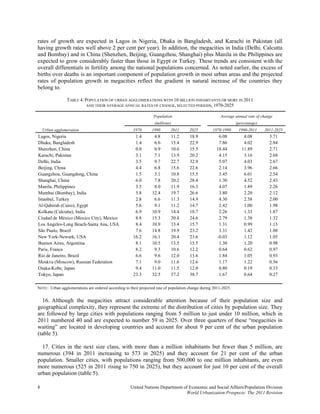
  15. Megacities are experiencing very different rates of population change (table 4). The megacities
exhibiting the lowest rates of population growth include those located in developed countries (France,
Japan, the Russian Federation and the United States) plus the four megacities in Latin America. Very high

United Nations Department of Economic and Social Affairs/Population Division                                                7
World Urbanization Prospects: The 2011 Revision
rates of growth are expected in Lagos in Nigeria, Dhaka in Bangladesh, and Karachi in Pakistan (all
having growth rates well above 2 per cent per year). In addition, the megacities in India (Delhi, Calcutta
and Bombay) and in China (Shenzhen, Beijing, Guangzhou, Shanghai) plus Manila in the Philippines are
expected to grow considerably faster than those in Egypt or Turkey. These trends are consistent with the
overall differentials in fertility among the national populations concerned. As noted earlier, the excess of
births over deaths is an important component of population growth in most urban areas and the projected
rates of population growth in megacities reflect the gradient in natural increase of the countries they
belong to.

                TABLE 4. POPULATION OF URBAN AGGLOMERATIONS WITH 10 MILLION INHABITANTS OR MORE IN 2011
                          AND THEIR AVERAGE ANNUAL RATES OF CHANGE, SELECTED PERIODS, 1970-2025

                                                                  Population                             Average annual rate of change
                                                                   (millions)                                     (percentage)
    Urban agglomeration                               1970       1990       2011       2025         1970-1990      1990-2011     2011-2025
Lagos, Nigeria                                         1.4        4.8           11.2   18.9            6.08           4.08          3.71
Dhaka, Bangladesh                                      1.4        6.6           15.4   22.9            7.86           4.02          2.84
Shenzhen, China                                        0.0        0.9           10.6   15.5           18.44          11.89          2.71
Karachi, Pakistan                                      3.1        7.1           13.9   20.2            4.15           3.16          2.68
Delhi, India                                           3.5        9.7           22.7   32.9            5.07           4.03          2.67
Beijing, China                                         4.4        6.8           15.6   22.6            2.14           3.96          2.66
Guangzhou, Guangdong, China                            1.5        3.1           10.8   15.5            3.45           6.01          2.54
Shanghai, China                                        6.0        7.8           20.2   28.4            1.30           4.52          2.43
Manila, Philippines                                    3.5        8.0           11.9   16.3            4.07           1.89          2.26
Mumbai (Bombay), India                                 5.8       12.4           19.7   26.6            3.80           2.20          2.12
Istanbul, Turkey                                       2.8        6.6           11.3   14.9            4.30           2.58          2.00
Al-Qahirah (Cairo), Egypt                              5.6        9.1           11.2   14.7            2.42           1.00          1.98
Kolkata (Calcutta), India                              6.9       10.9           14.4   18.7            2.26           1.33          1.87
Ciudad de México (Mexico City), Mexico                 8.8       15.3           20.4   24.6            2.79           1.38          1.32
Los Angeles-Long Beach-Santa Ana, USA                  8.4       10.9           13.4   15.7            1.31           0.99          1.13
São Paulo, Brazil                                      7.6       14.8           19.9   23.2            3.31           1.42          1.08
New York-Newark, USA                                  16.2       16.1           20.4   23.6           -0.03           1.12          1.05
Buenos Aires, Argentina                                8.1       10.5           13.5   15.5            1.30           1.20          0.98
Paris, France                                          8.2        9.3           10.6   12.2            0.64           0.62          0.97
Rio de Janeiro, Brazil                                 6.6        9.6           12.0   13.6            1.84           1.05          0.93
Moskva (Moscow), Russian Federation                    7.1        9.0           11.6   12.6            1.17           1.22          0.56
Osaka-Kobe, Japan                                      9.4       11.0           11.5   12.0            0.80           0.19          0.33
Tokyo, Japan                                          23.3       32.5           37.2   38.7            1.67           0.64          0.27

NOTE: Urban agglomerations are ordered according to their projected rate of population change during 2011-2025.


  16. Although the megacities attract considerable attention because of their population size and
geographical complexity, they represent the extreme of the distribution of cities by population size. They
are followed by large cities with populations ranging from 5 million to just under 10 million, which in
2011 numbered 40 and are expected to number 59 in 2025. Over three quarters of these “megacities in
waiting” are located in developing countries and account for about 9 per cent of the urban population
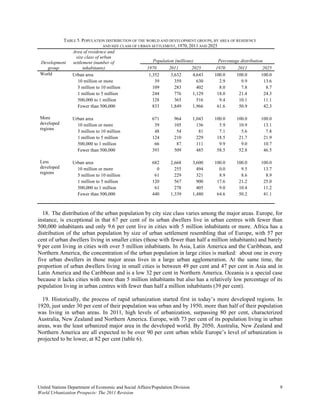
(table 5).

  17. Cities in the next size class, with more than a million inhabitants but fewer than 5 million, are
numerous (394 in 2011 increasing to 573 in 2025) and they account for 21 per cent of the urban
population. Smaller cities, with populations ranging from 500,000 to one million inhabitants, are even
more numerous (525 in 2011 rising to 750 in 2025), but they account for just 10 per cent of the overall
urban population (table 5).

8                                                    United Nations Department of Economic and Social Affairs/Population Division
                                                                                World Urbanization Prospects: The 2011 Revision
TABLE 5. POPULATION DISTRIBUTION OF THE WORLD AND DEVELOPMENT GROUPS, BY AREA OF RESIDENCE
                                AND SIZE CLASS OF URBAN SETTLEMENT, 1970, 2011 AND 2025
               Area of residence and
                 size class of urban
 Development   settlement (number of                     Population (millions)          Percentage distribution
    group            inhabitants)                     1970       2011        2025     1970       2011          2025
 World        Urban area                               1,352      3,632       4,643   100.0      100.0        100.0
                  10 million or more                      39        359         630     2.9        9.9          13.6
                  5 million to 10 million                109        283         402     8.0        7.8           8.7
                  1 million to 5 million                 244        776       1,129    18.0       21.4          24.3
                  500,000 to 1 million                   128        365         516     9.4       10.1          11.1
                  Fewer than 500,000                     833      1,849       1,966    61.6       50.9          42.3

 More            Urban area                              671        964        1,043   100.0      100.0       100.0
 developed         10 million or more                     39        105          136     5.9       10.9        13.1
 regions
                   5 million to 10 million                48         54           81     7.1        5.6         7.8
                   1 million to 5 million                124        210          229    18.5       21.7        21.9
                   500,000 to 1 million                   66         87          111     9.9        9.0        10.7
                   Fewer than 500,000                    393        509          485    58.5       52.8        46.5

 Less            Urban area                              682      2,668        3,600   100.0      100.0       100.0
 developed         10 million or more                      0        255          494     0.0        9.5        13.7
 regions
                   5 million to 10 million                61        229          321     8.9        8.6         8.9
                   1 million to 5 million                120        567          900    17.6       21.2        25.0
                   500,000 to 1 million                   61        278          405     9.0       10.4        11.2
                   Fewer than 500,000                    440      1,339        1,480    64.6       50.2        41.1


  18. The distribution of the urban population by city size class varies among the major areas. Europe, for
instance, is exceptional in that 67 per cent of its urban dwellers live in urban centres with fewer than
500,000 inhabitants and only 9.6 per cent live in cities with 5 million inhabitants or more. Africa has a
distribution of the urban population by size of urban settlement resembling that of Europe, with 57 per
cent of urban dwellers living in smaller cities (those with fewer than half a million inhabitants) and barely
9 per cent living in cities with over 5 million inhabitants. In Asia, Latin America and the Caribbean, and
Northern America, the concentration of the urban population in large cities is marked: about one in every
five urban dwellers in those major areas lives in a large urban agglomeration. At the same time, the
proportion of urban dwellers living in small cities is between 49 per cent and 47 per cent in Asia and in
Latin America and the Caribbean and is a low 32 per cent in Northern America. Oceania is a special case
because it lacks cities with more than 5 million inhabitants but also has a relatively low percentage of its
population living in urban centres with fewer than half a million inhabitants (39 per cent).

  19. Historically, the process of rapid urbanization started first in today’s more developed regions. In
1920, just under 30 per cent of their population was urban and by 1950, more than half of their population
was living in urban areas. In 2011, high levels of urbanization, surpassing 80 per cent, characterized
Australia, New Zealand and Northern America. Europe, with 73 per cent of its population living in urban
areas, was the least urbanized major area in the developed world. By 2050, Australia, New Zealand and
Northern America are all expected to be over 90 per cent urban while Europe’s level of urbanization is
projected to be lower, at 82 per cent (table 6).


United Nations Department of Economic and Social Affairs/Population Division                                           9
World Urbanization Prospects: The 2011 Revision
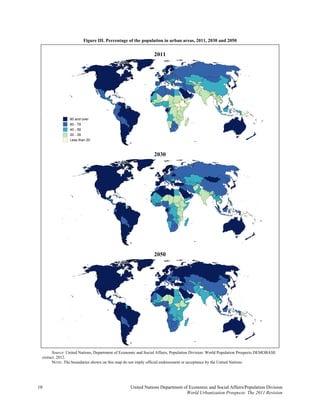
Figure III. Percentage of the population in urban areas, 2011, 2030 and 2050


                                                                  2011


                    80 and over
                    60 - 79
                    40 - 59
                    20 - 39
                    Less than 20


                                                                  2030


                                                                  2050


           Source: United Nations, Department of Economic and Social Affairs, Population Division: World Population Prospects DEMOBASE
     extract. 2012.
           NOTE: The boundaries shown on this map do not imply official endorsement or acceptance by the United Nations.


10                                                   United Nations Department of Economic and Social Affairs/Population Division
                                                                                World Urbanization Prospects: The 2011 Revision
Figure IV. Distribution of the world urban population by major area, 1950, 2011, 2050
   60%

                                                   52%53%
   50%
                                                                                                    1950         2011      2050

   40%                                                             38%
                                             33%

   30%


                              20%
   20%
                                                                     15%                                   15%
                                                                                         13%
                        11%
                                                                            9%          9%          10%
   10%                                                                                                         8%
                                                                                                                    6%
                   4%
                                                                                                                           1% 1% 1%
     0%
                      Africa                        Asia            Europe         Latin America             Northern       Oceania
                                                                                      and the                America
                                                                                     Caribbean


  20. Among the less developed regions, Latin America and the Caribbean has an exceptionally high
level of urbanization (79 per cent), higher than that of Europe. Africa and Asia, in contrast, remain mostly
rural, with 40 per cent and 45 per cent, respectively, of their populations living in urban areas. Over the
coming decades, the level of urbanization is expected to increase in all major areas of the developing
world, with Africa and Asia urbanizing more rapidly than the rest (table 6). Nevertheless, by mid-century,
Africa and Asia are expected still to have lower levels of urbanization than the more developed regions or
Latin America and the Caribbean (figure III).

                                       TABLE 6. PERCENTAGE URBAN BY MAJOR AREA, SELECTED PERIODS, 1950-2050

                                                                                                                        Rate of urbanization
                                                                         Percentage urban                                  (percentage)
                                                                                                                  1950-    1970- 2011- 2030-
 Major area                                                 1950     1970        2011    2030         2050        1970     2011      2030    2050

 Africa ................................................    14.4     23.5        39.6        47.7     57.7          2.47     1.27   0.98     0.96
 Asia ...................................................   17.5     23.7        45.0        55.5     64.4          1.52     1.57   1.10     0.74
 Europe...............................................      51.3     62.8        72.9        77.4     82.2          1.02     0.36   0.31     0.30
 Latin America and the Caribbean .....                      41.4     57.1        79.1        83.4     86.6          1.61     0.80   0.28     0.19
 Northern America .............................             63.9     73.8        82.2        85.8     88.6          0.72     0.26   0.22     0.16
 Oceania .............................................      62.4     71.2        70.7        71.4     73.0          0.66    -0.02   0.05     0.12


United Nations Department of Economic and Social Affairs/Population Division                                                                   11
World Urbanization Prospects: The 2011 Revision
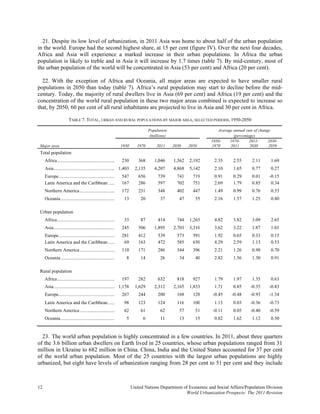
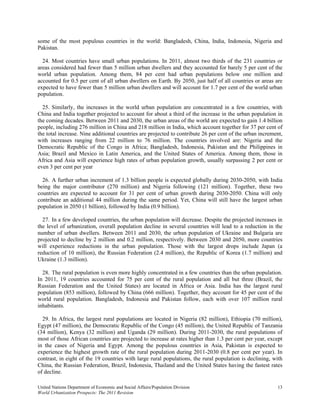
21. Despite its low level of urbanization, in 2011 Asia was home to about half of the urban population
in the world. Europe had the second highest share, at 15 per cent (figure IV). Over the next four decades,
Africa and Asia will experience a marked increase in their urban populations. In Africa the urban
population is likely to treble and in Asia it will increase by 1.7 times (table 7). By mid-century, most of
the urban population of the world will be concentrated in Asia (53 per cent) and Africa (20 per cent).

  22. With the exception of Africa and Oceania, all major areas are expected to have smaller rural
populations in 2050 than today (table 7). Africa’s rural population may start to decline before the mid-
century. Today, the majority of rural dwellers live in Asia (69 per cent) and Africa (19 per cent) and the
concentration of the world rural population in these two major areas combined is expected to increase so
that, by 2050, 60 per cent of all rural inhabitants are projected to live in Asia and 30 per cent in Africa.

                        TABLE 7. TOTAL, URBAN AND RURAL POPULATIONS BY MAJOR AREA, SELECTED PERIODS, 1950-2050

                                                                                 Population                       Average annual rate of change
                                                                                 (millions)                               (percentage)
                                                                                                               1950-    1970-      2011-      2030-
 Major area                                                     1950      1970       2011     2030    2050     1970     2011       2030       2050
 Total population
     Africa ................................................    230       368       1,046     1,562   2,192      2.35      2.55      2.11      1.69
     Asia ................................................... 1,403      2,135      4,207     4,868   5,142      2.10      1.65      0.77      0.27
     Europe...............................................      547       656         739       741     719      0.91      0.29      0.01     -0.15
     Latin America and the Caribbean .....                      167       286         597       702     751      2.69      1.79      0.85      0.34
     Northern America .............................             172       231         348       402     447      1.49      0.99      0.76      0.53
     Oceania .............................................       13         20         37        47      55      2.16      1.57      1.25      0.80

 Urban population
     Africa ................................................     33         87        414       744   1,265      4.82      3.82      3.09      2.65
     Asia ...................................................   245       506       1,895     2,703   3,310      3.62      3.22      1.87      1.01
     Europe...............................................      281       412         539       573     591      1.92      0.65      0.33      0.15
     Latin America and the Caribbean .....                       69       163         472       585     650      4.29      2.59      1.13      0.53
     Northern America .............................             110       171         286       344     396      2.21      1.26      0.98      0.70
     Oceania .............................................        8         14         26        34      40      2.82      1.56      1.30      0.91

 Rural population
     Africa ................................................    197       282         632       818     927      1.79      1.97      1.35      0.63
     Asia ................................................... 1,158      1,629      2,312     2,165   1,833      1.71      0.85     -0.35     -0.83
     Europe...............................................      267       244         200       168     128     -0.45     -0.48     -0.93     -1.34
     Latin America and the Caribbean .....                       98       123         124       116     100      1.13      0.03     -0.36     -0.73
     Northern America .............................              62         61         62        57      51     -0.11      0.05     -0.40     -0.59
     Oceania .............................................        5          6         11        13      15      0.82      1.62      1.12      0.50


  23. The world urban population is highly concentrated in a few countries. In 2011, about three quarters
of the 3.6 billion urban dwellers on Earth lived in 25 countries, whose urban populations ranged from 31
million in Ukraine to 682 million in China. China, India and the United States accounted for 37 per cent
of the world urban population. Most of the 25 countries with the largest urban populations are highly
urbanized, but eight have levels of urbanization ranging from 28 per cent to 51 per cent and they include


12                                                                     United Nations Department of Economic and Social Affairs/Population Division
                                                                                                  World Urbanization Prospects: The 2011 Revision
some of the most populous countries in the world: Bangladesh, China, India, Indonesia, Nigeria and
Pakistan.

  24. Most countries have small urban populations. In 2011, almost two thirds of the 231 countries or
areas considered had fewer than 5 million urban dwellers and they accounted for barely 5 per cent of the
world urban population. Among them, 84 per cent had urban populations below one million and
accounted for 0.5 per cent of all urban dwellers on Earth. By 2050, just half of all countries or areas are
expected to have fewer than 5 million urban dwellers and will account for 1.7 per cent of the world urban
population.

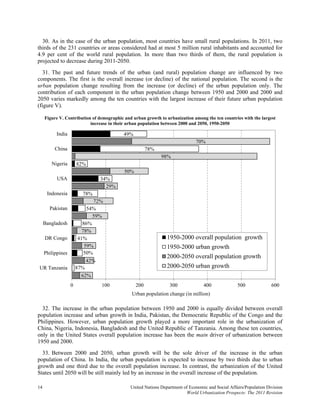
  25. Similarly, the increases in the world urban population are concentrated in a few countries, with
China and India together projected to account for about a third of the increase in the urban population in
the coming decades. Between 2011 and 2030, the urban areas of the world are expected to gain 1.4 billion
people, including 276 million in China and 218 million in India, which account together for 37 per cent of
the total increase. Nine additional countries are projected to contribute 26 per cent of the urban increment,
with increases ranging from 22 million to 76 million. The countries involved are: Nigeria and the
Democratic Republic of the Congo in Africa; Bangladesh, Indonesia, Pakistan and the Philippines in
Asia; Brazil and Mexico in Latin America, and the United States of America. Among them, those in
Africa and Asia will experience high rates of urban population growth, usually surpassing 2 per cent or
even 3 per cent per year

  26. A further urban increment of 1.3 billion people is expected globally during 2030-2050, with India
being the major contributor (270 million) and Nigeria following (121 million). Together, these two
countries are expected to account for 31 per cent of urban growth during 2030-2050. China will only
contribute an additional 44 million during the same period. Yet, China will still have the largest urban
population in 2050 (1 billion), followed by India (0.9 billion).

  27. In a few developed countries, the urban population will decrease. Despite the projected increases in
the level of urbanization, overall population decline in several countries will lead to a reduction in the
number of urban dwellers. Between 2011 and 2030, the urban population of Ukraine and Bulgaria are
projected to decline by 2 million and 0.2 million, respectively. Between 2030 and 2050, more countries
will experience reductions in the urban population. Those with the largest drops include Japan (a
reduction of 10 million), the Russian Federation (2.4 million), the Republic of Korea (1.7 million) and
Ukraine (1.3 million).

  28. The rural population is even more highly concentrated in a few countries than the urban population.
In 2011, 19 countries accounted for 75 per cent of the rural population and all but three (Brazil, the
Russian Federation and the United States) are located in Africa or Asia. India has the largest rural
population (853 million), followed by China (666 million). Together, they account for 45 per cent of the
world rural population. Bangladesh, Indonesia and Pakistan follow, each with over 107 million rural
inhabitants.

  29. In Africa, the largest rural populations are located in Nigeria (82 million), Ethiopia (70 million),
Egypt (47 million), the Democratic Republic of the Congo (45 million), the United Republic of Tanzania
(34 million), Kenya (32 million) and Uganda (29 million). During 2011-2030, the rural populations of
most of those African countries are projected to increase at rates higher than 1.3 per cent per year, except
in the cases of Nigeria and Egypt. Among the populous countries in Asia, Pakistan is expected to
experience the highest growth rate of the rural population during 2011-2030 (0.8 per cent per year). In
contrast, in eight of the 19 countries with large rural populations, the rural population is declining, with
China, the Russian Federation, Brazil, Indonesia, Thailand and the United States having the fastest rates
of decline.

United Nations Department of Economic and Social Affairs/Population Division                              13
World Urbanization Prospects: The 2011 Revision
30. As in the case of the urban population, most countries have small rural populations. In 2011, two
thirds of the 231 countries or areas considered had at most 5 million rural inhabitants and accounted for
4.9 per cent of the world rural population. In more than two thirds of them, the rural population is
projected to decrease during 2011-2050.
   31. The past and future trends of the urban (and rural) population change are influenced by two
components. The first is the overall increase (or decline) of the national population. The second is the
urban population change resulting from the increase (or decline) of the urban population only. The
contribution of each component in the urban population change between 1950 and 2000 and 2000 and
2050 varies markedly among the ten countries with the largest increase of their future urban population
(figure V).

     Figure V. Contribution of demographic and urban growth to urbanization among the ten countries with the largest
                           increase in their urban population between 2000 and 2050, 1950-2050

          India                            49%
                                                                              70%
          China                                        78%
                                                             98%
        Nigeria        82%
                                           50%
           USA                  34%
                                  29%
      Indonesia           78%
                               72%
       Pakistan             54%
                              59%
     Bangladesh           86%
                          78%
     DR Congo           41%                                     1950-2000 overall population growth
                           59%                                  1950-2000 urban growth
     Philippines           50%
                                                                2000-2050 overall population growth
                            42%
UR Tanzania            87%                                      2000-2050 urban growth
                         62%
                   0             100             200             300              400              500              600
                                              Urban population change (in million)

  32. The increase in the urban population between 1950 and 2000 is equally divided between overall
population increase and urban growth in India, Pakistan, the Democratic Republic of the Congo and the
Philippines. However, urban population growth played a more important role in the urbanization of
China, Nigeria, Indonesia, Bangladesh and the United Republic of Tanzania. Among these ten countries,
only in the United States overall population increase has been the main driver of urbanization between
1950 and 2000.
  33. Between 2000 and 2050, urban growth will be the sole driver of the increase in the urban
population of China. In India, the urban population is expected to increase by two thirds due to urban
growth and one third due to the overall population increase. In contrast, the urbanization of the United
States until 2050 will be still mainly led by an increase in the overall increase of the population.

14                                            United Nations Department of Economic and Social Affairs/Population Division
                                                                         World Urbanization Prospects: The 2011 Revision
34. Faced with the opportunities and challenges associated with urbanization, many Governments have
consistently considered their population’s spatial distribution as a concern. In 2009, 83 per cent of
Governments expressed concern about their pattern of population distribution, down from 89 per cent in
the 1970s (table 8). Among developing countries, 58 per cent expressed the desire to modify in a major
way the spatial distribution of their populations, whereas 28 per cent wanted to effect only minor changes.
Among developed countries, 29 per cent desired a major change and 43 per cent a minor change.

  35. Dissatisfaction regarding patterns of population distribution was highest in Africa (75 per cent of its
countries wished to make major changes in the spatial distribution of their populations) and Asia (57 per
cent desired a major change). In Latin America and the Caribbean, Oceania and Europe, about 40 per cent
of Governments considered that major changes in spatial distribution were desirable.

  36. Policies aimed at modifying the spatial distribution of a population often focus on ways to reduce
migrant flows to large cities. In 1976, 44 per cent of developing countries reported having implemented
such policies and by 2011, that proportion had increased to 72 per cent. At the same time, among
developed countries, the proportion having policies to reduce migrant flows to large cities declined from
55 per cent in 1976 to 26 per cent in 1996 but increased later to 34 per cent in 2009. In Oceania, 83 per
cent of countries have such policies, in Africa 77 per cent, in Asia 66 per cent and in Latin America and
the Caribbean 68 per cent (United Nations, 2009 a).
                              TABLE 8. GOVERNMENT VIEWS ON THE SPATIAL DISTRIBUTION OF THE POPULATION, 2009
                                          Major     Minor                                Major       Minor
                                          change    change                               change      change
                                          desired   desired   Satisfactory   Total       desired     desired    Satisfactory   Total

                                                       Number of countries                                Percentage
 World ................................       99        62              34      195             51        32             17      100
 More developed regions....                   14        21              14       49             29        43             29      100
 Less developed regions .....                 85        41              20      146             58        28             14      100

  Source: World Population Policies 2009 (United Nations publication, Sales No.E.09.XIII.14).


  37. Historically, urbanization has been driven by the concentration of investment and employment
opportunities in urban areas. Productive activities in industry and services cluster in cities. By one
estimate, 80 per cent of the world’s gross domestic product (GDP) is generated by urban areas. As cities
attract businesses and jobs, they bring together both the human and the entrepreneurial resources to
generate new ideas, innovations and increasingly productive uses of technology. The 2011 Revision of
World Urbanization Prospects provides a useful basis for the analysis of the world’s urban transformation
and the dynamics of city growth.
  38. The 2011 Revision of the World Urbanization Prospects includes, for the first time, geographical
coordinates for all the cities with more than 750,000 inhabitants. This will allow researchers to link future
demographic trends in urban agglomerations to various spatial and environmental characteristics, such
proximity to coasts, earthquake faults, or climate zones.

  39. Estimates and projections of urban and rural populations as well as urban agglomerations critically
depend on information from censuses. For the 2011 Revision of the World Population Prospects results
from the 2010 round of censuses that became available since the release of the previous revision could
now be included for many countries.


United Nations Department of Economic and Social Affairs/Population Division                                                           15
World Urbanization Prospects: The 2011 Revision
URBANIZATION AND NATURAL HAZARDS

   For the first time, the 2011 Revision of the World Urbanization Prospects includes geographical
coordinates for all 633 cities with more than 750,000 inhabitants in 2011. This will allow researchers to
link demographic trends in urban agglomerations to various spatial and environmental characteristics,
such as proximity to coastal areas, earthquake faults, or climate zones. In an initial analysis the Population
Division combined data from the 2011 Revision of the World Urbanization Prospects with a spatial
database on natural hazards prepared by the Center for International Earth Science Information Network
(CIESIN) at Columbia University.29 In this database an area is classified to be at “high risk” of a
particular natural disaster if it is located in grid cells ranking in the top three deciles of the global risk
distribution in terms of frequency of occurrences of one or more specified natural hazards. The main
findings of this analysis are as follows:
   1. Of the more than 450 urban areas with 1 million inhabitants or more in 2011 (representing 1.4
billion people), 60 per cent, or about 890 million people, were living in areas of high risk of exposure to
at least one natural hazard (tables 9 and 10).30
  2. Europe’s and Africa’s major cities are the least exposed overall. Only 26 and 37 per cent of their
cities with one million inhabitants or more are located in areas at high risk of exposure to at least one
natural disaster. However, cities in Latin America and the Caribbean, in Northern America, and especially
in Asia are often located in areas exposed to natural hazards (figure VI). Depending on the region,
between half and two thirds of the cities with 1 million inhabitants or more are located in areas that face
high risk of exposure to at least one natural disaster.
  3. Flooding is the most frequent and greatest hazard for the 633 largest cities or urban agglomerations
analyzed: At least 233 cities are located in or close to areas with a high risk of flooding – potentially
affecting 663 million inhabitants. One hundred forty eight of these cities are not coastal cities.31 Exposure
to a high risk of flooding does not necessarily mean that those cities are actually affected by frequent
floods. One has to take into account that this analysis relies only on flood data for the period 1985 to
2003. Previous or more recent flooding events have not been considered. The geographical data are also
rather coarse and refer to a 50 kilometer radius around the city proper. Moreover, cities may have already
built infrastructure to prevent flooding, such as dams, dikes or flood retention areas. However, the data
indicate that these 233 large cities may need to take precautions for flooding, if they have not already
done so.
  4. Drought is the second most frequent hazard, affecting areas where 132 cities are located, followed
by cyclones affecting 68 cities and earthquakes threatening 40 of the 633 cities analyzed (table 11). Some
277 million people live in cities at high risk of droughts and 229 million reside in cities at high risk of
cyclones (table 12). Other cities are also exposed to some of these hazards but to a lesser extent.
  5. Among the 63 most populated urban areas (with 5 million or more inhabitants in 2011), 39 are
29
   Natural Disaster Hotspots: A Global Risk Analysis (Dilley et al., 2005) produced by the Center for Hazards and Risk Research (CHRR); Center
for International Earth Science Information Network (CIESIN), Columbia University; International Bank for Reconstruction and Development /
The World Bank (http://www.ldeo.columbia.edu/chrr/research/hotspots/). The database includes information collected for cyclones (for the
period between 1980 and 2000), droughts (between 1980 and 2000), earthquakes (between 1976 and 2002), floods (between 1985 and 2003),
landslides, and volcano eruptions (between 79 and 2000). Data are published with a spatial resolution ranging from a 30 by 30 arc second grid to
a 2.5 by 2.5 arc degree grid for cyclones, earthquakes, landslides, volcanoes, droughts and floods. Data for floods are less reliable or missing in
the early-mid 1990s. For each single hazard, all grid cells with occurrence data were divided into deciles, 10 classes consisting of approximately
equal numbers of grid cells. The higher the value of the grid cell, the higher the decile ranking and the greater the frequency of the hazard relative
to other cells (Dilley et al., 2005: 23-34).
30
   Since the location of cities in the World Urbanization Prospects is specified by point coordinates, a buffer tool in ArcGIS 10.0 (ESRI, 2011)
was employed to create buffer polygons with 2 km and 5 km distance from the point data, respectively, to approximately reflect their actual
locations as accurate as possible. In classifying the degree of risk exposure of a city to hotspots of a specific hazard, the highest cell value of grids
is used when the city’s buffer zones overlap with surrounding grid cells of that particular hazard.
31
   The geographic data (in shape files) for coastal areas were from the Millennium Ecosystem Assessment (MA). The coastal areas were defined
as areas between 50 meters below mean sea level and 50 meters above the high tide level or extending landward to a distance of 100 kilometers
from shore, including coral reefs, intertidal zones, estuaries, coastal aquaculture, and seagrass communities (MA, 2003: 54).


United Nations Department of Economic and Social Affairs/Population Division                                                                          17
World Urbanization Prospects: The 2011 Revision
located in regions that are exposed to a high risk of at least one natural hazard; 72 per cent of them are
located on or near the coast, and two thirds of them are in Asia (table 13). Among the six natural hazards
analyzed, the greatest and most common hazard is flooding potentially affecting areas where 30 of the 63
agglomerations are located, followed by cyclones for 10 cities, droughts for another 9 cities, and
earthquakes potentially affecting 6 cities.


                       Figure VI. Distribution of cities by population size in 2011 and risk of natural hazards


     Multihazards Exposed to                     City Population
          No Hazard                                    750-1000 thousand

          Hazards not in top 3 deciles                 1-5 million

          1 Hazard in top 3 deciles                    5-10 million

                                                       10 million or more
          2 Hazards in top 3 declies

          3+ Hazards in top 3 deciles


           NOTE: The boundaries shown on this map do not imply official endorsement or acceptance by the United Nations.


   6. The five most populated cities in 2011 located in areas with exposure to at least one major natural
hazard are Tokyo, Delhi, Ciudad de México, New York-Newark and Shanghai. Tokyo is located in a
region with high risk of floods and cyclones; Delhi is potentially affected by high risk of floods and
medium risk of droughts; Ciudad de México has a high risk of floods, medium risk of landslides and low
risk of droughts; the region of New York-Newark, is at high risk of floods and medium risk of cyclones;
and Shanghai is at high risk of floods (table 13). Table 14 lists the top ten most populous cities in 2011 at
high risk for each of the six types of natural disasters. Table 15 lists the top ten fastest growing cities in
2001-2011 located in areas exposed to each of these hazards.
  7. Many cities are located in areas that are exposed to more than one natural hazard, but among the
largest inhabited urban areas (with 750,000 inhabitants or more in 2011), only ten major cities are located
in areas at high risk from three or more natural disasters (table 16). Manila (Philippines) with nearly 12
million inhabitants is the largest urban agglomeration at high risk of cyclones, floods and earthquakes.
Four other large coastal cities in Asia are at similar high risks. Davao (Philippines) is potentially exposed
to the risks of cyclones, floods, and earthquakes, while three other cities face additional high risks of
landslides: Taipei, Kaohsiung, and Taichung (China). Another group of major in-land cities at high risks
of multiple natural hazards are: Santiago and Valparaíso (Chile), Quito (Ecuador), Guwahati (India), and
Managua (Nicaragua) - all located in areas at high risks of droughts, earthquakes and floods (as well as
landslides and volcano in Quito).


18                                                   United Nations Department of Economic and Social Affairs/Population Division
                                                                                World Urbanization Prospects: The 2011 Revision
8. One out of five cities among the most populous in 2011 is located in an area that is at low risk of
natural disasters. 133 cities are located in areas not exposed to any natural disasters or are exposed only to
low risks. Table 17 provides the list of the top ten most populated cities located in areas at low or no risk
of natural disasters. Two megacities stand out: Moskva (Moscow) and Al-Qahirah (Cairo). For those
cities, the natural hazards database from CIESIN does not record a high risk for any kind of natural
disaster based on information from the 1985 to 2000 period.

The results of these initial analyses concerning the potential exposure of cities and urban agglomerations
to natural disasters are subject to the following constraints:
   The geographical database for the six major natural disasters only covers the relatively short time
    period from 1980 to 2000. Data for floods are even more restricted to the period between 1985 and
    2003. The analysis therefore likely underestimates the impact of rare, but perhaps more severe,
    natural disasters on urban areas.
   The spatial resolution for which floods, droughts, cyclones, earthquakes, landslides and volcanoes are
    recorded ranges from a 30 by 30 arc second grid to a 2.5 by 2.5 arc degree grid. These very different
    spatial resolutions make it difficult to assess absolute risks and compare hazards (Dilley et al., 2005:
    26).
   Spatial information for the cities and urban agglomerations are only point coordinates, extended by a
    circular “buffer area”. More appropriate information would be the polygon coordinates of the city
    area, which is currently not available in the World Urbanization Prospects. The overlay between
    urban agglomerations and hazard areas may therefore be only partial.


United Nations Department of Economic and Social Affairs/Population Division                               19
World Urbanization Prospects: The 2011 Revision
TABLE 9. NUMBER OF CITIES BY NUMBER OF NATURAL HAZARDS, CLASS SIZE (2011)
                                                             AND MAJOR AREA


                                               Natural hazard risk (1980-2000)
     1-5 million                                No or low hazard      1 hazard          2 hazards       3+ hazards      Total
     Africa                                                      29             16               2                         47
     Asia                                                        55             97              37                4       193
     Europe                                                      35             13                                         48
     Latin America and the Caribbean                             17             33               4                1        55
     Northern America                                            20             20               4                         44
     Oceania                                                      3              3                                          6
     Total                                                      159            182              47                5       393

     5-10 million                                No or low hazard        1 hazard       2 hazards       3+ hazards      Total
     Africa                                                        1             1                                          2
     Asia                                                         11            10               5                         26
     Europe                                                        2             1                                          3
     Latin America and the Caribbean                                             1               2                1         4
     Northern America                                              4             1                                          5
     Oceania                                                                                                                0
     Total                                                        18            14               7                1        40

     10 million and over                         No or low hazard        1 hazard       2 hazards       3+ hazards      Total
     Africa                                                        2                                                        2
     Asia                                                          2              5              5                1        13
     Europe                                                        2                                                        2
     Latin America and the Caribbean                                              4                                         4
     Northern America                                                                            2                          2
     Oceania                                                                                                                0
     Total                                                         6              9              7                1        23

     1 million and over                        No or low hazard         1 hazard       2 hazards      3+ hazards       Total
     Africa                                                  32               17               2               0         51
     Asia                                                    68              112              47               5        232
     Europe                                                  39               14               0               0         53
     Latin America and the Caribbean                         17               38               6               2         63
     Northern America                                        24               21               6               0         51
     Oceania                                                  3                3               0               0           6
     Total                                                  183              205              61               7        456

         NOTE: No or low hazard represents a city that is not located in an area or a region that are in top three deciles of
     any six natural hazards analyzed.


20                                                   United Nations Department of Economic and Social Affairs/Population Division
                                                                                World Urbanization Prospects: The 2011 Revision
TABLE 10. CITY POPULATION (IN MILLION) BY NUMBER OF NATURAL HAZARDS,
                                                CLASS SIZE (2011) AND REGION
                                                     Natural hazard risk (1980-2000 )
           1-5 million                               No or low hazard 1 hazard 2 hazards               3+ hazards        Total
           Africa                                                 68.0         31.1            4.9                      104.0
           Asia                                                  107.3        177.9           72.1             6.9      364.3
           Europe                                                 57.8         23.5                                      81.3
           Latin America and the Caribbean                        34.3         69.9            6.6             1.6      112.5
           Northern America                                       47.4         38.4           12.3                       98.0
           Oceania                                                 7.6          7.2                                      14.8
           Total                                                 322.5        348.0           95.9             8.5      775.0

           5-10 million                              No or low hazard      1 hazard     2 hazards      3+ hazards        Total
           Africa                                                   8.8          5.1                                     13.9
           Asia                                                    77.3         70.4          38.2                      185.9
           Europe                                                  12.1          9.0                                     21.1
           Latin America and the Caribbean                                       8.7          14.6             6.0       29.4
           Northern America                                        26.5          5.9                                     32.5
           Oceania                                                                                                        0.0
           Total                                                 124.8          99.1          52.8             6.0      282.8

           10 million and over                       No or low hazard      1 hazard     2 hazards      3+ hazards        Total
           Africa                                                  22.4                                                  22.4
           Asia                                                    35.3         74.7          93.3            11.9      215.2
           Europe                                                  22.2                                                  22.2
           Latin America and the Caribbean                                      65.9                                     65.9
           Northern America                                                                   33.7                       33.7
           Oceania                                                                                                        0.0
           Total                                                   80.0       140.5          127.1            11.9      359.4

           1 million and over                        No or low hazard      1 hazard     2 hazards      3+ hazards        Total
           Africa                                                 99.2         36.1            4.9             0.0      140.3
           Asia                                                  220.0        323.0          203.6            18.8      765.3
           Europe                                                 92.2         32.5            0.0             0.0      124.7
           Latin America and the Caribbean                        34.3        144.5           21.2             7.7      207.7
           Northern America                                       73.9         44.3           46.1             0.0      164.2
           Oceania                                                 7.6          7.2            0.0             0.0       14.8
           Total                                                 527.3        587.7          275.8            26.4    1,417.2
             NOTE: No or low hazard represents a city that is not located in an area or a region that are in top three deciles
        of any six natural hazards analyzed.


United Nations Department of Economic and Social Affairs/Population Division                                                     21
World Urbanization Prospects: The 2011 Revision
TABLE 11. NUMBER OF CITIES (750,000 INHABITANTS OR MORE IN 2011) BY RISK DECILE, TYPE OF NATURAL HAZARD
                                                         AND COASTAL STATUS


                 Type of natural hazard
                 Cyclone             Drought             Earthquake          Flood                 Landslide            Volcano
                 Coastal Inland Coastal        Inland     Coastal Inland      Coastal    Inland     Coastal Inland       Coastal      Inland
Risk decile        city      city       city    city       city     city        city      city       city    city         city         city
No hazard            138      308         87       110        196     314          45        83        233       364         242         385
1st-4th
decile                29        51        69       107         20      31          72       126
5-7th decile          26        13        40        86         13      20          38        45             9     21                          2
8-10th decile         50        18        47        87         14      25          88       136             1      5             1            3


     TABLE 12. POPULATION FOR CITIES OR URBAN AGGLOMERATIONS OF 750,000 INHABITANTS OR MORE IN 2011 (IN MILLIONS)
                              BY RISK DECILE, TYPE OF NATURAL HAZARD AND COASTAL STATUS


                 Type of natural hazard
                 Cyclone            Drought              Earthquake         Flood                 Landslide            Volcano
                 Coastal Inland Coastal        Inland     Coastal Inland     Coastal    Inland     Coastal Inland      Coastal       Inland
Risk decile       city      city      city      city       city     city       city      city       city    city         city         city
No hazard           364       668       298       244        559     690         85        151        709       765        732          829
1st-4th decile       92       112       196       234         40      59        182        248
5-7th decile         89        16       109       212         73      37        117        124         24       61                        4
8-10th decile       190        39       131       147         63      50        350        313          2       10           2            3


22                                                 United Nations Department of Economic and Social Affairs/Population Division
                                                                              World Urbanization Prospects: The 2011 Revision
TABLE 13. CITIES AND URBAN AGGLOMERATIONS (WITH 5 MILLION OR MORE INHABITANTS IN 2011) EXPOSED TO AT LEAST ONE MAJOR
                             NATURAL HAZARD (8-10TH RISK DECILES OF NATURAL DISASTERS)

                                         Population (in million)     Risk decile
    City                                 2011 Location Type          Cyclone     Drought     Earthquake Flood      Landslide    Volcano
 1 Tokyo, Japan                          37.2 Coastal     Not Arid 8-10th    No hazard 5-7th             8-10th No hazard No hazard
 2 Delhi, India                          22.7 Inland      Semiarid No hazard 5-7th     No hazard         8-10th No hazard No hazard
 3 Ciudad de México                      20.4 Inland      Not Arid No hazard 1st-4th   No hazard         8-10th 5-7th     No hazard
   (Mexico City), Mexico
 4 New York-Newark, USA                  20.4   Coastal   Not Arid   5-7th       No hazard   No hazard   8-10th    No hazard    No hazard
 5 Shanghai, China                       20.2   Coastal   Not Arid   8-10th      No hazard   No hazard   8-10th    No hazard    No hazard
 6 São Paulo, Brazil                     19.9   Inland    Not Arid   No hazard   No hazard   No hazard   8-10th    No hazard    No hazard
 7 Dhaka, Bangladesh                     15.4   Coastal   Not Arid   1st-4th     1st-4th     No hazard   8-10th    No hazard    No hazard
 8 Kolkata (Calcutta), India             14.4   Coastal   Not Arid   5-7th       8-10th      No hazard   8-10th    No hazard    No hazard
 9 Karachi, Pakistan                     13.9   Coastal   Arid       1st-4th     8-10th      No hazard   1st-4th   No hazard    No hazard
10 Buenos Aires, Argentina               13.5   Coastal   Not Arid   No hazard   1st-4th     No hazard   8-10th    No hazard    No hazard
11 Los Angeles-Long Beach                13.4   Coastal   Semiarid   No hazard   8-10th      8-10th      1st-4th   5-7th        No hazard
   -Santa Ana, USA
12 Rio de Janeiro, Brazil                12.0   Coastal   Not Arid   No hazard   No hazard   No hazard   8-10th    No hazard    No hazard
13 Manila, Philippines                   11.9   Coastal   Not Arid   8-10th      1st-4th     8-10th      8-10th    No hazard    No hazard
14 Osaka-Kobe, Japan                     11.5   Coastal   Not Arid   8-10th      No hazard   5-7th       5-7th     No hazard    No hazard
15 Istanbul, Turkey                      11.3   Coastal   Not Arid   No hazard   1st-4th     8-10th      1st-4th   No hazard    No hazard
16 Guangzhou, Guangdong, China           10.8   Coastal   Not Arid   8-10th      No hazard   No hazard   8-10th    No hazard    No hazard
17 Shenzhen, China                       10.6   Coastal   Not Arid   8-10th      1st-4th     No hazard   8-10th    No hazard    No hazard
18 Jakarta, Indonesia                     9.8   Coastal   Not Arid   No hazard   5-7th       1st-4th     8-10th    No hazard    No hazard
19 Seoul, Republic of Korea               9.7   Inland    Not Arid   8-10th      1st-4th     No hazard   8-10th    No hazard    No hazard
20 Wuhan, China                           9.2   Inland    Not Arid   1st-4th     1st-4th     No hazard   8-10th    No hazard    No hazard
21 Lima, Peru                             9.1   Coastal   Arid       No hazard   1st-4th     8-10th      5-7th     No hazard    No hazard
22 London, United Kingdom                 9.0   Coastal   Not Arid   No hazard   1st-4th     No hazard   8-10th    No hazard    No hazard
23 Chennai (Madras), India                8.8   Coastal   Not Arid   1st-4th     8-10th      No hazard   5-7th     No hazard    No hazard
24 Bogotá, Colombia                       8.7   Inland    Not Arid   No hazard   5-7th       5-7th       8-10th    5-7th        No hazard
25 Lahore, Pakistan                       7.6   Inland    Semiarid   No hazard   8-10th      1st-4th     8-10th    No hazard    No hazard
26 Tehran, Iran (Islamic Republic of)     7.3   Inland    Semiarid   No hazard   5-7th       8-10th      5-7th     No hazard    No hazard
27 Dongguan, Guangdong, China             7.3   Coastal   Not Arid   8-10th      No hazard   No hazard   8-10th    No hazard    No hazard
28 Hong Kong, China, Hong Kong SAR        7.1   Coastal   Not Arid   8-10th      1st-4th     No hazard   8-10th    No hazard    No hazard
29 Chengdu, China                         6.7   Inland    Not Arid   No hazard   No hazard   No hazard   8-10th    No hazard    No hazard
30 Foshan, China                          6.5   Coastal   Not Arid   8-10th      No hazard   No hazard   8-10th    No hazard    No hazard
31 Ahmadabad, India                       6.4   Coastal   Semiarid   No hazard   8-10th      No hazard   5-7th     No hazard    No hazard
32 Thành Pho Ho Chí Minh                  6.4   Coastal   Not Arid   No hazard   5-7th       No hazard   8-10th    No hazard    No hazard
   (Ho Chi Minh City), Viet Nam
33 Santiago, Chile                        6.0   Inland    Semiarid   No hazard   8-10th      8-10th      8-10th    No hazard    No hazard
34 Philadelphia, USA                      5.9   Coastal   Not Arid   5-7th       No hazard   No hazard   8-10th    No hazard    No hazard
35 Belo Horizonte, Brazil                 5.5   Inland    Not Arid   No hazard   8-10th      No hazard   8-10th    No hazard    No hazard
36 Hangzhou, China                        5.4   Coastal   Not Arid   5-7th       No hazard   No hazard   8-10th    No hazard    No hazard
37 Chittagong, Bangladesh                 5.2   Coastal   Not Arid   5-7th       5-7th       5-7th       8-10th    No hazard    No hazard
38 Singapore, Singapore                   5.2   Coastal   Not Arid   No hazard   No hazard   No hazard   8-10th    No hazard    No hazard
39 Luanda, Angola                         5.1   Coastal   Semiarid   No hazard   8-10th      No hazard   1st-4th   No hazard    No hazard


United Nations Department of Economic and Social Affairs/Population Division                                               23
World Urbanization Prospects: The 2011 Revision
TABLE 14. TOP 10 LARGEST CITY POPULATIONS IN 2011 AT 8-10TH RISK DECILES BY TYPE OF HAZARD

     Cyclone             Drought                   Earthquake                    Flood                    Landslide       Volcano
 1   Tokyo, Japan        Kolkata (Calcutta),       Los Angeles-Long              Tokyo, Japan             Taipei, China   Napoli
                         India                     Beach-Santa Ana,                                                       (Naples),
                                                   USA                                                                    Italy
 2   Shanghai, China     Karachi, Pakistan         Manila, Philippines           Delhi, India             Bandung,        Quito,
                                                                                                          Indonesia       Ecuador
 3   Manila,             Los Angeles-Long          Istanbul, Turkey              Ciudad de México         Quito,          Bogor,
     Philippines         Beach-Santa Ana,                                        (Mexico City),           Ecuador         Indonesia
                         USA                                                     Mexico
 4   Osaka-Kobe,         Chennai (Madras),         Lima, Peru                    New York-Newark,         San            Malang,
     Japan               India                                                   USA                      Salvador, El   Indonesia
                                                                                                          Salvador
 5   Guangzhou,          Lahore, Pakistan          Tehran, Iran (Islamic         Shanghai, China          Kaohsiung, China
     Guangdong,                                    Republic of)
     China
 6   Shenzhen, China     Ahmadabad, India          Santiago, Chile               São Paulo, Brazil        San José, Costa Rica
 7   Seoul, Republic     Santiago, Chile           San Francisco-                Dhaka, Bangladesh
     of Korea                                      Oakland, USA
 8   Dongguan,           Belo Horizonte, Brazil    Kunming, China                Kolkata (Calcutta), India
     Guangdong,
     China
 9   Hong Kong,          Luanda, Angola            Nagoya, Japan                 Buenos Aires, Argentina
     China, Hong
     Kong SAR
10   Foshan, China       Yangon, Myanmar           Izmir, Turkey                 Rio de Janeiro, Brazil


       TABLE 15. TOP 10 FASTEST GROWING CITY POPULATIONS IN 2001-2011 AT 8-10TH RISK DECILES BY TYPE OF HAZARD

     Cyclone              Drought                  Earthquake            Flood                   Landslide            Volcano
 1   Zhongshan, China     Nay Pyi Taw,             Yinchuan, China       Can Tho, Viet           San José, Costa      Bogor,
                          Myanmar                                        Nam                     Rica                 Indonesia
 2   Xiamen, China        Sharjah, United Arab     Kathmandu,            Batam, Indonesia        San Salvador, El     Quito,
                          Emirates                 Nepal                                         Salvador             Ecuador
 3   Haikou, China        Dubayy (Dubai),          Karaj, Iran           Yongin, Republic        Quito, Ecuador       Malang,
                          United Arab              (Islamic              of Korea                                     Indonesia
                          Emirates                 Republic of)
 4   Jinjiang, China      Luanda, Angola           Sulaimaniya,          Zhongshan, China        Bandung,             Napoli
                                                   Iraq                                          Indonesia            (Naples),
                                                                                                                       Italy
 5   Dongguan,            Huambo, Angola           San José, Costa       Xiamen, China           Kaohsiung, China
     Guangdong, China                              Rica
 6   Jiangmen, China      Hamah, Syrian Arab       Quetta, Pakistan      Suzhou, Jiangsu,   Taipei, China
                          Republic                                       China
 7   Vientiane, Lao       Nanyang, Henan,          Xining, China         Wuhu, Anhui, China
     People's             China
     Democratic
     Republic
 8   Huizhou, China       Liaocheng, China         Bursa, Turkey         Hefei, China
 9   Jiaxing, China       Handan, China            Tangshan,             Kigali, Rwanda
                                                   Hebei, China
10   Putian, China        Zhengzhou, China         Davao,                Jinjiang, China
                                                   Philippines


24                                             United Nations Department of Economic and Social Affairs/Population Division
                                                                          World Urbanization Prospects: The 2011 Revision
TABLE 16. URBAN AREAS (WITH 750,000 OR MORE INHABITANTS IN 2011) EXPOSED TO THREE OR MORE NATURAL HAZARDS
                                      (8-10TH RISK DECILES OF NATURAL DISASTERS)

                                 Population (in million)       Risk decile
     City                        2011 Location Type            Cyclone       Drought     Earthquake     Flood    Landslide    Volcano
 1   Manila, Philippines         11.9   Coastal    Not Arid    8-10th        1st-4th     8-10th         8-10th   No hazard    No hazard
 2   Santiago, Chile              6.0   Inland     Semiarid    No hazard     8-10th      8-10th         8-10th   No hazard    No hazard
 3   Taipei, China               2.7    Inland     Not Arid    8-10th        No hazard   8-10th         8-10th   8-10th       No hazard
 4   Quito, Ecuador              1.6    Inland     Not Arid    No hazard     8-10th      8-10th         8-10th   8-10th       8-10th
 5   Davao, Philippines          1.6    Coastal    Not Arid    8-10th        1st-4th     8-10th         8-10th   No hazard    No hazard
 6   Kaohsiung, China            1.5    Coastal    Not Arid    8-10th        No hazard   8-10th         5-7th    8-10th       No hazard
 7   Taichung, China              1.2   Inland     Not Arid    8-10th        No hazard   8-10th         8-10th   5-7th        No hazard
 8   Guwahati (Gauhati), India    1.0   Inland     Not Arid    No hazard     8-10th      8-10th         8-10th   No hazard    No hazard
 9   Managua, Nicaragua           1.0   Inland     Not Arid    1st-4th       8-10th      8-10th         8-10th   No hazard    No hazard
10   Valparaíso, Chile            0.9   Coastal    Not Arid    No hazard     8-10th      8-10th         8-10th   No hazard    No hazard

                  TABLE 17. TOP 10 LARGEST CITY POPULATIONS IN 2011 LEAST EXPOSED TO NATURAL HAZARDS
                              (NO RISK OR 1-4TH RISK DECILE FOR ONLY ONE NATURAL DISASTER)

                                   Population (in million)            Risk decile
     City                          2011 Location Type                 Cyclone     Drought   Earthquake      Flood      Landslide   Volcano
 1   Moskva (Moscow),              11.6 Inland     Not Arid       No hazard      No hazard No hazard No hazard        No hazard No hazard
     Russian Federation
 2   Al-Qahirah (Cairo), Egypt     11.2 Inland     Hyperarid      No hazard     No hazard   No hazard    1st-4th      No hazard    No hazard
 3   Kinshasa, DR. of the Congo     8.8 Inland     Not Arid       No hazard     1st-4th     No hazard    1st-4th      No hazard    No hazard
 4   Madrid, Spain                  6.6 Inland     Semiarid       No hazard     1st-4th     No hazard    No hazard    No hazard    No hazard
 5   Toronto, Canada                5.6 Inland     Not Arid       1st-4th       No hazard   No hazard    1st-4th      No hazard    No hazard
 6   Ar-Riyadh (Riyadh),           5.5 Inland      Hyperarid      No hazard     No hazard   No hazard    1st-4th      No hazard    No hazard
     Saudi Arabia
 7   Dallas-Fort Worth, USA         5.2 Inland     Semiarid       1st-4th       No hazard   No hazard    1st-4th      No hazard    No hazard
 8   Xi'an, Shaanxi, China          5.0 Inland     Dry subhumid   No hazard     1st-4th     No hazard    1st-4th      No hazard    No hazard
 9   Atlanta, USA                   5.0 Inland     Not Arid       1st-4th       No hazard   No hazard    1st-4th      No hazard    No hazard
10   Peterburg (Saint Petersburg), 4.9 Inland      Coastal        Not Arid      No hazard   No hazard    No hazard    1st-4th      No hazard
     Russian Federation


United Nations Department of Economic and Social Affairs/Population Division                                                 25
World Urbanization Prospects: The 2011 Revision
References

David Satterthwaite (2007). The transition to a predominantly urban world and its underpinnings.
    International Institute for Environment and Development. Human Settlements Discussion Paper
    Series, 4 September 2007.
Dilley, M, Chen, R.S., Deichmann, U., Lerner-Lam, A.L., Arnold, M., Agwe, J., Buys, P., Kjekstad, O.,
     Lyon, B., and Yetman, G. (2005). Natural Disaster Hotspots: A Global Risk Analysis. Disaster Risk
     Management, Series No. 5-34423. Washington DC: The World Bank.
Esri (2011). ArcGIS 10. (http://www.esri.com/software/arcgis/)
Millennium Ecosystem Assessment (2003). Ecosystems and Human Well-Beijing: A Framework for
     Assessment. Washington, D.C.: Island Press.

United Nations (2011). Department of Economic and Social Affairs, Population Division (2011):
    World Population Prospects: The 2010 Revision, New York (Extended Dataset on CD-ROM,
    ST/ESA/SER.A/308, Sales No. 11.XIII.7).

_______ (2009 a). World Population Monitoring. Focusing on Population Distribution, Urbanization,
    Internal Migration and Development. A Concise Report .New York, (ST/ESA/SER.A/284, Sales No.
    E.09.XII.3).

_______(2009 b). World Fertility Patterns 2009. Wall Chart. (ST/ESA/SER.A/294, Sales No.
    E.09.XIII.12).


26                                     United Nations Department of Economic and Social Affairs/Population Division
                                                                  World Urbanization Prospects: The 2011 Revision
UNITED NATIONS                                           NATIONS UNIES


                                      Department of Economic and Social Affairs
                                             POPULATION DIVISION
                                            DATA IN DIGITAL FORM

     The 2011 Revision of the World Urbanization Prospects, prepared by the United Nations Population Division,
provides a comprehensive and consistent set of urban and rural population data for the world's countries and areas,
as well as for urban agglomerations with more than 750,000 inhabitants in 2011. The data referring to urban and
rural areas cover the period 1950-2050 and those referring to urban agglomerations cover the period 1950-2025.
Detailed results from the 2011 Revision are available for purchase in two sets of files, distributed on a single CD-
ROM.
    The files are prepared in Excel 2003, which is compatible with all versions since Excel 5.0/95. The CD-ROM
version launches a navigation interface upon insertion that provides direct access to the files.
     In the data sets, figures for 1950-2011 are estimates and those for years beyond 2011 are projections. To the
exception of a selected set of annual indicators, estimates and projections are presented for years that are multiples
of five. The urban, rural and city data presented are consistent with the medium variant of the 2010 Revision of
World Population Prospects, the official United Nations population estimates and projections at the national level. A
short description of each set of files is presented below; the list of file names and their contents are presented in
detail in tables A and B on the following pages.
     (1) Urban and rural areas: Ten files present estimates and projections of the population in urban and rural areas
as well as associated indicators. The data are presented for 231 countries and areas individually and for 33 country
aggregates, including the world as a whole, the more and the less developed regions, the major world areas and
selected additional aggregates. The projected values cover the period 2011-2050. The files present information on:
(1) urban and rural population and percentage urban in 2011; (2) the percentage of the population residing in urban
areas; (3) the urban population by country; (4) the rural population by country; (5) the total population by country;
(6) the average annual rate of change of the urban population; (7) the average annual rate of change of the rural
population; (8) the average annual rate of change of the total population; (9) the urbanization rate or average annual
rate of change of the percentage urban, and (10) the average annual rate of change of the percentage rural. In
addition to these data presented for five-year periods, annual time series are provided for the following five
indicators: (10) the total population by country; (11) the urban population by country; (12) the rural population by
country; (13) the percentage of the population residing in urban areas.
     (2) Urban agglomerations: Eleven files present the estimates and projections of the population in urban
agglomerations. The main set of files contains data only for urban agglomerations with 750,000 inhabitants or more
in 2011. In addition to the latitude and longitude coordinates for each area name, they cover the following
indicators: (1) the total population of each urban agglomeration (also included as annual time series); (2) the average
annual rate of change of the population of each urban agglomeration; (3) the percentage of the urban population
residing in each urban agglomeration; (4) the percentage of the total population residing in each urban
agglomeration. Three more files provide data for specific sets of urban agglomerations. The first one presents the 30
largest urban agglomerations of the world ranked by population size over the period 1950-2025. The second
provides 1950-2025 time series of the population of the 30 largest urban agglomerations in 2007. The third presents
the population of the capital cities of each country for the year 2011. Lastly, four files (one per indicator and
altogether) provide summary statistics for major areas, regions and countries (with a population of less than 100,000
in 2011) on the number of cities, the percentage of urban population and the urban population by size class of urban
settlement.
    The following citation should be used to indicate the source of any data derived from the data sets described
above:
    United Nations, Department of Economic and Social Affairs, Population Division (2012). World Urbanization
Prospects: The 2011 Revision. CD-ROM Edition – Data in digital form (POP/DB/WUP/Rev.2011).


United Nations Department of Economic and Social Affairs/Population Division                                        27
World Urbanization Prospects: The 2011 Revision
28


                                                                                                                       World Urbanization Prospects: The 2011 Revision - CD-ROM Edition
                                                                                                                 Table A: Schematic Contents of Dataset on Urban and Rural Areas, 1950-2050
                                                                                                                                           POP/DB/WUP/Rev.2011/1
                                                                                                                                              All rights reserved.

                                                                                                                                                                          Number                                                      Table in
                                                                                  File                                 Indicator                       Geographical           of        Type of    Reference          Time period      World
                                                                                                    File name                              Units
                                                                                number                                 presented                         coverage         countries    indicator     date               covered     Urbanization
                                                                                                                                                                           or areas                                                  Prospects
                                                                               File 0    WUP2011-F00-              Location list with                   All                 231
                                                                                         Locations.xls             codes (numerical                     countries
                                                                                                                   and ISO3),                           and areas
                                                                                                                   description, major
                                                                                                                   area, region and
                                                                                                                   development
                                                                                                                   group.
                                                                                                                                                   Five-year Indicators

                                                                               File 1    WUP2011-F01-              Total, urban and     Thousands       All                 231       Stock        1 July      2011                     A.1
                                                                                         Total_Urban_Rural.xls     rural population     and Per cent    countries                     indicator
United Nations Department of Economic and Social Affairs/Population Division


                                                                                                                   and percentage                       and areas
                                                                                                                   urban
                                                                               File 2    WUP2011-F02-              Percentage of the    Per cent        All                 231       Stock        1 July      1950, 1955, 1960,…       A.2
                                                                                         Proportion_Urban.xls      population                           countries                     indicator                2045, 2050
                                                                                                                   residing in urban                    and areas
                                                                                                                   areas
                                                                               File 3    WUP2011-F03-              Total population     Thousands       All                 231       Stock        1 July      1950, 1955, 1960,…       A.3
                                                                                         Urban_Population.xls      residing in urban                    countries                     indicator                2045, 2050
                                                                                                                   areas                                and areas
                                                                               File 4    WUP2011-F04-              Total population     Thousands       All                 231       Stock        1 July      1950, 1955, 1960,…       A.4
                            World Urbanization Prospects: The 2011 Revision


                                                                                         Rural_Population.xls      residing in rural                    countries                     indicator                2045, 2050
                                                                                                                   areas                                and areas
                                                                               File 5    WUP2011-F05-              Total population     Thousands       All                 231       Stock        1 July      1950, 1955, 1960,…       A.5
                                                                                         Total_Population.xls                                           countries                     indicator                2045, 2050
                                                                                                                                                        and areas
                                                                               File 6    WUP2011-F06-              Average annual       Per cent        All                 231       Period       Average     1950-1955, 1955-         A.6
                                                                                         Urban_Growth_Rate.xls     rate of change of                    countries                     indicator    per year    1960,… 2040-2045,
                                                                                                                   the urban                            and areas                                              2045-2050
                                                                                                                   population
                                                                               File 7    WUP2011-F07-              Average annual       Per cent        All                 231       Period       Average     1950-1955, 1955-         A.7
                                                                                         Rural_Growth_Rate.xls     rate of change of                    countries                     indicator    per year    1960,… 2040-2045,
                                                                                                                   the rural                            and areas                                              2045-2050
                                                                                                                   population
World Urbanization Prospects: The 2011 Revision
United Nations Department of Economic and Social Affairs/Population Division

                                                                                                                                                                                 Number                                                        Table in
                                                                                  File                                            Indicator                       Geographical       of          Type of    Reference        Time period        World
                                                                                                       File name                                      Units
                                                                                number                                            presented                         coverage     countries      indicator     date             covered       Urbanization
                                                                                                                                                                                  or areas                                                    Prospects
                                                                               File 8      WUP2011-F08-                       Average annual      Per cent         All             231         Period       Average     1950-1955, 1955-         A.8
                                                                                           Total_Growth_Rate.xls              rate of change of                    countries                   indicator    per year    1960,… 2040-2045,
                                                                                                                              the total                            and areas                                            2045-2050
                                                                                                                              population
                                                                               File 9      WUP2011-F09-                       Average annual      Per cent         All             231         Period       Average     1950-1955, 1955-         A.9
                                                                                           Urbanization_Rate.xls              rate of change of                    countries                   indicator    per year    1960,… 2040-2045,
                                                                                                                              the percentage                       and areas                                            2045-2050
                                                                                                                              urban
                                                                               File 10     WUP2011-F10-                       Average annual      Per cent         All             231         Period       Average     1950-1955, 1955-         A.10
                                                                                           Rate_Proportion_Rural.xls          rate of change of                    countries                   indicator    per year    1960,… 2040-2045,
                                                                                                                              the percentage                       and areas                                            2045-2050
                                                                                                                              rural
                                                                                                                                                             Annual Indicators

                                                                               File 18     WUP2011-F18-                       Total population    Thousands        All           231         Stock          1 July      1950, 1951, 1952,…
                                                                                           Total_Population_Annual.xls                                             countries                 indicator                  2049, 2050
                                                                                                                                                                   and areas
                                                                               File 19     WWUP2011-F19-                      Total population    Thousands        All           231         Stock          1 July      1950, 1951, 1952,…
                                                                                           Urban_Population_Annual.xls        residing in urban                    countries                 indicator                  2049, 2050
                                                                                                                              areas                                and areas
                                                                               File 20     WUP2011-F20-                       Total population    Thousands        All           231         Stock          1 July      1950, 1951, 1952,…
                                                                                           Rural_Population_Annual.xls        residing in rural                    countries                 indicator                  2049, 2050
                                                                                                                              areas                                and areas
                                                                               File 21     WUP2011-F21-                       Percentage of the   Per cent         All           231         Stock          1 July      1950, 1951, 1952,…
                                                                                           Proportion_Urban_Annual.xls        population                           countries                 indicator                  2049, 2050
                                                                                                                              residing in urban                    and areas
                                                                                                                              areas

                                                                               Suggested citation: United Nations, Department of Economic and Social Affairs, Population Division (2010). World Urbanization Prospects: The 2011 Revision. CD-ROM Edition -
                                                                               Data in digital form (POP/DB/WUP/Rev.2011).
                                           29
30

                                                                                                                             World Urbanization Prospects: The 2011 Revision - CD-ROM Edition
                                                                                                                           Table B: Schematic Contents of Dataset on Urban Agglomerations, 1950-2025
                                                                                                                                                   POP/DB/WUP/Rev.2011/2
                                                                                                                                                       All rights reserved.

                                                                                                                                                                                           Number                                          Table in
                                                                                                                                                                                                                                Time
                                                                                 File                                                                                   Geographical           of       Type of    Reference                World
                                                                                                      File name                  Indicator presented       Units                                                                period
                                                                               number                                                                                     coverage         countries   indicator     date                Urbanization
                                                                                                                                                                                                                               covered
                                                                                                                                                                                            or areas                                      Prospects
                                                                               File 0     WUP2011-F00-                            Location list with                      All countries        231
                                                                                          Locations.xls                           codes (numerical                        and areas
                                                                                                                                  and ISO3),
                                                                                                                                  description, major
                                                                                                                                  area, region and
                                                                                                                                  development group.
                                                                                                                                                         Five-year Indicators
                                                                               File 11a   WUP2011-F11a-                           Population of the 30   Millions         The 30 most          …       Stock        1 July     1950,         A.11
                                                                                          30_Largest_Cities.xls                   largest urban                           populous                     indicator               1955,….
                                                                                                                                  agglomerations                          cities at each                                       , 2020,
                                                                                                                                  ranked by                               point in time                                        2025
United Nations Department of Economic and Social Affairs/Population Division


                                                                                                                                  population size at
                                                                                                                                  each point in time
                                                                               File 11b   WUP2011-F11b-                           Time series of the      Millions        The 30 most          …       Stock        1 July     1950,         A.11
                                                                                          30_Largest_Cities_in_2011_by_time.      population of the 30                    populous                     indicator               1955,….
                                                                                          xls                                     largest urban                           cities in                                            , 2020,
                                                                                                                                  agglomerations in                       2011                                                 2025
                                                                                                                                  2011
                                                                               File 12    WUP2011-F12-                            Population of each      Thousands       All cities          230      Stock        1 July     1950,         A.12
                                                                                          Cities_Over_750K.xls                    urban agglomeration                     with 750,000                 indicator               1955,….
                                                                                                                                                                          inhabitants                                          , 2020,
                           World Urbanization Prospects: The 2011 Revision


                                                                                                                                                                          or more in                                           2025
                                                                                                                                                                          2011
                                                                               File 14    WUP2011-F14-                            Average annual rate     Per cent        All cities          230      Stock        Average    1950-         A.14
                                                                                          Growth_Rate_Cities.xls                  of change of the                        with 750,000                 indicator    per year   1955,
                                                                                                                                  population of each                      inhabitants                                          1955-
                                                                                                                                  urban agglomeration                     or more in                                           1960,….
                                                                                                                                                                          2011                                                 2015-
                                                                                                                                                                                                                               2020,
                                                                                                                                                                                                                               2020-
                                                                                                                                                                                                                               2025

                                                                               File 15    WUP2011-F15-                            Percentage of the       Per cent        All cities          230      Stock        1 July     1950,         A.15
                                                                                          Percentage_Urban_in_Cities.xls          urban population                        with 750,000                 indicator               1955,….
                                                                                                                                  residing in each                        inhabitants                                          , 2020,
                                                                                                                                  urban agglomeration                     or more in                                           2025
                                                                                                                                                                          2011
World Urbanization Prospects: The 2011 Revision
United Nations Department of Economic and Social Affairs/Population Division

                                                                                                                                                                                  Number                                          Table in
                                                                                                                                                                                                                       Time
                                                                                 File                                                                            Geographical         of       Type of    Reference                World
                                                                                                      File name             Indicator presented     Units                                                              period
                                                                               number                                                                              coverage       countries   indicator     date                Urbanization
                                                                                                                                                                                                                      covered
                                                                                                                                                                                   or areas                                      Prospects
                                                                               File 16    WUP2011-F16-                      Percentage of the      Per cent       All cities          230     Stock        1 July     1950,         A.16
                                                                                          Percentage_Total_in_Cities.xls    total population                      with 750,000                indicator               1955,….
                                                                                                                            residing in each                      inhabitants                                         , 2020,
                                                                                                                            urban agglomeration                   or more in                                          2025
                                                                                                                                                                  2011
                                                                               File 17a   WUP2011-F17a-                     Urban population,      Various        All countries      197      Stock        1 July     1950,         A.17
                                                                                          City_Size_Class.xls               number of cities and                  and areas                   indicator               1955,….
                                                                                                                            percentage of urban                   with 100,000                                        , 2020,
                                                                                                                            population by size                    inhabitants                                         2025
                                                                                                                            class of urban                        or more in
                                                                                                                            settlement                            2011
                                                                               File 17b   WUP2011-F17b-                     Number of cities       Number of      All countries      197      Stock        1 July     1950,         A.17
                                                                                          City_Size_Class-Number.xls        classified by size     cities         and areas                   indicator               1955,….
                                                                                                                            class of urban                        with 100,000                                        , 2020,
                                                                                                                            settlement                            inhabitants                                         2025
                                                                                                                                                                  or more in
                                                                                                                                                                  2011

                                                                               File 17c   WUP2011-F17c-                     Percentage of urban    Per cent       All countries      197      Stock        1 July     1950,         A.17
                                                                                          City_Size_Class-Percentage.xls    population in cities                  and areas                   indicator               1955,….
                                                                                                                            classified by size                    with 100,000                                        , 2020,
                                                                                                                            class of urban                        inhabitants                                         2025
                                                                                                                            settlement                            or more in
                                                                                                                                                                  2011


                                                                               File 17d   WUP2011-F17d-                     Population in cities   Thousands      All countries      197      Stock        1 July     1950,         A.17
                                                                                          City_Size_Class-Population.xls    classified by size                    and areas                   indicator               1955,….
                                                                                                                            class of urban                        with 100,000                                        , 2020,
                                                                                                                            settlement                            inhabitants                                         2025
                                                                                                                                                                  or more in
                                                                                                                                                                  2011
                                                                               File 23    WUP2011-F23-                      Coastal status, Type   Risk decile    All cities         230      Stock                   About         A.18
                                                                                          City_Risk_Natural-Disasters.xls   of drylands                           with 750,000                indicator               1980-
                                                                                                                            ecosystem, Number                     inhabitants                                         2000
                                                                                                                            of multi-Hazards,                     or more in
                                                                                                                            Risk decile by type                   2011
                                                                                                                            of hazard (cyclone,
                                                                                                                            drought, earthquake,
                                                                                                                            flood, landslide,
                             32
                              31


                                                                                                                            volcano)


                                                                                                                                                       Annual Indicators
Number                                                Table in
                                                                                                                                                            Time
  File                                                                                        Geographical           of        Type of      Reference                   World
                         File name                    Indicator presented        Units                                                                      period
number                                                                                          coverage         countries    indicator       date                   Urbanization
                                                                                                                                                           covered
                                                                                                                  or areas                                            Prospects
File 13       WUP2011-F13-                             Population of capital   Thousands        Capital cities       231      Stock           1 July       2011          A.13
              Capital_Cities.xls                       cities in 2011                                                         indicator
File 22       WUP2011-F22-                             Population of each      Thousands        All cities          231       Stock           1 July       1950,
              Cities_Over_750K_Annual.xls              urban agglomeration                      with 750,000                  indicator                    1951,
                                                                                                inhabitants                                                1952,…
                                                                                                or more in                                                 2024,
                                                                                                2011                                                       2025

Suggested citation: United Nations, Department of Economic and Social Affairs, Population Division (2012). World Urbanization Prospects: The 2011 Revision. CD-ROM Edition - Data
in digital form (POP/DB/WUP/Rev.2011).
UNITED NATIONS                                                         NATIONS UNIES

                                          Department of Economic and Social Affairs
                                                                  POPULATION DIVISION

                         World Urbanization Prospects: The 2011 Revision
                                       Data in Digital Form
                                                                    Copyright © United Nations 2012
                                                                           All rights reserved


                                                                                                        Date: ____________________________

                                                                               Order Form

Data set requested (please mark appropriate box with an “x”)                                                                                                   Price in US$


CD-ROM:

             World Urbanization Prospects: The 2011 Revision.
             CD-ROM Edition – Data in digital form (POP/DB/WUP/Rev.2011) ......................................$200.-


SHIP TO:
Name:                 ..............................................................................................................................................................
Institution:          ..............................................................................................................................................................
Address:              ..............................................................................................................................................................
                      ..............................................................................................................................................................
Telephone:            .............................................................. Fax No: .................................................................................


Email address: .............................................................................................................................................................


For overnight or express mail delivery, please provide a billing account number: ............................................


                                                                                      Notes

1. Data contained in the above data sets are copyrighted by the United Nations. No portion of the data files
contained on the CD-ROM can be reproduced, distributed or used to prepare derivative works or for any other purpose
without the express permission of the United Nations, to be obtained from the Secretary of the United Nations
Publications Board. For further information, please contact the Director, Population Division/DESA, United Nations
(Room DC2-1950), New York, NY 10017, U.S.A. Telephone No. (1 212) 963-3179; Fax No. (1 212) 963-2147.

2. The order form should be accompanied by a cheque or an international money order in US dollars drawn on a
United States Bank for the correct amount, payable to the UNITED NATIONS POPULATION DIVISION and mailed
to: The Director, Population Division/DESA, United Nations, DC2-1950, New York, NY 10017, U.S.A.
      Credit cards are not accepted.


United Nations Department of Economic and Social Affairs/Population Division                                                                                                           33
World Urbanization Prospects: The 2011 Revision
World Urbanization Prospects 2011 highlights

World Urbanization Prospects 2011 highlights

  • 1.
    E c on o m i c & S o c i a l A f f a i r s World Urbanization Prospects The 2011 Revision Highlights United Nations New York
  • 3.
    ESA/P/WP/224 March 2012 English only Department of Economic and Social Affairs Population Division World Urbanization Prospects The 2011 Revision Highlights United Nations New York, 2012
  • 4.
    DESA The Department ofEconomic and Social Affairs of the United Nations Secretariat is a vital interface between global policies in the economic, social and environmental spheres and national action. The Department works in three main interlinked areas: (i) it compiles, generates and analyses a wide range of economic, social and environmental data and information on which States Members of the United Nations draw to review common problems and take stock of policy options; (ii) it facilitates the negotiations of Member States in many intergovernmental bodies on joint courses of action to address ongoing or emerging global challenges; and (iii) it advises interested Governments on the ways and means of translating policy frameworks developed in United Nations conferences and summits into programmes at the country level and, through technical assistance, helps build national capacities. Note The designations employed in this report and the material presented in it do not imply the expression of any opinion whatsoever on the part of the Secretariat of the United Nations concerning the legal status of any country, territory, city or area or of its authorities, or concerning the delimitation of its frontiers or boundaries. Symbols of United Nations documents are composed of capital letters combined with figures. This publication has been issued without formal editing.
  • 5.
    PREFACE The Population Division of the Department of Economic and Social Affairs at the United Nations Secretariat is responsible for providing the international community with up-to-date and scientifically objective information on population and development. The Population Division provides guidance to the United Nations General Assembly, Economic and Social Council, and the Commission on Population and Development on population and development issues and undertakes regular studies on population levels and trends, population estimates and projections, population policies, and population and development inter-relationships. The Population Division’s work encompasses the following substantive areas: the study of mortality, fertility, international and internal migration, including their levels and trends as well as their causes and consequences; estimates and projections of the distribution of the population between urban and rural areas and in cities; estimates and projections of population size, age and sex structure, and demographic indicators for all countries of the world; the documentation and analysis of population and development policies at the national and international levels; and the study of the relationship between socio-economic development and population change. This report presents the highlights of the 2011 Revision of World Urbanization Prospects including the official United Nations estimates and projections of urban and rural populations for major areas, regions and countries of the world and of all urban agglomerations with 750,000 inhabitants or more in 2011. The data in this Revision are consistent with the total populations estimated and projected according to the medium variant of the 2010 Revision of the United Nations global population estimates and projections, published in World Population Prospects: The 2010 Revision1. This Revision updates and supersedes previous estimates and projections published by the United Nations. Wall charts entitled Urban Agglomerations 2011 and Urban and Rural Areas 2011 will also be issued in 2012. A CD-ROM containing major results of the 2011 Revision can be purchased from the Population Division. A description of the databases and an order form are given on pages 27-33 of this publication and are also posted on the Population Division’s web site at www.unpopulation.org. All basic data and a complete list of data sources can be retrieved from an on-line database at the same web site. This publication may also be accessed on the website of the Population Division at www.unpopulation.org. For further information about the 2011 Revision, please contact the office of Mr. Gerhard Heilig, Chief, Population Estimates and Projections Section (heilig@un.org), Population Division, DESA, United Nations, New York, NY 10017, USA; tel.: (1 212) 963-4531, fax: (1 212) 963-2147. 1 World Population Prospects: The 2010 Revision, Volume I, Comprehensive Tables (United Nations publication, ST/ESA/SER.A/313) and Volume II: Demographic Profiles. (United Nations publication, ST/ESA/SER.A/317). http://esa.un.org/unpd/wpp/Documentation/publications.htm United Nations Department of Economic and Social Affairs/Population Division iii World Urbanization Prospects: The 2011 Revision
  • 7.
    CONTENTS Page PREFACE.................................................................................................................................................................... iii EXPLANATORY NOTES ............................................................................................................................................... vii EXECUTIVE SUMMARY .............................................................................................................................................. 1 KEY FINDINGS OF THE 2011 REVISION ....................................................................................................................... 3 URBANIZATION AND NATURAL HAZARDS .................................................................................................................. 17 DATA IN DIGITAL FORM ............................................................................................................................................. 27 ORDER FORM ............................................................................................................................................................. 33 TABLES No. 1. Total, urban and rural populations by development group, selected periods, 1950-2050 ............................... 4 2. Percentage urban by development group, selected periods, 1950-2050 .......................................................... 4 3. Population of urban agglomerations with 10 million inhabitants or more, 1950, 1975, 2011 and 2025 ......... 6 4. Population of urban agglomerations with 10 million inhabitants or more in 2011 and their average annual rates of change, selected periods, 1970-2025....................................................................................... 8 5. Population distribution of the world and development groups, by area of residence and size class of urban settlement, 1970, 2011 and 2025 ........................................................................................................... 9 6. Percentage urban by major area, selected periods, 1950-2050 ........................................................................ 11 7. Total, urban and rural populations by major area, selected periods, 1950-2050 ............................................. 12 8. Government views on the spatial distribution of the population, 2009 ........................................................... 15 9. Number of cities by number of natural hazards, class size (2011) and major area ......................................... 20 10. City population (in million) by number of natural hazards, class size (2011) and region ............................... 21 11. Number of cities (750,000 inhabitants or more in 2011) by risk decile, type of natural hazard and coastal status .................................................................................................................................................... 22 12. Population for cities or urban agglomerations of 750,000 inhabitants or more in 2011 (in millions) by risk decile, type of natural hazard and coastal status .................................................................................. 22 13. Cities and urban agglomerations (with 5 million or more inhabitants in 2011) exposed to at least one major natural hazard (8-10th risk deciles of natural disasters) ........................................................................ 23 14. Top 10 largest city populations in 2011 at 8-10th risk deciles by type of hazard ............................................ 24 15. Top 10 fastest growing city populations in 2001-2011 at 8-10th risk deciles by type of hazard..................... 24 16. Urban areas (with 750,000 or more inhabitants in 2011) exposed to three or more natural hazards (8-10th risk deciles of natural disasters ........................................................................................................... 25 17. Top 10 largest city populations in 2011 least exposed to natural hazards (no risk or 1-4th risk decile for only one natural disaster ............................................................................................................................ 25 United Nations Department of Economic and Social Affairs/Population Division v World Urbanization Prospects: The 2011 Revision
  • 8.
    FIGURES No Page I.Urban and rural population of the world, 1950-2050................................................................................... 3 II.Total population in millions by city size class, 1970, 1990, 2011 and 2025 ................................................ 5 III.Percentage of the population in urban areas, 2011, 2030 and 2050 ............................................................. 10 IV. Distribution of the world urban population by major area, 1950, 2011, 2050 ............................................. 11 V. Contribution of demographic and urban growth to urbanization among the ten countries with the largest increase in their urban population between 2000 and 2050, 1950-2050 .......................................... 14 VI. Distribution of cities by population size in 2011 and risk of natural hazards .............................................. 18 vi United Nations Department of Economic and Social Affairs/Population Division World Urbanization Prospects: The 2011 Revision
  • 9.
    EXPLANATORY NOTES The followingsymbols have been used in the tables throughout this report: Two dots (..) indicate that the item is not applicable. Three dots (...) indicate that data are not available or are not separately reported. An em dash (—) indicates that the value is zero (magnitude zero). 0 or 0.0 indicates that the magnitude is not zero, but less than half of the unit employed. A minus sign (-) before a figure indicates a decrease. A full stop (.) is used to indicate decimals. Years given start on 1 July. Use of a hyphen (-) between years, for example, 1995-2000, signifies the full period involved, from 1 July of the beginning year to 30 June of the end year. Decimals and percentages in tables may not add to the totals presented because of rounding. References to countries, territories, areas and urban locations The designations employed in this publication do not imply the expression of any opinion whatsoever on the part of the Secretariat of the United Nations concerning the legal status of any country, territory or area or of its authorities, or concerning the delimitation of its frontiers or boundaries. The designations “more developed regions” and “less developed regions” are used for statistical convenience and do not necessarily express a judgment about the stage reached by a particular country or area in the development process. The term “country” as used in this publication also refers, as appropriate, to territories or areas. The more developed regions comprise all regions of Europe plus Northern America, Australia/New Zealand and Japan. The term “developed countries” is used to designate countries in the more developed regions. The less developed regions comprise all regions of Africa, Asia (excluding Japan) and Latin America and the Caribbean, as well as Melanesia, Micronesia and Polynesia. The term “developing countries” is used to designate countries in the less developed regions. The group of least developed countries, as defined by the United Nations General Assembly in resolutions 59/209, 59/210 and 60/33, as of January 2008 comprises 49 countries, 33of which are located in Africa, 10 in Asia, one in Latin America and the Caribbean, and five in Oceania (Botswana graduated in 1994 and Cape Verde in December 2007 from the group of least developed countries). Country names and the composition of geographical areas follow those presented in “Standard country or area codes for statistical use” (ST/ESA/STAT/SER.M/49/Rev.3), available at: http://unstats.un.org/unsd/methods/m49/m49.htm. Names of cities or urban agglomerations are presented in their original language, following the names used by National Statistical Offices or the United Nations Demographic Yearbook. For cities with names in more than one language, different names are separated by a hyphen. If the country uses non-Latin scripts, a transliteration of the original spelling into Latin script is used. If cities have established alternative names or English names, those names are presented in brackets. When necessary, the administrative subdivision to which a city belongs is appended to the city name to identify it unambiguously. For convenience, the term “growth rate” is used in this report interchangeably with the more appropriate term “rate of change”, which is neutral in respect to either growth or decline. The following abbreviations are used in this publication: DESA Department of Economic and Social Affairs SAR Special Administrative Region HDI Human Development Index United Nations Department of Economic and Social Affairs/Population Division vii World Urbanization Prospects: The 2011 Revision
  • 10.
    CLASSIFICATION OF COUNTRIESBY MAJOR AREA AND REGION OF THE WORLD Africa Eastern Africa Middle Africa Northern Africa Western Africa Burundi Angola Algeria Benin Comoros Cameroon Egypt Burkina Faso Djibouti Central African Republic Libyan Arab Jamahiriya Cape Verde Eritrea Chad Morocco Côte d’Ivoire Ethiopia Congo Sudan Gambia Kenya Democratic Republic of the Tunisia Ghana Madagascar Congo Western Sahara Guinea Malawi Equatorial Guinea Guinea-Bissau Mauritius2 Gabon Southern Africa Liberia Mayotte São Tomé and Príncipe Mali Mozambique Botswana Mauritania Réunion Lesotho Niger Rwanda Namibia Nigeria Seychelles* South Africa Saint Helena3* Somalia Swaziland Senegal South Sudan Sierra Leone Uganda Togo United Republic of Tanzania4 Zambia Zimbabwe 2Including Agalega, Rodrigues, and Saint Brandon. 3Including Ascension, and Tristan da Cunha. 4Including Zanzibar. viii United Nations Department of Economic and Social Affairs/Population Division World Urbanization Prospects: The 2011 Revision
  • 11.
    CLASSIFICATION OF COUNTRIES(continued) Asia Eastern Asia5 South-Central Asia6 South-Eastern Asia Western Asia Central Asia China7 Kazakhstan Brunei Darussalam Armenia China, Hong Kong SAR8 Kyrgyzstan Cambodia Azerbaijan9 China, Macao SAR 10 Tajikistan Indonesia Bahrain Democratic People’s Turkmenistan Lao People’s Democratic Cyprus11 Republic of Korea Uzbekistan Republic Georgia12 Japan Malaysia13 Iraq Mongolia Southern Asia Myanmar Israel Republic of Korea Philippines Jordan Afghanistan Singapore Kuwait Bangladesh Thailand Lebanon Bhutan Timor-Leste Occupied Palestinian India Viet Nam Territory14 Iran (Islamic Republic of) Oman Maldives15 Qatar Nepal Saudi Arabia Pakistan Syrian Arab Republic Sri Lanka Turkey United Arab Emirates Yemen 5 Includes other non-specified areas 6 The regions Southern Asia and Central Asia are combined into South-Central Asia. 7 For statistical purposes, the data for China do not include Hong Kong and Macao, Special Administrative Regions (SAR) of China. 8 As of 1 July 1997, Hong Kong became a Special Administrative Region (SAR) of China. 9 Including Nagorno-Karabakh. 10 As of 20 December 1999, Macao became a Special Administrative Region (SAR) of China. 11 Including Northern-Cyprus. 12 Including Abkhazia and South Ossetia 13 Including Sabah and Sarawak. 14 Including East Jerusalem. 15 Including Transnistria. United Nations Department of Economic and Social Affairs/Population Division ix World Urbanization Prospects: The 2011 Revision
  • 12.
    CLASSIFICATION OF COUNTRIES(continued) Europe Eastern Europe Northern Europe Southern Europe Western Europe Belarus Channel Islands16 Albania Austria Bulgaria Denmark Andorra* Belgium Czech Republic Estonia Bosnia and Herzegovina France Hungary Faeroe Islands* Croatia Germany Poland Finland17 Gibraltar* Liechtenstein* Republic of Moldova Iceland Greece Luxembourg Romania Ireland Holy See18* Monaco* Russian Federation Isle of Man* Italy Netherlands Slovakia Latvia Malta Switzerland Ukraine Lithuania Montenegro Norway19 Portugal Sweden San Marino* United Kingdom of Great Serbia20 Britain and Northern Slovenia Ireland21 Spain22 The former Yugoslav Republic of Macedonia23 16 Refers to Guernsey, and Jersey. 17 Including Åland Islands. 18 Refers to the Vatican City State. 19 Including Svalbard and Jan Mayen Islands. 20 Including Kosovo. 21 Also referred to as United Kingdom. 22 Including Canary Islands, Ceuta and Melilla 23 Also referred to as TFYR Macedonia. x United Nations Department of Economic and Social Affairs/Population Division World Urbanization Prospects: The 2011 Revision
  • 13.
    CLASSIFICATION OF COUNTRIES(continued) Latin America and the Caribbean Caribbean Central America South America Anguilla* Belize Argentina Antigua and Barbuda* Costa Rica Bolivia Aruba El Salvador Brazil Bahamas Guatemala Chile Barbados Honduras Colombia British Virgin Islands* Mexico Ecuador Cayman Islands* Nicaragua Falkland Islands (Malvinas)* Cuba Panama French Guiana Dominica* Guyana Dominican Republic Paraguay Grenada Peru Guadeloupe24 Suriname Haiti Uruguay Jamaica Venezuela (Bolivarian Rep. of) Martinique Montserrat* Netherlands Antilles25 Puerto Rico Saint Kitts and Nevis* Saint Lucia Saint Vincent and the Grenadines Trinidad and Tobago Turks and Caicos Islands* United States Virgin Islands 24 Including Saint-Barthélemy and Saint-Martin (French part). 25 Refers to Curaçao, Sint Maarten (Dutch part), Bonaire, Saba and Sint Eustatius United Nations Department of Economic and Social Affairs/Population Division xi World Urbanization Prospects: The 2011 Revision
  • 14.
    CLASSIFICATION OF COUNTRIES(continued) Northern America Bermuda* Canada Greenland* Saint Pierre and Miquelon* United States of America Oceania Australia/New Zealand Melanesia Micronesia Polynesia26 Australia27 Fiji Guam American Samoa* New Zealand New Caledonia Kiribati* Cook Islands* Papua New Guinea Marshall Islands* French Polynesia Solomon Islands Micronesia Niue* Vanuatu (Federated States of) Samoa Nauru* Tokelau* Northern Mariana Islands* Tonga Palau* Tuvalu* Wallis and Futuna Islands* Sub-Saharan Africa Angola Côte d'Ivoire Kenya Niger South Sudan Benin Democratic Republic Lesotho Nigeria Swaziland Botswana of the Congo Liberia Réunion Togo Burkina Faso Djibouti Madagascar Rwanda Uganda Burundi Equatorial Guinea Malawi Saint Helena United Republic Cameroon Eritrea Mali São Tomé and Príncipe of Tanzania Cape Verde Ethiopia Mauritania Senegal Zambia Central African Republic Gabon Mauritius Seychelles Zimbabwe Chad Gambia Mayotte Sierra Leone Comoros Ghana Mozambique Somalia Congo Guinea Namibia South Africa Guinea-Bissau 26 Including Pitcairn. 27 Including Christmas Island, Cocos (Keeling) Islands, and Norfolk Island. xii United Nations Department of Economic and Social Affairs/Population Division World Urbanization Prospects: The 2011 Revision
  • 15.
    CLASSIFICATION OF COUNTRIES(continued) Least developed countries Afghanistan Gambia Rwanda Angola Guinea Samoa Bangladesh Guinea-Bissau São Tomé and Príncipe Benin Haiti Senegal Bhutan Kiribati Sierra Leone Burkina Faso Lao People’s Democratic Republic Solomon Islands Burundi Lesotho Somalia Cambodia Liberia South Sudan28 Central African Republic Madagascar Sudan Chad Malawi Timor-Leste Comoros Maldives Togo Democratic Republic of the Congo Mali Tuvalu Djibouti Mauritania Uganda Equatorial Guinea Mozambique United Republic of Tanzania Eritrea Myanmar Vanuatu Ethiopia Nepal Yemen Niger Zambia NOTE: Countries with fewer than 100,000 inhabitants in 2010 are marked by an asterisk (*). 28 Pending the official status, it was decided to include South Sudan in the least developed countries for statistical purposes. United Nations Department of Economic and Social Affairs/Population Division xiii World Urbanization Prospects: The 2011 Revision
  • 17.
    EXECUTIVE SUMMARY Since 1988 the Population Division of the Department of Economic and Social Affairs of the United Nations has been issuing every two years revised and updated estimates and projections of the urban and rural populations of all countries in the world and of their major urban agglomerations. This note presents the main findings of the 2011 Revision of World Urbanization Prospects which are consistent with the size of the total population of each country as estimated or projected in the 2010 Revision of World Population Prospects (United Nations, 2011). The 2011 Revision presents estimates and projections of the total, urban and rural populations of the world for the period 1950-2050. The results are shown for development groups, six major areas (i.e., Africa, Asia, Europe, Latin America and the Caribbean, Northern America and Oceania) and 21 regions. Data are further presented for the 231 countries or areas of the world. The 2011 Revision also provides estimates and projections of the population of urban agglomerations with at least 750,000 inhabitants in 2011 for the period 1950-2025. Estimates of the proportion of the population living in urban areas and the population of cities are based on national statistics. Population censuses are the most commonly used sources of data on the proportion urban and the population of cities. However, in some countries, the data used as the basis for estimation are obtained from population registers or administrative statistics. As reported in previous revisions, more than half of the world population lives in urban areas. Nevertheless, not all regions of the world have reached this level of urbanization. According to the 2011 Revision, it is expected that half of the population of Asia will live in urban areas by 2020, while Africa is likely to reach a 50 per cent urbanization rate only in 2035. Between 2011 and 2050, the world population is expected to increase by 2.3 billion, passing from 7.0 billion to 9.3 billion (United Nations, 2011).At the same time, the population living in urban areas is projected to gain 2.6 billion, passing from 3.6 billion in 2011 to 6.3 billion 2050. Thus, the urban areas of the world are expected to absorb all the population growth expected over the next four decades while at the same time drawing in some of the rural population. As a result, the world rural population is projected to start decreasing in about a decade and there will likely be 0.3 billion fewer rural inhabitants in 2050 than today. Furthermore, most of the population growth expected in urban areas will be concentrated in the cities and towns of the less developed regions. Asia, in particular, is projected to see its urban population increase by 1.4 billion, Africa by 0.9 billion, and Latin America and the Caribbean by 0.2 billion. Population growth is therefore becoming largely an urban phenomenon concentrated in the developing world (David Satterthwaite, 2007). Realization of these projections is contingent on the continuation of fertility reductions in the developing world. If fertility were to remain constant at current levels and the pace of urbanization remained that projected in the 2011 Revision, the world urban population would increase to 7.4 billion by 2050 instead of the 6.3 billion expected when fertility is assumed to continue declining in all developing regions (United Nations, 2009b). In many countries, natural increase (the difference of births minus deaths) accounts for 60 per cent or more of urban population growth. Consequently, policies that facilitate the reduction of fertility by ensuring that couples have access to the modern contraception and that they can decide freely the number of children they desire can contribute to moderate increases in the number of urban dwellers, thereby making it easier for developing countries to adjust to the transformations associated with growing urbanization. There is significant diversity in the urbanization levels reached by different regions. The transformative power of urbanization was felt earlier in today’s more developed regions and they have reached high levels of urbanization. Thus, 78 per cent of the inhabitants of the more developed regions United Nations Department of Economic and Social Affairs/Population Division 1 World Urbanization Prospects: The 2011 Revision
  • 18.
    lived in urbanareas in 2011, whereas just 47 per cent of those in the less developed regions did so. Urbanization is expected to continue rising in both the more developed and the less developed regions so that, by 2050, urban dwellers will likely account for 86 per cent of the population in the more developed regions and for 64 per cent of that in the less developed regions. Overall, the world population is expected to be 67 per cent urban in 2050. Today’s 3.6 billion urban dwellers are distributed unevenly among urban settlements of different size. In 2011, 23 urban agglomerations qualified as megacities because they had at least 10 million inhabitants. By 2025 there will be 37 megacities. About 13.6 per cent of the urban population of the world will then live in these very large agglomerations – up from 9.9 per cent today. The population living in urban agglomerations with a population of between 5 and 10 million inhabitants will also increase significantly – from 283 million in 2011 to 402 million in 2025. And the population in urban settlements with a population between 1 and 5 million inhabitants will increase from 776 million to 1.129 billion. There seems to be a process of urban concentration: Cities with more than 1 million inhabitants will increase their share of the urban population, while cities with less than 1 million inhabitants will have a declining share of the urban population of the world. For instance, in 2011, over half of the urban population of the world still lives in urban centres with fewer than half a million inhabitants; by 2025 it will be only 42.3 per cent of the urban population. These and other key findings of the 2011 Revision are summarized below. 2 United Nations Department of Economic and Social Affairs/Population Division World Urbanization Prospects: The 2011 Revision
  • 19.
    KEY FINDINGS OFTHE 2011 REVISION 1. Major disparities in the level of urbanization exist among development groups. Thus, whereas the proportion urban in the more developed regions was already nearly 54 per cent in 1950, it will still take another decade for half of the population of the less developed regions to live in urban areas (figure I). Figure I. Urban and rural populations by development group, 1950-2050 6,000 5,000 Population (millions) 4,000 3,000 2,000 1,000 0 1950 1960 1970 1980 1990 2000 2010 2020 2030 2040 2050 More developed regions - Urban population Less developed regions - Urban population More developed regions - Rural population Less developed regions - Rural population 2. The world urban population is expected to increase by 72 per cent by 2050, from 3.6 billion in 2011 to 6.3 billion in 2050. By mid-century the world urban population will likely be the same size as the world’s total population was in 2002. Virtually all of the expected growth in the world population will be concentrated in the urban areas of the less developed regions, whose population is projected to increase from 2.7 billion in 2011 to 5.1 billion in 2050. Over the same period, the rural population of the less developed regions is expected to decline from 3.1 billion to 2.9 billion. In the more developed regions, the urban population is projected to increase modestly, from 1 billion in 2011 to 1.1 billion in 2050 (table 1). 3. The world rural population is expected to reach a maximum of 3.4 billion in 2021 and to decline slowly thereafter, to reach 3.05 billion in 2050. These global trends are driven mostly by the dynamics of rural population growth in the less developed regions, which house today almost 92 per cent of the world rural population. Whereas the rural population of the more developed regions has been declining steadily during the second half of the twentieth century and will continue to do so for the foreseeable future, the rural population of the less developed regions more than doubled since 1950 and will likely continue to grow until 2021 before a long-term decline sets in. United Nations Department of Economic and Social Affairs/Population Division 3 World Urbanization Prospects: The 2011 Revision
  • 20.
    4. The rate of growth of the world urban population is slowing down (table 1). Between 1950 and 2011, the world urban population grew at an average rate of 2.6 per cent per year and increased nearly fivefold over the period, passing from 0.75 billion to 3.6 billion. During 2011-2030, the world urban population is projected to grow at an average annual rate of 1.7 per cent, which, if maintained, would lead to a doubling of the urban population in 41 years. During 2030-2050, the urban growth rate is expected to decline further to 1.1 per cent per year, implying a doubling time of 63 years. TABLE 1. TOTAL, URBAN AND RURAL POPULATIONS BY DEVELOPMENT GROUP, SELECTED PERIODS, 1950-2050 Population (billion) Average annual rate of change (percentage) Development group 1950 1970 2011 2030 2050 1950-1970 1970-2011 2011-2030 2030-2050 Total population World .................................... 2.53 3.70 6.97 8.32 9.31 1.89 1.55 0.93 0.56 More developed regions .... 0.81 1.01 1.24 1.30 1.31 1.08 0.51 0.23 0.06 Less developed regions ..... 1.72 2.69 5.73 7.03 7.99 2.23 1.85 1.07 0.65 Urban population World .................................... 0.75 1.35 3.63 4.98 6.25 2.98 2.41 1.66 1.13 More developed regions .... 0.44 0.67 0.96 1.06 1.13 2.09 0.89 0.52 0.29 Less developed regions ..... 0.30 0.68 2.67 3.92 5.12 4.04 3.33 2.02 1.34 Rural population World .................................... 1.79 2.34 3.34 3.34 3.05 1.36 0.87 -0.01 -0.44 More developed regions .... 0.37 0.34 0.28 0.23 0.18 -0.48 -0.48 -0.92 -1.14 Less developed regions ..... 1.42 2.01 3.07 3.11 2.87 1.74 1.03 0.07 -0.40 5. The sustained increase of the urban population combined with the pronounced deceleration of rural population growth will result in continued urbanization, that is, in increasing proportions of the population living in urban areas. Globally, the level of urbanization is expected to rise from 52 per cent in 2011 to 67 per cent in 2050 (table 2).The more developed regions are expected to see their level of urbanization increase from 78 per cent to 86 per cent over the same period. In the less developed regions, the proportion urban will likely increase from 47 per cent in 2011 to 64 per cent in 2050 (table2). 6. The world urban population is not distributed evenly among cities of different sizes. Over half of the world’s 3.6 billion urban dwellers (50.9 per cent) lived in cities or towns with fewer than half a million inhabitants. Such small cities account for 52.8 per cent of the urban population in the more developed regions and for 50.2 per cent of that in the less developed regions. TABLE 2. PERCENTAGE URBAN BY DEVELOPMENT GROUP, SELECTED PERIODS, 1950-2050 Rate of urbanization Percentage urban (percentage) Development group 1950 1970 2011 2030 2050 1950-1970 1970-2011 2011-2030 2030-2050 World ...................................... 29.4 36.6 52.1 59.9 67.2 1.09 0.86 0.74 0.57 More developed regions...... 54.5 66.6 77.7 82.1 85.9 1.01 0.38 0.29 0.23 Less developed regions ....... 17.6 25.3 46.5 55.8 64.1 1.81 1.48 0.95 0.69 4 United Nations Department of Economic and Social Affairs/Population Division World Urbanization Prospects: The 2011 Revision
  • 21.
    7. In 2011,cities with fewer than 500,000 inhabitants accounted for about half of the world urban population, amounting to 1.85 billion (figure II). Cities with populations ranging between 500,000 and 1 million were home to a further 365 million people, equivalent to 10.1 per cent of the world urban population. Taken together, cities with fewer than 1 million inhabitants account for 61 per cent of the urban population. Figure II. Total population in millions by city size class, 1970, 1990, 2011 and 2025 1,966 2,000 1,849 1970 1990 2011 2025 Total population (million) 1,500 1,333 1,129 1,000 833 776 630 516 500 456 365 402 359 283 206 244 128 109142 145 39 0 Fewer Than 500,000 to 1 1 to 5 million 5 to 10 million 10 million or more 500,000 million NOTE: The overall population in the smallest cities is estimated as the difference of the total urban population and the sum of the populations in cities estimated to have at least 500,000 inhabitants at each point in time. 8. While three in every five people living in urban areas reside in cities smaller than 1 million inhabitants in 2011, this proportion is expected to decline in the future. By 2025, only one person out of two will live in cities of this size. In contrast, cities of 1 million and more inhabitants, accounting for about 40 per cent of the world urban population in 2011, are expected to account for 47 per cent of the world urban population by 2025. Indeed, the future urban population will be increasingly concentrated in large cities of one million or more inhabitants. In fact, among the million plus cities, the megacities of at least 10 million inhabitants will experience the largest percentage increase. This increasing urban concentration in very large cities is a new trend which contradicts previous observations. 9. By 1970, the world had only two megacities: Tokyo and New York. Since then their number has increased markedly and most new megacities have arisen in developing countries (table 3). Today, Asia has 13 megacities, Latin America has four, and Africa, Europe and Northern America have two each (table 3). Thirteen of those megacities are capitals of their countries. By 2025, when the number of United Nations Department of Economic and Social Affairs/Population Division 5 World Urbanization Prospects: The 2011 Revision
  • 22.
    megacities is expectedto reach 37, Asia would have gained another nine, Latin America two, and Africa, Europe and Northern America one each. This indicates a clear trend of accelerated urban concentration in Asia. 10. In 2011, the world counted 23 megacities of at least 10 million inhabitants accounting for 9.9 per cent of the world urban population. The number of megacities is projected to increase to 37 in 2025, at which time they are expected to account for 13.6 per cent of the world urban population. 11. Between 1970 and 2011, the number of people living in megacities has been multiplied almost 10 times, passing from 39.5 million to 359.4 million. It is expected that this number will almost double by 2025 and reach 630 million. Today, about 1 person out of 10 living in urban areas resides in a megacity of at least 10 million inhabitants; by 2025, it is expected that about 1 person out of 7-8 living in urban areas will live in a megacity. In relation to the overall population of the world, the share of megacities was 5.2 per cent in 2011, implying that just about one in every twenty people on Earth live in megacities. By 2025, the population living in megacities is expected to reach almost 8 per cent of the overall world population. One out of 13 people will then reside in a megacity. 12. Tokyo, the capital of Japan, is today the most populous urban agglomeration. Its population, estimated at 37.2 million in 2011, is higher than that of 196 countries or areas. If it were a country, it would rank 35th in population size, surpassing the populations of Algeria, Canada or Uganda. To reach such a large number of inhabitants, Tokyo, the megacity, is actually an urban agglomeration that comprises not only Tokyo-to but also 87 surrounding cities and towns, including Yokohama, Kawasaki and Chiba, large cities in their own right. Often, megacities arise because of the fusion of several cities or urban localities that are functionally linked and form an urban agglomeration. 13. Following Tokyo, the next largest urban agglomerations are Delhi in India with 23 million inhabitants, Mexico City in Mexico, New York-Newark in the United States of America, Shanghai in China, São Paulo in Brazil and Bombay in India, each with about 20 million inhabitants. The smallest megacities are located in Africa and Europe. They include the two megacities in Africa, namely, Lagos in Nigeria and Cairo in Egypt, each with 11 million inhabitants, and the two megacities in Europe, namely, Moscow in the Russian Federation with 11.6 million inhabitants and Paris in France with 10.6 million inhabitants. TABLE 3. POPULATION OF URBAN AGGLOMERATIONS WITH 10 MILLION INHABITANTS OR MORE, 1950, 1975, 2011 AND 2025 (MILLIONS) 1970 1990 Rank Urban agglomeration Population Rank Urban agglomeration Population 1 Tokyo, Japan 23.3 1 Tokyo, Japan 32.5 2 New York-Newark, USA 16.2 2 New York-Newark, USA 16.1 3 Ciudad de México (Mexico City), Mexico 15.3 4 São Paulo, Brazil 14.8 5 Mumbai (Bombay), India 12.4 6 Osaka-Kobe, Japan 11.0 7 Kolkata (Calcutta), India 10.9 8 Los Angeles-Long Beach-Santa Ana, USA 10.9 9 Seoul, Republic of Korea 10.5 10 Buenos Aires, Argentina 10.5 6 United Nations Department of Economic and Social Affairs/Population Division World Urbanization Prospects: The 2011 Revision
  • 23.
    2011 2025 Rank Urban agglomeration Population Rank Urban agglomeration Population 1 Tokyo, Japan 37.2 1 Tokyo, Japan 38.7 2 Delhi, India 22.7 2 Delhi, India 32.9 3 Ciudad de México (Mexico City), Mexico 20.4 3 Shanghai, China 28.4 4 New York-Newark, USA 20.4 4 Mumbai (Bombay), India 26.6 5 Shanghai, China 20.2 5 Ciudad de México (Mexico City), Mexico 24.6 6 São Paulo, Brazil 19.9 6 New York-Newark, USA 23.6 7 Mumbai (Bombay), India 19.7 7 São Paulo, Brazil 23.2 8 Beijing, China 15.6 8 Dhaka, Bangladesh 22.9 9 Dhaka, Bangladesh 15.4 9 Beijing, China 22.6 10 Kolkata (Calcutta), India 14.4 10 Karachi, Pakistan 20.2 11 Karachi, Pakistan 13.9 11 Lagos, Nigeria 18.9 12 Buenos Aires, Argentina 13.5 12 Kolkata (Calcutta), India 18.7 13 Los Angeles-Long Beach-Santa Ana, USA 13.4 13 Manila, Philippines 16.3 14 Rio de Janeiro, Brazil 12.0 14 Los Angeles-Long Beach-Santa Ana, USA 15.7 15 Manila, Philippines 11.9 15 Shenzhen, China 15.5 16 Moskva (Moscow), Russian Federation 11.6 16 Buenos Aires, Argentina 15.5 17 Osaka-Kobe, Japan 11.5 17 Guangzhou, Guangdong, China 15.5 18 Istanbul, Turkey 11.3 18 Istanbul, Turkey 14.9 19 Lagos, Nigeria 11.2 19 Al-Qahirah (Cairo), Egypt 14.7 20 Al-Qahirah (Cairo), Egypt 11.2 20 Kinshasa, Democratic Rep. of the Congo 14.5 21 Guangzhou, Guangdong, China 10.8 21 Chongqing, China 13.6 22 Shenzhen, China 10.6 22 Rio de Janeiro, Brazil 13.6 23 Paris, France 10.6 23 Bangalore, India 13.2 24 Jakarta, Indonesia 12.8 25 Chennai (Madras), India 12.8 26 Wuhan, China 12.7 27 Moskva (Moscow), Russian Federation 12.6 28 Paris, France 12.2 29 Osaka-Kobe, Japan 12.0 30 Tianjin, China 11.9 31 Hyderabad, India 11.6 32 Lima, Peru 11.5 33 Chicago, USA 11.4 34 Bogotá, Colombia 11.4 35 Krung Thep (Bangkok), Thailand 11.2 36 Lahore, Pakistan 11.2 37 London, United Kingdom 10.3                   14. In 2025, Tokyo is projected to remain the world’s most populous urban agglomeration, with almost 39 million inhabitants, although its population will scarcely increase. It will be followed by Delhi in India with 33 million inhabitants and Shanghai in China with 28.4 million inhabitants. Mumbai in India would come next, with almost 27 million inhabitants. All three cities are expecting important population gains. 15. Megacities are experiencing very different rates of population change (table 4). The megacities exhibiting the lowest rates of population growth include those located in developed countries (France, Japan, the Russian Federation and the United States) plus the four megacities in Latin America. Very high United Nations Department of Economic and Social Affairs/Population Division 7 World Urbanization Prospects: The 2011 Revision
  • 24.
    rates of growthare expected in Lagos in Nigeria, Dhaka in Bangladesh, and Karachi in Pakistan (all having growth rates well above 2 per cent per year). In addition, the megacities in India (Delhi, Calcutta and Bombay) and in China (Shenzhen, Beijing, Guangzhou, Shanghai) plus Manila in the Philippines are expected to grow considerably faster than those in Egypt or Turkey. These trends are consistent with the overall differentials in fertility among the national populations concerned. As noted earlier, the excess of births over deaths is an important component of population growth in most urban areas and the projected rates of population growth in megacities reflect the gradient in natural increase of the countries they belong to. TABLE 4. POPULATION OF URBAN AGGLOMERATIONS WITH 10 MILLION INHABITANTS OR MORE IN 2011 AND THEIR AVERAGE ANNUAL RATES OF CHANGE, SELECTED PERIODS, 1970-2025 Population Average annual rate of change (millions) (percentage) Urban agglomeration 1970 1990 2011 2025 1970-1990 1990-2011 2011-2025 Lagos, Nigeria 1.4 4.8 11.2 18.9 6.08 4.08 3.71 Dhaka, Bangladesh 1.4 6.6 15.4 22.9 7.86 4.02 2.84 Shenzhen, China 0.0 0.9 10.6 15.5 18.44 11.89 2.71 Karachi, Pakistan 3.1 7.1 13.9 20.2 4.15 3.16 2.68 Delhi, India 3.5 9.7 22.7 32.9 5.07 4.03 2.67 Beijing, China 4.4 6.8 15.6 22.6 2.14 3.96 2.66 Guangzhou, Guangdong, China 1.5 3.1 10.8 15.5 3.45 6.01 2.54 Shanghai, China 6.0 7.8 20.2 28.4 1.30 4.52 2.43 Manila, Philippines 3.5 8.0 11.9 16.3 4.07 1.89 2.26 Mumbai (Bombay), India 5.8 12.4 19.7 26.6 3.80 2.20 2.12 Istanbul, Turkey 2.8 6.6 11.3 14.9 4.30 2.58 2.00 Al-Qahirah (Cairo), Egypt 5.6 9.1 11.2 14.7 2.42 1.00 1.98 Kolkata (Calcutta), India 6.9 10.9 14.4 18.7 2.26 1.33 1.87 Ciudad de México (Mexico City), Mexico 8.8 15.3 20.4 24.6 2.79 1.38 1.32 Los Angeles-Long Beach-Santa Ana, USA 8.4 10.9 13.4 15.7 1.31 0.99 1.13 São Paulo, Brazil 7.6 14.8 19.9 23.2 3.31 1.42 1.08 New York-Newark, USA 16.2 16.1 20.4 23.6 -0.03 1.12 1.05 Buenos Aires, Argentina 8.1 10.5 13.5 15.5 1.30 1.20 0.98 Paris, France 8.2 9.3 10.6 12.2 0.64 0.62 0.97 Rio de Janeiro, Brazil 6.6 9.6 12.0 13.6 1.84 1.05 0.93 Moskva (Moscow), Russian Federation 7.1 9.0 11.6 12.6 1.17 1.22 0.56 Osaka-Kobe, Japan 9.4 11.0 11.5 12.0 0.80 0.19 0.33 Tokyo, Japan 23.3 32.5 37.2 38.7 1.67 0.64 0.27 NOTE: Urban agglomerations are ordered according to their projected rate of population change during 2011-2025. 16. Although the megacities attract considerable attention because of their population size and geographical complexity, they represent the extreme of the distribution of cities by population size. They are followed by large cities with populations ranging from 5 million to just under 10 million, which in 2011 numbered 40 and are expected to number 59 in 2025. Over three quarters of these “megacities in waiting” are located in developing countries and account for about 9 per cent of the urban population (table 5). 17. Cities in the next size class, with more than a million inhabitants but fewer than 5 million, are numerous (394 in 2011 increasing to 573 in 2025) and they account for 21 per cent of the urban population. Smaller cities, with populations ranging from 500,000 to one million inhabitants, are even more numerous (525 in 2011 rising to 750 in 2025), but they account for just 10 per cent of the overall urban population (table 5). 8 United Nations Department of Economic and Social Affairs/Population Division World Urbanization Prospects: The 2011 Revision
  • 25.
    TABLE 5. POPULATIONDISTRIBUTION OF THE WORLD AND DEVELOPMENT GROUPS, BY AREA OF RESIDENCE AND SIZE CLASS OF URBAN SETTLEMENT, 1970, 2011 AND 2025 Area of residence and size class of urban Development settlement (number of Population (millions) Percentage distribution group inhabitants) 1970 2011 2025 1970 2011 2025 World Urban area 1,352 3,632 4,643 100.0 100.0 100.0 10 million or more 39 359 630 2.9 9.9 13.6 5 million to 10 million 109 283 402 8.0 7.8 8.7 1 million to 5 million 244 776 1,129 18.0 21.4 24.3 500,000 to 1 million 128 365 516 9.4 10.1 11.1 Fewer than 500,000 833 1,849 1,966 61.6 50.9 42.3 More Urban area 671 964 1,043 100.0 100.0 100.0 developed 10 million or more 39 105 136 5.9 10.9 13.1 regions 5 million to 10 million 48 54 81 7.1 5.6 7.8 1 million to 5 million 124 210 229 18.5 21.7 21.9 500,000 to 1 million 66 87 111 9.9 9.0 10.7 Fewer than 500,000 393 509 485 58.5 52.8 46.5 Less Urban area 682 2,668 3,600 100.0 100.0 100.0 developed 10 million or more 0 255 494 0.0 9.5 13.7 regions 5 million to 10 million 61 229 321 8.9 8.6 8.9 1 million to 5 million 120 567 900 17.6 21.2 25.0 500,000 to 1 million 61 278 405 9.0 10.4 11.2 Fewer than 500,000 440 1,339 1,480 64.6 50.2 41.1 18. The distribution of the urban population by city size class varies among the major areas. Europe, for instance, is exceptional in that 67 per cent of its urban dwellers live in urban centres with fewer than 500,000 inhabitants and only 9.6 per cent live in cities with 5 million inhabitants or more. Africa has a distribution of the urban population by size of urban settlement resembling that of Europe, with 57 per cent of urban dwellers living in smaller cities (those with fewer than half a million inhabitants) and barely 9 per cent living in cities with over 5 million inhabitants. In Asia, Latin America and the Caribbean, and Northern America, the concentration of the urban population in large cities is marked: about one in every five urban dwellers in those major areas lives in a large urban agglomeration. At the same time, the proportion of urban dwellers living in small cities is between 49 per cent and 47 per cent in Asia and in Latin America and the Caribbean and is a low 32 per cent in Northern America. Oceania is a special case because it lacks cities with more than 5 million inhabitants but also has a relatively low percentage of its population living in urban centres with fewer than half a million inhabitants (39 per cent). 19. Historically, the process of rapid urbanization started first in today’s more developed regions. In 1920, just under 30 per cent of their population was urban and by 1950, more than half of their population was living in urban areas. In 2011, high levels of urbanization, surpassing 80 per cent, characterized Australia, New Zealand and Northern America. Europe, with 73 per cent of its population living in urban areas, was the least urbanized major area in the developed world. By 2050, Australia, New Zealand and Northern America are all expected to be over 90 per cent urban while Europe’s level of urbanization is projected to be lower, at 82 per cent (table 6). United Nations Department of Economic and Social Affairs/Population Division 9 World Urbanization Prospects: The 2011 Revision
  • 26.
    Figure III. Percentageof the population in urban areas, 2011, 2030 and 2050 2011 80 and over 60 - 79 40 - 59 20 - 39 Less than 20 2030 2050 Source: United Nations, Department of Economic and Social Affairs, Population Division: World Population Prospects DEMOBASE extract. 2012. NOTE: The boundaries shown on this map do not imply official endorsement or acceptance by the United Nations. 10 United Nations Department of Economic and Social Affairs/Population Division World Urbanization Prospects: The 2011 Revision
  • 27.
    Figure IV. Distributionof the world urban population by major area, 1950, 2011, 2050 60% 52%53% 50% 1950 2011 2050 40% 38% 33% 30% 20% 20% 15% 15% 13% 11% 9% 9% 10% 10% 8% 6% 4% 1% 1% 1% 0% Africa Asia Europe Latin America Northern Oceania and the America Caribbean 20. Among the less developed regions, Latin America and the Caribbean has an exceptionally high level of urbanization (79 per cent), higher than that of Europe. Africa and Asia, in contrast, remain mostly rural, with 40 per cent and 45 per cent, respectively, of their populations living in urban areas. Over the coming decades, the level of urbanization is expected to increase in all major areas of the developing world, with Africa and Asia urbanizing more rapidly than the rest (table 6). Nevertheless, by mid-century, Africa and Asia are expected still to have lower levels of urbanization than the more developed regions or Latin America and the Caribbean (figure III). TABLE 6. PERCENTAGE URBAN BY MAJOR AREA, SELECTED PERIODS, 1950-2050 Rate of urbanization Percentage urban (percentage) 1950- 1970- 2011- 2030- Major area 1950 1970 2011 2030 2050 1970 2011 2030 2050 Africa ................................................ 14.4 23.5 39.6 47.7 57.7 2.47 1.27 0.98 0.96 Asia ................................................... 17.5 23.7 45.0 55.5 64.4 1.52 1.57 1.10 0.74 Europe............................................... 51.3 62.8 72.9 77.4 82.2 1.02 0.36 0.31 0.30 Latin America and the Caribbean ..... 41.4 57.1 79.1 83.4 86.6 1.61 0.80 0.28 0.19 Northern America ............................. 63.9 73.8 82.2 85.8 88.6 0.72 0.26 0.22 0.16 Oceania ............................................. 62.4 71.2 70.7 71.4 73.0 0.66 -0.02 0.05 0.12 United Nations Department of Economic and Social Affairs/Population Division 11 World Urbanization Prospects: The 2011 Revision
  • 28.
    21. Despite itslow level of urbanization, in 2011 Asia was home to about half of the urban population in the world. Europe had the second highest share, at 15 per cent (figure IV). Over the next four decades, Africa and Asia will experience a marked increase in their urban populations. In Africa the urban population is likely to treble and in Asia it will increase by 1.7 times (table 7). By mid-century, most of the urban population of the world will be concentrated in Asia (53 per cent) and Africa (20 per cent). 22. With the exception of Africa and Oceania, all major areas are expected to have smaller rural populations in 2050 than today (table 7). Africa’s rural population may start to decline before the mid- century. Today, the majority of rural dwellers live in Asia (69 per cent) and Africa (19 per cent) and the concentration of the world rural population in these two major areas combined is expected to increase so that, by 2050, 60 per cent of all rural inhabitants are projected to live in Asia and 30 per cent in Africa. TABLE 7. TOTAL, URBAN AND RURAL POPULATIONS BY MAJOR AREA, SELECTED PERIODS, 1950-2050 Population Average annual rate of change (millions) (percentage) 1950- 1970- 2011- 2030- Major area 1950 1970 2011 2030 2050 1970 2011 2030 2050 Total population Africa ................................................ 230 368 1,046 1,562 2,192 2.35 2.55 2.11 1.69 Asia ................................................... 1,403 2,135 4,207 4,868 5,142 2.10 1.65 0.77 0.27 Europe............................................... 547 656 739 741 719 0.91 0.29 0.01 -0.15 Latin America and the Caribbean ..... 167 286 597 702 751 2.69 1.79 0.85 0.34 Northern America ............................. 172 231 348 402 447 1.49 0.99 0.76 0.53 Oceania ............................................. 13 20 37 47 55 2.16 1.57 1.25 0.80 Urban population Africa ................................................ 33 87 414 744 1,265 4.82 3.82 3.09 2.65 Asia ................................................... 245 506 1,895 2,703 3,310 3.62 3.22 1.87 1.01 Europe............................................... 281 412 539 573 591 1.92 0.65 0.33 0.15 Latin America and the Caribbean ..... 69 163 472 585 650 4.29 2.59 1.13 0.53 Northern America ............................. 110 171 286 344 396 2.21 1.26 0.98 0.70 Oceania ............................................. 8 14 26 34 40 2.82 1.56 1.30 0.91 Rural population Africa ................................................ 197 282 632 818 927 1.79 1.97 1.35 0.63 Asia ................................................... 1,158 1,629 2,312 2,165 1,833 1.71 0.85 -0.35 -0.83 Europe............................................... 267 244 200 168 128 -0.45 -0.48 -0.93 -1.34 Latin America and the Caribbean ..... 98 123 124 116 100 1.13 0.03 -0.36 -0.73 Northern America ............................. 62 61 62 57 51 -0.11 0.05 -0.40 -0.59 Oceania ............................................. 5 6 11 13 15 0.82 1.62 1.12 0.50 23. The world urban population is highly concentrated in a few countries. In 2011, about three quarters of the 3.6 billion urban dwellers on Earth lived in 25 countries, whose urban populations ranged from 31 million in Ukraine to 682 million in China. China, India and the United States accounted for 37 per cent of the world urban population. Most of the 25 countries with the largest urban populations are highly urbanized, but eight have levels of urbanization ranging from 28 per cent to 51 per cent and they include 12 United Nations Department of Economic and Social Affairs/Population Division World Urbanization Prospects: The 2011 Revision
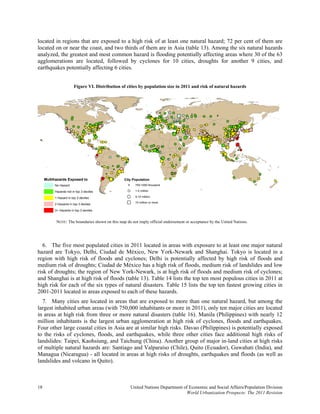
  • 29.
    some of themost populous countries in the world: Bangladesh, China, India, Indonesia, Nigeria and Pakistan. 24. Most countries have small urban populations. In 2011, almost two thirds of the 231 countries or areas considered had fewer than 5 million urban dwellers and they accounted for barely 5 per cent of the world urban population. Among them, 84 per cent had urban populations below one million and accounted for 0.5 per cent of all urban dwellers on Earth. By 2050, just half of all countries or areas are expected to have fewer than 5 million urban dwellers and will account for 1.7 per cent of the world urban population. 25. Similarly, the increases in the world urban population are concentrated in a few countries, with China and India together projected to account for about a third of the increase in the urban population in the coming decades. Between 2011 and 2030, the urban areas of the world are expected to gain 1.4 billion people, including 276 million in China and 218 million in India, which account together for 37 per cent of the total increase. Nine additional countries are projected to contribute 26 per cent of the urban increment, with increases ranging from 22 million to 76 million. The countries involved are: Nigeria and the Democratic Republic of the Congo in Africa; Bangladesh, Indonesia, Pakistan and the Philippines in Asia; Brazil and Mexico in Latin America, and the United States of America. Among them, those in Africa and Asia will experience high rates of urban population growth, usually surpassing 2 per cent or even 3 per cent per year 26. A further urban increment of 1.3 billion people is expected globally during 2030-2050, with India being the major contributor (270 million) and Nigeria following (121 million). Together, these two countries are expected to account for 31 per cent of urban growth during 2030-2050. China will only contribute an additional 44 million during the same period. Yet, China will still have the largest urban population in 2050 (1 billion), followed by India (0.9 billion). 27. In a few developed countries, the urban population will decrease. Despite the projected increases in the level of urbanization, overall population decline in several countries will lead to a reduction in the number of urban dwellers. Between 2011 and 2030, the urban population of Ukraine and Bulgaria are projected to decline by 2 million and 0.2 million, respectively. Between 2030 and 2050, more countries will experience reductions in the urban population. Those with the largest drops include Japan (a reduction of 10 million), the Russian Federation (2.4 million), the Republic of Korea (1.7 million) and Ukraine (1.3 million). 28. The rural population is even more highly concentrated in a few countries than the urban population. In 2011, 19 countries accounted for 75 per cent of the rural population and all but three (Brazil, the Russian Federation and the United States) are located in Africa or Asia. India has the largest rural population (853 million), followed by China (666 million). Together, they account for 45 per cent of the world rural population. Bangladesh, Indonesia and Pakistan follow, each with over 107 million rural inhabitants. 29. In Africa, the largest rural populations are located in Nigeria (82 million), Ethiopia (70 million), Egypt (47 million), the Democratic Republic of the Congo (45 million), the United Republic of Tanzania (34 million), Kenya (32 million) and Uganda (29 million). During 2011-2030, the rural populations of most of those African countries are projected to increase at rates higher than 1.3 per cent per year, except in the cases of Nigeria and Egypt. Among the populous countries in Asia, Pakistan is expected to experience the highest growth rate of the rural population during 2011-2030 (0.8 per cent per year). In contrast, in eight of the 19 countries with large rural populations, the rural population is declining, with China, the Russian Federation, Brazil, Indonesia, Thailand and the United States having the fastest rates of decline. United Nations Department of Economic and Social Affairs/Population Division 13 World Urbanization Prospects: The 2011 Revision
  • 30.
    30. As inthe case of the urban population, most countries have small rural populations. In 2011, two thirds of the 231 countries or areas considered had at most 5 million rural inhabitants and accounted for 4.9 per cent of the world rural population. In more than two thirds of them, the rural population is projected to decrease during 2011-2050. 31. The past and future trends of the urban (and rural) population change are influenced by two components. The first is the overall increase (or decline) of the national population. The second is the urban population change resulting from the increase (or decline) of the urban population only. The contribution of each component in the urban population change between 1950 and 2000 and 2000 and 2050 varies markedly among the ten countries with the largest increase of their future urban population (figure V). Figure V. Contribution of demographic and urban growth to urbanization among the ten countries with the largest increase in their urban population between 2000 and 2050, 1950-2050 India 49% 70% China 78% 98% Nigeria 82% 50% USA 34% 29% Indonesia 78% 72% Pakistan 54% 59% Bangladesh 86% 78% DR Congo 41% 1950-2000 overall population growth 59% 1950-2000 urban growth Philippines 50% 2000-2050 overall population growth 42% UR Tanzania 87% 2000-2050 urban growth 62% 0 100 200 300 400 500 600 Urban population change (in million) 32. The increase in the urban population between 1950 and 2000 is equally divided between overall population increase and urban growth in India, Pakistan, the Democratic Republic of the Congo and the Philippines. However, urban population growth played a more important role in the urbanization of China, Nigeria, Indonesia, Bangladesh and the United Republic of Tanzania. Among these ten countries, only in the United States overall population increase has been the main driver of urbanization between 1950 and 2000. 33. Between 2000 and 2050, urban growth will be the sole driver of the increase in the urban population of China. In India, the urban population is expected to increase by two thirds due to urban growth and one third due to the overall population increase. In contrast, the urbanization of the United States until 2050 will be still mainly led by an increase in the overall increase of the population. 14 United Nations Department of Economic and Social Affairs/Population Division World Urbanization Prospects: The 2011 Revision
  • 31.
    34. Faced withthe opportunities and challenges associated with urbanization, many Governments have consistently considered their population’s spatial distribution as a concern. In 2009, 83 per cent of Governments expressed concern about their pattern of population distribution, down from 89 per cent in the 1970s (table 8). Among developing countries, 58 per cent expressed the desire to modify in a major way the spatial distribution of their populations, whereas 28 per cent wanted to effect only minor changes. Among developed countries, 29 per cent desired a major change and 43 per cent a minor change. 35. Dissatisfaction regarding patterns of population distribution was highest in Africa (75 per cent of its countries wished to make major changes in the spatial distribution of their populations) and Asia (57 per cent desired a major change). In Latin America and the Caribbean, Oceania and Europe, about 40 per cent of Governments considered that major changes in spatial distribution were desirable. 36. Policies aimed at modifying the spatial distribution of a population often focus on ways to reduce migrant flows to large cities. In 1976, 44 per cent of developing countries reported having implemented such policies and by 2011, that proportion had increased to 72 per cent. At the same time, among developed countries, the proportion having policies to reduce migrant flows to large cities declined from 55 per cent in 1976 to 26 per cent in 1996 but increased later to 34 per cent in 2009. In Oceania, 83 per cent of countries have such policies, in Africa 77 per cent, in Asia 66 per cent and in Latin America and the Caribbean 68 per cent (United Nations, 2009 a). TABLE 8. GOVERNMENT VIEWS ON THE SPATIAL DISTRIBUTION OF THE POPULATION, 2009 Major Minor Major Minor change change change change desired desired Satisfactory Total desired desired Satisfactory Total Number of countries Percentage World ................................ 99 62 34 195 51 32 17 100 More developed regions.... 14 21 14 49 29 43 29 100 Less developed regions ..... 85 41 20 146 58 28 14 100 Source: World Population Policies 2009 (United Nations publication, Sales No.E.09.XIII.14). 37. Historically, urbanization has been driven by the concentration of investment and employment opportunities in urban areas. Productive activities in industry and services cluster in cities. By one estimate, 80 per cent of the world’s gross domestic product (GDP) is generated by urban areas. As cities attract businesses and jobs, they bring together both the human and the entrepreneurial resources to generate new ideas, innovations and increasingly productive uses of technology. The 2011 Revision of World Urbanization Prospects provides a useful basis for the analysis of the world’s urban transformation and the dynamics of city growth. 38. The 2011 Revision of the World Urbanization Prospects includes, for the first time, geographical coordinates for all the cities with more than 750,000 inhabitants. This will allow researchers to link future demographic trends in urban agglomerations to various spatial and environmental characteristics, such proximity to coasts, earthquake faults, or climate zones. 39. Estimates and projections of urban and rural populations as well as urban agglomerations critically depend on information from censuses. For the 2011 Revision of the World Population Prospects results from the 2010 round of censuses that became available since the release of the previous revision could now be included for many countries. United Nations Department of Economic and Social Affairs/Population Division 15 World Urbanization Prospects: The 2011 Revision
  • 33.
    URBANIZATION AND NATURALHAZARDS For the first time, the 2011 Revision of the World Urbanization Prospects includes geographical coordinates for all 633 cities with more than 750,000 inhabitants in 2011. This will allow researchers to link demographic trends in urban agglomerations to various spatial and environmental characteristics, such as proximity to coastal areas, earthquake faults, or climate zones. In an initial analysis the Population Division combined data from the 2011 Revision of the World Urbanization Prospects with a spatial database on natural hazards prepared by the Center for International Earth Science Information Network (CIESIN) at Columbia University.29 In this database an area is classified to be at “high risk” of a particular natural disaster if it is located in grid cells ranking in the top three deciles of the global risk distribution in terms of frequency of occurrences of one or more specified natural hazards. The main findings of this analysis are as follows: 1. Of the more than 450 urban areas with 1 million inhabitants or more in 2011 (representing 1.4 billion people), 60 per cent, or about 890 million people, were living in areas of high risk of exposure to at least one natural hazard (tables 9 and 10).30 2. Europe’s and Africa’s major cities are the least exposed overall. Only 26 and 37 per cent of their cities with one million inhabitants or more are located in areas at high risk of exposure to at least one natural disaster. However, cities in Latin America and the Caribbean, in Northern America, and especially in Asia are often located in areas exposed to natural hazards (figure VI). Depending on the region, between half and two thirds of the cities with 1 million inhabitants or more are located in areas that face high risk of exposure to at least one natural disaster. 3. Flooding is the most frequent and greatest hazard for the 633 largest cities or urban agglomerations analyzed: At least 233 cities are located in or close to areas with a high risk of flooding – potentially affecting 663 million inhabitants. One hundred forty eight of these cities are not coastal cities.31 Exposure to a high risk of flooding does not necessarily mean that those cities are actually affected by frequent floods. One has to take into account that this analysis relies only on flood data for the period 1985 to 2003. Previous or more recent flooding events have not been considered. The geographical data are also rather coarse and refer to a 50 kilometer radius around the city proper. Moreover, cities may have already built infrastructure to prevent flooding, such as dams, dikes or flood retention areas. However, the data indicate that these 233 large cities may need to take precautions for flooding, if they have not already done so. 4. Drought is the second most frequent hazard, affecting areas where 132 cities are located, followed by cyclones affecting 68 cities and earthquakes threatening 40 of the 633 cities analyzed (table 11). Some 277 million people live in cities at high risk of droughts and 229 million reside in cities at high risk of cyclones (table 12). Other cities are also exposed to some of these hazards but to a lesser extent. 5. Among the 63 most populated urban areas (with 5 million or more inhabitants in 2011), 39 are 29 Natural Disaster Hotspots: A Global Risk Analysis (Dilley et al., 2005) produced by the Center for Hazards and Risk Research (CHRR); Center for International Earth Science Information Network (CIESIN), Columbia University; International Bank for Reconstruction and Development / The World Bank (http://www.ldeo.columbia.edu/chrr/research/hotspots/). The database includes information collected for cyclones (for the period between 1980 and 2000), droughts (between 1980 and 2000), earthquakes (between 1976 and 2002), floods (between 1985 and 2003), landslides, and volcano eruptions (between 79 and 2000). Data are published with a spatial resolution ranging from a 30 by 30 arc second grid to a 2.5 by 2.5 arc degree grid for cyclones, earthquakes, landslides, volcanoes, droughts and floods. Data for floods are less reliable or missing in the early-mid 1990s. For each single hazard, all grid cells with occurrence data were divided into deciles, 10 classes consisting of approximately equal numbers of grid cells. The higher the value of the grid cell, the higher the decile ranking and the greater the frequency of the hazard relative to other cells (Dilley et al., 2005: 23-34). 30 Since the location of cities in the World Urbanization Prospects is specified by point coordinates, a buffer tool in ArcGIS 10.0 (ESRI, 2011) was employed to create buffer polygons with 2 km and 5 km distance from the point data, respectively, to approximately reflect their actual locations as accurate as possible. In classifying the degree of risk exposure of a city to hotspots of a specific hazard, the highest cell value of grids is used when the city’s buffer zones overlap with surrounding grid cells of that particular hazard. 31 The geographic data (in shape files) for coastal areas were from the Millennium Ecosystem Assessment (MA). The coastal areas were defined as areas between 50 meters below mean sea level and 50 meters above the high tide level or extending landward to a distance of 100 kilometers from shore, including coral reefs, intertidal zones, estuaries, coastal aquaculture, and seagrass communities (MA, 2003: 54). United Nations Department of Economic and Social Affairs/Population Division 17 World Urbanization Prospects: The 2011 Revision
  • 34.
    located in regionsthat are exposed to a high risk of at least one natural hazard; 72 per cent of them are located on or near the coast, and two thirds of them are in Asia (table 13). Among the six natural hazards analyzed, the greatest and most common hazard is flooding potentially affecting areas where 30 of the 63 agglomerations are located, followed by cyclones for 10 cities, droughts for another 9 cities, and earthquakes potentially affecting 6 cities. Figure VI. Distribution of cities by population size in 2011 and risk of natural hazards Multihazards Exposed to City Population No Hazard 750-1000 thousand Hazards not in top 3 deciles 1-5 million 1 Hazard in top 3 deciles 5-10 million 10 million or more 2 Hazards in top 3 declies 3+ Hazards in top 3 deciles NOTE: The boundaries shown on this map do not imply official endorsement or acceptance by the United Nations. 6. The five most populated cities in 2011 located in areas with exposure to at least one major natural hazard are Tokyo, Delhi, Ciudad de México, New York-Newark and Shanghai. Tokyo is located in a region with high risk of floods and cyclones; Delhi is potentially affected by high risk of floods and medium risk of droughts; Ciudad de México has a high risk of floods, medium risk of landslides and low risk of droughts; the region of New York-Newark, is at high risk of floods and medium risk of cyclones; and Shanghai is at high risk of floods (table 13). Table 14 lists the top ten most populous cities in 2011 at high risk for each of the six types of natural disasters. Table 15 lists the top ten fastest growing cities in 2001-2011 located in areas exposed to each of these hazards. 7. Many cities are located in areas that are exposed to more than one natural hazard, but among the largest inhabited urban areas (with 750,000 inhabitants or more in 2011), only ten major cities are located in areas at high risk from three or more natural disasters (table 16). Manila (Philippines) with nearly 12 million inhabitants is the largest urban agglomeration at high risk of cyclones, floods and earthquakes. Four other large coastal cities in Asia are at similar high risks. Davao (Philippines) is potentially exposed to the risks of cyclones, floods, and earthquakes, while three other cities face additional high risks of landslides: Taipei, Kaohsiung, and Taichung (China). Another group of major in-land cities at high risks of multiple natural hazards are: Santiago and Valparaíso (Chile), Quito (Ecuador), Guwahati (India), and Managua (Nicaragua) - all located in areas at high risks of droughts, earthquakes and floods (as well as landslides and volcano in Quito). 18 United Nations Department of Economic and Social Affairs/Population Division World Urbanization Prospects: The 2011 Revision
  • 35.
    8. One outof five cities among the most populous in 2011 is located in an area that is at low risk of natural disasters. 133 cities are located in areas not exposed to any natural disasters or are exposed only to low risks. Table 17 provides the list of the top ten most populated cities located in areas at low or no risk of natural disasters. Two megacities stand out: Moskva (Moscow) and Al-Qahirah (Cairo). For those cities, the natural hazards database from CIESIN does not record a high risk for any kind of natural disaster based on information from the 1985 to 2000 period. The results of these initial analyses concerning the potential exposure of cities and urban agglomerations to natural disasters are subject to the following constraints:  The geographical database for the six major natural disasters only covers the relatively short time period from 1980 to 2000. Data for floods are even more restricted to the period between 1985 and 2003. The analysis therefore likely underestimates the impact of rare, but perhaps more severe, natural disasters on urban areas.  The spatial resolution for which floods, droughts, cyclones, earthquakes, landslides and volcanoes are recorded ranges from a 30 by 30 arc second grid to a 2.5 by 2.5 arc degree grid. These very different spatial resolutions make it difficult to assess absolute risks and compare hazards (Dilley et al., 2005: 26).  Spatial information for the cities and urban agglomerations are only point coordinates, extended by a circular “buffer area”. More appropriate information would be the polygon coordinates of the city area, which is currently not available in the World Urbanization Prospects. The overlay between urban agglomerations and hazard areas may therefore be only partial. United Nations Department of Economic and Social Affairs/Population Division 19 World Urbanization Prospects: The 2011 Revision
  • 36.
    TABLE 9. NUMBEROF CITIES BY NUMBER OF NATURAL HAZARDS, CLASS SIZE (2011) AND MAJOR AREA Natural hazard risk (1980-2000) 1-5 million No or low hazard 1 hazard 2 hazards 3+ hazards Total Africa 29 16 2 47 Asia 55 97 37 4 193 Europe 35 13 48 Latin America and the Caribbean 17 33 4 1 55 Northern America 20 20 4 44 Oceania 3 3 6 Total 159 182 47 5 393 5-10 million No or low hazard 1 hazard 2 hazards 3+ hazards Total Africa 1 1 2 Asia 11 10 5 26 Europe 2 1 3 Latin America and the Caribbean 1 2 1 4 Northern America 4 1 5 Oceania 0 Total 18 14 7 1 40 10 million and over No or low hazard 1 hazard 2 hazards 3+ hazards Total Africa 2 2 Asia 2 5 5 1 13 Europe 2 2 Latin America and the Caribbean 4 4 Northern America 2 2 Oceania 0 Total 6 9 7 1 23 1 million and over No or low hazard 1 hazard 2 hazards 3+ hazards Total Africa 32 17 2 0 51 Asia 68 112 47 5 232 Europe 39 14 0 0 53 Latin America and the Caribbean 17 38 6 2 63 Northern America 24 21 6 0 51 Oceania 3 3 0 0 6 Total 183 205 61 7 456 NOTE: No or low hazard represents a city that is not located in an area or a region that are in top three deciles of any six natural hazards analyzed. 20 United Nations Department of Economic and Social Affairs/Population Division World Urbanization Prospects: The 2011 Revision
  • 37.
    TABLE 10. CITYPOPULATION (IN MILLION) BY NUMBER OF NATURAL HAZARDS, CLASS SIZE (2011) AND REGION Natural hazard risk (1980-2000 ) 1-5 million No or low hazard 1 hazard 2 hazards 3+ hazards Total Africa 68.0 31.1 4.9 104.0 Asia 107.3 177.9 72.1 6.9 364.3 Europe 57.8 23.5 81.3 Latin America and the Caribbean 34.3 69.9 6.6 1.6 112.5 Northern America 47.4 38.4 12.3 98.0 Oceania 7.6 7.2 14.8 Total 322.5 348.0 95.9 8.5 775.0 5-10 million No or low hazard 1 hazard 2 hazards 3+ hazards Total Africa 8.8 5.1 13.9 Asia 77.3 70.4 38.2 185.9 Europe 12.1 9.0 21.1 Latin America and the Caribbean 8.7 14.6 6.0 29.4 Northern America 26.5 5.9 32.5 Oceania 0.0 Total 124.8 99.1 52.8 6.0 282.8 10 million and over No or low hazard 1 hazard 2 hazards 3+ hazards Total Africa 22.4 22.4 Asia 35.3 74.7 93.3 11.9 215.2 Europe 22.2 22.2 Latin America and the Caribbean 65.9 65.9 Northern America 33.7 33.7 Oceania 0.0 Total 80.0 140.5 127.1 11.9 359.4 1 million and over No or low hazard 1 hazard 2 hazards 3+ hazards Total Africa 99.2 36.1 4.9 0.0 140.3 Asia 220.0 323.0 203.6 18.8 765.3 Europe 92.2 32.5 0.0 0.0 124.7 Latin America and the Caribbean 34.3 144.5 21.2 7.7 207.7 Northern America 73.9 44.3 46.1 0.0 164.2 Oceania 7.6 7.2 0.0 0.0 14.8 Total 527.3 587.7 275.8 26.4 1,417.2 NOTE: No or low hazard represents a city that is not located in an area or a region that are in top three deciles of any six natural hazards analyzed. United Nations Department of Economic and Social Affairs/Population Division 21 World Urbanization Prospects: The 2011 Revision
  • 38.
    TABLE 11. NUMBEROF CITIES (750,000 INHABITANTS OR MORE IN 2011) BY RISK DECILE, TYPE OF NATURAL HAZARD AND COASTAL STATUS Type of natural hazard Cyclone Drought Earthquake Flood Landslide Volcano Coastal Inland Coastal Inland Coastal Inland Coastal Inland Coastal Inland Coastal Inland Risk decile city city city city city city city city city city city city No hazard 138 308 87 110 196 314 45 83 233 364 242 385 1st-4th decile 29 51 69 107 20 31 72 126 5-7th decile 26 13 40 86 13 20 38 45 9 21 2 8-10th decile 50 18 47 87 14 25 88 136 1 5 1 3 TABLE 12. POPULATION FOR CITIES OR URBAN AGGLOMERATIONS OF 750,000 INHABITANTS OR MORE IN 2011 (IN MILLIONS) BY RISK DECILE, TYPE OF NATURAL HAZARD AND COASTAL STATUS Type of natural hazard Cyclone Drought Earthquake Flood Landslide Volcano Coastal Inland Coastal Inland Coastal Inland Coastal Inland Coastal Inland Coastal Inland Risk decile city city city city city city city city city city city city No hazard 364 668 298 244 559 690 85 151 709 765 732 829 1st-4th decile 92 112 196 234 40 59 182 248 5-7th decile 89 16 109 212 73 37 117 124 24 61 4 8-10th decile 190 39 131 147 63 50 350 313 2 10 2 3 22 United Nations Department of Economic and Social Affairs/Population Division World Urbanization Prospects: The 2011 Revision
  • 39.
    TABLE 13. CITIESAND URBAN AGGLOMERATIONS (WITH 5 MILLION OR MORE INHABITANTS IN 2011) EXPOSED TO AT LEAST ONE MAJOR NATURAL HAZARD (8-10TH RISK DECILES OF NATURAL DISASTERS) Population (in million) Risk decile City 2011 Location Type Cyclone Drought Earthquake Flood Landslide Volcano 1 Tokyo, Japan 37.2 Coastal Not Arid 8-10th No hazard 5-7th 8-10th No hazard No hazard 2 Delhi, India 22.7 Inland Semiarid No hazard 5-7th No hazard 8-10th No hazard No hazard 3 Ciudad de México 20.4 Inland Not Arid No hazard 1st-4th No hazard 8-10th 5-7th No hazard (Mexico City), Mexico 4 New York-Newark, USA 20.4 Coastal Not Arid 5-7th No hazard No hazard 8-10th No hazard No hazard 5 Shanghai, China 20.2 Coastal Not Arid 8-10th No hazard No hazard 8-10th No hazard No hazard 6 São Paulo, Brazil 19.9 Inland Not Arid No hazard No hazard No hazard 8-10th No hazard No hazard 7 Dhaka, Bangladesh 15.4 Coastal Not Arid 1st-4th 1st-4th No hazard 8-10th No hazard No hazard 8 Kolkata (Calcutta), India 14.4 Coastal Not Arid 5-7th 8-10th No hazard 8-10th No hazard No hazard 9 Karachi, Pakistan 13.9 Coastal Arid 1st-4th 8-10th No hazard 1st-4th No hazard No hazard 10 Buenos Aires, Argentina 13.5 Coastal Not Arid No hazard 1st-4th No hazard 8-10th No hazard No hazard 11 Los Angeles-Long Beach 13.4 Coastal Semiarid No hazard 8-10th 8-10th 1st-4th 5-7th No hazard -Santa Ana, USA 12 Rio de Janeiro, Brazil 12.0 Coastal Not Arid No hazard No hazard No hazard 8-10th No hazard No hazard 13 Manila, Philippines 11.9 Coastal Not Arid 8-10th 1st-4th 8-10th 8-10th No hazard No hazard 14 Osaka-Kobe, Japan 11.5 Coastal Not Arid 8-10th No hazard 5-7th 5-7th No hazard No hazard 15 Istanbul, Turkey 11.3 Coastal Not Arid No hazard 1st-4th 8-10th 1st-4th No hazard No hazard 16 Guangzhou, Guangdong, China 10.8 Coastal Not Arid 8-10th No hazard No hazard 8-10th No hazard No hazard 17 Shenzhen, China 10.6 Coastal Not Arid 8-10th 1st-4th No hazard 8-10th No hazard No hazard 18 Jakarta, Indonesia 9.8 Coastal Not Arid No hazard 5-7th 1st-4th 8-10th No hazard No hazard 19 Seoul, Republic of Korea 9.7 Inland Not Arid 8-10th 1st-4th No hazard 8-10th No hazard No hazard 20 Wuhan, China 9.2 Inland Not Arid 1st-4th 1st-4th No hazard 8-10th No hazard No hazard 21 Lima, Peru 9.1 Coastal Arid No hazard 1st-4th 8-10th 5-7th No hazard No hazard 22 London, United Kingdom 9.0 Coastal Not Arid No hazard 1st-4th No hazard 8-10th No hazard No hazard 23 Chennai (Madras), India 8.8 Coastal Not Arid 1st-4th 8-10th No hazard 5-7th No hazard No hazard 24 Bogotá, Colombia 8.7 Inland Not Arid No hazard 5-7th 5-7th 8-10th 5-7th No hazard 25 Lahore, Pakistan 7.6 Inland Semiarid No hazard 8-10th 1st-4th 8-10th No hazard No hazard 26 Tehran, Iran (Islamic Republic of) 7.3 Inland Semiarid No hazard 5-7th 8-10th 5-7th No hazard No hazard 27 Dongguan, Guangdong, China 7.3 Coastal Not Arid 8-10th No hazard No hazard 8-10th No hazard No hazard 28 Hong Kong, China, Hong Kong SAR 7.1 Coastal Not Arid 8-10th 1st-4th No hazard 8-10th No hazard No hazard 29 Chengdu, China 6.7 Inland Not Arid No hazard No hazard No hazard 8-10th No hazard No hazard 30 Foshan, China 6.5 Coastal Not Arid 8-10th No hazard No hazard 8-10th No hazard No hazard 31 Ahmadabad, India 6.4 Coastal Semiarid No hazard 8-10th No hazard 5-7th No hazard No hazard 32 Thành Pho Ho Chí Minh 6.4 Coastal Not Arid No hazard 5-7th No hazard 8-10th No hazard No hazard (Ho Chi Minh City), Viet Nam 33 Santiago, Chile 6.0 Inland Semiarid No hazard 8-10th 8-10th 8-10th No hazard No hazard 34 Philadelphia, USA 5.9 Coastal Not Arid 5-7th No hazard No hazard 8-10th No hazard No hazard 35 Belo Horizonte, Brazil 5.5 Inland Not Arid No hazard 8-10th No hazard 8-10th No hazard No hazard 36 Hangzhou, China 5.4 Coastal Not Arid 5-7th No hazard No hazard 8-10th No hazard No hazard 37 Chittagong, Bangladesh 5.2 Coastal Not Arid 5-7th 5-7th 5-7th 8-10th No hazard No hazard 38 Singapore, Singapore 5.2 Coastal Not Arid No hazard No hazard No hazard 8-10th No hazard No hazard 39 Luanda, Angola 5.1 Coastal Semiarid No hazard 8-10th No hazard 1st-4th No hazard No hazard United Nations Department of Economic and Social Affairs/Population Division 23 World Urbanization Prospects: The 2011 Revision
  • 40.
    TABLE 14. TOP10 LARGEST CITY POPULATIONS IN 2011 AT 8-10TH RISK DECILES BY TYPE OF HAZARD Cyclone Drought Earthquake Flood Landslide Volcano 1 Tokyo, Japan Kolkata (Calcutta), Los Angeles-Long Tokyo, Japan Taipei, China Napoli India Beach-Santa Ana, (Naples), USA Italy 2 Shanghai, China Karachi, Pakistan Manila, Philippines Delhi, India Bandung, Quito, Indonesia Ecuador 3 Manila, Los Angeles-Long Istanbul, Turkey Ciudad de México Quito, Bogor, Philippines Beach-Santa Ana, (Mexico City), Ecuador Indonesia USA Mexico 4 Osaka-Kobe, Chennai (Madras), Lima, Peru New York-Newark, San Malang, Japan India USA Salvador, El Indonesia Salvador 5 Guangzhou, Lahore, Pakistan Tehran, Iran (Islamic Shanghai, China Kaohsiung, China Guangdong, Republic of) China 6 Shenzhen, China Ahmadabad, India Santiago, Chile São Paulo, Brazil San José, Costa Rica 7 Seoul, Republic Santiago, Chile San Francisco- Dhaka, Bangladesh of Korea Oakland, USA 8 Dongguan, Belo Horizonte, Brazil Kunming, China Kolkata (Calcutta), India Guangdong, China 9 Hong Kong, Luanda, Angola Nagoya, Japan Buenos Aires, Argentina China, Hong Kong SAR 10 Foshan, China Yangon, Myanmar Izmir, Turkey Rio de Janeiro, Brazil TABLE 15. TOP 10 FASTEST GROWING CITY POPULATIONS IN 2001-2011 AT 8-10TH RISK DECILES BY TYPE OF HAZARD Cyclone Drought Earthquake Flood Landslide Volcano 1 Zhongshan, China Nay Pyi Taw, Yinchuan, China Can Tho, Viet San José, Costa Bogor, Myanmar Nam Rica Indonesia 2 Xiamen, China Sharjah, United Arab Kathmandu, Batam, Indonesia San Salvador, El Quito, Emirates Nepal Salvador Ecuador 3 Haikou, China Dubayy (Dubai), Karaj, Iran Yongin, Republic Quito, Ecuador Malang, United Arab (Islamic of Korea Indonesia Emirates Republic of) 4 Jinjiang, China Luanda, Angola Sulaimaniya, Zhongshan, China Bandung, Napoli Iraq Indonesia (Naples), Italy 5 Dongguan, Huambo, Angola San José, Costa Xiamen, China Kaohsiung, China Guangdong, China Rica 6 Jiangmen, China Hamah, Syrian Arab Quetta, Pakistan Suzhou, Jiangsu, Taipei, China Republic China 7 Vientiane, Lao Nanyang, Henan, Xining, China Wuhu, Anhui, China People's China Democratic Republic 8 Huizhou, China Liaocheng, China Bursa, Turkey Hefei, China 9 Jiaxing, China Handan, China Tangshan, Kigali, Rwanda Hebei, China 10 Putian, China Zhengzhou, China Davao, Jinjiang, China Philippines 24 United Nations Department of Economic and Social Affairs/Population Division World Urbanization Prospects: The 2011 Revision
  • 41.
    TABLE 16. URBANAREAS (WITH 750,000 OR MORE INHABITANTS IN 2011) EXPOSED TO THREE OR MORE NATURAL HAZARDS (8-10TH RISK DECILES OF NATURAL DISASTERS) Population (in million) Risk decile City 2011 Location Type Cyclone Drought Earthquake Flood Landslide Volcano 1 Manila, Philippines 11.9 Coastal Not Arid 8-10th 1st-4th 8-10th 8-10th No hazard No hazard 2 Santiago, Chile 6.0 Inland Semiarid No hazard 8-10th 8-10th 8-10th No hazard No hazard 3 Taipei, China 2.7 Inland Not Arid 8-10th No hazard 8-10th 8-10th 8-10th No hazard 4 Quito, Ecuador 1.6 Inland Not Arid No hazard 8-10th 8-10th 8-10th 8-10th 8-10th 5 Davao, Philippines 1.6 Coastal Not Arid 8-10th 1st-4th 8-10th 8-10th No hazard No hazard 6 Kaohsiung, China 1.5 Coastal Not Arid 8-10th No hazard 8-10th 5-7th 8-10th No hazard 7 Taichung, China 1.2 Inland Not Arid 8-10th No hazard 8-10th 8-10th 5-7th No hazard 8 Guwahati (Gauhati), India 1.0 Inland Not Arid No hazard 8-10th 8-10th 8-10th No hazard No hazard 9 Managua, Nicaragua 1.0 Inland Not Arid 1st-4th 8-10th 8-10th 8-10th No hazard No hazard 10 Valparaíso, Chile 0.9 Coastal Not Arid No hazard 8-10th 8-10th 8-10th No hazard No hazard TABLE 17. TOP 10 LARGEST CITY POPULATIONS IN 2011 LEAST EXPOSED TO NATURAL HAZARDS (NO RISK OR 1-4TH RISK DECILE FOR ONLY ONE NATURAL DISASTER) Population (in million) Risk decile City 2011 Location Type Cyclone Drought Earthquake Flood Landslide Volcano 1 Moskva (Moscow), 11.6 Inland Not Arid No hazard No hazard No hazard No hazard No hazard No hazard Russian Federation 2 Al-Qahirah (Cairo), Egypt 11.2 Inland Hyperarid No hazard No hazard No hazard 1st-4th No hazard No hazard 3 Kinshasa, DR. of the Congo 8.8 Inland Not Arid No hazard 1st-4th No hazard 1st-4th No hazard No hazard 4 Madrid, Spain 6.6 Inland Semiarid No hazard 1st-4th No hazard No hazard No hazard No hazard 5 Toronto, Canada 5.6 Inland Not Arid 1st-4th No hazard No hazard 1st-4th No hazard No hazard 6 Ar-Riyadh (Riyadh), 5.5 Inland Hyperarid No hazard No hazard No hazard 1st-4th No hazard No hazard Saudi Arabia 7 Dallas-Fort Worth, USA 5.2 Inland Semiarid 1st-4th No hazard No hazard 1st-4th No hazard No hazard 8 Xi'an, Shaanxi, China 5.0 Inland Dry subhumid No hazard 1st-4th No hazard 1st-4th No hazard No hazard 9 Atlanta, USA 5.0 Inland Not Arid 1st-4th No hazard No hazard 1st-4th No hazard No hazard 10 Peterburg (Saint Petersburg), 4.9 Inland Coastal Not Arid No hazard No hazard No hazard 1st-4th No hazard Russian Federation United Nations Department of Economic and Social Affairs/Population Division 25 World Urbanization Prospects: The 2011 Revision
  • 42.
    References David Satterthwaite (2007).The transition to a predominantly urban world and its underpinnings. International Institute for Environment and Development. Human Settlements Discussion Paper Series, 4 September 2007. Dilley, M, Chen, R.S., Deichmann, U., Lerner-Lam, A.L., Arnold, M., Agwe, J., Buys, P., Kjekstad, O., Lyon, B., and Yetman, G. (2005). Natural Disaster Hotspots: A Global Risk Analysis. Disaster Risk Management, Series No. 5-34423. Washington DC: The World Bank. Esri (2011). ArcGIS 10. (http://www.esri.com/software/arcgis/) Millennium Ecosystem Assessment (2003). Ecosystems and Human Well-Beijing: A Framework for Assessment. Washington, D.C.: Island Press. United Nations (2011). Department of Economic and Social Affairs, Population Division (2011): World Population Prospects: The 2010 Revision, New York (Extended Dataset on CD-ROM, ST/ESA/SER.A/308, Sales No. 11.XIII.7). _______ (2009 a). World Population Monitoring. Focusing on Population Distribution, Urbanization, Internal Migration and Development. A Concise Report .New York, (ST/ESA/SER.A/284, Sales No. E.09.XII.3). _______(2009 b). World Fertility Patterns 2009. Wall Chart. (ST/ESA/SER.A/294, Sales No. E.09.XIII.12). 26 United Nations Department of Economic and Social Affairs/Population Division World Urbanization Prospects: The 2011 Revision
  • 43.
    UNITED NATIONS NATIONS UNIES Department of Economic and Social Affairs POPULATION DIVISION DATA IN DIGITAL FORM The 2011 Revision of the World Urbanization Prospects, prepared by the United Nations Population Division, provides a comprehensive and consistent set of urban and rural population data for the world's countries and areas, as well as for urban agglomerations with more than 750,000 inhabitants in 2011. The data referring to urban and rural areas cover the period 1950-2050 and those referring to urban agglomerations cover the period 1950-2025. Detailed results from the 2011 Revision are available for purchase in two sets of files, distributed on a single CD- ROM. The files are prepared in Excel 2003, which is compatible with all versions since Excel 5.0/95. The CD-ROM version launches a navigation interface upon insertion that provides direct access to the files. In the data sets, figures for 1950-2011 are estimates and those for years beyond 2011 are projections. To the exception of a selected set of annual indicators, estimates and projections are presented for years that are multiples of five. The urban, rural and city data presented are consistent with the medium variant of the 2010 Revision of World Population Prospects, the official United Nations population estimates and projections at the national level. A short description of each set of files is presented below; the list of file names and their contents are presented in detail in tables A and B on the following pages. (1) Urban and rural areas: Ten files present estimates and projections of the population in urban and rural areas as well as associated indicators. The data are presented for 231 countries and areas individually and for 33 country aggregates, including the world as a whole, the more and the less developed regions, the major world areas and selected additional aggregates. The projected values cover the period 2011-2050. The files present information on: (1) urban and rural population and percentage urban in 2011; (2) the percentage of the population residing in urban areas; (3) the urban population by country; (4) the rural population by country; (5) the total population by country; (6) the average annual rate of change of the urban population; (7) the average annual rate of change of the rural population; (8) the average annual rate of change of the total population; (9) the urbanization rate or average annual rate of change of the percentage urban, and (10) the average annual rate of change of the percentage rural. In addition to these data presented for five-year periods, annual time series are provided for the following five indicators: (10) the total population by country; (11) the urban population by country; (12) the rural population by country; (13) the percentage of the population residing in urban areas. (2) Urban agglomerations: Eleven files present the estimates and projections of the population in urban agglomerations. The main set of files contains data only for urban agglomerations with 750,000 inhabitants or more in 2011. In addition to the latitude and longitude coordinates for each area name, they cover the following indicators: (1) the total population of each urban agglomeration (also included as annual time series); (2) the average annual rate of change of the population of each urban agglomeration; (3) the percentage of the urban population residing in each urban agglomeration; (4) the percentage of the total population residing in each urban agglomeration. Three more files provide data for specific sets of urban agglomerations. The first one presents the 30 largest urban agglomerations of the world ranked by population size over the period 1950-2025. The second provides 1950-2025 time series of the population of the 30 largest urban agglomerations in 2007. The third presents the population of the capital cities of each country for the year 2011. Lastly, four files (one per indicator and altogether) provide summary statistics for major areas, regions and countries (with a population of less than 100,000 in 2011) on the number of cities, the percentage of urban population and the urban population by size class of urban settlement. The following citation should be used to indicate the source of any data derived from the data sets described above: United Nations, Department of Economic and Social Affairs, Population Division (2012). World Urbanization Prospects: The 2011 Revision. CD-ROM Edition – Data in digital form (POP/DB/WUP/Rev.2011). United Nations Department of Economic and Social Affairs/Population Division 27 World Urbanization Prospects: The 2011 Revision
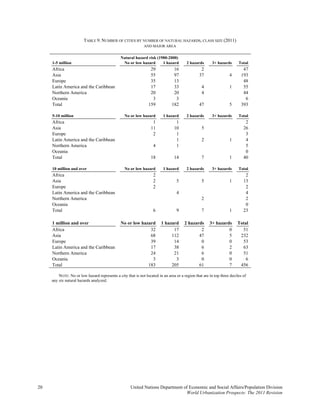
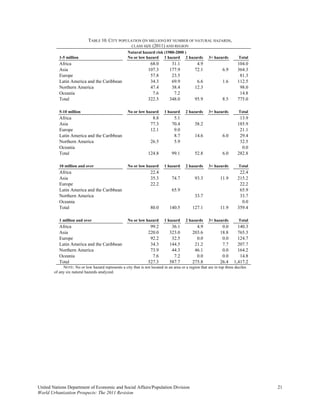
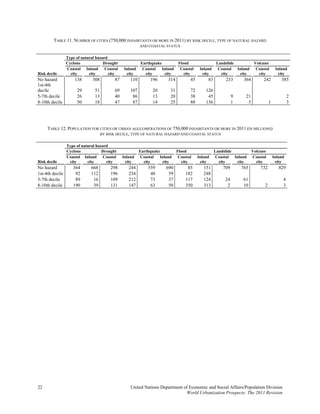
  • 44.
    28 World Urbanization Prospects: The 2011 Revision - CD-ROM Edition Table A: Schematic Contents of Dataset on Urban and Rural Areas, 1950-2050 POP/DB/WUP/Rev.2011/1 All rights reserved. Number Table in File Indicator Geographical of Type of Reference Time period World File name Units number presented coverage countries indicator date covered Urbanization or areas Prospects File 0 WUP2011-F00- Location list with All 231 Locations.xls codes (numerical countries and ISO3), and areas description, major area, region and development group. Five-year Indicators File 1 WUP2011-F01- Total, urban and Thousands All 231 Stock 1 July 2011 A.1 Total_Urban_Rural.xls rural population and Per cent countries indicator United Nations Department of Economic and Social Affairs/Population Division and percentage and areas urban File 2 WUP2011-F02- Percentage of the Per cent All 231 Stock 1 July 1950, 1955, 1960,… A.2 Proportion_Urban.xls population countries indicator 2045, 2050 residing in urban and areas areas File 3 WUP2011-F03- Total population Thousands All 231 Stock 1 July 1950, 1955, 1960,… A.3 Urban_Population.xls residing in urban countries indicator 2045, 2050 areas and areas File 4 WUP2011-F04- Total population Thousands All 231 Stock 1 July 1950, 1955, 1960,… A.4 World Urbanization Prospects: The 2011 Revision Rural_Population.xls residing in rural countries indicator 2045, 2050 areas and areas File 5 WUP2011-F05- Total population Thousands All 231 Stock 1 July 1950, 1955, 1960,… A.5 Total_Population.xls countries indicator 2045, 2050 and areas File 6 WUP2011-F06- Average annual Per cent All 231 Period Average 1950-1955, 1955- A.6 Urban_Growth_Rate.xls rate of change of countries indicator per year 1960,… 2040-2045, the urban and areas 2045-2050 population File 7 WUP2011-F07- Average annual Per cent All 231 Period Average 1950-1955, 1955- A.7 Rural_Growth_Rate.xls rate of change of countries indicator per year 1960,… 2040-2045, the rural and areas 2045-2050 population
  • 45.
    World Urbanization Prospects:The 2011 Revision United Nations Department of Economic and Social Affairs/Population Division Number Table in File Indicator Geographical of Type of Reference Time period World File name Units number presented coverage countries indicator date covered Urbanization or areas Prospects File 8 WUP2011-F08- Average annual Per cent All 231 Period Average 1950-1955, 1955- A.8 Total_Growth_Rate.xls rate of change of countries indicator per year 1960,… 2040-2045, the total and areas 2045-2050 population File 9 WUP2011-F09- Average annual Per cent All 231 Period Average 1950-1955, 1955- A.9 Urbanization_Rate.xls rate of change of countries indicator per year 1960,… 2040-2045, the percentage and areas 2045-2050 urban File 10 WUP2011-F10- Average annual Per cent All 231 Period Average 1950-1955, 1955- A.10 Rate_Proportion_Rural.xls rate of change of countries indicator per year 1960,… 2040-2045, the percentage and areas 2045-2050 rural Annual Indicators File 18 WUP2011-F18- Total population Thousands All 231 Stock 1 July 1950, 1951, 1952,… Total_Population_Annual.xls countries indicator 2049, 2050 and areas File 19 WWUP2011-F19- Total population Thousands All 231 Stock 1 July 1950, 1951, 1952,… Urban_Population_Annual.xls residing in urban countries indicator 2049, 2050 areas and areas File 20 WUP2011-F20- Total population Thousands All 231 Stock 1 July 1950, 1951, 1952,… Rural_Population_Annual.xls residing in rural countries indicator 2049, 2050 areas and areas File 21 WUP2011-F21- Percentage of the Per cent All 231 Stock 1 July 1950, 1951, 1952,… Proportion_Urban_Annual.xls population countries indicator 2049, 2050 residing in urban and areas areas Suggested citation: United Nations, Department of Economic and Social Affairs, Population Division (2010). World Urbanization Prospects: The 2011 Revision. CD-ROM Edition - Data in digital form (POP/DB/WUP/Rev.2011). 29
  • 46.
    30 World Urbanization Prospects: The 2011 Revision - CD-ROM Edition Table B: Schematic Contents of Dataset on Urban Agglomerations, 1950-2025 POP/DB/WUP/Rev.2011/2 All rights reserved. Number Table in Time File Geographical of Type of Reference World File name Indicator presented Units period number coverage countries indicator date Urbanization covered or areas Prospects File 0 WUP2011-F00- Location list with All countries 231 Locations.xls codes (numerical and areas and ISO3), description, major area, region and development group. Five-year Indicators File 11a WUP2011-F11a- Population of the 30 Millions The 30 most … Stock 1 July 1950, A.11 30_Largest_Cities.xls largest urban populous indicator 1955,…. agglomerations cities at each , 2020, ranked by point in time 2025 United Nations Department of Economic and Social Affairs/Population Division population size at each point in time File 11b WUP2011-F11b- Time series of the Millions The 30 most … Stock 1 July 1950, A.11 30_Largest_Cities_in_2011_by_time. population of the 30 populous indicator 1955,…. xls largest urban cities in , 2020, agglomerations in 2011 2025 2011 File 12 WUP2011-F12- Population of each Thousands All cities 230 Stock 1 July 1950, A.12 Cities_Over_750K.xls urban agglomeration with 750,000 indicator 1955,…. inhabitants , 2020, World Urbanization Prospects: The 2011 Revision or more in 2025 2011 File 14 WUP2011-F14- Average annual rate Per cent All cities 230 Stock Average 1950- A.14 Growth_Rate_Cities.xls of change of the with 750,000 indicator per year 1955, population of each inhabitants 1955- urban agglomeration or more in 1960,…. 2011 2015- 2020, 2020- 2025 File 15 WUP2011-F15- Percentage of the Per cent All cities 230 Stock 1 July 1950, A.15 Percentage_Urban_in_Cities.xls urban population with 750,000 indicator 1955,…. residing in each inhabitants , 2020, urban agglomeration or more in 2025 2011
  • 47.
    World Urbanization Prospects:The 2011 Revision United Nations Department of Economic and Social Affairs/Population Division Number Table in Time File Geographical of Type of Reference World File name Indicator presented Units period number coverage countries indicator date Urbanization covered or areas Prospects File 16 WUP2011-F16- Percentage of the Per cent All cities 230 Stock 1 July 1950, A.16 Percentage_Total_in_Cities.xls total population with 750,000 indicator 1955,…. residing in each inhabitants , 2020, urban agglomeration or more in 2025 2011 File 17a WUP2011-F17a- Urban population, Various All countries 197 Stock 1 July 1950, A.17 City_Size_Class.xls number of cities and and areas indicator 1955,…. percentage of urban with 100,000 , 2020, population by size inhabitants 2025 class of urban or more in settlement 2011 File 17b WUP2011-F17b- Number of cities Number of All countries 197 Stock 1 July 1950, A.17 City_Size_Class-Number.xls classified by size cities and areas indicator 1955,…. class of urban with 100,000 , 2020, settlement inhabitants 2025 or more in 2011 File 17c WUP2011-F17c- Percentage of urban Per cent All countries 197 Stock 1 July 1950, A.17 City_Size_Class-Percentage.xls population in cities and areas indicator 1955,…. classified by size with 100,000 , 2020, class of urban inhabitants 2025 settlement or more in 2011 File 17d WUP2011-F17d- Population in cities Thousands All countries 197 Stock 1 July 1950, A.17 City_Size_Class-Population.xls classified by size and areas indicator 1955,…. class of urban with 100,000 , 2020, settlement inhabitants 2025 or more in 2011 File 23 WUP2011-F23- Coastal status, Type Risk decile All cities 230 Stock About A.18 City_Risk_Natural-Disasters.xls of drylands with 750,000 indicator 1980- ecosystem, Number inhabitants 2000 of multi-Hazards, or more in Risk decile by type 2011 of hazard (cyclone, drought, earthquake, flood, landslide, 32 31 volcano) Annual Indicators
  • 48.
    Number Table in Time File Geographical of Type of Reference World File name Indicator presented Units period number coverage countries indicator date Urbanization covered or areas Prospects File 13 WUP2011-F13- Population of capital Thousands Capital cities 231 Stock 1 July 2011 A.13 Capital_Cities.xls cities in 2011 indicator File 22 WUP2011-F22- Population of each Thousands All cities 231 Stock 1 July 1950, Cities_Over_750K_Annual.xls urban agglomeration with 750,000 indicator 1951, inhabitants 1952,… or more in 2024, 2011 2025 Suggested citation: United Nations, Department of Economic and Social Affairs, Population Division (2012). World Urbanization Prospects: The 2011 Revision. CD-ROM Edition - Data in digital form (POP/DB/WUP/Rev.2011).
  • 49.
    UNITED NATIONS NATIONS UNIES Department of Economic and Social Affairs POPULATION DIVISION World Urbanization Prospects: The 2011 Revision Data in Digital Form Copyright © United Nations 2012 All rights reserved Date: ____________________________ Order Form Data set requested (please mark appropriate box with an “x”) Price in US$ CD-ROM: World Urbanization Prospects: The 2011 Revision. CD-ROM Edition – Data in digital form (POP/DB/WUP/Rev.2011) ......................................$200.- SHIP TO: Name: .............................................................................................................................................................. Institution: .............................................................................................................................................................. Address: .............................................................................................................................................................. .............................................................................................................................................................. Telephone: .............................................................. Fax No: ................................................................................. Email address: ............................................................................................................................................................. For overnight or express mail delivery, please provide a billing account number: ............................................ Notes 1. Data contained in the above data sets are copyrighted by the United Nations. No portion of the data files contained on the CD-ROM can be reproduced, distributed or used to prepare derivative works or for any other purpose without the express permission of the United Nations, to be obtained from the Secretary of the United Nations Publications Board. For further information, please contact the Director, Population Division/DESA, United Nations (Room DC2-1950), New York, NY 10017, U.S.A. Telephone No. (1 212) 963-3179; Fax No. (1 212) 963-2147. 2. The order form should be accompanied by a cheque or an international money order in US dollars drawn on a United States Bank for the correct amount, payable to the UNITED NATIONS POPULATION DIVISION and mailed to: The Director, Population Division/DESA, United Nations, DC2-1950, New York, NY 10017, U.S.A. Credit cards are not accepted. United Nations Department of Economic and Social Affairs/Population Division 33 World Urbanization Prospects: The 2011 Revision