INSTITUTE OF AERONAUTICAL ENGINEERING
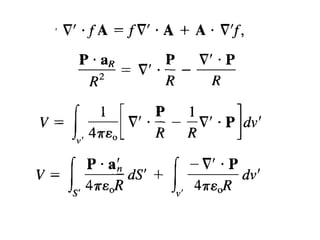
(Autonomous)
DUNDIGAL, HYDERABAD - 500043
PPT ON ELECTROMAGNETIC FIELDS
II B.Tech I semester (JNTUH-R13)
Prepared by
Ms.S.Ranjitha
Assistant professor
Introduction
Electrostatics can be defined as the study of electric charges at rest. Electric
fields have their sources in electric charges.
( Note: Almost all real electric fields vary to some extent with time. However,
for many problems, the field variation is slow and the field may be
considered as static. For some other cases spatial distribution is nearly same
as for the static case even though the actual field may vary with time. Such
cases are termed as quasi-static.)
In this chapter we first study two fundamental laws governing the
electrostatic fields, viz, (1) Coulomb's Law and (2) Gauss's Law. Both these
law have experimental basis. Coulomb's law is applicable in finding electric
field due to any charge distribution, Gauss's law is easier to use when the
distribution is symmetrical.
Unit I
Coulomb’s Law
Coulomb's Torsion Balance
This dial allows
you to adjust and
measure the
torque in the fibre
and thus the force
restraining the
charge
This scale allows you to read
the separation of the charges
Coulomb’s Experiments
r
F
Line Fr-2
Coulomb's Law
•
•
Coulomb determined
– Force is attractive if charges are opposite sign
–Force proportional to the product of the charges q1
and q2 along the lines joing them
–Force inversly proportional square of the distance
I.e.
– |F12|  |Q1| |Q2| / r12
2
– or
– |F12|= k |Q1| |Q2| / r122
Coulomb's Law
•
•
Units of constant can be determined from Coulomb's
Law
Colomb (and others since) have determined this
constant which (in a vacuum) in SI units is
– k = 8.987.5x109 Nm2C-2
• k is normally expressed as k = 1/40
– where is the permittivity of free space
Coulomb's Law
Vector form of Coulomb’s Law
+
Q1
Q2
r12
F21
F12
F12
rˆ12
+
21
F
+ -
Force from many charges
Superposition
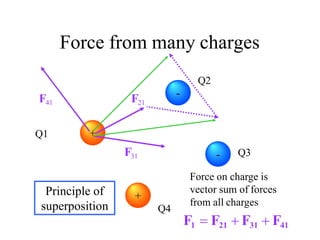
Force from many charges
+
F41
F31
F21
Q1
-
Q2
+
Q4
- Q3
Force on charge is
vector sum of forces
from all charges
F1  F21  F31  F41
Principle of
superposition
Always attractive
1/r2
very weak
•
•
•
• important on very
large scales, planets,
the Universe
Coulomb’s Law
vs Newton’s Law of Gravity
12
r
ˆ
|2 12
F12  G
|r
•
•
•
•
Attractive or repulsive
1/r2
very strong
only relevant
relatively local scales
12
12
ˆ
|2
r
1 Q1Q2 m1m2
40 |r12
F 
2
0
e2
 Gm
4
Two spheres
The Electric Field
Van de Graaf
Generator and
thread
Van de Graaf Generator
and many threads
Electric Field
Physicists did not like the concept of
“action at a distance” i.e. a force that
was “caused” by an object a long
distance away
They preferred to think
of an object producing
a “field” and other
objects interacting with
that field
Thus rather than ...
+
- they liked to think...
+
-
Electric Field
r̂
0
1 Q
4 | r|2
E 
F
E 
Thus Electric Field
from a single
charge is
Q
r
Q0
rˆ
Electric Field E is defined as the force
acting on a test particle divided by the
charge of that test particle
F
E
+Q0
Electric Field of a single charge
+
r
+Q0
+Q0
E
+Q0
Note: the Electric Field is defined
everywhere, even if there is no test
charge is not there.
+Q0
Electric field
from test
particles
Electric Field
from isolated
charges
(interactive)
E
F  QE
F  QE
+Q
-Q
Charged particles in electric field
Using the Field to determine the force
Vector & Scalar Fields
The Electric Field
Electric Field as a vector field
The Electric Field is one example
of a Vector Field
A “field” (vector or scalar) is defined
everywhere
A vector field has direction as well as size
The Electric Field has units of N/C
Other examples of fields:
Elevation above sea level is a scalar field
Elevation is defined everywhere (on the earth)
Elevation has a size (and unit), i.e. length, measured in m
A contour diagram
Elevation does not have
a direction
100m
50m
Elevation
Other examples of fields:
Slope
Slope is a vector field Slope is defined everywhere
(on the earth)
Slope has a size (though no dimension), i.e. 10%, 1 in 10, 2º
Slope does have a
direction
A contour diagram
Representation of the Electric
Field
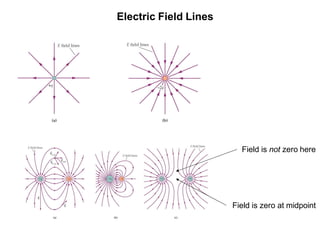
Electric Field Lines
Representation of the Electric
Field
It would be difficult to represent the electric field by
drawing vectors whose direction was the direction of the
field and whose length was the size of the field
everywhere
Representation of the Electric
Field
Instead we choose to represent the electric field with
lines whose direction indicates the direction of the field
Notice that as we
move away from the
charge, the density of
lines decreases
These are called
Electric Field Lines
Drawing Electric Field Lines
• The lines must begin on positive charges (or
infinity)
• The lines must end on negative charges (or
infinity)
• The number of lines leaving a +ve charge
(or approaching a -ve charge) is
proportional to the magnitude of the charge
• electric field lines cannot cross
Field is zero at midpoint
Field is not zero here
Electric Field Lines
Field lines for a conductor
Drawing Electric Field Lines:
Examples
From Electric field
vectors to field lines
Field lines
from all angles
Field lines
representation
Electric Field Lines
A
 
Nlines
Define N
 
4r2
Q
4r2
 
Nlines  Q
since
2
1 Q
40 | r|
| E|
we know
The number density of field lines is
| E | 
Interpreting Electric Field Lines
• The electric field vector, E, is at a tangent
to the electric field lines at each point along
the lines
• The number of lines per unit area through a
surface perpendicular to the field is
proportional to the strength of the electric
field in that region
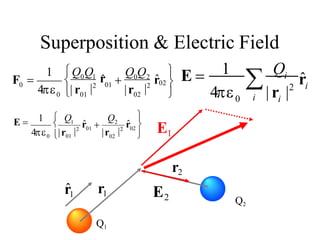
Superposition & Electric Field
E1
Q1
r̂1 r1
Q2
r2
E2

i
i
i
i
r̂
| r |
1 Q
2
0
E 
4


 02

02
0 2
01
01
 0 1
0
0
ˆ
|2
ˆ
|2
r
|r
F 
1 Q Q
r
Q Q
4 | r




 02
02
2
01
1
0  01
ˆ
|2
ˆ
|2
r
|r
r
Q
1 Q
E  
4 |r
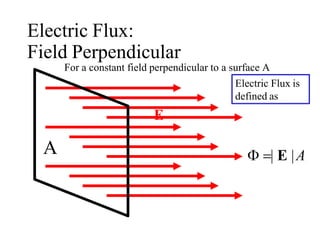
Electric Flux
Electric Flux:
A  | E |A
Field Perpendicular
For a constant field perpendicular to a surface A
Electric Flux is
defined as
E
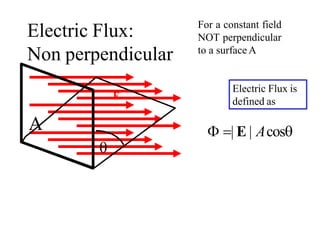
Electric Flux:
Non perpendicular
For a constant field
NOT perpendicular
to a surface A
Electric Flux is
defined as
 | E | Acos
A
E

Electric Flux:
Relation to field lines
 | E |A
 | E|
A | E | A
Number of flux lines N  
A
E
Field line
density
Field line density
× Area
FLUX
Gauss’s Law
Relates flux through a closed surface
to
charge within that surface
Flux through a sphere from a
point charge
2
| r1|
1 Q
40
| E|
1
0 1
4 | r |2
4 | r |2
 
1 Q
0
 
Q
r1
The electric field
around a point charge
Thus the
flux on a
sphere is E
×Area
Area
E
Cancelling
we get
Now we change the
radius of sphere
2
1 Q
40 | r2 |
| E|
2
0 2
2  2  4 | r2
| 4 |r |
1 Q
0
2


Q

r2
1
2

Q
0
  
Flux through a sphere from a
pointcharge
2
1 Q
40 | r1 |
|E|
1
0 1
4 | r |2
 
1 Q
4 | r |2
 
Q
0
r1
The electric field
around a point charge
Thus the
flux on a
sphere is E
× Area
E Area
Cancelling
we get
The flux is
the same
as before
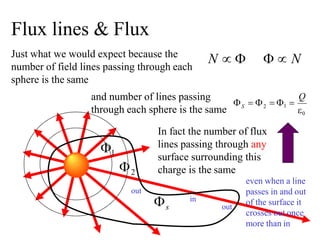
Flux lines & Flux
N     N
and number of lines passing
through each sphere is the same
1
2


In fact the number of flux
lines passing through any
surface surrounding this
charge is the same
even when a line
passes in and out
of the surface it
crosses out once
more than in
out
in
s out
2
0
Q
S
    1 
Just what we would expect because the
number of field lines passing through each
sphere is the same
Principle of superposition:
What is the flux from two charges?
s

Q1
Q2
0 0
Q1 Q2
S 
 
  0
S
Qi
For
any
surface
Gauss’s Law
Since the flux is related to the
number of field lines passing
through a surface the total flux is
the total from each charge
In general
Quiz
-Q/0 0 +Q/0 +2Q/0
1
2
3
2

Q1
1
3

What flux is passing through each of
these surfaces?
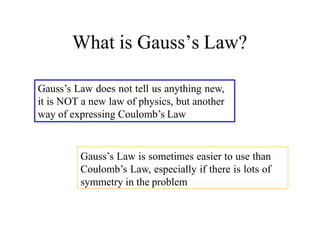
What is Gauss’s Law?
Gauss’s Law does not tell us anything new,
it is NOT a new law of physics, but another
way of expressing Coulomb’s Law
Gauss’s Law is sometimes easier to use than
Coulomb’s Law, especially if there is lots of
symmetry in the problem
Examples of using Gauss’s Law
r2
Q
0
 
Q
Example of using Gauss’s Law 1
oh no! I’ve just forgotten Coulomb’s Law!
Not to worry I remember Gauss’s Law
By symmetry E is  to surface
consider spherical surface
centred on charge
 | E | A 
Q
| E | 4r2

Q
0 0
r2
4r2
 4
0 0
1 Q

1 Q
| E| 0
1 qQ
4r2

F 
F=qE
q
Phew!
Using the Symmetry
Example of using Gauss’s Law 2
What’s the field around a charged spherical
shell?
Q
0
out


Q

Again consider spherical
surface centred on
charged shell
2
1 Q
40 r
| E|
E  0
Outside
out

in

So as e.g. 1
Inside
in
  0
charge within surface = 0
Examples
Gauss’s Law
and a line of
charge
Gauss’s Law
and a uniform
sphere
Gauss’s Law around
a point charge
Properties of Conductors
Using Gauss’s Law
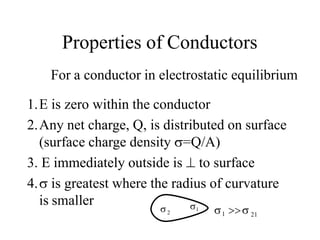
Properties of Conductors
1.E is zero within the conductor
2.Any net charge, Q, is distributed on surface
(surface charge density =Q/A)
3. E immediately outside is  to surface
4. is greatest where the radius of curvature
is smaller
For a conductor in electrostatic equilibrium
1
2
 21
1 
1. E is zero within conductor
If there is a field in the conductor, then the
free electrons would feel a force and be
accelerated. They would then move and
since there are charges moving the
conductor would not be in electrostatic
equilibrium
Thus E=0
2. Any net charge, Q, is
distributed on surface
qi
As surface can be drawn
arbitrarily close to surface of
conductor, all net charge must
be distributed on surface
Consider surface S below surface of conductor
Since we are in a conductor in
equilibrium, rule 1 says E=0, thus =0
  EA  q /0
Gauss’s Law
qi / 0 0
thus
So, net charge within
the surface is zero
3. E immediately outside is  to
surface
Consider a small cylindrical surface at the surface
of the conductor
  EA q / 
Gauss’s Law
cylinder is small enough that E is constant
E
E||
If E|| >0 it would cause surface charge q to move thus
||
it would not be in electrostatic equilibrium, thus E =0
thus E  q / A
E   /
Electromagnetic Fields
UNIT-II
Contents
• Electric Potential
ELECTRIC POTENTIAL
ELECTRIC POTENTIAL
• Suppose we wish to move a point charge
Q from point A to point B in an electric field
E some work is done in displacing the
charge by dl Given by
dW = - F • dl = -QE • dl
Where E is the Electric field intensity.
The negative sign indicates that the work is
being done by an external agent.
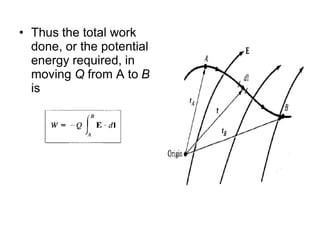
• Thus the total work
done, or the potential
energy required, in
moving Q from A to B
is
Potential Difference
• The potential difference between points A
and B.
•
•
•
• In determining VAB, A is the initial point while B
is the final point.
If VAB is negative, there is a loss in potential
energy in moving Q from A to B; this implies that
the work is being done by the field. However, if
VAB is positive, there is a gain in potential energy
in the movement; an external agent performs the
work.
VAB is independent of the path taken (to be
shown a little later).
VAB is measured in joules per coulomb,
commonly referred to as volts (V).
Note
Electric Potential Due to Point
Charge
• Suppose a point charge Q located at the
origin, Then
• Thus if VA = 0 as rA —> ∞, the potential
• at any point rB —> r due to a point charge
Q located at the origin is
Super position Principle
• For n point charges Qu Q2,. • • ,Qn
located at points with position vectors r1,
r2,. . ., rn, the potential at r is
Relation Between E & V
• The potential difference between points A
and B is independent of the path taken is
given by
• i.e
• Therefore
Stroke’s Theorem
E = -Grad V
Electric Dipole
• An electric dipole is formed when two
point charges of equal magnitude but
opposite sign are separated by a small
distance.
Electric Potential
• Consider an electric dipole, the potential at
point p is given by
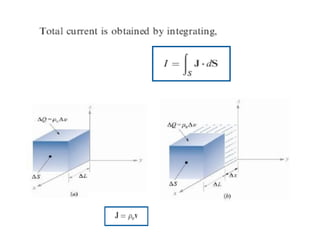
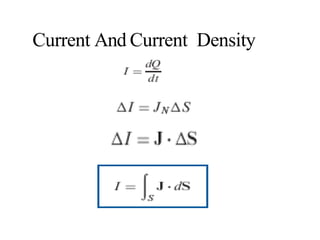
Current & Current Density
• Electric Charges in motion Constitute
electric current.
CONDUCTORS
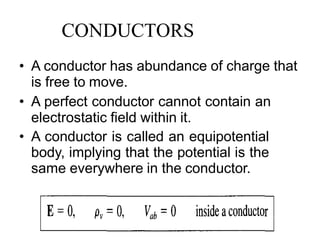
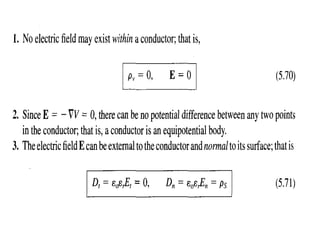
• A conductor has abundance of charge that
is free to move.
• A perfect conductor cannot contain an
electrostatic field within it.
• A conductor is called an equipotential
body, implying that the potential is the
same everywhere in the conductor.
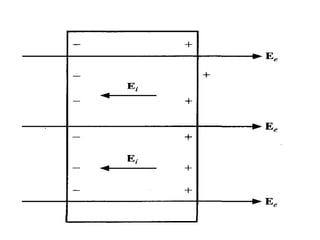
• When an external electric field Ee is applied, the
positive free charges are pushed along the same
direction as the applied field, while the negative
free charges move in the opposite direction.
• This charge migration takes place very quickly.
The free charges do two things.
• First, they accumulate on the surface of the
conductor and form an induced surface charge.
• Second, the induced charges set up an internal
induced field E,, which cancels the externally
applied field Ee.
UNIT - III
➢
➢
➢
➢
➢
➢
Static Magnetic Fields, Biot-Savart's Law
Oesterd's Experiment
Magnetic Field Intensity
MFI due to a straight current carrying
conductor
MFI due to square and solenoid currents
Div B = 0
Oesterd's Experiment
➢
➢
➢
An electrostatic field is produced by static or
stationary charges.
If the charges are moving with constant
velocity, a static magnetic (or magnetostatic)
field is produced.
A magnetostatic field is produced by a
constant current flow (or direct current).
Biot-Savart's Law
Two major laws governing magnetostatic fields:
(1) Biot-Savart's law and
(2) Ampere's circuit law.
The magnetic field intensity dHl produced at a
point P , as shown in Figure by the differential
current clement Idl is proportional to the
product Idl and the sine of the angle α between
the clement and the line joining P
element and is inversely proportional
to the
to the
square of the distance R between P and the
element.
Biot-Savart's Law - Definition
Determination of direction of dH
Different current distributions: line current,
surface current, and volume current as shown
in Figure .
K as the surface current density
and
J as the volume current density.
Then
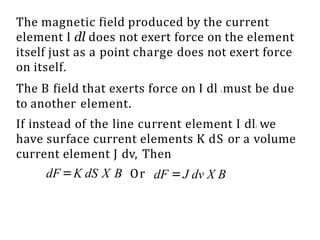
The magnetic field produced by the current
element I dl does not exert force on the element
itself just as a point charge does not exert force
on itself.
The B field that exerts force on I dl l must be due
to another element.
If instead of the line current element I dll, we
have surface current elements K dS or a volume
current element J dv, Then
dF=K dS X B Or dF =J dv X B
Current distributions:
(a) line current.
(b) surface current.
(c) volume current.
MFI due to a straight
filamentary conductor.
According to Biot-
Savart's Law
The contribution
dH at P due to an
element dl at (0,
0, z),
When the conductor is semiinfinite (with
respect to P) so that point A is now at O(0, 0, 0)
while B is at (0, 0, ά); α1= 90° α2 = 0°.
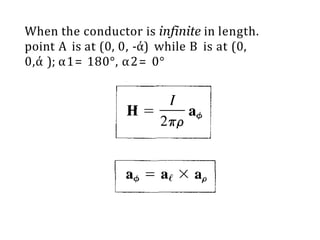
When the conductor is infinite in length.
point A is at (0, 0, -ά) while B is at (0,
0,ά ); α1= 180°, α2= 0°
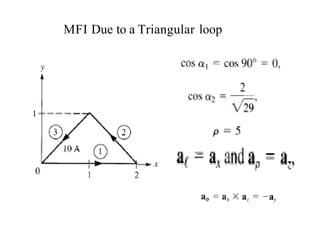
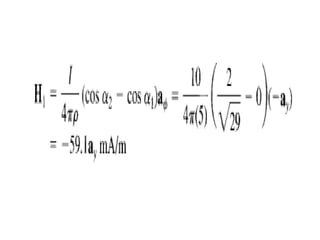
MFI Due to a Triangular loop
MFI due to Circular Loop of
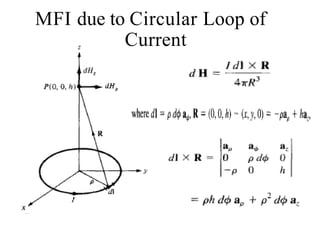
Current
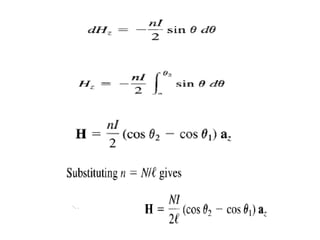
MFI due to Solenoid Current
Cross sectional view of a solenoid.
H = nIa
z
The contribution to the magnetic field H at P
by an element of the solenoid of length dz is
Ampere's Circuital Law
Ampere's circuit law states that the line
integral of the tangential component of H
around a closed path is the same as the net
current I enclosed by the path.
enc
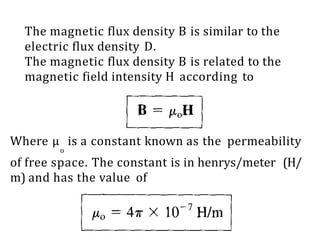
The magnetic flux density B is similar to the
electric flux density D.
The magnetic flux density B is related to the
magnetic field intensity H according to
Where μ is a constant known as the permeability
o
of free space. The constant is in henrys/meter (H/
m) and has the value of
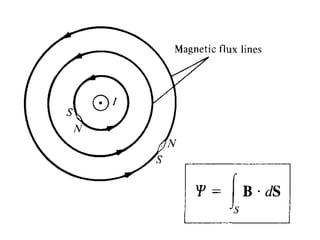
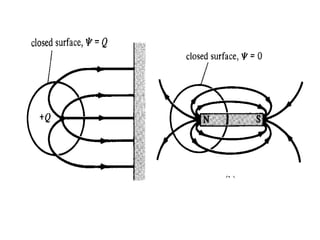
The Total Flux through a closed Surface
in a magnetic field must be zero
➢
➢
➢
MFI due to infinite sheet of
current and a long current
carrying conductor
Point form of Ampere's Law
Field due to circular loop,
rectangular and square loops.
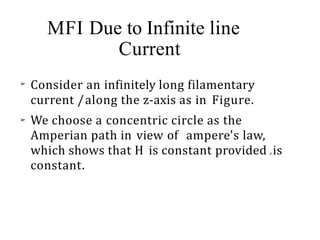
MFI Due to Infinite line
Current
➢
➢
Consider an infinitely long filamentary
current /along the z-axis as in Figure.
We choose a concentric circle as the
Amperian path in view of ampere's law,
which shows that H is constant provided p is
constant.
Ampere's law applied to an infinite filamentary
line current.
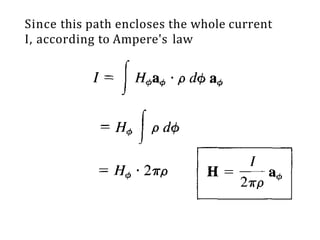
Since this path encloses the whole current
I, according to Ampere's law
MFI Due to Infinite Sheet of
Current
Consider an infinite current sheet in the z = 0
plane.
If the sheet has a uniform current density K =
K a . A/m
y y
Applying Ampere's law to the rectangular
closed path gives
the resultant dH has only an x-component.
Also, H on one side of the sheet is the
negative of that on the other side.
Due to the infinite extent of the sheet, the sheet
can be regarded as consisting of such
filamentary pairs so that the characteristics of H
for a pair are the same for the infinite current
sheets, that is,
Evaluating the line integral of H along the
closed path in Figure gives
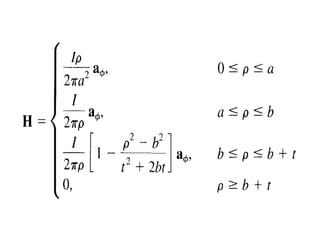
Infinitely Long Coaxial
Transmission Line
➢
➢
Consider an infinitely long
transmission line consisting of two
concentric cylinders having their
axes along the z-axis.
The cross section of the line is
shown in Figure, where the z-axis
is out of the page. The inner
conductor has radius a and carries
current I while the outer conductor
has inner radius b and thickness t
Cross section of the transmission line, the
positive - direction is out of the page.
Plot of H against ρ.
φ
Toroid
●
Ampere'scircuit law states that the line
integral of the tangential component of H
around a dosed path is the same as the net
current I .IK. enclosed by the path.
enc
Ampere' Circuital Law
Ampere's Circuital Law
Ampere's circuit law states that the line
integral of the tangential component of H
around a closed path is the same as the net
current I enclosed by the path.
enc
➢
➢
➢
➢
➢
➢
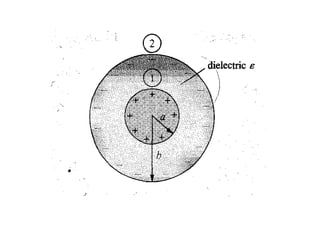
Electric Field inside a dielectric
Material
Dielectric- Conductor And
Dielectric – Dielectric Boundary
Conditions
Capacitance
Current Density
Ohm's Law
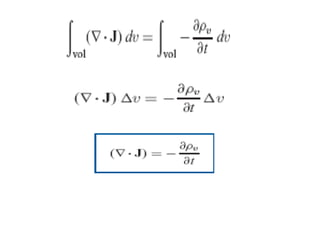
Equation of Continuity
Electric Field inside a
Dielectric Material
consider an atom of the dielectric as consisting
of a negative charge -Q (electron cloud) and a
positive charge +Q(nucleus) as in Figure
➢
When
a
n
electric field E is applied, the
positive charge is displaced
from
its
➢
equilibrium position in the direction of E by
the force F = QEwhile the negative charge is
+
displaced in the opposite direction by the
force F_ =-QE
A dipole results from the displacement of the
charges and the dielectric is said to be
polarized.
➢
The major effect of the electric field E on a
dielectric is the creation of dipole moments that
align themselves in the direction of E.
The total positive bound charge on surface S
bounding the dielectric is
while the charge that remains inside S is
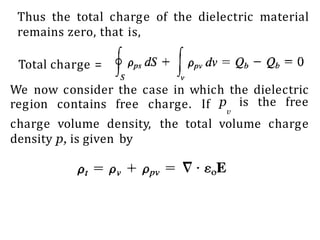
Thus the total charge of the dielectric material
remains zero, that is,
Total charge =
We now consider the case in which the dielectric
region contains free charge. If p is the free
v
charge volume density, the total volume charge
density p, is given by
We would expect that the polarization P would
vary directly as the applied electric field E. For
some dielectrics, this is usually the case and we
have
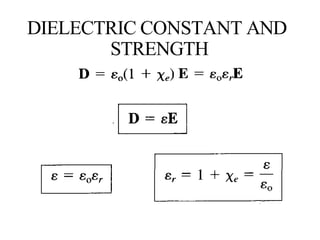
DIELECTRIC CONSTANT AND
STRENGTH
ε is called the permittivity of the dielectric, ε is
o
the permittivity of free space, as approximately
10-9
/36π F/m, and ε is called the dielectric
r
constant or relative permittivity.
The dielectric strength is the maximum electric
field that a dielectric can tolerate or
withstand without breakdown.
A dielectric material is linear if ε does not
change with applied E field. homogeneous if ε
does not change from point to point, and
isotropic if ε does not change with direction.
BOUNDARY CONDITIONS
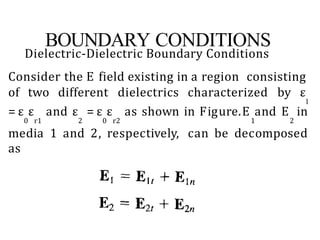
Dielectric-Dielectric Boundary Conditions
Consider the E field existing in a region consisting
of two different dielectrics characterized by ε
l
= ε ε and ε = ε ε as shown in Figure.E and E in
0 r1 2 0 r2 1 2
media 1 and 2, respectively, can be decomposed
as
Conductor-Dielectric Boundary
Conditions
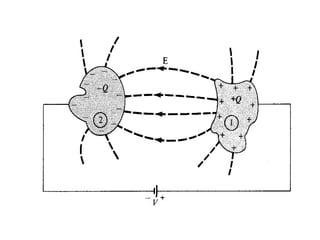
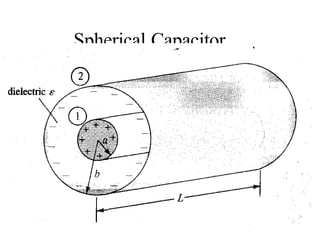
Capacitance
Parallel-Plate Capacitor
Coaxial Capacitor
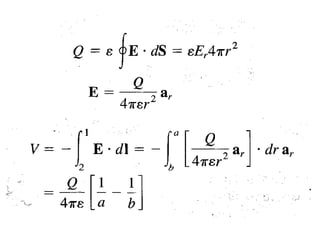
Spherical Capacitor
Current And Current Density
Continuity of Current
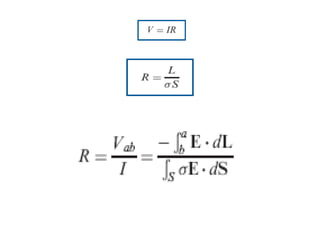
Resistance & Ohm's Law
UNIT - VI
➢
➢
➢
➢
➢
➢
Magnetic force
Charges Movement in magnetic field
Lorentz Force equation
Force on current carrying elements
Magnetic Dipoles
Torque on a current carrying loop in
magnetic field.
FORCES DUE TO
MAGNETIC
FIELDS
➢
There are at least three ways in which force
due to magnetic fields can be experienced.
1.Due to a moving charged particle in a B
field.
2.On a current element in an external B field.
3. Between two current elements.
Force on a Charged Particle
The electric force Fe on a stationary or moving
electric charge Q in an electric field is given by
Coulomb's experimental law and is related to
the electric field intensity E as
Fe=QE
This shows that if FQ is positive, F and E have the
same direction.
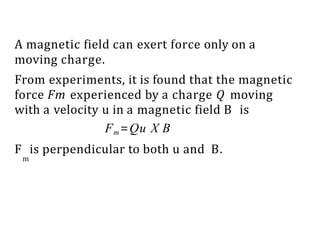
A magnetic field can exert force only on a
moving charge.
From experiments, it is found that the magnetic
force Fm experienced by a charge Q moving
with a velocity u in a magnetic field B is
Fm=Qu X B
F is perpendicular to both u and B.
m
For a moving charge Q in the presence of both
electric and magnetic fields, the total force on
the charge is given by
F = Fe + Fm
Or
F = Q(E + u X B)
This equation is known as Lorentz Force
equation.
Lorentz Force equation
It relates mechanical force to electrical force.
If the mass of the charged particle moving in E
and B fields is m, by Newton's second law of
motion.
dt
The solution to this equation is important in
determining the motion of charged particles in
E and B fields.
F=m
du
=Q E uX B
Force on a Current Element
To determine the force on a current element I dl
of a current-carrying conductor due to the
magnetic field B
J =v
u
We know that
I dl=K dS= J dv
Then
I dl=u
dv=dQ u
Hence
I dl=dQ u
The force acting on an elemental charge dQ
moving with velocity u is equivalent to a
conduction current element I dl in a magnetic
field B.
dF =I dl X B
If the current is through a closed path L or
circuit, the force on circuit is given by
F =∮ I dl XB
The magnetic field produced by the current
element I dl does not exert force on the element
itself just as a point charge does not exert force
on itself.
The B field that exerts force on I dl l must be due
to another element.
If instead of the line current element I dll, we
have surface current elements K dS or a volume
current element J dv, Then
dF= K dS X B Or dF =J dv X B
Then
and
F =∮ K dSX B
F =∮ J dv XB
Force between Two Current
Elements
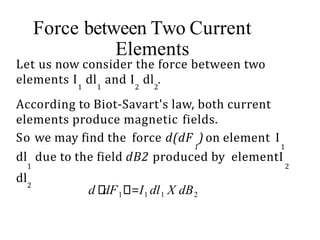
Let us now consider the force between two
elements I dl and I dl .
1 1 2 2
According to Biot-Savart's law, both current
elements produce magnetic fields.
So we may find the force d(dF ) on element I
1 1
dl due to the field dB2 produced by elementI
1 2
dl2
1 1 1
d dF =I dl X dB2
From Biot-Savart's law
dB2=
0I2 dI2 X aR 21
4 R21
2
d dF1 = 21
0 I1 dI1 X I2 dI2 X aR
4 R21
2
F1=
4
0 I1 I2 ∯dI1 X dI2 X aR21
21
R2
MAGNETIC TORQUE AND
MOMENT
The torque T (or mechanical moincnl of force)
on ihe loop is the vector product of the force F
and the moment arm r.
That is T = r X F
Consider a rectangular loop of length l and
width w placed in a uniform magnetic field B as
shown in Figure
Or
Thus F = Bil. Thus no force is exerted on the
loop as a whole. However Fo and -Fo act at
different points on the loop, there by creating
a couple.
4
3 1
F=I ∫dl X B I ∫dl X B
2
l l
F=I ∫dz az X B I∫dz az X B
0 0
F=F 0− F0=0
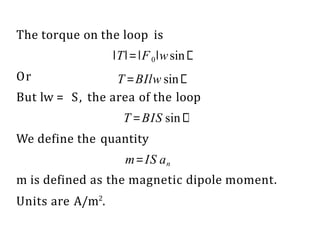
The torque on the loop is
Or
∣T∣=∣F0∣wsin
T=BIlw sin
But lw = S, the area of the loop
T=BIS sin
We define the quantity
m=IS an
m is defined as the magnetic dipole moment.
Units are A/m2
.
Magnetic Dipole Moment
The magnetic dipole moment is the product
of current and area of the loop.
Its direction is normal to the loop.
Torque on a magnetic loop placed in Magnetic
field is
T = m X B
This is applicable only when the magnetic field
is uniform in nature.
Field due to a Magnetic Dipole
●
●
A Bar magnet or a small
filamentary current loop is usually
referred to as a magnetic dipole.
Consider a current carrying loop
carrying a current of I amps, the
the magnetic field due this at any
arbitrary point P(r,θ,φ) due the
loop is calculated as follows.
The magnetic Vector Potential at P is
0
I dl
A=
4 ∮r
A=
2
0I a sin a
4 r2
or
A=
0
m X ar
4 r2
The magnetic Flux density B is determined as
B= ∇ X A
Therefore
B=
0
m
4 r3
2cos ar sin a
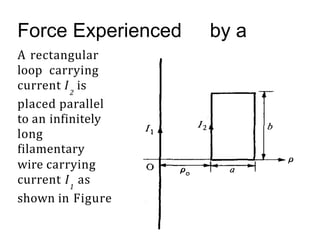
Force Experienced by a
square
loop
A rectangular
loop carrying
current I is
2
placed parallel
to an infinitely
long
filamentary
wire carrying
current I as
1
shown in Figure
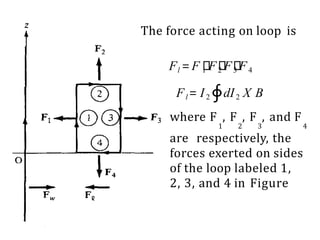
The force acting on loop is
Fl =F 1 F2 F3 F4
Fl= I2∮dI2 X B
where F , F , F , and F
1 2 3 4
are respectively, the
forces exerted on sides
of the loop labeled 1,
2, 3, and 4 in Figure
Due to the infinitely long wire
1
B =
0
I1
2 0
a
Then
F1= I 2∮dI2 X B1
1
F = I 2 ∮
z=0
b
z
dz a X
I
0 1
2 0
a
F1=−
0
I1 I2 b
2 0
a (Attractive)
F3= I2∮dI2 X B1
3
F = I2 ∮
z=0
b
z
dz a X
I
0 1
0
2 a
a
3
F =
0
I1 I2 b
0
2 a
a (Repulsive)
F2=
I1 I2
2
ln
0 a
0
az
F2=I 2
=0
0 a
∮ d a X
I
0 1
0
2 a
a
(Parallel)
F4= I2
0
∮
= 0 a
d a X
I
0 1
0
2 a
a
F4=
− I1 I2
2
ln
0 a
0
az
(Parallel)
The Total Force
Fl =
I1 I2 b 1
0
[ −
1
0
2 a
] −a
Magnetization in Materials
➢
➢
➢
A medium for which M is not zero everywhere
is said to be magnetized.
M = lim
v 0
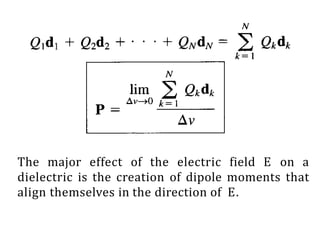
The magnetization M (in amperes/meter) is
the magnetic dipole moment per unit volume.
If there are N atoms in a given volume Δv and
the kth
atom has a magnetic moment m .
K
N
∑ mk
k=1
v
dA=
0
M X aR
dv1
dA=
4 R2
0
M X R
4 R3
dv1
R
R3 =∇
1 1
R
Hence
0
A=
4
1 1
∫M X ∇
R
dv1
But
M X ∇1 1 =
1 ∇1
X M − ∇1
X
M
R R R
Substituting the above equation in A
0
∫ ∇1
X M
R
1 0
A=
4
dv −
4
1 M
∫ ∇ X
R
dv1
Applying the Vector Identity
1
1
∇ X F dv =−
∫ ∫
v1
S1
F X dS
0
A=
4 ∫
v1
∇ 1
X M 1
dv ∮
S1
0 M X an
dS1
A=
4 ∫
v1
Jb
R
1
dv
0
4
∮
S1 R
dS1
0
A=
4
0
∫
v
1
1
∇ R
XM
R
dv1 4
0
4
∮
Kb S
1
M R
Xan
R
dS1
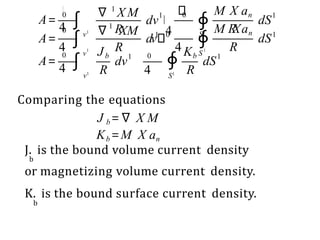
Comparing the equations
J b=∇ X M
Kb=M X an
J. is the bound volume current density
b
or magnetizing volume current density.
K. is the bound surface current density.
b
In free Space
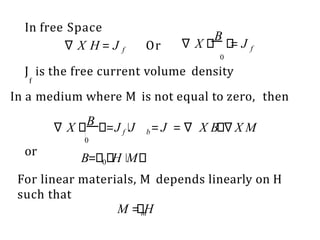
∇ X H = J f Or
B
∇ X = J f
0
J is the free current volume density
f
In a medium where M is not equal to zero, then
0
f b
∇ X B =J J =J =∇ X B ∇X M
or
B= 0 H M
For linear materials, M depends linearly on H
such that
M =m
H
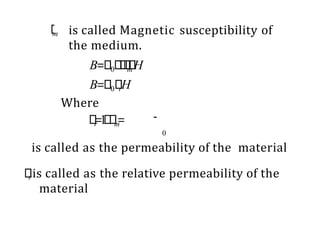
m is called Magnetic susceptibility of
the medium.
B= 0 1 mH
B= 0 rH
Where
r
=
1 m
=
0
is called as the permeability of the material
ris called as the relative permeability of the
material
➢
➢
➢
➢
➢
Scalar and Vector Magnetic
Potentials
Vector Potentials due to simple
configurations Self and Mutual
Inductances
Determination of
inductance Energy
Magnetic Potential
➢
➢
we can define a potential associated with
magnetostatic field B.
The magnetic potential could be scalar or
vector
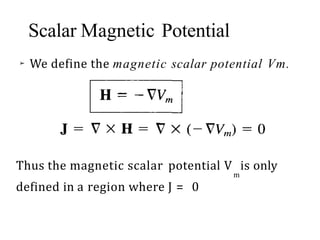
Scalar Magnetic Potential
➢ We define the magnetic scalar potential Vm.
Thus the magnetic scalar potential V is only
m
defined in a region where J = 0
Vector Magnetic Potential
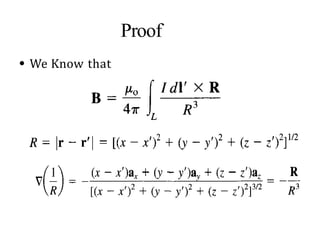
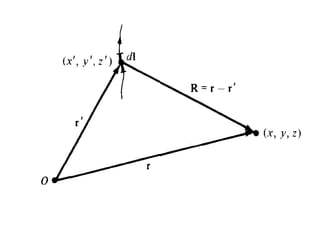
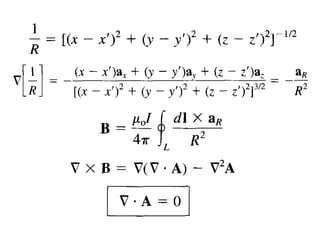
Proof
● We Know that
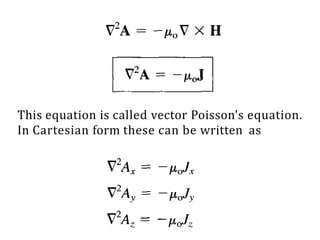
Vector Poisson's Equations
We Know that
This equation is called vector Poisson's equation.
In Cartesian form these can be written as
Flux Linkages
➢
➢
➢
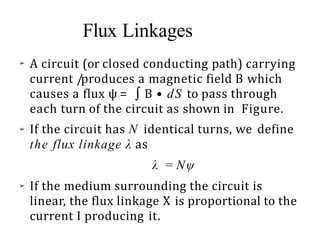
A circuit (or closed conducting path) carrying
current /produces a magnetic field B which
causes a flux ψ = ∫ B • dS to pass through
each turn of the circuit as shown in Figure.
If the circuit has N identical turns, we define
the flux linkage λ as
λ = Nψ
If the medium surrounding the circuit is
linear, the flux linkage X is proportional to the
current I producing it.
Inductance
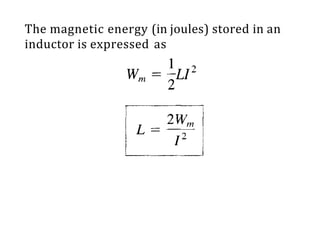
Inductance L of an inductor as the ratio of the
magnetic flux linkage λ to the current I
through the inductor
The unit of inductance is the henry (H) which
is the same as webers/ampere.
Inductance is a measure of how much magnetic
energy is stored in an inductor.
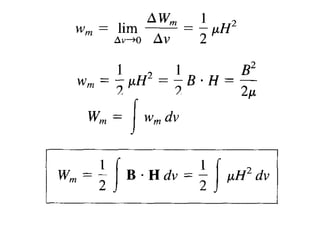
The magnetic energy (in joules) stored in an
inductor is expressed as
Mutual Inductance
➢
➢
➢
If instead of having a single circuit we have
two circuits carrying current I and I as
1 2
shown in Figure, a magnetic interaction exists
between the circuits.
Four component fluxes ψ ,ψ ,ψ and ψ are
11 12 21 22
produced.
The flux ψ , for example, is the flux passing
12
through circuit 1 due to current I in circuit 2.
2
If B in the field due to I and S is the area of
2 2 1
circuit 1, then
We define the mutual inductance M as the
12
ratio of the flux linkage λ = N ψ on circuit
12 1 12
1 to current I , that is
2
Magnetic Energy
Inductance of a Solenoid
For an infinitely long solenoid, the magnetic flux
inside the solenoid per unit length is
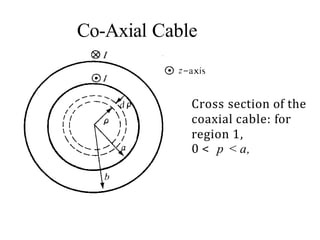
Co-Axial Cable
Cross section of the
coaxial cable: for
region 1,
0 < p < a,
(b) for region 2, a < p < b
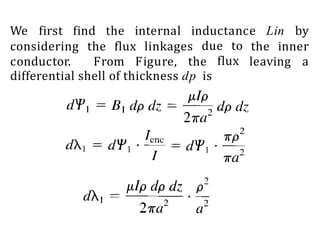
We first find the internal inductance Lin by
due to
considering the flux linkages
conductor. From Figure, the flux
the inner
leaving a
differential shell of thickness dp is
For length l of the cable,
The internal inductance per unit length, given by
the external inductance L by considering the
ext
flux linkages between the inner and the outer
conductor as in Figure. For a differential shell of
thickness dρ.
The inductance per length is
Maxwell’s Equations
• We have been examining a variety of
electrical and magnetic phenomena
• James Clerk Maxwell summarized all of
electricity and magnetism in just four
equations
• Remarkably, the equations predict the
existence of electromagnetic waves
Maxwell’s Equations
Maxwell’s Equations
• The first is Gauss’s Law which is an
extended form of Coulomb’s Law
• The second is the equivalent for magnetic
fields, except that we know that magnetic
poles always occur in pairs (north & south)
Maxwell’s Equations
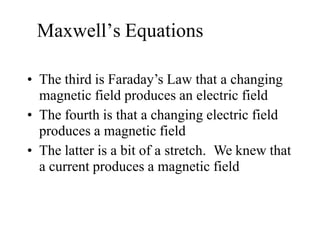
• The third is Faraday’s Law that a changing
magnetic field produces an electric field
• The fourth is that a changing electric field
produces a magnetic field
• The latter is a bit of a stretch. We knew that
a current produces a magnetic field
Maxwell’s Equations
• Start with Ampere’s Law B ||l  0I
Earlier, we just went on a
closed path enclosing
surface 1. But according to
Ampere’s Law, we could
have considered surface 2.
The current enclosed is the
same as for surface 1. We
can say that the current
flowing into any volume
must equal that coming out.
Maxwell’s Equations
• Suppose we have a charged
capacitor and it begins to
discharge
Surface 1 works but
surface 2 has no
current passing
through the surface yet
there is a magnetic
field inside the
surface.
Maxwell’s Equations
Same problem here.
Surface 1 works,
but no current
passes through
surface two which
encloses a magnetic
field. What is
happening???
Maxwell’s Equations
• While the capacitor is discharging, a current
flows
• The electric field between the plates of the
capacitor is decreasing as current flows
• Maxwell said the changing electric field is
equivalent to a current
• He called it the displacement current
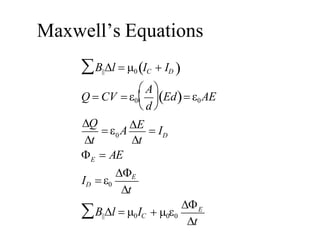
Maxwell’s Equations

B||l  0 IC  ID
Q  CV  0
 A
 d 
Ed 0AE
Q
t
0
t
  A
E
 ID
E
  AE
ID  0
E
t
 00
E
t
B||l  0IC

EMF PPT_0.pdf

  • 1.
    INSTITUTE OF AERONAUTICALENGINEERING (Autonomous) DUNDIGAL, HYDERABAD - 500043 PPT ON ELECTROMAGNETIC FIELDS II B.Tech I semester (JNTUH-R13) Prepared by Ms.S.Ranjitha Assistant professor
  • 2.
    Introduction Electrostatics can bedefined as the study of electric charges at rest. Electric fields have their sources in electric charges. ( Note: Almost all real electric fields vary to some extent with time. However, for many problems, the field variation is slow and the field may be considered as static. For some other cases spatial distribution is nearly same as for the static case even though the actual field may vary with time. Such cases are termed as quasi-static.) In this chapter we first study two fundamental laws governing the electrostatic fields, viz, (1) Coulomb's Law and (2) Gauss's Law. Both these law have experimental basis. Coulomb's law is applicable in finding electric field due to any charge distribution, Gauss's law is easier to use when the distribution is symmetrical.
  • 3.
  • 4.
    Coulomb's Torsion Balance Thisdial allows you to adjust and measure the torque in the fibre and thus the force restraining the charge This scale allows you to read the separation of the charges
  • 5.
  • 6.
    Coulomb's Law • • Coulomb determined –Force is attractive if charges are opposite sign –Force proportional to the product of the charges q1 and q2 along the lines joing them –Force inversly proportional square of the distance I.e. – |F12|  |Q1| |Q2| / r12 2 – or – |F12|= k |Q1| |Q2| / r122
  • 7.
    Coulomb's Law • • Units ofconstant can be determined from Coulomb's Law Colomb (and others since) have determined this constant which (in a vacuum) in SI units is – k = 8.987.5x109 Nm2C-2 • k is normally expressed as k = 1/40 – where is the permittivity of free space
  • 8.
  • 9.
    Vector form ofCoulomb’s Law + Q1 Q2 r12 F21 F12 F12 rˆ12 + 21 F + -
  • 10.
    Force from manycharges Superposition
  • 11.
    Force from manycharges + F41 F31 F21 Q1 - Q2 + Q4 - Q3 Force on charge is vector sum of forces from all charges F1  F21  F31  F41 Principle of superposition
  • 12.
    Always attractive 1/r2 very weak • • • •important on very large scales, planets, the Universe Coulomb’s Law vs Newton’s Law of Gravity 12 r ˆ |2 12 F12  G |r • • • • Attractive or repulsive 1/r2 very strong only relevant relatively local scales 12 12 ˆ |2 r 1 Q1Q2 m1m2 40 |r12 F  2 0 e2  Gm 4 Two spheres
  • 13.
    The Electric Field Vande Graaf Generator and thread Van de Graaf Generator and many threads
  • 14.
    Electric Field Physicists didnot like the concept of “action at a distance” i.e. a force that was “caused” by an object a long distance away They preferred to think of an object producing a “field” and other objects interacting with that field Thus rather than ... + - they liked to think... + -
  • 15.
    Electric Field r̂ 0 1 Q 4| r|2 E  F E  Thus Electric Field from a single charge is Q r Q0 rˆ Electric Field E is defined as the force acting on a test particle divided by the charge of that test particle F E +Q0
  • 16.
    Electric Field ofa single charge + r +Q0 +Q0 E +Q0 Note: the Electric Field is defined everywhere, even if there is no test charge is not there. +Q0 Electric field from test particles Electric Field from isolated charges (interactive)
  • 17.
    E F  QE F QE +Q -Q Charged particles in electric field Using the Field to determine the force
  • 18.
    Vector & ScalarFields The Electric Field
  • 19.
    Electric Field asa vector field The Electric Field is one example of a Vector Field A “field” (vector or scalar) is defined everywhere A vector field has direction as well as size The Electric Field has units of N/C
  • 20.
    Other examples offields: Elevation above sea level is a scalar field Elevation is defined everywhere (on the earth) Elevation has a size (and unit), i.e. length, measured in m A contour diagram Elevation does not have a direction 100m 50m Elevation
  • 21.
    Other examples offields: Slope Slope is a vector field Slope is defined everywhere (on the earth) Slope has a size (though no dimension), i.e. 10%, 1 in 10, 2º Slope does have a direction A contour diagram
  • 22.
    Representation of theElectric Field Electric Field Lines
  • 23.
    Representation of theElectric Field It would be difficult to represent the electric field by drawing vectors whose direction was the direction of the field and whose length was the size of the field everywhere
  • 24.
    Representation of theElectric Field Instead we choose to represent the electric field with lines whose direction indicates the direction of the field Notice that as we move away from the charge, the density of lines decreases These are called Electric Field Lines
  • 25.
    Drawing Electric FieldLines • The lines must begin on positive charges (or infinity) • The lines must end on negative charges (or infinity) • The number of lines leaving a +ve charge (or approaching a -ve charge) is proportional to the magnitude of the charge • electric field lines cannot cross
  • 26.
    Field is zeroat midpoint Field is not zero here Electric Field Lines
  • 27.
    Field lines fora conductor
  • 28.
    Drawing Electric FieldLines: Examples From Electric field vectors to field lines Field lines from all angles Field lines representation
  • 29.
    Electric Field Lines A  Nlines Define N   4r2 Q 4r2   Nlines  Q since 2 1 Q 40 | r| | E| we know The number density of field lines is | E | 
  • 30.
    Interpreting Electric FieldLines • The electric field vector, E, is at a tangent to the electric field lines at each point along the lines • The number of lines per unit area through a surface perpendicular to the field is proportional to the strength of the electric field in that region
  • 31.
  • 32.
    Superposition & ElectricField E1 Q1 r̂1 r1 Q2 r2 E2  i i i i r̂ | r | 1 Q 2 0 E  4    02  02 0 2 01 01  0 1 0 0 ˆ |2 ˆ |2 r |r F  1 Q Q r Q Q 4 | r      02 02 2 01 1 0  01 ˆ |2 ˆ |2 r |r r Q 1 Q E   4 |r
  • 33.
  • 34.
    Electric Flux: A | E |A Field Perpendicular For a constant field perpendicular to a surface A Electric Flux is defined as E
  • 35.
    Electric Flux: Non perpendicular Fora constant field NOT perpendicular to a surface A Electric Flux is defined as  | E | Acos A E 
  • 36.
    Electric Flux: Relation tofield lines  | E |A  | E| A | E | A Number of flux lines N   A E Field line density Field line density × Area FLUX
  • 37.
    Gauss’s Law Relates fluxthrough a closed surface to charge within that surface
  • 38.
    Flux through asphere from a point charge 2 | r1| 1 Q 40 | E| 1 0 1 4 | r |2 4 | r |2   1 Q 0   Q r1 The electric field around a point charge Thus the flux on a sphere is E ×Area Area E Cancelling we get
  • 39.
    Now we changethe radius of sphere 2 1 Q 40 | r2 | | E| 2 0 2 2  2  4 | r2 | 4 |r | 1 Q 0 2   Q  r2 1 2  Q 0    Flux through a sphere from a pointcharge 2 1 Q 40 | r1 | |E| 1 0 1 4 | r |2   1 Q 4 | r |2   Q 0 r1 The electric field around a point charge Thus the flux on a sphere is E × Area E Area Cancelling we get The flux is the same as before
  • 40.
    Flux lines &Flux N     N and number of lines passing through each sphere is the same 1 2   In fact the number of flux lines passing through any surface surrounding this charge is the same even when a line passes in and out of the surface it crosses out once more than in out in s out 2 0 Q S     1  Just what we would expect because the number of field lines passing through each sphere is the same
  • 41.
    Principle of superposition: Whatis the flux from two charges? s  Q1 Q2 0 0 Q1 Q2 S      0 S Qi For any surface Gauss’s Law Since the flux is related to the number of field lines passing through a surface the total flux is the total from each charge In general
  • 42.
    Quiz -Q/0 0 +Q/0+2Q/0 1 2 3 2  Q1 1 3  What flux is passing through each of these surfaces?
  • 43.
    What is Gauss’sLaw? Gauss’s Law does not tell us anything new, it is NOT a new law of physics, but another way of expressing Coulomb’s Law Gauss’s Law is sometimes easier to use than Coulomb’s Law, especially if there is lots of symmetry in the problem
  • 44.
    Examples of usingGauss’s Law
  • 45.
    r2 Q 0   Q Example ofusing Gauss’s Law 1 oh no! I’ve just forgotten Coulomb’s Law! Not to worry I remember Gauss’s Law By symmetry E is  to surface consider spherical surface centred on charge  | E | A  Q | E | 4r2  Q 0 0 r2 4r2  4 0 0 1 Q  1 Q | E| 0 1 qQ 4r2  F  F=qE q Phew! Using the Symmetry
  • 46.
    Example of usingGauss’s Law 2 What’s the field around a charged spherical shell? Q 0 out   Q  Again consider spherical surface centred on charged shell 2 1 Q 40 r | E| E  0 Outside out  in  So as e.g. 1 Inside in   0 charge within surface = 0
  • 47.
    Examples Gauss’s Law and aline of charge Gauss’s Law and a uniform sphere Gauss’s Law around a point charge
  • 48.
  • 49.
    Properties of Conductors 1.Eis zero within the conductor 2.Any net charge, Q, is distributed on surface (surface charge density =Q/A) 3. E immediately outside is  to surface 4. is greatest where the radius of curvature is smaller For a conductor in electrostatic equilibrium 1 2  21 1 
  • 50.
    1. E iszero within conductor If there is a field in the conductor, then the free electrons would feel a force and be accelerated. They would then move and since there are charges moving the conductor would not be in electrostatic equilibrium Thus E=0
  • 51.
    2. Any netcharge, Q, is distributed on surface qi As surface can be drawn arbitrarily close to surface of conductor, all net charge must be distributed on surface Consider surface S below surface of conductor Since we are in a conductor in equilibrium, rule 1 says E=0, thus =0   EA  q /0 Gauss’s Law qi / 0 0 thus So, net charge within the surface is zero
  • 52.
    3. E immediatelyoutside is  to surface Consider a small cylindrical surface at the surface of the conductor   EA q /  Gauss’s Law cylinder is small enough that E is constant E E|| If E|| >0 it would cause surface charge q to move thus || it would not be in electrostatic equilibrium, thus E =0 thus E  q / A E   /
  • 53.
  • 54.
  • 55.
  • 56.
    ELECTRIC POTENTIAL • Supposewe wish to move a point charge Q from point A to point B in an electric field E some work is done in displacing the charge by dl Given by dW = - F • dl = -QE • dl Where E is the Electric field intensity. The negative sign indicates that the work is being done by an external agent.
  • 57.
    • Thus thetotal work done, or the potential energy required, in moving Q from A to B is
  • 58.
    Potential Difference • Thepotential difference between points A and B.
  • 59.
    • • • • In determiningVAB, A is the initial point while B is the final point. If VAB is negative, there is a loss in potential energy in moving Q from A to B; this implies that the work is being done by the field. However, if VAB is positive, there is a gain in potential energy in the movement; an external agent performs the work. VAB is independent of the path taken (to be shown a little later). VAB is measured in joules per coulomb, commonly referred to as volts (V). Note
  • 60.
    Electric Potential Dueto Point Charge • Suppose a point charge Q located at the origin, Then
  • 61.
    • Thus ifVA = 0 as rA —> ∞, the potential • at any point rB —> r due to a point charge Q located at the origin is
  • 62.
    Super position Principle •For n point charges Qu Q2,. • • ,Qn located at points with position vectors r1, r2,. . ., rn, the potential at r is
  • 65.
    Relation Between E& V • The potential difference between points A and B is independent of the path taken is given by • i.e • Therefore
  • 66.
  • 67.
  • 68.
    Electric Dipole • Anelectric dipole is formed when two point charges of equal magnitude but opposite sign are separated by a small distance.
  • 70.
    Electric Potential • Consideran electric dipole, the potential at point p is given by
  • 73.
    Current & CurrentDensity • Electric Charges in motion Constitute electric current.
  • 75.
    CONDUCTORS • A conductorhas abundance of charge that is free to move. • A perfect conductor cannot contain an electrostatic field within it. • A conductor is called an equipotential body, implying that the potential is the same everywhere in the conductor.
  • 77.
    • When anexternal electric field Ee is applied, the positive free charges are pushed along the same direction as the applied field, while the negative free charges move in the opposite direction. • This charge migration takes place very quickly. The free charges do two things. • First, they accumulate on the surface of the conductor and form an induced surface charge. • Second, the induced charges set up an internal induced field E,, which cancels the externally applied field Ee.
  • 78.
    UNIT - III ➢ ➢ ➢ ➢ ➢ ➢ StaticMagnetic Fields, Biot-Savart's Law Oesterd's Experiment Magnetic Field Intensity MFI due to a straight current carrying conductor MFI due to square and solenoid currents Div B = 0
  • 79.
    Oesterd's Experiment ➢ ➢ ➢ An electrostaticfield is produced by static or stationary charges. If the charges are moving with constant velocity, a static magnetic (or magnetostatic) field is produced. A magnetostatic field is produced by a constant current flow (or direct current).
  • 80.
    Biot-Savart's Law Two majorlaws governing magnetostatic fields: (1) Biot-Savart's law and (2) Ampere's circuit law.
  • 81.
    The magnetic fieldintensity dHl produced at a point P , as shown in Figure by the differential current clement Idl is proportional to the product Idl and the sine of the angle α between the clement and the line joining P element and is inversely proportional to the to the square of the distance R between P and the element. Biot-Savart's Law - Definition
  • 84.
  • 85.
    Different current distributions:line current, surface current, and volume current as shown in Figure . K as the surface current density and J as the volume current density. Then
  • 86.
    The magnetic fieldproduced by the current element I dl does not exert force on the element itself just as a point charge does not exert force on itself. The B field that exerts force on I dl l must be due to another element. If instead of the line current element I dll, we have surface current elements K dS or a volume current element J dv, Then dF=K dS X B Or dF =J dv X B
  • 87.
    Current distributions: (a) linecurrent. (b) surface current. (c) volume current.
  • 89.
    MFI due toa straight filamentary conductor. According to Biot- Savart's Law The contribution dH at P due to an element dl at (0, 0, z),
  • 91.
    When the conductoris semiinfinite (with respect to P) so that point A is now at O(0, 0, 0) while B is at (0, 0, ά); α1= 90° α2 = 0°.
  • 92.
    When the conductoris infinite in length. point A is at (0, 0, -ά) while B is at (0, 0,ά ); α1= 180°, α2= 0°
  • 93.
    MFI Due toa Triangular loop
  • 95.
    MFI due toCircular Loop of Current
  • 97.
    MFI due toSolenoid Current Cross sectional view of a solenoid.
  • 98.
    H = nIa z Thecontribution to the magnetic field H at P by an element of the solenoid of length dz is
  • 101.
    Ampere's Circuital Law Ampere'scircuit law states that the line integral of the tangential component of H around a closed path is the same as the net current I enclosed by the path. enc
  • 103.
    The magnetic fluxdensity B is similar to the electric flux density D. The magnetic flux density B is related to the magnetic field intensity H according to Where μ is a constant known as the permeability o of free space. The constant is in henrys/meter (H/ m) and has the value of
  • 106.
    The Total Fluxthrough a closed Surface in a magnetic field must be zero
  • 107.
    ➢ ➢ ➢ MFI due toinfinite sheet of current and a long current carrying conductor Point form of Ampere's Law Field due to circular loop, rectangular and square loops.
  • 108.
    MFI Due toInfinite line Current ➢ ➢ Consider an infinitely long filamentary current /along the z-axis as in Figure. We choose a concentric circle as the Amperian path in view of ampere's law, which shows that H is constant provided p is constant.
  • 109.
    Ampere's law appliedto an infinite filamentary line current.
  • 110.
    Since this pathencloses the whole current I, according to Ampere's law
  • 111.
    MFI Due toInfinite Sheet of Current
  • 113.
    Consider an infinitecurrent sheet in the z = 0 plane. If the sheet has a uniform current density K = K a . A/m y y Applying Ampere's law to the rectangular closed path gives the resultant dH has only an x-component. Also, H on one side of the sheet is the negative of that on the other side.
  • 114.
    Due to theinfinite extent of the sheet, the sheet can be regarded as consisting of such filamentary pairs so that the characteristics of H for a pair are the same for the infinite current sheets, that is, Evaluating the line integral of H along the closed path in Figure gives
  • 116.
    Infinitely Long Coaxial TransmissionLine ➢ ➢ Consider an infinitely long transmission line consisting of two concentric cylinders having their axes along the z-axis. The cross section of the line is shown in Figure, where the z-axis is out of the page. The inner conductor has radius a and carries current I while the outer conductor has inner radius b and thickness t
  • 117.
    Cross section ofthe transmission line, the positive - direction is out of the page.
  • 124.
    Plot of Hagainst ρ. φ
  • 125.
  • 127.
    ● Ampere'scircuit law statesthat the line integral of the tangential component of H around a dosed path is the same as the net current I .IK. enclosed by the path. enc Ampere' Circuital Law
  • 130.
    Ampere's Circuital Law Ampere'scircuit law states that the line integral of the tangential component of H around a closed path is the same as the net current I enclosed by the path. enc
  • 132.
    ➢ ➢ ➢ ➢ ➢ ➢ Electric Field insidea dielectric Material Dielectric- Conductor And Dielectric – Dielectric Boundary Conditions Capacitance Current Density Ohm's Law Equation of Continuity
  • 133.
    Electric Field insidea Dielectric Material consider an atom of the dielectric as consisting of a negative charge -Q (electron cloud) and a positive charge +Q(nucleus) as in Figure
  • 134.
    ➢ When a n electric field Eis applied, the positive charge is displaced from its ➢ equilibrium position in the direction of E by the force F = QEwhile the negative charge is + displaced in the opposite direction by the force F_ =-QE A dipole results from the displacement of the charges and the dielectric is said to be polarized. ➢
  • 135.
    The major effectof the electric field E on a dielectric is the creation of dipole moments that align themselves in the direction of E.
  • 139.
    The total positivebound charge on surface S bounding the dielectric is while the charge that remains inside S is
  • 140.
    Thus the totalcharge of the dielectric material remains zero, that is, Total charge = We now consider the case in which the dielectric region contains free charge. If p is the free v charge volume density, the total volume charge density p, is given by
  • 141.
    We would expectthat the polarization P would vary directly as the applied electric field E. For some dielectrics, this is usually the case and we have
  • 142.
  • 143.
    ε is calledthe permittivity of the dielectric, ε is o the permittivity of free space, as approximately 10-9 /36π F/m, and ε is called the dielectric r constant or relative permittivity. The dielectric strength is the maximum electric field that a dielectric can tolerate or withstand without breakdown. A dielectric material is linear if ε does not change with applied E field. homogeneous if ε does not change from point to point, and isotropic if ε does not change with direction.
  • 145.
    BOUNDARY CONDITIONS Dielectric-Dielectric BoundaryConditions Consider the E field existing in a region consisting of two different dielectrics characterized by ε l = ε ε and ε = ε ε as shown in Figure.E and E in 0 r1 2 0 r2 1 2 media 1 and 2, respectively, can be decomposed as
  • 151.
  • 155.
  • 157.
  • 161.
  • 163.
  • 167.
  • 169.
  • 171.
  • 175.
    UNIT - VI ➢ ➢ ➢ ➢ ➢ ➢ Magneticforce Charges Movement in magnetic field Lorentz Force equation Force on current carrying elements Magnetic Dipoles Torque on a current carrying loop in magnetic field.
  • 176.
    FORCES DUE TO MAGNETIC FIELDS ➢ Thereare at least three ways in which force due to magnetic fields can be experienced. 1.Due to a moving charged particle in a B field. 2.On a current element in an external B field. 3. Between two current elements.
  • 177.
    Force on aCharged Particle The electric force Fe on a stationary or moving electric charge Q in an electric field is given by Coulomb's experimental law and is related to the electric field intensity E as Fe=QE This shows that if FQ is positive, F and E have the same direction.
  • 178.
    A magnetic fieldcan exert force only on a moving charge. From experiments, it is found that the magnetic force Fm experienced by a charge Q moving with a velocity u in a magnetic field B is Fm=Qu X B F is perpendicular to both u and B. m
  • 179.
    For a movingcharge Q in the presence of both electric and magnetic fields, the total force on the charge is given by F = Fe + Fm Or F = Q(E + u X B) This equation is known as Lorentz Force equation. Lorentz Force equation
  • 180.
    It relates mechanicalforce to electrical force. If the mass of the charged particle moving in E and B fields is m, by Newton's second law of motion. dt The solution to this equation is important in determining the motion of charged particles in E and B fields. F=m du =Q E uX B
  • 181.
    Force on aCurrent Element To determine the force on a current element I dl of a current-carrying conductor due to the magnetic field B J =v u We know that I dl=K dS= J dv Then I dl=u dv=dQ u
  • 182.
    Hence I dl=dQ u Theforce acting on an elemental charge dQ moving with velocity u is equivalent to a conduction current element I dl in a magnetic field B. dF =I dl X B If the current is through a closed path L or circuit, the force on circuit is given by F =∮ I dl XB
  • 183.
    The magnetic fieldproduced by the current element I dl does not exert force on the element itself just as a point charge does not exert force on itself. The B field that exerts force on I dl l must be due to another element. If instead of the line current element I dll, we have surface current elements K dS or a volume current element J dv, Then dF= K dS X B Or dF =J dv X B
  • 184.
    Then and F =∮ KdSX B F =∮ J dv XB
  • 185.
    Force between TwoCurrent Elements Let us now consider the force between two elements I dl and I dl . 1 1 2 2 According to Biot-Savart's law, both current elements produce magnetic fields. So we may find the force d(dF ) on element I 1 1 dl due to the field dB2 produced by elementI 1 2 dl2 1 1 1 d dF =I dl X dB2
  • 186.
    From Biot-Savart's law dB2= 0I2dI2 X aR 21 4 R21 2 d dF1 = 21 0 I1 dI1 X I2 dI2 X aR 4 R21 2 F1= 4 0 I1 I2 ∯dI1 X dI2 X aR21 21 R2
  • 188.
    MAGNETIC TORQUE AND MOMENT Thetorque T (or mechanical moincnl of force) on ihe loop is the vector product of the force F and the moment arm r. That is T = r X F
  • 189.
    Consider a rectangularloop of length l and width w placed in a uniform magnetic field B as shown in Figure
  • 190.
    Or Thus F =Bil. Thus no force is exerted on the loop as a whole. However Fo and -Fo act at different points on the loop, there by creating a couple. 4 3 1 F=I ∫dl X B I ∫dl X B 2 l l F=I ∫dz az X B I∫dz az X B 0 0 F=F 0− F0=0
  • 191.
    The torque onthe loop is Or ∣T∣=∣F0∣wsin T=BIlw sin But lw = S, the area of the loop T=BIS sin We define the quantity m=IS an m is defined as the magnetic dipole moment. Units are A/m2 .
  • 192.
    Magnetic Dipole Moment Themagnetic dipole moment is the product of current and area of the loop. Its direction is normal to the loop. Torque on a magnetic loop placed in Magnetic field is T = m X B This is applicable only when the magnetic field is uniform in nature.
  • 193.
    Field due toa Magnetic Dipole ● ● A Bar magnet or a small filamentary current loop is usually referred to as a magnetic dipole. Consider a current carrying loop carrying a current of I amps, the the magnetic field due this at any arbitrary point P(r,θ,φ) due the loop is calculated as follows.
  • 194.
    The magnetic VectorPotential at P is 0 I dl A= 4 ∮r A= 2 0I a sin a 4 r2 or A= 0 m X ar 4 r2
  • 195.
    The magnetic Fluxdensity B is determined as B= ∇ X A Therefore B= 0 m 4 r3 2cos ar sin a
  • 196.
    Force Experienced bya square loop A rectangular loop carrying current I is 2 placed parallel to an infinitely long filamentary wire carrying current I as 1 shown in Figure
  • 197.
    The force actingon loop is Fl =F 1 F2 F3 F4 Fl= I2∮dI2 X B where F , F , F , and F 1 2 3 4 are respectively, the forces exerted on sides of the loop labeled 1, 2, 3, and 4 in Figure
  • 198.
    Due to theinfinitely long wire 1 B = 0 I1 2 0 a Then F1= I 2∮dI2 X B1 1 F = I 2 ∮ z=0 b z dz a X I 0 1 2 0 a F1=− 0 I1 I2 b 2 0 a (Attractive)
  • 199.
    F3= I2∮dI2 XB1 3 F = I2 ∮ z=0 b z dz a X I 0 1 0 2 a a 3 F = 0 I1 I2 b 0 2 a a (Repulsive) F2= I1 I2 2 ln 0 a 0 az F2=I 2 =0 0 a ∮ d a X I 0 1 0 2 a a (Parallel)
  • 200.
    F4= I2 0 ∮ = 0a d a X I 0 1 0 2 a a F4= − I1 I2 2 ln 0 a 0 az (Parallel) The Total Force Fl = I1 I2 b 1 0 [ − 1 0 2 a ] −a
  • 201.
    Magnetization in Materials ➢ ➢ ➢ Amedium for which M is not zero everywhere is said to be magnetized. M = lim v 0 The magnetization M (in amperes/meter) is the magnetic dipole moment per unit volume. If there are N atoms in a given volume Δv and the kth atom has a magnetic moment m . K N ∑ mk k=1 v
  • 202.
    dA= 0 M X aR dv1 dA= 4R2 0 M X R 4 R3 dv1 R R3 =∇ 1 1 R Hence 0 A= 4 1 1 ∫M X ∇ R dv1
  • 203.
    But M X ∇11 = 1 ∇1 X M − ∇1 X M R R R Substituting the above equation in A 0 ∫ ∇1 X M R 1 0 A= 4 dv − 4 1 M ∫ ∇ X R dv1 Applying the Vector Identity 1 1 ∇ X F dv =− ∫ ∫ v1 S1 F X dS
  • 204.
    0 A= 4 ∫ v1 ∇ 1 XM 1 dv ∮ S1 0 M X an dS1 A= 4 ∫ v1 Jb R 1 dv 0 4 ∮ S1 R dS1 0 A= 4 0 ∫ v 1 1 ∇ R XM R dv1 4 0 4 ∮ Kb S 1 M R Xan R dS1 Comparing the equations J b=∇ X M Kb=M X an J. is the bound volume current density b or magnetizing volume current density. K. is the bound surface current density. b
  • 205.
    In free Space ∇X H = J f Or B ∇ X = J f 0 J is the free current volume density f In a medium where M is not equal to zero, then 0 f b ∇ X B =J J =J =∇ X B ∇X M or B= 0 H M For linear materials, M depends linearly on H such that M =m H
  • 206.
    m is calledMagnetic susceptibility of the medium. B= 0 1 mH B= 0 rH Where r = 1 m = 0 is called as the permeability of the material ris called as the relative permeability of the material
  • 208.
    ➢ ➢ ➢ ➢ ➢ Scalar and VectorMagnetic Potentials Vector Potentials due to simple configurations Self and Mutual Inductances Determination of inductance Energy
  • 209.
    Magnetic Potential ➢ ➢ we candefine a potential associated with magnetostatic field B. The magnetic potential could be scalar or vector
  • 210.
    Scalar Magnetic Potential ➢We define the magnetic scalar potential Vm. Thus the magnetic scalar potential V is only m defined in a region where J = 0
  • 211.
  • 213.
  • 218.
  • 220.
    This equation iscalled vector Poisson's equation. In Cartesian form these can be written as
  • 222.
    Flux Linkages ➢ ➢ ➢ A circuit(or closed conducting path) carrying current /produces a magnetic field B which causes a flux ψ = ∫ B • dS to pass through each turn of the circuit as shown in Figure. If the circuit has N identical turns, we define the flux linkage λ as λ = Nψ If the medium surrounding the circuit is linear, the flux linkage X is proportional to the current I producing it.
  • 223.
    Inductance Inductance L ofan inductor as the ratio of the magnetic flux linkage λ to the current I through the inductor The unit of inductance is the henry (H) which is the same as webers/ampere.
  • 224.
    Inductance is ameasure of how much magnetic energy is stored in an inductor.
  • 225.
    The magnetic energy(in joules) stored in an inductor is expressed as
  • 226.
    Mutual Inductance ➢ ➢ ➢ If insteadof having a single circuit we have two circuits carrying current I and I as 1 2 shown in Figure, a magnetic interaction exists between the circuits. Four component fluxes ψ ,ψ ,ψ and ψ are 11 12 21 22 produced. The flux ψ , for example, is the flux passing 12 through circuit 1 due to current I in circuit 2. 2 If B in the field due to I and S is the area of 2 2 1 circuit 1, then
  • 228.
    We define themutual inductance M as the 12 ratio of the flux linkage λ = N ψ on circuit 12 1 12 1 to current I , that is 2
  • 230.
  • 233.
    Inductance of aSolenoid For an infinitely long solenoid, the magnetic flux inside the solenoid per unit length is
  • 236.
    Co-Axial Cable Cross sectionof the coaxial cable: for region 1, 0 < p < a,
  • 237.
    (b) for region2, a < p < b
  • 238.
    We first findthe internal inductance Lin by due to considering the flux linkages conductor. From Figure, the flux the inner leaving a differential shell of thickness dp is
  • 239.
    For length lof the cable, The internal inductance per unit length, given by
  • 240.
    the external inductanceL by considering the ext flux linkages between the inner and the outer conductor as in Figure. For a differential shell of thickness dρ.
  • 241.
  • 242.
    Maxwell’s Equations • Wehave been examining a variety of electrical and magnetic phenomena • James Clerk Maxwell summarized all of electricity and magnetism in just four equations • Remarkably, the equations predict the existence of electromagnetic waves
  • 243.
  • 244.
    Maxwell’s Equations • Thefirst is Gauss’s Law which is an extended form of Coulomb’s Law • The second is the equivalent for magnetic fields, except that we know that magnetic poles always occur in pairs (north & south)
  • 245.
    Maxwell’s Equations • Thethird is Faraday’s Law that a changing magnetic field produces an electric field • The fourth is that a changing electric field produces a magnetic field • The latter is a bit of a stretch. We knew that a current produces a magnetic field
  • 246.
    Maxwell’s Equations • Startwith Ampere’s Law B ||l  0I Earlier, we just went on a closed path enclosing surface 1. But according to Ampere’s Law, we could have considered surface 2. The current enclosed is the same as for surface 1. We can say that the current flowing into any volume must equal that coming out.
  • 247.
    Maxwell’s Equations • Supposewe have a charged capacitor and it begins to discharge Surface 1 works but surface 2 has no current passing through the surface yet there is a magnetic field inside the surface.
  • 248.
    Maxwell’s Equations Same problemhere. Surface 1 works, but no current passes through surface two which encloses a magnetic field. What is happening???
  • 249.
    Maxwell’s Equations • Whilethe capacitor is discharging, a current flows • The electric field between the plates of the capacitor is decreasing as current flows • Maxwell said the changing electric field is equivalent to a current • He called it the displacement current
  • 250.
    Maxwell’s Equations  B||l 0 IC  ID Q  CV  0  A  d  Ed 0AE Q t 0 t   A E  ID E   AE ID  0 E t  00 E t B||l  0IC