Application Considerations
For
Power System Grounding
To Ground
or Not to Ground
IS NOT the Question.
The real question is ----
What’s the best grounding
method for this application ?
Power Systems Grounding is
Probably the most misunderstood
element of any power system
design.
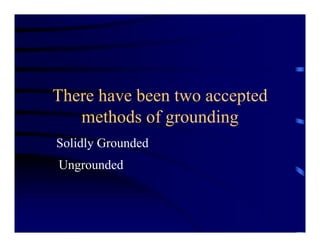
There have been two accepted
methods of grounding
Solidly Grounded
Ungrounded
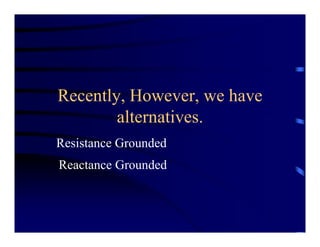
Recently, However, we have
alternatives.
Resistance Grounded
Reactance Grounded
Principles of Grounding
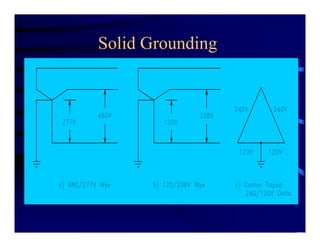
Solid Grounding
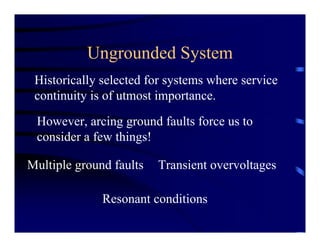
Ungrounded System
Historically selected for systems where service
continuity is of utmost importance.
However, arcing ground faults force us to
consider a few things!
Multiple ground faults Transient overvoltages
Resonant conditions
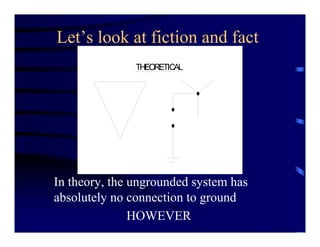
Let’s look at fiction and fact
THEORETICAL
In theory, the ungrounded system has
absolutely no connection to ground
HOWEVER
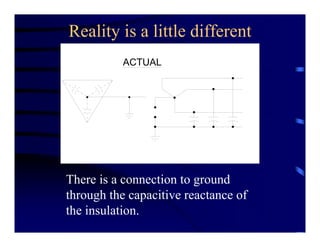
Reality is a little different
ACTUAL
There is a connection to ground
through the capacitive reactance of
the insulation.
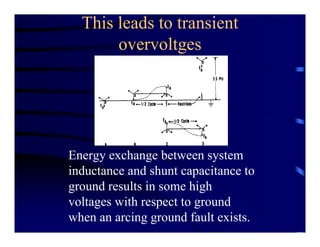
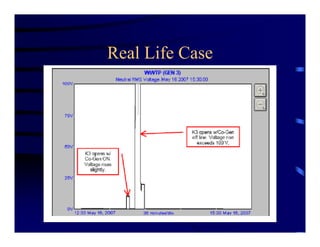
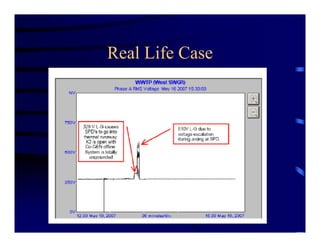
This leads to transient
overvoltges
Energy exchange between system
inductance and shunt capacitance to
ground results in some high
voltages with respect to ground
when an arcing ground fault exists.
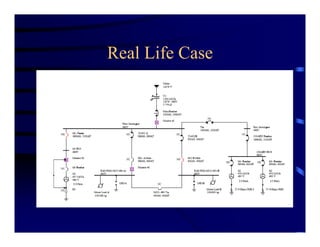
Real Life Case
Real Life Case
Real Life Case
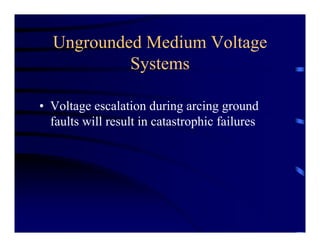
Ungrounded Medium Voltage
Systems
• Voltage escalation during arcing ground
faults will result in catastrophic failures
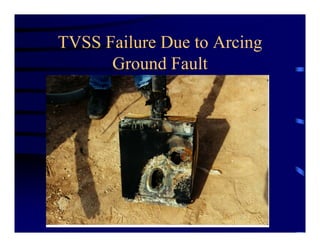
TVSS Failure Due to Arcing
Ground Fault
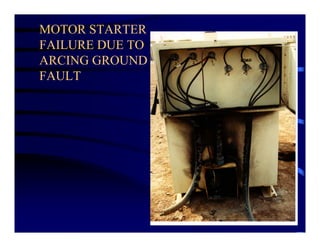
MOTOR STARTER
FAILURE DUE TO
ARCING GROUND
FAULT
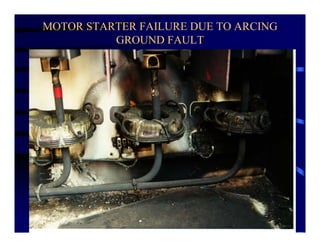
MOTOR STARTER FAILURE DUE TO ARCING
GROUND FAULT
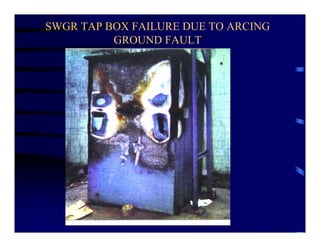
SWGR TAP BOX FAILURE DUE TO ARCING
GROUND FAULT
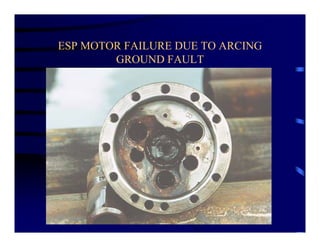
ESP MOTOR FAILURE DUE TO ARCING
GROUND FAULT
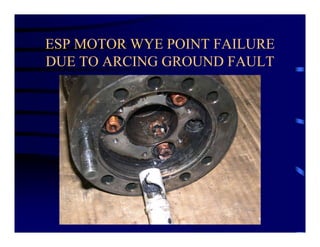
ESP MOTOR WYE POINT FAILURE
DUE TO ARCING GROUND FAULT
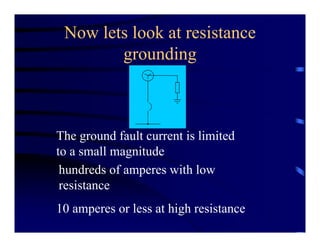
Now lets look at resistance
grounding
The ground fault current is limited
to a small magnitude
hundreds of amperes with low
resistance
10 amperes or less at high resistance
High Resistance Grounding
Low fault current means no
significant damage at the fault point
This means that the faulted circuit
need not to be tripped off line.
This also means it is likely that the
location of the ground fault is
unknown….
No smoke and fire…..
And that is a good thing.
In this way, it performs just like an
ungrounded system...
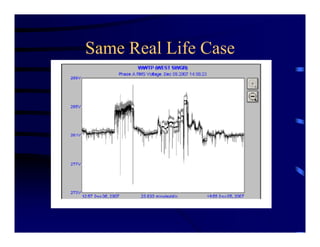
Same Real Life Case
What’s the best method of
grounding ?
Lets ask two questions
1. Are there any line - to - neutral loads?
2. How important is service continuity for this
electrical system?
YES…. Solid grounding may be good, but high
resistance is still an option.
No…… Solid grounding is still an option, but
high resistance is easier
Not very… solid grounding is great!
EXTREMELY!!! High resistance is BEST
What considerations are
necessary to retrofit a solidly
grounded system to a high
resistance grounded system?
What is the system voltage?
Are there any line-to-neutral loads?
Is there space for a cabinet -
usually 90” high and 18” wide?
If not, that’s ok, there’s always a
wall mount cabinet.
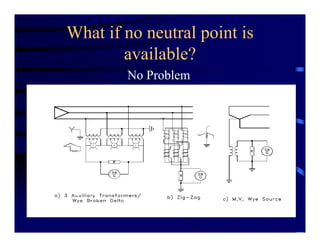
What if no neutral point is
available?
No Problem
OK , I need to install high
resistance grounding, but we
have some feeders with line-to-
neutral loads… What’s the
procedure?
Measure the load on each feeder & determine the
maximum load.
Select a delta-wye isolation transformer sized to
support the load on each feeder with line-to-neutral
loads.
Install the transformers near the distribution panel
supplying the loads
Install the high resistance grounding retrofit
equipment….
That’s all there is to it.
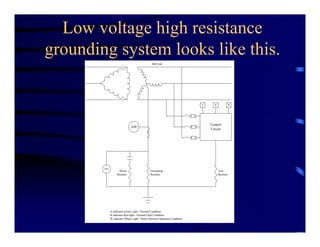
Low voltage high resistance
grounding system looks like this.
AM
Control
Circuit
G WR
59N
Grounding
Resistor
Pulser
Resistor
Test
Resistor
G indicates Green Light - Normal Condition
R indicates Red light - Ground Fault Condition
W indicates White Light - Pulser Resistor Operation Condition
480 Volt
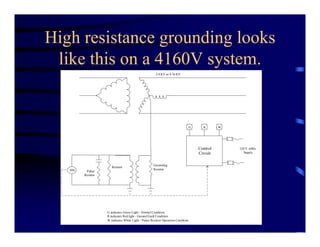
High resistance grounding looks
like this on a 4160V system.
G indicates Green Light - Normal Condition
R indicates Red light - Ground Fault Condition
W indicates White Light - Pulser Resistor Operation Condition
2.4 KV or 4.16 KV
Grounding
Resistor59N Pulser
Resistor
Control
Circuit
G WR
120 V, 60Hz
Supply
Resistor
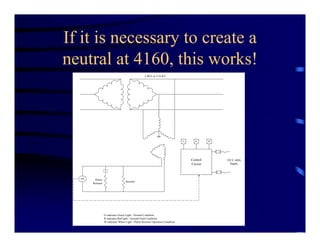
If it is necessary to create a
neutral at 4160, this works!
G indicates Green Light - Normal Condition
R indicates Red light - Ground Fault Condition
W indicates White Light - Pulser Resistor Operation Condition
2.4KV or 4.16 KV
59N
Resistor
Pulser
Resistor
Control
Circuit
G WR
120 V, 60Hz
Supply
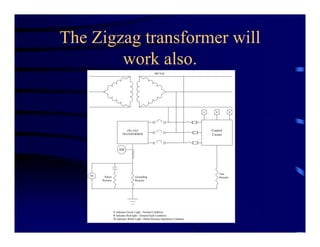
The Zigzag transformer will
work also.
Control
Circuit
G WR
Test
Resistor
G indicates Green Light - Normal Condition
R indicates Red light - Ground Fault Condition
W indicates White Light - Pulser Resistor Operation Condition
480 Volt
AM
59N
Grounding
Resistor
Pulser
Resistor
ZIG ZAG
TRANSFORMER
A quick review of considerations
for the application of high
resistance ground retrofits.
1.Requirement for continuity of service
2. Capacitive leakage current less than
current through resistor
3. System line-line voltage less than 4160
4. All loads must be balanced 3 phase
How about training of personnel?
You BET!
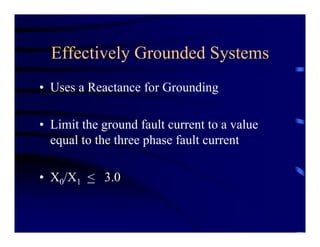
Effectively Grounded Systems
• Uses a Reactance for Grounding
• Limit the ground fault current to a value
equal to the three phase fault current
• X0/X1 < 3.0
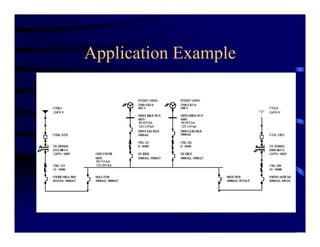
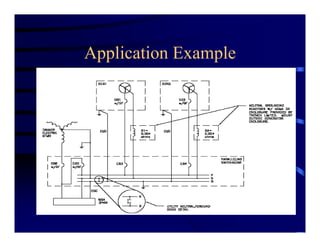
Application Example
Application Example
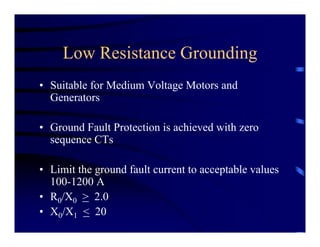
Low Resistance Grounding
• Suitable for Medium Voltage Motors and
Generators
• Ground Fault Protection is achieved with zero
sequence CTs
• Limit the ground fault current to acceptable values
100-1200 A
• R0/X0 > 2.0
• X0/X1 < 20
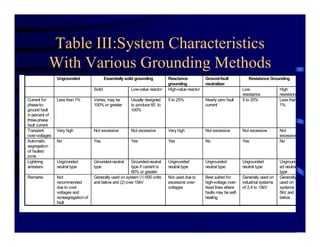
Table III:System Characteristics
With Various Grounding Methods
Ungrounded Essentially solid grounding Reactance
grounding
Ground-fault
neutralizer
Resistance Grounding
Solid Low-value reactor High-value reactor Low
resistance
High
resistance
Current for
phase-to-
ground fault
in percent of
three-phase
fault current
Less than 1% Varies, may be
100% or greater
Usually designed
to produce 60 to
100%
5 to 25% Nearly zero fault
current
5 to 20% Less than
1%
Transient
over-voltages
Very high Not excessive Not excessive Very high Not excessive Not excessive Not
excessive
Automatic
segregation
of faulted
zone
No Yes Yes Yes No Yes No
Lightning
arresters
Ungrounded
neutral type
Grounded-neutral
type
Grounded-neutral
type if current is
60% or greater
Ungrounded
neutral type
Ungrounded
neutral type
Ungrounded
neutral type
Unground
ed neutra
type
Remarks Not
recommended
due to over
voltages and
nonsegregation of
fault
Generally used on system (1) 600 volts
and below and (2) over 15kV
Not used due to
excessive over-
voltages
Best suited for
high-voltage over-
head lines where
faults may be self-
healing
Generally used on
industrial systems
of 2.4 to 15kV
Generally
used on
systems
5kV and
below
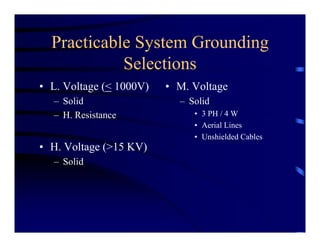
Practicable System Grounding
Selections
• L. Voltage (< 1000V)
– Solid
– H. Resistance
• H. Voltage (>15 KV)
– Solid
• M. Voltage
– Solid
• 3 PH / 4 W
• Aerial Lines
• Unshielded Cables
Practicable System Grounding
Selections
• Medium Voltage
– L. Resistance
• Motors / Generators
• Shielded Cables
• No VLN Loads
• Medium Voltage
– H. Resistance
• < 5 KV-No Tripping
• > 5 KV - Tripping
• No VLN Loads
Hybrid High Resistance
Grounding HHRG
• A combination of high and low resistance
grounding
• Applicable to medium voltage generators,
motors and transformers
Grounding and Ground Fault Protection of
Multiple Generator Installations on Medium-
Voltage Industrial and Commercial Systems
a Protection Committee Working Group Report
Prafulla Pillai, chair
Alan Pierce
Bruce Bailey
Bruce Douglas
Charles Mozina
Clifford Normand
Daniel Love
David Baker
David Shipp
Gerald Dalke
James R. Jones
Jay D. Fischer
Jim Bowen
Lorraine Padden
Louie J. Powell
Neil Nichols
Ralph Young
Norman T. Stringer
M.V.-MULTIPLE LOW RESISTANCE
GROUND SOURCES [Author = Powell]
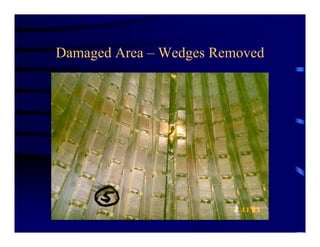
Damaged Area – Wedges Removed
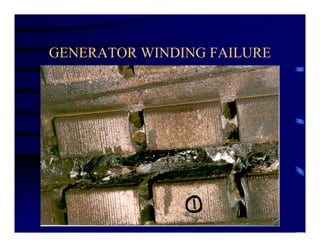
GENERATOR WINDING FAILURE
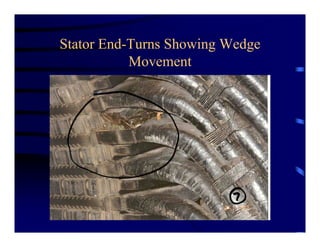
Stator End-Turns Showing Wedge
Movement
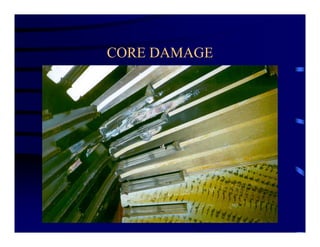
CORE DAMAGE
TYPICAL GENERATOR GROUND FAULT
[Author = Powell]
400a
400a
13.8kV distribution bus
SYSTEM ARC ENERGY
[Author = Powell]
0 100 200 300 400
0
250
500
750
1000
System
1 10
3
0.01 0.1 1 10
0
250
500
750
1000
System
Faultenergy,watt-seconds
Current, amperes Time, seconds
• FIG.7A-ENERGY DUE TO “SYSTEM” -
VARIOUS CURRENT MAGNITUDES
• FIG.7B-ARC ENERGY FOR 400A
R.”SYSTEM”
GEN. ARC ENERGY
[Author = Powell]
• FIG. 8B-FAULT ENERGY FOR 400A
“GEN CURRENT”
• FIG. 8A-FAULT ENERGY DUE TO
“GEN.” FOR VARIOUS CURRENTS
0 100 200 300 400
0
2500
5000
7500
1 10
4
Generator
0.01 0.1 1 10
0
2500
5000
7500
1 10
4
Generator
Faultenergy,watt-seconds
Current, amperes Time, seconds
FAULT ENERGY WITH 10A GROUNDING
[Author = Powell]
Generator
Faultenergy,watt-seconds
0.01 0.1 1 10
0
25
50
75
100
Time, seconds
LOW RESISTANCE GROUNDED
Advantages;
– Allows for Sensitive Grd Fault Current Available for
Sensitive & Selective Relaying.
– Greatly Minimizes Damage at Fault Point
Disadvantages
– Possibility of Generator Stator Iron Burning
– Hi G. F. Current Avail. With Multiple Sources
– Large Variations of Available Ground Fault Current
Complicates Ground Fault Relaying
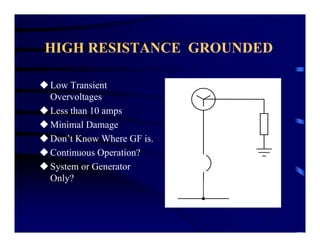
HIGH RESISTANCE GROUNDED
Low Transient
Overvoltages
Less than 10 amps
Minimal Damage
Don’t Know Where GF is.
Continuous Operation?
System or Generator
Only?
GENERATOR SOLUTIONS - HYBRID
• GEN. H. R. GROUNDED AND SYSTEM L. R. GROUNDED
[Author=Shipp]
G 59G
51G
LRG
86
R
HRG
* PHASE RELAYS
*
Thank You

Application Considerations for Power System Grounding

  • 1.
  • 2.
  • 3.
    IS NOT theQuestion.
  • 4.
    The real questionis ---- What’s the best grounding method for this application ?
  • 5.
    Power Systems Groundingis Probably the most misunderstood element of any power system design.
  • 6.
    There have beentwo accepted methods of grounding Solidly Grounded Ungrounded
  • 7.
    Recently, However, wehave alternatives. Resistance Grounded Reactance Grounded
  • 8.
  • 10.
  • 11.
    Ungrounded System Historically selectedfor systems where service continuity is of utmost importance. However, arcing ground faults force us to consider a few things! Multiple ground faults Transient overvoltages Resonant conditions
  • 12.
    Let’s look atfiction and fact THEORETICAL In theory, the ungrounded system has absolutely no connection to ground HOWEVER
  • 13.
    Reality is alittle different ACTUAL There is a connection to ground through the capacitive reactance of the insulation.
  • 14.
    This leads totransient overvoltges Energy exchange between system inductance and shunt capacitance to ground results in some high voltages with respect to ground when an arcing ground fault exists.
  • 15.
  • 16.
  • 17.
  • 18.
    Ungrounded Medium Voltage Systems •Voltage escalation during arcing ground faults will result in catastrophic failures
  • 19.
    TVSS Failure Dueto Arcing Ground Fault
  • 20.
    MOTOR STARTER FAILURE DUETO ARCING GROUND FAULT
  • 21.
    MOTOR STARTER FAILUREDUE TO ARCING GROUND FAULT
  • 22.
    SWGR TAP BOXFAILURE DUE TO ARCING GROUND FAULT
  • 23.
    ESP MOTOR FAILUREDUE TO ARCING GROUND FAULT
  • 24.
    ESP MOTOR WYEPOINT FAILURE DUE TO ARCING GROUND FAULT
  • 25.
    Now lets lookat resistance grounding The ground fault current is limited to a small magnitude hundreds of amperes with low resistance 10 amperes or less at high resistance
  • 26.
    High Resistance Grounding Lowfault current means no significant damage at the fault point This means that the faulted circuit need not to be tripped off line. This also means it is likely that the location of the ground fault is unknown…. No smoke and fire…..
  • 27.
    And that isa good thing. In this way, it performs just like an ungrounded system...
  • 28.
  • 29.
    What’s the bestmethod of grounding ? Lets ask two questions 1. Are there any line - to - neutral loads? 2. How important is service continuity for this electrical system? YES…. Solid grounding may be good, but high resistance is still an option. No…… Solid grounding is still an option, but high resistance is easier Not very… solid grounding is great! EXTREMELY!!! High resistance is BEST
  • 30.
    What considerations are necessaryto retrofit a solidly grounded system to a high resistance grounded system? What is the system voltage? Are there any line-to-neutral loads? Is there space for a cabinet - usually 90” high and 18” wide? If not, that’s ok, there’s always a wall mount cabinet.
  • 31.
    What if noneutral point is available? No Problem
  • 32.
    OK , Ineed to install high resistance grounding, but we have some feeders with line-to- neutral loads… What’s the procedure?
  • 33.
    Measure the loadon each feeder & determine the maximum load. Select a delta-wye isolation transformer sized to support the load on each feeder with line-to-neutral loads. Install the transformers near the distribution panel supplying the loads Install the high resistance grounding retrofit equipment…. That’s all there is to it.
  • 34.
    Low voltage highresistance grounding system looks like this. AM Control Circuit G WR 59N Grounding Resistor Pulser Resistor Test Resistor G indicates Green Light - Normal Condition R indicates Red light - Ground Fault Condition W indicates White Light - Pulser Resistor Operation Condition 480 Volt
  • 35.
    High resistance groundinglooks like this on a 4160V system. G indicates Green Light - Normal Condition R indicates Red light - Ground Fault Condition W indicates White Light - Pulser Resistor Operation Condition 2.4 KV or 4.16 KV Grounding Resistor59N Pulser Resistor Control Circuit G WR 120 V, 60Hz Supply Resistor
  • 36.
    If it isnecessary to create a neutral at 4160, this works! G indicates Green Light - Normal Condition R indicates Red light - Ground Fault Condition W indicates White Light - Pulser Resistor Operation Condition 2.4KV or 4.16 KV 59N Resistor Pulser Resistor Control Circuit G WR 120 V, 60Hz Supply
  • 37.
    The Zigzag transformerwill work also. Control Circuit G WR Test Resistor G indicates Green Light - Normal Condition R indicates Red light - Ground Fault Condition W indicates White Light - Pulser Resistor Operation Condition 480 Volt AM 59N Grounding Resistor Pulser Resistor ZIG ZAG TRANSFORMER
  • 38.
    A quick reviewof considerations for the application of high resistance ground retrofits. 1.Requirement for continuity of service 2. Capacitive leakage current less than current through resistor 3. System line-line voltage less than 4160 4. All loads must be balanced 3 phase
  • 39.
    How about trainingof personnel? You BET!
  • 40.
    Effectively Grounded Systems •Uses a Reactance for Grounding • Limit the ground fault current to a value equal to the three phase fault current • X0/X1 < 3.0
  • 41.
  • 42.
  • 43.
    Low Resistance Grounding •Suitable for Medium Voltage Motors and Generators • Ground Fault Protection is achieved with zero sequence CTs • Limit the ground fault current to acceptable values 100-1200 A • R0/X0 > 2.0 • X0/X1 < 20
  • 44.
    Table III:System Characteristics WithVarious Grounding Methods Ungrounded Essentially solid grounding Reactance grounding Ground-fault neutralizer Resistance Grounding Solid Low-value reactor High-value reactor Low resistance High resistance Current for phase-to- ground fault in percent of three-phase fault current Less than 1% Varies, may be 100% or greater Usually designed to produce 60 to 100% 5 to 25% Nearly zero fault current 5 to 20% Less than 1% Transient over-voltages Very high Not excessive Not excessive Very high Not excessive Not excessive Not excessive Automatic segregation of faulted zone No Yes Yes Yes No Yes No Lightning arresters Ungrounded neutral type Grounded-neutral type Grounded-neutral type if current is 60% or greater Ungrounded neutral type Ungrounded neutral type Ungrounded neutral type Unground ed neutra type Remarks Not recommended due to over voltages and nonsegregation of fault Generally used on system (1) 600 volts and below and (2) over 15kV Not used due to excessive over- voltages Best suited for high-voltage over- head lines where faults may be self- healing Generally used on industrial systems of 2.4 to 15kV Generally used on systems 5kV and below
  • 45.
    Practicable System Grounding Selections •L. Voltage (< 1000V) – Solid – H. Resistance • H. Voltage (>15 KV) – Solid • M. Voltage – Solid • 3 PH / 4 W • Aerial Lines • Unshielded Cables
  • 46.
    Practicable System Grounding Selections •Medium Voltage – L. Resistance • Motors / Generators • Shielded Cables • No VLN Loads • Medium Voltage – H. Resistance • < 5 KV-No Tripping • > 5 KV - Tripping • No VLN Loads
  • 47.
    Hybrid High Resistance GroundingHHRG • A combination of high and low resistance grounding • Applicable to medium voltage generators, motors and transformers
  • 48.
    Grounding and GroundFault Protection of Multiple Generator Installations on Medium- Voltage Industrial and Commercial Systems a Protection Committee Working Group Report Prafulla Pillai, chair Alan Pierce Bruce Bailey Bruce Douglas Charles Mozina Clifford Normand Daniel Love David Baker David Shipp Gerald Dalke James R. Jones Jay D. Fischer Jim Bowen Lorraine Padden Louie J. Powell Neil Nichols Ralph Young Norman T. Stringer
  • 49.
    M.V.-MULTIPLE LOW RESISTANCE GROUNDSOURCES [Author = Powell]
  • 50.
    Damaged Area –Wedges Removed
  • 51.
  • 52.
  • 53.
  • 54.
    TYPICAL GENERATOR GROUNDFAULT [Author = Powell] 400a 400a 13.8kV distribution bus
  • 55.
    SYSTEM ARC ENERGY [Author= Powell] 0 100 200 300 400 0 250 500 750 1000 System 1 10 3 0.01 0.1 1 10 0 250 500 750 1000 System Faultenergy,watt-seconds Faultenergy,watt-seconds Current, amperes Time, seconds • FIG.7A-ENERGY DUE TO “SYSTEM” - VARIOUS CURRENT MAGNITUDES • FIG.7B-ARC ENERGY FOR 400A R.”SYSTEM”
  • 56.
    GEN. ARC ENERGY [Author= Powell] • FIG. 8B-FAULT ENERGY FOR 400A “GEN CURRENT” • FIG. 8A-FAULT ENERGY DUE TO “GEN.” FOR VARIOUS CURRENTS 0 100 200 300 400 0 2500 5000 7500 1 10 4 Generator 0.01 0.1 1 10 0 2500 5000 7500 1 10 4 Generator Faultenergy,watt-seconds Faultenergy,watt-seconds Current, amperes Time, seconds
  • 57.
    FAULT ENERGY WITH10A GROUNDING [Author = Powell] Generator Faultenergy,watt-seconds 0.01 0.1 1 10 0 25 50 75 100 Time, seconds
  • 58.
    LOW RESISTANCE GROUNDED Advantages; –Allows for Sensitive Grd Fault Current Available for Sensitive & Selective Relaying. – Greatly Minimizes Damage at Fault Point Disadvantages – Possibility of Generator Stator Iron Burning – Hi G. F. Current Avail. With Multiple Sources – Large Variations of Available Ground Fault Current Complicates Ground Fault Relaying
  • 59.
    HIGH RESISTANCE GROUNDED LowTransient Overvoltages Less than 10 amps Minimal Damage Don’t Know Where GF is. Continuous Operation? System or Generator Only?
  • 60.
    GENERATOR SOLUTIONS -HYBRID • GEN. H. R. GROUNDED AND SYSTEM L. R. GROUNDED [Author=Shipp] G 59G 51G LRG 86 R HRG * PHASE RELAYS *
  • 61.