MEDIUM Voltage systems
Electrical Neutral grounding methods
and system implications
MV system transmission & distribution practices
 MV system when transmitted through bare conductor through O/head lines ,in
such cases the Neutral should be solidly grounded .
 The neutral is solidly grounded for safety of life/properties and in such case the L-g
fault is supposed to get cleared within 200ms.
 The associated circuit equipments eg cables, termination kits/splicing CT & PTs, LA
and insulators are also specified differently for effectively grounded system.
 The L-g fault current is not controlled so protection systems are relatively easier.
 The normal 50/51 A,B,C,N can be used with normal residually connected systems
for earth fault protections .
MV system impedance grounded
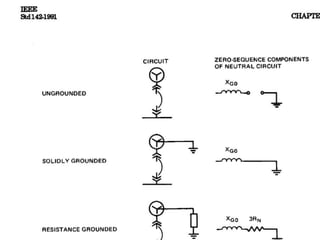
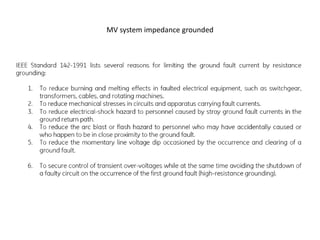
 Impedance grounding achieved by limiting the L-g fault .
 For High impedance grounding with limited MVA level and arc flash
control requirements and also for limiting the L-g fault current of the
winding for large generators this is achieved by a Neutral grounding
Transformer maximum rating up to 15amps short time 1minute.
 During any L-g fault conditions the ground fault current is passed through
NGR ,and is called let off current and this must be >=capacitive charging
current and this will control dangerous( on the other two healthy
phases)o/voltage due to arcing ground and this will not be > 3PU.
 For low impedance grounding the NGR rating should be 100Amp
minimum,for practically offering a better equipment protection beyond
90% of the winding the NGR rating -with the minimum basic necessity of
10Amp /MVA for short time ie 10sec rating
 Higher NGR rating upto 1000 Amp provides better protection ie 99%
protection of the winding which is found in many refineries and in O/seas
plants.
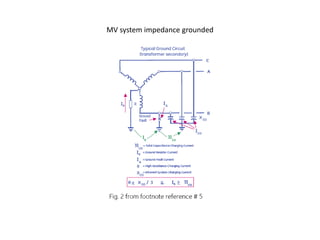
Equivalent circuit for neutral grounding
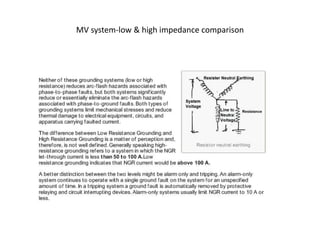
MV system-low & high impedance comparison
MV system impedance grounded
High resistance grounding
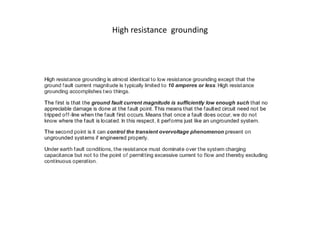
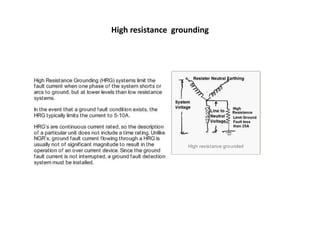
 In colliery and mines where there are presence of hazardous trapped
gases and the arc flash hazard control is achieved by the HRG - NGT system
where the L-g current is controlled within 10-15 amp.
 The mines and collieries are having relatively smaller distribution and the
system capacitive charging current can be limited within 10-15 amp and
the main objective is to limit the Arc flash /fire hazard.
 The selection of CT/PTs , LA-surge supressors, Busducts /SWGRs, Cable
termination n Splicing kits voltage selection should be graded for UE
system.
High resistance grounding
Low impedance grounding
 The low impedance grounding is applicable for large instalations where the arc
flash is not a very important factor stability of system is paramount.
 The system equipments selection of CT/Pts, LA-surge supressors, Busducts/SWGRs,
Cable termination n Splicing kits voltage selection should be made compatible for
UE system.
 This system offers greater stability as with one L-g fault the fault current is limited
to the NGR rated current and generates alarm to clear the fault subsequently.
 During any L-g fault condition the CBCT senses the current and isolates the faulty
system and thus prevents any further unstability to the system.
Low impedance grounding
• Neutral grounding resistors limit the fault current when any one phase of the systems gets
grounded or arcs. In this condition the NGR typically limits the fault current to 200-
400amp(NGR rating).
MV neutral resistance grounded system effects on protections and
overvoltage
 In this system any L-g fault will create an earth fault current with limited
value which will not be detectable by normal residually connected CT and
even though detectable this does not offer proper equipment protection.
 In this system for Earth fault detection on the Bus bar there should be a
Open Delta PT ie Up/√3/110/3 ratio with a stabilizing resistor across the
secondary winding with neutral side grounded(to limit ferro resonance
and provide a stabilizing ground path ) .
 For Earth fault detection on O/g service feeders ie motor/transformer
there should be Core balancing/Z Cts of ratio 50/1.
 This core balancing CT will protect system against L-G fault and effectively
isolate the faulty system .
 The Cable Sheath needed to be returned back through CBCT and then
grounded to nullify the circulating current.
MV system core balacing CT
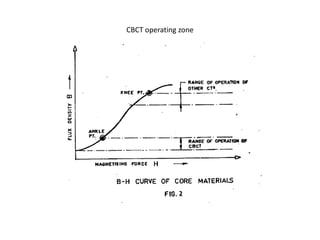
 The CBCT acts in case of a single L-g fault and the actuation value is set at 10amp
primary current.
 The CBCT current setting must be > than the capacitive charging current of the
largest feeder connected with the system or else there will be spurious
(sympathetic) tripping..
 The CBCT current value should be set <10amp and minimum 0.132*CTR ie 6.6Amp
to limit the overvoltage on the other healthy phases.
 On a gross calculation for the APPDCL BFP motor of 18.5MW the capacitive
charging current was found approx 8.5Amp.
 The max allowable CBCT operating current level should be not greater than
10amp (primary) and this value must be >than the capacitive charging current of
the connected system the O/voltage on the other two healthy phases cannot be
limited to 3PU.
CBCT operating zone
MV –neutral grounding effect on LA selection
 For non effective grounding system
 In GSU-GCB-UAT-ExcitationTrafo-Generator section the grounding is at the NGT at 10amp at
the most .
 The O/v factor is 1.4Un for 5secs for GSU/IPBD/UAT t and all associated section n equipment
.
 The Un=21KV,taking AVR regulation +/-5% the Um=1.05Un=22KV
 The LA should be 27.5 KV grade by taking care of O/voltage related TOV and GT-AVR
regulation of +/-5%.
MV neutral grounding-CT /PT selection
 The rated voltage factor with a non effective grounded system
should be
 1.2Un continuous.
 1.9Un for 30secs
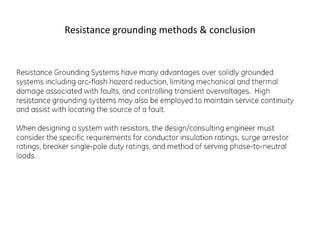
Resistance grounding methods & conclusion
MV neutral grounding-Reference
 IEC-60099
 IEC-60044,61869
 IEC-60071
 IEEE-C.62.92.1,2,3,4,5
 EBG paper on CBCT
 GE –NGR paper
 ABB-LA paper
 IEEE-141,143
 GE publications-GEI-72116

Mv system neutral grounding

  • 1.
    MEDIUM Voltage systems ElectricalNeutral grounding methods and system implications
  • 2.
    MV system transmission& distribution practices  MV system when transmitted through bare conductor through O/head lines ,in such cases the Neutral should be solidly grounded .  The neutral is solidly grounded for safety of life/properties and in such case the L-g fault is supposed to get cleared within 200ms.  The associated circuit equipments eg cables, termination kits/splicing CT & PTs, LA and insulators are also specified differently for effectively grounded system.  The L-g fault current is not controlled so protection systems are relatively easier.  The normal 50/51 A,B,C,N can be used with normal residually connected systems for earth fault protections .
  • 3.
    MV system impedancegrounded  Impedance grounding achieved by limiting the L-g fault .  For High impedance grounding with limited MVA level and arc flash control requirements and also for limiting the L-g fault current of the winding for large generators this is achieved by a Neutral grounding Transformer maximum rating up to 15amps short time 1minute.  During any L-g fault conditions the ground fault current is passed through NGR ,and is called let off current and this must be >=capacitive charging current and this will control dangerous( on the other two healthy phases)o/voltage due to arcing ground and this will not be > 3PU.  For low impedance grounding the NGR rating should be 100Amp minimum,for practically offering a better equipment protection beyond 90% of the winding the NGR rating -with the minimum basic necessity of 10Amp /MVA for short time ie 10sec rating  Higher NGR rating upto 1000 Amp provides better protection ie 99% protection of the winding which is found in many refineries and in O/seas plants.
  • 4.
    Equivalent circuit forneutral grounding
  • 5.
    MV system-low &high impedance comparison
  • 6.
  • 7.
  • 8.
    High resistance grounding In colliery and mines where there are presence of hazardous trapped gases and the arc flash hazard control is achieved by the HRG - NGT system where the L-g current is controlled within 10-15 amp.  The mines and collieries are having relatively smaller distribution and the system capacitive charging current can be limited within 10-15 amp and the main objective is to limit the Arc flash /fire hazard.  The selection of CT/PTs , LA-surge supressors, Busducts /SWGRs, Cable termination n Splicing kits voltage selection should be graded for UE system.
  • 9.
  • 10.
  • 11.
    Low impedance grounding The low impedance grounding is applicable for large instalations where the arc flash is not a very important factor stability of system is paramount.  The system equipments selection of CT/Pts, LA-surge supressors, Busducts/SWGRs, Cable termination n Splicing kits voltage selection should be made compatible for UE system.  This system offers greater stability as with one L-g fault the fault current is limited to the NGR rated current and generates alarm to clear the fault subsequently.  During any L-g fault condition the CBCT senses the current and isolates the faulty system and thus prevents any further unstability to the system.
  • 12.
    Low impedance grounding •Neutral grounding resistors limit the fault current when any one phase of the systems gets grounded or arcs. In this condition the NGR typically limits the fault current to 200- 400amp(NGR rating).
  • 13.
    MV neutral resistancegrounded system effects on protections and overvoltage  In this system any L-g fault will create an earth fault current with limited value which will not be detectable by normal residually connected CT and even though detectable this does not offer proper equipment protection.  In this system for Earth fault detection on the Bus bar there should be a Open Delta PT ie Up/√3/110/3 ratio with a stabilizing resistor across the secondary winding with neutral side grounded(to limit ferro resonance and provide a stabilizing ground path ) .  For Earth fault detection on O/g service feeders ie motor/transformer there should be Core balancing/Z Cts of ratio 50/1.  This core balancing CT will protect system against L-G fault and effectively isolate the faulty system .  The Cable Sheath needed to be returned back through CBCT and then grounded to nullify the circulating current.
  • 14.
    MV system corebalacing CT  The CBCT acts in case of a single L-g fault and the actuation value is set at 10amp primary current.  The CBCT current setting must be > than the capacitive charging current of the largest feeder connected with the system or else there will be spurious (sympathetic) tripping..  The CBCT current value should be set <10amp and minimum 0.132*CTR ie 6.6Amp to limit the overvoltage on the other healthy phases.  On a gross calculation for the APPDCL BFP motor of 18.5MW the capacitive charging current was found approx 8.5Amp.  The max allowable CBCT operating current level should be not greater than 10amp (primary) and this value must be >than the capacitive charging current of the connected system the O/voltage on the other two healthy phases cannot be limited to 3PU.
  • 15.
  • 16.
    MV –neutral groundingeffect on LA selection  For non effective grounding system  In GSU-GCB-UAT-ExcitationTrafo-Generator section the grounding is at the NGT at 10amp at the most .  The O/v factor is 1.4Un for 5secs for GSU/IPBD/UAT t and all associated section n equipment .  The Un=21KV,taking AVR regulation +/-5% the Um=1.05Un=22KV  The LA should be 27.5 KV grade by taking care of O/voltage related TOV and GT-AVR regulation of +/-5%.
  • 17.
    MV neutral grounding-CT/PT selection  The rated voltage factor with a non effective grounded system should be  1.2Un continuous.  1.9Un for 30secs
  • 18.
  • 19.
    MV neutral grounding-Reference IEC-60099  IEC-60044,61869  IEC-60071  IEEE-C.62.92.1,2,3,4,5  EBG paper on CBCT  GE –NGR paper  ABB-LA paper  IEEE-141,143  GE publications-GEI-72116