Grounding (Earthing)
• Connecting the neutrals of the system (i.e., the neutral points of star-
connected 3-phase windings of power transformers, generators,
motors, earthing transformers, etc.) or non-current carrying metallic
parts of the electrical equipment to the general mass of earth
(ground).
Purpose of grounding
i) To minimize transient over voltages due to lightning and ground
faults
ii) To allow sufficient fault current to flow safely for proper operation
of protective relays during ground faults
iii) To eliminate persistent arcing grounds
iv) To provide improved service reliability
v) To ensure safety of personnel against electric shocks and protection
of equipment against lightning.
Types of grounding
• Neutral grounding or system grounding
• grounding of the system neutrals to ensure system security and
protection
• Example: Grounding of neutrals in power stations and subtations
• Equipment grounding
• grounding of non-current carrying metallic parts of the equipment to
ensure safety of personnel and protection against lightningor safety
grounding
• safety grounding
Three classes of neutral grounding
• Ungrounded (isolated neutral),
• Impedance-grounded (resistance or reactance), and
• Effectively grounded (neutral solidly grounded).
• An ungrounded neutral system is connected to ground through the
natural shunt capacitance.
• Neutral grounding (neutral earthing) is also called ‘system grounding
(system earthing)’.
Difficulties encountered in ungrounded systems
• Repeated arcing grounds and
• Overvoltages of the healthy lines during single line to ground fault.
• Causes stress on the insulation of the lines and equipment and
• Result in insulation breakdown
• Capacitive fault current is so small in magnitude that the same cannot
operate the ground fault relays and hence the ground
Neutral grounding
• Effective grounding
• Non-effective grounding
• Effective grounding
• The neutral is directly connected to ground without inserting any intentional
impedance (resistance or reactance).
• Solid grounding
• The coefficient of grounding of effectively grounded system is less than 80%
• Non-effective grounding
• the neutral is connected to ground through impedance (resistance or
reactance).
• The coefficient of grounding of non-effectively grounded system is greater
than 80%
Grounded systems
• The neutral grounding provides a return path to the zero-
seuqence current, and
• Ground fault current in a grounded system may be too large
compared to the small capacitive fault current in an ungrounded
system.
Advantages of Neutral Grounding
• Persistent arcing grounds are eliminated and hence the system is not subjected to overvoltages due to
arcing grounds.
• The neutral point remains stable and is not shifted.
• The voltages of healthy phases (lines) with respect to ground remain at normal value. They do not increase
to √3 times normal value as in the case of an ungrounded (isolated neutral) system.
• The ground-fault relaying is relatively simple because sufficient amount of ground-fault current is available
to operate ground fault relays.
• The life of insulation is increased due to prevention of voltage surges caused by arcing grounds. Hence,
maintenance, repairs and breakdowns are reduced
• By employing resistance or reactance in ground connection, the ground-fault current can be controlled.
• The overvoltages due to lightning are discharged to ground.
• Improved service reliability is provided because of limitation of arcing grounds and prevention of
unnecessary tripping of circuit-breakers.
• Greater safety is provided to personnel and equipment.
Types of Neutral Grounding
• Effective grounding (solid grounding)
• Resistance grounding
• Reactance grounding
• Resonant grounding (arc suppression coil
grounding)
• Voltage transformer grounding
• Grounding through grounding transformer
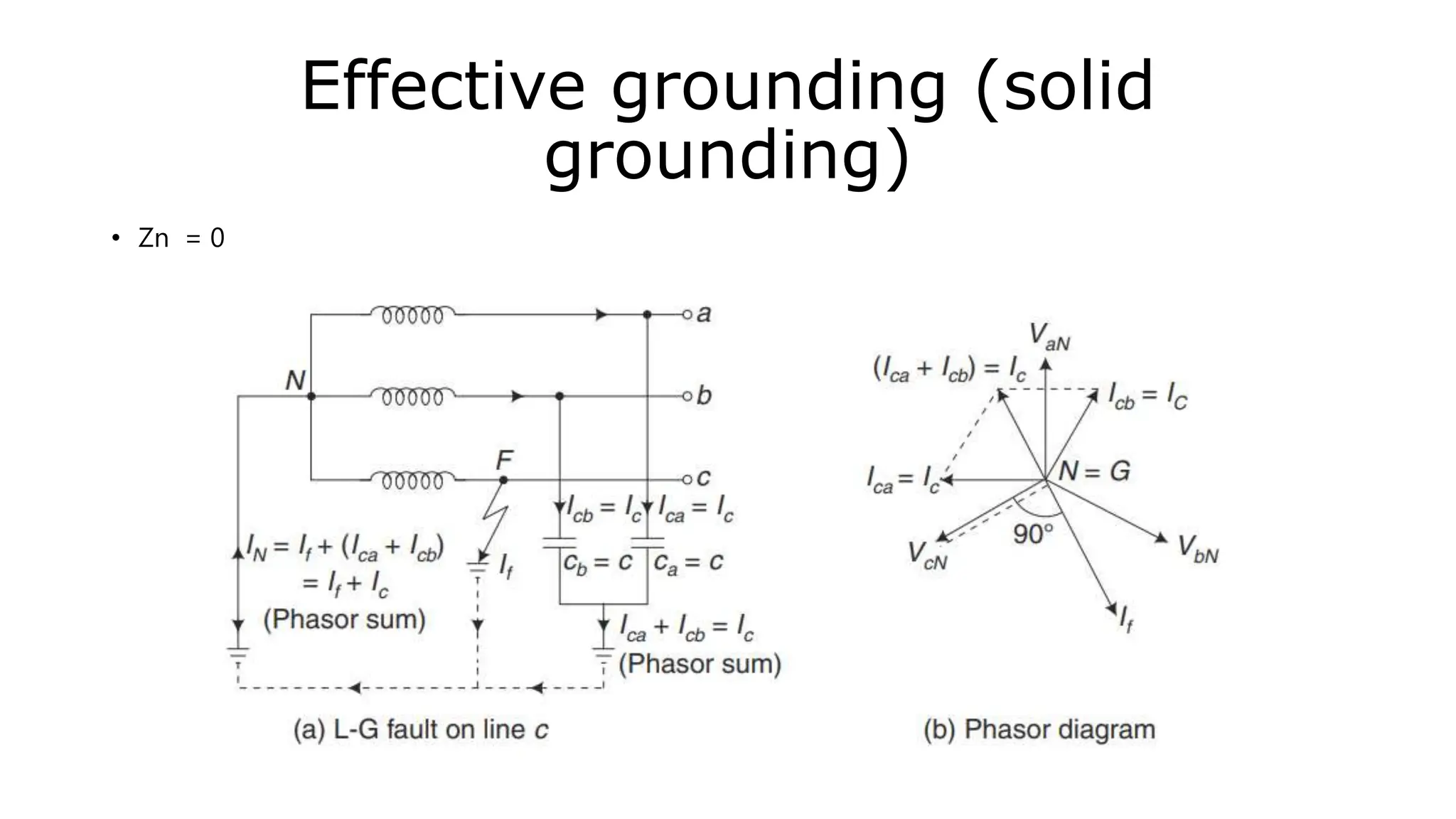
Effective grounding (solid
grounding)
• Zn = 0
Limitations of Effective grounding
• The use of ‘effective grounding’ is limited only to systems where the
normal circuit impedance is sufficient to keep the ground fault
current within safe limits.
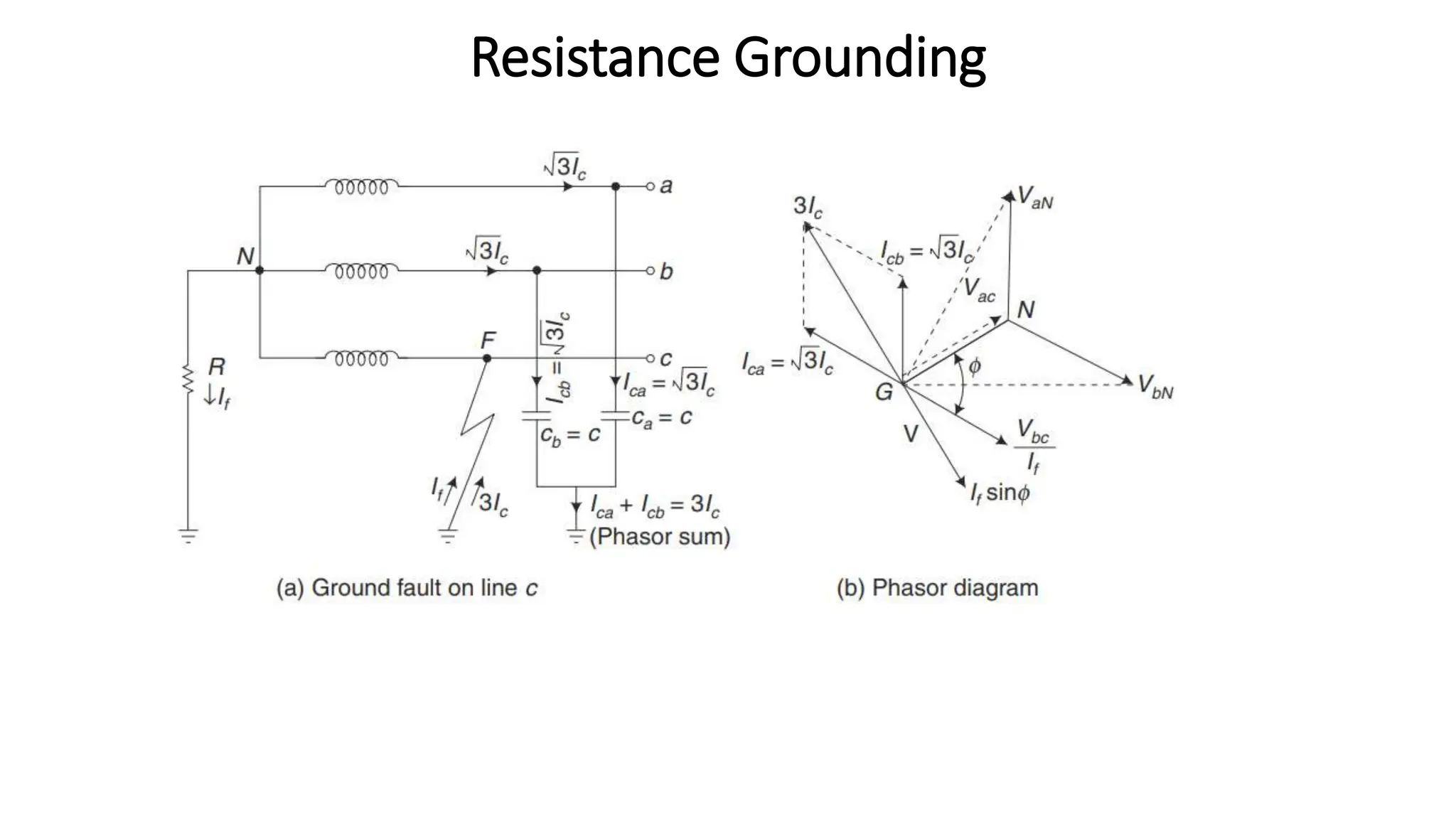
Resistance Grounding
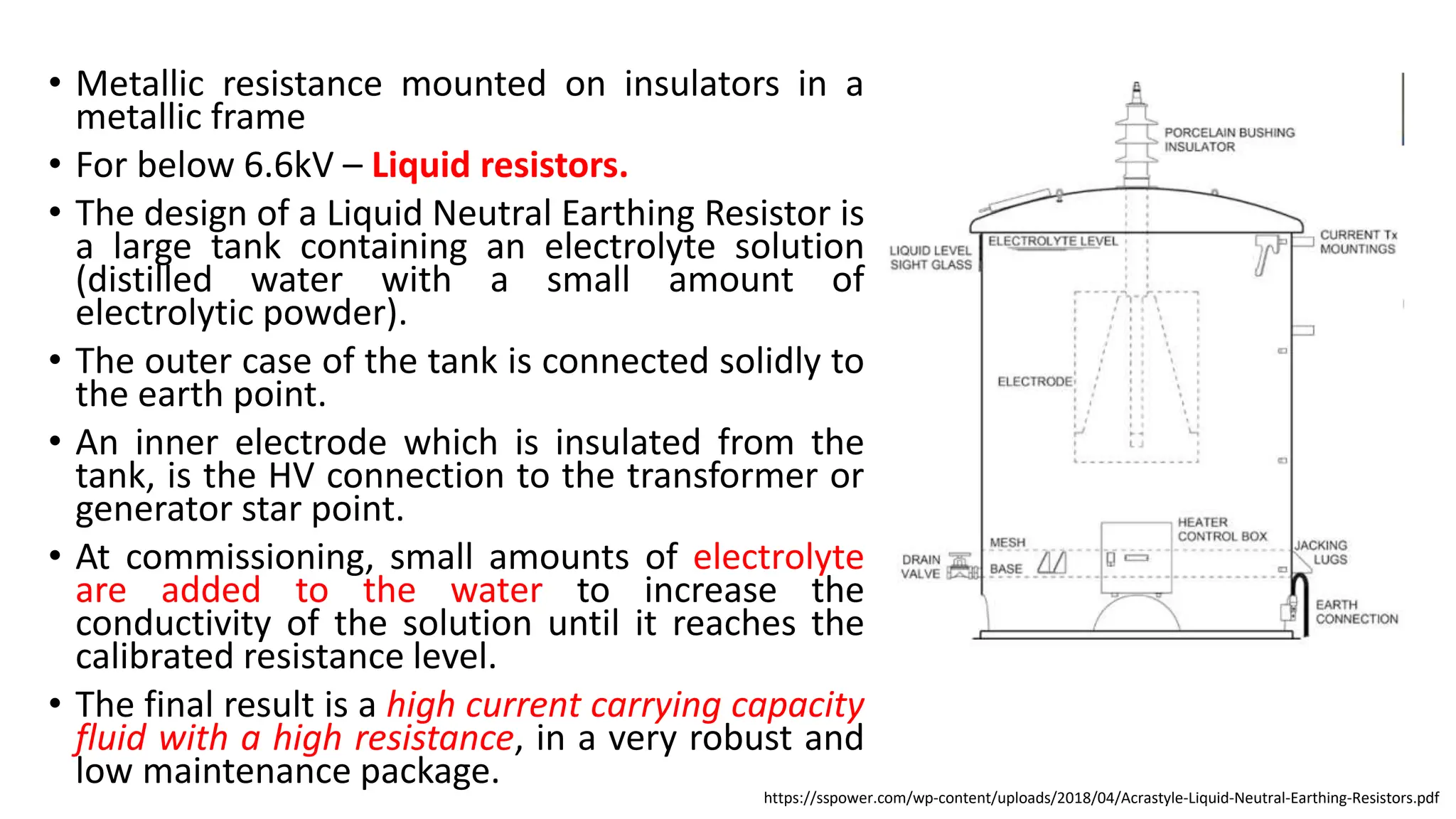
• Metallic resistance mounted on insulators in a
metallic frame
• For below 6.6kV – Liquid resistors.
• The design of a Liquid Neutral Earthing Resistor is
a large tank containing an electrolyte solution
(distilled water with a small amount of
electrolytic powder).
• The outer case of the tank is connected solidly to
the earth point.
• An inner electrode which is insulated from the
tank, is the HV connection to the transformer or
generator star point.
• At commissioning, small amounts of electrolyte
are added to the water to increase the
conductivity of the solution until it reaches the
calibrated resistance level.
• The final result is a high current carrying capacity
fluid with a high resistance, in a very robust and
low maintenance package.
https://sspower.com/wp-content/uploads/2018/04/Acrastyle-Liquid-Neutral-Earthing-Resistors.pdf
Neutral Grounding Resistor (NGR)
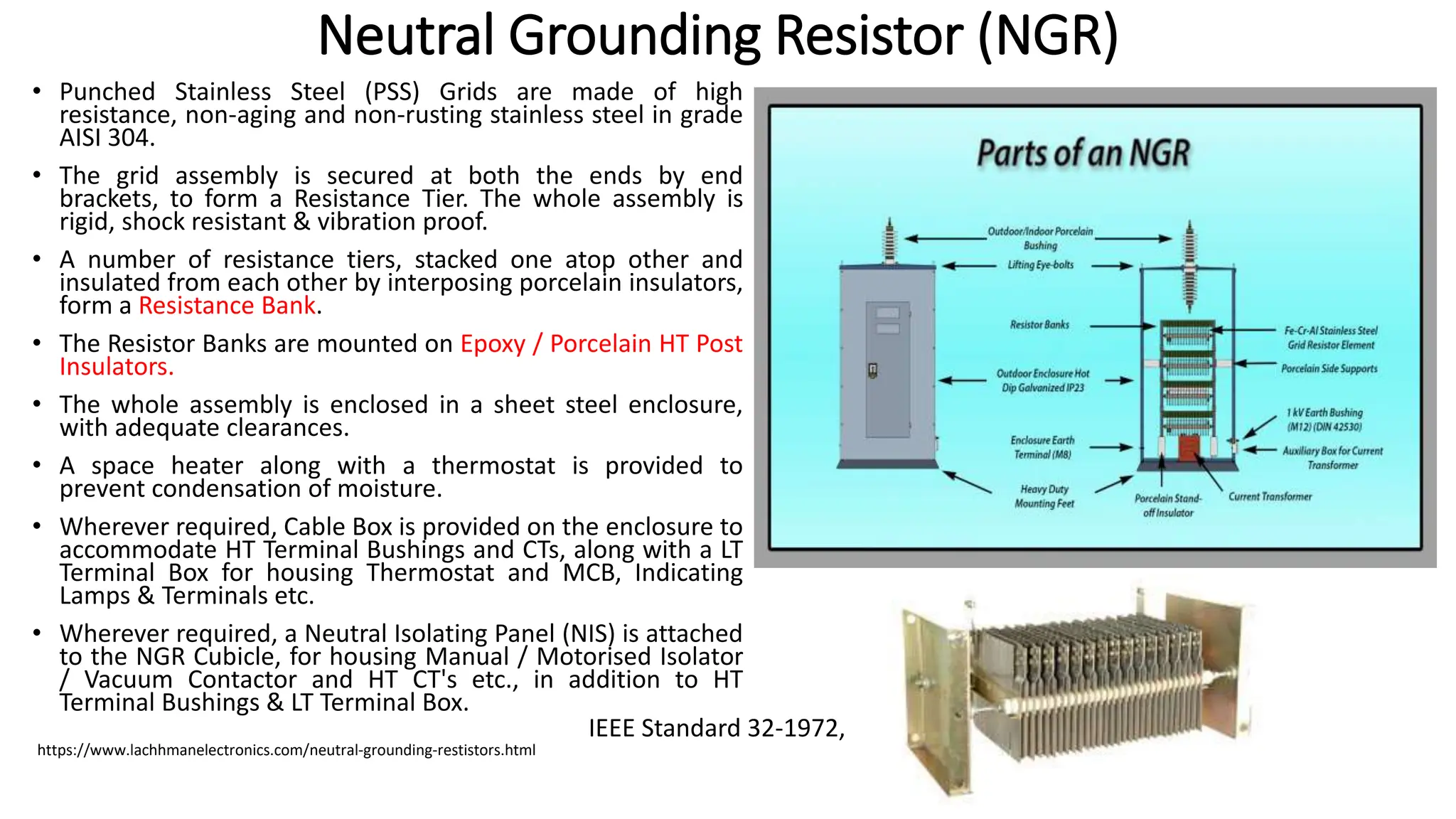
• Punched Stainless Steel (PSS) Grids are made of high
resistance, non-aging and non-rusting stainless steel in grade
AISI 304.
• The grid assembly is secured at both the ends by end
brackets, to form a Resistance Tier. The whole assembly is
rigid, shock resistant & vibration proof.
• A number of resistance tiers, stacked one atop other and
insulated from each other by interposing porcelain insulators,
form a Resistance Bank.
• The Resistor Banks are mounted on Epoxy / Porcelain HT Post
Insulators.
• The whole assembly is enclosed in a sheet steel enclosure,
with adequate clearances.
• A space heater along with a thermostat is provided to
prevent condensation of moisture.
• Wherever required, Cable Box is provided on the enclosure to
accommodate HT Terminal Bushings and CTs, along with a LT
Terminal Box for housing Thermostat and MCB, Indicating
Lamps & Terminals etc.
• Wherever required, a Neutral Isolating Panel (NIS) is attached
to the NGR Cubicle, for housing Manual / Motorised Isolator
/ Vacuum Contactor and HT CT's etc., in addition to HT
Terminal Bushings & LT Terminal Box.
https://www.lachhmanelectronics.com/neutral-grounding-restistors.html
IEEE Standard 32-1972,
• Resistance grounding is usually employed for the systems operating at
voltages between 3.3 kV and 33 kV.
Tolerable Step and Touch Voltages
• When a fault occurs, the flow of fault current to ground results in
voltage gradient on the surface of the ground in the vicinity of the
grounding system.
• This voltage gradient may affect a person in two ways, viz.,
• step or foot to foot contact and
• hand to both feet or touch contact
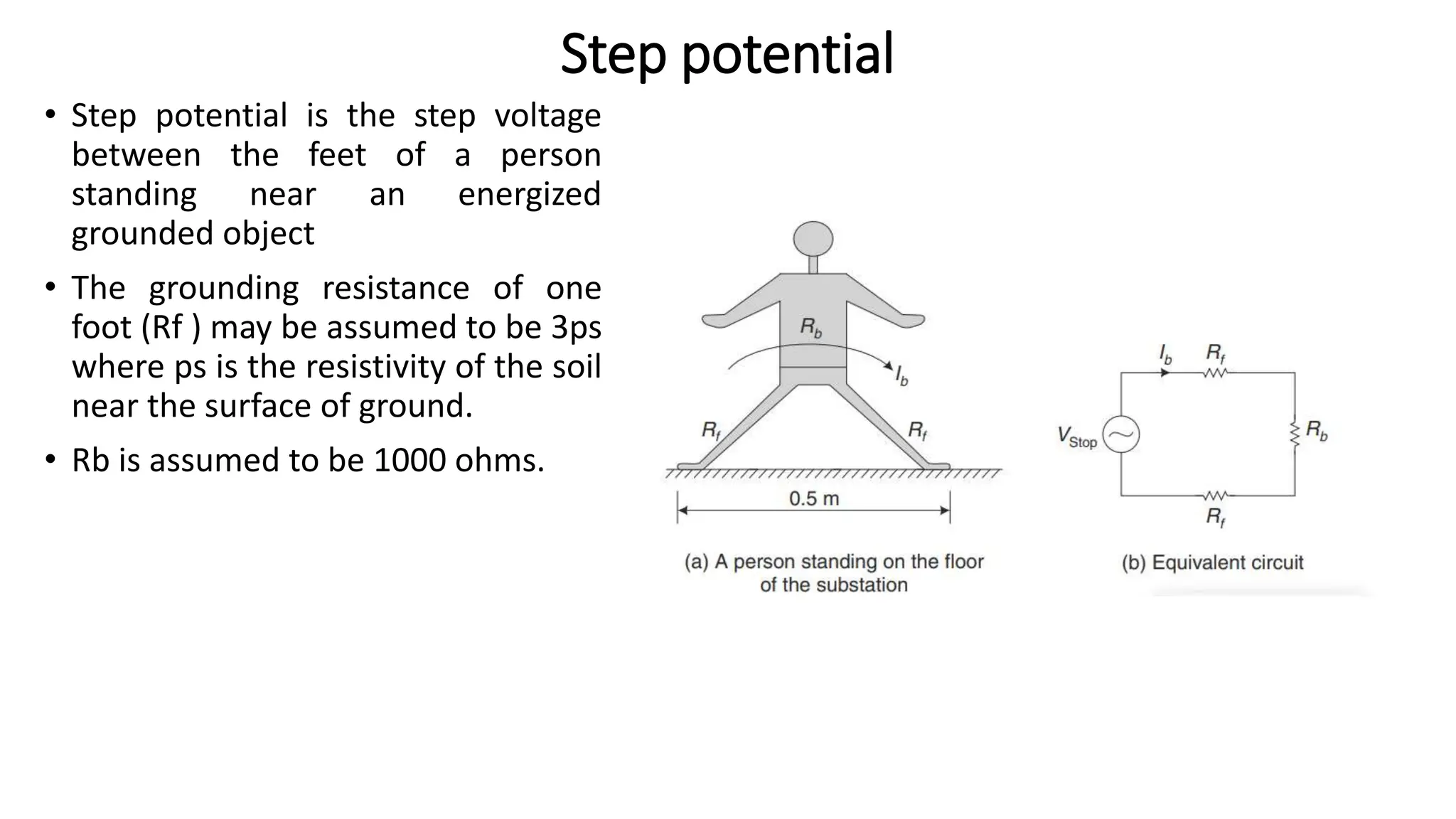
Step potential
• Step potential is the step voltage
between the feet of a person
standing near an energized
grounded object
• The grounding resistance of one
foot (Rf ) may be assumed to be 3ps
where ps is the resistivity of the soil
near the surface of ground.
• Rb is assumed to be 1000 ohms.
Touch potential
• Touch potential is the touch voltage between the energized object and the
feet of a person in contact with the object.
Earthing  grounding protection Difference between earthing and grounding.pptx

Earthing grounding protection Difference between earthing and grounding.pptx

  • 1.
  • 2.
    Grounding (Earthing) • Connectingthe neutrals of the system (i.e., the neutral points of star- connected 3-phase windings of power transformers, generators, motors, earthing transformers, etc.) or non-current carrying metallic parts of the electrical equipment to the general mass of earth (ground).
  • 3.
    Purpose of grounding i)To minimize transient over voltages due to lightning and ground faults ii) To allow sufficient fault current to flow safely for proper operation of protective relays during ground faults iii) To eliminate persistent arcing grounds iv) To provide improved service reliability v) To ensure safety of personnel against electric shocks and protection of equipment against lightning.
  • 4.
    Types of grounding •Neutral grounding or system grounding • grounding of the system neutrals to ensure system security and protection • Example: Grounding of neutrals in power stations and subtations • Equipment grounding • grounding of non-current carrying metallic parts of the equipment to ensure safety of personnel and protection against lightningor safety grounding • safety grounding
  • 5.
    Three classes ofneutral grounding • Ungrounded (isolated neutral), • Impedance-grounded (resistance or reactance), and • Effectively grounded (neutral solidly grounded). • An ungrounded neutral system is connected to ground through the natural shunt capacitance. • Neutral grounding (neutral earthing) is also called ‘system grounding (system earthing)’.
  • 6.
    Difficulties encountered inungrounded systems • Repeated arcing grounds and • Overvoltages of the healthy lines during single line to ground fault. • Causes stress on the insulation of the lines and equipment and • Result in insulation breakdown • Capacitive fault current is so small in magnitude that the same cannot operate the ground fault relays and hence the ground
  • 7.
    Neutral grounding • Effectivegrounding • Non-effective grounding • Effective grounding • The neutral is directly connected to ground without inserting any intentional impedance (resistance or reactance). • Solid grounding • The coefficient of grounding of effectively grounded system is less than 80% • Non-effective grounding • the neutral is connected to ground through impedance (resistance or reactance). • The coefficient of grounding of non-effectively grounded system is greater than 80%
  • 8.
    Grounded systems • Theneutral grounding provides a return path to the zero- seuqence current, and • Ground fault current in a grounded system may be too large compared to the small capacitive fault current in an ungrounded system.
  • 9.
    Advantages of NeutralGrounding • Persistent arcing grounds are eliminated and hence the system is not subjected to overvoltages due to arcing grounds. • The neutral point remains stable and is not shifted. • The voltages of healthy phases (lines) with respect to ground remain at normal value. They do not increase to √3 times normal value as in the case of an ungrounded (isolated neutral) system. • The ground-fault relaying is relatively simple because sufficient amount of ground-fault current is available to operate ground fault relays. • The life of insulation is increased due to prevention of voltage surges caused by arcing grounds. Hence, maintenance, repairs and breakdowns are reduced • By employing resistance or reactance in ground connection, the ground-fault current can be controlled. • The overvoltages due to lightning are discharged to ground. • Improved service reliability is provided because of limitation of arcing grounds and prevention of unnecessary tripping of circuit-breakers. • Greater safety is provided to personnel and equipment.
  • 10.
    Types of NeutralGrounding • Effective grounding (solid grounding) • Resistance grounding • Reactance grounding • Resonant grounding (arc suppression coil grounding) • Voltage transformer grounding • Grounding through grounding transformer
  • 11.
  • 12.
    Limitations of Effectivegrounding • The use of ‘effective grounding’ is limited only to systems where the normal circuit impedance is sufficient to keep the ground fault current within safe limits.
  • 13.
  • 14.
    • Metallic resistancemounted on insulators in a metallic frame • For below 6.6kV – Liquid resistors. • The design of a Liquid Neutral Earthing Resistor is a large tank containing an electrolyte solution (distilled water with a small amount of electrolytic powder). • The outer case of the tank is connected solidly to the earth point. • An inner electrode which is insulated from the tank, is the HV connection to the transformer or generator star point. • At commissioning, small amounts of electrolyte are added to the water to increase the conductivity of the solution until it reaches the calibrated resistance level. • The final result is a high current carrying capacity fluid with a high resistance, in a very robust and low maintenance package. https://sspower.com/wp-content/uploads/2018/04/Acrastyle-Liquid-Neutral-Earthing-Resistors.pdf
  • 15.
    Neutral Grounding Resistor(NGR) • Punched Stainless Steel (PSS) Grids are made of high resistance, non-aging and non-rusting stainless steel in grade AISI 304. • The grid assembly is secured at both the ends by end brackets, to form a Resistance Tier. The whole assembly is rigid, shock resistant & vibration proof. • A number of resistance tiers, stacked one atop other and insulated from each other by interposing porcelain insulators, form a Resistance Bank. • The Resistor Banks are mounted on Epoxy / Porcelain HT Post Insulators. • The whole assembly is enclosed in a sheet steel enclosure, with adequate clearances. • A space heater along with a thermostat is provided to prevent condensation of moisture. • Wherever required, Cable Box is provided on the enclosure to accommodate HT Terminal Bushings and CTs, along with a LT Terminal Box for housing Thermostat and MCB, Indicating Lamps & Terminals etc. • Wherever required, a Neutral Isolating Panel (NIS) is attached to the NGR Cubicle, for housing Manual / Motorised Isolator / Vacuum Contactor and HT CT's etc., in addition to HT Terminal Bushings & LT Terminal Box. https://www.lachhmanelectronics.com/neutral-grounding-restistors.html IEEE Standard 32-1972,
  • 16.
    • Resistance groundingis usually employed for the systems operating at voltages between 3.3 kV and 33 kV.
  • 17.
    Tolerable Step andTouch Voltages • When a fault occurs, the flow of fault current to ground results in voltage gradient on the surface of the ground in the vicinity of the grounding system. • This voltage gradient may affect a person in two ways, viz., • step or foot to foot contact and • hand to both feet or touch contact
  • 18.
    Step potential • Steppotential is the step voltage between the feet of a person standing near an energized grounded object • The grounding resistance of one foot (Rf ) may be assumed to be 3ps where ps is the resistivity of the soil near the surface of ground. • Rb is assumed to be 1000 ohms.
  • 20.
    Touch potential • Touchpotential is the touch voltage between the energized object and the feet of a person in contact with the object.