Basic Definitions: Ecliptic 
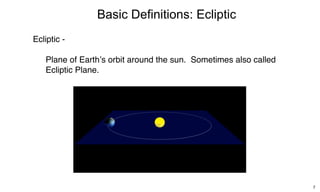
Ecliptic - 
Plane of Earthʼs orbit around the sun. Sometimes also called 
Ecliptic Plane. 
7
Basic Definitions: Inclination 
8 
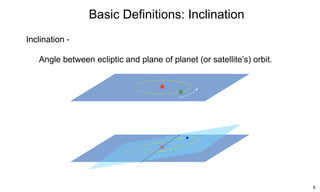
Inclination - 
Angle between ecliptic and plane of planet (or satellite’s) orbit.
9 
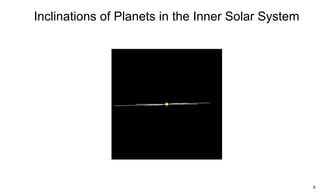
Inclinations of Planets in the Inner Solar System
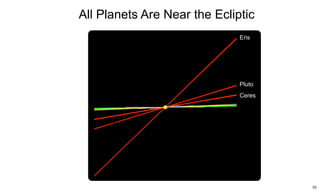
All Planets Are Near the Ecliptic 
10 
Eris 
Pluto 
Ceres
11 
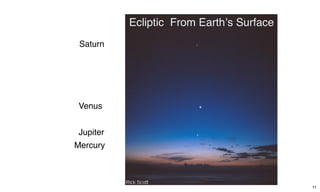
Saturn 
Ecliptic From Earthʼs Surface 
Venus 
Jupiter 
Mercury
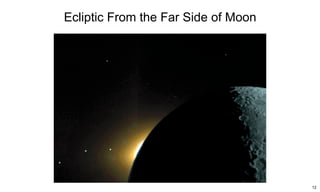
Ecliptic From the Far Side of Moon 
12
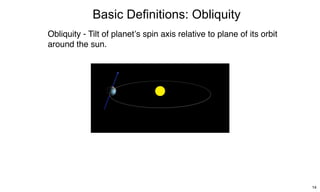
Basic Definitions: Obliquity 
14 
Obliquity - Tilt of planetʼs spin axis relative to plane of its orbit 
around the sun.
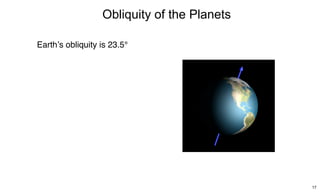
Obliquity of the Planets 
17 
Earthʼs obliquity is 23.5°
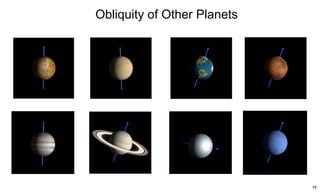
Obliquity of Other Planets 
18 
Mercury - 0.1° Venus - 177° Earth - 23° Mars - 25° 
Jupiter - 3° Saturn - 27° Uranus - 98° Neptune - 30°
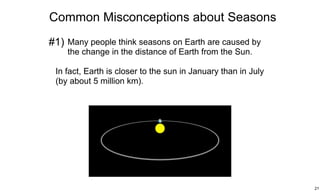
Common Misconceptions about Seasons 
#1) Many people think seasons on Earth are caused by 
the change in the distance of Earth from the Sun. 
In fact, Earth is closer to the sun in January than in July 
(by about 5 million km). 
21
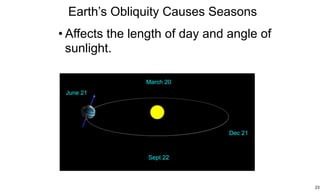
Earth’s Obliquity Causes Seasons 
• Affects the length of day and angle of 
sunlight. 
23 
June 21 
Sept 22 
Dec 21 
March 20
25 
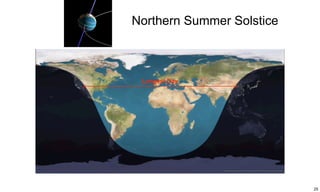
Northern Summer Solstice 
Longest Day
28 
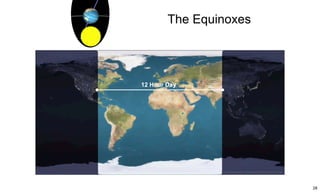
The Equinoxes 
12 Hour Day
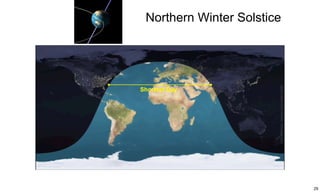
Northern Winter Solstice 
29 
Shortest Day
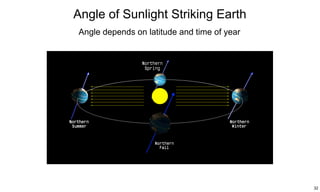
Angle of Sunlight Striking Earth 
Angle depends on latitude and time of year 
32
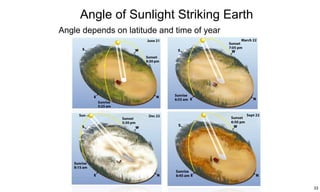
Angle of Sunlight Striking Earth 
Angle depends on latitude and time of year 
33
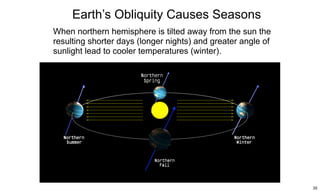
Earth’s Obliquity Causes Seasons 
When northern hemisphere is tilted away from the sun the 
resulting shorter days (longer nights) and greater angle of 
sunlight lead to cooler temperatures (winter). 
35
THE END 
36 
Precession - The natural tendency of all rotating objects to wobble. 
The rotational axis of the Earth, and all planets, constantly wobbles. 
For the Earth, one full precession takes approximately 26,000 years.

PSunit3notes

  • 1.
    Basic Definitions: Ecliptic Ecliptic - Plane of Earthʼs orbit around the sun. Sometimes also called Ecliptic Plane. 7
  • 2.
    Basic Definitions: Inclination 8 Inclination - Angle between ecliptic and plane of planet (or satellite’s) orbit.
  • 3.
    9 Inclinations ofPlanets in the Inner Solar System
  • 4.
    All Planets AreNear the Ecliptic 10 Eris Pluto Ceres
  • 5.
    11 Saturn EclipticFrom Earthʼs Surface Venus Jupiter Mercury
  • 6.
    Ecliptic From theFar Side of Moon 12
  • 7.
    Basic Definitions: Obliquity 14 Obliquity - Tilt of planetʼs spin axis relative to plane of its orbit around the sun.
  • 8.
    Obliquity of thePlanets 17 Earthʼs obliquity is 23.5°
  • 9.
    Obliquity of OtherPlanets 18 Mercury - 0.1° Venus - 177° Earth - 23° Mars - 25° Jupiter - 3° Saturn - 27° Uranus - 98° Neptune - 30°
  • 10.
    Common Misconceptions aboutSeasons #1) Many people think seasons on Earth are caused by the change in the distance of Earth from the Sun. In fact, Earth is closer to the sun in January than in July (by about 5 million km). 21
  • 11.
    Earth’s Obliquity CausesSeasons • Affects the length of day and angle of sunlight. 23 June 21 Sept 22 Dec 21 March 20
  • 12.
    25 Northern SummerSolstice Longest Day
  • 13.
    28 The Equinoxes 12 Hour Day
  • 14.
    Northern Winter Solstice 29 Shortest Day
  • 15.
    Angle of SunlightStriking Earth Angle depends on latitude and time of year 32
  • 16.
    Angle of SunlightStriking Earth Angle depends on latitude and time of year 33
  • 17.
    Earth’s Obliquity CausesSeasons When northern hemisphere is tilted away from the sun the resulting shorter days (longer nights) and greater angle of sunlight lead to cooler temperatures (winter). 35
  • 18.
    THE END 36 Precession - The natural tendency of all rotating objects to wobble. The rotational axis of the Earth, and all planets, constantly wobbles. For the Earth, one full precession takes approximately 26,000 years.