Describing circular motion
This is the motion of an object moving in a circular path with uniform
speed about a fixed point.
Motion of a body is said to be circular if the path taken (trajectory) is a
circle of constant radius r.
Many things move in circles. Some examples of such include;
•the wheels of a car or a bicycle
•the earth in its approximately circular orbit round the sun
•the hands of a clock
•a spinning DVD in a laptop
•a spinning drier
•the drum of a washing machine
•an electron round the nucleus of the atom
•satellites cycling the earth
•a car negotiating a corner. etc
Consider a particle of mass m moving along the circumference of a
circle center O, and radius r, as shown below. If the particle covers the
distance s in a time t, then its curvilinear speed is given by: v =
𝒔
𝒕
As the particle moves a distance s, it goes
through an angle ∆𝜽.This is called the
angular displacement. If ∆𝜃 is small and and
measured in radians, then; s = r ∆𝜃
Angular displacement: is the ratio of the arc
length to the radius of the circular path taken
by the object. i.e. ∆𝜃 =
𝑠
𝑟
(in radians)
One radian: is that angle subtended at the
center of the circle by an arc equal in length
to the radius of the circle. I.e. (s = r)
B A
r r
s
O
∆𝜃
V
V
Suppose in a small time,∆𝑡 the object moves along an arc
length, ∆𝑠 and sweeps out an angle, ∆𝜃.
From definition of the radian,
∆𝜃 =
∆𝑠
𝑟
⇒ ∆𝑠 = 𝑟∆𝜃
Dividing both sides of the above equation
by ∆𝑡,
∆𝑠
∆𝑡
=
𝑟∆𝜃
∆𝑡
By definition for small angles,
∆𝑠
∆𝑡
is the linear
velocity, v of the object and
∆𝜃
∆𝑡
is the angular
velocity, 𝝎(read as omega).
Hence 𝒗 = 𝒓𝝎
If the body sweeps through equal angular displacements in
equal time intervals the body is described to have uniform
circular motion.
Period [T]: is the time taken to make one complete revolution.
When a body makes a complete circle;
it has traveled a distance, s = 2πr and the tangential speed is given
by 𝑣 = 𝑟𝜔
the time taken =
𝑑𝑖𝑠𝑡𝑎𝑛𝑐𝑒
𝑠𝑝𝑒𝑒𝑑
⇒ T =
2πr
𝑟𝜔
𝐓 =
𝟐𝛑
𝝎
. The SI unit of period is seconds (s)
Frequency [f]: is the number of revolutions or cycles made in one
second.
𝒇 =
𝟏
𝑻
=
𝝎
𝟐𝛑
. The SI unit of frequency is the Hertz (Hz)
Example 1
1.A particle moving in a circular path of radius 50cm has a speed of
12m/s. Find the angular velocity of the particle in
(i) radians per second
(ii) revolutions per minute
Solution
v = 12 m/s and r = 50cm = 0.5m
(i) Using 𝑣 = 𝑟𝜔
𝜔 =
𝑣
𝑟
=
12
0.5
= 24 radians per second or 24 rad/s
(ii) 𝟐𝛑 radians = 360o
= 1 revolution
1 radian =
𝟏
𝟐𝛑
revolutions
1 radian per second =
𝟏
𝟐𝛑
revolutions per second
24 radians per second =
𝟏
𝟐𝛑
× 𝟐𝟒 revolutions per second
24 radians per second =
𝟏
𝟐𝛑
× 𝟐𝟒 × 𝟔𝟎 revolutions per minute
= 229.18 revolutions per minutes.
Example 2
1. Determine the linear velocity of the earth whose radius is
6400km and has a period of 24hours
Solution
radius = 6400km = 6400000m, T = 24hours = 86400s
From T =
2π
𝜔
and 𝑣 = 𝑟𝜔 ⇒ 𝜔 =
𝑣
𝑟
T =
2π
𝑣
𝑟
thus 𝑣 =
2πr
𝑇
=
2π×6400000
86400
= 465.42 ms-1
Assignment: Deduce the angular velocity
It’s now your turn
1.A particle moves along a circular path of radius 3m with an
angular velocity of 20 rad s-1
. Calculate the: i) linear speed of
the particle,
ii) angular velocity in revolutions per second
iii) time taken for one revolution.
[Ans. v = 60ms-1
, 𝜔 = 3.2 rev.s-1
, T = 0.31s]
2.A train is travelling on a track, which is part of a circle of radius
600 m, at a constant speed of 50 ms-1
. What is its angular
velocity?
3.A washing machine spins its tub at a rate of 1200 revolutions
per minute. If the diameter of the tub is 35 cm, find
a.the angular velocity of the tub.
b.the linear speed of the rim of the tub.
4.An aircraft in a display team makes a turn in a horizontal circle
of radius 500m. It is travelling at a speed of 100ms-1
.Calculate
the angular speed of the aircraft. [Ans. 0.2rad s-1
]
5.A car is travelling along a circular path with linear speed 15ms-1
and angular speed 0.36 rad s-1
. What is the radius of curvature
of the track?
Centripetal Force and Centripetal acceleration
Even if a body in circular motion moves at constant speed, it
is said to be accelerating.
An object travelling in a circle may have a constant speed, but it
is not travelling in a straight line. The velocity is changing as
velocity is a vector (has magnitude and direction) and its
direction is changing. A change in velocity means the object is
accelerating.
This acceleration is towards the center of the circle. It is called
centripetal acceleration
Consider a ball on a string which is being swung
in a vertical circle. The tension in the string
provides the centripetal force as shown above.
At any instant, the direction of the ball’s velocity
is along the tangent to the circle, as shown above.
If the string breaks or is released, there is no
longer any tension in the string and hence no
centripetal force. The ball will travel in the
direction of the tangent to the circle at the
moment of release.
Deriving expression of centripetal acceleration
Suppose a particle of mass, m has travelled at a constant speed, v in a circular path from A
to B in time, .
At A the velocity is vA, and at B the velocity is vB. Both vA and vB are vectors.
The change in velocity may be seen in the vector diagram above. A vector must be
added to vA in order to give the new velocity vB. Note that triangle OAB and CDE are
similar
Consider angle so small that the arc AB may be approximated to a straight line
Then using similar triangles, and
A
B
𝝎
∆𝜽
r
r
∆𝜽
O
CvA
vB
E
D
C
∆𝜽
∆𝒗
vB
− vA
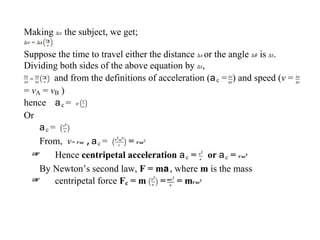
Making the subject, we get;
Suppose the time to travel either the distance or the angle is .
Dividing both sides of the above equation by ,
and from the definitions of acceleration (ac = ) and speed (v =
= vA = vB )
hence ac =
Or
ac =
From, v , ac = =
Hence centripetal acceleration ac = or ac =
By Newton’s second law, F = ma, where m is the mass
centripetal force Fc = m = = m
Definitions
Centripetal acceleration: is the rate of
change of velocity for a body moving in a
circular path and its directed towards the
center of that circular path.
Centripetal force: is the force which
keeps a body moving in a circular path to
continue moving along its circular path
and is directed towards the centre of the
circular path.
Application of circular motion
Application 1: Motion in a vertical:
Consider a body of mass m, attached to a string of length r
and whirled in a vertical circle at a constant speed v.
Also consider the three positions of the body as it moves in
the circle.
The tension in the string varies as the body moves. It should
however be noted that whatever the case, the resultant force
towards the centre of the circular path is the centripetal force,
Fc = = m
It can therefore be noted that tension in the string is maximum when the
body is at the bottom of the circle and minimum at the top of the circle
So the string is most likely to break when the body is at the bottom of the
circle.
mg
O
O
O
mg
mg
T2 T3T1
A
B
C
Motion Horizontal Circle
Now let’s consider a body revolving horizontally. We can estimate
the force a person must exert on a string attached to a ball to make the
ball revolve in a horizontal circle of radius r.
The forces acting on the object are the force of gravity, downwards
and the tension in the string (acting towards the center) which keeps
the body in the circular motion.
Note that the object’s weight makes it difficult to make it revolve
with the string perfectly horizontal. We normally assume that the
weight is small and thus the angle θ negligible. Thus the tension will
act nearly horizontally and hence provide the necessary force that
gives the object its centripetal acceleration.
By Newton’s second law F = ma then Fc = T =
θ
mg
r
T
Examples
1. A mass of 0.4kg is rotated by a string at a speed, v in a vertical
circle of radius 1m. If the minimum tension in the string is 3N,
(i) calculate; the velocity
(ii) the maximum tension
(iii)the tension when the string is just horizontal
Solution
O
mg
mg
mg
T2
T1
T3
A
B
C
(i) Tension of the string is minimum at the top
of the circle
Thus, T1 =
𝒎𝒗 𝟐
𝒓
− mg
3 =
0.4𝑣2
1
− 0.4 x 9.81
v = 4.16ms-1
(ii) The maximum tension occurs at the bottom
of the string
T2 =
𝑚𝑣 2
𝑟
+ mg =
0.4 (4.16)2
1
+ 0.4 x 9.81 =
10.85N
(iii) T3 =
𝑚𝑣 2
𝑟
=
0.4(4.16)2
1
= 6.92N
4.A particle of mass 2kg is suspended from a
fixed point O by a light inextensible string of
length 20cm. The particle is projected from
the lowest point A with a horizontal speed of
5ms-1
and describes a vertical circle. When
the particle is at point B, then the tension in
the string is T N, where OB makes an angle
of 45o
with the downward vertical, determine
the speed of the particle and the tension in the
string at B.
Solution
2g
45o
45o
2g
2g cos 45
A
B
T
O
u
P.e = 0
rcos45
h
r
At A: k.e = = 25J , P.e = 0
M.e = k.e + P.e = 25J
At B: let the speed of the particle at B be v ms-1
k.e = = J
p.e = mgh but h = r rcos45
p.e = 2g(r rcos45) =2g(0.2 0.2cos45) = 1.15J
M.e = 1.15 +
From the principle of conservation of mechanical energy,
M.e at A should be equal to M.e at B
25 = 1.15 +
v = 4.88ms-1
Also from the figure: Net resultant force at B towards
the centre = T – mgcosθ
T – mgcosθ
T + mgcosθ = =
252.02N
2. A particle of mass 5kg describes a
complete vertical circle at the end of a
light inextensible string of length 2m.
Given that the speed of the particle is 5m
s-1
at the highest point. Find;
(i) speed at the lowest point
(ii) tension in the string when it is
horizontal
(iii) the magnitude of the centripetal
acceleration when the string is
horizontal.
SOLUTION:
O
mg
mg
mg
T3
T1
T2
A
B
C
r = 2m,
m=5kg,
vA = 5ms-1
M.e at A = h = = 258.7J
M.e at C = h = = 2.5 J
By the principle of conservation of M.e
M.e at A = M.e at C
2.5 = 258.7 thus vc =10.17m s-1
M.e at B = h = = 98.1+2.5
98.1+2.5 = 258.7 thus vB = 8.015 m s-1
At B T2 = = 160.6N
From = 32.12 m s-1
3. A particle of mass m describes a complete
vertical circle to the end of a light
inextensible string of length r. Given that
the speed of the particle at the lowest point
is twice the speed at the highest point. Show
that:
(i) the speed of the particle at the lowest point
is v = 4
𝑔𝑟
3
(ii) the tension in the string when the particle is
at the highest point is T =
𝑚𝑔
3
Solution
O
mg
mg
mg
T3
T1
T2
A
B
C
M.e at A =
M.e at C = h = = 2m
By the principle of conservation of M.e
M.e at A = M.e at C
= 2m
3
vA = 2 but vc = 2vA
At the highest point A,
T1 + mg = T1 = mg = mg =
mg
T1 =
It’s Now Your Turn
1. A bucket of water is swung in a vertical circle of
radius 64.0m in such a way that the bucket is upside
down when it is at the top of the circle. What is the
minimum speed that the bucket may have at this point
if the water is to remain in it? [Ans.
25.06ms-1
]
2. An aero plane loops the loop in a vertical circle of
radius 200m, with a speed of 40ms-1
at the top of the
loop. The pilot has a mass of 80kg. What is the tension
in the strap holding him into his seat when he is at the
top of the loop? [Ans. 60N]
1. A stone of mass 500g is attached to a string of length 50cm,
which will break if the tension in it exceeds 20N. The string is
whirled in a vertical circle, the axis of rotation being at a height
of 100cm above the ground. The angular speed is gradually
increased until the string breaks.
(i) In what position is this break most likely to take place, and
at what angular velocity?
(ii) Where will the stone hit the ground?
Application 3: Conical pendulum
Consider a particle of mass, m attached to a string of length l
moving round a horizontal circle of radius r, at a constant speed
v. The string describes the curved surface of a cone and turns at
a constant angle, θ to the vertical. This arrangement is what we
call a conical pendulum.
There are only two forces acting on the particle, the tension in
the string, and the weight of the particle
T
l
mg
θ
r
h
(90- θ)
The horizontal component of the tension T towards the center of the circular path gives
the centripetal acceleration.
Resolving horizontally; Tcos (90 –θ) =
Tsin θ = ……….. (i)
The vertical component of the tension should be equal to the weight for equilibrium.
Tsin (90 –θ) =
Tcos θ = ……. (ii). Then dividing eqn (i) by eqn (ii) gives:
tan θ
θ
Also from the diagram, the triangle below can be drawn,
Substituting for in the equation Tcos θ = gives:
T = . Therefore T = ……………………(iv)
Equating equations (iii) and (iv) gives:
Therefore
The period, T = = =
Therefore frequency f = = =
h
r
l
θ
(90- θ)
From the triangle, r = l sin θ and h = l cosθ
𝑠𝑖𝑛𝜃 =
𝑟
𝑙
and 𝑐𝑜𝑠𝜃 =
ℎ
𝑙
let’s substitute for 𝑠𝑖𝑛𝜃 in the equation Tsin θ =
𝑚 𝑣2
𝑟
gives;
T ×
𝑟
𝑙
=
𝑚 𝑣2
𝑟
but 𝑣 = 𝑟𝜔
T ×
𝑟
𝑙
=
𝑚 𝑟2 𝜔2
𝑟
= 𝑚𝑙𝜔2
.Therefore T = 𝒎𝒍𝝎 𝟐
………… (iii)
Exercise
For the above arrangement of the conical pendulum, show that:
(i) v =
𝑟2 𝑔
ℎ
1
2
(ii) T =
𝒎𝒈
𝒉
(𝒓 𝟐 + 𝒉 𝟐)
𝟏
𝟐
Examples
1. A mass of 0.2kg is whirled in a horizontal circle of radius
0.5m by a string inclined at 30o
to the vertical.
Find
(i) the tension in the string
(ii) the speed of the mass on the horizontal surface
(iii) the length of the string
(iv) the angular speed
(iii)From =
l = = 1m
(iv)From
= = 3.265 rad s-1
T
0.5m
30o
0.2g
𝑚𝑣2
𝑟
60o
(i) Resolving vertically:
Tcos θ = 𝑚𝑔
𝑇 =
𝑚𝑔
cos 𝜃
=
0.2 ×9.81
cos 30
=2.2655N
(ii) Resolving horizontally:
Tsin θ =
𝑚 𝑣2
𝑟
𝑣2
=
𝑟Tsin θ
𝑚
𝑣=
𝑟Tsin θ
𝑚
=
0.5 ×2.2655sin 30
0.2
= 1.6828 ms-1
1.A steel ball of mass 0.5kg is suspended from
light inelastic string of length 1m, the ball is
whirled in a horizontal circle of radius 0.5m.
find;
(i) the centripetal force and the tension in the
string
(ii) the angular speed of the ball
(iii)the angle between the string and the radius of
the circle if the tension in the string is 10N

Circular motion

  • 1.
    Describing circular motion Thisis the motion of an object moving in a circular path with uniform speed about a fixed point. Motion of a body is said to be circular if the path taken (trajectory) is a circle of constant radius r. Many things move in circles. Some examples of such include; •the wheels of a car or a bicycle •the earth in its approximately circular orbit round the sun •the hands of a clock •a spinning DVD in a laptop •a spinning drier •the drum of a washing machine •an electron round the nucleus of the atom •satellites cycling the earth •a car negotiating a corner. etc
  • 2.
    Consider a particleof mass m moving along the circumference of a circle center O, and radius r, as shown below. If the particle covers the distance s in a time t, then its curvilinear speed is given by: v = 𝒔 𝒕 As the particle moves a distance s, it goes through an angle ∆𝜽.This is called the angular displacement. If ∆𝜃 is small and and measured in radians, then; s = r ∆𝜃 Angular displacement: is the ratio of the arc length to the radius of the circular path taken by the object. i.e. ∆𝜃 = 𝑠 𝑟 (in radians) One radian: is that angle subtended at the center of the circle by an arc equal in length to the radius of the circle. I.e. (s = r) B A r r s O ∆𝜃 V V
  • 3.
    Suppose in asmall time,∆𝑡 the object moves along an arc length, ∆𝑠 and sweeps out an angle, ∆𝜃. From definition of the radian, ∆𝜃 = ∆𝑠 𝑟 ⇒ ∆𝑠 = 𝑟∆𝜃 Dividing both sides of the above equation by ∆𝑡, ∆𝑠 ∆𝑡 = 𝑟∆𝜃 ∆𝑡 By definition for small angles, ∆𝑠 ∆𝑡 is the linear velocity, v of the object and ∆𝜃 ∆𝑡 is the angular velocity, 𝝎(read as omega). Hence 𝒗 = 𝒓𝝎
  • 4.
    If the bodysweeps through equal angular displacements in equal time intervals the body is described to have uniform circular motion. Period [T]: is the time taken to make one complete revolution. When a body makes a complete circle; it has traveled a distance, s = 2πr and the tangential speed is given by 𝑣 = 𝑟𝜔 the time taken = 𝑑𝑖𝑠𝑡𝑎𝑛𝑐𝑒 𝑠𝑝𝑒𝑒𝑑 ⇒ T = 2πr 𝑟𝜔 𝐓 = 𝟐𝛑 𝝎 . The SI unit of period is seconds (s) Frequency [f]: is the number of revolutions or cycles made in one second. 𝒇 = 𝟏 𝑻 = 𝝎 𝟐𝛑 . The SI unit of frequency is the Hertz (Hz)
  • 5.
    Example 1 1.A particlemoving in a circular path of radius 50cm has a speed of 12m/s. Find the angular velocity of the particle in (i) radians per second (ii) revolutions per minute Solution v = 12 m/s and r = 50cm = 0.5m (i) Using 𝑣 = 𝑟𝜔 𝜔 = 𝑣 𝑟 = 12 0.5 = 24 radians per second or 24 rad/s (ii) 𝟐𝛑 radians = 360o = 1 revolution 1 radian = 𝟏 𝟐𝛑 revolutions 1 radian per second = 𝟏 𝟐𝛑 revolutions per second 24 radians per second = 𝟏 𝟐𝛑 × 𝟐𝟒 revolutions per second 24 radians per second = 𝟏 𝟐𝛑 × 𝟐𝟒 × 𝟔𝟎 revolutions per minute = 229.18 revolutions per minutes.
  • 6.
    Example 2 1. Determinethe linear velocity of the earth whose radius is 6400km and has a period of 24hours Solution radius = 6400km = 6400000m, T = 24hours = 86400s From T = 2π 𝜔 and 𝑣 = 𝑟𝜔 ⇒ 𝜔 = 𝑣 𝑟 T = 2π 𝑣 𝑟 thus 𝑣 = 2πr 𝑇 = 2π×6400000 86400 = 465.42 ms-1
  • 7.
    Assignment: Deduce theangular velocity It’s now your turn 1.A particle moves along a circular path of radius 3m with an angular velocity of 20 rad s-1 . Calculate the: i) linear speed of the particle, ii) angular velocity in revolutions per second iii) time taken for one revolution. [Ans. v = 60ms-1 , 𝜔 = 3.2 rev.s-1 , T = 0.31s] 2.A train is travelling on a track, which is part of a circle of radius 600 m, at a constant speed of 50 ms-1 . What is its angular velocity?
  • 8.
    3.A washing machinespins its tub at a rate of 1200 revolutions per minute. If the diameter of the tub is 35 cm, find a.the angular velocity of the tub. b.the linear speed of the rim of the tub. 4.An aircraft in a display team makes a turn in a horizontal circle of radius 500m. It is travelling at a speed of 100ms-1 .Calculate the angular speed of the aircraft. [Ans. 0.2rad s-1 ] 5.A car is travelling along a circular path with linear speed 15ms-1 and angular speed 0.36 rad s-1 . What is the radius of curvature of the track?
  • 9.
    Centripetal Force andCentripetal acceleration Even if a body in circular motion moves at constant speed, it is said to be accelerating. An object travelling in a circle may have a constant speed, but it is not travelling in a straight line. The velocity is changing as velocity is a vector (has magnitude and direction) and its direction is changing. A change in velocity means the object is accelerating. This acceleration is towards the center of the circle. It is called centripetal acceleration
  • 11.
    Consider a ballon a string which is being swung in a vertical circle. The tension in the string provides the centripetal force as shown above. At any instant, the direction of the ball’s velocity is along the tangent to the circle, as shown above. If the string breaks or is released, there is no longer any tension in the string and hence no centripetal force. The ball will travel in the direction of the tangent to the circle at the moment of release.
  • 12.
    Deriving expression ofcentripetal acceleration Suppose a particle of mass, m has travelled at a constant speed, v in a circular path from A to B in time, . At A the velocity is vA, and at B the velocity is vB. Both vA and vB are vectors. The change in velocity may be seen in the vector diagram above. A vector must be added to vA in order to give the new velocity vB. Note that triangle OAB and CDE are similar Consider angle so small that the arc AB may be approximated to a straight line Then using similar triangles, and A B 𝝎 ∆𝜽 r r ∆𝜽 O CvA vB E D C ∆𝜽 ∆𝒗 vB − vA
  • 13.
    Making the subject,we get; Suppose the time to travel either the distance or the angle is . Dividing both sides of the above equation by , and from the definitions of acceleration (ac = ) and speed (v = = vA = vB ) hence ac = Or ac = From, v , ac = = Hence centripetal acceleration ac = or ac = By Newton’s second law, F = ma, where m is the mass centripetal force Fc = m = = m
  • 14.
    Definitions Centripetal acceleration: isthe rate of change of velocity for a body moving in a circular path and its directed towards the center of that circular path. Centripetal force: is the force which keeps a body moving in a circular path to continue moving along its circular path and is directed towards the centre of the circular path.
  • 15.
    Application of circularmotion Application 1: Motion in a vertical: Consider a body of mass m, attached to a string of length r and whirled in a vertical circle at a constant speed v. Also consider the three positions of the body as it moves in the circle. The tension in the string varies as the body moves. It should however be noted that whatever the case, the resultant force towards the centre of the circular path is the centripetal force, Fc = = m It can therefore be noted that tension in the string is maximum when the body is at the bottom of the circle and minimum at the top of the circle So the string is most likely to break when the body is at the bottom of the circle. mg O O O mg mg T2 T3T1 A B C
  • 17.
    Motion Horizontal Circle Nowlet’s consider a body revolving horizontally. We can estimate the force a person must exert on a string attached to a ball to make the ball revolve in a horizontal circle of radius r. The forces acting on the object are the force of gravity, downwards and the tension in the string (acting towards the center) which keeps the body in the circular motion. Note that the object’s weight makes it difficult to make it revolve with the string perfectly horizontal. We normally assume that the weight is small and thus the angle θ negligible. Thus the tension will act nearly horizontally and hence provide the necessary force that gives the object its centripetal acceleration. By Newton’s second law F = ma then Fc = T = θ mg r T
  • 18.
    Examples 1. A massof 0.4kg is rotated by a string at a speed, v in a vertical circle of radius 1m. If the minimum tension in the string is 3N, (i) calculate; the velocity (ii) the maximum tension (iii)the tension when the string is just horizontal Solution O mg mg mg T2 T1 T3 A B C (i) Tension of the string is minimum at the top of the circle Thus, T1 = 𝒎𝒗 𝟐 𝒓 − mg 3 = 0.4𝑣2 1 − 0.4 x 9.81 v = 4.16ms-1 (ii) The maximum tension occurs at the bottom of the string T2 = 𝑚𝑣 2 𝑟 + mg = 0.4 (4.16)2 1 + 0.4 x 9.81 = 10.85N (iii) T3 = 𝑚𝑣 2 𝑟 = 0.4(4.16)2 1 = 6.92N
  • 19.
    4.A particle ofmass 2kg is suspended from a fixed point O by a light inextensible string of length 20cm. The particle is projected from the lowest point A with a horizontal speed of 5ms-1 and describes a vertical circle. When the particle is at point B, then the tension in the string is T N, where OB makes an angle of 45o with the downward vertical, determine the speed of the particle and the tension in the string at B. Solution 2g 45o 45o 2g 2g cos 45 A B T O u P.e = 0 rcos45 h r At A: k.e = = 25J , P.e = 0 M.e = k.e + P.e = 25J At B: let the speed of the particle at B be v ms-1 k.e = = J p.e = mgh but h = r rcos45 p.e = 2g(r rcos45) =2g(0.2 0.2cos45) = 1.15J M.e = 1.15 + From the principle of conservation of mechanical energy, M.e at A should be equal to M.e at B 25 = 1.15 + v = 4.88ms-1 Also from the figure: Net resultant force at B towards the centre = T – mgcosθ T – mgcosθ T + mgcosθ = = 252.02N
  • 20.
    2. A particleof mass 5kg describes a complete vertical circle at the end of a light inextensible string of length 2m. Given that the speed of the particle is 5m s-1 at the highest point. Find; (i) speed at the lowest point (ii) tension in the string when it is horizontal (iii) the magnitude of the centripetal acceleration when the string is horizontal. SOLUTION: O mg mg mg T3 T1 T2 A B C r = 2m, m=5kg, vA = 5ms-1 M.e at A = h = = 258.7J M.e at C = h = = 2.5 J By the principle of conservation of M.e M.e at A = M.e at C 2.5 = 258.7 thus vc =10.17m s-1 M.e at B = h = = 98.1+2.5 98.1+2.5 = 258.7 thus vB = 8.015 m s-1 At B T2 = = 160.6N From = 32.12 m s-1
  • 21.
    3. A particleof mass m describes a complete vertical circle to the end of a light inextensible string of length r. Given that the speed of the particle at the lowest point is twice the speed at the highest point. Show that: (i) the speed of the particle at the lowest point is v = 4 𝑔𝑟 3 (ii) the tension in the string when the particle is at the highest point is T = 𝑚𝑔 3 Solution O mg mg mg T3 T1 T2 A B C M.e at A = M.e at C = h = = 2m By the principle of conservation of M.e M.e at A = M.e at C = 2m 3 vA = 2 but vc = 2vA At the highest point A, T1 + mg = T1 = mg = mg = mg T1 =
  • 22.
    It’s Now YourTurn 1. A bucket of water is swung in a vertical circle of radius 64.0m in such a way that the bucket is upside down when it is at the top of the circle. What is the minimum speed that the bucket may have at this point if the water is to remain in it? [Ans. 25.06ms-1 ] 2. An aero plane loops the loop in a vertical circle of radius 200m, with a speed of 40ms-1 at the top of the loop. The pilot has a mass of 80kg. What is the tension in the strap holding him into his seat when he is at the top of the loop? [Ans. 60N]
  • 23.
    1. A stoneof mass 500g is attached to a string of length 50cm, which will break if the tension in it exceeds 20N. The string is whirled in a vertical circle, the axis of rotation being at a height of 100cm above the ground. The angular speed is gradually increased until the string breaks. (i) In what position is this break most likely to take place, and at what angular velocity? (ii) Where will the stone hit the ground?
  • 24.
    Application 3: Conicalpendulum Consider a particle of mass, m attached to a string of length l moving round a horizontal circle of radius r, at a constant speed v. The string describes the curved surface of a cone and turns at a constant angle, θ to the vertical. This arrangement is what we call a conical pendulum. There are only two forces acting on the particle, the tension in the string, and the weight of the particle
  • 25.
    T l mg θ r h (90- θ) The horizontalcomponent of the tension T towards the center of the circular path gives the centripetal acceleration. Resolving horizontally; Tcos (90 –θ) = Tsin θ = ……….. (i) The vertical component of the tension should be equal to the weight for equilibrium. Tsin (90 –θ) = Tcos θ = ……. (ii). Then dividing eqn (i) by eqn (ii) gives: tan θ θ
  • 26.
    Also from thediagram, the triangle below can be drawn, Substituting for in the equation Tcos θ = gives: T = . Therefore T = ……………………(iv) Equating equations (iii) and (iv) gives: Therefore The period, T = = = Therefore frequency f = = = h r l θ (90- θ) From the triangle, r = l sin θ and h = l cosθ 𝑠𝑖𝑛𝜃 = 𝑟 𝑙 and 𝑐𝑜𝑠𝜃 = ℎ 𝑙 let’s substitute for 𝑠𝑖𝑛𝜃 in the equation Tsin θ = 𝑚 𝑣2 𝑟 gives; T × 𝑟 𝑙 = 𝑚 𝑣2 𝑟 but 𝑣 = 𝑟𝜔 T × 𝑟 𝑙 = 𝑚 𝑟2 𝜔2 𝑟 = 𝑚𝑙𝜔2 .Therefore T = 𝒎𝒍𝝎 𝟐 ………… (iii)
  • 27.
    Exercise For the abovearrangement of the conical pendulum, show that: (i) v = 𝑟2 𝑔 ℎ 1 2 (ii) T = 𝒎𝒈 𝒉 (𝒓 𝟐 + 𝒉 𝟐) 𝟏 𝟐 Examples 1. A mass of 0.2kg is whirled in a horizontal circle of radius 0.5m by a string inclined at 30o to the vertical. Find (i) the tension in the string (ii) the speed of the mass on the horizontal surface (iii) the length of the string (iv) the angular speed
  • 28.
    (iii)From = l == 1m (iv)From = = 3.265 rad s-1 T 0.5m 30o 0.2g 𝑚𝑣2 𝑟 60o (i) Resolving vertically: Tcos θ = 𝑚𝑔 𝑇 = 𝑚𝑔 cos 𝜃 = 0.2 ×9.81 cos 30 =2.2655N (ii) Resolving horizontally: Tsin θ = 𝑚 𝑣2 𝑟 𝑣2 = 𝑟Tsin θ 𝑚 𝑣= 𝑟Tsin θ 𝑚 = 0.5 ×2.2655sin 30 0.2 = 1.6828 ms-1
  • 29.
    1.A steel ballof mass 0.5kg is suspended from light inelastic string of length 1m, the ball is whirled in a horizontal circle of radius 0.5m. find; (i) the centripetal force and the tension in the string (ii) the angular speed of the ball (iii)the angle between the string and the radius of the circle if the tension in the string is 10N