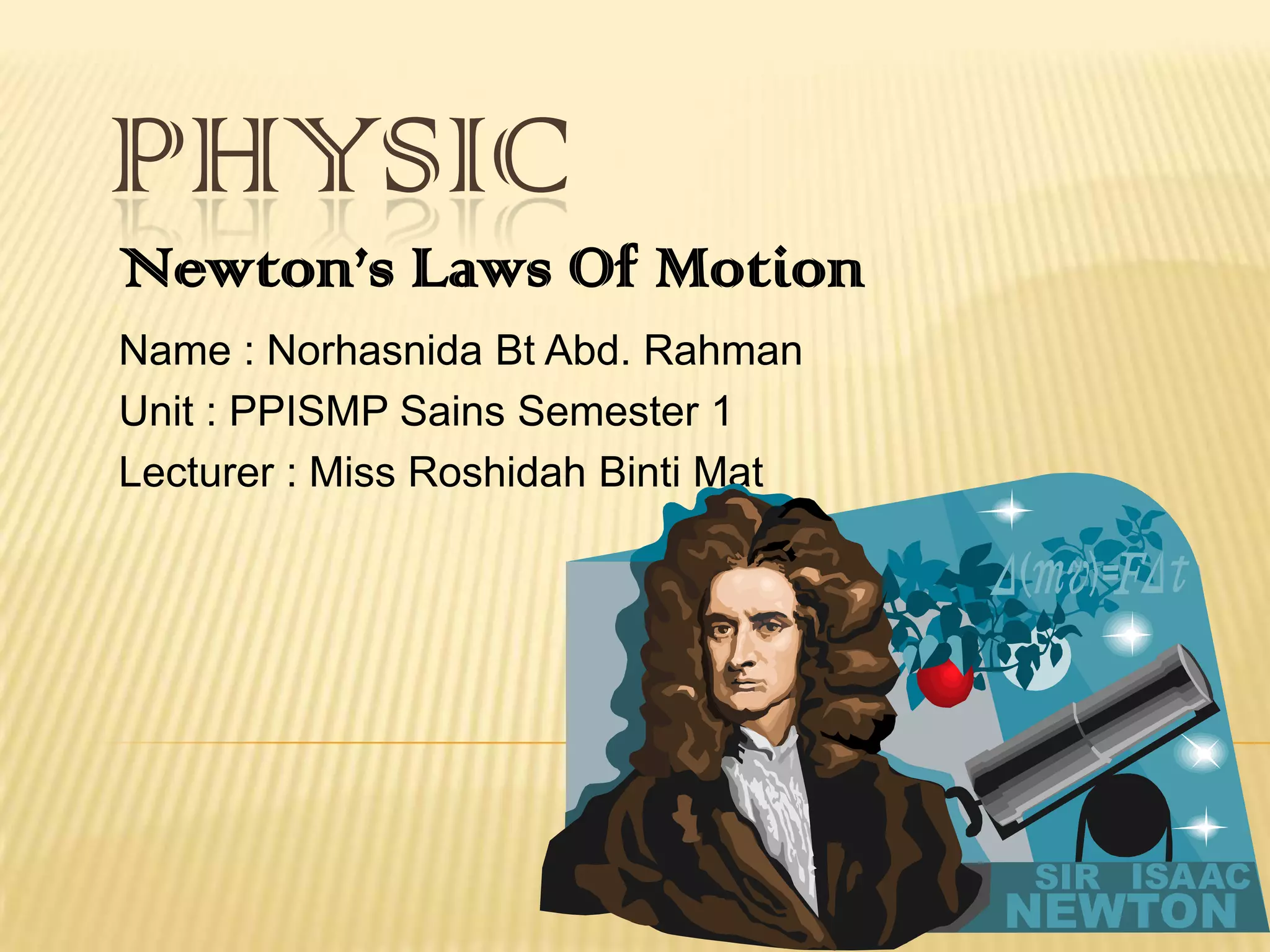
PHYSICNewton’s Laws Of MotionName : Norhasnida Bt Abd. RahmanUnit : PPISMP Sains Semester 1Lecturer : Miss RoshidahBinti Mat
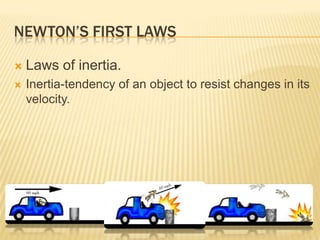
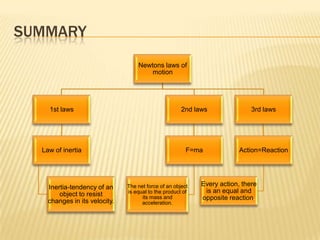
NEWTON’S FIRST LAWSLaws of inertia.Inertia-tendency of an object to resist changes in its velocity.
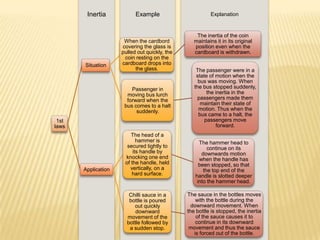
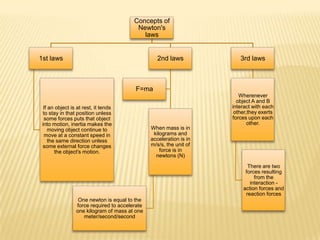
CONCEPTS OF INERTIAIf an object is at rest, it tends to stay in that position unless some forces puts that object into motion, inertia makes the moving object continue to move at a constant speed in the same direction unless some external force changes the object's motion.
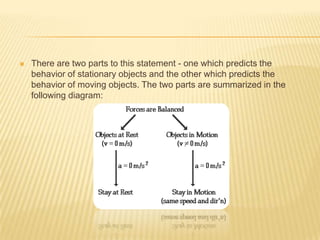
There are two parts to this statement - one which predicts the behavior of stationary objects and the other which predicts the behavior of moving objects. The two parts are summarized in the following diagram:
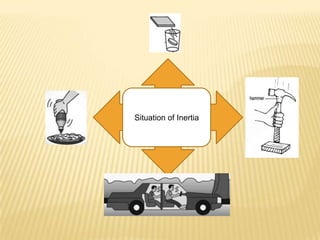
Situation of Inertia
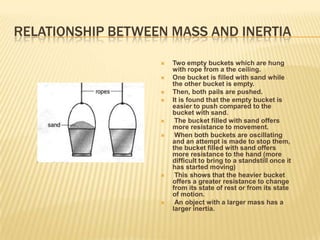
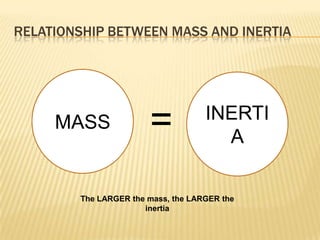
RELATIONSHIP BETWEEN MASS AND INERTIATwo empty buckets which are hung with rope from a the ceiling. One bucket is filled with sand while the other bucket is empty. Then, both pails are pushed. It is found that the empty bucket is easier to push compared to the bucket with sand. The bucket filled with sand offers more resistance to movement. When both buckets are oscillating and an attempt is made to stop them, the bucket filled with sand offers more resistance to the hand (more difficult to bring to a standstill once it has started moving) This shows that the heavier bucket offers a greater resistance to change from its state of rest or from its state of motion. An object with a larger mass has a larger inertia.
RELATIONSHIP BETWEEN MASS AND INERTIAMASSINERTIA=The LARGER the mass, the LARGER the inertia
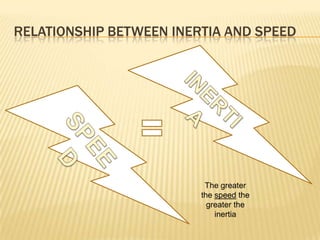
RELATIONSHIP BETWEEN INERTIA AND SPEEDNERTIAINERTIASPEEDThe greater the speed the greater the inertia
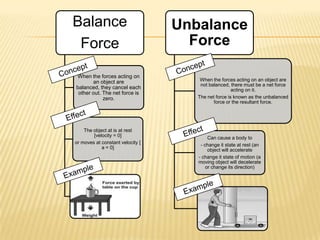
ConceptConceptEffectEffectExampleExample
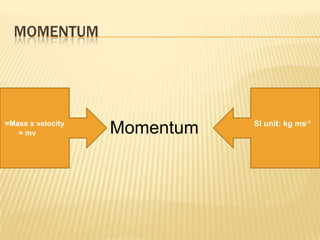
momentum=Mass x velocity = mvSI unit: kg ms-1 Momentum
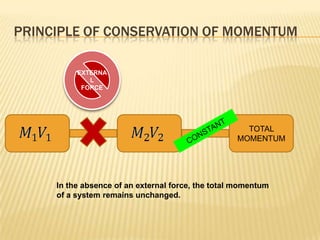
Principle of conservation of momentumEXTERNALFORCETOTAL MOMENTUMCONSTANTIn the absence of an external force, the total momentum of a system remains unchanged.
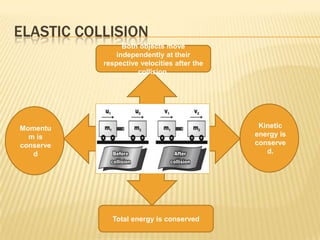
ELASTIC COLLISIONBoth objects move independently at their respective velocities after the collision. Kinetic energy is conserved. Momentum is conserved Total energy is conserved
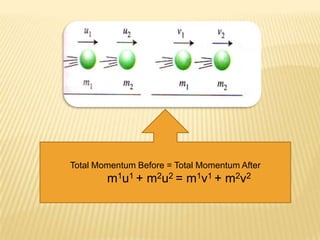
Total Momentum Before = Total Momentum After            m1u1 + m2u2 = m1v1 + m2v2
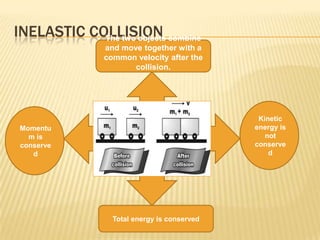
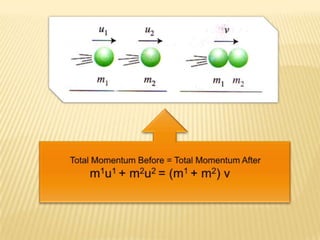
INELASTIC COLLISIONThe two objects combine and move together with a common velocity after the collision. Kinetic energy is not conserved Momentum is conserved Total energy is conserved
Total Momentum Before = Total Momentum After m1u1 + m2u2 = (m1 + m2) v
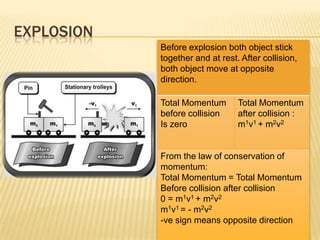
explosion
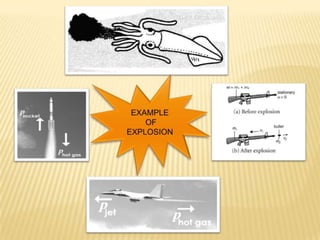
EXAMPLE OF EXPLOSION
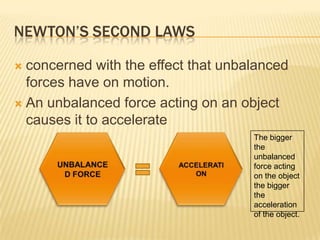
Newton’s Second Lawsconcerned with the effect that unbalanced forces have on motion. An unbalanced force acting on an object causes it to accelerateThe bigger the unbalanced force acting on the object the bigger the acceleration of the object.UNBALANCED FORCEACCELERATION
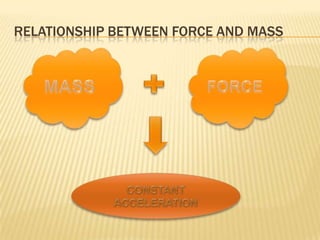
RELATIONSHIP BETWEEN FORCE AND MASSMASSFORCECONSTANT ACCELERATION
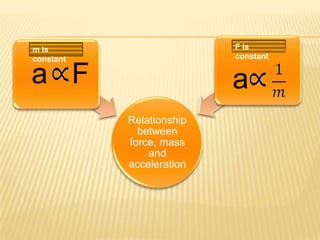
F is constantm is constanta
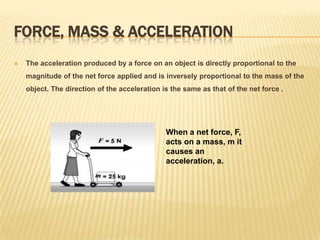
Force, Mass & Acceleration The acceleration produced by a force on an object is directly proportional to the magnitude of the net force applied and is inversely proportional to the mass of the object. The direction of the acceleration is the same as that of the net force .When a net force, F, acts on a mass, m it causes an acceleration, a.
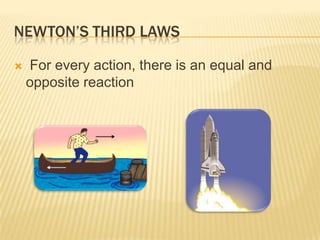
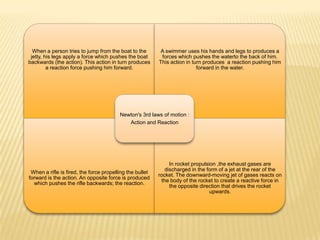
Newton’s third laws For every action, there is an equal and opposite reaction
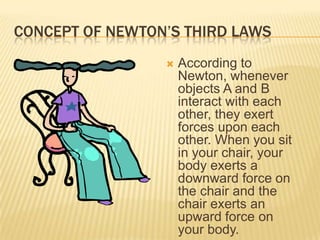
CONCEPT OF NEWTON’S THIRD LAWSAccording to Newton, whenever objects A and B interact with each other, they exert forces upon each other. When you sit in your chair, your body exerts a downward force on the chair and the chair exerts an upward force on your body.
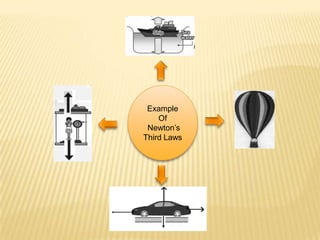
Example Of Newton’s Third Laws
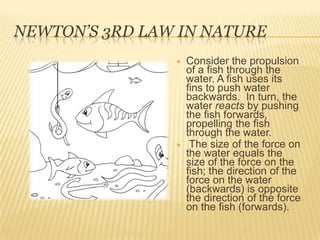
Newton’s 3rd Law in NatureConsider the propulsion of a fish through the water. A fish uses its fins to push water backwards.  In turn, the water reacts by pushing the fish forwards, propelling the fish through the water.
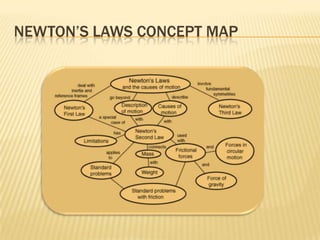
 The size of the force on the water equals the size of the force on the fish; the direction of the force on the water (backwards) is opposite the direction of the force on the fish (forwards).NEWTON’S LAWS CONCEPT MAP
SUMMARY
Physic
Physic

Physic

  • 1.
    PHYSICNewton’s Laws OfMotionName : Norhasnida Bt Abd. RahmanUnit : PPISMP Sains Semester 1Lecturer : Miss RoshidahBinti Mat
  • 2.
    NEWTON’S FIRST LAWSLawsof inertia.Inertia-tendency of an object to resist changes in its velocity.
  • 3.
    CONCEPTS OF INERTIAIfan object is at rest, it tends to stay in that position unless some forces puts that object into motion, inertia makes the moving object continue to move at a constant speed in the same direction unless some external force changes the object's motion.
  • 4.
    There are twoparts to this statement - one which predicts the behavior of stationary objects and the other which predicts the behavior of moving objects. The two parts are summarized in the following diagram:
  • 6.
  • 7.
    RELATIONSHIP BETWEEN MASSAND INERTIATwo empty buckets which are hung with rope from a the ceiling. One bucket is filled with sand while the other bucket is empty. Then, both pails are pushed. It is found that the empty bucket is easier to push compared to the bucket with sand. The bucket filled with sand offers more resistance to movement. When both buckets are oscillating and an attempt is made to stop them, the bucket filled with sand offers more resistance to the hand (more difficult to bring to a standstill once it has started moving) This shows that the heavier bucket offers a greater resistance to change from its state of rest or from its state of motion. An object with a larger mass has a larger inertia.
  • 8.
    RELATIONSHIP BETWEEN MASSAND INERTIAMASSINERTIA=The LARGER the mass, the LARGER the inertia
  • 9.
    RELATIONSHIP BETWEEN INERTIAAND SPEEDNERTIAINERTIASPEEDThe greater the speed the greater the inertia
  • 10.
  • 11.
    momentum=Mass x velocity= mvSI unit: kg ms-1 Momentum
  • 12.
    Principle of conservationof momentumEXTERNALFORCETOTAL MOMENTUMCONSTANTIn the absence of an external force, the total momentum of a system remains unchanged.
  • 13.
    ELASTIC COLLISIONBoth objectsmove independently at their respective velocities after the collision. Kinetic energy is conserved. Momentum is conserved Total energy is conserved
  • 14.
    Total Momentum Before= Total Momentum After m1u1 + m2u2 = m1v1 + m2v2
  • 15.
    INELASTIC COLLISIONThe twoobjects combine and move together with a common velocity after the collision. Kinetic energy is not conserved Momentum is conserved Total energy is conserved
  • 16.
    Total Momentum Before= Total Momentum After m1u1 + m2u2 = (m1 + m2) v
  • 17.
  • 18.
  • 19.
    Newton’s Second Lawsconcernedwith the effect that unbalanced forces have on motion. An unbalanced force acting on an object causes it to accelerateThe bigger the unbalanced force acting on the object the bigger the acceleration of the object.UNBALANCED FORCEACCELERATION
  • 20.
    RELATIONSHIP BETWEEN FORCEAND MASSMASSFORCECONSTANT ACCELERATION
  • 21.
    F is constantmis constanta
  • 22.
    Force, Mass &Acceleration The acceleration produced by a force on an object is directly proportional to the magnitude of the net force applied and is inversely proportional to the mass of the object. The direction of the acceleration is the same as that of the net force .When a net force, F, acts on a mass, m it causes an acceleration, a.
  • 24.
    Newton’s third lawsFor every action, there is an equal and opposite reaction
  • 25.
    CONCEPT OF NEWTON’STHIRD LAWSAccording to Newton, whenever objects A and B interact with each other, they exert forces upon each other. When you sit in your chair, your body exerts a downward force on the chair and the chair exerts an upward force on your body.
  • 26.
  • 28.
    Newton’s 3rd Lawin NatureConsider the propulsion of a fish through the water. A fish uses its fins to push water backwards. In turn, the water reacts by pushing the fish forwards, propelling the fish through the water.
  • 29.
    The sizeof the force on the water equals the size of the force on the fish; the direction of the force on the water (backwards) is opposite the direction of the force on the fish (forwards).NEWTON’S LAWS CONCEPT MAP
  • 30.