PHYSICS
CHAPTER – 1
ROTATIONAL DYNAMICS
MAHARASHTRA STATE BOARD
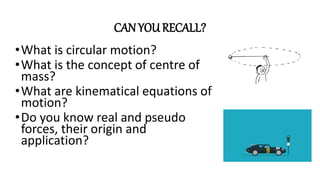
CAN YOU RECALL?
•What is circular motion?
•What is the concept of centre of
mass?
•What are kinematical equations of
motion?
•Do you know real and pseudo
forces, their origin and
application?
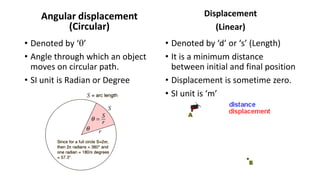
Angular displacement
(Circular)
• Denoted by ‘’
• Angle through which an object
moves on circular path.
• SI unit is Radian or Degree
Displacement
(Linear)
• Denoted by ‘d’ or ‘s’ (Length)
• It is a minimum distance
between initial and final position
• Displacement is sometime zero.
• SI unit is ‘m’
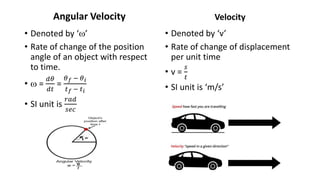
Angular Velocity
• Denoted by ‘’
• Rate of change of the position
angle of an object with respect
to time.
•  =
𝑑𝜃
𝑑𝑡
=
𝜃𝑓 − 𝜃𝑖
𝑡𝑓 − 𝑡𝑖
• SI unit is
𝑟𝑎𝑑
𝑠𝑒𝑐
Velocity
• Denoted by ‘v’
• Rate of change of displacement
per unit time
• v =
𝑠
𝑡
• SI unit is ‘m/s’
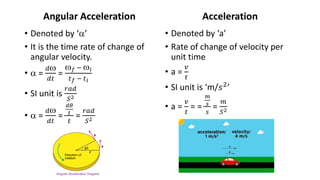
Angular Acceleration
• Denoted by ‘’
• It is the time rate of change of
angular velocity.
•  =
𝑑
𝑑𝑡
=
𝑓 − 𝑖
𝑡𝑓 − 𝑡𝑖
• SI unit is
𝑟𝑎𝑑
𝑆2
•  =
𝑑
𝑑𝑡
=
𝑑𝜃
𝑡
𝑡
=
𝑟𝑎𝑑
𝑆2
Acceleration
• Denoted by ‘a’
• Rate of change of velocity per
unit time
• a =
𝑣
𝑡
• SI unit is ‘m/𝑠2’
• a =
𝑣
𝑡
= =
𝑚
𝑠
𝑠
=
𝑚
𝑆2
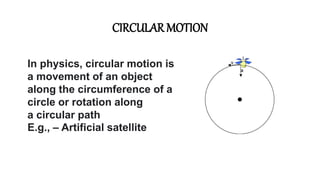
CIRCULAR MOTION
In physics, circular motion is
a movement of an object
along the circumference of a
circle or rotation along
a circular path
E.g., – Artificial satellite
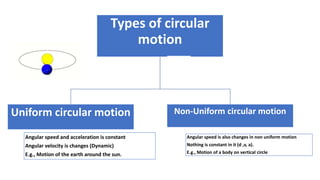
Types of circular
motion
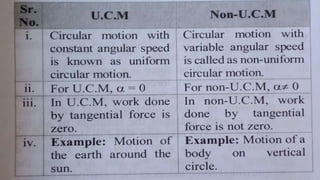
Uniform circular motion
Angular speed and acceleration is constant
Angular velocity is changes (Dynamic)
E.g., Motion of the earth around the sun.
Non-Uniform circular motion
Angular speed is also changes in non uniform motion
Nothing is constant in it (d ,v, a).
E.g., Motion of a body on vertical circle
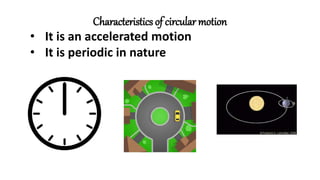
Characteristics of circular motion
• It is an accelerated motion
• It is periodic in nature
n → Frequency of an object to rotate
T → Periodic time / Period of circular motion
So, w = 2 𝝅 n
[ i.e. w = 2 𝝅 ×
𝟏
𝑻
] ……….( n =
𝟏
𝑻
)
Where, w → Angular Velocity
Relation betweenangular velocityand linear velocity
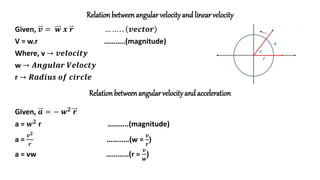
Given, 𝒗 = 𝒘 𝒙 𝒓 … … . . 𝒗𝒆𝒄𝒕𝒐𝒓
V = w.r ………..(magnitude)
Where, v → 𝒗𝒆𝒍𝒐𝒄𝒊𝒕𝒚
w → 𝑨𝒏𝒈𝒖𝒍𝒂𝒓 𝑽𝒆𝒍𝒐𝒄𝒕𝒚
r → 𝑹𝒂𝒅𝒊𝒖𝒔 𝒐𝒇 𝒄𝒊𝒓𝒄𝒍𝒆
Relation betweenangular velocityand acceleration
Given, 𝒂 = − 𝒘𝟐
𝒓
a = 𝒘𝟐
r ………..(magnitude)
a =
𝒗𝟐
𝒓
…………(w =
𝒗
𝒓
)
a = vw …………(r =
𝒗
𝒘
)
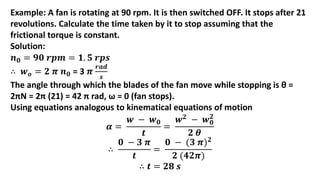
Example: A fan is rotating at 90 rpm. It is then switched OFF. It stops after 21
revolutions. Calculate the time taken by it to stop assuming that the
frictional torque is constant.
Solution:
𝒏𝟎 = 𝟗𝟎 𝒓𝒑𝒎 = 𝟏. 𝟓 𝒓𝒑𝒔
∴ 𝒘𝒐 = 𝟐 𝝅 𝒏𝟎 = 3 𝝅
𝒓𝒂𝒅
𝒔
The angle through which the blades of the fan move while stopping is θ =
2πN = 2π (21) = 42 π rad, ω = 0 (fan stops).
Using equations analogous to kinematical equations of motion
𝜶 =
𝒘 − 𝒘𝟎
𝒕
=
𝒘𝟐 − 𝒘𝟎
𝟐
𝟐 𝜽
∴
𝟎 − 𝟑 𝝅
𝒕
=
𝟎 − (𝟑 𝝅)𝟐
𝟐 (𝟒𝟐𝝅)
∴ 𝒕 = 𝟐𝟖 𝒔
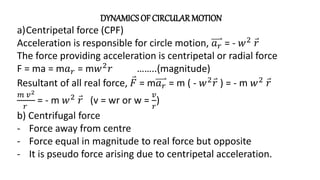
DYNAMICSOF CIRCULAR MOTION
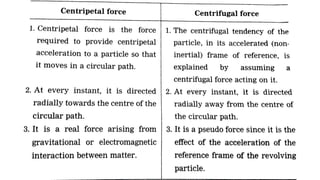
a)Centripetal force (CPF)
Acceleration is responsible for circle motion, 𝑎𝑟 = - 𝑤2
𝑟
The force providing acceleration is centripetal or radial force
F = ma = m𝑎𝑟 = m𝑤2
𝑟 ……..(magnitude)
Resultant of all real force, 𝐹 = m𝑎𝑟 = m ( - 𝑤2
𝑟 ) = - m 𝑤2
𝑟
𝑚 𝑣2
𝑟
= - m 𝑤2
𝑟 (v = wr or w =
𝑣
𝑟
)
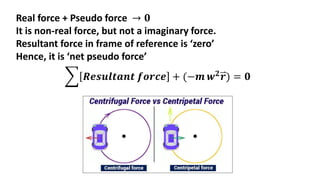
b) Centrifugal force
- Force away from centre
- Force equal in magnitude to real force but opposite
- It is pseudo force arising due to centripetal acceleration.
Real force + Pseudo force → 𝟎
It is non-real force, but not a imaginary force.
Resultant force in frame of reference is ‘zero’
Hence, it is ‘net pseudo force’
𝑹𝒆𝒔𝒖𝒍𝒕𝒂𝒏𝒕 𝒇𝒐𝒓𝒄𝒆 + (−𝒎 𝒘𝟐
𝒓) = 𝟎
APPLICATIONOF UCM
a) Vehicle along a horizontal circular track:
Theoretical proof:
In this, force acting on car is
(i) Weight (mg)
(ii) Normal reaction (N)
(iii) Force of friction (𝒇𝒔)
Here, mg = N …..(1)
And 𝒇𝒔 → 𝒄𝒆𝒏𝒕𝒓𝒊𝒑𝒆𝒕𝒂𝒍 𝒇𝒐𝒓𝒄𝒆 = 𝒎𝒓𝒘𝟐
= mr (
𝒗𝟐
𝒓𝟐) …….(v=wr)
= m
𝒗𝟐
𝒓
…….[from equation (1)]
∴ 𝒇𝒔 =
𝑵
𝒈
𝒗𝟐
𝒓
…….. (m =
𝑵
𝒈
)
∴ 𝒇𝒔 = 𝑵
𝒗𝟐
𝒓𝒈
→
𝒇𝒔
𝑵
=
𝒗𝟐
𝒓𝒈
Fig.: Vehicle on a horizontal road.
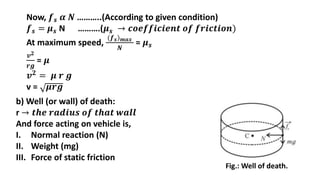
Now, 𝒇𝒔 𝜶 𝑵 ………..(According to given condition)
𝒇𝒔 = 𝝁𝒔 N ……….(𝝁𝒔 → 𝒄𝒐𝒆𝒇𝒇𝒊𝒄𝒊𝒆𝒏𝒕 𝒐𝒇 𝒇𝒓𝒊𝒄𝒕𝒊𝒐𝒏)
At maximum speed,
(𝒇𝒔)𝒎𝒂𝒙
𝑵
= 𝝁𝒔
𝒗𝟐
𝒓𝒈
= 𝝁
𝒗𝟐 = 𝝁 𝒓 𝒈
v = 𝝁𝒓𝒈
b) Well (or wall) of death:
r → 𝒕𝒉𝒆 𝒓𝒂𝒅𝒊𝒖𝒔 𝒐𝒇 𝒕𝒉𝒂𝒕 𝒘𝒂𝒍𝒍
And force acting on vehicle is,
I. Normal reaction (N)
II. Weight (mg)
III. Force of static friction
Fig.: Well of death.
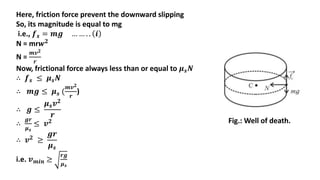
Here, friction force prevent the downward slipping
So, its magnitude is equal to mg
i.e., 𝒇𝒔 = 𝒎𝒈 … … . . 𝒊
N = mr𝒘𝟐
N =
𝒎𝒗𝟐
𝒓
Now, frictional force always less than or equal to 𝝁𝒔𝑵
∴ 𝒇𝒔 ≤ 𝝁𝒔𝑵
∴ 𝒎𝒈 ≤ 𝝁𝒔 (
𝒎𝒗𝟐
𝒓
)
∴ 𝒈 ≤
𝝁𝒔𝒗𝟐
𝒓
∴
𝒈𝒓
𝝁𝒔
≤ 𝒗𝟐
∴ 𝒗𝟐 ≥
𝒈𝒓
𝝁𝒔
i.e. 𝒗𝒎𝒊𝒏 ≥
𝒓𝒈
𝝁𝒔
Fig.: Well of death.
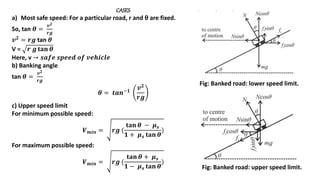
Vehicle on a BankedRoad
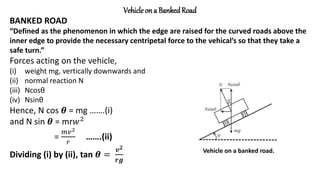
BANKED ROAD
“Defined as the phenomenon in which the edge are raised for the curved roads above the
inner edge to provide the necessary centripetal force to the vehical’s so that they take a
safe turn.”
Forces acting on the vehicle,
(i) weight mg, vertically downwards and
(ii) normal reaction N
(iii) Ncosθ
(iv) Nsinθ
Hence, N cos 𝜽 = mg …….(i)
and N sin 𝜽 = mr𝑤2
=
𝑚𝑣2
𝑟
…….(ii)
Dividing (i) by (ii), tan 𝜽 =
𝒗𝟐
𝒓𝒈
Vehicle on a banked road.
CASES
a) Most safe speed: For a particular road, r and θ are fixed.
So, tan 𝜽 =
𝒗𝟐
𝒓𝒈
𝒗𝟐
= 𝒓𝒈 tan 𝜽
V = 𝒓 𝒈 𝐭𝐚𝐧 𝜽
Here, v → 𝒔𝒂𝒇𝒆 𝒔𝒑𝒆𝒆𝒅 𝒐𝒇 𝒗𝒆𝒉𝒊𝒄𝒍𝒆
b) Banking angle
tan 𝜽 =
𝒗𝟐
𝒓𝒈
𝜽 = 𝒕𝒂𝒏−𝟏
𝒗𝟐
𝒓𝒈
c) Upper speed limit
For minimum possible speed:
𝑽𝒎𝒊𝒏 = 𝒓𝒈 (
𝐭𝐚𝐧 𝜽 − 𝝁𝒔
𝟏 + 𝝁𝒔 𝐭𝐚𝐧 𝜽
)
For maximum possible speed:
𝑽𝒎𝒊𝒏 = 𝒓𝒈 (
𝐭𝐚𝐧 𝜽 + 𝝁𝒔
𝟏 − 𝝁𝒔 𝐭𝐚𝐧 𝜽
)
Fig: Banked road: lower speed limit.
Fig: Banked road: upper speed limit.
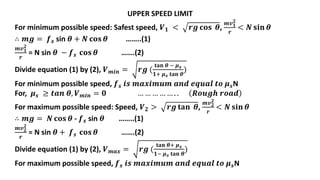
UPPER SPEED LIMIT
For minimum possible speed: Safest speed, 𝑽𝟏 < 𝒓𝒈 𝐜𝐨𝐬 𝜽,
𝒎𝒗𝟏
𝟐
𝒓
< 𝑵 𝐬𝐢𝐧 𝜽
∴ 𝒎𝒈 = 𝒇𝒔 sin 𝜽 + 𝑵 𝐜𝐨𝐬 𝜽 ……..(1)
𝒎𝒗𝟏
𝟐
𝒓
= N sin 𝜽 − 𝒇𝒔 𝐜𝐨𝐬 𝜽 …….(2)
Divide equation (1) by (2), 𝑽𝒎𝒊𝒏 = 𝒓𝒈 (
𝐭𝐚𝐧 𝜽 − 𝝁𝒔
𝟏+ 𝝁𝒔 𝐭𝐚𝐧 𝜽
)
For minimum possible speed, 𝒇𝒔 𝒊𝒔 𝒎𝒂𝒙𝒊𝒎𝒖𝒎 𝒂𝒏𝒅 𝒆𝒒𝒖𝒂𝒍 𝒕𝒐 𝝁𝒔N
For, 𝝁𝒔 ≥ 𝒕𝒂𝒏 𝜽, 𝑽𝒎𝒊𝒏 = 𝟎 … … … … … . . 𝑹𝒐𝒖𝒈𝒉 𝒓𝒐𝒂𝒅
For maximum possible speed: Speed, 𝑽𝟐 > 𝒓𝒈 𝐭𝐚𝐧 𝜽,
𝒎𝒗𝟐
𝟐
𝒓
< 𝑵 𝐬𝐢𝐧 𝜽
∴ 𝒎𝒈 = 𝑵 𝐜𝐨𝐬 𝜽 - 𝒇𝒔 sin 𝜽 ……..(1)
𝒎𝒗𝟐
𝟐
𝒓
= N sin 𝜽 + 𝒇𝒔 𝐜𝐨𝐬 𝜽 …….(2)
Divide equation (1) by (2), 𝑽𝒎𝒂𝒙 = 𝒓𝒈 (
𝐭𝐚𝐧 𝜽+ 𝝁𝒔
𝟏− 𝝁𝒔 𝐭𝐚𝐧 𝜽
)
For maximum possible speed, 𝒇𝒔 𝒊𝒔 𝒎𝒂𝒙𝒊𝒎𝒖𝒎 𝒂𝒏𝒅 𝒆𝒒𝒖𝒂𝒍 𝒕𝒐 𝝁𝒔N
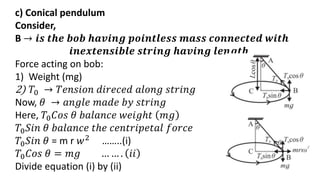
c) Conical pendulum
Consider,
B → 𝒊𝒔 𝒕𝒉𝒆 𝒃𝒐𝒃 𝒉𝒂𝒗𝒊𝒏𝒈 𝒑𝒐𝒊𝒏𝒕𝒍𝒆𝒔𝒔 𝒎𝒂𝒔𝒔 𝒄𝒐𝒏𝒏𝒆𝒄𝒕𝒆𝒅 𝒘𝒊𝒕𝒉
𝒊𝒏𝒆𝒙𝒕𝒆𝒏𝒔𝒊𝒃𝒍𝒆 𝒔𝒕𝒓𝒊𝒏𝒈 𝒉𝒂𝒗𝒊𝒏𝒈 𝒍𝒆𝒏𝒈𝒕𝒉
Force acting on bob:
1) Weight (mg)
2) 𝑇0 → 𝑇𝑒𝑛𝑠𝑖𝑜𝑛 𝑑𝑖𝑟𝑒𝑐𝑒𝑑 𝑎𝑙𝑜𝑛𝑔 𝑠𝑡𝑟𝑖𝑛𝑔
Now, 𝜃 → 𝑎𝑛𝑔𝑙𝑒 𝑚𝑎𝑑𝑒 𝑏𝑦 𝑠𝑡𝑟𝑖𝑛𝑔
Here, 𝑇0𝐶𝑜𝑠 𝜃 𝑏𝑎𝑙𝑎𝑛𝑐𝑒 𝑤𝑒𝑖𝑔ℎ𝑡 𝑚𝑔
𝑇0𝑆𝑖𝑛 𝜃 𝑏𝑎𝑙𝑎𝑛𝑐𝑒 𝑡ℎ𝑒 𝑐𝑒𝑛𝑡𝑟𝑖𝑝𝑒𝑡𝑎𝑙 𝑓𝑜𝑟𝑐𝑒
𝑇0𝑆𝑖𝑛 𝜃 = m r 𝑤2
……..(i)
𝑇0𝐶𝑜𝑠 𝜃 = 𝑚𝑔 … … . 𝑖𝑖
Divide equation (i) by (ii)
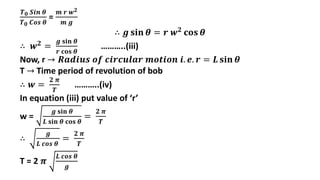
𝑻𝟎 𝑺𝒊𝒏 𝜽
𝑻𝟎 𝑪𝒐𝒔 𝜽
=
𝒎 𝒓 𝒘𝟐
𝒎 𝒈
∴ 𝒈 𝐬𝐢𝐧 𝜽 = 𝒓 𝒘𝟐 𝐜𝐨𝐬 𝜽
∴ 𝒘𝟐
=
𝒈 𝐬𝐢𝐧 𝜽
𝒓 𝐜𝐨𝐬 𝜽
………..(iii)
Now, r → 𝑹𝒂𝒅𝒊𝒖𝒔 𝒐𝒇 𝒄𝒊𝒓𝒄𝒖𝒍𝒂𝒓 𝒎𝒐𝒕𝒊𝒐𝒏 𝒊. 𝒆. 𝒓 = 𝑳 𝐬𝐢𝐧 𝜽
T → Time period of revolution of bob
∴ 𝒘 =
𝟐 𝝅
𝑻
………..(iv)
In equation (iii) put value of ‘r’
w =
𝒈 𝐬𝐢𝐧 𝜽
𝑳 𝐬𝐢𝐧 𝜽 𝐜𝐨𝐬 𝜽
=
𝟐 𝝅
𝑻
∴
𝒈
𝑳 𝒄𝒐𝒔 𝜽
=
𝟐 𝝅
𝑻
T = 2 𝝅
𝑳 𝒄𝒐𝒔 𝜽
𝒈
VERTICAL CIRCULAR MOTION
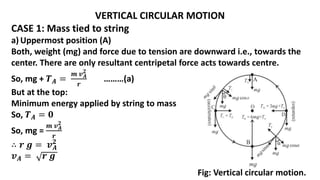
CASE 1: Mass tied to string
a) Uppermost position (A)
Both, weight (mg) and force due to tension are downward i.e., towards the
center. There are only resultant centripetal force acts towards centre.
So, mg + 𝑻𝑨 =
𝒎 𝒗𝑨
𝟐
𝒓
………(a)
But at the top:
Minimum energy applied by string to mass
So, 𝑻𝑨 = 𝟎
So, mg =
𝒎 𝒗𝑨
𝟐
𝒓
∴ 𝒓 𝒈 = 𝒗𝑨
𝟐
𝒗𝑨 = 𝒓 𝒈
Fig: Vertical circular motion.
VERTICAL CIRCULAR MOTION
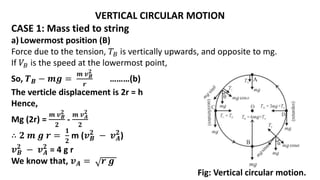
CASE 1: Mass tied to string
a) Lowermost position (B)
Force due to the tension, 𝑇𝐵 is vertically upwards, and opposite to mg.
If 𝑉𝐵 is the speed at the lowermost point,
So, 𝑻𝑩 − 𝒎𝒈 =
𝒎 𝒗𝑩
𝟐
𝒓
………(b)
The verticle displacement is 2r = h
Hence,
Mg (2r) =
𝒎 𝒗𝑩
𝟐
𝟐
-
𝒎 𝒗𝑨
𝟐
𝟐
∴ 𝟐 𝒎 𝒈 𝒓 =
𝟏
𝟐
m (𝒗𝑩
𝟐
− 𝒗𝑨
𝟐
)
𝒗𝑩
𝟐
− 𝒗𝑨
𝟐
= 4 g r
We know that, 𝒗𝑨 = 𝒓 𝒈
Fig: Vertical circular motion.
From equation (1)
𝒗𝑩
𝟐
− ( 𝒓𝒈)𝟐= 4 g r
𝒗𝑩
𝟐
− 𝒓 𝒈 = 4 g r
𝒗𝑩 = 𝟓 𝒓 𝒈
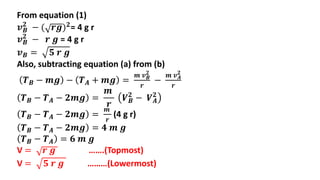
Also, subtracting equation (a) from (b)
𝑻𝑩 − 𝒎𝒈 − 𝑻𝑨 + 𝒎𝒈 =
𝒎 𝒗𝑩
𝟐
𝒓
−
𝒎 𝒗𝑨
𝟐
𝒓
𝑻𝑩 − 𝑻𝑨 − 𝟐𝒎𝒈 =
𝒎
𝒓
𝑽𝑩
𝟐
− 𝑽𝑨
𝟐
𝑻𝑩 − 𝑻𝑨 − 𝟐𝒎𝒈 =
𝒎
𝒓
(4 g r)
𝑻𝑩 − 𝑻𝑨 − 𝟐𝒎𝒈 = 𝟒 𝒎 𝒈
𝑻𝑩 − 𝑻𝑨 = 𝟔 𝒎 𝒈
V = 𝒓 𝒈 …….(Topmost)
V = 𝟓 𝒓 𝒈 ………(Lowermost)
VERTICAL CIRCULAR MOTION
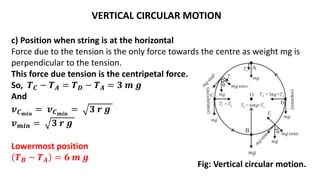
c) Position when string is at the horizontal
Force due to the tension is the only force towards the centre as weight mg is
perpendicular to the tension.
This force due tension is the centripetal force.
So, 𝑻𝑪 − 𝑻𝑨 = 𝑻𝑫 − 𝑻𝑨 = 𝟑 𝒎 𝒈
And
𝒗𝑪𝒎𝒊𝒏
= 𝒗𝑪𝒎𝒊𝒏
= 𝟑 𝒓 𝒈
𝒗𝒎𝒊𝒏 = 𝟑 𝒓 𝒈
Lowermost position
𝑻𝑩 − 𝑻𝑨 = 𝟔 𝒎 𝒈
Fig: Vertical circular motion.
VERTICAL CIRCULAR MOTION
CASE 2: Mass tied to rod
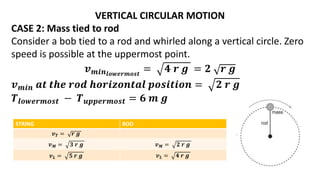
Consider a bob tied to a rod and whirled along a vertical circle. Zero
speed is possible at the uppermost point.
𝒗𝒎𝒊𝒏𝒍𝒐𝒘𝒆𝒓𝒎𝒐𝒔𝒕
= 𝟒 𝒓 𝒈 = 𝟐 𝒓 𝒈
𝒗𝒎𝒊𝒏 𝒂𝒕 𝒕𝒉𝒆 𝒓𝒐𝒅 𝒉𝒐𝒓𝒊𝒛𝒐𝒏𝒕𝒂𝒍 𝒑𝒐𝒔𝒊𝒕𝒊𝒐𝒏 = 𝟐 𝒓 𝒈
𝑻𝒍𝒐𝒘𝒆𝒓𝒎𝒐𝒔𝒕 − 𝑻𝒖𝒑𝒑𝒆𝒓𝒎𝒐𝒔𝒕 = 𝟔 𝒎 𝒈
STRING ROD
𝒗𝑻 = 𝒓 𝒈
𝒗𝑴 = 𝟑 𝒓 𝒈 𝒗𝑴 = 𝟐 𝒓 𝒈
𝒗𝑳 = 𝟓 𝒓 𝒈 𝒗𝑳 = 𝟒 𝒓 𝒈
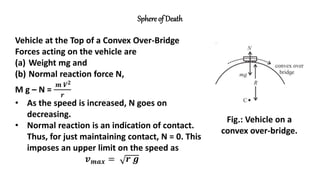
Vehicle at the Top of a Convex Over-Bridge
Forces acting on the vehicle are
(a) Weight mg and
(b) Normal reaction force N,
M g – N =
𝒎 𝑽𝟐
𝒓
• As the speed is increased, N goes on
decreasing.
• Normal reaction is an indication of contact.
Thus, for just maintaining contact, N = 0. This
imposes an upper limit on the speed as
𝒗𝒎𝒂𝒙 = 𝒓 𝒈
Fig.: Vehicle on a
convex over-bridge.
Sphere of Death
MOMENT OF INERTIA
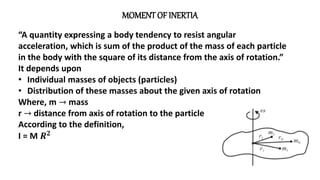
“A quantity expressing a body tendency to resist angular
acceleration, which is sum of the product of the mass of each particle
in the body with the square of its distance from the axis of rotation.”
It depends upon
• Individual masses of objects (particles)
• Distribution of these masses about the given axis of rotation
Where, m → mass
r → distance from axis of rotation to the particle
According to the definition,
I = M 𝑹𝟐
Expression for moment of inertia (I)
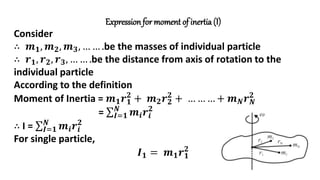
Consider
∴ 𝒎𝟏, 𝒎𝟐, 𝒎𝟑, … … .be the masses of individual particle
∴ 𝒓𝟏, 𝒓𝟐, 𝒓𝟑, … … .be the distance from axis of rotation to the
individual particle
According to the definition
Moment of Inertia = 𝒎𝟏𝒓𝟏
𝟐
+ 𝒎𝟐𝒓𝟐
𝟐
+ … … … + 𝒎𝑵𝒓𝑵
𝟐
= 𝑰=𝟏
𝑵
𝒎𝒊𝒓𝒊
𝟐
∴ I = 𝑰=𝟏
𝑵
𝒎𝒊𝒓𝒊
𝟐
For single particle,
𝑰𝟏 = 𝒎𝟏𝒓𝟏
𝟐
Expression for KINETICENERGY
Consider
∴ 𝒎𝟏, 𝒎𝟐, 𝒎𝟑, … … .be individual masses of rigid body
∴ 𝒓𝟏, 𝒓𝟐, 𝒓𝟑, … … .be the distance between axis of rotation and point masses
Here, for individual mass of particle the K.E. will be
K.E. =
𝟏
𝟐
𝒎 𝒗𝟐
So, for all the point masses of the rotating body
Rotational K.E. =
𝟏
𝟐
𝒎𝟏 𝒗𝟏
𝟐
+
𝟏
𝟐
𝒎𝟐 𝒗𝟐
𝟐
+ …….+
𝟏
𝟐
𝒎𝑵 𝒗𝑵
𝟐
Rotational K.E. =
𝟏
𝟐
[ 𝒎𝟏 𝒗𝟏
𝟐
+ 𝒎𝟐 𝒗𝟐
𝟐
+ …….+ 𝒎𝑵 𝒗𝑵
𝟐
]
We know, v = r w
Rotational K.E. =
𝟏
𝟐
𝒎𝟏 𝒓𝟏
𝟐
𝒘𝟐 +
𝟏
𝟐
𝒎𝟐 𝒓𝟐
𝟐
𝒘𝟐 + …….+
𝟏
𝟐
𝒎𝑵 𝒓𝑵
𝟐
𝒘𝟐
Rotational K.E. =
𝟏
𝟐
[𝒎𝟏 𝒓𝟏
𝟐
+ 𝒎𝟐 𝒓𝟐
𝟐
+ …….+ 𝒎𝑵 𝒓𝑵
𝟐
] 𝒘𝟐
Rotational K.E. =
𝟏
𝟐
[ 𝒊=𝟏
𝑵
𝒎𝑵 𝒓𝑵
𝟐
] 𝒘𝟐
=
𝟏
𝟐
𝑰 𝒘𝟐 …………..[I = 𝒊=𝟏
𝑵
𝒎𝑵 𝒓𝑵
𝟐
]
Expression OF ‘I’ FOR UNIFORMRING
Moment of Inertia of a ring.
Said to be uniform if mass of any body
practically situated uniformly on the
circumference of circle
It entire mass practically at equal
distance from centre that is mass (m)
Also distance R is same for the ring
So, expression is,
I = M 𝑹𝟐
….[For ring]
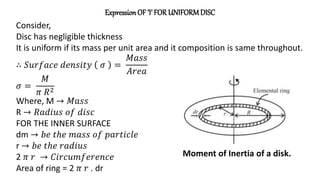
Expression OF ‘I’ FOR UNIFORMDISC
Consider,
Disc has negligible thickness
It is uniform if its mass per unit area and it composition is same throughout.
∴ 𝑆𝑢𝑟𝑓𝑎𝑐𝑒 𝑑𝑒𝑛𝑠𝑖𝑡𝑦 𝜎 =
𝑀𝑎𝑠𝑠
𝐴𝑟𝑒𝑎
𝜎 =
𝑀
𝜋 𝑅2
Where, M → 𝑀𝑎𝑠𝑠
R → 𝑅𝑎𝑑𝑖𝑢𝑠 𝑜𝑓 𝑑𝑖𝑠𝑐
FOR THE INNER SURFACE
dm → 𝑏𝑒 𝑡ℎ𝑒 𝑚𝑎𝑠𝑠 𝑜𝑓 𝑝𝑎𝑟𝑡𝑖𝑐𝑙𝑒
r → 𝑏𝑒 𝑡ℎ𝑒 𝑟𝑎𝑑𝑖𝑢𝑠
2 𝜋 𝑟 → 𝐶𝑖𝑟𝑐𝑢𝑚𝑓𝑒𝑟𝑒𝑛𝑐𝑒
Area of ring = 2 𝜋 𝑟 . dr
Moment of Inertia of a disk.
Expression OF ‘I’ FOR UNIFORMDISC
So, surface density ( 𝜎 ) =
𝑑𝑚
2 𝜋 𝑟 𝑑𝑟
∴ 𝑑𝑚 = 2 𝜋 𝑟 𝑑𝑟 𝜎
Here, r → 𝑖𝑠 𝑠𝑎𝑚𝑒 𝑡ℎ𝑟𝑜𝑢𝑔ℎ𝑜𝑢𝑡 𝑏𝑜𝑑𝑦
𝐼𝑟 = 𝑑𝑚 𝑟2
For whole,
By integration the inertia:
I = 0
𝑅
𝐼𝑟 = 0
𝑅
𝑑𝑚 𝑟2
= 0
𝑅
2 𝜋 𝑟 𝜎 𝑟2
𝑑𝑟
= 0
𝑅
2 𝜋 𝜎 𝑟3 dr
= 2 π 𝜎 0
𝑅
𝑟3 dr
= 2 π 𝜎 [
𝑟4
4
]0
𝑅
= 2 π 𝜎
𝑅4
4
=
1
2
𝜋 𝜎 𝑅4
Moment of Inertia of a disk.
I =
𝟏
𝟐
𝝅
𝑴
𝝅𝑹𝟐 𝑹𝟒
=
𝟏
𝟐
𝑴 𝑹𝟐 …(For disc)
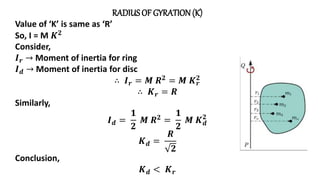
RADIUSOF GYRATION(K)
Value of ‘K’ is same as ‘R’
So, I = M 𝑲𝟐
Consider,
𝑰𝒓 → Moment of inertia for ring
𝑰𝒅 → Moment of inertia for disc
∴ 𝑰𝒓 = 𝑴 𝑹𝟐 = 𝑴 𝑲𝒓
𝟐
∴ 𝑲𝒓 = 𝑹
Similarly,
𝑰𝒅 =
𝟏
𝟐
𝑴 𝑹𝟐 =
𝟏
𝟐
𝑴 𝑲𝒅
𝟐
𝑲𝒅 =
𝑹
𝟐
Conclusion,
𝑲𝒅 < 𝑲𝒓
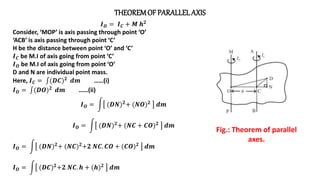
THEOREMOF PARALLEL AXIS
Fig.: Theorem of parallel
axes.
𝑰𝑶 = 𝑰𝑪 + 𝑴 𝒉𝟐
Consider, ‘MOP’ is axis passing through point ‘O’
‘ACB’ is axis passing through point ‘C’
H be the distance between point ‘O’ and ‘C’
𝑰𝑪 be M.I of axis going from point ‘C’
𝑰𝑶 be M.I of axis going from point ‘O’
D and N are individual point mass.
Here, 𝑰𝑪 = (𝑫𝑪)𝟐 𝒅𝒎 ……(i)
𝑰𝑶 = (𝑫𝑶)𝟐
𝒅𝒎 ……(ii)
𝑰𝑶 = (𝑫𝑵)𝟐+ (𝑵𝑶)𝟐 𝒅𝒎
𝑰𝑶 = (𝑫𝑵)𝟐+ (𝑵𝑪 + 𝑪𝑶)𝟐 𝒅𝒎
𝑰𝑶 = (𝑫𝑵)𝟐+ (𝑵𝑪)𝟐+𝟐 𝑵𝑪. 𝑪𝑶 + (𝑪𝑶)𝟐 𝒅𝒎
𝑰𝑶 = (𝑫𝑪)𝟐+𝟐 𝑵𝑪. 𝒉 + (𝒉)𝟐 𝒅𝒎
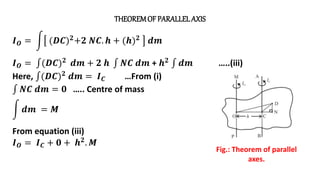
THEOREMOF PARALLEL AXIS
Fig.: Theorem of parallel
axes.
𝑰𝑶 = (𝑫𝑪)𝟐+𝟐 𝑵𝑪. 𝒉 + (𝒉)𝟐 𝒅𝒎
𝑰𝑶 = (𝑫𝑪)𝟐 𝒅𝒎 + 𝟐 𝒉 𝑵𝑪 𝒅𝒎 + 𝒉𝟐 𝒅𝒎 …..(iii)
Here, (𝑫𝑪)𝟐 𝒅𝒎 = 𝑰𝑪 …From (i)
𝑵𝑪 𝒅𝒎 = 𝟎 ….. Centre of mass
𝒅𝒎 = 𝑴
From equation (iii)
𝑰𝑶 = 𝑰𝑪 + 𝟎 + 𝒉𝟐. 𝑴
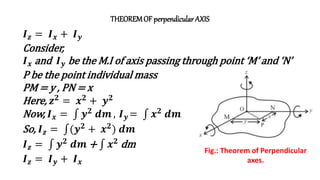
THEOREMOF perpendicular AXIS
Fig.: Theorem of Perpendicular
axes.
𝑰𝒛 = 𝑰𝒙 + 𝑰𝒚
Consider,
𝑰𝒙 and 𝑰𝒚 be the M.I of axis passing through point ‘M’ and ‘N’
P be the point individual mass
PM = y , PN = x
Here, 𝒛𝟐
= 𝒙𝟐
+ 𝒚𝟐
Now, 𝑰𝒙 = 𝒚𝟐
𝒅𝒎 , 𝑰𝒚 = 𝒙𝟐
𝒅𝒎
So, 𝑰𝒛 = (𝒚𝟐
+ 𝒙𝟐
) 𝒅𝒎
𝑰𝒛 = 𝒚𝟐
𝒅𝒎 + 𝒙𝟐
dm
𝑰𝒛 = 𝑰𝒚 + 𝑰𝒙
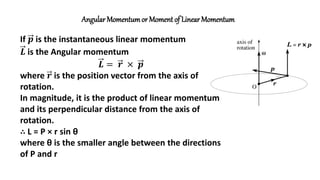
Angular Momentumor Moment of Linear Momentum
If 𝒑 is the instantaneous linear momentum
𝑳 is the Angular momentum
𝑳 = 𝒓 × 𝒑
where 𝒓 is the position vector from the axis of
rotation.
In magnitude, it is the product of linear momentum
and its perpendicular distance from the axis of
rotation.
∴ L = P × r sin θ
where θ is the smaller angle between the directions
of P and r
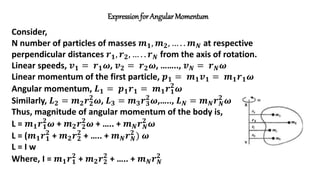
Expressionfor Angular Momentum
Consider,
N number of particles of masses 𝒎𝟏, 𝒎𝟐, … . . 𝒎𝑵 at respective
perpendicular distances 𝒓𝟏, 𝒓𝟐, … . . 𝒓𝑵 from the axis of rotation.
Linear speeds, 𝒗𝟏 = 𝒓𝟏𝝎, 𝒗𝟐 = 𝒓𝟐𝝎, …….., 𝒗𝑵 = 𝒓𝑵𝝎
Linear momentum of the first particle, 𝒑𝟏 = 𝒎𝟏𝒗𝟏 = 𝒎𝟏𝒓𝟏𝝎
Angular momentum, 𝑳𝟏 = 𝒑𝟏𝒓𝟏 = 𝒎𝟏𝒓𝟏
𝟐
𝝎
Similarly, 𝑳𝟐 = 𝒎𝟐𝒓𝟐
𝟐
𝝎, 𝑳𝟑 = 𝒎𝟑𝒓𝟑
𝟐
𝝎,….., 𝑳𝑵 = 𝒎𝑵𝒓𝑵
𝟐
𝝎
Thus, magnitude of angular momentum of the body is,
L = 𝒎𝟏𝒓𝟏
𝟐
𝝎 + 𝒎𝟐𝒓𝟐
𝟐
𝝎 + ….. + 𝒎𝑵𝒓𝑵
𝟐
𝝎
L = (𝒎𝟏𝒓𝟏
𝟐
+ 𝒎𝟐𝒓𝟐
𝟐
+ ….. + 𝒎𝑵𝒓𝑵
𝟐
) 𝝎
L = I w
Where, I = 𝒎𝟏𝒓𝟏
𝟐
+ 𝒎𝟐𝒓𝟐
𝟐
+ ….. + 𝒎𝑵𝒓𝑵
𝟐
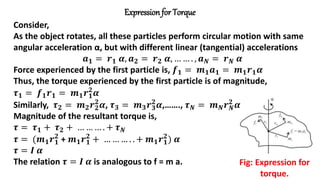
Expression for Torque
Fig: Expression for
torque.
Consider,
As the object rotates, all these particles perform circular motion with same
angular acceleration α, but with different linear (tangential) accelerations
𝒂𝟏 = 𝒓𝟏 𝜶, 𝒂𝟐 = 𝒓𝟐 𝜶, … … . , 𝒂𝑵 = 𝒓𝑵 𝜶
Force experienced by the first particle is, 𝒇𝟏 = 𝒎𝟏𝒂𝟏 = 𝒎𝟏𝒓𝟏𝜶
Thus, the torque experienced by the first particle is of magnitude,
𝝉𝟏 = 𝒇𝟏𝒓𝟏 = 𝒎𝟏𝒓𝟏
𝟐
𝜶
Similarly, 𝝉𝟐 = 𝒎𝟐𝒓𝟐
𝟐
𝜶, 𝝉𝟑 = 𝒎𝟑𝒓𝟑
𝟐
𝜶,……., 𝝉𝑵 = 𝒎𝑵𝒓𝑵
𝟐
𝜶
Magnitude of the resultant torque is,
𝝉 = 𝝉𝟏 + 𝝉𝟐 + … … … . + 𝝉𝑵
𝝉 = (𝒎𝟏𝒓𝟏
𝟐
+ 𝒎𝟏𝒓𝟏
𝟐
+ … … … . . + 𝒎𝟏𝒓𝟏
𝟐
) 𝜶
𝝉 = 𝑰 𝜶
The relation 𝝉 = 𝑰 𝜶 is analogous to f = m a.
Conservationof Angular Momentum
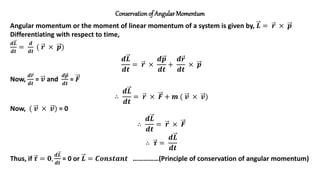
Angular momentum or the moment of linear momentum of a system is given by, 𝑳 = 𝒓 × 𝒑
Differentiating with respect to time,
𝒅𝑳
𝒅𝒕
=
𝒅
𝒅𝒕
( 𝒓 × 𝒑)
𝒅𝑳
𝒅𝒕
= 𝒓 ×
𝒅𝒑
𝒅𝒕
+
𝒅𝒓
𝒅𝒕
× 𝒑
Now,
𝒅𝒓
𝒅𝒕
= 𝒗 and
𝒅𝒑
𝒅𝒕
= 𝑭
∴
𝒅𝑳
𝒅𝒕
= 𝒓 × 𝑭 + 𝒎 ( 𝒗 × 𝒗)
Now, ( 𝒗 × 𝒗) = 0
∴
𝒅𝑳
𝒅𝒕
= 𝒓 × 𝑭
∴ 𝝉 =
𝒅𝑳
𝒅𝒕
Thus, if 𝝉 = 𝟎,
𝒅𝑳
𝒅𝒕
= 0 or 𝑳 = 𝑪𝒐𝒏𝒔𝒕𝒂𝒏𝒕 ……………(Principle of conservation of angular momentum)
Rolling Motion
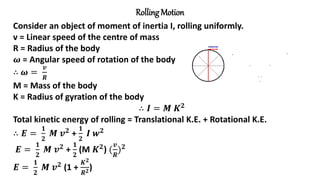
Consider an object of moment of inertia I, rolling uniformly.
v = Linear speed of the centre of mass
R = Radius of the body
𝝎 = Angular speed of rotation of the body
∴ 𝝎 =
𝒗
𝑹
M = Mass of the body
K = Radius of gyration of the body
∴ 𝑰 = 𝑴 𝑲𝟐
Total kinetic energy of rolling = Translational K.E. + Rotational K.E.
∴ 𝑬 =
𝟏
𝟐
𝑴 𝒗𝟐
+
𝟏
𝟐
𝑰 𝒘𝟐
𝑬 =
𝟏
𝟐
𝑴 𝒗𝟐 +
𝟏
𝟐
(M 𝑲𝟐) (
𝒗
𝑹
)𝟐
𝑬 =
𝟏
𝟐
𝑴 𝒗𝟐 (1 +
𝑲𝟐
𝑹𝟐)
Linear Acceleration and Speed While Pure RollingDown an Inclined Plane
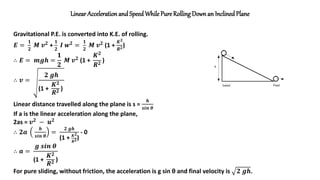
Gravitational P.E. is converted into K.E. of rolling.
𝑬 =
𝟏
𝟐
𝑴 𝒗𝟐
+
𝟏
𝟐
𝑰 𝒘𝟐
=
𝟏
𝟐
𝑴 𝒗𝟐
(1 +
𝑲𝟐
𝑹𝟐)
∴ 𝑬 = 𝒎𝒈𝒉 =
𝟏
𝟐
𝑴 𝒗𝟐 (1 +
𝑲𝟐
𝑹𝟐
)
∴ 𝒗 =
𝟐 𝒈𝒉
(1 +
𝑲𝟐
𝑹𝟐 )
Linear distance travelled along the plane is s =
𝒉
𝒔𝒊𝒏 𝜽
If a is the linear acceleration along the plane,
2as = 𝒗𝟐
− 𝒖𝟐
∴ 𝟐𝒂
𝒉
𝒔𝒊𝒏 𝜽
=
𝟐 𝒈𝒉
(1 + 𝑲𝟐
𝑹𝟐)
- 0
∴ 𝒂 =
𝒈 𝒔𝒊𝒏 𝜽
(1 +
𝑲𝟐
𝑹𝟐 )
For pure sliding, without friction, the acceleration is g sin θ and final velocity is 𝟐 𝒈𝒉.

PHYSICS - Rotational dynamics (MAHARASHTRA STATE BOARD)

  • 1.
    PHYSICS CHAPTER – 1 ROTATIONALDYNAMICS MAHARASHTRA STATE BOARD
  • 2.
    CAN YOU RECALL? •Whatis circular motion? •What is the concept of centre of mass? •What are kinematical equations of motion? •Do you know real and pseudo forces, their origin and application?
  • 3.
    Angular displacement (Circular) • Denotedby ‘’ • Angle through which an object moves on circular path. • SI unit is Radian or Degree Displacement (Linear) • Denoted by ‘d’ or ‘s’ (Length) • It is a minimum distance between initial and final position • Displacement is sometime zero. • SI unit is ‘m’
  • 4.
    Angular Velocity • Denotedby ‘’ • Rate of change of the position angle of an object with respect to time. •  = 𝑑𝜃 𝑑𝑡 = 𝜃𝑓 − 𝜃𝑖 𝑡𝑓 − 𝑡𝑖 • SI unit is 𝑟𝑎𝑑 𝑠𝑒𝑐 Velocity • Denoted by ‘v’ • Rate of change of displacement per unit time • v = 𝑠 𝑡 • SI unit is ‘m/s’
  • 5.
    Angular Acceleration • Denotedby ‘’ • It is the time rate of change of angular velocity. •  = 𝑑 𝑑𝑡 = 𝑓 − 𝑖 𝑡𝑓 − 𝑡𝑖 • SI unit is 𝑟𝑎𝑑 𝑆2 •  = 𝑑 𝑑𝑡 = 𝑑𝜃 𝑡 𝑡 = 𝑟𝑎𝑑 𝑆2 Acceleration • Denoted by ‘a’ • Rate of change of velocity per unit time • a = 𝑣 𝑡 • SI unit is ‘m/𝑠2’ • a = 𝑣 𝑡 = = 𝑚 𝑠 𝑠 = 𝑚 𝑆2
  • 6.
    CIRCULAR MOTION In physics,circular motion is a movement of an object along the circumference of a circle or rotation along a circular path E.g., – Artificial satellite
  • 7.
    Types of circular motion Uniformcircular motion Angular speed and acceleration is constant Angular velocity is changes (Dynamic) E.g., Motion of the earth around the sun. Non-Uniform circular motion Angular speed is also changes in non uniform motion Nothing is constant in it (d ,v, a). E.g., Motion of a body on vertical circle
  • 8.
    Characteristics of circularmotion • It is an accelerated motion • It is periodic in nature
  • 10.
    n → Frequencyof an object to rotate T → Periodic time / Period of circular motion So, w = 2 𝝅 n [ i.e. w = 2 𝝅 × 𝟏 𝑻 ] ……….( n = 𝟏 𝑻 ) Where, w → Angular Velocity
  • 11.
    Relation betweenangular velocityandlinear velocity Given, 𝒗 = 𝒘 𝒙 𝒓 … … . . 𝒗𝒆𝒄𝒕𝒐𝒓 V = w.r ………..(magnitude) Where, v → 𝒗𝒆𝒍𝒐𝒄𝒊𝒕𝒚 w → 𝑨𝒏𝒈𝒖𝒍𝒂𝒓 𝑽𝒆𝒍𝒐𝒄𝒕𝒚 r → 𝑹𝒂𝒅𝒊𝒖𝒔 𝒐𝒇 𝒄𝒊𝒓𝒄𝒍𝒆 Relation betweenangular velocityand acceleration Given, 𝒂 = − 𝒘𝟐 𝒓 a = 𝒘𝟐 r ………..(magnitude) a = 𝒗𝟐 𝒓 …………(w = 𝒗 𝒓 ) a = vw …………(r = 𝒗 𝒘 )
  • 12.
    Example: A fanis rotating at 90 rpm. It is then switched OFF. It stops after 21 revolutions. Calculate the time taken by it to stop assuming that the frictional torque is constant. Solution: 𝒏𝟎 = 𝟗𝟎 𝒓𝒑𝒎 = 𝟏. 𝟓 𝒓𝒑𝒔 ∴ 𝒘𝒐 = 𝟐 𝝅 𝒏𝟎 = 3 𝝅 𝒓𝒂𝒅 𝒔 The angle through which the blades of the fan move while stopping is θ = 2πN = 2π (21) = 42 π rad, ω = 0 (fan stops). Using equations analogous to kinematical equations of motion 𝜶 = 𝒘 − 𝒘𝟎 𝒕 = 𝒘𝟐 − 𝒘𝟎 𝟐 𝟐 𝜽 ∴ 𝟎 − 𝟑 𝝅 𝒕 = 𝟎 − (𝟑 𝝅)𝟐 𝟐 (𝟒𝟐𝝅) ∴ 𝒕 = 𝟐𝟖 𝒔
  • 13.
    DYNAMICSOF CIRCULAR MOTION a)Centripetalforce (CPF) Acceleration is responsible for circle motion, 𝑎𝑟 = - 𝑤2 𝑟 The force providing acceleration is centripetal or radial force F = ma = m𝑎𝑟 = m𝑤2 𝑟 ……..(magnitude) Resultant of all real force, 𝐹 = m𝑎𝑟 = m ( - 𝑤2 𝑟 ) = - m 𝑤2 𝑟 𝑚 𝑣2 𝑟 = - m 𝑤2 𝑟 (v = wr or w = 𝑣 𝑟 ) b) Centrifugal force - Force away from centre - Force equal in magnitude to real force but opposite - It is pseudo force arising due to centripetal acceleration.
  • 15.
    Real force +Pseudo force → 𝟎 It is non-real force, but not a imaginary force. Resultant force in frame of reference is ‘zero’ Hence, it is ‘net pseudo force’ 𝑹𝒆𝒔𝒖𝒍𝒕𝒂𝒏𝒕 𝒇𝒐𝒓𝒄𝒆 + (−𝒎 𝒘𝟐 𝒓) = 𝟎
  • 16.
    APPLICATIONOF UCM a) Vehiclealong a horizontal circular track: Theoretical proof: In this, force acting on car is (i) Weight (mg) (ii) Normal reaction (N) (iii) Force of friction (𝒇𝒔) Here, mg = N …..(1) And 𝒇𝒔 → 𝒄𝒆𝒏𝒕𝒓𝒊𝒑𝒆𝒕𝒂𝒍 𝒇𝒐𝒓𝒄𝒆 = 𝒎𝒓𝒘𝟐 = mr ( 𝒗𝟐 𝒓𝟐) …….(v=wr) = m 𝒗𝟐 𝒓 …….[from equation (1)] ∴ 𝒇𝒔 = 𝑵 𝒈 𝒗𝟐 𝒓 …….. (m = 𝑵 𝒈 ) ∴ 𝒇𝒔 = 𝑵 𝒗𝟐 𝒓𝒈 → 𝒇𝒔 𝑵 = 𝒗𝟐 𝒓𝒈 Fig.: Vehicle on a horizontal road.
  • 17.
    Now, 𝒇𝒔 𝜶𝑵 ………..(According to given condition) 𝒇𝒔 = 𝝁𝒔 N ……….(𝝁𝒔 → 𝒄𝒐𝒆𝒇𝒇𝒊𝒄𝒊𝒆𝒏𝒕 𝒐𝒇 𝒇𝒓𝒊𝒄𝒕𝒊𝒐𝒏) At maximum speed, (𝒇𝒔)𝒎𝒂𝒙 𝑵 = 𝝁𝒔 𝒗𝟐 𝒓𝒈 = 𝝁 𝒗𝟐 = 𝝁 𝒓 𝒈 v = 𝝁𝒓𝒈 b) Well (or wall) of death: r → 𝒕𝒉𝒆 𝒓𝒂𝒅𝒊𝒖𝒔 𝒐𝒇 𝒕𝒉𝒂𝒕 𝒘𝒂𝒍𝒍 And force acting on vehicle is, I. Normal reaction (N) II. Weight (mg) III. Force of static friction Fig.: Well of death.
  • 18.
    Here, friction forceprevent the downward slipping So, its magnitude is equal to mg i.e., 𝒇𝒔 = 𝒎𝒈 … … . . 𝒊 N = mr𝒘𝟐 N = 𝒎𝒗𝟐 𝒓 Now, frictional force always less than or equal to 𝝁𝒔𝑵 ∴ 𝒇𝒔 ≤ 𝝁𝒔𝑵 ∴ 𝒎𝒈 ≤ 𝝁𝒔 ( 𝒎𝒗𝟐 𝒓 ) ∴ 𝒈 ≤ 𝝁𝒔𝒗𝟐 𝒓 ∴ 𝒈𝒓 𝝁𝒔 ≤ 𝒗𝟐 ∴ 𝒗𝟐 ≥ 𝒈𝒓 𝝁𝒔 i.e. 𝒗𝒎𝒊𝒏 ≥ 𝒓𝒈 𝝁𝒔 Fig.: Well of death.
  • 19.
    Vehicle on aBankedRoad BANKED ROAD “Defined as the phenomenon in which the edge are raised for the curved roads above the inner edge to provide the necessary centripetal force to the vehical’s so that they take a safe turn.” Forces acting on the vehicle, (i) weight mg, vertically downwards and (ii) normal reaction N (iii) Ncosθ (iv) Nsinθ Hence, N cos 𝜽 = mg …….(i) and N sin 𝜽 = mr𝑤2 = 𝑚𝑣2 𝑟 …….(ii) Dividing (i) by (ii), tan 𝜽 = 𝒗𝟐 𝒓𝒈 Vehicle on a banked road.
  • 20.
    CASES a) Most safespeed: For a particular road, r and θ are fixed. So, tan 𝜽 = 𝒗𝟐 𝒓𝒈 𝒗𝟐 = 𝒓𝒈 tan 𝜽 V = 𝒓 𝒈 𝐭𝐚𝐧 𝜽 Here, v → 𝒔𝒂𝒇𝒆 𝒔𝒑𝒆𝒆𝒅 𝒐𝒇 𝒗𝒆𝒉𝒊𝒄𝒍𝒆 b) Banking angle tan 𝜽 = 𝒗𝟐 𝒓𝒈 𝜽 = 𝒕𝒂𝒏−𝟏 𝒗𝟐 𝒓𝒈 c) Upper speed limit For minimum possible speed: 𝑽𝒎𝒊𝒏 = 𝒓𝒈 ( 𝐭𝐚𝐧 𝜽 − 𝝁𝒔 𝟏 + 𝝁𝒔 𝐭𝐚𝐧 𝜽 ) For maximum possible speed: 𝑽𝒎𝒊𝒏 = 𝒓𝒈 ( 𝐭𝐚𝐧 𝜽 + 𝝁𝒔 𝟏 − 𝝁𝒔 𝐭𝐚𝐧 𝜽 ) Fig: Banked road: lower speed limit. Fig: Banked road: upper speed limit.
  • 21.
    UPPER SPEED LIMIT Forminimum possible speed: Safest speed, 𝑽𝟏 < 𝒓𝒈 𝐜𝐨𝐬 𝜽, 𝒎𝒗𝟏 𝟐 𝒓 < 𝑵 𝐬𝐢𝐧 𝜽 ∴ 𝒎𝒈 = 𝒇𝒔 sin 𝜽 + 𝑵 𝐜𝐨𝐬 𝜽 ……..(1) 𝒎𝒗𝟏 𝟐 𝒓 = N sin 𝜽 − 𝒇𝒔 𝐜𝐨𝐬 𝜽 …….(2) Divide equation (1) by (2), 𝑽𝒎𝒊𝒏 = 𝒓𝒈 ( 𝐭𝐚𝐧 𝜽 − 𝝁𝒔 𝟏+ 𝝁𝒔 𝐭𝐚𝐧 𝜽 ) For minimum possible speed, 𝒇𝒔 𝒊𝒔 𝒎𝒂𝒙𝒊𝒎𝒖𝒎 𝒂𝒏𝒅 𝒆𝒒𝒖𝒂𝒍 𝒕𝒐 𝝁𝒔N For, 𝝁𝒔 ≥ 𝒕𝒂𝒏 𝜽, 𝑽𝒎𝒊𝒏 = 𝟎 … … … … … . . 𝑹𝒐𝒖𝒈𝒉 𝒓𝒐𝒂𝒅 For maximum possible speed: Speed, 𝑽𝟐 > 𝒓𝒈 𝐭𝐚𝐧 𝜽, 𝒎𝒗𝟐 𝟐 𝒓 < 𝑵 𝐬𝐢𝐧 𝜽 ∴ 𝒎𝒈 = 𝑵 𝐜𝐨𝐬 𝜽 - 𝒇𝒔 sin 𝜽 ……..(1) 𝒎𝒗𝟐 𝟐 𝒓 = N sin 𝜽 + 𝒇𝒔 𝐜𝐨𝐬 𝜽 …….(2) Divide equation (1) by (2), 𝑽𝒎𝒂𝒙 = 𝒓𝒈 ( 𝐭𝐚𝐧 𝜽+ 𝝁𝒔 𝟏− 𝝁𝒔 𝐭𝐚𝐧 𝜽 ) For maximum possible speed, 𝒇𝒔 𝒊𝒔 𝒎𝒂𝒙𝒊𝒎𝒖𝒎 𝒂𝒏𝒅 𝒆𝒒𝒖𝒂𝒍 𝒕𝒐 𝝁𝒔N
  • 22.
    c) Conical pendulum Consider, B→ 𝒊𝒔 𝒕𝒉𝒆 𝒃𝒐𝒃 𝒉𝒂𝒗𝒊𝒏𝒈 𝒑𝒐𝒊𝒏𝒕𝒍𝒆𝒔𝒔 𝒎𝒂𝒔𝒔 𝒄𝒐𝒏𝒏𝒆𝒄𝒕𝒆𝒅 𝒘𝒊𝒕𝒉 𝒊𝒏𝒆𝒙𝒕𝒆𝒏𝒔𝒊𝒃𝒍𝒆 𝒔𝒕𝒓𝒊𝒏𝒈 𝒉𝒂𝒗𝒊𝒏𝒈 𝒍𝒆𝒏𝒈𝒕𝒉 Force acting on bob: 1) Weight (mg) 2) 𝑇0 → 𝑇𝑒𝑛𝑠𝑖𝑜𝑛 𝑑𝑖𝑟𝑒𝑐𝑒𝑑 𝑎𝑙𝑜𝑛𝑔 𝑠𝑡𝑟𝑖𝑛𝑔 Now, 𝜃 → 𝑎𝑛𝑔𝑙𝑒 𝑚𝑎𝑑𝑒 𝑏𝑦 𝑠𝑡𝑟𝑖𝑛𝑔 Here, 𝑇0𝐶𝑜𝑠 𝜃 𝑏𝑎𝑙𝑎𝑛𝑐𝑒 𝑤𝑒𝑖𝑔ℎ𝑡 𝑚𝑔 𝑇0𝑆𝑖𝑛 𝜃 𝑏𝑎𝑙𝑎𝑛𝑐𝑒 𝑡ℎ𝑒 𝑐𝑒𝑛𝑡𝑟𝑖𝑝𝑒𝑡𝑎𝑙 𝑓𝑜𝑟𝑐𝑒 𝑇0𝑆𝑖𝑛 𝜃 = m r 𝑤2 ……..(i) 𝑇0𝐶𝑜𝑠 𝜃 = 𝑚𝑔 … … . 𝑖𝑖 Divide equation (i) by (ii)
  • 23.
    𝑻𝟎 𝑺𝒊𝒏 𝜽 𝑻𝟎𝑪𝒐𝒔 𝜽 = 𝒎 𝒓 𝒘𝟐 𝒎 𝒈 ∴ 𝒈 𝐬𝐢𝐧 𝜽 = 𝒓 𝒘𝟐 𝐜𝐨𝐬 𝜽 ∴ 𝒘𝟐 = 𝒈 𝐬𝐢𝐧 𝜽 𝒓 𝐜𝐨𝐬 𝜽 ………..(iii) Now, r → 𝑹𝒂𝒅𝒊𝒖𝒔 𝒐𝒇 𝒄𝒊𝒓𝒄𝒖𝒍𝒂𝒓 𝒎𝒐𝒕𝒊𝒐𝒏 𝒊. 𝒆. 𝒓 = 𝑳 𝐬𝐢𝐧 𝜽 T → Time period of revolution of bob ∴ 𝒘 = 𝟐 𝝅 𝑻 ………..(iv) In equation (iii) put value of ‘r’ w = 𝒈 𝐬𝐢𝐧 𝜽 𝑳 𝐬𝐢𝐧 𝜽 𝐜𝐨𝐬 𝜽 = 𝟐 𝝅 𝑻 ∴ 𝒈 𝑳 𝒄𝒐𝒔 𝜽 = 𝟐 𝝅 𝑻 T = 2 𝝅 𝑳 𝒄𝒐𝒔 𝜽 𝒈
  • 24.
    VERTICAL CIRCULAR MOTION CASE1: Mass tied to string a) Uppermost position (A) Both, weight (mg) and force due to tension are downward i.e., towards the center. There are only resultant centripetal force acts towards centre. So, mg + 𝑻𝑨 = 𝒎 𝒗𝑨 𝟐 𝒓 ………(a) But at the top: Minimum energy applied by string to mass So, 𝑻𝑨 = 𝟎 So, mg = 𝒎 𝒗𝑨 𝟐 𝒓 ∴ 𝒓 𝒈 = 𝒗𝑨 𝟐 𝒗𝑨 = 𝒓 𝒈 Fig: Vertical circular motion.
  • 25.
    VERTICAL CIRCULAR MOTION CASE1: Mass tied to string a) Lowermost position (B) Force due to the tension, 𝑇𝐵 is vertically upwards, and opposite to mg. If 𝑉𝐵 is the speed at the lowermost point, So, 𝑻𝑩 − 𝒎𝒈 = 𝒎 𝒗𝑩 𝟐 𝒓 ………(b) The verticle displacement is 2r = h Hence, Mg (2r) = 𝒎 𝒗𝑩 𝟐 𝟐 - 𝒎 𝒗𝑨 𝟐 𝟐 ∴ 𝟐 𝒎 𝒈 𝒓 = 𝟏 𝟐 m (𝒗𝑩 𝟐 − 𝒗𝑨 𝟐 ) 𝒗𝑩 𝟐 − 𝒗𝑨 𝟐 = 4 g r We know that, 𝒗𝑨 = 𝒓 𝒈 Fig: Vertical circular motion.
  • 26.
    From equation (1) 𝒗𝑩 𝟐 −( 𝒓𝒈)𝟐= 4 g r 𝒗𝑩 𝟐 − 𝒓 𝒈 = 4 g r 𝒗𝑩 = 𝟓 𝒓 𝒈 Also, subtracting equation (a) from (b) 𝑻𝑩 − 𝒎𝒈 − 𝑻𝑨 + 𝒎𝒈 = 𝒎 𝒗𝑩 𝟐 𝒓 − 𝒎 𝒗𝑨 𝟐 𝒓 𝑻𝑩 − 𝑻𝑨 − 𝟐𝒎𝒈 = 𝒎 𝒓 𝑽𝑩 𝟐 − 𝑽𝑨 𝟐 𝑻𝑩 − 𝑻𝑨 − 𝟐𝒎𝒈 = 𝒎 𝒓 (4 g r) 𝑻𝑩 − 𝑻𝑨 − 𝟐𝒎𝒈 = 𝟒 𝒎 𝒈 𝑻𝑩 − 𝑻𝑨 = 𝟔 𝒎 𝒈 V = 𝒓 𝒈 …….(Topmost) V = 𝟓 𝒓 𝒈 ………(Lowermost)
  • 27.
    VERTICAL CIRCULAR MOTION c)Position when string is at the horizontal Force due to the tension is the only force towards the centre as weight mg is perpendicular to the tension. This force due tension is the centripetal force. So, 𝑻𝑪 − 𝑻𝑨 = 𝑻𝑫 − 𝑻𝑨 = 𝟑 𝒎 𝒈 And 𝒗𝑪𝒎𝒊𝒏 = 𝒗𝑪𝒎𝒊𝒏 = 𝟑 𝒓 𝒈 𝒗𝒎𝒊𝒏 = 𝟑 𝒓 𝒈 Lowermost position 𝑻𝑩 − 𝑻𝑨 = 𝟔 𝒎 𝒈 Fig: Vertical circular motion.
  • 28.
    VERTICAL CIRCULAR MOTION CASE2: Mass tied to rod Consider a bob tied to a rod and whirled along a vertical circle. Zero speed is possible at the uppermost point. 𝒗𝒎𝒊𝒏𝒍𝒐𝒘𝒆𝒓𝒎𝒐𝒔𝒕 = 𝟒 𝒓 𝒈 = 𝟐 𝒓 𝒈 𝒗𝒎𝒊𝒏 𝒂𝒕 𝒕𝒉𝒆 𝒓𝒐𝒅 𝒉𝒐𝒓𝒊𝒛𝒐𝒏𝒕𝒂𝒍 𝒑𝒐𝒔𝒊𝒕𝒊𝒐𝒏 = 𝟐 𝒓 𝒈 𝑻𝒍𝒐𝒘𝒆𝒓𝒎𝒐𝒔𝒕 − 𝑻𝒖𝒑𝒑𝒆𝒓𝒎𝒐𝒔𝒕 = 𝟔 𝒎 𝒈 STRING ROD 𝒗𝑻 = 𝒓 𝒈 𝒗𝑴 = 𝟑 𝒓 𝒈 𝒗𝑴 = 𝟐 𝒓 𝒈 𝒗𝑳 = 𝟓 𝒓 𝒈 𝒗𝑳 = 𝟒 𝒓 𝒈
  • 29.
    Vehicle at theTop of a Convex Over-Bridge Forces acting on the vehicle are (a) Weight mg and (b) Normal reaction force N, M g – N = 𝒎 𝑽𝟐 𝒓 • As the speed is increased, N goes on decreasing. • Normal reaction is an indication of contact. Thus, for just maintaining contact, N = 0. This imposes an upper limit on the speed as 𝒗𝒎𝒂𝒙 = 𝒓 𝒈 Fig.: Vehicle on a convex over-bridge. Sphere of Death
  • 30.
    MOMENT OF INERTIA “Aquantity expressing a body tendency to resist angular acceleration, which is sum of the product of the mass of each particle in the body with the square of its distance from the axis of rotation.” It depends upon • Individual masses of objects (particles) • Distribution of these masses about the given axis of rotation Where, m → mass r → distance from axis of rotation to the particle According to the definition, I = M 𝑹𝟐
  • 31.
    Expression for momentof inertia (I) Consider ∴ 𝒎𝟏, 𝒎𝟐, 𝒎𝟑, … … .be the masses of individual particle ∴ 𝒓𝟏, 𝒓𝟐, 𝒓𝟑, … … .be the distance from axis of rotation to the individual particle According to the definition Moment of Inertia = 𝒎𝟏𝒓𝟏 𝟐 + 𝒎𝟐𝒓𝟐 𝟐 + … … … + 𝒎𝑵𝒓𝑵 𝟐 = 𝑰=𝟏 𝑵 𝒎𝒊𝒓𝒊 𝟐 ∴ I = 𝑰=𝟏 𝑵 𝒎𝒊𝒓𝒊 𝟐 For single particle, 𝑰𝟏 = 𝒎𝟏𝒓𝟏 𝟐
  • 32.
    Expression for KINETICENERGY Consider ∴𝒎𝟏, 𝒎𝟐, 𝒎𝟑, … … .be individual masses of rigid body ∴ 𝒓𝟏, 𝒓𝟐, 𝒓𝟑, … … .be the distance between axis of rotation and point masses Here, for individual mass of particle the K.E. will be K.E. = 𝟏 𝟐 𝒎 𝒗𝟐 So, for all the point masses of the rotating body Rotational K.E. = 𝟏 𝟐 𝒎𝟏 𝒗𝟏 𝟐 + 𝟏 𝟐 𝒎𝟐 𝒗𝟐 𝟐 + …….+ 𝟏 𝟐 𝒎𝑵 𝒗𝑵 𝟐 Rotational K.E. = 𝟏 𝟐 [ 𝒎𝟏 𝒗𝟏 𝟐 + 𝒎𝟐 𝒗𝟐 𝟐 + …….+ 𝒎𝑵 𝒗𝑵 𝟐 ] We know, v = r w Rotational K.E. = 𝟏 𝟐 𝒎𝟏 𝒓𝟏 𝟐 𝒘𝟐 + 𝟏 𝟐 𝒎𝟐 𝒓𝟐 𝟐 𝒘𝟐 + …….+ 𝟏 𝟐 𝒎𝑵 𝒓𝑵 𝟐 𝒘𝟐 Rotational K.E. = 𝟏 𝟐 [𝒎𝟏 𝒓𝟏 𝟐 + 𝒎𝟐 𝒓𝟐 𝟐 + …….+ 𝒎𝑵 𝒓𝑵 𝟐 ] 𝒘𝟐 Rotational K.E. = 𝟏 𝟐 [ 𝒊=𝟏 𝑵 𝒎𝑵 𝒓𝑵 𝟐 ] 𝒘𝟐 = 𝟏 𝟐 𝑰 𝒘𝟐 …………..[I = 𝒊=𝟏 𝑵 𝒎𝑵 𝒓𝑵 𝟐 ]
  • 33.
    Expression OF ‘I’FOR UNIFORMRING Moment of Inertia of a ring. Said to be uniform if mass of any body practically situated uniformly on the circumference of circle It entire mass practically at equal distance from centre that is mass (m) Also distance R is same for the ring So, expression is, I = M 𝑹𝟐 ….[For ring]
  • 34.
    Expression OF ‘I’FOR UNIFORMDISC Consider, Disc has negligible thickness It is uniform if its mass per unit area and it composition is same throughout. ∴ 𝑆𝑢𝑟𝑓𝑎𝑐𝑒 𝑑𝑒𝑛𝑠𝑖𝑡𝑦 𝜎 = 𝑀𝑎𝑠𝑠 𝐴𝑟𝑒𝑎 𝜎 = 𝑀 𝜋 𝑅2 Where, M → 𝑀𝑎𝑠𝑠 R → 𝑅𝑎𝑑𝑖𝑢𝑠 𝑜𝑓 𝑑𝑖𝑠𝑐 FOR THE INNER SURFACE dm → 𝑏𝑒 𝑡ℎ𝑒 𝑚𝑎𝑠𝑠 𝑜𝑓 𝑝𝑎𝑟𝑡𝑖𝑐𝑙𝑒 r → 𝑏𝑒 𝑡ℎ𝑒 𝑟𝑎𝑑𝑖𝑢𝑠 2 𝜋 𝑟 → 𝐶𝑖𝑟𝑐𝑢𝑚𝑓𝑒𝑟𝑒𝑛𝑐𝑒 Area of ring = 2 𝜋 𝑟 . dr Moment of Inertia of a disk.
  • 35.
    Expression OF ‘I’FOR UNIFORMDISC So, surface density ( 𝜎 ) = 𝑑𝑚 2 𝜋 𝑟 𝑑𝑟 ∴ 𝑑𝑚 = 2 𝜋 𝑟 𝑑𝑟 𝜎 Here, r → 𝑖𝑠 𝑠𝑎𝑚𝑒 𝑡ℎ𝑟𝑜𝑢𝑔ℎ𝑜𝑢𝑡 𝑏𝑜𝑑𝑦 𝐼𝑟 = 𝑑𝑚 𝑟2 For whole, By integration the inertia: I = 0 𝑅 𝐼𝑟 = 0 𝑅 𝑑𝑚 𝑟2 = 0 𝑅 2 𝜋 𝑟 𝜎 𝑟2 𝑑𝑟 = 0 𝑅 2 𝜋 𝜎 𝑟3 dr = 2 π 𝜎 0 𝑅 𝑟3 dr = 2 π 𝜎 [ 𝑟4 4 ]0 𝑅 = 2 π 𝜎 𝑅4 4 = 1 2 𝜋 𝜎 𝑅4 Moment of Inertia of a disk. I = 𝟏 𝟐 𝝅 𝑴 𝝅𝑹𝟐 𝑹𝟒 = 𝟏 𝟐 𝑴 𝑹𝟐 …(For disc)
  • 36.
    RADIUSOF GYRATION(K) Value of‘K’ is same as ‘R’ So, I = M 𝑲𝟐 Consider, 𝑰𝒓 → Moment of inertia for ring 𝑰𝒅 → Moment of inertia for disc ∴ 𝑰𝒓 = 𝑴 𝑹𝟐 = 𝑴 𝑲𝒓 𝟐 ∴ 𝑲𝒓 = 𝑹 Similarly, 𝑰𝒅 = 𝟏 𝟐 𝑴 𝑹𝟐 = 𝟏 𝟐 𝑴 𝑲𝒅 𝟐 𝑲𝒅 = 𝑹 𝟐 Conclusion, 𝑲𝒅 < 𝑲𝒓
  • 37.
    THEOREMOF PARALLEL AXIS Fig.:Theorem of parallel axes. 𝑰𝑶 = 𝑰𝑪 + 𝑴 𝒉𝟐 Consider, ‘MOP’ is axis passing through point ‘O’ ‘ACB’ is axis passing through point ‘C’ H be the distance between point ‘O’ and ‘C’ 𝑰𝑪 be M.I of axis going from point ‘C’ 𝑰𝑶 be M.I of axis going from point ‘O’ D and N are individual point mass. Here, 𝑰𝑪 = (𝑫𝑪)𝟐 𝒅𝒎 ……(i) 𝑰𝑶 = (𝑫𝑶)𝟐 𝒅𝒎 ……(ii) 𝑰𝑶 = (𝑫𝑵)𝟐+ (𝑵𝑶)𝟐 𝒅𝒎 𝑰𝑶 = (𝑫𝑵)𝟐+ (𝑵𝑪 + 𝑪𝑶)𝟐 𝒅𝒎 𝑰𝑶 = (𝑫𝑵)𝟐+ (𝑵𝑪)𝟐+𝟐 𝑵𝑪. 𝑪𝑶 + (𝑪𝑶)𝟐 𝒅𝒎 𝑰𝑶 = (𝑫𝑪)𝟐+𝟐 𝑵𝑪. 𝒉 + (𝒉)𝟐 𝒅𝒎
  • 38.
    THEOREMOF PARALLEL AXIS Fig.:Theorem of parallel axes. 𝑰𝑶 = (𝑫𝑪)𝟐+𝟐 𝑵𝑪. 𝒉 + (𝒉)𝟐 𝒅𝒎 𝑰𝑶 = (𝑫𝑪)𝟐 𝒅𝒎 + 𝟐 𝒉 𝑵𝑪 𝒅𝒎 + 𝒉𝟐 𝒅𝒎 …..(iii) Here, (𝑫𝑪)𝟐 𝒅𝒎 = 𝑰𝑪 …From (i) 𝑵𝑪 𝒅𝒎 = 𝟎 ….. Centre of mass 𝒅𝒎 = 𝑴 From equation (iii) 𝑰𝑶 = 𝑰𝑪 + 𝟎 + 𝒉𝟐. 𝑴
  • 39.
    THEOREMOF perpendicular AXIS Fig.:Theorem of Perpendicular axes. 𝑰𝒛 = 𝑰𝒙 + 𝑰𝒚 Consider, 𝑰𝒙 and 𝑰𝒚 be the M.I of axis passing through point ‘M’ and ‘N’ P be the point individual mass PM = y , PN = x Here, 𝒛𝟐 = 𝒙𝟐 + 𝒚𝟐 Now, 𝑰𝒙 = 𝒚𝟐 𝒅𝒎 , 𝑰𝒚 = 𝒙𝟐 𝒅𝒎 So, 𝑰𝒛 = (𝒚𝟐 + 𝒙𝟐 ) 𝒅𝒎 𝑰𝒛 = 𝒚𝟐 𝒅𝒎 + 𝒙𝟐 dm 𝑰𝒛 = 𝑰𝒚 + 𝑰𝒙
  • 40.
    Angular Momentumor Momentof Linear Momentum If 𝒑 is the instantaneous linear momentum 𝑳 is the Angular momentum 𝑳 = 𝒓 × 𝒑 where 𝒓 is the position vector from the axis of rotation. In magnitude, it is the product of linear momentum and its perpendicular distance from the axis of rotation. ∴ L = P × r sin θ where θ is the smaller angle between the directions of P and r
  • 41.
    Expressionfor Angular Momentum Consider, Nnumber of particles of masses 𝒎𝟏, 𝒎𝟐, … . . 𝒎𝑵 at respective perpendicular distances 𝒓𝟏, 𝒓𝟐, … . . 𝒓𝑵 from the axis of rotation. Linear speeds, 𝒗𝟏 = 𝒓𝟏𝝎, 𝒗𝟐 = 𝒓𝟐𝝎, …….., 𝒗𝑵 = 𝒓𝑵𝝎 Linear momentum of the first particle, 𝒑𝟏 = 𝒎𝟏𝒗𝟏 = 𝒎𝟏𝒓𝟏𝝎 Angular momentum, 𝑳𝟏 = 𝒑𝟏𝒓𝟏 = 𝒎𝟏𝒓𝟏 𝟐 𝝎 Similarly, 𝑳𝟐 = 𝒎𝟐𝒓𝟐 𝟐 𝝎, 𝑳𝟑 = 𝒎𝟑𝒓𝟑 𝟐 𝝎,….., 𝑳𝑵 = 𝒎𝑵𝒓𝑵 𝟐 𝝎 Thus, magnitude of angular momentum of the body is, L = 𝒎𝟏𝒓𝟏 𝟐 𝝎 + 𝒎𝟐𝒓𝟐 𝟐 𝝎 + ….. + 𝒎𝑵𝒓𝑵 𝟐 𝝎 L = (𝒎𝟏𝒓𝟏 𝟐 + 𝒎𝟐𝒓𝟐 𝟐 + ….. + 𝒎𝑵𝒓𝑵 𝟐 ) 𝝎 L = I w Where, I = 𝒎𝟏𝒓𝟏 𝟐 + 𝒎𝟐𝒓𝟐 𝟐 + ….. + 𝒎𝑵𝒓𝑵 𝟐
  • 42.
    Expression for Torque Fig:Expression for torque. Consider, As the object rotates, all these particles perform circular motion with same angular acceleration α, but with different linear (tangential) accelerations 𝒂𝟏 = 𝒓𝟏 𝜶, 𝒂𝟐 = 𝒓𝟐 𝜶, … … . , 𝒂𝑵 = 𝒓𝑵 𝜶 Force experienced by the first particle is, 𝒇𝟏 = 𝒎𝟏𝒂𝟏 = 𝒎𝟏𝒓𝟏𝜶 Thus, the torque experienced by the first particle is of magnitude, 𝝉𝟏 = 𝒇𝟏𝒓𝟏 = 𝒎𝟏𝒓𝟏 𝟐 𝜶 Similarly, 𝝉𝟐 = 𝒎𝟐𝒓𝟐 𝟐 𝜶, 𝝉𝟑 = 𝒎𝟑𝒓𝟑 𝟐 𝜶,……., 𝝉𝑵 = 𝒎𝑵𝒓𝑵 𝟐 𝜶 Magnitude of the resultant torque is, 𝝉 = 𝝉𝟏 + 𝝉𝟐 + … … … . + 𝝉𝑵 𝝉 = (𝒎𝟏𝒓𝟏 𝟐 + 𝒎𝟏𝒓𝟏 𝟐 + … … … . . + 𝒎𝟏𝒓𝟏 𝟐 ) 𝜶 𝝉 = 𝑰 𝜶 The relation 𝝉 = 𝑰 𝜶 is analogous to f = m a.
  • 43.
    Conservationof Angular Momentum Angularmomentum or the moment of linear momentum of a system is given by, 𝑳 = 𝒓 × 𝒑 Differentiating with respect to time, 𝒅𝑳 𝒅𝒕 = 𝒅 𝒅𝒕 ( 𝒓 × 𝒑) 𝒅𝑳 𝒅𝒕 = 𝒓 × 𝒅𝒑 𝒅𝒕 + 𝒅𝒓 𝒅𝒕 × 𝒑 Now, 𝒅𝒓 𝒅𝒕 = 𝒗 and 𝒅𝒑 𝒅𝒕 = 𝑭 ∴ 𝒅𝑳 𝒅𝒕 = 𝒓 × 𝑭 + 𝒎 ( 𝒗 × 𝒗) Now, ( 𝒗 × 𝒗) = 0 ∴ 𝒅𝑳 𝒅𝒕 = 𝒓 × 𝑭 ∴ 𝝉 = 𝒅𝑳 𝒅𝒕 Thus, if 𝝉 = 𝟎, 𝒅𝑳 𝒅𝒕 = 0 or 𝑳 = 𝑪𝒐𝒏𝒔𝒕𝒂𝒏𝒕 ……………(Principle of conservation of angular momentum)
  • 44.
    Rolling Motion Consider anobject of moment of inertia I, rolling uniformly. v = Linear speed of the centre of mass R = Radius of the body 𝝎 = Angular speed of rotation of the body ∴ 𝝎 = 𝒗 𝑹 M = Mass of the body K = Radius of gyration of the body ∴ 𝑰 = 𝑴 𝑲𝟐 Total kinetic energy of rolling = Translational K.E. + Rotational K.E. ∴ 𝑬 = 𝟏 𝟐 𝑴 𝒗𝟐 + 𝟏 𝟐 𝑰 𝒘𝟐 𝑬 = 𝟏 𝟐 𝑴 𝒗𝟐 + 𝟏 𝟐 (M 𝑲𝟐) ( 𝒗 𝑹 )𝟐 𝑬 = 𝟏 𝟐 𝑴 𝒗𝟐 (1 + 𝑲𝟐 𝑹𝟐)
  • 45.
    Linear Acceleration andSpeed While Pure RollingDown an Inclined Plane Gravitational P.E. is converted into K.E. of rolling. 𝑬 = 𝟏 𝟐 𝑴 𝒗𝟐 + 𝟏 𝟐 𝑰 𝒘𝟐 = 𝟏 𝟐 𝑴 𝒗𝟐 (1 + 𝑲𝟐 𝑹𝟐) ∴ 𝑬 = 𝒎𝒈𝒉 = 𝟏 𝟐 𝑴 𝒗𝟐 (1 + 𝑲𝟐 𝑹𝟐 ) ∴ 𝒗 = 𝟐 𝒈𝒉 (1 + 𝑲𝟐 𝑹𝟐 ) Linear distance travelled along the plane is s = 𝒉 𝒔𝒊𝒏 𝜽 If a is the linear acceleration along the plane, 2as = 𝒗𝟐 − 𝒖𝟐 ∴ 𝟐𝒂 𝒉 𝒔𝒊𝒏 𝜽 = 𝟐 𝒈𝒉 (1 + 𝑲𝟐 𝑹𝟐) - 0 ∴ 𝒂 = 𝒈 𝒔𝒊𝒏 𝜽 (1 + 𝑲𝟐 𝑹𝟐 ) For pure sliding, without friction, the acceleration is g sin θ and final velocity is 𝟐 𝒈𝒉.