A&P Module 1 
Introduction to Anatomy and 
Physiology
So, What is What? 
 How would you define Anatomy? 
 Anatomy is the study of the structure 
of the body and its parts. 
 How would you define Physiology? 
 Physiology is how those parts function 
and work together.
Different Types of Anatomy 
 Developmental Anatomy 
 Surface Anatomy 
 Regional Anatomy 
 Gross Anatomy 
 Microscope Anatomy 
 Systemic Anatomy 
 Comparative Anatomy
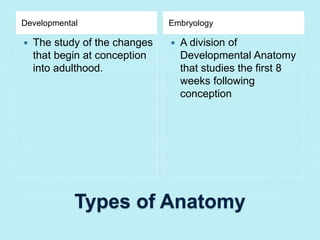
Developmental Embryology 
 The study of the changes 
that begin at conception 
into adulthood. 
 A division of 
Developmental Anatomy 
that studies the first 8 
weeks following 
conception 
Types of Anatomy
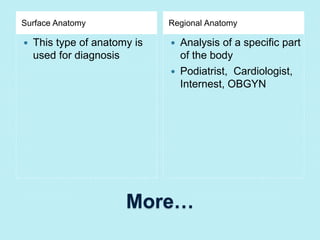
Surface Anatomy Regional Anatomy 
 This type of anatomy is 
used for diagnosis 
 Analysis of a specific part 
of the body 
 Podiatrist, Cardiologist, 
Internest, OBGYN 
More…
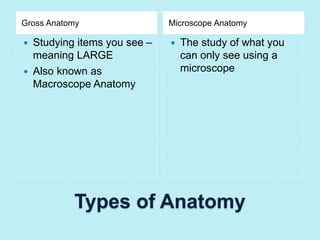
Gross Anatomy Microscope Anatomy 
 Studying items you see – 
meaning LARGE 
 Also known as 
Macroscope Anatomy 
 The study of what you 
can only see using a 
microscope 
Types of Anatomy
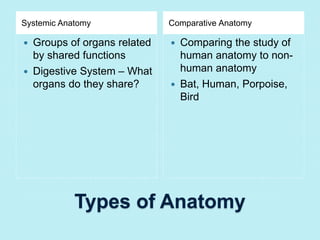
Systemic Anatomy Comparative Anatomy 
 Groups of organs related 
by shared functions 
 Digestive System – What 
organs do they share? 
 Comparing the study of 
human anatomy to non-human 
anatomy 
 Bat, Human, Porpoise, 
Bird 
Types of Anatomy
11 Of Them! 
ORGANIZATIONAL 
LEVELS OF THE HUMAN 
BODY
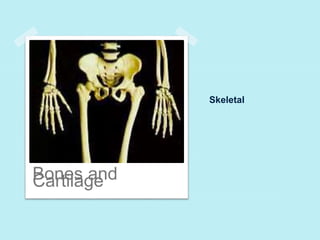
Skeletal 
BCoanrteilas gaend
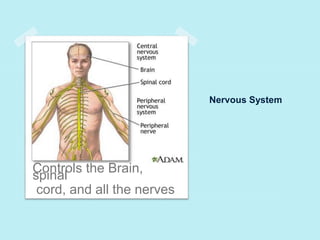
Nervous System 
Controls the Brain, 
spinal 
cord, and all the nerves
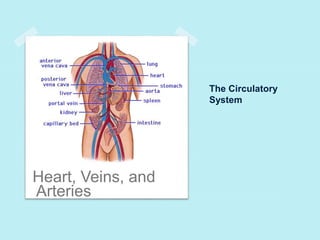
The Circulatory 
System 
Heart, Veins, and 
Arteries
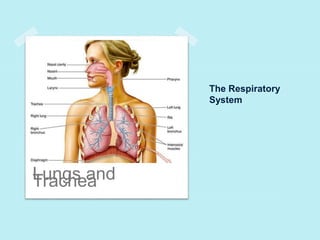
The Respiratory 
System 
LTurancghse aand
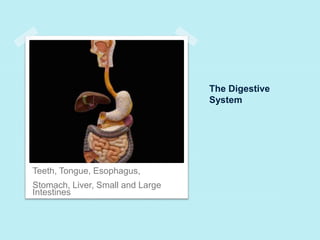
The Digestive 
System 
Teeth, Tongue, Esophagus, 
Stomach, Liver, Small and Large 
Intestines
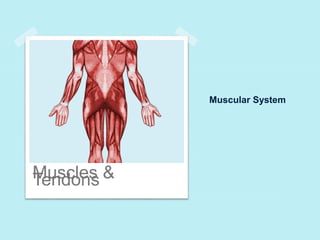
Muscular System 
TMeunsdcolenss &
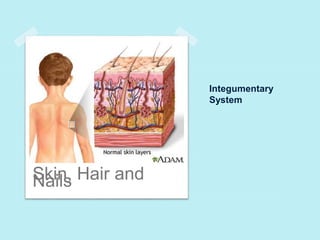
Integumentary 
System 
SNkaiinls, Hair and
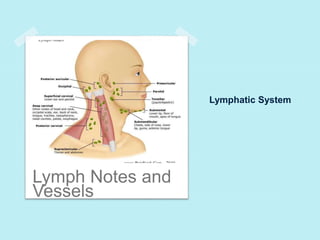
Lymphatic System 
Lymph Notes and 
Vessels
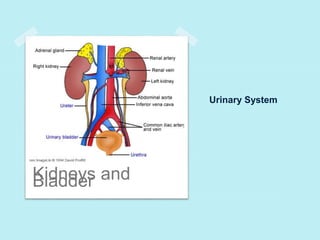
Urinary System 
BKiladdndeyesr and
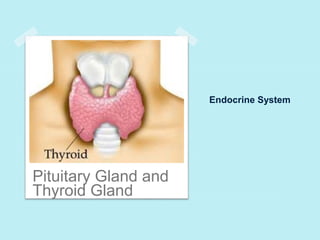
Endocrine System 
Pituitary Gland and 
Thyroid Gland
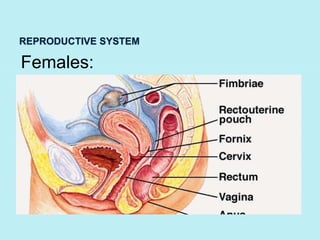
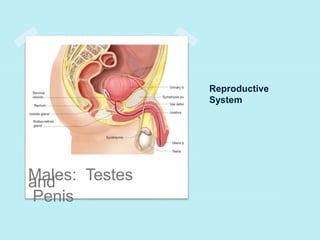
REPRODUCTIVE SYSTEM 
Females: 
Ovaries and 
Uterus
Reproductive 
System 
aMnadles: Testes 
Penis
Define 
 Organ: A group of tissues 
specialized for a particular 
function 
 Tissues: Group of cells forming 
various building materials of the 
body 
 There are 4 Basic Kinds of 
Tissues
Nervous Tissue 
 Brain, spinal cord, and nerves 
 Ability to conduct electrical 
signals
Muscular Tissue 
Muscles that enable your 
skeleton to move, heart to 
beat and internal organs to 
push food along
Connective Tissue 
Bone, cartilage, deeper layer 
of the skin, and the bindings or 
connectors around and 
between organs
Epithelial Tissue 
 Surface of your skin, inner lining of the 
respiratory passages, digestive tract, 
urinary tract, reproductive tract, thyroid 
gland and liver
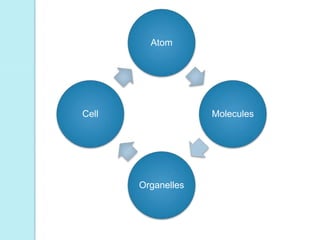
Atom 
Molecules 
Organelles 
Cell
7 Levels of Organization of an 
Organism 
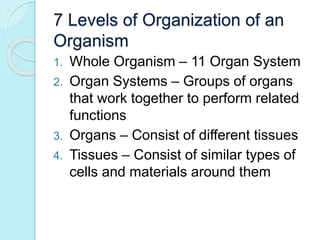
1. Whole Organism – 11 Organ System 
2. Organ Systems – Groups of organs 
that work together to perform related 
functions 
3. Organs – Consist of different tissues 
4. Tissues – Consist of similar types of 
cells and materials around them
7 Levels of Organization of an 
Organism 
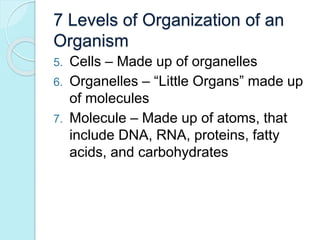
5. Cells – Made up of organelles 
6. Organelles – “Little Organs” made up 
of molecules 
7. Molecule – Made up of atoms, that 
include DNA, RNA, proteins, fatty 
acids, and carbohydrates
Homeostasis 
 What do you think of when you 
think of Homeostasis? 
 Homeostasis = A state of dynamic 
equilibrium in the body with 
respect to its internal environment 
and functions.
Example 
 A normal body temperature should be 
between 98.2°F and 98.8°F 
 If it rises only a few degrees, you 
could die from overheating (like 
106°F) where many enzymes stop 
functioning OR if it falls lover than 
80°F, your heart may fail 
 Too hot: Overheating during exercise 
 Too Cold: Hypothermia – shivering
 If your calcium levels are too high 
you can slip into a coma. 
 If too low, your heartbeat 
becomes irregular
Constantly Changing 
 We live in a constantly changing 
environment, so our body has to 
change to bring it into balance = 
Homeostasis 
 Temperature, fluids, salts, pH, 
nutrients, and gases
Look at the Handout 
attached to your notes
Question 
 If the girl in cold temperatures starts 
jogging, how would the control 
mechanism in her skin respond as she 
runs? 
 Answer: Her skin would respond the 
way it does in hot temperatures. 
Pours would open, sweat glands 
would release water to cool the body
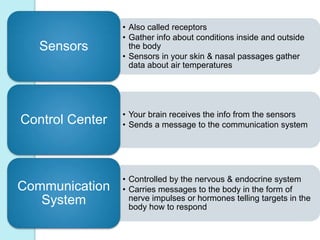
• Also called receptors 
• Gather info about conditions inside and outside 
the body 
• Sensors in your skin & nasal passages gather 
data about air temperatures 
Sensors 
• Your brain receives the info from the sensors 
• Sends a message to the communication system Control Center 
• Controlled by the nervous & endocrine system 
• Carries messages to the body in the form of 
nerve impulses or hormones telling targets in the 
body how to respond 
Communication 
System
Question 
 Why is it so important to maintain 
homeostasis within the body? 
 Answer: The process is necessary for 
life to work best within a narrow range 
of conditions. 
 To maintain these ranges, the internal 
environment of the body must remain 
stable.
Feedback 
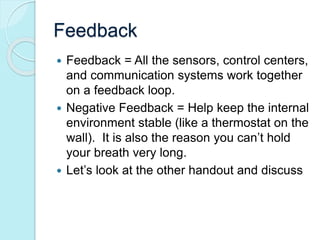
 Feedback = All the sensors, control centers, 
and communication systems work together 
on a feedback loop. 
 Negative Feedback = Help keep the internal 
environment stable (like a thermostat on the 
wall). It is also the reason you can’t hold 
your breath very long. 
 Let’s look at the other handout and discuss
Question 
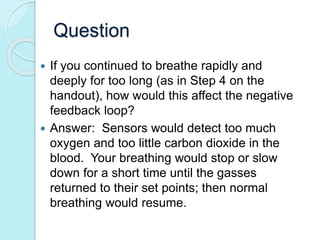
 If you continued to breathe rapidly and 
deeply for too long (as in Step 4 on the 
handout), how would this affect the negative 
feedback loop? 
 Answer: Sensors would detect too much 
oxygen and too little carbon dioxide in the 
blood. Your breathing would stop or slow 
down for a short time until the gasses 
returned to their set points; then normal 
breathing would resume.
Quick Lab on Negative 
Feedback Loop 
 Materials: Hardcover book at least 6”x9” 
 Problem: How does the negative feedback 
loop work? 
 Procedure: 
◦ Balance the hardcover book on your head 
◦ Walk 3 meters forward and backward – 
once with eyes open, then with eyes 
closed
Analyze and Conclude 
 1. Analyze: Describe the negative 
feedback loop that helped keep the book 
balanced on your head. How did closing 
your eyes affect your ability to balance the 
book? 
 2. Connect: Think of another example of a 
negative feedback loop that you might 
observe in your everyday life. Explain how 
you think this loop works.
Positive Feedback 
 Positive Feedback = A control 
center uses information from 
sensors to increase the rate of 
change away from the set points. 
This is needed when rapid 
change is needed.
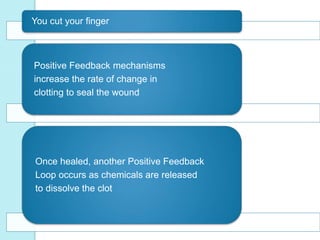
You cut your finger 
Positive Feedback mechanisms 
increase the rate of change in 
clotting to seal the wound 
Once healed, another Positive Feedback 
Loop occurs as chemicals are released 
to dissolve the clot
Another Example 
 Your body releases certain 
hormones during puberty – higher 
levels of hormones to accomplish 
all the changes that will take 
place. 
 Raging hormones!
Question 
 Why are most of the functions of the body 
regulated by negative feedback, rather than 
by positive feedback mechanisms? 
 Answer: Negative Feedback is the means 
by which the body maintains homeostasis. 
Positive Feedback only occurs in situations 
in which a change away from set values is 
needed.
Let’s Review about Homeostasis and 
Feedback Systems 
 1. A system to maintain 
homeostasis must have at least 
four parts that function together. 
Name these parts briefly and 
explain what each one does. 
Work with a partner
Review 
 2. What is the main difference 
between the way negative 
feedback and positive feedback 
mechanisms regulate change in 
the body? 
Work with a partner
Review 
 3. Predict: When a newborn 
baby nurses, the mother’s body is 
stimulated to produce milk. What 
would happen to the milk supply if 
the mother chose to bottle feed 
rather than breast feed? Why? 
Work with a partner
Review 
 4. Suppose you go on a long hike 
in hot weather. Describe a 
possible negative feedback loop 
that would keep your body from 
overheating. 
Work with a partner
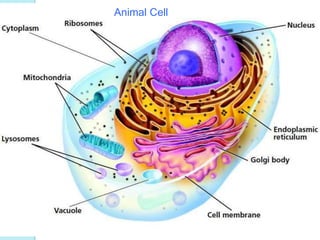
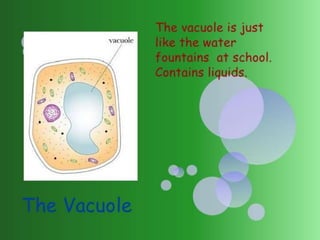
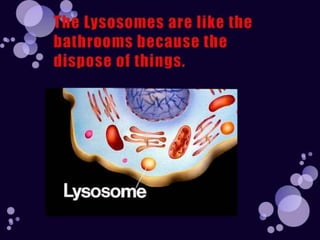
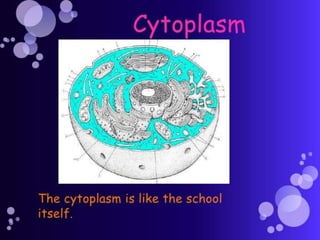
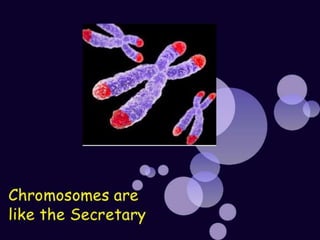
Animal Cell
The following images are from Slideshare 
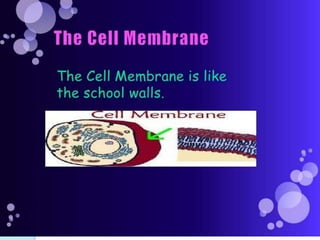
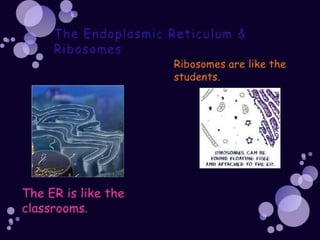
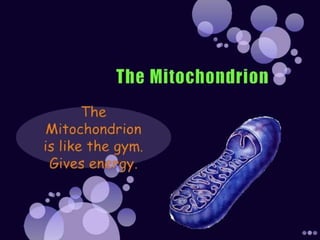
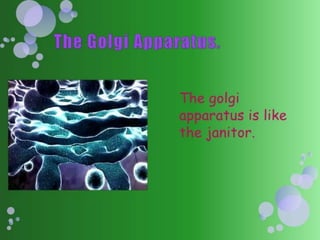
THE CELL IS LIKE A 
SCHOOL…
A&P Module 1
A&P Module 1
A&P Module 1
A&P Module 1
A&P Module 1
A&P Module 1
A&P Module 1
A&P Module 1
A&P Module 1
A&P Module 1

A&P Module 1

  • 1.
    A&P Module 1 Introduction to Anatomy and Physiology
  • 2.
    So, What isWhat?  How would you define Anatomy?  Anatomy is the study of the structure of the body and its parts.  How would you define Physiology?  Physiology is how those parts function and work together.
  • 3.
    Different Types ofAnatomy  Developmental Anatomy  Surface Anatomy  Regional Anatomy  Gross Anatomy  Microscope Anatomy  Systemic Anatomy  Comparative Anatomy
  • 4.
    Developmental Embryology The study of the changes that begin at conception into adulthood.  A division of Developmental Anatomy that studies the first 8 weeks following conception Types of Anatomy
  • 5.
    Surface Anatomy RegionalAnatomy  This type of anatomy is used for diagnosis  Analysis of a specific part of the body  Podiatrist, Cardiologist, Internest, OBGYN More…
  • 6.
    Gross Anatomy MicroscopeAnatomy  Studying items you see – meaning LARGE  Also known as Macroscope Anatomy  The study of what you can only see using a microscope Types of Anatomy
  • 7.
    Systemic Anatomy ComparativeAnatomy  Groups of organs related by shared functions  Digestive System – What organs do they share?  Comparing the study of human anatomy to non-human anatomy  Bat, Human, Porpoise, Bird Types of Anatomy
  • 8.
    11 Of Them! ORGANIZATIONAL LEVELS OF THE HUMAN BODY
  • 9.
  • 10.
    Nervous System Controlsthe Brain, spinal cord, and all the nerves
  • 11.
    The Circulatory System Heart, Veins, and Arteries
  • 12.
    The Respiratory System LTurancghse aand
  • 13.
    The Digestive System Teeth, Tongue, Esophagus, Stomach, Liver, Small and Large Intestines
  • 14.
  • 15.
  • 16.
    Lymphatic System LymphNotes and Vessels
  • 17.
  • 18.
    Endocrine System PituitaryGland and Thyroid Gland
  • 19.
    REPRODUCTIVE SYSTEM Females: Ovaries and Uterus
  • 20.
  • 21.
    Define  Organ:A group of tissues specialized for a particular function  Tissues: Group of cells forming various building materials of the body  There are 4 Basic Kinds of Tissues
  • 22.
    Nervous Tissue Brain, spinal cord, and nerves  Ability to conduct electrical signals
  • 23.
    Muscular Tissue Musclesthat enable your skeleton to move, heart to beat and internal organs to push food along
  • 24.
    Connective Tissue Bone,cartilage, deeper layer of the skin, and the bindings or connectors around and between organs
  • 25.
    Epithelial Tissue Surface of your skin, inner lining of the respiratory passages, digestive tract, urinary tract, reproductive tract, thyroid gland and liver
  • 26.
  • 27.
    7 Levels ofOrganization of an Organism 1. Whole Organism – 11 Organ System 2. Organ Systems – Groups of organs that work together to perform related functions 3. Organs – Consist of different tissues 4. Tissues – Consist of similar types of cells and materials around them
  • 28.
    7 Levels ofOrganization of an Organism 5. Cells – Made up of organelles 6. Organelles – “Little Organs” made up of molecules 7. Molecule – Made up of atoms, that include DNA, RNA, proteins, fatty acids, and carbohydrates
  • 29.
    Homeostasis  Whatdo you think of when you think of Homeostasis?  Homeostasis = A state of dynamic equilibrium in the body with respect to its internal environment and functions.
  • 30.
    Example  Anormal body temperature should be between 98.2°F and 98.8°F  If it rises only a few degrees, you could die from overheating (like 106°F) where many enzymes stop functioning OR if it falls lover than 80°F, your heart may fail  Too hot: Overheating during exercise  Too Cold: Hypothermia – shivering
  • 31.
     If yourcalcium levels are too high you can slip into a coma.  If too low, your heartbeat becomes irregular
  • 32.
    Constantly Changing We live in a constantly changing environment, so our body has to change to bring it into balance = Homeostasis  Temperature, fluids, salts, pH, nutrients, and gases
  • 33.
    Look at theHandout attached to your notes
  • 34.
    Question  Ifthe girl in cold temperatures starts jogging, how would the control mechanism in her skin respond as she runs?  Answer: Her skin would respond the way it does in hot temperatures. Pours would open, sweat glands would release water to cool the body
  • 35.
    • Also calledreceptors • Gather info about conditions inside and outside the body • Sensors in your skin & nasal passages gather data about air temperatures Sensors • Your brain receives the info from the sensors • Sends a message to the communication system Control Center • Controlled by the nervous & endocrine system • Carries messages to the body in the form of nerve impulses or hormones telling targets in the body how to respond Communication System
  • 36.
    Question  Whyis it so important to maintain homeostasis within the body?  Answer: The process is necessary for life to work best within a narrow range of conditions.  To maintain these ranges, the internal environment of the body must remain stable.
  • 37.
    Feedback  Feedback= All the sensors, control centers, and communication systems work together on a feedback loop.  Negative Feedback = Help keep the internal environment stable (like a thermostat on the wall). It is also the reason you can’t hold your breath very long.  Let’s look at the other handout and discuss
  • 38.
    Question  Ifyou continued to breathe rapidly and deeply for too long (as in Step 4 on the handout), how would this affect the negative feedback loop?  Answer: Sensors would detect too much oxygen and too little carbon dioxide in the blood. Your breathing would stop or slow down for a short time until the gasses returned to their set points; then normal breathing would resume.
  • 39.
    Quick Lab onNegative Feedback Loop  Materials: Hardcover book at least 6”x9”  Problem: How does the negative feedback loop work?  Procedure: ◦ Balance the hardcover book on your head ◦ Walk 3 meters forward and backward – once with eyes open, then with eyes closed
  • 40.
    Analyze and Conclude  1. Analyze: Describe the negative feedback loop that helped keep the book balanced on your head. How did closing your eyes affect your ability to balance the book?  2. Connect: Think of another example of a negative feedback loop that you might observe in your everyday life. Explain how you think this loop works.
  • 41.
    Positive Feedback Positive Feedback = A control center uses information from sensors to increase the rate of change away from the set points. This is needed when rapid change is needed.
  • 42.
    You cut yourfinger Positive Feedback mechanisms increase the rate of change in clotting to seal the wound Once healed, another Positive Feedback Loop occurs as chemicals are released to dissolve the clot
  • 43.
    Another Example Your body releases certain hormones during puberty – higher levels of hormones to accomplish all the changes that will take place.  Raging hormones!
  • 44.
    Question  Whyare most of the functions of the body regulated by negative feedback, rather than by positive feedback mechanisms?  Answer: Negative Feedback is the means by which the body maintains homeostasis. Positive Feedback only occurs in situations in which a change away from set values is needed.
  • 45.
    Let’s Review aboutHomeostasis and Feedback Systems  1. A system to maintain homeostasis must have at least four parts that function together. Name these parts briefly and explain what each one does. Work with a partner
  • 46.
    Review  2.What is the main difference between the way negative feedback and positive feedback mechanisms regulate change in the body? Work with a partner
  • 47.
    Review  3.Predict: When a newborn baby nurses, the mother’s body is stimulated to produce milk. What would happen to the milk supply if the mother chose to bottle feed rather than breast feed? Why? Work with a partner
  • 48.
    Review  4.Suppose you go on a long hike in hot weather. Describe a possible negative feedback loop that would keep your body from overheating. Work with a partner
  • 49.
  • 50.
    The following imagesare from Slideshare THE CELL IS LIKE A SCHOOL…

Editor's Notes

  • #27 1. Atom 2. Molecules: Combination of atoms 3. Organelles: Little organs formed from molecules 4. Cell: Basic unit of life made of organelles
  • #41 Analyze and Conclude: As sensors in the scalp detect changes in the book’s position, they send messages to control sensors in the brain, which then send messages to the muscles. Students may have adjusted their speed, shifted their head or body, or grabbed the book with their hands. When students closed their eyes, they lost sensory information about body position relative to their surroundings which may have made the balancing task more difficult. Other feedback systems include cooling systems in a car engine, thermostats that control air conditioners; and the body’s signals for hunger or thirst. All these feedback loops involve preset values and information about changing conditions that are relayed to control centers, which then send messages to targets to counteract changes and restore conditions to the present values.