Unit-I
1. Introduction to human body
Represented By,
Mr. Audumbar Mali.
(Assistant Professor)
Sahyadri College of Pharmacy Methwade
BP101T. Human Anatomy And Physiology-I (Theory)
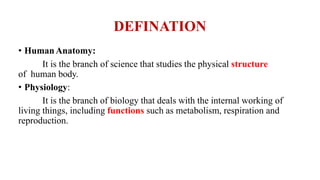
DEFINATION
• HumanAnatomy:
It is the branch of science that studies the physical structure
of human body.
• Physiology:
It is the branch of biology that deals with the internal working of
living things, including functions such as metabolism, respiration and
reproduction.
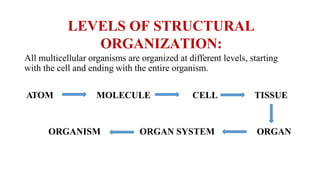
LEVELS OF STRUCTURAL
ORGANIZATION:
All multicellular organisms are organized at different levels, starting
with the cell and ending with the entire organism.
ATOM MOLECULE CELL TISSUE
ORGANISM ORGAN SYSTEM ORGAN
LEVELS OF STRUCTURAL
ORGANIZATION
• There are six levels of organization (from smallest to largest)
1. The chemical level
2. The cellular level
3. The tissue level
4. The organ level
5. The organ system level
6. The organism level
SYSTEMS OF THE HUMAN BODY
• There are 11 systems of the human body
1. Integumentary system (hairs, nails, sweat glands, oil glands)
2. Skeletal system
3. Muscular system
4. Endocrine system
5. Cardiovascular system
6. Lymphatic system
7. Respiratory system
8. Digestive system
9. Nervous system
10. Urinary system
11. Reproductive system
BASIC LIFE PROCESSES
• There are 6 most important life processes of human body are :
1. Metabolism: It is the sum of all chemical processes that occurs in the
body.
a) Catabolism: breakdown of complex chemical substance into simpler
components e.g. digestion of protein into amino acids.
b) Anabolism: building up of complex chemical substance from smaller, simpler
components e.g. use of amino acids to build new proteins of the body.
2. Responsiveness: It is the body’s ability to detect and respond to changes.
3. Movement: It includes motion of the whole body, individual organs, single
cells etc.
4. Growth: It is an increase in body size and weight
5. Differentiation: It is the development of a cell from an unspecialized to a
specialized state.
6. Reproduction: formation of new cells or to the production of a new individual.
HOMEOSTASIS
Homeostasis- A major mechanism for homeostasis is
communication and exchange of materials between intracellular fluid (ICF),
interstitial fluid (between cells) and plasma (the liquid portion of
blood). (Extracellular fluid (ECF) = plasma plus interstitial fluid.)
• the self-sustaining mechanisms in organisms that tries to maintain stable
internal conditions.
• Without homeostasis, organisms would not be able to have stable
internal conditions, and therefore would not be able to survive.
• Homeostasis is a dynamic condition in response to changing
conditions.
The two body systems that largely control the body’s homeostatic state:
1. Nervous system
2. Endocrine system
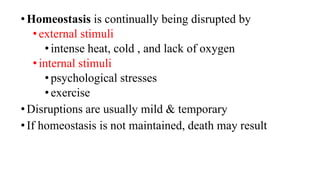
•Homeostasis is continually being disrupted by
•external stimuli
•intense heat, cold , and lack of oxygen
•internal stimuli
•psychological stresses
•exercise
•Disruptions are usually mild & temporary
•If homeostasis is not maintained, death may result
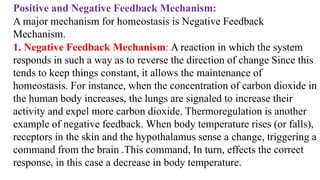
Positive and Negative Feedback Mechanism:
A major mechanism for homeostasis is Negative Feedback
Mechanism.
1. Negative Feedback Mechanism: A reaction in which the system
responds in such a way as to reverse the direction of change Since this
tends to keep things constant, it allows the maintenance of
homeostasis. For instance, when the concentration of carbon dioxide in
the human body increases, the lungs are signaled to increase their
activity and expel more carbon dioxide. Thermoregulation is another
example of negative feedback. When body temperature rises (or falls),
receptors in the skin and the hypothalamus sense a change, triggering a
command from the brain .This command, In turn, effects the correct
response, in this case a decrease in body temperature.
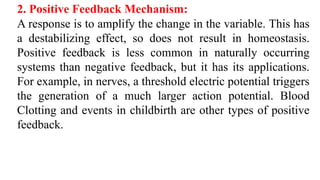
2. Positive Feedback Mechanism:
A response is to amplify the change in the variable. This has
a destabilizing effect, so does not result in homeostasis.
Positive feedback is less common in naturally occurring
systems than negative feedback, but it has its applications.
For example, in nerves, a threshold electric potential triggers
the generation of a much larger action potential. Blood
Clotting and events in childbirth are other types of positive
feedback.
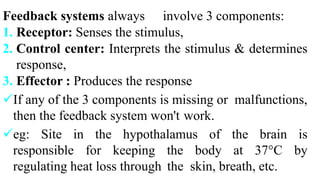
Feedback systems always involve 3 components:
1. Receptor: Senses the stimulus,
2. Control center: Interprets the stimulus & determines
response,
3. Effector : Produces the response
If any of the 3 components is missing or malfunctions,
then the feedback system won't work.
eg: Site in the hypothalamus of the brain is
responsible for keeping the body at 37°C by
regulating heat loss through the skin, breath, etc.
Our bodies control body temperature in a similar way. The
brain is the control center, the receptor is our body's
temperature sensors, and the effector is our blood vessels and
glands in our skin. When we feel heat, the temperature
sensors in our skin send the message to our brain. Our brain
then sends the message to the sweat glands to increase
sweating and increase blood flow to our skin. When we feel
cold, the opposite happens. Our brain sends, message to our
sweat glands to decrease sweating, decrease blood flow, and
begin shivering. This is an ongoing process that continually
works to restore and maintain homeostasis
CONTROL OFHOMEOSTASIS
• Homeostatic imbalances occur because of disruptions from the
external or internal environments.
• Homeostasis is regulated by the nervous system and endocrine
system, acting together or independently.
• The nervous system detects changes and sends nerve impulses to
counteract the disruption.
• The endocrine system regulates homeostasis by secreting
hormones.
• Whereas nerve impulses cause rapid changes, hormones usually work
more slowly.
BASIC ANATOMICALTERMINOLOGY
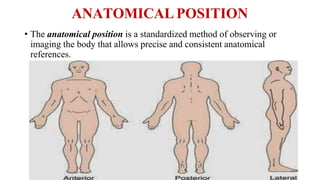
ANATOMICAL POSITION
• The anatomical position is a standardized method of observing or
imaging the body that allows precise and consistent anatomical
references.
TERMINOLOGY
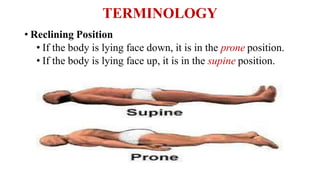
• Reclining Position
• If the body is lying face down, it is in the prone position.
• If the body is lying face up, it is in the supine position.
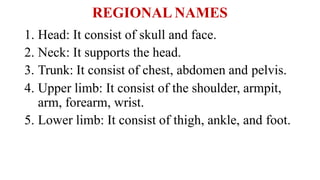
REGIONAL NAMES
1. Head: It consist of skull and face.
2. Neck: It supports the head.
3. Trunk: It consist of chest, abdomen and pelvis.
4. Upper limb: It consist of the shoulder, armpit,
arm, forearm, wrist.
5. Lower limb: It consist of thigh, ankle, and foot.
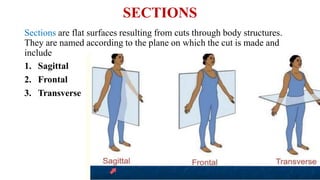
SECTIONS
Sections are flat surfaces resulting from cuts through body structures.
They are named according to the plane on which the cut is made and
include
1. Sagittal
2. Frontal
3. Transverse
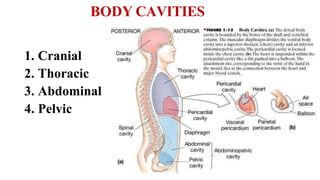
BODY CAVITIES
1. Cranial
2. Thoracic
3. Abdominal
4. Pelvic
References:
1. Presentation on Introduction To Human Anatomy &
Physiology, By Mr. Abhay Shripad Joshi.
2. Human Anatomy and Physiology-I,
By Dr. Mahesh Prasad, Dr. Antesh Kumar Jha, Mr.
Ritesh Kumar Srivastav, Nirali Prakashan, As per PCI
Syllabus. Page No. 1.1 to 1.7.
3. www.google.com.
THANK YOU

Unit I, chapter-1- introduction to human body final

  • 1.
    Unit-I 1. Introduction tohuman body Represented By, Mr. Audumbar Mali. (Assistant Professor) Sahyadri College of Pharmacy Methwade BP101T. Human Anatomy And Physiology-I (Theory)
  • 2.
    DEFINATION • HumanAnatomy: It isthe branch of science that studies the physical structure of human body. • Physiology: It is the branch of biology that deals with the internal working of living things, including functions such as metabolism, respiration and reproduction.
  • 3.
    LEVELS OF STRUCTURAL ORGANIZATION: Allmulticellular organisms are organized at different levels, starting with the cell and ending with the entire organism. ATOM MOLECULE CELL TISSUE ORGANISM ORGAN SYSTEM ORGAN
  • 4.
    LEVELS OF STRUCTURAL ORGANIZATION •There are six levels of organization (from smallest to largest) 1. The chemical level 2. The cellular level 3. The tissue level 4. The organ level 5. The organ system level 6. The organism level
  • 5.
    SYSTEMS OF THEHUMAN BODY • There are 11 systems of the human body 1. Integumentary system (hairs, nails, sweat glands, oil glands) 2. Skeletal system 3. Muscular system 4. Endocrine system 5. Cardiovascular system 6. Lymphatic system 7. Respiratory system 8. Digestive system 9. Nervous system 10. Urinary system 11. Reproductive system
  • 6.
    BASIC LIFE PROCESSES •There are 6 most important life processes of human body are : 1. Metabolism: It is the sum of all chemical processes that occurs in the body. a) Catabolism: breakdown of complex chemical substance into simpler components e.g. digestion of protein into amino acids. b) Anabolism: building up of complex chemical substance from smaller, simpler components e.g. use of amino acids to build new proteins of the body. 2. Responsiveness: It is the body’s ability to detect and respond to changes. 3. Movement: It includes motion of the whole body, individual organs, single cells etc. 4. Growth: It is an increase in body size and weight 5. Differentiation: It is the development of a cell from an unspecialized to a specialized state. 6. Reproduction: formation of new cells or to the production of a new individual.
  • 7.
    HOMEOSTASIS Homeostasis- A majormechanism for homeostasis is communication and exchange of materials between intracellular fluid (ICF), interstitial fluid (between cells) and plasma (the liquid portion of blood). (Extracellular fluid (ECF) = plasma plus interstitial fluid.) • the self-sustaining mechanisms in organisms that tries to maintain stable internal conditions. • Without homeostasis, organisms would not be able to have stable internal conditions, and therefore would not be able to survive. • Homeostasis is a dynamic condition in response to changing conditions. The two body systems that largely control the body’s homeostatic state: 1. Nervous system 2. Endocrine system
  • 8.
    •Homeostasis is continuallybeing disrupted by •external stimuli •intense heat, cold , and lack of oxygen •internal stimuli •psychological stresses •exercise •Disruptions are usually mild & temporary •If homeostasis is not maintained, death may result
  • 9.
    Positive and NegativeFeedback Mechanism: A major mechanism for homeostasis is Negative Feedback Mechanism. 1. Negative Feedback Mechanism: A reaction in which the system responds in such a way as to reverse the direction of change Since this tends to keep things constant, it allows the maintenance of homeostasis. For instance, when the concentration of carbon dioxide in the human body increases, the lungs are signaled to increase their activity and expel more carbon dioxide. Thermoregulation is another example of negative feedback. When body temperature rises (or falls), receptors in the skin and the hypothalamus sense a change, triggering a command from the brain .This command, In turn, effects the correct response, in this case a decrease in body temperature.
  • 10.
    2. Positive FeedbackMechanism: A response is to amplify the change in the variable. This has a destabilizing effect, so does not result in homeostasis. Positive feedback is less common in naturally occurring systems than negative feedback, but it has its applications. For example, in nerves, a threshold electric potential triggers the generation of a much larger action potential. Blood Clotting and events in childbirth are other types of positive feedback.
  • 11.
    Feedback systems alwaysinvolve 3 components: 1. Receptor: Senses the stimulus, 2. Control center: Interprets the stimulus & determines response, 3. Effector : Produces the response If any of the 3 components is missing or malfunctions, then the feedback system won't work. eg: Site in the hypothalamus of the brain is responsible for keeping the body at 37°C by regulating heat loss through the skin, breath, etc.
  • 12.
    Our bodies controlbody temperature in a similar way. The brain is the control center, the receptor is our body's temperature sensors, and the effector is our blood vessels and glands in our skin. When we feel heat, the temperature sensors in our skin send the message to our brain. Our brain then sends the message to the sweat glands to increase sweating and increase blood flow to our skin. When we feel cold, the opposite happens. Our brain sends, message to our sweat glands to decrease sweating, decrease blood flow, and begin shivering. This is an ongoing process that continually works to restore and maintain homeostasis
  • 13.
    CONTROL OFHOMEOSTASIS • Homeostaticimbalances occur because of disruptions from the external or internal environments. • Homeostasis is regulated by the nervous system and endocrine system, acting together or independently. • The nervous system detects changes and sends nerve impulses to counteract the disruption. • The endocrine system regulates homeostasis by secreting hormones. • Whereas nerve impulses cause rapid changes, hormones usually work more slowly.
  • 14.
  • 15.
    ANATOMICAL POSITION • Theanatomical position is a standardized method of observing or imaging the body that allows precise and consistent anatomical references.
  • 16.
    TERMINOLOGY • Reclining Position •If the body is lying face down, it is in the prone position. • If the body is lying face up, it is in the supine position.
  • 17.
    REGIONAL NAMES 1. Head:It consist of skull and face. 2. Neck: It supports the head. 3. Trunk: It consist of chest, abdomen and pelvis. 4. Upper limb: It consist of the shoulder, armpit, arm, forearm, wrist. 5. Lower limb: It consist of thigh, ankle, and foot.
  • 18.
    SECTIONS Sections are flatsurfaces resulting from cuts through body structures. They are named according to the plane on which the cut is made and include 1. Sagittal 2. Frontal 3. Transverse
  • 19.
    BODY CAVITIES 1. Cranial 2.Thoracic 3. Abdominal 4. Pelvic
  • 20.
    References: 1. Presentation onIntroduction To Human Anatomy & Physiology, By Mr. Abhay Shripad Joshi. 2. Human Anatomy and Physiology-I, By Dr. Mahesh Prasad, Dr. Antesh Kumar Jha, Mr. Ritesh Kumar Srivastav, Nirali Prakashan, As per PCI Syllabus. Page No. 1.1 to 1.7. 3. www.google.com.
  • 21.