Chapter 7Chapter 7
Consumers,
Producers, and
the Efficiency of
Markets
©© 2002 by Nelson, a division of Thomson Canada Limited2002 by Nelson, a division of Thomson Canada Limited
Mankiw et al. Principles of Microeconomics, 2nd Canadian Edi
• Examine the link between buyers’ willingness to
pay for a good and the demand curve.
• Learn how to define and measure consumer
surplus.
• Examine the link between sellers’ cost of
producing a good and the supply curve.
• Learn how to define and measure consumer
surplus.
• See that the equilibrium of supply and demand
maximizes total surplus in a market.
• Examine the link between buyers’ willingness to
pay for a good and the demand curve.
• Learn how to define and measure consumer
surplus.
• Examine the link between sellers’ cost of
producing a good and the supply curve.
• Learn how to define and measure consumer
surplus.
• See that the equilibrium of supply and demand
maximizes total surplus in a market.
In this chapter you will…In this chapter you will…
Mankiw et al. Principles of Microeconomics, 2nd Canadian Edi
• Do the equilibrium price and quantity
maximize the total welfare of buyers and
sellers?
• Market equilibrium reflects the way
markets allocate scarce resources.
• Whether the market allocation is desirable
can be addressed by welfare economics.
• Do the equilibrium price and quantity
maximize the total welfare of buyers and
sellers?
• Market equilibrium reflects the way
markets allocate scarce resources.
• Whether the market allocation is desirable
can be addressed by welfare economics.
CONSUMERS, PRODUCERS, AND THECONSUMERS, PRODUCERS, AND THE
EFFICIENCY OF MARKETSEFFICIENCY OF MARKETS
Mankiw et al. Principles of Microeconomics, 2nd Canadian Edi
• Welfare economics is the study of how the
allocation of resources affects economic well-
being.
• Buyers and sellers receive benefits from taking
part in the market.
• The equilibrium in a market maximizes the total
welfare of buyers and sellers.
• Equilibrium in the market results in maximum
benefits, and therefore maximum total welfare for
both the consumers and the producers of the
product.
• Welfare economics is the study of how the
allocation of resources affects economic well-
being.
• Buyers and sellers receive benefits from taking
part in the market.
• The equilibrium in a market maximizes the total
welfare of buyers and sellers.
• Equilibrium in the market results in maximum
benefits, and therefore maximum total welfare for
both the consumers and the producers of the
product.
CONSUMERS, PRODUCERS, AND THECONSUMERS, PRODUCERS, AND THE
EFFICIENCY OF MARKETSEFFICIENCY OF MARKETS
Mankiw et al. Principles of Microeconomics, 2nd Canadian Edi
• Consumer surplus measures economic
welfare from the buyer’s side
• Consumer surplus measures economic
welfare from the buyer’s side
• Producer surplus measures economic
welfare from the seller’s side.
• Producer surplus measures economic
welfare from the seller’s side.
CONSUMERS, PRODUCERS, AND THECONSUMERS, PRODUCERS, AND THE
EFFICIENCY OF MARKETSEFFICIENCY OF MARKETS
Mankiw et al. Principles of Microeconomics, 2nd Canadian Edi
• Consumer surplus is the buyer’s
willingness to pay for a good minus the
amount the buyer actually pays for it.
• Consumer surplus is the buyer’s
willingness to pay for a good minus the
amount the buyer actually pays for it.
CONSUMER SURPLUSCONSUMER SURPLUS
• Willingness to pay is the maximum
amount that a buyer will pay for a good.
• It measures how much the buyer values
the good or service.
• Willingness to pay is the maximum
amount that a buyer will pay for a good.
• It measures how much the buyer values
the good or service.
Mankiw et al. Principles of Microeconomics, 2nd Canadian Edi
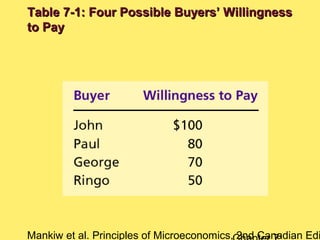
Table 7-1: Four Possible Buyers’ WillingnessTable 7-1: Four Possible Buyers’ Willingness
to Payto Pay
Mankiw et al. Principles of Microeconomics, 2nd Canadian Edi
CONSUMER SURPLUSCONSUMER SURPLUS
• The market demand curve depicts the
various quantities that buyers would be
willing and able to purchase at different
prices.
• The market demand curve depicts the
various quantities that buyers would be
willing and able to purchase at different
prices.
Mankiw et al. Principles of Microeconomics, 2nd Canadian Edi
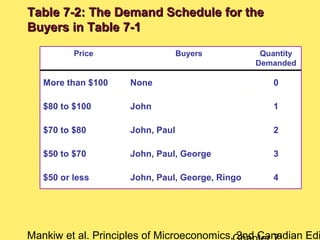
Table 7-2: The Demand Schedule for theTable 7-2: The Demand Schedule for the
Buyers in Table 7-1Buyers in Table 7-1
4John, Paul, George, Ringo$50 or less
3John, Paul, George$50 to $70
2John, Paul$70 to $80
1John$80 to $100
0NoneMore than $100
Quantity
Demanded
BuyersPrice
Mankiw et al. Principles of Microeconomics, 2nd Canadian Edi
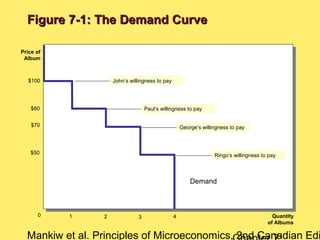
Quantity
of Albums
Price of
Album
$100
$80
$70
$50
0 1 2 3 4
John’s willingness to pay
Paul’s willingness to pay
George’s willingness to pay
Ringo’s willingness to pay
Demand
Figure 7-1: The Demand CurveFigure 7-1: The Demand Curve
Mankiw et al. Principles of Microeconomics, 2nd Canadian Edi
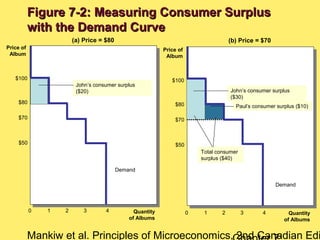
(a) Price = $80 (b) Price = $70
Price of
Album
Quantity
of Albums
$100
$80
$70
$50
0 1 2 3 4
John’s consumer surplus
($20)
Demand
Price of
Album
$100
$80
$70
$50
0 1 2 3 4 Quantity
of Albums
John’s consumer surplus
($30)
Paul’s consumer surplus ($10)
Total consumer
surplus ($40)
Figure 7-2: Measuring Consumer SurplusFigure 7-2: Measuring Consumer Surplus
with the Demand Curvewith the Demand Curve
Demand
Mankiw et al. Principles of Microeconomics, 2nd Canadian Edi
Using the Demand Curve to MeasureUsing the Demand Curve to Measure
Consumer SurplusConsumer Surplus
• The area below the demand curve and
above the price measures the consumer
surplus in the market.
• The area below the demand curve and
above the price measures the consumer
surplus in the market.
Mankiw et al. Principles of Microeconomics, 2nd Canadian Edi
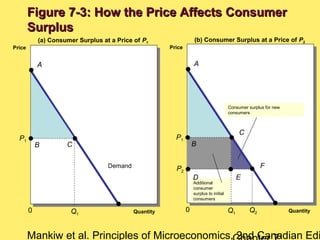
(a) Consumer Surplus at a Price of P1
(b) Consumer Surplus at a Price of P2
Price
Quantity
Price
0 Quantity
Consumer surplus for new
consumers
P1
0 Q1
B
A
C
Demand
Additional
consumer
surplus to initial
consumers
Q1
A
C
P1
B
P2
Q2
E
F
D
Figure 7-3: How the Price Affects ConsumerFigure 7-3: How the Price Affects Consumer
SurplusSurplus
Mankiw et al. Principles of Microeconomics, 2nd Canadian Edi
What Does Consumer Surplus Measure?What Does Consumer Surplus Measure?
• Consumer surplus, the amount that
buyers are willing to pay for a good minus
the amount they actually pay for it,
measures the benefit that buyers receive
from a good as the buyers themselves
perceive it.
• Consumer surplus, the amount that
buyers are willing to pay for a good minus
the amount they actually pay for it,
measures the benefit that buyers receive
from a good as the buyers themselves
perceive it.
Mankiw et al. Principles of Microeconomics, 2nd Canadian Edi
PRODUCER SURPLUSPRODUCER SURPLUS
• Producer surplus is the amount a
seller is paid for a good minus the
seller’s cost.
• It measures the benefit to sellers
participating in a market.
• Producer surplus is the amount a
seller is paid for a good minus the
seller’s cost.
• It measures the benefit to sellers
participating in a market.
Mankiw et al. Principles of Microeconomics, 2nd Canadian Edi
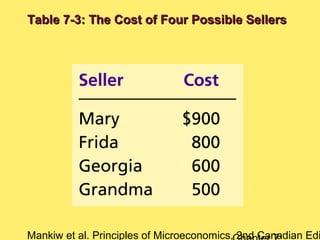
Table 7-3: The Cost of Four Possible SellersTable 7-3: The Cost of Four Possible Sellers
Mankiw et al. Principles of Microeconomics, 2nd Canadian Edi
Using the Supply Curve to MeasureUsing the Supply Curve to Measure
Producer SurplusProducer Surplus
• Just as consumer surplus is related to the
demand curve, producer surplus is closely
related to the supply curve.
• Just as consumer surplus is related to the
demand curve, producer surplus is closely
related to the supply curve.
Mankiw et al. Principles of Microeconomics, 2nd Canadian Edi
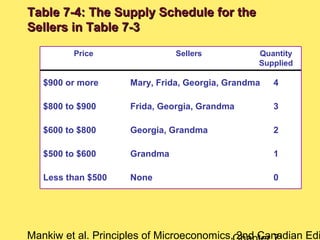
Table 7-4: The Supply Schedule for theTable 7-4: The Supply Schedule for the
Sellers in Table 7-3Sellers in Table 7-3
0NoneLess than $500
1Grandma$500 to $600
2Georgia, Grandma$600 to $800
3Frida, Georgia, Grandma$800 to $900
4Mary, Frida, Georgia, Grandma$900 or more
Quantity
Supplied
SellersPrice
Mankiw et al. Principles of Microeconomics, 2nd Canadian Edi
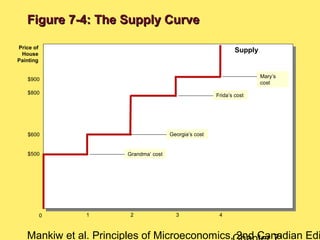
0 1 2 3 4
Mary’s
cost
Frida’s cost
Georgia’s cost
Grandma’ cost
Price of
House
Painting
Supply
$900
$800
$500
$600
Figure 7-4: The Supply CurveFigure 7-4: The Supply Curve
Mankiw et al. Principles of Microeconomics, 2nd Canadian Edi
Using the Supply Curve to MeasureUsing the Supply Curve to Measure
Producer SurplusProducer Surplus
• The area below the price and above the
supply curve measures the producer
surplus in a market.
• The area below the price and above the
supply curve measures the producer
surplus in a market.
Mankiw et al. Principles of Microeconomics, 2nd Canadian Edi
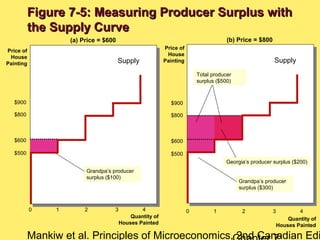
(a) Price = $600 (b) Price = $800
Price of
House
Painting
Quantity of
Houses Painted
$900
$800
$500
0 1 2 3 4
Grandpa’s producer
surplus ($100)
Supply
$600
Price of
House
Painting
0 1 2 3 4
Quantity of
Houses Painted
$900
$800
$500
$600
Grandpa’s producer
surplus ($300)
Georgia’s producer surplus ($200)
Supply
Total producer
surplus ($500)
Figure 7-5: Measuring Producer Surplus withFigure 7-5: Measuring Producer Surplus with
the Supply Curvethe Supply Curve
Mankiw et al. Principles of Microeconomics, 2nd Canadian Edi
Producer
surplus
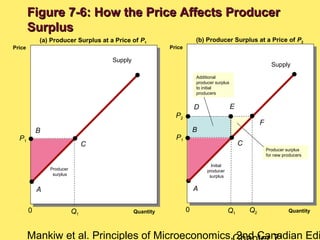
(a) Producer Surplus at a Price of P1
(b) Producer Surplus at a Price of P2
Price
Quantity
Price
0 Quantity
Producer surplus
for new producers
Additional
producer surplus
to initial
producers
P1
0 Q1
B
A
C
Supply
Supply
Initial
producer
surplus
P1
Q1
B
A
C
P2
Q2
E
F
D
Figure 7-6: How the Price Affects ProducerFigure 7-6: How the Price Affects Producer
SurplusSurplus
Mankiw et al. Principles of Microeconomics, 2nd Canadian Edi
MARKET EFFICIENCYMARKET EFFICIENCY
• Consumer surplus and producer surplus
may be used to address the following
question:
– Is the allocation of resources
determined by free markets in any way
desirable?
• Consumer surplus and producer surplus
may be used to address the following
question:
– Is the allocation of resources
determined by free markets in any way
desirable?
Mankiw et al. Principles of Microeconomics, 2nd Canadian Edi
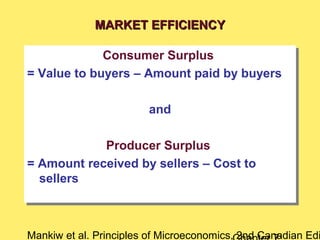
Consumer Surplus
= Value to buyers – Amount paid by buyers
and
Producer Surplus
= Amount received by sellers – Cost to
sellers
Consumer Surplus
= Value to buyers – Amount paid by buyers
and
Producer Surplus
= Amount received by sellers – Cost to
sellers
MARKET EFFICIENCYMARKET EFFICIENCY
Mankiw et al. Principles of Microeconomics, 2nd Canadian Edi
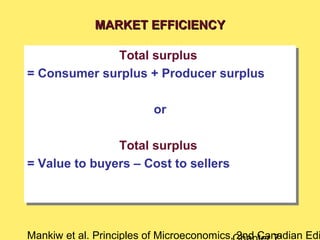
Total surplus
= Consumer surplus + Producer surplus
or
Total surplus
= Value to buyers – Cost to sellers
Total surplus
= Consumer surplus + Producer surplus
or
Total surplus
= Value to buyers – Cost to sellers
MARKET EFFICIENCYMARKET EFFICIENCY
Mankiw et al. Principles of Microeconomics, 2nd Canadian Edi
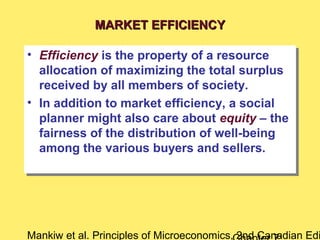
• Efficiency is the property of a resource
allocation of maximizing the total surplus
received by all members of society.
• In addition to market efficiency, a social
planner might also care about equity – the
fairness of the distribution of well-being
among the various buyers and sellers.
• Efficiency is the property of a resource
allocation of maximizing the total surplus
received by all members of society.
• In addition to market efficiency, a social
planner might also care about equity – the
fairness of the distribution of well-being
among the various buyers and sellers.
MARKET EFFICIENCYMARKET EFFICIENCY
Mankiw et al. Principles of Microeconomics, 2nd Canadian Edi
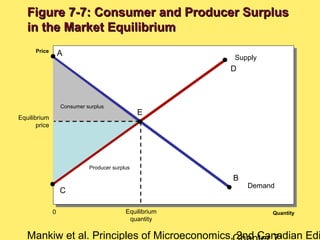
Demand
Supply
B
Quantity
Price
0
Consumer surplus
A
C
D
Equilibrium
price
Equilibrium
quantity
E
Producer surplus
Figure 7-7: Consumer and Producer SurplusFigure 7-7: Consumer and Producer Surplus
in the Market Equilibriumin the Market Equilibrium
Mankiw et al. Principles of Microeconomics, 2nd Canadian Edi
• Three Insights Concerning Market
Outcomes
– Free markets allocate the supply of goods to
the buyers who value them most highly, as
measured by their willingness to pay.
– Free markets allocate the demand for goods to
the sellers who can produce them at least
cost.
– Free markets produce the quantity of goods
that maximizes the sum of consumer and
producer surplus.
• Three Insights Concerning Market
Outcomes
– Free markets allocate the supply of goods to
the buyers who value them most highly, as
measured by their willingness to pay.
– Free markets allocate the demand for goods to
the sellers who can produce them at least
cost.
– Free markets produce the quantity of goods
that maximizes the sum of consumer and
producer surplus.
MARKET EFFICIENCYMARKET EFFICIENCY
Mankiw et al. Principles of Microeconomics, 2nd Canadian Edi
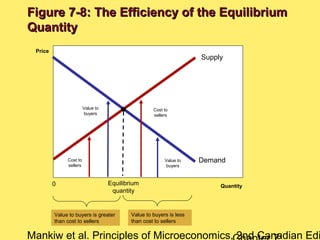
Demand
Supply
Quantity
Price
0 Equilibrium
quantity
Value to buyers is greater
than cost to sellers
Value to buyers is less
than cost to sellers
Cost to
sellers
Value to
buyers
Value to
buyers
Cost to
sellers
Figure 7-8: The Efficiency of the EquilibriumFigure 7-8: The Efficiency of the Equilibrium
QuantityQuantity
Mankiw et al. Principles of Microeconomics, 2nd Canadian Edi
Evaluating the Market EquilibriumEvaluating the Market Equilibrium
• Because the equilibrium outcome is an
efficient allocation of resources, the social
planner can leave the market outcome as
he/she finds it.
• This policy of leaving well enough alone
goes by the French expression laissez
faire.
• Because the equilibrium outcome is an
efficient allocation of resources, the social
planner can leave the market outcome as
he/she finds it.
• This policy of leaving well enough alone
goes by the French expression laissez
faire.
Mankiw et al. Principles of Microeconomics, 2nd Canadian Edi
Evaluating the Market EquilibriumEvaluating the Market Equilibrium
• Market Power
– If a market system is not perfectly
competitive, market power may result.
• Market power is the ability to influence
prices.
• Market power can cause markets to be
inefficient because it keeps price and
quantity from the equilibrium of supply and
demand.
• Market Power
– If a market system is not perfectly
competitive, market power may result.
• Market power is the ability to influence
prices.
• Market power can cause markets to be
inefficient because it keeps price and
quantity from the equilibrium of supply and
demand.
Mankiw et al. Principles of Microeconomics, 2nd Canadian Edi
Evaluating the Market EquilibriumEvaluating the Market Equilibrium
• Externalities
– created when a market outcome affects
individuals other than buyers and sellers in
that market.
– cause welfare in a market to depend on more
than just the value to the buyers and cost to
the sellers.
• When buyers and sellers do not take externalities
into account when deciding how much to
consume and produce, the equilibrium in the
market can be inefficient.
• Externalities
– created when a market outcome affects
individuals other than buyers and sellers in
that market.
– cause welfare in a market to depend on more
than just the value to the buyers and cost to
the sellers.
• When buyers and sellers do not take externalities
into account when deciding how much to
consume and produce, the equilibrium in the
market can be inefficient.
Mankiw et al. Principles of Microeconomics, 2nd Canadian Edi
SummarySummary
• Consumer surplus equals buyers’
willingness to pay for a good minus the
amount they actually pay for it.
• Consumer surplus measures the benefit
buyers get from participating in a market.
• Consumer surplus can be computed by
finding the area below the demand curve
and above the price.
• Consumer surplus equals buyers’
willingness to pay for a good minus the
amount they actually pay for it.
• Consumer surplus measures the benefit
buyers get from participating in a market.
• Consumer surplus can be computed by
finding the area below the demand curve
and above the price.
Mankiw et al. Principles of Microeconomics, 2nd Canadian Edi
SummarySummary
• Producer surplus equals the amount
sellers receive for their goods minus their
costs of production.
• Producer surplus measures the benefit
sellers get from participating in a market.
• Producer surplus can be computed by
finding the area below the price and above
the supply curve.
• Producer surplus equals the amount
sellers receive for their goods minus their
costs of production.
• Producer surplus measures the benefit
sellers get from participating in a market.
• Producer surplus can be computed by
finding the area below the price and above
the supply curve.
Mankiw et al. Principles of Microeconomics, 2nd Canadian Edi
SummarySummary
• An allocation of resources that maximizes
the sum of consumer and producer
surplus is said to be efficient.
• Policymakers are often concerned with the
efficiency, as well as the equity, of
economic outcomes.
• An allocation of resources that maximizes
the sum of consumer and producer
surplus is said to be efficient.
• Policymakers are often concerned with the
efficiency, as well as the equity, of
economic outcomes.
Mankiw et al. Principles of Microeconomics, 2nd Canadian Edi
SummarySummary
• The equilibrium of demand and supply
maximizes the sum of consumer and
producer surplus.
• This is as if the invisible hand of the
marketplace leads buyers and sellers to
allocate resources efficiently.
• Markets do not allocate resources
efficiently in the presence of market
failures.
• The equilibrium of demand and supply
maximizes the sum of consumer and
producer surplus.
• This is as if the invisible hand of the
marketplace leads buyers and sellers to
allocate resources efficiently.
• Markets do not allocate resources
efficiently in the presence of market
failures.
Mankiw et al. Principles of Microeconomics, 2nd Canadian Edi
The EndThe End

Macro Economics_Chapter 7_Consumers,Producers and Efficiency Market

  • 1.
    Chapter 7Chapter 7 Consumers, Producers,and the Efficiency of Markets ©© 2002 by Nelson, a division of Thomson Canada Limited2002 by Nelson, a division of Thomson Canada Limited
  • 2.
    Mankiw et al.Principles of Microeconomics, 2nd Canadian Edi • Examine the link between buyers’ willingness to pay for a good and the demand curve. • Learn how to define and measure consumer surplus. • Examine the link between sellers’ cost of producing a good and the supply curve. • Learn how to define and measure consumer surplus. • See that the equilibrium of supply and demand maximizes total surplus in a market. • Examine the link between buyers’ willingness to pay for a good and the demand curve. • Learn how to define and measure consumer surplus. • Examine the link between sellers’ cost of producing a good and the supply curve. • Learn how to define and measure consumer surplus. • See that the equilibrium of supply and demand maximizes total surplus in a market. In this chapter you will…In this chapter you will…
  • 3.
    Mankiw et al.Principles of Microeconomics, 2nd Canadian Edi • Do the equilibrium price and quantity maximize the total welfare of buyers and sellers? • Market equilibrium reflects the way markets allocate scarce resources. • Whether the market allocation is desirable can be addressed by welfare economics. • Do the equilibrium price and quantity maximize the total welfare of buyers and sellers? • Market equilibrium reflects the way markets allocate scarce resources. • Whether the market allocation is desirable can be addressed by welfare economics. CONSUMERS, PRODUCERS, AND THECONSUMERS, PRODUCERS, AND THE EFFICIENCY OF MARKETSEFFICIENCY OF MARKETS
  • 4.
    Mankiw et al.Principles of Microeconomics, 2nd Canadian Edi • Welfare economics is the study of how the allocation of resources affects economic well- being. • Buyers and sellers receive benefits from taking part in the market. • The equilibrium in a market maximizes the total welfare of buyers and sellers. • Equilibrium in the market results in maximum benefits, and therefore maximum total welfare for both the consumers and the producers of the product. • Welfare economics is the study of how the allocation of resources affects economic well- being. • Buyers and sellers receive benefits from taking part in the market. • The equilibrium in a market maximizes the total welfare of buyers and sellers. • Equilibrium in the market results in maximum benefits, and therefore maximum total welfare for both the consumers and the producers of the product. CONSUMERS, PRODUCERS, AND THECONSUMERS, PRODUCERS, AND THE EFFICIENCY OF MARKETSEFFICIENCY OF MARKETS
  • 5.
    Mankiw et al.Principles of Microeconomics, 2nd Canadian Edi • Consumer surplus measures economic welfare from the buyer’s side • Consumer surplus measures economic welfare from the buyer’s side • Producer surplus measures economic welfare from the seller’s side. • Producer surplus measures economic welfare from the seller’s side. CONSUMERS, PRODUCERS, AND THECONSUMERS, PRODUCERS, AND THE EFFICIENCY OF MARKETSEFFICIENCY OF MARKETS
  • 6.
    Mankiw et al.Principles of Microeconomics, 2nd Canadian Edi • Consumer surplus is the buyer’s willingness to pay for a good minus the amount the buyer actually pays for it. • Consumer surplus is the buyer’s willingness to pay for a good minus the amount the buyer actually pays for it. CONSUMER SURPLUSCONSUMER SURPLUS • Willingness to pay is the maximum amount that a buyer will pay for a good. • It measures how much the buyer values the good or service. • Willingness to pay is the maximum amount that a buyer will pay for a good. • It measures how much the buyer values the good or service.
  • 7.
    Mankiw et al.Principles of Microeconomics, 2nd Canadian Edi Table 7-1: Four Possible Buyers’ WillingnessTable 7-1: Four Possible Buyers’ Willingness to Payto Pay
  • 8.
    Mankiw et al.Principles of Microeconomics, 2nd Canadian Edi CONSUMER SURPLUSCONSUMER SURPLUS • The market demand curve depicts the various quantities that buyers would be willing and able to purchase at different prices. • The market demand curve depicts the various quantities that buyers would be willing and able to purchase at different prices.
  • 9.
    Mankiw et al.Principles of Microeconomics, 2nd Canadian Edi Table 7-2: The Demand Schedule for theTable 7-2: The Demand Schedule for the Buyers in Table 7-1Buyers in Table 7-1 4John, Paul, George, Ringo$50 or less 3John, Paul, George$50 to $70 2John, Paul$70 to $80 1John$80 to $100 0NoneMore than $100 Quantity Demanded BuyersPrice
  • 10.
    Mankiw et al.Principles of Microeconomics, 2nd Canadian Edi Quantity of Albums Price of Album $100 $80 $70 $50 0 1 2 3 4 John’s willingness to pay Paul’s willingness to pay George’s willingness to pay Ringo’s willingness to pay Demand Figure 7-1: The Demand CurveFigure 7-1: The Demand Curve
  • 11.
    Mankiw et al.Principles of Microeconomics, 2nd Canadian Edi (a) Price = $80 (b) Price = $70 Price of Album Quantity of Albums $100 $80 $70 $50 0 1 2 3 4 John’s consumer surplus ($20) Demand Price of Album $100 $80 $70 $50 0 1 2 3 4 Quantity of Albums John’s consumer surplus ($30) Paul’s consumer surplus ($10) Total consumer surplus ($40) Figure 7-2: Measuring Consumer SurplusFigure 7-2: Measuring Consumer Surplus with the Demand Curvewith the Demand Curve Demand
  • 12.
    Mankiw et al.Principles of Microeconomics, 2nd Canadian Edi Using the Demand Curve to MeasureUsing the Demand Curve to Measure Consumer SurplusConsumer Surplus • The area below the demand curve and above the price measures the consumer surplus in the market. • The area below the demand curve and above the price measures the consumer surplus in the market.
  • 13.
    Mankiw et al.Principles of Microeconomics, 2nd Canadian Edi (a) Consumer Surplus at a Price of P1 (b) Consumer Surplus at a Price of P2 Price Quantity Price 0 Quantity Consumer surplus for new consumers P1 0 Q1 B A C Demand Additional consumer surplus to initial consumers Q1 A C P1 B P2 Q2 E F D Figure 7-3: How the Price Affects ConsumerFigure 7-3: How the Price Affects Consumer SurplusSurplus
  • 14.
    Mankiw et al.Principles of Microeconomics, 2nd Canadian Edi What Does Consumer Surplus Measure?What Does Consumer Surplus Measure? • Consumer surplus, the amount that buyers are willing to pay for a good minus the amount they actually pay for it, measures the benefit that buyers receive from a good as the buyers themselves perceive it. • Consumer surplus, the amount that buyers are willing to pay for a good minus the amount they actually pay for it, measures the benefit that buyers receive from a good as the buyers themselves perceive it.
  • 15.
    Mankiw et al.Principles of Microeconomics, 2nd Canadian Edi PRODUCER SURPLUSPRODUCER SURPLUS • Producer surplus is the amount a seller is paid for a good minus the seller’s cost. • It measures the benefit to sellers participating in a market. • Producer surplus is the amount a seller is paid for a good minus the seller’s cost. • It measures the benefit to sellers participating in a market.
  • 16.
    Mankiw et al.Principles of Microeconomics, 2nd Canadian Edi Table 7-3: The Cost of Four Possible SellersTable 7-3: The Cost of Four Possible Sellers
  • 17.
    Mankiw et al.Principles of Microeconomics, 2nd Canadian Edi Using the Supply Curve to MeasureUsing the Supply Curve to Measure Producer SurplusProducer Surplus • Just as consumer surplus is related to the demand curve, producer surplus is closely related to the supply curve. • Just as consumer surplus is related to the demand curve, producer surplus is closely related to the supply curve.
  • 18.
    Mankiw et al.Principles of Microeconomics, 2nd Canadian Edi Table 7-4: The Supply Schedule for theTable 7-4: The Supply Schedule for the Sellers in Table 7-3Sellers in Table 7-3 0NoneLess than $500 1Grandma$500 to $600 2Georgia, Grandma$600 to $800 3Frida, Georgia, Grandma$800 to $900 4Mary, Frida, Georgia, Grandma$900 or more Quantity Supplied SellersPrice
  • 19.
    Mankiw et al.Principles of Microeconomics, 2nd Canadian Edi 0 1 2 3 4 Mary’s cost Frida’s cost Georgia’s cost Grandma’ cost Price of House Painting Supply $900 $800 $500 $600 Figure 7-4: The Supply CurveFigure 7-4: The Supply Curve
  • 20.
    Mankiw et al.Principles of Microeconomics, 2nd Canadian Edi Using the Supply Curve to MeasureUsing the Supply Curve to Measure Producer SurplusProducer Surplus • The area below the price and above the supply curve measures the producer surplus in a market. • The area below the price and above the supply curve measures the producer surplus in a market.
  • 21.
    Mankiw et al.Principles of Microeconomics, 2nd Canadian Edi (a) Price = $600 (b) Price = $800 Price of House Painting Quantity of Houses Painted $900 $800 $500 0 1 2 3 4 Grandpa’s producer surplus ($100) Supply $600 Price of House Painting 0 1 2 3 4 Quantity of Houses Painted $900 $800 $500 $600 Grandpa’s producer surplus ($300) Georgia’s producer surplus ($200) Supply Total producer surplus ($500) Figure 7-5: Measuring Producer Surplus withFigure 7-5: Measuring Producer Surplus with the Supply Curvethe Supply Curve
  • 22.
    Mankiw et al.Principles of Microeconomics, 2nd Canadian Edi Producer surplus (a) Producer Surplus at a Price of P1 (b) Producer Surplus at a Price of P2 Price Quantity Price 0 Quantity Producer surplus for new producers Additional producer surplus to initial producers P1 0 Q1 B A C Supply Supply Initial producer surplus P1 Q1 B A C P2 Q2 E F D Figure 7-6: How the Price Affects ProducerFigure 7-6: How the Price Affects Producer SurplusSurplus
  • 23.
    Mankiw et al.Principles of Microeconomics, 2nd Canadian Edi MARKET EFFICIENCYMARKET EFFICIENCY • Consumer surplus and producer surplus may be used to address the following question: – Is the allocation of resources determined by free markets in any way desirable? • Consumer surplus and producer surplus may be used to address the following question: – Is the allocation of resources determined by free markets in any way desirable?
  • 24.
    Mankiw et al.Principles of Microeconomics, 2nd Canadian Edi Consumer Surplus = Value to buyers – Amount paid by buyers and Producer Surplus = Amount received by sellers – Cost to sellers Consumer Surplus = Value to buyers – Amount paid by buyers and Producer Surplus = Amount received by sellers – Cost to sellers MARKET EFFICIENCYMARKET EFFICIENCY
  • 25.
    Mankiw et al.Principles of Microeconomics, 2nd Canadian Edi Total surplus = Consumer surplus + Producer surplus or Total surplus = Value to buyers – Cost to sellers Total surplus = Consumer surplus + Producer surplus or Total surplus = Value to buyers – Cost to sellers MARKET EFFICIENCYMARKET EFFICIENCY
  • 26.
    Mankiw et al.Principles of Microeconomics, 2nd Canadian Edi • Efficiency is the property of a resource allocation of maximizing the total surplus received by all members of society. • In addition to market efficiency, a social planner might also care about equity – the fairness of the distribution of well-being among the various buyers and sellers. • Efficiency is the property of a resource allocation of maximizing the total surplus received by all members of society. • In addition to market efficiency, a social planner might also care about equity – the fairness of the distribution of well-being among the various buyers and sellers. MARKET EFFICIENCYMARKET EFFICIENCY
  • 27.
    Mankiw et al.Principles of Microeconomics, 2nd Canadian Edi Demand Supply B Quantity Price 0 Consumer surplus A C D Equilibrium price Equilibrium quantity E Producer surplus Figure 7-7: Consumer and Producer SurplusFigure 7-7: Consumer and Producer Surplus in the Market Equilibriumin the Market Equilibrium
  • 28.
    Mankiw et al.Principles of Microeconomics, 2nd Canadian Edi • Three Insights Concerning Market Outcomes – Free markets allocate the supply of goods to the buyers who value them most highly, as measured by their willingness to pay. – Free markets allocate the demand for goods to the sellers who can produce them at least cost. – Free markets produce the quantity of goods that maximizes the sum of consumer and producer surplus. • Three Insights Concerning Market Outcomes – Free markets allocate the supply of goods to the buyers who value them most highly, as measured by their willingness to pay. – Free markets allocate the demand for goods to the sellers who can produce them at least cost. – Free markets produce the quantity of goods that maximizes the sum of consumer and producer surplus. MARKET EFFICIENCYMARKET EFFICIENCY
  • 29.
    Mankiw et al.Principles of Microeconomics, 2nd Canadian Edi Demand Supply Quantity Price 0 Equilibrium quantity Value to buyers is greater than cost to sellers Value to buyers is less than cost to sellers Cost to sellers Value to buyers Value to buyers Cost to sellers Figure 7-8: The Efficiency of the EquilibriumFigure 7-8: The Efficiency of the Equilibrium QuantityQuantity
  • 30.
    Mankiw et al.Principles of Microeconomics, 2nd Canadian Edi Evaluating the Market EquilibriumEvaluating the Market Equilibrium • Because the equilibrium outcome is an efficient allocation of resources, the social planner can leave the market outcome as he/she finds it. • This policy of leaving well enough alone goes by the French expression laissez faire. • Because the equilibrium outcome is an efficient allocation of resources, the social planner can leave the market outcome as he/she finds it. • This policy of leaving well enough alone goes by the French expression laissez faire.
  • 31.
    Mankiw et al.Principles of Microeconomics, 2nd Canadian Edi Evaluating the Market EquilibriumEvaluating the Market Equilibrium • Market Power – If a market system is not perfectly competitive, market power may result. • Market power is the ability to influence prices. • Market power can cause markets to be inefficient because it keeps price and quantity from the equilibrium of supply and demand. • Market Power – If a market system is not perfectly competitive, market power may result. • Market power is the ability to influence prices. • Market power can cause markets to be inefficient because it keeps price and quantity from the equilibrium of supply and demand.
  • 32.
    Mankiw et al.Principles of Microeconomics, 2nd Canadian Edi Evaluating the Market EquilibriumEvaluating the Market Equilibrium • Externalities – created when a market outcome affects individuals other than buyers and sellers in that market. – cause welfare in a market to depend on more than just the value to the buyers and cost to the sellers. • When buyers and sellers do not take externalities into account when deciding how much to consume and produce, the equilibrium in the market can be inefficient. • Externalities – created when a market outcome affects individuals other than buyers and sellers in that market. – cause welfare in a market to depend on more than just the value to the buyers and cost to the sellers. • When buyers and sellers do not take externalities into account when deciding how much to consume and produce, the equilibrium in the market can be inefficient.
  • 33.
    Mankiw et al.Principles of Microeconomics, 2nd Canadian Edi SummarySummary • Consumer surplus equals buyers’ willingness to pay for a good minus the amount they actually pay for it. • Consumer surplus measures the benefit buyers get from participating in a market. • Consumer surplus can be computed by finding the area below the demand curve and above the price. • Consumer surplus equals buyers’ willingness to pay for a good minus the amount they actually pay for it. • Consumer surplus measures the benefit buyers get from participating in a market. • Consumer surplus can be computed by finding the area below the demand curve and above the price.
  • 34.
    Mankiw et al.Principles of Microeconomics, 2nd Canadian Edi SummarySummary • Producer surplus equals the amount sellers receive for their goods minus their costs of production. • Producer surplus measures the benefit sellers get from participating in a market. • Producer surplus can be computed by finding the area below the price and above the supply curve. • Producer surplus equals the amount sellers receive for their goods minus their costs of production. • Producer surplus measures the benefit sellers get from participating in a market. • Producer surplus can be computed by finding the area below the price and above the supply curve.
  • 35.
    Mankiw et al.Principles of Microeconomics, 2nd Canadian Edi SummarySummary • An allocation of resources that maximizes the sum of consumer and producer surplus is said to be efficient. • Policymakers are often concerned with the efficiency, as well as the equity, of economic outcomes. • An allocation of resources that maximizes the sum of consumer and producer surplus is said to be efficient. • Policymakers are often concerned with the efficiency, as well as the equity, of economic outcomes.
  • 36.
    Mankiw et al.Principles of Microeconomics, 2nd Canadian Edi SummarySummary • The equilibrium of demand and supply maximizes the sum of consumer and producer surplus. • This is as if the invisible hand of the marketplace leads buyers and sellers to allocate resources efficiently. • Markets do not allocate resources efficiently in the presence of market failures. • The equilibrium of demand and supply maximizes the sum of consumer and producer surplus. • This is as if the invisible hand of the marketplace leads buyers and sellers to allocate resources efficiently. • Markets do not allocate resources efficiently in the presence of market failures.
  • 37.
    Mankiw et al.Principles of Microeconomics, 2nd Canadian Edi The EndThe End