
Perfect Competition
Topic 3.3.9
Perfect Competition
Topic 3.3.9
Students should be able to:
• Understand the assumptions of perfect competition and be
able to explain the behaviour of firms in this market
structure.
• Understand the significance of firms as price-takers in
perfectly competitive markets. An understanding of the
meaning of shut-down point is required. The impact of entry
into and exit from the industry should be considered.
What is Perfect Competition?
• Perfect competition describes a market structure
whose assumptions are strong and therefore
unlikely to exist in most real-world markets
• We can however take some useful insights from
studying a world of perfect competition and then
comparing and contrasting with “real world”
imperfectly competitive markets and industries
• Economists have become more interested in pure
competition because of the rapid growth of e-
commerce as a means of buying and selling goods
and services. And also the popularity of online
auctions as a device for allocating scarce resources
• Homogenous Products (all perfect substitutes)
• All firms have access to factors of production
• Large number of buyers & sellers
• Free entry and exit to/from the market
• Perfectly elastic demand curve
• Perfect knowledge / information
• Profit maximization assumed as key objective
What is Perfect Competition?
Price,
Cost
Output
Price,
Cost
Output
Market Supply and
Demand
Revenues, Costs and Profits for a
Competitive Firm
D
S
AC
MC
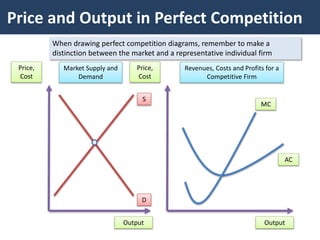
Price and Output in Perfect Competition
When drawing perfect competition diagrams, remember to make a
distinction between the market and a representative individual firm
Price,
Cost
Output
Price,
Cost
Output
Market Supply and
Demand
Revenues, Costs and Profits for a
Competitive Firm
D
S
AC
MC
P
1
Price and Output in Perfect Competition
The market price is set by the interaction of supply and demand
Price,
Cost
Output
Price,
Cost
Output
Market Supply and
Demand
Revenues, Costs and Profits for a
Competitive Firm
D
S
AC
MC
P
1
Price and Output in Perfect Competition
Each individual firm is a price taker in a perfectly competitive market
Price,
Cost
Output
Price,
Cost
Output
Market Supply and
Demand
Revenues, Costs and Profits for a
Competitive Firm
D
S
AC
MC
P
1
Price and Output in Perfect Competition
The ruling market price becomes the AR and MR curve for the firm
Price,
Cost
Output
Price,
Cost
Output
Market Supply and
Demand
Revenues, Costs and Profits for a
Competitive Firm
D
S
AC
MC
P
1
AR=MR
Price and Output in Perfect Competition
Average revenue equals marginal revenue at every level of output
Price,
Cost
Output
Price,
Cost
Output
Market Supply and
Demand
Revenues, Costs and Profits for a
Competitive Firm
D
S
AC
MC
P
1
AR=MR
Q1
C1
Supernormal
profits
Price and Output in Perfect Competition
We assume that the aim of each firm is to find a profit-maximising output
Adjustment to Long Run Equilibrium
• If most firms are making abnormal (economic) profits in
the short run, this encourages the entry of new firms into
the industry driven into the market by the profit motive
• This will cause an outward shift in market supply forcing
down the ruling market price
• The increase in market supply will eventually reduce the
price until price = long run average cost
• At this point, each firm in the industry is making normal
profit where price (AR) = average cost
• Other things remaining the same, there is no further
incentive for movement of firms in and out of the industry
and a long-run equilibrium has been established
Price,
Cost
Output
Price,
Cost
Output
Market Supply and
Demand
Revenues, Costs and Profits for a
Competitive Firm
D
S1
AC
MC
P
1
AR1=MR1
The Entry of New Firms in the Long Run
At this market price P1, most firms in the market make supernormal profit
Price,
Cost
Output
Price,
Cost
Output
Market Supply and
Demand
Revenues, Costs and Profits for a
Competitive Firm
D
S1
AC
MC
P
1
AR1=MR1
S2
P
2
The Entry of New Firms in the Long Run
The entry of firms causes an outward shift of market supply – price falls
Price,
Cost
Output
Price,
Cost
Output
Market Supply and
Demand
Revenues, Costs and Profits for a
Competitive Firm
D
S1
AC
MC
P
1
AR1=MR1
S2
P
2
The Entry of New Firms in the Long Run
Price,
Cost
Output
Price,
Cost
Output
Market Supply and
Demand
Revenues, Costs and Profits for a
Competitive Firm
D
S1
AC
MC
P
1
AR1=MR1
S2
P
2 AR2=MR2
The Entry of New Firms in the Long Run
Price,
Cost
Output
Price,
Cost
Output
Market Supply and
Demand
Revenues, Costs and Profits for a
Competitive Firm
D
S1
AC
MC
P
1
AR1=MR1
S2
P
2 AR2=MR2
Q2
Long Run Equilibrium Price and Profit
In long run equilibrium all firms are making normal profits (P=AC)
Price,
Cost
Output
Price,
Cost
Output
Market Supply and
Demand
Revenues, Costs and Profits for a
Competitive Firm
D
S1
AC
MC
Q2
AR2=MR2
S2
P
2
Normal profits where AR=AC – i.e. just enough profits to keep resources in their current use
A Normal Profit LR Equilibrium
AC
AVC
P1: Price = average
cost, normal profits
made
P2: Price = average
variable cost
P=Min AVC is the shut
down price for a
competitive firm in
short run
Price
Output
Google and Apple’s RevenueThe Shut Down Price (Short Run)
A business needs to make at least normal profit in
the long run to justify remaining in an industry but
in the short run a firm will continue to produce as
long as price per unit > or equal to average
variable cost (AR = AVC). This is called the
shutdown price in a competitive market.
MC
P
1
P
2
Evaluating Assumptions of the Model
• Most firms have some amount of price-setting
power – they are price makers not price takers!
• Dominance in real world markets of differentiated /
branded products
• Highly complex products, there always information
gaps facing consumers
• Impossible to avoid search costs even with the
spread of digital/web technology
• Patents, control of intellectual property, control of
key inputs are all ignored by the competitive model
• Rare for entry and exit in an industry to be costless
Econ Efficiency & Perfect Competition
• Allocative efficiency: In both the short and long run, price
is equal to marginal cost (P=MC) and thus allocative
efficiency is achieved. No one can be made better off
without making some other agent at least as worse off –
i.e. we achieve a Pareto optimum allocation of resources.
• Productive efficiency: Productive efficiency occurs when
the equilibrium output is supplied at minimum average
cost. This is attained in the long run for a competitive
market.
• Dynamic efficiency: We assume that a perfectly
competitive market produces homogeneous products – in
other words, there is little scope for innovation designed
purely to make products differentiated from each other
and allow a supplier to establish some monopoly power.
Characteristics of Competitive Markets
• Lower prices because of many competing firms. The cross-price
elasticity of demand for one product will be high suggesting that
consumers are prepared to switch their demand to the most
competitively priced products in the marketplace.
• Low barriers to entry – the entry of new firms provides competition
and ensures prices are kept low
• Lower total profits and profit margins than in monopoly
• Greater entrepreneurial activity. For competition to be improved and
sustained there needs to be a genuine desire on behalf of
entrepreneurs to innovate and to invent to drive markets
• Economic efficiency
– Competition will ensure that firms move towards productive
efficiency.
– The threat of competition should lead to a faster rate of
technological diffusion, as firms have to be responsive to the
changing needs of consumers. This is known as dynamic efficiency.
The Real World of Imperfect Competition
• Suppliers may exert control over the quantity of goods
and services supplied and also exploit their monopoly
power by having control over market prices
• On the demand-side, consumers may have monopsony
(buying) power against their suppliers because they
purchase a high percentage of total demand.
• There are always some barriers to the contestability of a
market and far from being homogeneous; most markets
are full of heterogeneous products due to product
differentiation
• Most consumers have imperfect information and
preferences are influenced by persuasive marketing
• There may be imperfect competition in related markets
such as the market for key raw materials, labour and
capital goods.
Perfect Competition
Topic 3.3.9

Perfect Competition

  • 1.
  • 2.
    Perfect Competition Topic 3.3.9 Studentsshould be able to: • Understand the assumptions of perfect competition and be able to explain the behaviour of firms in this market structure. • Understand the significance of firms as price-takers in perfectly competitive markets. An understanding of the meaning of shut-down point is required. The impact of entry into and exit from the industry should be considered.
  • 3.
    What is PerfectCompetition? • Perfect competition describes a market structure whose assumptions are strong and therefore unlikely to exist in most real-world markets • We can however take some useful insights from studying a world of perfect competition and then comparing and contrasting with “real world” imperfectly competitive markets and industries • Economists have become more interested in pure competition because of the rapid growth of e- commerce as a means of buying and selling goods and services. And also the popularity of online auctions as a device for allocating scarce resources
  • 4.
    • Homogenous Products(all perfect substitutes) • All firms have access to factors of production • Large number of buyers & sellers • Free entry and exit to/from the market • Perfectly elastic demand curve • Perfect knowledge / information • Profit maximization assumed as key objective What is Perfect Competition?
  • 5.
    Price, Cost Output Price, Cost Output Market Supply and Demand Revenues,Costs and Profits for a Competitive Firm D S AC MC Price and Output in Perfect Competition When drawing perfect competition diagrams, remember to make a distinction between the market and a representative individual firm
  • 6.
    Price, Cost Output Price, Cost Output Market Supply and Demand Revenues,Costs and Profits for a Competitive Firm D S AC MC P 1 Price and Output in Perfect Competition The market price is set by the interaction of supply and demand
  • 7.
    Price, Cost Output Price, Cost Output Market Supply and Demand Revenues,Costs and Profits for a Competitive Firm D S AC MC P 1 Price and Output in Perfect Competition Each individual firm is a price taker in a perfectly competitive market
  • 8.
    Price, Cost Output Price, Cost Output Market Supply and Demand Revenues,Costs and Profits for a Competitive Firm D S AC MC P 1 Price and Output in Perfect Competition The ruling market price becomes the AR and MR curve for the firm
  • 9.
    Price, Cost Output Price, Cost Output Market Supply and Demand Revenues,Costs and Profits for a Competitive Firm D S AC MC P 1 AR=MR Price and Output in Perfect Competition Average revenue equals marginal revenue at every level of output
  • 10.
    Price, Cost Output Price, Cost Output Market Supply and Demand Revenues,Costs and Profits for a Competitive Firm D S AC MC P 1 AR=MR Q1 C1 Supernormal profits Price and Output in Perfect Competition We assume that the aim of each firm is to find a profit-maximising output
  • 11.
    Adjustment to LongRun Equilibrium • If most firms are making abnormal (economic) profits in the short run, this encourages the entry of new firms into the industry driven into the market by the profit motive • This will cause an outward shift in market supply forcing down the ruling market price • The increase in market supply will eventually reduce the price until price = long run average cost • At this point, each firm in the industry is making normal profit where price (AR) = average cost • Other things remaining the same, there is no further incentive for movement of firms in and out of the industry and a long-run equilibrium has been established
  • 12.
    Price, Cost Output Price, Cost Output Market Supply and Demand Revenues,Costs and Profits for a Competitive Firm D S1 AC MC P 1 AR1=MR1 The Entry of New Firms in the Long Run At this market price P1, most firms in the market make supernormal profit
  • 13.
    Price, Cost Output Price, Cost Output Market Supply and Demand Revenues,Costs and Profits for a Competitive Firm D S1 AC MC P 1 AR1=MR1 S2 P 2 The Entry of New Firms in the Long Run The entry of firms causes an outward shift of market supply – price falls
  • 14.
    Price, Cost Output Price, Cost Output Market Supply and Demand Revenues,Costs and Profits for a Competitive Firm D S1 AC MC P 1 AR1=MR1 S2 P 2 The Entry of New Firms in the Long Run
  • 15.
    Price, Cost Output Price, Cost Output Market Supply and Demand Revenues,Costs and Profits for a Competitive Firm D S1 AC MC P 1 AR1=MR1 S2 P 2 AR2=MR2 The Entry of New Firms in the Long Run
  • 16.
    Price, Cost Output Price, Cost Output Market Supply and Demand Revenues,Costs and Profits for a Competitive Firm D S1 AC MC P 1 AR1=MR1 S2 P 2 AR2=MR2 Q2 Long Run Equilibrium Price and Profit In long run equilibrium all firms are making normal profits (P=AC)
  • 17.
    Price, Cost Output Price, Cost Output Market Supply and Demand Revenues,Costs and Profits for a Competitive Firm D S1 AC MC Q2 AR2=MR2 S2 P 2 Normal profits where AR=AC – i.e. just enough profits to keep resources in their current use A Normal Profit LR Equilibrium
  • 18.
    AC AVC P1: Price =average cost, normal profits made P2: Price = average variable cost P=Min AVC is the shut down price for a competitive firm in short run Price Output Google and Apple’s RevenueThe Shut Down Price (Short Run) A business needs to make at least normal profit in the long run to justify remaining in an industry but in the short run a firm will continue to produce as long as price per unit > or equal to average variable cost (AR = AVC). This is called the shutdown price in a competitive market. MC P 1 P 2
  • 19.
    Evaluating Assumptions ofthe Model • Most firms have some amount of price-setting power – they are price makers not price takers! • Dominance in real world markets of differentiated / branded products • Highly complex products, there always information gaps facing consumers • Impossible to avoid search costs even with the spread of digital/web technology • Patents, control of intellectual property, control of key inputs are all ignored by the competitive model • Rare for entry and exit in an industry to be costless
  • 20.
    Econ Efficiency &Perfect Competition • Allocative efficiency: In both the short and long run, price is equal to marginal cost (P=MC) and thus allocative efficiency is achieved. No one can be made better off without making some other agent at least as worse off – i.e. we achieve a Pareto optimum allocation of resources. • Productive efficiency: Productive efficiency occurs when the equilibrium output is supplied at minimum average cost. This is attained in the long run for a competitive market. • Dynamic efficiency: We assume that a perfectly competitive market produces homogeneous products – in other words, there is little scope for innovation designed purely to make products differentiated from each other and allow a supplier to establish some monopoly power.
  • 21.
    Characteristics of CompetitiveMarkets • Lower prices because of many competing firms. The cross-price elasticity of demand for one product will be high suggesting that consumers are prepared to switch their demand to the most competitively priced products in the marketplace. • Low barriers to entry – the entry of new firms provides competition and ensures prices are kept low • Lower total profits and profit margins than in monopoly • Greater entrepreneurial activity. For competition to be improved and sustained there needs to be a genuine desire on behalf of entrepreneurs to innovate and to invent to drive markets • Economic efficiency – Competition will ensure that firms move towards productive efficiency. – The threat of competition should lead to a faster rate of technological diffusion, as firms have to be responsive to the changing needs of consumers. This is known as dynamic efficiency.
  • 22.
    The Real Worldof Imperfect Competition • Suppliers may exert control over the quantity of goods and services supplied and also exploit their monopoly power by having control over market prices • On the demand-side, consumers may have monopsony (buying) power against their suppliers because they purchase a high percentage of total demand. • There are always some barriers to the contestability of a market and far from being homogeneous; most markets are full of heterogeneous products due to product differentiation • Most consumers have imperfect information and preferences are influenced by persuasive marketing • There may be imperfect competition in related markets such as the market for key raw materials, labour and capital goods.
  • 23.