Monopoly
Monopoly versus Competition Monopoly Is the sole producer Has a downward-sloping demand curve Is a price maker Reduces price to increase sales
Demand Curves for Competitive and Monopoly Firms... Quantity of Output Demand (a) A Competitive Firm’s  Demand Curve (b) A Monopolist’s  Demand Curve 0 Price 0 Quantity of Output Price Demand
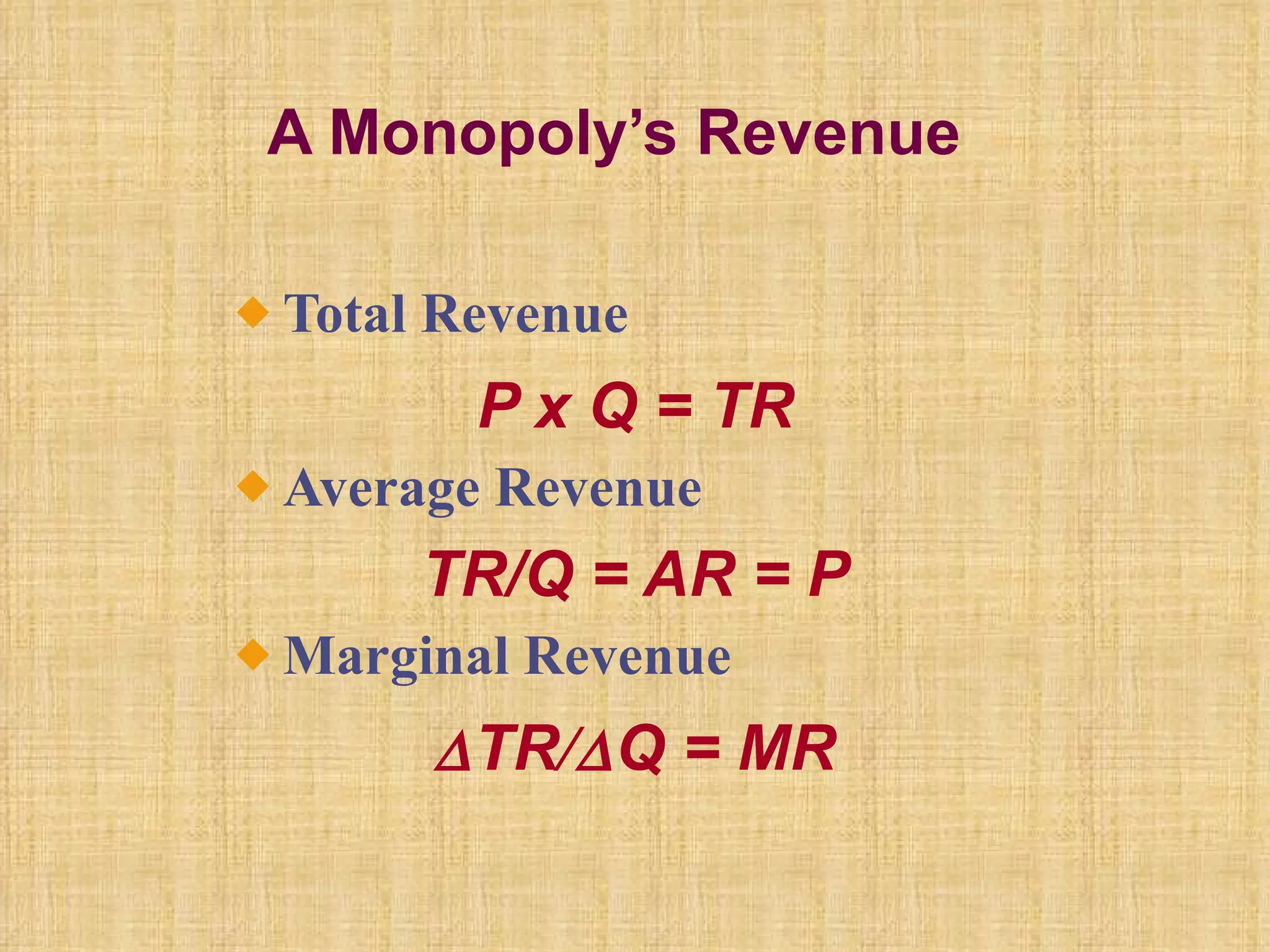
A Monopoly’s Revenue Total Revenue P x Q = TR Average Revenue TR/Q = AR = P Marginal Revenue  TR /  Q = MR
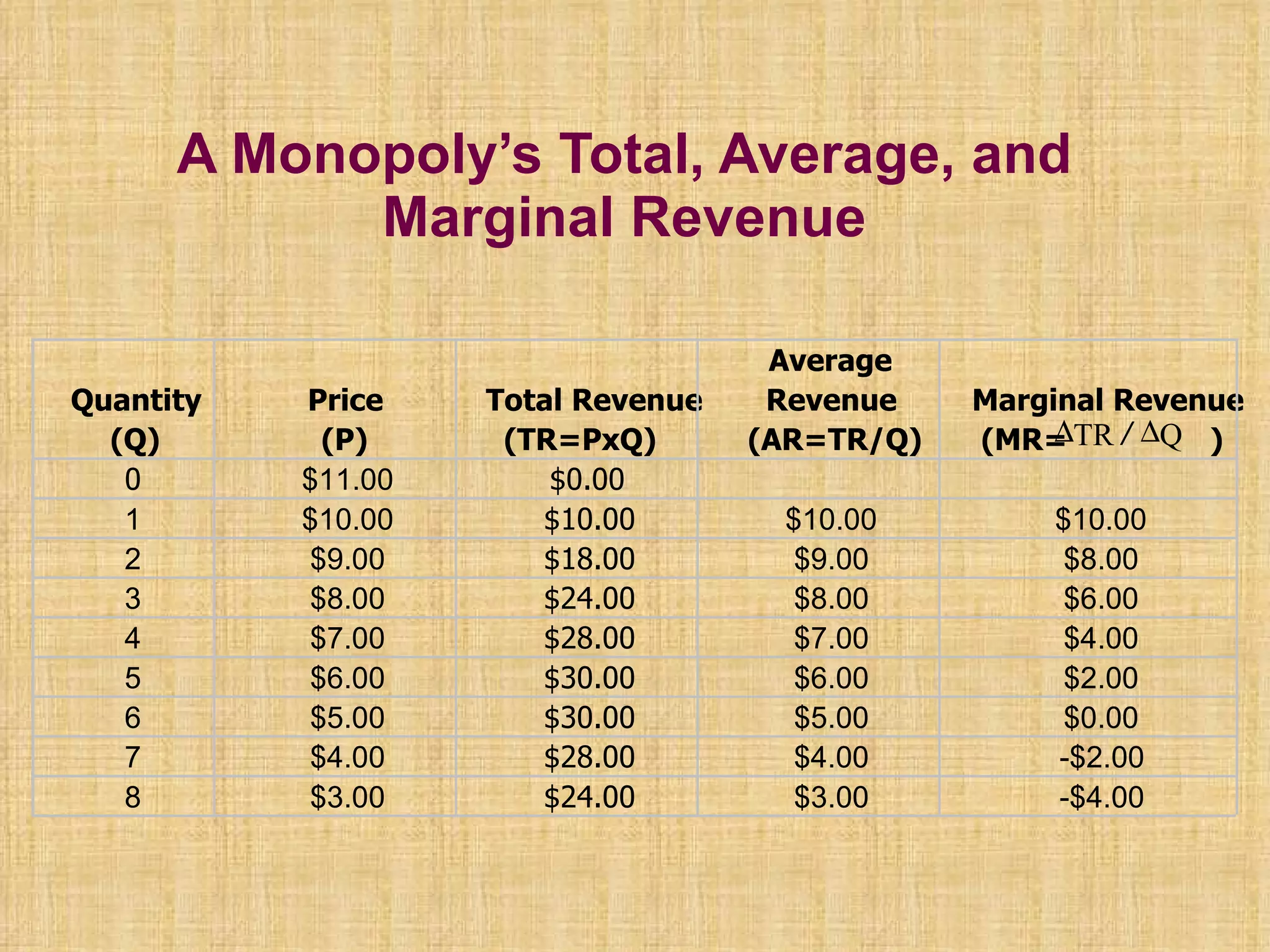
A Monopoly’s Total, Average, and Marginal Revenue Quantity (Q) Price (P) Total Revenue (TR=PxQ) Average  Revenue (AR=TR/Q) Marginal Revenue (MR=  ) 0 $11.00 $0.00 1 $10.00 $10.00 $10.00 $10.00 2 $9.00 $18.00 $9.00 $8.00 3 $8.00 $24.00 $8.00 $6.00 4 $7.00 $28.00 $7.00 $4.00 5 $6.00 $30.00 $6.00 $2.00 6 $5.00 $30.00 $5.00 $0.00 7 $4.00 $28.00 $4.00 -$2.00 8 $3.00 $24.00 $3.00 -$4.00 Q TR   /
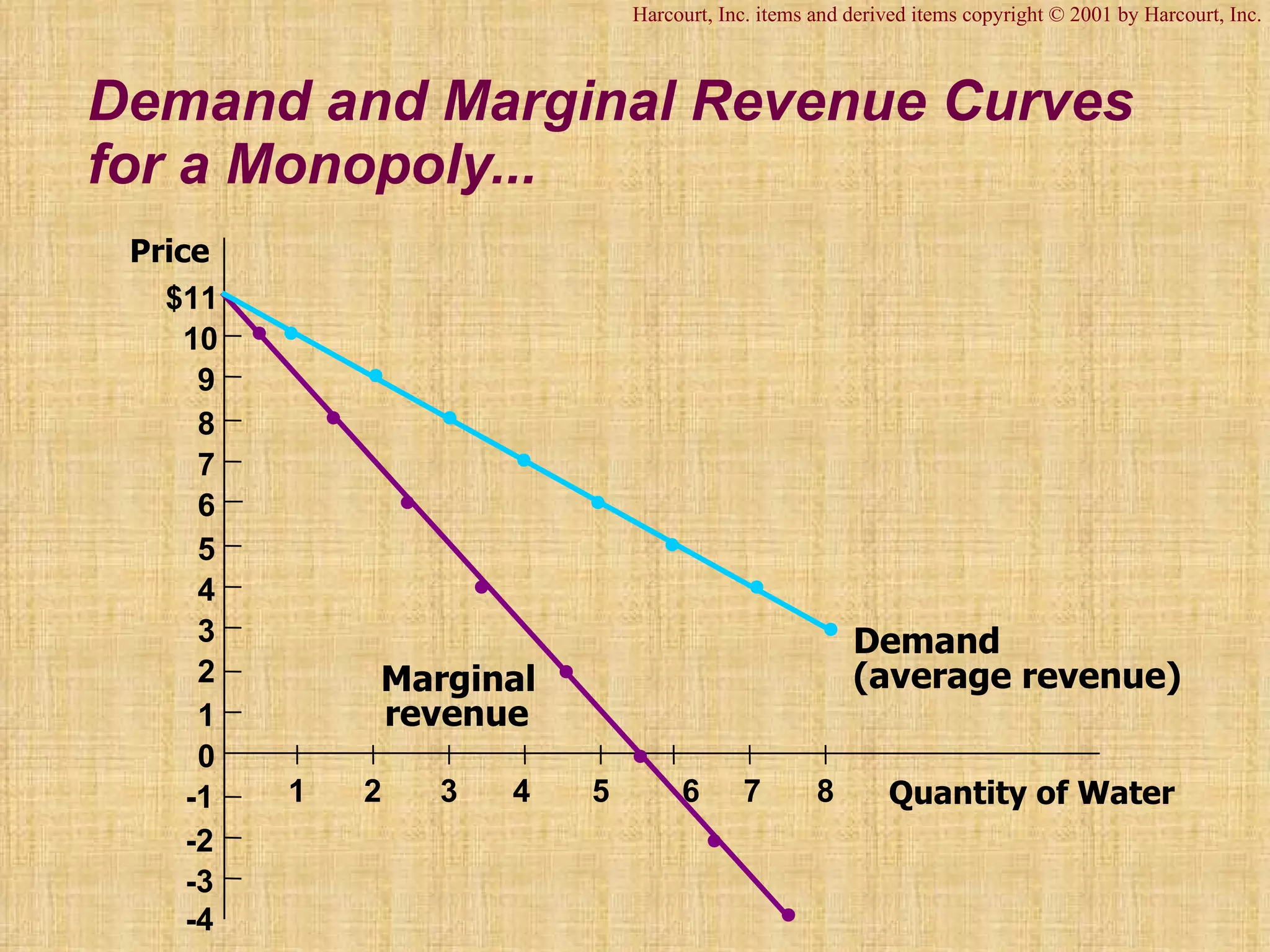
A Monopoly’s Marginal Revenue A monopolist’s marginal revenue is always  less than  the price of its good. The demand curve is downward sloping. When a monopoly drops the price to sell one more unit, the revenue received from previously sold units also decreases.
Demand and Marginal Revenue Curves for a Monopoly... Quantity of Water Price $11 10 9 8 7 6 5 4 3 2 1 0 -1 -2 -3 -4 1 2 3 4 5 6 7 8 Harcourt, Inc. items and derived items copyright © 2001 by Harcourt, Inc. Marginal revenue Demand (average revenue)
Profit Maximization of a Monopoly A monopoly maximizes profit by producing the quantity at which marginal revenue equals marginal cost. It then uses the demand curve to find the price that will induce consumers to buy that quantity.
Profit-Maximization for a Monopoly... Quantity Q MAX 0 Demand Average total cost Marginal revenue Monopoly price Costs and Revenue Marginal cost A 1. The intersection of the marginal-revenue curve and the marginal-cost curve determines the profit-maximizing quantity... B 2. ...and then the demand curve shows the price consistent with this quantity.
Comparing Monopoly and Competition   For a  competitive  firm, price equals marginal cost. P = MR = MC For a  monopoly  firm, price exceeds marginal cost. P > MR = MC
The Monopolist’s Profit... Quantity 0 Demand Marginal cost Marginal revenue Average total cost Monopoly profit Costs and Revenue Q MAX B Monopoly price E Average total cost D C
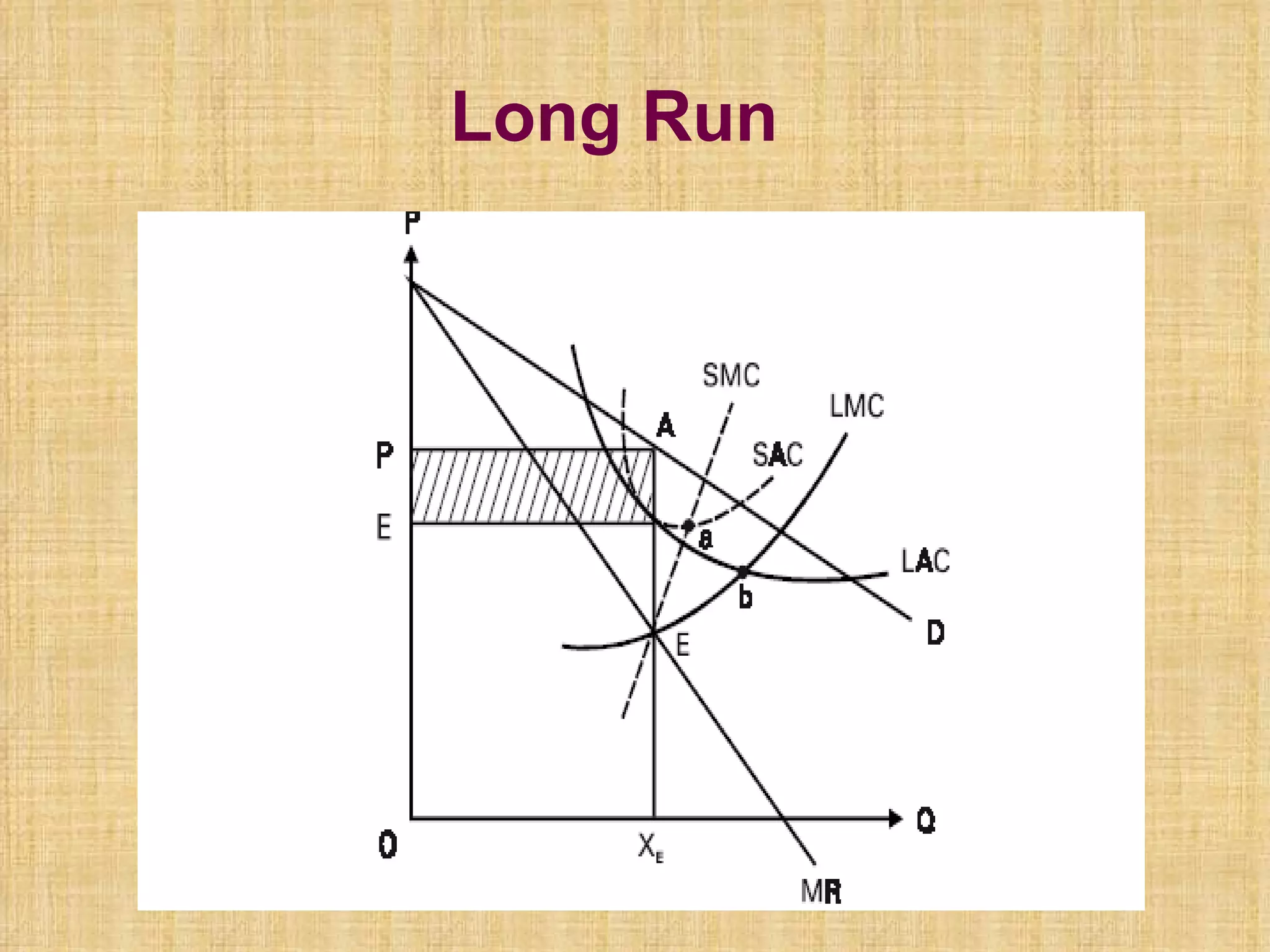
Long Run
Price Discrimination Price discrimination  is the practice of selling the same good at different prices to different customers, even though the costs for producing for the two customers are the same.
Examples of Price Discrimination Movie tickets Airline prices Discount coupons Financial aid Quantity discounts
Case I A monopolist firm sells a single product in two different markets either with different elasticities of demand
Case II Dumping - when the firm is a monopolistic in the domestic market but faces perfect competition in the world market

5 monopoly

  • 1.
  • 2.
    Monopoly versus CompetitionMonopoly Is the sole producer Has a downward-sloping demand curve Is a price maker Reduces price to increase sales
  • 3.
    Demand Curves forCompetitive and Monopoly Firms... Quantity of Output Demand (a) A Competitive Firm’s Demand Curve (b) A Monopolist’s Demand Curve 0 Price 0 Quantity of Output Price Demand
  • 4.
    A Monopoly’s RevenueTotal Revenue P x Q = TR Average Revenue TR/Q = AR = P Marginal Revenue  TR /  Q = MR
  • 5.
    A Monopoly’s Total,Average, and Marginal Revenue Quantity (Q) Price (P) Total Revenue (TR=PxQ) Average Revenue (AR=TR/Q) Marginal Revenue (MR= ) 0 $11.00 $0.00 1 $10.00 $10.00 $10.00 $10.00 2 $9.00 $18.00 $9.00 $8.00 3 $8.00 $24.00 $8.00 $6.00 4 $7.00 $28.00 $7.00 $4.00 5 $6.00 $30.00 $6.00 $2.00 6 $5.00 $30.00 $5.00 $0.00 7 $4.00 $28.00 $4.00 -$2.00 8 $3.00 $24.00 $3.00 -$4.00 Q TR   /
  • 6.
    A Monopoly’s MarginalRevenue A monopolist’s marginal revenue is always less than the price of its good. The demand curve is downward sloping. When a monopoly drops the price to sell one more unit, the revenue received from previously sold units also decreases.
  • 7.
    Demand and MarginalRevenue Curves for a Monopoly... Quantity of Water Price $11 10 9 8 7 6 5 4 3 2 1 0 -1 -2 -3 -4 1 2 3 4 5 6 7 8 Harcourt, Inc. items and derived items copyright © 2001 by Harcourt, Inc. Marginal revenue Demand (average revenue)
  • 8.
    Profit Maximization ofa Monopoly A monopoly maximizes profit by producing the quantity at which marginal revenue equals marginal cost. It then uses the demand curve to find the price that will induce consumers to buy that quantity.
  • 9.
    Profit-Maximization for aMonopoly... Quantity Q MAX 0 Demand Average total cost Marginal revenue Monopoly price Costs and Revenue Marginal cost A 1. The intersection of the marginal-revenue curve and the marginal-cost curve determines the profit-maximizing quantity... B 2. ...and then the demand curve shows the price consistent with this quantity.
  • 10.
    Comparing Monopoly andCompetition For a competitive firm, price equals marginal cost. P = MR = MC For a monopoly firm, price exceeds marginal cost. P > MR = MC
  • 11.
    The Monopolist’s Profit...Quantity 0 Demand Marginal cost Marginal revenue Average total cost Monopoly profit Costs and Revenue Q MAX B Monopoly price E Average total cost D C
  • 12.
  • 13.
    Price Discrimination Pricediscrimination is the practice of selling the same good at different prices to different customers, even though the costs for producing for the two customers are the same.
  • 14.
    Examples of PriceDiscrimination Movie tickets Airline prices Discount coupons Financial aid Quantity discounts
  • 15.
    Case I Amonopolist firm sells a single product in two different markets either with different elasticities of demand
  • 16.
    Case II Dumping- when the firm is a monopolistic in the domestic market but faces perfect competition in the world market

Editor's Notes