MONOPOLY---IN MICROECONOMICS
          ----------NILORMI DAS
MARKET STRUCTURES

In economics, monopoly is a pivotal area to the study
of market structures, which directly concerns
normative aspects of economic competition, and
sets the foundations for fields such as industrial
organization and economics of regulation. There are
four basic types of market structures under
traditional economic analysis: perfect competition,
monopolistic competition, oligopoly and monopoly.
A monopoly is a market structure in which a single
supplier produces and sells the product. If there is a
single seller in a certain industry and there are no
close substitutes for the goods being produced, then
the market structure is that of a "pure monopoly".
Sometimes, there are many sellers in an industry
and/or there exist many close substitutes for the
goods being produced, but nevertheless firms retain
some market power. This is called monopolistic
competition, whereas in oligopoly the main
theoretical framework revolves around firm's
strategic interactions.
MONOPOLY
   In economics, a monopoly (from Greek monos /
   μονος (alone or single) + polein / πωλειν (to sell))
   exists when a specific individual or an enterprise is
   the only supplier of a particular kind of product or
   service

   While a competitive firm is a price taker, a
   monopoly firm is a price maker.


   A firm is considered a monopoly if . . .
           it is the sole seller of its product.
           its product does not have close substitutes.
Why Monopolies Arise

                                       The fundamental cause of monopoly is
•   The fundamental cause of
                                       barriers to entry.
    monopoly is barriers to entry
                                    Barriers to entry have three sources:
                                    Ownership of a key resource.
                                         This tends to be rare. De Beers is an example

                                    The government gives a single firm the exclusive
                                    right to produce some good.
                                           Patents, Copyrights and Government
                                           Licensing.
                                    Costs of production make a single producer more
                                    efficient than a large number of producers.
                                           Natural Monopolies
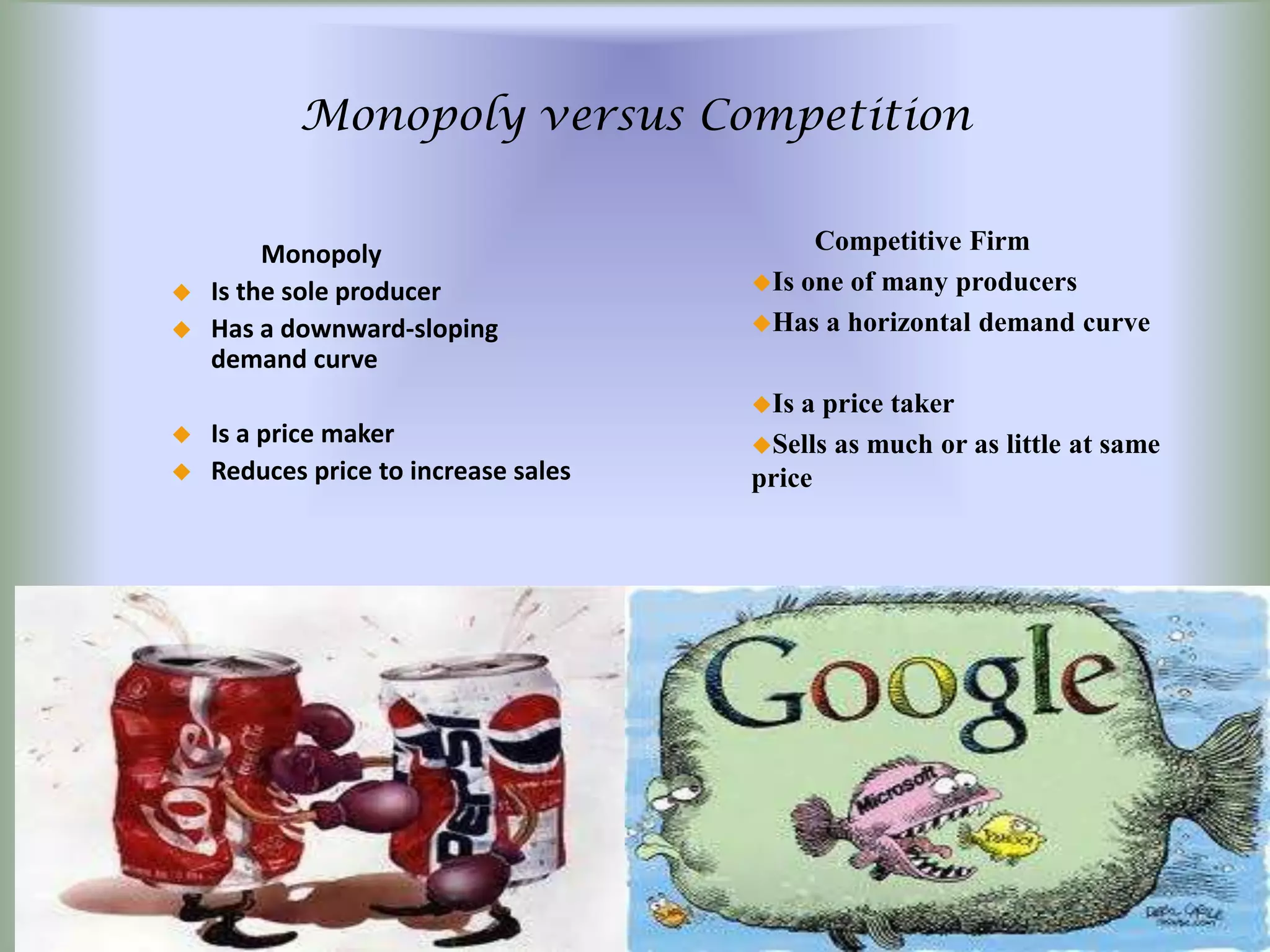
Monopoly versus Competition


         Monopoly                          Competitive Firm
   Is the sole producer              Is one of many producers

   Has a downward-sloping            Has a horizontal demand curve
    demand curve
                                      Is a price taker
   Is a price maker                  Sells as much or as little at same
   Reduces price to increase sales   price
A Monopoly’s Marginal Revenue

    •   A monopolist’s marginal revenue is always less than the price of its good.
          The demand curve is downward sloping.
          When a monopoly drops the price to sell one more unit, the revenue received from

            previously sold units also decreases   .

A MONOPOLY’S REVENUE
•  Total Revenue
          P x Q = TR
•       Average Revenue
        TR/Q = AR = P
•       Marginal Revenue
          TR/ Q = MR
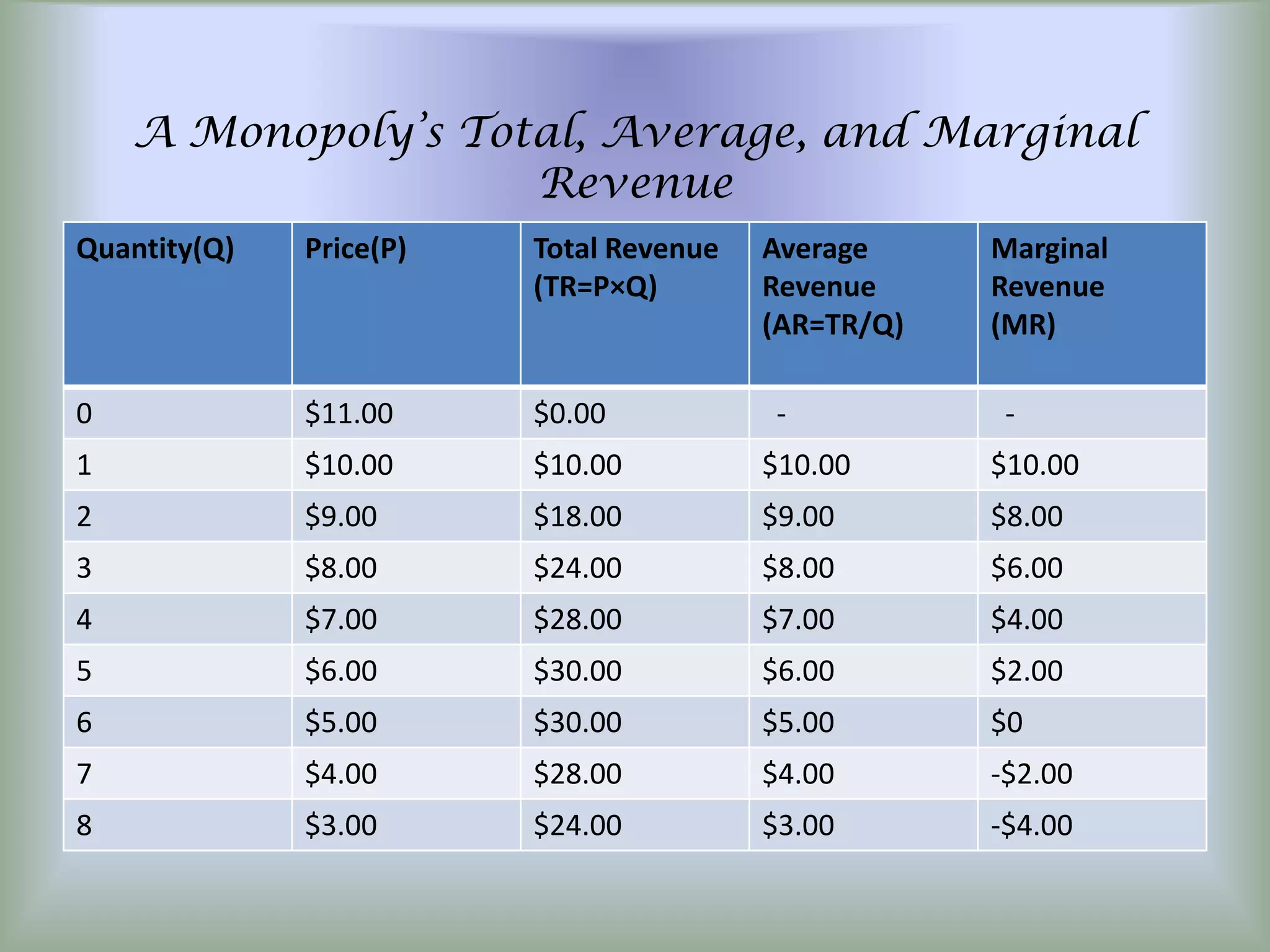
A Monopoly’s Total, Average, and Marginal
                    Revenue
Quantity(Q)   Price(P)   Total Revenue   Average     Marginal
                         (TR=P×Q)        Revenue     Revenue
                                         (AR=TR/Q)   (MR)

0             $11.00     $0.00           -            -
1             $10.00     $10.00          $10.00      $10.00
2             $9.00      $18.00          $9.00       $8.00
3             $8.00      $24.00          $8.00       $6.00
4             $7.00      $28.00          $7.00       $4.00
5             $6.00      $30.00          $6.00       $2.00
6             $5.00      $30.00          $5.00       $0
7             $4.00      $28.00          $4.00       -$2.00
8             $3.00      $24.00          $3.00       -$4.00
A Monopoly’s Profit

•   Profit equals total revenue minus total costs.
•           Profit = TR - TC
•           Profit = (TR/Q - TC/Q) x Q
•           Profit = (P - ATC) x Q
    MONOPOLIST’S PROFIT
•   The monopolist will receive economic profits as long as price is greater than average total
    cost
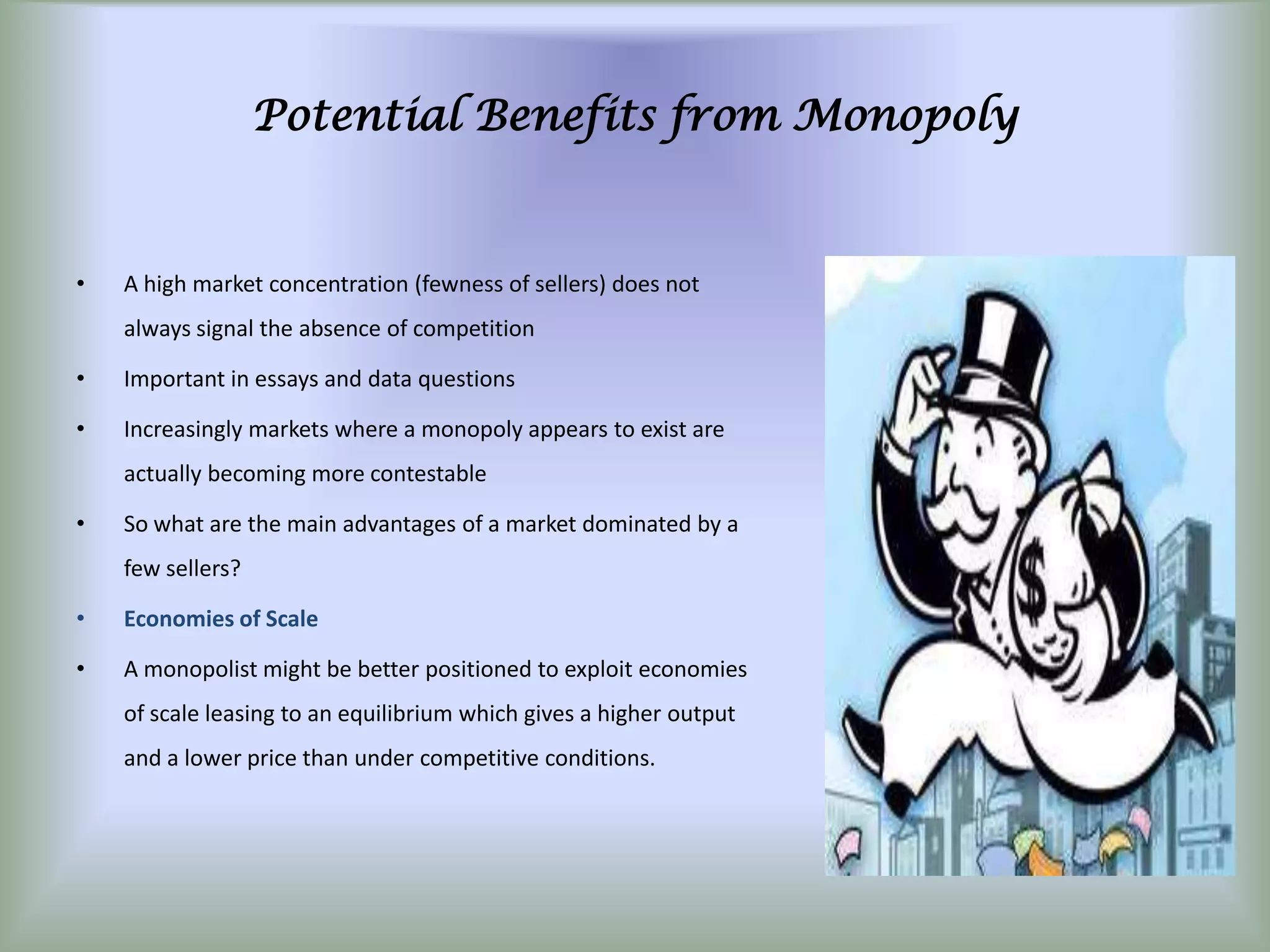
Potential Benefits from Monopoly


•   A high market concentration (fewness of sellers) does not
    always signal the absence of competition

•   Important in essays and data questions

•   Increasingly markets where a monopoly appears to exist are
    actually becoming more contestable

•   So what are the main advantages of a market dominated by a
    few sellers?

•   Economies of Scale

•   A monopolist might be better positioned to exploit economies
    of scale leasing to an equilibrium which gives a higher output
    and a lower price than under competitive conditions.
EXAMPLE OF THE BEFITS OF MONOPOLY

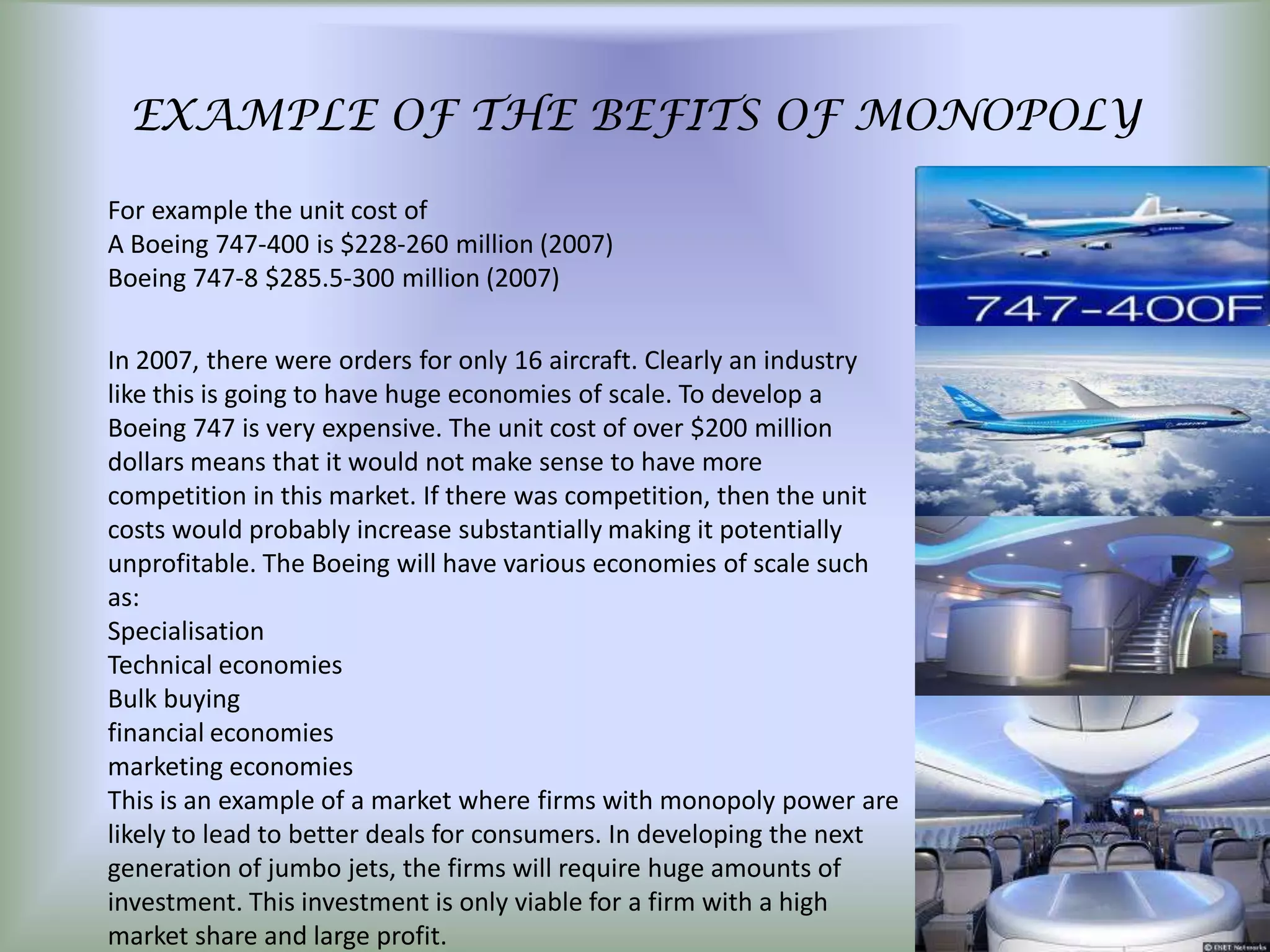
For example the unit cost of
A Boeing 747-400 is $228-260 million (2007)
Boeing 747-8 $285.5-300 million (2007)

In 2007, there were orders for only 16 aircraft. Clearly an industry
like this is going to have huge economies of scale. To develop a
Boeing 747 is very expensive. The unit cost of over $200 million
dollars means that it would not make sense to have more
competition in this market. If there was competition, then the unit
costs would probably increase substantially making it potentially
unprofitable. The Boeing will have various economies of scale such
as:
Specialisation
Technical economies
Bulk buying
financial economies
marketing economies
This is an example of a market where firms with monopoly power are
likely to lead to better deals for consumers. In developing the next
generation of jumbo jets, the firms will require huge amounts of
investment. This investment is only viable for a firm with a high
market share and large profit.
CHARACTERISTICS OF MONOPOLY

•   Profit Maximiser: Maximizes profit.
•   Price Maker: Decides the price of the good or product to be sold.
•   High Barriers to Entry: Other sellers are unable to enter the
    market of the monopoly.
•   Single seller: In a monopoly there is one seller of the good who
    produces all the output. Therefore, the whole market is being
    served by a single firm, and for practical purposes, the firm is the
    same as the industry.
•   Market power: Market power is the ability to affect the terms and
    conditions of exchange so that the price of the product is set by
    the firm (price is not imposed by the market as in perfect
    competition). Although a monopoly's market power is high it is
    still limited by the demand side of the market. A monopoly faces a
    negatively sloped demand curve not a perfectly inelastic curve.
    Consequently, any price increase will result in the loss of some
    customers.
•   Firm and industry: In a monopoly, market, a firm is itself an
    industry. Therefore, there is no distinction between a firm and an
    industry in such a market.
•   Price Discrimination: A monopolist can change the price and
    quality of the product. He sells more quantities charging less price
    against the product in a highly elastic market and sells less
    quantities charging high price in a less elastic market.
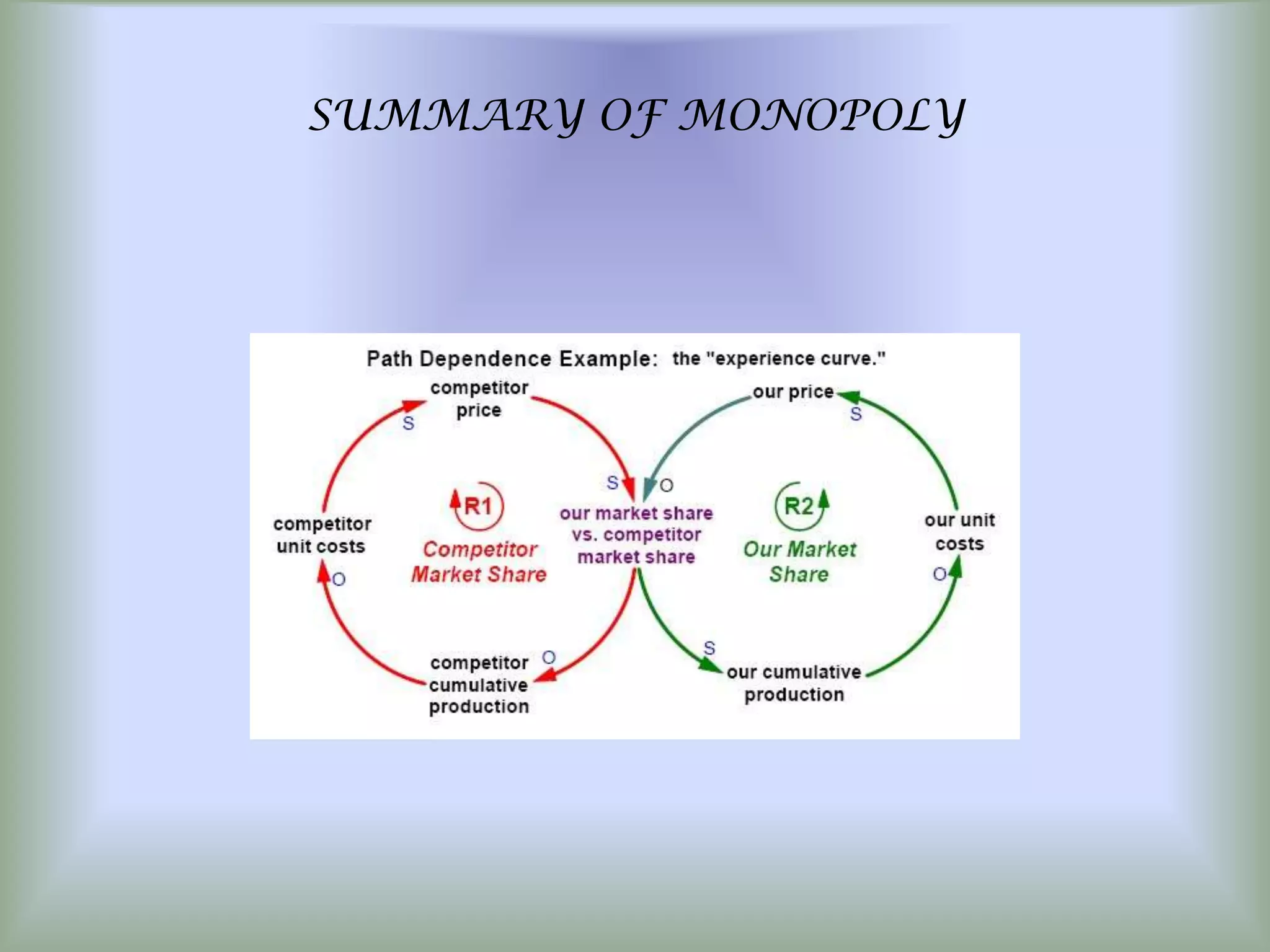
SUMMARY OF MONOPOLY
Monopoly --in microeconomics

Monopoly --in microeconomics

  • 1.
    MONOPOLY---IN MICROECONOMICS ----------NILORMI DAS
  • 2.
    MARKET STRUCTURES In economics,monopoly is a pivotal area to the study of market structures, which directly concerns normative aspects of economic competition, and sets the foundations for fields such as industrial organization and economics of regulation. There are four basic types of market structures under traditional economic analysis: perfect competition, monopolistic competition, oligopoly and monopoly. A monopoly is a market structure in which a single supplier produces and sells the product. If there is a single seller in a certain industry and there are no close substitutes for the goods being produced, then the market structure is that of a "pure monopoly". Sometimes, there are many sellers in an industry and/or there exist many close substitutes for the goods being produced, but nevertheless firms retain some market power. This is called monopolistic competition, whereas in oligopoly the main theoretical framework revolves around firm's strategic interactions.
  • 3.
    MONOPOLY In economics, a monopoly (from Greek monos / μονος (alone or single) + polein / πωλειν (to sell)) exists when a specific individual or an enterprise is the only supplier of a particular kind of product or service While a competitive firm is a price taker, a monopoly firm is a price maker. A firm is considered a monopoly if . . . it is the sole seller of its product. its product does not have close substitutes.
  • 4.
    Why Monopolies Arise The fundamental cause of monopoly is • The fundamental cause of barriers to entry. monopoly is barriers to entry Barriers to entry have three sources: Ownership of a key resource. This tends to be rare. De Beers is an example The government gives a single firm the exclusive right to produce some good. Patents, Copyrights and Government Licensing. Costs of production make a single producer more efficient than a large number of producers. Natural Monopolies
  • 5.
    Monopoly versus Competition Monopoly Competitive Firm  Is the sole producer Is one of many producers  Has a downward-sloping Has a horizontal demand curve demand curve Is a price taker  Is a price maker Sells as much or as little at same  Reduces price to increase sales price
  • 6.
    A Monopoly’s MarginalRevenue • A monopolist’s marginal revenue is always less than the price of its good.  The demand curve is downward sloping.  When a monopoly drops the price to sell one more unit, the revenue received from previously sold units also decreases . A MONOPOLY’S REVENUE • Total Revenue P x Q = TR • Average Revenue TR/Q = AR = P • Marginal Revenue TR/ Q = MR
  • 7.
    A Monopoly’s Total,Average, and Marginal Revenue Quantity(Q) Price(P) Total Revenue Average Marginal (TR=P×Q) Revenue Revenue (AR=TR/Q) (MR) 0 $11.00 $0.00 - - 1 $10.00 $10.00 $10.00 $10.00 2 $9.00 $18.00 $9.00 $8.00 3 $8.00 $24.00 $8.00 $6.00 4 $7.00 $28.00 $7.00 $4.00 5 $6.00 $30.00 $6.00 $2.00 6 $5.00 $30.00 $5.00 $0 7 $4.00 $28.00 $4.00 -$2.00 8 $3.00 $24.00 $3.00 -$4.00
  • 8.
    A Monopoly’s Profit • Profit equals total revenue minus total costs. • Profit = TR - TC • Profit = (TR/Q - TC/Q) x Q • Profit = (P - ATC) x Q MONOPOLIST’S PROFIT • The monopolist will receive economic profits as long as price is greater than average total cost
  • 9.
    Potential Benefits fromMonopoly • A high market concentration (fewness of sellers) does not always signal the absence of competition • Important in essays and data questions • Increasingly markets where a monopoly appears to exist are actually becoming more contestable • So what are the main advantages of a market dominated by a few sellers? • Economies of Scale • A monopolist might be better positioned to exploit economies of scale leasing to an equilibrium which gives a higher output and a lower price than under competitive conditions.
  • 10.
    EXAMPLE OF THEBEFITS OF MONOPOLY For example the unit cost of A Boeing 747-400 is $228-260 million (2007) Boeing 747-8 $285.5-300 million (2007) In 2007, there were orders for only 16 aircraft. Clearly an industry like this is going to have huge economies of scale. To develop a Boeing 747 is very expensive. The unit cost of over $200 million dollars means that it would not make sense to have more competition in this market. If there was competition, then the unit costs would probably increase substantially making it potentially unprofitable. The Boeing will have various economies of scale such as: Specialisation Technical economies Bulk buying financial economies marketing economies This is an example of a market where firms with monopoly power are likely to lead to better deals for consumers. In developing the next generation of jumbo jets, the firms will require huge amounts of investment. This investment is only viable for a firm with a high market share and large profit.
  • 11.
    CHARACTERISTICS OF MONOPOLY • Profit Maximiser: Maximizes profit. • Price Maker: Decides the price of the good or product to be sold. • High Barriers to Entry: Other sellers are unable to enter the market of the monopoly. • Single seller: In a monopoly there is one seller of the good who produces all the output. Therefore, the whole market is being served by a single firm, and for practical purposes, the firm is the same as the industry. • Market power: Market power is the ability to affect the terms and conditions of exchange so that the price of the product is set by the firm (price is not imposed by the market as in perfect competition). Although a monopoly's market power is high it is still limited by the demand side of the market. A monopoly faces a negatively sloped demand curve not a perfectly inelastic curve. Consequently, any price increase will result in the loss of some customers. • Firm and industry: In a monopoly, market, a firm is itself an industry. Therefore, there is no distinction between a firm and an industry in such a market. • Price Discrimination: A monopolist can change the price and quality of the product. He sells more quantities charging less price against the product in a highly elastic market and sells less quantities charging high price in a less elastic market.
  • 12.