1
EVALUATION SEMINAR ON

 Preclinical
evaluation of
 anxiolytics
  Presented to : Dr. KVSRG PRASAD


                              Presented by:
                                   P. Bindu,
                       M.Pharmacy 1st year
                Department of pharmacology
                                         2
Contents
o Introduction
o Types of anxiety
o Physiological Vs pathological anxiety
o Classification of anxiolytics
o Screening methods for anxiolytics
     In vitro methods
     In vivo methods
o Conclusion
o References
                                          3
Introduction
o Anxiety is an emotional state caused by
  the perception of real or perceived danger
  that threatens the security of an
  individual.

o It is normal human adaptive response to
  stressful events.

o Physiological anxiety – transient in nature

o Pathological anxiety – needs treatment
                                                4
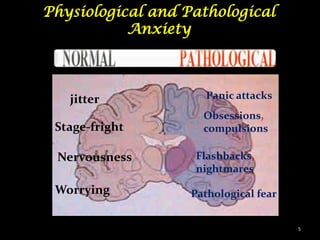
Physiological and Pathological
           Anxiety


   jitter             Panic attacks
                     Obsessions,
 Stage-fright        compulsions

 Nervousness        Flashbacks,
                    nightmares

 Worrying          Pathological fear


                                       5
Types of anxiety disorders

a. Panic disorder

b. Generalised anxiety disorder

c. Social anxiety disorder.

d. Obsessive compulsive disorder.

e. Post traumatic stress disorder.

                                     6
Pathophysiology of anxiety
o Neurotransmitters like GABA,
  noradrenaline, serotonin abnormalities –
  anxiety.

o Amygdala, temporal lobe, hippocampus and
  hypothalamus - involved in anxeity

o Neurochemical theories :

    1. Noradrenaline theory
    2. Serotonin theory
    3. GABA receptor theory
                                             7
Noradrenaline theory

o ANS of anxious patients- hypersensitive to
  stimuli.

o Locus cerulus – activates epinephrine release

o Anxiogenics – stimulate locus cerulus firing

o Anxiolytics- inhibits locus cerulus firing and
  decrease noradrenaline activity.
                                                 8
GABA Receptor Theory
o GABA – inhibitory neurotransmitter in brain.

o Has inhibitory and regulatory effects on
  serotonin, noradrenaline and dopamine.

o GABAA receptor involved in anxiety;
  decreases neuronal excitability

o Patients suffering from anxiety disorders
  have less level of GABA in cortex.
                                              9
Serotonin Theory
• Abnormalities in serotonin function i.e.,
  release and uptake plays role in anxiety.

• Greater serotonin activity – reduces
  norepinephrine activity in locus cerulus.

• SSRIs – increases serotonin levels post
  synaptically – blocks symptoms of anxiety.


                                              10
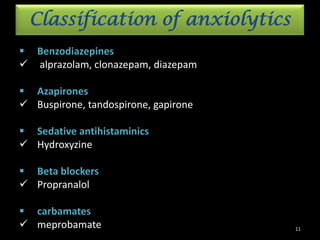
Classification of anxiolytics
 Benzodiazepines
 alprazolam, clonazepam, diazepam

 Azapirones
 Buspirone, tandospirone, gapirone

 Sedative antihistaminics
 Hydroxyzine

 Beta blockers
 Propranalol

 carbamates
 meprobamate                         11
Screening

methods for

anxiolytics
              12
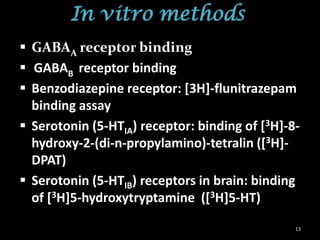
In vitro methods
 GABAA receptor binding
 GABAB receptor binding
 Benzodiazepine receptor: [3H]-flunitrazepam
  binding assay
 Serotonin (5-HTIA) receptor: binding of [3H]-8-
  hydroxy-2-(di-n-propylamino)-tetralin ([3H]-
  DPAT)
 Serotonin (5-HTIB) receptors in brain: binding
  of [3H]5-hydroxytryptamine ([3H]5-HT)

                                                13
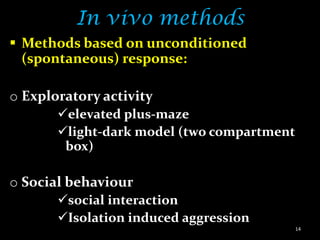
In vivo methods
 Methods based on unconditioned
  (spontaneous) response:

o Exploratory activity
       elevated plus-maze
       light-dark model (two compartment
        box)

o Social behaviour
       social interaction
       Isolation induced aggression
                                            14
 Methods based on conditioned (learned)
  response:
o Conflict models
     Vogel punished drinking/ Vogel’s lick
      conflict model


 Normal (adaptive) anxiety
o Elevated plus-maze test
o Social interaction
o Light-dark model
o Marble burying test
                                         15
 Stress-induced anxiety
o Vogel lick conflict test


 Pathological anxiety
o Neurochemically - induced anxiety
        mCPP induced anxiety in rats


                                        16
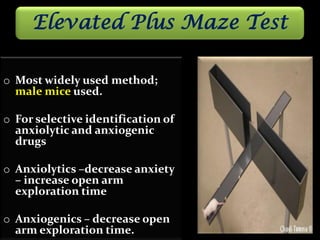
Elevated Plus Maze Test

o Most widely used method;
  male mice used.

o For selective identification of
  anxiolytic and anxiogenic
  drugs

o Anxiolytics –decrease anxiety
  – increase open arm
  exploration time

o Anxiogenics – decrease open
  arm exploration time.             17
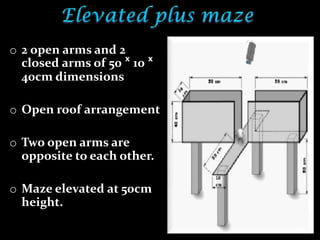
o 2 open arms and 2
  closed arms of 50 ˣ 10 ˣ
  40cm dimensions

o Open roof arrangement

o Two open arms are
  opposite to each other.

o Maze elevated at 50cm
  height.
                             18
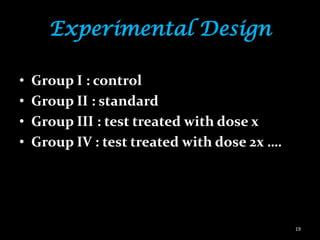
Experimental Design

•   Group I : control
•   Group II : standard
•   Group III : test treated with dose x
•   Group IV : test treated with dose 2x ….


                                              19
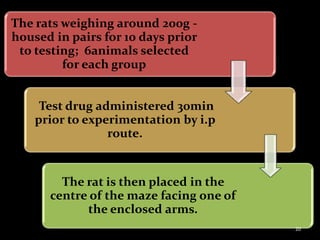
The rats weighing around 200g -
housed in pairs for 10 days prior
 to testing; 6animals selected
         for each group


     Test drug administered 30min
    prior to experimentation by i.p
                 route.


        The rat is then placed in the
      centre of the maze facing one of
            the enclosed arms.
                                         20
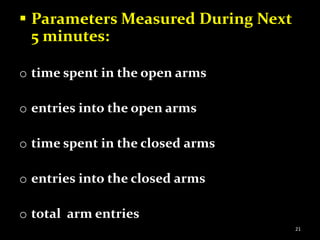
 Parameters Measured During Next
  5 minutes:

o time spent in the open arms

o entries into the open arms

o time spent in the closed arms

o entries into the closed arms

o total arm entries
                                    21
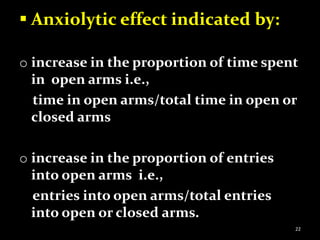
 Anxiolytic effect indicated by:

o increase in the proportion of time spent
  in open arms i.e.,
  time in open arms/total time in open or
  closed arms

o increase in the proportion of entries
  into open arms i.e.,
  entries into open arms/total entries
  into open or closed arms.
                                          22
 Evaluation of results:

o Motor activity and open arm exploratory
  activity determined.

o Values of treated groups expressed as % of
  control values.

o Benzodiazepines and valproate – decrease
  motor activity and increase exploratory
  time.
                                               23
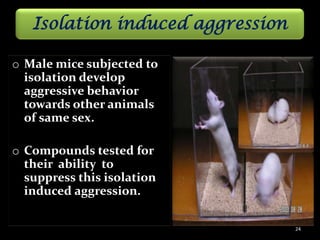
Isolation induced aggression

o Male mice subjected to
  isolation develop
  aggressive behavior
  towards other animals
  of same sex.

o Compounds tested for
  their ability to
  suppress this isolation
  induced aggression.

                                  24
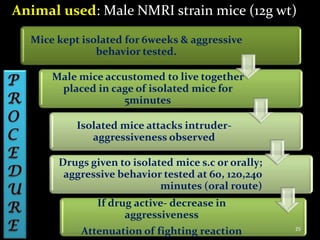
Animal used: Male NMRI strain mice (12g wt)
  Mice kept isolated for 6weeks & aggressive
               behavior tested.

      Male mice accustomed to live together
       placed in cage of isolated mice for
                   5minutes

           Isolated mice attacks intruder-
              aggressiveness observed

       Drugs given to isolated mice s.c or orally;
        aggressive behavior tested at 60, 120,240
                            minutes (oral route)
               If drug active- decrease in
                     aggressiveness
            Attenuation of fighting reaction         25
 Evaluation of results:

o No. of animals with complete suppression
  of aggressiveness.

o Reaction time noted.

o Graduated scale of inhibition of
  aggressiveness is established.

o Results of test group animals is compared
  with the control group results.
                                              26
Anti – anxiety test
           (light – dark model)
o Rodents – have exploratory activity

o Animals placed in 2 chambered systems,
  where they can freely move between a brightly
  –lit open field and a dark corner.

o After treatment with anxiolytic - show more
  crossings between the two chambers and more
  locomotor activity.

o Number of crossings between the light and
  dark sites is recorded.                     27
Methodology
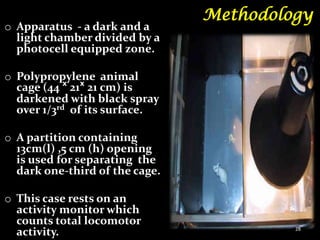
o Apparatus - a dark and a
  light chamber divided by a
  photocell equipped zone.

o Polypropylene animal
  cage (44 ˣ 21ˣ 21 cm) is
  darkened with black spray
  over 1/3rd of its surface.

o A partition containing
  13cm(l) ,5 cm (h) opening
  is used for separating the
  dark one-third of the cage.

o This case rests on an
  activity monitor which
  counts total locomotor
  activity.                              28
o An electronic system consisting of 4 sets of
  photocells across the partition.

o It automatically counts movements through
  the partition and records the time spent in
  the light and dark compartments.

o Animals- treated 30 min before the test with
  drugs or vehicle given i.p. placed in the cage
  and observed for 10 min.

o Groups of 6-8 animals used for each dose.
                                                 29
o No. of crossings through the partition between
  the light and dark chambers compared with total
  activity counts during the 10 min.

o Loco motor activity also monitored.
o anxiolytics like diazepam & meprobamate
  increase locomotor activity and no. of crossings.

o non anxiolytics - not effective in this model.

                                                   30
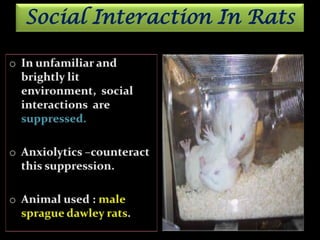
Social Interaction In Rats


                             31
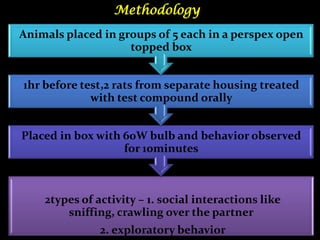
Methodology
Animals placed in groups of 5 each in a perspex open
                    topped box


1hr before test,2 rats from separate housing treated
             with test compound orally


Placed in box with 60W bulb and behavior observed
                   for 10minutes


    2types of activity – 1. social interactions like
        sniffing, crawling over the partner
               2. exploratory behavior                 32
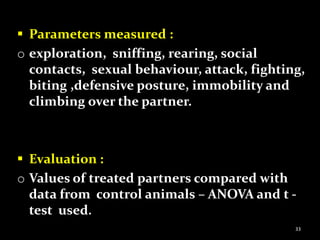
 Parameters measured :
o exploration, sniffing, rearing, social
  contacts, sexual behaviour, attack, fighting,
  biting ,defensive posture, immobility and
  climbing over the partner.


 Evaluation :
o Values of treated partners compared with
  data from control animals – ANOVA and t -
  test used.
                                             33
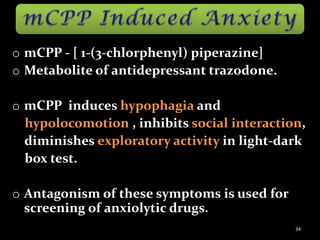
o mCPP - [ 1-(3-chlorphenyl) piperazine]
o Metabolite of antidepressant trazodone.

o mCPP induces hypophagia and
  hypolocomotion , inhibits social interaction,
  diminishes exploratory activity in light-dark
  box test.

o Antagonism of these symptoms is used for
  screening of anxiolytic drugs.
                                             34
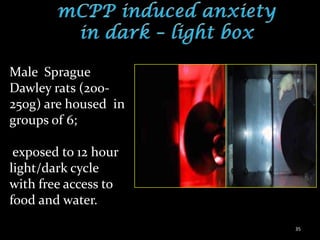
Male Sprague
Dawley rats (200-
250g) are housed in
groups of 6;

 exposed to 12 hour
light/dark cycle
with free access to
food and water.
                      35
 Parameters measured :
o time spent in both sides
  (horizontal, vertical activity)
o frequency of motion
o number of transition


 Anxiolytic effect :
o increase in parameters measured in the
  light/dark box or in number of
  transitions if test is active.
                                       36
mCPP Induced Anxiety -
           Locomotion Study

• Test compound or vehicle are administered orally
  1h or i.p 30 min before the locomotion test.

• mCPP is injected i.p. in a dose of 7 mg/kg 20 min
  before the test.

•    The animals are placed individually in an
    automated locomotor activity cages and
    locomotion is recorded for 10 min.

• Anxiolytic effect : disinhibition of locomotion.
                                                     37
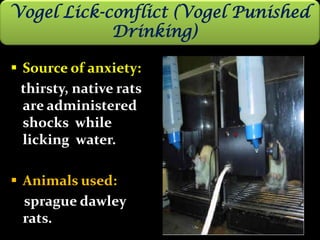
Vogel Lick-conflict (Vogel Punished
            Drinking)

 Source of anxiety:
  thirsty, native rats
  are administered
  shocks while
  licking water.

 Animals used:
  sprague dawley
  rats.
                                 38
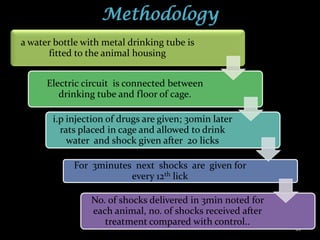
Methodology
a water bottle with metal drinking tube is
      fitted to the animal housing


      Electric circuit is connected between
         drinking tube and floor of cage.

       i.p injection of drugs are given; 30min later
         rats placed in cage and allowed to drink
           water and shock given after 20 licks

            For 3minutes next shocks are given for
                        every 12th lick

                 No. of shocks delivered in 3min noted for
                 each animal, no. of shocks received after
                    treatment compared with control..
                                                             39
 Parameters measured:
o number of accepted punishments
  (electric shock)


 Anxiolytic effect :
o statistically significant increase in the
  accepted shocks.

                                              40
conclusion

• Anxiety disorderstress, tension, feardisorder and
  associated with
                   is a psychological
                                        and threat
    about future.
•   The pathophysiology of anxiety disorder is not
    fully understood and hence improper diagnosis
    leads to increase morbidity and mortality rates.
•   Development of the screening methods resulted
    in introduction of many new anxiolytic agents.
• In future aspects more reliable and easy models
  for screening are to be developed.
                                                       41
References
•   Joseph T. Dipiro, Robert L.Talbert, Gary C.Yee;
    Pharmacotherapy-And-Pathophysiologic Approach;
    Seventh edition; 1161-1181.

•   Parmar N.S, Shiv prakash; Screening Methods in
    Pharmacology; 98-107.

•   Gerhard Vogel; Drug discovery and Evaluation –
    Pharmacological Assays; Second Edition; 401-458.

•   Shenoy et.al/ Preclinical evaluation of anxiolytic
    agents: an overview; Journal of Pharmaceutical
    Research and Opinion; june 2011/volume 1/ issue 2/
    7-22 pgs.
                                                    42
43