Sedative-Hypnotics
Dr. Arun Jakhar - MBBS,MD (KGMU)
Senior Resident
Department of Pharmacology
UPUMS, Saifai
Sedative:
subdues excitement
calms the subject without inducing sleep
drowsiness may be produced
decreased responsiveness to stimulation
decrease in alertness, ideation and motor activity
Hypnotic:
induces and/or maintains sleep
similar to normal arousable sleep
not to be confused with ‘hypnosis’
meaning a trans-like state
subject becomes passive and highly suggestible
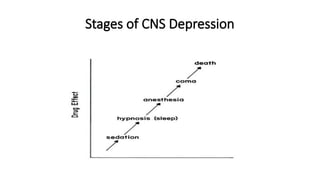
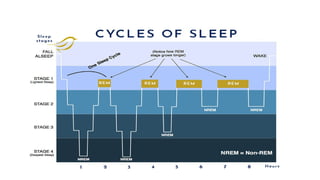
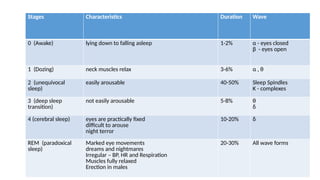
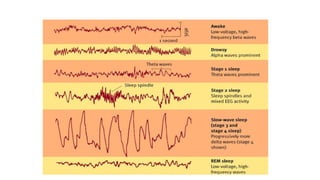
Stages of CNS Depression
Stages Characteristics Duration Wave
0 (Awake) lying down to falling asleep 1-2% α - eyes closed
β - eyes open
1 (Dozing) neck muscles relax 3-6% α , θ
2 (unequivocal
sleep)
easily arousable 40-50% Sleep Spindles
K - complexes
3 (deep sleep
transition)
not easily arousable 5-8% θ
δ
4 (cerebral sleep) eyes are practically fixed
difficult to arouse
night terror
10-20% δ
REM (paradoxical
sleep)
Marked eye movements
dreams and nightmares
Irregular – BP, HR and Respiration
Muscles fully relaxed
Erection in males
20-30% All wave forms
BARBITURATES
• popular upto 1960s
• but are not used now to promote sleep or to calm patients
• are substituted derivatives of barbituric acid (malonyl urea)
• barbituric acid as such is not a hypnotic but compounds with alkyl or
aryl substitution on C5 have this property
• Replacement of O with S at C2 yields thiobarbiturates which are more
lipid-soluble and more potent
PHARMACOLOGICAL ACTIONS:
• depressants for all excitable cells
• more for the CNS
1. CNS:
Barbiturates produce dose-dependent effects:
sedation → sleep → anaesthesia → coma
Hypnotic dose:
• shortens the time taken to fall asleep
• increases sleep duration
• night awakenings are reduced
• REM and stage 3, 4 sleep are decreased
• REM-NREM sleep cycle is disrupted
• effects become progressively less if taken every night
• rebound increase in REM sleep and nightmares
• when drug discontinued after a few nights of use
• it takes several nights for normal pattern to be restored
• hang over (headache, dizziness, distortions of mood, irritability and
lethargy) may occur in the morning after a nightly dose
Sedative dose:
• smaller dose of a longer acting barbiturate
• given at daytime can produce drowsiness, reduction in anxiety and
excitability
• however, barbiturates do not have selective anti anxiety action
• they can impair learning, short-term memory and judgement
• euphoria may be experienced by addicts
2. Other actions:
• at relatively higher doses
• depress respiration
• lower BP
• decrease cardiac contractility and heart rate
• but reflex tachycardia can occur due to fall in BP
• muscle tone, bowel motility and urine output are also reduced
• toxic does cause respiratory failure and cardiovascular collapse
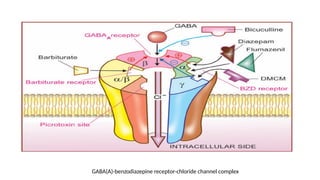
MECHANISM OF ACTION:
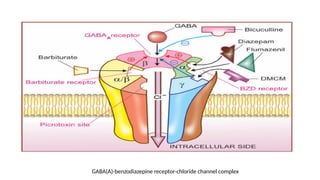
• Increase duration of chloride channel opening
• At high concentrations:
directly increase Cl¯ conductance (GABA-mimetic action)
 inhibit Ca2+ dependent release of neurotransmitters
depress glutamate induced neuronal depolarization through AMPA
receptors (a type of excitatory amino acid receptors)
depress voltage sensitive Na+ and K+ channels
GABA(A)-benzodiazepine receptor-chloride channel complex
PHARMACOKINETICS:
• well absorbed from the g.i. tract
• widely distributed in the body
• rate of entry into CNS is dependent on lipid solubility
• Highly-lipid soluble thiopentone has practically instantaneous entry
while less lipid-soluble ones (pentobarbitone) take longer
• phenobarbitone enters very slowly
• cross placenta
• secreted in milk
• produce effects on the foetus and suckling infant
• termination of action of barbiturates:
redistribution, metabolism and excretion
• induce several hepatic microsomal enzymes (CYP3A4/5, CYP2D6,
CYP2C8/9, CYP2B6, UGTs)
• increase rate of their own metabolism as well as that of many other
drugs
USES:
1. phenobarbitone ----epilepsy
2. thiopentone/methohexitone ---anaesthesia
ADVERSE EFFECTS:
3. hangover
4. mental confusion
5. impaired performance and
6. traffic accidents
7. tolerance and dependence
Acute barbiturate poisoning:
• Mostly suicidal
• some times accidental
• infrequently encountered now
• Manifestations:
patient is flabby and comatose
shallow and failing respiration
fall in BP and cardiovascular collapse
renal shut down
pulmonary complications
Treatment of Acute barbiturate poisoning:
• Gastric lavage----activated
• Supportive measures:
patent airway, assisted respiration, oxygen, maintenance of blood
volume by fluid infusion and use of vasopressors—
dopamine may be preferred for its renal vasodilating action
• Alkaline diuresis
• Haemodialysis and haemoperfusion
BENZODIAZEPINES (BZDs)
• selective CNS depressants
• have a high therapeutic index
• hypnotic doses do not affect respiration or cardiovascular functions
• cause less distortion of sleep architec ture; rebound phenomena on
discontinuation
• do not alter disposition of other drugs by microsomal enzyme
induction
• have lower abuse liability than barbiturates
• specific BZD antagonist flumazenil is available
USES:
1. Antianxiety
2. Hypnotic
3. Muscle relaxant
4. Anticonvulsant
5. Alcohol withdrawal( Chlordiazepoxide)
MECHANISM OF ACTION:
• act preferentially on midbrain ascending reticular formation (which
maintains wakefulness)
• and on limbic system (thought and mental functions)
• Muscle relaxation----primary medullary site of action and ataxia is due
to action on cerebellum
GABA(A)-benzodiazepine receptor-chloride channel complex
ADVERSE EFFECTS:
hypnotic doses----dizziness, vertigo, ataxia, disorientation, amnesia,
prolongation of reaction time—impairment of psychomotor skills
(should not drive)
Sleep walking, sleep driving and other abnormal sleep behaviours with
no memory of these events has been recognized as a possible hazard
Hangover----less common
Weakness,
blurring of vision, dry mouth and urinary incontinence are sometimes
complained
Older individuals--more susceptible to psychomotor side effects
Like any hypnotic, BZDs can aggravate sleep apnoea
NON-BENZODIAZEPINE HYPNOTICS
• chemically different from BZDs
• but act as agonists on a specific subset of BZD receptors
• action is competitively antagonized by flumazenil
• which can be used to treat their overdose toxicity
• act selectively on α1 subunit containing BZD receptors
• produce hypnotic-amnesic action
• With weak antianxiety, muscle relaxant and anticonvulsant effects
• have lower abuse potential than hypnotic BZDs
• shorter duration of action----preferred over BZDs
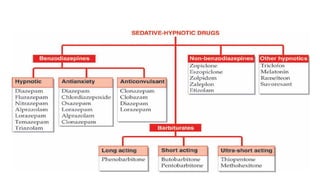
• Zopiclone
• Eszopiclone
• Zolpidem
• Zaleplon
Types of Insomnia
• Chronic insomnia (> 3 weeks)
• Short-term insomnia (3–21 days)
• Transient insomnia (1–3 days)
BENZODIAZEPINE ANTAGONIST
FLUMAZENIL:
• competes with BZD agonists as well as inverse agonists
• reverses their depressant or stimulant effects respectively
• absorbed orally, but it is not used orally
• Injected i.v.-----action starts in seconds and lasts for 1–2 hours
• elimination t½ is 1 hr, due to rapid metabolism
Uses:
1. To reverse BZD anaesthesia
2. BZD overdose
Other Hypnotics
Triclofos:
• old CNS depressant
• fast-acting hypnotic
• acts in 30 min, action lasts 6–8 hours
• though obsolete
• some times used to sedate children in distress
• and rarely to induce sleep in adults
Melatonin:
• principal hormone of the pineal gland
• secreted at night
• important role in sleep-wakefulness cycle
• receptor MT1 and MT2 in the brain
• Both are GPCRs
• high doses (80 mg) of melatonin administered orally can induce sleep
low doses (2–10 mg) do not depress the CNS, but probably increase
the propensity of falling asleep
Uses: jet-lag, shift workers and elderly insomniacs
Ramelteon:
• MT1 , MT2 melatonin receptor agonist
• 8 mg ½ hour before going to bed
• hasten sleep onset as well as increase sleep duration
• without causing next morning sedation or impairment
Suvorexant:
• first member of a novel class of insomnia drugs—’dual orexin
receptor antagonists’ (DORAs)
• Orexins are neuropeptides found in lateral hypothalamus
• which promote wakefulness by acting on OX1R and OX2R
• orexin levels are high during day time and low at night,
• and that narcolepsy (episodes of sudden sleep) is associated with loss
of orexin neurones, support this role of orexin
Sedative- Hypnotics wonderful presentation.pptx

Sedative- Hypnotics wonderful presentation.pptx

  • 1.
    Sedative-Hypnotics Dr. Arun Jakhar- MBBS,MD (KGMU) Senior Resident Department of Pharmacology UPUMS, Saifai
  • 2.
    Sedative: subdues excitement calms thesubject without inducing sleep drowsiness may be produced decreased responsiveness to stimulation decrease in alertness, ideation and motor activity
  • 3.
    Hypnotic: induces and/or maintainssleep similar to normal arousable sleep not to be confused with ‘hypnosis’ meaning a trans-like state subject becomes passive and highly suggestible
  • 4.
    Stages of CNSDepression
  • 6.
    Stages Characteristics DurationWave 0 (Awake) lying down to falling asleep 1-2% α - eyes closed β - eyes open 1 (Dozing) neck muscles relax 3-6% α , θ 2 (unequivocal sleep) easily arousable 40-50% Sleep Spindles K - complexes 3 (deep sleep transition) not easily arousable 5-8% θ δ 4 (cerebral sleep) eyes are practically fixed difficult to arouse night terror 10-20% δ REM (paradoxical sleep) Marked eye movements dreams and nightmares Irregular – BP, HR and Respiration Muscles fully relaxed Erection in males 20-30% All wave forms
  • 9.
    BARBITURATES • popular upto1960s • but are not used now to promote sleep or to calm patients • are substituted derivatives of barbituric acid (malonyl urea) • barbituric acid as such is not a hypnotic but compounds with alkyl or aryl substitution on C5 have this property • Replacement of O with S at C2 yields thiobarbiturates which are more lipid-soluble and more potent
  • 10.
    PHARMACOLOGICAL ACTIONS: • depressantsfor all excitable cells • more for the CNS 1. CNS: Barbiturates produce dose-dependent effects: sedation → sleep → anaesthesia → coma
  • 11.
    Hypnotic dose: • shortensthe time taken to fall asleep • increases sleep duration • night awakenings are reduced • REM and stage 3, 4 sleep are decreased • REM-NREM sleep cycle is disrupted
  • 12.
    • effects becomeprogressively less if taken every night • rebound increase in REM sleep and nightmares • when drug discontinued after a few nights of use • it takes several nights for normal pattern to be restored • hang over (headache, dizziness, distortions of mood, irritability and lethargy) may occur in the morning after a nightly dose
  • 13.
    Sedative dose: • smallerdose of a longer acting barbiturate • given at daytime can produce drowsiness, reduction in anxiety and excitability • however, barbiturates do not have selective anti anxiety action • they can impair learning, short-term memory and judgement • euphoria may be experienced by addicts
  • 14.
    2. Other actions: •at relatively higher doses • depress respiration • lower BP • decrease cardiac contractility and heart rate • but reflex tachycardia can occur due to fall in BP • muscle tone, bowel motility and urine output are also reduced • toxic does cause respiratory failure and cardiovascular collapse
  • 15.
    MECHANISM OF ACTION: •Increase duration of chloride channel opening • At high concentrations: directly increase Cl¯ conductance (GABA-mimetic action)  inhibit Ca2+ dependent release of neurotransmitters depress glutamate induced neuronal depolarization through AMPA receptors (a type of excitatory amino acid receptors) depress voltage sensitive Na+ and K+ channels
  • 16.
  • 17.
    PHARMACOKINETICS: • well absorbedfrom the g.i. tract • widely distributed in the body • rate of entry into CNS is dependent on lipid solubility • Highly-lipid soluble thiopentone has practically instantaneous entry while less lipid-soluble ones (pentobarbitone) take longer • phenobarbitone enters very slowly • cross placenta • secreted in milk • produce effects on the foetus and suckling infant
  • 18.
    • termination ofaction of barbiturates: redistribution, metabolism and excretion • induce several hepatic microsomal enzymes (CYP3A4/5, CYP2D6, CYP2C8/9, CYP2B6, UGTs) • increase rate of their own metabolism as well as that of many other drugs
  • 19.
    USES: 1. phenobarbitone ----epilepsy 2.thiopentone/methohexitone ---anaesthesia ADVERSE EFFECTS: 3. hangover 4. mental confusion 5. impaired performance and 6. traffic accidents 7. tolerance and dependence
  • 20.
    Acute barbiturate poisoning: •Mostly suicidal • some times accidental • infrequently encountered now • Manifestations: patient is flabby and comatose shallow and failing respiration fall in BP and cardiovascular collapse renal shut down pulmonary complications
  • 21.
    Treatment of Acutebarbiturate poisoning: • Gastric lavage----activated • Supportive measures: patent airway, assisted respiration, oxygen, maintenance of blood volume by fluid infusion and use of vasopressors— dopamine may be preferred for its renal vasodilating action • Alkaline diuresis • Haemodialysis and haemoperfusion
  • 22.
    BENZODIAZEPINES (BZDs) • selectiveCNS depressants • have a high therapeutic index • hypnotic doses do not affect respiration or cardiovascular functions • cause less distortion of sleep architec ture; rebound phenomena on discontinuation • do not alter disposition of other drugs by microsomal enzyme induction • have lower abuse liability than barbiturates • specific BZD antagonist flumazenil is available
  • 23.
    USES: 1. Antianxiety 2. Hypnotic 3.Muscle relaxant 4. Anticonvulsant 5. Alcohol withdrawal( Chlordiazepoxide)
  • 24.
    MECHANISM OF ACTION: •act preferentially on midbrain ascending reticular formation (which maintains wakefulness) • and on limbic system (thought and mental functions) • Muscle relaxation----primary medullary site of action and ataxia is due to action on cerebellum
  • 25.
  • 26.
    ADVERSE EFFECTS: hypnotic doses----dizziness,vertigo, ataxia, disorientation, amnesia, prolongation of reaction time—impairment of psychomotor skills (should not drive) Sleep walking, sleep driving and other abnormal sleep behaviours with no memory of these events has been recognized as a possible hazard Hangover----less common Weakness, blurring of vision, dry mouth and urinary incontinence are sometimes complained Older individuals--more susceptible to psychomotor side effects Like any hypnotic, BZDs can aggravate sleep apnoea
  • 27.
    NON-BENZODIAZEPINE HYPNOTICS • chemicallydifferent from BZDs • but act as agonists on a specific subset of BZD receptors • action is competitively antagonized by flumazenil • which can be used to treat their overdose toxicity • act selectively on α1 subunit containing BZD receptors • produce hypnotic-amnesic action • With weak antianxiety, muscle relaxant and anticonvulsant effects • have lower abuse potential than hypnotic BZDs • shorter duration of action----preferred over BZDs
  • 28.
    • Zopiclone • Eszopiclone •Zolpidem • Zaleplon
  • 29.
    Types of Insomnia •Chronic insomnia (> 3 weeks) • Short-term insomnia (3–21 days) • Transient insomnia (1–3 days)
  • 30.
    BENZODIAZEPINE ANTAGONIST FLUMAZENIL: • competeswith BZD agonists as well as inverse agonists • reverses their depressant or stimulant effects respectively • absorbed orally, but it is not used orally • Injected i.v.-----action starts in seconds and lasts for 1–2 hours • elimination t½ is 1 hr, due to rapid metabolism Uses: 1. To reverse BZD anaesthesia 2. BZD overdose
  • 31.
    Other Hypnotics Triclofos: • oldCNS depressant • fast-acting hypnotic • acts in 30 min, action lasts 6–8 hours • though obsolete • some times used to sedate children in distress • and rarely to induce sleep in adults
  • 32.
    Melatonin: • principal hormoneof the pineal gland • secreted at night • important role in sleep-wakefulness cycle • receptor MT1 and MT2 in the brain • Both are GPCRs • high doses (80 mg) of melatonin administered orally can induce sleep low doses (2–10 mg) do not depress the CNS, but probably increase the propensity of falling asleep Uses: jet-lag, shift workers and elderly insomniacs
  • 33.
    Ramelteon: • MT1 ,MT2 melatonin receptor agonist • 8 mg ½ hour before going to bed • hasten sleep onset as well as increase sleep duration • without causing next morning sedation or impairment
  • 34.
    Suvorexant: • first memberof a novel class of insomnia drugs—’dual orexin receptor antagonists’ (DORAs) • Orexins are neuropeptides found in lateral hypothalamus • which promote wakefulness by acting on OX1R and OX2R • orexin levels are high during day time and low at night, • and that narcolepsy (episodes of sudden sleep) is associated with loss of orexin neurones, support this role of orexin