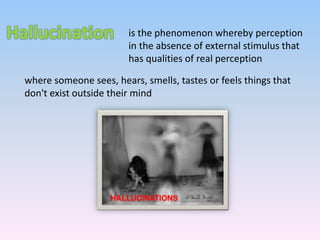
is the phenomenon whereby perception
in the absence of external stimulus that
has qualities of real perception
where someone sees, hears, smells, tastes or feels things that
don't exist outside their mind
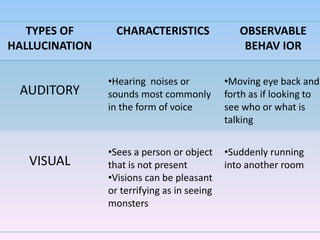
TYPES OF
HALLUCINATION
CHARACTERISTICS OBSERVABLE
BEHAV IOR
AUDITORY
•Hearing noises or
sounds most commonly
in the form of voice
•Moving eye back and
forth as if looking to
see who or what is
talking
VISUAL
•Sees a person or object
that is not present
•Visions can be pleasant
or terrifying as in seeing
monsters
•Suddenly running
into another room
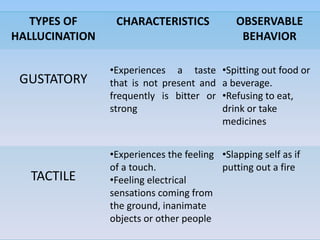
TYPES OF
HALLUCINATION
CHARACTERISTICS OBSERVABLE
BEHAVIOR
GUSTATORY
•Experiences a taste
that is not present and
frequently is bitter or
strong
•Spitting out food or
a beverage.
•Refusing to eat,
drink or take
medicines
TACTILE
•Experiences the feeling
of a touch.
•Feeling electrical
sensations coming from
the ground, inanimate
objects or other people
•Slapping self as if
putting out a fire
Drugs which causes
hallucinations
Drug which alter mood, behavior, thought and perception
Psychedelic
Psychotogenic
Psychotomimetic
Synonyms -
• Lysergic acid diethylamine
• Lysergic acid amide
• Psilocybin
• Mescaline
• Cannabinoids
How do hallucinogens affect the brain?
Interfere with the action of the
brain chemical serotonin, which
regulates:
•mood
•sensory perception
•sleep
•hunger
•body temperature
•muscle control
Interfere with the action of the
brain chemical glutamate, which
regulates:
•pain perception
•responses to the
environment
•emotion
•learning and memory
Partially work by temporarily disrupting communication between
brain chemical systems throughout brain and spinal cord
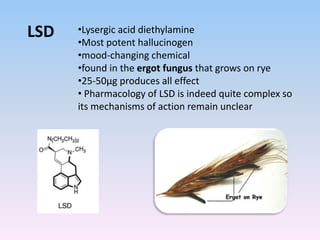
LSD •Lysergic acid diethylamine
•Most potent hallucinogen
•mood-changing chemical
•found in the ergot fungus that grows on rye
•25-50µg produces all effect
• Pharmacology of LSD is indeed quite complex so
its mechanisms of action remain unclear
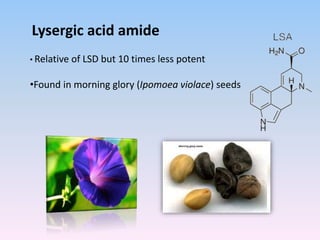
Lysergic acid amide
• Relative of LSD but 10 times less potent
•Found in morning glory (Ipomoea violace) seeds
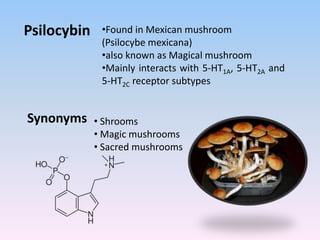
Psilocybin •Found in Mexican mushroom
(Psilocybe mexicana)
•also known as Magical mushroom
•Mainly interacts with 5-HT1A, 5-HT2A and
5-HT2C receptor subtypes
Synonyms • Shrooms
• Magic mushrooms
• Sacred mushrooms
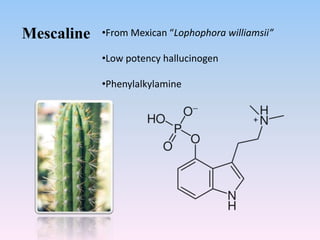
Mescaline •From Mexican “Lophophora williamsii”
•Low potency hallucinogen
•Phenylalkylamine
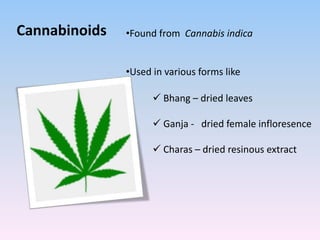
Cannabinoids •Found from Cannabis indica
•Used in various forms like
 Bhang – dried leaves
 Ganja - dried female infloresence
 Charas – dried resinous extract
 Zmigrod L, Garrison J, Carr J. The neural mechanisms of
hallucinations: A quantitative meta-analysis of neuroimaging
studies. Neuroscience and Biobehavioral Reviews 2016 (69);113–
123
Strassman R. Hallucinogenic Drugs in Psychiatric Research and
Treatment:
Perspectives and Prospects, The Journal of Nervous and Mental
Disease, Vol. 183, No. 3, pp. 127-138
Kokate C, Purohit A, Gokhale S. Pharmacognosy. Nirali
prakashan, 51th ed, pp-451-453
European Monitoring Centre for Drugs and Drug Addiction
(2011) Drug Profiles: Hallucinogenic Mushrooms.
Available: http://www.emcdda.europa.eu/publications/drug-
profiles/mushrooms. Accessed 21th Sep 2016
National Institute on Drug Abuse (2009) DrugFacts:
Hallucinogens - LSD, Peyote, Psilocybin, and PCP. Available:
http://www.drugabuse.gov/publications/drugfacts/hallucinogen
s-lsd-peyote-psilocybin-pcp. Accessed 21th Sep 2016
Hallucination

Hallucination

  • 2.
    is the phenomenonwhereby perception in the absence of external stimulus that has qualities of real perception where someone sees, hears, smells, tastes or feels things that don't exist outside their mind
  • 3.
    TYPES OF HALLUCINATION CHARACTERISTICS OBSERVABLE BEHAVIOR AUDITORY •Hearing noises or sounds most commonly in the form of voice •Moving eye back and forth as if looking to see who or what is talking VISUAL •Sees a person or object that is not present •Visions can be pleasant or terrifying as in seeing monsters •Suddenly running into another room
  • 4.
    TYPES OF HALLUCINATION CHARACTERISTICS OBSERVABLE BEHAVIOR GUSTATORY •Experiencesa taste that is not present and frequently is bitter or strong •Spitting out food or a beverage. •Refusing to eat, drink or take medicines TACTILE •Experiences the feeling of a touch. •Feeling electrical sensations coming from the ground, inanimate objects or other people •Slapping self as if putting out a fire
  • 5.
    Drugs which causes hallucinations Drugwhich alter mood, behavior, thought and perception Psychedelic Psychotogenic Psychotomimetic Synonyms - • Lysergic acid diethylamine • Lysergic acid amide • Psilocybin • Mescaline • Cannabinoids
  • 7.
    How do hallucinogensaffect the brain? Interfere with the action of the brain chemical serotonin, which regulates: •mood •sensory perception •sleep •hunger •body temperature •muscle control Interfere with the action of the brain chemical glutamate, which regulates: •pain perception •responses to the environment •emotion •learning and memory Partially work by temporarily disrupting communication between brain chemical systems throughout brain and spinal cord
  • 8.
    LSD •Lysergic aciddiethylamine •Most potent hallucinogen •mood-changing chemical •found in the ergot fungus that grows on rye •25-50µg produces all effect • Pharmacology of LSD is indeed quite complex so its mechanisms of action remain unclear
  • 9.
    Lysergic acid amide •Relative of LSD but 10 times less potent •Found in morning glory (Ipomoea violace) seeds
  • 10.
    Psilocybin •Found inMexican mushroom (Psilocybe mexicana) •also known as Magical mushroom •Mainly interacts with 5-HT1A, 5-HT2A and 5-HT2C receptor subtypes Synonyms • Shrooms • Magic mushrooms • Sacred mushrooms
  • 11.
    Mescaline •From Mexican“Lophophora williamsii” •Low potency hallucinogen •Phenylalkylamine
  • 12.
    Cannabinoids •Found fromCannabis indica •Used in various forms like  Bhang – dried leaves  Ganja - dried female infloresence  Charas – dried resinous extract
  • 13.
     Zmigrod L,Garrison J, Carr J. The neural mechanisms of hallucinations: A quantitative meta-analysis of neuroimaging studies. Neuroscience and Biobehavioral Reviews 2016 (69);113– 123 Strassman R. Hallucinogenic Drugs in Psychiatric Research and Treatment: Perspectives and Prospects, The Journal of Nervous and Mental Disease, Vol. 183, No. 3, pp. 127-138 Kokate C, Purohit A, Gokhale S. Pharmacognosy. Nirali prakashan, 51th ed, pp-451-453
  • 14.
    European Monitoring Centrefor Drugs and Drug Addiction (2011) Drug Profiles: Hallucinogenic Mushrooms. Available: http://www.emcdda.europa.eu/publications/drug- profiles/mushrooms. Accessed 21th Sep 2016 National Institute on Drug Abuse (2009) DrugFacts: Hallucinogens - LSD, Peyote, Psilocybin, and PCP. Available: http://www.drugabuse.gov/publications/drugfacts/hallucinogen s-lsd-peyote-psilocybin-pcp. Accessed 21th Sep 2016