Antipsychotic Drugs Chapter 29

OBJECTIVES

1. Describe the dopamine hypothesis of schizophrenia.
2. List the major receptors blocked by antipsychotic drugs.
3. Describe the pharmacodynamics of older antipsychotic
drugs and relate these characteristics to their clinical uses.
4. Identify the main characteristics and clinical uses of
newer atypical antipsychotic drugs.
5. List the major adverse effects of the antipsychotic drugs.
Significance of antipsychotics/neuroleptics
• Introduction of chlorpromazine in 1952 led by
the end of the 1950’s to emptying psychiatric
hospitals back into community, with mixed
results
• The successful treatment of a psychiatric
disorder with a drug led to a search for
biological mechanisms and development of
biological psychiatry
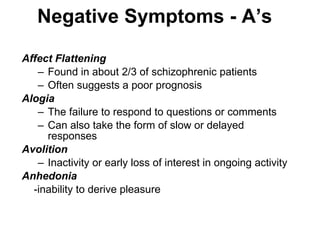
Negative Symptoms - A’s

Affect Flattening
   – Found in about 2/3 of schizophrenic patients
   – Often suggests a poor prognosis
Alogia
   – The failure to respond to questions or comments
   – Can also take the form of slow or delayed
     responses
Avolition
   – Inactivity or early loss of interest in ongoing activity
Anhedonia
  -inability to derive pleasure
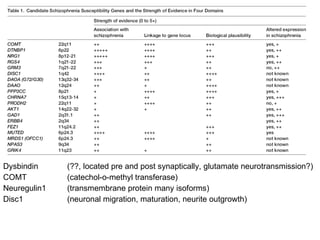
Dysbindin     (??, located pre and post synaptically, glutamate neurotransmission?)
COMT          (catechol-o-methyl transferase)
Neuregulin1   (transmembrane protein many isoforms)
Disc1         (neuronal migration, maturation, neurite outgrowth)
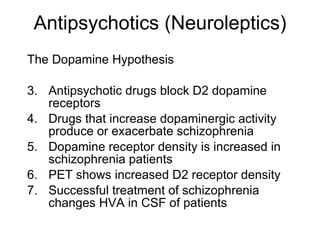
Antipsychotics (Neuroleptics)
The Dopamine Hypothesis

3. Antipsychotic drugs block D2 dopamine
   receptors
4. Drugs that increase dopaminergic activity
   produce or exacerbate schizophrenia
5. Dopamine receptor density is increased in
   schizophrenia patients
6. PET shows increased D2 receptor density
7. Successful treatment of schizophrenia
   changes HVA in CSF of patients
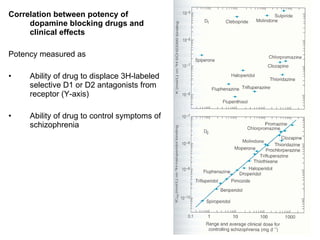
Correlation between potency of
     dopamine blocking drugs and
     clinical effects

Potency measured as

•    Ability of drug to displace 3H-labeled
     selective D1 or D2 antagonists from
     receptor (Y-axis)

•    Ability of drug to control symptoms of
     schizophrenia
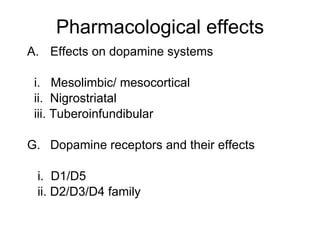
Pharmacological effects
A. Effects on dopamine systems

 i. Mesolimbic/ mesocortical
 ii. Nigrostriatal
 iii. Tuberoinfundibular

G. Dopamine receptors and their effects

 i. D1/D5
 ii. D2/D3/D4 family
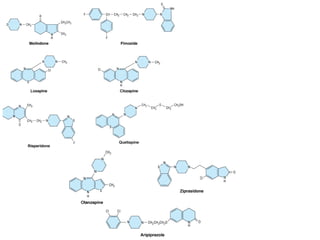
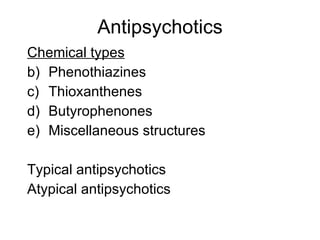
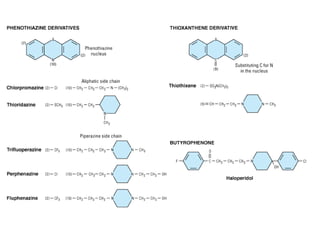
Antipsychotics
Chemical types
b) Phenothiazines
c) Thioxanthenes
d) Butyrophenones
e) Miscellaneous structures

Typical antipsychotics
Atypical antipsychotics
CLOZAPINE: AN EXAMPLE OF AN ATYPICAL NEUROLEPTIC


•Clozapine (sold as Clozaril, Leponex, Fazaclo; Gen-Clozapine in Canada) was the
first of the atypical antipsychotics to be developed. It was approved by the United
States Food and Drug Administration (FDA) in 1989 and is the only FDA-approved
medication indicated for treatment-resistant schizophrenia and for reducing the risk
of suicidal behaviour in patients with schizophrenia. [dubious – discuss]

•Clozapine has been shown to be superior in efficacy in treating schizophrenia.
Were it not for its side effects it would be first line treatment; however the rare but
potentially lethal side effects of agranulocytosis and myocarditis relegate it to third-
line use. Furthermore it may rarely lower seizure threshold, cause hepatic
dysfunction, weight gain and be associated with type II diabetes. More common side
effects are predominantly anticholinergic in nature, with dry mouth, sedation and
constipation. It is also a strong antagonist at different subtypes of adrenergic,
cholinergic, histaminergic and serotonergic receptors.

•Safer use of clozapine requires weekly blood monitoring for around five months
followed by four weekly testing thereafter. Echocardiograms are recommended
every 6 months to exclude cardiac damage.
Charlton BG. If 'atypical' neuroleptics did not
  exist, it wouldn't be necessary to invent them:
    perverse incentives in drug development,
    research, marketing and clinical practice.
      Medical Hypotheses. 2005; 6: 1005-9.
There is now ample evidence to suggest that neuroleptics (aka. anti-psychotics and major
tranquillizers) are dangerous drugs, and patients’ exposure to them should be minimized
wherever possible. This clinical imperative applies whether neuroleptics are of the traditional
type or atypical variety, albeit for different reasons since the traditional agents are neurotoxic
while atypicals are mainly metabolic poisons. Usage of traditional neuroleptics seems indeed
to be declining progressively, but the opposite seems to be happening for ‘atypicals’, and new
indications for these drugs are being promoted. Yet the atypical neuroleptics are a category of
pharmaceuticals which are close to being un-necessary since there are safer, cheaper and
pleasanter substitutes such as benzodiazepines and the sedative antihistamines (eg.
promethazine).
“In terms of therapeutic value, it therefore seems likely that 'atypicals' are merely an unusually dangerous
way of sedating patients. In therapeutic terms these drugs therefore represent a significant backward step.
Rationally, the atypicals should now be dropped and replaced with safer sedatives. Potential neuroleptic-
substitutes which already exist would include benzodiazepines and sedative antihistamines such as
promethazine [4,8].”
Clozapine is generally referred to as an "atypical"
neuroleptic. What is the difference between
"atypical" and "typical" neuroleptics (such as
haloperidol)?
There is no rigorous line between typical and
   atypical neuroleptics…but
• Atypicals have less tendency to produce
   motor side effects
• Atypicals produce effects on negative
   symptoms of schizophrenia
• May have effects in therapy-resistant
   patients
Pharmacological effects
A. Effects on dopamine systems

 i. Mesolimbic/ mesocortical
 ii. Nigrostriatal
 iii. Tuberoinfundibular

G. Dopamine receptors and their effects

 i. D1/D5
 ii. D2/D3/D4 family
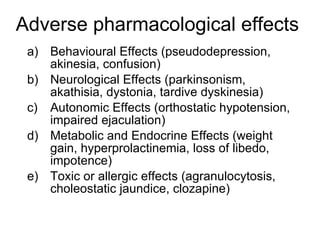
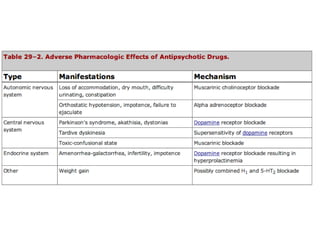
Adverse pharmacological effects
 a) Behavioural Effects (pseudodepression,
    akinesia, confusion)
 b) Neurological Effects (parkinsonism,
    akathisia, dystonia, tardive dyskinesia)
 c) Autonomic Effects (orthostatic hypotension,
    impaired ejaculation)
 d) Metabolic and Endocrine Effects (weight
    gain, hyperprolactinemia, loss of libedo,
    impotence)
 e) Toxic or allergic effects (agranulocytosis,
    choleostatic jaundice, clozapine)
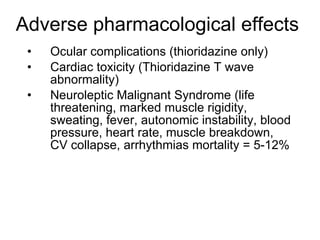
Adverse pharmacological effects
 •   Ocular complications (thioridazine only)
 •   Cardiac toxicity (Thioridazine T wave
     abnormality)
 •   Neuroleptic Malignant Syndrome (life
     threatening, marked muscle rigidity,
     sweating, fever, autonomic instability, blood
     pressure, heart rate, muscle breakdown,
     CV collapse, arrhythmias mortality = 5-12%
Pharmacological effects
A. Effects on dopamine systems

 i. Mesolimbic/ mesocortical
 ii. Nigrostriatal
 iii. Tuberoinfundibular

G. Dopamine receptors and their effects

 i. D1/D5
 ii. D2/D3/D4 family
Drug Combinations
Combining antipsychotic drugs confounds evaluation of
the efficacy of the drugs being used. Use of
combinations, however, is widespread, with more
emerging experimental data supporting it.
Tricyclic antidepressants or, more often, SSRIs may be
used with antipsychotics for clear symptoms of
depression complicating schizophrenia.
Lithium or valproic acid is sometimes added to
antipsychotic agents with benefit to patients who do
not respond to the latter drugs alone. Clozapine plus
lamotrigine developed here in Psychiatry. It is
uncertain whether such instances represent
misdiagnosed cases of mania or schizoaffective
disorder. Sedative drugs may be added for relief of
anxiety or insomnia not controlled by antipsychotics.

Antipsychotics 07web

  • 1.
    Antipsychotic Drugs Chapter29 OBJECTIVES 1. Describe the dopamine hypothesis of schizophrenia. 2. List the major receptors blocked by antipsychotic drugs. 3. Describe the pharmacodynamics of older antipsychotic drugs and relate these characteristics to their clinical uses. 4. Identify the main characteristics and clinical uses of newer atypical antipsychotic drugs. 5. List the major adverse effects of the antipsychotic drugs.
  • 2.
    Significance of antipsychotics/neuroleptics •Introduction of chlorpromazine in 1952 led by the end of the 1950’s to emptying psychiatric hospitals back into community, with mixed results • The successful treatment of a psychiatric disorder with a drug led to a search for biological mechanisms and development of biological psychiatry
  • 3.
    Negative Symptoms -A’s Affect Flattening – Found in about 2/3 of schizophrenic patients – Often suggests a poor prognosis Alogia – The failure to respond to questions or comments – Can also take the form of slow or delayed responses Avolition – Inactivity or early loss of interest in ongoing activity Anhedonia -inability to derive pleasure
  • 4.
    Dysbindin (??, located pre and post synaptically, glutamate neurotransmission?) COMT (catechol-o-methyl transferase) Neuregulin1 (transmembrane protein many isoforms) Disc1 (neuronal migration, maturation, neurite outgrowth)
  • 5.
    Antipsychotics (Neuroleptics) The DopamineHypothesis 3. Antipsychotic drugs block D2 dopamine receptors 4. Drugs that increase dopaminergic activity produce or exacerbate schizophrenia 5. Dopamine receptor density is increased in schizophrenia patients 6. PET shows increased D2 receptor density 7. Successful treatment of schizophrenia changes HVA in CSF of patients
  • 6.
    Correlation between potencyof dopamine blocking drugs and clinical effects Potency measured as • Ability of drug to displace 3H-labeled selective D1 or D2 antagonists from receptor (Y-axis) • Ability of drug to control symptoms of schizophrenia
  • 7.
    Pharmacological effects A. Effectson dopamine systems i. Mesolimbic/ mesocortical ii. Nigrostriatal iii. Tuberoinfundibular G. Dopamine receptors and their effects i. D1/D5 ii. D2/D3/D4 family
  • 8.
    Antipsychotics Chemical types b) Phenothiazines c)Thioxanthenes d) Butyrophenones e) Miscellaneous structures Typical antipsychotics Atypical antipsychotics
  • 10.
    CLOZAPINE: AN EXAMPLEOF AN ATYPICAL NEUROLEPTIC •Clozapine (sold as Clozaril, Leponex, Fazaclo; Gen-Clozapine in Canada) was the first of the atypical antipsychotics to be developed. It was approved by the United States Food and Drug Administration (FDA) in 1989 and is the only FDA-approved medication indicated for treatment-resistant schizophrenia and for reducing the risk of suicidal behaviour in patients with schizophrenia. [dubious – discuss] •Clozapine has been shown to be superior in efficacy in treating schizophrenia. Were it not for its side effects it would be first line treatment; however the rare but potentially lethal side effects of agranulocytosis and myocarditis relegate it to third- line use. Furthermore it may rarely lower seizure threshold, cause hepatic dysfunction, weight gain and be associated with type II diabetes. More common side effects are predominantly anticholinergic in nature, with dry mouth, sedation and constipation. It is also a strong antagonist at different subtypes of adrenergic, cholinergic, histaminergic and serotonergic receptors. •Safer use of clozapine requires weekly blood monitoring for around five months followed by four weekly testing thereafter. Echocardiograms are recommended every 6 months to exclude cardiac damage.
  • 11.
    Charlton BG. If'atypical' neuroleptics did not exist, it wouldn't be necessary to invent them: perverse incentives in drug development, research, marketing and clinical practice. Medical Hypotheses. 2005; 6: 1005-9. There is now ample evidence to suggest that neuroleptics (aka. anti-psychotics and major tranquillizers) are dangerous drugs, and patients’ exposure to them should be minimized wherever possible. This clinical imperative applies whether neuroleptics are of the traditional type or atypical variety, albeit for different reasons since the traditional agents are neurotoxic while atypicals are mainly metabolic poisons. Usage of traditional neuroleptics seems indeed to be declining progressively, but the opposite seems to be happening for ‘atypicals’, and new indications for these drugs are being promoted. Yet the atypical neuroleptics are a category of pharmaceuticals which are close to being un-necessary since there are safer, cheaper and pleasanter substitutes such as benzodiazepines and the sedative antihistamines (eg. promethazine). “In terms of therapeutic value, it therefore seems likely that 'atypicals' are merely an unusually dangerous way of sedating patients. In therapeutic terms these drugs therefore represent a significant backward step. Rationally, the atypicals should now be dropped and replaced with safer sedatives. Potential neuroleptic- substitutes which already exist would include benzodiazepines and sedative antihistamines such as promethazine [4,8].”
  • 12.
    Clozapine is generallyreferred to as an "atypical" neuroleptic. What is the difference between "atypical" and "typical" neuroleptics (such as haloperidol)? There is no rigorous line between typical and atypical neuroleptics…but • Atypicals have less tendency to produce motor side effects • Atypicals produce effects on negative symptoms of schizophrenia • May have effects in therapy-resistant patients
  • 14.
    Pharmacological effects A. Effectson dopamine systems i. Mesolimbic/ mesocortical ii. Nigrostriatal iii. Tuberoinfundibular G. Dopamine receptors and their effects i. D1/D5 ii. D2/D3/D4 family
  • 16.
    Adverse pharmacological effects a) Behavioural Effects (pseudodepression, akinesia, confusion) b) Neurological Effects (parkinsonism, akathisia, dystonia, tardive dyskinesia) c) Autonomic Effects (orthostatic hypotension, impaired ejaculation) d) Metabolic and Endocrine Effects (weight gain, hyperprolactinemia, loss of libedo, impotence) e) Toxic or allergic effects (agranulocytosis, choleostatic jaundice, clozapine)
  • 17.
    Adverse pharmacological effects • Ocular complications (thioridazine only) • Cardiac toxicity (Thioridazine T wave abnormality) • Neuroleptic Malignant Syndrome (life threatening, marked muscle rigidity, sweating, fever, autonomic instability, blood pressure, heart rate, muscle breakdown, CV collapse, arrhythmias mortality = 5-12%
  • 18.
    Pharmacological effects A. Effectson dopamine systems i. Mesolimbic/ mesocortical ii. Nigrostriatal iii. Tuberoinfundibular G. Dopamine receptors and their effects i. D1/D5 ii. D2/D3/D4 family
  • 20.
    Drug Combinations Combining antipsychoticdrugs confounds evaluation of the efficacy of the drugs being used. Use of combinations, however, is widespread, with more emerging experimental data supporting it. Tricyclic antidepressants or, more often, SSRIs may be used with antipsychotics for clear symptoms of depression complicating schizophrenia. Lithium or valproic acid is sometimes added to antipsychotic agents with benefit to patients who do not respond to the latter drugs alone. Clozapine plus lamotrigine developed here in Psychiatry. It is uncertain whether such instances represent misdiagnosed cases of mania or schizoaffective disorder. Sedative drugs may be added for relief of anxiety or insomnia not controlled by antipsychotics.