ANTIPSYCHOTICS
• Dopamine is a predominant neurotransmitter in human
brain.
Location
• corpus striatum
• Limbic system
• Hypothalamus
Functions
• Motor control
• Behavioral effects
• Endocrine control
• Dopaminergic Hyperactivity:- Psychosis/Schizophrenia
• Dopaminergic Deficiency:- Depression
Synthesis
•Nigrostriatal pathway
•Mesolimbic/Mesocortical Pathway
•Tuberohypophyseal pathway
• Psychosis is a severe mental illness characterized
by distortion of thought, behavior, capacity to
recognize reality & perception. The patient shows
misperception, misevaluation & unable to meet
ordinary demands of life.
• The antipsychotic drugs are used primarily to treat
schizophrenia, but they are also effective in other
psychotic states like bipolar disorder & manias.
• Antipsychotic drugs decrease the intensity of
hallucinations and delusions and allows the person
with schizophrenia to function in a supportive
environment.
• Schizophrenia is a major type of psychosis. This
mental disorder is a common in about 1 % of the
population. The illness often affects people during
late adolescence or early adulthood.
• Schizophrenia results from the dysfunction of the
mesolimbic or mesocortical dopaminergic
neuronal pathways.
• It is characterized by:
• Delusions
• Hallucinations
• Paranoia
• Catatonia
• Disordered thought
1.Phenothiazines Chlorpromazine (100-800mg/day)
Triflupromazine, Thioridazine,
Trifluoperazine, Fluphenazine
2.Butyrophenones Haloperidol (2-20mg/day)
Trifluperidol, Penfluridol
3.Thioxanthenes Flupenthixol
4.Others Loxapine, Reserpine
5.Atypical
Antipsychotics
Clozapine, Risperidone, Olanzapine
ANTIPSYCHOTICS (neuroleptics/major tranquilizers)
Classification:
Mechanism of action of antipsychotics
1. Dopamine receptor–blocking activity in the brain
• Most of the antipsychotic drugs block dopamine
receptors in the brain and the periphery. Their clinical
efficacy is based on their ability to block D2 receptors
in the mesolimbic system of the brain.
2. Serotonin receptor–blocking activity in the brain
• Some of the antipsychotic drugs (Atypical
antipsychotics) act through inhibition of serotonin
receptors (5-HT), particularly 5-HT2A receptors.
e.g:- Clozapine has high affinity for D1, D4, 5-HT2,
muscarinic, and α-adrenergic receptors, but it is also a
weak dopamine blocker, Risperidone blocks 5-HT2A
receptors to a greater extent than it does D2
receptors, as does Olanzapine.
Pharmacological Actions:
CNS: Antipsychotics reduces irrational behaviour,
agitation and aggressiveness and controls psychotic
symptoms.
ANS: α adrenergic blocking activity
Local anaesthetic: Chlorpromazine is as potent a local
anaesthetic as procaine but it is not used for this
purpose because of its irritant action.
CVS: hypotension
Skeletal muscles: reduces spasticity
Endocrine: increases prolactin release by blocking the
inhibitory action of DA on pituitary lactotropes.
Uses:
• Treatment of schizophrenia, bipolar disorder &
manias.
• Prevention of severe nausea & vomiting
• Antianxiety
• Preanaesthetic medication
• Potentiation of hypnotics, analgesics & anaesthetics
• Intractable Hiccup
Adverse Effects: Drowsiness, Lethargy, Hypotension,
Palpitation, constipation, Gynaecomastia,
Extrapyramidal effects (akathisia, tardive dyskinesia)
Contraindications: respiratory disorders, glaucoma,
prostatic hypertrophy, epilepsy, decreased renal
function, peptic ulcer disease
ANTIDEPRESSANT
• Depression is a mental disorder characterized by
intense feelings of sadness, hopelessness, inability
to experience pleasure in usual activities, changes
in sleep patterns and appetite, loss of energy, and
suicidal thoughts.
• It occurs due to deficiency of monoamines such as
norepinephrine & serotonin in brain areas.
• Antidepressants potentiate either directly or
indirectly the actions of noradrenaline, dopamine
or serotonin in the brain.
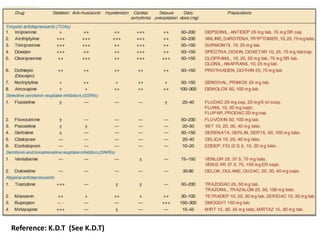
1.Tricyclic antidepressants (TCAs) Amitriptyline,Imipramine,
Trimipramine,Doxepin
2.Selective serotonin reuptake
inhibitors (SSRIs)
Fluoxetine,Escitalopram,Sertaline,
Paroxetine
3.Serotonin & noradrenaline
reuptake inhibitors (SNRIs)
Venlafaxine, Duloxetine
4.Monoamine oxidase inhibitors
(MAOI)
Isocarboxazid,Moclobemide,
Clorgyline, Selegiline
5.Atypical antidepressants Bupropion, Mirtazapine, Trazodone
ANTIDEPRESSANTS
Classification:
Reference: K.D.T (See K.D.T)
1. Tricyclic antidepressants (TCAs)
MOA: Tricyclic antidepressants act by blocking
noradrenaline & serotonin reuptake in the
neurons. Continuous administration of TCAs for 2-
3 weeks improves mood in depression patients.
Uses: endogenous depression, obsessive compulsive
& phobic state, attention deficit hyperactive
disorder, enuresis in children, migraine
Adverse effects: dry mouth, sedation, weight gain,
hypotension, sexual distress, arrhythmia, rashes
Contraindications: pregnancy, heart block,
myocardial infarction, hepatic dysfunction
2. Selective serotonin reuptake inhibitors (SSRIs)
MOA: SSRIs are specific inhibitors of serotonin
reuptake by blocking serotonin transporters
(SERT) in the neurons.
Uses: depression, post traumatic stress disorder,
obsessive compulsive disorder, anxiety,
premature ejaculation
Adverse effects: nausea, anorexia, dizziness,
akathisia, anorgasmia
Contraindications: bipolar disorder, epilepsy,
diabetes, driving & operating machinery,
pregnancy
3.Serotonin & noradrenaline reuptake inhibitors (SNRIs)
MOA: SNRIs are inhibitors of serotonin & noradrenaline
reuptake by blocking serotonin transporters (SERT) &
noradrenaline transporters (NET) in the neurons. It is
considered as effective antidepressant.
Uses: depression, post traumatic stress disorder,
obsessive compulsive disorder, anxiety, attention
deficit hyperactivity disorder, fibromyalgia, nerve pain
Adverse effects: nausea, dizziness, sweating, sexual
distress, withdrawal symptoms
Contraindications: bipolar disorder, epilepsy, diabetes,
driving & operating machinery, pregnancy, lactation
4. Monoamine oxidase inhibitors (MAOI)
MOA: MAOI are inhibitors of mitochondrial enzyme
that is involved in deamination of biogenic amines
(Adr, NA, DA, 5-HT). MAOI binds irreversibly with
monoamine oxidase causing their inactivation.
Uses: depression, post traumatic stress disorder,
obsessive compulsive disorder, anxiety, migraine
Adverse effects: dry mouth, weight gain, nausea,
headache, drowsiness, cardiac arrhythmia, stroke,
hypertensive crisis, serotonin syndrome
Contraindications: Tyramine containing foods (cheese,
nuts, alcohol), severe heart disease, epilepsy, asthma
Anti-maniacs (Mood stabilising drugs)
Lithium salts (Lithium carbonate)
• Lithium salts are used prophylactically for treating
manic-depressive patients and in the treatment of
manic episodes (mood stabilizers)
• Lithium is effective in treating 60 to 80 percent of
patients exhibiting mania and hypomania.
• Lithium attenuates signaling via receptors coupled to
the phosphatidylinositol bisphosphate (PIP2) second
messenger system.
• Lithium is given orally (started at 600mg/day).
Adverse effects: headache, dry mouth, polydipsia,
polyuria, polyphagia, GI distress (give lithium with
food), fine hand tremor, dizziness, fatigue,
dermatologic reactions, and sedation.
Contraindications: pregnancy

Antipsychotics, Antidepressants (dopamine)

  • 1.
  • 2.
    • Dopamine isa predominant neurotransmitter in human brain. Location • corpus striatum • Limbic system • Hypothalamus Functions • Motor control • Behavioral effects • Endocrine control • Dopaminergic Hyperactivity:- Psychosis/Schizophrenia • Dopaminergic Deficiency:- Depression Synthesis •Nigrostriatal pathway •Mesolimbic/Mesocortical Pathway •Tuberohypophyseal pathway
  • 3.
    • Psychosis isa severe mental illness characterized by distortion of thought, behavior, capacity to recognize reality & perception. The patient shows misperception, misevaluation & unable to meet ordinary demands of life. • The antipsychotic drugs are used primarily to treat schizophrenia, but they are also effective in other psychotic states like bipolar disorder & manias. • Antipsychotic drugs decrease the intensity of hallucinations and delusions and allows the person with schizophrenia to function in a supportive environment.
  • 4.
    • Schizophrenia isa major type of psychosis. This mental disorder is a common in about 1 % of the population. The illness often affects people during late adolescence or early adulthood. • Schizophrenia results from the dysfunction of the mesolimbic or mesocortical dopaminergic neuronal pathways. • It is characterized by: • Delusions • Hallucinations • Paranoia • Catatonia • Disordered thought
  • 5.
    1.Phenothiazines Chlorpromazine (100-800mg/day) Triflupromazine,Thioridazine, Trifluoperazine, Fluphenazine 2.Butyrophenones Haloperidol (2-20mg/day) Trifluperidol, Penfluridol 3.Thioxanthenes Flupenthixol 4.Others Loxapine, Reserpine 5.Atypical Antipsychotics Clozapine, Risperidone, Olanzapine ANTIPSYCHOTICS (neuroleptics/major tranquilizers) Classification:
  • 6.
    Mechanism of actionof antipsychotics 1. Dopamine receptor–blocking activity in the brain • Most of the antipsychotic drugs block dopamine receptors in the brain and the periphery. Their clinical efficacy is based on their ability to block D2 receptors in the mesolimbic system of the brain. 2. Serotonin receptor–blocking activity in the brain • Some of the antipsychotic drugs (Atypical antipsychotics) act through inhibition of serotonin receptors (5-HT), particularly 5-HT2A receptors. e.g:- Clozapine has high affinity for D1, D4, 5-HT2, muscarinic, and α-adrenergic receptors, but it is also a weak dopamine blocker, Risperidone blocks 5-HT2A receptors to a greater extent than it does D2 receptors, as does Olanzapine.
  • 8.
    Pharmacological Actions: CNS: Antipsychoticsreduces irrational behaviour, agitation and aggressiveness and controls psychotic symptoms. ANS: α adrenergic blocking activity Local anaesthetic: Chlorpromazine is as potent a local anaesthetic as procaine but it is not used for this purpose because of its irritant action. CVS: hypotension Skeletal muscles: reduces spasticity Endocrine: increases prolactin release by blocking the inhibitory action of DA on pituitary lactotropes.
  • 9.
    Uses: • Treatment ofschizophrenia, bipolar disorder & manias. • Prevention of severe nausea & vomiting • Antianxiety • Preanaesthetic medication • Potentiation of hypnotics, analgesics & anaesthetics • Intractable Hiccup Adverse Effects: Drowsiness, Lethargy, Hypotension, Palpitation, constipation, Gynaecomastia, Extrapyramidal effects (akathisia, tardive dyskinesia) Contraindications: respiratory disorders, glaucoma, prostatic hypertrophy, epilepsy, decreased renal function, peptic ulcer disease
  • 10.
  • 11.
    • Depression isa mental disorder characterized by intense feelings of sadness, hopelessness, inability to experience pleasure in usual activities, changes in sleep patterns and appetite, loss of energy, and suicidal thoughts. • It occurs due to deficiency of monoamines such as norepinephrine & serotonin in brain areas. • Antidepressants potentiate either directly or indirectly the actions of noradrenaline, dopamine or serotonin in the brain.
  • 12.
    1.Tricyclic antidepressants (TCAs)Amitriptyline,Imipramine, Trimipramine,Doxepin 2.Selective serotonin reuptake inhibitors (SSRIs) Fluoxetine,Escitalopram,Sertaline, Paroxetine 3.Serotonin & noradrenaline reuptake inhibitors (SNRIs) Venlafaxine, Duloxetine 4.Monoamine oxidase inhibitors (MAOI) Isocarboxazid,Moclobemide, Clorgyline, Selegiline 5.Atypical antidepressants Bupropion, Mirtazapine, Trazodone ANTIDEPRESSANTS Classification:
  • 13.
  • 16.
    1. Tricyclic antidepressants(TCAs) MOA: Tricyclic antidepressants act by blocking noradrenaline & serotonin reuptake in the neurons. Continuous administration of TCAs for 2- 3 weeks improves mood in depression patients. Uses: endogenous depression, obsessive compulsive & phobic state, attention deficit hyperactive disorder, enuresis in children, migraine Adverse effects: dry mouth, sedation, weight gain, hypotension, sexual distress, arrhythmia, rashes Contraindications: pregnancy, heart block, myocardial infarction, hepatic dysfunction
  • 17.
    2. Selective serotoninreuptake inhibitors (SSRIs) MOA: SSRIs are specific inhibitors of serotonin reuptake by blocking serotonin transporters (SERT) in the neurons. Uses: depression, post traumatic stress disorder, obsessive compulsive disorder, anxiety, premature ejaculation Adverse effects: nausea, anorexia, dizziness, akathisia, anorgasmia Contraindications: bipolar disorder, epilepsy, diabetes, driving & operating machinery, pregnancy
  • 18.
    3.Serotonin & noradrenalinereuptake inhibitors (SNRIs) MOA: SNRIs are inhibitors of serotonin & noradrenaline reuptake by blocking serotonin transporters (SERT) & noradrenaline transporters (NET) in the neurons. It is considered as effective antidepressant. Uses: depression, post traumatic stress disorder, obsessive compulsive disorder, anxiety, attention deficit hyperactivity disorder, fibromyalgia, nerve pain Adverse effects: nausea, dizziness, sweating, sexual distress, withdrawal symptoms Contraindications: bipolar disorder, epilepsy, diabetes, driving & operating machinery, pregnancy, lactation
  • 19.
    4. Monoamine oxidaseinhibitors (MAOI) MOA: MAOI are inhibitors of mitochondrial enzyme that is involved in deamination of biogenic amines (Adr, NA, DA, 5-HT). MAOI binds irreversibly with monoamine oxidase causing their inactivation. Uses: depression, post traumatic stress disorder, obsessive compulsive disorder, anxiety, migraine Adverse effects: dry mouth, weight gain, nausea, headache, drowsiness, cardiac arrhythmia, stroke, hypertensive crisis, serotonin syndrome Contraindications: Tyramine containing foods (cheese, nuts, alcohol), severe heart disease, epilepsy, asthma
  • 20.
    Anti-maniacs (Mood stabilisingdrugs) Lithium salts (Lithium carbonate) • Lithium salts are used prophylactically for treating manic-depressive patients and in the treatment of manic episodes (mood stabilizers) • Lithium is effective in treating 60 to 80 percent of patients exhibiting mania and hypomania. • Lithium attenuates signaling via receptors coupled to the phosphatidylinositol bisphosphate (PIP2) second messenger system. • Lithium is given orally (started at 600mg/day). Adverse effects: headache, dry mouth, polydipsia, polyuria, polyphagia, GI distress (give lithium with food), fine hand tremor, dizziness, fatigue, dermatologic reactions, and sedation. Contraindications: pregnancy

Editor's Notes

  • #10 Blocking dopamine receptors alters this balance, results in extrapyramidal motor effects-movement disorders